# ASC 360-980: Property, Plant, and Equipment — Regulated Operations
Source: FASB Accounting Standards Codification, Basic View
[Read online](https://asc.understandingaccounting.org/asc/360/980/)
Study and research edition. Verify current requirements with the official source. Summaries, enrichment, and tags are machine-generated study aids. Paragraph html preserves source markup; snippet is abbreviated. Pending content is not necessarily effective.
Tables and mathematical or amendment markup are retained as HTML where Markdown would lose structure.
Source downloaded (UTC): 2026-09-10T00:13:03.015Z to 2026-09-10T00:13:32.748Z
Record version: sha256:56928678b44a23c2506cae016d3502d0ce529cd1c3f50eb040a986b8415a43c9
Snapshot version: sha256:15aea8165dff9f5ae47d9484f8470588b13b307f56e1d50801bf4d85ec190e3f
Effective as of: not established by retrieval timestamps.
## ASC 360-980: Property, Plant, and Equipment — Regulated Operations
### Machine-generated study aids
```json
{
"summary": "This Subtopic tells regulated entities (utilities) how to account for property, plant, and equipment in three situations: plant abandonments, disallowances of costs of recently completed plants, and capitalization of an allowance for funds used during construction (AFUDC). When abandonment becomes probable, the asset's cost comes out of construction work-in-process or plant-in-service and a separate new asset is recorded — at full cost if a full return on investment is likely to be provided, or at the present value of expected future recovery revenues (discounted at the entity's incremental borrowing rate) if partial or no return is likely, with the shortfall and any probable, estimable disallowance recognized as a loss. When it becomes probable that part of the cost of a recently completed plant will be disallowed for rate-making purposes and the amount is reasonably estimable, that amount is deducted from the plant's reported cost and recognized as a loss.",
"key_points": [
"AFUDC, including a designated cost of equity funds, may be capitalized as part of the asset's acquisition cost only if its subsequent inclusion in allowable costs for rate-making purposes is probable (360-980-25-1).",
"When abandonment of an operating asset or asset under construction becomes probable, its cost must be removed from construction work-in-process or plant-in-service (360-980-35-1).",
"If full return on investment is likely, any probable and reasonably estimable disallowance is a loss and the remaining cost is reported as a separate new asset; if partial or no return is likely, the new asset equals the present value of expected future recovery revenues (discounted at the incremental borrowing rate) and any excess cost is a loss (360-980-35-3).",
"If the expected recovery period is a range, Section 450-20-55 applies: use the most likely period, or the minimum period if no point in the range is a better estimate (360-980-35-3(b)).",
"Between recognition of the new asset and the start of recovery, a carrying charge accrues at the allowed overall cost of capital (full return case) or at the discount rate used for the present value (partial/no return case); during recovery the asset is amortized per rate-making methods or so as to produce a constant return equal to the discount rate (360-980-35-7; 35-8).",
"Estimates of the new asset are updated as new information arises (the rate order is usually the confirming event), with adjustments recognized in income as a loss or gain, but the carrying amount is never adjusted for changes in the incremental borrowing rate (360-980-35-4; 35-6).",
"A probable and reasonably estimable disallowance of part of a recently completed plant's cost — including an explicit but indirect disallowance, such as excluding part of the plant from rate base or an agreed cost cap — is deducted from reported plant cost and recognized as a loss (360-980-35-12; 35-13; 35-15)."
],
"categories": [
"Impairment",
"Subsequent measurement",
"Industry-specific",
"Inventory and PP&E"
],
"audience_level": "advanced",
"student_note": "This is the classic utility-specific \"regulatory asset\" mechanic: economic value in regulated PP&E depends on what the regulator will let the utility recover, so losses are driven by rate orders rather than market value. The most common misunderstanding is skipping the full-return vs. partial/no-return branch — only in the partial/no-return case do you discount expected recovery revenues (at the incremental borrowing rate) and recognize the resulting shortfall as a loss.",
"related_topics": [
"980-10",
"980-835",
"450-20",
"740-10",
"360-10",
"980-340"
],
"key_concepts": [
"plant abandonment",
"allowance for funds used during construction",
"cost disallowance",
"explicit but indirect disallowance",
"return on investment",
"rate base",
"incremental borrowing rate",
"separate new asset"
]
}
```
Source downloaded (UTC): 2026-09-10T00:13:03.015Z to 2026-09-10T00:13:03.015Z
Record version: sha256:15cecd20958bd945c18ec13d3dd163cffb30cc0b6d162b0592ec88ac1374f2b6
Snapshot version: sha256:15aea8165dff9f5ae47d9484f8470588b13b307f56e1d50801bf4d85ec190e3f
Effective as of: not established by retrieval timestamps.
## ASC 360-980-05: 05 Overview and Background
[Read section](https://asc.understandingaccounting.org/asc/360/980/#05-overview-and-background)
SEC content: no
##### [360-980-05-1](https://asc.understandingaccounting.org/asc/360/980/#360-980-05-1)
Pending content: no
Source downloaded (UTC): 2026-09-10T00:13:03.015Z to 2026-09-10T00:13:03.015Z
Record version: sha256:af21221b90d4b0a63b72b05f5f50217dbc62d378aa90cde2b70da59e84d1ed87
Snapshot version: sha256:15aea8165dff9f5ae47d9484f8470588b13b307f56e1d50801bf4d85ec190e3f
Effective as of: not established by retrieval timestamps.
This Subtopic provides guidance for property, plant, and equipment for entities with regulated operations. It provides guidance for plant abandonments and disallowances of costs of recently completed plants, as well as for the capitalization of an [allowance for funds used during construction](https://asc.understandingaccounting.org/glossary/a/#allowance-for-funds-used-during-construction "The cost of financing construction as financed partially by borrowings and partially by equity, capitalized as part of the cost of plant and equipment pursuant to requirements of the regulator.").
Source downloaded (UTC): 2026-09-10T00:13:05.536Z to 2026-09-10T00:13:05.536Z
Record version: sha256:7290fa1200817c74245b4f3cb639566f8641f3f446e945ee94926e36d0c61d3b
Snapshot version: sha256:15aea8165dff9f5ae47d9484f8470588b13b307f56e1d50801bf4d85ec190e3f
Effective as of: not established by retrieval timestamps.
## ASC 360-980-15: 15 Scope and Scope Exceptions
[Read section](https://asc.understandingaccounting.org/asc/360/980/#15-scope-and-scope-exceptions)
SEC content: no
#### Overall Guidance
##### [360-980-15-1](https://asc.understandingaccounting.org/asc/360/980/#360-980-15-1)
Pending content: no
Source downloaded (UTC): 2026-09-10T00:13:05.536Z to 2026-09-10T00:13:05.536Z
Record version: sha256:6c874b01c98cd6c5113bd1fe85d17a8c41374d64161906bbcaa418fbaea04aea
Snapshot version: sha256:15aea8165dff9f5ae47d9484f8470588b13b307f56e1d50801bf4d85ec190e3f
Effective as of: not established by retrieval timestamps.
This Subtopic follows the same Scope and Scope Exceptions as outlined in the Overall Subtopic, see Section 980-10-15.
Source downloaded (UTC): 2026-09-10T00:13:12.506Z to 2026-09-10T00:13:12.506Z
Record version: sha256:4a13e3bf1c8dd8977ebebffab80c23c179b8282a59bec5c48e0b42d5333d2a8e
Snapshot version: sha256:15aea8165dff9f5ae47d9484f8470588b13b307f56e1d50801bf4d85ec190e3f
Effective as of: not established by retrieval timestamps.
## ASC 360-980-25: 25 Recognition
[Read section](https://asc.understandingaccounting.org/asc/360/980/#25-recognition)
SEC content: no
#### Allowance for Funds Used During Construction
##### [360-980-25-1](https://asc.understandingaccounting.org/asc/360/980/#360-980-25-1)
Pending content: no
Source downloaded (UTC): 2026-09-10T00:13:12.506Z to 2026-09-10T00:13:12.506Z
Record version: sha256:64eb96b3b81e76432ec15ef30a065f33b3a4cf638c3b19e555ba36c672256645
Snapshot version: sha256:15aea8165dff9f5ae47d9484f8470588b13b307f56e1d50801bf4d85ec190e3f
Effective as of: not established by retrieval timestamps.
Paragraph [980-835-25-1](https://asc.understandingaccounting.org/asc/835/980/#835-980-25-1) requires an [allowance for funds used during construction](https://asc.understandingaccounting.org/glossary/a/#allowance-for-funds-used-during-construction "The cost of financing construction as financed partially by borrowings and partially by equity, capitalized as part of the cost of plant and equipment pursuant to requirements of the regulator."), including a designated cost of equity funds, to be capitalized in specified circumstances as part of the acquisition cost of the related asset. That cost shall be capitalized under those circumstances only if its subsequent inclusion in [allowable costs](https://asc.understandingaccounting.org/glossary/a/#allowable-costs "All costs for which revenue is intended to provide recovery. Those costs can be actual or estimated. In that context, allowable costs include interest cost and amounts provided for earnings on shareholders' investments.") for rate-making purposes is probable.
##### [360-980-25-2](https://asc.understandingaccounting.org/asc/360/980/#360-980-25-2)
Pending content: no
Source downloaded (UTC): 2026-09-10T00:13:12.506Z to 2026-09-10T00:13:12.506Z
Record version: sha256:b6f9b98a9b6dd7a01848ed8ee89e13c5ee612a9e77805ed314f5f0c902ccdc0b
Snapshot version: sha256:15aea8165dff9f5ae47d9484f8470588b13b307f56e1d50801bf4d85ec190e3f
Effective as of: not established by retrieval timestamps.
[Paragraph not used](https://asc.understandingaccounting.org/updates/page-1833002/).
Source downloaded (UTC): 2026-09-10T00:13:14.576Z to 2026-09-10T00:13:14.576Z
Record version: sha256:7a74e3d1f9825c2d6dfb5ea92fa3f28389bc2bb686b4de11e7be96691a101856
Snapshot version: sha256:15aea8165dff9f5ae47d9484f8470588b13b307f56e1d50801bf4d85ec190e3f
Effective as of: not established by retrieval timestamps.
## ASC 360-980-35: 35 Subsequent Measurement
[Read section](https://asc.understandingaccounting.org/asc/360/980/#35-subsequent-measurement)
SEC content: no
#### Abandonments
##### [360-980-35-1](https://asc.understandingaccounting.org/asc/360/980/#360-980-35-1)
Pending content: no
Source downloaded (UTC): 2026-09-10T00:13:14.576Z to 2026-09-10T00:13:14.576Z
Record version: sha256:d40a0e646b29f492bd3f49926a3e6a4f012c66b7a23f37eb15ad256992114473
Snapshot version: sha256:15aea8165dff9f5ae47d9484f8470588b13b307f56e1d50801bf4d85ec190e3f
Effective as of: not established by retrieval timestamps.
When it becomes probable (likely to occur) that an operating asset or an asset under construction will be abandoned, the cost of that asset shall be removed from construction work-in-process or plant-in-service.
##### [360-980-35-2](https://asc.understandingaccounting.org/asc/360/980/#360-980-35-2)
Pending content: no
Source downloaded (UTC): 2026-09-10T00:13:14.576Z to 2026-09-10T00:13:14.576Z
Record version: sha256:024652b33b950176e624294658ec28de1851422f250b0b51521a588956ac07df
Snapshot version: sha256:15aea8165dff9f5ae47d9484f8470588b13b307f56e1d50801bf4d85ec190e3f
Effective as of: not established by retrieval timestamps.
The entity shall determine whether recovery of any allowed cost is likely to be provided with either of the following:
1. a
Full return on investment during the period from the time when abandonment becomes probable to the time when recovery is completed
2. b
Partial or no return on investment during that period.
##### [360-980-35-3](https://asc.understandingaccounting.org/asc/360/980/#360-980-35-3)
Pending content: no
Source downloaded (UTC): 2026-09-10T00:13:14.576Z to 2026-09-10T00:13:14.576Z
Record version: sha256:dfe07b5dac0b2b93699c3a33264e71418b363f103f4220cc63f70a0676f58329
Snapshot version: sha256:15aea8165dff9f5ae47d9484f8470588b13b307f56e1d50801bf4d85ec190e3f
Effective as of: not established by retrieval timestamps.
That determination shall focus on the facts and circumstances related to the specific abandonment and shall also consider the past practice and current policies of the applicable regulatory jurisdiction on abandonment situations. Based on that determination, the entity shall account for the cost of the abandoned plant as follows:
1. a
Full return on investment is likely to be provided. Any disallowance of all or part of the cost of the abandoned plant that is both probable and reasonably estimable (as defined in Topic 450) shall be recognized as a loss, and the carrying basis of the recorded asset shall be correspondingly reduced. The remainder of the cost of the abandoned plant shall be reported as a separate new asset.
2. b
Partial or no return on investment is likely to be provided. Any disallowance of all or part of the cost of the abandoned plant that is both probable and reasonably estimable shall be recognized as a loss. The present value of the future revenues expected to be provided to recover the allowable cost of that abandoned plant and return on investment, if any, shall be reported as a separate new asset. Any excess of the remainder of the cost of the abandoned plant over that present value also shall be recognized as a loss. The discount rate used to compute the present value shall be the entity's incremental borrowing rate, that is, the rate that the entity would have to pay to borrow an equivalent amount for a period equal to the expected recovery period. In determining the present value of expected future revenues, the entity shall consider such matters as the following:
1. 1
The probable time period before such recovery is expected to begin
2. 2
The probable time period over which recovery is expected to be provided.
If the estimate of either period is a range, the guidance in Section 450-20-55 shall be applied to determine the loss to be recognized. Accordingly, the most likely period within that range shall be used to compute the present value. If no period within that range is a better estimate than any other, the present value shall be based on the minimum time period within that range.
##### [360-980-35-4](https://asc.understandingaccounting.org/asc/360/980/#360-980-35-4)
Pending content: no
Source downloaded (UTC): 2026-09-10T00:13:14.576Z to 2026-09-10T00:13:14.576Z
Record version: sha256:0a45a7b30230c6e3cad081e752d308cb8206e5e822c23d6563ce1a005d9bbfca
Snapshot version: sha256:15aea8165dff9f5ae47d9484f8470588b13b307f56e1d50801bf4d85ec190e3f
Effective as of: not established by retrieval timestamps.
The recorded amount of the new asset shall be adjusted from time to time as necessary if new information indicates that the estimates used to record the separate new asset have changed. The rate order is usually viewed as the confirming event, permitting an estimate of the loss to be refined at that time. However, a loss shall not be recognized unless it is probable that a loss has occurred and the amount can be reasonably estimated. If those criteria are not met at the time of an initial rate order, the loss shall not be recognized at that time.
##### [360-980-35-5](https://asc.understandingaccounting.org/asc/360/980/#360-980-35-5)
Pending content: no
Source downloaded (UTC): 2026-09-10T00:13:14.576Z to 2026-09-10T00:13:14.576Z
Record version: sha256:a4dcd944c46810438721610d6b4c6fe60522795cd9d0a3bfc37150023f6a2bdb
Snapshot version: sha256:15aea8165dff9f5ae47d9484f8470588b13b307f56e1d50801bf4d85ec190e3f
Effective as of: not established by retrieval timestamps.
The estimates used to record the separate new asset include both of the following:
1. a
The determination of whether full return on investment will be provided and, if not, the probable time period before recovery is expected to begin and the probable time period over which recovery is expected to be provided
2. b
The amount of any probable and reasonably estimable disallowance of recorded costs of the abandoned plant.
##### [360-980-35-6](https://asc.understandingaccounting.org/asc/360/980/#360-980-35-6)
Pending content: no
Source downloaded (UTC): 2026-09-10T00:13:14.576Z to 2026-09-10T00:13:14.576Z
Record version: sha256:ab5aee1b28d6fbba20dc9e31eb797d5f4edc94029ed5fd3952f9388798c7717b
Snapshot version: sha256:15aea8165dff9f5ae47d9484f8470588b13b307f56e1d50801bf4d85ec190e3f
Effective as of: not established by retrieval timestamps.
The amount of the adjustment shall be recognized in income as a loss or gain. The recorded carrying amount of the new asset shall not be adjusted for changes in the entity's incremental borrowing rate.
##### [360-980-35-7](https://asc.understandingaccounting.org/asc/360/980/#360-980-35-7)
Pending content: no
Source downloaded (UTC): 2026-09-10T00:13:14.576Z to 2026-09-10T00:13:14.576Z
Record version: sha256:61d25bbeda9d418bb87399c1c567224c6045a61f2028e3418d940a6ab747800a
Snapshot version: sha256:15aea8165dff9f5ae47d9484f8470588b13b307f56e1d50801bf4d85ec190e3f
Effective as of: not established by retrieval timestamps.
During the period between the date on which the new asset is recognized and the date on which recovery begins, the carrying amount shall be increased by accruing a carrying charge. The rate used to accrue that carrying charge shall be as follows:
1. a
If full return on investment is likely to be provided, a rate equal to the allowed overall cost of capital in the jurisdiction in which recovery is expected to be provided shall be used.
2. b
If partial or no return on investment is likely to be provided, the rate that was used to compute the present value shall be used.
##### [360-980-35-8](https://asc.understandingaccounting.org/asc/360/980/#360-980-35-8)
Pending content: no
Source downloaded (UTC): 2026-09-10T00:13:14.576Z to 2026-09-10T00:13:14.576Z
Record version: sha256:7310bc765caebc9da122d0c4f121efbfc7187d824c4cd3dc5cc0abfdd4053123
Snapshot version: sha256:15aea8165dff9f5ae47d9484f8470588b13b307f56e1d50801bf4d85ec190e3f
Effective as of: not established by retrieval timestamps.
During the recovery period, the new asset shall be amortized as follows:
1. a
If full return on investment is likely to be provided, the asset shall be amortized in the same manner as that used for rate-making purposes.
2. b
If partial or no return on investment is likely to be provided, the asset shall be amortized in a manner that will produce a constant return on the unamortized investment in the new asset equal to the rate at which the expected revenues were discounted.
##### [360-980-35-9](https://asc.understandingaccounting.org/asc/360/980/#360-980-35-9)
Pending content: no
Source downloaded (UTC): 2026-09-10T00:13:14.576Z to 2026-09-10T00:13:14.576Z
Record version: sha256:61ecc5f2de250812a01ef3bd947ade41784fb4d5621be149c7b856c938ca4747
Snapshot version: sha256:15aea8165dff9f5ae47d9484f8470588b13b307f56e1d50801bf4d85ec190e3f
Effective as of: not established by retrieval timestamps.
Usually, the net loss on an abandonment shall be computed by discounting the after-tax future revenues expected to be allowed by the regulator at an after-tax incremental borrowing rate and comparing the result to the recorded net investment in the abandoned plant. If that discounted present value is less than the recorded net investment, a net loss shall be recognized. However, the present accounting model generally does not permit display of losses on a net-of-tax basis. As a result, the net loss on an abandonment is grossed up for display purposes.
##### [360-980-35-10](https://asc.understandingaccounting.org/asc/360/980/#360-980-35-10)
Pending content: no
Source downloaded (UTC): 2026-09-10T00:13:14.576Z to 2026-09-10T00:13:14.576Z
Record version: sha256:5bdcfcb3928964da3fdbfb309f38eb74c636ded643b1049903249b2f511a53bc
Snapshot version: sha256:15aea8165dff9f5ae47d9484f8470588b13b307f56e1d50801bf4d85ec190e3f
Effective as of: not established by retrieval timestamps.
The computation of a loss on an abandonment (see Example 1 \[paragraph [980-360-55-2](https://asc.understandingaccounting.org/asc/360/980/#360-980-55-2)\]) is intended to approximate the economic effects of the regulator's rate actions in the preceding paragraph. The computation is based on both of the following general assumptions about the rate-making methods used for income taxes:
1. a
Deferred income taxes are allocated to the assets that resulted in those deferred income taxes. Under that assumption, if certain assets are included in the rate base (that is, a return is allowed on those assets), the deferred income taxes allocated to those assets are deducted from the rate base in computing the investment on which a return will be allowed. Similarly, if certain assets are excluded from the rate base (that is, a return is not allowed on those assets), the deferred income taxes allocated to those assets are not deducted from the rate base in computing the investment on which a return will be allowed.
2. b
Income taxes that result from recovery of the recorded cost of the abandoned plant will be treated as [allowable costs](https://asc.understandingaccounting.org/glossary/a/#allowable-costs "All costs for which revenue is intended to provide recovery. Those costs can be actual or estimated. In that context, allowable costs include interest cost and amounts provided for earnings on shareholders' investments.") when those income taxes become payable to the extent those income taxes do not represent repayment of an income tax benefit that has already accrued to the entity's shareholders.
##### [360-980-35-11](https://asc.understandingaccounting.org/asc/360/980/#360-980-35-11)
Pending content: no
Source downloaded (UTC): 2026-09-10T00:13:14.576Z to 2026-09-10T00:13:14.576Z
Record version: sha256:8a24427b27626070275668d108fcacc712faa854af684a96bf151343be3aad32
Snapshot version: sha256:15aea8165dff9f5ae47d9484f8470588b13b307f56e1d50801bf4d85ec190e3f
Effective as of: not established by retrieval timestamps.
If the rate-making methods used for an entity differ from the assumptions stated in the preceding paragraph, the computation used to compute the loss on the abandonment shall be different from that described in paragraph [980-360-35-9](https://asc.understandingaccounting.org/asc/360/980/#360-980-35-9) and illustrated in Example 1 (see paragraph [980-360-55-2](https://asc.understandingaccounting.org/asc/360/980/#360-980-55-2)). The computation shall be changed to reflect the different economics of those different rate-making methods. For example, if the regulator deducts all existing deferred income taxes from the rate base in determining the investment on which a return will be provided (instead of allocating deferred income taxes between items included in the rate base and items excluded from the rate base), the procedure effectively disallows a return on the gross investment in the abandoned plant instead of disallowing a return on the net investment, and the recognized loss shall reflect a disallowance of a return on the gross investment in the abandoned plant.
#### Cost Disallowances
##### [360-980-35-12](https://asc.understandingaccounting.org/asc/360/980/#360-980-35-12)
Pending content: no
Source downloaded (UTC): 2026-09-10T00:13:14.576Z to 2026-09-10T00:13:14.576Z
Record version: sha256:6f23e42098835c92f9889505f3025a1ff2db2a4db839a9b96ac296db1ee7ed16
Snapshot version: sha256:15aea8165dff9f5ae47d9484f8470588b13b307f56e1d50801bf4d85ec190e3f
Effective as of: not established by retrieval timestamps.
When it becomes probable that part of the cost of a recently completed plant will be disallowed for rate-making purposes and a reasonable estimate of the amount of the disallowance can be made, the estimated amount of the probable disallowance shall be deducted from the reported cost of the plant and recognized as a loss. Section 450-20-55 provides guidance for making a reasonable estimate of the amount of a loss. If part of the cost is explicitly, but indirectly, disallowed (for example, by an explicit disallowance of return on investment on a portion of the plant), an equivalent amount of cost shall be deducted from the reported cost of the plant and recognized as a loss.
##### [360-980-35-13](https://asc.understandingaccounting.org/asc/360/980/#360-980-35-13)
Pending content: no
Source downloaded (UTC): 2026-09-10T00:13:14.576Z to 2026-09-10T00:13:14.576Z
Record version: sha256:8f08bcb5267b470170656c5e0af6c7fb139abbc22c5da2691a835c6c7f5403ed
Snapshot version: sha256:15aea8165dff9f5ae47d9484f8470588b13b307f56e1d50801bf4d85ec190e3f
Effective as of: not established by retrieval timestamps.
Excess capacity disallowances relate to part of the cost of service of a recently completed plant and are based on a finding that an entity's reserve capacity exceeds an amount deemed to be reasonable. If an excess capacity disallowance is ordered by a regulator without a specific finding that the entity should not have constructed that capacity or should have delayed the construction of that capacity, the rate order raises questions about whether the entity meets the criteria of paragraph [980-10-15-2](https://asc.understandingaccounting.org/asc/980/10/#980-10-15-2) for application of this Topic, in that it is not being regulated based on its own cost of service. However, because such a rate order itself is neither a direct disallowance nor an explicit, but indirect, disallowance of part of the cost of the plant, this Section does not specify the accounting for it. If an excess capacity disallowance is ordered by a regulator with a specific finding that the entity should not have constructed that capacity or should have delayed the construction of that capacity, the rate order may be an explicit, but indirect, disallowance of part of the cost of the plant, and the entity shall account for the substance of that order as set forth in the preceding paragraph.
##### [360-980-35-14](https://asc.understandingaccounting.org/asc/360/980/#360-980-35-14)
Pending content: no
Source downloaded (UTC): 2026-09-10T00:13:14.576Z to 2026-09-10T00:13:14.576Z
Record version: sha256:d5ac0874644525d03e5f02fde8416eb17c3ae809f88a2bb3d408472569953b5e
Snapshot version: sha256:15aea8165dff9f5ae47d9484f8470588b13b307f56e1d50801bf4d85ec190e3f
Effective as of: not established by retrieval timestamps.
If a regulator has included a recently completed plant in rates based on the assumed cost of another plant rather than based on the cost of the plant that exists, then the entity is not being regulated based on its own cost, and the criteria of paragraph [980-10-15-2](https://asc.understandingaccounting.org/asc/980/10/#980-10-15-2) for application of this Topic do not appear to be met. If the rate order is based on a finding that, based on factors that were known during the construction, the entity should not have constructed the plant that it did construct, the order may be an explicit, but indirect, disallowance, and it shall be accounted for as set forth in paragraph [980-360-35-12](https://asc.understandingaccounting.org/asc/360/980/#360-980-35-12). Otherwise, unless the order is being appealed, the entity shall consider discontinuing application of this Topic.
##### [360-980-35-15](https://asc.understandingaccounting.org/asc/360/980/#360-980-35-15)
Pending content: no
Source downloaded (UTC): 2026-09-10T00:13:14.576Z to 2026-09-10T00:13:14.576Z
Record version: sha256:8f5e83b51e822bf0838887e64cd6784cb35dba9ec5f87d1f9da3ff9ba5ab7fb2
Snapshot version: sha256:15aea8165dff9f5ae47d9484f8470588b13b307f56e1d50801bf4d85ec190e3f
Effective as of: not established by retrieval timestamps.
Regulators have considerable discretion in selecting a rate that represents a fair return on equity investment, and that specific matters included in a settlement agreement might not be apparent. Explicit, but indirect, disallowances shall be reported as disallowances; however, an entity is not required to determine whether the terms of a settlement agreement or rate order contain a hidden, indirect disallowance.
##### [360-980-35-16](https://asc.understandingaccounting.org/asc/360/980/#360-980-35-16)
Pending content: no
Source downloaded (UTC): 2026-09-10T00:13:14.576Z to 2026-09-10T00:13:14.576Z
Record version: sha256:bc6956fdd45b0ec5d4a8e73664eae4eb10049a7390f6ce462af38285ec3bedb9
Snapshot version: sha256:15aea8165dff9f5ae47d9484f8470588b13b307f56e1d50801bf4d85ec190e3f
Effective as of: not established by retrieval timestamps.
The following Examples illustrate specific situations related to cost disallowances:
1. a
Example 2 (see paragraph [980-360-55-14](https://asc.understandingaccounting.org/asc/360/980/#360-980-55-14)) illustrates a disallowance of plant cost.
2. b
Example 3 (see paragraph [980-360-55-18](https://asc.understandingaccounting.org/asc/360/980/#360-980-55-18)) illustrates a disallowance of plant cost resulting from a cost cap.
3. c
Example 4 (see paragraph [980-360-55-26](https://asc.understandingaccounting.org/asc/360/980/#360-980-55-26)) illustrates an explicit, but indirect, disallowance.
Source downloaded (UTC): 2026-09-10T00:13:17.858Z to 2026-09-10T00:13:17.858Z
Record version: sha256:15d79b726fe30f00d73a3222e86fdfe721f14d4f74ef666c572947d3581618e2
Snapshot version: sha256:15aea8165dff9f5ae47d9484f8470588b13b307f56e1d50801bf4d85ec190e3f
Effective as of: not established by retrieval timestamps.
## ASC 360-980-55: 55 Implementation Guidance and Illustrations
[Read section](https://asc.understandingaccounting.org/asc/360/980/#55-implementation-guidance-and-illustrations)
SEC content: no
#### Illustrations
##### [360-980-55-1](https://asc.understandingaccounting.org/asc/360/980/#360-980-55-1)
Pending content: no
Source downloaded (UTC): 2026-09-10T00:13:17.858Z to 2026-09-10T00:13:17.858Z
Record version: sha256:ed1266569bb1bc92c0076249f0095fe6e13a17a36091e4595e0c9a7599cc7bef
Snapshot version: sha256:15aea8165dff9f5ae47d9484f8470588b13b307f56e1d50801bf4d85ec190e3f
Effective as of: not established by retrieval timestamps.
Cases similar to those illustrated in this Section may involve income tax effects that could accrue to the utility in question. Under Subtopic 740-10, the tax effects of temporary differences are measured based on enacted tax laws and rates and are recognized based on specified criteria.
##### [360-980-55-2](https://asc.understandingaccounting.org/asc/360/980/#360-980-55-2)
Pending content: no
Source downloaded (UTC): 2026-09-10T00:13:17.858Z to 2026-09-10T00:13:17.858Z
Record version: sha256:c33045d04145f493843c0399e9963dec499a3525f3b99d07217c06619165105c
Snapshot version: sha256:15aea8165dff9f5ae47d9484f8470588b13b307f56e1d50801bf4d85ec190e3f
Effective as of: not established by retrieval timestamps.
This Example illustrates how a loss on an abandonment should be computed under the guidance in Section 450-20-55 and paragraphs
[980-360-35-9 through 35-11](https://asc.understandingaccounting.org/asc/360/980/#360-980-35-9)
by an entity that has applied Subtopic 740-10. The Example is based on specific rate actions related to the abandonment and on the other assumptions stated. The computations may need to be changed to reflect the economic effects of different fact situations.
##### [360-980-55-3](https://asc.understandingaccounting.org/asc/360/980/#360-980-55-3)
Pending content: no
Source downloaded (UTC): 2026-09-10T00:13:17.858Z to 2026-09-10T00:13:17.858Z
Record version: sha256:1a6997d4476cc68ba0cf5f56e319353526f1ac4e821905cf0e611e7a0c7b51f1
Snapshot version: sha256:15aea8165dff9f5ae47d9484f8470588b13b307f56e1d50801bf4d85ec190e3f
Effective as of: not established by retrieval timestamps.
The principal assumptions on which the Example is based are as follows:
1. a
Upon initial application of Subtopic 740-10, an entity that meets the criteria of paragraph [980-10-15-2](https://asc.understandingaccounting.org/asc/980/10/#980-10-15-2) for application of this Topic will adjust its deferred income tax liabilities as required. This Example is presented as though the entity has already applied Subtopic 740-10 prior to the date of the abandonment. If an entity initially applies that Subtopic after a loss has been recognized on an abandonment and before the end of the recovery period for any recoverable costs, the amount of the previously recognized loss may change. The amount of that loss will change if the tax rate used in the initial net-of-tax discount rate under that Subtopic is different from that used by the entity previously. Once that Subtopic is initially applied, the accounting for the abandonment should follow the approach described in this Example.
2. b
This Example assumes a tax rate of 34 percent.
3. c
Utility A decides to abandon a plant that has been under construction for some time. Although the possibility of abandoning the plant has been under consideration, abandonment was not considered probable before the actual decision was made.
4. d
Immediately before the abandonment, the recorded assets for the plant and related deferred income tax liabilities are as follows.
- 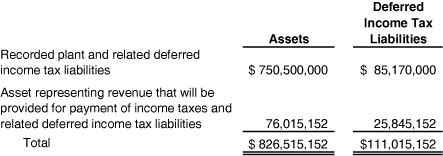
Assets Deferred Income Tax Liabilities Recorded plant and related deferred income tax liabilities " $750,500,000 " " $85,170,000 " Asset representing revenue that will be provided for payment of income taxes and related deferred income tax liabilities " 76,015,152 " " 25,845,152 " Total " $826,515,152 " " $111,015,152 "
5. e
For income tax purposes, the abandoned plant has a basis of $500 million at the date of the abandonment.
6. f
Utility A will deduct the remaining tax basis of the abandoned plant ($500,000,000) as an abandonment loss on its income tax return in the year of the abandonment and will receive a tax benefit of 34 percent of the tax basis of the plant ($170,000,000). Utility A operates in a state that has no state income taxes. The federal income tax rate is 34 percent.
7. g
Accounting pretax income before the loss on the abandonment and taxable income before any deduction for the loss on the abandonment are both $1,500,000,000. Utility A has no other temporary differences or tax credits.
8. h
Utility A operates solely in a single-state jurisdiction.
9. i
In the past, Utility A's regulator has permitted recovery of amounts prudently invested in abandoned plants over an extended period of time without a return on unrecovered investment during the recovery period.
10. j
The normal practice of Utility A's regulator is to allocate deferred income taxes to assets on which return on investment is disallowed. Deferred taxes allocated to assets excluded from the rate base are not deducted from the rate base for purposes of computing allowable return on investment.
11. k
Utility A's regulator normally treats income taxes that were not previously provided as [allowable costs](https://asc.understandingaccounting.org/glossary/a/#allowable-costs "All costs for which revenue is intended to provide recovery. Those costs can be actual or estimated. In that context, allowable costs include interest cost and amounts provided for earnings on shareholders' investments.") if they result from recovery of other allowable costs.
12. l
Utility A's incremental borrowing rate at the date of the decision to abandon the plant is 14 percent, interest payable monthly.
13. m
Utility A believes that it is probable that recovery of cost without return on investment during the recovery period will be granted over a period that will not be less than 5 years nor more than 10 years, but it has no basis for estimating the exact time period that the regulator will select.
14. n
At the date of the abandonment, Utility A believes that it will take approximately 18 months to obtain a rate order covering the abandoned plant.
15. o
No disallowance of recorded cost is expected.
16. p
A rate order covering the abandoned plant is received in the 18th month following the abandonment. There is no disallowance of recorded costs of the abandoned plant. Those recorded costs are to be recovered over 60 months commencing in the 19th month after abandonment.
##### [360-980-55-4](https://asc.understandingaccounting.org/asc/360/980/#360-980-55-4)
Pending content: no
Source downloaded (UTC): 2026-09-10T00:13:17.858Z to 2026-09-10T00:13:17.858Z
Record version: sha256:11b23182552ef58c14312ead40bc2dc9b0e9a84db94e16e983af11624495a855
Snapshot version: sha256:15aea8165dff9f5ae47d9484f8470588b13b307f56e1d50801bf4d85ec190e3f
Effective as of: not established by retrieval timestamps.
Because the amount of deferred taxes related to the remaining investment is both a component of the net investment on which return would be based in the regulatory process and based on the amount of the accounting loss on the abandonment (which is based on the present value of the net investment), the present value of the net investment cannot be derived through a simple present value calculation using a pretax rate. That present value could be derived through a series of iterative calculations, starting with an assumed loss and the resulting deferred tax amounts, then computing the accrual of return on investment and amortization by applying the pretax rate to the resulting net investment, and then computing the income tax effects of the resulting pretax income. Using the remaining asset at the end of the recovery period, the estimate of the loss could be refined until the accrual of a return, amortization, recovery of recorded costs, and the related tax effects resulted in a zero net asset at the end of the recovery period. Alternatively, the net loss can be initially computed based on a present value calculation using an after-tax rate. While that approach is used in this Example, either approach will provide the same result. The following paragraphs illustrate how that approach can be used and the resulting computations of loss recognition, return to be accrued, and amortization.
##### [360-980-55-5](https://asc.understandingaccounting.org/asc/360/980/#360-980-55-5)
Pending content: no
Source downloaded (UTC): 2026-09-10T00:13:17.858Z to 2026-09-10T00:13:17.858Z
Record version: sha256:0216b0b8466f75dfe3330367141b6d39a728ec9d66b21937103e95d3daff0632
Snapshot version: sha256:15aea8165dff9f5ae47d9484f8470588b13b307f56e1d50801bf4d85ec190e3f
Effective as of: not established by retrieval timestamps.
When the abandonment becomes probable (in this case, at the date of the decision to abandon), Utility A should remove the recorded cost of the plant from the construction work-in-process accounts. Any disallowance of the recorded cost that is probable and can be reasonably estimated should also be recorded as a loss. There is none in this Example. Utility A should record a separate new asset, representing the future revenues expected to result from the regulator's treatment of the cost of the abandoned plant, at the present value of those expected future revenues.
##### [360-980-55-6](https://asc.understandingaccounting.org/asc/360/980/#360-980-55-6)
Pending content: no
Source downloaded (UTC): 2026-09-10T00:13:17.858Z to 2026-09-10T00:13:17.858Z
Record version: sha256:ac066300a5abf86d1b66f107e29323199b72b97cd512142c1e36bb46320f5945
Snapshot version: sha256:15aea8165dff9f5ae47d9484f8470588b13b307f56e1d50801bf4d85ec190e3f
Effective as of: not established by retrieval timestamps.
The next step is to compute the deferred income tax liabilities that would be recorded if the tax consequences of the abandonment were recognized before any loss related to the disallowance of return on investment were recognized. When the tax basis of the abandoned plant is deducted as an abandonment loss on the current year's tax return, an additional $500,000,000 of the recorded cost of the asset will be without tax basis. Recovery of that additional amount will result in $500,000,000 of taxable income. The deferred income tax liability on that amount should be computed in accordance with Subtopic 740-10. This Example assumes that the rate is the statutory rate of 34 percent and that Utility A should recognize additional deferred income tax liabilities of $170,000,000.
##### [360-980-55-7](https://asc.understandingaccounting.org/asc/360/980/#360-980-55-7)
Pending content: no
Source downloaded (UTC): 2026-09-10T00:13:17.858Z to 2026-09-10T00:13:17.858Z
Record version: sha256:2d6608055543ac104cfb036c93d01648913de588474192660dd1bcff5eef9dc7
Snapshot version: sha256:15aea8165dff9f5ae47d9484f8470588b13b307f56e1d50801bf4d85ec190e3f
Effective as of: not established by retrieval timestamps.
The amount of tax benefit that resulted from the current deduction of the abandonment loss is also $170,000,000, so no additional asset representing revenue that will be provided for the payment of income taxes should be recognized. Thus, the recorded balance sheet items related to the plant after the abandonment, but before any loss for disallowance of return on investment is recognized, and the resulting net investment should be as follows.
- 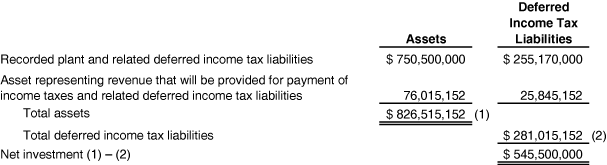
Assets Deferred Income Tax Liabilities Recorded plant and related deferred income tax liabilities " $750,500,000 " " $255,170,000 " Asset representing revenue that will be provided for payment of income taxes and related deferred income tax liabilities " 76,015,152 " " 25,845,152 " Total assets " $826,515,152 " (1) Total deferred income tax liabilities " $281,015,152 " (2) Net investment (1) - (2) " $545,500,000 "
##### [360-980-55-8](https://asc.understandingaccounting.org/asc/360/980/#360-980-55-8)
Pending content: no
Source downloaded (UTC): 2026-09-10T00:13:17.858Z to 2026-09-10T00:13:17.858Z
Record version: sha256:a6eb35763faec0a0026fb8541256b9ef39e7e8c52488a1616af6caf101a79c14
Snapshot version: sha256:15aea8165dff9f5ae47d9484f8470588b13b307f56e1d50801bf4d85ec190e3f
Effective as of: not established by retrieval timestamps.
If the computed additional deferred income tax liabilities did not equal the tax benefit that resulted from the abandonment loss, the difference should be recorded as an adjustment of the asset representing revenue that will be provided for the payment of income taxes.
##### [360-980-55-9](https://asc.understandingaccounting.org/asc/360/980/#360-980-55-9)
Pending content: no
Source downloaded (UTC): 2026-09-10T00:13:17.858Z to 2026-09-10T00:13:17.858Z
Record version: sha256:4208e3fa725fb5f68397b1eb600f0437cc00a1f7f214e64d9c6f8d7859eafb0f
Snapshot version: sha256:15aea8165dff9f5ae47d9484f8470588b13b307f56e1d50801bf4d85ec190e3f
Effective as of: not established by retrieval timestamps.
The cash flows provided to recover the asset should be estimated to begin in 19 months. For purposes of computing the present value of the net investment, the probable future after-tax revenues would be estimated at $9,091,667 per month for 5 years (based on an assumed straight-line recovery of the net investment over the 5-year minimum period within the range— $545,500,000/60). The discount rate used should be 9.24 percent (14 percent net of tax at the rate computed in paragraph [980-360-55-6](https://asc.understandingaccounting.org/asc/360/980/#360-980-55-6)). The computation of the amount to be recorded for the new asset and of the loss resulting from the abandonment would be as follows.
- 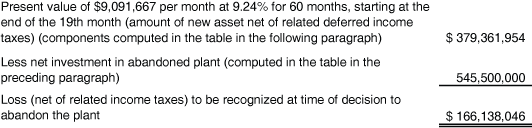
"Present value of $9,091,667 per month at 9.24% for 60 months, starting at the end of the 19th month (amount of new asset net of related deferred income taxes) (components computed in the table in the following paragraph)" " $379,361,954 " Less net investment in abandoned plant (computed in the table in the preceding paragraph) " 545,500,000 " Loss (net of related income taxes) to be recognized at time of decision to abandon the plant " $166,138,046 "
##### [360-980-55-10](https://asc.understandingaccounting.org/asc/360/980/#360-980-55-10)
Pending content: no
Source downloaded (UTC): 2026-09-10T00:13:17.858Z to 2026-09-10T00:13:17.858Z
Record version: sha256:cd0a45a723fc0c7777f05ecbe39c6c4fbe994f6034412cd5edcc564f05181807
Snapshot version: sha256:15aea8165dff9f5ae47d9484f8470588b13b307f56e1d50801bf4d85ec190e3f
Effective as of: not established by retrieval timestamps.
The net loss should be allocated between the new asset resulting from the abandonment and the existing deferred taxes based on the relationship between the investment (100 percent), deferred taxes (34 percent, computed as $281,015,152/$826,515,152), and the net investment (66 percent). The computation would be as follows.
- 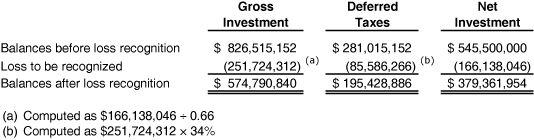
Gross Investment Deferred Taxes Net Investment Balances before loss recognition " $826,515,152 " " $281,015,152 " " $545,500,000 " Loss to be recognized " (251,724,312)" (a) " (85,586,266)" (b) " (166,138,046)" Balances after loss recognition " $574,790,840 " " $195,428,886 " " $379,361,954 " (a) "Computed as $166,138,046 ÷ 0.66" (b) "Computed as $251,724,312 × 34%"
##### [360-980-55-11](https://asc.understandingaccounting.org/asc/360/980/#360-980-55-11)
Pending content: no
Source downloaded (UTC): 2026-09-10T00:13:17.858Z to 2026-09-10T00:13:17.858Z
Record version: sha256:d77248d82d40c9717447cccdbb498e573a9d87e3be18c80d051c3c4a6ac7257a
Snapshot version: sha256:15aea8165dff9f5ae47d9484f8470588b13b307f56e1d50801bf4d85ec190e3f
Effective as of: not established by retrieval timestamps.
Pending receipt of a rate order, Utility A should accrue carrying charges on the net recorded asset at a monthly rate of 1/12 of 14 percent. Taxes should be provided on those accrued carrying charges based on the rate required to adjust the accumulated deferred income tax liabilities to the amounts required by Subtopic 740-10. Usually, that rate will be the statutory rate. The following table illustrates those computations based on the statutory rate.
- 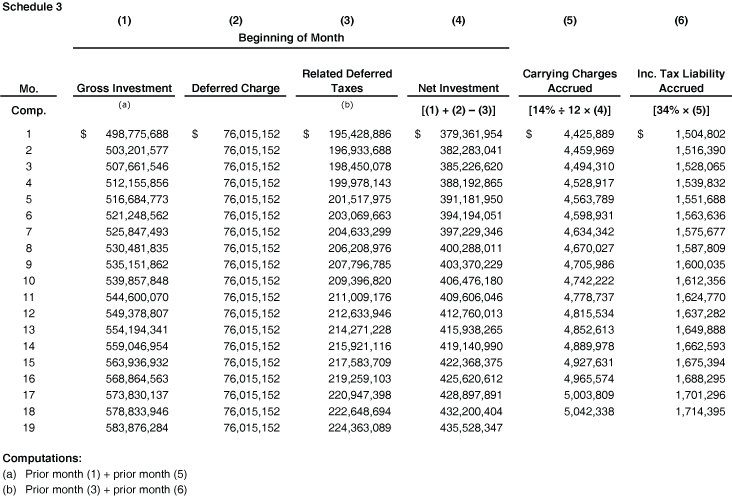
Schedule 3 (1) (2) (3) (4) (5) (6) Beginning of Month Mo. Gross Investment Deferred Charge Related Deferred Taxes Net Investment Carrying Charges Accrued Inc. Tax Liability Accrued Comp. (a) (b) \[(1) + (2) - (3)\] \[14% ÷ 12 × (4)\] \[34% × (5)\] 1 " $498,775,688 " " $76,015,152 " " $195,428,886 " " $379,361,954 " " $4,425,889 " " $1,504,802 " 2 " 503,201,577 " " 76,015,152 " " 196,933,688 " " 382,283,041 " " 4,459,969 " " 1,516,390 " 3 " 507,661,546 " " 76,015,152 " " 198,450,078 " " 385,226,620 " " 4,494,310 " " 1,528,065 " 4 " 512,155,856 " " 76,015,152 " " 199,978,143 " " 388,192,865 " " 4,528,917 " " 1,539,832 " 5 " 516,684,773 " " 76,015,152 " " 201,517,975 " " 391,181,950 " " 4,563,789 " " 1,551,688 " 6 " 521,248,562 " " 76,015,152 " " 203,069,663 " " 394,194,051 " " 4,598,931 " " 1,563,636 " 7 " 525,847,493 " " 76,015,152 " " 204,633,299 " " 397,229,346 " " 4,634,342 " " 1,575,677 " 8 " 530,481,835 " " 76,015,152 " " 206,208,976 " " 400,288,011 " " 4,670,027 " " 1,587,809 " 9 " 535,151,862 " " 76,015,152 " " 207,796,785 " " 403,370,229 " " 4,705,986 " " 1,600,035 " 10 " 539,857,848 " " 76,015,152 " " 209,396,820 " " 406,476,180 " " 4,742,222 " " 1,612,356 " 11 " 544,600,070 " " 76,015,152 " " 211,009,176 " " 409,606,046 " " 4,778,737 " " 1,624,770 " 12 " 549,378,807 " " 76,015,152 " " 212,633,946 " " 412,760,013 " " 4,815,534 " " 1,637,282 " 13 " 554,194,341 " " 76,015,152 " " 214,271,228 " " 415,938,265 " " 4,852,613 " " 1,649,888 " 14 " 559,046,954 " " 76,015,152 " " 215,921,116 " " 419,140,990 " " 4,889,978 " " 1,662,593 " 15 " 563,936,932 " " 76,015,152 " " 217,583,709 " " 422,368,375 " " 4,927,631 " " 1,675,394 " 16 " 568,864,563 " " 76,015,152 " " 219,259,103 " " 425,620,612 " " 4,965,574 " " 1,688,295 " 17 " 573,830,137 " " 76,015,152 " " 220,947,398 " " 428,897,891 " " 5,003,809 " " 1,701,296 " 18 " 578,833,946 " " 76,015,152 " " 222,648,694 " " 432,200,404 " " 5,042,338 " " 1,714,395 " 19 " 583,876,284 " " 76,015,152 " " 224,363,089 " " 435,528,347 " Computations: (a) Prior month (1) + prior month (5) (b) Prior month (3) + prior month (6)
##### [360-980-55-12](https://asc.understandingaccounting.org/asc/360/980/#360-980-55-12)
Pending content: no
Source downloaded (UTC): 2026-09-10T00:13:17.858Z to 2026-09-10T00:13:17.858Z
Record version: sha256:c4d8da80486913f35922bd794462039bc68c82eee50268a4f33fcdb8f8d45c8e
Snapshot version: sha256:15aea8165dff9f5ae47d9484f8470588b13b307f56e1d50801bf4d85ec190e3f
Effective as of: not established by retrieval timestamps.
Based on the rate order (see paragraph [980-360-55-3(n)](https://asc.understandingaccounting.org/asc/360/980/#360-980-55-3)), revenues actually allowed would be $13,775,253 per month ($826,515,152/60). Earnings should continue to be recognized each month equal to 1/12 of 14 percent of the remaining net investment, and taxes should continue to be provided on those earnings at the rate required to adjust the recorded deferred income tax liabilities to the amount required by Subtopic 740-10. Usually that rate would be the statutory rate. The following table illustrates those computations using the 34 percent statutory rate.
- 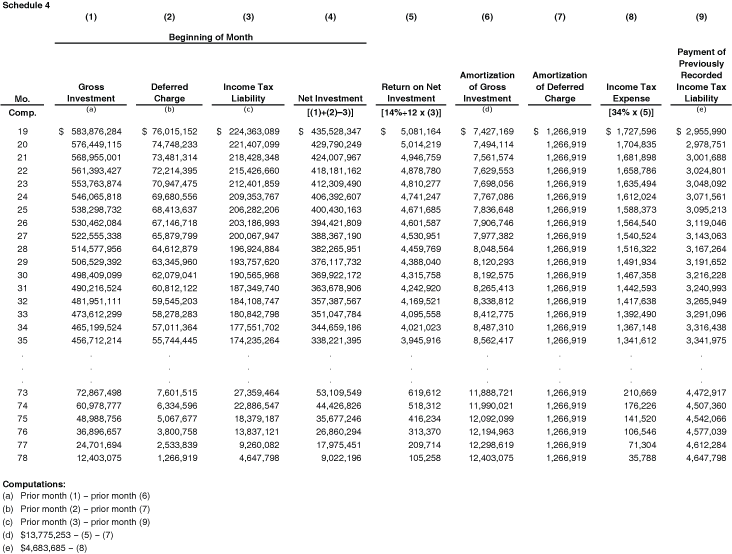
Schedule 4 (1) (2) (3) (4) (5) (6) (7) (8) (9) Beginning of Month Mo. Gross Investment Deferred Charge Income Tax Liability Net Investment Return on Net Investment Amortization of Gross Investment Amortization of Deferred Charge Income Tax Expense Payment of Previously Recorded Income Tax Liability Comp. (a) (b) (c) \[(1)+(2)-3)\] \[14%÷12 x (3)\] (d) \[34% x (5)\] (e) 19 " $583,876,284 " " $76,015,152 " " $224,363,089 " " $435,528,347 " " $5,081,164 " " $7,427,169 " " $1,266,919 " " $1,727,596 " " $2,955,990 " 20 " 576,449,115 " " 74,748,233 " " 221,407,099 " " 429,790,249 " " 5,014,219 " " 7,494,114 " " 1,266,919 " " 1,704,835 " " 2,978,751 " 21 " 568,955,001 " " 73,481,314 " " 218,428,348 " " 424,007,967 " " 4,946,759 " " 7,561,574 " " 1,266,919 " " 1,681,898 " " 3,001,688 " 22 " 561,393,427 " " 72,214,395 " " 215,426,660 " " 418,181,162 " " 4,878,780 " " 7,629,553 " " 1,266,919 " " 1,658,786 " " 3,024,801 " 23 " 553,763,874 " " 70,947,475 " " 212,401,859 " " 412,309,490 " " 4,810,277 " " 7,698,056 " " 1,266,919 " " 1,635,494 " " 3,048,092 " 24 " 546,065,818 " " 69,680,556 " " 209,353,767 " " 406,392,607 " " 4,741,247 " " 7,767,086 " " 1,266,919 " " 1,612,024 " " 3,071,561 " 25 " 538,298,732 " " 68,413,637 " " 206,282,206 " " 400,430,163 " " 4,671,685 " " 7,836,648 " " 1,266,919 " " 1,588,373 " " 3,095,213 " 26 " 530,462,084 " " 67,146,718 " " 203,186,993 " " 394,421,809 " " 4,601,587 " " 7,906,746 " " 1,266,919 " " 1,564,540 " " 3,119,046 " 27 " 522,555,338 " " 65,879,799 " " 200,067,947 " " 388,367,190 " " 4,530,951 " " 7,977,382 " " 1,266,919 " " 1,540,524 " " 3,143,063 " 28 " 514,577,956 " " 64,612,879 " " 196,924,884 " " 382,265,951 " " 4,459,769 " " 8,048,564 " " 1,266,919 " " 1,516,322 " " 3,167,264 " 29 " 506,529,392 " " 63,345,960 " " 193,757,620 " " 376,117,732 " " 4,388,040 " " 8,120,293 " " 1,266,919 " " 1,491,934 " " 3,191,652 " 30 " 498,409,099 " " 62,079,041 " " 190,565,968 " " 369,922,172 " " 4,315,758 " " 8,192,575 " " 1,266,919 " " 1,467,358 " " 3,216,228 " 31 " 490,216,524 " " 60,812,122 " " 187,349,740 " " 363,678,906 " " 4,242,920 " " 8,265,413 " " 1,266,919 " " 1,442,593 " " 3,240,993 " 32 " 481,951,111 " " 59,545,203 " " 184,108,747 " " 357,387,567 " " 4,169,521 " " 8,338,812 " " 1,266,919 " " 1,417,638 " " 3,265,949 " 33 " 473,612,299 " " 58,278,283 " " 180,842,798 " " 351,047,784 " " 4,095,558 " " 8,412,775 " " 1,266,919 " " 1,392,490 " " 3,291,096 " 34 " 465,199,524 " " 57,011,364 " " 177,551,702 " " 344,659,186 " " 4,021,023 " " 8,487,310 " " 1,266,919 " " 1,367,148 " " 3,316,438 " 35 " 456,712,214 " " 55,744,445 " " 174,235,264 " " 338,221,395 " " 3,945,916 " " 8,562,417 " " 1,266,919 " " 1,341,612 " " 3,341,975 " . . . . . . . . . . . . . . . . . . . . . . . . . . . . . . 73 " 72,867,498 " " 7,601,515 " " 27,359,464 " " 53,109,549 " " 619,612 " " 11,888,721 " " 1,266,919 " " 210,669 " " 4,472,917 " 74 " 60,978,777 " " 6,334,596 " " 22,886,547 " " 44,426,826 " " 518,312 " " 11,990,021 " " 1,266,919 " " 176,226 " " 4,507,360 " 75 " 48,988,756 " " 5,067,677 " " 18,379,187 " " 35,677,246 " " 416,234 " " 12,092,099 " " 1,266,919 " " 141,520 " " 4,542,066 " 76 " 36,896,657 " " 3,800,758 " " 13,837,121 " " 26,860,294 " " 313,370 " " 12,194,963 " " 1,266,919 " " 106,546 " " 4,577,039 " 77 " 24,701,694 " " 2,533,839 " " 9,260,082 " " 17,975,451 " " 209,714 " " 12,298,619 " " 1,266,919 " " 71,304 " " 4,612,284 " 78 " 12,403,075 " " 1,266,919 " " 4,647,798 " " 9,022,196 " " 105,258 " " 12,403,075 " " 1,266,919 " " 35,788 " " 4,647,798 " Computations: (a) Prior month (1) − prior month (6) (b) Prior month (2) − prior month (7) (c) Prior month (3) − prior month (9) (d) "$13,775,253 − (5) − (7)" (e) "$4,683,685 − (8)"
##### [360-980-55-13](https://asc.understandingaccounting.org/asc/360/980/#360-980-55-13)
Pending content: no
Source downloaded (UTC): 2026-09-10T00:13:17.858Z to 2026-09-10T00:13:17.858Z
Record version: sha256:c3053612c689f69f1d7360ba26b3e73c9d06c782360220b1ce4eb4566d7663b6
Snapshot version: sha256:15aea8165dff9f5ae47d9484f8470588b13b307f56e1d50801bf4d85ec190e3f
Effective as of: not established by retrieval timestamps.
In the event of a change in tax rates, the accumulated deferred income tax liabilities should be adjusted to the computed liability at the new rates. If the change in tax rates causes a reduction of the recorded deferred income tax liability, that reduction would usually result in a reduction of the recorded asset representing revenue that will be provided for payment of income taxes. If the change in tax rates causes an increase of the recorded deferred income tax liability, that increase would usually result in an increase of the recorded asset representing revenue that will be provided for payment of income taxes. However, the regulator's expected rate actions could change that result.
##### [360-980-55-14](https://asc.understandingaccounting.org/asc/360/980/#360-980-55-14)
Pending content: no
Source downloaded (UTC): 2026-09-10T00:13:17.858Z to 2026-09-10T00:13:17.858Z
Record version: sha256:f780b5b1b4b766eb3fe07053e4ab53ccc50b6abb62809ef951ea644f4531cbb1
Snapshot version: sha256:15aea8165dff9f5ae47d9484f8470588b13b307f56e1d50801bf4d85ec190e3f
Effective as of: not established by retrieval timestamps.
This Example illustrates the guidance in paragraphs
[980-360-35-12 through 35-14](https://asc.understandingaccounting.org/asc/360/980/#360-980-35-12)
.
##### [360-980-55-15](https://asc.understandingaccounting.org/asc/360/980/#360-980-55-15)
Pending content: no
Source downloaded (UTC): 2026-09-10T00:13:17.858Z to 2026-09-10T00:13:17.858Z
Record version: sha256:70191ea106967b46b2c009073f8e8c7cb72e5863df98ff6cd85c2b8e11deabe3
Snapshot version: sha256:15aea8165dff9f5ae47d9484f8470588b13b307f56e1d50801bf4d85ec190e3f
Effective as of: not established by retrieval timestamps.
This Example assumes a tax rate of 34 percent.
##### [360-980-55-16](https://asc.understandingaccounting.org/asc/360/980/#360-980-55-16)
Pending content: no
Source downloaded (UTC): 2026-09-10T00:13:17.858Z to 2026-09-10T00:13:17.858Z
Record version: sha256:8c604dfb8890db366b0d028487ddee3dd0af87e241720f5aeaa1f79da7c89c87
Snapshot version: sha256:15aea8165dff9f5ae47d9484f8470588b13b307f56e1d50801bf4d85ec190e3f
Effective as of: not established by retrieval timestamps.
Assume that Utility B operates in two state jurisdictions. After an extensive prudence investigation, the regulator in one of those state jurisdictions disallows $865 million of the $3.6 billion total cost of Utility B's recently completed nuclear generating plant. That state jurisdiction represents approximately 50 percent of Utility B's operations, and approximately 50 percent of the output of the recently completed plant is expected to be used in that state. The tax basis of the plant is $2.4 billion. The regulator indicates that the tax benefit from a ratable portion of depreciation will be given to the shareholders as a result of the disallowance. After consultation with counsel, Utility B decides that it should not appeal the regulator's disallowance. The regulator in Utility B's other state jurisdiction has not participated in the prudence investigation, and there is no indication that a similar disallowance is likely in that jurisdiction.
##### [360-980-55-17](https://asc.understandingaccounting.org/asc/360/980/#360-980-55-17)
Pending content: no
Source downloaded (UTC): 2026-09-10T00:13:17.858Z to 2026-09-10T00:13:17.858Z
Record version: sha256:a5e7b3849cd8dcf1c9d23d7aee26de356ee4772abf1c5c871b6a851a1aaa7b38
Snapshot version: sha256:15aea8165dff9f5ae47d9484f8470588b13b307f56e1d50801bf4d85ec190e3f
Effective as of: not established by retrieval timestamps.
Utility B should recognize the effective disallowance as a loss. Because only 50 percent of the plant's cost will be recoverable from customers in the state, the effective disallowance is 50 percent of the amount disallowed, or $432.5 million. The disallowance should be recognized when the disallowance is probable and the amount of the disallowance can be reasonably estimated, and those conditions are met in this case. The tax benefit of the loss will be realized as future depreciation is taken for income tax purposes. Since the tax benefit of the plant is based on $2.4 billion and the cost of the plant prior to the disallowance is $3.6 billion, only two-thirds of the loss is available for tax benefit. A deferred tax benefit, based on two-thirds of the loss, can be recognized when the loss is recognized providing that benefit meets the criteria of Subtopic 740-10 for recognition.
##### [360-980-55-18](https://asc.understandingaccounting.org/asc/360/980/#360-980-55-18)
Pending content: no
Source downloaded (UTC): 2026-09-10T00:13:17.858Z to 2026-09-10T00:13:17.858Z
Record version: sha256:41b88ca2af7ce21eca1637024fdfec8a9b4483757c34b80b4e53671c12817af5
Snapshot version: sha256:15aea8165dff9f5ae47d9484f8470588b13b307f56e1d50801bf4d85ec190e3f
Effective as of: not established by retrieval timestamps.
This Example illustrates the guidance in paragraphs
[980-360-35-12 through 35-14](https://asc.understandingaccounting.org/asc/360/980/#360-980-35-12)
.
##### [360-980-55-19](https://asc.understandingaccounting.org/asc/360/980/#360-980-55-19)
Pending content: no
Source downloaded (UTC): 2026-09-10T00:13:17.858Z to 2026-09-10T00:13:17.858Z
Record version: sha256:d4e60619a0c12c700f7c353633f5eb84a8ce29f448dc7362b73bc8ccc5024c0d
Snapshot version: sha256:15aea8165dff9f5ae47d9484f8470588b13b307f56e1d50801bf4d85ec190e3f
Effective as of: not established by retrieval timestamps.
This Example assumes a tax rate of 34 percent.
##### [360-980-55-20](https://asc.understandingaccounting.org/asc/360/980/#360-980-55-20)
Pending content: no
Source downloaded (UTC): 2026-09-10T00:13:17.858Z to 2026-09-10T00:13:17.858Z
Record version: sha256:fc786599794d15176827dc530ed5e67dab5b9dbdf45198bb2d6332bee799ea37
Snapshot version: sha256:15aea8165dff9f5ae47d9484f8470588b13b307f56e1d50801bf4d85ec190e3f
Effective as of: not established by retrieval timestamps.
Assume that Utility C, which operates solely in one state jurisdiction, is constructing a new electric generating plant. Completion is expected to take approximately one year. The cost of the plant, which was originally expected to be $1.25 billion, is now estimated to be as follows.
- 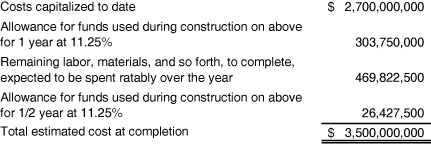
Costs capitalized to date " $2,700,000,000 " Allowance for funds used during construction on above for 1 year at 11.25% " 303,750,000 " "Remaining labor, materials, and so forth, to complete, expected to be spent ratably over the year" " 469,822,500 " Allowance for funds used during construction on above for 1/2 year at 11.25% " 26,427,500 " Total estimated cost at completion " $3,500,000,000 "
##### [360-980-55-21](https://asc.understandingaccounting.org/asc/360/980/#360-980-55-21)
Pending content: no
Source downloaded (UTC): 2026-09-10T00:13:17.858Z to 2026-09-10T00:13:17.858Z
Record version: sha256:aeac6f8323afe1e9e11490060dca70dd29b3656d6c78bfa8136b54df8bebe491
Snapshot version: sha256:15aea8165dff9f5ae47d9484f8470588b13b307f56e1d50801bf4d85ec190e3f
Effective as of: not established by retrieval timestamps.
Various parties have charged that certain cost increases were a result of imprudent management of the construction.
##### [360-980-55-22](https://asc.understandingaccounting.org/asc/360/980/#360-980-55-22)
Pending content: no
Source downloaded (UTC): 2026-09-10T00:13:17.858Z to 2026-09-10T00:13:17.858Z
Record version: sha256:eb82d20af9eaa3169f6d1192b137cc6487bccceafd7a85dcd517c05192c20740
Snapshot version: sha256:15aea8165dff9f5ae47d9484f8470588b13b307f56e1d50801bf4d85ec190e3f
Effective as of: not established by retrieval timestamps.
To avoid the cost and time delay that would be involved in a full-scale prudence investigation of the construction of the plant, Utility C and its regulator agree that the total cost of the plant that will be allowable in determining depreciation and that will be allowed in Utility C's rate base will be $3.4 billion. If the eventual cost of the plant exceeds that cap, a ratable portion of the tax benefit of depreciation will accrue to the benefit of the shareholders. For tax purposes, the plant is expected to have a net depreciable basis of $2.0 billion.
##### [360-980-55-23](https://asc.understandingaccounting.org/asc/360/980/#360-980-55-23)
Pending content: no
Source downloaded (UTC): 2026-09-10T00:13:17.858Z to 2026-09-10T00:13:17.858Z
Record version: sha256:2768e9effefbe2333edda1d07d0a76cd9b0d3ff624d4de07f6386eefe8f734ff
Snapshot version: sha256:15aea8165dff9f5ae47d9484f8470588b13b307f56e1d50801bf4d85ec190e3f
Effective as of: not established by retrieval timestamps.
The loss that results from the disallowance inherent in the cost cap would be computed as follows.
- 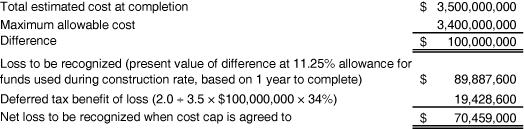
Total estimated cost at completion " $3,500,000,000 " Maximum allowable cost " 3,400,000,000 " Difference " $100,000,000 " "Loss to be recognized (present value of difference at 11.25% allowance for funds used during construction rate, based on 1 year to complete)" " $89,887,600 " "Deferred tax benefit of loss (2.0 ÷ 3.5 × $100,000,000 × 34%)" " 19,428,600 " Net loss to be recognized when cost cap is agreed to " $70,459,000 "
##### [360-980-55-24](https://asc.understandingaccounting.org/asc/360/980/#360-980-55-24)
Pending content: no
Source downloaded (UTC): 2026-09-10T00:13:17.858Z to 2026-09-10T00:13:17.858Z
Record version: sha256:b0921e6eec7cc1c4f3f74d8afaed5d5b9157ab4f48e29f72fcc508fc253527ed
Snapshot version: sha256:15aea8165dff9f5ae47d9484f8470588b13b307f56e1d50801bf4d85ec190e3f
Effective as of: not established by retrieval timestamps.
After the loss is recognized, an [allowance for funds used during construction](https://asc.understandingaccounting.org/glossary/a/#allowance-for-funds-used-during-construction "The cost of financing construction as financed partially by borrowings and partially by equity, capitalized as part of the cost of plant and equipment pursuant to requirements of the regulator.") would continue to be recorded based on the remaining recorded costs. Subsequently, if additional increases in the cost of the plant become probable and those costs are not allowable under the agreed cost cap, those increases would also be recognized as losses from disallowances when they become probable.
##### [360-980-55-25](https://asc.understandingaccounting.org/asc/360/980/#360-980-55-25)
Pending content: no
Source downloaded (UTC): 2026-09-10T00:13:17.858Z to 2026-09-10T00:13:17.858Z
Record version: sha256:5d2cfdf47e19304a73ebd9afb772039c3dcaa7dd4f1385009de4412d713917bb
Snapshot version: sha256:15aea8165dff9f5ae47d9484f8470588b13b307f56e1d50801bf4d85ec190e3f
Effective as of: not established by retrieval timestamps.
If the regulator ordered a cost cap that Utility C did not agree to, Utility C would have to assess whether the criteria of Topic 450 for loss recognition are met. If those criteria are met, the accounting would be as indicated above. Otherwise, no loss would be recognized until that loss was probable and could be reasonably estimated. Because of the possible disallowance inherent in the cost cap, it may no longer be probable that some amount of allowance for funds used during construction will be included in allowable costs in the future, and that amount may be reasonably estimable. In that case, that amount of allowance for funds used during construction would not be capitalized.
##### [360-980-55-26](https://asc.understandingaccounting.org/asc/360/980/#360-980-55-26)
Pending content: no
Source downloaded (UTC): 2026-09-10T00:13:17.858Z to 2026-09-10T00:13:17.858Z
Record version: sha256:560776ba34fe97ec481c62962ea5f32448026119050ab08530a37e0bdba53a94
Snapshot version: sha256:15aea8165dff9f5ae47d9484f8470588b13b307f56e1d50801bf4d85ec190e3f
Effective as of: not established by retrieval timestamps.
This Example illustrates the guidance in paragraphs
[980-360-35-12 through 35-14](https://asc.understandingaccounting.org/asc/360/980/#360-980-35-12)
.
##### [360-980-55-27](https://asc.understandingaccounting.org/asc/360/980/#360-980-55-27)
Pending content: no
Source downloaded (UTC): 2026-09-10T00:13:17.858Z to 2026-09-10T00:13:17.858Z
Record version: sha256:bcf093d8aac49c46650f70da993714d2cf9417f41ed5a93030d65a41ea64f754
Snapshot version: sha256:15aea8165dff9f5ae47d9484f8470588b13b307f56e1d50801bf4d85ec190e3f
Effective as of: not established by retrieval timestamps.
Assume that Utility D operates solely in a single-state jurisdiction. On January 1, 19X1, Utility D's new electric generating plant becomes operational. The cost of that plant is $1 billion.
##### [360-980-55-28](https://asc.understandingaccounting.org/asc/360/980/#360-980-55-28)
Pending content: no
Source downloaded (UTC): 2026-09-10T00:13:17.858Z to 2026-09-10T00:13:17.858Z
Record version: sha256:a5b1eb07f356d2a5c3ee2bf639ca0944cae2a9180114ff6f118b78ff6ecc5b75
Snapshot version: sha256:15aea8165dff9f5ae47d9484f8470588b13b307f56e1d50801bf4d85ec190e3f
Effective as of: not established by retrieval timestamps.
Utility D's regulator concludes that part of the cost of the recently completed plant was imprudently incurred. However, rather than disallow the specific costs that were imprudent, the regulator instead excludes 10 percent ($100 million) of the plant from the rate base, thereby providing no return on investment on that portion of the plant. The regulator does not intend any part of the tax benefit of depreciation to accrue to the benefit of Utility D's shareholders. The regulator indicates that the exclusion of 10 percent of the plant's cost from the rate base is intended to be permanent. The utility concludes that it will not appeal the disallowance after considering the likely outcome of an appeal.
##### [360-980-55-29](https://asc.understandingaccounting.org/asc/360/980/#360-980-55-29)
Pending content: no
Source downloaded (UTC): 2026-09-10T00:13:17.858Z to 2026-09-10T00:13:17.858Z
Record version: sha256:7fc2cf68d1a270c469938c37b83d92a4727e2860fef1231570b7fd96238421fa
Snapshot version: sha256:15aea8165dff9f5ae47d9484f8470588b13b307f56e1d50801bf4d85ec190e3f
Effective as of: not established by retrieval timestamps.
Utility D should record the indirect disallowance as a loss and should estimate the amount of that loss using the best available information. If the regulator specifies the amount of cost that was imprudent, that amount may be the best estimate of the loss. Otherwise, Utility D would have to estimate the future cash flows that have been disallowed as a result of the order and determine the effective disallowance by computing the present value of those disallowed future cash flows. Since both the disallowed future cash flows and the appropriate discount rate to compute the present value would be estimates, those estimates should be calculated on a consistent basis. Accordingly, if the future cash flows are estimated based on the current weighted-average overall cost of Utility D's capital, that weighted-average overall cost of capital should also be used as the discount rate. The loss has no tax benefit to Utility D.
##### [360-980-55-30](https://asc.understandingaccounting.org/asc/360/980/#360-980-55-30)
Pending content: no
Source downloaded (UTC): 2026-09-10T00:13:17.858Z to 2026-09-10T00:13:17.858Z
Record version: sha256:892d2c85e5ebcac5666e082d3b1d133675905ce07e646d6f55fe28d0920df864
Snapshot version: sha256:15aea8165dff9f5ae47d9484f8470588b13b307f56e1d50801bf4d85ec190e3f
Effective as of: not established by retrieval timestamps.
[Paragraph not used](https://asc.understandingaccounting.org/updates/page-1833002/).
##### [360-980-55-31](https://asc.understandingaccounting.org/asc/360/980/#360-980-55-31)
Pending content: no
Source downloaded (UTC): 2026-09-10T00:13:17.858Z to 2026-09-10T00:13:17.858Z
Record version: sha256:b5d2125d3ea2f5ededa61f51df31fc49510ee1774e35db692e2d294cd4d76adb
Snapshot version: sha256:15aea8165dff9f5ae47d9484f8470588b13b307f56e1d50801bf4d85ec190e3f
Effective as of: not established by retrieval timestamps.
[Paragraph not used](https://asc.understandingaccounting.org/updates/page-1833002/).
##### [360-980-55-32](https://asc.understandingaccounting.org/asc/360/980/#360-980-55-32)
Pending content: no
Source downloaded (UTC): 2026-09-10T00:13:17.858Z to 2026-09-10T00:13:17.858Z
Record version: sha256:3c3c7d9c9eee37b20438b331ad490ee2dba4552ac041c53afc13642994c11130
Snapshot version: sha256:15aea8165dff9f5ae47d9484f8470588b13b307f56e1d50801bf4d85ec190e3f
Effective as of: not established by retrieval timestamps.
[Paragraph not used](https://asc.understandingaccounting.org/updates/page-1833002/).
##### [360-980-55-33](https://asc.understandingaccounting.org/asc/360/980/#360-980-55-33)
Pending content: no
Source downloaded (UTC): 2026-09-10T00:13:17.858Z to 2026-09-10T00:13:17.858Z
Record version: sha256:cf23316809c9aabb8e89cdb13b7c84cae95c9a15e99f8d4f23ab5ac8e16fe152
Snapshot version: sha256:15aea8165dff9f5ae47d9484f8470588b13b307f56e1d50801bf4d85ec190e3f
Effective as of: not established by retrieval timestamps.
[Paragraph not used](https://asc.understandingaccounting.org/updates/page-1833002/).
##### [360-980-55-34](https://asc.understandingaccounting.org/asc/360/980/#360-980-55-34)
Pending content: no
Source downloaded (UTC): 2026-09-10T00:13:17.858Z to 2026-09-10T00:13:17.858Z
Record version: sha256:efd427b2ef76d15a2407d1019a1d431264fea624a3137911e9ab3255fdcab205
Snapshot version: sha256:15aea8165dff9f5ae47d9484f8470588b13b307f56e1d50801bf4d85ec190e3f
Effective as of: not established by retrieval timestamps.
[Paragraph not used](https://asc.understandingaccounting.org/updates/page-1833002/).
##### [360-980-55-35](https://asc.understandingaccounting.org/asc/360/980/#360-980-55-35)
Pending content: no
Source downloaded (UTC): 2026-09-10T00:13:17.858Z to 2026-09-10T00:13:17.858Z
Record version: sha256:6d40c461dfc3ec849e54cc17cc9549368b942896d0661e66703878f88175aea2
Snapshot version: sha256:15aea8165dff9f5ae47d9484f8470588b13b307f56e1d50801bf4d85ec190e3f
Effective as of: not established by retrieval timestamps.
[Paragraph not used](https://asc.understandingaccounting.org/updates/page-1833002/).
Source downloaded (UTC): 2026-09-10T00:13:22.181Z to 2026-09-10T00:13:22.181Z
Record version: sha256:8c84b07fe2f7a315a0387516fc2601720ad452e88d530fcdeeccfd1b49b44243
Snapshot version: sha256:15aea8165dff9f5ae47d9484f8470588b13b307f56e1d50801bf4d85ec190e3f
Effective as of: not established by retrieval timestamps.
## ASC 360-980-S00: SEC 00 Status
[Read section](https://asc.understandingaccounting.org/asc/360/980/#sec-00-status)
SEC content: yes
##### [360-980-S00-1](https://asc.understandingaccounting.org/asc/360/980/#360-980-S00-1)
Pending content: no
Source downloaded (UTC): 2026-09-10T00:13:22.181Z to 2026-09-10T00:13:22.181Z
Record version: sha256:0c6ad09e0b78082dd38b0fbf903a381d7271f76c13015d458452d9bfb5946fed
Snapshot version: sha256:15aea8165dff9f5ae47d9484f8470588b13b307f56e1d50801bf4d85ec190e3f
Effective as of: not established by retrieval timestamps.
No updates have been made to this subtopic.
Source downloaded (UTC): 2026-09-10T00:13:24.993Z to 2026-09-10T00:13:24.993Z
Record version: sha256:acc1ce04156a96e523d37a0b611ed8f5da9cd8ee87fc247d4cfb02108a40424c
Snapshot version: sha256:15aea8165dff9f5ae47d9484f8470588b13b307f56e1d50801bf4d85ec190e3f
Effective as of: not established by retrieval timestamps.
## ASC 360-980-S45: SEC 45 Other Presentation Matters
[Read section](https://asc.understandingaccounting.org/asc/360/980/#sec-45-other-presentation-matters)
SEC content: yes
#### Classification of Charges for Abandonment and Disallowances
##### [360-980-S45-1](https://asc.understandingaccounting.org/asc/360/980/#360-980-S45-1)
Pending content: no
Source downloaded (UTC): 2026-09-10T00:13:24.993Z to 2026-09-10T00:13:24.993Z
Record version: sha256:cdd62fdd449836a4c9f7d63189614bd83c0731dea267352a5832a1caa935e540
Snapshot version: sha256:15aea8165dff9f5ae47d9484f8470588b13b307f56e1d50801bf4d85ec190e3f
Effective as of: not established by retrieval timestamps.
See paragraph [980-360-S99-2](https://asc.understandingaccounting.org/asc/360/980/#360-980-S99-2), SAB Topic 10.E, for SEC Staff views on the classification of charges for abandonment and disallowances.
Source downloaded (UTC): 2026-09-10T00:13:27.652Z to 2026-09-10T00:13:27.652Z
Record version: sha256:9762b809886edd87d74d4998a998e6bebcdda7bedf2a77a4cabf54b939bd0c9b
Snapshot version: sha256:15aea8165dff9f5ae47d9484f8470588b13b307f56e1d50801bf4d85ec190e3f
Effective as of: not established by retrieval timestamps.
## ASC 360-980-S50: SEC 50 Disclosure
[Read section](https://asc.understandingaccounting.org/asc/360/980/#sec-50-disclosure)
SEC content: yes
#### Tangible and Intangible Utility Plant
##### [360-980-S50-1](https://asc.understandingaccounting.org/asc/360/980/#360-980-S50-1)
Pending content: no
Source downloaded (UTC): 2026-09-10T00:13:27.652Z to 2026-09-10T00:13:27.652Z
Record version: sha256:287ca03f74458885ed20eacfbd31641cd48e7f325d446fba6e0d115defee894a
Snapshot version: sha256:15aea8165dff9f5ae47d9484f8470588b13b307f56e1d50801bf4d85ec190e3f
Effective as of: not established by retrieval timestamps.
See paragraph [210-10-S99-1](https://asc.understandingaccounting.org/asc/210/10/#210-10-S99-1), Regulation S-X Rule 5-02.13(b), for disclosure requirements for tangible and intangible utility plants of a public utility company.
#### Jointly Owned Electric Utility Plants
##### [360-980-S50-2](https://asc.understandingaccounting.org/asc/360/980/#360-980-S50-2)
Pending content: no
Source downloaded (UTC): 2026-09-10T00:13:27.652Z to 2026-09-10T00:13:27.652Z
Record version: sha256:b96d91e22fc34ebccd004c08c356e3fff84483e965ba107340cdbe305c171fac
Snapshot version: sha256:15aea8165dff9f5ae47d9484f8470588b13b307f56e1d50801bf4d85ec190e3f
Effective as of: not established by retrieval timestamps.
See paragraph [980-360-S99-1](https://asc.understandingaccounting.org/asc/360/980/#360-980-S99-1), SAB Topic 10.C, for SEC Staff views on disclosure concerning interests in jointly owned utility plants.
Source downloaded (UTC): 2026-09-10T00:13:32.748Z to 2026-09-10T00:13:32.748Z
Record version: sha256:057e0fb4900fefa07f9a682bc3bd459085f2a829825742a5f4c680e8b694352a
Snapshot version: sha256:15aea8165dff9f5ae47d9484f8470588b13b307f56e1d50801bf4d85ec190e3f
Effective as of: not established by retrieval timestamps.
## ASC 360-980-S99: SEC 99 SEC Materials
[Read section](https://asc.understandingaccounting.org/asc/360/980/#sec-99-sec-materials)
SEC content: yes
#### SEC Staff Guidance
##### [360-980-S99-1](https://asc.understandingaccounting.org/asc/360/980/#360-980-S99-1)
Pending content: no
Source downloaded (UTC): 2026-09-10T00:13:32.748Z to 2026-09-10T00:13:32.748Z
Record version: sha256:1ae0bd1f1506a3d973340c8aa1dfd4caa9f76b40d095ec790b5ad06368d199c1
Snapshot version: sha256:15aea8165dff9f5ae47d9484f8470588b13b307f56e1d50801bf4d85ec190e3f
Effective as of: not established by retrieval timestamps.
The following is the text of SAB Topic 10.C, Jointly Owned Electric Utility Plants.
- Facts: Groups of electric utility companies have been building and operating utility plants under joint ownership agreements or arrangements which do not create legal entities for which separate financial statements are presented. FN1 Under these arrangements, a participating utility has an undivided interest in a utility plant and is responsible for its proportionate share of the costs of construction and operation and its entitled to its proportionate share of the energy produced.
- FN1 Before considering the guidance in this SAB Topic, registrants are reminded that the arrangement should be evaluated in accordance with the provisions of Interpretation 46 \[Topic 810\].
- During the construction period a participating utility finances its own share of a utility plant using its own financial resources and not the combined resources of the group. Allowance for funds used during construction is provided in the same manner and at the same rates as for plants constructed to be used entirely by the participant utility.
- When a joint-owned plant becomes operational, one of the participant utilities acts as operator and bills the other participants for their proportionate share of the direct expenses incurred. Each individual participant incurs other expenses related to transmission, distribution, supervision and control which cannot be related to the energy generated or received from any particular source. Many companies maintain depreciation records on a composite basis for each class of property so that neither the accumulated allowance for depreciation nor the periodic expense can be allocated to specific generating units whether jointly or wholly owned.
- Question: What disclosure should be made on the financial statements or in the notes concerning interests in jointly owned utility plants?
- Interpretive Response: A participating utility should include information concerning the extent of its interests in jointly owned plants in a note to its financial statements. The note should include a table showing separately for each interest in a jointly owned plant the amount of utility plant in service, the accumulated provision for depreciation (if available), the amount of plant under construction, and the proportionate share. The amounts presented for plant in service or plant under construction may be further subdivided to show amounts applicable to plant subcategories such as production, transmission, and distribution. The note should include statements that the dollar amounts represent the participating utility's share in each joint plant and that each participant must provide its own financing. Information concerning two or more generating plants on the same site may be combined if appropriate.
- The note should state that the participating utility's share of direct expenses of the joint plants is included in the corresponding operating expenses on its income statement (e. g., fuel, maintenance of plant, other operating expense). If the share of direct expenses is charged to purchased power then the note should disclose the amount so charged and the proportionate amounts charged to specific operating expenses on the records maintained for the joint plants.
##### [360-980-S99-2](https://asc.understandingaccounting.org/asc/360/980/#360-980-S99-2)
Pending content: no
Source downloaded (UTC): 2026-09-10T00:13:32.748Z to 2026-09-10T00:13:32.748Z
Record version: sha256:8a772361148386c7d8b7fc1845c7ce6c3ca2020dd3669cb1e81930e3ccd3812c
Snapshot version: sha256:15aea8165dff9f5ae47d9484f8470588b13b307f56e1d50801bf4d85ec190e3f
Effective as of: not established by retrieval timestamps.
The following is the text of SAB Topic 10.E, Classification of Charges for Abandonment and Disallowances.
- Facts: A public utility company abandons the construction of a plant and, under the provisions of Statement 90 \[Topic 980\], must charge a portion of the costs of the abandoned plant to expense. FN3 Also, the utility determines that it is probable that certain costs of a recently completed plant will be disallowed, and charges those costs to expense as required by Statement 90 \[Topic 980\].
- FN3 Paragraph 3 of Statement 90 \[paragraph [980-360-35-3](https://asc.understandingaccounting.org/asc/360/980/#360-980-35-3)\] requires that costs of abandoned plants in excess of the present value of the future revenues expected to be provided to recover any allowable costs be charged to expense in the period that the abandonment becomes probable. Also, paragraph 7 of Statement 90 \[paragraph [980-360-35-12](https://asc.understandingaccounting.org/asc/360/980/#360-980-35-12)\] requires that disallowed costs for recently completed plants be charged to expense when the disallowance becomes probable and can be reasonably estimated.
- Question: May such charges for abandonments and disallowances be reported as extraordinary items in the statement of income?
- Interpretive Response: No. The staff does not believe that such charges meet the requirements of APB Opinion 30 \[Topic 225\] that an item be both unusual and infrequent to be classified as an extraordinary item. Accordingly, the public utility was advised by the staff that such charges should be reported as a component of income from continuing operations, separately presented, if material. FN4
- FN4 Additionally, the registrant was reminded that paragraph 26 of APB Opinion 30 \[paragraph [220-20-45-1](https://asc.understandingaccounting.org/asc/220/20/#220-20-45-1)\] provides that items which are not reported as extraordinary should not be reported on the income statement net of income taxes or in any manner that implies that they are similar to extraordinary items.
- Paragraph 20 of APB Opinion 30 \[paragraph [225-20-45-2](https://asc.understandingaccounting.org/asc/225/20/#225-20-45-2)\] indicates that to be unusual, an item must "possess a high degree of abnormality and be of a type clearly unrelated to, or only incidentally related to, the ordinary and typical activities of the entity, taking into account the environment in which the entity operates." Similarly, that paragraph indicates that, to be infrequent, an event should "not reasonably be expected to recur in the foreseeable future."
- Electric utilities operate under a franchise that requires them to furnish adequate supplies of electricity for their service area. That undertaking requires utilities to continually forecast the future demand for electricity, and the costs to be incurred in constructing the plants necessary to meet that demand. Abandonments and disallowances result from the failure of demand to reach projected levels and/or plant construction costs that exceed anticipated amounts. Neither event qualifies as being both unusual and infrequent in the environment in which electric utilities operate.
- Accordingly, the staff believes that charges for abandonments and disallowances under Statement 90 should not be presented as extraordinary items. FN5
- FN5 The staff also notes that paragraphs 3 and 7 of Statement 90 \[paragraphs [980-360-35-3](https://asc.understandingaccounting.org/asc/360/980/#360-980-35-3) and [980-360-35-12](https://asc.understandingaccounting.org/asc/360/980/#360-980-35-12)\], in requiring that such costs be "recognized as a loss," do not specify extraordinary item treatment. The staff believes that it generally has been the FASB's practice to affirmatively require extraordinary item treatment when it believes that it is appropriate for charges or credits to income specifically required by a provision of a statement.