ASC 340-40
Contracts with Customers
340 Other Assets and Deferred Costs
Source downloaded: .Record version 11b94ff78ae4. Effective date must be checked in the source.
ASC 340-40 governs capitalization, amortization, and impairment of two kinds of contract costs for contracts within the scope of Topic 606: incremental costs of obtaining a contract and costs to fulfill a contract that are not within the scope of another Topic. Incremental costs of obtaining a contract (e.g., sales commissions) are capitalized if the entity expects to recover them (340-40-25-1), while fulfillment costs are capitalized only if they relate directly to an identifiable (or specifically anticipated) contract, generate or enhance resources used to satisfy future performance obligations, and are expected to be recovered (340-40-25-5). Capitalized amounts are amortized consistently with transfer of the related goods or services and tested for impairment, with no reversal of impairment losses.
Key points (7)
- An entity shall recognize as an asset the incremental costs of obtaining a contract—costs it would not have incurred had the contract not been obtained, such as a sales commission—if it expects to recover them (340-40-25-1 through 25-2); costs that would have been incurred regardless are expensed when incurred unless explicitly chargeable to the customer regardless of whether the contract is obtained (340-40-25-3).
- Practical expedient: incremental costs of obtaining a contract may be expensed as incurred if the amortization period of the asset otherwise recognized would be one year or less (340-40-25-4), and use of the expedient must be disclosed (340-40-50-5).
- Fulfillment costs are capitalized only if all three criteria in 340-40-25-5 are met (direct relation to an identified or specifically anticipated contract, generation or enhancement of resources used to satisfy future performance obligations, and expected recovery); costs within the scope of Topic 330, 340-10-25-1 through 25-4, Subtopic 350-40, Topic 360, or Subtopic 985-20 follow those Topics instead (340-40-25-6; 340-40-15-3).
- General and administrative costs, wasted materials/labor not priced into the contract, costs relating to satisfied or partially satisfied performance obligations, and costs that cannot be distinguished between satisfied and unsatisfied obligations are expensed as incurred (340-40-25-8); costs that relate directly to a contract are listed in 340-40-25-7.
- The capitalized asset is amortized on a systematic basis consistent with the transfer of the goods or services to which it relates, including goods or services under anticipated renewals (340-40-35-1; Example 2 amortizes a commission over seven years for a five-year contract with two expected renewals), and changes in expected timing are accounted for as a change in accounting estimate under Subtopic 250-10 (340-40-35-2).
- An impairment loss is recognized to the extent carrying amount exceeds remaining expected consideration (determined using transaction price principles but ignoring the variable consideration constraint, adjusted for customer credit risk and including expected renewals/extensions) less the directly related costs not yet expensed (340-40-35-3 through 35-4); other-Topic assets are tested first and the remaining carrying amount is then included in the asset group or reporting unit under Topics 360 and 350 (340-40-35-5).
- Reversal of a previously recognized impairment loss is prohibited (340-40-35-6); required disclosures include judgments made, amortization method, closing balances by main category of asset, and amortization and impairment amounts (340-40-50-2 through 50-3), which non-PBEs may elect not to provide (340-40-50-4).
For students. This is the cost-side companion to Topic 606 and a frequent exam trap: a sales commission tied to obtaining a specific contract is capitalized, but discretionary bonuses and legal/travel costs incurred whether or not the bid was won are expensed. Students also commonly amortize the asset over the stated contract term instead of the longer expected period including anticipated renewals, and forget that impairment losses can never be reversed.
Machine-generated study aid for ASC 340-40. Check the source paragraphs below.
340-40-00Status
Source downloaded: .Record version d7b9a13f6638. Effective date must be checked in the source.
340-40-05Overview and Background
Source downloaded: .Record version 9f928f59c611. Effective date must be checked in the source.
- aIncremental costs of obtaining a contract with a customer
- bCosts incurred in fulfilling a contract with a customer that are not in the scope of another Topic.
340-40-15Scope and Scope Exceptions
Source downloaded: .Record version d4b6d22714a5. Effective date must be checked in the source.
Overall Guidance
Transactions
340-40-25Recognition
Source downloaded: .Record version 47a557fe75b8. Effective date must be checked in the source.
Contract Costs
- a The costs relate directly to a contract or to an anticipated contract that the entity can specifically identify (for example, costs relating to services to be provided under renewal of an existing contract or costs of designing an asset to be transferred under a specific contract that has not yet been approved).
- b The costs generate or enhance resources of the entity that will be used in satisfying (or in continuing to satisfy) performance obligations in the future.
- c The costs are expected to be recovered.
- a Direct labor (for example, salaries and wages of employees who provide the promised services directly to the customer)
- b Direct materials (for example, supplies used in providing the promised services to a customer)
- c Allocations of costs that relate directly to the contract or to contract activities (for example, costs of contract management and supervision, insurance, and depreciation of tools and equipment used in fulfilling the contract)
- d Costs that are explicitly chargeable to the customer under the contract
- e Other costs that are incurred only because an entity entered into the contract (for example, payments to subcontractors).
- a General and administrative costs (unless those costs are explicitly chargeable to the customer under the contract, in which case an entity shall evaluate those costs in accordance with paragraph 340-40-25-7)
- b Costs of wasted materials, labor, or other resources to fulfill the contract that were not reflected in the price of the contract
- c Costs that relate to satisfied performance obligations (or partially satisfied performance obligations) in the contract (that is, costs that relate to past performance)
- d Costs for which an entity cannot distinguish whether the costs relate to unsatisfied performance obligations or to satisfied performance obligations (or partially satisfied performance obligations).
340-40-35Subsequent Measurement
Source downloaded: .Record version 96771d0c18ee. Effective date must be checked in the source.
Amortization and Impairment
- a The amount of consideration that the entity expects to receive in the future and that the entity has received but has not recognized as revenue, in exchange for the goods or services to which the asset relates (“the consideration”), less
- b The costs that relate directly to providing those goods or services and that have not been recognized as expenses (see paragraphs 340-40-25-2 and 340-40-25-7).
340-40-50Disclosure
Source downloaded: .Record version fa268ef1ee84. Effective date must be checked in the source.
Assets Recognized from the Costs to Obtain or Fulfill a Contract with a Customer
- aThe judgments made in determining the amount of the costs incurred to obtain or fulfill a contract with a customer (in accordance with paragraph 340-40-25-1 or 340-40-25-5)
- bThe method it uses to determine the amortization for each reporting period.
- aThe closing balances of assets recognized from the costs incurred to obtain or fulfill a contract with a customer (in accordance with paragraph 340-40-25-1 or 340-40-25-5), by main category of asset (for example, costs to obtain contracts with customers, precontract costs, and setup costs)
- bThe amount of amortization and any impairment losses recognized in the reporting period.
- aThe closing balances of assets recognized from the costs incurred to obtain or fulfill a contract with a customer (in accordance with paragraph 340-40-25-1 or 340-40-25-5), by main category of asset (for example, costs to obtain contracts with customers, precontract costs, and setup costs)
- bThe amount of amortization and any impairment losses recognized in the reporting period.
Practical Expedients
340-40-55Implementation Guidance and Illustrations
Source downloaded: .Record version 0c7d0d82d79b. Effective date must be checked in the source.
Illustrations
-
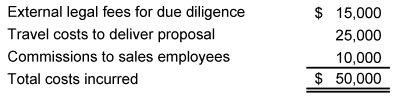 External legal fees for due diligence " $15,000 " Travel costs to deliver proposal " 25,000 " Commissions to sales employees " 10,000 " Total costs incurred " $50,000 "
-
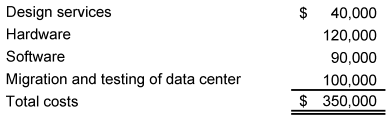 Design services " $40,000 " Hardware " 120,000 " Software " 90,000 " Migration and testing of data center " 100,000 " Total costs " $350,000 "
- a Hardware costs—accounted for in accordance with Topic 360 on property, plant, and equipment
- b Software costs—accounted for in accordance with Subtopic 350-40 on internal-use software
- c Costs of the design, migration, and testing of the data center—assessed in accordance with paragraph 340-40-25-5 to determine whether an asset can be recognized for the costs to fulfill the contract. Any resulting asset would be amortized on a systematic basis over the seven-year period (that is, the five-year contract term and two anticipated one-year renewal periods) that the entity expects to provide services related to the data center.
340-40-60Relationships
Source downloaded: .Record version 147ff7a2e27f. Effective date must be checked in the source.
Revenue from Contracts with Customers
Financial Services—Insurance
Related subtopics
- 606-10 OverallRevenue from Contracts with Customers
- 610-20 Gains and Losses from the Derecognition of Nonfinancial AssetsOther Income
- 350-40 Internal-Use SoftwareIntangibles—Goodwill and Other
- 730-10 OverallResearch and Development
- 340-10 OverallOther Assets and Deferred Costs
- 985-20 Costs of Software to Be Sold, Leased, or MarketedSoftware