ASC 606-10
Overall
606 Revenue from Contracts with Customers
Source downloaded: .Record version 08bc3b2f2d41. Effective date must be checked in the source.
ASC 606-10 is the general revenue recognition model for contracts with customers: revenue is recognized to depict the transfer of promised goods or services in an amount reflecting the consideration to which the entity expects to be entitled. It is applied through five steps — identify the contract, identify the performance obligations, determine the transaction price, allocate that price to the performance obligations, and recognize revenue as each obligation is satisfied when the customer obtains control (606-10-05-4). It also sets the scope exclusions (leases, insurance, financial instruments, guarantees, certain nonmonetary exchanges), balance sheet presentation of contract assets/liabilities and receivables, and a broad disclosure package.
Key points (7)
- A contract is accounted for under Topic 606 only when all five criteria in 606-10-25-1 are met: approval and commitment, identifiable rights, identifiable payment terms, commercial substance, and probable collection of substantially all consideration for the goods or services that will be transferred; if not met, consideration received is a liability until one of the events in 606-10-25-7 occurs.
- A promised good or service is a performance obligation if it is distinct — the customer can benefit from it on its own or with readily available resources and the promise is separately identifiable within the context of the contract (606-10-25-19); integration services, significant customization, and high interdependence indicate promises are not separately identifiable (606-10-25-21).
- Contracts entered into at or near the same time with the same customer must be combined when any criterion in 606-10-25-9 is met; a modification is a separate contract only if it adds distinct goods or services priced at standalone selling price (606-10-25-12), otherwise it is treated as a termination and new contract or as a cumulative catch-up adjustment (606-10-25-13).
- Revenue is recognized when (or as) the customer obtains control — the ability to direct the use of and obtain substantially all the remaining benefits from the asset (606-10-25-23 through 25-25).
- A performance obligation is satisfied over time if any of the three criteria in 606-10-25-27 is met (simultaneous receipt and consumption; customer controls the asset as created; no alternative use plus enforceable right to payment for performance completed to date); otherwise it is satisfied at a point in time using the control indicators in 606-10-25-30.
- For over-time obligations an entity applies a single output or input method consistently, remeasures progress each period as a change in estimate, and if progress cannot be reasonably measured recognizes revenue only up to costs incurred (606-10-25-31 through 25-37).
- Once either party performs, the contract is presented as a contract asset or contract liability, with unconditional rights to consideration presented separately as a receivable (606-10-45-1 through 45-4); contract assets and receivables are assessed for credit losses under Subtopic 326-20.
For students. This is the backbone of modern revenue recognition and shows up constantly on the FAR exam; the most common mistakes are treating every deliverable in a contract as a separate performance obligation (ignoring the 'separately identifiable within the context of the contract' prong) and confusing physical delivery or legal title with transfer of control.
Machine-generated study aid for ASC 606-10. Check the source paragraphs below.
606-10-00Status
Source downloaded: .Record version 6a2cc61dd58e. Effective date must be checked in the source.
606-10-05Overview and Background
Source downloaded: .Record version 15f5f86db29d. Effective date must be checked in the source.
- a Step 1: Identify the contract(s) with a customer—A contract is an agreement between two or more parties that creates enforceable rights and obligations. The guidance in this Topic applies to each contract that has been agreed upon with a customer and meets specified criteria. In some cases, this Topic requires an entity to combine contracts and account for them as one contract. This Topic also provides requirements for the accounting for contract modifications. (See paragraphs .)
- b Step 2: Identify the performance obligations in the contract—A contract includes promises to transfer goods or services to a customer. If those goods or services are distinct, the promises are performance obligations and are accounted for separately. A good or service is distinct if the customer can benefit from the good or service on its own or together with other resources that are readily available to the customer and the entity's promise to transfer the good or service to the customer is separately identifiable from other promises in the contract. (See paragraphs .)
- c Step 3: Determine the transaction price—The transaction price is the amount of consideration in a contract to which an entity expects to be entitled in exchange for transferring promised goods or services to a customer. The transaction price can be a fixed amount of customer consideration, but it may sometimes include variable consideration or consideration in a form other than cash. The transaction price also is adjusted for the effects of the time value of money if the contract includes a significant financing component and for any consideration payable to the customer. If the consideration is variable, an entity estimates the amount of consideration to which it will be entitled in exchange for the promised goods or services. The estimated amount of variable consideration will be included in the transaction price only to the extent that it is probable that a significant reversal in the amount of cumulative revenue recognized will not occur when the uncertainty associated with the variable consideration is subsequently resolved. (See paragraphs .)
- d Step 4: Allocate the transaction price to the performance obligations in the contract—An entity typically allocates the transaction price to each performance obligation on the basis of the relative standalone selling prices of each distinct good or service promised in the contract. If a standalone selling price is not observable, an entity estimates it. Sometimes, the transaction price includes a discount or a variable amount of consideration that relates entirely to a part of the contract. The requirements specify when an entity allocates the discount or variable consideration to one or more, but not all, performance obligations (or distinct goods or services) in the contract. (See paragraphs .)
- e Step 5: Recognize revenue when (or as) the entity satisfies a performance obligation—An entity recognizes revenue when (or as) it satisfies a performance obligation by transferring a promised good or service to a customer (which is when the customer obtains control of that good or service). The amount of revenue recognized is the amount allocated to the satisfied performance obligation. A performance obligation may be satisfied at a point in time (typically for promises to transfer goods to a customer) or over time (typically for promises to transfer services to a customer). For performance obligations satisfied over time, an entity recognizes revenue over time by selecting an appropriate method for measuring the entity's progress toward complete satisfaction of that performance obligation. (See paragraphs .)
- a Revenue recognized from contracts with customers, including the disaggregation of revenue into appropriate categories
- b Contract balances, including the opening and closing balances of receivables, contract assets, and contract liabilities
- c Performance obligations, including when the entity typically satisfies its performance obligations and the transaction price that is allocated to the remaining performance obligations in a contract
- d Significant judgments, and changes in judgments, made in applying the requirements to those contracts.
606-10-10Objectives
Source downloaded: .Record version 1707c0804670. Effective date must be checked in the source.
Meeting the Objective
606-10-15Scope and Scope Exceptions
Source downloaded: .Record version 0c882a627b5b. Effective date must be checked in the source.
Entities
Transactions
- aLease contracts within the scope of Topic 842, Leases.
- bContracts within the scope of Topic 944, Financial Services—Insurance.
- cFinancial instruments and other contractual rights or obligations within the scope of the following Topics:
- 1Topic 310, Receivables
- 2Topic 320, Investments—Debt Securities
- 2aTopic 321, Investments—Equity Securities
- 3Topic 323, Investments—Equity Method and Joint Ventures
- 4Topic 325, Investments—Other
- 5Topic 405, Liabilities
- 6Topic 470, Debt
- 7Topic 815, Derivatives and Hedging
- 8Topic 825, Financial Instruments
- 9Topic 860, Transfers and Servicing.
- 1
- dGuarantees (other than product or service warranties) within the scope of Topic 460, Guarantees.
- eNonmonetary exchanges between entities in the same line of business to facilitate sales to customers or potential customers. For example, this Topic would not apply to a contract between two oil companies that agree to an exchange of oil to fulfill demand from their customers in different specified locations on a timely basis. Topic 845 on nonmonetary transactions may apply to nonmonetary exchanges that are not within the scope of this Topic.
- aIf the other Topics specify how to separate and/or initially measure one or more parts of the contract, then an entity shall first apply the separation and/or measurement guidance in those Topics. An entity shall exclude from the transaction price the amount of the part (or parts) of the contract that are initially measured in accordance with other Topics and shall apply paragraphs to allocate the amount of the transaction price that remains (if any) to each performance obligation within the scope of this Topic and to any other parts of the contract identified by paragraph 606-10-15-4(b).
- bIf the other Topics do not specify how to separate and/or initially measure one or more parts of the contract, then the entity shall apply the guidance in this Topic to separate and/or initially measure the part (or parts) of the contract.
606-10-25Recognition
Source downloaded: .Record version 6cf23df720ee. Effective date must be checked in the source.
Identifying the Contract
- a The parties to the contract have approved the contract (in writing, orally, or in accordance with other customary business practices) and are committed to perform their respective obligations.
- b The entity can identify each party's rights regarding the goods or services to be transferred.
- c The entity can identify the payment terms for the goods or services to be transferred.
- d The contract has commercial substance (that is, the risk, timing, or amount of the entity's future cash flows is expected to change as a result of the contract).
- e It is probable that the entity will collect substantially all of the consideration to which it will be entitled in exchange for the goods or services that will be transferred to the customer (see paragraphs ). In evaluating whether collectibility of an amount of consideration is probable, an entity shall consider only the customer's ability and intention to pay that amount of consideration when it is due. The amount of consideration to which the entity will be entitled may be less than the price stated in the contract if the consideration is variable because the entity may offer the customer a price concession (see paragraph 606-10-32-7).
- a The entity has not yet transferred any promised goods or services to the customer.
- b The entity has not yet received, and is not yet entitled to receive, any consideration in exchange for promised goods or services.
- a The entity has no remaining obligations to transfer goods or services to the customer, and all, or substantially all, of the consideration promised by the customer has been received by the entity and is nonrefundable.
- b The contract has been terminated, and the consideration received from the customer is nonrefundable.
- c The entity has transferred control of the goods or services to which the consideration that has been received relates, the entity has stopped transferring goods or services to the customer (if applicable) and has no obligation under the contract to transfer additional goods or services, and the consideration received from the customer is nonrefundable.
Combination of Contracts
- a The contracts are negotiated as a package with a single commercial objective.
- b The amount of consideration to be paid in one contract depends on the price or performance of the other contract.
- c The goods or services promised in the contracts (or some goods or services promised in each of the contracts) are a single performance obligation in accordance with paragraphs .
Contract Modifications
- a The scope of the contract increases because of the addition of promised goods or services that are distinct (in accordance with paragraphs ).
- b The price of the contract increases by an amount of consideration that reflects the entity's standalone selling prices of the additional promised goods or services and any appropriate adjustments to that price to reflect the circumstances of the particular contract. For example, an entity may adjust the standalone selling price of an additional good or service for a discount that the customer receives, because it is not necessary for the entity to incur the selling-related costs that it would incur when selling a similar good or service to a new customer.
- a An entity shall account for the contract modification as if it were a termination of the existing contract, and the creation of a new contract, if the remaining goods or services are distinct from the goods or services transferred on or before the date of the contract modification. The amount of consideration to be allocated to the remaining performance obligations (or to the remaining distinct goods or services in a single performance obligation identified in accordance with paragraph 606-10-25-14(b)) is the sum of:
- 1 The consideration promised by the customer (including amounts already received from the customer) that was included in the estimate of the transaction price and that had not been recognized as revenue and
- 2 The consideration promised as part of the contract modification.
- 1
- b An entity shall account for the contract modification as if it were a part of the existing contract if the remaining goods or services are not distinct and, therefore, form part of a single performance obligation that is partially satisfied at the date of the contract modification. The effect that the contract modification has on the transaction price, and on the entity's measure of progress toward complete satisfaction of the performance obligation, is recognized as an adjustment to revenue (either as an increase in or a reduction of revenue) at the date of the contract modification (that is, the adjustment to revenue is made on a cumulative catch-up basis).
- c If the remaining goods or services are a combination of items (a) and (b), then the entity shall account for the effects of the modification on the unsatisfied (including partially unsatisfied) performance obligations in the modified contract in a manner that is consistent with the objectives of this paragraph.
Identifying Performance Obligations
- a A good or service (or a bundle of goods or services) that is distinct
- b A series of distinct goods or services that are substantially the same and that have the same pattern of transfer to the customer (see paragraph 606-10-25-15).
- a Each distinct good or service in the series that the entity promises to transfer to the customer would meet the criteria in paragraph 606-10-25-27 to be a performance obligation satisfied over time.
- b In accordance with paragraphs , the same method would be used to measure the entity's progress toward complete satisfaction of the performance obligation to transfer each distinct good or service in the series to the customer.
- a Sale of goods produced by an entity (for example, inventory of a manufacturer)
- b Resale of goods purchased by an entity (for example, merchandise of a retailer)
- c Resale of rights to goods or services purchased by an entity (for example, a ticket resold by an entity acting as a principal, as described in paragraphs )
- d Performing a contractually agreed-upon task (or tasks) for a customer
- e Providing a service of standing ready to provide goods or services (for example, unspecified updates to software that are provided on a when-and-if-available basis) or of making goods or services available for a customer to use as and when the customer decides
- f Providing a service of arranging for another party to transfer goods or services to a customer (for example, acting as an agent of another party, as described in paragraphs )
- g Granting rights to goods or services to be provided in the future that a customer can resell or provide to its customer (for example, an entity selling a product to a retailer promises to transfer an additional good or service to an individual who purchases the product from the retailer)
- h Constructing, manufacturing, or developing an asset on behalf of a customer
- i Granting licenses (see paragraphs and paragraphs 606-10-55-62 through 55-65B)
- j Granting options to purchase additional goods or services (when those options provide a customer with a material right, as described in paragraphs ).
- a The customer can benefit from the good or service either on its own or together with other resources that are readily available to the customer (that is, the good or service is capable of being distinct).
- b The entity's promise to transfer the good or service to the customer is separately identifiable from other promises in the contract (that is, the promise to transfer the good or service is distinct within the context of the contract).
- a The entity provides a significant service of integrating goods or services with other goods or services promised in the contract into a bundle of goods or services that represent the combined output or outputs for which the customer has contracted. In other words, the entity is using the goods or services as inputs to produce or deliver the combined output or outputs specified by the customer. A combined output or outputs might include more than one phase, element, or unit.
- b One or more of the goods or services significantly modifies or customizes, or are significantly modified or customized by, one or more of the other goods or services promised in the contract.
- c The goods or services are highly interdependent or highly interrelated. In other words, each of the goods or services is significantly affected by one or more of the other goods or services in the contract. For example, in some cases, two or more goods or services are significantly affected by each other because the entity would not be able to fulfill its promise by transferring each of the goods or services independently.
Satisfaction of Performance Obligations
- a Using the asset to produce goods or provide services (including public services)
- b Using the asset to enhance the value of other assets
- c Using the asset to settle liabilities or reduce expenses
- d Selling or exchanging the asset
- e Pledging the asset to secure a loan
- f Holding the asset.
- a The customer simultaneously receives and consumes the benefits provided by the entity's performance as the entity performs (see paragraphs ).
- b The entity's performance creates or enhances an asset (for example, work in process) that the customer controls as the asset is created or enhanced (see paragraph 606-10-55-7).
- c The entity's performance does not create an asset with an alternative use to the entity (see paragraph 606-10-25-28), and the entity has an enforceable right to payment for performance completed to date (see paragraph 606-10-25-29).
- a The entity has a present right to payment for the asset—If a customer presently is obliged to pay for an asset, then that may indicate that the customer has obtained the ability to direct the use of, and obtain substantially all of the remaining benefits from, the asset in exchange.
- b The customer has legal title to the asset—Legal title may indicate which party to a contract has the ability to direct the use of, and obtain substantially all of the remaining benefits from, an asset or to restrict the access of other entities to those benefits. Therefore, the transfer of legal title of an asset may indicate that the customer has obtained control of the asset. If an entity retains legal title solely as protection against the customer's failure to pay, those rights of the entity would not preclude the customer from obtaining control of an asset.
- c The entity has transferred physical possession of the asset—The customer's physical possession of an asset may indicate that the customer has the ability to direct the use of, and obtain substantially all of the remaining benefits from, the asset or to restrict the access of other entities to those benefits. However, physical possession may not coincide with control of an asset. For example, in some repurchase agreements and in some consignment arrangements, a customer or consignee may have physical possession of an asset that the entity controls. Conversely, in some bill-and-hold arrangements, the entity may have physical possession of an asset that the customer controls. Paragraphs , , and provide guidance on accounting for repurchase agreements, consignment arrangements, and bill-and-hold arrangements, respectively.
- d The customer has the significant risks and rewards of ownership of the asset—The transfer of the significant risks and rewards of ownership of an asset to the customer may indicate that the customer has obtained the ability to direct the use of, and obtain substantially all of the remaining benefits from, the asset. However, when evaluating the risks and rewards of ownership of a promised asset, an entity shall exclude any risks that give rise to a separate performance obligation in addition to the performance obligation to transfer the asset. For example, an entity may have transferred control of an asset to a customer but not yet satisfied an additional performance obligation to provide maintenance services related to the transferred asset.
- e The customer has accepted the asset—The customer's acceptance of an asset may indicate that it has obtained the ability to direct the use of, and obtain substantially all of the remaining benefits from, the asset. To evaluate the effect of a contractual customer acceptance clause on when control of an asset is transferred, an entity shall consider the guidance in paragraphs .
606-10-32Measurement
Source downloaded: .Record version 23cd61089835. Effective date must be checked in the source.
Determining the Transaction Price
- aVariable consideration (see paragraphs and 606-10-32-14)
- bConstraining estimates of variable consideration (see paragraphs )
- cThe existence of a significant financing component in the contract (see paragraphs )
- dNoncash consideration (see paragraphs )
- eConsideration payable to a customer (see paragraphs ).
- aThe customer has a valid expectation arising from an entity's customary business practices, published policies, or specific statements that the entity will accept an amount of consideration that is less than the price stated in the contract. That is, it is expected that the entity will offer a price concession. Depending on the jurisdiction, industry, or customer this offer may be referred to as a discount, rebate, refund, or credit.
- bOther facts and circumstances indicate that the entity's intention, when entering into the contract with the customer, is to offer a price concession to the customer.
- aThe expected value—The expected value is the sum of probability-weighted amounts in a range of possible consideration amounts. An expected value may be an appropriate estimate of the amount of variable consideration if an entity has a large number of contracts with similar characteristics.
- bThe most likely amount—The most likely amount is the single most likely amount in a range of possible consideration amounts (that is, the single most likely outcome of the contract). The most likely amount may be an appropriate estimate of the amount of variable consideration if the contract has only two possible outcomes (for example, an entity either achieves a performance bonus or does not).
- aThe amount of consideration is highly susceptible to factors outside the entity's influence. Those factors may include volatility in a market, the judgment or actions of third parties, weather conditions, and a high risk of obsolescence of the promised good or service.
- bThe uncertainty about the amount of consideration is not expected to be resolved for a long period of time.
- cThe entity's experience (or other evidence) with similar types of contracts is limited, or that experience (or other evidence) has limited predictive value.
- dThe entity has a practice of either offering a broad range of price concessions or changing the payment terms and conditions of similar contracts in similar circumstances.
- eThe contract has a large number and broad range of possible consideration amounts.
- aThe difference, if any, between the amount of promised consideration and the cash selling price of the promised goods or services
- bThe combined effect of both of the following:
- 1The expected length of time between when the entity transfers the promised goods or services to the customer and when the customer pays for those goods or services
- 2The prevailing interest rates in the relevant market.
- 1
- aThe customer paid for the goods or services in advance, and the timing of the transfer of those goods or services is at the discretion of the customer.
- bA substantial amount of the consideration promised by the customer is variable, and the amount or timing of that consideration varies on the basis of the occurrence or nonoccurrence of a future event that is not substantially within the control of the customer or the entity (for example, if the consideration is a sales-based royalty).
- cThe difference between the promised consideration and the cash selling price of the good or service (as described in paragraph 606-10-32-16) arises for reasons other than the provision of finance to either the customer or the entity, and the difference between those amounts is proportional to the reason for the difference. For example, the payment terms might provide the entity or the customer with protection from the other party failing to adequately complete some or all of its obligations under the contract.
- aCash amounts that an entity pays, or expects to pay, to the customer (or to other parties that purchase the entity's goods or services from the customer)
- bCredit or other items (for example, a coupon or voucher) that can be applied against amounts owed to the entity (or to other parties that purchase the entity's goods or services from the customer)
- cEquity instruments (liability or equity classified) granted in conjunction with selling goods or services (for example, shares, share options, or other equity instruments).
- aCash amounts that an entity pays, or expects to pay, to the customer (or to other parties that purchase the entity's goods or services from the customer)
- bCredit or other items (for example, a coupon or voucher) that can be applied against amounts owed to the entity (or to other parties that purchase the entity's goods or services from the customer)
- cShare-based consideration (liability or equity classified) granted to the customer (or to other parties that purchase the grantor’s goods or services from the customer) in conjunction with selling goods or services. Share-based consideration encompasses the same instruments as share-based payment arrangements (for example, shares, cash-settled stock appreciation rights, share options and warrants, or other equity instruments), but the grantee (as a customer) need not be a supplier of goods or services to the grantor.
- aThe entity recognizes revenue for the transfer of the related goods or services to the customer.
- bThe entity pays or promises to pay the consideration (even if the payment is conditional on a future event). That promise might be implied by the entity's customary business practices.
Allocating the Transaction Price to Performance Obligations
- aAdjusted market assessment approach—An entity could evaluate the market in which it sells goods or services and estimate the price that a customer in that market would be willing to pay for those goods or services. That approach also might include referring to prices from the entity's competitors for similar goods or services and adjusting those prices as necessary to reflect the entity's costs and margins.
- bExpected cost plus a margin approach—An entity could forecast its expected costs of satisfying a performance obligation and then add an appropriate margin for that good or service.
- cResidual approach—An entity may estimate the standalone selling price by reference to the total transaction price less the sum of the observable standalone selling prices of other goods or services promised in the contract. However, an entity may use a residual approach to estimate, in accordance with paragraph 606-10-32-33, the standalone selling price of a good or service only if one of the following criteria is met:
- 1The entity sells the same good or service to different customers (at or near the same time) for a broad range of amounts (that is, the selling price is highly variable because a representative standalone selling price is not discernible from past transactions or other observable evidence).
- 2The entity has not yet established a price for that good or service, and the good or service has not previously been sold on a standalone basis (that is, the selling price is uncertain).
- 1
- aThe entity regularly sells each distinct good or service (or each bundle of distinct goods or services) in the contract on a standalone basis.
- bThe entity also regularly sells on a standalone basis a bundle (or bundles) of some of those distinct goods or services at a discount to the standalone selling prices of the goods or services in each bundle.
- cThe discount attributable to each bundle of goods or services described in (b) is substantially the same as the discount in the contract, and an analysis of the goods or services in each bundle provides observable evidence of the performance obligation (or performance obligations) to which the entire discount in the contract belongs.
- aOne or more, but not all, performance obligations in the contract (for example, a bonus may be contingent on an entity transferring a promised good or service within a specified period of time)
- bOne or more, but not all, distinct goods or services promised in a series of distinct goods or services that forms part of a single performance obligation in accordance with paragraph 606-10-25-14(b) (for example, the consideration promised for the second year of a two-year cleaning service contract will increase on the basis of movements in a specified inflation index).
- aThe terms of a variable payment relate specifically to the entity's efforts to satisfy the performance obligation or transfer the distinct good or service (or to a specific outcome from satisfying the performance obligation or transferring the distinct good or service).
- bAllocating the variable amount of consideration entirely to the performance obligation or the distinct good or service is consistent with the allocation objective in paragraph 606-10-32-28 when considering all of the performance obligations and payment terms in the contract.
Changes in the Transaction Price
- aAn entity shall allocate the change in the transaction price to the performance obligations identified in the contract before the modification if, and to the extent that, the change in the transaction price is attributable to an amount of variable consideration promised before the modification and the modification is accounted for in accordance with paragraph 606-10-25-13(a).
- bIn all other cases in which the modification was not accounted for as a separate contract in accordance with paragraph 606-10-25-12, an entity shall allocate the change in the transaction price to the performance obligations in the modified contract (that is, the performance obligations that were unsatisfied or partially unsatisfied immediately after the modification).
606-10-45Other Presentation Matters
Source downloaded: .Record version a0bcdc8cc3b2. Effective date must be checked in the source.
606-10-50Disclosure
Source downloaded: .Record version d38ba6319aa5. Effective date must be checked in the source.
- aIts contracts with customers (see paragraphs )
- bThe significant judgments, and changes in the judgments, made in applying the guidance in this Topic to those contracts (see paragraphs )
- cAny assets recognized from the costs to obtain or fulfill a contract with a customer in accordance with paragraph 340-40-25-1 or 340-40-25-5 (see paragraphs ).
Contracts with Customers
- a
- bCredit losses recorded (in accordance with Subtopic 326-20 on financial instruments measured at amortized cost) on any receivables or contract assets arising from an entity's contracts with customers, which the entity shall disclose separately from credit losses from other contracts.
- aThe opening and closing balances of receivables, contract assets, and contract liabilities from contracts with customers, if not otherwise separately presented or disclosed
- bRevenue recognized in the reporting period that was included in the contract liability balance at the beginning of the period
- c
- aThe opening and closing balances of receivables, contract assets, and contract liabilities from contracts with customers, if not otherwise separately presented or disclosed
- bRevenue recognized in the reporting period that was included in the contract liability balance at the beginning of the period
- c
- aChanges due to business combinations
- bCumulative catch-up adjustments to revenue that affect the corresponding contract asset or contract liability, including adjustments arising from a change in the measure of progress, a change in an estimate of the transaction price (including any changes in the assessment of whether an estimate of variable consideration is constrained), or a contract modification
- cImpairment of a contract asset
- dA change in the time frame for a right to consideration to become unconditional (that is, for a contract asset to be reclassified to a receivable)
- eA change in the time frame for a performance obligation to be satisfied (that is, for the recognition of revenue arising from a contract liability).
- aWhen the entity typically satisfies its performance obligations (for example, upon shipment, upon delivery, as services are rendered, or upon completion of service) including when performance obligations are satisfied in a bill-and-hold arrangement
- bThe significant payment terms (for example, when payment typically is due, whether the contract has a significant financing component, whether the consideration amount is variable, and whether the estimate of variable consideration is typically constrained in accordance with paragraphs )
- cThe nature of the goods or services that the entity has promised to transfer, highlighting any performance obligations to arrange for another party to transfer goods or services (that is, if the entity is acting as an agent)
- dObligations for returns, refunds, and other similar obligations
- eTypes of warranties and related obligations.
- aThe aggregate amount of the transaction price allocated to the performance obligations that are unsatisfied (or partially unsatisfied) as of the end of the reporting period
- bAn explanation of when the entity expects to recognize as revenue the amount disclosed in accordance with paragraph 606-10-50-13(a), which the entity shall disclose in either of the following ways:
- 1On a quantitative basis using the time bands that would be most appropriate for the duration of the remaining performance obligations
- 2By using qualitative information.
- 1
- aThe aggregate amount of the transaction price allocated to the performance obligations that are unsatisfied (or partially unsatisfied) as of the end of the reporting period
- bAn explanation of when the entity expects to recognize as revenue the amount disclosed in accordance with paragraph 606-10-50-13(a), which the entity shall disclose in either of the following ways:
- 1On a quantitative basis using the time bands that would be most appropriate for the duration of the remaining performance obligations
- 2By using qualitative information.
- 1
- aThe performance obligation is part of a contract that has an original expected duration of one year or less.
- bThe entity recognizes revenue from the satisfaction of the performance obligation in accordance with paragraph 606-10-55-18.
- aThe variable consideration is a sales-based or usage-based royalty promised in exchange for a license of intellectual property accounted for in accordance with paragraphs 606-10-55-65 through 55-65B.
- bThe variable consideration is allocated entirely to a wholly unsatisfied performance obligation or to a wholly unsatisfied promise to transfer a distinct good or service that forms part of a single performance obligation in accordance with paragraph 606-10-25-14(b), for which the criteria in paragraph 606-10-32-40 have been met.
Significant Judgments in the Application of the Guidance in This Topic
- aThe timing of satisfaction of performance obligations (see paragraphs )
- bThe transaction price and the amounts allocated to performance obligations (see paragraph 606-10-50-20).
- aThe methods used to recognize revenue (for example, a description of the output methods or input methods used and how those methods are applied)
- bAn explanation of why the methods used provide a faithful depiction of the transfer of goods or services.
- aDetermining the transaction price, which includes, but is not limited to, estimating variable consideration, adjusting the consideration for the effects of the time value of money, and measuring noncash consideration
- bAssessing whether an estimate of variable consideration is constrained
- cAllocating the transaction price, including estimating standalone selling prices of promised goods or services and allocating discounts and variable consideration to a specific part of the contract (if applicable)
- dMeasuring obligations for returns, refunds, and other similar obligations.
- aParagraph 606-10-50-18(b), which states that an entity shall disclose, for performance obligations satisfied over time, an explanation of why the methods used to recognize revenue provide a faithful depiction of the transfer of goods or services to a customer
- bParagraph 606-10-50-19, which states that an entity shall disclose, for performance obligations satisfied at a point in time, the significant judgments made in evaluating when a customer obtains control of promised goods or services
- cParagraph 606-10-50-20, which states that an entity shall disclose the methods, inputs, and assumptions used to determine the transaction price and to allocate the transaction price. However, if an entity elects not to provide the disclosures in paragraph 606-10-50-20, the entity shall provide the disclosure in paragraph 606-10-50-20(b), which states that an entity shall disclose the methods, inputs, and assumptions used to assess whether an estimate of variable consideration is constrained.
Practical Expedients
606-10-55Implementation Guidance and Illustrations
Source downloaded: .Record version 32d47f1b13c8. Effective date must be checked in the source.
- aImplementation guidance is provided in paragraphs with a listing of contents in paragraph 606-10-55-3.
- bIllustrations are provided in paragraphs with a listing of contents in paragraph 606-10-55-93.
Implementation Guidance
- aAssessing collectibility (paragraphs )
- aaPerformance obligations satisfied over time (paragraphs )
- bMethods for measuring progress toward complete satisfaction of a performance obligation (paragraphs )
- cSale with a right of return (paragraphs )
- dWarranties (paragraphs )
- ePrincipal versus agent considerations (paragraphs )
- fCustomer options for additional goods or services (paragraphs )
- gCustomers' unexercised rights (paragraphs )
- hNonrefundable upfront fees (and some related costs) (paragraphs )
- iLicensing (paragraphs and 606-10-55-62 through 55-65B)
- jRepurchase agreements (paragraphs )
- kConsignment arrangements (paragraphs )
- lBill-and-hold arrangements (paragraphs )
- mCustomer acceptance (paragraphs )
- mmEquity instruments granted as consideration payable to a customer (paragraphs )
- nDisclosure of disaggregated revenue (paragraphs ).
- aAssessing collectibility (paragraphs )
- aaPerformance obligations satisfied over time (paragraphs )
- bMethods for measuring progress toward complete satisfaction of a performance obligation (paragraphs )
- cSale with a right of return (paragraphs )
- dWarranties (paragraphs )
- ePrincipal versus agent considerations (paragraphs )
- fCustomer options for additional goods or services (paragraphs )
- gCustomers' unexercised rights (paragraphs )
- hNonrefundable upfront fees (and some related costs) (paragraphs )
- iLicensing (paragraphs and 606-10-55-62 through 55-65B)
- jRepurchase agreements (paragraphs )
- kConsignment arrangements (paragraphs )
- lBill-and-hold arrangements (paragraphs )
- mCustomer acceptance (paragraphs )
- mmShare-based consideration payable to a customer (paragraphs )
- nDisclosure of disaggregated revenue (paragraphs ).
- aPayment terms—In some contracts, payment terms limit an entity's exposure to credit risk. For example, a customer may be required to pay a portion of the consideration promised in the contract before the entity transfers promised goods or services to the customer. In those cases, any consideration that will be received before the entity transfers promised goods or services to the customer would not be subject to credit risk.
- bThe ability to stop transferring promised goods or services—An entity may limit its exposure to credit risk if it has the right to stop transferring additional goods or services to a customer in the event that the customer fails to pay consideration when it is due. In those cases, an entity should assess only the collectibility of the consideration to which it will be entitled in exchange for the goods or services that will be transferred to the customer on the basis of the entity's rights and customary business practices. Therefore, if the customer fails to perform as promised and, consequently, the entity would respond to the customer's failure to perform by not transferring additional goods or services to the customer, the entity would not consider the likelihood of payment for the promised goods or services that will not be transferred under the contract.
- aThe customer simultaneously receives and consumes the benefits provided by the entity's performance as the entity performs (see paragraphs ).
- bThe entity's performance creates or enhances an asset (for example, work in process) that the customer controls as the asset is created or enhanced (see paragraph 606-10-55-7).
- cThe entity's performance does not create an asset with an alternative use to the entity (see paragraphs ), and the entity has an enforceable right to payment for performance completed to date (see paragraphs ).
- aDisregard potential contractual restrictions or practical limitations that otherwise would prevent the entity from transferring the remaining performance obligation to another entity
- bPresume that another entity fulfilling the remainder of the performance obligation would not have the benefit of any asset that is presently controlled by the entity and that would remain controlled by the entity if the performance obligation were to transfer to another entity.
- aA proportion of the expected profit margin in the contract that reasonably reflects the extent of the entity's performance under the contract before termination by the customer (or another party)
- bA reasonable return on the entity's cost of capital for similar contracts (or the entity's typical operating margin for similar contracts) if the contract-specific margin is higher than the return the entity usually generates from similar contracts.
- aLegislation, administrative practice, or legal precedent confers upon the entity a right to payment for performance to date even though that right is not specified in the contract with the customer.
- bRelevant legal precedent indicates that similar rights to payment for performance completed to date in similar contracts have no binding legal effect.
- cAn entity's customary business practices of choosing not to enforce a right to payment has resulted in the right being rendered unenforceable in that legal environment. However, notwithstanding that an entity may choose to waive its right to payment in similar contracts, an entity would continue to have a right to payment to date if, in the contract with the customer, its right to payment for performance to date remains enforceable.
- aOutput methods (see paragraphs )
- bInput methods (see paragraphs ).
- aWhen a cost incurred does not contribute to an entity's progress in satisfying the performance obligation. For example, an entity would not recognize revenue on the basis of costs incurred that are attributable to significant inefficiencies in the entity's performance that were not reflected in the price of the contract (for example, the costs of unexpected amounts of wasted materials, labor, or other resources that were incurred to satisfy the performance obligation).
- bWhen a cost incurred is not proportionate to the entity's progress in satisfying the performance obligation. In those circumstances, the best depiction of the entity's performance may be to adjust the input method to recognize revenue only to the extent of that cost incurred. For example, a faithful depiction of an entity's performance might be to recognize revenue at an amount equal to the cost of a good used to satisfy a performance obligation if the entity expects at contract inception that all of the following conditions would be met:
- 1The good is not distinct.
- 2The customer is expected to obtain control of the good significantly before receiving services related to the good.
- 3The cost of the transferred good is significant relative to the total expected costs to completely satisfy the performance obligation.
- 4The entity procures the good from a third party and is not significantly involved in designing and manufacturing the good (but the entity is acting as a principal in accordance with paragraphs ).
- 1
- aA full or partial refund of any consideration paid
- bA credit that can be applied against amounts owed, or that will be owed, to the entity
- cAnother product in exchange.
- aRevenue for the transferred products in the amount of consideration to which the entity expects to be entitled (therefore, revenue would not be recognized for the products expected to be returned)
- bA refund liability
- cAn asset (and corresponding adjustment to cost of sales) for its right to recover products from customers on settling the refund liability.
- aWhether the warranty is required by law—If the entity is required by law to provide a warranty, the existence of that law indicates that the promised warranty is not a performance obligation because such requirements typically exist to protect customers from the risk of purchasing defective products.
- bThe length of the warranty coverage period—The longer the coverage period, the more likely it is that the promised warranty is a performance obligation because it is more likely to provide a service in addition to the assurance that the product complies with agreed-upon specifications.
- cThe nature of the tasks that the entity promises to perform—If it is necessary for an entity to perform specified tasks to provide the assurance that a product complies with agreed-upon specifications (for example, a return shipping service for a defective product), then those tasks likely do not give rise to a performance obligation.
- aIdentify the specified goods or services to be provided to the customer (which, for example, could be a right to a good or service to be provided by another party [see paragraph 606-10-25-18])
- bAssess whether it controls (as described in paragraph 606-10-25-25) each specified good or service before that good or service is transferred to the customer.
- aA good or another asset from the other party that it then transfers to the customer.
- bA right to a service to be performed by the other party, which gives the entity the ability to direct that party to provide the service to the customer on the entity's behalf.
- cA good or service from the other party that it then combines with other goods or services in providing the specified good or service to the customer. For example, if an entity provides a significant service of integrating goods or services (see paragraph 606-10-25-21(a)) provided by another party into the specified good or service for which the customer has contracted, the entity controls the specified good or service before that good or service is transferred to the customer. This is because the entity first obtains control of the inputs to the specified good or service (which include goods or services from other parties) and directs their use to create the combined output that is the specified good or service.
- aThe entity is primarily responsible for fulfilling the promise to provide the specified good or service. This typically includes responsibility for the acceptability of the specified good or service (for example, primary responsibility for the good or service meeting customer specifications). If the entity is primarily responsible for fulfilling the promise to provide the specified good or service, this may indicate that the other party involved in providing the specified good or service is acting on the entity's behalf.
- bThe entity has inventory risk before the specified good or service has been transferred to a customer or after transfer of control to the customer (for example, if the customer has a right of return). For example, if the entity obtains, or commits to obtain, the specified good or service before obtaining a contract with a customer, that may indicate that the entity has the ability to direct the use of, and obtain substantially all of the remaining benefits from, the good or service before it is transferred to the customer.
- cThe entity has discretion in establishing the price for the specified good or service. Establishing the price that the customer pays for the specified good or service may indicate that the entity has the ability to direct the use of that good or service and obtain substantially all of the remaining benefits. However, an agent can have discretion in establishing prices in some cases. For example, an agent may have some flexibility in setting prices in order to generate additional revenue from its service of arranging for goods or services to be provided by other parties to customers.
- d
- e
- aAny discount that the customer could receive without exercising the option
- bThe likelihood that the option will be exercised.
- aSoftware (other than software subject to a hosting arrangement that does not meet the criteria in paragraph 985-20-15-5) and technology
- bMotion pictures, music, and other forms of media and entertainment
- cFranchises
- dPatents, trademarks, and copyrights.
- aA license that forms a component of a tangible good and that is integral to the functionality of the good
- bA license that the customer can benefit from only in conjunction with a related service (such as an online service provided by the entity that enables, by granting a license, the customer to access content).
- aA right to access the entity's intellectual property throughout the license period (or its remaining economic life, if shorter)
- bA right to use the entity's intellectual property as it exists at the point in time at which the license is granted.
- aAn entity provides (or otherwise makes available) a copy of the intellectual property to the customer.
- bThe beginning of the period during which the customer is able to use and benefit from its right to access or its right to use the intellectual property. That is, an entity would not recognize revenue before the beginning of the license period even if the entity provides (or otherwise makes available) a copy of the intellectual property before the start of the license period or the customer has a copy of the intellectual property from another transaction. For example, an entity would recognize revenue from a license renewal no earlier than the beginning of the renewal period.
- aFunctional intellectual property. Intellectual property that has significant standalone functionality (for example, the ability to process a transaction, perform a function or task, or be played or aired). Functional intellectual property derives a substantial portion of its utility (that is, its ability to provide benefit or value) from its significant standalone functionality.
- bSymbolic intellectual property. Intellectual property that is not functional intellectual property (that is, intellectual property that does not have significant standalone functionality). Because symbolic intellectual property does not have significant standalone functionality, substantially all of the utility of symbolic intellectual property is derived from its association with the entity's past or ongoing activities, including its ordinary business activities.
- aGrant the customer rights to use and benefit from the entity's intellectual property
- bSupport or maintain the intellectual property. An entity generally supports or maintains symbolic intellectual property by continuing to undertake those activities from which the utility of the intellectual property is derived and/or refraining from activities or other actions that would significantly degrade the utility of the intellectual property.
- c
- aThe functionality of the intellectual property to which the customer has rights is expected to substantively change during the license period as a result of activities of the entity that do not transfer a promised good or service to the customer (see paragraphs ). Additional promised goods or services (for example, intellectual property upgrade rights or rights to use or access additional intellectual property) are not considered in assessing this criterion.
- bThe customer is contractually or practically required to use the updated intellectual property resulting from the activities in criterion (a).
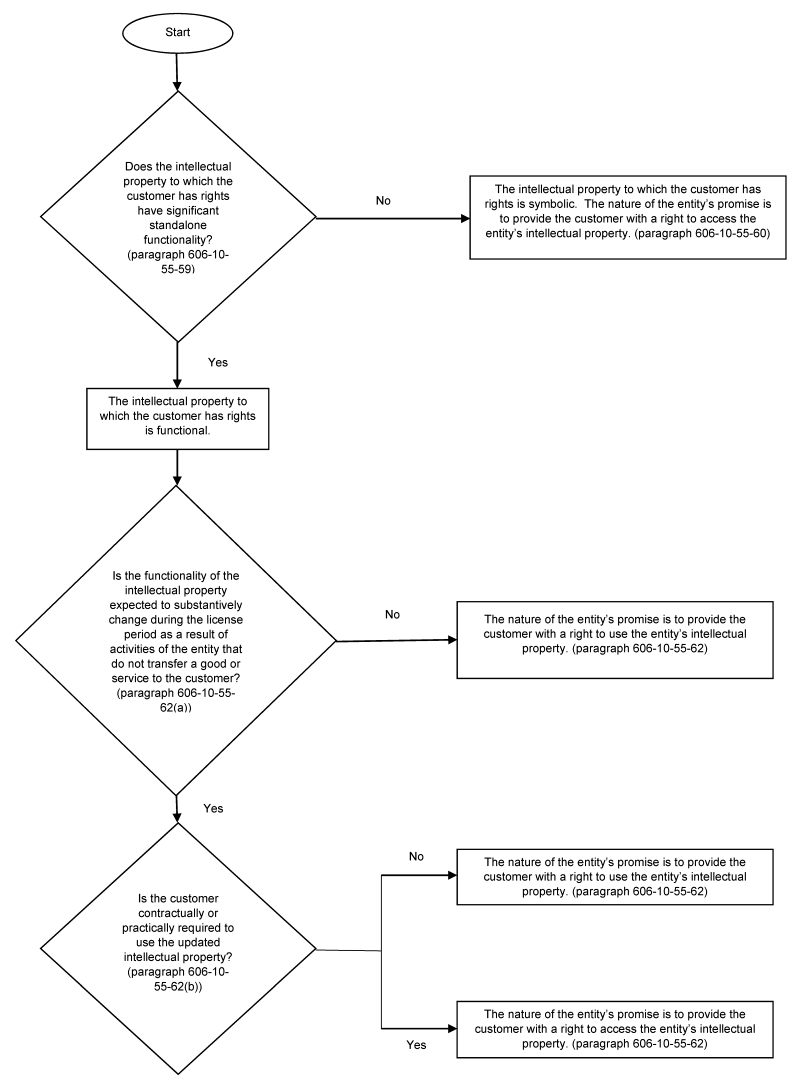 The intellectual property to which the customer has rights is symbolic. The nature of the entity's promise is to provide the customer with a right to access the entity's intellectual property. (paragraph 606-10-55-60) The nature of the entity's promise is to provide the customer with a right to use the entity's intellectual property. (paragraph 606-10-55-62) The nature of the entity's promise is to provide the customer with a right to access the entity's intellectual property. (paragraph 606-10-55-62) The nature of the entity's promise is to provide the customer with a right to use the entity's intellectual property. (paragraph 606-10-55-62) Is the customer contractually or practically required to use the updated intellectual property? (paragraph 606-10-55-62b) Is the functionality of the intellectual property expected to substantively change during the license period as a result of activities of the entity that do not transfer a good or service to the customer? (paragraph 606-10-55-62a) Does the intellectual property to which the customer has rights have significant standalone functionality? (paragraph 606-10-55-59) The intellectual property to which the customer has rights is functional.
- a
- b
- aThe subsequent sale or usage occurs.
- bThe performance obligation to which some or all of the sales-based or usage-based royalty has been allocated has been satisfied (or partially satisfied).
- aAn entity's obligation to repurchase the asset (a forward)
- bAn entity's right to repurchase the asset (a call option)
- cAn entity's obligation to repurchase the asset at the customer's request (a put option).
- aA lease in accordance with Topic 842 on leases, if the entity can or must repurchase the asset for an amount that is less than the original selling price of the asset unless the contract is part of a sale and leaseback transaction. If the contract is part of a sale and leaseback transaction, the entity should account for the contract as a financing arrangement and not as a sale and leaseback transaction in accordance with Subtopic 842-40.
- bA financing arrangement in accordance with paragraph 606-10-55-70, if the entity can or must repurchase the asset for an amount that is equal to or more than the original selling price of the asset.
- aThe product is controlled by the entity until a specified event occurs, such as the sale of the product to a customer of the dealer, or until a specified period expires.
- bThe entity is able to require the return of the product or transfer the product to a third party (such as another dealer).
- cThe dealer does not have an unconditional obligation to pay for the product (although it might be required to pay a deposit).
- aThe reason for the bill-and-hold arrangement must be substantive (for example, the customer has requested the arrangement).
- bThe product must be identified separately as belonging to the customer.
- cThe product currently must be ready for physical transfer to the customer.
- dThe entity cannot have the ability to use the product or to direct it to another customer.
| Editor's Note: The content of paragraph 606-10-55-88A will change upon transition, together with a change in the heading noted below. |
| • > Share-Based Consideration Payable to a Customer |
- aA specified volume of goods or services (including over a specified period of time). This includes performance targets achieved upon the first purchase from the grantor (or the grantor’s customers).
- bA specified monetary amount of goods or services (including over a specified period of time).
- aDisclosures presented outside the financial statements (for example, in earnings releases, annual reports, or investor presentations)
- bInformation regularly reviewed by the chief operating decision maker for evaluating the financial performance of operating segments
- cOther information that is similar to the types of information identified in (a) and (b) and that is used by the entity or users of the entity's financial statements to evaluate the entity's financial performance or make resource allocation decisions.
- aType of good or service (for example, major product lines)
- bGeographical region (for example, country or region)
- cMarket or type of customer (for example, government and nongovernment customers)
- dType of contract (for example, fixed-price and time-and-materials contracts)
- eContract duration (for example, short-term and long-term contracts)
- fTiming of transfer of goods or services (for example, revenue from goods or services transferred to customers at a point in time and revenue from goods or services transferred over time)
- gSales channels (for example, goods sold directly to consumers and goods sold through intermediaries).
Illustrations
- aIdentifying the Contract
- Example 1—Collectibility of the Consideration
- Example 2—Consideration Is Not the Stated Price—Implicit Price Concession
- Example 3—Implicit Price Concession
- Example 4—Reassessing the Criteria for Identifying a Contract
- bContract Modifications
- Example 5—Modification of a Contract for Goods
- Example 6—Change in the Transaction Price after a Contract Modification
- Example 7—Modification of a Services Contract
- Example 8—Modification Resulting in a Cumulative Catch-Up Adjustment to Revenue
- Example 9—Unapproved Change in Scope and Price
- cIdentifying Performance Obligations
- Example 10—Goods and Services Are Not Distinct
- Example 11—Determining Whether Goods or Services Are Distinct
- Example 12—Explicit and Implicit Promises in a Contract
- Example 12A—Series of Distinct Goods or Services
- dPerformance Obligations Satisfied Over Time
- Example 13—Customer Simultaneously Receives and Consumes the Benefits
- Example 14—Assessing Alternative Use and Right to Payment
- Example 15—Asset Has No Alternative Use to the Entity
- Example 16—Enforceable Right to Payment for Performance Completed to Date
- Example 17—Assessing Whether a Performance Obligation Is Satisfied at a Point in Time or Over Time
- eMeasuring Progress toward Complete Satisfaction of a Performance Obligation
- Example 18—Measuring Progress When Making Goods or Services Available
- Example 19—Uninstalled Materials
- fVariable Consideration
- Example 20—Penalty Gives Rise to Variable Consideration
- Example 21—Estimating Variable Consideration
- gConstraining Estimates of Variable Consideration
- Example 22—Right of Return
- Example 23—Price Concessions
- Example 24—Volume Discount Incentive
- Example 25—Management Fees Subject to the Constraint
- hThe Existence of a Significant Financing Component in the Contract
- Example 26—Significant Financing Component and Right of Return
- Example 27—Withheld Payments on a Long-Term Contract
- Example 28—Determining the Discount Rate
- Example 29—Advance Payment and Assessment of the Discount Rate
- Example 30—Advance Payment
- iNoncash Consideration
- Example 31—Entitlement to Noncash Consideration
- jConsideration Payable to a Customer
- Example 32—Consideration Payable to a Customer
- kAllocating the Transaction Price to Performance Obligations
- Example 33—Allocation Methodology
- Example 34—Allocating a Discount
- Example 35—Allocation of Variable Consideration
- lContract Costs
- Example 36—Incremental Costs of Obtaining a Contract
- Example 37—Costs That Give Rise to an Asset
- mPresentation
- Example 38—Contract Liability and Receivable
- Example 39—Contract Asset Recognized for the Entity's Performance
- Example 40—Receivable Recognized for the Entity's Performance
- nDisclosure
- Example 41—Disaggregation of Revenue Quantitative Disclosure
- Example 42—Disclosure of the Transaction Price Allocated to the Remaining Performance Obligations
- Example 43—Disclosure of the Transaction Price Allocated to the Remaining Performance Obligations—Qualitative
- oWarranties
- Example 44—Warranties
- pPrincipal versus Agent Considerations
- Example 45—Arranging for the Provision of Goods or Services (Entity Is an Agent)
- Example 46—Promise to Provide Goods or Services (Entity Is a Principal)
- Example 46A—Promise to Provide Goods or Services (Entity Is a Principal)
- Example 47—Promise to Provide Goods or Services (Entity Is a Principal)
- Example 48—Arranging for the Provision of Goods or Services (Entity Is an Agent)
- Example 48A—Entity Is a Principal and an Agent in the Same Contract
- qCustomer Options for Additional Goods or Services
- Example 49—Option That Provides the Customer with a Material Right (Discount Voucher)
- Example 50—Option That Does Not Provide the Customer with a Material Right (Additional Goods or Services)
- Example 51—Option That Provides the Customer with a Material Right (Renewal Option)
- Example 52—Customer Loyalty Program
- rNonrefundable Upfront Fees
- Example 53—Nonrefundable Upfront Fee
- sLicensing
- Example 54—Right to Use Intellectual Property
- Example 55—License of Intellectual Property
- Example 56—Identifying a Distinct License
- Example 57—Franchise Rights
- Example 58—Access to Intellectual Property
- Example 59—Right to Use Intellectual Property
- Example 60—Sales-Based Royalty Promised in Exchange for a License of Intellectual Property and Other Goods and Services
- Example 61—Access to Intellectual Property
- Example 61A—Right to Use Intellectual Property
- Example 61B—Distinguishing Multiple Licenses from Attributes of a Single License
- tRepurchase Agreements
- Example 62—Repurchase Agreements
- uBill-and-Hold Arrangements
- Example 63—Bill-and-Hold Arrangement
- aIdentifying the Contract
- Example 1—Collectibility of the Consideration
- Example 2—Consideration Is Not the Stated Price—Implicit Price Concession
- Example 3—Implicit Price Concession
- Example 4—Reassessing the Criteria for Identifying a Contract
- bContract Modifications
- Example 5—Modification of a Contract for Goods
- Example 6—Change in the Transaction Price after a Contract Modification
- Example 7—Modification of a Services Contract
- Example 8—Modification Resulting in a Cumulative Catch-Up Adjustment to Revenue
- Example 9—Unapproved Change in Scope and Price
- cIdentifying Performance Obligations
- Example 10—Goods and Services Are Not Distinct
- Example 11—Determining Whether Goods or Services Are Distinct
- Example 12—Explicit and Implicit Promises in a Contract
- Example 12A—Series of Distinct Goods or Services
- dPerformance Obligations Satisfied Over Time
- Example 13—Customer Simultaneously Receives and Consumes the Benefits
- Example 14—Assessing Alternative Use and Right to Payment
- Example 15—Asset Has No Alternative Use to the Entity
- Example 16—Enforceable Right to Payment for Performance Completed to Date
- Example 17—Assessing Whether a Performance Obligation Is Satisfied at a Point in Time or Over Time
- eMeasuring Progress toward Complete Satisfaction of a Performance Obligation
- Example 18—Measuring Progress When Making Goods or Services Available
- Example 19—Uninstalled Materials
- fVariable Consideration
- Example 20—Penalty Gives Rise to Variable Consideration
- Example 21—Estimating Variable Consideration
- gConstraining Estimates of Variable Consideration
- Example 22—Right of Return
- Example 23—Price Concessions
- Example 24—Volume Discount Incentive
- Example 25—Management Fees Subject to the Constraint
- hThe Existence of a Significant Financing Component in the Contract
- Example 26—Significant Financing Component and Right of Return
- Example 27—Withheld Payments on a Long-Term Contract
- Example 28—Determining the Discount Rate
- Example 29—Advance Payment and Assessment of the Discount Rate
- Example 30—Advance Payment
- iNoncash Consideration
- Example 31—Entitlement to Noncash Consideration
- Example 31A—Share-Based Noncash Consideration
- jConsideration Payable to a Customer
- Example 32—Consideration Payable to a Customer
- kAllocating the Transaction Price to Performance Obligations
- Example 33—Allocation Methodology
- Example 34—Allocating a Discount
- Example 35—Allocation of Variable Consideration
- lContract Costs
- Example 36—Incremental Costs of Obtaining a Contract
- Example 37—Costs That Give Rise to an Asset
- mPresentation
- Example 38—Contract Liability and Receivable
- Example 39—Contract Asset Recognized for the Entity's Performance
- Example 40—Receivable Recognized for the Entity's Performance
- nDisclosure
- Example 41—Disaggregation of Revenue Quantitative Disclosure
- Example 42—Disclosure of the Transaction Price Allocated to the Remaining Performance Obligations
- Example 43—Disclosure of the Transaction Price Allocated to the Remaining Performance Obligations—Qualitative
- oWarranties
- Example 44—Warranties
- pPrincipal versus Agent Considerations
- Example 45—Arranging for the Provision of Goods or Services (Entity Is an Agent)
- Example 46—Promise to Provide Goods or Services (Entity Is a Principal)
- Example 46A—Promise to Provide Goods or Services (Entity Is a Principal)
- Example 47—Promise to Provide Goods or Services (Entity Is a Principal)
- Example 48—Arranging for the Provision of Goods or Services (Entity Is an Agent)
- Example 48A—Entity Is a Principal and an Agent in the Same Contract
- qCustomer Options for Additional Goods or Services
- Example 49—Option That Provides the Customer with a Material Right (Discount Voucher)
- Example 50—Option That Does Not Provide the Customer with a Material Right (Additional Goods or Services)
- Example 51—Option That Provides the Customer with a Material Right (Renewal Option)
- Example 52—Customer Loyalty Program
- rNonrefundable Upfront Fees
- Example 53—Nonrefundable Upfront Fee
- sLicensing
- Example 54—Right to Use Intellectual Property
- Example 55—License of Intellectual Property
- Example 56—Identifying a Distinct License
- Example 57—Franchise Rights
- Example 58—Access to Intellectual Property
- Example 59—Right to Use Intellectual Property
- Example 60—Sales-Based Royalty Promised in Exchange for a License of Intellectual Property and Other Goods and Services
- Example 61—Access to Intellectual Property
- Example 61A—Right to Use Intellectual Property
- Example 61B—Distinguishing Multiple Licenses from Attributes of a Single License
- tRepurchase Agreements
- Example 62—Repurchase Agreements
- uBill-and-Hold Arrangements
- Example 63—Bill-and-Hold Arrangement
- aParagraph 606-10-25-1(e) and paragraphs on assessing collectibility (Example 1)
- bThe interaction of paragraph 606-10-25-1 with paragraphs 606-10-32-2 and 606-10-32-7 on estimating variable consideration (Examples 2 and 3)
- cParagraph 606-10-55-65 on consideration in the form of sales-based or usage-based royalties on licenses of intellectual property (Example 4).
- aThe customer intends to repay the loan (which has a significant balance) primarily from income derived from its restaurant business (which is a business facing significant risks because of high competition in the industry and the customer's limited experience).
- bThe customer lacks other income or assets that could be used to repay the loan.
- cThe customer's liability under the loan is limited because the loan is nonrecourse.
- aParagraphs on identifying performance obligations (Examples 7 and 8)
- bParagraphs on constraining estimates of variable consideration (Examples 6, 8, and 9)
- cParagraphs on changes in the transaction price (Example 6).
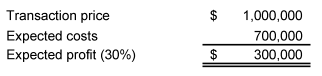 Transaction price " $1,000,000 " Expected costs " 700,000 " Expected profit (30%) " $300,000 "
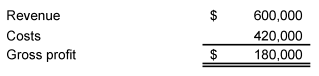 Revenue " $600,000 " Costs " 420,000 " Gross profit " $180,000 "
- aThe software license
- bAn installation service
- cSoftware updates
- dTechnical support.
- aSoftware customization which is comprised of the license to the software and the customized installation service
- bSoftware updates
- cTechnical support.
- aThe entity is not providing a significant integration service. That is, the entity has promised to deliver the equipment and then install it; the entity would be able to fulfill its promise to transfer the equipment separately from its promise to subsequently install it. The entity has not promised to combine the equipment and the installation services in a way that would transform them into a combined output.
- bThe entity's installation services will not significantly customize or significantly modify the equipment.
- cAlthough the customer can benefit from the installation services only after it has obtained control of the equipment, the installation services do not significantly affect the equipment because the entity would be able to fulfill its promise to transfer the equipment independently of its promise to provide the installation services. Because the equipment and the installation services do not each significantly affect the other, they are not highly interdependent or highly interrelated.
- aThe equipment
- bThe consumables.
- aParagraphs 606-10-25-27(a) and on when a customer simultaneously receives and consumes the benefits provided by the entity's performance as the entity performs (Examples 13 and 14)
- bParagraphs 606-10-25-27(c) and and on an entity's performance that does not create an asset with an alternative use and an entity's enforceable right to payment for performance completed to date (Examples 14-17)
- cParagraph 606-10-25-30 on performance obligations satisfied at a point in time (Example 17).
- aIn accordance with paragraphs 606-10-25-28 and , the development of the professional opinion does not create an asset with alternative use to the entity because the professional opinion relates to facts and circumstances that are specific to the customer. Therefore, there is a practical limitation on the entity's ability to readily direct the asset to another customer.
- bIn accordance with paragraphs 606-10-25-29 and , the entity has an enforceable right to payment for its performance completed to date for its costs plus a reasonable margin, which approximates the profit margin in other contracts.
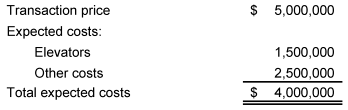 Transaction price " $5,000,000 " Expected costs: Elevators " 1,500,000 " Other costs " 2,500,000 " Total expected costs " $4,000,000 "
- aOther costs incurred (excluding elevators) are$500,000.
- bPerformance is 20% complete (that is, $500,000 ÷ $2,500,000).
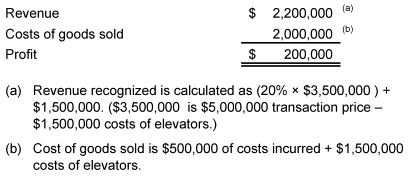 Revenue " $2,200,000 " (a) Costs of goods sold " 2,000,000 " (b) Profit " $200,000 " (a) "Revenue recognized is calculated as (20% × $3,500,000 ) + $1,500,000. ($3,500,000 is $5,000,000 transaction price - $1,500,000 costs of elevators.)" (b) "Cost of goods sold is $500,000 of costs incurred + $1,500,000 costs of elevators."
- aThe entity decides to use the expected value method to estimate the variable consideration associated with the daily penalty or incentive (that is, $2.5 million, plus or minus $10,000 per day). This is because it is the method that the entity expects to better predict the amount of consideration to which it will be entitled.
- bThe entity decides to use the most likely amount to estimate the variable consideration associated with the incentive bonus. This is because there are only 2 possible outcomes ($150,000 or $0) and it is the method that the entity expects to better predict the amount of consideration to which it will be entitled.
- aParagraph 606-10-32-10 on refund liabilities (Example 22)
- bParagraphs on sales with a right of return (Example 22)
- cParagraphs on allocating variable consideration to performance obligations (Example 25).
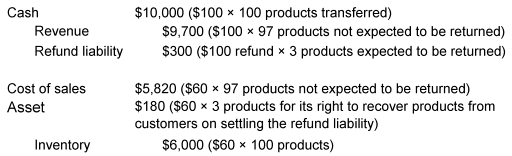 Cash "$10,000 ($100 × 100 products transferred)" Revenue "$9,700 ($100 × 97 products not expected to be returned)" Refund liability $300 ($100 refund × 3 products expected to be returned) Cost of sales "$5,820 ($60 × 97 products not expected to be returned)" Asset $180 ($60 × 3 products for its right to recover products from customers on settling the refund liability) Inventory "$6,000 ($60 × 100 products)"
- aParagraphs on constraining estimates of variable consideration
- bParagraphs on sales with a right of return.
- aWhen the product is transferred to the customer, in accordance with paragraph 606-10-55-23.
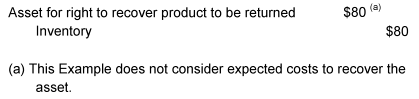 Asset for right to recover product to be returned $80 (a) Inventory $80 (a) This Example does not consider expected costs to recover the asset.
- bDuring the three-month right of return period, no interest is recognized in accordance with paragraph 606-10-32-20 because no contract asset or receivable has been recognized.
- cWhen the right of return lapses (the product is not returned).
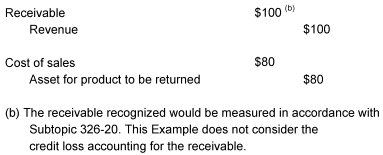 Receivable $100 (b) Revenue $100 Cost of sales $80 Asset for product to be returned $80 (b) The receivable recognized would be measured in accordance with Subtopic 326-20. This Example does not consider the credit loss accounting for the receivable.
- aRecognize a contract liability for the $4,000 payment received at contract inception.
 Cash "$4,000 " Contract liability "$4,000 "
- bDuring the 2 years from contract inception until the transfer of the asset, the entity adjusts the promised amount of consideration (in accordance with paragraph 606-10-32-20) and accretes the contract liability by recognizing interest on $4,000 at 6 percent for 2 years.
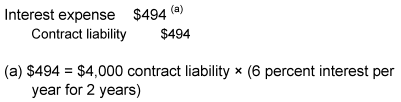 Interest expense $494 (a) Contract liability $494 "(a) $494 = $4,000 contract liability × (6 percent interest per" year for 2 years)
- cRecognize revenue for the transfer of the asset.
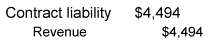 Contract liability "$4,494 " Revenue "$4,494 "
- aParagraph 606-10-25-14 on identifying performance obligations
- bParagraphs on constraining estimates of variable consideration.
- aParagraph 606-10-25-14 on identifying performance obligations
- bParagraphs on constraining estimates of variable consideration.
- aParagraph 606-10-25-14 on identifying performance obligations
- bParagraph 606-10-32-4 on determining transaction price
- cParagraphs on variable consideration
- dParagraphs on allocating transaction price to the performance obligations in the contract
- eParagraph 606-10-45-4 on an unconditional right to consideration.
- aParagraph 606-10-32-8 on variable consideration
- bParagraph 606-10-55-65 on consideration in the form of sales-based or usage-based royalties on licenses of intellectual property.
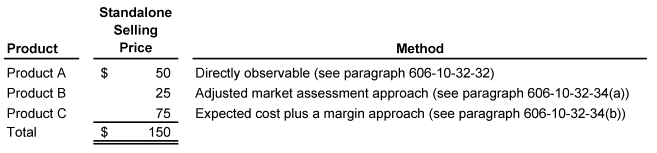 Product Standalone Selling Price Method Product A $50 Directly observable (see paragraph 606-10-32-32) Product B 25 Adjusted market assessment approach (see paragraph 606-10-32-34(a)) Product C 75 Expected cost plus a margin approach (see paragraph 606-10-32-34(b)) Total $150
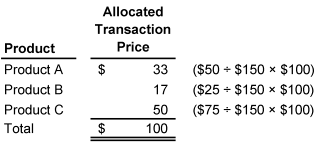 Product Allocated Transaction Price Product A $33 ($50 ÷ $150 × $100) Product B 17 ($25 ÷ $150 × $100) Product C 50 ($75 ÷ $150 × $100) Total $100
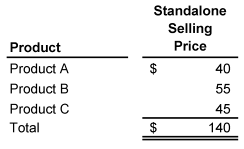 Product "Standalone Selling Price" Product A $40 Product B 55 Product C 45 Total $140
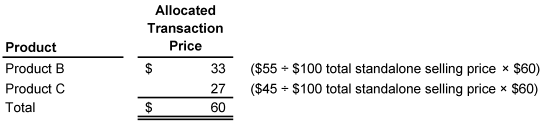 Product Allocated Transaction Price Product B $33 ($55 ÷ $100 total standalone selling price × $60) Product C 27 ($45 ÷ $100 total standalone selling price × $60) Total $60
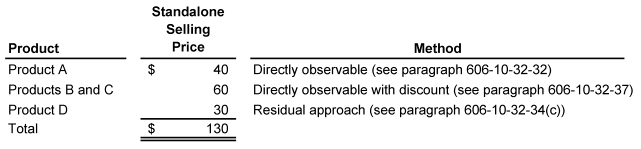 Product "Standalone Selling Price" Method Product A $40 Directly observable (see paragraph 606-10-32-32) Products B and C 60 Directly observable with discount (see paragraph 606-10-32-37) Product D 30 Residual approach (see paragraph 606-10-32-34(c)) Total $130
- aThe variable payment relates specifically to an outcome from the performance obligation to transfer License Y (that is, the customer's subsequent sales of products that use License Y).
- bAllocating the expected royalty amounts of $1,000 entirely to License Y is consistent with the allocation objective in paragraph 606-10-32-28. This is because the entity's estimate of the amount of sales-based royalties ($1,000) approximates the standalone selling price of License Y and the fixed amount of $800 approximates the standalone selling price of License X. The entity allocates $800 to License X in accordance with paragraph 606-10-32-41. This is because, based on an assessment of the facts and circumstances relating to both licenses, allocating to License Y some of the fixed consideration in addition to all of the variable consideration would not meet the allocation objective in paragraph 606-10-32-28.
- aThe entity receives cash of $1,000 on March 1, 20X9 (cash is received in advance of performance).
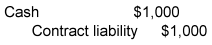 Cash "$1,000 " Contract liability "$1,000 "
- bThe entity satisfies the performance obligation on March 31, 20X9.
 Contract liability "$1,000 " Revenue "$1,000 "
- aJanuary 31, 20X9 is the date at which the entity recognizes a receivable because it has an unconditional right to consideration.
 Receivable "$1,000 " Contract liability "$1,000 "
- bThe entity receives the cash on March 1, 20X9.
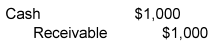 Cash "$1,000 " Receivable "$1,000 "
- cThe entity satisfies the performance obligation on March 31, 20X9.
 Contract liability "$1,000 " Revenue "$1,000 "
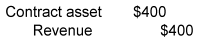 Contract asset $400 Revenue $400
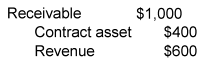 Receivable "$1,000 " Contract asset $400 Revenue $600
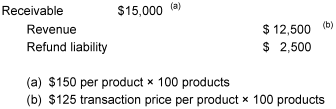 Receivable "$15,000 (a)" Revenue " $12,500 " (b) Refund liability " $2,500 " (a) $150 per product × 100 products (b) $125 transaction price per product × 100 products
- aParagraph 606-10-32-12 on constraining estimates of variable consideration
- bParagraph 606-10-55-18 on methods for measuring progress toward complete satisfaction of a performance obligation.
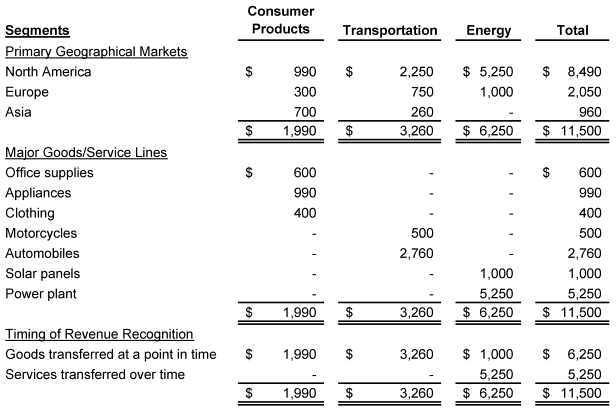 Segments Consumer Products Transportation Energy Total Primary Geographical Markets North America $990 " $2,250 " " $5,250 " " $8,490 " Europe 300 750 " 1,000 " " 2,050 " Asia 700 260 - 960 " $1,990 " " $3,260 " " $6,250 " " $11,500 " Major Goods/Service Lines Office supplies $600 - - $600 Appliances 990 - - 990 Clothing 400 - - 400 Motorcycles - 500 - 500 Automobiles - " 2,760 " - " 2,760 " Solar panels - - " 1,000 " " 1,000 " Power plant - - " 5,250 " " 5,250 " " $1,990 " " $3,260 " " $6,250 " " $11,500 " Timing of Revenue Recognition Goods transferred at a point in time " $1,990 " " $3,260 " " $1,000 " " $6,250 " Services transferred over time - - " 5,250 " " 5,250 " " $1,990 " " $3,260 " " $6,250 " " $11,500 "
 20X8 20X9 Total "Revenue expected to be recognized on this contract as of December 31, 20X7" " $4,800 " (a) " $2,400 " (b) " $7,200 " (a) " $4,800 = $400 × 12 months" (b) "$2,400 = $400 × 6 months"
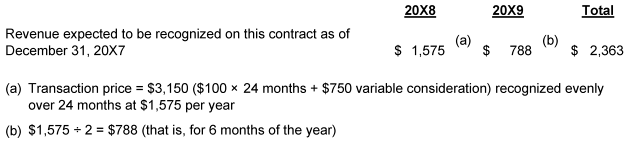 20X8 20X9 Total "Revenue expected to be recognized on this contract as of December 31, 20X7" " $1,575 " (a) $788 (b) " $2,363 " (a) "Transaction price = $3,150 ($100 × 24 months + $750 variable consideration) recognized evenly over 24 months at $1,575 per year" (b) "$1,575 ÷ 2 = $788 (that is, for 6 months of the year)"
- As of December 31, 20X2, the aggregate amount of the transaction price allocated to the remaining performance obligation is $6.8 million, and the entity will recognize this revenue as the building is completed, which is expected to occur over the next 12-18 months.
- a
- b
- c
- d
- e
- aThe supplier is primarily responsible for fulfilling the promise to provide the goods to the customer. The entity is neither obliged to provide the goods if the supplier fails to transfer the goods to the customer nor responsible for the acceptability of the goods.
- bThe entity does not take inventory risk at any time before or after the goods are transferred to the customer. The entity does not commit to obtain the goods from the supplier before the goods are purchased by the customer and does not accept responsibility for any damaged or returned goods.
- cThe entity does not have discretion in establishing prices for the supplier's goods. The sales price is set by the supplier.
- a
- b
- c
- d
- e
- aThe entity is primarily responsible for fulfilling the promise to provide office maintenance services. Although the entity has hired a service provider to perform the services promised to the customer, it is the entity itself that is responsible for ensuring that the services are performed and are acceptable to the customer (that is, the entity is responsible for fulfilment of the promise in the contract, regardless of whether the entity performs the services itself or engages a third-party service provider to perform the services).
- bThe entity has discretion in setting the price for the services to the customer.
- a
- b
- c
- d
- a
- b
- c
- d
- aThe vouchers are created only at the time that they are transferred to the customers and, thus, do not exist before that transfer. Therefore, the entity does not at any time have the ability to direct the use of the vouchers or obtain substantially all of the remaining benefits from the vouchers before they are transferred to customers.
- bThe entity neither purchases nor commits itself to purchase vouchers before they are sold to customers. The entity also has no responsibility to accept any returned vouchers. Therefore, the entity does not have inventory risk with respect to the vouchers as described in the indicator in paragraph 606-10-55-39(b).
- aThe entity is not responsible for fulfilling the promise to provide the database access service. The customer contracts for the license directly with the third-party database provider, and the database provider is responsible for the acceptability of the database access (for example, by providing technical support or service credits).
- bThe entity does not have inventory risk because it does not purchase or commit to purchase the database access before the customer contracts for database access directly with the database provider.
- cThe entity does not have discretion in setting the price for the database access with the customer because the database provider sets that price.
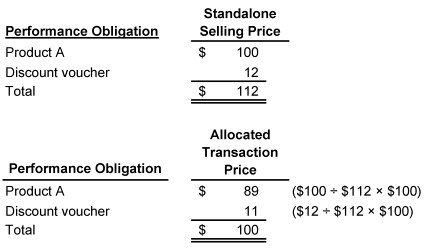 Performance Obligation "Standalone Selling Price" Product A $100 Discount voucher 12 Total $112 Performance Obligation Allocated Transaction Price Product A $89 ($100 ÷ $112 × $100) Discount voucher 11 ($12 ÷ $112 × $100) Total $100
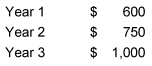 Year 1 $600 Year 2 $750 Year 3 " $1,000 "
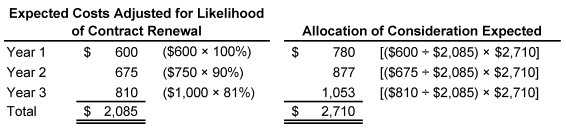 Expected Costs Adjusted for Likelihood of Contract Renewal Allocation of Consideration Expected Year 1 $600 ($600 × 100%) $780 "[($600 ÷ $2,085) × $2,710]" Year 2 675 ($750 × 90%) 877 "[($675 ÷ $2,085) × $2,710]" Year 3 810 "($1,000 × 81%)" " 1,053 " "[($810 ÷ $2,085) × $2,710]" Total " $2,085 " " $2,710 "
 Product "$91,324 [$100,000 × ($100,000 standalone selling price ÷ $109,500)]" Points "$8,676 [$100,000 × ($9,500 standalone selling price ÷ $109,500)]"
- aParagraphs on measuring progress toward complete satisfaction of a performance obligation (Examples 57 and 58)
- bParagraphs on allocating variable consideration to performance obligations (Example 57)
- cParagraphs 606-10-55-65 through 55-65B on consideration in the form of sales-based or usage-based royalties on licenses of intellectual property (Examples 57 and 61).
- aThe software license
- bInstallation services
- cSoftware updates
- dTechnical support.
- aLicense of patent rights
- bManufacturing service.
- aThe franchise license
- bThe equipment.
- a
- b
- c
- a
- b
- c
- aThe classical symphony recording has significant standalone functionality because the recording can be played in its present, completed form without the entity's further involvement. The customer can derive substantial benefit from that functionality regardless of the entity's further activities or actions. Therefore, the nature of the licensed intellectual property is functional.
- bThe contract does not require, and the customer does not reasonably expect, that the entity will undertake activities to change the licensed recording.
- a
- b
- c
- aThe license to the existing episodes (see paragraph 606-10-55-399C)
- bThe license to the episodes comprising Season 5, when all of those episodes are completed.
- aEach license is capable of being distinct because the customer can benefit from its right to air the existing completed episodes on their own and can benefit from the right to air the episodes comprising Season 5, when they are all completed, on their own and together with the right to air the existing completed content.
- bEach of the two promises to transfer a license in the contract also is separately identifiable; they do not, together, constitute a single overall promise to the customer. The existing episodes do not modify or customize the Season 5 episodes in production, and the existing episodes do not, together with the pending Season 5 episodes, result in a combined functionality or changed content. The right to air the existing content and the right to air the Season 5 content, when available, are not highly interdependent or highly interrelated because the entity's ability to fulfill its promise to transfer either license is unaffected by its promise to transfer the other. In addition, whether the customer or another licensee had rights to air the future episodes would not be expected to significantly affect the customer's license to air the existing, completed episodes (for example, viewers' desire to watch existing episodes from Seasons 1-4 on the customer's network generally would not be significantly affected by whether the customer, or another network, had the right to broadcast the episodes that will comprise Season 5).
- aThe licensed intellectual property (that is, the completed episodes in Seasons 1-4 and the episodes in Season 5, when completed) has significant standalone functionality separate from the entity's ongoing business activities, such as in producing additional intellectual property (for example, future seasons) or in promoting the show, and completed episodes can be aired without the entity's further involvement.
- bThere is no expectation that the entity will substantively change any of the content once it is made available to the customer for broadcast (that is, the criteria in paragraph 606-10-55-62 are not met).
- cThe activities expected to be undertaken by the entity to produce Season 5 and transfer the right to air those episodes constitute an additional promised good (license) in the contract and, therefore, do not affect the nature of the entity's promise in granting the license to Seasons 1-4.
606-10-60Relationships
Source downloaded: .Record version 73599d342bea. Effective date must be checked in the source.
Costs Related to a Contract with a Customer
Revenue Recognition
Provision for Losses
Interest—Imputation of Interest
Nonmonetary Transactions
606-10-65Transition and Open Effective Date Information
Source downloaded: .Record version 636b86d9df01. Effective date must be checked in the source.
Transition Related to Accounting Standards Update No. 2025-04, <em class="ph i">Compensation—Stock Compensation (Topic 718) and Revenue from Contracts with Customers (Topic 606): Clarifications to Share-Based Consideration Payable to a Customer</em>
- aAll entities shall apply the pending content that links to this paragraph for annual reporting periods beginning after December 15, 2026, and interim reporting periods within those annual reporting periods.
- bEarly adoption of the pending content that links to this paragraph is permitted in an interim or annual reporting period in which financial statements have not yet been issued (or made available for issuance). If an entity adopts the pending content that links to this paragraph in an interim reporting period, it shall adopt the pending content as of the beginning of the annual reporting period that includes that interim reporting period.
- cAn entity shall apply the pending content that links to this paragraph using one of the following transition methods:
- 1On a modified retrospective basis through a cumulative-effect adjustment to the opening balance of retained earnings (or other appropriate components of equity or net assets in the statement of financial position) as of the beginning of the annual reporting period in which the pending content that links to this paragraph is adopted.
- 2On a retrospective basis through a cumulative-effect adjustment to the opening balance of retained earnings (or other appropriate components of equity or net assets in the statement of financial position) as of the beginning of the first period presented in accordance with the guidance on accounting changes in paragraphs 250-10-45-5 and 250-10-45-8. If retrospective transition is applied, an entity shall use the actual outcome, if known, of a performance condition or service condition as of the beginning of the annual reporting period in which the pending content that links to this paragraph is adopted for all prior-period estimates. If the actual outcome is unknown, an entity shall use its estimate of the probability of achieving a service condition or performance condition as of the beginning of the annual reporting period of adoption for all prior-period estimates.
- 1
- dAn entity applying the pending content that links to this paragraph in accordance with (c)(1) shall provide the following transition disclosures in the financial statements of both the interim reporting period (if applicable) and the annual reporting period of the change:
- 1The nature of the change in accounting principle, including an explanation of the newly adopted accounting principle
- 2The method of applying the change
- 3The cumulative effect of the change on retained earnings or other components of equity in the statement of financial position as of the annual reporting period in which the pending content that links to this paragraph is adopted.
- 1
- eAn entity applying the pending content that links to this paragraph in accordance with (c)(2) shall provide the following transition disclosures in the financial statements of both the interim reporting period (if applicable) and the annual reporting period of the change:
- 1The nature of the change in accounting principle, including an explanation of the newly adopted accounting principle
- 2The method of applying the change
- 3The cumulative effect of the change on retained earnings or other components of equity in the statement of financial position as of the beginning of the earliest period presented
- 4The effect of the change on income from continuing operations, net income (or other appropriate captions of changes in the applicable net assets or performance indicator), any other affected financial statement line item, and any affected per-share amounts for any prior periods retrospectively adjusted.
- 1
Transition Related to Accounting Standards Update No. 2025-07, <em class="ph i">Derivatives and Hedging (Topic 815) and Revenue from Contracts with Customers (Topic 606): Derivatives Scope Refinements and Scope Clarification for Share-Based Noncash Consideration from a Customer in a Revenue Contract</em>
- aAll entities shall apply the pending content that links to this paragraph for annual reporting periods beginning after December 15, 2026, and interim reporting periods within those annual reporting periods.
- bEarly adoption of the pending content that links to this paragraph is permitted in both interim and annual reporting periods for which financial statements have not yet been issued or made available for issuance. If an entity early adopts the pending content that links to this paragraph in an interim reporting period, it shall apply the pending content as of the beginning of the annual reporting period that includes that interim reporting period. If an entity early adopts the pending content that links to this paragraph, it also shall early adopt the pending content that links to paragraph 815-10-65-8 simultaneously.
- cAn entity shall apply the pending content that links to this paragraph using one of the following transition methods:
- 1Prospectively to new contracts entered into on or after the date of adoption, including modified contracts accounted for as separate contracts in accordance with paragraph 606-10-25-12
- 2On a modified retrospective basis through a cumulative-effect adjustment to the opening balance of retained earnings (or other appropriate components of equity or net assets in the statement of financial position) as of the beginning of the annual reporting period of adoption for contracts existing as of the beginning of the annual reporting period of adoption.
- 1
- dAn entity that applies the transition method in (c)(1) shall disclose the nature of and reason for the change in accounting principle in both the interim reporting period and the annual reporting period in which the entity adopts the pending content that links to this paragraph.
- eAn entity that applies the transition method in (c)(2) shall disclose the following in both the interim reporting period and the annual reporting period in which the entity adopts the pending content that links to this paragraph:
- 1The nature of and reason for the change in accounting principle
- 2The cumulative effect of the change on retained earnings or other components of equity or net assets in the statement of financial position as of the beginning of the annual reporting period of adoption.
- 1
606-10-S00StatusSEC
Source downloaded: .Record version 9769c8233211. Effective date must be checked in the source.
| Paragraph | Action | Accounting Standards Update | Date |
| 606-10-S25-1 | Added | Accounting Standards Update No. 2017-14 | 11/22/2017 |
| 606-10-S65-1 | Added | Accounting Standards Update No. 2017-13 | 09/29/2017 |
606-10-S25RecognitionSEC
Source downloaded: .Record version 235018f1073c. Effective date must be checked in the source.
- AGENCY: Securities and Exchange Commission.
- ACTION: Interpretation.
- SUMMARY: The Securities and Exchange Commission is publishing this interpretive release to update previously issued guidance with respect to accounting for sales of vaccines and bioterror countermeasures to the Federal Government for placement into stockpiles related to the Vaccines for Children Program or the Strategic National Stockpile. This update is being provided to bring existing guidance into conformity with Financial Accounting Standards Board's Accounting Standards Codification Topic 606, Revenue from Contracts with Customers. This guidance is applicable upon a registrant's adoption of Accounting Standards Codification Topic 606 and is applicable to all arrangements for which revenue is recognized in accordance with Accounting Standards Codification Topic 606.
- EFFECTIVE DATE: August 29, 2017.
- FOR FURTHER INFORMATION CONTACT: Kevin L. Vaughn, Senior Associate Chief Accountant, or Joseph R. Epstein, Professional Accounting Fellow, Office of the Chief Accountant, at (202) 551-5300, U.S. Securities and Exchange Commission, 100 F Street, NE, Washington, DC 20549-6561. Inquiries about this interpretive release also can be directed to oca@sec.gov.
- SUPPLEMENTARY INFORMATION:
- I. Introduction
- The Securities and Exchange Commission (“Commission”) continues to be committed, as stated in previously-issued guidance (the “2005 Release”), FN1 to addressing any unintended consequences of accounting requirements that could impair the nation's ability to create and maintain sufficient supplies of various vaccines and bioterror countermeasures (“enumerated vaccines”). The Commission issued the 2005 Release to address questions about the timing of revenue recognition for vaccines placed into the Vaccines for Children Program and the Strategic National Stockpile. At the time of the 2005 Release, some expressed concerns that the application of generally accepted accounting principles may require revenue recognition to be delayed beyond the period in which the vaccine is placed in the stockpile, and may have an unintended consequence of causing some vaccine manufacturers to decline to participate in these critical stockpile programs. The Commission published the guidance in the 2005 Release to resolve the accounting questions. With the Financial Accounting Standards Board's (“FASB”) issuance of Accounting Standards Codification (“ASC”) Topic 606, Revenues from Contracts with Customers (“ASC Topic 606”), FN2 we are providing this updated guidance.
- FN1 See Commission Guidance Regarding Accounting for Sales of Vaccines and Bioterror Countermeasures to the Federal Government for Placement into the Pediatric Vaccine Stockpile or the Strategic National Stockpile, Release No. 33-8642 (Dec. 5, 2005).
- FN2 The International Accounting Standards Board (IASB) has also issued IFRS 15, Revenue from Contracts with Customers (IFRS 15). The issuance of ASC Topic 606 and IFRS 15 completes the joint effort by the FASB and IASB that was undertaken with the intent of improving financial reporting by creating converged comprehensive revenue recognition guidance for U.S. GAAP and IFRS.
-
- Government vaccine stockpile programs are unique in many respects. For example, the primary objective of purchasing the vaccines is not to take delivery for ultimate use but rather to be able to require immediate delivery on notice. An additional characteristic of vaccine stockpiles is the limited shelf life of the vaccines. For these and other reasons, the Commission continues to limit this guidance to the vaccines enumerated below.
- II. The Application of Generally Accepted Accounting Principles for Revenue Recognition to Vaccine Stockpiles
- The Commission historically has recognized pronouncements of the FASB as authoritative in the absence of any contrary determination by the Commission. FN3 In Financial Reporting Release No. 70, FN4 the Commission stated its determination that the FASB and its parent organization, the Financial Accounting Foundation, satisfied the criteria in Section 19(b) of the Securities Act of 1933 FN5 and, accordingly, FASB's financial accounting and reporting standards are recognized as “generally accepted” for purposes of the federal securities laws. As a result, registrants are required to comply with those standards in preparing financial statements filed with the Commission, unless the Commission provides otherwise. FN6
- FN3 Rule 4-01(a)(1) of Regulation S-X, 17 CFR 210.4-01(a)(1). See Accounting Series Release (“ASR”) No. 150 (Dec. 20, 1973) and ASR No. 4 (Apr. 25, 1938).
- FN4 Policy Statement: Reaffirming the Status of the FASB as a Designated Private-Sector Standard Setter, Release Nos. 33-8221; 34-47743; IC-26028; FR-70 (Apr. 25, 2003) (“FR-70”); 68 FR 23333 (May 1, 2003).
- FN5 15 U.S.C 77s(b).
- FN6 See FR-70; Rule 4-01(a)(1) of Regulation S-X, 17 CFR 210.4-01(a)(1).
-
- Although no specific guidance has been published by the FASB related to revenue recognition for vaccine stockpiles, the FASB has issued comprehensive revenue recognition guidance in ASC Topic 606, which supersedes most previous revenue recognition guidance issued by the FASB.
- In response to the new, comprehensive revenue recognition model in ASC Topic 606, simultaneous with publication of this release, the Commission has issued an interpretation stating FN7 that upon the registrant's adoption of ASC Topic 606, such registrant should no longer rely on the guidance in Securities Exchange Act Release No. 23507 and Accounting and Auditing Enforcement Release No. 108, In the Matter of Stewart Parness (“AAER 108”), FN8 which set forth criteria to be met in order to recognize revenue when delivery has not occurred. The Commission staff had previously reiterated the guidance in AAER 108 in Staff Accounting Bulletin (“SAB”) Topic 13, Revenue Recognition, which the staff is modifying as a result of the FASB's issuance of ASC Topic 606.
- FN7 Commission Guidance Regarding Revenue Recognition for Bill-and-Hold Arrangements, Release No. 33-10402 (Aug. 18, 2017).
- FN8 See In the Matter of Stewart Parness, AAER 108 (Aug. 5, 1986).
-
- Under ASC Topic 606, the general criteria for revenue recognition includes identifying the contract(s) with a customer, identifying the performance obligations in the contract, determining the transaction price, allocating the transaction price to the performance obligations in the contract, and recognizing revenue when (or as) the entity satisfies a performance obligation by transferring a promised good or service to a customer. FN9 A good or service is transferred when (or as) the customer obtains control of that good or service and ASC Topic 606 sets forth indicators of when control has been transferred. FN10
- FN9 See ASC paragraph 606-10-05-4.
- FN10 See ASC paragraphs .
-
- ASC Topic 606 also provides specific guidance on contracts under which an entity bills a customer for a product but the entity retains physical possession of the product until it is transferred to the customer at a point in time in the future (i.e., a bill-and-hold arrangement). FN11 Topic 606 acknowledges that, for some contracts, a customer may obtain control of a product even though that product remains in an entity's physical possession. FN12 In order to recognize revenue in a bill-and-hold arrangement, Topic 606 requires consideration of the indicators of when control has been transferred and sets forth additional criteria to be met. FN13
- FN11 See ASC paragraphs .
- FN12 See ASC paragraph 606-10-55-82.
- FN13 See ASC paragraph 606-10-55-83.
-
- III. Updated Commission Guidance
- The Commission believes vaccine manufacturers should recognize revenue and provide the disclosures required under ASC Topic 606 when vaccines are placed into Federal Governmental stockpile programs because control of the enumerated vaccines will have been transferred to the customer and the criteria to recognize revenue in a bill-and-hold arrangement under ASC Topic 606 will have been met.
- The following are the enumerated vaccines subject to this release:
- • Childhood disease vaccines;
- • Influenza vaccines; and
- • Other vaccines and countermeasures sold to the Federal Government for placement in the Strategic National Stockpile.
-
- Due to the uniqueness of the vaccine stockpile programs as discussed above, this interpretative guidance is not applicable to transactions other than the sales of enumerated vaccines by vaccine manufacturers.
- Prior to a registrant's adoption of ASC Topic 606, the guidance contained in the 2005 Release is still applicable to all arrangements for which revenue is recognized.
- List of Subjects
- 17 CFR Parts 231, 241, and 271
- Securities.
- Amendments to the Code of Federal Regulations
- For the reasons set out in the preamble, the Commission is amending Title 17, chapter II of the Code of Federal Regulations as set forth below:
- PART 231 - INTERPRETATIVE RELEASES RELATING TO THE SECURITIES ACT OF 1933 AND GENERAL RULES AND REGULATIONS THEREUNDER
- Part 231 is amended by adding Release No. 33-10403 and the release date of August 18, 2017 to the list of interpretive releases.
- PART 241 - INTERPRETATIVE RELEASES RELATING TO THE SECURITIES EXCHANGE ACT OF 1934 AND GENERAL RULES AND REGULATIONS THEREUNDER
- Part 241 is amended by adding Release No. 34-81429 and the release date of August 18, 2017 to the list of interpretive releases.
- PART 271 - INTERPRETATIVE RELEASES RELATING TO THE INVESTMENT COMPANY ACT OF 1940 AND GENERAL RULES AND REGULATIONS THEREUNDER
- Part 271 is amended by adding Release No. IC-32785 and the release date of August 18, 2017 to the list of interpretive releases.
- By the Commission.
- Dated: August 18, 2017
- Jill M. Peterson
- Assistant Secretary
606-10-S65Transition and Open Effective Date InformationSEC
Source downloaded: .Record version 375a195108c6. Effective date must be checked in the source.
SEC Staff Guidance
- FASB Accounting Standards Updates No. 2014-09, Revenue from Contracts with Customers (Topic 606), issued in May 2014 and codified in ASC Topic 606, Revenue from Contracts with Customers, and No. 2016-02, Leases (Topic 842), issued in February 2016 and codified in ASC Topic 842, Leases, provide effective dates that differ for (1) public business entities and certain other specified entities and (2) all other entities. The SEC staff has received inquiries from stakeholders regarding the application of the effective dates of ASC Topic 606 and ASC Topic 842 for a public business entityFN1 that otherwise would not meet the definition of a public business entity except for a requirement to include or the inclusion of its financial statements or financial information in another entity's filing with the SEC.
- The transition provisions in ASC Topic 606 require that a public business entity and certain other specified entities adopt ASC Topic 606 for annual reporting periods beginning after December 15, 2017, including interim reporting periods within that reporting period. FN2 All other entities are required to adopt ASC Topic 606 for annual reporting periods beginning after December 15, 2018, and interim reporting periods within annual reporting periods beginning after December 15, 2019.
- The transition provisions in ASC Topic 842 require that a public business entity and certain other specified entities adopt ASC Topic 842 for fiscal years beginning after December 15, 2018, and interim periods within those fiscal years. FN3 All other entities are required to adopt ASC Topic 842 for fiscal years beginning after December 15, 2019, and interim periods within fiscal years beginning after December 15, 2020.
- In response to the stakeholder inquiries outlined above, the SEC staff would not object to a public business entity that otherwise would not meet the definition of a public business entity except for a requirement to include or the inclusion of its financial statements or financial information in another entity's filing with the SEC adopting (1) ASC Topic 606 for annual reporting periods beginning after December 15, 2018, and interim reporting periods within annual reporting periods beginning after December 15, 2019, and (2) ASC Topic 842 for fiscal years beginning after December 15, 2019, and interim periods within fiscal years beginning after December 15, 2020.
- A public business entity that otherwise would not meet the definition of a public business entity except for a requirement to include or the inclusion of its financial statements or financial information in another entity's filing with the SEC may still elect to adopt ASC Topic 606 and ASC Topic 842 according to the public business entity effective dates outlined above.
- This announcement is applicable only to public business entities that otherwise would not meet the definition of a public business entity except for a requirement to include or the inclusion of its financial statements or financial information in another entity's filing with the SEC. This announcement is not applicable to other public business entities.
- FN 1 The definition of Public Business Entity in the FASB's ASC Master Glossary states, in part, the following:
- A public business entity is a business entity meeting any one of the criteria below . . .
- aIt is required by the U.S. Securities and Exchange Commission (SEC) to file or furnish financial statements, or does file or furnish financial statements (including voluntary filers), with the SEC (including other entities whose financial statements or financial information are required to be or are included in a filing) . . .
- a
- An entity may meet the definition of a public business entity solely because its financial statements or financial information is included in another entity's filing with the SEC. In that case, the entity is only a public business entity for purposes of financial statements that are filed or furnished with the SEC.
- FN 2 Early adoption of ASC Topic 606 is permitted for public business entities and certain other specified entities only as of annual reporting periods beginning after December 15, 2016, including interim reporting periods within that reporting period.
- FN 3 Early adoption of ASC Topic 842 is permitted for public business entities and certain other specified entities, as well as for all other entities.
Related subtopics
- 340-40 Contracts with CustomersOther Assets and Deferred Costs
- 860-50 Servicing Assets and LiabilitiesTransfers and Servicing
- 610-20 Gains and Losses from the Derecognition of Nonfinancial AssetsOther Income
- 842-10 OverallLeases
- 860-10 OverallTransfers and Servicing
- 805-20 Identifiable Assets and Liabilities, and Any Noncontrolling InterestBusiness Combinations