ASC

ASC 835-30

Imputation of Interest

835 Interest

Download JSONDownload Markdown46 paragraphs · 14 sectionsIncludes SEC contentJump to summary

Source downloaded: .Record version 362550137fe8. Effective date must be checked in the source.

ASC 835-30 governs when and how interest must be "imputed" on notes receivable and payable whose face amount does not reasonably represent the present value of the consideration exchanged — typically non-interest-bearing notes or notes with an unreasonable stated rate. In those cases the note and the related sales price/cost are recorded at the fair value of the property, goods, or service or at an amount approximating the fair value of the note (whichever is more clearly determinable), and any resulting discount or premium is amortized to interest income or expense using the interest method. Discount, premium, and debt issuance costs are presented as direct deductions from or additions to the face amount of the note, not as deferred charges or credits.

Key points (7)
  • There is a general presumption that the stated interest rate in an arm's-length bargained exchange is fair and adequate, but that presumption is overcome if interest is not stated, the rate is unreasonable, or the face amount differs materially from the cash sales price or the note's fair value (835-30-05-2).
  • When the presumption is overcome, the note, the sales price, and the cost of the property, goods, or service are recorded at the fair value of the property/goods/service or at an amount reasonably approximating the fair value of the note, whichever is more clearly determinable, with the difference from face amount treated as an element of interest over the note's life (835-30-25-10).
  • Absent an established exchange price or evidence of the note's fair value, present value is determined by discounting all future payments at an imputed rate fixed at the date the note is issued, assumed, or acquired; later changes in prevailing rates are ignored (835-30-25-11).
  • The imputed rate should approximate the rate an independent borrower and lender would negotiate (835-30-10-1) and in any event shall be the rate at which the debtor can obtain similar financing from other sources at the transaction date, considering credit standing, covenants, collateral, and terms (835-30-25-12).
  • The discount or premium is amortized as interest expense or income over the life of the note so as to produce a constant rate of interest on the outstanding amount — the interest method; other methods are permitted only if results are not materially different (835-30-35-2 through 35-4; 835-30-55-2).
  • Discount, premium, and debt issuance costs are not separable assets or liabilities and must be reported as a direct deduction from or addition to the face amount of the note, never as a deferred charge or credit; the note's description must include the effective interest rate and the face amount must be presented or disclosed (835-30-45-1A; 45-2; 50-1).
  • Scope exclusions include normal-course trade payables due within about one year, deposits/progress payments, security deposits and retainages, financial institutions' customary lending and deposit activities, rates affected by governmental tax attributes or legal restrictions, parent-subsidiary transactions, and receivables/contract assets and liabilities under ASC 606 (835-30-15-3).

For students. Exam questions almost always test the mechanics: discount a non-interest-bearing note at the imputed rate, record the asset/sale at that present value, and amortize the discount by the effective interest method. The most common errors are (1) re-imputing the rate when market rates later change (the rate is locked at inception) and (2) still showing discount or debt issuance costs as a separate deferred charge — since ASU 2015-03 both must be netted against the note's face amount.

Machine-generated study aid for ASC 835-30. Check the source paragraphs below.

835-30-00Status

Source downloaded: .Record version 7209a58e8945. Effective date must be checked in the source.

835-30-00-1
The following table identifies the changes made to this Subtopic.
Paragraph Action Accounting Standards Update Date
Contract Superseded Accounting Standards Update No. 2020-10 10/29/2020
Contract Added Accounting Standards Update No. 2014-09 05/28/2014
Contract Asset Added Accounting Standards Update No. 2014-09 05/28/2014
Contract Liability Added Accounting Standards Update No. 2014-09 05/28/2014
Customer(1st def.) Superseded Accounting Standards Update No. 2020-10 10/29/2020
Customer Added Accounting Standards Update No. 2014-09 05/28/2014
Fair Value (3rd def.) Added Accounting Standards Update No. 2012-04 10/01/2012
Public Business Entity Amended Maintenance Update 2017-06 (PDF) 04/07/2017
Public Business Entity Amended Maintenance Update 2016-11 (PDF) 06/27/2016
Public Business Entity Added Accounting Standards Update No. 2015-03 04/07/2015
835-30-05-2 Amended Accounting Standards Update No. 2012-04 10/01/2012
835-30-15-3 Amended Accounting Standards Update No. 2020-10 10/29/2020
835-30-15-3 Amended Accounting Standards Update No. 2014-09 05/28/2014
835-30-15-4 Amended Accounting Standards Update No. 2020-06 08/05/2020
835-30-25-2 Amended Accounting Standards Update No. 2012-04 10/01/2012
835-30-25-5 Amended Accounting Standards Update No. 2012-04 10/01/2012
835-30-25-10 Amended Accounting Standards Update No. 2012-04 10/01/2012
835-30-25-11 Amended Accounting Standards Update No. 2012-04 10/01/2012
835-30-45-1 Amended Accounting Standards Update No. 2015-03 04/07/2015
835-30-45-1A Amended Accounting Standards Update No. 2015-03 04/07/2015
835-30-45-2 Amended Accounting Standards Update No. 2020-10 10/29/2020
835-30-45-3 Amended Accounting Standards Update No. 2015-03 04/07/2015
835-30-45-4 Amended Accounting Standards Update No. 2015-03 04/07/2015
835-30-50-1 Added Accounting Standards Update No. 2020-10 10/29/2020
835-30-55-8 Amended Accounting Standards Update No. 2015-03 04/07/2015
835-30-65-1 Added Accounting Standards Update No. 2015-03 04/07/2015

835-30-05Overview and Background

Source downloaded: .Record version 57ecb4168925. Effective date must be checked in the source.

835-30-05-1
This Subtopic addresses the imputation of interest.
835-30-05-2
Business transactions often involve the exchange of cash or property, goods, or service for a note or similar instrument. When a note is exchanged for property, goods, or service in a bargained transaction entered into at arm's length, there should be a general presumption that the rate of interest stipulated by the parties to the transaction represents fair and adequate compensation to the supplier for the use of the related funds. That presumption, however, must not permit the form of the transaction to prevail over its economic substance and thus would not apply if interest is not stated, the stated interest rate is unreasonable, or the stated face amount of the note is materially different from the current cash sales price for the same or similar items or from the fair value of the note at the date of the transaction. The use of an interest rate that varies from prevailing interest rates warrants evaluation of whether the face amount and the stated interest rate of a note or obligation provide reliable evidence for properly recording the exchange and subsequent related interest.
835-30-05-3
This Subtopic provides guidance for the appropriate accounting when the face amount of a note does not reasonably represent the present value of the consideration given or received in the exchange. This circumstance may arise if the note is non-interest-bearing or has a stated interest rate that is different from the rate of interest appropriate for the debt at the date of the transaction. Unless the note is recorded at its present value in this circumstance, the sales price and profit to a seller in the year of the transaction and the purchase price and cost to the buyer are misstated, and interest income and interest expense in subsequent periods are also misstated.

835-30-10Objectives

Source downloaded: .Record version 1ef9c337c56a. Effective date must be checked in the source.

835-30-10-1
The objective of the guidance in this Subtopic is to approximate the rate for a note that would have resulted if an independent borrower and an independent lender had negotiated a similar transaction under comparable terms and conditions with the option to pay the cash price upon purchase or to give a note for the amount of the purchase that bears the prevailing rate of interest to maturity.

835-30-15Scope and Scope Exceptions

Source downloaded: .Record version 7084b4f1158e. Effective date must be checked in the source.

Entities

835-30-15-1
The guidance in this Subtopic applies to all entities. Specific guidance applies to finance companies, including finance company subsidiaries, and other entities that engage in transactions that involve lending to or financing the activities of others. For such entities, transactions in which captive finance companies offer favorable financing to increase sales of related entities are included in the scope of this Subtopic.

Instruments

835-30-15-2
The guidance in this Subtopic applies to receivables and payables that represent contractual rights to receive money or contractual obligations to pay money on fixed or determinable dates, whether or not there is any stated provision for interest, with certain exceptions noted below. Such receivables and payables are collectively referred to in this Subtopic as notes. Some examples are the following:
  1. a
    Secured and unsecured notes
  2. b
    Debentures
  3. c
    Bonds
  4. d
    Mortgage notes
  5. e
    Equipment obligations
  6. f
    Some accounts receivable and payable.
835-30-15-3
With the exception of guidance in paragraphs addressing the presentation of discount and premium in the financial statements, which is applicable in all circumstances, and the guidance in paragraphs regarding the application of the interest method, the guidance in this Subtopic does not apply to the following:
  1. a
    Payables arising from transactions with suppliers in the normal course of business that are due in customary trade terms not exceeding approximately one year
  2. b
    Amounts that do not require repayment in the future, but rather will be applied to the purchase price of the property, goods, or service involved; for example, deposits or progress payments on construction contracts, advance payments for acquisition of resources and raw materials, advances to encourage exploration in the extractive industries (see paragraph 932-835-25-2)
  3. c
    Amounts intended to provide security for one party to an agreement (for example, security deposits, retainages on contracts)
  4. d
    The customary cash lending activities and demand or savings deposit activities of financial institutions whose primary business is lending money
  5. e
    Transactions where interest rates are affected by the tax attributes or legal restrictions prescribed by a governmental agency (for example, industrial revenue bonds, tax exempt obligations, government guaranteed obligations, income tax settlements)
  6. f
    Transactions between parent and subsidiary entities and between subsidiaries of a common parent
  7. g
    The application of the present value measurement (valuation) technique to estimates of contractual or other obligations assumed in connection with sales of property, goods, or service, for example, a warranty for product performance
  8. h
    Receivables, contract assets, and contract liabilities in contracts with customers, see paragraphs for guidance on identifying a significant financing component in a contract with a customer.

Other Considerations

835-30-15-4
This Subtopic does not modify the following accounting guidance addressed in other Topics:
  1. a
  2. b
    The guidance that deferred income taxes should not be accounted for on a discounted (present value) basis in Subtopic 740-10.

835-30-25Recognition

Source downloaded: .Record version e19cf93a2d8b. Effective date must be checked in the source.

835-30-25-1
This Section provides guidance on the imputation of interest.

Imputation of Interest

835-30-25-2
If determinable, the established exchange price (which, presumably, is the same as the price for a cash sale) of property, goods, or service acquired or sold in consideration for a note may be used to establish the present value of the note. When notes are traded in an open market, the market rate of interest and quoted prices of the notes provide the evidence of the present value. These methods are preferable means of establishing the present value of the note.
835-30-25-3
If an established exchange price is not determinable and if the note has no ready market, the problem of determining present value is more difficult. To estimate the present value of a note under such circumstances, an applicable interest rate is approximated that may differ from the stated or coupon rate. This process of approximation is called imputation, and the resulting rate is called an imputed interest rate. Nonrecognition of an apparently small difference between the stated rate of interest and the applicable current rate may have a material effect on the financial statements if the face amount of the note is large and its term is relatively long.
835-30-25-4
When a note is received or issued solely for cash and no other right or privilege is exchanged, it is presumed to have a present value at issuance measured by the cash proceeds exchanged. If cash and some other rights or privileges are exchanged for a note, the value of the rights or privileges shall be given accounting recognition as described in paragraph 835-30-25-6.
835-30-25-5
The total amount of interest during the entire period of a cash loan is generally measured by the difference between the actual amount of cash received by the borrower and the total amount agreed to be repaid to the lender. The difference between the face amount and the proceeds upon issuance is shown as either discount or premium. For example, if a bond is issued at a discount or premium, such discount or premium is recognized in accounting for the original issue. The coupon or stated interest rate is not regarded as the effective yield or market rate. Moreover, if a long-term non-interest-bearing note or bond is issued, its net proceeds are less than face amount and an effective interest rate is based on its fair value upon issuance.
835-30-25-6
A note issued solely for cash equal to its face amount is presumed to earn the stated rate of interest. However, in some cases the parties may also exchange unstated (or stated) rights or privileges, which are given accounting recognition by establishing a note discount or premium account. In such instances, the effective interest rate differs from the stated rate. For example, an entity may lend a supplier cash that is to be repaid five years hence with no stated interest. Such a non-interest-bearing loan may be partial consideration under a purchase contract for supplier products at lower than the prevailing market prices. In this circumstance, the difference between the present value of the receivable and the cash loaned to the supplier is appropriately regarded as an addition to the cost of products purchased during the contract term. The note discount shall be amortized as interest income over the five-year life of the note, as required by Section 835-30-35.
835-30-25-7
A note exchanged for property, goods, or service represents the following two elements, which may or may not be stipulated in the note:
  1. a
    The principal amount, equivalent to the bargained exchange price of the property, goods, or service as established between the supplier and the purchaser
  2. b
    An interest factor to compensate the supplier over the life of the note for the use of funds that would have been received in a cash transaction at the time of the exchange.
835-30-25-8
Notes exchanged for property, goods, or services are valued and accounted for at the present value of the consideration exchanged between the contracting parties at the date of the transaction in a manner similar to that followed for a cash transaction.
835-30-25-9
The difference between the face amount and the present value upon issuance is shown as either discount or premium.
835-30-25-10
In circumstances where interest is not stated, the stated amount is unreasonable, or the stated face amount of the note is materially different from the current cash sales price for the same or similar items or from the fair value of the note at the date of the transaction, the note, the sales price, and the cost of the property, goods, or service exchanged for the note shall be recorded at the fair value of the property, goods, or service or at an amount that reasonably approximates the fair value of the note, whichever is the more clearly determinable. That amount may or may not be the same as its face amount, and any resulting discount or premium shall be accounted for as an element of interest over the life of the note.
835-30-25-11
In the absence of established exchange prices for the related property, goods, or service or evidence of the fair value of the note (as described in paragraph 835-30-25-2), the present value of a note that stipulates either no interest or a rate of interest that is clearly unreasonable shall be determined by discounting all future payments on the notes using an imputed rate of interest. This determination shall be made at the time the note is issued, assumed, or acquired; any subsequent changes in prevailing interest rates shall be ignored.

Determining an Appropriate Interest Rate

835-30-25-12
Paragraph 835-30-10-1 identifies the objective of the guidance in this Subtopic for approximating an interest rate. The variety of transactions encountered precludes any specific interest rate from being applicable in all circumstances. However, this paragraph provides the following general guidelines:
  1. a
    The choice of a rate may be affected by the credit standing of the issuer, restrictive covenants, the collateral, payment and other terms pertaining to the debt, and, if appropriate, the tax consequences to the buyer and seller.
  2. b
    The prevailing rates for similar instruments of issuers with similar credit ratings will normally help determine the appropriate interest rate for determining the present value of a specific note at its date of issuance.
  3. c
    In any event, the rate used for valuation purposes shall be the rate at which the debtor can obtain financing of a similar nature from other sources at the date of the transaction.
835-30-25-13
The selection of a rate may be affected by many considerations. For instance, where applicable, the choice of a rate may be influenced by the following:
  1. a
    An approximation of the prevailing market rates for the source of credit that would provide a market for sale or assignment of the note
  2. b
    The prime or higher rate for notes that are discounted with banks, giving due weight to the credit standing of the maker
  3. c
    Published market rates for similar-quality bonds
  4. d
    Current rates for debentures with substantially identical terms and risks that are traded in open markets
  5. e
    The current rate charged by investors for first or second mortgage loans on similar property.

835-30-35Subsequent Measurement

Source downloaded: .Record version cf96de06abb1. Effective date must be checked in the source.

835-30-35-1
This Section provides guidance for the measurement of interest income or expense over the term of a note.

The Interest Method

835-30-35-2
With respect to a note for which the imputation of interest is required, the difference between the present value and the face amount shall be treated as discount or premium and amortized as interest expense or income over the life of the note in such a way as to result in a constant rate of interest when applied to the amount outstanding at the beginning of any given period. This is the interest method.
835-30-35-3
The difference between the periodic interest cost so calculated using the interest method and the nominal interest on the outstanding amount of the debt is the amount of periodic amortization.

Other Methods of Amortization

835-30-35-4
Other methods of amortization may be used if the results obtained are not materially different from those that would result from the interest method.

Eligibility for Interest Capitalization

835-30-35-5
The amount chargeable to interest expense under the guidance in this Subtopic is eligible for inclusion in the amount of interest cost capitalized in accordance with Subtopic 835-20.

835-30-45Other Presentation Matters

Source downloaded: .Record version e2fa3c2bd5e2. Effective date must be checked in the source.

835-30-45-1
The guidance in this Section does not apply to the amortization of premium and discount of assets and liabilities that are reported at fair value and the debt issuance costs of liabilities that are reported at fair value.
835-30-45-1A
The discount or premium resulting from the determination of present value in cash or noncash transactions is not an asset or liability separable from the note that gives rise to it. Therefore, the discount or premium shall be reported in the balance sheet as a direct deduction from or addition to the face amount of the note. Similarly, debt issuance costs related to a note shall be reported in the balance sheet as a direct deduction from the face amount of that note. The discount, premium, or debt issuance costs shall not be classified as a deferred charge or deferred credit.
835-30-45-2
Paragraph 835-30-45-1A provides requirements for the balance sheet presentation for the discount or premium and debt issuance costs of a note. The description of the note shall include the effective interest rate. The face amount of the note also shall be presented in the financial statements or disclosed in the notes to financial statements. (See paragraph 835-30-50-1.)
835-30-45-3
Amortization of discount or premium shall be reported as interest expense in the case of liabilities or as interest income in the case of assets. Amortization of debt issuance costs also shall be reported as interest expense.
835-30-45-4
See Example 2 (paragraph 835-30-55-8) for illustrations of balance sheet presentation of a discount and debt issuance costs on a note.

835-30-50Disclosure

Source downloaded: .Record version e291d0da545f. Effective date must be checked in the source.

835-30-50-1
Paragraph 835-30-45-1A provides requirements for the balance sheet presentation for the discount or premium and debt issuance costs of a note. The description of the note shall include the effective interest rate. The face amount of the note also shall be presented in the financial statements or disclosed in the notes to financial statements. (See paragraph 835-30-45-2.)

835-30-55Implementation Guidance and Illustrations

Source downloaded: .Record version 72cb202ad064. Effective date must be checked in the source.

Implementation Guidance

835-30-55-1
The guidance in the following paragraphs is not subject to the scope limitation in paragraph 835-30-15-3(b).
835-30-55-2
Generally accepted accounting principles (GAAP) require use of the interest method. There is no basis for using an alternative to the interest method except if the results of alternative methods do not differ materially from those obtained by using the interest method. Therefore, methods other than the interest method, such as the rule of 78s, sum of the years' digits, and straight-line methods shall not be used if their results materially differ from the interest method.
835-30-55-3
The interest method produces periodic interest income at a constant effective yield on a loan; therefore, in a lending arrangement in which interest collected in earlier periods will be greater than that computed using the interest method, the excess interest collected shall be deferred and recognized as interest income in later periods so as to produce a constant yield. For example, the interest method would be applied in this way to loans for which interest is collected by the sum of the years' digits method.

Illustrations

835-30-55-4
This Example illustrates the guidance in paragraphs 835-30-05-2, , and that the coupon or stated rate of interest and the face amount of a note or bond may not be the appropriate bases for valuation. The presumption that market values provide the evidence for valuation must be overcome before using coupon or stated rates and face or maturity amounts as the bases for accounting.
835-30-55-5
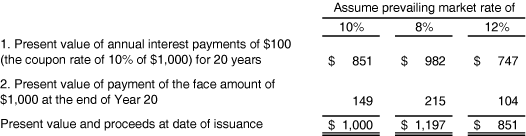
Upon issuance of a note or bond, the issuer customarily records as a liability the face or principal amount of the obligation. Ordinarily, the recorded liability also represents the amount that is to be repaid upon maturity of the obligation. The value recorded in the liability account, however, may be different from the proceeds received or the present value of the obligation at issuance if the market rate of interest differs from the coupon rate of interest. For example, consider the issuance of a $1,000, 20-year bond that bears interest at 10% annually. If we assume that 10% is an appropriate market rate of interest for such a bond, the proceeds at issuance will be $1,000. The bond payable would be recorded at $1,000, which represents the amount repayable at maturity and also the present value at issuance, which is equal to the proceeds. However, under similar circumstances, if the prevailing market rate were more (less) than 10%, a 20-year 10% bond with a face amount of $1,000 would usually have a value at issuance and provide cash proceeds of less (more) than $1,000. The significant point is that, upon issuance, a bond is valued at the present value of the future coupon interest payments plus the present value of the future principal payments (face amount). These two sets of future cash payments are discounted at the prevailing market rate of interest (for an equivalent security) at the date of issuance of the debt. As the 8% and 12% columns show, premium or discount arises when the prevailing market rate of interest differs from the coupon rate.
  • Assume prevailing market rate of 10% 8% 12% "1. Present value of annual interest payments of $100 (the coupon rate of 10% of $1,000) for 20 years" $851 $982 $747 "2. Present value of payment of the face amount of $1,000 at the end of Year 20" 149 215 104 Present value and proceeds at date of issuance " $1,000 " " $1,197 " $851
835-30-55-6
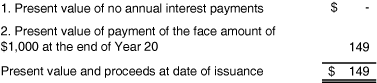
In the case of a $1,000 non-interest-bearing 20-year note, where the prevailing market rate for comparable credit risks is 10%, the following valuation should be made.
  • 1. Present value of no annual interest payments $- "2. Present value of payment of the face amount of $1,000 at the end of Year 20" 149 Present value and proceeds at date of issuance $149
835-30-55-7
Comparison of the two tables shows the significant impact of interest.
835-30-55-8
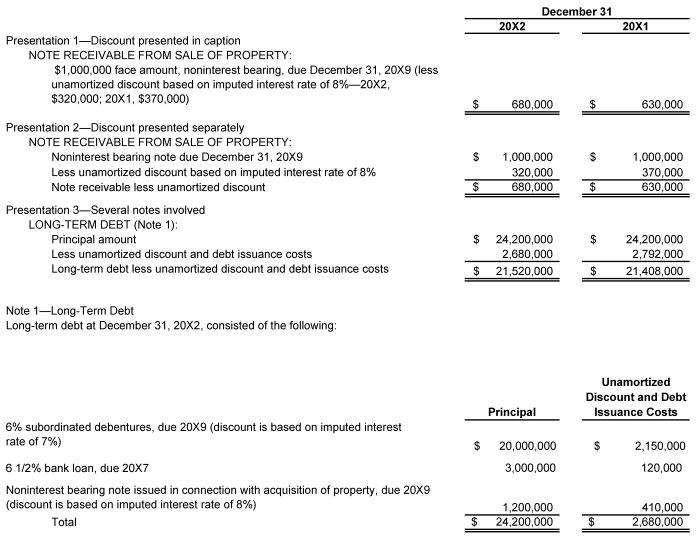
This Example is an illustration of the guidance in paragraphs related to the balance sheet presentation of notes that are discounted.
  • December 31 20X2 20X1 Presentation 1—Discount presented in caption NOTE RECEIVABLE FROM SALE OF PROPERTY: " $1,000,000 face amount, noninterest bearing, due December 31, 20X9 (less unamortized discount based on imputed interest rate of 8%—20X2, $320,000; 20X1, $370,000)" " $680,000 " " $630,000 " Presentation 2—Discount presented separately NOTE RECEIVABLE FROM SALE OF PROPERTY: "Noninterest bearing note due December 31, 20X9" " $1,000,000 " " $1,000,000 " Less unamortized discount based on imputed interest rate of 8% " 320,000 " " 370,000 " Note receivable less unamortized discount " $680,000 " " $630,000 " Presentation 3—Several notes involved LONG-TERM DEBT (Note 1): Principal amount " $24,200,000 " " $24,200,000 " Less unamortized discount and debt issuance costs " 2,680,000 " " 2,792,000 " Long-term debt less unamortized discount and debt issuance costs " $21,520,000 " " $21,408,000 " Note 1—Long-Term Debt "Long-term debt at December 31, 20X2, consisted of the following:" Principal Unamortized Discount and Debt Issuance Costs "6% subordinated debentures, due 20X9 (discount is based on imputed interest rate of 7%)" " $20,000,000 " " $2,150,000 " "6 1/2% bank loan, due 20X7" " 3,000,000 " " 120,000 " "Noninterest bearing note issued in connection with acquisition of property, due 20X9 (discount is based on imputed interest rate of 8%) " " 1,200,000 " " 410,000 " Total " $24,200,000 " " $2,680,000 "

835-30-60Relationships

Source downloaded: .Record version 276587da354a. Effective date must be checked in the source.

Income Taxes

835-30-60-1
For guidance on accounting for differences between the recognition for financial accounting purposes and income tax purposes of discount or premium resulting from determination of the present value of a note, see Topic 740.

835-30-65Transition and Open Effective Date Information

Source downloaded: .Record version e6c135ae0aad. Effective date must be checked in the source.

835-30-65-1
Paragraph superseded on 10/26/2017 after the end of the transition period stated in Accounting Standards Update No. 2015-03, Interest—Imputation of Interest (Subtopic 835-30): Simplifying the Presentation of Debt Issuance Costs.

835-30-S00StatusSEC

Source downloaded: .Record version 9e1fedde0bd6. Effective date must be checked in the source.

835-30-S00-1
The following table identifies the changes made to this Subtopic.

835-30-S35Subsequent MeasurementSEC

Source downloaded: .Record version 4468bacf085b. Effective date must be checked in the source.

SEC Staff Guidance

835-30-S35-1
See paragraph 835-30-S45-1, SEC Staff Announcement: Presentation and Subsequent Measurement of Debt Issuance Costs Associated with Line-of-Credit Arrangements, for SEC Staff views on the presentation and subsequent measurement of debt issuance costs related to line-of-credit arrangements.

835-30-S45Other Presentation MattersSEC

Source downloaded: .Record version 459627147b4a. Effective date must be checked in the source.

SEC Staff Guidance

835-30-S45-1
On April 7, 2015, the FASB issued Accounting Standards Update 2015-03, Interest—Imputation of Interest (Subtopic 835-30): Simplifying the Presentation of Debt Issuance Costs, which requires entities to present debt issuance costs related to a recognized debt liability as a direct deduction from the carrying amount of that debt liability. The guidance in Update 2015-03 (see paragraph 835-30-45-1A) does not address presentation or subsequent measurement of debt issuance costs related to line-of-credit arrangements.
  • Given the absence of authoritative guidance within Update 2015-03 for debt issuance costs related to line-of-credit arrangements, the SEC staff would not object to an entity deferring and presenting debt issuance costs as an asset and subsequently amortizing the deferred debt issuance costs ratably over the term of the line-of-credit arrangement, regardless of whether there are any outstanding borrowings on the line-of-credit arrangement.

Related subtopics