ASC 310-10
Overall
310 Receivables
Source downloaded: .Record version 64110485b68b. Effective date must be checked in the source.
ASC 310-10 is the Overall subtopic for receivables, providing general guidance on recognizing, measuring, presenting, and disclosing loans and trade receivables (including factoring, loan syndications, standby commitments to purchase loans, purchased credit card portfolios, and secured loans), plus a separate set of Subsections on acquisition, development, and construction (ADC) arrangements. Receivables held for the foreseeable future are carried at amortized cost basis (with credit losses under Topic 326), while nonmortgage loans held for sale are carried at the lower of amortized cost basis or fair value through a valuation allowance. The ADC Subsections tell a lender whether an arrangement in which it participates in expected residual profit is a loan, a real estate investment, or a real estate joint venture; most of the old impairment/TDR guidance in this subtopic was superseded by ASU 2016-13 and ASU 2022-02, leaving modification disclosures behind.
Key points (7)
- The General Subsections apply to all entities and to trade accounts receivable, loans, loan syndications, factoring arrangements, standby letters of credit, and financing receivables, but not to mortgage banking activities (Topic 948) or contracts accounted for as derivatives under Subtopic 815-10 (310-10-15-1 through 15-3).
- Trade receivables and nonmortgage loans that management has the intent and ability to hold for the foreseeable future or until maturity or payoff are reported at amortized cost basis, with credit losses measured under Subtopic 326-20; nonmortgage loans held for sale are reported at the lower of amortized cost basis or fair value with the excess recorded as a valuation allowance charged to income (310-10-35-47, 35-47A, 35-48).
- On transfer between classifications, an entity reverses in earnings the previously recorded allowance for credit losses (or valuation allowance), transfers the loan at amortized cost basis excluding that allowance, and then establishes the other type of allowance; the reversals and establishments are presented gross in the income statement (310-10-35-48A through 35-48B; 310-10-45-2).
- A standby commitment to purchase loans is treated as part of normal loan production (loans recorded at cost net of the commitment fee on settlement date) if settlement is within a reasonable period and the entity intends and is able to accept delivery without selling assets; otherwise it is accounted for as a written put option, with the liability carried at the greater of the initial standby commitment fee or the fair value of the option (310-10-25-6, 30-7, 35-46).
- Notes receivable are initially measured at present value: cash-only notes at the cash proceeds, notes for property, goods, or services at the present value of the consideration exchanged, with interest imputed under Subtopic 835-30 when interest is absent or clearly unreasonable (310-10-30-2 through 30-6).
- In an ADC arrangement in which the lender participates in expected residual profit, the lender accounts for the arrangement as a real estate investment under Topic 970 if it expects over 50 percent of the expected residual profit; if 50 percent or less, it is a loan only if at least one characteristic in 310-10-25-20(b) through (e) or a qualifying personal guarantee is present, otherwise real estate joint venture accounting applies (310-10-25-27); classification is reassessed periodically and changes are accounted for prospectively (310-10-35-55 through 35-59).
- Creditors must disclose commitments to lend additional funds to debtors experiencing financial difficulty whose receivables were modified, and, by class of financing receivable, the types, financial effect, and 12-month post-modification performance of modifications in the form of principal forgiveness, interest rate reduction, other-than-insignificant payment delay, or term extension, plus defaults within 12 months of such modifications (310-10-50-36, 50-42 through 50-45).
For students. Know that ASC 310-10 is now largely a residual subtopic: credit-loss and troubled-debt-restructuring measurement moved to Topic 326 (ASU 2016-13) and ASU 2022-02, so the surviving content is classification/measurement of loans and trade receivables, standby commitments, ADC arrangements, and modification disclosures. A common mistake is applying old "impaired loan" or TDR measurement rules from superseded 310-10-35 paragraphs instead of the CECL model in 326-20.
Machine-generated study aid for ASC 310-10. Check the source paragraphs below.
310-10-00Status
Source downloaded: .Record version 721154ac3d58. Effective date must be checked in the source.
310-10-05Overview and Background
Source downloaded: .Record version 78246292e0fc. Effective date must be checked in the source.
- aOverall
- bNonrefundable Fees and Other Costs
- c
- d
- aGeneral
- b
Receivables in General
Standby Commitments to Purchase Loans
Factoring Arrangements
Rebates
Acquisition, Development, and Construction Arrangements
310-10-15Scope and Scope Exceptions
Source downloaded: .Record version 70b77c9a3875. Effective date must be checked in the source.
Entities
Transactions
- aTrade accounts receivable
- b
- c
- dFactoring arrangements
- e
- f
- aMortgage banking activities (as described in paragraph 948-10-05-4)
- bA contract that is required to be accounted for as a derivative instrument under Subtopic 815-10. For example, paragraph 815-10-15-70 states that commitments to purchase or sell mortgage loans or other types of loans at a future date shall be evaluated under the definition of a derivative instrument to determine whether Subtopic 815-10 applies.
Acquisition, Development, and Construction Arrangements
Entities
Transactions
310-10-25Recognition
Source downloaded: .Record version c33b7836df91. Effective date must be checked in the source.
- aRecognition of certain types of receivables
- bRecognition of interest and fees for certain types of receivables.
Recognition of Certain Types of Receivables
- aFactoring arrangements
- bLoan syndications and loan participations
- cStandby commitments
- dCredit card portfolio purchased
- eSecured loans.
Recognition of Interest and Fees for Certain Types of Receivables
- aInterest income on receivables
- bImpact of rebates on accrued interest income
- cPrepayment fees
- dDelinquency fees.
Acquisition, Development, and Construction Arrangements
- a
- bCharacteristics implying investment in real estate or joint ventures
- cCharacteristics implying loans
- dAccounting for an arrangement as a loan or an investment in real estate
- eParticipations in acquisition, development, and construction arrangements.
Expected Residual Profit
Characteristics Implying Investment in Real Estate or Joint Ventures
- aThe lender agrees to provide all or substantially all necessary funds to acquire, develop, or construct the property. The borrower has title to but little or no equity in the underlying property.
- bThe lender funds the commitment or origination fees or both by including them in the amount of the loan.
- cThe lender funds all or substantially all interest and fees during the term of the loan by adding them to the loan balance.
- dThe lender's only security is the acquisition, development, and construction project. The lender has no recourse to other assets of the borrower, and the borrower does not guarantee the debt.
- eIn order for the lender to recover the investment in the project, the property must be sold to independent third parties, the borrower must obtain refinancing from another source, or the property must be placed in service and generate sufficient net cash flow to service debt principal and interest.
- fThe arrangement is structured so that foreclosure during the project's development as a result of delinquency is unlikely because the borrower is not required to make any payments until the project is complete, and, therefore, the loan normally cannot become delinquent.
Characteristics Implying Loans
- aThe lender participates in less than a majority of the expected residual profit.
- bThe borrower has an equity investment, substantial to the project, not funded by the lender. The investment may be in the form of cash payments by the borrower or contribution by the borrower of land (without considering value expected to be added by future development or construction) or other assets. The value attributed to the land or other assets should be net of encumbrances. There may be little value to assets with substantial prior liens that make foreclosure to collect less likely. Recently acquired property generally shall be valued at no higher than cost.
- cThe lender has either of the following:
- 1Recourse to substantial tangible, saleable assets of the borrower, with a determinable sales value, other than the acquisition, development, and construction project that are not pledged as collateral under other loans
- 2An irrevocable letter of credit from a creditworthy, independent third party provided by the borrower to the lender for a substantial amount of the loan over the entire term of the loan.
- 1
- dA take-out commitment for the full amount of the lender's loans has been obtained from a creditworthy, independent third party. Take-out commitments often are conditional. If so, the conditions should be reasonable and their attainment probable.
- eNoncancelable sales contracts or lease commitments from creditworthy, independent third parties are currently in effect that will provide sufficient net cash flow on completion of the project to service normal loan amortization, that is, principal and interest. Any associated conditions should be probable of attainment.
- aThe ability of the guarantor to perform under the guarantee
- bThe practicality of enforcing the guarantee in the applicable jurisdiction
- cA demonstrated intent to enforce the guarantee.
- aLiquidity and net worth of the guarantor. There should be evidence of sufficient liquidity to perform under the guarantee. There may be little substance to a personal guarantee if the guarantor's net worth consists primarily of assets pledged to secure other debt.
- bGuarantees provided by the guarantor to other projects. If the financial statements do not disclose and quantify such information, inquiries should be made as to other guarantees. Also, it may be appropriate to obtain written representation from the guarantor regarding other contingent liabilities.
Accounting for an Arrangement as a Loan or an Investment in Real Estate
- aIf the lender is expected to receive over 50 percent of the expected residual profit from the project, the lender shall account for income or loss from the arrangement as a real estate investment as specified by Topic 970.
- bIf the lender is expected to receive 50 percent or less of the expected residual profit, the entire arrangement shall be accounted for either as a loan or as a real estate joint venture, depending on the circumstances. At least one of the characteristics identified in paragraph 310-10-25-20(b) through (e) or a qualifying personal guarantee shall be present for the arrangement to be accounted for as a loan. Otherwise, real estate joint venture accounting would be appropriate.
Participations in Acquisition, Development, and Construction Arrangements
310-10-30Initial Measurement
Source downloaded: .Record version 2e8d970bdfa4. Effective date must be checked in the source.
Certain Receivables
Standby Commitments to Purchase Loans
310-10-35Subsequent Measurement
Source downloaded: .Record version f1948a149e02. Effective date must be checked in the source.
Subsequent Measurement of Specific Types of Receivables
- aFinancial assets subject to prepayment
- bStandby commitments to purchase loans
- cLoans and trade receivables not held for sale
- dNonmortgage loans held for sale
- eLoans not previously held for sale
- fAmortization of discount or premium on notes
- gPremium allocated to loans purchased in a credit card portfolio
- hHedged portfolios of loans
- iInterest income.
Acquisition, Development, and Construction Arrangements
- aLender interest in expected residual profit
- bChanges in initial determination factors
- cOther matters.
Changes in Initial Determination Factors
Other Matters
310-10-40Derecognition
Source downloaded: .Record version 679d219cb935. Effective date must be checked in the source.
Transfers of Receivables
Classification and Measurement of Certain Government-Guaranteed Mortgage Loans upon Foreclosure
Acquisition, Development, and Construction Arrangements
310-10-45Other Presentation Matters
Source downloaded: .Record version 8b53165041fe. Effective date must be checked in the source.
- aLoans or trade receivables
- bForeclosed and repossessed assets
- c
- d
- eDiscount and premium
- fUnearned discounts
- gReceivables classified as current assets
- hCash flows
- iReceivables from officers, employees, or affiliates
- jNote received as an equity contribution.
Nonmortgage Loans or Trade Receivables
Foreclosed or Repossessed Assets
Discount and Premium
Unearned Discounts
Receivables Classified as Current Assets
- aTrade accounts, notes, and acceptances receivable
- bReceivables from officers, employees, affiliates, and others, if collectible in the ordinary course of business within a year
- cInstallment or deferred accounts and notes receivable if they conform generally to normal trade practices and terms within the business.
Cash Flows
Receivables from Officers, Employees, or Affiliates
Note Received as an Equity Contribution
Acquisition, Development, and Construction Arrangements
310-10-50Disclosure
Source downloaded: .Record version ff5243c443e2. Effective date must be checked in the source.
- aAccounting policies for loans and trade receivables
- bAssets serving as collateral
- c
- d
- eForeclosed and repossessed assets
- f
- g
- h
- iRisks and uncertainties
- jFair value disclosures
- k
- lModifications.
Accounting Policies for Loans and Trade Receivables
- aLoans
- bTrade receivables.
- aThe basis for accounting for loans and trade receivables
- bThe method used in determining the lower of amortized cost basis or fair value of nonmortgage loans held for sale (that is, aggregate or individual asset basis)
- cThe classification and method of accounting for interest-only strips, loans, other receivables, or retained interests in securitizations that can be contractually prepaid or otherwise settled in a way that the holder would not recover substantially all of its recorded investment
- dThe method for recognizing interest income on loan and trade receivables, including a statement about the entity's policy for treatment of related fees and costs, including the method of amortizing net deferred fees or costs.
Assets Serving as Collateral
Foreclosed and Repossessed Assets
Risks and Uncertainties
Fair Value Disclosures
Loans in Process of Foreclosure
Modifications
- aReceivables measured at fair value with changes in fair value reported in earnings
- bReceivables measured at lower of amortized cost basis or fair value
- cExcept for credit card receivables, trade accounts receivable that have both of the following characteristics:
- 1They have a contractual maturity of one year or less.
- 2They arose from the sale of goods or services.
- 1
- dParticipant loans in defined contribution pension plans.
- aReceivables measured at fair value with changes in fair value reported in earnings
- bReceivables measured at lower of amortized cost basis or fair value
- cExcept for credit card receivables, trade accounts receivable that have both of the following characteristics:
- 1They have a contractual maturity of one year or less.
- 2They arose from the sale of goods or services.
- 1
- dParticipant loans in defined contribution pension plans
- eLease receivables arising from sales-type leases or direct financing leases.
- aBy class of financing receivable, qualitative and quantitative information about:
- 1The types of modifications utilized by an entity, including the total period-end amortized cost basis of the modified receivables and the percentage of modifications of receivables made to debtors experiencing financial difficulty relative to the total period-end amortized cost basis of receivables in the class of financing receivable.
- 2The financial effect of the modification by type of modification, which shall provide information about the changes to the contractual terms as a result of the modification and shall include the incremental effect of principal forgiveness on the amortized cost basis of the modified receivables, as applicable, or the reduction in weighted-average interest rates (versus a range) for interest rate reductions.
- 3Receivable performance in the 12 months after a modification of a receivable made to a debtor experiencing financial difficulty.
- 1
- bBy portfolio segment, qualitative information about how those modifications and the debtors’ subsequent performance are factored into determining the allowance for credit losses.
- aBy class of financing receivable, qualitative and quantitative information about:
- 1The types of modifications utilized by an entity, including the total period-end amortized cost basis of the modified receivables and the percentage of modifications of receivables made to debtors experiencing financial difficulty relative to the total period-end amortized cost basis of receivables in the class of financing receivable.
- 2The financial effect of the modification by type of modification, which shall provide information about the changes to the contractual terms as a result of the modification and shall include the incremental effect of principal forgiveness on the amortized cost basis of the modified receivables, as applicable, or the reduction in weighted-average interest rates (versus a range) for interest rate reductions.
- 3Receivable performance in the 12 months after a modification of a receivable made to a debtor experiencing financial difficulty.
- 1
- bBy portfolio segment, qualitative information about how those modifications and the debtors’ subsequent performance are factored into determining the allowance for credit losses.
- aBy class of financing receivable, qualitative and quantitative information about those defaulted financing receivables, including the following:
- 1The type of contractual change that the modification provided
- 2The amount of financing receivables that defaulted, including the period-end amortized cost basis for financing receivables that defaulted.
- 1
- bBy portfolio segment, qualitative information about how those defaults are factored into determining the allowance for credit losses.
- aBy class of financing receivable, qualitative and quantitative information about those defaulted financing receivables, including the following:
- 1The type of contractual change that the modification provided
- 2The amount of financing receivables that defaulted, including the period-end amortized cost basis for financing receivables that defaulted.
- 1
- bBy portfolio segment, qualitative information about how those defaults are factored into determining the allowance for credit losses.
- aThe debtor is currently in payment default on any of its debt. In addition, a creditor shall evaluate whether it is probable that the debtor would be in payment default on any of its debt in the foreseeable future without the modification. That is, a creditor may conclude that a debtor is experiencing financial difficulties, even though the debtor is not currently in payment default.
- bThe debtor has declared or is in the process of declaring bankruptcy.
- cThere is substantial doubt as to whether the debtor will continue to be a going concern.
- dThe debtor has securities that have been delisted, are in the process of being delisted, or are under threat of being delisted from an exchange.
- eOn the basis of estimates and projections that only encompass the debtor's current capabilities, the creditor forecasts that the debtor's entity-specific cash flows will be insufficient to service any of its debt (both interest and principal) in accordance with the contractual terms of the existing agreement for the foreseeable future.
- fWithout the current modification, the debtor cannot obtain funds from sources other than the existing creditors at an effective interest rate equal to the current market interest rate for similar debt for a nontroubled debtor.
- aThe amount of the restructured payments subject to the delay is insignificant relative to the unpaid principal or collateral value of the debt and will result in an insignificant shortfall in the contractual amount due.
- bThe delay in timing of the restructured payment period is insignificant relative to any one of the following:
- 1The frequency of payments due under the debt
- 2The debt's original contractual maturity
- 3The debt's original expected duration.
- 1
310-10-55Implementation Guidance and Illustrations
Source downloaded: .Record version ecf7099992d4. Effective date must be checked in the source.
Illustrations
- Entity B
- The allowance for credit losses incorporates an estimate of lifetime expected credit losses and is recorded on each asset upon asset origination or acquisition. The starting point for the estimate of the allowance for credit losses is historical loss information, which includes losses from modifications of receivables to borrowers experiencing financial difficulty. Entity B uses a probability of default/loss given default model to determine the allowance for credit losses. An assessment of whether a borrower is experiencing financial difficulty is made on the date of a modification.
- Because the effect of most modifications made to borrowers experiencing financial difficulty is already included in the allowance for credit losses because of the measurement methodologies used to estimate the allowance, a change to the allowance for credit losses is generally not recorded upon modification. Occasionally, Entity B modifies loans by providing principal forgiveness on certain of its real estate loans. When principal forgiveness is provided, the amortized cost basis of the asset is written off against the allowance for credit losses. The amount of the principal forgiveness is deemed to be uncollectible; therefore, that portion of the loan is written off, resulting in a reduction of the amortized cost basis and a corresponding adjustment to the allowance for credit losses.
- In some cases, Entity B will modify a certain loan by providing multiple types of concessions. Typically, one type of concession, such as a term extension, is granted initially. If the borrower continues to experience financial difficulty, another concession, such as principal forgiveness, may be granted. For the real estate loans included in the “combination” columns below, multiple types of modifications have been made on the same loan within the current reporting period. The combination is at least two of the following: a term extension, principal forgiveness, and interest rate reduction.
- The following table shows the amortized cost basis at the end of the reporting period of the loans modified to borrowers experiencing financial difficulty, disaggregated by class of financing receivable and type of concession granted (numbers in thousands):
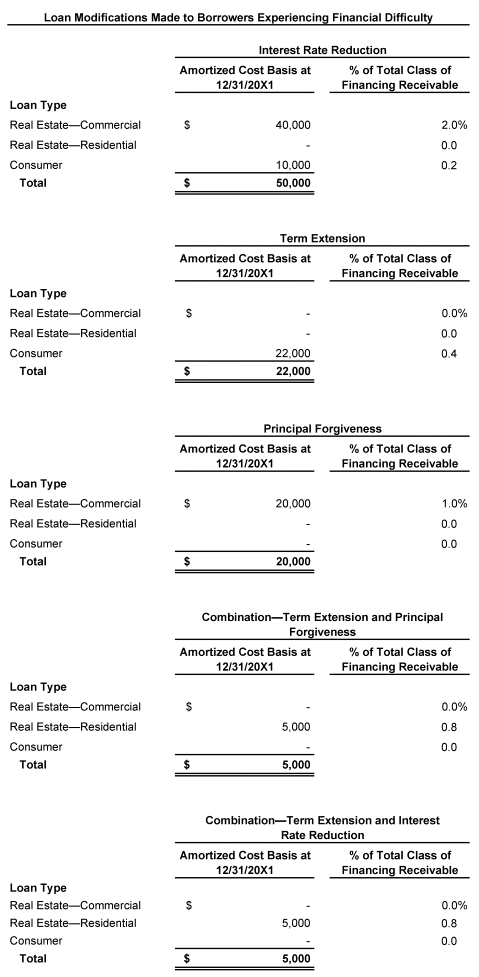 Loan Modifications Made to Borrowers Experiencing Financial Difficulty Interest Rate Reduction Amortized Cost Basis at 12/31/20X1 % of Total Class of Financing Receivable Loan Type Real Estate—Commercial " $40,000 " 2.0% Real Estate—Residential - 0.0 Consumer " 10,000 " 0.2 Total " $50,000 " Term Extension Amortized Cost Basis at 12/31/20X1 % of Total Class of Financing Receivable Loan Type Real Estate—Commercial $- 0.0% Real Estate—Residential - 0.0 Consumer " 22,000 " 0.4 Total " $22,000 " Principal Forgiveness Amortized Cost Basis at 12/31/20X1 % of Total Class of Financing Receivable Loan Type Real Estate—Commercial " $20,000 " 1.0% Real Estate—Residential - 0.0 Consumer - 0.0 Total " $20,000 " Combination—Term Extension and Principal Forgiveness Amortized Cost Basis at 12/31/20X1 % of Total Class of Financing Receivable Loan Type Real Estate—Commercial $- 0.0% Real Estate—Residential " 5,000 " 0.8 Consumer - 0.0 Total " $5,000 " "Combination—Term Extension and Interest Rate Reduction" Amortized Cost Basis at 12/31/20X1 % of Total Class of Financing Receivable Loan Type Real Estate—Commercial $- 0.0% Real Estate—Residential " 5,000 " 0.8 Consumer - 0.0 Total " $5,000 "
- The following table describes the financial effect of the modifications made to borrowers experiencing financial difficulty:
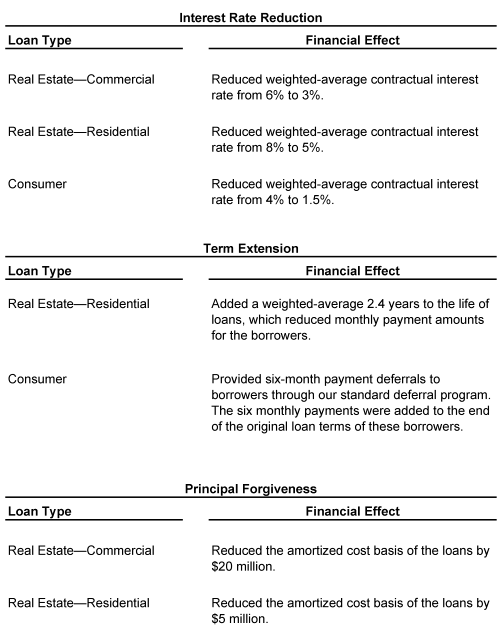 Interest Rate Reduction Loan Type Financial Effect Real Estate—Commercial Reduced weighted-average contractual interest rate from 6% to 3%. Real Estate—Residential Reduced weighted-average contractual interest rate from 8% to 5%. Consumer Reduced weighted-average contractual interest rate from 4% to 1.5%. Term Extension Loan Type Financial Effect Real Estate—Residential "Added a weighted-average 2.4 years to the life of loans, which reduced monthly payment amounts for the borrowers." Consumer Provided six-month payment deferrals to borrowers through our standard deferral program. The six monthly payments were added to the end of the original loan terms of these borrowers. Principal Forgiveness Loan Type Financial Effect Real Estate—Commercial Reduced the amortized cost basis of the loans by $20 million. Real Estate—Residential Reduced the amortized cost basis of the loans by $5 million.
- Upon Entity B’s determination that a modified loan (or portion of a loan) has subsequently been deemed uncollectible, the loan (or a portion of the loan) is written off. Therefore, the amortized cost basis of the loan is reduced by the uncollectible amount and the allowance for credit losses is adjusted by the same amount.
- The following table provides the amortized cost basis of financing receivables that had a payment default during the period and were modified in the 12 months before default to borrowers experiencing financial difficulty (numbers in thousands):
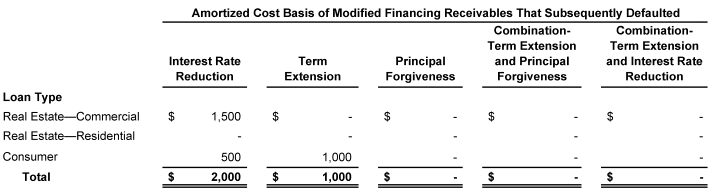 Financing Receivable That Subsequently Defaulted Amortized Cost Basis of Modified Financing Receivables That Subsequently Defaulted Interest Rate Reduction Term Extension Principal Forgiveness Combination- Term Extension and Principal Forgiveness Combination- Term Extension and Interest Rate Reduction Loan Type Real Estate—Commercial " $1,500 " $- $- $- $- Real Estate—Residential - - - - - Consumer 500 " 1,000 " - - - Total " $2,000 " " $1,000 " $- $- $-
- Entity B closely monitors the performance of the loans that are modified to borrowers experiencing financial difficulty to understand the effectiveness of its modification efforts. The following table depicts the performance of loans that have been modified in the last 12 months (numbers in thousands):
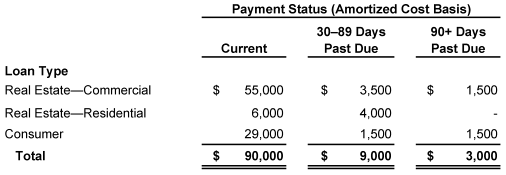 Payment Status (Amortized Cost Basis) Current "30–89 Days Past Due" "90+ Days Past Due" Loan Type Real Estate—Commercial " $55,000 " " $3,500 " " $1,500 " Real Estate—Residential " 6,000 " " 4,000 " - Consumer " 29,000 " " 1,500 " " 1,500 " Total " $90,000 " " $9,000 " " $3,000 "
- aHas a fixed interest rate
- bIs collateralized by commercial real estate
- cRequires monthly interest payments
- dRequires a balloon principal payment at maturity.
- aHave repaid all past due amounts
- bBe considered current in relation to the debt's original terms
- cHave resumed making monthly payments set out under the debt's original terms.
- aLoans
- bTrade accounts receivable
- cNotes receivable
- dCredit cards
- eReceivables relating to a lessor's right(s) to payment(s) from a leveraged lease that should be recognized as an asset in accordance with paragraphs 842-10-65-1(z)
- 1
- 2
- 3
- fLease receivables arising from sales-type leases or direct financing leases.
- aDebt securities within the scope of Topic 320 (see the guidance beginning in paragraph 320-10-15-5)
- bUnconditional promises to give (for example, contributions receivable) that should be recognized as an asset in accordance with paragraphs
- cBoth of the following instruments, which are within the scope of Subtopic 325-40:
- 1A transferor's interests in securitization transactions that are accounted for as sales under Topic 860
- 2Purchased beneficial interests in securitized financial assets.
For related guidance, see paragraph 325-40-15. - 1
310-10-60Relationships
Source downloaded: .Record version bbe8ea89ea14. Effective date must be checked in the source.
Liabilities
Contingencies
Guarantees
Transfers and Servicing
310-10-65Transition and Open Effective Date Information
Source downloaded: .Record version f1f3673f8b9f. Effective date must be checked in the source.
310-10-S00StatusSEC
Source downloaded: .Record version b7d8d82dc5e7. Effective date must be checked in the source.
| Paragraph | Action | Accounting Standards Update | Date |
| 310-10-S50-2 | Amended | Accounting Standards Update No. 2009-07 | 09/15/2009 |
| 310-10-S99-1 | Amended | Accounting Standards Update No. 2012-03 | 08/27/2012 |
| 310-10-S99-4 | Amended | Accounting Standards Update No. 2012-03 | 08/27/2012 |
| 310-10-S99-4 | Amended | Accounting Standards Update No. 2009-03 | 08/24/2009 |
310-10-S35Subsequent MeasurementSEC
Source downloaded: .Record version 4bd0a232c2c4. Effective date must be checked in the source.
Accounting for Loan Losses by Registrants Engaged in Lending Activities
310-10-S45Other Presentation MattersSEC
Source downloaded: .Record version ca18975002a2. Effective date must be checked in the source.
Receivables Arising from the Issuance of Capital Stock to Officers or Other Employees
Notes or Other Receivables from a Parent or Another Affiliate
310-10-S50DisclosureSEC
Source downloaded: .Record version ce956b9129e2. Effective date must be checked in the source.
Disclosure Requirements for Accounts and Notes Receivable
Acquisition, Development, and Construction Arrangements
Disclosures Related to Acquisition, Development, and Construction Arrangements
310-10-S55Implementation Guidance and IllustrationsSEC
Source downloaded: .Record version b4539ebbe0d4. Effective date must be checked in the source.
Acquisition, Development, and Construction Arrangements
Criteria for Loan Accounting
310-10-S99SEC MaterialsSEC
Source downloaded: .Record version c2a150efc6e8. Effective date must be checked in the source.
SEC Staff Guidance
- Facts: A registrant files a Securities Act registration statement covering a maximum of $100 million of securities. Proceeds of the offering will be used to make mortgage loans on operating residential or commercial property. Proceeds of the offering will be placed in escrow until $1 million of securities are sold at which point escrow may be broken, making the proceeds immediately available for lending, while the selling of securities would continue.
- Question 1: Under what circumstances are the financial statements of a property on which the registrant makes or expects to make a loan required to be included in a filing?
- Interpretive Response: Rule 3-14 of Regulation S-X specifies the requirements for financial statements when the registrant has acquired one or more properties which in the aggregate are significant, or since the date of the latest balance sheet required has acquired or proposes to acquire one or more properties which in the aggregate are significant.
- Included in the category of properties acquired or to be acquired under Rule 3-14 are operating properties underlying certain mortgage loans, which in economic substance represent an investment in real estate or a joint venture rather than a loan. Certain characteristics of a lending arrangement indicate that the "lender" has the same risks and potential rewards as an owner or joint venturer. Those characteristics are set forth in the Acquisition, Development, and Construction Arrangements (ADC Arrangements) Subsections of FASB ASC Subtopic 310-10, Receivables—Overall FN6FN7. In September 1986 the EITF FN8 reached a consensus on this issue FN9 to the effect that, although the guidance in the ADC Arrangements Subsections of FASB ASC Subtopic 310-10 was issued to address the real estate ADC arrangements of financial institutions, preparers and auditors should consider that guidance in accounting for shared appreciation mortgages, loans on operating real estate and real estate ADC arrangements entered into by enterprises other than financial institutions.
- FN6 [Original footnote removed by SAB 114.]
- FN7 [Original footnote removed by SAB 114.]
- FN8 The Emerging Issues Task Force ("EITF") was formed in 1984 to assist the Financial Accounting Standards Board in the early identification and resolution of emerging accounting issues. Topics to be discussed by the EITF are publicly announced prior to its meetings and minutes of all EITF meetings are available to the public.
- FN9 FASB ASC paragraph 310-10-05-9.
- FASB ASC Topic 815, Derivatives and Hedging—Embedded Derivatives, generally requires that embedded instruments meeting the definition of a derivative and not clearly and closely related to the host contract be accounted for separately from the host instrument. If the embedded expected residual profit component of an ADC arrangement need not be separately accounted for as a derivative under FASB ASC Topic 815, then the disclosure requirements discussed below for ADC loans and similar arrangements should be followed. FN10
- FN10 The equity kicker (the expected residual profit) would typically not be separated from the host contract and accounted for as a derivative because FASB ASC subparagraph 815-15-25-1(c) exempts a hybrid contract from bifurcation if a separate instrument with the same terms as the embedded equity kicker is not a derivative instrument subject to the requirements of FASB ASC Topic 815.
- In certain cases the "lender" has virtually the same potential rewards as those of an owner or a joint venturer by virtue of participating in expected residual profit. FN11 In addition, the ADC Arrangements Subsections of FASB ASC Subtopic 310-10 include a number of other characteristics which, when considered individually or in combination, would suggest that the risks of an ADC arrangement are similar to those associated with an investment in real estate or a joint venture or, conversely, that they are similar to those associated with a loan. Among those other characteristics is whether the lender agrees to provide all or substantially all necessary funds to acquire the property, resulting in the borrower having title to, but little or no equity in, the underlying property. The staff believes that the borrower's equity in the property is adequate to support accounting for the transaction as a mortgage loan when the borrower's initial investment meets the criteria in FASB ASC paragraph 360-20-40-18 (Property, Plant, and Equipment Topic) FN12 and the borrower's payments of principal and interest on the loan are adequate to maintain a continuing investment in the property which meets the criteria in FASB ASC paragraph 360-20-40-19. FN13
- FN11 Expected residual profit is defined in the ADC Arrangements Subsections of FASB ASC Subtopic 310-10 as the amount of profit, whether called interest or another name, such as equity kicker, above a reasonable amount of interest and fees expected to be earned by the "lender."
- FN12 FASB ASC Subtopic 360-20 establishes standards for the recognition of profit on real estate sales transactions. FASB ASC paragraph 360-20-40-18 states that the buyer's initial investment shall be adequate to demonstrate the buyer's commitment to pay for the property and shall indicate a reasonable likelihood that the seller will collect the receivable. Guidance on minimum initial investments in various types of real estate is provided in FASB ASC paragraphs 360-20-55-1 and 360-20-55-2.
- FN13 FASB ASC paragraph 360-20-40-19 states that the buyer's continuing investment in a real estate transaction shall not qualify unless the buyer is contractually required to pay each year on its total debt for the purchase price of the property an amount at least equal to the level annual payment that would be needed to pay that debt and interest on the unpaid balance over not more than (a) 20 years for debt for land and (b) the customary amortization term of a first mortgage loan by an independent established lending institution for other real estate.
- The financial statements of properties which will secure mortgage loans made or to be made from the proceeds of the offering which have the characteristics of real estate investments or joint ventures should be included as required by Rule 3-14 in the registration statement when such properties secure loans previously made, or have been identified as security for probable loans prior to effectiveness, and in filings made pursuant to the undertaking in Item 20D of Securities Act Industry Guide 5.
- Rule 1-02(w) of Regulation S-X includes the conditions used in determining whether an acquisition is significant. The separate financial statements of an individual property should be provided when a property would meet the requirements for a significant subsidiary under this rule using the amount of the "loan" as a substitute for the "investment in the subsidiary" in computing the specified conditions. The combined financial statements of properties which are not individually significant should also be provided. However, the staff will not object if the combined financial statements of such properties are not included if none of the conditions specified in Rule 1-02(w), with respect to all such properties combined, exceeds 20% in the aggregate.
- Under certain circumstances, information may also be required regarding operating properties underlying mortgage loans where the terms do not result in the lender having virtually the same risks and potential rewards as those of owners or joint venturers. Generally, the staff believes that, where investment risks exist due to substantial asset concentration, financial and other information should be included regarding operating properties underlying a mortgage loan that represents a significant amount of the registrant's assets. Such presentation is consistent with Rule 3-13 of Regulation S-X and Rule 408 under the Securities Act of 1933.
- Where the amount of a loan exceeds 20% of the amount in good faith expected to be raised in the offering, disclosures would be expected to consist of financial statements for the underlying operating properties for the periods contemplated by Rule 3-14. Further, where loans on related properties are made to a single person or group of affiliated persons which in the aggregate amount to more than 20% of the amount expected to be raised, the staff believes that such lending arrangements result in a sufficient concentration of assets so as to warrant the inclusion of financial and other information regarding the underlying properties.
- Question 2: Will the financial statements of the mortgaged properties be required in filings made under the 1934 Act?
- Interpretive Response: Rule 3-09 of Regulation S-X specifies the requirement for significant, as defined, investments in operating entities, the operations of which are not included in the registrant's consolidated financial statements. FN14 Accordingly, the staff believes that the financial statements of properties securing significant loans which have the characteristics of real estate investments or joint ventures should be included in subsequent filings as required by Rule 3-09. The materiality threshold for determining whether such an investment is significant is the same as set forth in paragraph (a) of that Rule. FN15
- FN14 Rule 3-14 states that the financial statements of an acquired property should be furnished if the acquisition took place during the period for which the registrant's income statements are required. Paragraph (b) of the Rule states that the information required by the Rule is not required to be included in a filing on Form 10-K. That exception is consistent with Item 8 of Form 10-K which excludes acquired company financial statements, which would otherwise be required by Rule 3-05 of Regulation S-X, from inclusion in filings on that Form. Those exceptions are based, in part, on the fact that acquired properties and acquired companies will generally be included in the registrant's consolidated financial statements from the acquisition date.
- FN15 Rule 3-09(a) states, in part, that "[i]f any of the conditions set forth in [Rule] 1-02(w), substituting 20 percent for 10 percent in the tests used therein to determine significant subsidiary, are met... separate financial statements... shall be filed."
- Likewise, the staff believes that filings made under the 1934 Act should include the same financial and other information relating to properties underlying any loans which are significant as discussed in the last paragraph of Question 1, except that in the determination of significance the 20% disclosure threshold should be measured using total assets. The staff believes that this presentation would be consistent with Rule 12b-20 under the Securities Exchange Act of 1934.
- Question 3: The interpretive response to question 1 indicates that the staff believes that the borrower's equity in an operating property is adequate to support accounting for the transaction as a mortgage loan when the borrower's initial investment meets the criteria in FASB ASC paragraph 360-20-40-18 and the borrower's payments of principal and interest on the loan are adequate to maintain a continuing investment in the property which meets the criteria in FASB ASC paragraph 360-20-40-19. Is it the staff's view that meeting these criteria is the only way the borrower's equity in the property is considered adequate to support accounting for the transaction as a mortgage loan?
- Interpretive Response: No. It is the staff's position that the determination of whether loan accounting is appropriate for these arrangements should be made by the registrant and its independent accountants based on the facts and circumstances of the individual arrangements, using the guidance provided in the ADC Arrangements Subsections of FASB ASC Subtopic 310-10. As stated in those Subsections, loan accounting may not be appropriate when the lender participates in expected residual profit and has virtually the same risks as those of an owner, or joint venturer. In assessing the question of whether the lender has virtually the same risks as an owner, or joint venturer, the essential test that needs to be addressed is whether the borrower has and is expected to continue to have a substantial amount at risk in the project. FN16 The criteria described in FASB ASC Subtopic 360-20, Property, Plant, and Equipment—Real Estate Sales, provide a "safe harbor" for determining whether the borrower has a substantial amount at risk in the form of a substantial equity investment. The borrower may have a substantial amount at risk without meeting the criteria described in FASB ASC Subtopic 360-20.
- FN16 Regarding the composition of the borrower's investment, FASB ASC paragraph 310-10-25-20 indicates that the borrower's investment may include the value of land or other assets contributed by the borrower, net of encumbrances. The staff emphasizes that such paragraph indicates, "...recently acquired property generally should be valued at no higher than cost.. " Thus, for such recently acquired property, appraisals will not be sufficient to justify the use of a value in excess of cost.
- Question 4: What financial statements should be included in filings made under the Securities Act regarding investment-type arrangements that individually amount to 10% or more of total assets?
- Interpretive Response: In the staff's view, separate audited financial statements should be provided for any investment-type arrangement that constitutes 10% or more of the greater of (i) the amount of minimum proceeds or (ii) the total assets of the registrant, including the amount of proceeds raised, as of the date the filing is required to be made. Of course, the narrative information required by items 14 and 15 of Form S-11 should also be included with respect to these investment-type arrangements.
- Question 5: What information must be provided under the Securities Act for investment-type arrangements that individually amount to less than 10%?
- Interpretive Response: No specific financial information need be presented for investment-type arrangements that amount to less than 10%. However, where such arrangements aggregate more than 20%, a narrative description of the general character of the properties and arrangements should be included that gives an investor an understanding of the risks and rewards associated with these arrangements. Such information may, for example, include a description of the terms of the arrangements, participation by the registrant in expected residual profits, and property types and locations.
- Question 6: What financial statements should be included in annual reports filed under the Exchange Act with respect to investment-type arrangements that constitute 10% or more of the registrant's total assets?
- Interpretive Response: In annual reports filed with the Commission, the staff has advised registrants that separate audited financial statements should be provided for each nonconsolidated investment-type arrangement that is 20% or more of the registrant's total assets. While the distribution is on-going, however, the percentage may be calculated using the greater of (i) the amount of the minimum proceeds or (ii) the total assets of the registrant, including the amount of proceeds raised, as of the date the filing is required to be made. In annual reports to shareholders registrants may either include the separate audited financial statements for 20% or more nonconsolidated investment-type arrangements or, if those financial statements are not included, present summarized financial information for those arrangements in the notes to the registrant's financial statements.
- The staff has also indicated that separate summarized financial information (as defined in Rule 1-02(bb) of Regulation S-X) should be provided in the footnotes to the registrant's financial statements for each nonconsolidated investment-type arrangement that is 10% or more but less than 20%. Of course, registrants should also make appropriate textural disclosure with respect to material investment-type arrangements in the "business" and "property" sections of their annual reports to the Commission. FN17
- FN17 Registrants are reminded that in filings on Form 8-K that are triggered in connection with an acquisition of an investment-type arrangement, separate audited financial statements are required for any such arrangement that individually constitutes 10% or more.
- Question 7: What information should be provided in annual reports filed under the Exchange Act with respect to investment-type arrangements that do not meet the 10% threshold?
- Interpretive Response: The staff believes it will not be necessary to provide any financial information (full or summarized) for investment-type arrangements that do not meet the 10% threshold. However, in the staff's view, where such arrangements aggregate more than 20%, a narrative description of the general character of the properties and arrangements would be necessary. The staff believes that information should be included that would give an investor an understanding of the risks and rewards associated with these arrangements. Such information may, for example, include a description of the terms of the arrangements, participation by the registrant in expected residual profits, and property types and locations. Of course, disclosure regarding the operations of such components should be included as part of the Management's Discussion and Analysis where there is a known trend or uncertainty in the operations of such properties, either individually or in the aggregate, which would be reasonably likely to result in a material impact on the registrant's future operations, liquidity or capital resources.
- (Replaced by SAB 107)
- Facts: Capital stock is sometimes issued to officers or other employees before the cash payment is received.
- Question: How should the receivables from the officers or other employees be presented in the balance sheet?
- Interpretive Response: The amount recorded as a receivable should be presented in the balance sheet as a deduction from stockholders' equity. This is generally consistent with Rule 5-02.30 of Regulation S-X which states that accounts or notes receivable arising from transactions involving the registrant's capital stock should be presented as deductions from stockholders' equity and not as assets.
- It should be noted generally that all amounts receivable from officers and directors resulting from sales of stock or from other transactions (other than expense advances or sales on normal trade terms) should be separately stated in the balance sheet irrespective of whether such amounts may be shown as assets or are required to be reported as deductions from stockholders' equity.
- The staff will not suggest that a receivable from an officer or director be deducted from stockholders' equity if the receivable was paid in cash prior to the publication of the financial statements and the payment date is stated in a note to the financial statements. However, the staff would consider the subsequent return of such cash payment to the officer or director to be part of a scheme or plan to evade the registration or reporting requirements of the securities laws.
- Facts: The balance sheet of a corporate general partner is often presented in a registration statement. Frequently, the balance sheet of the general partner discloses that it holds notes or other receivables from a parent or another affiliate. Often the notes or other receivables were created in order to meet the "substantial assets" test which the Internal Revenue Service utilizes in applying its "Safe Harbor" doctrine in the classification of organizations for income tax purposes.
- Question: How should such notes and other receivables be reported in the balance sheet of the general partner?
- Interpretive Response: While these notes and other receivables evidencing a promise to contribute capital are often legally enforceable, they seldom are actually paid. In substance, these receivables are equivalent to unpaid subscriptions receivable for capital shares which Rule 5-02.30 of Regulation S-X requires to be deducted from the dollar amount of capital shares subscribed.
- The balance sheet display of these or similar items is not determined by the quality or actual value of the receivable or other asset "contributed" to the capital of the affiliated general partner, but rather by the relationship of the parties and the control inherent in that relationship. Accordingly, in these situations, the receivable must be treated as a deduction from stockholders' equity in the balance sheet of the corporate general partner.
- 1. Accounting for loan losses
- General: GAAP for recognition of loan losses is provided by FASB ASC Subtopic 450-20, Contingencies—Loss Contingencies, and FASB ASC Subtopic 310-10, Receivables—Overall. FN6 An estimated loss from a loss contingency, such as the collectibility of receivables, should be accrued when, based on information available prior to the issuance of the financial statements, it is probable that an asset has been impaired or a liability has been incurred at the date of the financial statements and the amount of the loss can be reasonably estimated. FN7 FASB ASC Subtopic 310-10 provides more specific guidance on measurement of loan impairment and related disclosures but does not change the fundamental recognition criteria for loan losses provided by FASB ASC 450-20.
- FN6 [Original footnote removed by SAB 114.]
- FN7 FASB ASC paragraph 450-20-25-2.
- Further guidance for SEC registrants is provided by FRR 28, which added subsection (b), Procedural Discipline in Determining the Allowance and Provision for Loan Losses to be Reported, of Section 401.09, Accounting for Loan Losses by Registrants Engaged in Lending Activities, to the Codification of Financial Reporting Policies (hereafter referred to as FRR 28). Additionally, public companies are required to comply with the books and records provisions of the Securities Exchange Act of 1934 (Exchange Act). Under Sections 13(b)(2) - (7) of the Exchange Act, registrants must make and keep books, records, and accounts, which, in reasonable detail, accurately and fairly reflect the transactions and dispositions of assets of the registrant. Registrants also must maintain internal accounting controls that are sufficient to provide reasonable assurances that, among other things, transactions are recorded as necessary to permit the preparation of financial statements in conformity with GAAP.
- This staff interpretation applies to all registrants that are creditors in loan transactions that, individually or in the aggregate, have a material effect on the registrant's financial statements. FN8.
- FN8 For purposes of this interpretation, a loan is defined (consistent with the FASB ASC Master Glossary) as a contractual right to receive money on demand or on fixed or determinable dates that is recognized as an asset in the creditor's statement of financial position. For purposes of this interpretation, loans do not include trade accounts receivable or notes receivable with terms less than one year or debt securities subject to the provisions of FASB ASC Topic 320, Investments—Debt and Equity Securities.
- 2. Developing and documenting a systematic methodology
- a. Developing a systematic methodology.
- Facts: Registrant A, or one of its consolidated subsidiaries, engages in lending activities and is developing or performing a review of its loan loss allowance methodology.
- Question: What are some of the factors or elements that the staff normally would expect Registrant A to consider when developing (or subsequently performing an assessment of) its methodology for determining its loan loss allowance under GAAP?
- Interpretive Response: The staff normally would expect a registrant that engages in lending activities to develop and document a systematic methodology FN9 to determine its provision for loan losses and allowance for loan losses as of each financial reporting date. It is critical that loan loss allowance methodologies incorporate management's current judgments about the credit quality of the loan portfolio through a disciplined and consistently applied process. A registrant's loan loss allowance methodology is influenced by entity-specific factors, such as an entity's size, organizational structure, business environment and strategy, management style, loan portfolio characteristics, loan administration procedures, and management information systems.
- FN9 FRR 28 states that " the Commission's staff normally would expect to find that the books and records of registrants engaged in lending activities include documentation of [the]: (a) systematic methodology to be employed each period in determining the amount of the loan losses to be reported, and (b) rationale supporting each period's determination that the amounts reported were adequate."
- However, as indicated in the AICPA Audit and Accounting Guide, Depository and Lending Institutions with Conforming Changes as of June 1, 2009 (Audit Guide), while different institutions may use different methods, there are certain common elements that should be included in any [loan loss allowance] methodology for it to be effective. FN10 A registrant's loan loss allowance methodology generally should: FN11.
- FN10 See paragraph 9.05 of the Audit Guide.
- FN11 Ibid.
- Include a detailed analysis of the loan portfolio, performed on a regular basis;
- Consider all loans (whether on an individual or group basis);
- Identify loans to be evaluated for impairment on an individual basis under FASB ASC Subtopic 310-10 and segment the remainder of the portfolio into groups of loans with similar risk characteristics for evaluation and analysis under FASB ASC Subtopic 450-20;
- Consider all known relevant internal and external factors that may affect loan collectibility;
- Be applied consistently but, when appropriate, be modified for new factors affecting collectibility;
- Consider the particular risks inherent in different kinds of lending;
- Consider current collateral values (less costs to sell), where applicable;
- Require that analyses, estimates, reviews and other loan loss allowance methodology functions be performed by competent and well-trained personnel;
- Be based on current and reliable data;
- Be well documented, in writing, with clear explanations of the supporting analyses and rationale (see Question 2 below for staff views on documenting a loan loss allowance methodology); and
- Include a systematic and logical method to consolidate the loss estimates and ensure the loan loss allowance balance is recorded in accordance with GAAP.
- For many entities engaged in lending activities, the allowance and provision for loan losses are significant elements of the financial statements.
- Therefore, the staff believes it is appropriate for an entity's management to review, on a periodic basis, its methodology for determining its allowance for loan losses. FN12 Additionally, for registrants that have audit committees, the staff believes that oversight of the financial reporting and auditing of the loan loss allowance by the audit committee can strengthen the registrant's control system and process for determining its allowance for loan losses. FN13
- FN12 For federally insured depository institutions, the December 21, 1993 "Interagency Policy Statement on the Allowance for Loan and Lease Losses (ALLL)" (the 1993 Interagency Policy Statement) indicates that boards of directors and management have certain responsibilities for the ALLL process and amounts reported. For example, as indicated on page 4 of that statement, "the board of directors and management are expected to: Ensure that the institution has an effective loan review system and controls[;] Ensure the prompt charge-off of loans, or portions of loans, that available information confirms to be uncollectible[; and] Ensure that the institution's process for determining an adequate level for the ALLL is based on a comprehensive, adequately documented, and consistently applied analysis of the institution's loan and lease portfolio."
- FN13 SAS 61 (as amended by SAS 90) states, in part: "In connection with each SEC engagement the auditor should discuss with the audit committee the auditor's judgments about the quality, not just the acceptability, of the entity's accounting principles as applied in its financial reporting. The discussion should include items that have a significant impact on the representational faithfulness, verifiability, and neutrality of the accounting information included in the financial statements. [Footnote omitted.] Examples of items that may have such an impact are the following: Selection of new or changes to accounting policies. Estimates, judgments, and uncertainties. Unusual transactions. Accounting policies relating to significant financial statement items, including the timing or transactions and the period in which they are recorded."
- Selection of new or changes to accounting policies
- Estimates, judgments, and uncertainties
- Unusual transactions.
- Accounting policies relating to significant financial statement items, including the timing or transactions and the period in which they are recorded."
- A systematic methodology that is properly designed and implemented should result in a registrant's best estimate of its allowance for loan losses. FN14 Accordingly, the staff normally would expect registrants to adjust their loan loss allowance balance, either upward or downward, in each period for differences between the results of the systematic determination process and the unadjusted loan loss allowance balance in the general ledger. FN15
- FN14 Registrants should also refer to FASB ASC Section 450-20-30, Contingencies—Loss Contingencies—Initial Measurement, which provides accounting and disclosure guidance for situations in which a range of loss can be reasonably estimated but no single amount within the range appears to be a better estimate than any other amount within the range.
- FN15 Registrants should refer to the guidance on materiality in SAB Topic 1.M.
- b. Documenting a systematic methodology.
- Question 1: Assume the same facts as in the previous question in Section 2(a). What would the staff normally expect Registrant A to include in its documentation of its loan loss allowance methodology?
- Interpretive Response: In FRR 28, the Commission provided guidance for documentation of loan loss provisions and allowances for registrants engaged in lending activities. The staff believes that appropriate written supporting documentation for the loan loss provision and allowance facilitates review of the loan loss allowance process and reported amounts, builds discipline and consistency into the loan loss allowance determination process, and improves the process for estimating loan losses by helping to ensure that all relevant factors are appropriately considered in the allowance analysis.
- The staff, therefore, normally would expect a registrant to document the relationship between the findings of its detailed review of the loan portfolio and the amount of the loan loss allowance and the provision for loan losses reported in each period. FN16
- FN16 FRR 28 states: "The specific rationale upon which the [loan loss allowance and provision] amount actually reported is based - i. e., the bridge between the findings of the detailed review [of the loan portfolio] and the amount actually reported in each period—would be documented to help ensure the adequacy of the reported amount, to improve auditability, and to serve as a benchmark for exercise of prudent judgment in future periods."
- The staff normally would expect to find that registrants maintain written supporting documentation for the following decisions, strategies, and processes: FN17
- FN17 Paragraph 9.64 in the Audit Guide outlines specific aspects of effective internal control related to the allowance for loan losses. These specific aspects include the control environment ("management communication of the need for proper reporting of the allowance"); management reports that summarize loan activity and the institution's procedures and controls ("accumulation of relevant, sufficient, and reliable data on which to base management's estimate of the allowance"); "independent loan review;" review of information and assumptions ("adequate review and approval of the allowance estimates by the individuals specified in management's written policy"); and assessment of the process ("comparison of prior estimates related to the allowance with subsequent results to assess the reliability of the process used to develop the allowance").
- Policies and procedures:
- Over the systems and controls that maintain an appropriate loan loss allowance, and
- Over the loan loss allowance methodology;
- Loan grading system or process;
- Summary or consolidation of the loan loss allowance balance;
- Validation of the loan loss allowance methodology; and
- Periodic adjustments to the loan loss allowance process.
- Question 2: The Interpretive Response to Question 2 indicates that the staff normally would expect to find that registrants maintain written supporting documentation for their loan loss allowance policies and procedures. In the staff's view, what aspects of a registrant's loan loss allowance internal accounting control systems and processes would appropriately be addressed in its written policies and procedures?
- Interpretive Response: The staff is aware that registrants utilize a wide range of policies, procedures, and control systems in their loan loss allowance processes, and these policies, procedures, and systems are tailored to the size and complexity of the registrant and its loan portfolio. However, the staff believes that, in order for a registrant's loan loss allowance methodology to be effective, the registrant's written policies and procedures for the systems and controls that maintain an appropriate loan loss allowance would likely address the following:
- The roles and responsibilities of the registrant's departments and personnel (including the lending function, credit review, financial reporting, internal audit, senior management, audit committee, board of directors, and others, as applicable) who determine or review, as applicable, the loan loss allowance to be reported in the financial statements; FN18
- FN18 Paragraph 9.64 of the Audit Guide discusses "management communication of the need for proper reporting of the allowance." As indicated in that paragraph, the "control environment strongly influences the effectiveness of the system of controls and reflects the overall attitude, awareness, and action of the board of directors and management concerning the importance of control."
- The registrant's accounting policies for loans and loan losses, including the policies for charge-offs and recoveries and for estimating the fair value of collateral, where applicable; FN19
- FN19 Paragraph 9.56 of the Audit Guide refers to the documentation, for disclosure purposes, that an entity should include in the notes to the financial statements describing the accounting policies the entity used to estimate its allowance and related provision for loan losses.
- The description of the registrant's systematic methodology, which should be consistent with the registrant's accounting policies for determining its loan loss allowance (see Question 4 below for further discussion); FN20 and
- FN20 Ibid. As indicated in paragraph 9.56, "[s]uch a description should identify the factors that influenced management's judgment (for example, historical losses and existing economic conditions) and may also include discussion of risk elements relevant to particular categories of financial instruments."
- The system of internal controls used to ensure that the loan loss allowance process is maintained in accordance with GAAP. FN21
- FN21 See also paragraph 9.64 in the Audit Guide which provides information about specific aspects of effective internal control related to the allowance for loan losses.
- The staff normally would expect an internal control system FN22 for the loan loss allowance estimation process to:
- FN22 Ibid. Public companies are required to comply with the books and records provisions of the Exchange Act. Under Sections 13(b)(2) - (7) of the Exchange Act, registrants must make and keep books, records, and accounts, which, in reasonable detail, accurately and fairly reflect the transactions and dispositions of assets of the registrant. Registrants also must maintain internal accounting controls that are sufficient to provide reasonable assurances that, among other things, transactions are recorded as necessary to permit the preparation of financial statements in conformity with GAAP.
- Include measures to provide assurance regarding the reliability FN23 and integrity of information and compliance with laws, regulations, and internal policies and procedures; FN24
- FN23 Concepts Statement 2, Qualitative Characteristics of Accounting Information, provides guidance on "reliability" as a primary quality of accounting information.
- FN24 Section 13(b)(2) - (7) of the Exchange Act.
- Reasonably assure that the registrant's financial statements are prepared in accordance with GAAP; and
- Include a well-defined loan review process. FN25
- FN25 As indicated in paragraph 9.05, item a, in the Audit Guide, a loan loss allowance methodology should "include a detailed and regular analysis of the loan portfolio." Paragraphs 9.06 to 9.13 provide additional information on how creditors traditionally identify and review loans on an individual basis and review or analyze loans on a group or pool basis.
- A well-defined loan review process FN26 typically contains:
- FN26 Ibid. Additionally, paragraph 9.64 in the Audit Guide provides guidance on the loan review process. As stated in that paragraph, "[m]anagement reports summarizing loan activity, renewals, and delinquencies are vital to the timely identification of problem loans." The paragraph further states: "Loan reviews should be conducted by institution personnel who are independent of the underwriting, supervision, and collections functions. The specific lines of reporting depend on the complexity of the institution's organizational structure, but the loan reviewers should report to a high level of management that is independent from the lending process in the institution."
- An effective loan grading system that is consistently applied, identifies differing risk characteristics and loan quality problems accurately and in a timely manner, and prompts appropriate administrative actions; FN27
- FN27 Ibid.
- Sufficient internal controls to ensure that all relevant loan review information is appropriately considered in estimating losses. This includes maintaining appropriate reports, details of reviews performed, and identification of personnel involved; FN28 and
- FN28 Ibid.
- Clear formal communication and coordination between a registrant's credit administration function, financial reporting group, management, board of directors, and others who are involved in the loan loss allowance determination or review process, as applicable (e. g., written policies and procedures, management reports, audit programs, and committee minutes). FN29
- FN29 Ibid.
- Question 3: The Interpretive Response to Question 3 indicates that the staff normally would expect a registrant's written loan loss allowance policies and procedures to include a description of the registrant's systematic allowance methodology, which should be consistent with its accounting policies for determining its loan loss allowance. What elements of a registrant's loan loss allowance methodology would the staff normally expect to be described in the registrant's written policies and procedures?
- Interpretive Response: The staff normally would expect a registrant's written policies and procedures to describe the primary elements of its loan loss allowance methodology, including portfolio segmentation and impairment measurement. The staff normally would expect that, in order for a registrant's loan loss allowance methodology to be effective, the registrant's written policies and procedures would describe the methodology:
- For segmenting the portfolio:
- How the segmentation process is performed (i. e., by loan type, industry, risk rates, etc.); FN30
- FN30 Paragraph 9.07 in the Audit Guide states that "creditors have traditionally identified loans that are to be evaluated for collectibility by dividing the loan portfolio into different segments. Loans with similar risk characteristics, such as risk classification, past-due status, and type of loan should be grouped together." Paragraph 9.08 provides additional guidance on classifying individual loans and paragraph 9.13 indicates considerations for groups or pools of loans.
- When a loan grading system is used to segment the portfolio:
- The definitions of each loan grade;
- A reconciliation of the internal loan grades to supervisory loan grades, if applicable; and
- The delineation of responsibilities for the loan grading system.
- For determining and measuring impairment under FASB ASC Subtopic 310-10: FN31
- FN31 See FASB ASC paragraphs on recognition of impairment and FASB ASC paragraphs on measurement of impairment.
- The methods used to identify loans to be analyzed individually;
- For individually reviewed loans that are impaired, how the amount of any impairment is determined and measured, including:
- Procedures describing the impairment measurement techniques available; and
- Steps performed to determine which technique is most appropriate in a given situation.
- The methods used to determine whether and how loans individually evaluated under FASB ASC Subtopic 310-10, but not considered to be individually impaired, should be grouped with other loans that share common characteristics for impairment evaluation under FASB ASC Subtopic 450-20. FN32
- FN32 See FASB ASC paragraph 310-10-35-36.
- For determining and measuring impairment under FASB ASC Subtopic 450-20: FN33
- FN33 See FASB ASC paragraph 450-20-25-2 on accrual of loss contingencies and FASB ASC paragraphs on collectibility of receivables.
- How loans with similar characteristics are grouped to be evaluated for loan collectibility (such as loan type, past-due status, and risk);
- How loss rates are determined (e. g., historical loss rates adjusted for environmental factors or migration analysis) and what factors are considered when establishing appropriate time frames over which to evaluate loss experience; and
- Descriptions of qualitative factors (e. g., industry, geographical, economic, and political factors) that may affect loss rates or other loss measurements.
- 3. Applying a systematic methodology - measuring and documenting loan losses under FASB ASC Subtopic 310-10
- a. Measuring and documenting loan losses under FASB ASC Subtopic 310-10.
- Facts: Approximately one-third of Registrant B's commercial loan portfolio consists of large balance, non-homogeneous loans. Due to their large individual balances, these loans meet the criteria under Registrant B's policies and procedures for individual review for impairment under FASB ASC Subtopic 310-10.
- Upon review of the large balance loans, Registrant B determines that certain of the loans are impaired as defined by FASB ASC Subtopic 310-10. FN34
- FN34 FASB ASC paragraph 310-10-35-8 provides that a loan is impaired when, based on current information and events, it is probable that all amounts due will not be collected pursuant to the terms of the loan agreement.
- Question: For the commercial loans reviewed under FASB ASC Subtopic 310-10 that are individually impaired, how would the staff normally expect Registrant B to measure and document the impairment on those loans? Can it use an impairment measurement method other than the methods allowed by FASB ASC Subtopic 310-10?
- Interpretive Response: For those loans that are reviewed individually under FASB ASC Subtopic 310-10 and considered individually impaired, Registrant B must use one of the methods for measuring impairment that is specified by FASB ASC Subtopic 310-10 (that is, the present value of expected future cash flows, the loan's observable market price, or the fair value of collateral). FN35 Accordingly, in the circumstances described above, for the loans considered individually impaired under FASB ASC Subtopic 310-10, it would not be appropriate for Registrant B to choose a measurement method not prescribed by FASB ASC Subtopic 310-10. For example, it would not be appropriate to measure loan impairment by applying a loss rate to each loan based on the average historical loss percentage for all of its commercial loans for the past five years.
- FN35 See FASB ASC paragraph 310-10-35-22.
- The staff normally would expect Registrant B to maintain as sufficient, objective evidence FN36 written documentation to support its measurement of loan impairment under FASB ASC Subtopic 310-10. FN37 If Registrant B uses the present value of expected future cash flows to measure impairment of a loan, it should document the amount and timing of cash flows, the effective interest rate used to discount the cash flows, and the basis for the determination of cash flows, including consideration of current environmental factors FN38 and other information reflecting past events and current conditions. If Registrant B uses the fair value of collateral to measure impairment, the staff normally would expect to find that Registrant B had documented how it determined the fair value, including the use of appraisals, valuation assumptions and calculations, the supporting rationale for adjustments to appraised values, if any, and the determination of costs to sell, if applicable, appraisal quality, and the expertise and independence of the appraiser. FN39 Similarly, the staff normally would expect to find that Registrant B had documented the amount, source, and date of the observable market price of a loan, if that method of measuring loan impairment is used.
- FN36 Under GAAS, auditors should obtain "sufficient competent evidential matter" to support its audit opinion. See AU Section 326. The staff normally would expect registrants to maintain such evidential matter for its allowances for loan losses for use by the auditors in conducting their annual audit.
- FN37 Paragraph 9.74 in the Audit Guide outlines sources of information, available from management, that the independent accountant should consider in identifying loans that contain high credit risk or other significant exposures and concentrations. These sources of information would also likely include documentation of loan impairment under FASB ASC Subtopic 310-10 or FASB ASC Subtopic 450-20. Additionally, as indicated in paragraphs 9.85 to 9.97 of the Audit Guide, the independent accountant, in conducting an audit, may perform a detailed loan file review for selected loans. A registrant's loan files may contain documentation about borrowers' financial resources and cash flows (see paragraph 9.92) or about the collateral securing the loans, if applicable (see paragraphs 9.94 and 9.95).
- FN38 FASB ASC paragraph 310-10-35-27 indicates that environmental factors include existing industry, geographical, economic, and political factors.
- FN39 See paragraphs 9.94 and 9.95 in the Audit Guide for additional information about documentation of loan collateral.
- b. Measuring and documenting loan losses under FASB ASC Subtopic 310-10 for a collateral dependent loan.
- Facts: Registrant C has a $10 million loan outstanding to Company X that is secured by real estate, which Registrant C individually evaluates under FASB ASC Subtopic 310-10 due to the loan's size. Company X is delinquent in its loan payments under the terms of the loan agreement. Accordingly, Registrant C determines that its loan to Company X is impaired, as defined by FASB ASC Subtopic 310-10. Because the loan is collateral dependent, Registrant C measures impairment of the loan based on the fair value of the collateral. Registrant C determines that the most recent valuation of the collateral was performed by an appraiser eighteen months ago and, at that time, the estimated value of the collateral (fair value less costs to sell) was $12 million.
- Registrant C believes that certain of the assumptions that were used to value the collateral eighteen months ago do not reflect current market conditions and, therefore, the appraiser's valuation does not approximate current fair value of the collateral.
- Several buildings, which are comparable to the real estate collateral, were recently completed in the area, increasing vacancy rates, decreasing lease rates, and attracting several tenants away from the borrower. Accordingly, credit review personnel at Registrant C adjust certain of the valuation assumptions to better reflect the current market conditions as they relate to the loan's collateral. FN40 After adjusting the collateral valuation assumptions, the credit review department determines that the current estimated fair value of the collateral, less costs to sell, is $8 million. FN41 Given that the recorded investment in the loan is $10 million, Registrant C concludes that the loan is impaired by $2 million and records an allowance for loan losses of $2 million.
- FN40 When reviewing collateral dependent loans, Registrant C may often find it more appropriate to obtain an updated appraisal to estimate the effect of current market conditions on the appraised value instead of internally estimating an adjustment.
- FN41 An auditor who uses the work of a specialist, such as an appraiser, in performing an audit in accordance with GAAS should refer to the guidance in SAS 73 (AU Section 336).
- Question: What documentation would the staff normally expect Registrant C to maintain to support its determination of the allowance for loan losses of $2 million for the loan to Company X?
- Interpretive Response: The staff normally would expect Registrant C to document that it measured impairment of the loan to Company X by using the fair value of the loan's collateral, less costs to sell, which it estimated to be $8 million. FN42 This documentation FN43 should include the registrant's rationale and basis for the $8 million valuation, including the revised valuation assumptions it used, the valuation calculation, and the determination of costs to sell, if applicable.
- FN42 See paragraphs 9.94 to 9.95 in the Audit Guide for further information about documentation of loan collateral and associated audit procedures that may be performed by the independent accountant.
- FN43 As stated in paragraph 9.14 of the Audit Guide, "[t]he approach for determination of the allowance should be well documented."
- Because Registrant C arrived at the valuation of $8 million by modifying an earlier appraisal, it should document its rationale and basis for the changes it made to the valuation assumptions that resulted in the collateral value declining from $12 million eighteen months ago to $8 million in the current period.
- c. Measuring and documenting loan losses under FASB ASC Subtopic 310-10 - fully collateralized loans.
- Question: In the staff's view, what is an example of an acceptable documentation practice for a registrant to adequately support its determination that no allowance for loan losses should be recorded for a group of loans because the loans are fully collateralized?
- Interpretive Response: Consider the following fact pattern: Registrant D has $10 million in loans that are fully collateralized by highly rated debt securities with readily determinable market values. The loan agreement for each of these loans requires the borrower to provide qualifying collateral sufficient to maintain a loan-to-value ratio with sufficient margin to absorb volatility in the securities' market prices. Registrant D's collateral department has physical control of the debt securities through safekeeping arrangements. In addition, Registrant D perfected its security interest in the collateral when the funds were originally distributed. On a quarterly basis, Registrant D's credit administration function determines the market value of the collateral for each loan using two independent market quotes and compares the collateral value to the loan carrying value. If there are any collateral deficiencies, Registrant D notifies the borrower and requests that the borrower immediately remedy the deficiency. Due in part to its efficient operation, Registrant D has historically not incurred any material losses on these loans. Registrant D believes these loans are fully-collateralized and therefore does not maintain any loan loss allowance balance for these loans.
- Registrant D's management summary of the loan loss allowance includes documentation indicating that, in accordance with its loan loss allowance policy, the collateral protection on these loans has been verified by the registrant, no probable loss has been incurred, and no loan loss allowance is necessary.
- Documentation in Registrant D's loan files includes the two independent market quotes obtained each quarter for each loan's collateral amount, the documents evidencing the perfection of the security interest in the collateral, and other relevant supporting documents. Additionally, Registrant D's loan loss allowance policy includes a discussion of how to determine when a loan is considered "fully collateralized" and does not require a loan loss allowance. Registrant D's policy requires the following factors to be considered and its findings concerning these factors to be fully documented:
- Volatility of the market value of the collateral;
- Recency and reliability of the appraisal or other valuation;
- Recency of the registrant's or third party's inspection of the collateral;
- Historical losses on similar loans;
- Confidence in the registrant's lien or security position including appropriate:
- Type of security perfection (e. g., physical possession of collateral or secured filing);
- Filing of security perfection (i. e., correct documents and with the appropriate officials); and
- Relationship to other liens; and
- Other factors as appropriate for the loan type.
- In the staff's view, Registrant D's documentation supporting its determination that certain of its loans are fully collateralized, and no loan loss allowance should be recorded for those loans, is acceptable under FRR 28.
- 4. Applying a systematic methodology - measuring and documenting loan losses under FASB ASC Subtopic 450-20
- a. Measuring and documenting loan losses under FASB ASC Subtopic 450-20.
- Question 1: In the staff's view, what are some general considerations for a registrant in applying its systematic methodology to measure and document loan losses under FASB ASC Subtopic 450-20?
- Interpretive Response: For loans evaluated on a group basis under FASB ASC Subtopic 450-20, the staff believes that a registrant should segment the loan portfolio by identifying risk characteristics that are common to groups of loans. FN44 Registrants typically decide how to segment their loan portfolios based on many factors, which vary with their business strategies as well as their information system capabilities. Regardless of the segmentation method used, the staff normally would expect a registrant to maintain documentation to support its conclusion that the loans in each segment have similar attributes or characteristics. As economic and other business conditions change, registrants often modify their business strategies, which may result in adjustments to the way in which they segment their loan portfolio for purposes of estimating loan losses. The staff normally would expect registrants to maintain documentation to support these segmentation adjustments. FN45
- FN44 Paragraph 9.07 of the Audit Guide indicates that "loans with similar risk characteristics, such as risk classification, past-due status, and type of loan, should be grouped together."
- FN45 Segmentation of the loan portfolio is a standard element in a loan loss allowance methodology. As indicated in paragraph 9.05 of the Audit Guide, the loan loss allowance methodology "should be well documented, with clear explanations of the supporting analyses and rationale."
- Based on the segmentation of the loan portfolio, a registrant should estimate the FASB ASC Subtopic 450-20 portion of its loan loss allowance. For those segments that require an allowance for loan losses, FN46 the registrant should estimate the loan losses, on at least a quarterly basis, based upon its ongoing loan review process and analysis of loan performance. FN47 The registrant should follow a systematic and consistently applied approach to select the most appropriate loss measurement methods and support its conclusions and rationale with written documentation. FN48
- FN46 An example of a loan segment that does not generally require an allowance for loan losses is a group of loans that are fully secured by deposits maintained at the lending institution.
- FN47 FRR 28 refers to a "systematic methodology to be employed each period" in determining provisions and allowances for loan losses. As indicated in FRR 28, the staff normally would expect that the systematic methodology would be documented "to help ensure that all matters affecting loan collectibility will consistently be identified in the detailed [loan] review process."
- FN48 Ibid. Also, as indicated in paragraph 9.05 of the Audit Guide, the loan loss allowance methodology "should be well documented, with clear explanations of the supporting analyses and rationale." Further, as indicated in paragraph 9.14 of the Audit Guide, "[t]he approach for determination of the allowance should be well documented."
- Facts: After identifying certain loans for evaluation under FASB ASC Subtopic 310-10, Registrant E segments its remaining loan portfolio into five pools of loans. For three of the pools, it measures loan impairment under FASB ASC Subtopic 450-20 by applying historical loss rates, adjusted for relevant environmental factors, to the pools' aggregate loan balances. For the remaining two pools of loans, Registrant E uses a loss estimation model that is consistent with GAAP to measure loan impairment under FASB ASC Subtopic 450-20.
- Question 2: What documentation would the staff normally expect Registrant E to prepare to support its loan loss allowance for its pools of loans under FASB ASC Subtopic 450-20?
- Interpretive Response: Regardless of the method used to determine loan loss measurements under FASB ASC 450-20, Registrant E should demonstrate and document that the loss measurement methods used to estimate the loan loss allowance for each segment of its loan portfolio are determined in accordance with GAAP as of the financial statement date. FN49
- FN49 Refer to FASB ASC paragraph 450-20-25-2(b). Also, as indicated in FASB ASC paragraph 310-10-35-4(c), "[t]he approach for determination of the allowance shall be well documented and applied consistently from period to period."
- As indicated for Registrant E, one method of estimating loan losses for groups of loans is through the application of loss rates to the groups' aggregate loan balances. Such loss rates typically reflect the registrant's historical loan loss experience for each group of loans, adjusted for relevant environmental factors (e. g., industry, geographical, economic, and political factors) over a defined period of time. If a registrant does not have loss experience of its own, it may be appropriate to reference the loss experience of other companies in the same business, provided that the registrant demonstrates that the attributes of the loans in its portfolio segment are similar to those of the loans included in the portfolio of the registrant providing the loss experience. FN50 Registrants should maintain supporting documentation for the technique used to develop their loss rates, including the period of time over which the losses were incurred. If a range of loss is determined, registrants should maintain documentation to support the identified range and the rationale used for determining which estimate is the best estimate within the range of loan losses. FN51
- FN50 Refer to FASB ASC paragraphs .
- FN51 Registrants should also refer to FASB ASC Subtopic 450-20, which provides guidance for situations in which a range of loss can be reasonably estimated but no single amount within the range appears to be a better estimate than any other amount within the range. Also, paragraph 9.14 of the Audit Guide notes the use of "a method that results in a range of estimates for the allowance," except for impairment measurement under FASB ASC Subtopic 310-10, which is based on a single best estimate and not a range of estimates. Paragraph 9.14 also states that "[t]he approach for determination of the allowance should be well documented."
- The staff normally would expect that, before employing a loss estimation model, a registrant would evaluate and modify, as needed, the model's assumptions to ensure that the resulting loss estimate is consistent with GAAP. In order to demonstrate consistency with GAAP, registrants that use loss estimation models should typically document the evaluation, the conclusions regarding the appropriateness of estimating loan losses with a model or other loss estimation tool, and the objective support for adjustments to the model or its results. FN52
- FN52 The systematic methodology (including, if applicable, loss estimation models) used to determine loan loss provisions and allowances should be documented in accordance with FRR 28, paragraph 9.05 of the Audit Guide, and FASB ASC Subtopic 310-10.
- In developing loss measurements, registrants should consider the impact of current environmental factors and then document which factors were used in the analysis and how those factors affected the loss measurements. Factors that should be considered in developing loss measurements include the following: FN53
- FN53 Refer to paragraph 9.13 in the Audit Guide.
- Levels of and trends in delinquencies and impaired loans;
- Levels of and trends in charge-offs and recoveries;
- Trends in volume and terms of loans;
- Effects of any changes in risk selection and underwriting standards, and other changes in lending policies, procedures, and practices;
- Experience, ability, and depth of lending management and other relevant staff;
- National and local economic trends and conditions;
- Industry conditions; and
- Effects of changes in credit concentrations.
- For any adjustment of loss measurements for environmental factors, a registrant should maintain sufficient, objective evidence FN54 (a) to support the amount of the adjustment and (b) to explain why the adjustment is necessary to reflect current information, events, circumstances, and conditions in the loss measurements.
- FN54 AU 326 describes the "sufficient competent evidential matter" that auditors must consider in accordance with GAAS.
- b. Measuring and documenting loan losses under FASB ASC Subtopic 450-20 - adjusting loss rates.
- Facts: Registrant F's lending area includes a metropolitan area that is financially dependent upon the profitability of a number of manufacturing businesses. These businesses use highly specialized equipment and significant quantities of rare metals in the manufacturing process. Due to increased low-cost foreign competition, several of the parts suppliers servicing these manufacturing firms declared bankruptcy. The foreign suppliers have subsequently increased prices and the manufacturing firms have suffered from increased equipment maintenance costs and smaller profit margins.
- Additionally, the cost of the rare metals used in the manufacturing process increased and has now stabilized at double last year's price. Due to these events, the manufacturing businesses are experiencing financial difficulties and have recently announced downsizing plans.
- Although Registrant F has yet to confirm an increase in its loss experience as a result of these events, management knows that it lends to a significant number of businesses and individuals whose repayment ability depends upon the long-term viability of the manufacturing businesses. Registrant F's management has identified particular segments of its commercial and consumer customer bases that include borrowers highly dependent upon sales or salary from the manufacturing businesses. Registrant F's management performs an analysis of the affected portfolio segments to adjust its historical loss rates used to determine the loan loss allowance. In this particular case, Registrant F has experienced similar business and lending conditions in the past that it can compare to current conditions.
- Question: How would the staff normally expect Registrant F to document its support for the loss rate adjustments that result from considering these manufacturing firms' financial downturns? FN55
- FN55 This question and response would also apply to other registrant fact patterns in which the registrant adjusts loss rates for environmental factors.
- Interpretive Response: The staff normally would expect Registrant F to document its identification of the particular segments of its commercial and consumer loan portfolio for which it is probable that the manufacturing business' financial downturn has resulted in loan losses. In addition, the staff normally would expect Registrant F to document its analysis that resulted in the adjustments to the loss rates for the affected portfolio segments. FN56 The staff normally would expect that, as part of its documentation, Registrant F would maintain copies of the documents supporting the analysis, which may include relevant economic reports, economic data, and information from individual borrowers.
- FN56 Paragraph 9.56 of the Audit Guide refers to the documentation, for disclosure purposes, that an entity should include in the notes to the financial statements describing the accounting policies and methodology the entity used to estimate its allowance and related provision for loan losses. As indicated in paragraph 9.56, "[s]uch a description should identify the factors that influenced management's judgment (for example, historical losses and existing economic conditions) and may also include discussion of risk elements relevant to particular categories of financial instruments."
- Because in this case Registrant F has experienced similar business and lending conditions in the past, it should consider including in its supporting documentation an analysis of how the current conditions compare to its previous loss experiences in similar circumstances. The staff normally would expect that, as part of Registrant F's effective loan loss allowance methodology, it would create a summary of the amount and rationale for the adjustment factor for review by management prior to the issuance of the financial statements. FN57
- FN57 Paragraph 9.64 in the Audit Guide indicates that effective internal control related to the allowance for loan losses should include "accumulation of relevant, sufficient, and reliable data on which to base management's estimate of the allowance."
- c. Measuring and documenting loan losses under FASB ASC Subtopic 450-20 estimating losses on loans individually reviewed for impairment but not considered individually impaired.
- Facts: Registrant G has outstanding loans of $2 million to Company Y and $1 million to Company Z, both of which are paying as agreed upon in the loan documents. The registrant's loan loss allowance policy specifies that all loans greater than $750,000 must be individually reviewed for impairment under FASB ASC Subtopic 310-10. Company Y's financial statements reflect a strong net worth, good profits, and ongoing ability to meet debt service requirements. In contrast, recent information indicates Company Z's profitability is declining and its cash flow is tight. Accordingly, this loan is rated substandard under the registrant's loan grading system. Despite its concern, management believes Company Z will resolve its problems and determines that neither loan is individually impaired as defined by FASB ASC Subtopic 310-10.
- Registrant G segments its loan portfolio to estimate loan losses under FASB ASC Subtopic 450-20. Two of its loan portfolio segments are Segment 1 and Segment 2. The loan to Company Y has risk characteristics similar to the loans included in Segment 1 and the loan to Company Z has risk characteristics similar to the loans included in Segment 2. FN58
- In its determination of its loan loss allowance under FASB ASC Subtopic 450-20, Registrant G includes its loans to Company Y and Company Z in the groups of loans with similar characteristics (i. e., Segment 1 for Company Y's loan and Segment 2 for Company Z's loan). FN59 Management's analyses of Segment 1 and Segment 2 indicate that it is probable that each segment includes some losses, even though the losses cannot be identified to one or more specific loans. Management estimates that the use of its historical loss rates for these two segments, with adjustments for changes in environmental factors, provides a reasonable estimate of the registrant's probable loan losses in these segments.
- FN59 FASB ASC paragraph 310-10-35-36 states that if a creditor concludes that an individual loan specifically identified for evaluation is not impaired under FASB ASC Subtopic 310-10, that loan may be included in the assessment of the allowance for loan losses under FASB ASC Subtopic 450-20, but only if specific characteristics of the loan indicate that it is probable that there would be an incurred loss in a group of loans with those characteristics.
- Question: How would the staff normally expect Registrant G to adequately document a loan loss allowance under FASB ASC Subtopic 450-20 for these loans that were individually reviewed for impairment but are not considered individually impaired?
- Interpretive Response: The staff normally would expect that, as part of Registrant G's effective loan loss allowance methodology, it would document its decision to include its loans to Company Y and Company Z in its determination of its loan loss allowance under FASB ASC Subtopic 450-20. FN60 The staff also normally would expect that Registrant G would document the specific characteristics of the loans that were the basis for grouping these loans with other loans in Segment 1 and Segment 2, respectively. FN61 Additionally, the staff normally would expect Registrant G to maintain documentation to support its method of estimating loan losses for Segment 1 and Segment 2, which typically would include the average loss rate used, the analysis of historical losses by loan type and by internal risk rating, and support for any adjustments to its historical loss rates. FN62 The registrant would typically maintain copies of the economic and other reports that provided source data.
- FN60 Paragraph 9.05 in the Audit Guide indicates that an entity's method of estimating credit losses should "include a detailed and regular analysis of the loan portfolio," "consider all loans (whether on an individual or pool-of-loans basis)," "be based on current and reliable data," and "be well documented, with clear explanations of the supporting analyses and rationale." FASB ASC paragraph 310-10-35-36 provides guidance as to the analysis to be performed when determining whether a loan that is not individually impaired under FASB ASC Subtopic 310-10 should be included in the assessment of the loan loss allowance under FASB ASC Subtopic 450-20.
- FN61 Ibid.
- FN62 Ibid.
- When measuring and documenting loan losses, Registrant G should take steps to prevent layering loan loss allowances. Layering is the inappropriate practice of recording in the allowance more than one amount for the same probable loan loss. Layering can happen when a registrant includes a loan in one segment, determines its best estimate of loss for that loan either individually or on a group basis (after taking into account all appropriate environmental factors, conditions, and events), and then includes the loan in another group, which receives an additional loan loss allowance amount.
- 5. Documenting the results of a systematic methodology
- a. Documenting the results of a systematic methodology - general.
- Facts: Registrant H has completed its estimation of its loan loss allowance for the current reporting period, in accordance with GAAP, using its established systematic methodology.
- Question: What summary documentation would the staff normally expect Registrant H to prepare to support the amount of its loan loss allowance to be reported in its financial statements?
- Interpretive Response: The staff normally would expect that, to verify that loan loss allowance balances are presented fairly in accordance with GAAP and are auditable, management would prepare a document that summarizes the amount to be reported in the financial statements for the loan loss allowance. FN63 Common elements that the staff normally would expect to find documented in loan loss allowance summaries include: FN64
- FN63 FRR 28 states: "[t]he specific rationale upon which the [loan loss allowance and provision] amount actually reported is based-i. e., the bridge between the findings of the detailed review [of the loan portfolio] and the amount actually reported in each period-would be documented to help ensure the adequacy of the reported amount, to improve auditability, and to serve as a benchmark for exercise of prudent judgment in future periods."
- FN64 See also paragraph 9.14 of the Audit Guide.
- The estimate of the probable loss or range of loss incurred for each category evaluated (e. g., individually evaluated impaired loans, homogeneous pools, and other groups of loans that are collectively evaluated for impairment);
- The aggregate probable loss estimated using the registrant's methodology;
- A summary of the current loan loss allowance balance;
- The amount, if any, by which the loan loss allowance balance is to be adjusted; FN65 and
- FN65 Subsequent to adjustments, the staff normally would expect that there would be no material differences between the consolidated loss estimate, as determined by the methodology, and the final loan loss allowance balance reported in the financial statements. Registrants should refer to SAB 99 and SAS 89 and their amendments to AU Section 310.
- Depending on the level of detail that supports the loan loss allowance analysis, detailed subschedules of loss estimates that reconcile to the summary schedule.
- Generally, a registrant's review and approval process for the loan loss allowance relies upon the data provided in these consolidated summaries. There may be instances in which individuals or committees that review the loan loss allowance methodology and resulting allowance balance identify adjustments that need to be made to the loss estimates to provide a better estimate of loan losses. These changes may be due to information not known at the time of the initial loss estimate (e. g., information that surfaces after determining and adjusting, as necessary, historical loss rates, or a recent decline in the marketability of property after conducting a FASB ASC Subtopic 310-10 valuation based upon the fair value of collateral). It is important that these adjustments are consistent with GAAP and are reviewed and approved by appropriate personnel. FN66 Additionally, it would typically be appropriate for the summary to provide each subsequent reviewer with an understanding of the support behind these adjustments. Therefore, the staff normally would expect management to document the nature of any adjustments and the underlying rationale for making the changes. FN67
- FN66 Paragraph 9.64 in the Audit Guide indicates that effective internal control related to the allowance for loan losses should include "adequate review and approval of the allowance estimates by the individuals specified in management's written policy."
- FN67 See the guidance in paragraph 9.14 of the Audit Guide ("[t]he approach for determination of the allowance should be well documented") and in FRR 28 ("the specific rationale upon which the amount actually reported in each individual period is based would be documented").
- The staff also normally would expect this documentation to be provided to those among management making the final determination of the loan loss allowance amount. FN68
- FN68 Ibid.
- b. Documenting the results of a systematic methodology allowance adjustments.
- Facts: Registrant I determines its loan loss allowance using an established systematic process. At the end of each reporting period, the accounting department prepares a summary schedule that includes the amount of each of the components of the loan loss allowance, as well as the total loan loss allowance amount, for review by senior management, including the Credit Committee. Members of senior management meet to discuss the loan loss allowance. During these discussions, they identify changes that are required by GAAP to be made to certain of the loan loss allowance estimates. As a result of the adjustments made by senior management, the total amount of the loan loss allowance changes. However, senior management (or its designee) does not update the loan loss allowance summary schedule to reflect the adjustments or reasons for the adjustments. When performing their audit of the financial statements, the independent accountants are provided with the original loan loss allowance summary schedule reviewed by senior management, as well as a verbal explanation of the changes made by senior management when they met to discuss the loan loss allowance.
- Question: In the staff's view, are Registrant I's documentation practices related to the balance of its loan loss allowance in compliance with existing documentation guidance in this area?
- Interpretive Response: No. A registrant should maintain supporting documentation for the loan loss allowance amount reported in its financial statements. FN69 As illustrated above, there may be instances in which loan loss allowance reviewers identify adjustments that need to be made to the loan loss estimates. The staff normally would expect the nature of the adjustments, how they were measured or determined, and the underlying rationale for making the changes to the loan loss allowance balance to be documented. FN70 The staff also normally would expect appropriate documentation of the adjustments to be provided to management for review of the final loan loss allowance amount to be reported in the financial statements. This documentation should also be made available to the independent accountants. If changes frequently occur during management or credit committee reviews of the loan loss allowance, management may find it appropriate to analyze the reasons for the frequent changes and to reassess the methodology the registrant uses. FN71
- FN69 Ibid.
- FN70 Ibid.
- FN71 As outlined in paragraph 9.64 of the Audit Guide, effective internal controls related to the allowance for loan losses should include adequate review and approval of allowance estimates, including review of sources of relevant information, review of development of assumptions, review of reasonableness of assumptions and resulting estimates, and consideration of changes in previously established methods to arrive at the allowance.
- 6. Validating a systematic methodology
- Question: What is the staff's guidance to a registrant on validating, and documenting the validation of, its systematic methodology used to estimate loan loss allowances?
- Interpretive Response: The staff believes that a registrant's loan loss allowance methodology is considered valid when it accurately estimates the amount of loss contained in the portfolio. Thus, the staff normally would expect the registrant's methodology to include procedures that adjust loan loss estimation methods to reduce differences between estimated losses and actual subsequent charge-offs, as necessary. To verify that the loan loss allowance methodology is valid and conforms to GAAP, the staff believes it is appropriate for management to establish internal control policies, FN72 appropriate for the size of the registrant and the type and complexity of its loan products. These policies may include procedures for a review, by a party who is independent of the allowance for loan losses estimation process, of the allowance for loan losses methodology and its application in order to confirm its effectiveness.
- FN72 Ibid.
- In practice, registrants employ numerous procedures when validating the reasonableness of their loan loss allowance methodology and determining whether there may be deficiencies in their overall methodology or loan grading process. Examples are:
- A review of trends in loan volume, delinquencies, restructurings, and concentrations.
- A review of previous charge-off and recovery history, including an evaluation of the timeliness of the entries to record both the charge-offs and the recoveries.
- A review by a party that is independent of the loan loss allowance estimation process. This often involves the independent party reviewing, on a test basis, source documents and underlying assumptions to determine that the established methodology develops reasonable loss estimates.
- An evaluation of the appraisal process of the underlying collateral. This may be accomplished by periodically comparing the appraised value to the actual sales price on selected properties sold.
- It is the staff's understanding that, in practice, management usually supports the validation process with the workpapers from the loan loss allowance review function. Additional documentation often includes the summary findings of the independent reviewer. The staff normally would expect that, if the methodology is changed based upon the findings of the validation process, documentation that describes and supports the changes would be maintained. FN73
- FN73 See paragraph 9.64 of the Audit Guide.
Related subtopics
- 860-50 Servicing Assets and LiabilitiesTransfers and Servicing
- 860-30 Secured Borrowing and CollateralTransfers and Servicing
- 310-20 Nonrefundable Fees and Other CostsReceivables
- 310-978 Real Estate—Time-Sharing ActivitiesReceivables
- 860-20 Sales of Financial AssetsTransfers and Servicing
- 310-948 Financial Services—Mortgage BankingReceivables