ASC 860-20
Sales of Financial Assets
860 Transfers and Servicing
Source downloaded: .Record version 3ad7b9d92f76. Effective date must be checked in the source.
ASC 860-20 tells a transferor what to record once a transfer of financial assets qualifies as a sale under 860-10-40-5, and what happens if the transferor later regains control. For a sale of entire financial assets, the transferor derecognizes the assets, recognizes at fair value all assets obtained and liabilities incurred (cash, servicing assets/liabilities, beneficial interests, options, forwards, swaps), and books the gain or loss in earnings; for a participating interest, the prior carrying amount is allocated between the interest sold and the interest retained on relative fair values. If a change in law or circumstance causes the transferor to regain control, it rerecognizes the assets and related liabilities at fair value as if it purchased them, with no gain or loss on its beneficial interests.
Key points (7)
- On a sale of an entire financial asset or group, the transferor derecognizes the transferred assets, recognizes assets obtained/liabilities incurred, and recognizes gain or loss in earnings (860-20-40-1B); any amount in AOCI for an available-for-sale asset is recognized in earnings at the transfer date.
- On a sale of a participating interest, the previous carrying amount of the entire financial asset is allocated between the participating interest sold and the interest retained based on relative fair values at the transfer date; the retained interest equals the carrying amount less the amount derecognized (860-20-40-1A).
- Assets obtained and liabilities incurred by the transferor (cash, servicing assets and liabilities, beneficial interests, puts/calls including recourse obligations, forwards, swaps) are recognized (860-20-25-1) and initially measured at fair value (860-20-30-1); the transferee recognizes all assets obtained and liabilities incurred (860-20-25-3) at fair value, except PCD assets and 325-40-30-1A beneficial interests (860-20-30-2).
- Proceeds equal cash and other assets obtained (including beneficial interests and separately recognized servicing assets) less liabilities incurred, with concurrent derivatives part of the proceeds (860-20-25-4); no portion of the resulting gain or loss may be deferred (860-20-25-6).
- Retained credit risk is a separate liability only if the transferor could be required to pay more than the cash flows of the interest it obtained; otherwise it is reflected in measuring the beneficial interest (860-20-25-6; 860-20-55-24).
- If the transferor regains control, it accounts for the change as a purchase of the assets in exchange for liabilities assumed, rerecognizing them at fair value on that date (860-20-25-9 through 25-10; 860-20-30-3), with no gain or loss on its beneficial interests (860-20-25-12), no change to the servicing asset (860-20-25-10(b)), and an allowance for credit losses under Topic 326 (860-20-25-13).
- Financial assets (other than those within Subtopic 815-10) that can contractually be prepaid or settled such that the holder would not recover substantially all of its recorded investment must be measured like available-for-sale or trading debt securities and can never be held-to-maturity, however remote prepayment is (860-20-35-2; 860-20-35-5).
For students. This is the "what do I book after the sale test is passed" half of Topic 860 — the sale/secured-borrowing test itself lives in 860-10-40-5. A common misunderstanding is thinking retained recourse or credit risk lets you defer part of the gain: 860-20-25-6 expressly forbids deferring gain, requiring instead a separately recognized liability at fair value (or reflection in the beneficial interest's measurement).
Machine-generated study aid for ASC 860-20. Check the source paragraphs below.
860-20-00Status
Source downloaded: .Record version 7355df9f94d1. Effective date must be checked in the source.
860-20-05Overview and Background
Source downloaded: .Record version aa120b68f564. Effective date must be checked in the source.
860-20-10Objectives
Source downloaded: .Record version 3a503de32a32. Effective date must be checked in the source.
860-20-15Scope and Scope Exceptions
Source downloaded: .Record version 31de706e1e4f. Effective date must be checked in the source.
Overall Guidance
860-20-25Recognition
Source downloaded: .Record version 3e91504ff564. Effective date must be checked in the source.
- aCash
- bServicing assets
- cServicing liabilities
- dIn a sale of an entire financial asset or a group of entire financial assets, any of the following:
- 1The transferor's beneficial interest in the transferred financial assets
- 2Put or call options held or written (for example, guarantee or recourse obligations)
- 3Forward commitments (for example, commitments to deliver additional receivables during the revolving periods of some securitizations)
- 4Swaps (for example, provisions that convert interest rates from fixed to variable).
- 1
Assets Obtained and Liabilities Incurred as Proceeds
Distinguishing New Interests Obtained from Part of a Beneficial Interest Obtained
Regaining Control of Financial Assets Sold
- aConsolidation of an entity involved in the transfer at a subsequent date (see paragraph 860-20-25-10)
- bA change in market prices (for example, an increase in price that moves into the money a freestanding call option on a non-readily-obtainable, transferred financial asset that was originally sufficiently out of the money that it was judged not to constrain the transferee).
- aRecognize in its financial statements those transferred financial assets together with liabilities to the former transferee(s) or beneficial interest holders of the former transferee(s).
- bNot change the accounting for the servicing asset related to the previously sold financial assets. That is, even though the transferor has regained control over the previously sold assets, the cash flows from those assets will contractually be paid to the special-purpose entity, which will then distribute the proceeds to satisfy its contractual obligations (including obligations to the beneficial interest holders). Because the transferor, as servicer, is still contractually required to collect the asset's cash flows for the benefit of the special-purpose entity and otherwise service the assets, it shall continue to recognize the servicing asset and assess the asset for impairment if subsequently measured using the amortization method, as required by paragraph 860-50-35-9. Once a servicing asset is recognized it shall not be added back to the underlying asset. Even when the transferor has regained control over the underlying assets through an event that triggers a transferor to rerecognize previously transferred assets that were accounted for as having been sold, the related servicing asset shall continue to be separately recognized.
- cContinue to account for the transferor's interests in those underlying financial assets apart from any rerecognized financial assets. That is, the transferor's interests shall not be combined with and accounted for with the rerecognized financial assets. Example 10 (see paragraph 860-20-55-83) illustrates this guidance. However, a subsequent event that results in the transferor reclaiming those financial assets from the transferee, for example, the exercise of a removal-of-accounts provision or the consolidation by the transferor of the securitization entity in accordance with applicable GAAP, including the Variable Interest Entities Subsections of Subtopic 810-10, would result in a recombination of the transferor's interests with the underlying financial assets.
- aA third party's action (such as default or cancellation) or decision not to act (expiration) occurs.
- bThe occurrence allows removal of assets to be initiated solely by the transferor.
- cThe provision provides a more-than-trivial benefit to the transferor.
- aFor those financial assets that are not purchased financial assets with credit deterioration within the scope of Topic 326, an entity shall recognize an allowance for credit losses with a corresponding charge to credit loss expense as of the reporting date.
- bFor those financial assets that are purchased financial assets with credit deterioration (which includes beneficial interest that meets the criteria in paragraph 325-40-30-1A) within the scope of Topic 326, an entity shall recognize an allowance for credit losses in accordance with Topic 326 with a corresponding increase to the amortized cost basis of the financial asset(s) as of the recognition date.
- aFor those financial assets that are not purchased financial assets with credit deteriorationor purchased seasoned loanswithin the scope of Topic 326, an entity shall recognize an allowance for credit losses with a corresponding charge to credit loss expense as of the reporting date.
- bFor those financial assets that are purchased financial assets with credit deterioration (which includes beneficial interest that meets the criteria in paragraph 325-40-30-1A) and purchased seasoned loans within the scope of Topic 326, an entity shall recognize an allowance for credit losses in accordance with Topic 326 with a corresponding increase to the amortized cost basis of the financial asset(s) as of the recognition date.
860-20-30Initial Measurement
Source downloaded: .Record version 9461de766210. Effective date must be checked in the source.
Regaining Control of Financial Assets Sold
860-20-35Subsequent Measurement
Source downloaded: .Record version e575a4420b1e. Effective date must be checked in the source.
- aFinancial assets subject to prepayment
- b
- cCredit enhancements
- d
- eTransaction costs.
Financial Assets Subject to Prepayment
Credit Enhancements
Beneficial Interests
Transaction Costs
860-20-40Derecognition
Source downloaded: .Record version 924e7935f594. Effective date must be checked in the source.
Sale of a Participating Interest
- aAllocate the previous carrying amount of the entire financial asset between both of the following on the basis of their relative fair values at the date of the transfer:
- 1The participating interest(s) sold
- 2The participating interest that continues to be held by the transferor.
- 1
- bDerecognize the participating interest(s) sold
- cApply the guidance in paragraphs 860-20-25-1 and 860-20-30-1 on recognition and measurement of assets obtained and liabilities incurred in the sale
- dRecognize in earnings any gain or loss on the sale
- eReport any participating interest(s) that continue to be held by the transferor as the difference between the following amountsmeasured at the date of the transfer:
- 1The previous carrying amount of the entire financial asset
- 2The amount derecognized.
- 1
Sale of an Entire Financial Asset or Group of Entire Financial Assets
- aDerecognize the transferred financial assets
- bApply the guidance in paragraphs 860-20-25-1 and 860-20-30-1 on recognition and measurement of assets obtained and liabilities incurred in the sale
- cRecognize in earnings any gain or loss on the sale.
Transferor and Transferee Accounting Circumstances upon Regaining Control
860-20-50Disclosure
Source downloaded: .Record version d350e577c5f8. Effective date must be checked in the source.
All Entities within Scope of Subtopic
- aThe transfer is accounted for as a sale
- bThe transferor has continuing involvement with the transferred financial assets.
- a
- bThe characteristics of the transfer including all of the following:
- 1A description of the transferor's continuing involvement with the transferred financial assets
- 2The nature and initial fair value of both of the following:
- iThe asset obtained as proceeds
- iiThe liabilities incurred in the transfer.
- i
- 3The gain or loss from sale of transferred financial assets.
- 1
- bbFor the initial fair value measurements in item (b)(2), the level within the fair value hierarchy in Topic 820 in which the fair value measurements fall, segregating fair value measurements using each of the following:
- 1Quoted prices in active markets for identical assets or liabilities (Level 1)
- 2Significant other observable inputs (Level 2)
- 3Significant unobservable inputs (Level 3).
- 1
- cFor the initial fair value measurements in item (b)(2), the key inputs and assumptions used in measuring the fair value of assets obtained and liabilities incurred as a result of the sale that relate to the transferor's continuing involvement, including quantitative information about all of the following:
- 1Discount rates.
- 2Expected prepayments including the expected weighted-average life of prepayable financial assets. The weighted-average life of prepayable assets in periods (for example, months or years) can be calculated by multiplying the principal collections expected in each future period by the number of periods until that future period, summing those products, and dividing the sum by the initial principal balance.
- 3Anticipated credit losses, including expected static pool losses.
If an entity has aggregated transfers during a period in accordance with the guidance beginning in paragraph 860-10-50-5, it may disclose the range of assumptions. - 1
- ccFor the initial fair value measurements in item (b)(2), the valuation technique(s) used to measure fair value.
- dCash flows between a transferor and transferee, including all of the following:
- 1Proceeds from new transfers
- 2Proceeds from collections reinvested in revolving-period transfers
- 3Purchases of previously transferred financial assets
- 4Servicing fees
- 5Cash flows received from a transferor's interests.
- 1
- a
- bThe characteristics of the transfer including all of the following:
- 1A description of the transferor's continuing involvement with the transferred financial assets
- 2The nature and initial fair value of both of the following:
- iThe asset obtained as proceeds
- iiThe liabilities incurred in the transfer.
- i
- 3The gain or loss from sale of transferred financial assets.
- 1
- bbFor the initial fair value measurements in item (b)(2), the level within the fair value hierarchy in Topic 820 in which the fair value measurements fall, segregating fair value measurements using each of the following:
- 1Quoted prices in active markets for identical assets or liabilities (Level 1)
- 2Significant other observable inputs (Level 2)
- 3Significant unobservable inputs (Level 3).
- 1
- cFor the initial fair value measurements in item (b)(2), the key inputs and assumptions used in measuring the fair value of assets obtained and liabilities incurred as a result of the sale that relate to the transferor's continuing involvement, including quantitative information about all of the following:
- 1Discount rates.
- 2Expected prepayments including the expected weighted-average life of prepayable financial assets. The weighted-average life of prepayable assets in periods (for example, months or years) can be calculated by multiplying the principal collections expected in each future period by the number of periods until that future period, summing those products, and dividing the sum by the initial principal balance.
- 3Anticipated credit losses, including expected static pool losses.
If an entity has aggregated transfers during a period in accordance with the guidance beginning in paragraph 860-10-50-5, it may disclose the range of assumptions. - 1
- ccFor the initial fair value measurements in item (b)(2), the valuation technique(s) used to measure fair value.
- dCash flows between a transferor and transferee, including all of the following:
- 1Proceeds from new transfers
- 2Proceeds from collections reinvested in revolving-period transfers
- 3Purchases of previously transferred financial assets
- 4Servicing fees
- 5Cash flows received from a transferor's interests.
- 1
- aQualitative and quantitative information about the transferor's continuing involvement with transferred financial assets that provides financial statement users with sufficient information to assess the reasons for the continuing involvement and the risks related to the transferred financial assets to which the transferor continues to be exposed after the transfer and the extent that the transferor's risk profile has changed as a result of the transfer (including, but not limited to, credit risk, interest rate risk, and other risks), including all of the following:
- 1The total principal amount outstanding
- 2The amount that has been derecognized
- 3The amount that continues to be recognized in the statement of financial position
- 4The terms of any arrangements that could require the transferor to provide financial support (for example, liquidity arrangements and obligations to purchase assets) to the transferee or its beneficial interest holders, including both of the following:
- iA description of any events or circumstances that could expose the transferor to loss
- iiThe amount of the maximum exposure to loss.
- i
- 5Whether the transferor has provided financial or other support during the periods presented that it was not previously contractually required to provide to the transferee or its beneficial interest holders, including—when the transferor assisted the transferee or its beneficial interest holders in obtaining support—both of the following:
- iThe type and amount of support
- iiThe primary reasons for providing the support.
An entity also is encouraged to disclose information about any liquidity arrangements, guarantees, or other commitments by third parties related to the transferred financial assets that may affect the fair value or risk of the related transferor's interest. - i
- 1
- aaThe entity's accounting policies for subsequently measuring assets or liabilities that relate to the continuing involvement with the transferred financial assets.
- bThe key inputs and assumptions used in measuring the fair value of assets or liabilities that relate to the transferor's continuing involvement including, at a minimum, but not limited to, quantitative information about all of the following:
- 1Discount rates
- 2Expected prepayments including the expected weighted-average life of prepayable financial assets (see paragraph 860-20-50-3(c)(2))
- 3Anticipated credit losses, including expected static pool losses, if applicable. Expected static pool losses can be calculated by summing the actual and projected future credit losses and dividing the sum by the original balance of the pool of assets.
If an entity has aggregated transfers during a period in accordance with the guidance beginning in paragraph 860-10-50-5, it may disclose the range of assumptions. - 1
- cFor the transferor's interest in the transferred financial assets, a sensitivity analysis or stress test showing the hypothetical effect on the fair value of those interests (including any servicing assets or servicing liabilities) of two or more unfavorable variations from the expected levels for each key assumption that is reported under item (b) of this paragraph independently from any change in another key assumption.
- dA description of the objectives, methodology, and limitations of the sensitivity analysis or stress test.
- eInformation about the asset quality of transferred financial assets and any other financial assets that it manages together with them. This information shall be separated between assets that have been derecognized and assets that continue to be recognized in the statement of financial position. This information is intended to provide financial statement users with an understanding of the risks inherent in the transferred financial assets as well as in other financial assets and liabilities that it manages together with transferred financial assets. For example, information for receivables shall include, but is not limited to both of the following:
- 1
- 2
- 3
- 4Delinquencies at the end of the period
- 5Credit losses, net of recoveries, during the period.
- aQualitative and quantitative information about the transferor's continuing involvement with transferred financial assets that provides financial statement users with sufficient information to assess the reasons for the continuing involvement and the risks related to the transferred financial assets to which the transferor continues to be exposed after the transfer and the extent that the transferor's risk profile has changed as a result of the transfer (including, but not limited to, credit risk, interest rate risk, and other risks), including all of the following:
- 1The total principal amount outstanding
- 2The amount that has been derecognized
- 3The amount that continues to be recognized in the statement of financial position
- 4The terms of any arrangements that could require the transferor to provide financial support (for example, liquidity arrangements and obligations to purchase assets) to the transferee or its beneficial interest holders, including both of the following:
- iA description of any events or circumstances that could expose the transferor to loss
- iiThe amount of the maximum exposure to loss.
- i
- 5Whether the transferor has provided financial or other support during the periods presented that it was not previously contractually required to provide to the transferee or its beneficial interest holders, including—when the transferor assisted the transferee or its beneficial interest holders in obtaining support—both of the following:
- iThe type and amount of support
- iiThe primary reasons for providing the support.
An entity also is encouraged to disclose information about any liquidity arrangements, guarantees, or other commitments by third parties related to the transferred financial assets that may affect the fair value or risk of the related transferor's interest. - i
- 1
- aaThe entity's accounting policies for subsequently measuring assets or liabilities that relate to the continuing involvement with the transferred financial assets.
- bThe key inputs and assumptions used in measuring the fair value of assets or liabilities that relate to the transferor's continuing involvement including, at a minimum, but not limited to, quantitative information about all of the following:
- 1Discount rates
- 2Expected prepayments including the expected weighted-average life of prepayable financial assets (see paragraph 860-20-50-3(c)(2))
- 3Anticipated credit losses, including expected static pool losses, if applicable. Expected static pool losses can be calculated by summing the actual and projected future credit losses and dividing the sum by the original balance of the pool of assets.
If an entity has aggregated transfers during a period in accordance with the guidance beginning in paragraph 860-10-50-5, it may disclose the range of assumptions. - 1
- cFor the transferor's interest in the transferred financial assets, a sensitivity analysis or stress test showing the hypothetical effect on the fair value of those interests (including any servicing assets or servicing liabilities) of two or more unfavorable variations from the expected levels for each key assumption that is reported under item (b) of this paragraph independently from any change in another key assumption.
- dA description of the objectives, methodology, and limitations of the sensitivity analysis or stress test.
- eInformation about the asset quality of transferred financial assets and any other financial assets that it manages together with them. This information shall be separated between assets that have been derecognized and assets that continue to be recognized in the statement of financial position. This information is intended to provide financial statement users with an understanding of the risks inherent in the transferred financial assets as well as in other financial assets and liabilities that it manages together with transferred financial assets. For example, information for receivables shall include, but is not limited to both of the following:
- 1
- 2
- 3
- 4Delinquencies at the end of the period
- 5Credit losses, net of recoveries, during the period.
- aA transfer of financial assets to a transferee
- bAn agreement entered into in contemplation of the initial transfer with the transferee that results in the transferor retaining substantially all of the exposure to the economic return on the transferred financial asset throughout the term of the transaction. For purposes of this paragraph, an agreement entered into in contemplation of the initial transfer refers to transactions that depend on the execution of one another and that are entered into for the same business purpose.
- aTransfers of financial assets with an agreement to repurchase the transferred financial asset (or a substantially-the-same financial asset) before maturity at a fixed or determinable price that will be settled in a form other than the return of the transferred financial asset (for example, the transaction is cash-settled)
- bTransfers of financial assets with an agreement that requires that the transferor retain substantially all of the exposure to the economic return on the transferred financial asset (for example, a sale with a total return swap).
- aTransfers of financial assets with an agreement to purchase another financial asset that is not substantially the same as the initial transferred financial asset in accordance with paragraph 860-10-40-24(a), for example, a dollar roll transaction accounted for as a sale because the financial asset to be purchased is not substantially the same as the initially transferred financial asset in accordance with paragraph 860-10-40-24(a)
- bTransactions described in paragraph 860-20-50-2 that are subject to the disclosures in paragraphs .
- aThe carrying amount of assets derecognized as of the date of derecognition:
- 1If the amounts that have been derecognized have changed significantly from the amounts that have been derecognized in prior periods or are not representative of the activity throughout the period, a discussion of the reasons for the change shall be disclosed.
- 1
- bThe amount of gross cash proceeds received by the transferor for the assets derecognized as of the date of derecognition.
- cInformation about the transferor's ongoing exposure to the economic return on the transferred financial assets:
- 1As of the reporting date, the fair value of assets derecognized by the transferor.
- 2Amounts reported in the statement of financial position arising from the transaction (for example, the carrying value or fair value of forward repurchase agreements or swap contracts). To the extent that those amounts are captured in the derivative disclosures presented in accordance with paragraph 815-10-50-4B, an entity shall provide a cross-reference to the appropriate line item in that disclosure.
- 3A description of the arrangements that result in the transferor retaining substantially all of the exposure to the economic return on the transferred financial assets and the risks related to those arrangements.
- 1
- aThe carrying amount of assets derecognized as of the date of derecognition:
- 1If the amounts that have been derecognized have changed significantly from the amounts that have been derecognized in prior periods or are not representative of the activity throughout the period, a discussion of the reasons for the change shall be disclosed.
- 1
- bThe amount of gross cash proceeds received by the transferor for the assets derecognized as of the date of derecognition.
- cInformation about the transferor's ongoing exposure to the economic return on the transferred financial assets:
- 1As of the reporting date, the fair value of assets derecognized by the transferor.
- 2Amounts reported in the statement of financial position arising from the transaction (for example, the carrying value or fair value of forward repurchase agreements or swap contracts). To the extent that those amounts are captured in the derivative disclosures presented in accordance with paragraph 815-10-50-4B, an entity shall provide a cross-reference to the appropriate line item in that disclosure.
- 3A description of the arrangements that result in the transferor retaining substantially all of the exposure to the economic return on the transferred financial assets and the risks related to those arrangements.
- 1
860-20-55Implementation Guidance and Illustrations
Source downloaded: .Record version 8e864779a0c6. Effective date must be checked in the source.
Implementation Guidance
- a
- bEstimating the fair value of certain beneficial interests
- cAccrued interest receivable
- dOptions embedded in transferred securities
- eCredit risk associated with transferred assets
- fTransfer of a bond purchased at a premium
- gSales or securitizations of lease receivables
- h
- iForward contracts in revolving-period securitizations
- jSubsequent measurement of interests issued in securitization transactions
- kTransferor regains control of assets through a removal-of-accounts provision.
- aStandard representations and warranties
- bOngoing contractual obligations to service the entire financial asset and administer the transfer contract
- cContractual obligations to share in any set-off benefits received by any participating interest holder.
- aInstruments that can be prepaid or otherwise settled in such a way that the holder would not recover substantially all of the recorded investment
- bLoan that can be prepaid or otherwise settled in such a way that the holder would not recover substantially all of the recorded investment at initial acquisition
- cClassification of a residual tranche in a securitization as held to maturity.
- aA financial asset that is not a debt security denominated in a foreign currency
- bA note for which the repayment amount is indexed to the creditworthiness of a party other than the issuer.
- aIt would no longer be possible for the holder not to recover substantially all of its recorded investment upon contractual prepayment or settlement.
- bThe conditions for amortized cost accounting are met (for example, paragraphs 310-10-35-47 and 948-310-25-1).
Illustrations
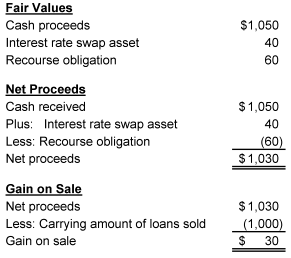 Fair Values Cash proceeds " $1,050 " Interest rate swap asset 40 Recourse obligation 60 Net Proceeds Cash received " $1,050 " Plus: Interest rate swap asset 40 Less: Recourse obligation (60) Net proceeds " $1,030 " Gain on Sale Net proceeds " $1,030 " Less: Carrying amount of loans sold " (1,000)" Gain on sale $30
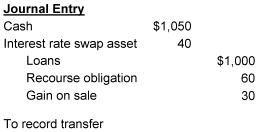 Journal Entry Cash " $1,050 " Interest rate swap asset 40 Loans " $1,000 " Recourse obligation 60 Gain on sale 30 To record transfer
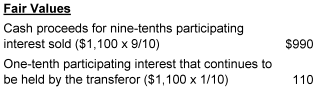 Fair Values "Cash proceeds for nine-tenths participating interest sold ($1,100 x 9/10) " $990 "One-tenth participating interest that continues to be held by the transferor ($1,100 x 1/10) " 110
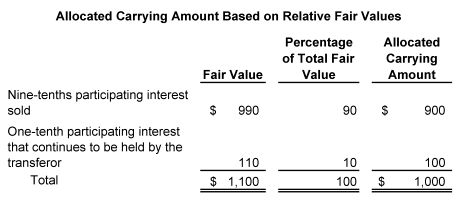 Allocated Carrying Amount Based on Relative Fair Values Fair Value Percentage of Total Fair Value Allocated Carrying Amount Nine-tenths participating interest sold $990 90 $900 One-tenth participating interest that continues to be held by the transferor 110 10 100 Total $1,100 100 $1,000
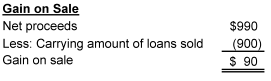 Gain on Sale Net proceeds $990 Less: Carrying amount of loans sold (900) Gain on sale $90
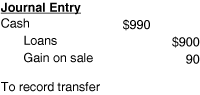 Journal Entry Cash $990 Loans $900 Gain on sale 90 To record transfer
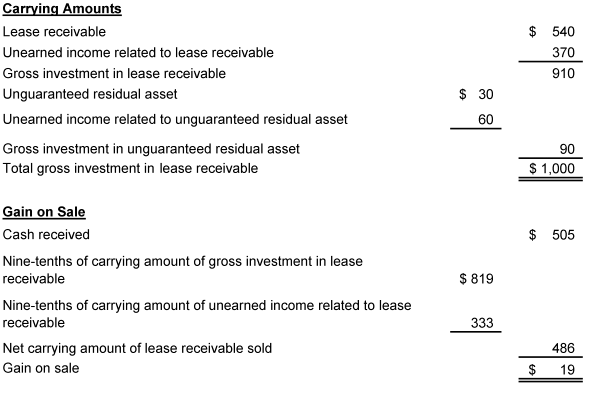 Carrying Amounts Lease receivable $540 Unearned income related to lease receivable 370 Gross investment in lease receivable 910 Unguaranteed residual asset $30 Unearned income related to unguaranteed residual asset 60 Gross investment in unguaranteed residual asset 90 Total gross investment in lease receivable " $1,000 " Gain on Sale Cash received $505 Nine-tenths of carrying amount of gross investment in lease receivable $819 Nine-tenths of carrying amount of unearned income related to lease receivable 333 Net carrying amount of lease receivable sold 486 Gain on sale $19
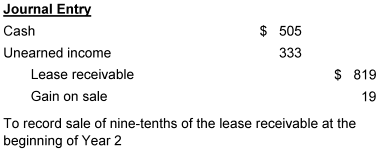 Journal Entry Cash $505 Unearned income 333 Lease receivable $819 Gain on sale 19 To record sale of nine-tenths of the lease receivable at the beginning of Year 2
- aThe fair value of the servicing asset is $40.
- bThe total fair value of the loans including servicing is $1,040.
- cThe fair value of the interest-income strip receivable is $60.
- January 2, 20X1
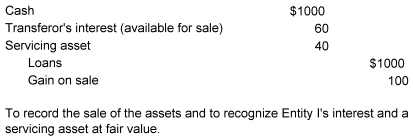 Cash $1000 Transferor's interest (available for sale) 60 Servicing asset 40 Loans $1000 Gain on sale 100 To record the sale of the assets and to recognize Entity I's interest and a servicing asset at fair value.
- December 1, 20X1
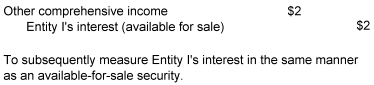 Other comprehensive income $2 Entity I's interest (available for sale) $2 To subsequently measure Entity I's interest in the same manner as an available-for-sale security.
- December 1, 20X1
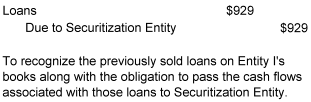 Loans $929 Due to Securitization Entity $929 To recognize the previously sold loans on Entity I's books along with the obligation to pass the cash flows associated with those loans to Securitization Entity.
- aEntity I would continue to account for transferor's interests (in accordance with paragraph 320-10-35-1) at fair value with changes in fair value recognized in other comprehensive income.
- bEntity I would account for the loans at cost plus accrued interest in accordance with Subtopic 310-20.
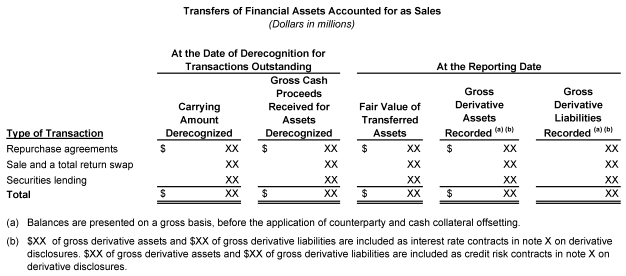 "Transfers of Financial Assets Accounted for as Sales (Dollars in millions)" At the Date of Derecognition for Transactions Outstanding At the Reporting Date " Type of Transaction" Carrying Amount Derecognized Gross Cash Proceeds Received for Assets Derecognized Fair Value of Transferred Assets Gross Derivative Assets Recorded (a) (b) Gross Derivative Liabilities Recorded (a) (b) Repurchase agreements $ XX $ XX $ XX $ XX $ XX Repo financings xx xx xx xx xx Sale and a total return swap XX XX XX XX XX Securities lending XX XX XX XX XX Total $ XX $ XX $ XX $ XX $ XX (a) "Balances are presented on a gross basis, before the application of counterparty and cash collateral offsetting." (b) "$XX of gross derivative assets and $XX of gross derivative liabilities are included as interest rate contracts in footnote X on derivative disclosures. $XX of gross derivative assets and $XX of gross derivative liabilities are included as credit risk contracts in footnote X on derivative disclosures. "