ASC 860-30
Secured Borrowing and Collateral
860 Transfers and Servicing
Source downloaded: .Record version df3992702252. Effective date must be checked in the source.
ASC 860-30 governs transfers of financial assets that fail the sale conditions and therefore must be accounted for as secured borrowings, plus the accounting for collateral pledged in such transactions. The transferor keeps the transferred asset on its balance sheet with no change in measurement basis (860-30-25-2), reclassifying it separately (e.g., "securities pledged to creditors") if the secured party may sell or repledge it (860-30-45-1). Cash collateral — and securities collateral the holder may sell or repledge — is treated as proceeds of a borrowing rather than as collateral, and is recognized as an asset by the recipient with a corresponding obligation to return it (860-30-25-3, 25-8).
Key points (7)
- A transfer is accounted for as a secured borrowing with pledge of collateral if it fails the sale conditions of 860-10-40-5, or if a transfer of a portion of an entire financial asset does not meet the participating interest definition; the transferor continues to report the asset with no change in its basis of accounting (860-30-25-2).
- All cash collateral is recorded as an asset by the secured party receiving it with a liability to return it, and as a receivable by the obligor, because cash transfers cannot be distinguished from borrowing cash (860-30-25-3).
- Cash, or securities the holder may sell or repledge, received as 'collateral' for noncash financial assets (e.g., securities lending) is not collateral accounting but proceeds of a sale or borrowing (860-30-25-4, 25-8, 25-9).
- Noncash collateral accounting depends on the secured party's right to sell or repledge and on default: if that right exists the obligor reclassifies and separately reports the asset (860-30-25-5(a), 860-30-45-1); if the secured party sells the collateral it recognizes the proceeds and an obligation to return the collateral (860-30-25-5(b)); otherwise the obligor keeps the asset and the secured party recognizes nothing (860-30-25-5(d)).
- On the obligor's default with no right of redemption, the obligor derecognizes the pledged asset and the secured party recognizes it, initially measured at fair value if not already sold; a secured party that already sold the collateral derecognizes its return obligation (860-30-25-5(c), 860-30-30-1, 860-30-40-1).
- Reclassified pledged collateral continues to be measured under the same principles as before the transfer (e.g., AFS at fair value through OCI, HTM at amortized cost) (860-30-35-2), while the obligation to return collateral is measured under other guidance (banks selling collateral measure it like a short sale at fair value per 942-405-35-1).
- Required disclosures include collateral policies, carrying amounts of pledged assets not reclassified and associated liabilities, fair value of accepted collateral permitted to be sold or repledged and the portion sold or repledged (860-30-50-1A), and for repos, securities lending, and repurchase-to-maturity transactions, disaggregation of the gross obligation by class of collateral, remaining contractual maturity, and risk discussion (860-30-50-7).
For students. This is the default landing spot whenever a transfer fails sale accounting under 860-10-40-5 — repos, dollar rolls, and securities lending — so know that the transferor keeps the asset at its old measurement basis and simply books a borrowing. The classic trap is applying "collateral" accounting to cash received in a securities lending deal: cash (and securities that can be sold or repledged) is proceeds of a borrowing, not collateral.
Machine-generated study aid for ASC 860-30. Check the source paragraphs below.
860-30-00Status
Source downloaded: .Record version 12afe4575eba. Effective date must be checked in the source.
860-30-05Overview and Background
Source downloaded: .Record version d6cba50b3f07. Effective date must be checked in the source.
860-30-10Objectives
Source downloaded: .Record version 232ac3262ec5. Effective date must be checked in the source.
860-30-15Scope and Scope Exceptions
Source downloaded: .Record version 37aa8e224309. Effective date must be checked in the source.
Overall Guidance
Transactions
- a
- b Dollar rolls
- c Securities lending transactions.
860-30-25Recognition
Source downloaded: .Record version e4491bedb80a. Effective date must be checked in the source.
- aCash collateral
- bNoncash collateral
- cCash or securities received as proceeds
- dSales of collateral received.
- a If a transfer of an entire financial asset, a group of entire financial assets, or a participating interest in an entire financial asset does not meet the conditions for a sale in paragraph 860-10-40-5
- b If a transfer of a portion of an entire financial asset does not meet the definition of a participating interest.
Cash Collateral
Noncash Collateral
- aIf the secured party (transferee) has the right by contract or custom to sell or repledge the collateral, then paragraph 860-30-45-1 requires that the obligor (transferor) reclassify that asset and report that asset in its statement of financial position separately (for example, as security pledged to creditors) from other assets not so encumbered.
- bIf the secured party (transferee) sells collateral pledged to it, it shall recognize the proceeds from the sale and its obligation to return the collateral. The sale of the collateral is a transfer subject to the provisions of this Topic.
- cIf the obligor (transferor) defaults under the terms of the secured contract and is no longer entitled to redeem the pledged asset, it shall derecognize the pledged asset as required by paragraph 860-30-40-1 and the secured party (transferee) shall recognize the collateral as its asset. (See paragraph 860-30-30-1 for guidance on the secured party's initial measurement of collateral recognized. See paragraph 860-30-40-1 for further guidance if the debtor has sold the collateral.)
- dExcept as provided in paragraph 860-30-40-1 the obligor (transferor) shall continue to carry the collateral as its asset, and the secured party (transferee) shall not recognize the pledged asset.
Cash or Securities Received as Proceeds
Sales of Collateral Held
860-30-30Initial Measurement
Source downloaded: .Record version 66f368463f2b. Effective date must be checked in the source.
Noncash Collateral
860-30-35Subsequent Measurement
Source downloaded: .Record version a6bb6c6228a4. Effective date must be checked in the source.
- aPledged assets required to be reclassified
- bObligation to return transferred collateral.
Pledged Assets Required to Be Reclassified
Obligation to Return Transferred Collateral
860-30-40Derecognition
Source downloaded: .Record version 2500931f33b0. Effective date must be checked in the source.
860-30-45Other Presentation Matters
Source downloaded: .Record version 268ec528c549. Effective date must be checked in the source.
- a Pledged assets reclassified by the transferor of securities loaned or transferred under a repurchase agreement accounted for as a collateralized borrowing if the transferee is permitted to sell or repledge those securities
- b Liabilities incurred by either the secured party or obligor in securities borrowing or resale transactions.
- a Pledged assets reclassified by the transferor of securities loaned or transferred under a repurchase agreement accounted for as a collateralized borrowing if the transferee is permitted to sell or repledge those securities
- b Liabilities, including accrued interest, incurred by either the secured party or obligor in securities borrowing or resale transactions.
860-30-50Disclosure
Source downloaded: .Record version d92a39204092. Effective date must be checked in the source.
- aIf the entity has entered into repurchase agreements or securities lending transactions, it shall disclose its policy for requiring collateral or other security.
- bAs of the date of the latest statement of financial position presented, both of the following:
- 1The carrying amount and classifications of both of the following:
- iAny assets pledged as collateral that are not reclassified and separately reported in the statement of financial position in accordance with paragraph 860-30-25-5(a)
- iiAssociated liabilities.
- i
- 2Qualitative information about the relationship(s) between those assets and associated liabilities; for example, if assets are restricted solely to satisfy a specific obligation, a description of the nature of restrictions placed on those assets.
- 1
- cIf the entity has accepted collateral that it is permitted by contract or custom to sell or repledge, it shall disclose all of the following:
- 1The fair value as of the date of each statement of financial position presented of that collateral
- 2The fair value as of the date of each statement of financial position presented of the portion of that collateral that it has sold or repledged
- 3Information about the sources and uses of that collateral.
- 1
- aIf the entity has entered into repurchase agreements or securities lending transactions, it shall disclose its policy for requiring collateral or other security.
- bAs of the date of the latest statement of financial position presented, both of the following:
- 1The carrying amount and classifications of both of the following:
- iAny assets pledged as collateral that are not reclassified and separately reported in the statement of financial position in accordance with paragraph 860-30-25-5(a)
- iiAssociated liabilities.
- i
- 2Qualitative information about the relationship(s) between those assets and associated liabilities; for example, if assets are restricted solely to satisfy a specific obligation, a description of the nature of restrictions placed on those assets.
- 1
- cIf the entity has accepted collateral that it is permitted by contract or custom to sell or repledge, it shall disclose all of the following:
- 1The fair value as of the date of each statement of financial position presented of that collateral
- 2The fair value as of the date of each statement of financial position presented of the portion of that collateral that it has sold or repledged
- 3Information about the sources and uses of that collateral.
- 1
Disclosures for Repurchase Agreements, Securities Lending Transactions, and Repurchase-to-Maturity Transactions
- aA disaggregation of the gross obligation by the class of collateral pledged. An entity shall determine the appropriate level of disaggregation and classes to be presented on the basis of the nature, characteristics, and risks of the collateral pledged.
- 1Total borrowings under those agreements shall be reconciled to the amount of the gross liability for repurchase agreements and securities lending transactions disclosed in accordance with paragraph 210-20-50-3(a) before any adjustments for offsetting. Any difference between the amount of the gross obligation disclosed under this paragraph and the amount disclosed in accordance with paragraph 210-20-50-3(a) shall be presented as reconciling item(s).
- 1
- bThe remaining contractual maturity of the repurchase agreements, securities lending transactions, and repurchase-to-maturity transactions. An entity shall use judgment to determine an appropriate range of maturity intervals that would convey an understanding of the overall maturity profile of the entity's financing agreements.
- cA discussion of the potential risks associated with the agreements and related collateral pledged, including obligations arising from a decline in the fair value of the collateral pledged and how those risks are managed.
- aA disaggregation of the gross obligation by the class of collateral pledged. An entity shall determine the appropriate level of disaggregation and classes to be presented on the basis of the nature, characteristics, and risks of the collateral pledged.
- 1Total borrowings under those agreements shall be reconciled to the amount of the gross liability for repurchase agreements and securities lending transactions disclosed in accordance with paragraph 210-20-50-3(a) before any adjustments for offsetting. Any difference between the amount of the gross obligation disclosed under this paragraph and the amount disclosed in accordance with paragraph 210-20-50-3(a) shall be presented as reconciling item(s).
- 1
- bThe remaining contractual maturity of the repurchase agreements, securities lending transactions, and repurchase-to-maturity transactions. An entity shall use judgment to determine an appropriate range of maturity intervals that would convey an understanding of the overall maturity profile of the entity's financing agreements.
- cA discussion of the potential risks associated with the agreements and related collateral pledged, including obligations arising from a decline in the fair value of the collateral pledged and how those risks are managed.
- dFor a public business entity, the weighted-average interest rate of the repurchase liability and the related repurchase liability.
- a
- bRecognized securities borrowing and securities lending transactions.
Disclosures for Counterparty Risk for Repurchase Agreements, Securities Lending Transactions, and Repurchase-to-Maturity Transactions
860-30-55Implementation Guidance and Illustrations
Source downloaded: .Record version f9ed3ca1d656. Effective date must be checked in the source.
Illustrations
- aTransferor's carrying amount and fair value of security loaned: $1,000
- bCash collateral: $1,020
- cTransferor's return from investing cash collateral at a 5 percent annual rate: $5
- dTransferor's rebate to the securities borrower at a 4 percent annual rate: $4.
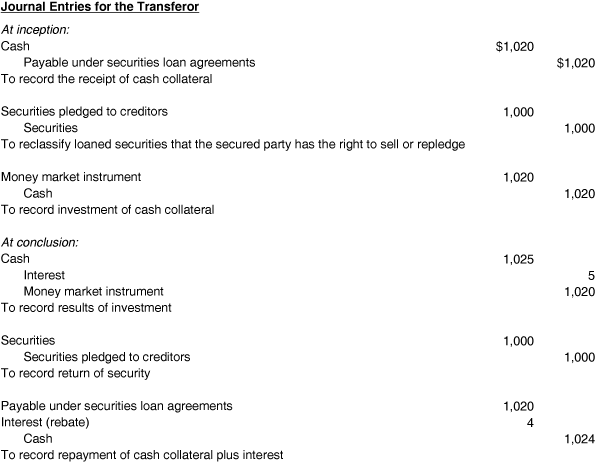 Journal Entries for the Transferor At inception: Cash " $1,020 " Payable under securities loan agreements " $1,020 " To record the receipt of cash collateral Securities pledged to creditors " 1,000 " Securities " 1,000 " To reclassify loaned securities that the secured party has the right to sell or repledge Money market instrument " 1,020 " Cash " 1,020 " To record investment of cash collateral At conclusion: Cash " 1,025 " Interest 5 Money market instrument " 1,020 " To record results of investment Securities " 1,000 " Securities pledged to creditors " 1,000 " To record return of security Payable under securities loan agreements " 1,020 " Interest (rebate) 4 Cash " 1,024 " To record repayment of cash collateral plus interest
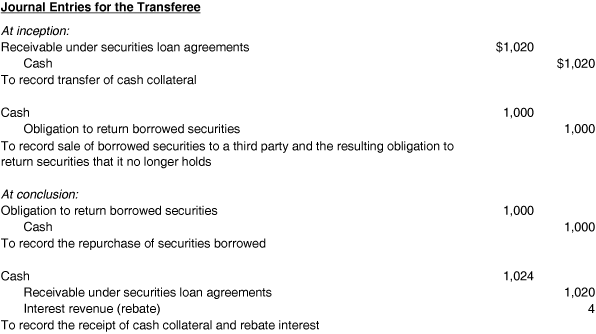 Journal Entries for the Transferee At inception: Receivable under securities loan agreements " $1,020 " Cash " $1,020 " To record transfer of cash collateral Cash " 1,000 " Obligation to return borrowed securities " 1,000 " To record sale of borrowed securities to a third party and the resulting obligation to return securities that it no longer holds At conclusion: Obligation to return borrowed securities " 1,000 " Cash " 1,000 " To record the repurchase of securities borrowed Cash " 1,024 " Receivable under securities loan agreements " 1,020 " Interest revenue (rebate) 4 To record the receipt of cash collateral and rebate interest
-
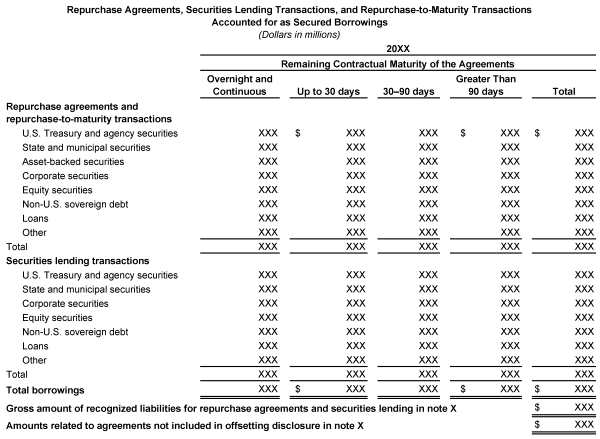 "Repurchase Agreements, Securities Lending Transactions, and Repurchase-to-Maturity Transactions Accounted for as Secured Borrowings (Dollars in millions)" 20XX Remaining Contractual Maturity of the Agreements Overnight and Continuous Up to 30 days 30-90 days Greater Than 90 days Total Repurchase agreements and repurchase-to-maturity transactions U.S. Treasury and agency securities $ XXX $ XXX $ XXX $ XXX $ XXX State and municipal securities XXX XXX XXX XXX XXX Asset-backed securities XXX XXX XXX XXX XXX Corporate securities XXX XXX XXX XXX XXX Equity securities XXX XXX XXX XXX XXX Non-U.S. sovereign debt XXX XXX XXX XXX XXX Loans XXX XXX XXX XXX XXX Other XXX XXX XXX XXX XXX Total XXX XXX XXX XXX XXX 20XX Gross Obligations Overnight Up to 30 Days 30-90 Days Over 90 Days Securities lending transactions U.S. Treasury and agency securities XXX XXX XXX XXX XXX State and municipal securities XXX XXX XXX XXX XXX Corporate securities XXX XXX XXX XXX XXX Equity securities XXX XXX XXX XXX XXX Non-U.S. sovereign debt XXX XXX XXX XXX XXX Loans XXX XXX XXX XXX XXX Other XXX XXX XXX XXX XXX Total XXX XXX XXX XXX XXX Total borrowings $ XXX $ XXX $ XXX $ XXX $ XXX Gross amount of recognized liabilities for repurchase agreements and securities lending in footnote X $ XXX Amounts related to agreements not included in offsetting disclosure in footnote X $ XXX
- "Repurchase Agreements, Securities Lending Transactions, and Repurchase-to-Maturity Transactions Accounted for as Secured Borrowings (Dollars in millions)" 20XX Remaining Contractual Maturity of the Agreements Overnight and Continuous Up to 30 days 30-90 days Greater Than 90 days Total Repurchase agreements and repurchase-to-maturity transactions U.S. Treasury and agency securities $ XXX $ XXX $ XXX $ XXX $ XXX State and municipal securities XXX XXX XXX XXX XXX Asset-backed securities XXX XXX XXX XXX XXX Corporate securities XXX XXX XXX XXX XXX Equity securities XXX XXX XXX XXX XXX Non-U.S. sovereign debt XXX XXX XXX XXX XXX Loans XXX XXX XXX XXX XXX Other XXX XXX XXX XXX XXX Total XXX XXX XXX XXX XXX 20XX Gross Obligations Overnight Up to 30 Days 30-90 Days Over 90 Days Securities lending transactions U.S. Treasury and agency securities XXX XXX XXX XXX XXX State and municipal securities XXX XXX XXX XXX XXX Corporate securities XXX XXX XXX XXX XXX Equity securities XXX XXX XXX XXX XXX Non-U.S. sovereign debt XXX XXX XXX XXX XXX Loans XXX XXX XXX XXX XXX Other XXX XXX XXX XXX XXX Total XXX XXX XXX XXX XXX Total borrowings $ XXX $ XXX $ XXX $ XXX $ XXX Gross amount of recognized liabilities for repurchase agreements and securities lending in footnote X $ XXX Amounts related to agreements not included in offsetting disclosure in footnote X $ XXX
860-30-60Relationships
Source downloaded: .Record version 9ab1d697f6ac. Effective date must be checked in the source.
Balance Sheet
860-30-S50DisclosureSEC
Source downloaded: .Record version 8f201bc2cdc9. Effective date must be checked in the source.