ASC 235-10
Overall
235 Notes to Financial Statements
Source downloaded: .Record version 377a008ace55. Effective date must be checked in the source.
ASC 235-10 requires an entity whose financial statements purport to present fairly financial position, cash flows, and results of operations in accordance with GAAP to include a description of all significant accounting policies as an integral part of those statements (235-10-50-1). "Accounting policies" are the specific accounting principles and the methods of applying them that management judges most appropriate in the circumstances (235-10-05-3). The disclosure must cover principles and methods that materially affect the financial statements, especially selections among acceptable alternatives, industry-peculiar methods, and unusual or innovative applications of GAAP (235-10-50-3).
Key points (7)
- The guidance applies to all entities (235-10-15-2), and applies to any basic financial statement issued alone that purports to present fairly in accordance with GAAP (235-10-50-1).
- A description of all significant accounting policies must be included as an integral part of financial statements that are issued or available to be issued (235-10-50-1).
- The requirement does not apply to unaudited interim financial statements issued between annual reporting dates if the entity has not changed its accounting policies since the end of the preceding fiscal year (235-10-50-2).
- Disclosure must identify and describe principles and methods that materially affect financial position, cash flows, or results of operations, including important judgments about revenue recognition and allocation of asset costs, and specifically: selections from existing acceptable alternatives, industry-peculiar principles, and unusual or innovative applications of GAAP (235-10-50-3).
- Commonly required policy disclosures include basis of consolidation, depreciation methods, amortization of intangibles, inventory pricing, revenue recognition from contracts with customers, and revenue recognition from leasing operations (235-10-50-4).
- Policy disclosure shall not duplicate details presented elsewhere in the financial statements and may cross-reference them; changes in accounting policies during the period are described with cross-reference to Topic 250 disclosures (235-10-50-5).
- Format and location are flexible, but disclosure is preferred in a separate summary of significant accounting policies preceding the notes or as the initial note (235-10-50-6); policy disclosures for specific line items are addressed in the related Topics (235-10-05-2).
For students. This is the source of the ubiquitous "Note 1 — Summary of Significant Accounting Policies," so it shows up on exams as the general disclosure baseline. A common misunderstanding is thinking the note should repeat detailed balances (inventory composition, PP&E rollforwards) — 235-10-50-5 forbids duplication; the note describes the principles and methods chosen, not the numbers.
Machine-generated study aid for ASC 235-10. Check the source paragraphs below.
235-10-00Status
Source downloaded: .Record version dc18d5117d4c. Effective date must be checked in the source.
| Paragraph | Action | Accounting Standards Update | Date |
| Contract | Added | Accounting Standards Update No. 2014-09 | 05/28/2014 |
| Customer | Added | Accounting Standards Update No. 2014-09 | 05/28/2014 |
| Financial Instrument | Amended | Accounting Standards Update No. 2024-02 | 03/29/2024 |
| Revenue | Added | Accounting Standards Update No. 2014-09 | 05/28/2014 |
| 235-10-50-4 | Amended | Accounting Standards Update No. 2014-09 | 05/28/2014 |
| 235-10-50-6 | Amended | Maintenance Update 2016-11 (PDF) | 06/27/2016 |
235-10-05Overview and Background
Source downloaded: .Record version f212faaccec9. Effective date must be checked in the source.
Importance of Accounting Policies Disclosure
235-10-15Scope and Scope Exceptions
Source downloaded: .Record version f4957e0099f5. Effective date must be checked in the source.
Overall Guidance
Entities
235-10-50Disclosure
Source downloaded: .Record version b0011c1ef6df. Effective date must be checked in the source.
Accounting Policies Disclosure
Accounting Policies Disclosure in Interim Periods
What to Disclose
- a A selection from existing acceptable alternatives
- b Principles and methods peculiar to the industry in which the entity operates, even if such principles and methods are predominantly followed in that industry
- c Unusual or innovative applications of GAAP.
Examples of Disclosures
- a Basis of consolidation
- b Depreciation methods
- c Amortization of intangibles
- d Inventory pricing
- e
- f Recognition of revenue from leasing operations.
Avoid Duplicate Details of Disclosures
Format
235-10-S00StatusSEC
Source downloaded: .Record version aa6744bb0859. Effective date must be checked in the source.
| Paragraph | Action | Accounting Standards Update | Date |
| Amended | Accounting Standards Update No. 2019-07 | 07/26/2019 | |
| 235-10-S99-1 | Amended | Accounting Standards Update No. 2012-03 | 08/27/2012 |
| 235-10-S99-1 | Amended | Accounting Standards Update No. 2010-21 | 08/02/2010 |
| 235-10-S99-1 | Amended | Accounting Standards Update No. 2009-07 | 09/15/2009 |
| 235-10-S99-5 | Amended | Accounting Standards Update No. 2012-03 | 08/27/2012 |
235-10-S50DisclosureSEC
Source downloaded: .Record version 0a2bd1fdc590. Effective date must be checked in the source.
Required General Disclosures
Foreign Private Issuers
Disclosures from Supplemental Schedules
235-10-S99SEC MaterialsSEC
Source downloaded: .Record version b50ef8b99af3. Effective date must be checked in the source.
SEC Rules, Regulations, and Interpretations
- If applicable to the person for which the financial statements are filed, the following shall be set forth on the face of the appropriate statement or in appropriately captioned notes. The information shall be provided for each statement required to be filed, except that the information required by paragraphs (b), (c), (d), (e) and (f) of this section shall be provided as of the most recent audited balance sheet being filed and for paragraph (j) of this section as specified therein. When specific statements are presented separately, the pertinent notes shall accompany such statements unless cross-referencing is appropriate.
- (a) [Reserved]
- (b) Assets subject to lien. Assets mortgaged, pledged, or otherwise subject to lien, and the approximate amounts thereof, shall be designated and the obligations collateralized briefly identified.
- (c) Defaults. The facts and amounts concerning any default in principal, interest, sinking fund, or redemption provisions with respect to any issue of securities or credit agreements, or any breach of covenant of a related indenture or agreement, which default or breach existed at the date of the most recent balance sheet being filed and which has not been subsequently cured, shall be stated in the notes to the financial statements. If a default or breach exists but acceleration of the obligation has been waived for a stated period of time beyond the date of the most recent balance sheet being filed, state the amount of the obligation and the period of the waiver.
- (d) Preferred shares. Aggregate preferences on involuntary liquidation, if other than par or stated value, shall be shown parenthetically in the equity section of the balance sheet.
- (e) Restrictions which limit the payment of dividends by the registrant.
- (1) Describe the most significant restrictions on the payment of dividends by the registrant, indicating their sources, their pertinent provisions, and the amount of retained earnings or net income restricted or free of restrictions.
- (2) Disclose the amount of consolidated retained earnings which represents undistributed earnings of 50 percent or less owned persons accounted for by the equity method.
- (3) The disclosures in paragraphs (e)(3)(i) and (ii) of this section shall be provided when material.
- (i) Describe the nature of any restrictions on the ability of consolidated subsidiaries and unconsolidated subsidiaries to transfer funds to the registrant in the form of cash dividends, loans or advances (i. e., borrowing arrangements, regulatory restraints, foreign government, etc.)
- (ii) Disclose separately the amounts of such restricted net assets for unconsolidated subsidiaries and consolidated subsidiaries as of the end of the most recently completed fiscal year.
- (f) Significant changes in bonds, mortgages and similar debt. Any significant changes in the authorized amounts of bonds, mortgages and similar debt since the date of the latest balance sheet being filed for a particular person or group shall be stated.
- (g) Summarized financial information of subsidiaries not consolidated and 50 percent or less owned persons.
- (1) The summarized information as to assets, liabilities and results of operations as detailed in § 210.1-02(bb) shall be presented in notes to the financial statements on an individual or group basis for:
- (i) Subsidiaries not consolidated; or
- (ii) For 50 percent or less owned persons accounted for by the equity method by the registrant or by a subsidiary of the registrant, if the criteria in § 210.1-02(w) for a significant subsidiary are met:
- (A) Individually by any subsidiary not consolidated or any 50% or less owned person; or
- (B) On an aggregated basis by any combination of such subsidiaries and persons.
- (2) Summarized financial information shall be presented insofar as is practicable as of the same dates and for the same periods as the audited consolidated financial statements provided and shall include the disclosures prescribed by § 210.1-02(bb). Summarized information of subsidiaries not consolidated shall not be combined for disclosure purposes with the summarized information of 50 percent or less owned persons.
- (h) Income tax expense.
- (1) Disclosure shall be made in the statement of comprehensive income or a note thereto, of the components of income (loss) before income tax expense (benefit) as either domestic or foreign.
- NOTE 1 to Paragraph (h)(1): Amounts applicable to United States Federal income taxes, to foreign income taxes and the other income taxes shall be stated separately for each major component. Amounts applicable to foreign income (loss) and amounts applicable to foreign or other income taxes which are less than five percent of the total of income before taxes or the component of tax expense, respectively, need not be separately disclosed. For purposes of this rule, foreign income (loss) is defined as income (loss) generated from a registrant's foreign operations, i. e., operations that are located outside of the registrant's home country.
- (2) In the reconciliation between the amount of reported total income tax expense (benefit) and the amount computed by multiplying the income (loss) before tax by the applicable statutory Federal income tax rate if no individual reconciling item amounts to more than five percent of the amount computed by multiplying the income before tax by the applicable statutory Federal income tax rate, and the total difference to be reconciled is less than five percent of such computed amount, no reconciliation need be provided unless it would be significant in appraising the trend of earnings. Reconciling items that are individually less than five percent of the computed amount may be aggregated in the reconciliation. Where the reporting person is a foreign entity, the income tax rate in that person's country of domicile should normally be used in making the above computation, but different rates should not be used for subsidiaries or other segments of a reporting entity. When the rate used by a reporting person is other than the United States Federal corporate income tax rate, the rate used and the basis for using such rate shall be disclosed.
- (4) Price at which warrant or right is exercisable.
- (i)-(j) [Reserved]
- (k) Related party transactions that affect the financial statements.
- (1) Amounts of related party transactions should be stated on the face of the balance sheet, statement of comprehensive income, or statement of cash flows.
- (2) In cases where separate financial statements are presented for the registrant, certain investees, or subsidiaries, any intercompany profits or losses resulting from transactions with related parties and the effects thereof shall be disclosed.
- (l) [Reserved]
- (m) Repurchase and reverse repurchase agreements.
- (1) Repurchase agreements (assets sold under agreements to repurchase).
- (i) If, as of the most recent balance sheet date, the carrying amount (or market value, if higher than the carrying amount or if there is no carrying amount) of the securities or other assets sold under agreements to repurchase (repurchase agreements) exceeds 10% of total assets, disclose separately in the balance sheet the aggregate amount of liabilities incurred pursuant to repurchase agreements including accrued interest payable thereon.
- (ii)(A) If, as of the most recent balance sheet date, the carrying amount (or market value, if higher than the carrying amount) of securities or other assets sold under repurchase agreements, other than securities or assets specified in paragraph (m)(1)(ii)(B) of this section, exceeds 10% of total assets, disclose in an appropriately captioned footnote containing a tabular presentation, segregated as to type of such securities or assets sold under agreements to repurchase (e. g., U.S. Treasury obligations, U.S. Government agency obligations and loans), the following information as of the balance sheet date for each such agreement or group of agreements (other than agreements involving securities or assets specified in paragraph (m)(1)(ii)(B) of this section) maturing (1) overnight; (2) term up to 30 days; (3) term of 30 to 90 days; (4) term over 90 days and (5) demand:
- (i) The carrying amount and market value of the assets sold under agreement to repurchase, including accrued interest plus any cash or other assets on deposit under the repurchase agreements; and
- (ii) The repurchase liability associated with such transaction or group of transactions and the interest rate(s) thereon.
- (B) For purposes of paragraph (m)(1)(ii)(A) of this section only, do not include securities or other assets for which unrealized changes in market value are reported in current income or which have been obtained under reverse repurchase agreements.
- (iii) If, as of the most recent balance sheet date, the amount at risk under repurchase agreements with any individual counterparty or group of related counterparties exceeds 10% of stockholders' equity (or in the case of investment companies, net asset value), disclose the name of each such counterparty or group of related counterparties, the amount at risk with each, and the weighted average maturity of the repurchase agreements with each. The amount at risk under repurchase agreements is defined as the excess of carrying amount (or market value, if higher than the carrying amount or if there is no carrying amount) of the securities or other assets sold under agreement to repurchase, including accrued interest plus any cash or other assets on deposit to secure the repurchase obligation, over the amount of the repurchase liability (adjusted for accrued interest). (Cash deposits in connection with repurchase agreements shall not be reported as unrestricted cash pursuant to rule 5-02.1.)
- (2) Reverse repurchase agreements (assets purchased under agreements to resell).
- (i) If, as of the most recent balance sheet date, the aggregate carrying amount of "reverse repurchase agreements" (securities or other assets purchased under agreements to resell) exceeds 10% of total assets:
- (A) Disclose separately such amount in the balance sheet; and
- (B) Disclose in an appropriately captioned footnote:
- (1) The registrant's policy with regard to taking possession of securities or other assets purchased under agreements to resell; and
- (2) Whether or not there are any provisions to ensure that the market value of the underlying assets remains sufficient to protect the registrant in the event of default by the counterparty and if so, the nature of those provisions.
- (ii) If, as of the most recent balance sheet date, the amount at risk under reverse repurchase agreements with any individual counterparty or group of related counterparties exceeds 10% of stockholders' equity (or in the case of investment companies, net asset value), disclose the name of each such counterparty or group of related counterparties, the amount at risk with each, and the weighted average maturity of the reverse repurchase agreements with each. The amount at risk under reverse repurchase agreements is defined as the excess of the carrying amount of the reverse repurchase agreements over the market value of assets delivered pursuant to the agreements by the counterparty to the registrant (or to a third party agent that has affirmatively agreed to act on behalf of the registrant) and not returned to the counterparty, except in exchange for their approximate market value in a separate transaction.
- (n) Accounting policies for certain derivative instruments. Disclosures regarding accounting policies shall include to the extent material where in the statement of cash flows derivative financial instruments, and their related gains and losses, as defined by U.S. generally accepted accounting principles are reported.
- [45 FR 63669, Sept. 25, 1980, as amended at 46 FR 56179, Nov. 16, 1981; 50 FR 25215, June 18, 1985; 50 FR 49532, Dec. 3, 1985; 51 FR 3770, Jan. 30, 1986; 57 FR 45293, Oct. 1, 1992; 59 FR 65636, Dec. 20, 1994; 62 FR 6063, Feb. 10, 1997; 74 FR 18615, Apr. 23, 2009; 76 FR 50119, Aug. 12, 2011; 83 FR 50200, Oct. 4, 2018]
- These sections prescribe the form and content of the schedules required by §§ 210.5-04, 210.6-10, 210.6A-05, and 210.7-05.
- [59 FR 65637, Dec. 20, 1994]
- (a) Provide condensed financial information as to financial position, cash flows and results of operations of the registrant as of the same dates and for the same periods for which audited consolidated financial statements are required. The financial information required need not be presented in greater detail than is required for condensed statements by § 210.10-01(a)(2), (3) and (4). Detailed footnote disclosure which would normally be included with complete financial statements may be omitted with the exception of disclosures regarding material contingencies, long-term obligations and guarantees. Descriptions of significant provisions of the registrant's long-term obligations, mandatory dividend or redemption requirements of redeemable stocks, and guarantees of the registrant shall be provided along with a five-year schedule of maturities of debt. If the material contingencies, long-term obligations, redeemable stock requirements and guarantees of the registrant have been separately disclosed in the consolidated statements, they need not be repeated in this schedule.
- (b) Disclose separately the amounts of cash dividends paid to the registrant for each of the last three fiscal years by consolidated subsidiaries, unconsolidated subsidiaries and 50 percent or less owned persons accounted for by the equity method, respectively.
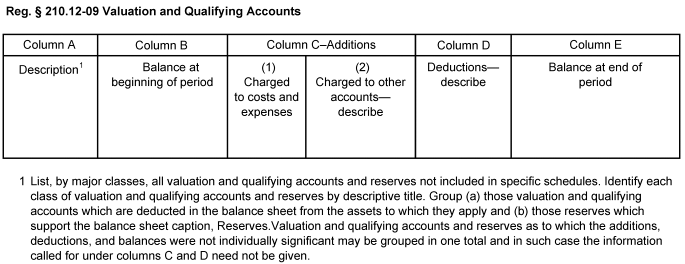 Reg. § 210.12-09 Valuation and Qualifying Accounts Column A Column B Column C-Additions Column D Column E Description1 Balance at beginning of period " (1) Charged to costs and expenses" " (2) Charged to other accounts— describe" Deductions— describe "Balance at end of period" 1 "List, by major classes, all valuation and qualifying accounts and reserves not included in specific schedules. Identify each class of valuation and qualifying accounts and reserves by descriptive title. Group (a) those valuation and qualifying accounts which are deducted in the balance sheet from the assets to which they apply and (b) those reserves which support the balance sheet caption, Reserves.Valuation and qualifying accounts and reserves as to which the additions, deductions, and balances were not individually significant may be grouped in one total and in such case the information called for under columns C and D need not be given."
SEC Staff Guidance
- Facts: A foreign private issuer may use Form 20-F as a registration statement under section 12 or as an annual report under section 13(a) or 15(d) of the Exchange Act. The registrant must furnish the financial statements specified in Item 17 of that form (Effective for fiscal years ending on or after December 15, 2011, compliance with Item 18 rather than Item 17 will be required for all issuer financial statements in all Securities Act registration statements, Exchange Act registration statements on Form 20-F, and annual reports on Form 20-F. See SEC Release No. 33-8959). However, in certain circumstances, Form F-3 requires that the annual report include financial statements complying with Item 18 of the form. Also, financial statements complying with Item 18 are required for registration of securities under the Securities Act in most circumstances. Item 17 permits the registrant to use its financial statements that are prepared on a comprehensive basis other than U.S. GAAP, but requires quantification of the material differences in the principles, practices and methods of accounting for any basis other than International Financial Reporting Standards (IFRS) as issued by the International Accounting Standards Board (IASB). An issuer complying with Item 18, other than those using IFRS as issued by the IASB, must satisfy the requirements of Item 17 and also must provide all other information required by U.S. GAAP and Regulation S-X.
- Question: Assuming that the registrant's financial statements include a discussion of material variances from U.S. GAAP along with quantitative reconciliations of net income and material balance sheet items, does Item 17 of Form 20-F require other disclosures in addition to those prescribed by the standards and practices which comprise the comprehensive basis on which the registrant's primary financial statements are prepared?
- Interpretive Response: No. The distinction between Items 17 and 18 is premised on a classification of the requirements of U.S. GAAP and Regulation S-X into those that specify the methods of measuring the amounts shown on the face of the financial statements and those prescribing disclosures that explain, modify or supplement the accounting measurements. Disclosures required by U.S. GAAP but not required under the foreign GAAP on which the financial statements are prepared need not be furnished pursuant to Item 17.
- Notwithstanding the absence of a requirement for certain disclosures within the body of the financial statements, some matters routinely disclosed pursuant to U.S. GAAP may rise to a level of materiality such that their disclosure is required by Item 5 (Management's Discussion and Analysis) of Form 20-F. Among other things, this item calls for a discussion of any known trends, demands, commitments, events or uncertainties that are reasonably likely to affect liquidity, capital resources or the results of operations in a material way. Also, instruction 2 of this item requires "a discussion of any aspects of the differences between foreign and U.S. GAAP, not discussed in the reconciliation, that the registrant believes is necessary for an understanding of the financial statements as a whole." Matters that may warrant discussion in response to Item 5 include the following:
- material undisclosed uncertainties (such as reasonably possible loss contingencies), commitments (such as those arising from leases), and credit risk exposures and concentrations;
- material unrecognized obligations (such as pension obligations);
- material changes in estimates and accounting methods, and other factors or events affecting comparability;
- defaults on debt and material restrictions on dividends or other legal constraints on the registrant's use of its assets;
- material changes in the relative amounts of constituent elements comprising line items presented on the face of the financial statements;
- significant terms of financings which would reveal material cash requirements or constraints;
- material subsequent events, such as events that affect the recoverability of recorded assets;
- material related party transactions (as addressed by FASB ASC Topic 850, Related Party Disclosures) that may affect the terms under which material revenues or expenses are recorded; and
- significant accounting policies and measurement assumptions not disclosed in the financial statements, including methods of costing inventory, recognizing revenues, and recording and amortizing assets, which may bear upon an understanding of operating trends or financial condition.