ASC 210-10
Overall
210 Balance Sheet
Source downloaded: .Record version a4f1b3372d9b. Effective date must be checked in the source.
ASC 210-10 provides the general guidance for classifying assets and liabilities as current or noncurrent on a classified balance sheet (statement of financial position), permitting ready determination of working capital. Current assets are cash and other resources expected to be realized in cash or consumed within one year or the operating cycle, whichever is longer; current liabilities are obligations whose liquidation is expected to require use of current assets within that same period. The guidance applies to all entities, but only when an entity chooses to present a classified balance sheet (210-10-15-3).
Key points (7)
- Current assets generally include cash available for current operations and cash equivalents, inventories, trade receivables, receivables collectible within a year, marketable securities representing investment of cash available for current operations, and prepaid expenses (210-10-45-1).
- The operating cycle, not one year, is the measuring period: use one year when several cycles occur within a year, use the longer cycle if it exceeds 12 months (e.g., tobacco, distillery, lumber), and default to one year if there is no clearly defined cycle (210-10-45-3).
- Excluded from current assets are restricted cash or cash designated for noncurrent asset acquisition or long-term debt liquidation, investments/advances held for control or affiliation, receivables from unusual transactions not collectible within 12 months, cash surrender value of life insurance, land and natural resources, depreciable assets, and long-term prepayments or deferred charges (210-10-45-4).
- Prepaid expenses are current not because they convert to cash but because, if not prepaid, they would require use of current assets during the operating cycle (210-10-45-2).
- A total of current liabilities shall be presented in classified balance sheets (210-10-45-5); current liabilities include payables from the operating cycle, collections received in advance of delivery, accruals for wages, taxes and royalties, and estimated or accrued known obligations measurable only approximately (210-10-45-6; 45-8).
- Other obligations liquidated within about 12 months are current, including short-term debts for capital assets, serial maturities of long-term obligations, amounts payable within one year under sinking fund provisions, and agency obligations (210-10-45-9); debts to be liquidated from funds not classified as current assets, or long-term obligations incurred to increase working capital, are excluded (210-10-45-12).
- Asset valuation allowances (e.g., for losses on receivables and investments) shall be deducted from the related assets or groups of assets (210-10-45-13), and inventory amounts must be supplemented by disclosure of the basis of statement and cost method such as average cost, FIFO, or LIFO (210-10-50-1).
For students. This is the foundational current/noncurrent classification guidance tested constantly on the FAR exam; the classic trap is applying a rigid one-year rule when the entity's operating cycle is longer, or treating restricted cash and prepaid expenses incorrectly. Also remember classification of pension over/underfunded status goes to ASC 715-20-45, and debt refinancing/callable debt questions go to ASC 470-10-45.
Machine-generated study aid for ASC 210-10. Check the source paragraphs below.
210-10-00Status
Source downloaded: .Record version 2abdc8ff7f26. Effective date must be checked in the source.
| Paragraph | Action | Accounting Standards Update | Date |
| 210-10-45-1 | Amended | Accounting Standards Update No. 2016-01 | 01/05/2016 |
| 210-10-45-2 | Amended | Accounting Standards Update No. 2012-04 | 10/01/2012 |
| 210-10-45-10 | Amended | Accounting Standards Update No. 2012-04 | 10/01/2012 |
| 210-10-45-13 | Amended | Accounting Standards Update No. 2016-13 | 06/16/2016 |
| 210-10-45-13 | Added | Accounting Standards Update No. 2012-04 | 10/01/2012 |
210-10-05Overview and Background
Source downloaded: .Record version 4af0855449ff. Effective date must be checked in the source.
- aOverall
- bOffsetting.
210-10-15Scope and Scope Exceptions
Source downloaded: .Record version 90daeb2c1996. Effective date must be checked in the source.
Entities
Transactions
210-10-45Other Presentation Matters
Source downloaded: .Record version 514a3a365ee0. Effective date must be checked in the source.
Classification of Current Assets
- aCash available for current operations and items that are cash equivalents
- bInventories of merchandise, raw materials, goods in process, finished goods, operating supplies, and ordinary maintenance material and parts
- cTrade accounts, notes, and acceptances receivable
- dReceivables from officers, employees, affiliates, and others, if collectible in the ordinary course of business within a year
- eInstallment or deferred accounts and notes receivable if they conform generally to normal trade practices and terms within the business
- fMarketable securities representing the investment of cash available for current operations
- gPrepaid expenses such as the following:
- 1Insurance
- 2Interest
- 3Rents
- 4Taxes
- 5Unused royalties
- 6Current paid advertising service not yet received
- 7Operating supplies.
- 1
- aCash and claims to cash that are restricted as to withdrawal or use for other than current operations, are designated for expenditure in the acquisition or construction of noncurrent assets, or are segregated for the liquidation of long-term debts. Even though not actually set aside in special accounts, funds that are clearly to be used in the near future for the liquidation of long-term debts, payments to sinking funds, or for similar purposes shall also, under this concept, be excluded from current assets. However, if such funds are considered to offset maturing debt that has properly been set up as a current liability, they may be included within the current asset classification.
- bInvestments in securities (whether marketable or not) or advances that have been made for the purposes of control, affiliation, or other continuing business advantage.
- cReceivables arising from unusual transactions (such as the sale of capital assets, or loans or advances to affiliates, officers, or employees) that are not expected to be collected within 12 months.
- dCash surrender value of life insurance policies.
- eLand and other natural resources.
- fDepreciable assets.
- gLong-term prepayments that are fairly chargeable to the operations of several years, or deferred charges such as bonus payments under a long-term lease, costs of rearrangement of factory layout or removal to a new location.
Classification of Current Liabilities
- aDue on demand loan agreements
- bCallable debt agreements
- cShort-term obligations expected to be refinanced.
- aPayables incurred in the acquisition of materials and supplies to be used in the production of goods or in providing services to be offered for sale.
- bCollections received in advance of the delivery of goods or performance of services. Examples of such current liabilities are obligations resulting from advance collections on ticket sales, which will normally be liquidated in the ordinary course of business by the delivery of services. On the contrary, obligations representing long-term deferments of the delivery of goods or services would not be shown as current liabilities. Examples of the latter are the issuance of a long-term warranty or the advance receipt by a lessor of rental for the final period of a 10 year lease as a condition to execution of the lease agreement.
- cDebts that arise from operations directly related to the operating cycle, such as accruals for wages, salaries, commissions, rentals, royalties, and income and other taxes.
- aShort-term debts arising from the acquisition of capital assets
- bSerial maturities of long-term obligations
- cAmounts required to be expended within one year under sinking fund provisions
- dAgency obligations arising from the collection or acceptance of cash or other assets for the account of third persons. Loans accompanied by pledge of life insurance policies would be classified as current liabilities if, by their terms or by intent, they are to be repaid within 12 months. The pledging of life insurance policies does not affect the classification of the asset any more than does the pledging of receivables, inventories, real estate, or other assets as collateral for a short-term loan. However, when a loan on a life insurance policy is obtained from the insurance entity with the intent that it will not be paid but will be liquidated by deduction from the proceeds of the policy upon maturity or cancellation, the obligation shall be excluded from current liabilities.
Valuation Allowances
210-10-50Disclosure
Source downloaded: .Record version b5d8928c376d. Effective date must be checked in the source.
Current Assets
210-10-60Relationships
Source downloaded: .Record version b006cd677a57. Effective date must be checked in the source.
Receivables
Revenue Recognition
Reorganizations
Entertainment—Films
210-10-S00StatusSEC
Source downloaded: .Record version 64c0d586a15b. Effective date must be checked in the source.
| Paragraph | Action | Accounting Standards Update | Date |
| 210-10-S99-1 | Amended | Accounting Standards Update No. 2019-07 | 07/26/2019 |
| 210-10-S99-1 | Amended | Accounting Standards Update No. 2010-21 | 08/02/2010 |
210-10-S15Scope and Scope ExceptionsSEC
Source downloaded: .Record version 62600d93b40c. Effective date must be checked in the source.
Entities
210-10-S45Other Presentation MattersSEC
Source downloaded: .Record version 43e0b5e894b0. Effective date must be checked in the source.
Classification
210-10-S50DisclosureSEC
Source downloaded: .Record version 3ccc09e79b5e. Effective date must be checked in the source.
Marketable Securities
Receivables
Inventory
Other Investments
Property, Plant, and Equipment
Intangible Assets
Other Assets, Including Deferred Costs
Debt
Redeemable Preferred Stock
Compensating Balance Arrangements
Minority Interest Represented by Preferred Stock
210-10-S55Implementation Guidance and IllustrationsSEC
Source downloaded: .Record version 044dbc1f3095. Effective date must be checked in the source.
Compensating Balance Arrangements
210-10-S99SEC MaterialsSEC
Source downloaded: .Record version bba734597561. Effective date must be checked in the source.
SEC Rules, Regulations, and Interpretations
- The purpose of this rule is to indicate the various line items and certain additional disclosures which, if applicable, and except as otherwise permitted by the Commission, should appear on the face of the balance sheets or related notes filed for the persons to whom this article pertains (see § 210.4-01(a)).
- ASSETS AND OTHER DEBITS
- Current Assets, when appropriate
- 1. Cash and cash items. Separate disclosure shall be made of the cash and cash items which are restricted as to withdrawal or usage. The provisions of any restrictions shall be described in a note to the financial statements. Restrictions may include legally restricted deposits held as compensating balances against short-term borrowing arrangements, contracts entered into with others, or company statements of intention with regard to particular deposits; however, time deposits and short-term certificates of deposit are not generally included in legally restricted deposits. In cases where compensating balance arrangements exist but are not agreements which legally restrict the use of cash amounts shown on the balance sheet, describe in the notes to the financial statements these arrangements and the amount involved, if determinable, for the most recent audited balance sheet required and for any subsequent unaudited balance sheet required in the notes to the financial statements. Compensating balances that are maintained under an agreement to assure future credit availability shall be disclosed in the notes to the financial statements along with the amount and terms of such agreement.
- 2. Marketable securities. The accounting and disclosure requirements for current marketable equity securities are specified by generally accepted accounting principles. With respect to all other current marketable securities, state, parenthetically or otherwise, the basis of determining the aggregate amount shown in the balance sheet, along with the alternatives of the aggregate cost or the aggregate market value at the balance sheet date.
- 3. Accounts and notes receivable.
- (a) State separately amounts receivable from
- (1) customers (trade);
- (2) related parties (see § 210.4-08(k));
- (3) underwriters, promoters, and employees (other than related parties) which arose in other than the ordinary course of business; and
- (4) others.
- (b) If the aggregate amount of notes receivable exceeds 10 percent of the aggregate amount of receivables, the above information shall be set forth separately, in the balance sheet or in a note thereto, for accounts receivable and notes receivable.
- (c) If receivables include amounts due under long-term contracts (see §210.5-02.6(d)), state separately in the balance sheet or in a note to the financial statements the following amounts:
- (1) Balances billed but not paid by customers under retainage provisions in contracts.
- (2) Amounts representing the recognized sales value of performance and such amounts that had not been billed and were not billable to customers at the date of the balance sheet.
- Include a general description of the prerequisites for billing.
- (3) Billed or unbilled amounts representing claims or other similar items subject to uncertainty concerning their determination or ultimate realization.
- Include a description of the nature and status of the principal items comprising such amount.
- (4) With respect to (1) through (3) above, also state the amounts included in each item which are expected to be collected after one year. Also state, by year, if practicable, when the amounts of retainage (see (1) above) are expected to be collected.
- 4. Allowances for doubtful accounts and notes receivable. The amount is to be set forth separately in the balance sheet or in a note thereto.
- 5. Unearned income.
- 6. Inventories.
- (a) State separately in the balance sheet or in a note thereto, if practicable, the amounts of major classes of inventory such as:
- (1) Finished goods;
- (2) inventoried costs relating to long-term contracts or programs (see paragraph (d) of this section);
- (3) work in process;
- (4) raw materials; and
- (5) supplies.
- If the method of calculating a LIFO inventory does not allow for the practical determination of amounts assigned to major classes of inventory, the amounts of those classes may be stated under cost flow assumptions other that LIFO with the excess of such total amount over the aggregate LIFO amount shown as a deduction to arrive at the amount of the LIFO inventory.
- (b) The basis of determining the amounts shall be stated.
- If cost is used to determine any portion of the inventory amounts, the description of this method shall include the nature of the cost elements included in inventory. Elements of cost include, among other items, retained costs representing the excess of manufacturing or production costs over the amounts charged to cost of sales or delivered or in-process units, initial tooling or other deferred startup costs, or general and administrative costs.
- The method by which amounts are removed from inventory (e. g., average cost, first-in, first-out, last-in, first-out, estimated average cost per unit) shall be described. If the estimated average cost per unit is used as a basis to determine amounts removed from inventory under a total program or similar basis of accounting, the principal assumptions (including, where meaningful, the aggregate number of units expected to be delivered under the program, the number of units delivered to date and the number of units on order) shall be disclosed.
- If any general and administrative costs are charged to inventory, state in a note to the financial statements the aggregate amount of the general and administrative costs incurred in each period and the actual or estimated amount remaining in inventory at the date of each balance sheet.
- (c) If the LIFO inventory method is used, the excess of replacement or current cost over stated LIFO value shall, if material, be stated parenthetically or in a note to the financial statements.
- (d) For purposes of §§ 210.5-02.3 and 210.5-02.6, long-term contracts or programs include
- (1) all contracts or programs for which gross profits are recognized on a percentage-of-completion method of accounting or any variant thereof (e. g., delivered unit, cost to cost, physical completion), and
- (2) any contracts or programs accounted for on a completed contract basis of accounting where, in either case, the contracts or programs have associated with them material amounts of inventories or unbilled receivables and where such contracts or programs have been or are expected to be performed over a period of more than twelve months. Contracts or programs of shorter duration may also be included, if deemed appropriate.
- For all long-term contracts or programs, the following information, if applicable, shall be stated in a note to the financial statements:
- (i) The aggregate amount of manufacturing or production costs and any related deferred costs (e. g., initial tooling costs) which exceeds the aggregate estimated cost of all in-process and delivered units on the basis of the estimated average cost of all units expected to be produced under long-term contracts and programs not yet complete, as well as that portion of such amount which would not be absorbed in cost of sales based on existing firm orders at the latest balance sheet date. In addition, if practicable, disclose the amount of deferred costs by type of cost (e. g., initial tooling, deferred production, etc.).
- (ii) The aggregate amount representing claims or other similar items subject to uncertainty concerning their determination or ultimate realization, and include a description of the nature and status of the principal items comprising such aggregate amount.
- (iii) The amount of progress payments netted against inventory at the date of the balance sheet.
- 7. Prepaid expenses.
- 8. Other current assets. State separately, in the balance sheet or in a note thereto, any amounts in excess of five percent of total current assets.
- 9. Total current assets, when appropriate.
- 10. Securities of related parties. (See § 210.4-08(k).)
- 11. Indebtedness of related parties—not current. (See § 210.4-08(k).)
- 12. Other investments. The accounting and disclosure requirements for non-current marketable equity securities are specified by generally accepted accounting principles. With respect to other security investments and any other investment, state, parenthetically or otherwise, the basis of determining the aggregate amounts shown in the balance sheet, along with the alternate of the aggregate cost or aggregate market value at the balance sheet date.
- 13. Property, plant and equipment.
- (a) State the basis of determining the amounts.
- (b) Tangible and intangible utility plant of a public utility company shall be segregated so as to show separately the original cost, plant acquisition adjustments, and plant adjustments, as required by the system of accounts prescribed by the applicable regulatory authorities. This rule shall not be applicable in respect to companies which are not required to make such a classification.
- 14. Accumulated depreciation, depletion, and amortization of property, plant and equipment. The amount is to be set forth separately in the balance sheet or in a note thereto.
- 15. Intangible assets. State separately each class of such assets which is in excess of five percent of the total assets, along with the basis of determining the respective amounts. Any significant addition or deletion shall be explained in a note.
- 16. Accumulated depreciation and amortization of intangible assets. The amount is to be set forth separately in the balance sheet or in a note thereto.
- 17. Other assets. State separately, in the balance sheet or in a note thereto, any other item not properly classed in one of the preceding asset captions which is in excess of five percent to total assets.
- Any significant addition or deletion should be explained in a note. With respect to any significant deferred charge, state the policy for deferral and amortization.
- 18. Total assets.
- LIABILITIES AND STOCKHOLDERS' EQUITY
- Current Liabilities, When Appropriate
- 19. Accounts and notes payable.
- (a) State separately amounts payable to
- (1) banks for borrowings;
- (2) factors or other financial institutions for borrowings;
- (3) holders of commercial paper;
- (4) trade creditors;
- (5) related parties (see § 210.4-08(k));
- (6) underwriters, promoters, and employees (other than related parties); and
- (7) others.
- Amounts applicable to (1), (2) and (3) may be stated separately in the balance sheet or in a note thereto.
- (b) The amount and terms (including commitment fees and the conditions under which lines may be withdrawn) of unused lines of credit for short-term financing shall be disclosed, if significant, in the notes to the financial statements. The weighted average interest rate on short term borrowings outstanding as of the date of each balance sheet presented shall be furnished in a note. The amount of these lines of credit which support a commercial paper borrowing arrangement or similar arrangements shall be separately identified.
- 20. Other current liabilities. State separately, in the balance sheet or in a note thereto, any item in excess of 5 percent of total current liabilities. Such items may include, but are not limited to, accrued payrolls, accrued interest, taxes, indicating the current portion of deferred income taxes, and the current portion of long-term debt. Remaining items may be shown in one amount.
- 21. Total current liabilities, when appropriate.
- Long-Term Debt.
- 22. Bonds, mortgages and other long-term debt, including capitalized leases.
- (a) State separately, in the balance sheet or in a note thereto, each issue or type of obligation and such information as will indicate:
- (1) The general character of each type of debt including the rate of interest;
- (2) the date of maturity, or, if maturing serially, a brief indication of the serial maturities, such as "maturing serially from 1980 to 1990";
- (3) if the payment of principal or interest is contingent, an appropriate indication of such contingency;
- (4) a brief indication of priority; and
- (5) if convertible, the basis. For amounts owed to related parties, see § 210.4-08(k).
- (b) The amount and terms (including commitment fees and the conditions under which commitments may be withdrawn) of unused commitments for long-term financing arrangements that would be disclosed under this rule if used shall be disclosed in the notes to the financial statements if significant.
- 23. Indebtedness to related parties—noncurrent. Include under this caption indebtedness to related parties as required under § 210.4-08(k).
- 24. Other liabilities. State separately, in the balance sheet or in a note thereto, any item not properly classified in one of the preceding liability captions which is in excess of 5 percent of total liabilities.
- 25. Commitments and contingent liabilities.
- 26. Deferred credits. State separately in the balance sheet amounts for (a) deferred income taxes, (b) deferred tax credits, and (c) material items of deferred income.
- Redeemable Preferred Stocks.
- 27. Preferred stocks subject to mandatory redemption requirements or whose redemption is outside the control of the issuer.
- (a) Include under this caption amounts applicable to any class of stock which has any of the following characteristics:
- (1) it is redeemable at a fixed or determinable price on a fixed or determinable date or dates, whether by operation of a sinking fund or otherwise;
- (2) it is redeemable at the option of the holder; or
- (3) it has conditions for redemption which are not solely within the control of the issuer, such as stocks which must be redeemed out of future earnings.
- Amounts attributable to preferred stock which is not redeemable or is redeemable solely at the option of the issuer shall be included under § 210.5-02.28 unless it meets one or more of the above criteria.
- (b) State on the face of the balance sheet the title of each issue, the carrying amount, and redemption amount. (If there is more than one issue, these amounts may be aggregated on the face of the balance sheet and details concerning each issue may be presented in the note required by paragraph (c) below.) Show also the dollar amount of any shares subscribed but unissued, and show the deduction of subscriptions receivable therefrom.
- If the carrying value is different from the redemption amount, describe the accounting treatment for such difference in the note required by paragraph (c) below.
- Also state in this note or on the face of the balance sheet, for each issue, the number of shares authorized and the number of shares issued or outstanding, as appropriate (See § 210.4-07).
- (c) State in a separate note captioned "Redeemable Preferred Stocks"
- (1) a general description of each issue, including its redemption features (e. g. sinking fund, at option of holders, out of future earnings) and the rights, if any, of holders in the event of default, including the effect, if any, on junior securities in the event a required dividend, sinking fund, or other redemption payment(s) is not made;
- (2) the combined aggregate amount of redemption requirements for all issues each year for the five years following the date of the latest balance sheet; and
- (3) the changes in each issue for each period for which a statement of comprehensive income is required to be filed. (See also § 210.4-08(d).)
- (d) Securities reported under this caption are not to be included under a general heading "stockholders' equity" or combined in a total with items described in captions 29, 30 or 31 which follow.
- Non-Redeemable Preferred Stocks.
- 28. Preferred stocks which are not redeemable or are redeemable solely at the option of the issuer. State on the face of the balance sheet, or if more than one issue is outstanding state in a note, the title of each issue and the dollar amount thereof. Show also the dollar amount of any shares subscribed but unissued, and show the deduction of subscriptions receivable therefrom. State on the face of the balance sheet or in a note, for each issue, the number of shares authorized and the number of shares issued or outstanding, as appropriate (see § 210.4-07). Show in a note or separate statement the changes in each class of preferred shares reported under this caption for each period for which a statement of comprehensive income is required to be filed. (See also § 210.4-08(d).)
- Common Stocks.
- 29. Common stocks. For each class of common shares state, on the face of the balance sheet, the number of shares issued or outstanding, as appropriate (see § 210.4-07), and the dollar amount thereof. If convertible, this fact should be indicated on the face of the balance sheet. For each class of common shares state, on the face of the balance sheet or in a note, the title of the issue, the number of shares authorized, and, if convertible, the basis of conversion (see also § 210.4-08(d)). Show also the dollar amount of any common shares subscribed but unissued, and show the deduction of subscriptions receivable therefrom. Show in a note or statement the changes in each class of common shares for each period for which a statement of comprehensive income is required to be filed.
- Other Stockholders' Equity.
- 30. Other stockholders' equity.
- (a) Separate captions shall be shown for
- (1) additional paid-in capital,
- (2) other additional capital and
- (3) retained earnings (i) appropriated and (ii) unappropriated. (See § 210.4-08(e)), and
- (4) accumulated other comprehensive income.
- Note 1 to Paragraph 30.(a). Additional paid-in capital and other additional capital may be combined with the stock caption to which it applies, if appropriate.
- (b) For a period of at least 10 years subsequent to the effective date of a quasi-reorganization, any description of retained earnings shall indicate the point in time from which the new retained earnings dates and for a period of at least three years shall indicate, on the face of the balance sheet, the total amount of the deficit eliminated.
- Noncontrolling Interests
- 31. Noncontrolling interests in consolidated subsidiaries. State separately in a note the amounts represented by preferred stock and the applicable dividend requirements if the preferred stock is material in relation to the consolidated equity.
- 32. Total liabilities and equity.
- [45 FR 63671, Sept. 25, 1980, as amended at 46 FR 43412, Aug. 28, 1981; 47 FR 29837, July 9, 1982; 50 FR 25215, June 18, 1985; 50 FR 49533, Dec. 3, 1985; 59 FR 65636, Dec. 20, 1994; 74 FR 18615, Apr. 23, 2009; 83 FR 50201, Oct. 4, 2018]
SEC Staff Guidance
- Facts: ASR 148 (as modified) amends Regulation S-X to include:
- 1. Disclosure of compensating balance arrangements.
- 2. Segregation of cash for compensating balance arrangements that are legal restrictions on the availability of cash.
- SAB Topic 6.H.1, Applicability
- a. Arrangements with other lending institutions.
- Question: In addition to banks, is ASR 148 applicable to arrangements with factors, commercial finance companies or other lending entities?
- Interpretive Response: Yes.
- b. Bank holding companies and brokerage firms.
- Question: Do the provisions of ASR 148 apply to bank holding companies and to brokerage firms filing under Rule 17a-5?
- Interpretive Response: Yes; however, brokerage firms are not expected to meet these requirements when filing Form X-17a-5.
- c. Financial statements of parent company and unconsolidated subsidiaries.
- Question: Are the provisions of ASR 148 applicable to parent company financial statements in addition to consolidated financial statements? To financial statements of unconsolidated subsidiaries?
- Interpretive Response: ASR 148 data for consolidated financial statements only will generally be sufficient when a filing includes consolidated and parent company financial statements. Such data are required for each unconsolidated subsidiary or other entity when a filing is required to include complete financial statements of those entities. When the filing includes summarized financial data in a footnote about such entities, the disclosures under ASR 148 relating to the consolidated financial statements will be sufficient.
- d. Foreign lenders.
- Question: Are ASR 148 disclosure requirements applicable to arrangements with foreign lenders?
- Interpretive Response: Yes.
- SAB Topic 6.H.3, Compensating balances
- a. Compensating balances for future credit availability.
- Facts: Rule 5-02.1 of Regulation S-X requires disclosure of compensating balances in order to avoid undisclosed commingling of such balances with other funds having different liquidity characteristics and bearing no determinable relationship to borrowing arrangements. It also requires footnote disclosure distinguishing the amounts of such balances maintained under a formal agreement to assure future credit availability.
- Question: In disclosing compensating balances maintained to assure future credit availability, is it necessary to segregate compensating balances for an unused portion of a regular line of credit when a total compensating balance amount covering both used and unused amounts of a line of credit is disclosed?
- Interpretive Response: No.
- b. Changes in compensating balances.
- Facts: ASR 148 guidelines indicate the need for additional disclosures where compensating balances were materially greater during the period than at the end of the period.
- Question: Does this disclosure relate to changes in the arrangement (e. g., the required compensating balance percentage) or changes in borrowing levels?
- Interpretive Response: Both.
- c. Float.
- Facts: ASR 148 states that "compensating balance arrangements... are normally expressed in terms of collected bank ledger balances but the financial statements are presented on the basis of the company's books. In order to make the disclosure of compensating balance amounts... consistent with the cash amounts reflected in the financial statements, the balance figure agreed upon by the bank and the company should be adjusted if possible by the estimated float."
- Question: In determining the amount of "float" as suggested by ASR 148 guidelines, frequently an adjustment to the bank balance is required for "uncollected funds." On what basis should this adjustment be estimated?
- Interpretive Response: The adjustment should be estimated based upon the method used by the bank or a reasonable approximation of that method. The following is a sample computation of the amount of compensating balances to be disclosed where uncollected funds are involved.
- Assumptions: The company has agreed to maintain compensating balances equal to 20% of short-term borrowings.
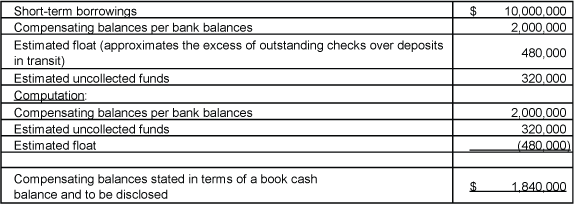 Short-term borrowings " $10,000,000 " Compensating balances per bank balances " 2,000,000 " Estimated float (approximates the excess of outstanding checks over deposits in transit) " 480,000 " Estimated uncollected funds " 320,000 " Computation: Compensating balances per bank balances " 2,000,000 " Estimated uncollected funds " 320,000 " Estimated float " (480,000)" "Compensating balances stated in terms of a book cash balance and to be disclosed " " $1,840,000 "
- SAB Topic 6.H.4, Miscellaneous
- a. Periods required.
- Question: For what periods are ASR 148 disclosures required?
- Interpretive Response: Disclosure of compensating balance arrangements and other disclosures called for in ASR 148 are required for the latest fiscal year but are generally not required for any later interim period unless a material change has occurred since year end.
- b. 10-Q Disclosures.
- Question: Are ASR 148 disclosures required in 10-Q's?
- Interpretive Response: In general, ASR 148 disclosures are not required in Form 10-Q. However, in some instances material changes in borrowing arrangements or borrowing levels may give rise to the need for disclosure either in Form 10-Q or Form 8-K.
Related subtopics
- 210-942 Financial Services—Depository and LendingBalance Sheet
- 942-10 OverallFinancial Services—Depository and Lending
- 205-10 OverallPresentation of Financial Statements
- 210-946 Financial Services—Investment CompaniesBalance Sheet
- 235-10 OverallNotes to Financial Statements
- 210-944 Financial Services—InsuranceBalance Sheet