ASC 220-10
Overall
220 Income Statement—Reporting Comprehensive Income
Source downloaded: .Record version d96b157966b9. Effective date must be checked in the source.
ASC 220-10 governs how an entity presents comprehensive income — net income plus other comprehensive income (OCI) — in a full set of general-purpose financial statements. Comprehensive income must be reported either in a single continuous statement or in two separate but consecutive statements (net income first, then OCI beginning with net income), with totals for net income, OCI, and comprehensive income (220-10-45-1 through 45-1B). The Subtopic addresses only presentation and disclosure; it does not specify when to recognize or how to measure the items making up comprehensive income (220-10-25-1; 220-10-30-1).
Key points (7)
- Comprehensive income measures all changes in equity from recognized transactions and other economic events of the period other than transactions with owners in their capacity as owners (220-10-10-1); investments by and distributions to owners and items charged directly to paid-in capital or retained earnings are not items of comprehensive income (220-10-45-10B).
- An entity must report comprehensive income in a single continuous statement (two sections: net income and OCI) or in two separate but consecutive statements, the second beginning with net income (220-10-45-1 through 45-1B); the terms 'comprehensive income' and 'other comprehensive income' need not be used (220-10-45-4).
- Items of OCI are enumerated in 220-10-45-10A and include foreign currency translation adjustments, cash flow hedge gains and losses, unrealized holding gains and losses on available-for-sale debt securities, pension/OPEB gains, losses, prior service costs and transition amounts, and instrument-specific credit risk changes on fair value option liabilities; components are classified based on their nature (220-10-45-1C).
- An entity with no items of OCI in any period presented, and an NFP following Subtopic 958-205, are outside the Topic's scope (220-10-15-3).
- OCI components may be presented net of tax or before tax with one aggregate tax amount, but the tax expense or benefit allocated to each OCI component (including reclassification adjustments) must be shown in the statement or disclosed in the notes (220-10-45-11; 45-12; 50-4), and the policy for releasing income tax effects from AOCI must be disclosed (220-10-50-1).
- The total of OCI for the period is transferred to a separate equity component, typically labeled accumulated other comprehensive income, and the changes in accumulated balances for each OCI component—separating current-period reclassifications from other current-period OCI—must be presented on the face of the statements or in the notes (220-10-45-14; 45-14A; 50-5).
- Reclassification adjustments must be determined for each OCI component to avoid double counting amounts included in both net income and OCI (220-10-45-15; 45-16), and significant amounts reclassified out of AOCI must be reported together in one place—parenthetically on the face of the statement of net income if all such amounts are reclassified to net income in their entirety in the same period (220-10-45-17; 45-17A), otherwise in a tabular note (220-10-50-6).
For students. This is the presentation backbone for OCI: know the two permitted formats, the list of OCI items in 220-10-45-10A, and the reclassification-adjustment mechanics. The most common misunderstanding is thinking ASC 220 tells you when to recognize or how to measure OCI items — it does not; the source Topics (320/326, 715, 815, 830, 825) do, and a separate 'statement of comprehensive income' is no longer permitted to be a non-consecutive or equity-statement presentation.
Machine-generated study aid for ASC 220-10. Check the source paragraphs below.
220-10-00Status
Source downloaded: .Record version cc1646956dbe. Effective date must be checked in the source.
220-10-05Overview and Background
Source downloaded: .Record version 6a91fef565c8. Effective date must be checked in the source.
- aOverall
- bUnusual or Infrequently Occurring Items
- cBusiness Interruption Insurance.
220-10-10Objectives
Source downloaded: .Record version 0479a8346aa2. Effective date must be checked in the source.
220-10-15Scope and Scope Exceptions
Source downloaded: .Record version d3ea2b53f30e. Effective date must be checked in the source.
Overall Guidance
Entities
- aEntities that provide a full set of financial statements that report financial position, results of operations, and cash flows
- bInvestment companies, defined benefit pension plans, and other employee benefit plans that are exempt from the requirement to provide a statement of cash flows by paragraph 230-10-15-4.
- aAn entity that has no items of other comprehensive income in any period presented. In such cases, the entity is not required to report other comprehensive income or comprehensive income. See paragraph 220-10-45-10A for items that are required to be reported as other comprehensive income.
- bA not-for-profit entity (NFP) that is required to follow the provisions of Subtopic 958-205.
220-10-25Recognition
Source downloaded: .Record version cc106971945e. Effective date must be checked in the source.
220-10-30Initial Measurement
Source downloaded: .Record version b6873f8a4b8d. Effective date must be checked in the source.
220-10-35Subsequent Measurement
Source downloaded: .Record version 876b46b1f1ae. Effective date must be checked in the source.
220-10-45Other Presentation Matters
Source downloaded: .Record version 8ffa7a3e2716. Effective date must be checked in the source.
Reporting Comprehensive Income
- aA total amount for net income together with the components that make up net income.
- bA total amount for other comprehensive income together with the components that make up other comprehensive income. As indicated in paragraph 220-10-15-3, an entity that has no items of other comprehensive income in any period presented is not required to report comprehensive income.
- cTotal comprehensive income.
- aComponents of and the total for net income in the statement of net income
- bComponents of and the total for other comprehensive income as well as a total for comprehensive income in the statement of comprehensive income, which shall be presented immediately after the statement of net income. A reporting entity shall begin the second statement with net income.
- aInvestment companies
- bInsurance entities
- cCertain not-for-profit entities (NFPs).
- aForeign currency translation adjustments (see paragraph 830-30-45-12)
- bGains and losses on foreign currency transactions that are designated as, and are effective as, economic hedges of a net investment in a foreign entity, commencing as of the designation date (see paragraph 830-20-35-3(a))
- cGains and losses on intra-entity foreign currency transactions that are of a long-term-investment nature (that is, settlement is not planned or anticipated in the foreseeable future), when the entities to the transaction are consolidated, combined, or accounted for by the equity method in the reporting entity's financial statements (see paragraph 830-20-35-3(b))
- dGains and losses on derivative instruments that are designated as, and qualify as, cash flow hedges (see paragraph 815-20-35-1(c))
- ddFor derivatives that are designated in qualifying hedging relationships, the difference between changes in fair value of the excluded components and the initial value of the excluded components recognized in earnings under a systematic and rational method in accordance with paragraphs 815-20-25-83A and 815-35-35-5A
- eUnrealized holding gains and losses on available-for-sale debt securities (see paragraph 326-30-35-2)
- fUnrealized holding gains and losses that result from a debt security being transferred into the available-for-sale category from the held-to-maturity category (see paragraph 320-10-35-10(c))
- g
- h
- iGains or losses associated with pension or other postretirement benefits (that are not recognized immediately as a component of net periodic benefit cost) (see paragraph 715-20-50-1(j))
- jPrior service costs or credits associated with pension or other postretirement benefits (see paragraph 715-20-50-1(j))
- kTransition assets or obligations associated with pension or other postretirement benefits (that are not recognized immediately as a component of net periodic benefit cost) (see paragraph 715-20-50-1(j)).
- lChanges in fair value attributable to instrument-specific credit risk of liabilities for which the fair value option is elected (see paragraph 825-10-45-5).
- mThe effect of changes in the discount rates used to measure traditional and limited-payment long-duration insurance contracts (see paragraph 944-40-35-6A(b)(1)).
- nThe effect of changes in the fair value of a market risk benefit attributable to a change in the instrument-specific credit risk (see paragraph 944-40-35-8A).
- aChanges in equity during a period resulting from investments by owners and distributions to owners
- bItems required to be reported as direct adjustments to paid-in capital, retained earnings, or other nonincome equity accounts such as the following types of transactions:
- 1A reduction of shareholders' equity related to employee stock ownership plans (see paragraph 718-740-25-5)
- 2Recognition of tax benefits related to deductible temporary differences and carryforwards arising from a quasi-reorganization as defined in Subtopic 852-20 (see paragraph 852-740-45-3)
- 3Net cash settlement resulting from a change in value of a contract that gives the entity a choice of net cash settlement or settlement in its own shares (see paragraph 815-40-25-4(b)(2)).
- 1
Presentation of Income Tax Effects
- aThe effect of the change in the U.S. federal corporate income tax rate on the gross deferred tax amounts and related valuation allowances, if any, at the date of enactment of the Tax Cuts and Jobs Act related to items remaining in accumulated other comprehensive income. The effect of the change in the U.S. federal corporate income tax rate on gross valuation allowances that were originally charged to income from continuing operations shall not be included.
- bOther income tax effects of the Tax Cuts and Jobs Act on items remaining in accumulated other comprehensive income that an entity elects to reclassify, subject to the disclosures in paragraph 220-10-50-2(b).
Reclassification Adjustments
- aOn the face of the statement where net income is presented
- bAs a separate disclosure in the notes to financial statements.
Interim-Period Reporting
220-10-50Disclosure
Source downloaded: .Record version 7608d983d80e. Effective date must be checked in the source.
<strong class="ph b">Disclosing Changes and Certain Income Tax Effects within Accumulated Other Comprehensive Income</strong>
- aA statement that an election was made to reclassify the income tax effects of the Tax Cuts and Jobs Act from accumulated other comprehensive income to retained earnings
- bA description of other income tax effects related to the application of the Tax Cuts and Jobs Act that are reclassified from accumulated other comprehensive income to retained earnings, if any (see paragraph 220-10-45-12A(b)).
220-10-55Implementation Guidance and Illustrations
Source downloaded: .Record version cf488d0ffde1. Effective date must be checked in the source.
Implementation Guidance
Illustrations
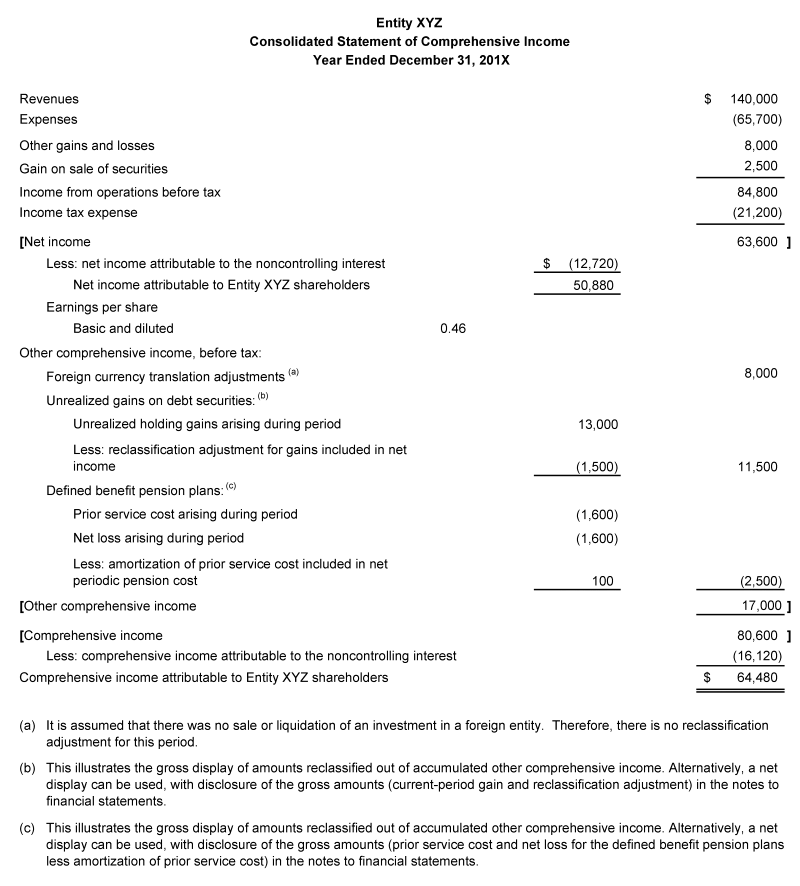 Entity XYZ Consolidated Statement of Comprehensive Income " Year Ended December 31, 201X" Revenues " $140,000 " Expenses " (65,700)" Other gains and losses " 8,000 " Gain on sale of securities " 2,500 " Income from operations before tax " 84,800 " Income tax expense " (21,200)" [Net income " 63,600 " ] Less: net income attributable to the noncontrolling interest " $(12,720)" Net income attributable to Entity XYZ shareholders " 50,880 " Earnings per share Basic and diluted 0.46 "Other comprehensive income, before tax:" Foreign currency translation adjustments (a) " 8,000 " Unrealized gains on debt securities: (b) $ Unrealized holding gains arising during period "13,000" Less: reclassification adjustment for gains included in net income " (1,500)" " 11,500 " Defined benefit pension plans: (c) Prior service cost arising during period " (1,600)" Net loss arising during period " (1,600)" Less: amortization of prior service cost included in net periodic pension cost 100 " (2,500)" [Other comprehensive income " 17,000" ] [Comprehensive income " 80,600 " ] Less: comprehensive income attributable to the noncontrolling interest " (16,120)" Comprehensive income attributable to Entity XYZ shareholders " $64,480 " (a) "It is assumed that there was no sale or liquidation of an investment in a foreign entity. Therefore, there is no reclassification adjustment for this period." (b) "This illustrates the gross display of amounts reclassified out of accumulated other comprehensive income. Alternatively, a net display can be used, with disclosure of the gross amounts (current-period gain and reclassification adjustment) in the notes to financial statements." (c) "This illustrates the gross display of amounts reclassified out of accumulated other comprehensive income. Alternatively, a net display can be used, with disclosure of the gross amounts (prior service cost and net loss for the defined benefit pension plans less amortization of prior service cost) in the notes to financial statements."
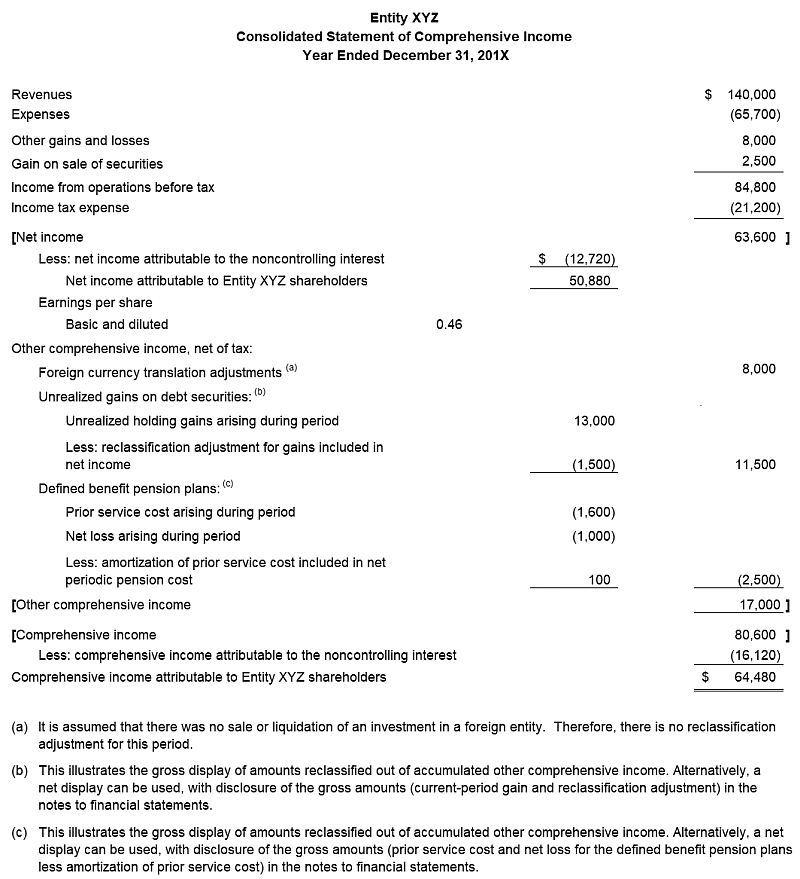 Entity XYZ Consolidated Statement of Comprehensive Income " Year Ended December 31, 201X" Revenues " $140,000 " Expenses " (65,700)" Other gains and losses " 8,000 " Gain on sale of securities " 2,500 " Income from operations before tax " 84,800 " Income tax expense " (21,200)" [Net income " 63,600 " ] Less: net income attributable to the noncontrolling interest " $(12,720)" Net income attributable to Entity XYZ shareholders " 50,880 " Earnings per share Basic and diluted 0.46 "Other comprehensive income, net of tax:" Foreign currency translation adjustments (a) " 8,000 " Unrealized gains on debt securities: (b) $ Unrealized holding gains arising during period "13,000" Less: reclassification adjustment for gains included in net income " (1,500)" " 11,500 " Defined benefit pension plans: (c) Prior service cost arising during period " (1,600)" Net loss arising during period " (1,000)" Less: amortization of prior service cost included in net periodic pension cost 100 " (2,500)" [Other comprehensive income " 17,000" ] [Comprehensive income " 80,600 " ] Less: comprehensive income attributable to the noncontrolling interest " (16,120)" Comprehensive income attributable to Entity XYZ shareholders " $64,480 " (a) "It is assumed that there was no sale or liquidation of an investment in a foreign entity. Therefore, there is no reclassification adjustment for this period." (b) "This illustrates the gross display of amounts reclassified out of accumulated other comprehensive income. Alternatively, a net display can be used, with disclosure of the gross amounts (current-period gain and reclassification adjustment) in the notes to financial statements." (c) "This illustrates the gross display of amounts reclassified out of accumulated other comprehensive income. Alternatively, a net display can be used, with disclosure of the gross amounts (prior service cost and net loss for the defined benefit pension plans less amortization of prior service cost) in the notes to financial statements."
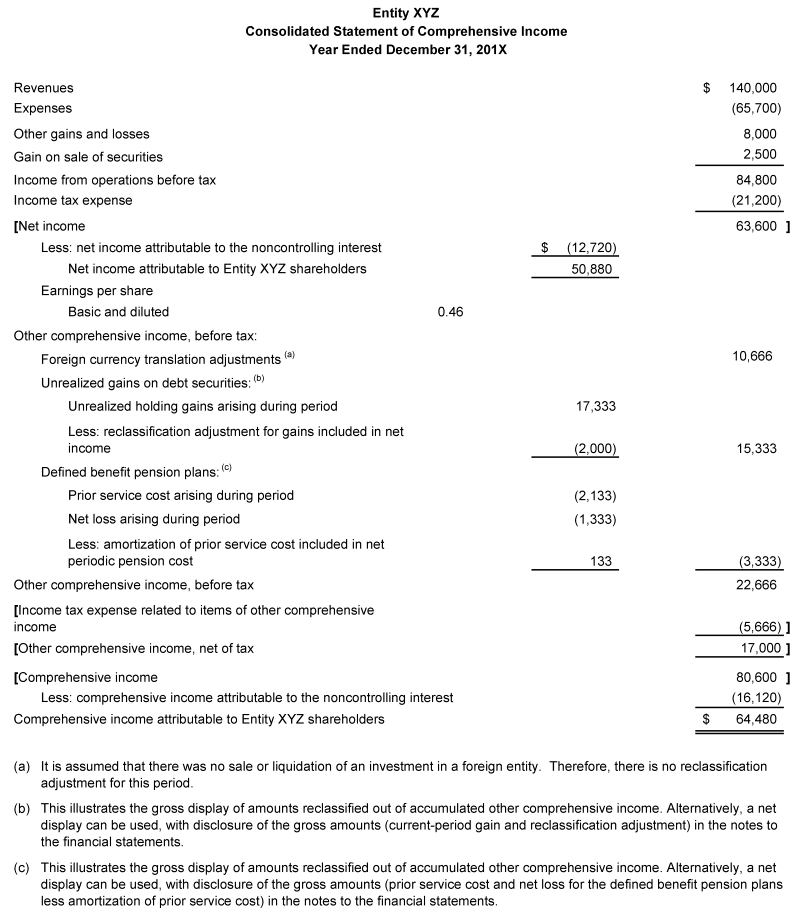 Entity XYZ Consolidated Statement of Comprehensive Income " Year Ended December 31, 201X" Revenues " $140,000 " Expenses " (65,700)" Other gains and losses " 8,000 " Gain on sale of securities " 2,500 " Income from operations before tax " 84,800 " Income tax expense " (21,200)" [Net income " 63,600 " ] Less: net income attributable to the noncontrolling interest " $(12,720)" Net income attributable to Entity XYZ shareholders " 50,880 " Earnings per share Basic and diluted 0.46 "Other comprehensive income, before tax:" Foreign currency translation adjustments (a) " 10,666 " Unrealized gains on debt securities: (b) $ Unrealized holding gains arising during period " 17,333" Less: reclassification adjustment for gains included in net income " (2,000)" " 15,333 " Defined benefit pension plans: (c) Prior service cost arising during period " (2,133)" Net loss arising during period " (1,333)" Less: amortization of prior service cost included in net periodic pension cost 133 " (3,333)" "Other comprehensive income, before tax" " 22,666 " 6 [Income tax expense related to items of other comprehensive income " (5,666)" ] ] "[Other comprehensive income, net of tax" " 17,000" ] [Comprehensive income " 80,600 " ] Less: comprehensive income attributable to the noncontrolling interest " (16,120)" Comprehensive income attributable to Entity XYZ shareholders " $64,480 " (a) "It is assumed that there was no sale or liquidation of an investment in a foreign entity. Therefore, there is no reclassification adjustment for this period." (b) "This illustrates the gross display of amounts reclassified out of accumulated other comprehensive income. Alternatively, a net display can be used, with disclosure of the gross amounts (current-period gain and reclassification adjustment) in the notes to the financial statements." (c) "This illustrates the gross display of amounts reclassified out of accumulated other comprehensive income. Alternatively, a net display can be used, with disclosure of the gross amounts (prior service cost and net loss for the defined benefit pension plans less amortization of prior service cost) in the notes to the financial statements."
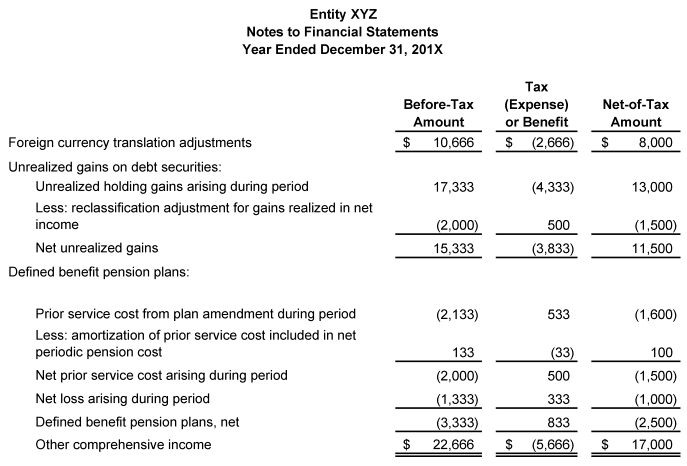 "Entity XYZ Notes to Financial Statements Year Ended December 31, 201X " Before-Tax Amount Tax (Expense) or Benefit Net-of-Tax Amount Foreign currency translation adjustments " $10,666 " " $(2,666)" " $8,000 " Unrealized gains on debt securities: Unrealized holding gains arising during period " 17,333 " " (4,333)" " 13,000 " Less: reclassification adjustment for gains realized in net income " (2,000)" 500 " (1,500)" Net unrealized gains " 15,333 " " (3,833)" " 11,500 " Defined benefit pension plans: Prior service cost from plan amendment during period " (2,133)" 533 " (1,600)" Less: amortization of prior service cost included in net periodic pension cost 133 (33) 100 Net prior service cost arising during period " (2,000)" 500 " (1,500)" Net loss arising during period " (1,333)" 333 " (1,000)" "Defined benefit pension plans, net" " (3,333)" 833 " (2,500)" Other comprehensive income " $22,666 " " $(5,666)" " $17,000 "
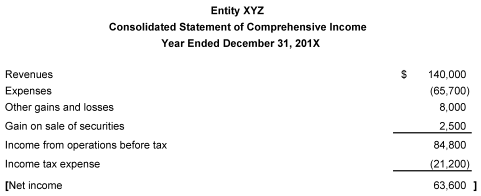 Entity XYZ Consolidated Statement of Comprehensive Income " Year Ended December 31, 201X" Revenues " $140,000 " Expenses " (65,700)" Other gains and losses " 8,000 " Gains on sale of securities " 2,500 " Income from operations before tax " 125,000 " " 84,800 " Income tax expense " (31,250)" " (21,200)" [Net income " 63,250 " " 63,600 " ] Less: net income attributable to the noncontrolling interest " (12,720)" Net income attributable to Entity XYZ " $50,880 " Earnings per share Basic and diluted 0.46 0.46 (b) "This illustrates the gross display. Alternatively, a net display can be used, with disclosure of the gross amounts (current-period gain and reclassification adjustment) in the notes to the financial statements." (c) "This illustrates the gross display. Alternatively, a net display can be used, with disclosure of the gross amounts (prior service cost and net loss for the defined benefit pension plans less amortization of prior service cost) in the notes to financial statements."
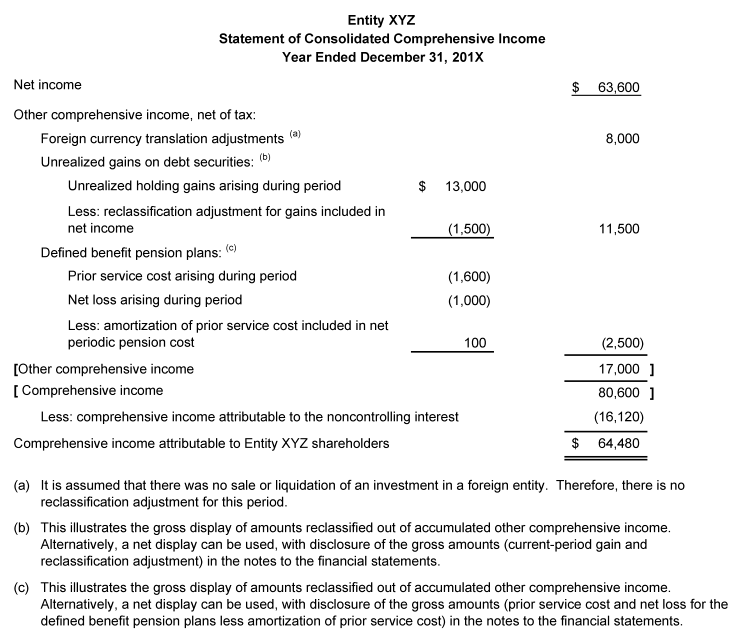 Entity XYZ Statement of Consolidated Comprehensive Income " Year Ended December 31, 201X" Net income " $63,600 " "Other comprehensive income, net of tax:" Foreign currency translation adjustments (a) " 8,000 " Unrealized gains on debt securities: (b) Unrealized holding gains arising during period " $13,000 " Less: reclassification adjustment for gains included in net income " (1,500)" " 11,500 " Defined benefit pension plans: (c) Prior service cost arising during period " (1,600)" Net loss arising during period " (1,000)" Less: amortization of prior service cost included in net periodic pension cost 100 " (2,500)" [Other comprehensive income " 17,000 " ] [ Comprehensive income " 80,600 " ] Less: comprehensive income attributable to the noncontrolling interest " (16,120)" Comprehensive income attributable to Entity XYZ shareholders " $64,480 " (a) "It is assumed that there was no sale or liquidation of an investment in a foreign entity. Therefore, there is no reclassification adjustment for this period." (b) "This illustrates the gross display of amounts reclassified out of accumulated other comprehensive income. Alternatively, a net display can be used, with disclosure of the gross amounts (current-period gain and reclassification adjustment) in the notes to the financial statements." (c) "This illustrates the gross display of amounts reclassified out of accumulated other comprehensive income. Alternatively, a net display can be used, with disclosure of the gross amounts (prior service cost and net loss for the defined benefit pension plans less amortization of prior service cost) in the notes to the financial statements."
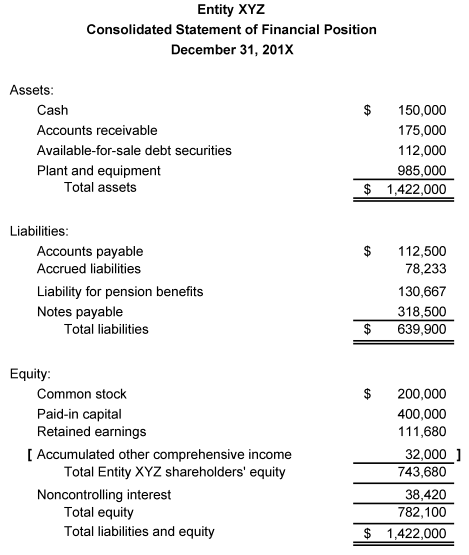 Entity XYZ Consolidated Statement of Financial Position " December 31, 201X" Assets: Cash " $150,000 " Accounts receivable " 175,000 " Available-for-sale debt securities " 112,000 " Plant and equipment " 985,000 " Total assets " $1,422,000 " Liabilities: Accounts payable " $112,500 " Accrued liabilities " 78,583 " " 78,233 " Liability for pension benefits " 130,667 " Notes payable " 318,500 " Total liabilities " $640,250 " " $639,900 " Equity: Common stock " $200,000 " Paid-in capital " 400,000 " Retained earnings " 141,750 " " 111,680 " [ Accumulated other comprehensive income " 40,000 " " 32,000 " ] Total Entity XYZ shareholders' equity " 743,680 " Noncontrolling interest " 38,420 " Total equity " 781,750 " " 782,100 " Total liabilities and equity " $1,422,000 "
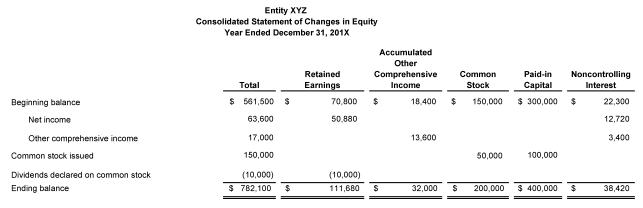 Entity XYZ Consolidated Statement of Changes in Equity " Year Ended December 31, 201X" Total Comprehensive Income (a) "Retained Earnings" Accumulated Other Comprehensive Income Common Stock Paid-in Capital Noncontrolling Interest Beginning balance " $561,500 " " $88,500 " " $70,800 " " $23,000 " " $18,400 " " $150,000 " " $300,000 " " $22,300 " Net income " 63,250 " " 63,600 " [ " $63,250 " " 63,250 " " 50,880 " " 12,720 " Other comprehensive income " 17,000 " " 17,000 " " 17,000 " " 13,600 " " 3,400 " Common stock issued " 150,000 " " 50,000 " " 100,000 " Dividends declared on common stock " (10,000)" " (10,000)" Ending balance " $781,750 " " $782,100 " " $141,750 " " $111,680 " " $40,000 " " $32,000 " " $200,000 " " $400,000 " " $38,420 "
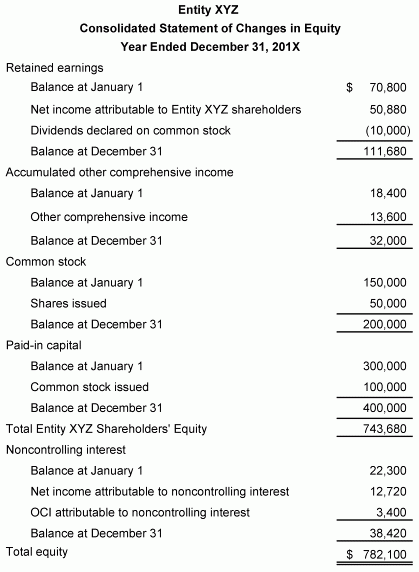 Entity XYZ Consolidated Statement of Changes in Equity " Year Ended December 31, 201X" Retained earnings Balance at January 1 " $70,800 " Net income attributable to Entity XYZ " 50,880 " Dividends declared on common stock " (10,000)" Balance at December 31 " 111,680 " Accumulated other comprehensive income Balance at January 1 " 18,400 " Other comprehensive income " 13,600 " Balance at December 31 " 32,000 " Common stock Balance at January 1 " 150,000 " Shares issued " 50,000 " Balance at December 31 " 200,000 " Paid-in capital Balance at January 1 " 300,000 " Common stock issued " 100,000 " Balance at December 31 " 400,000 " Total Entity XYZ Shareholders' Equity " 743,680 " Noncontrolling interest Balance at January 1 " 22,300 " Net income attributable to noncontrolling interest " 12,720 " OCI attributable to noncontrolling interest " 3,400 " Balance at December 31 " 38,420 " Total equity " $782,100 "
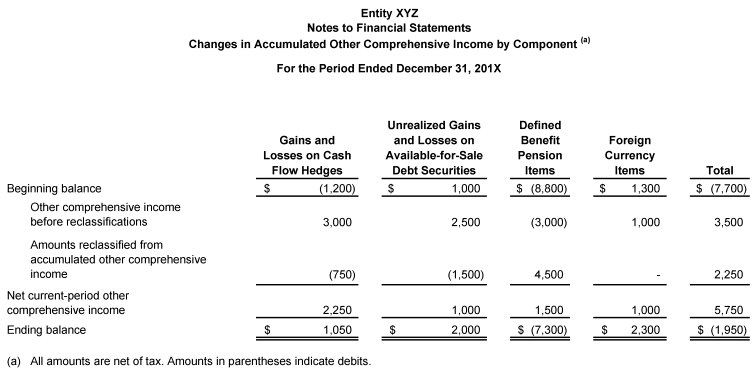 Entity XYZ Notes to Financial Statements Changes in Accumulated Other Comprehensive Income by Component (a) "For the Period Ended December 31, 201X" Gains and Losses on Cash Flow Hedges Unrealized Gains and Losses on Available-for-Sale Securities Defined Benefit Pension Items Foreign Currency Items Total Beginning balance " $(1,200)" " $1,000 " " $(8,800)" " $1,300 " " $(7,700)" "Other comprehensive income before reclassifications" " 3,000 " " 2,500 " " (3,000)" " 1,000 " " 3,500 " "Amounts reclassified from accumulated other comprehensive income" (750) " (1,500)" " 4,500 " - " 2,250 " "Net current-period other comprehensive income" " 2,250 " " 1,000 " " 1,500 " " 1,000 " " 5,750 " Ending balance " $1,050 " " $2,000 " " $(7,300)" " $2,300 " " $(1,950)" (a) All amounts are net of tax. Amounts in parentheses indicate debits.
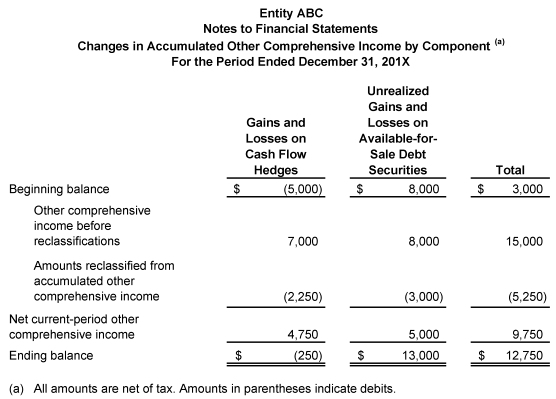 Entity ABC Notes to Financial Statements Changes in Accumulated Other Comprehensive Income by Component (a) "For the Period Ended December 31, 201X" Gains and Losses on Cash Flow Hedges Unrealized Gains and Losses on Available-for-Sale Debt Securities Total Beginning balance " $(5,000)" " $8,000 " " $3,000 " "Other comprehensive income before reclassifications" " 7,000 " " 8,000 " " 15,000 " "Amounts reclassified from accumulated other comprehensive income " " (2,250)" " (3,000)" " (5,250)" "Net current-period other comprehensive income" " 4,750 " " 5,000 " " 9,750 " Ending balance $(250) " $13,000 " " $12,750 " (a) All amounts are net of tax. Amounts in parentheses indicate debits.
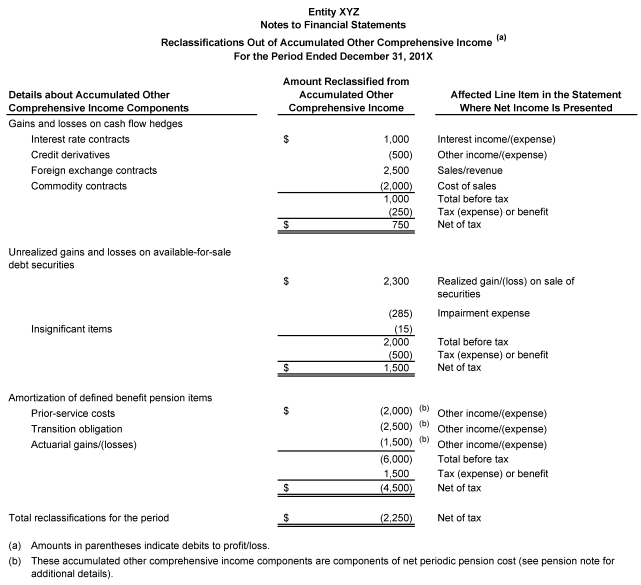 Entity XYZ Notes to Financial Statements Reclassifications Out of Accumulated Other Comprehensive Income (a) "For the Period Ended December 31, 201X" "Details about Accumulated Other Comprehensive Income Components" Amount Reclassified from Accumulated Other Comprehensive Income Affected Line Item in the Statement Where Net Income Is Presented Gains and losses on cash flow hedges Interest rate contracts " $1,000 " Interest income/(expense) Credit derivatives (500) Other income/(expense) Foreign exchange contracts " 2,500 " Sales/revenue Commodity contracts " (2,000)" Cost of sales " 1,000 " Total before tax (250) Tax (expense) or benefit $750 Net of tax "Unrealized gains and losses on available-for-sale debt securities" " $2,300 " "Realized gain/(loss) on sale of securities" (285) Impairment expense Insignificant items (15) " 2,000 " Total before tax (500) Tax (expense) or benefit " $1,500 " Net of tax Amortization of defined benefit pension items Prior-service costs " $(2,000)" (b) Other income/(expense) Transition obligation " (2,500)" (b) Other income/(expense) Actuarial gains/(losses) " (1,500)" (b) Other income/(expense) " (6,000)" Total before tax " 1,500 " Tax (expense) or benefit " $(4,500)" Net of tax Total reclassifications for the period " $(2,250)" Net of tax (a) Amounts in parentheses indicate debits to profit/loss. (b) These accumulated other comprehensive income components are components of net periodic pension cost (see pension note for additional details).
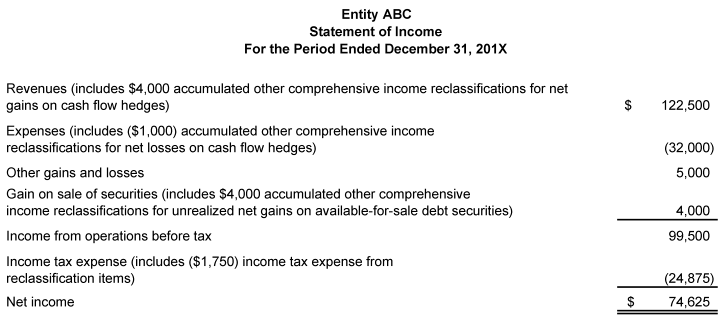 Entity ABC Statement of Income "For the Period Ended December 31, 201X" "Revenues (includes $4,000 accumulated other comprehensive income reclassifications for net gains on cash flow hedges)" " $122,500 " "Expenses (includes ($1,000) accumulated other comprehensive income reclassifications for net losses on cash flow hedges) " " (32,000)" Other gains and losses " 5,000 " "Gain on sale of securities (includes $4,000 accumulated other comprehensive income reclassifications for unrealized net gains on available-for-sale debt securities) " " 4,000 " Income from operations before tax " 99,500 " "Income tax expense (includes ($1,750) income tax expense from reclassification items)" " (24,875)" Net income " $74,625 "
- a
- bAvailable-for-sale debt securities (Case B).
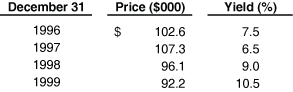 December 31 Price ($000) Yield (%) 1996 $102.6 7.5 1997 107.3 6.5 1998 96.1 9.0 1999 92.2 10.5
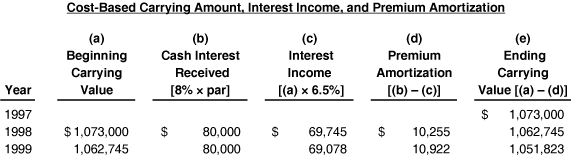 Cost-Based Carrying Amount, Interest Income, and Premium Amortization (a) (b) (c) (d) (e) Beginning Cash Interest Interest Premium Ending Carrying Received Income Amortization Carrying Year Value [8% × par] [(a) × 6.5%] [(b) - (c)] Value [(a) - (d)] 1997 $1,073,000 1998 $1,073,000 $80,000 $69,745 $10,255 1,062,745 1999 1,062,745 80,000 69,078 10,922 1,051,823
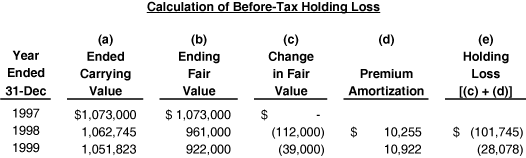 Calculation of Before-Tax Holding Loss (a) (b) (c) (d) (e) Year Ended Ending Change Holding Ended Carrying Fair in Fair Premium Loss 31-Dec Value Value Value Amortization [(c) + (d)] 1997 $1,073,000 $1,073,000 $- 1998 1,062,745 961,000 (112,000) $10,255 $(101,745) 1999 1,051,823 922,000 (39,000) 10,922 (28,078)
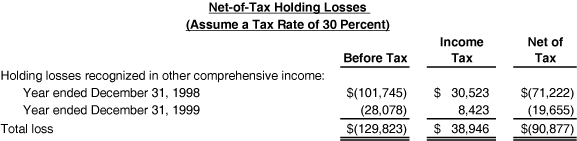 Net-of-Tax Holding Losses (Assume a Tax Rate of 30 Percent) Before Tax Income Tax Net of Tax Holding losses recognized in other comprehensive income: Year ended December 31, 1998 $(101,745) $30,523 $(71,222) Year ended December 31, 1999 (28,078) 8,423 (19,655) Total loss $(129,823) $38,946 $(90,877)
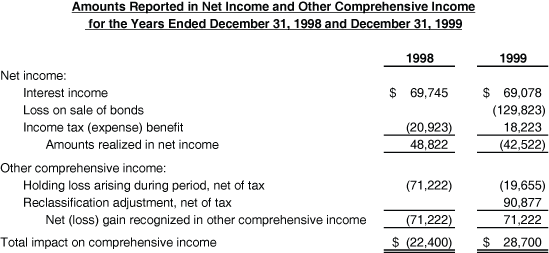 Amounts Reported in Net Income and Other Comprehensive Income for the Years Ended December 31, 1998 and December 31, 1999 1998 1999 Net income: Interest income $69,745 $69,078 Loss on sale of bonds (129,823) Income tax (expense) benefit (20,923) 18,223 Amounts realized in net income 48,822 (42,522) Other comprehensive income: Holding loss arising during period, net of tax (71,222) (19,655) Reclassification adjustment, net of tax 90,877 Net (loss) gain recognized in other comprehensive income (71,222) 71,222 Total impact on comprehensive income $(22,400) $28,700
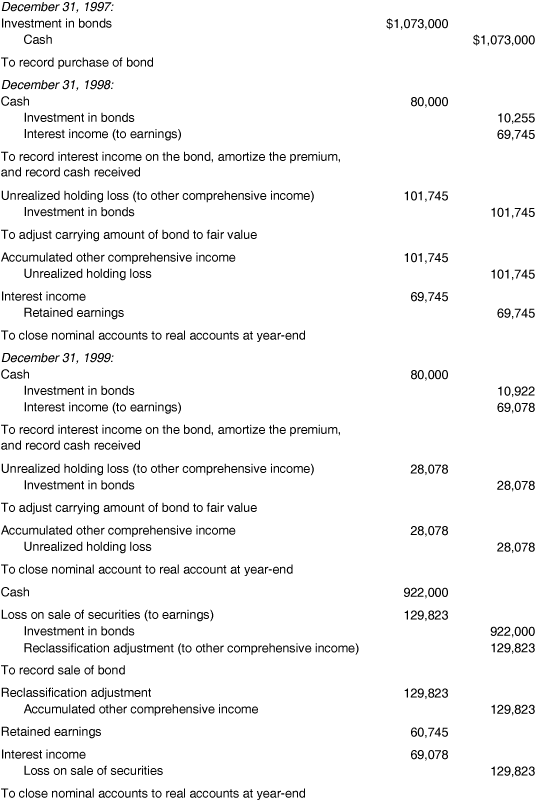 December 31, 1997: Investment in bonds $1,073,000 Cash $1,073,000 To record purchase of bond December 31, 1998: Cash 80,000 Investment in bonds 10,255 Interest income (to earnings) 69,745 To record interest income on the bond, amortize the premium, and record cash received Unrealized holding loss (to other comprehensive income) 101,745 Investment in bonds 101,745 To adjust carrying amount of bond to fair value Accumulated other comprehensive income 101,745 Unrealized holding loss 101,745 Interest income 69,745 Retained earnings 69,745 To close nominal accounts to real accounts at year-end December 31, 1999: Cash 80,000 Investment in bonds 10,922 Interest income (to earnings) 69,078 To record interest income on the bond, amortize the premium, and record cash received Unrealized holding loss (to other comprehensive income) 28,078 Investment in bonds 28,078 To adjust carrying amount of bond to fair value Accumulated other comprehensive income 28,078 Unrealized holding loss 28,078 To close nominal account to real account at year-end Cash 922,000 Loss on sale of securities (to earnings) 129,823 Investment in bonds 922,000 Reclassification adjustment (to other comprehensive income) 129,823 To record sale of bond Reclassification adjustment 129,823 Accumulated other comprehensive income 129,823 Retained earnings 60,745 Interest income 69,078 Loss on sale of securities 129,823 To close nominal accounts to real accounts at year-end
220-10-65Transition and Open Effective Date Information
Source downloaded: .Record version 1a82faf1d8d5. Effective date must be checked in the source.
220-10-S00StatusSEC
Source downloaded: .Record version ec54fb5bfd77. Effective date must be checked in the source.
| Paragraph | Action | Accounting Standards Update | Date |
| 220-10-S15-1 | Added | Maintenance Update 2017-19 (PDF) | 11/15/2017 |
| 220-10-S25-1 | Added | Maintenance Update 2017-19 (PDF) | 11/15/2017 |
| 220-10-S25-2 | Added | Maintenance Update 2017-19 (PDF) | 11/15/2017 |
| 220-10-S30-1 | Added | Maintenance Update 2017-19 (PDF) | 11/15/2017 |
| Added | Maintenance Update 2017-19 (PDF) | 11/15/2017 | |
| 220-10-S50-1 | Added | Maintenance Update 2017-19 (PDF) | 11/15/2017 |
| 220-10-S99-1 | Amended | Accounting Standards Update No. 2019-07 | 07/26/2019 |
| Added | Maintenance Update 2017-19 (PDF) | 11/15/2017 | |
| 220-10-S99-2 | Amended | Accounting Standards Update No. 2019-07 | 07/26/2019 |
| 220-10-S99-4 | Amended | Accounting Standards Update No. 2023-03 | 07/14/2023 |
| 220-10-S99-5 | Amended | Accounting Standards Update No. 2023-03 | 07/14/2023 |
| 220-10-S99-7 | Amended | Accounting Standards Update No. 2017-14 | 11/22/2017 |
220-10-S15ScopeSEC
Source downloaded: .Record version f35501a04e82. Effective date must be checked in the source.
Entities
220-10-S25RecognitionSEC
Source downloaded: .Record version 8e71aadc67bf. Effective date must be checked in the source.
Allocation of Expenses
220-10-S30Initial MeasurementSEC
Source downloaded: .Record version d3245b542abb. Effective date must be checked in the source.
Allocation of Expenses
220-10-S45Other PresentationSEC
Source downloaded: .Record version 787d8bba738f. Effective date must be checked in the source.
General Requirements
Format
Income or Loss Applicable to Common Stock
Classification of Operating Subsidies
220-10-S50DisclosureSEC
Source downloaded: .Record version bccb728be7a6. Effective date must be checked in the source.
Allocation of Expenses
220-10-S99SEC MaterialsSEC
Source downloaded: .Record version 738c0a564101. Effective date must be checked in the source.
SEC Rules, Regulations, and Interpretations
- (a) The statements required shall be prepared in compliance with the applicable requirements of this regulation.
- (b) If the registrant is engaged primarily (1) in the generation, transmission or distribution of electricity, the manufacture, mixing, transmission or distribution of gas, the supplying or distribution of water, or the furnishing of telephone or telegraph service; or (2) in holding securities of companies engaged in such businesses, it may at its option include statements of comprehensive income and cash flows (which may be unaudited) for the twelve-month period ending on the date of the most recent balance sheet being filed, in lieu of the statements of comprehensive income and cash flows for the interim periods specified.
- (c) If a period or periods reported on include operations of a business prior to the date of acquisition, or for other reasons differ from reports previously issued for any period, the statements shall be reconciled as to sales or revenues and net income in the statement or in a note thereto with the amounts previously reported: Provided, however, That such reconciliations need not be made (1) if they have been made in filings with the Commission in prior years or (2) the financial statements which are being retroactively adjusted have not previously been filed with the Commission or otherwise made public.
- (d) Any unaudited interim financial statements furnished shall reflect all adjustments which are, in the opinion of management, necessary to a fair statement of the results for the interim periods presented. A statement to that effect shall be included. If all such adjustments are of a normal recurring nature, a statement to that effect shall be made; otherwise, there shall be furnished information describing in appropriate detail the nature and amount of any adjustments other than normal recurring adjustments entering into the determination of the results shown.
- [45 FR 63687, Sept. 25, 1980. Redesignated at 47 FR 29836, July 9, 1982, and amended at 50 FR 25215, June 18, 1985; 50 FR 49532, Dec. 3, 1985; 57 FR 45292, Oct. 1, 1992; 64 FR 1734, Jan 12, 1999; 83 FR 50199, Oct. 4, 2018].
- (a) The purpose of this rule is to indicate the various line items which, if applicable, and except as otherwise permitted by the Commission, should appear on the face of the statements of comprehensive income filed for the persons to whom this article pertains (see § 210.4-01(a)).
- (b) If income is derived from more than one of the subcaptions described under § 210.5-03.1, each class which is not more than 10 percent of the sum of the items may be combined with another class. If these items are combined, related costs and expenses as described under § 210.5-03.2 shall be combined in the same manner.
- 1. Net sales and gross revenues. State separately:
- (a) Net sales of tangible products (gross sales less discounts, returns and allowances),
- (b) operating revenues of public utilities or others;
- (c) income from rentals;
- (d) revenues from services; and
- (e) other revenues.
- Amounts earned from transactions with related parties shall be disclosed as required under § 210.4-08(k).
- A public utility company using a uniform system of accounts or a form for annual report prescribed by federal or state authorities, or a similar system or report, shall follow the general segregation of operating revenues and operating expenses reported under § 210.5-03.2 prescribed by such system or report.
- If the total of sales and revenues reported under this caption includes excise taxes in an amount equal to 1 percent or more of such total, the amount of such excise taxes shall be shown on the face of the statement parenthetically or otherwise.
- 2. Costs and expenses applicable to sales and revenues.
- State separately the amount of
- (a) cost of tangible goods sold,
- (b) operating expenses of public utilities or others,
- (c) expenses applicable to rental income,
- (d) cost of services, and
- (e) expenses applicable to other revenues.
- Merchandising organizations, both wholesale and retail, may include occupancy and buying costs under caption 2(a). Amounts of costs and expenses incurred from transactions with related parties shall be disclosed as required under § 210.4-08(k).
- 3. Other operating costs and expenses. State separately any material amounts not included under caption 2 above.
- 4. Selling, general and administrative expenses.
- 5. Provision for doubtful accounts and notes.
- 6. Other general expenses. Include items not normally included in caption 4 above. State separately any material item.
- 7. Non-operating income.
- State separately in the statement of comprehensive income or in a note thereto amounts earned from
- (a) dividends,
- (b) interest on securities,
- (c) profits on securities (net of losses), and
- (d) miscellaneous other income.
- Amounts earned from transactions in securities of related parties shall be disclosed as required under § 210.4-08(k). Material amounts included under miscellaneous other income shall be separately stated in the statement of comprehensive income or in a note thereto, indicating clearly the nature of the transactions out of which the items arose.
- 8. Interest and amortization of debt discount and expense.
- 9. Non-operating expenses.
- State separately in the statement of comprehensive income or in a note thereto amounts of
- (a) losses on securities (net of profits) and
- (b) miscellaneous income deductions.
- Material amounts included under miscellaneous income deductions shall be separately stated in the statement of comprehensive income or in a note thereto, indicating clearly the nature of the transactions out of which the items arose.
- 10. Income or loss before income tax expense and appropriate items below.
- 11. Income tax expense. Include under this caption only taxes based on income (see § 210.4-08(h)).
- 12. Equity in earnings of unconsolidated subsidiaries and 50 percent or less owned persons. State, parenthetically or in a note, the amount of dividends received from such persons. If justified by the circumstances, this item may be presented in a different position and a different manner (see § 210.4-01(a)).
- 13. Income or loss from continuing operations.
- 14. Discontinued operations.
- 15-17. [Reserved]
- 18. Net income or loss.
- 19. Net income attributable to the noncontrolling interest.
- 20. Net income attributable to the controlling interest.
- 21. Other comprehensive income.
- State separately the components of and the total for other comprehensive income. Present the components either net of related tax effects or before related tax effects with one amount shown for the aggregate income tax expense or benefit. State the amount of income tax expense or benefit allocated to each component, including reclassification adjustments, in the statement of comprehensive income or in a note.
- 22. Comprehensive income.
- 23. Comprehensive income attributable to the noncontrolling interest.
- 24. Comprehensive income attributable to the controlling interest.
- 25. Earnings per share data.
- [45 FR 63671, Sept. 25, 1980, as amended at 45 FR 76977, Nov. 21, 1980; 50 FR 25215, June 18, 1985; 74 FR 18615, Apr. 23, 2009; 83 FR 50202, Oct. 4, 2018]
SEC Staff Guidance
- Facts: A company (the registrant) operates as a subsidiary of another company (parent). Certain expenses incurred by the parent on behalf of the subsidiary have not been charged to the subsidiary in the past. The subsidiary files a registration statement under the Securities Act of 1933 in connection with an initial public offering.
- Question 1: Should the subsidiary's historical income statements reflect all of the expenses that the parent incurred on its behalf?
- Interpretive Response: In general, the staff believes that the historical income statements of a registrant should reflect all of its costs of doing business. Therefore, in specific situations, the staff has required the subsidiary to revise its financial statements to include certain expenses incurred by the parent on its behalf. Examples of such expenses may include, but are not necessarily limited to, the following (income taxes and interest are discussed separately below):
- 1. Officer and employee salaries,
- 2. Rent or depreciation,
- 3. Advertising,
- 4. Accounting and legal services, and
- 5. Other selling, general and administrative expenses.
- When the subsidiary's financial statements have been previously reported on by independent accountants and have been used other than for internal purposes, the staff has accepted a presentation that shows income before tax as previously reported, followed by adjustments for expenses not previously allocated, income taxes, and adjusted net income.
- Question 2: How should the amount of expenses incurred on the subsidiary's behalf by its parent be determined, and what disclosure is required in the financial statements?
- Interpretive Response: The staff expects any expenses clearly applicable to the subsidiary to be reflected in its income statements. However, the staff understands that in some situations a reasonable method of allocating common expenses to the subsidiary (e. g., incremental or proportional cost allocation) must be chosen because specific identification of expenses is not practicable.
- In these situations, the staff has required an explanation of the allocation method used in the notes to the financial statements along with management's assertion that the method used is reasonable.
- In addition, since agreements with related parties are by definition not at arms length and may be changed at any time, the staff has required footnote disclosure, when practicable, of management's estimate of what the expenses (other than income taxes and interest discussed separately below) would have been on a stand alone basis, that is, the cost that would have been incurred if the subsidiary had operated as an unaffiliated entity. The disclosure has been presented for each year for which an income statement was required when such basis produced materially different results.
- Question 3: What are the staff's views with respect to the accounting for and disclosure of the subsidiary's income tax expense?
- Interpretive Response: Recently, a number of parent companies have sold interests in subsidiaries, but have retained sufficient ownership interests to permit continued inclusion of the subsidiaries in their consolidated tax returns. The staff believes that it is material to investors to know what the effect on income would have been if the registrant had not been eligible to be included in a consolidated income tax return with its parent.
- Some of these subsidiaries have calculated their tax provision on the separate return basis, which the staff believes is the preferable method. Others, however, have used different allocation methods.
- When the historical income statements in the filing do not reflect the tax provision on the separate return basis, the staff has required a pro forma income statement for the most recent year and interim period reflecting a tax provision calculated on the separate return basis.FN1
- FN1 Paragraph 40 of Statement 109 [paragraph 740-10-30-27] states: "The consolidated amount of current and deferred tax expense for a group that files a consolidated tax return shall be allocated among the members of the group when those members issue separate financial statements.... The method adopted... shall be systematic, rational, and consistent with the broad principles established by [Statement 109] [Subtopic 740-10]. A method that allocates current and deferred taxes to members of the group by applying [Statement 109] [Subtopic 740-10] to each member as if it were a separate taxpayer meets those criteria.
- Question 4: Should the historical income statements reflect a charge for interest on intercompany debt if no such charge had been previously provided?
- Interpretive Response: The staff generally believes that financial statements are more useful to investors if they reflect all costs of doing business, including interest costs. Because of the inherent difficulty in distinguishing the elements of a subsidiary's capital structure, the staff has not insisted that the historical income statements include an interest charge on intercompany debt if such a charge was not provided in the past, except when debt specifically related to the operations of the subsidiary and previously carried on the parent's books will henceforth be recorded in the subsidiary's books. In any case, financing arrangements with the parent must be discussed in a note to the financial statements. In this connection, the staff has taken the position that, where an interest charge on intercompany debt has not been provided, appropriate disclosure would include an analysis of the intercompany accounts as well as the average balance due to or from related parties for each period for which an income statement is required. The analysis of the intercompany accounts has taken the form of a listing of transactions (e. g., the allocation of costs to the subsidiary, intercompany purchases, and cash transfers between entities) for each period for which an income statement was required, reconciled to the intercompany accounts reflected in the balance sheets.
- (Replaced by SAB 107).
- Facts: Company X was a defendant in litigation for which the company had not recorded a liability in accordance with FASB ASC Topic 450, Contingencies. A principal stockholder FN34 of the company transfers a portion of his shares to the plaintiff to settle such litigation. If the company had settled the litigation directly, the company would have recorded the settlement as an expense.
- FN34 The FASB ASC Master Glossary defines principal owners as "owners of record or known beneficial owners of more than 10 percent of the voting interests of the enterprise."
- Question: Must the settlement be reflected as an expense in the company's financial statements, and if so, how?
- Interpretive Response: Yes. The value of the shares transferred should be reflected as an expense in the company's financial statements with a corresponding credit to contributed (paid-in) capital.
- The staff believes that such a transaction is similar to those described in FASB ASC paragraph 718-10-15-4 (Compensation—Stock Compensation Topic), which states that "share-based payments awarded to a grantee by a related party or other holder of an economic interest FN35 in the entity as compensation for goods or services provided to the reporting entity are share-based payment transactions to be accounted for under this Topic unless the transfer is clearly for a purpose other than compensation for goods or services to the reporting entity." As explained in this paragraph, the substance of such a transaction is that the economic interest holder makes a capital contribution to the reporting entity, and the reporting entity makes a share-based payment to its grantee in exchange for goods or services provided to the reporting entity.
- FN35 The FASB ASC Master Glossary defines an economic interest in an entity as "any type or form of pecuniary interest or arrangement that an entity could issue or be a party to, including equity securities; financial instruments with characteristics of equity, liabilities or both; long-term debt and other debt-financing arrangements; leases; and contractual arrangements such as management contracts, service contracts, or intellectual property licenses." Accordingly, a principal stockholder would be considered a holder of an economic interest in an entity.
- The staff believes that the problem of separating the benefit to the principal stockholder from the benefit to the company cited in FASB ASC Topic 718 is not limited to transactions involving stock compensation. Therefore, similar accounting is required in this and otherFN36 transactions where a principal stockholder pays an expense for the company, unless the stockholder's action is caused by a relationship or obligation completely unrelated to his position as a stockholder or such action clearly does not benefit the company.
- FN36 For example, SAB Topic 1.B indicates that the separate financial statements of a subsidiary should reflect any costs of its operations which are incurred by the parent on its behalf. Additionally, the staff notes that AICPA Technical Practice Aids §4160 also indicates that the payment by principal stockholders of a company's debt should be accounted for as a capital contribution.
- Some registrants and their accountants have taken the position that since FASB ASC Topic 850, Related Party Disclosures, applies to these transactions and requires only the disclosure of material related party transactions, the staff should not analogize to the accounting called for by FASB ASC paragraph 718-10-15-4 for transactions other than those specifically covered by it. The staff notes, however, that FASB ASC Topic 850 does not address the measurement of related party transactions and that, as a result, such transactions are generally recorded at the amounts indicated by their terms. FN37 However, the staff believes that transactions of the type described above differ from the typical related party transactions.
- FN37 However, in some circumstances it is necessary to reflect, either in the historical financial statements or a pro forma presentation (depending on the circumstances), related party transactions at amounts other than those indicated by their terms. Two such circumstances are addressed in Staff Accounting Bulletin Topic 1.B.1, Questions 3 and 4. Another example is where the terms of a material contract with a related party are expected to change upon the completion of an offering (i.e., the principal shareholder requires payment for services which had previously been contributed by the shareholder to the company).
- The transactions for which FASB ASC Topic 850 requires disclosure generally are those in which a company receives goods or services directly from, or provides goods or services directly to, a related party, and the form and terms of such transactions may be structured to produce either a direct or indirect benefit to the related party. The participation of a related party in such a transaction negates the presumption that transactions reflected in the financial statements have been consummated at arm's length. Disclosure is therefore required to compensate for the fact that, due to the related party's involvement, the terms of the transaction may produce an accounting measurement for which a more faithful measurement may not be determinable.
- However, transactions of the type discussed in the facts given do not have such problems of measurement and appear to be transacted to provide a benefit to the stockholder through the enhancement or maintenance of the value of the stockholder's investment. The staff believes that the substance of such transactions is the payment of an expense of the company through contributions by the stockholder. Therefore, the staff believes it would be inappropriate to account for such transactions according to the form of the transaction.
- Facts: A registrant has various classes of preferred stock. Dividends on those preferred stocks and accretions of their carrying amounts cause income applicable to common stock to be less than reported net income.
- Question: In ASR 280, the Commission stated that although it had determined not to mandate presentation of income or loss applicable to common stock in all cases, it believes that disclosure of that amount is of value in certain situations. In what situations should the amount be reported, where should it be reported, and how should it be computed?
- Interpretive Response: Income or loss applicable to common stock should be reported on the face of the income statement FN1 when it is materially different in quantitative terms from reported net income or loss FN2 or when it is indicative of significant trends or other qualitative considerations. The amount to be reported should be computed for each period as net income or loss less: (a) dividends on preferred stock, including undeclared or unpaid dividends if cumulative; and (b) periodic increases in the carrying amounts of instruments reported as redeemable preferred stock (as discussed in Topic 3.C) or increasing rate preferred stock (as discussed in Topic 5.Q).
- FN1 When a registrant reports net income and total comprehensive income in one continuous financial statement, the registrant must continue to follow the guidance set forth in the SAB Topic. One approach may be to provide a separate reconciliation of net income to income available to common stock below comprehensive income reported on a statement of income and comprehensive income.
- FN2 The assessment of materiality is the responsibility of each registrant. However, absent concerns about trends or other qualitative considerations, the staff generally will not insist on the reporting of income or loss applicable to common stock if the amount differs from net income or loss by less than ten percent.
- Facts: Occasionally an income statement format will contain a subtitle or caption titled "Income before depreciation and depletion."
- Question: Is this caption appropriate?
- Interpretive Response: The staff objects to this presentation because in the staff's view the presentation may suggest to the reader that the amount so captioned represents cash flow for the period, which is rarely the case (see ASR 142).
- Facts: Company A has received an operating-differential subsidy pursuant to the Merchant Marine Act of 1936, as amended.
- Question: How should such subsidies be displayed in the statement of comprehensive income?
- Interpretive Response: Revenue representing an operating-differential subsidy under the Merchant Marine Act of 1936, as amended, must be set forth as a separate line item in the statement of comprehensive income either under a revenue caption presented separately from revenue from contracts with customers accounted for under ASC Topic 606 or as credit in the costs and expenses section.
- Facts: Company B excludes depreciation and depletion from cost of sales in its income statement.
- Question: How should this exclusion be disclosed?
- Interpretive Response: If cost of sales or operating expenses exclude charges for depreciation, depletion and amortization of property, plant and equipment, the description of the line item should read somewhat as follows: "Cost of goods sold (exclusive of items shown separately below)" or "Cost of goods sold (exclusive of depreciation shown separately below)." To avoid placing undue emphasis on "cash flow," depreciation, depletion and amortization should not be positioned in the income statement in a manner which results in reporting a figure for income before depreciation.