ASC 715-20
Defined Benefit Plans—General
715 Compensation—Retirement Benefits
Source downloaded: .Record version 1a260d202585. Effective date must be checked in the source.
ASC 715-20 governs the presentation and disclosure requirements for single-employer defined benefit pension and other postretirement benefit (OPEB) plans, and it confirms that a cash balance plan is a defined benefit plan. It requires employers to disclose, separately for pension and OPEB plans, reconciliations of the benefit obligation and plan assets, funded status and where it is recognized on the balance sheet, plan asset fair value information by class, weighted-average assumptions, expected future benefit payments and contributions, and amounts in AOCI not yet recognized in net periodic benefit cost. On the face of the income statement, only the service cost component goes with other compensation cost; all other components must be presented separately and outside any subtotal of income from operations.
Key points (7)
- An employer must provide the Section 715-20-50 disclosures separately for defined benefit pension plans and for other postretirement benefit plans (715-20-05-3; 715-20-50-1).
- Service cost is reported in the same income statement line as other employee compensation cost (except amounts capitalized into inventory or PP&E), while the other components of net periodic benefit cost—including settlement/curtailment gains or losses and certain termination benefit costs—are presented separately and outside any subtotal of income from operations (715-20-45-3A).
- The funded status must be presented on the balance sheet: an overfunded plan's asset is noncurrent, and an underfunded plan's liability is current to the extent the actuarial present value of benefits payable in the next 12 months (or operating cycle) exceeds plan asset fair value, capped at the recognized unfunded status (715-20-45-2 through 45-3).
- Required annual disclosures include reconciliations of the benefit obligation (PBO for pensions, APBO for OPEB) and of plan asset fair value, the accumulated benefit obligation, benefits expected to be paid in each of the next five years and in aggregate for the following five, next-year expected contributions, components of net benefit cost, OCI and AOCI amounts not yet recognized in cost, and weighted-average discount rates, compensation increase rates, expected long-term rates of return, and interest crediting rates (715-20-50-1(a)–(k)).
- Plan asset disclosures must convey investment policies and strategies, fair value by class, the basis for the expected long-term rate-of-return assumption, fair value hierarchy levels, and a Level 3 rollforward, with NAV practical expedient investments excluded from the hierarchy (715-20-50-1(d)).
- Disclosures are aggregated across all pension plans and across all OPEB plans unless disaggregation is useful, but aggregate presentation triggers disclosure of PBO/ABO/APBO and plan asset fair value for plans whose obligations exceed plan assets; non-U.S. plans may be combined unless significant and using significantly different assumptions (715-20-50-2 through 50-4).
- Nonpublic entities are exempt from 715-20-50-1(a)–(c), (h), (o)–(q), and (r)(2) and instead follow the reduced list in 715-20-50-5, while publicly traded entities must disclose net benefit cost components and materially changed contribution estimates in interim periods (715-20-50-5 through 50-7); a cash balance plan is a defined benefit plan because the benefit depends on the promised interest-crediting rate, not actual asset returns (715-20-25-1 through 25-3).
For students. Exam questions love the ASU 2017-07 split: service cost sits in operating compensation expense while interest cost, expected return, amortization, and settlement/curtailment effects must be shown below any operating income subtotal—students often wrongly lump all components into operating expense. Also remember the classification rule: an overfunded plan asset is always noncurrent, but an underfunded plan liability can be split current/noncurrent.
Machine-generated study aid for ASC 715-20. Check the source paragraphs below.
715-20-00Status
Source downloaded: .Record version 14687cff2a4d. Effective date must be checked in the source.
715-20-05Overview and Background
Source downloaded: .Record version e514fe73f6b6. Effective date must be checked in the source.
- a
- b
- aThe content and organization of annual disclosures about defined benefit pension plans and other postretirement benefits
- bDisclosures required for interim-period financial reports.
- cPresentation matters about defined benefit pension and other postretirement benefit plans.
715-20-15Scope and Scope Exceptions
Source downloaded: .Record version fe1e78d240a5. Effective date must be checked in the source.
Overall Guidance
Transactions
715-20-25Recognition
Source downloaded: .Record version 59b0a8c35004. Effective date must be checked in the source.
Cash Balance Plans
715-20-45Other Presentation Matters
Source downloaded: .Record version 7bdc32c766c1. Effective date must be checked in the source.
Entities That Do Not Report Other Comprehensive Income, Other Than Not-for-Profit
Classification
- aThe service cost component of net periodic pension cost and net periodic postretirement benefit cost in the same line item or items as other compensation costs arising from services rendered by the pertinent employees during the period (except for the amount being capitalized, if appropriate, in connection with the production or construction of an asset such as inventory or property, plant, and equipment)
- bThe other components as defined in paragraphs 715-30-35-4 and 715-60-35-9 separately from the service cost component and outside a subtotal of income from operations, if one is presented. If a separate line item or items are used to present the other components, that line item or items shall be described appropriately.
715-20-50Disclosure
Source downloaded: .Record version 5a7c5d70b06b. Effective date must be checked in the source.
Disclosures by Public Entities
- aA reconciliation of beginning and ending balances of the benefit obligation showing separately, if applicable, the effects during the period attributable to each of the following:
- 1Service cost
- 2Interest cost
- 3Contributions by plan participants
- 4Actuarial gains and losses
- 5Foreign currency exchange rate changes (The effects of foreign currency exchange rate changes that are to be disclosed are those applicable to plans of a foreign operation whose functional currency is not the reporting currency pursuant to Section 830-10-45.)
- 6Benefits paid
- 7Plan amendments
- 8Business combinations
- 9Divestitures
- 10Curtailments, settlements, and special and contractual termination benefits.
For defined benefit pension plans, the benefit obligation is the projected benefit obligation. For defined benefit other postretirement plans, the benefit obligation is the accumulated postretirement benefit obligation. - 1
- bA reconciliation of beginning and ending balances of the fair value of plan assets showing separately, if applicable, the effects during the period attributable to each of the following:
- 1Actual return on plan assets
- 2Foreign currency exchange rate changes (see (a)(5))
- 3Contributions by the employer
- 4Contributions by plan participants
- 5Benefits paid
- 6Business combinations
- 7Divestitures
- 8Settlements.
- 1
- cThe funded status of the plans and the amounts recognized in the statement of financial position, showing separately the assets and current and noncurrent liabilities recognized.
- dThe objectives of the disclosures about postretirement benefit plan assets are to provide users of financial statements with an understanding of:
- 1How investment allocation decisions are made, including the factors that are pertinent to an understanding of investment policies and strategies
- 2The classes of plan assets
- 3The inputs and valuation techniques used to measure the fair value of plan assets
- 4The effect of fair value measurements using significant unobservable inputs (Level 3) on changes in plan assets for the period
- 5Significant concentrations of risk within plan assets.An employer shall consider those overall objectives in providing the following information about plan assets:
- iA narrative description of investment policies and strategies, including target allocation percentages or range of percentages considering the classes of plan assets disclosed pursuant to (ii) below, as of the latest statement of financial position presented (on a weighted-average basis for employers with more than one plan), and other factors that are pertinent to an understanding of those policies and strategies such as investment goals, risk management practices, permitted and prohibited investments including the use of derivatives, diversification, and the relationship between plan assets and benefit obligations. For investment funds disclosed as classes as described in (ii) below, a description of the significant investment strategies of those funds shall be provided.
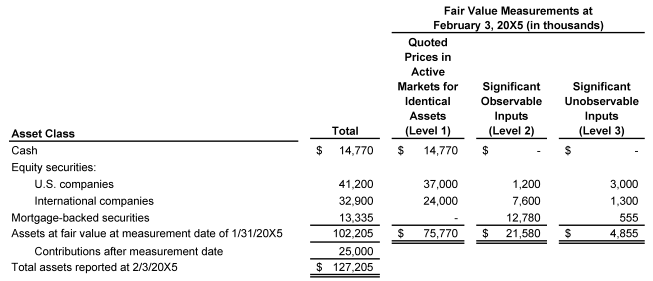
- iiThe fair value of each class of plan assets as of each date for which a statement of financial position is presented. For additional guidance on determining appropriate classes of plan assets, see paragraph 820-10-50-2B. Examples of classes of assets could include, but are not limited to, the following: cash and cash equivalents; equity securities (segregated by industry type, company size, or investment objective); debt securities issued by national, state, and local governments; corporate debt securities; asset-backed securities; structured debt; derivatives on a gross basis (segregated by type of underlying risk in the contract, for example, interest rate contracts, foreign exchange contracts, equity contracts, commodity contracts, credit contracts, and other contracts); investment funds (segregated by type of fund); and real estate. Those examples are not meant to be all inclusive. An employer should consider the overall objectives in paragraph 715-20-50-1(d)(1) through (5) in determining whether additional classes of plan assets or further disaggregation of classes should be disclosed. If an employer determines the measurement date of plan assets in accordance with paragraph 715-30-35-63A or 715-60-35-123A and the employer contributes assets to the plan between the measurement date and its fiscal year-end, the employer shall not adjust the fair value of each class of plan assets for the effects of the contribution. Instead, the employer shall disclose the amount of the contribution to permit reconciliation of the total fair value of all the classes of plan assets to the ending balance of the fair value of plan assets. For example, the contribution could be disclosed as follows:
 Fair Value Measurements at "February 3, 20X5 (in thousands)" Asset Class Total "Quoted Prices in Active Markets for Identical Assets (Level 1)" "Significant Observable Inputs (Level 2)" "Significant Unobservable Inputs (Level 3)" Cash " $14,770 " " $14,770 " $- $- Equity securities: U.S. companies " 41,200 " " 37,000 " " 1,200 " " 3,000 " International companies " 32,900 " " 24,000 " " 7,600 " " 1,300 " Mortgage-backed securities " 13,335 " - " 12,780 " 555 Assets at fair value at measurement date of 1/31/20X5 " 102,205 " " $75,770 " " $21,580 " " $4,855 " Contributions after measurement date " 25,000 " Total assets reported at 2/3/20X5 " $127,205 "
- iiiA narrative description of the basis used to determine the overall expected long-term rate-of-return-on-assets assumption, such as the general approach used, the extent to which the overall rate-of-return-on-assets assumption was based on historical returns, the extent to which adjustments were made to those historical returns in order to reflect expectations of future returns, and how those adjustments were determined. The description should consider the classes of assets as described in (ii) above, as appropriate.
- ivInformation that enables users of financial statements to assess the inputs and valuation techniques used to develop fair value measurements of plan assets at the reporting date. For fair value measurements using significant unobservable inputs, an employer shall disclose the effect of the measurements on changes in plan assets for the period. To meet those objectives, the employer shall disclose the following information for each class of plan assets disclosed pursuant to (ii) above for each annual period:
- 01The level of the fair value hierarchy within which the fair value measurements are categorized in their entirety, segregating fair value measurements using quoted prices in active markets for identical assets or liabilities (Level 1), significant other observable inputs (Level 2), and significant unobservable inputs (Level 3). The guidance in paragraphs 820-10-35-37 through 35-37A is applicable. Investments for which fair value is measured using the net asset value per share (or its equivalent) practical expedient in paragraph 820-10-35-59 shall not be categorized within the fair value hierarchy, as noted by paragraph 820-10-35-54B. If an employer determines the measurement date of plan assets in accordance with paragraph 715-30-35-63A or 715-60-35-123A and the employer contributes assets to the plan between the measurement date and its fiscal year-end, the employer shall not adjust the fair value of each class of plan assets for the effects of the contribution. Instead, the employer shall disclose the amount of the contribution to permit reconciliation of the total fair value of all plan assets in the fair value hierarchy to the ending balance of the fair value of plan assets. For example, the contribution could be disclosed as follows:
- Fair Value Measurements at "February 3, 20X5 (in thousands)" Asset Class Total "Quoted Prices in Active Markets for Identical Assets (Level 1)" "Significant Observable Inputs (Level 2)" "Significant Unobservable Inputs (Level 3)" Cash " $14,770 " " $14,770 " $- $- Equity securities: U.S. companies " 41,200 " " 37,000 " " 1,200 " " 3,000 " International companies " 32,900 " " 24,000 " " 7,600 " " 1,300 " Mortgage-backed securities " 13,335 " - " 12,780 " 555 Assets at fair value at measurement date of 1/31/20X5 " 102,205 " " $75,770 " " $21,580 " " $4,855 " Contributions after measurement date " 25,000 " Total assets reported at 2/3/20X5 " $127,205 "
- 02For fair value measurements of plan assets using significant unobservable inputs (Level 3), a reconciliation from the opening balances to the closing balances, disclosing separately changes during the period attributable to the following:
- AActual Return on Plan Assets (Component of Net Periodic Postretirement Benefit Cost) or Actual Return on Plan Assets (Component of Net Periodic Pension Cost), separately identifying the amount related to assets still held at the reporting date and the amount related to assets sold during the period
- BPurchases, sales, and settlements, net
- CThe amounts of any transfers into or out of Level 3 (for example, transfers due to changes in the observability of significant inputs).
- A
- 03Information about the valuation technique(s) and inputs used to measure fair value and a discussion of changes in valuation techniques and inputs, if any, during the period.
- 01
- i
- 1
- eFor defined benefit pension plans, the accumulated benefit obligation.
- fThe benefits (as of the date of the latest statement of financial position presented) expected to be paid in each of the next five fiscal years, and in the aggregate for the five fiscal years thereafter. The expected benefits shall be estimated based on the same assumptions used to measure the entity's benefit obligation at the end of the year and shall include benefits attributable to estimated future employee service.
- gThe employer's best estimate, as soon as it can reasonably be determined, of contributions expected to be paid to the plan during the next fiscal year beginning after the date of the latest statement of financial position presented. Estimated contributions may be presented in the aggregate combining all of the following:
- 1Contributions required by funding regulations or laws
- 2Discretionary contributions
- 3Noncash contributions.
- 1
- hThe amount of net benefit cost recognized, showing separately all of the following:
- 1The service cost component
- 2The interest cost component
- 3The expected return on plan assets for the period
- 4The gain or loss component
- 5The prior service cost or credit component
- 6The transition asset or obligation component
- 7The gain or loss recognized due to settlements or curtailments.
- 1
- iSeparately the net gain or loss and net prior service cost or credit recognized in other comprehensive income for the period pursuant to paragraphs 715-30-35-11, 715-30-35-21, 715-60-35-16, and 715-60-35-25, and reclassification adjustments of other comprehensive income for the period, as those amounts, including amortization of the net transition asset or obligation, are recognized as components of net periodic benefit cost.
- jThe amounts in accumulated other comprehensive income that have not yet been recognized as components of net periodic benefit cost, showing separately the net gain or loss, net prior service cost or credit, and net transition asset or obligation.
- kOn a weighted-average basis, all of the following assumptions used in the accounting for the plans, specifying in a tabular format, the assumptions used to determine the benefit obligation and the assumptions used to determine net benefit cost:
- 1Discount rates (see paragraph 715-30-35-45 for a discussion of representationally faithful disclosure)
- 2Rates of compensation increase (for pay-related plans)
- 3Expected long-term rates of return on plan assets.
- 4Interest crediting rates (for cash balance plans and other plans with promised interest crediting rates).
- 1
- lThe assumed health care cost trend rate(s) for the next year used to measure the expected cost of benefits covered by the plan (gross eligible charges), and a general description of the direction and pattern of change in the assumed trend rates thereafter, together with the ultimate trend rate(s) and when that rate is expected to be achieved.
- m
- nIf applicable, the amounts and types of securities of the employer and related parties included in plan assets.
- oIf applicable, any alternative method used to amortize prior service amounts or net gains and losses pursuant to paragraphs 715-30-35-13 and 715-30-35-25 or 715-60-35-18 and 715-60-35-31.
- pIf applicable, any substantive commitment, such as past practice or a history of regular benefit increases, used as the basis for accounting for the benefit obligation.
- qIf applicable, the cost of providing special or contractual termination benefits recognized during the period and a description of the nature of the event.
- rAn explanation of the following information:
- 1The reasons for significant gains and losses related to changes in the defined benefit obligation for the period
- 2Any other significant change in the benefit obligation or plan assets not otherwise apparent in the other disclosures required by this Subtopic.
- 1
- s
- t
- uIf applicable, the accounting policy election to measure plan assets and benefit obligations using the month-end that is closest to the employer's fiscal year-end in accordance with paragraph 715-30-35-63A or 715-60-35-123A and the month-end measurement date.
- aA reconciliation of beginning and ending balances of the benefit obligation showing separately, if applicable, the effects during the period attributable to each of the following:
- 1Service cost
- 2Interest cost
- 3Contributions by plan participants
- 4Actuarial gains and losses
- 5Foreign currency exchange rate changes (The effects of foreign currency exchange rate changes that are to be disclosed are those applicable to plans of a foreign operation whose functional currency is not the reporting currency pursuant to Section 830-10-45.)
- 6Benefits paid
- 7Plan amendments
- 8Business combinations
- 9Divestitures
- 10Curtailments, settlements, and special and contractual termination benefits.
For defined benefit pension plans, the benefit obligation is the projected benefit obligation. For defined benefit other postretirement plans, the benefit obligation is the accumulated postretirement benefit obligation. - 1
- bA reconciliation of beginning and ending balances of the fair value of plan assets showing separately, if applicable, the effects during the period attributable to each of the following:
- 1Actual return on plan assets
- 2Foreign currency exchange rate changes (see (a)(5))
- 3Contributions by the employer
- 4Contributions by plan participants
- 5Benefits paid
- 6Business combinations
- 7Divestitures
- 8Settlements.
- 1
- cThe funded status of the plans and the amounts recognized in the statement of financial position, showing separately the assets and current and noncurrent liabilities recognized.
- dThe objectives of the disclosures about postretirement benefit plan assets are to provide users of financial statements with an understanding of:
- 1How investment allocation decisions are made, including the factors that are pertinent to an understanding of investment policies and strategies
- 2The classes of plan assets
- 3The inputs and valuation techniques used to measure the fair value of plan assets
- 4The effect of fair value measurements using significant unobservable inputs (Level 3) on changes in plan assets for the period
- 5Significant concentrations of risk within plan assets.An employer shall consider those overall objectives in providing the following information about plan assets:
- iA narrative description of investment policies and strategies, including target allocation percentages or range of percentages considering the classes of plan assets disclosed pursuant to (ii) below, as of the latest statement of financial position presented (on a weighted-average basis for employers with more than one plan), and other factors that are pertinent to an understanding of those policies and strategies such as investment goals, risk management practices, permitted and prohibited investments including the use of derivatives, diversification, and the relationship between plan assets and benefit obligations. For investment funds disclosed as classes as described in (ii) below, a description of the significant investment strategies of those funds shall be provided.
- iiThe fair value of each class of plan assets as of each date for which a statement of financial position is presented. For additional guidance on determining appropriate classes of plan assets, see paragraph 820-10-50-2B. Examples of classes of assets could include, but are not limited to, the following: cash and cash equivalents; equity securities (segregated by industry type, company size, or investment objective); debt securities issued by national, state, and local governments; corporate debt securities; asset-backed securities; structured debt; derivatives on a gross basis (segregated by type of underlying risk in the contract, for example, interest rate contracts, foreign exchange contracts, equity contracts, commodity contracts, credit contracts, and other contracts); investment funds (segregated by type of fund); and real estate. Those examples are not meant to be all inclusive. An employer should consider the overall objectives in paragraph 715-20-50-1(d)(1) through (5) in determining whether additional classes of plan assets or further disaggregation of classes should be disclosed. If an employer determines the measurement date of plan assets in accordance with paragraph 715-30-35-63A or 715-60-35-123A and the employer contributes assets to the plan between the measurement date and its fiscal year-end, the employer shall not adjust the fair value of each class of plan assets for the effects of the contribution. Instead, the employer shall disclose the amount of the contribution to permit reconciliation of the total fair value of all the classes of plan assets to the ending balance of the fair value of plan assets. For example, the contribution could be disclosed as follows:
- Fair Value Measurements at "February 3, 20X5 (in thousands)" Asset Class Total "Quoted Prices in Active Markets for Identical Assets (Level 1)" "Significant Observable Inputs (Level 2)" "Significant Unobservable Inputs (Level 3)" Cash " $14,770 " " $14,770 " $- $- Equity securities: U.S. companies " 41,200 " " 37,000 " " 1,200 " " 3,000 " International companies " 32,900 " " 24,000 " " 7,600 " " 1,300 " Mortgage-backed securities " 13,335 " - " 12,780 " 555 Assets at fair value at measurement date of 1/31/20X5 " 102,205 " " $75,770 " " $21,580 " " $4,855 " Contributions after measurement date " 25,000 " Total assets reported at 2/3/20X5 " $127,205 "
- iiiA narrative description of the basis used to determine the overall expected long-term rate-of-return-on-assets assumption, such as the general approach used, the extent to which the overall rate-of-return-on-assets assumption was based on historical returns, the extent to which adjustments were made to those historical returns in order to reflect expectations of future returns, and how those adjustments were determined. The description should consider the classes of assets as described in (ii) above, as appropriate.
- ivInformation that enables users of financial statements to assess the inputs and valuation techniques used to develop fair value measurements of plan assets at the reporting date. For fair value measurements using significant unobservable inputs, an employer shall disclose the effect of the measurements on changes in plan assets for the period. To meet those objectives, the employer shall disclose the following information for each class of plan assets disclosed pursuant to (ii) above for each annual period:
- 01The level of the fair value hierarchy within which the fair value measurements are categorized in their entirety, segregating fair value measurements using quoted prices in active markets for identical assets or liabilities (Level 1), significant other observable inputs (Level 2), and significant unobservable inputs (Level 3). The guidance in paragraphs 820-10-35-37 through 35-37A is applicable. Investments for which fair value is measured using the net asset value per share (or its equivalent) practical expedient in paragraph 820-10-35-59 shall not be categorized within the fair value hierarchy, as noted by paragraph 820-10-35-54B. If an employer determines the measurement date of plan assets in accordance with paragraph 715-30-35-63A or 715-60-35-123A and the employer contributes assets to the plan between the measurement date and its fiscal year-end, the employer shall not adjust the fair value of each class of plan assets for the effects of the contribution. Instead, the employer shall disclose the amount of the contribution to permit reconciliation of the total fair value of all plan assets in the fair value hierarchy to the ending balance of the fair value of plan assets. For example, the contribution could be disclosed as follows:
- Fair Value Measurements at "February 3, 20X5 (in thousands)" Asset Class Total "Quoted Prices in Active Markets for Identical Assets (Level 1)" "Significant Observable Inputs (Level 2)" "Significant Unobservable Inputs (Level 3)" Cash " $14,770 " " $14,770 " $- $- Equity securities: U.S. companies " 41,200 " " 37,000 " " 1,200 " " 3,000 " International companies " 32,900 " " 24,000 " " 7,600 " " 1,300 " Mortgage-backed securities " 13,335 " - " 12,780 " 555 Assets at fair value at measurement date of 1/31/20X5 " 102,205 " " $75,770 " " $21,580 " " $4,855 " Contributions after measurement date " 25,000 " Total assets reported at 2/3/20X5 " $127,205 "
- 02For fair value measurements of plan assets using significant unobservable inputs (Level 3), a reconciliation from the opening balances to the closing balances, disclosing separately changes during the period attributable to the following:
- AActual Return on Plan Assets (Component of Net Periodic Postretirement Benefit Cost) or Actual Return on Plan Assets (Component of Net Periodic Pension Cost), separately identifying the amount related to assets still held at the reporting date and the amount related to assets sold during the period
- BPurchases, sales, and settlements, net
- CThe amounts of any transfers into or out of Level 3 (for example, transfers due to changes in the observability of significant inputs).
- A
- 03Information about the valuation technique(s) and inputs used to measure fair value and a discussion of changes in valuation techniques and inputs, if any, during the period.
- 01
- i
- 1
- eFor defined benefit pension plans, the accumulated benefit obligation.
- fThe benefits (as of the date of the latest statement of financial position presented) expected to be paid in each of the next five fiscal years, and in the aggregate for the five fiscal years thereafter. The expected benefits shall be estimated based on the same assumptions used to measure the entity's benefit obligation at the end of the year and shall include benefits attributable to estimated future employee service.
- gThe employer's best estimate, as soon as it can reasonably be determined, of contributions expected to be paid to the plan during the next fiscal year beginning after the date of the latest statement of financial position presented. Estimated contributions may be presented in the aggregate combining all of the following:
- 1Contributions required by funding regulations or laws
- 2Discretionary contributions
- 3Noncash contributions.
- 1
- hThe amount of net benefit cost recognized, showing separately all of the following:
- 1The service cost component
- 2The interest cost component
- 3The expected return on plan assets for the period
- 4The gain or loss component
- 5The prior service cost or credit component
- 6The transition asset or obligation component
- 7The gain or loss recognized due to settlements or curtailments.
- 1
- iSeparately the net gain or loss and net prior service cost or credit recognized in other comprehensive income for the period pursuant to paragraphs 715-30-35-11, 715-30-35-21, 715-60-35-16, and 715-60-35-25, and reclassification adjustments of other comprehensive income for the period, as those amounts, including amortization of the net transition asset or obligation, are recognized as components of net periodic benefit cost.
- jThe amounts in accumulated other comprehensive income that have not yet been recognized as components of net periodic benefit cost, showing separately the net gain or loss, net prior service cost or credit, and net transition asset or obligation.
- kOn a weighted-average basis, all of the following assumptions used in the accounting for the plans, specifying in a tabular format, the assumptions used to determine the benefit obligation and the assumptions used to determine net benefit cost:
- 1Discount rates (see paragraph 715-30-35-45 for a discussion of representationally faithful disclosure)
- 2Rates of compensation increase (for pay-related plans)
- 3Expected long-term rates of return on plan assets.
- 4Interest crediting rates (for cash balance plans and other plans with promised interest crediting rates).
- 1
- lThe assumed health care cost trend rate(s) for the next year used to measure the expected cost of benefits covered by the plan (gross eligible charges), and a general description of the direction and pattern of change in the assumed trend rates thereafter, together with the ultimate trend rate(s) and when that rate is expected to be achieved.
- m
- nIf applicable, the amounts and types of securities of the employer and related parties included in plan assets.
- oIf applicable, any alternative method used to amortize prior service amounts or net gains and losses pursuant to paragraphs 715-30-35-13 and 715-30-35-25 or 715-60-35-18 and 715-60-35-31.
- pIf applicable, any substantive commitment, such as past practice or a history of regular benefit increases, used as the basis for accounting for the benefit obligation.
- qIf applicable, the cost of providing special or contractual termination benefits recognized during the period and a description of the nature of the event.
- rAn explanation of the following information:
- 1The reasons for significant gains and losses related to changes in the defined benefit obligation for the period
- 2Any other significant change in the benefit obligation or plan assets not otherwise apparent in the other disclosures required by this Subtopic.
- 1
- s
- t
- uIf applicable, the accounting policy election to measure plan assets and benefit obligations using the month-end that is closest to the employer's fiscal year-end in accordance with paragraph 715-30-35-63A or 715-60-35-123A and the month-end measurement date.
Entities (Public and Nonpublic) with Two or More Plans
- aFor pension plans, the projected benefit obligation and fair value of plan assets for plans with projected benefit obligations in excess of plan assets, and the accumulated benefit obligation and fair value of plan assets for plans with accumulated benefit obligations in excess of plan assets
- bFor other postretirement benefit plans, the accumulated postretirement benefit obligation and fair value of plan assets for plans with accumulated postretirement benefit obligations in excess of plan assets.
Disclosures by Nonpublic Entities
- aThe benefit obligation, fair value of plan assets, and funded status of the plan.
- bEmployer contributions, participant contributions, and benefits paid.
- cThe objectives of the disclosures about postretirement benefit plan assets are to provide users of financial statements with an understanding of:
- 1How investment allocation decisions are made, including the factors that are pertinent to an understanding of investment policies and strategies
- 2The classes of plan assets
- 3The inputs and valuation techniques used to measure the fair value of plan assets
- 4The effect of fair value measurements using significant unobservable inputs (Level 3) on changes in plan assets for the period
- 5Significant concentrations of risk within plan assets.An employer shall consider those overall objectives in providing the following information about plan assets:
- iA narrative description of investment policies and strategies, including target allocation percentages or range of percentages considering the classes of plan assets disclosed pursuant to (ii) below, as of the latest statement of financial position presented (on a weighted-average basis for employers with more than one plan), and other factors that are pertinent to an understanding of those policies and strategies such as investment goals, risk management practices, permitted and prohibited investments including the use of derivatives, diversification, and the relationship between plan assets and benefit obligations. For investment funds disclosed as classes as described in (ii) below, a description of the significant investment strategies of those funds shall be provided.
- iiThe fair value of each class of plan assets as of each date for which a statement of financial position is presented. For additional guidance on determining appropriate classes of plan assets, see paragraph 820-10-50-2B. Examples of classes of assets could include, but are not limited to, the following: cash and cash equivalents; equity securities (segregated by industry type, company size, or investment objective); debt securities issued by national, state, and local governments; corporate debt securities; asset-backed securities; structured debt; derivatives on a gross basis (segregated by type of underlying risk in the contract, for example, interest rate contracts, foreign exchange contracts, equity contracts, commodity contracts, credit contracts, and other contracts); investment funds (segregated by type of fund); and real estate. Those examples are not meant to be all inclusive. An employer should consider the overall objectives in paragraph 715-20-50-5(c)(1) through (5) in determining whether additional classes of plan assets or further disaggregation of classes should be disclosed. If an employer determines the measurement date of plan assets in accordance with paragraph 715-30-35-63A or 715-60-35-123A and the employer contributes assets to the plan between the measurement date and its fiscal year-end, the employer shall not adjust the fair value of each class of plan assets for the effects of the contribution. Instead, the employer shall disclose the amount of the contribution to permit reconciliation of the total fair value of all the classes of plan assets to the ending balance of the fair value of plan assets. For example, the contribution could be disclosed as follows:
- Fair Value Measurements at "February 3, 20X5 (in thousands)" Asset Class Total "Quoted Prices in Active Markets for Identical Assets (Level 1)" "Significant Observable Inputs (Level 2)" "Significant Unobservable Inputs (Level 3)" Cash " $14,770 " " $14,770 " $- $- Equity securities: U.S. companies " 41,200 " " 37,000 " " 1,200 " " 3,000 " International companies " 32,900 " " 24,000 " " 7,600 " " 1,300 " Mortgage-backed securities " 13,335 " - " 12,780 " 555 Assets at fair value at measurement date of 1/31/20X5 " 102,205 " " $75,770 " " $21,580 " " $4,855 " Contributions after measurement date " 25,000 " Total assets reported at 2/3/20X5 " $127,205 "
- iiiA narrative description of the basis used to determine the overall expected long-term rate-of-return-on-assets assumption, such as the general approach used, the extent to which the overall rate-of-return-on-assets assumption was based on historical returns, the extent to which adjustments were made to those historical returns in order to reflect expectations of future returns, and how those adjustments were determined. The description should consider the classes of assets described in (ii) above, as appropriate.
- ivInformation that enables users of financial statements to assess the inputs and valuation techniques used to develop fair value measurements of plan assets at the reporting date. For fair value measurements using significant unobservable inputs, an employer shall disclose the effect of the measurements on changes in plan assets for the period. To meet those objectives, the employer shall disclose the following information for each class of plan assets disclosed pursuant to (ii) above for each annual period:
- 01The level of the fair value hierarchy within which the fair value measurements are categorized in their entirety, segregating fair value measurements using quoted prices in active markets for identical assets or liabilities (Level 1), significant other observable inputs (Level 2), and significant unobservable inputs (Level 3). The guidance in paragraphs 820-10-35-37 through 35-37A is applicable. Investments for which fair value is measured using the net asset value per share (or its equivalent) practical expedient in paragraph 820-10-35-59 shall not be categorized within the fair value hierarchy, as noted by paragraph 820-10-35-54B. If an employer determines the measurement date of plan assets in accordance with paragraph 715-30-35-63A or 715-60-35-123A and the employer contributes assets to the plan between the measurement date and its fiscal year-end, the employer shall not adjust the fair value of each class of plan assets for the effects of the contribution. Instead, the employer shall disclose the amount of the contribution to permit reconciliation of the total fair value of all plan assets in the fair value hierarchy to the ending balance of the fair value of plan assets. For example, the contribution could be disclosed as follows:
- Fair Value Measurements at "February 3, 20X5 (in thousands)" Asset Class Total "Quoted Prices in Active Markets for Identical Assets (Level 1)" "Significant Observable Inputs (Level 2)" "Significant Unobservable Inputs (Level 3)" Cash " $14,770 " " $14,770 " $- $- Equity securities: U.S. companies " 41,200 " " 37,000 " " 1,200 " " 3,000 " International companies " 32,900 " " 24,000 " " 7,600 " " 1,300 " Mortgage-backed securities " 13,335 " - " 12,780 " 555 Assets at fair value at measurement date of 1/31/20X5 " 102,205 " " $75,770 " " $21,580 " " $4,855 " Contributions after measurement date " 25,000 " Total assets reported at 2/3/20X5 " $127,205 "
- 02For fair value measurements of plan assets using significant unobservable inputs (Level 3), the amounts of purchases and any transfers into or out of Level 3 (for example, transfers due to changes in the observability of significant inputs), disclosed separately.
- A
- B
- C
- 03Information about the valuation technique(s) and inputs used to measure fair value and a discussion of changes in valuation techniques and inputs, if any, during the period.
- 01
- i
- 1
- dFor defined benefit pension plans, the accumulated benefit obligation.
- eThe benefits (as of the date of the latest statement of financial position presented) expected to be paid in each of the next five fiscal years, and in the aggregate for the five fiscal years thereafter. The expected benefits shall be estimated based on the same assumptions used to measure the entity's benefit obligation at the end of the year and shall include benefits attributable to estimated future employee service.
- fThe employer's best estimate, as soon as it can reasonably be determined, of contributions expected to be paid to the plan during the next fiscal year beginning after the date of the latest statement of financial position presented. Estimated contributions may be presented in the aggregate combining any of the following:
- 1Contributions required by funding regulations or laws
- 2Discretionary contributions
- 3Noncash contributions.
- 1
- gThe amounts recognized in the statements of financial position, showing separately the postretirement benefit assets and current and noncurrent postretirement benefit liabilities.
- hSeparately, the net gain or loss and net prior service cost or credit recognized in other comprehensive income for the period pursuant to paragraphs 715-30-35-11, 715-30-35-21, 715-60-35-16, and 715-60-35-25 and reclassification adjustments of other comprehensive income for the period, as those amounts, including amortization of the net transition asset or obligation, are recognized as components of net periodic benefit cost.
- iThe amounts in accumulated other comprehensive income that have not yet been recognized as components of net periodic benefit cost, showing separately the net gain or loss, net prior service cost or credit, and net transition asset or obligation.
- jOn a weighted-average basis, all of the following assumptions used in the accounting for the plans, specifying in a tabular format, the assumptions used to determine the benefit obligation and the assumptions used to determine net benefit cost:
- 1Discount rates (see paragraph 715-30-35-45 for a discussion of representationally faithful disclosure)
- 2Rates of compensation increase (for pay-related plans)
- 3Expected long-term rates of return on plan assets.
- 4Interest crediting rates (for cash balance plans and other plans with promised interest crediting rates).
- 1
- kThe assumed health care cost trend rate(s) for the next year used to measure the expected cost of benefits covered by the plan (gross eligible charges), and a general description of the direction and pattern of change in the assumed trend rates thereafter, together with the ultimate trend rate(s) and when that rate is expected to be achieved.
- lIf applicable, the amounts and types of securities of the employer and related parties included in plan assets.
- mThe nature and effect of significant nonroutine events, such as amendments, combinations, divestitures, curtailments, and settlements.
- n
- o
- pIf applicable, the accounting policy election to measure plan assets and benefit obligations using the month-end that is closest to the employer's fiscal year-end in accordance with paragraph 715-30-35-63A or 715-60-35-123A and the month-end measurement date.
- qThe amount of net periodic benefit cost recognized. In addition, if the components other than the service cost component are not presented in a separate line item or items in the income statement, the amount of the other components and the line item(s) used in the income statement to present them shall be disclosed.
- rAn explanation of the reasons for significant gains and losses related to changes in the benefit obligation for the period.
Interim Disclosure Requirements for Publicly Traded Entities
- aThe amount of net benefit cost recognized, for each period for which a statement of income is presented, showing separately each of the following:
- 1The service cost component
- 2The interest cost component
- 3The expected return on plan assets for the period
- 4The gain or loss component
- 5The prior service cost or credit component
- 6The transition asset or obligation component
- 7The gain or loss recognized due to a settlement or curtailment.
- 1
- bThe total amount of the employer's contributions paid, and expected to be paid, during the current fiscal year, if significantly different from amounts previously disclosed pursuant to paragraph 715-20-50-1(g). Estimated contributions may be presented in the aggregate combining all of the following:
- 1Contributions required by funding regulations or laws
- 2Discretionary contributions
- 3Noncash contributions.
- 1
Interim Disclosure Requirements for Nonpublic Entities
- aContributions required by funding regulations or laws
- bDiscretionary contributions
- cNoncash contributions.
Disclosures Related to Expected Rate of Return on Plan Assets
Disclosures Related to Japanese Governmental Settlement Transactions
715-20-55Implementation Guidance and Illustrations
Source downloaded: .Record version 02dfd3bddc30. Effective date must be checked in the source.
Implementation Guidance
-
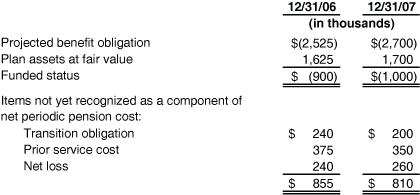 12/31/06 12/31/07 (in thousands) Projected benefit obligation " $(2,525)" " $(2,700)" Plan assets at fair value " 1,625 " " 1,700 " Funded status $(900) " $(1,000)" Items not yet recognized as a component of net periodic pension cost: Transition obligation $240 $200 Prior service cost 375 350 Net loss 240 260 $855 $810
-
 Accumulated other comprehensive income 855 Deferred tax asset 342 Deferred tax benefit—accumulated other comprehensive income 342 Liability for pension benefits 855
-
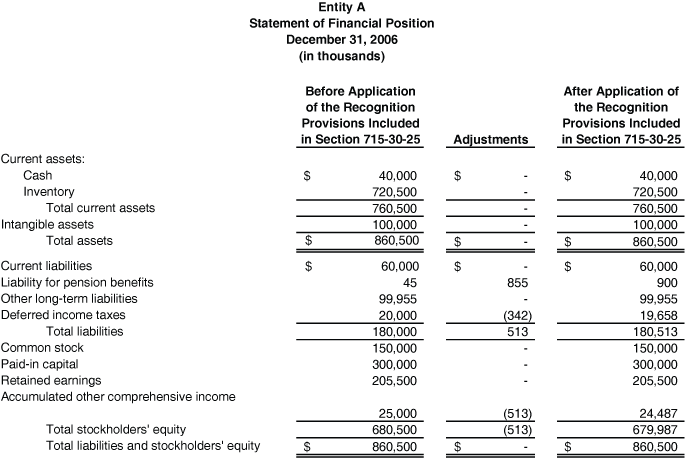 Entity A Statement of Financial Position "December 31, 2006" (in thousands) Before Application of the Recognition Provisions Included in Section 715-30-25 Adjustments After Application of the Recognition Provisions Included in Section 715-30-25 Current assets: Cash " $40,000 " $- " $40,000 " Inventory " 720,500 " - " 720,500 " Total current assets " 760,500 " - " 760,500 " Intangible assets " 100,000 " - " 100,000 " Total assets " $860,500 " $- " $860,500 " Current liabilities " $60,000 " $- " $60,000 " Liability for pension benefits 45 855 900 Other long-term liabilities " 99,955 " - " 99,955 " Deferred income taxes " 20,000 " (342) " 19,658 " Total liabilities " 180,000 " 513 " 180,513 " Common stock " 150,000 " - " 150,000 " Paid-in capital " 300,000 " - " 300,000 " Retained earnings " 205,500 " - " 205,500 " Accumulated other comprehensive income " 25,000 " (513) " 24,487 " Total stockholders' equity " 680,500 " (513) " 679,987 " Total liabilities and stockholders' equity " $860,500 " $- " $860,500 "
-
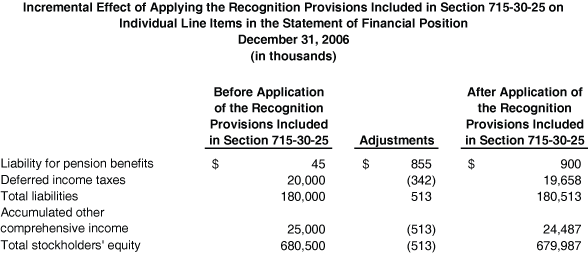 Incremental Effect of Applying the Recognition Provisions Included in Section 715-30-25 on Individual Line Items in the Statement of Financial Position "December 31, 2006" (in thousands) Before Application of the Recognition Provisions Included in Section 715-30-25 Adjustments After Application of the Recognition Provisions Included in Section 715-30-25 Liability for pension benefits $45 $855 $900 Deferred income taxes " 20,000 " (342) " 19,658 " Total liabilities " 180,000 " 513 " 180,513 " Accumulated other comprehensive income " 25,000 " (513) " 24,487 " Total stockholders' equity " 680,500 " (513) " 679,987 "
-
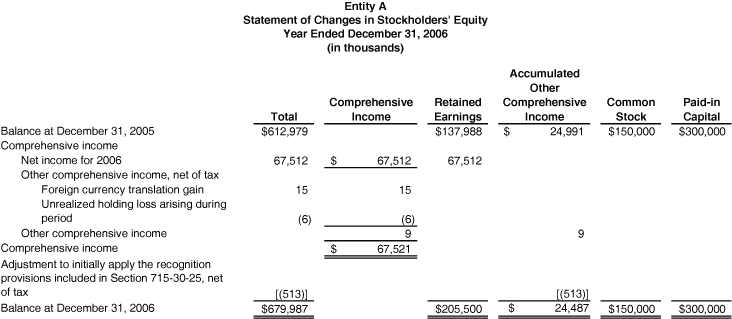 Entity A Statement of Changes in Stockholders' Equity "Year Ended December 31, 2006" (in thousands) Total Comprehensive Income Retained Earnings Accumulated Other Comprehensive Income Common Stock Paid-in Capital "Balance at December 31, 2005" " $612,979 " " $137,988 " " $24,991 " " $150,000 " " $300,000 " Comprehensive income Net income for 2006 " 67,512 " " $67,512 " " 67,512 " "Other comprehensive income, net of tax" Foreign currency translation gain 15 15 Unrealized holding loss arising during period (6) (6) Other comprehensive income 9 9 Comprehensive income " $67,521 " "Adjustment to initially apply the recognition provisions included in Section 715-30-25, net of tax" [(513)] [(513)] "Balance at December 31, 2006" " $679,987 " " $205,500 " " $24,487 " " $150,000 " " $300,000 "
- a Adjusts other comprehensive income, net of tax, to recognize the amortization of the transition obligation in net periodic pension cost
- b Adjusts other comprehensive income, net of tax, to recognize the amortization of prior service cost in net periodic pension cost
- c Recognizes a pension liability for the additional net loss arising during the year, and a corresponding decrease in other comprehensive income, net of tax
- d Recognizes a pension liability and net periodic pension cost, net of tax, for the service cost, interest cost, and expected return on plan assets.
-
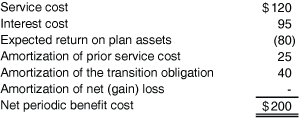 Service cost $120 Interest cost 95 Expected return on plan assets (80) Amortization of prior service cost 25 Amortization of the transition obligation 40 Amortization of net (gain) loss - Net periodic benefit cost $200
- a Recognize net periodic pension cost and a corresponding increase in other comprehensive income, net of tax, for amortization of the transition obligation (see the preceding paragraph).
-
 Net periodic pension cost—transition obligation 40 Deferred tax benefit—other comprehensive income 16 Deferred tax benefit—net income 16 Other comprehensive income 40
-
- b Recognize net periodic pension cost and a corresponding increase in other comprehensive income, net of tax, for amortization of prior service cost (see the preceding paragraph).
-
 Net periodic pension cost—prior service cost 25 Deferred tax benefit—other comprehensive income 10 Deferred tax benefit—net income 10 Other comprehensive income 25
-
- c Recognize a pension liability and net periodic pension cost, net of tax, for the service cost of $120, interest cost of $95, and the expected return on plan assets of $(80) (see the preceding paragraph). The service cost should be recognized separately, and the interest cost and expected return on plan assets may be recognized together or separately.
-
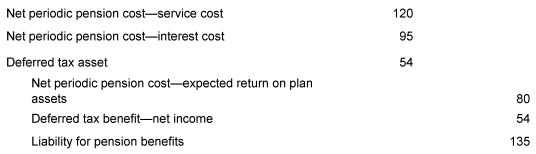 Net periodic pension cost—service cost 120 Net periodic pension cost—interest cost 95 Deferred tax asset 54 "Net periodic pension cost—expected return on plan assets" 80 Deferred tax benefit—net income 54 Liability for pension benefits 135
-
- d Recognize a pension liability for the additional net loss arising during the year and a corresponding decrease in other comprehensive income, net of tax (this is the increase in net loss from $240 to $260 shown in paragraph 715-20-55-6).
-
 Other comprehensive income 20 Deferred tax asset 8 Deferred tax benefit—other comprehensive income 8 Liability for pension benefits 20
-
Illustrations
- a Disclosures about pension and other postretirement benefit plans in the annual financial statements of a publicly traded entity. See Example 1 (paragraph 715-20-55-16).
- b Interim-period disclosures of a publicly traded entity. See Example 2 (paragraph 715-20-55-18).
- c Interim-period disclosures of a nonpublic entity in a complete set of financial statements. See Example 3 (paragraph 715-20-55-19).
- Notes to Financial Statements
- Pension and Other Postretirement Benefit Plans
- Entity A has both funded and unfunded noncontributory defined benefit pension plans that together cover substantially all of its employees. The plans provide defined benefits based on years of service and final average salary.
- Entity A also has both funded and unfunded other postretirement benefit plans covering substantially all of its employees. The health care plans are contributory with participants' contributions adjusted annually; the life insurance plans are noncontributory. The accounting for the health care plans anticipates future cost-sharing changes to the written plans that are consistent with the entity's expressed intent to increase retiree contributions each year by 50 percent of health care cost increases in excess of 6 percent. The postretirement health care plans include a limit on the entity's share of costs for recent and future retirees.
- Entity A acquired FV Industries on December 27, 20X3, including its pension plans and other postretirement benefit plans. Amendments made at the end of 20X3 to Entity A's plans increased the pension benefit obligations by $70 and reduced the other postretirement benefit obligations by $75.
-
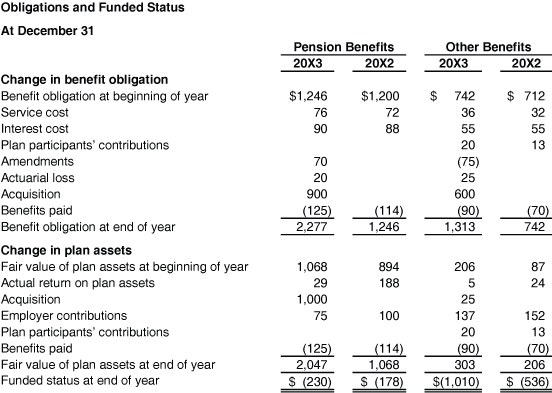 Obligations and Funded Status At December 31 Pension Benefits Other Benefits 20X3 20X2 20X3 20X2 Change in benefit obligation Benefit obligation at beginning of year $1,246 $1,200 $742 $712 Service cost 76 72 36 32 Interest cost 90 88 55 55 Plan participants' contributions 20 13 Amendments 70 (75) Actuarial loss 20 25 Acquisition 900 600 Benefits paid (125) (114) (90) (70) Benefit obligation at end of year 2,277 1,246 1,313 742 Change in plan assets Fair value of plan assets at beginning of year 1,068 894 206 87 Actual return on plan assets 29 188 5 24 Acquisition 1,000 25 Employer contributions 75 100 137 152 Plan participants' contributions 20 13 Benefits paid (125) (114) (90) (70) Fair value of plan assets at end of year 2,047 1,068 303 206 Funded status at end of year $(230) $(178) $(1,010) $(536)
-
- [Note: Nonpublic entities are not required to provide information in the preceding tables; they are required to disclose the employer's contributions, participants' contributions, benefit payments, and the funded status.]
- Amounts recognized in the statement of financial position consist of the following.
-
 Pension Benefits Other Benefits 20X3 20X2 20X3 20X2 Noncurrent assets $227 $127 $- $- Current liabilities (125) (125) (150) (150) Noncurrent liabilities (332) (180) (860) (386) $(230) $(178) $(1,010) $(536)
-
- [Note: The sum of current liabilities and noncurrent liabilities consists of the amount of underfunded (including unfunded) pension benefits or other benefits.]
- Amounts recognized in accumulated other comprehensive income consist of the following.
-
 Pension Benefits Other Benefits 20X3 20X2 20X3 20X2 Net loss (gain) $94 $18 $(11) $(48) Prior service cost (credit) 210 160 (92) (22) $304 $178 $(103) $(70)
-
- The accumulated benefit obligation for all defined benefit pension plans was $1,300 and $850 at December 31, 20X3, and 20X2, respectively.
-
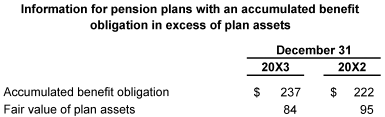 Information for pension plans with an accumulated benefit obligation in excess of plan assets December 31 20X3 20X2 Accumulated benefit obligation $ 237 $ 222 Fair value of plan assets 84 95
 -
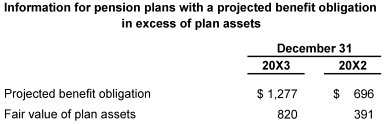 Information for pension plans with a projected benefit obligation in excess of plan assets December 31 20X3 20X2 Projected benefit obligation " $1,277 " $696 Fair value of plan assets 820 391
-
- [Note: The net amount of projected benefit obligation and plan assets for all underfunded (including unfunded) pension plans was $457 and $305 at December 31, 20X3, and 20X2, respectively, and was classified as liabilities on the statement of financial position.]
- [Note: Information for other postretirement benefit plans with an accumulated postretirement benefit obligation in excess of plan assets has been disclosed in the note on “Obligations and Funded Status” because all the other postretirement benefit plans are unfunded or underfunded.]
-
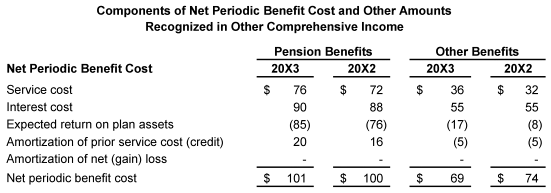 Components of Net Periodic Benefit Cost and Other Amounts Recognized in Accumulated Other Comprehensive Income Pension Benefits Other Benefits Net Periodic Benefit Cost 20X3 20X2 20X3 20X2 Service cost $76 $72 $36 $32 Interest cost 90 88 55 55 Expected return on plan assets (85) (76) (17) (8) Amortization of prior service cost (credit) 20 16 (5) (5) Amortization of net (gain) loss - - - - Net periodic benefit cost $101 $100 $69 $74
 -
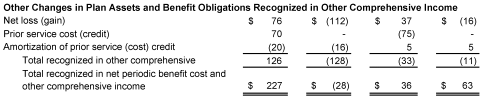 "Other Changes in Plan Assets and Benefit Obligations Recognized in Other Comprehensive Income" Pension Benefits Other Benefits 20X3 20X2 20X3 20X2 Net loss (gain) $76 $112 $37 $(48) Prior service cost (credit) 70 - (75) (27) Amortization of prior service (cost) credit (20) (16) 5 5 Total recognized in other comprehensive income 126 96 (33) (70) Total recognized in net periodic benefit cost and other comprehensive income $227 $196 $36 $4
-
- The components of net periodic benefit cost other than the service cost component are included in the line item "other income/(expense)" in the income statement.
- [Note: Nonpublic entities are not required to separately disclose components of net periodic benefit cost.]
- [Entity-specific narrative description of the reasons for significant gains and losses related to changes in the defined benefit obligation for the period would be disclosed.]
- Assumptions
-
 Weighted-average assumptions used to determine benefit obligations at December 31 Pension Benefits Other Benefits 20X3 20X2 20X3 20X2 Discount rate 6.75% 7.25% 7.00% 7.50% Rate of compensation increase 4.25 4.50
 -
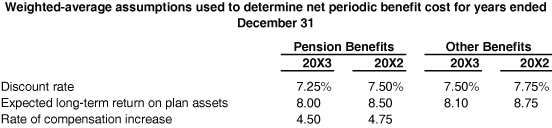 Weighted-average assumptions used to determine net periodic benefit cost for years ended December 31 Pension Benefits Other Benefits 20X3 20X2 20X3 20X2 Discount rate 7.25% 7.50% 7.50% 7.75% Expected long-term return on plan assets 8.00 8.50 8.10 8.75 Rate of compensation increase 4.50 4.75
-
- [Entity-specific narrative description of the basis used to determine the overall expected long-term rate of return on assets, as described in paragraph 715-20-50-1(d)(iii), would be disclosed.]
- [An entity with cash balance plans or other plans with promised interest crediting rates would disclose the weighted-average interest crediting rates used to determine the benefit obligation and net periodic benefit cost.]
-
 Assumed health care cost trend rates at December 31 20X3 20X2 Health care cost trend rate assumed for next year 12% 12.5% Rate to which the cost trend rate is assumed to decline (the ultimate trend rate) 6% 5% Year that the rate reaches the ultimate trend rate 20X9 20X9
-
- Plan Assets
- The company's overall investment strategy is to achieve a mix of approximately 75 percent of investments for long-term growth and 25 percent for near-term benefit payments with a wide diversification of asset types, fund strategies, and fund managers. The target allocations for plan assets are 65 percent equity securities, 20 percent corporate bonds and U.S. Treasury securities, and 15 percent to all other types of investments. Equity securities primarily include investments in large-cap and mid-cap companies primarily located in the United States. Fixed income securities include corporate bonds of companies from diversified industries, mortgage-backed securities, and U.S. Treasuries. Other types of investments include investments in hedge funds and private equity funds that follow several different strategies.
- The fair value of Entity A's pension plan assets at December 31, 20X3, by asset class are as follows.
- [Note: The two methods for disclosing the fair value of classes of plan assets presented below are not intended to be treated as a template. While they both provide examples of disclosures that comply with the requirements of paragraph 715-20-50-1(d)(ii), the classes disclosed should be tailored to the nature and risks of assets in an employer's plan(s). Additionally, an employer should consider the overall objectives in paragraphs 715-20-50-1(d)(1), (2), and (5).]
- Method 1:
-
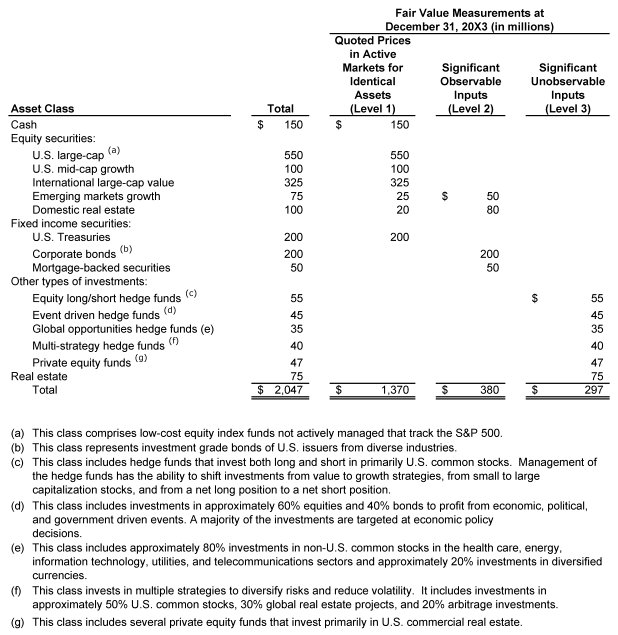 Fair Value Measurements at "December 31, 20X3 (in millions)" Quoted Prices in Active Markets for Significant Significant Identical Observable Unobservable Assets Inputs Inputs Asset Class Total (Level 1) (Level 2) (Level 3) Cash $150 $150 Equity securities: U.S. large-cap (a) 550 550 U.S. mid-cap growth 100 100 International large-cap value 325 325 Emerging markets growth 75 25 $50 Domestic real estate 100 20 80 Fixed income securities: U.S. Treasuries 200 200 Corporate bonds (b) 200 200 Mortgage-backed securities 50 50 Other types of investments: Equity long/short hedge funds (c) 55 $55 Event driven hedge funds (d) 45 45 Global opportunities hedge funds (e) 35 35 Multi-strategy hedge funds (f) 40 40 Private equity funds (g) 47 47 Real estate 75 75 Total " $2,047 " " $1,370 " $380 $297 (a) This class comprises low-cost equity index funds not actively managed that track the S&P 500. b) (b) This class represents investment grade bonds of U.S. issuers from diverse industries. (c) "This class includes hedge funds that invest both long and short in primarily U.S. common stocks. Management of the hedge funds has the ability to shift investments from value to growth strategies, from small to large capitalization stocks, and from a net long position to a net short position." (d) "This class includes investments in approximately 60% equities and 40% bonds to profit from economic, political, and government driven events. A majority of the investments are targeted at economic policy decisions." (e) "This class includes approximately 80% investments in non-U.S. common stocks in the health care, energy, information technology, utilities, and telecommunications sectors and approximately 20% investments in diversified currencies." (f) "This class invests in multiple strategies to diversify risks and reduce volatility. It includes investments in approximately 50% U.S. common stocks, 30% global real estate projects, and 20% arbitrage investments." (g) This class includes several private equity funds that invest primarily in U.S. commercial real estate.
-
- [Note: Presented below is another method by which management could disclose classes of plan assets.]
- Method 2:
-
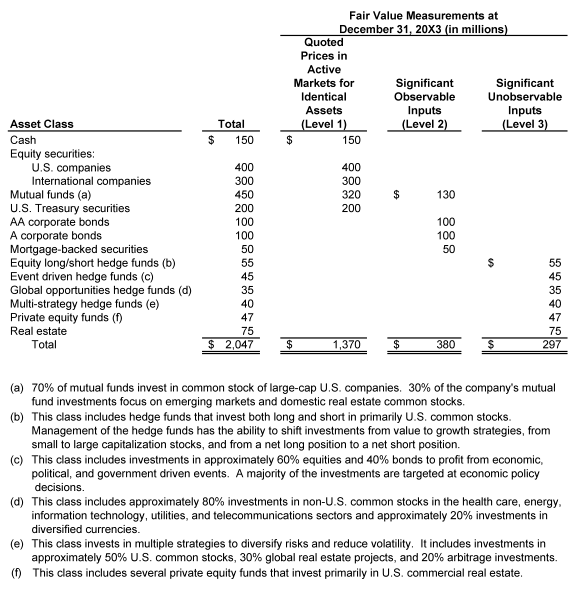 Fair Value Measurements at "December 31, 20X3 (in millions)" Quoted Prices in Active Markets for Significant Significant Identical Observable Unobservable Assets Inputs Inputs Asset Class Total (Level 1) (Level 2) (Level 3) Cash $150 $150 Equity securities: U.S. companies 400 400 International companies 300 300 Mutual funds (a) 450 320 $130 U.S. Treasury securities 200 200 AA corporate bonds 100 100 A corporate bonds 100 100 Mortgage-backed securities 50 50 Equity long/short hedge funds (b) 55 $55 Event driven hedge funds (c) 45 45 Global opportunities hedge funds (d) 35 35 Multi-strategy hedge funds (e) 40 40 Private equity funds (f) 47 47 Real estate 75 75 Total " $2,047 " " $1,370 " $380 $297 (a) 70% of mutual funds invest in common stock of large-cap U.S. companies. 30% of the company's mutual fund investments focus on emerging markets and domestic real estate common stocks. (b) "This class includes hedge funds that invest both long and short in primarily U.S. common stocks. Management of the hedge funds has the ability to shift investments from value to growth strategies, from small to large capitalization stocks, and from a net long position to a net short position." c0 (c) "This class includes investments in approximately 60% equities and 40% bonds to profit from economic, political, and government driven events. A majority of the investments are targeted at economic policy decisions." (d) "This class includes approximately 80% investments in non-U.S. common stocks in the health care, energy, information technology, utilities, and telecommunications sectors and approximately 20% investments in diversified currencies." (e) "This class invests in multiple strategies to diversify risks and reduce volatility. It includes investments in approximately 50% U.S. common stocks, 30% global real estate projects, and 20% arbitrage investments." (f) This class includes several private equity funds that invest primarily in U.S. commercial real estate.
-
- [Note: An entity shall disclose the following information regardless of its method for disclosing classes of plan assets.]
-
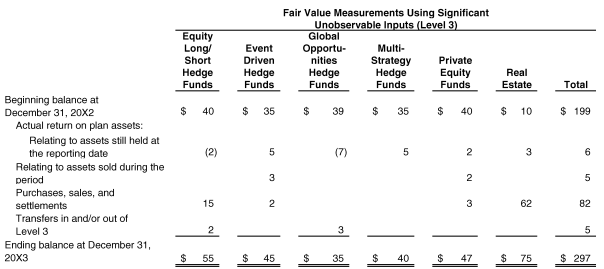 Fair Value Measurements Using Significant Unobservable Inputs (Level 3) Equity Global Long/ Event Opportu- Multi- Short Driven nities Strategy Private Hedge Hedge Hedge Hedge Equity Real Funds Funds Funds Funds Funds Estate Total "Beginning balance at December 31, 20X2" $40 $35 $39 $35 $40 $10 $199 Actual return on plan assets: Relating to assets still held at the reporting date (2) 5 (7) 5 2 3 6 Relating to assets sold during the period 3 2 5 "Purchases, sales, and settlements" 15 2 3 62 82 "Transfers in and/or out of Level 3" 2 3 5 "Ending balance at December 31, 20X3" $55 $45 $35 $40 $47 $75 $297
-
- [Note: Nonpublic entities are not required to provide a reconciliation from the opening balances to the closing balances of plan assets measured on a recurring basis in Level 3 of the fair value hierarchy. However, nonpublic entities are required to disclose separately the amounts of purchases of Level 3 plan assets and transfers into and out of Level 3 of the fair value hierarchy.]
- [Entity-specific narrative description of investment policies and strategies for plan assets, including weighted-average target asset allocations [if used as part of those policies and strategies] as described in paragraph 715-20-50-1(d)(ii) would be included here.]
- The fair values of Entity A's other postretirement benefit plan assets at December 31, 20X3, by asset class are as follows.
-
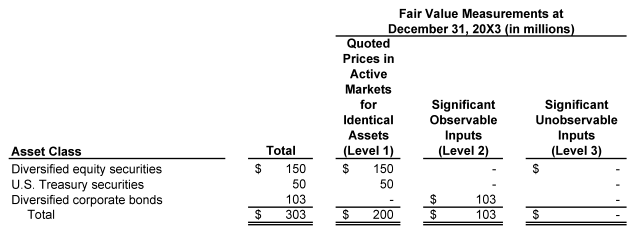 Fair Value Measurements at "December 31, 20X3 (in millions)" Quoted Prices in Active Markets for Significant Significant Identical Observable Unobservable Assets Inputs Inputs Asset Class Total (Level 1) (Level 2) (Level 3) Diversified equity securities $150 $150 - $- U.S. Treasury securities 50 50 - - Diversified corporate bonds 103 - $103 - Total $303 $200 $103 $-
-
- Diversified equity securities include Entity A common stock in the amounts of $12 at December 31, 20X3.
- Cash Flows
- Contributions
- Entity A expects to contribute $125 million to its pension plan and $150 million to its other postretirement benefit plan in 20X4.
- Estimated Future Benefit Payments
- The following benefit payments, which reflect expected future service, as appropriate, are expected to be paid.
-
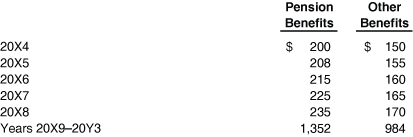 Pension Benefits Other Benefits 20X4 $200 $150 20X5 208 155 20X6 215 160 20X7 225 165 20X8 235 170 Years 20X9-20Y3 1,352 984
-
- Components of Net Periodic Benefit Cost
-
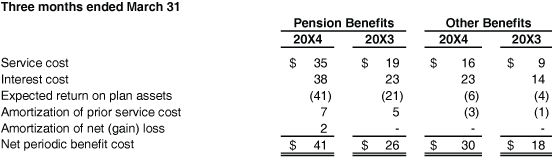 Three months ended March 31 Pension Benefits Other Benefits 20X4 20X3 20X4 20X3 Service cost $35 $19 $16 $9 Interest cost 38 23 23 14 Expected return on plan assets (41) (21) (6) (4) Amortization of prior service cost 7 5 (3) (1) Amortization of net (gain) loss 2 - - - Net periodic benefit cost $41 $26 $30 $18
 - The components of net periodic benefit cost other than the service cost component are included in the line item “other income/(expense)” in the income statement.
- Employer Contributions
- Entity A previously disclosed in its financial statements for the year ended December 31, 20X3, that it expected to contribute $125 million to its pension plan in 20X4. As of March 31, 20X4, $20 million of contributions have been made. Entity A presently anticipates contributing an additional $120 million to fund its pension plan in 20X4 for a total of $140 million.
- Entity A previously disclosed in its financial statements for the year ended December 31, 20X3, that it expected to contribute $125 million to its pension plan in 20X4. As of March 31, 20X4, $20 million of contributions have been made. Entity A presently anticipates contributing an additional $120 million to fund its pension plan in 20X4 for a total of $140 million.
715-20-60Relationships
Source downloaded: .Record version e155f20cb6a6. Effective date must be checked in the source.
Compensation—General
715-20-65Transition and Open Effective Date Information
Source downloaded: .Record version 68d2ceca4e47. Effective date must be checked in the source.
715-20-S00StatusSEC
Source downloaded: .Record version ff8a359d48b2. Effective date must be checked in the source.
| Paragraph | Action | Accounting Standards Update | Date |
| 715-20-S99-1 | Amended | Accounting Standards Update No. 2010-04 | 01/15/2010 |
715-20-S50DisclosureSEC
Source downloaded: .Record version caefddab9cf9. Effective date must be checked in the source.
Determination of Vested Benefit Obligation for a Defined Benefit Pension Plan
715-20-S55Implementation Guidance and IllustrationsSEC
Source downloaded: .Record version 6ce8f1bf80ed. Effective date must be checked in the source.
Selection of Discount Rate Used for Measuring Defined Benefit Pension Obligation and Obligations of Postretirement Plans Other Than Pensions
715-20-S99SEC MaterialsSEC
Source downloaded: .Record version 0e3195de5714. Effective date must be checked in the source.
SEC Staff Guidance
- The SEC Observer made the following announcement of the SEC staff's position on the selection of discount rates used for purposes of measuring defined benefit pension obligations under paragraph 715-30-35-44 and obligations of postretirement benefit plans other than pensions under paragraph 715-60-35-80. Those paragraphs provide guidance for selecting discount rates to measure obligations for pension benefits and postretirement benefits other than pensions.
- At each measurement date, the SEC staff expects registrants to use discount rates to measure obligations for pension benefits and postretirement benefits other than pensions that reflect the then current level of interest rates. The staff suggests that fixed-income debt securities that receive one of the two highest ratings given by a recognized ratings agency be considered high quality (for example, a fixed-income security that receives a rating of Aa or higher from Moody's Investors Service, Inc.).
- Under the guidance in paragraph 715-30-35-41, an entity has the option of determining whether the vested benefit obligation for a defined benefit pension plan is the actuarial present value of the vested benefits to which the employee is entitled if the employee separates immediately or the actuarial present value of the vested benefits to which the employee is currently entitled but based on the employee's expected date of separation of retirement. The method used should be disclosed.
Related subtopics
- 965-30 Plan Benefit ObligationsPlan Accounting—Health and Welfare Benefit Plans
- 715-80 Multiemployer PlansCompensation—Retirement Benefits
- 205-962 Plan Accounting—Defined Contribution Pension PlansPresentation of Financial Statements
- 715-60 Defined Benefit Plans—Other PostretirementCompensation—Retirement Benefits
- 715-70 Defined Contribution PlansCompensation—Retirement Benefits
- 825-10 OverallFinancial Instruments