ASC 715-80
Multiemployer Plans
715 Compensation—Retirement Benefits
Source downloaded: .Record version bb61d05941c2. Effective date must be checked in the source.
ASC 715-80 governs an employer's accounting and disclosure for participation in multiemployer pension and other postretirement benefit plans — plans to which two or more unrelated employers contribute, usually under collective-bargaining agreements. The core rule is defined-contribution-like: the employer recognizes as net pension (or net periodic postretirement benefit) cost the required contribution for the period, including cash and the fair value of noncash contributions, and recognizes a liability only for unpaid required contributions (715-80-35-1). Extensive plan-by-plan disclosures (zone status, EIN, contributions, collective-bargaining agreement expirations, withdrawal exposure) are required so users can assess the distinctive risks of multiemployer participation.
Key points (7)
- An employer recognizes as net pension cost or net periodic postretirement benefit cost the required contribution for the period (cash plus fair value of noncash contributions) and records a liability for any unpaid required contributions (715-80-35-1); an executed agreement to make future contributions does not create a liability beyond contributions currently due and unpaid (715-80-55-2).
- If withdrawal from the plan under circumstances giving rise to an obligation, or an increased contribution under a maintenance of benefits clause, is probable or reasonably possible, Topic 450 contingency accounting applies (715-80-35-2; 715-80-50-2).
- The Subtopic applies to all multiemployer pension and OPEB plans but not to multiple-employer plans, which are in substance aggregations of single-employer plans pooled for investment or administrative efficiency and ordinarily do not involve collective bargaining (715-80-15-2 through 15-3).
- For each individually significant multiemployer pension plan, an employer must disclose (in tabular format when feasible) the plan's legal name, EIN/plan number, most recently available PPA certified zone status (or funded-percentage ranges of <65%, 65–80%, at least 80%), collective-bargaining agreement expiration dates, contributions made, whether contributions exceed 5 percent of total plan contributions per Form 5500, and whether a funding improvement or rehabilitation plan is pending or implemented, whether a surcharge was paid, and any required minimum future contributions (715-80-50-5).
- An employer must give a narrative description of the plans and its participation showing how the risks differ from single-employer plans (715-80-50-4), describe changes affecting period-to-period comparability such as business combinations, divestitures, rate changes, or changes in covered employees (715-80-50-6), and disclose in tabular form total contributions to plans that are not individually significant and total contributions to all plans (715-80-50-9).
- When plan-level information is not publicly available, additional disclosures about the nature of benefits, the extent of the employer's potential responsibility for plan obligations, and available quantitative plan data are required; certain quantitative items may be omitted if they cannot be obtained without undue cost and effort, with an explanation of what was omitted and why (715-80-50-7 through 50-8).
- A multiemployer plan cannot be a substantially equivalent successor plan for a terminated single-employer defined benefit plan, so prior service cost in accumulated other comprehensive income must be recognized on an accelerated basis (715-80-55-3 through 55-4); an arrangement in which retirees lose plan coverage when the former employer stops contributing is not a multiemployer plan (715-80-55-5).
For students. The key exam trap is assuming multiemployer plan participation requires defined benefit accounting: it does not — expense equals the required contribution, and no unfunded benefit obligation is recorded unless withdrawal liability becomes probable or reasonably possible under Topic 450. Also distinguish a true multiemployer plan (obligation to retirees survives an employer's withdrawal) from a multiple-employer plan, which is accounted for as an aggregation of single-employer plans.
Machine-generated study aid for ASC 715-80. Check the source paragraphs below.
715-80-00Status
Source downloaded: .Record version 0abfe5a7bd48. Effective date must be checked in the source.
715-80-05Overview and Background
Source downloaded: .Record version 918eef8046a1. Effective date must be checked in the source.
715-80-15Scope and Scope Exceptions
Source downloaded: .Record version a9aefe160d03. Effective date must be checked in the source.
Overall Guidance
Transactions
715-80-35Subsequent Measurement
Source downloaded: .Record version 4b305ecdb456. Effective date must be checked in the source.
715-80-50Disclosure
Source downloaded: .Record version dbd51bd27222. Effective date must be checked in the source.
- a An employer would withdraw from the plan under circumstances that would give rise to an obligation.
- b An employer's contribution to the fund would be increased during the remainder of the contract period to make up a shortfall in the funds necessary to maintain the negotiated level of benefit coverage (a maintenance of benefits clause).
Multiemployer Plans That Provide Pension Benefits
- a Legal name of the plan.
- b The plan's Employer Identification Number and, if available, its plan number.
- c For each statement of financial position presented, the most recently available certified zone status provided by the plan, as currently defined by the Pension Protection Act of 2006 or a subsequent amendment of that Act. The disclosure shall specify the date of the plan's year-end to which the zone status relates and whether the plan has utilized any extended amortization provisions that affect the calculation of the zone status. If the zone status is not available, an employer shall disclose, as of the most recent date available, on the basis of the financial statements provided by the plan, the total plan assets and accumulated benefit obligations, whether the plan was:
- 1 Less than 65 percent funded
- 2 Between 65 percent and 80 percent funded
- 3 At least 80 percent funded.
- 1
- d The expiration date(s) of the collective-bargaining agreement(s) requiring contributions to the plan, if any. If more than one collective-bargaining agreement applies to the plan, the employer shall provide a range of the expiration dates of those agreements, supplemented with a qualitative description that identifies the significant collective-bargaining agreements within that range as well as other information to help investors understand the significance of the collective-bargaining agreements and when they expire (for example, the portion of employees covered by each agreement or the portion of contributions required by each agreement).
- e For each period that a statement of income (statement of activities for a not-for-profit entity) is presented:
- 1 The employer's contributions made to the plan
- 2 Whether the employer's contributions represent more than 5 percent of total contributions to the plan as indicated in the plan's most recently available annual report (Form 5500 for U.S. plans). The disclosure shall specify the year-end date of the plan to which the annual report relates.
- 1
- f As of the end of the most recent annual period presented:
- 1 Whether a funding improvement plan or rehabilitation plan (for example, as those terms are defined by the Employment Retirement Security Act of 1974) had been implemented or was pending
- 2 Whether the employer paid a surcharge to the plan
- 3 A description of any minimum contribution(s), required for future periods by the collective-bargaining agreement(s), statutory obligations, or other contractual obligations, if applicable.
- 1
- a A business combination or a divestiture
- b A change in the contractual employer contribution rate
- c A change in the number of employees covered by the plan during each year.
- a A description of the nature of the plan benefits
- b A qualitative description of the extent to which the employer could be responsible for the obligations of the plan, including benefits earned by employees during employment with another employer
- c Other quantitative information, to the extent available, as of the most recent date available, to help users understand the financial information about the plan, such as total plan assets, actuarial present value of accumulated plan benefits, and total contributions received by the plan.
- a Its total contributions made to all plans that are not individually significant
- b Its total contributions made to all plans.
Multiemployer Plans That Provide Postretirement Benefits Other Than Pensions
- a A business combination or a divestiture
- b A change in the contractual employer contribution rate
- c A change in the number of employees covered by the plan during each year.
715-80-55Implementation Guidance and Illustrations
Source downloaded: .Record version b95459a3f086. Effective date must be checked in the source.
Implementation Guidance
Illustrations
- a Assets contributed to the multiemployer plan by one employer may be used to provide benefits to employees of other participating employers.
- b If a participating employer stops contributing to the plan, the unfunded obligations of the plan may be borne by the remaining participating employers.
- c If Entity A chooses to stop participating in some of its multiemployer plans, Entity A may be required to pay those plans an amount based on the underfunded status of the plan, referred to as a withdrawal liability.
-
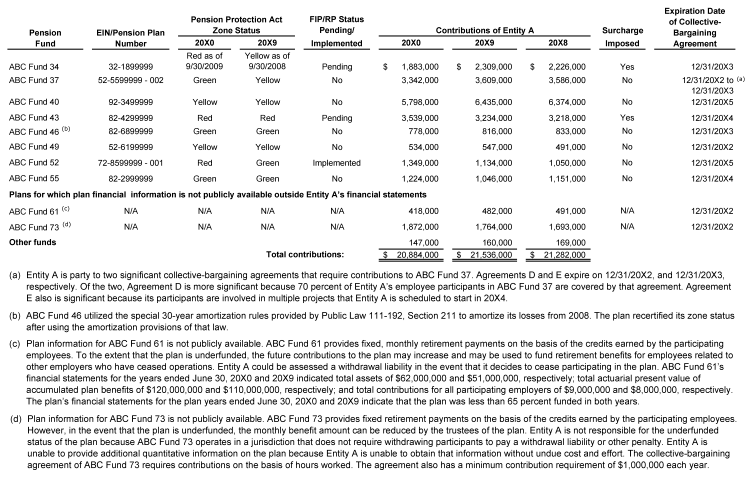 "Pension Fund" EIN/Pension Plan Number Pension Protection Act Zone Status FIP/RP Status Pending/ Contributions of Entity A Surcharge "Expiration Date of Collective- Bargaining Agreement" 20X0 20X9 " Implemented" 20X0 20X9 20X8 Imposed ABC Fund 34 32-1899999 Red as of 9/30/2009 Yellow as of 9/30/2008 Pending " $1,883,000 " " $2,309,000 " " $2,226,000 " Yes 12/31/20X3 ABC Fund 37 52-5599999 - 002 Green Yellow No " 3,342,000 " " 3,609,000 " " 3,586,000 " No "12/31/20X2 to 12/31/20X3" (a) ABC Fund 40 92-3499999 Yellow Yellow No " 5,798,000 " " 6,435,000 " " 6,374,000 " No 12/31/20X5 ABC Fund 43 82-4299999 Red Red Pending " 3,539,000 " " 3,234,000 " " 3,218,000 " Yes 12/31/20X4 ABC Fund 46 (b) 82-6899999 Green Green No " 778,000 " " 816,000 " " 833,000 " No 12/31/20X3 ABC Fund 49 52-6199999 Yellow Yellow No " 534,000 " " 547,000 " " 491,000 " No 12/31/20X2 ABC Fund 52 72-8599999 - 001 Red Green Implemented " 1,349,000 " " 1,134,000 " " 1,050,000 " No 12/31/20X5 ABC Fund 55 82-2999999 Green Green No " 1,224,000 " " 1,046,000 " " 1,151,000 " No 12/31/20X4 Plans for which plan financial information is not publicly available outside Entity A's financial statements ABC Fund 61 (c) N/A N/A N/A N/A " 418,000 " " 482,000 " " 491,000 " N/A 12/31/20X2 ABC Fund 73 (d) N/A N/A N/A N/A " 1,872,000 " " 1,764,000 " " 1,693,000 " N/A 12/31/20X2 Other funds " 147,000 " " 160,000 " " 169,000 " Total contributions: " $20,884,000 " " $21,536,000 " " $21,282,000 " (a) "Entity A is party to two significant collective-bargaining agreements that require contributions to ABC Fund 37. Agreements D and E expire on 12/31/20X2, and 12/31/20X3, respectively. Of the two, Agreement D is more significant because 70 percent of Entity A's employee participants in ABC Fund 37 are covered by that agreement. Agreement E also is significant because its participants are involved in multiple projects that Entity A is scheduled to start in 20X4. " (b) "ABC Fund 46 utilized the special 30-year amortization rules provided by Public Law 111-192, Section 211 to amortize its losses from 2008. The plan recertified its zone status after using the amortization provisions of that law. " (c) "Plan information for ABC Fund 61 is not publicly available. ABC Fund 61 provides fixed, monthly retirement payments on the basis of the credits earned by the participating employees. To the extent that the plan is underfunded, the future contributions to the plan may increase and may be used to fund retirement benefits for employees related to other employers who have ceased operations. Entity A could be assessed a withdrawal liability in the event that it decides to cease participating in the plan. ABC Fund 61's financial statements for the years ended June 30, 20X0 and 20X9 indicated total assets of $62,000,000 and $51,000,000, respectively; total actuarial present value of accumulated plan benefits of $120,000,000 and $110,000,000, respectively; and total contributions for all participating employers of $9,000,000 and $8,000,000, respectively. The plan's financial statements for the plan years ended June 30, 20X0 and 20X9 indicate that the plan was less than 65 percent funded in both years." (d) "Plan information for ABC Fund 73 is not publicly available. ABC Fund 73 provides fixed retirement payments on the basis of the credits earned by the participating employees. However, in the event that the plan is underfunded, the monthly benefit amount can be reduced by the trustees of the plan. Entity A is not responsible for the underfunded status of the plan because ABC Fund 73 operates in a jurisdiction that does not require withdrawing participants to pay a withdrawal liability or other penalty. Entity A is unable to provide additional quantitative information on the plan because Entity A is unable to obtain that information without undue cost and effort. The collective-bargaining agreement of ABC Fund 73 requires contributions on the basis of hours worked. The agreement also has a minimum contribution requirement of $1,000,000 each year. "
-
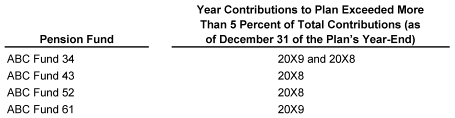 Fund "Year Contributions to Plan Exceeded More Than 5 Percent of Total Contributions (as of December 31 of the Plan's Year-End)" ABC Fund 34 20X9 and 2008 ABC Fund 43 20X8 ABC Fund 52 20X8 ABC Fund 61 20X9
715-80-65Transition and Open Effective Date Information
Source downloaded: .Record version 8096146efe0c. Effective date must be checked in the source.
Related subtopics
- 715-70 Defined Contribution PlansCompensation—Retirement Benefits
- 715-20 Defined Benefit Plans—GeneralCompensation—Retirement Benefits
- 715-60 Defined Benefit Plans—Other PostretirementCompensation—Retirement Benefits
- 965-30 Plan Benefit ObligationsPlan Accounting—Health and Welfare Benefit Plans
- 325-962 Plan Accounting—Defined Contribution Pension PlansInvestments—Other
- 715-10 OverallCompensation—Retirement Benefits