ASC

ASC 715-60

Defined Benefit Plans—Other Postretirement

715 Compensation—Retirement Benefits

Source downloaded: .Record version 358fce79d8a5. Effective date must be checked in the source.

ASC 715-60 governs an employer's accounting for single-employer defined benefit postretirement benefit plans other than pensions (OPEB)—chiefly retiree health care, but also retiree life insurance, tuition, day care, legal services and housing subsidies. The employer must recognize the funded status of each plan (fair value of plan assets less the accumulated postretirement benefit obligation) on the balance sheet, attribute the expected postretirement benefit obligation ratably over an attribution period ending at the full eligibility date, and recognize net periodic postretirement benefit cost with delayed recognition of prior service cost, gains/losses, and any transition obligation through other comprehensive income. Separate Subsections address the Medicare Part D subsidy, settlements/curtailments/termination benefits, and split-dollar life insurance arrangements.

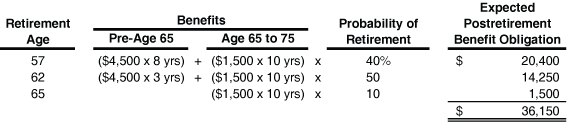
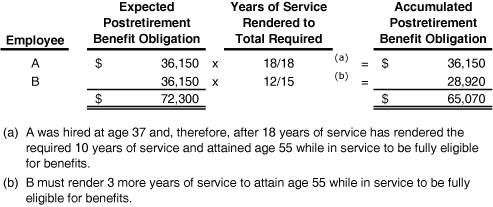
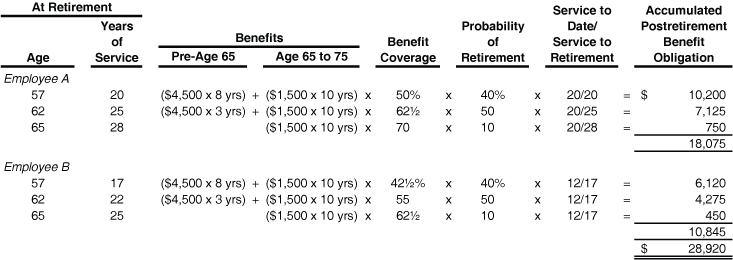
Key points (7)
  • An employer must recognize the funded status of its OPEB plans in the statement of financial position, aggregating overfunded plans as an asset and underfunded plans as a liability (715-60-25-1), with funded status measured as fair value of plan assets minus the accumulated postretirement benefit obligation (715-60-35-5).
  • Net periodic postretirement benefit cost comprises service cost, interest cost, actual return on plan assets, amortization of prior service cost or credit, gain or loss to the extent recognized, and amortization of any transition obligation or asset (715-60-35-9); only the service cost component may be capitalized into inventory or other assets (715-60-35-10A).
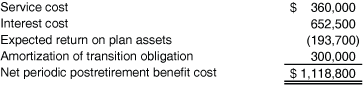
  • The accounting must follow the substantive plan—the plan as understood by both parties, which may differ from the extant written plan where a past cost-sharing practice or a communicated intent to change cost sharing exists (715-60-35-49; 715-60-35-51), but not where offset by other benefit changes or significant costs such as work stoppages (715-60-35-52 through 35-55).
  • An equal amount of the expected postretirement benefit obligation is attributed to each year in the attribution period (benefit-years-of-service approach), beginning at date of hire (or a non-nominal later credited service date) and always ending at the full eligibility date (715-60-35-62, 35-66, 35-68); frontloaded plans are attributed per the benefit formula (715-60-35-64).
  • Prior service cost from a benefit improvement is charged to OCI at the amendment date and amortized by assigning an equal amount to each remaining year of service to full eligibility of active participants not yet fully eligible (715-60-35-16 through 35-17); a negative amendment creates a prior service credit that first offsets remaining prior service cost, then transition obligation, with any excess amortized rather than recognized immediately (715-60-35-20).
  • Gains and losses are recognized in OCI as they arise and amortized only to the extent the net gain or loss exceeds 10 percent of the greater of the accumulated postretirement benefit obligation or the market-related value of plan assets, divided by the average remaining service period of active participants (715-60-35-25, 35-29).
  • Explicit, individually best-estimate and mutually consistent assumptions are required, including discount rates based on returns on high-quality fixed-income investments matched to expected benefit payments, per capita claims cost by age, and health care cost trend rates (715-60-35-72 through 35-79, 35-90, 35-99), measured as of the employer's fiscal year-end (715-60-35-121).

For students. OPEB accounting mirrors pension accounting under 715-30 but differs in crucial ways: the attribution period always ends at the full eligibility date (not retirement), salary progression is embedded in the "accumulated" obligation for pay-related plans, and benefits in kind require health care cost trend assumptions. The most common mistake is importing 715-30 rules wholesale—715-60-05-7 warns that neither Subtopic overrides the other.

Machine-generated study aid for ASC 715-60. Check the source paragraphs below.

715-60-00Status

Source downloaded: .Record version bb920c7c1a06. Effective date must be checked in the source.

715-60-00-1
The following table identifies the changes made to this Subtopic.
Paragraph Action Accounting Standards Update Date
Actuarial Present Value (1st def.) Added Accounting Standards Update No. 2014-06 03/14/2014
Actuarial Present Value (2nd def.) Superseded Accounting Standards Update No. 2014-06 03/14/2014
Amortization (1st def.) Amended Accounting Standards Update No. 2014-06 03/14/2014
Assumptions (1st def.) Amended Accounting Standards Update No. 2014-06 03/14/2014
Attribution (1st def.) Amended Accounting Standards Update No. 2014-06 03/14/2014
Benefits Amended Accounting Standards Update No. 2016-19 12/14/2016
Benefits (3rd def.) Amended Accounting Standards Update No. 2014-06 03/14/2014
Debt Security (1st def.) Added Accounting Standards Update No. 2016-19 12/14/2016
Debt Security (2nd def.) Superseded Accounting Standards Update No. 2016-19 12/14/2016
Defined Benefit Plan Added Accounting Standards Update No. 2014-06 03/14/2014
Defined Benefit Postretirement Plan Superseded Accounting Standards Update No. 2014-06 03/14/2014
Defined Contribution Plan Amended Accounting Standards Update No. 2014-06 03/14/2014
Discount Rate Added Accounting Standards Update No. 2014-06 03/14/2014
Discount Rates Superseded Accounting Standards Update No. 2014-06 03/14/2014
Equity Security (2nd def.) Amended Accounting Standards Update No. 2016-01 01/05/2016
Explicit Approach to Assumptions (1st def.) Superseded Accounting Standards Update No. 2014-06 03/14/2014
Explicit Approach to Assumptions (2nd def.) Added Accounting Standards Update No. 2014-06 03/14/2014
Funding Policy (3rd def.) Amended Accounting Standards Update No. 2014-06 03/14/2014
Gain or Loss (1st def.) Amended Accounting Standards Update No. 2014-06 03/14/2014
Market-Related Value of Plan Assets (1st def.) Added Accounting Standards Update No. 2014-06 03/14/2014
Market-Related Value of Plan Assets (2nd def.) Superseded Accounting Standards Update No. 2014-06 03/14/2014
Multiple-Employer Plan (1st def.) Amended Accounting Standards Update No. 2014-06 03/14/2014
Participating Insurance Contract Superseded Accounting Standards Update No. 2016-19 12/14/2016
Participation Right (2nd def.) Amended Accounting Standards Update No. 2016-19 12/14/2016
Plan Amendment (1st def.) Amended Accounting Standards Update No. 2014-06 03/14/2014
Plan Assets (1st def.) Amended Accounting Standards Update No. 2016-19 12/14/2016
Plan Termination (1st def.) Amended Accounting Standards Update No. 2014-06 03/14/2014
Prior Service Cost (1st def.) Superseded Accounting Standards Update No. 2014-06 03/14/2014
Prior Service Cost (2nd def.) Added Accounting Standards Update No. 2014-06 03/14/2014
Single-Employer Plan (1st def.) Amended Accounting Standards Update No. 2014-06 03/14/2014
715-60-05-2 Amended Accounting Standards Update No. 2017-07 03/10/2017
715-60-05-2 Amended Accounting Standards Update No. 2014-06 03/14/2014
Superseded Accounting Standards Update No. 2017-07 03/10/2017
715-60-05-7 Amended Accounting Standards Update No. 2017-07 03/10/2017
715-60-05-9 Superseded Accounting Standards Update No. 2017-07 03/10/2017
715-60-05-10 Superseded Accounting Standards Update No. 2017-07 03/10/2017
715-60-05-11 Amended Accounting Standards Update No. 2017-07 03/10/2017
715-60-15-9A Added Accounting Standards Update No. 2012-04 10/01/2012
715-60-35-3 Amended Accounting Standards Update No. 2014-06 03/14/2014
715-60-35-9 Amended Accounting Standards Update No. 2014-06 03/14/2014
715-60-35-10A Added Accounting Standards Update No. 2017-07 03/10/2017
715-60-35-11 Amended Accounting Standards Update No. 2014-06 03/14/2014
715-60-35-26 Amended Accounting Standards Update No. 2014-06 03/14/2014
715-60-35-71 Amended Accounting Standards Update No. 2014-06 03/14/2014
715-60-35-80 Amended Accounting Standards Update No. 2012-04 10/01/2012
715-60-35-107 Amended Accounting Standards Update No. 2016-19 12/14/2016
715-60-35-112 Amended Accounting Standards Update No. 2016-19 12/14/2016
715-60-35-115 Amended Accounting Standards Update No. 2016-19 12/14/2016
715-60-35-123A Added Accounting Standards Update No. 2015-04 04/15/2015
715-60-35-123B Added Accounting Standards Update No. 2015-04 04/15/2015
715-60-35-126A Added Accounting Standards Update No. 2015-04 04/15/2015
715-60-35-126B Added Accounting Standards Update No. 2015-04 04/15/2015
715-60-35-140 Amended Accounting Standards Update No. 2014-06 03/14/2014
715-60-35-156 Amended Accounting Standards Update No. 2016-19 12/14/2016
715-60-35-163 Amended Accounting Standards Update No. 2014-06 03/14/2014
715-60-35-179 Amended Accounting Standards Update No. 2014-06 03/14/2014
715-60-55-4 Amended Accounting Standards Update No. 2014-06 03/14/2014
715-60-55-13 Amended Accounting Standards Update No. 2014-06 03/14/2014
715-60-55-20 Amended Accounting Standards Update No. 2014-06 03/14/2014
715-60-55-86 Amended Accounting Standards Update No. 2017-07 03/10/2017
715-60-55-89 Amended Accounting Standards Update No. 2017-07 03/10/2017
715-60-55-92 Amended Accounting Standards Update No. 2017-07 03/10/2017
715-60-55-106 Amended Accounting Standards Update No. 2014-06 03/14/2014
715-60-55-161 Amended Accounting Standards Update No. 2014-06 03/14/2014
715-60-60-1 Amended Accounting Standards Update No. 2014-06 03/14/2014

715-60-05Overview and Background

Source downloaded: .Record version a91e1825dbdf. Effective date must be checked in the source.

715-60-05-1
This Subtopic provides accounting and reporting guidance for other postretirement benefits. The guidance in this Subtopic is presented in the following four Subsections:
  1. a
    General
  2. b
    Medicare Prescription Drug, Improvement, and Modernization Act
  3. c
    Settlements, Curtailments, and Certain Termination Benefits
  4. d
    Split-Dollar Life Insurance Arrangements.
715-60-05-2
The General Subsections provide guidance on an employer's accounting and reporting for a defined benefit postretirement benefit plan, that is, a single-employer plan that defines the nonpension postretirement benefits to be provided to retirees. This Subtopic refers to these benefits as postretirement benefits and to these plans as postretirement plans. Generally, the amount of those benefits depends on the benefit formula (which may include factors such as the number of years of service rendered or the employee's compensation before retirement or termination), the longevity of the retiree and any beneficiaries and covered dependents, and the incidence of events requiring benefit payments (for example, illnesses affecting the amount of health care required).
715-60-05-6
Although this Subtopic applies to all defined benefit postretirement plans other than pensions, postretirement health care benefits are likely to be the most significant in terms of cost and prevalence, and certain of the issues that arise in measuring those benefits are unique.
715-60-05-7
Many of the provisions in this Subtopic are the same as or similar to the provisions of Subtopic 715-30. Consequently, the guidance provided in that Subtopic may be useful in understanding and implementing many of the provisions of this Subtopic. However, there are differences between the specific requirements of this Subtopic and that Subtopic, and therefore the specific guidance in one Subtopic should not be used to override guidance of the other.

Medicare Prescription Drug, Improvement, and Modernization Act

715-60-05-8
The Medicare Prescription Drug, Improvement, and Modernization Act Subsections provide guidance on the accounting for the effects of the Medicare Prescription Drug, Improvement, and Modernization Act of 2003 for employers that sponsor postretirement health care plans that provide prescription drug benefits.
715-60-05-11
The Medicare Prescription Drug, Improvement, and Modernization Act Subsections make reference to various provisions of the Act and, in many cases, paraphrase those provisions. However, nothing in these Subsections should be considered a definitive interpretation of any provision of the Act for any purpose.

Settlements, Curtailments, and Certain Termination Benefits

715-60-05-12
The Settlements, Curtailments, and Certain Termination Benefits Subsections provide guidance on an employer's accounting for settlement of defined benefit postretirement obligations, for curtailment of a defined benefit postretirement plan, and for termination benefits.

Split-Dollar Life Insurance Arrangements

715-60-05-13
The Split-Dollar Life Insurance Arrangements Subsections provide guidance on accounting and reporting for split-dollar life insurance arrangements.
715-60-05-14
Entities purchase life insurance for various reasons that may include protecting against the loss of key employees, funding deferred compensation and postretirement benefit obligations, and providing an investment return. One form of this insurance is split-dollar life insurance. The structure of split-dollar life insurance arrangements can be complex and varied.
715-60-05-15
The two most common types of arrangements are endorsement split-dollar life insurance arrangements and collateral assignment split-dollar life insurance arrangements. Generally, the difference between these arrangements is dependent on the ownership and control of the life insurance policy.

715-60-15Scope and Scope Exceptions

Source downloaded: .Record version 0038579d115c. Effective date must be checked in the source.

Overall Guidance

715-60-15-1
This Subtopic follows the same Scope and Scope Exceptions as outlined in the Overall Subtopic, see Section 715-10-15, with specific qualifications and exceptions noted below.
715-60-15-2
The General Subsection of this Section establishes the pervasive scope of this Subtopic, with specific exceptions noted in the other Subsections of this Section.

Transactions

715-60-15-3
The guidance in the General Subsections applies to the following plans and benefits:
  1. a
    A single-employer plan that defines the postretirement benefits to be provided to retirees. This includes postretirement benefits expected to be provided by an employer to current and former employees (including retirees, disabled employees, and other former employees who are expected to receive postretirement benefits), their beneficiaries, and covered dependents, pursuant to the terms of an employer's undertaking to provide those benefits.
715-60-15-4
Other postretirement benefits include, but are not limited to, postretirement health care; life insurance provided outside a pension plan to retirees; and other welfare benefits such as tuition assistance, day care, legal services, and housing subsidies provided after retirement. Often those benefits are in the form of a reimbursement to plan participants or direct payment to providers for the cost of specified services as the need for those services arises, but they may also include benefits payable as a lump sum, such as death benefits. Much of the guidance in this Subtopic focuses on postretirement health care plans. Nevertheless, this Subtopic applies equally to all postretirement benefits other than pensions.
715-60-15-5
The guidance in the General Subsections applies to health and other welfare benefits expected to be provided to disabled employees, whether in cash or in kind, for example, disability medical benefits. For example, the provisions of the postretirement health care plan may provide postretirement health care coverage after a disabled employee attains a specified number of years of credited service (which may include credit for periods after the employee is disabled), with a separate disability plan that provides health benefits before that date. Or, the postretirement health care plan may have special provisions for disabled employees that entitle them to benefit coverage under the postretirement benefit plan at a date earlier than that coverage would commence for other employees who are not disabled.
715-60-15-6
The guidance in the General Subsections does not apply to the following plans and benefits:
  1. a
    Pension or life insurance benefits provided through a pension plan. The accounting for those benefits is set forth in Subtopic 715-30.
  2. b
    Disability benefits paid to former or inactive employees not on disability retirement (such benefits shall be accounted for under Topic 712). However, the measurement guidance in this Subtopic may be useful in applying the provisions of that topic.
  3. c
    Disability income benefits paid pursuant to a pension plan (such benefits shall be accounted for under Subtopic 715-30).
  4. d
    An employee's right to continue health care coverage under the provisions of the Consolidated Omnibus Budget Reconciliation Act of 1985 (COBRA). This right does not constitute a postretirement benefit plan per se because an employee need not be a retiree to receive that benefit. It is a right generally available upon termination of employment. If an employee voluntarily elects at retirement to continue health care coverage provided through the active employee health care plan and the cost to the employer of their continuing coverage exceeds the retirees' contributions, the employer shall account for the excess cost in accordance with Topic 712.

Other Considerations

715-60-15-7
A postretirement benefit plan may be part of a larger plan or arrangement that provides benefits currently to active employees as well as to retirees. In those circumstances, the promise to provide benefits to present and future retirees under the plan shall be segregated from the promise to provide benefits currently to active employees and shall be accounted for in accordance with the provisions of this Subtopic.
715-60-15-8
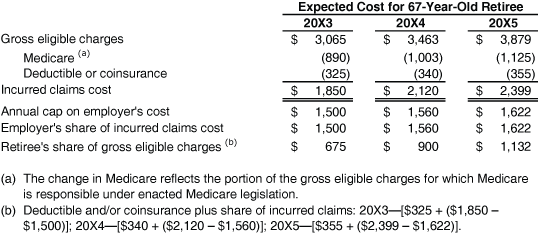
In some cases, an employer may limit its obligation through an individual or an aggregate cap on the employer's cost or benefit obligation. For example, an employer may elect to limit its annual postretirement benefit obligation for each retired plan participant to a maximum of $5,000. Or, an employer may elect to limit its share of the aggregate cost of covered postretirement health care benefits for a period to an amount determined based on an average per capita cost per retired plan participant. Plans of that nature are considered to be defined benefit postretirement plans. See paragraphs for an illustration of the measurement considerations for defined dollar capped plans and paragraphs for implementation guidance on capped plans.
715-60-15-9
Absent evidence to the contrary, it shall be presumed that an employer that has provided postretirement benefits in the past or is currently promising those benefits to employees will continue to provide those future benefits.

Plans with Characteristics of both a Defined Contribution and a Defined Benefit Plan

715-60-15-9A
See paragraph 715-70-15-2 for guidance for plans with characteristics of both a defined contribution and a defined benefit plan.

Medicare Prescription Drug, Improvement, and Modernization Act

Overall Guidance

715-60-15-10
The Medicare Prescription Drug, Improvement, and Modernization Act Subsections follow the same Scope and Scope Exceptions as outlined in the General Subsection of this Subtopic, see paragraph 715-60-15-1, with specific exceptions noted below.

Transactions

715-60-15-11
The guidance in the Medicare Prescription Drug, Improvement, and Modernization Act Subsections applies to the following plans and benefits:
  1. a
    A single-employer defined benefit postretirement health care plan that has both of the following characteristics:
    1. 1
      The employer has concluded that prescription drug benefits available under the plan to some or all participants for some or all future years are "actuarially equivalent" to Medicare Part D and thus qualify for the subsidy under the Medicare Prescription Drug, Improvement, and Modernization Act.
    2. 2
      The expected subsidy will offset or reduce the employer's share of the cost of the underlying postretirement prescription drug coverage on which the subsidy is based.
715-60-15-12
The guidance in the Medicare Prescription Drug, Improvement, and Modernization Act Subsections does not address the following:
  1. a
    Situations that may arise in which the expected subsidy exceeds the employer's share of the cost of the underlying postretirement prescription drug coverage on which the subsidy is based
  2. b
    Multiemployer health and welfare benefit plans.

Other Considerations

715-60-15-13
Although the Medicare Prescription Drug, Improvement, and Modernization Act Subsections provide limited guidance on certain other related aspects of accounting and disclosure necessitated by the Act (for example, changes in assumed participation rates and health care cost trend rates, as well as income tax accounting), that guidance is not intended to supersede or in any way limit the application of other relevant authoritative literature.

Settlements, Curtailments, and Certain Termination Benefits

Overall Guidance

715-60-15-14
The Settlements, Curtailments, and Certain Termination Benefits Subsections follow the same Scope and Scope Exceptions as outlined in the General Subsection of this Subtopic, see paragraph 715-60-15-1, with specific exceptions noted below.

Transactions

715-60-15-15
The guidance in the Settlements, Curtailments, and Certain Termination Benefits Subsections applies to the following transactions and activities:
  1. a
  2. b
    Other termination benefits not otherwise addressed in the following:
    1. 1
      Topic 420
    2. 2
      Topic 710
    3. 3
      Topic 712
    4. 4
      Subtopic 715-30.
715-60-15-16
Examples of transactions that constitute a settlement include making lump-sum cash payments to plan participants in exchange for their rights to receive specified postretirement benefits and purchasing long-term nonparticipating insurance contracts for the accumulated postretirement benefit obligation for some or all of the plan participants.
715-60-15-17
Curtailments include the following:
  1. a
    Termination of employees' services earlier than expected, which may or may not involve closing a facility or discontinuing a component of an entity
  2. b
    Termination or suspension of a plan so that employees do not earn additional benefits for future service. In the latter situation, future service may be counted toward eligibility for benefits accumulated based on past service.
715-60-15-18
The guidance in the Settlements, Curtailments, and Certain Termination Benefits Subsections does not apply to the following transactions and activities:
  1. a
    Other termination benefits addressed in the following:
    1. 1
      Topic 420
    2. 2
      Topic 710
    3. 3
      Topic 712
    4. 4
      Subtopic 715-30.

Split-Dollar Life Insurance Arrangements

Overall Guidance

715-60-15-19
The Split-Dollar Life Insurance Arrangements Subsections follow the same Scope and Scope Exceptions as outlined in the General Subsection of this Subtopic, see paragraph 715-60-15-1, with specific exceptions noted below.

Transactions

715-60-15-20
The guidance in the Split-Dollar Life Insurance Arrangements Subsections applies to the following plans and benefits:
  1. a
    Endorsement split-dollar life insurance arrangements that provide a benefit to an employee that extends to postretirement periods.
  2. b
    Collateral split-dollar life insurance arrangements that provide a benefit to an employee that extends to postretirement periods.
715-60-15-21
The guidance in the Split-Dollar Life Insurance Arrangements Subsections does not apply to the following plans and benefits:
  1. a
    A split-dollar life insurance arrangement that provides a specified benefit to an employee that is limited to the employee's active service period with an employer.

715-60-25Recognition

Source downloaded: .Record version 63eaff661c6f. Effective date must be checked in the source.

Recognition of Liabilities and Assets

715-60-25-1
An employer that sponsors one or more single-employer defined benefit postretirement plans other than pensions shall recognize in its statement of financial position the funded statuses of those plans. The employer shall aggregate the statuses of all overfunded plans and recognize that amount as an asset in its statement of financial position. It also shall aggregate the statuses of all underfunded plans and recognize that amount as a liability in its statement of financial position.
715-60-25-2
As indicated in paragraphs remeasurement of both plan assets and the accumulated postretirement benefit obligation may be necessary. Upon remeasurement, a business entity shall adjust its statement of financial position in a subsequent interim period to reflect the overfunded or underfunded status of the plan consistent with that measurement date.

Participation Rights

715-60-25-3
To the extent that insurance contracts meeting the conditions for treatment as insurance contracts in paragraph 715-60-35-110 are purchased during the current period to cover postretirement benefits attributed to service in that period (such as life insurance benefits), the cost of those benefits shall be the cost of purchasing the coverage under the contracts, except the cost of the participation right, which shall be recognized at the date of purchase as an asset.

Settlements, Curtailments, and Certain Termination Benefits

715-60-25-4
The Settlements, Curtailments, and Certain Termination Benefits Subsections provide recognition guidance for the postretirement benefit incentive to be received by employees in exchange for early termination. Postretirement benefits offered as special or contractual termination benefits shall be recognized in accordance with paragraph 715-30-25-10.
715-60-25-5
Situations involving special or contractual termination benefits may also result in a curtailment to be accounted for under paragraphs .
715-60-25-6
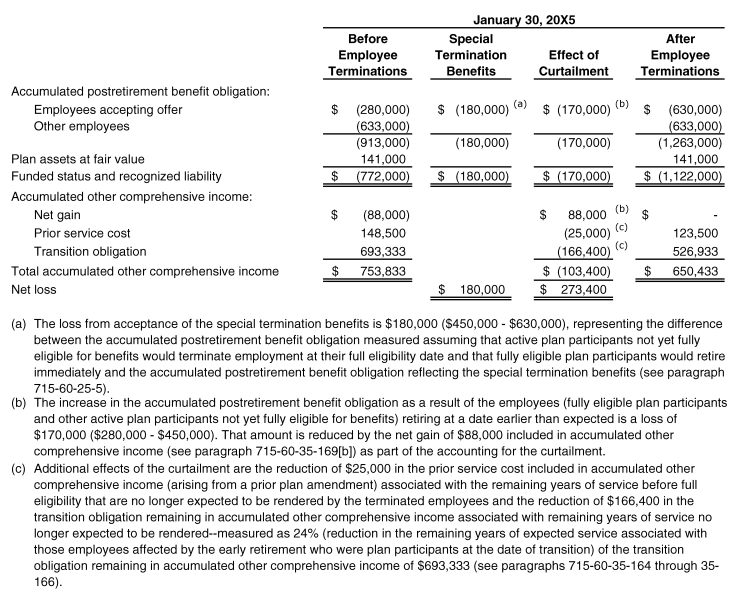
The liability and loss recognized for employees who accept an offer of special termination benefits to be provided by a postretirement benefit plan shall be the difference between:
  1. a
    The accumulated postretirement benefit obligation for those employees, assuming that those employees (active plan participants) not yet fully eligible for benefits would terminate at their full eligibility date and that fully eligible plan participants would retire immediately, without considering any special termination benefits
  2. b
    The accumulated postretirement benefit obligation as measured in (a) adjusted to reflect the special termination benefits.
See Example 4 (paragraphs ) and Example 7 (paragraphs ).

715-60-35Subsequent Measurement

Source downloaded: .Record version 009eccbfb186. Effective date must be checked in the source.

Use of Reasonable Approximations

715-60-35-1
This Subtopic is intended to specify accounting objectives and results rather than computational means of obtaining those results. If estimates, averages, or computational shortcuts can reduce the cost of applying this Subtopic, their use is appropriate, provided the results are reasonably expected not to be materially different from the results of a detailed application.

Benefit Obligations

715-60-35-1A
This Subtopic uses two terms to describe certain measures of the obligation to provide postretirement benefits: expected postretirement benefit obligation and accumulated postretirement benefit obligation.
715-60-35-2
Measurement of the expected postretirement benefit obligation is based on the expected amount and timing of future benefits, taking into consideration the expected future cost of providing the benefits and the extent to which those costs are shared by the employer, the employee (including consideration of contributions required during the employee's active service period and following retirement, deductibles, coinsurance provisions, and so forth), or others (such as through governmental programs).
715-60-35-3
The accumulated postretirement benefit obligation is the actuarial present value of all future benefits attributed to an employee's service rendered to a particular date pursuant to paragraphs , 715-60-35-62, and 715-60-35-66, assuming the plan continues in effect and all assumptions about future events are fulfilled.
715-60-35-4
The accumulated postretirement benefit obligation generally reflects a ratable allocation of expected future benefits to employee service already rendered in the attribution period.
715-60-35-5
An employer that sponsors one or more single-employer defined benefit other postretirement plans other than pensions shall measure the funded status for each plan as the difference between the fair value of plan assets and the accumulated postretirement benefit obligation as it is defined in this Subtopic.
715-60-35-6
See paragraphs for an illustration of the terms expected postretirement benefit obligation and accumulated postretirement benefit obligation.

Components of Net Periodic Postretirement Benefit Cost

715-60-35-7
As with other forms of deferred compensation, the cost of providing postretirement benefits shall be attributed to the periods of employee service rendered in exchange for those future benefits pursuant to the terms of the plan. That cost notionally represents the change in the unfunded accumulated postretirement benefit obligation for the period, ignoring employer contributions to the plan, plan settlements, and payments made by the employer directly to retirees. However, changes in that unfunded obligation that arise from experience gains and losses and the effects of changes in assumptions may be recognized as a component of net periodic postretirement benefit cost on a delayed basis. In addition, the effects of a plan initiation or amendment generally are recognized on a delayed basis.
715-60-35-8
Thus, any change in the accumulated postretirement benefit obligation or the plan assets (other than contributions and benefit payments) either is initially recognized in other comprehensive income or is included in net periodic postretirement benefit cost. Contributions to a funded plan by the employer decrease the recognized postretirement benefit liability or increase the recognized postretirement benefit asset.
715-60-35-9
Net periodic postretirement benefit cost comprises several components that reflect different aspects of the employer's financial arrangements. All of the following components shall be included in the net periodic postretirement benefit cost recognized by an employer sponsoring a defined benefit postretirement plan:
  1. a
    Service cost (see the following paragraph).
  2. b
    Interest cost (see paragraph 715-60-35-11). The interest cost component of postretirement benefit cost shall not be considered interest for purposes of applying Subtopic 835-20.
  3. c
  4. d
    Amortization of any prior service cost or credit included in accumulated other comprehensive income to the extent required by paragraphs .
  5. e
    Gain or loss (including the effects of changes in assumptions) to the extent recognized, which includes amortization of the net gain or loss included in accumulated other comprehensive income (see paragraphs ).
  6. f
    Amortization of any obligation or asset existing at the date of initial application of this Subtopic, hereinafter referred to as the transition obligation or transition asset remaining in accumulated other comprehensive income (see paragraphs ).
715-60-35-10
The measurement of the service cost component requires identification of the substantive plan and the use of assumptions and an attribution method, which are discussed in paragraphs .
715-60-35-10A
The service cost component shall be the only component of net periodic postretirement benefit cost eligible to be capitalized as part of the cost of inventory or other assets.
715-60-35-11
Interest cost is the interest on the accumulated postretirement benefit obligation, which is a discounted amount. Measuring the accumulated postretirement benefit obligation as a present value requires accrual of an interest cost at rates equal to the assumed discount rates.
715-60-35-12
In measuring an employer's expected and accumulated postretirement benefit obligations, changes in in-kind benefits covered by a postretirement health care plan or by other postretirement benefit plans shall not be anticipated. However, if the employer amends the benefits to be provided by the plan, the effect of the amendment is recognized immediately in measuring the employer's expected and accumulated postretirement benefit obligations, even if the effective date of the change in benefits is delayed until a specified date in the future.
715-60-35-13
Plan amendments (including initiation of a plan) may include provisions that attribute the increase or reduction in benefits to employee service rendered in prior periods or only to employee service to be rendered in future periods.
715-60-35-14
For purposes of measuring the accumulated postretirement benefit obligation, the effect of a plan amendment on a plan participant's expected postretirement benefit obligation shall be attributed to each year of service in that plan participant's attribution period, including years of service already rendered by that plan participant, in accordance with the attribution of the expected postretirement benefit obligation to years of service as discussed in paragraphs 715-60-35-62 and 715-60-35-66. If a plan is initiated that grants benefits solely in exchange for employee service after the date of the plan initiation or a future date, no portion of the expected postretirement benefit obligation is attributed to prior service periods because, in that case, the credited service period for the current employees who are expected to receive benefits under the plan begins at the date of the plan initiation or the future date.
715-60-35-15
Plan amendments that improve benefits are granted with the expectation that the employer will realize economic benefits in future periods. Consequently, except as discussed in paragraph 715-60-35-19 this Subtopic does not permit the cost of benefit improvements (that is, prior service cost) to be included in net periodic postretirement benefit cost entirely in the year of the amendment. Rather, paragraphs requires that prior service cost arising from a plan initiation or plan amendment shall be recognized initially in other comprehensive income with subsequent amortization in net periodic postretirement benefit cost, at a minimum, by assigning an equal amount of the prior service cost to each remaining year of service to the full eligibility date of each plan participant active at the date of the plan initiation or amendment. (See paragraphs for plan amendments that reduce benefits.)
715-60-35-16
A plan amendment that retroactively increases benefits (including benefits that are granted to fully eligible plan participants) increases the accumulated postretirement benefit obligation. The cost of the benefit improvement shall be recognized as a charge to other comprehensive income at the date of the amendment.
715-60-35-17
Except as stated in this paragraph and in paragraphs , prior service cost shall be amortized as a component of net periodic postretirement benefit cost by assigning an equal amount to each remaining year of service to the full eligibility date of each plan participant active at the date of the amendment who was not yet fully eligible for benefits at that date. To determine total remaining service years before full eligibility, consideration is given to the remaining number of years of service to the full eligibility date of each plan participant or group of plan participants active at the date of the plan amendment who is not yet fully eligible for benefits. In determining the amortization period, future years of service of active employees who are not plan participants are excluded. Thus, the portion of prior service cost to be recognized in net periodic postretirement benefit cost in each of those future years is weighted based on the number of those plan participants expected to render service in each of those future years. If all or almost all of a plan's participants are fully eligible for benefits, the prior service cost shall be amortized based on the remaining life expectancy of those plan participants rather than on the remaining years of service to the full eligibility dates of the active plan participants. Other comprehensive income is adjusted as a result of amortizing prior service cost.
715-60-35-18
To reduce the complexity and detail of the computations required, consistent use of an alternative approach that more rapidly amortizes the prior service cost recognized in accumulated other comprehensive income is permitted. For example, a straight-line amortization of the cost over the average remaining years of service to full eligibility for benefits of the active plan participants is acceptable.
715-60-35-19
In some situations, a history of regular plan amendments and other evidence may indicate that the period during which the employer expects to realize economic benefits from an amendment that grants increased benefits is shorter than the remaining years of service to full eligibility for benefits of the active plan participants. Identification of those situations requires an assessment of the individual circumstances of the particular plan. In those circumstances, the amortization of prior service cost shall be accelerated to reflect the more rapid expiration of the employer's economic benefits and to recognize the cost in the periods benefited.
715-60-35-20
A plan amendment that retroactively reduces, rather than increases, benefits decreases the accumulated postretirement benefit obligation. The reduction in benefits shall be recognized as a corresponding credit (prior service credit) to other comprehensive income that shall be used first to reduce any remaining prior service cost included in accumulated other comprehensive income, then to reduce any transition obligation remaining in accumulated other comprehensive income. The excess, if any, shall be amortized as a component of net periodic postretirement benefit cost on the same basis as specified in paragraphs for prior service cost. Immediate recognition of the excess is not permitted. However, as with a plan amendment that increases benefits, the effect of a negative plan amendment (an amendment that decreases benefits) is reflected immediately in the measurement of the accumulated postretirement benefit obligation.
715-60-35-21
The effects of a plan amendment, whether positive or negative, shall be considered at the date the amendment is adopted only if it is communicated to plan participants at that time or within a reasonable period of time thereafter; that is, within the time period that would ordinarily be required to prepare information about the amendment and disseminate it to employees and retirees.
715-60-35-22
See paragraphs and for implementation guidance on plan amendments.
715-60-35-23
This Subtopic generally does not distinguish between gains and losses that result from experience different than assumed or from changes in assumptions. Gains and losses include amounts that have been realized, for example, by the sale of a security, as well as amounts that are unrealized.
715-60-35-24
Because gains and losses may reflect refinements in estimates as well as real changes in economic values and because some gains in one period may be offset by losses in another or vice versa, this Subtopic does not require recognition of gains and losses as components of net postretirement benefit cost in the period in which they arise, except as described in paragraphs .
715-60-35-25
Gains and losses that are not recognized immediately as a component of net periodic postretirement benefit cost shall be recognized as increases or decreases in other comprehensive income as they arise. (Gain and loss recognition in accounting for settlements and curtailments is addressed in paragraphs .)
715-60-35-26
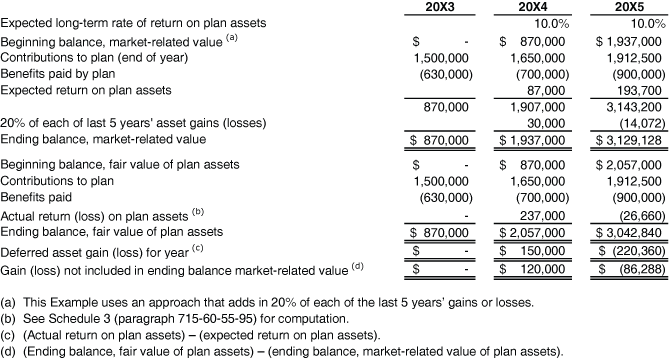
The expected return on plan assets shall be determined based on the expected long-term rate of return on plan assets (see paragraphs ) and the market-related value of plan assets. If the fund holding plan assets is a taxable entity, the expected long-term rate of return on plan assets is net of estimated income taxes.
715-60-35-27
Plan asset gains and losses are differences between the actual return on plan assets during a period and the expected return on plan assets for that period. Plan asset gains and losses include both of the following:
  1. a
    Changes reflected in the market-related value of plan assets
  2. b
    Changes not yet reflected in the market-related value of plan assets (that is, the difference between the fair value and the market-related value of plan assets).
715-60-35-28
Plan asset gains and losses not yet reflected in market-related value are not required to be amortized under the following paragraph and paragraphs .
715-60-35-29
As a minimum, amortization of a net gain or loss included in accumulated other comprehensive income (excluding plan asset gains and losses not yet reflected in market-related value) shall be included as a component of net periodic postretirement benefit cost for a year if, as of the beginning of the year, that net gain or loss exceeds 10 percent of the greater of the accumulated postretirement benefit obligation or the market-related value of plan assets. If amortization is required, the minimum amortization shall be that excess divided by the average remaining service period of active plan participants. If all or almost all of a plan's participants are inactive, the average remaining life expectancy of the inactive participants shall be used instead of the average remaining service period.
715-60-35-30
The amortization shall reduce the beginning-of-the-year balance included in accumulated other comprehensive income. Amortization of a net gain included in accumulated other comprehensive income results in a decrease in net periodic postretirement benefit cost; amortization of a net loss included in accumulated other comprehensive income results in an increase in net periodic postretirement benefit cost.
715-60-35-31
Any systematic method of amortizing gains and losses included in accumulated other comprehensive income may be used in place of the minimum amortization specified in paragraph 715-60-35-29 provided that all of the following conditions are met:
  1. a
    The minimum amortization is recognized in any period in which it is greater (reduces the net gain or loss balance by more) than the amount that would be recognized under the method used.
  2. b
    The method is applied consistently.
  3. c
    The method is applied similarly to both gains and losses.
715-60-35-32
If an entity uses a method of consistently recognizing gains and losses immediately, any gain that does not offset a loss previously recognized in income pursuant to this paragraph shall first offset any transition obligation remaining in accumulated other comprehensive income; any loss that does not offset a gain previously recognized in income pursuant to this paragraph shall first offset any transition asset remaining in accumulated other comprehensive income.
715-60-35-33
In applying the provisions of paragraphs for the recognition of gains and losses as a component of net periodic postretirement benefit cost, it is not appropriate for an employer to elect annually a new method of amortization of gains and losses included in accumulated other comprehensive income. Rather, an employer shall select an amortization method and apply it consistently from period to period as long as the resulting amortization equals or exceeds the minimum amortization specified by paragraph 715-60-35-29. Any change in the method selected would be subject to Topic 250.
715-60-35-34
In some situations, an employer may forgive a retrospective adjustment of the current or past years' cost-sharing provisions of the plan as they relate to benefit costs already incurred by retirees or may otherwise deviate from the provisions of the substantive plan to increase or decrease the employer's share of the benefit costs incurred in the current or past periods. The effect of a decision to temporarily deviate from the substantive plan shall be immediately recognized as a loss or gain.
715-60-35-35
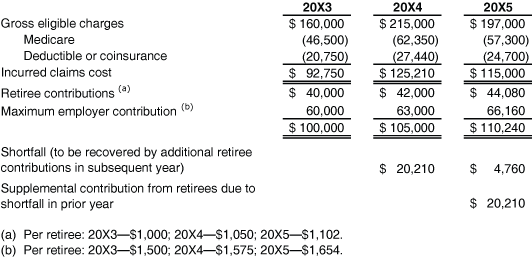
For example, the terms of a substantive postretirement health care plan may provide that any shortfall resulting from current year benefit payments in excess of the employer's stated share of incurred claims cost and retiree contributions for that year is to be recovered from increased retiree contributions in the subsequent year. The employer may subsequently determine that increasing retiree contributions for the shortfall in the prior year would be onerous and decides to bear the cost of the shortfall for that year. The employer's decision to bear the shortfall represents a change in intent and the resulting loss shall be recognized immediately. Future decisions by the employer to continue to bear the shortfall suggest an amendment of the substantive plan that shall be accounted for as described in paragraphs .
715-60-35-36
The gain or loss component of net periodic postretirement benefit cost shall consist of all of the following:
  1. a
    The difference between the actual return on plan assets and the expected return on plan assets
  2. b
    Any gain or loss immediately recognized or the amortization of the net gain or loss included in accumulated other comprehensive income
  3. c
    Any amount immediately recognized as a gain or loss pursuant to paragraphs .
715-60-35-37
See paragraphs for implementation guidance on gains and losses.
715-60-35-38
Amortization of the transition obligation or asset shall be adjusted prospectively to recognize the effects of all of the following:
  1. a
    A negative plan amendment pursuant to paragraph 715-60-35-20
  2. b
    A constraint on immediate recognition of a net gain or loss pursuant to paragraphs
  3. c
    Settlement accounting pursuant to paragraphs
  4. d
    Plan curtailment accounting pursuant to paragraphs
  5. e
    A constraint on delayed amortization of the transition obligation pursuant to the following paragraph.
715-60-35-39
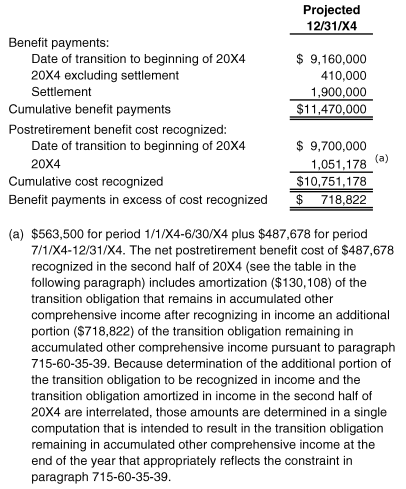
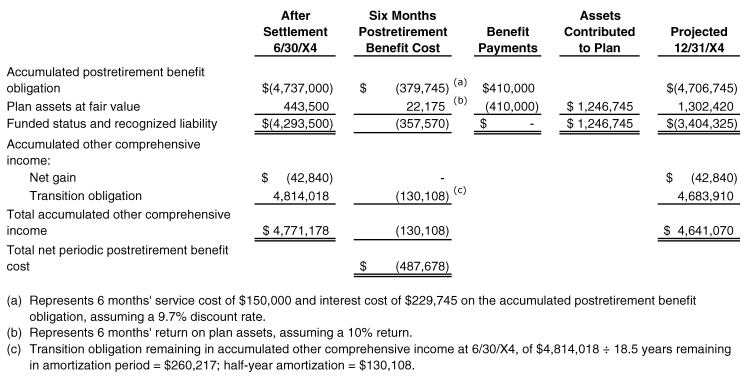
The amortization of the transition obligation shall be accelerated if the cumulative benefit payments after the date the employer first applied the provisions of this Subtopic to all plan participants exceed the cumulative postretirement benefit cost accrued after the transition date. In that situation, an additional amount of the transition obligation remaining in accumulated other comprehensive income shall be recognized as a component of net periodic postretirement benefit cost equal to the excess cumulative benefit payments. For purposes of applying this provision, cumulative benefit payments shall be reduced by any plan assets or any recognized accrued postretirement benefit obligation at the date the employer first applied the provisions of this Subtopic. Payments made pursuant to a settlement, as discussed in paragraphs , shall be included in the determination of cumulative benefit payments made after the transition date. If a settlement occurs in the middle of the year, the additional transition obligation to be recognized in income, if any, pursuant to the constraint in this paragraph is determined based on projected amounts for the full year.
715-60-35-40
If at the measurement date for the beginning of an employer's fiscal year it is expected that additional recognition in net periodic postretirement benefit cost of any transition obligation remaining in accumulated other comprehensive income will be required pursuant to the preceding paragraph, amortization of the transition obligation for interim reporting purposes (see Topic 270) shall be based on the amount expected to be amortized for the year, except for the effects of applying the preceding paragraph for any settlement required to be accounted for pursuant to paragraphs . Those effects shall be recognized in net periodic postretirement benefit cost when the related settlement is recognized in income. The effects of changes during the year in the initial assessment of whether additional recognition in net periodic postretirement benefit cost of the transition obligation remaining in accumulated other comprehensive income for the year shall be recognized in net periodic postretirement benefit cost over the remainder of the year. The amount of the transition obligation remaining in accumulated other comprehensive income to be recognized in net periodic postretirement benefit cost for a year shall be finally determined at the measurement date for the end of the year based on the constraints on delayed recognition in net periodic postretirement benefit cost discussed in the preceding paragraph; any difference between the amortization of the transition obligation recognized in net periodic postretirement benefit cost during interim periods and the amount required to be recognized in net periodic postretirement benefit cost for the year shall be recognized in net periodic postretirement benefit cost immediately.

Measurement of Costs and Obligations

715-60-35-41
Any method of accounting that recognizes the cost of postretirement benefits over employee service periods (before the payment of benefits to retirees) must deal with two factors that stem from the nature of the arrangement. First, estimates or assumptions shall be made about the future events that will determine the amount and timing of the benefit payments. Second, an attribution approach that assigns benefits and the cost of those benefits to individual years of service shall be selected.
715-60-35-42
Unlike Subtopic 715-30, this Subtopic implicitly considers salary progression in the measurement of the accumulated postretirement benefit obligation of a pay-related plan. Because measurement of the expected postretirement benefit obligation includes an assumed salary progression for a pay-related plan, salary progression is, by definition, included in the accumulated benefit obligation for a pay-related postretirement benefit plan. Thus, the accumulated postretirement benefit obligation disclosed pursuant to Subtopic 715-20 is defined in terms notionally more comparable to the projected benefit obligation under Subtopic 715-30.
715-60-35-43
For other postretirement plans that provide disability benefits, the determination of disability benefits to be accrued pursuant to this Subtopic is based on the terms of the postretirement benefit plan defining when a disabled employee is entitled to postretirement benefits.
715-60-35-44
For example, an employer may promise to provide postretirement health care coverage to all employees who render 30 or more years of service. The employer may carry active employees who become disabled on active status so a disabled employee continues to accumulate credit toward postretirement benefits. Measurement of the expected postretirement benefit obligation shall include an assumption that some employees who are expected to receive benefits under the postretirement benefit plan will become disabled and cease working before the date at which they otherwise would have been eligible for postretirement health care benefits. The measurement of the postretirement benefits expected to be paid to disabled employees would encompass only those benefits expected to be paid during the period following what otherwise would have been their full eligibility date; in this case, the date at which the employee would have completed 30 years of service. That amount is attributed to an employee's service to the date the disability is assumed to occur.
715-60-35-45
Only some employees become and remain disabled. Therefore, in measuring the expected postretirement benefit obligation and in determining the attribution period for plan participants expected to become disabled, the probability and timing of a disabling event is considered in determining whether employees are likely to become disabled and whether they will be entitled to receive postretirement benefits.
715-60-35-46
Note that measurement of an employer's postretirement benefit obligation is based on the current plan participants (a closed group approach) because it better recognizes the benefit obligation over the period in which employees render service in exchange for benefits.
715-60-35-48
An objective of this Subtopic is that the accounting reflect the terms of the exchange transaction that takes place between an employer that provides other postretirement benefits and the employees who render services in exchange for those benefits, as those terms are understood by both parties to the transaction.
715-60-35-49
Generally, the extant written plan provides the best evidence of the terms of that exchange transaction. However, in some situations, an employer's cost-sharing policy, as evidenced by past practice or by communication of intended changes to a plan's cost-sharing provisions, or a past practice of regular increases in certain monetary benefits (see paragraphs ), may indicate that the substantive plan—the plan as understood by the parties to the exchange transaction—differs from the extant written plan. The substantive plan shall be the basis for the accounting.
715-60-35-50
See paragraph 715-60-55-1 for implementation guidance on a collectively bargained defined benefit postretirement health care plan.
715-60-35-51
Except as provided in paragraphs , an employer's cost-sharing policy, as evidenced by the following past practice or communication, shall constitute the cost-sharing provisions of the substantive plan if either of the following conditions exist:
  1. a
    The employer has a past practice of maintaining a consistent level of cost sharing between the employer and its retirees through changes in deductibles, coinsurance provisions, retiree contributions, or some combination of those changes or consistently increasing or reducing the employer's share of the cost of the covered benefits through changes in retired or active plan participants' contributions toward their retiree health care benefits, deductibles, coinsurance provisions, out-of-pocket limitations, and so forth, in accordance with the employer's established cost-sharing policy Such a past practice would be indicated when the nature of the change and duration of the past practice are sufficient to warrant a presumption that it is understood by the plan participants.
  2. b
    The employer has the ability, and has communicated to affected plan participants its intent, to institute different cost-sharing provisions at a specified time or when certain conditions exist (for example, when health care cost increases exceed a certain level).
Otherwise, the extant written plan shall be considered to be the substantive plan.
715-60-35-52
An employer's past practice of maintaining a consistent level of cost sharing with its retirees or consistently increasing or reducing its share of the cost of providing the covered benefits shall not constitute provisions of the substantive plan if accompanied by identifiable offsetting changes in other benefits or compensation or if the employer incurred significant costs, such as work stoppages, to effect that cost-sharing policy.
715-60-35-53
For example, a past practice of increasing retiree contributions annually based on a specified index or formula may appear to indicate that the substantive plan includes a determinable indexing of the retirees' annual contributions to the plan. However, if that past practice of increasing retiree contributions is accompanied by identifiable offsetting changes in other benefits or compensation, those offsetting changes would indicate that the substantive plan incorporates only the current cost-sharing provisions. Therefore, future increases or reductions of those cost-sharing provisions shall not be incorporated in measuring the expected postretirement benefit obligation.
715-60-35-54
Similarly, an employer's communication of its intent to institute cost-sharing provisions that differ from the extant written plan or the past cost-sharing practice shall not constitute provisions of the substantive plan if either of the following conditions exists:
  1. a
    The plan participants would be unwilling to accept the change without adverse consequences to the employer's operations.
  2. b
    Other modifications of the plan, such as the level of benefit coverage, or providing offsetting changes in other benefits, such as pension benefits, would be required to gain plan participants' acceptance of the change to the cost-sharing arrangement.
715-60-35-55
By definition, an employer does not have the unilateral right to change a collectively bargained plan. Therefore, if the postretirement benefits are the subject of collective bargaining, the extant written plan shall be the substantive plan unless the employer can demonstrate its ability to maintain a consistent level of cost sharing or a consistent practice of increasing or reducing its share of the cost of the covered benefits in past negotiations without making offsetting changes in other benefits or compensation of the affected plan participants or by incurring other significant costs to maintain that cost-sharing arrangement.
715-60-35-56
A past practice of regular increases in postretirement benefits defined in terms of monetary amounts may indicate that the employer has a present commitment to make future improvements to the plan and that the plan will provide monetary benefits attributable to prior service that are greater than the monetary benefits defined by the extant written plan. In those situations, the substantive commitment to increase those benefits shall be the basis for the accounting. Changes in the benefits, other than benefits defined in terms of monetary amounts, covered by a postretirement health care plan or by other postretirement benefit plans shall not be anticipated.
715-60-35-57
Contributions expected to be received from active employees toward the cost of their postretirement benefits and from retired plan participants are treated similarly for purposes of measuring an employer's expected postretirement benefit obligation. That obligation is measured as the actuarial present value of the benefits expected to be provided under the plan, reduced by the actuarial present value of contributions expected to be received from the plan participants during their remaining active service and postretirement periods. In determining the amount of the contributions expected to be received from those participants toward the cost of their postretirement benefits, consideration is given to any related substantive plan provisions, such as an employer's past practice of consistently increasing or reducing the contribution rates as described in paragraphs . An obligation to return contributions received from employees who do not attain eligibility for postretirement benefits and, if applicable, any interest accrued on those contributions shall be recognized as a component of an employer's postretirement benefit obligation.
715-60-35-58
Automatic benefit changes specified by the plan that are expected to occur shall be included in measurements of the expected and accumulated postretirement benefit obligations and the service cost component of net periodic postretirement benefit cost.
715-60-35-59
For purposes of this Subtopic, a plan that promises to provide retirees a benefit in kind, such as health care benefits, rather than a defined dollar amount of benefit, is considered to be a plan that specifies automatic benefit changes. (The assumed rate of change in the future cost of providing health care benefits, the assumed health care cost trend rate, is discussed in paragraphs .) Because automatic benefit changes are not conditional on employees rendering additional years of service, the full eligibility date is not affected by those changes. A benefit in kind includes the direct rendering of services, the payment directly to others who provide the services, or the reimbursement of the retiree's payment for those services.
715-60-35-60
Also, plan amendments shall be included in the computation of the expected and accumulated postretirement benefit obligations once they have been contractually agreed to, even if some provisions take effect only in future periods. For example, if a plan amendment grants a different benefit level for employees retiring after a future date, that increased or reduced benefit level shall be included in current-period measurements for employees expected to retire after that date.
715-60-35-61
In the context of this Subtopic, attribution is the process of assigning the expected cost of benefits to periods of employee service. The general objective is to assign to each year of service the cost of benefits earned or assumed to have been earned in that year.
715-60-35-62
An equal amount of the expected postretirement benefit obligation for an employee generally shall be attributed to each year of service in the attribution period (a benefit-years-of-service approach).
715-60-35-63
Some plans may frontload benefits, that is some plans have a benefit formula that defines benefits in terms of specific periods of service to be rendered in exchange for those benefits but attributes all or a disproportionate share of the expected postretirement benefit obligation to employees' early years of service in the attribution period.
715-60-35-64
For that type of plan, the expected postretirement benefit obligation shall not be attributed ratably to each year of service in the attribution period but shall be attributed in accordance with the plan's benefit formula.
715-60-35-65
Whether a plan is frontloaded is determined by considering the active participants as a group rather than applying the benefit formula to each individual participant. Paragraph 715-60-55-59 contains an example of a benefit formula that results in a frontloaded benefit for a plan that provides only postretirement death benefits.
715-60-35-66
The beginning of the attribution period generally shall be the date of hire. However, if the plan's benefit formula grants credit only for service from a later date and that credited service period is not nominal in relation to employees' total years of service before their full eligibility dates, the expected postretirement benefit obligation shall be attributed from the beginning of that credited service period.
715-60-35-67
For a plan with a benefit formula that attributes benefits to a credited service period that is nominal in relation to employees' total years of service before their full eligibility dates, an equal amount of the expected postretirement benefit obligation for an employee is attributed to each year of that employee's service from date of hire to date of full eligibility for benefits.
715-60-35-68
In all cases, the end of the attribution period shall be the full eligibility date. For postretirement benefit plans that are pay-related or that otherwise index benefits during employees' service periods to their retirement date, the full eligibility date and retirement date may be the same. The attribution period for those benefits will differ from the attribution period for a similarly defined pension benefit with a capped credited service period.
715-60-35-69
Therefore, the present value of all of the benefits expected to be received by or on behalf of an employee is attributed to the employee's credited service period, which ends at the full eligibility date.
715-60-35-70
See paragraphs , which illustrate the attribution provisions of this Subtopic, and paragraphs for implementation guidance on attribution provisions.
715-60-35-71
Measuring the net periodic postretirement benefit cost and accumulated postretirement benefit obligation based on best estimates is superior to implying, by a failure to accrue, that no cost or obligation exists before the payment of benefits. This Subtopic requires the use of explicit assumptions, each of which individually represents the best estimate of a particular future event, to measure the expected postretirement benefit obligation. A portion of that expected postretirement benefit obligation is attributed to each period of an employee's service associated with earning the postretirement benefits, and that amount is accrued as service cost for that period.
715-60-35-72
The service cost component of postretirement benefit cost, any prior service cost, and the accumulated postretirement benefit obligation are measured using actuarial assumptions and present value techniques to calculate the actuarial present value of the expected future benefits attributed to periods of employee service. Each assumption used shall reflect the best estimate solely with respect to that individual assumption. All assumptions shall presume that the plan will continue in effect in the absence of evidence that it will not continue.
715-60-35-73
Principal actuarial assumptions include, but are not limited to, all of the following:
  1. a
    The time value of money (discount rates)
  2. b
    Participation rates (for contributory plans)
  3. c
    Retirement age
  4. d
    Salary progression (for pay-related plans)
  5. e
    The probability of payment (turnover, dependency status, mortality, and so forth)
  6. f
    Factors affecting the amount and timing of future benefit payments, which for postretirement health care benefits consider past and present per capita claims cost by age, health care cost trend rates, and Medicare reimbursement rates, and so forth.
715-60-35-74
This Subtopic also requires use of an assumption about the long-term rate of return on plan assets and a market-related value of plan assets to calculate the expected return on plan assets.
715-60-35-75
All assumptions shall be consistent to the extent that each reflects expectations about the same future economic conditions, such as future rates of inflation. Measuring service cost and the expected and accumulated postretirement benefit obligations based on estimated future compensation levels entails considering any indirect effects, such as benefit limitations, that would affect benefits provided by the plan. For example, a plan may define the maximum benefit to be provided under the plan (a fixed cap). In measuring the expected postretirement benefit obligation under that plan, the projected benefit payments would be limited to that cap. For a plan that automatically adjusts the maximum benefit to be provided under the plan for the effects of inflation (an adjustable cap), the expected postretirement benefit obligation would be measured based on adjustments to that cap consistent with the assumed inflation rate reflected in other inflation-related assumptions.
715-60-35-76
For example, assumed discount rates include an inflationary element that reflects the expected general rate of inflation. Assumed compensation levels include consideration of future changes attributable to general price levels. Similarly, assumed health care cost trend rates include an element that reflects expected general rates of inflation for the economy overall and an element that reflects price changes of health care costs in particular. To the extent that those assumptions consider similar inflationary effects, the assumptions about those effects shall be consistent.
715-60-35-77
Many of the assumptions used in postretirement benefit measurements are similar to assumptions used in pension measurements, but the sensitivity of the measures to changes in the assumptions may be more significant. For example, the turnover assumption may have a more significant effect for postretirement benefits than for pension benefits because, in many cases, eligibility for postretirement benefits is an all-or-nothing proposition, while most pension plans provide reduced benefits for relatively short periods of service. The dependency status assumption also may have a more significant effect on postretirement benefit measurements than on pension measurements. Plan provisions that entitle an employee's spouse and other dependents to health care and other welfare benefits may substantially increase an employer's cost and obligation for postretirement benefits.
715-60-35-78
Postretirement benefit measurements are more sensitive to assumptions about retirement ages and the probability of retiring at each age than are pension measurements. For example, employer-provided postretirement health care benefits are significantly more expensive before Medicare coverage begins than after. Many pension arrangements provide for an actuarially reduced pension benefit for employees retiring before the normal retirement age; however, for an employee retiring early, there typically is no reduction in the postretirement benefit levels, and those benefits will be paid over a longer period of time and at a higher annual cost to the employer than if the employee retired at the normal retirement age. Similarly, postretirement benefit measurements are more sensitive than pension measurements to the life expectancy assumption. In particular, health care benefits are sensitive to that assumption because health care costs generally increase with age.
715-60-35-79
Assumed discount rates shall reflect the time value of money as of the measurement date in determining the present value of future cash outflows currently expected to be required to satisfy the postretirement benefit obligation. In making that assumption, employers shall look to rates of return on high-quality fixed-income investments currently available whose cash flows match the timing and amount of expected benefit payments. If settlement of the obligation with third-party insurers is possible (for example, the purchase of nonparticipating life insurance contracts to provide death benefits), the interest rates inherent in the amount at which the postretirement benefit obligation could be settled are relevant in determining the assumed discount rates. Assumed discount rates are used in measurements of the expected and accumulated postretirement benefit obligations and the service cost and interest cost components of net periodic postretirement benefit cost.
715-60-35-80
Pursuant to paragraph 715-60-35-79, an employer shall look to rates of return on high-quality fixed-income investments in determining assumed discount rates. The objective of selecting assumed discount rates using that method is to measure the single amount that, if invested at the measurement date in a portfolio of high-quality debt instruments, would provide the necessary future cash flows to pay the postretirement benefits when due. Notionally, that single amount, the accumulated postretirement benefit obligation, would equal the fair value of a portfolio of high-quality zero coupon bonds whose maturity dates and amounts would be the same as the timing and amount of the expected future benefit payments. Because cash inflows would equal cash outflows in timing and amount, there would be no reinvestment risk in the yields to maturity of the portfolio.
715-60-35-81
However, in other than a zero coupon portfolio, such as a portfolio of long-term debt instruments that pay semiannual interest payments or whose maturities do not extend far enough into the future to meet expected benefit payments, the assumed discount rates (the yield to maturity) need to incorporate expected reinvestment rates available in the future. Those rates shall be extrapolated from the existing yield curve at the measurement date.
715-60-35-82
The determination of the assumed discount rate is separate from the determination of the expected rate of return on plan assets whenever the actual portfolio differs from the hypothetical portfolio described in the preceding paragraph. Assumed discount rates shall be reevaluated at each measurement date. If the general level of interest rates rises or declines, the assumed discount rates shall change in a similar manner.
715-60-35-83
See paragraph 715-60-55-4 for implementation guidance on discount rates used to measure an employer's postretirement benefit obligation.
715-60-35-84
The expected long-term rate of return on plan assets shall reflect the average rate of earnings expected on the existing assets that qualify as plan assets and contributions to the plan expected to be made during the period. In estimating that rate, appropriate consideration shall be given to the returns being earned on the plan assets currently invested and the rates of return expected to be available for reinvestment.
715-60-35-85
Unlike most pension plans, the return on postretirement benefit plan assets may be subject to income tax because of the lack of tax-exempt vehicles for funding those benefits. At present, even if postretirement benefit plan assets are restricted and segregated within a trust, the income generated by those assets generally is taxable. If the plan has taxable income, the assessed tax will reduce the returns available for payment of benefits or reinvestment. If the trust or other entity holding the plan assets is taxed as a separate entity on the return on plan assets, the expected long-term rate of return shall be determined by giving consideration to anticipated income taxes under enacted tax law. However, if the tax on income generated by plan assets is not a liability of the plan, but of the employer, the expected long-term rate of return shall not anticipate a tax on those earnings, because that tax will be reflected in the employer's accounting for income taxes (see Topic 740).
715-60-35-86
Thus, if the return on plan assets is taxable to the trust or other fund under the plan, the expected long-term rate of return shall be reduced to reflect the related income taxes expected to be paid under existing law.
715-60-35-87
The expected long-term rate of return on plan assets is used with the market-related value of plan assets to compute the expected return on plan assets. (See paragraph 715-60-35-26.) There is no assumption of an expected long-term rate of return on plan assets for plans that are unfunded or that have no assets that qualify as plan assets pursuant to this Subtopic.
715-60-35-88
The service cost component of net periodic postretirement benefit cost and the expected and accumulated postretirement benefit obligations shall reflect future compensation levels to the extent the postretirement benefit formula defines the benefits wholly or partially as a function of future compensation levels. For such pay-related plans, assumed compensation levels shall reflect the best estimate of the actual future compensation levels of the individual employees involved, including future changes attributed to general price levels, productivity, seniority, promotion, and other factors.
715-60-35-89
For pay-related plans, salary progression is included in measuring the expected postretirement benefit obligation. For example, a postretirement health care plan may define the deductible amount or copayment, or a postretirement life insurance plan may define the amount of death benefit, based on the employee's average or final level of annual compensation.
715-60-35-90
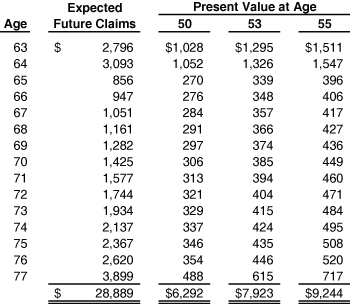
Measurement of an employer's postretirement health care obligation requires the use of several assumptions unique to health care benefits. Most significantly, it includes making several assumptions about factors that will affect the amount and timing of future benefit payments for postretirement health care. Those factors include consideration of historical per capita claims cost by age, health care cost trend rates (for plans that provide a benefit in kind), and medical coverage to be paid by governmental authorities and other providers of health care benefits. Recent claims cost experience and the claims cost experience of other employers in the same industry or geographical location may provide useful information in developing the assumed per capita claims cost by age from the earliest age at which a plan participant could receive benefits under the plan to the longest life expectancy. Data files developed and maintained by insurers or benefits consultants about employers' claims costs for similar benefits programs and national or regional statistics about claims cost patterns also may provide information that may be used for developing the per capita claims cost by age.
715-60-35-91
In principle, an employer's share of the expected future postretirement health care cost for a plan participant is developed by reducing the assumed per capita claims cost at each age at which the plan participant is expected to receive benefits under the plan by both of the following:
  1. a
    The effects of coverage by Medicare and other providers of health care benefits
  2. b
    The effects of the cost-sharing provisions of the plan (deductibles, copayment provisions, out-of-pocket limitations, caps on the limits of the employer-provided payments, and retiree contributions).
715-60-35-92
The resulting amount represents the assumed net incurred claims cost at each age at which the plan participant is expected to receive benefits under the plan. If contributions are required to be paid by active plan participants toward their postretirement health care benefits, the actuarial present value of the plan participants' future contributions reduces the actuarial present value of the aggregate assumed net incurred claims costs.
715-60-35-93
The assumed per capita claims cost shall be the best estimate of the expected future cost of the benefits covered by the plan. It may be appropriate to consider other factors in addition to age, such as sex and geographical location, in developing the assumed per capita claims cost.
715-60-35-94
Past and present claims data for the plan, such as a historical pattern of gross claims by age (claims curve), should be used in developing the current per capita claims cost to the extent that those data are considered to be indicative of the current cost of providing the benefits covered by the plan. Those current claims data shall be adjusted by the assumed health care cost trend rate. The resulting assumed per capita claims cost by age, together with the plan demographics, determines the amount and timing of expected future gross eligible charges.
715-60-35-95
In the absence of sufficiently reliable plan data about the current cost of the benefits covered by the plan, the current per capita claims cost should be based, entirely or in part, on the claims information of other employers to the extent those costs are indicative of the current cost of providing the benefits covered by the plan. For example, the current per capita claims cost may be based on the claims experience of other employers derived from information in data files developed by insurance entities, actuarial firms, or employee benefits consulting firms. The current per capita claims cost developed on those bases shall be adjusted to best reflect the terms of the employer's plan and the plan demographics. For example, the information should be adjusted, as necessary, for differing demographics, such as the age and sex of plan participants, health care utilization patterns by men and women at various ages, and the expected geographical location of retirees and their dependents, and for significant differences between the nature and types of benefits covered by the employer's plan and those encompassed by the underlying data.
715-60-35-96
For a plan that stipulates that the benefit to be provided is the payment of certain health insurance premiums for retirees rather than the payment of their health care claims, the employer shall project the cost of those future premiums in measuring its benefit obligation. That projection requires an assessment of how future health care costs will affect future premiums.
715-60-35-97
In some cases, retiree contributions are established based on the average per capita cost of benefit coverage under an employer's health care plan that provides coverage to both active employees and retirees. However, the medical cost of the retirees may cause the average per capita cost of benefit coverage under the plan to be higher than it would be if only active employees were covered by the plan. In that case, the employer has a postretirement benefit obligation for the portion of the expected future cost of the retiree health care benefits that are not recovered through retiree contributions, Medicare, or other providers of health care benefits.
715-60-35-98
If significant, the internal and external costs directly associated with administering the postretirement benefit plan also shall be accrued as a component of assumed per capita claims cost.
715-60-35-99
The assumption about health care cost trend rates represents the expected annual rates of change in the cost of health care benefits currently provided by the postretirement benefit plan, due to factors other than changes in the demographics of the plan participants, for each year from the measurement date until the end of the period in which benefits are expected to be paid. Past and current health care cost trends shall be used in developing an employer's assumed health care cost trend rates, which implicitly consider estimates of health care inflation, changes in health care utilization or delivery patterns, technological advances, and changes in the health status of plan participants.
715-60-35-100
Differing services, such as hospital care and dental care, may require the use of different health care cost trend rates. It is appropriate for that assumption to reflect changes in health care cost trend rates over time. For example, the health care cost trend rates may be assumed to continue at the present level for the near term, or increase for a period of time, and then grade down over time to an estimated health care cost trend rate ultimately expected to prevail.
715-60-35-101
An assumption about changes in the health status of plan participants considers, for example, the probability that certain claims costs will be incurred based on expectations of future events, such as the likelihood that some retirees will incur claims requiring technology currently being developed or that historical claims experience for certain medical needs may be reduced as a result of participation in a wellness program.
715-60-35-102
Certain medical claims may be covered by governmental programs under existing law or by other providers of health care benefits. Benefit coverage by those governmental programs shall be assumed to continue as provided by the present law and by other providers pursuant to their present plans. Presently enacted changes in the law or amendments of the plans of other health care providers that take effect in future periods and that will affect the future level of their benefit coverage shall be considered in current-period measurements for benefits expected to be provided in those future periods. Future changes in laws concerning medical costs covered by governmental programs and future changes in the plans of other providers shall not be anticipated.
715-60-35-103
As an example of another provider of health care benefits, a retiree's spouse also may be covered by the spouse's present (or former) employer's health care plan. In that case, the spouse's employer (or former employer) may provide either primary or secondary postretirement health care benefits to the retiree's spouse or dependents.
715-60-35-104
In some cases, determining the assumed per capita claims cost by age as described in paragraphs may not be practical because credible historical information about the gross per capita cost of covered benefits may not be available or determinable to satisfy the stated measurement approach. However, credible historical information about incurred claims costs may be available. In those cases, an alternative method of developing the assumed per capita claims cost may be used provided the method results in a measure that is the best estimate of the expected future cost of the benefits covered by the plan. For example, the assumed health care cost trend rates may be determined by adjusting the expected change in the employer's share of per capita incurred claims cost by age by a factor that reflects the effects of the plan's cost-sharing provisions. However, an approach that projects net incurred claims costs using unadjusted assumed health care cost trend rates would implicitly assume changes in the plan's cost-sharing provisions at those assumed rates and, therefore, is not acceptable unless the plan's cost-sharing provisions are indexed in that manner or the substantive plan (see paragraphs ) operates in that manner.
715-60-35-105
See paragraphs for implementation guidance on assumed per capita health care costs.

Measurement of Plan Assets

715-60-35-106
For recognition guidance on the funded statuses of other postretirement benefit plans, see paragraph 715-60-25-1.
715-60-35-107
For purposes of the disclosures required by paragraph 715-20-50-1 and paragraph 715-20-50-5, plan investments, whether equity or debt securities, real estate, or other, shall be measured at their fair value as of the measurement date. (See paragraph 715-60-35-120.) The fair value of an investment shall be reduced by brokerage commissions and other costs normally incurred in a sale if those costs are significant (similar to fair value less cost to sell). Plan assets used in plan operations (for example, buildings, equipment, furniture and fixtures, and leasehold improvements) shall be measured at cost less accumulated depreciation or amortization for all purposes.
715-60-35-108
See paragraphs for implementation guidance on plan assets.

Insurance Contracts

715-60-35-109
Benefits covered by insurance contracts shall be excluded from the accumulated postretirement benefit obligation. Insurance contracts shall be excluded from plan assets, except as provided in paragraphs 715-60-25-3 and for the cost of participation rights.
715-60-35-110
If the insurance entity providing the contract does business primarily with the employer and related parties (a captive insurer) or if there is any reasonable doubt that the insurance entity will meet its obligations under the contract, the contract is not an insurance contract for purposes of this Subtopic.
715-60-35-111
An insurance contract with a captive insurer generally does not qualify as a plan asset unless it meets the criteria in the definition of the term plan assets. To qualify as a plan asset, an investment contract with a captive insurer shall be segregated and restricted for the payment of postretirement benefits. Note that whether a funding vehicle can be restricted solely for the payment of retirees' benefits is subject to legal, not accounting, interpretation.
715-60-35-112
In addition, because a plan's investment contract with a captive insurance entity represents an obligation of the employer to pay cash to be used to pay benefits and because amounts accrued by the employer to pay benefits are not plan assets, that contract shall be considered an employer debt security for purposes of this Subtopic and, therefore, must be currently transferable to be included in plan assets. (See paragraphs for guidance on employer entities.)
715-60-35-113
See paragraphs for a description of investment contracts.
715-60-35-114
Some insurance contracts (participating insurance contracts) provide that the purchaser (either the plan or the employer) may participate in the experience of the insurance entity. Under those contracts, if the insurance entity has favorable experience, the insurance entity will pay dividends to the purchaser, the effect of which is to reduce the cost of the plan. For example, if the insurance entity's investment return is better than anticipated, or perhaps if actual experience related to mortality or other assumptions is favorable, the purchaser will receive dividends that reduce the cost of the contract.
715-60-35-115
The purchase price of a participating insurance contract ordinarily is higher than the price of an equivalent contract without a participation right. The difference is the cost of the participation right.
715-60-35-116
In subsequent periods, the participation right shall be measured at its fair value if the contract is such that fair value is reasonably estimable. Otherwise the participation right shall be measured at its amortized cost (not in excess of its net realizable value), and the cost shall be amortized systematically over the expected dividend period under the contract.
715-60-35-117
If the participating insurance contract causes the employer to remain subject to all or most of the risks and rewards associated with the benefit obligation covered or the assets transferred to the insurance entity, that contract is not an insurance contract for purposes of this Subtopic, and the purchase of that contract does not constitute a settlement pursuant to paragraphs and .
715-60-35-118
To the extent that insurance contracts are purchased during the period to cover postretirement benefits attributed to service in the current period (such as life insurance benefits), the cost of those benefits shall be the cost of purchasing the coverage under the contracts, except as provided in paragraphs 715-60-25-3 and for the cost of a participation right. If all the postretirement benefits attributed to service in the current period are covered by nonparticipating insurance contracts purchased during that period, the cost of the contracts determines the service cost component of net postretirement benefit cost for that period.
715-60-35-119
Benefits attributed to current service in excess of benefits provided by nonparticipating insurance contracts purchased during the current period shall be accounted for according to the provisions of this Subtopic applicable to plans not involving insurance contracts.
715-60-35-120
Other contracts with insurance entities may not meet the definition of an insurance contract because the insurance entity does not unconditionally undertake a legal obligation to provide specified benefits to specified individuals. Those contracts shall be accounted for as investments and measured at fair value. If a contract has a determinable cash surrender value or conversion value, that is presumed to be its fair value. For some contracts, the best available estimate of fair value may be contract value.

Timing of Measurement

715-60-35-121
The measurements of plan assets and benefit obligations required by this Subtopic shall be as of the date of the employer's fiscal year-end statement of financial position, unless either of the following conditions applies:
  1. a
    The plan is sponsored by a subsidiary that is consolidated using a fiscal period that differs from its parent's, as permitted by paragraph 810-10-45-12.
  2. b
    The plan is sponsored by an investee that is accounted for using the equity method of accounting under Subtopic 323-10, using financial statements of the investee for a fiscal period that is different from the investor's, as permitted by paragraph 323-10-35-6.
715-60-35-122
In those cases, the employer shall measure the subsidiary's plan assets and benefit obligations as of the date used to consolidate the subsidiary's statement of financial position and shall measure the investee's plan assets and benefit obligations as of the date of the investee's financial statements used to apply the equity method.
715-60-35-123
For example, if a calendar year-end parent consolidates a subsidiary using the subsidiary's September 30 financial statements, the funded status of the subsidiary's benefit plan included in the consolidated financial statements shall be measured as of September 30.
715-60-35-123A
If an employer's fiscal year-end does not coincide with a month-end, the employer may measure plan assets and benefit obligations using the month-end that is closest to the employer's fiscal year-end. That election shall be applied consistently from year to year. The practical expedient shall be applied consistently to all of its defined benefit plans if an employer has more than one defined benefit plan.
715-60-35-123B
If an employer measures plan assets and benefit obligations in accordance with paragraph 715-60-35-123A and a contribution or significant event caused by the employer (such as a plan amendment, settlement, or curtailment that calls for a remeasurement) occurs between the month-end date used to measure plan assets and benefit obligations and the employer's fiscal year-end, the employer shall adjust the fair value of plan assets and the actuarial present value of benefit obligations so those contributions or significant events are recognized in the period in which they occurred. An employer should not adjust the fair value of plan assets and the actuarial present value of benefit obligations for other events occurring between the month-end date used to measure plan assets and benefit obligations and the employer's fiscal year-end that may be significant to the measurement of defined benefit plan assets and obligations, but are not caused by the employer (for example, changes in market prices or interest rates).
715-60-35-124
Even though the postretirement benefit measurements are required as of a particular date, all procedures are not required to be performed after that date. As with other financial statement items requiring estimates, much of the information can be prepared as of an earlier date and projected forward to account for subsequent events (for example, employee service).
715-60-35-125
Measurements of net periodic postretirement benefit cost for both interim and annual financial statements generally shall be based on the assumptions at the beginning of the year (assumptions used for the previous year-end measurements of plan assets and obligations) unless more recent measurements of both plan assets and the accumulated postretirement benefit obligation are available.
715-60-35-126
For example, if a significant event occurs, such as a plan amendment, settlement, or curtailment, that ordinarily would call for remeasurement, the assumptions used for those later measurements shall be used to remeasure net periodic postretirement benefit cost from the date of the event to the year-end measurement date.
715-60-35-126A
If a significant event caused by the employer (such as a plan amendment, settlement, or curtailment) that requires an employer to remeasure both plan assets and benefit obligations does not coincide with a month-end, the employer may elect to remeasure plan assets and benefit obligations using the month-end that is closest to the date of the significant event.
715-60-35-126B
If an employer remeasures plan assets and benefit obligations during the fiscal year in accordance with paragraph 715-60-35-126A, the employer shall adjust the fair value of plan assets and the actuarial present value of benefit obligations for any effects of the significant event that may or may not be captured in the month-end measurement (for example, if the closest month-end is before the date of a partial settlement, then the measurement of plan assets may include assets that are no longer part of the plan). An employer shall not adjust the fair value of plan assets and the actuarial present value of benefit obligations for other events occurring between the month-end date used to measure plan assets and benefit obligations and the employer's fiscal year-end that may be significant to the measurement of defined benefit plan assets and obligations, but are not caused by the employer (for example, changes in market prices or interest rates).
715-60-35-127
Unless an employer remeasures both its plan assets and benefit obligations during the fiscal year, the funded status it reports in its interim-period statement of financial position shall be the same asset or liability recognized in the previous year-end statement of financial position adjusted for subsequent accruals of net periodic postretirement benefit cost that exclude the amortization of amounts previously recognized in other comprehensive income (for example, subsequent accruals of service cost, interest cost, and return on plan assets) and contributions to a funded plan, or benefit payments.

Employers with Two or More Plans

715-60-35-128
An employer may have separate medical care, dental care, and eye care plans that provide benefit coverage to all retirees of the entity. Similarly, an employer may combine two or more unfunded plans that provide the same benefits to different groups of plan participants. For example, an employer may have identical postretirement medical care plans at each of its operating locations. This Subtopic permits combining plans in those situations because the differences in the plans are not substantive. Combining information in those cases results in combined measurements for accounting and disclosure purposes.
715-60-35-128A
As required by paragraph 715-60-25-2, upon remeasurement, a business entity shall adjust its statement of financial position in a subsequent interim period to reflect the overfunded or underfunded status of the plan consistent with that measurement date.
715-60-35-129
Postretirement benefits offered by an employer may vary in nature and may be provided to different groups of employees. As discussed in the following paragraph, in some cases an employer may aggregate data from unfunded plans for measurement purposes in lieu of performing separate measurements for each unfunded plan (including plans whose designated assets are not appropriately segregated and restricted and thus have no plan assets as that term is used in this Subtopic). Net periodic postretirement benefit cost, the accumulated postretirement benefit obligation, and plan assets shall be determined for each separately measured plan or aggregation of plans by applying the provisions of this Subtopic to each such plan or aggregation of plans.
715-60-35-130
The data from all unfunded postretirement health care plans may be aggregated for measurement purposes if those plans provide different benefits to the same group of employees or those plans provide the same benefits to different groups of employees. Data from other unfunded postretirement welfare benefit plans may be aggregated for measurement purposes in similar circumstances, such as when an employer has a variety of welfare benefit plans that provide benefits to the same group of employees. However, a plan that has plan assets (as defined herein) shall not be aggregated with other plans but shall be measured separately.

Multiple-Employer Plans

715-60-35-131
Some postretirement benefit plans to which two or more unrelated employers contribute are not multiemployer plans. Rather, those multiple-employer plans are in substance aggregations of single-employer plans, combined to allow participating employers to pool plan assets for investment purposes or to reduce the costs of plan administration. Those plans ordinarily do not involve collective-bargaining agreements. They may also have features that allow participating employers to have different benefit formulas, with the employer's contributions to the plan based on the benefit formula selected by the employer. Those plans shall be considered single-employer plans rather than multiemployer plans for purposes of this Subtopic, and each employer's accounting shall be based on its respective interest in the plan.

Transfer of Excess Pension Assets to a Retiree Health Care Benefits Account

Medicare Prescription Drug, Improvement, and Modernization Act

715-60-35-133
Changes in coverage provided by governmental programs (see paragraph 715-60-35-102) shall be considered in the period that the law is changed. However, the Medicare Prescription Drug, Improvement, and Modernization Act introduces the following two new features to Medicare that an employer needs to consider in determining those measurements:
  1. a
    A subsidy that is based on 28 percent of an individual beneficiary's annual prescription drug costs between $250 and $5,000 (subject to indexation and the provisions of the Act as to allowable retiree costs)
  2. b
    The opportunity for a retiree to obtain a prescription drug benefit under Medicare.
715-60-35-134
Regardless of the impact of the subsidy, the existence of prescription drug coverage under Medicare Part D may have an effect on an employer's per capita claims cost for a plan that currently provides a prescription drug benefit. That effect depends on whether current and future retirees (or their beneficiaries under the employer-sponsored plan) enroll in the voluntary Medicare Part D plan and on the Act's macrosocioeconomic effects on health care cost trends and consumers' behavior.
715-60-35-135
In response to the Act, or for other reasons, an employer may amend an existing plan (or establish a new one). To the extent that an employer amends a plan (positively or negatively), the accumulated postretirement benefit obligation will be affected by the direct effects of the change in benefits attributed to employee services already rendered. If an amendment changes the determination as to the actuarial equivalency of benefits available under the plan, the expected subsidy to the employer also will change.
715-60-35-136
Therefore, under that guidance, measures of the accumulated postretirement benefit obligation and net periodic other postretirement benefit cost on or after the date of enactment shall reflect the effects of the Act.
715-60-35-137
When an employer initially accounts for the subsidy its effect on the accumulated postretirement benefit obligation shall be accounted for as an actuarial experience gain pursuant to paragraphs 715-60-35-23 and .
715-60-35-138
Because the subsidy affects the employer's share of its plan's costs, the subsidy is included in measuring the costs of benefits attributable to current service. Therefore, the subsidy reduces service cost when it is recognized as a component of net periodic other postretirement benefit cost.
715-60-35-139
If an estimate of the expected subsidy subsequently changes—as a result of changes in regulations or legislation, changes in the underlying estimates of other postretirement prescription drug costs, or for reasons other than a plan amendment—the effect of the change in estimate is an actuarial experience gain or loss pursuant to paragraph 715-60-35-23.
715-60-35-140
If prescription drug benefits currently available under an existing plan are deemed not actuarially equivalent as of the date of enactment of the Act, but the plan is subsequently amended to provide actuarially equivalent benefits, the direct effect of the plan amendment on the accumulated postretirement benefit obligation (that is, the effect of only the change in prescription drug coverage) and the effect on the accumulated postretirement benefit obligation from any resulting subsidy to which the employer is expected to be entitled as a result of the amendment shall be combined. If that combined effect reduces the accumulated postretirement benefit obligation, it is deemed to be an actuarial experience gain pursuant to paragraph 715-60-35-23. If the combined effect increases the accumulated postretirement benefit obligation, it is deemed to be prior service cost that shall be accounted for pursuant to paragraphs .
715-60-35-141
A plan that provides prescription drug benefits that previously were deemed actuarially equivalent under the Act may be subsequently amended to reduce its prescription drug coverage and that reduced coverage may not be considered actuarially equivalent. In that circumstance, any actuarial experience gain related to the subsidy previously recognized is unaffected. However, the combined net effect on the accumulated postretirement benefit obligation of the subsequent plan amendment that reduces benefits under the plan and thus disqualifies the benefits as actuarially equivalent and the elimination of the subsidy shall be accounted for as prior service cost (credit) as of the date the amendment is adopted.
715-60-35-142
When first determining the effects of the Act, an employer and its actuarial consultants may have been unable to determine the extent to which the benefits provided by a plan are actuarially equivalent as of the date of the initial measurement applying the guidance in the Medicare Prescription Drug, Improvement, and Modernization Act Subsections.
715-60-35-143
If additional clarifying regulations related to the Act or new information about the interpretation or determination of actuarial equivalency under the Act becomes available, the employer shall reconsider whether the benefits provided under its plan, as presently constructed, are actuarially equivalent. If that reconsideration results in a conclusion that benefits provided by the plan are actuarially equivalent (or that additional benefits provided by the plan are actuarially equivalent in the case of a plan under which an employer previously had determined that some benefits were actuarially equivalent), that conclusion could be a significant event pursuant to paragraphs .
715-60-35-144
However, the guidance in the preceding paragraph does not apply if a plan amendment is the event that gives rise to the employer's reconsideration of actuarial equivalency. The guidance in paragraphs applies to plan amendments.
715-60-35-145
If the effects of the subsidy on the plan are significant, a measurement of plan assets and obligations shall be performed as of the date that actuarial equivalency is determined.
715-60-35-146
Any effect on the accumulated postretirement benefit obligation due to the subsidy shall be reflected as an actuarial gain consistent with the guidance in paragraph 715-60-35-137.
715-60-35-147
Measures of net periodic postretirement benefit cost for subsequent periods would reflect the effects of those measurements.
715-60-35-148
Prior financial statements shall not be retroactively adjusted nor shall a cumulative effect for prior periods be recognized in income.

Settlements, Curtailments, and Certain Termination Benefits

715-60-35-149
This Subtopic provides for delayed recognition in net periodic postretirement benefit cost of the effects of a plan initiation or a plan amendment, the transition obligation or transition asset, and gains or losses arising in the ordinary course of operations. That is, generally, those amounts are recognized in other comprehensive income with subsequent amortization in net periodic postretirement benefit cost. However, in certain circumstances, as discussed in these Subsections, recognition in net periodic postretirement benefit cost of some or all of those amounts initially recognized in other comprehensive income is appropriate.

Remeasurement of Cost Due to Settlements

715-60-35-150
Settlements are events that may require income or expense recognition of certain amounts initially recognized in other comprehensive income and adjustments to liabilities or assets recognized in the employer's statement of financial position. The settlement of all or part of the accumulated postretirement benefit obligation is an event that requires recognition in income of all or part of a net gain or loss and transition asset remaining in accumulated other comprehensive income. A settlement also may accelerate recognition in income of a transition obligation under the constraint in paragraph 715-60-35-39.
715-60-35-151
For purposes of this Subsection, the maximum gain or loss subject to recognition in income when a postretirement benefit obligation is settled is the net gain or loss included in accumulated other comprehensive income defined in paragraphs plus any transition asset remaining in accumulated other comprehensive income. That maximum gain or loss includes any gain or loss resulting from remeasurements of plan assets and the accumulated postretirement benefit obligation at the time of settlement.
715-60-35-152
If the entire accumulated postretirement benefit obligation is settled and the maximum amount subject to recognition is a gain, the settlement gain shall first reduce any transition obligation remaining in accumulated other comprehensive income; any excess gain shall be recognized in income.
715-60-35-153
If the entire accumulated postretirement benefit obligation is settled and the maximum amount subject to recognition is a loss, the maximum settlement loss shall be recognized in income. If only part of the accumulated postretirement benefit obligation is settled, the employer shall recognize in income the excess of the pro rata portion (equal to the percentage reduction in the accumulated postretirement benefit obligation) of the maximum settlement gain over any remaining transition obligation or a pro rata portion of the maximum settlement loss.
715-60-35-154
As discussed in paragraph 715-60-35-39, in measuring the gain or loss subject to recognition in income when a postretirement benefit obligation is settled, an employer must determine whether recognition in income of an additional amount of any transition obligation remaining in accumulated other comprehensive income is required pursuant to the constraint on delayed recognition in income. Any additional transition obligation required to be recognized in income as a result of a settlement is recognized when the related settlement is recognized (see paragraph 715-60-35-40).
715-60-35-155
Because the plan is the unit of accounting, the determination of the effects of a settlement considers only the net gain or loss and transition obligation or asset included in accumulated other comprehensive income related to the plan for which all or a portion of the accumulated postretirement benefit obligation is being settled.
715-60-35-156
If the purchase of a participating insurance contract constitutes a settlement, the maximum gain (but not the maximum loss) shall be reduced by the cost of the participation right before determining the amount to be recognized in income (see paragraphs and 715-60-35-160).
715-60-35-157
For the following types of settlements, the cost of the settlement is:
  1. a
    For a cash settlement, the amount of cash paid to plan participants
  2. b
    For a settlement using nonparticipating insurance contracts, the cost of the contracts
  3. c
    For a settlement using participating insurance contracts, the cost of the contracts less the amount attributed to participation rights (see paragraphs 715-60-35-115 and 35-116).
715-60-35-158
If the cost of all settlements in a year is less than or equal to the sum of the service cost and interest cost components of net postretirement benefit cost for the plan for the year, gain or loss recognition is permitted but not required for those settlements. However, the accounting policy adopted shall be applied consistently from year to year.
715-60-35-159
A settlement requires remeasurement of the accumulated postretirement benefit obligation before the settlement. In addition, after the settlement, net periodic postretirement benefit cost for the remainder of the year is remeasured.
715-60-35-160
If an insurance contract is purchased from an insurance entity controlled by the employer, or if a participating insurance contract causes the employer to remain subject to all or most of the risks and rewards associated with the benefit obligation covered or the assets transferred to the insurance entity, that contract is not an insurance contract and the purchase of that contract does not constitute a settlement pursuant to paragraphs .

Remeasurement of Cost Due to Curtailments

715-60-35-161
Curtailments are events that may require income or expense recognition of certain amounts that were initially recognized in other comprehensive income.
715-60-35-162
The reduction in active plan participants' expected years of future service or elimination of future benefit accruals caused by a curtailment raises doubt about the continued existence of the future economic benefits of prior plan amendments.
715-60-35-163
Accordingly, these Subsections require recognition in net periodic postretirement benefit cost of any related prior service cost included in accumulated other comprehensive income.
715-60-35-164
The prior service cost included in accumulated other comprehensive income associated with the portion of the future years of service that had been expected to be rendered, but as a result of a curtailment are no longer expected to be rendered, is a loss. For purposes of measuring the effect of a curtailment, prior service cost includes the cost of plan amendments and any remaining transition obligation. For example, a curtailment may result from the termination of a significant number of employees who were plan participants at the date of a prior plan amendment.
715-60-35-165
The loss associated with that curtailment is measured as the portion of the remaining prior service cost included in accumulated other comprehensive income related to that (and any prior) plan amendment attributable to the previously expected remaining future years of service of the employees who were terminated and the portion of the remaining transition obligation attributable to the previously expected remaining future years of service of the terminated employees who were plan participants at the date of transition.
715-60-35-166
A curtailment also may result from terminating the accrual of additional benefits for the future services of a significant number of employees. The loss in that situation is both of the following:
  1. a
    A proportionate amount of the remaining prior service cost included in accumulated other comprehensive income based on the portion of the remaining expected years of service in the amortization period that originally was attributable to those employees who were plan participants at the date of the plan amendment and whose future accrual of benefits has been terminated
  2. b
    A proportionate amount of the transition obligation remaining in accumulated other comprehensive income based on the portion of the remaining years of service of all participants active at the date of transition that originally was attributable to the remaining expected future years of service of the employees whose future accrual of benefits has been terminated.
715-60-35-167
When a full curtailment occurs, the entire prior service cost and transition obligation remaining in accumulated other comprehensive income is a loss because there are no future years of service to be rendered.
715-60-35-168
Accounting for a curtailment is not applied to any prior service cost newly created at the time of the curtailment.
715-60-35-169
The accumulated postretirement benefit obligation may be decreased (a gain) or increased (a loss) by a curtailment. That (gain) loss shall reduce any net loss (gain) included in accumulated other comprehensive income as follows:
  1. a
    To the extent that such a gain exceeds any net loss included in accumulated other comprehensive income (or the entire gain, if a net gain exists), it is a curtailment gain.
  2. b
    To the extent that such a loss exceeds any net gain included in accumulated other comprehensive income (or the entire loss, if a net loss exists), it is a curtailment loss.
For purposes of applying the provisions of this paragraph, any transition asset remaining in accumulated other comprehensive income shall be treated as a net gain and shall be combined with the net gain or loss arising after transition to the Settlements, Curtailments, and Certain Termination Benefits Subsections.
715-60-35-170
Increases in the accumulated postretirement benefit obligation that reflect termination benefits are excluded from the scope of paragraphs 715-60-35-161 through this paragraph (see paragraphs for guidance on accounting for termination benefits).
715-60-35-171
If the sum of the effects identified in paragraphs is a net loss, it shall be recognized in income when it is probable that a curtailment will occur and the net effect is reasonably estimable. If the sum of those effects is a net gain, it shall be recognized in income when the related employees terminate or the plan suspension or amendment is adopted.

Relationship of Settlements or Curtailments to Other Events

715-60-35-172
A settlement and a curtailment may occur separately or together.
715-60-35-173
If benefits expected to be paid in future periods are eliminated for some plan participants (for example, because a significant portion of the work force is dismissed or a plant is closed) but the plan remains in existence and continues to pay benefits, to invest assets, and to receive contributions, a curtailment has occurred but not a settlement.
715-60-35-174
If an employer purchases nonparticipating insurance contracts for the accumulated postretirement benefit obligation and continues to provide defined benefits for future service, either in the same plan or in a successor plan, a settlement has occurred but not a curtailment.
715-60-35-175
If a plan termination occurs (that is, the obligation is settled and the plan ceases to exist) and the plan is not replaced by a successor defined benefit plan, both a settlement and a curtailment have occurred (whether or not the employees continue to work for the employer).
715-60-35-176
The settlement or the termination of one plan and the adoption of a substantially equivalent replacement plan does not trigger recognition in income of prior service cost. Neither of those events, absent a curtailment, raises sufficient doubt as to the existence of future economic benefits to trigger that recognition in income.

Split-Dollar Life Insurance Arrangements

715-60-35-177
For an endorsement split-dollar life insurance arrangement within the scope of the Split-Dollar Life Insurance Arrangements Subsections, an employer shall recognize a liability for future benefits in accordance with this Subtopic (if, in substance, a postretirement benefit plan exists) or Subtopic 710-10 (if the arrangement is, in substance, an individual deferred compensation contract) based on the substantive agreement with the employee.A liability for the benefit obligation under this Subtopic or Subtopic 710-10 has not been settled through the purchase of a typical endorsement split-dollar life insurance arrangement.
715-60-35-178
For example, if the employer has effectively agreed to maintain a life insurance policy during the employee's retirement, the cost of the insurance policy during postretirement periods shall be accrued in accordance with either this Subtopic or Subtopic 710-10.
715-60-35-179
Similarly, if the employer has effectively agreed to provide the employee with a death benefit, the employer shall accrue, over the service period, a liability for the actuarial present value of the future death benefit as of the employee's expected retirement date, in accordance with either this Subtopic or Subtopic 710-10.
715-60-35-180
An employer shall recognize a liability for the postretirement benefit related to a collateral assignment split-dollar life insurance arrangement in accordance with either this Subtopic (if, in substance, a postretirement benefit plan exists) or Subtopic 710-10 (if the arrangement is, in substance, an individual deferred compensation contract) if the employer has agreed to maintain a life insurance policy during the employee's retirement or provide the employee with a death benefit based on the substantive agreement with the employee.
715-60-35-181
For example, if the employer has effectively agreed to maintain life insurance policy during the employee's retirement, the estimated cost of maintaining the insurance policy during the postretirement period shall be accrued in accordance with either this Subtopic or Subtopic 710-10.
715-60-35-182
Similarly, if the employer has effectively agreed to provide the employee with a death benefit, the employer shall accrue a liability for the actuarial present value of the future death benefit as of the employee's expected retirement date, in accordance with either this Subtopic or Subtopic 710-10.
715-60-35-183
For purposes of the Split-Dollar Life Insurance Arrangements Subsections, an employer has agreed to maintain a life insurance policy if the employer has stated or implied commitment to provide loans to an employee to fund premium payments on the underlying insurance policy during the postretirement period. Absent evidence to the contrary, it shall be presumed that an employer will provide loans to an employee to fund premium payments on the underlying insurance policy in the postretirement period if the employer has provided loans in the past or if the employer is currently promising to provide loans in the future.
715-60-35-184
In periods following the inception of the collateral assignment split-dollar life insurance arrangement, employers shall continue to evaluate (pursuant to the guidance in the Split-Dollar Life Insurance Arrangements Subsections) whether a change in facts and circumstances (for example, an amendment to the arrangement or change from the employer's past practice) has altered the substance of the collateral assignment split-dollar life insurance arrangement, which could result in a liability or an adjustment to a previously recognized liability, for a postretirement benefit.
715-60-35-185
In addition, an employer shall recognize and measure an asset based on the nature and substance of the collateral assignment split-dollar life insurance arrangement.

715-60-50Disclosure

Source downloaded: .Record version 1a4f7dcac753. Effective date must be checked in the source.

715-60-50-1
See paragraphs for disclosure requirements for defined benefit plans other than disclosure requirements related to the Medicare Prescription Drug, Improvement, and Modernization Act, which are provided in paragraphs .

Medicare Prescription Drug, Improvement, and Modernization Act

715-60-50-2
This Subsection provides guidance on disclosures regarding the effect of the Medicare subsidy. This Subsection also provides guidance on the disclosures about the effects of the subsidy for an employer that sponsors a postretirement health care benefit plan that provides prescription drug coverage but for which the employer has not yet been able to determine actuarial equivalency.
715-60-50-3
In interim and annual financial statements for the first period in which an employer includes the effects of the subsidy in measuring the accumulated postretirement benefit obligation and the first period in which an employer includes the effects of the subsidy in measuring net periodic postretirement benefit cost, it shall disclose all of the following:
  1. a
    The reduction in the accumulated postretirement benefit obligation for the subsidy related to benefits attributed to past service.
  2. b
    The effect of the subsidy on the measurement of net periodic postretirement benefit cost for the current period. That effect includes any amortization of the actuarial gain in (a) of this paragraph as a component of the net amortization called for by paragraphs , the reduction in current period service cost due to the subsidy, and the resulting reduction in interest cost on the accumulated postretirement benefit obligation as a result of the subsidy.
  3. c
    Any other disclosures required by paragraph 715-20-50-1(r).
715-60-50-4
For purposes of the disclosures required by paragraph 715-20-50-1(a) and 715-20-50-1(f), an employer shall disclose gross benefit payments (paid and expected, respectively), including prescription drug benefits, and separately the gross amount of the subsidy receipts (received and expected, respectively).
715-60-50-6
Until an employer is able to determine whether benefits provided by its plan are actuarially equivalent, it shall disclose both of the following in financial statements for interim or annual periods:
  1. a
    The existence of the Medicare Prescription Drug, Improvement, and Modernization Act
  2. b
    That measures of the accumulated postretirement benefit obligation or net periodic postretirement benefit cost do not reflect any amount associated with the subsidy because the employer is unable to conclude whether the benefits provided by the plan are actuarially equivalent to Medicare Part D under the Act.

715-60-55Implementation Guidance and Illustrations

Source downloaded: .Record version e5a6ac372944. Effective date must be checked in the source.

Implementation Guidance

715-60-55-1
A collectively bargained defined benefit postretirement health care plan of a single employer may stipulate that benefits will be provided for the duration of the collective-bargaining agreement or may imply or explicitly state that benefits are subject to renegotiation upon the expiration of the current collective-bargaining agreement. Past negotiations have resulted in the continuation of the plan, although the plan has been amended at various times. The accumulated postretirement benefit obligation should be measured assuming that benefits will be provided beyond the period covered by the current collective-bargaining agreement. Unless the most recently negotiated collective-bargaining agreement explicitly states for the first time that the payment of postretirement benefits will be discontinued upon the contract's expiration and that is the expectation of the parties to the agreement, the presumption of an ongoing plan is not overcome by the presence of an expiration date for the present collective-bargaining agreement.
715-60-55-2
A defined dollar cap is part of an employer's cost-sharing arrangement under which the employer limits the amount it will spend for retiree benefits by defining the maximum dollar amount for each retiree or the retiree group to be applied by the employer toward the cost of retiree benefits. For example, a plan with a defined dollar cap may stipulate that the employer will pay for all retiree health care costs in a year up to a specified dollar limit. A past practice of regular increases (or decreases) in that defined dollar cap may indicate that the cost-sharing provisions of the substantive plan differ from the extant written plan. Future amendments to a written postretirement health care plan that change the amount of a defined dollar cap can be anticipated as part of the substantive plan if the conditions in paragraphs are satisfied.
715-60-55-3
A postretirement health care plan with a defined dollar cap is not considered to be a plan that provides benefits defined in terms of monetary amounts as discussed in paragraph 715-60-35-56. Changes in monetary benefits provided by one plan or changes in the amount of a defined dollar cap on cost sharing for a different plan may need to be anticipated as part of determining what the substantive plans are. However, the nature of the promises for the two plans differs. Benefits for the first plan are defined in monetary amounts, for example, a stipulated dollar amount of life insurance coverage, whereas benefits offered under the defined dollar capped plan are not defined in monetary amounts. Although the cap on the employer's contribution is defined in monetary terms, the benefits are the specified eligible medical claims with payment by the employer being no greater than the amount of that cap. Changes in the types of benefits or the types of health care costs covered by a plan cannot be anticipated.
715-60-55-4
The assumed discount rates used to measure an employer's postretirement benefit obligation may be the same rates used to measure its pension benefit obligation under Subtopic 715-30 or they may not be for various reasons. Differences could occur between the discount rates used to measure the pension benefit obligation and the discount rates used to measure the postretirement benefit obligation. For example, the expected timing of postretirement benefit payments may differ from the expected timing of pension benefit payments. Those differences could occur particularly if the participants in each plan are different. In addition, rates implicit in current prices of annuity contracts might be used to measure the pension benefit obligation, and no similar contracts may be available to settle the postretirement benefit obligation (see paragraphs ).
715-60-55-5
An employer sponsors a health care plan that provides benefits to both active employees and pre-age-65 retirees. The plan requires active employees and retirees to contribute to the plan. The contributions of active employees may be used to reduce the employer's cost of providing benefits to retirees , but only if the amount contributed by active employees over their service periods exceeds the cost of providing their health care benefits while they are employed and the employer has no obligation to refund that excess. In that case, the excess would be applied to reduce the cost of the retirees' benefits. If active employee contributions do not exceed the cost of active benefits, the full amount of the active employees' contributions should be applied to the cost of their active benefits. The cost of providing health care benefits to active employees should be measured assuming only active employees are covered by the plan.
715-60-55-6
An employer has a contributory health care plan covering active employees and retirees under which retirees pay 100 percent of the average cost of benefits determined based on the combined experience of active employees and retirees. The employer pays all of the remaining cost. The active employees do not contribute to the plan. Under this arrangement, the employer has an obligation under this Subtopic if the actual cost of providing benefits to the retirees is greater than their contributions. In that case, the employer is subsidizing a portion of the cost of the retirees' benefits. See paragraph 715-60-35-97. Thus, the employer would have an obligation for the difference between the expected cost of providing the retirees' benefits and the retirees' expected contributions, whether those contributions are established at 100 percent of the average cost or at a lesser amount.
715-60-55-7
For a plan that stipulates that the benefit to be provided is the payment of retirees' health care claims, the cost of premiums for insurance that an employer expects to purchase to finance its obligation may be used to measure the obligation if it produces a reasonable estimate of the future cost of benefits covered by the plan. In some situations, such as in a community-rated insurance plan that provides the type of benefits covered by the employer's plan and in which the premium cost to the employer is based on the experience of all participating employers, the claims experience of a single employer generally will have little impact on its premiums. Accordingly, in those situations a projection of future premiums based on the current premium structure and expected changes in the general level of health care costs may provide a reasonable estimate of the employer's obligation. However, if premiums are adjusted for the actual claims experience or the age and sex of the plan's participants (an experience-rated plan), the foregoing projection of the employer's obligation may not produce a reasonable estimate of the future cost of the underlying benefits of the plan.
715-60-55-8
An employer that has measured its postretirement health care benefit obligation by projecting the cost of premiums for purchased health care insurance has not reduced or eliminated the applicability of any provisions of this Subtopic. The employer should follow this Subtopic in its entirety including calculating and disclosing the components of net periodic postretirement benefit cost, which would still include service cost for active employees and interest cost.
715-60-55-9
When determining its postretirement benefit obligation , an employer should assume a trend of decreasing (or increasing) Medicare reimbursement rates (for example, certain health care costs may have increased by 15 percent last year but Medicare may have only covered a smaller increase, which increased the employer's or retirees' share of the cost of benefits) only if those changes result from currently enacted legislation or regulations. For instance, to the extent that certain coverage under Medicare changes as a result of applying a legislated formula or historical administrative practice, an employer should consider the effects of those changes in projecting Medicare coverage in future years. Doing so may result in a higher or lower amount of coverage. Future legislation that would change the portion of costs covered by Medicare should not be anticipated even though a historical trend of those changes may be apparent.
715-60-55-10
An employer modifies the eligibility requirements under its postretirement benefit plan by changing the plan's credited service period from 25 years of service after age 40 to 15 years of service after both reaching age 50 and rendering 10 years of service. Under the amended plan, the attribution period begins at the date of hire because the plan has an undefined credited service period. The amended plan still requires 25 years of credited service. However, it grants credit for 10 years of service before age 50 and those years of service are not defined. The effect of the change in eligibility requirements is to lengthen the attribution period for employees hired before age 40.
715-60-55-11
An employer provides retiree health care and life insurance benefits under one plan. Employees are eligible for health care and death benefits upon attaining age 55 and having rendered 20 years of service; however, the life insurance benefits are based on final pay. Basing the life insurance benefits on final pay extends the full eligibility date to a plan participant's expected retirement date, provided the incremental increase in the life insurance benefits offered under the plan for an employee's service after age 55 is not trivial in relation to the total benefits expected to be received by the employee under that plan. For example, if an employee is expected to fulfill the 20-year service requirement before age 55 and is expected to retire at age 62 with salary increases in all years of service, the employee's full eligibility date is the date he or she reaches age 62. Note that the plan described has an indefinite credited service period, because the qualifying 20-year period is unspecified. Accordingly, the attribution period for that plan begins at the date of hire and ends on the full eligibility date.
715-60-55-12
Moreover, even if the terms of the plan described in paragraphs specified which 20-year service period constituted the credited service period, for example, the first 20 years after date of hire, or the first 20 years of service after age 35, basing life insurance benefits on final pay would still extend the full eligibility date to the expected date of retirement, again, assuming the incremental life insurance benefits after the defined 20 years of service are nontrivial. If the plan formula specifies the first 20 years as the credited service period, the employer needs to assess whether that results in a frontloaded benefit as described in paragraph 715-60-35-62. If that provision results in a frontloaded benefit, the benefit obligation should not be attributed ratably to each year of service in the attribution period but should be attributed in accordance with the plan's benefit formula.
715-60-55-13
However, the attribution period for the plan described in paragraphs would be different if the benefits are provided and accounted for under two separate plans, one providing life insurance benefits and the other providing health care benefits. In that case, the full eligibility date for participants in the life insurance plan would not influence the determination of the full eligibility date for participants in the health care plan. A frontloaded plan may provide two or more benefits, such as health care and life insurance benefits, that are earned under different benefit formulas. For example, assume the typical participant covered by the plan described in paragraphs is an individual hired at age 20 who is expected to retire at age 62 with 42 years of service. If the expected postretirement benefit obligation at age 40 for that employee is $39,405 ($28,500 for health care benefits and $10,905 for life insurance benefits), a ratable (1/42) allocation of the expected postretirement benefit obligation to each year of service would result in an accumulated postretirement benefit obligation of $18,764 ($13,571 for health care benefits and $5,193 for life insurance benefits) at the end of the 20th year. However, if the plan's benefit formulas for both health care and life insurance benefits stipulate that employees are not required to render additional service after their first 20 years in order to receive those benefits, the aggregate benefits under the plan may be frontloaded, even though life insurance benefits increase for additional years of service beyond the 20th year. See the following calculations:
  1. a
    $10,915 equals the actuarial present value of life insurance benefits based on final pay, assuming the employee was hired at a salary of $15,000 that increases by 5 percent annually, a life expectancy of 75 years, and a discount rate of 7 percent.
  2. b
    20/42 x $39,405 = $18,764.
  3. c
    20/42 x $28,500 = $13,571.
  4. d
    20/42 x $10,905 = $5,193.
715-60-55-14
If the combined values of both health care and life insurance benefits earned based on their respective benefit formulas after 20 years are significantly greater than the accumulated postretirement benefit obligation that would result from a ratable allocation of the expected postretirement benefit obligation, a disproportionate share of the expected postretirement benefit obligation is attributable under the benefit formulas to the employee's early years of service. In that case, the attribution of the obligation for both benefits under the plan should follow their respective benefit formulas. Following the benefit formulas in this example, the accumulated postretirement benefit obligation for health care and for life insurance benefits for the hypothetical employee at the end of 20 years is $28,500 and $3,728, respectively. Accordingly, the accumulated postretirement benefit obligation for that employee at the end of the first 20 years of service should be $32,228 rather than $18,764; that is, the plan is frontloaded and benefits should be attributed following the benefit formula. (Assumed life insurance benefit equal to Year 20 salary of $39,799 discounted at 7 percent for 35 years = $3,728.)
715-60-55-15
An employer has a retiree health care plan that bases benefits on length of service and requires employees to render a minimum of 10 years of service after attaining age 45 to be eligible for any benefits. However, upon attaining age 45, employees receive credit for 3 percent of the maximum benefit for each year of service before age 45. For example, at age 45 an employee hired at age 25 receives credit for 60 percent (3 percent x 20 years) of the plan's postretirement health care benefits. The credited service period begins at the date of hire because the amount of total benefits is based on the years of service rendered after that date.
715-60-55-16
An employer requires an employee to participate in its contributory active health care plan to be eligible to participate in its retiree health care plan. An employee can join the active plan at any time before retirement but must have worked 10 years and attained age 55 while in service to be eligible for benefits under the retiree plan. The attribution period for an employee who is or is expected to be a participant in the active plan begins at the date of hire because the plan's eligibility requirements do not specify which 10 years of service must be rendered in exchange for the benefits. That an employee must participate in the contributory active plan does not affect the determination of the attribution period. However, an employee would not be considered a plan participant if the employer expects that the employee will never contribute to the active plan and, therefore, will not be eligible to participate in the retiree plan.
715-60-55-17
An employer's annual accrual for the service cost component of net periodic postretirement benefit cost should generally relate to only those employees who are in their credited service periods. However, if the credited service period begins later than the date of hire and is considered nominal relative to the employees' average total expected years of service to full eligibility, employees expected to receive benefits under the retiree plan should be considered plan participants at the date of hire, and the expected obligation for their benefits should be accrued from that date.
715-60-55-18
In determining the attribution period, judgment is required to determine whether a credited service period is nominal. Generally, a nominal credited service period is a period that is very short compared to employees' average total expected years of service before full eligibility.
715-60-55-19
An employer's previous accounting for postretirement benefits has considered the written plan to be the substantive plan. On July 1, 20X1, its board of directors approves a negative plan amendment (that is, an amendment that reduces benefits attributable to prior service) that will be effective on January 1, 20X3. The employer intends to announce the negative plan amendment to plan participants on July 1, 20X2. The effects of the negative plan amendment should be accounted for as of July 1, 20X2, when it is communicated to plan participants and not as of July 1, 20X1, the date of the board's approval. The amendment in this instance will not be communicated within a reasonable period of time after its adoption. Therefore, the extant unamended written plan continues to be the substantive plan that should be accounted for because it represents the last plan whose terms were mutually understood by the employer and the plan participants.
715-60-55-20
It is important to distinguish between a reduction in the accumulated postretirement benefit obligation caused by a negative plan amendment and a reduction caused by a curtailment. Unless the plan is being terminated, a reduction in the accumulated postretirement benefit obligation caused by a negative plan amendment that exceeds any transition obligation or prior service cost included in accumulated other comprehensive income is not immediately recognized as a reduction of current postretirement benefit costs.
715-60-55-21
An employer adopts an amendment to its postretirement health care plan that has the dual effect of expanding the plan's coverage and increasing the deductible. The increase in the deductible should not be measured and recognized separately from the benefit improvement. If a plan amendment results in numerous changes to a plan that both increase and decrease benefits attributed to prior service, the net effect of all those changes should be considered at the same time to determine whether there has been a net positive or negative plan amendment. If the combined effect of all the changes is a net increase in benefits (a positive plan amendment), the resulting prior service cost should be accounted for in accordance with paragraphs or paragraph 715-60-35-18. If the combined effect is a net decrease in benefits (a negative plan amendment), the effect should be accounted for in accordance with paragraph 715-60-35-20.
715-60-55-22
An employer sponsors a contributory postretirement health care plan that has an annual limitation on the dollar amount of the employer's share of the cost of benefits (a defined dollar capped plan). The cap on the employer's share of annual costs and the retirees' contribution rates are increased 5 percent annually. Any amount by which incurred claims costs exceed the combined employer and retiree contributions is initially borne by the employer but is passed back to retirees in the subsequent year through supplemental retiree contributions for that year. In 20X1, incurred claims costs exceed the combined employer and retiree contributions requiring a supplemental retiree contribution in 20X2. The employer decides in 20X2 to absorb the excess that arose in 20X1 rather than pass it on to the retirees. The employer should recognize as a component of net periodic postretirement benefit cost the loss due to that temporary deviation from the substantive plan. The employer should recognize the loss as a component of net periodic postretirement benefit cost in 20X2 when it makes the decision to deviate from the substantive plan.
715-60-55-23
An employer previously projected that health care costs under a defined dollar capped plan would exceed the cap in 20X1 but actual claims in that year do not exceed the cap. The resulting gain should not be recognized immediately as a component of net periodic postretirement benefit cost in 20X1 in accordance with paragraphs .
715-60-55-24
The change in the accumulated postretirement benefit obligation due to experience different from that assumed results in a gain or loss that should be recognized in accumulated other comprehensive income in accordance with paragraphs . Paragraphs addresses the recognition of a temporary deviation from provisions of the substantive plan that increases or decreases the employer's share of the benefit costs incurred in the current or past periods. A situation that would result in a gain or loss that should be recognized immediately as a component of net periodic postretirement benefit cost is one in which an employer has a past practice of changing the cap to reduce its share of expenses such that that practice constitutes the cost-sharing provision of the substantive plan. If, as a result of perceived economic adversity affecting the retiree population, the employer decides in 20X1 and for that year alone not to change the cap to further reduce its share of expenses in 20X1 as had been anticipated in the substantive plan, that action would give rise to a loss that would be required to be recognized immediately as a component of net periodic postretirement benefit cost in 20X1.
715-60-55-25
A gain that would be recognized immediately as a component of net periodic postretirement benefit cost in accordance with paragraphs would occur if participants voluntarily agreed to bear a one-time higher share of costs for a past or current period. For example, if retirees agreed to make a contribution to the plan in one year that is larger than the contribution amount called for by the plan and future contributions would comply with the existing terms of the plan, the employer would recognize immediately as a component of net periodic postretirement benefit cost a one-time gain for the excess of the new retiree contribution amount over the old retiree contribution amount.
715-60-55-26
If a trust arrangement explicitly provides that segregated assets are available to satisfy claims of creditors in bankruptcy, such a provision would effectively permit those assets to be used for other purposes at the discretion of the employer. It is not necessary to determine that a trust is bankruptcy-proof for the assets of the trust to qualify as plan assets under this Subtopic. Assets held in a trust that explicitly provides that such assets are available to the general creditors of the employer in the event of the employer's bankruptcy would not qualify as plan assets under this Subtopic.
715-60-55-27
An employer may not include in plan assets the assets of a rabbi trust. The assets of a rabbi trust do not qualify as plan assets because they are explicitly available to the employer's creditors in the event of bankruptcy.
715-60-55-28
An employer that issues its own debt or equity securities directly to its postretirement benefit trust may include those securities as plan assets under this Subtopic provided the securities are currently transferable. To be transferable the securities held by the postretirement benefit trust must be legally and unconditionally transferable to unrelated third parties at any time, for any reason, and without economic penalties. Thus, the trustee of the postretirement benefit trust must have the unilateral right and ability to legally and unconditionally sell, transfer, or otherwise dispose of the securities. Securities that are not transferable in their present state do not meet the transferability requirement even though they can be converted into securities that are transferable or can otherwise be made transferable through other means, such as through future registration of the securities for trading in a public market. For example, if an employer issues to its postretirement benefit trust nontransferable convertible preferred stock that can be converted into transferable common stock of the employer, the convertible preferred stock would not meet the criterion of currently transferable and, thus, would not be included in plan assets.
715-60-55-29
An employer has two legally separate postretirement benefit plans. Both plans are unfunded defined benefit plans covering the same employees. One plan provides postretirement medical care and the other provides postretirement dental care. An employer that has two or more such plans is permitted, but not required, to account for those plans as a single plan. The last sentence of paragraph 715-60-35-130 reinforces the criterion that the plans must be unfunded.
715-60-55-30
It would be appropriate for the employer in the preceding paragraph to change from one-plan accounting to two-plan accounting; that is, to accounting for each plan separately if the conditions of paragraph 715-60-35-130 are no longer satisfied. If the change is elective (that is, it is made even though the conditions of that paragraph are still satisfied), the employer would have to demonstrate the preferability of the change in accounting to satisfy the requirements of Subtopic 250-10, and its effects would be accounted for in accordance with that Subtopic.
715-60-55-32
Any assets of the defined contribution plan described in paragraph 715-70-55-3 that have not yet been allocated to participants' individual accounts do not reduce the accumulated postretirement benefit obligation of the defined benefit plan. The terms of the defined benefit plan require the payment of benefits that exceed those payable using participants' individual account balances in the defined contribution plan. Pursuant to those terms, assets of a defined contribution plan that have not yet been allocated to participants' individual accounts do not reduce the employer's present obligation under the defined benefit plan.
715-60-55-33
Although an employer's intent may be to allocate the unallocated assets in the future so that participants can use those assets to pay health care costs, that intent is insufficient to offset the present defined benefit plan obligation. When the unallocated assets in the defined contribution plan are allocated, the benefits payable under that plan are increased and the obligation of the defined benefit plan is reduced. That reduction is recognized immediately in determining the net periodic postretirement benefit cost for the defined benefit plan.
715-60-55-34
Because the two plans are legally separate and, thus, the assets of one plan are not available to pay the benefits of the other, neither the allocated nor the unallocated assets of the defined contribution plan would be considered plan assets of the defined benefit plan.
715-60-55-35
The following illustrates the notion of the expected postretirement benefit obligation and the relationship between that obligation and the accumulated postretirement benefit obligation at various dates.
715-60-55-36
Entity A's plan provides postretirement health care benefits to all employees who render at least 10 years of service and attain age 55 while in service. A 50-year-old employee, hired January 1, 20X3, at age 30 and eligible for benefits upon attaining age 55, is expected to terminate employment at age 62 and is expected to live to age 77. A discount rate of 8 percent is assumed.
715-60-55-37
At December 31, 20Z2, Entity A estimates the expected amount and timing of benefit payments for that employee as follows.
  • Expected Future Claims Present Value at Age Age 50 53 55 63 " $2,796 " " $1,028 " " $1,295 " " $1,511 " 64 " 3,093 " " 1,052 " " 1,326 " " 1,547 " 65 856 270 339 396 66 947 276 348 406 67 " 1,051 " 284 357 417 68 " 1,161 " 291 366 427 69 " 1,282 " 297 374 436 70 " 1,425 " 306 385 449 71 " 1,577 " 313 394 460 72 " 1,744 " 321 404 471 73 " 1,934 " 329 415 484 74 " 2,137 " 337 424 495 75 " 2,367 " 346 435 508 76 " 2,620 " 354 446 520 77 " 3,899 " 488 615 717 " $28,889 " " $6,292 " " $7,923 " " $9,244 "
715-60-55-38
The expected and accumulated postretirement benefit obligations at December 31, 20Z2 (age 50) are $6,292 and $5,034 (20/25 of $6,292), respectively. An equal amount of the expected postretirement benefit obligation is attributed to each year of service from the employee's date of hire to the employee's full eligibility date (age 55) (see paragraphs ). Therefore, when the employee is age 50, the accumulated postretirement benefit obligation is measured as 20/25 of the expected postretirement benefit obligation, as the employee has rendered 20 years of the 25-year credited service period. See paragraphs for additional guidance on the full eligibility date and paragraphs for additional guidance on attribution.
715-60-55-39
Assuming no changes in health care costs or other circumstances, the accumulated postretirement benefit obligation at December 31, 20Z5 (age 53), is $7,289 (23/25 of $7,923). At the end of the employee's 25th year of service and thereafter, the expected postretirement benefit obligation and the accumulated postretirement benefit obligation are equal. In this Example, at December 31, 20Z7, when the employee is 55 and fully eligible for benefits, the accumulated and expected postretirement benefit obligations are $9,244. At the end of the 26th year of service (December 31, 20Z8) when the employee is 56, those obligations are $9,984 ($9,244 plus interest at 8 percent for 1 year).
715-60-55-40
Paragraphs are presented to assist in understanding the full eligibility date.
715-60-55-41
Some plans have benefit formulas that define different benefits for different years of service.
715-60-55-42
To illustrate, assume a plan in which the percentage of postretirement health care coverage to be provided by an employer is defined by groups of years of service. The plan provides 20 percent postretirement health care coverage for 10 years of service after age 35, 50 percent for 20 years of service after age 35, 70 percent for 25 years of service after age 35, and 100 percent for 30 years of service after age 35. The full eligibility date for an employee who was hired at age 35 and is expected to retire at age 62 is at age 60. At that date the employee has rendered 25 years of service after age 35 and is eligible to receive a benefit of 70 percent health care coverage after retirement. The employee receives no additional benefits for the last two years of service.
715-60-55-43
Some plans may base the amount of benefits or level of benefit coverage on employees' compensation, for example, as a percentage of their final pay. To the extent the plan's postretirement benefit formula defines benefits wholly or partially as a function of future compensation (that is, the plan provides incremental benefits for additional years of service when it is assumed that final pay will increase), determination of the full eligibility date or an employee is affected by those additional years of service the employee is expected to render.
715-60-55-44
In addition, measurements of the postretirement benefit obligation and service cost reflect the best estimate of employees' future compensation levels (see paragraphs ).
715-60-55-45
For example, assume a plan provides life insurance benefits to employees who render 20 years of service and attain age 55 while in service; the benefit is equal to 20 percent of final pay. A 55-year-old employee, who currently earns a salary of $90,000, has worked 22 years for the entity. The employee is expected to retire at age 60 and is expected to be earning $120,000 at that time. The employee is eligible for life insurance coverage under the plan at age 55, when the employee has met the age and service requirements. However, because the employee's salary continues to increase each year, the employee is not fully eligible for benefits until age 60 when the employee retires because the employee earns an incremental benefit for each additional year of service beyond age 55. That is, the employee earns an additional benefit equal to 20 percent of the increase in salary each year from age 55 to retirement at age 60 for service during each of those years.
715-60-55-46
Some postretirement benefit plans provide spousal or dependent coverage or both if the employee works a specified number of years beyond the date at which the employee attains eligibility for single coverage.
715-60-55-47
For example, a postretirement health care plan provides single coverage to employees who work 10 years and attain age 50 while in service; the plan provides coverage for dependents if the employee works 20 years and attains age 60 while in service. Because the additional 10 years of service may provide an incremental benefit to employees, for employees expected to satisfy the age and service requirements and to have covered dependents during the period following the employee's retirement, their full eligibility date is the date at which they have both rendered 20 years of service and attained age 60 while in service. For employees not expected to have covered dependents after their retirement or who are not expected to render at least 20 years of service or attain age 60 while in service, or both, their full eligibility date is the date at which they have both rendered 10 years of service and attained age 50 while in service.
715-60-55-48
Some postretirement benefit plans may have different eligibility requirements for different types of benefits.
715-60-55-49
For example, assume a plan provides a postretirement death benefit of $100,000 to employees who render 20 or more years of service. Fifty percent health care coverage is provided to eligible employees who render 10 years of service, 70 percent coverage to those who render 20 years of service, and 100 percent coverage to those who render 30 years of service. Employees are eligible for the health care and death benefits if they attain age 55 while in service.
715-60-55-50
The full eligibility date for an individual hired at age 30 and expected to terminate employment at age 62 is the date on which that employee has rendered 30 years of service and attained age 55 while in service (age 60 in this example). At that date the employee is eligible for all of the benefits expected to be paid to or on behalf of that employee under the postretirement benefit plan ($100,000 death benefits and 100 percent health care coverage). The full eligibility date for an employee hired at age 37 and expected to retire at age 62 is the date on which that employee has rendered 20 years of service and attained age 55 while in service (age 57 in this example). At that date the employee is eligible for all of the benefits expected to be paid to or on behalf of that employee under the postretirement benefit plan ($100,000 death benefits and 70 percent health care coverage).
715-60-55-51
Some postretirement benefit plans provide coverage for the spouse to whom an employee is married when the employee terminates service; that is, the marital status of an employee upon termination of employment determines whether single or spousal coverage is to be provided.
715-60-55-52
In measuring the expected postretirement benefit obligation, consideration is given to factors such as when benefit coverage will commence, who will receive benefits (employee and any covered dependents), and the expected need for and utilization of benefit coverage.
715-60-55-53
For example, assume a plan provides postretirement health care coverage to employees who render at least 10 years of service and attain age 55 while in service; health care coverage also is provided to employees' spouses at the date of the employees' retirement. A 55-year-old employee is single, has worked for the entity for 30 years, and is expected to marry at age 59 and to retire at age 62. Although the employee is entitled to spousal coverage only if married at retirement, at age 55 the employee has earned the right to spousal coverage. The probability that the employee will be married when the employee retires is included in the actuarial assumptions developed to measure the expected postretirement benefit obligation for that plan participant. The full eligibility date (age 55 in this example) is not affected by that measurement assumption.
715-60-55-54
Some plans provide postretirement benefits to disabled employees.
715-60-55-55
For example, Entity B provides disability income and health care benefits to employees who become disabled while in service and have rendered 10 or more years of service. Retiree health care benefits are provided to employees who render 20 or more years of service and attain age 55 while in service. Employees receiving disability benefits continue to accrue credit toward their eligibility for retiree health care benefits. Under this plan, an employee hired at age 25, who becomes permanently disabled at age 40, is entitled to receive retiree health care benefits commencing at age 55 (in addition to any disability income benefits commencing at age 40) because that employee worked for Entity B for more than 10 years before becoming disabled. Under the terms of the plan the employee is given credit for working to age 55 even though no actual service is rendered by the employee after the disabling event occurs.
715-60-55-56
Because the employee is permanently disabled, the full eligibility date is accelerated to recognize the shorter period of service required to be rendered in exchange for the retiree health care benefits—in this case the full eligibility date is age 40, the date of the disabling event. For a similar employee who is temporarily disabled at age 40 but returns to work and attains age 55 while in service, the full eligibility date is age 55. Entity B's expected postretirement benefit health care obligation for the permanently disabled employee is based on the employee's expected health care costs commencing at age 55 and is attributed ratably to that employee's active service to age 40.
715-60-55-56A
The following illustrates the guidance in paragraphs related to attribution.
715-60-55-57
A plan that provides benefit coverage to employees who render 30 or more years of service or who render at least 10 years of service and attain age 55 while in service, without specifying when the credited service period begins, the expected postretirement benefit obligation is attributed to service from the date of hire to the earlier of the date at which a plan participant has rendered 30 years of service or has rendered 10 years of service and attained age 55 while in service. However, for a plan that provides benefit coverage to employees who render at least 20 years of service after age 35, the expected postretirement benefit obligation is attributed to a plan participant's first 20 years of service after attaining age 35 or after the date of hire, if later than age 35.
715-60-55-58
A plan with a benefit formula that defines 100 percent benefit coverage for service for the year in which employees attain age 60 has a 1-year credited service period. If plan participants are expected to have rendered an average of 20 years of service at age 60, the credited service period is nominal in relation to their total years of service before their full eligibility dates. In that case, the service cost is recognized from date of hire to age 60.
715-60-55-59
An example of a frontloaded plan is a life insurance plan that provides postretirement death benefits of $250,000 for 10 years of service after age 45 and $5,000 of additional death benefits for each year of service thereafter up to age 65 (maximum benefit of $300,000). For plans that frontload the benefit, the expected postretirement benefit obligation is attributed to employee service in accordance with the plan's benefit formula (see paragraph 715-60-35-62). In this example, the actuarial present value of a $25,000 death benefit is attributed to each of the first 10 years of service after age 45, and the actuarial present value of an additional $5,000 death benefit is attributed to each year of service thereafter up to age 65.

Illustrations

715-60-55-60
Throughout these Examples the accumulated postretirement benefit obligation and service cost are assumed as inputs rather than calculated based on some underlying population. For simplicity, benefit payments are assumed to be made at the end of the year, service cost is assumed to include interest on the portion of the expected postretirement benefit obligation attributed to the current year, and interest cost is based on the accumulated postretirement benefit obligation as of the beginning of the year. For unfunded plans, benefits are assumed to be paid directly by the employer and are reflected as a reduction in the liability for postretirement benefits. In many of the cases, application of the underlying concepts has been simplified by focusing on a single employee for purposes of illustration. In practice, the determination of the full eligibility date and the measurement of postretirement benefit cost and obligation are based on employee groups and consider various possible retirement dates and the probabilities associated with retirement at each of those dates.
715-60-55-61
The following Cases illustrate how events that change the accumulated postretirement benefit obligation are reflected in net periodic postretirement benefit cost and other comprehensive income:
  1. a
    Employer accrual of net periodic postretirement benefit cost (Case A)
  2. b
    Plan amendment that increases benefits (Case B)
  3. c
    Negative plan amendments (Case C)
  4. d
    Change in assumptions (Case D).
715-60-55-62
The tables in each Case illustrate the effect of changes in assumptions or changes in the plan on measurement of the accumulated postretirement benefit obligation. In each Case, it is assumed that the plan is unfunded.
715-60-55-63
In this Case, benefit payments of $42,000 are made at the end of 20X3. Net periodic postretirement benefit cost and other comprehensive income for 20X3, and changes in the postretirement benefit liability, and accumulated other comprehensive income for 20X3 are summarized as follows.
  • Net Periodic Postretirement Benefit Cost Other Comprehensive Income Postretirement Benefit Liability Transition Obligation Remaining in Accumulated Other Comprehensive Income Beginning of year " $(600,000)" " $400,000 " Recognition of components of net periodic postretirement benefit cost: Service cost " $32,000 " " (32,000)" Interest cost (a) " 48,000 " " (48,000)" Amortization of transition obligation (b) " 30,000 " " $(30,000)" " (30,000)" Total net periodic postretirement benefit cost " $110,000 " Total other comprehensive income " $(30,000)" Benefit payments " 42,000 " Net change " (38,000)" " (30,000)" End of year " $(638,000)" " $370,000 " (a) Assumed discount rate of 8% applied to the accumulated postretirement benefit obligation at the beginning of the year. (b) "The transition obligation of $400,000 is amortized on a straight-line basis over the remaining amortization period of approximately 13 years."
715-60-55-64
In this Case, the plan is amended on January 2, 20X4, resulting in a $90,000 increase in the accumulated postretirement benefit obligation.
715-60-55-65
Benefit payments of $39,000 are made at the end of 20X4. Net periodic postretirement benefit cost and other comprehensive income for 20X4, and changes in the postretirement benefit liability and accumulated other comprehensive income for 20X4 are summarized as follows.
  • Amounts Remaining in Accumulated Other Comprehensive Income Net Periodic Postretirement Benefit Cost Other Comprehensive Income Postretirement Benefit Liability Transition Obligation Prior Service Cost Beginning of year " $(638,000)" " $370,000 " $- Plan amendment " $90,000 " " (90,000)" " 90,000 " Recognition of components of net periodic postretirement cost: Service cost " $30,000 " " (30,000)" Interest cost (a) " 58,240 " " (58,240)" Amortization of transition obligation " 30,000 " " (30,000)" " (30,000)" Amortization of prior service cost (b) " 9,000 " " (9,000)" " (9,000)" Total net periodic postretirement benefit cost " $127,240 " Total other comprehensive income " $51,000 " Benefit payments " 39,000 " Net change " (139,240)" " (30,000)" " 81,000 " End of year " $(777,240)" " $340,000 " " $81,000 " (a) "Assumed discount rate of 8% applied to the accumulated postretirement benefit obligation at the beginning of the year and to the increase in that obligation for the prior service cost initially recognized in other comprehensive income at the date of the plan amendment [($638,000 x 8%) + ($90,000 x 8%)]." (b) "As permitted by paragraph 715-60-35-18, prior service cost of $90,000 is amortized in net periodic postretirement benefit cost on a straight-line basis over the average remaining years of service to full eligibility for benefits of the active plan participants (10 years in this Case)."
715-60-55-66
In this Case, the plan is amended on January 4, 20X5, resulting in a $99,000 reduction in the accumulated postretirement benefit obligation.
715-60-55-67
Benefit payments in 20X5 are $40,000. Net periodic postretirement benefit cost and other comprehensive income for 20X5, and the changes in the postretirement benefit liability and accumulated other comprehensive income for 20X5 are summarized as follows.
  • Amounts Remaining in Accumulated Other Comprehensive Income Net Periodic Postretirement Benefit Cost Other Comprehensive Income Postretirement Benefit Liability Transition Obligation Prior Service Cost Beginning of year " $(777,240)" " $340,000 " " $81,000 " Plan amendment (a) " $(99,000)" " 99,000 " " (18,000)" " (81,000)" Recognition of components of net periodic postretirement benefit cost: Service cost " $30,000 " " (30,000)" Interest cost (a) " 54,259 " " (54,259)" Amortization of transition obligation (b) " 29,000 " " (29,000)" " (29,000)" Amortization of prior service cost - - - Total net periodic postretirement benefit cost " $113,259 " Total other comprehensive income " $(128,000)" Benefit payments " 40,000 " Net change " 54,741 " " (47,000)" " (81,000)" End of year " $(722,499)" " $293,000 " $- (a) "Assumed discount rate of 8% applied to the accumulated postretirement benefit obligation at the beginning of the year and to the decrease in that obligation at the date of the plan amendment [($777,240 x 8%) - ($99,000 x 8%)]." (b) "Transition obligation remaining in accumulated other comprehensive income of $322,000 ($340,000 - $18,000) is amortized on a straight-line basis over the remaining transition period of approximately 11 years."
715-60-55-68
In this Case, the assumed health care cost trend rates are changed at December 31, 20X5, resulting in a $55,000 increase in the accumulated postretirement benefit obligation.
715-60-55-69
The net loss that results from a change in the health care cost trend rates assumption is reflected immediately in the postretirement benefit liability.
  • Before Change Loss Recognized in other Comprehensive Income After Change Accumulated postretirement benefit obligation " $(722,499)" " $(55,000)" " $(777,499)" Plan assets at fair value - - Funded status and recognized liability " $(722,499)" " $(55,000)" " $(777,499)" Accumulated other comprehensive income: Net loss $- " $55,000 " " $55,000 " Transition obligation " 293,000 " " 293,000 " " $293,000 " " $55,000 " " $348,000 "
715-60-55-70
See Example 4 (paragraphs ).
715-60-55-71
Entity H has a postretirement benefit plan that provides benefits to employees who render at least 20 years of service after age 35. On January 2, 20X4, Entity H amends its postretirement benefit plan to increase the lifetime cap on benefits provided, resulting in prior service cost of $750,000 that is initially recognized in other comprehensive income (the increase in the accumulated postretirement benefit obligation as a result of the plan amendment). Cases A and B illustrate the amortization of prior service cost included in accumulated other comprehensive income.
715-60-55-72
At the date of the amendment (January 2, 20X4), Entity H has 165 employees of whom 15 are fully eligible for benefits, 10 are under age 35, and 40 are expected to terminate before becoming eligible for any benefits. Because the 10 employees under age 35 have not met the age requirements to participate in the plan (only service after age 35 is credited) and 40 employees are not expected to receive benefits under the plan, those 50 employees are not considered to be plan participants and, therefore, are excluded from the calculation. The 15 fully eligible plan participants also are excluded from the calculation because they do not have to render any additional service to earn the added benefits. The remaining 100 employees have not yet earned the full amount of the benefits they are expected to earn under the plan. Those employees are expected to become fully eligible for those benefits over the next 20 years. Their remaining years of service to full eligibility for benefits is the basis for amortization of the prior service cost.
715-60-55-73
Employees hired after the date of the plan amendment or who attain age 35 after the date of the plan amendment do not affect the amortization nor do revised estimates of remaining years of service, except those due to a curtailment.
715-60-55-74
Schedule 1—Determination of Expected Remaining Years of Service Prior to Full Eligibility as of January 2, 20X4
  • Year Indiv. Remaining Years of Service Prior to Full Elig. 20X4 20X5 20X6 20X7 20X8 20X9 20Y0 20Y1 20Y2 20Y3 20Y4 20Y5 20Y6 20Y7 20Y8 20Y9 20Z0 20Z1 20Z2 20Z3 Total Remaining Years of Service Prior to Full Elig. A1-A4 1 4 4 B1-B6 2 6 6 12 C1-C5 3 5 5 5 15 D1-D5 4 5 5 5 5 20 E1-E7 5 7 7 7 7 7 35 F1-F5 6 5 5 5 5 5 5 30 G1-G9 7 9 9 9 9 9 9 9 63 H1-H7 8 7 7 7 7 7 7 7 7 56 I1-I5 9 5 5 5 5 5 5 5 5 5 45 J1-J5 10 5 5 5 5 5 5 5 5 5 5 50 K1-K4 11 4 4 4 4 4 4 4 4 4 4 4 44 L1-L8 12 8 8 8 8 8 8 8 8 8 8 8 8 96 M1-M8 13 8 8 8 8 8 8 8 8 8 8 8 8 8 104 N1-N5 14 5 5 5 5 5 5 5 5 5 5 5 5 5 5 70 O1-O4 15 4 4 4 4 4 4 4 4 4 4 4 4 4 4 4 60 P1-P3 16 3 3 3 3 3 3 3 3 3 3 3 3 3 3 3 3 48 Q1-Q4 17 4 4 4 4 4 4 4 4 4 4 4 4 4 4 4 4 4 68 R1-R3 18 3 3 3 3 3 3 3 3 3 3 3 3 3 3 3 3 3 3 54 S1-S2 19 2 2 2 2 2 2 2 2 2 2 2 2 2 2 2 2 2 2 2 38 T1 20 1 1 1 1 1 1 1 1 1 1 1 1 1 1 1 1 1 1 1 1 20 Service Years Rendered 100 96 90 85 80 73 68 59 52 47 42 38 30 22 17 13 10 6 3 1 932 Amortization Fraction 100 96 90 85 80 73 68 59 52 47 42 38 30 22 17 13 10 6 3 1 932 932 932 932 932 932 932 932 932 932 932 932 932 932 932 932 932 932 932 932
715-60-55-75
For example, in 20X4, individuals A1-A4 meet the entity's age and service requirements for full eligibility for the benefits they are expected to receive under the plan. Although it may be expected that those employees will work beyond 20X4, benefits are not attributed to years of service beyond their full eligibility date. See Case B for less complex amortization approaches.
715-60-55-76
Schedule 2—Amortization of Prior Service Cost
  • Year Beginning-of-Year Balance Amortization Rate Amortization End-of-Year Balance 20X4 " $750,000 " 100/932 " $80,472 " " $669,528 " 20X5 " 669,528 " 96/932 " 77,253 " " 592,275 " 20X6 " 592,275 " 90/932 " 72,425 " " 519,850 " 20X7 " 519,850 " 85/932 " 68,401 " " 451,449 " 20X8 " 451,449 " 80/932 " 64,378 " " 387,071 " 20X9 " 387,071 " 73/932 " 58,745 " " 328,326 " 20Y0 " 328,326 " 68/932 " 54,721 " " 273,605 " 20Y1 " 273,605 " 59/932 " 47,479 " " 226,126 " 20Y2 " 226,126 " 52/932 " 41,845 " " 184,281 " 20Y3 " 184,281 " 47/932 " 37,822 " " 146,459 " 20Y4 " 146,459 " 42/932 " 33,798 " " 112,661 " 20Y5 " 112,661 " 38/932 " 30,579 " " 82,082 " 20Y6 " 82,082 " 30/932 " 24,142 " " 57,940 " 20Y7 " 57,940 " 22/932 " 17,704 " " 40,236 " 20Y8 " 40,236 " 17/932 " 13,680 " " 26,556 " 20Y9 " 26,556 " 13/932 " 10,461 " " 16,095 " 20Z0 " 16,095 " 10/932 " 8,047 " " 8,048 " 20Z1 " 8,048 " 6/932 " 4,828 " " 3,220 " 20Z2 " 3,220 " 3/932 " 2,414 " 806 20Z3 806 1/932 806 -
715-60-55-77
To reduce the complexity and detail of the computations shown in Case A, alternative amortization approaches that more rapidly reduce prior service cost previously recognized in other comprehensive income may be applied if used consistently (see paragraph 715-60-35-18). For example, if Entity H (in Case A) elects to use straight-line amortization of prior service cost over the average remaining years of service before full eligibility for benefits of the active plan participants (932 future service years/100 employees = 9.32 years), the amortization would be as follows.
  • Year Beginning-of- Year Balance Amortization End-of-Year Balance 20X4 " $750,000 " " $80,472 " (a) " $669,528 " 20X5 " 669,528 " " 80,472 " " 589,056 " 20X6 " 589,056 " " 80,472 " " 508,584 " 20X7 " 508,584 " " 80,472 " " 428,112 " 20X8 " 428,112 " " 80,472 " " 347,640 " 20X9 " 347,640 " " 80,472 " " 267,168 " 20Y0 " 267,168 " " 80,472 " " 186,696 " 20Y1 " 186,696 " " 80,472 " " 106,224 " 20Y2 " 106,224 " " 80,472 " " 25,752 " 20Y3 " 25,752 " " 25,752 " - (a) "$750,000 ÷ 9.32 years = $80,472."
715-60-55-78
Note: Under this approach, the first year's amortization is the same as the first year's amortization under the weighted remaining years of service method illustrated in Case A (see paragraph 715-60-55-76). Thereafter, the amortization pattern will differ.
715-60-55-79
The following Cases demonstrate the effects of gains and losses in accounting for postretirement benefits for Entity I from 20X3 to 20X5:
  1. a
    The accounting for a loss resulting from changes in assumptions in measuring the accumulated postretirement benefit obligation (Case A).
  2. b
    The effect of a gain when the return on plan assets exceeds projections (Case B).
  3. c
    The accounting in a year in which both gains and losses are experienced (Case C).
715-60-55-80
Entity I's plan is unfunded and the accumulated postretirement benefit obligation is $6,000,000 at the beginning of 20X3. There is also a $2,000,000 transition obligation remaining in accumulated other comprehensive income at that date. Beginning in 20X3, and unless otherwise noted, the entity decides to fund at the end of each year an amount equal to the benefits paid that year plus the service cost and interest cost for that year.
715-60-55-81
For illustrative purposes, the following assumptions are used to project changes in the accumulated postretirement benefit obligation and plan assets during the period 20X3-20X5.
  • 20X3 20X4 20X5 Discount rate 9.5% 9.0% 9.0% Expected long-term rate of return on plan assets 10.0% 10.0% Average remaining years of service of active plan participants 12 12 12
715-60-55-82
Pursuant to paragraph 715-60-35-39, Entity I amortizes the transition obligation remaining in accumulated other comprehensive income over a 20-year period rather than the average remaining service period of active plan participants at the date of transition (12 years). Projected changes in net periodic postretirement benefit cost and other comprehensive income for 20X3 and changes in the postretirement benefit liability and accumulated other comprehensive income for 20X3 are summarized as follows.
  • Net Periodic Postretirement Benefit Cost Other Comprehensive Income Postretirement Benefit Liability Transition Obligation Remaining in Accumulated Other Comprehensive Income Beginning of year 20X3 " $(6,000,000)" " $2,000,000 " Recognition of components of net periodic postretirement benefit cost: Service cost " $300,000 " " (300,000)" Interest cost " 570,000 " " (570,000)" Amortization of transition obligation " 300,000 " " $(300,000)" " (300,000)" Total net periodic postretirement benefit cost " $1,170,000 " Total other comprehensive income " $(300,000)" "Excess of assets contributed to plan over benefit payments ($1,500,000 - $630,000 = $870,000)" " 870,000 " Benefit payments from plan " 630,000 " Net change " 630,000 " " (300,000)" End of year 20X3—projected " $(5,370,000)" " $1,700,000 "
715-60-55-83
When Entity I's plan assets and obligations are measured at December 31, 20X3, the accumulated postretirement benefit obligation is $760,000 greater than projected (a loss occurs) because the discount rate declined to 9 percent and for various other reasons not specifically identified. Entity I elects to amortize amounts in excess of the corridor over the average remaining service period of active plan participants.
715-60-55-84
As used herein, amounts in excess of the corridor refers to the portion of the net gain or loss remaining in accumulated other comprehensive income in excess of the greater of those defined amounts.
715-60-55-85
The projected and actual postretirement benefit liability and accumulated other comprehensive income at December 31, 20X3, and the difference between those projected and actual amounts at that date follow.
  • Projected 12/31/X3 Loss Recognized in Other Comprehensive Income Actual 12/31/X3 Accumulated postretirement benefit obligation " $(6,240,000)" " $(760,000)" " $(7,000,000)" Plan assets at fair value " 870,000 " " 870,000 " Funded status and recognized liability " $(5,370,000)" " $(760,000)" " $(6,130,000)" Accumulated other comprehensive income: Net loss $- " $760,000 " " $760,000 " Transition obligation " 1,700,000 " " 1,700,000 " " $1,700,000 " " $760,000 " " $2,460,000 "
715-60-55-86
In addition to disclosures regarding changes in plan assets and benefit obligations required by paragraph 715-20-50-1(a) through 1(b), the 20X3 financial statements include the following disclosure of the components of net periodic postretirement benefit cost (as required by paragraph 715-20-50-1(h)).
  • Service cost " $300,000 " Interest cost " 570,000 " Amortization of transition obligation " 300,000 " Net periodic postretirement benefit cost " $1,170,000 "
The components of net periodic postretirement benefit cost other than the service cost component are included in the line item “other income/(expense)” in the income statement.
715-60-55-87
Net periodic postretirement benefit cost and other comprehensive income for 20X4, and changes in the postretirement benefit liability and accumulated other comprehensive income are projected at the beginning of the year. That projection serves as the basis for interim accounting until a subsequent event occurs requiring remeasurement. The projection at the beginning of 20X4 follows.
  • Net Periodic Postretirement Benefit Cost Other Comprehensive Income Postretirement Benefit Liability Amounts Remaining in Accumulated Other Comprehensive Income Transition Obligation Net Loss Beginning of year 20X4 " $(6,130,000)" " $1,700,000 " " $760,000 " Recognition of components of net periodic postretirement benefit cost: Service cost " $320,000 " " (320,000)" Interest cost " 630,000 " " (630,000)" Amortization of transition obligation " 300,000 " " $(300,000)" " (300,000)" Amortization of net loss (a) " 5,000 " " (5,000)" " (5,000)" Expected return on plan assets (b) " (87,000)" " 87,000 " "Total net periodic postretirement benefit cost" " $1,168,000 " Total other comprehensive income " $(305,000)" "Excess of assets contributed to plan over benefit payments ($1,650,000 - $700,000 = $950,000)" " 950,000 " Benefit payments from plan " 700,000 " Net change "787,000" " (300,000)" " (5,000)" End of year 20X4—projected " $(5,343,000)" " $1,400,000 " " $755,000 " (a) See Schedule 2 (paragraph 715-60-55-94) for computation. (b) See Schedule 1 (paragraph 715-60-55-93) for computation.
715-60-55-88
When Entity I's plan assets and obligations are measured at December 31, 20X4, the fair value of the plan assets is $150,000 greater than expected (an experience gain) because market performance was better than the 10 percent return that was assumed. The projected and actual postretirement benefit liability and accumulated other comprehensive income at December 31, 20X4, and the difference between those projected and actual amounts at that date follow.
  • Projected 12/31/X4 Gain Recognized in Other Comprehensive Income Actual 12/31/X4 Accumulated postretirement benefit obligation " $(7,250,000)" " $(7,250,000)" Plan assets at fair value " 1,907,000 " " $150,000 " (a) " 2,057,000 " Funded status and recognized liability " $(5,343,000)" " $150,000 " " $(5,193,000)" Accumulated other comprehensive income: Net (gain) or loss " $755,000 " " $(150,000)" " $605,000 " Transition obligation " 1,400,000 " " 1,400,000 " " $2,155,000 " " $(150,000)" " $2,005,000 " (a) See Schedule 1 (paragraph 715-60-55-93) for computation.
715-60-55-89
The 20X4 financial statements include the following disclosure of the components of net periodic postretirement benefit cost.
  • Service cost " $320,000 " Interest cost " 630,000 " Expected return on plan assets " (87,000)" Amortization of transition obligation " 300,000 " Amortization of net actuarial loss " 5,000 " Net periodic postretirement benefit cost " $1,168,000 "
The components of net periodic postretirement benefit cost other than the service cost component are included in the line item “other income/(expense)” in the income statement.
715-60-55-90
Projected changes in net periodic postretirement benefit cost and other comprehensive income for 20X5 and changes in the postretirement benefit liability and accumulated other comprehensive income for 20X5 are summarized as follows.
  • Net Periodic Postretirement Benefit Cost Other Comprehensive Income Postretirement Benefit Liability Amounts Remaining in Accumulated Other Comprehensive Income Transition Obligation Net Loss Beginning of year 20X5 " $(5,193,000)" " $1,400,000 " " $605,000 " Recognition of components of net periodic postretirement benefit cost: Service cost " $360,000 " " (360,000)" Interest cost " 652,500 " " (652,500)" Amortization of transition obligation " 300,000 " " $(300,000)" " (300,000)" Amortization of net loss (a) Expected return on plan assets (b) " (193,700)" " 193,700 " Total net periodic postretirement benefit cost " $1,118,800 " Total other comprehensive income " $(300,000)" "Excess of plan assets contributed to plan over benefit payments ($1,912,500 - $900,000 = $1,012,500)" " 1,012,500 " Benefit payments from plan " 900,000 " Net change " 1,093,700 " " (300,000)" - End of year 20X5—projected " $(4,099,300)" " $1,100,000 " " $605,000 " (a) See Schedule 2 (paragraph 715-60-55-94) for computation. (b) See Schedule 1 (paragraph 715-60-55-93) for computation.
715-60-55-91
When Entity I's plan assets and obligations are measured at December 31, 20X5, both an asset loss of $220,360 and a liability gain of $237,260 are determined. The projected and actual postretirement benefit liability and accumulated other comprehensive income at December 31, 20X5, and the difference between those projected and actual amounts at that date follow.
  • Projected 12/31/X5 Gain (Loss) Recognized in Other Comprehensive Income Actual 12/31/X5 Accumulated postretirement benefit obligation " $(7,362,500)" " $237,260 " " $(7,125,240)" Plan assets at fair value " 3,263,200 " " (220,360)" (a) " 3,042,840 " Funded status and recognized liability " $(4,099,300)" " $16,900 " " $(4,082,400)" Accumulated other comprehensive income: Net (gain) or loss " $605,000 " " $(16,900)" " $588,100 " Transition obligation " 1,100,000 " " 1,100,000 " " $1,705,000 " " $(16,900)" " $1,688,100 " (a) See Schedule 1 (paragraph 715-60-55-93) for computation.
715-60-55-92
The 20X5 financial statements include the following disclosure of the components of net periodic postretirement benefit cost.
  • Service cost " $360,000 " Interest cost " 652,500 " Expected return on plan assets " (193,700)" Amortization of transition obligation " 300,000 " Net periodic postretirement benefit cost " $1,118,800 "
The components of net periodic postretirement benefit cost other than the service cost component are included in the line item “other income/(expense)” in the income statement.
715-60-55-93
This schedule reflects the calculation of market-related value, the fair value of plan assets, the actual return on plan assets, and the deferred asset gain or loss for the year (the difference between actual and expected return on plan assets included in the net amortization and deferral component of net periodic postretirement benefit cost).
  • 20X3 20X4 20X5 Expected long-term rate of return on plan assets 10.0% 10.0% "Beginning balance, market-related value (a)" $- " $870,000 " " $1,937,000 " Contributions to plan (end of year) " 1,500,000 " " 1,650,000 " " 1,912,500 " Benefits paid by plan " (630,000)" " (700,000)" " (900,000)" Expected return on plan assets " 87,000 " " 193,700 " " 870,000 " " 1,907,000 " " 3,143,200 " 20% of each of last 5 years' asset gains (losses) " 30,000 " " (14,072)" "Ending balance, market-related value" " $870,000 " " $1,937,000 " " $3,129,128 " "Beginning balance, fair value of plan assets" $- " $870,000 " " $2,057,000 " Contributions to plan " 1,500,000 " " 1,650,000 " " 1,912,500 " Benefits paid " (630,000)" " (700,000)" " (900,000)" Actual return (loss) on plan assets (b) - " 237,000 " " (26,660)" "Ending balance, fair value of plan assets" " $870,000 " " $2,057,000 " " $3,042,840 " Deferred asset gain (loss) for year (c) $- " $150,000 " " $(220,360)" Gain (loss) not included in ending balance market-related value (d) $- " $120,000 " " $(86,288)" (a) This Example uses an approach that adds in 20% of each of the last 5 years' gains or losses. (b) See Schedule 3 (paragraph 715-60-55-95) for computation. (c) (Actual return on plan assets) - (expected return on plan assets). (d) "(Ending balance, fair value of plan assets) - (ending balance, market-related value of plan assets)."
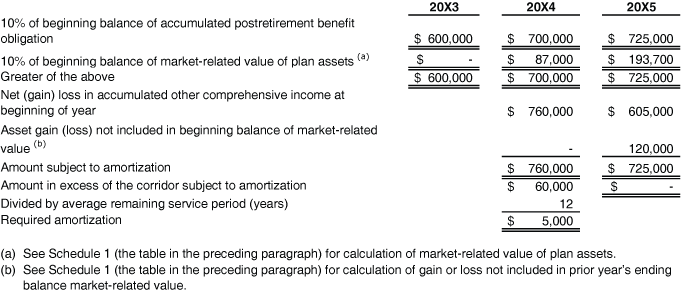
715-60-55-94
The following Schedule provides a way to calculate the minimum amortization of the net gain or loss included in accumulated other comprehensive income, to be included as a component of net periodic postretirement benefit cost.
  • 20X3 20X4 20X5 10% of beginning balance of accumulated postretirement benefit obligation " $600,000 " " $700,000 " " $725,000 " 10% of beginning balance of market-related value of plan assets (a) $- " $87,000 " " $193,700 " Greater of the above " $600,000 " " $700,000 " " $725,000 " Net (gain) loss in accumulated other comprehensive income at beginning of year " $760,000 " " $605,000 " Asset gain (loss) not included in beginning balance of market-related value (b) - " 120,000 " Amount subject to amortization " $760,000 " " $725,000 " Amount in excess of the corridor subject to amortization " $60,000 " $- Divided by average remaining service period (years) 12 Required amortization " $5,000 " (a) See Schedule 1 (the table in the preceding paragraph) for calculation of market-related value of plan assets. (b) See Schedule 1 (the table in the preceding paragraph) for calculation of gain or loss not included in prior year's ending balance market-related value.
715-60-55-95
The determination of the actual return or loss on plan assets component of net periodic postretirement benefit cost is as follows:
  • 20X3 20X4 20X5 "Plan assets at fair value, beginning of year" $- " $870,000 " " $2,057,000 " Plus: assets contributed to plan " 1,500,000 " " 1,650,000 " " 1,912,500 " Less: benefit payments from plan " (630,000)" " (700,000)" " (900,000)" " 870,000 " " 1,820,000 " " 3,069,500 " "Less: plan assets at fair value, end of year" " (870,000)" " (2,057,000)" " (3,042,840)" Actual (return) loss on plan assets $- " $(237,000)" " $26,660 "
715-60-55-96
The following Cases (Case A and Case B, paragraphs ) demonstrate the operation of defined dollar capped plans and the possible effect of the cap on projecting costs for purposes of measuring the accumulated postretirement benefit obligation and net periodic postretirement benefit cost. The Cases are simplified and illustrate only one aspect of the measurement process (see paragraphs 715-60-15-7 and 715-60-35-75).
715-60-55-97
Entity J sponsors a postretirement health care plan for its salaried employees. The plan has an annual limitation (a cap) on the dollar amount of the employer's share of the cost of covered benefits incurred by a plan participant. The retiree is responsible, therefore, for the amount by which the cost of the benefit coverage under the plan incurred during a year exceeds that cap. The entity adjusts the cap annually for the effects of inflation. For 20X3, the cap is $1,500; the inflation adjustment in 20X4 and 20X5 is assumed to be 4 percent. The employer's health care cost trend rate assumption is 13 percent for 20X4 and 12 percent for 20X5.
715-60-55-98
The employer's projected cost of providing benefit coverage in 20X3-20X5 for a 67-year-old retiree follows. Similar projections are made for each age at which a plan participant is expected to receive benefits under the plan. In this Case, the incurred claims cost exceeds the cap on the employer's share of the cost in each year.
  • Expected Cost for 67-Year-Old Retiree 20X3 20X4 20X5 Gross eligible charges " $3,065 " " $3,463 " " $3,879 " Medicare (a) (890) " (1,003)" " (1,125)" Deductible or coinsurance (325) (340) (355) Incurred claims cost " $1,850 " " $2,120 " " $2,399 " Annual cap on employer's cost " $1,500 " " $1,560 " " $1,622 " Employer's share of incurred claims cost " $1,500 " " $1,560 " " $1,622 " Retiree's share of gross eligible charges (b) $675 $900 " $1,132 " (a) The change in Medicare reflects the portion of the gross eligible charges for which Medicare is responsible under enacted Medicare legislation. (b) "Deductible and/or coinsurance plus share of incurred claims: 20X3—[$325 + ($1,850 - $1,500)]; 20X4—[$340 + ($2,120 - $1,560)]; 20X5—[$355 + ($2,399 - $1,622)]."
715-60-55-99
If, based on the health care cost trend rate assumptions, the employer's share of costs for each plan participant is not expected to be less than the cap in the future, Entity J could measure its expected postretirement benefit obligation by projecting the annual cap. However, if per capita claims data for some plan participants or estimates of the health care cost trend rate indicate that in the future the employer's share of the incurred claims cost will be less than the cap for at least some plan participants, the employer's obligation is to be measured as described in paragraphs .
715-60-55-100
Entity K sponsors a contributory postretirement health care plan for its hourly employees. The plan has an annual limitation (a cap) on the dollar amount of the employer's share of the cost of covered benefits incurred by the retiree group as a whole. The Entity agrees to bear annual costs equal to a specified dollar amount ($1,500 in 20X3) multiplied by the number of retired plan participants (the employer contribution); participating retirees are required to contribute a stated amount each year ($1,000 in 20X3). The cap on the employer's share of annual costs and the retirees' contribution rates are increased 5 percent annually. The shortfall in a year (the amount by which incurred claims cost exceeds the combined employer and retiree contributions) is initially borne by the employer but is passed back to retirees in the subsequent year through supplemental retiree contributions for that year (a retrospective adjustment).
715-60-55-101
The employer projects the aggregate cost of benefits expected to be paid to current plan participants (40 retirees) in each future period as follows.
  • 20X3 20X4 20X5 Gross eligible charges " $160,000 " " $215,000 " " $197,000 " Medicare " (46,500)" " (62,350)" " (57,300)" Deductible or coinsurance " (20,750)" " (27,440)" " (24,700)" Incurred claims cost " $92,750 " " $125,210 " " $115,000 " Retiree contributions (a) " $40,000 " " $42,000 " " $44,080 " Maximum employer contribution (b) " 60,000 " " 63,000 " " 66,160 " " $100,000 " " $105,000 " " $110,240 " Shortfall (to be recovered by additional retiree contributions in subsequent year) " $20,210 " " $4,760 " Supplemental contribution from retirees due to shortfall in prior year " $20,210 " (a) "Per retiree: 20X3—$1,000; 20X4—$1,050; 20X5—$1,102." (b) "Per retiree: 20X3—$1,500; 20X4—$1,575; 20X5—$1,654."
715-60-55-102
If, as in this Case, retirees absorb the entire shortfall in annual contributions and if there is a projected shortfall for all future years, the employer could measure its expected postretirement benefit obligation by projecting its annual contribution (contribution rate x expected number of retirees = expected obligation for the year).

Medicare Prescription Drug, Improvement, and Modernization Act

Implementation Guidance
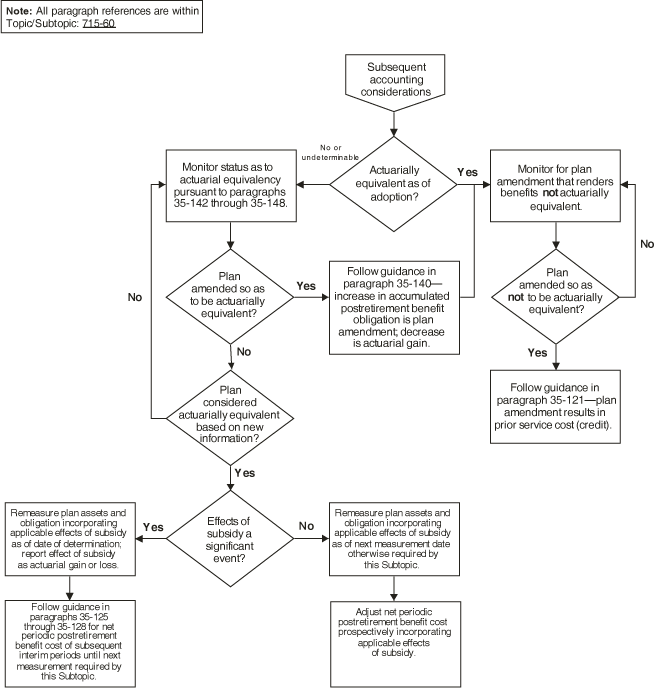
715-60-55-103
The following flowchart illustrates the application of certain aspects of the accounting for the effects of the Medicare Prescription Drug, Improvement, and Modernization Act.

Settlements, Curtailments, and Certain Termination Benefits

715-60-55-104
A transaction that does not meet the three criteria in the definition of the term settlement does not constitute a settlement for purposes of the Settlements, Curtailments, and Certain Termination Benefits Subsections.
715-60-55-105
For example, investing in a portfolio of high-quality fixed-income securities with principal and interest payment dates similar to the estimated payment dates of benefits may avoid or minimize certain risks. However, that investment decision does not constitute a settlement because that decision can be reversed, and investing in that portfolio does not relieve the employer (or the plan) of primary responsibility for a postretirement benefit obligation nor does it eliminate significant risks related to that obligation.
715-60-55-106
This Subtopic requires recognition in net periodic postretirement benefit cost of any related prior service cost or transition obligation included in accumulated other comprehensive income.
715-60-55-107
A curtailment does not only result from events that occur outside a postretirement benefit plan.
715-60-55-108
Although many curtailments may result from events that occur outside a plan, such as closing a plant, discontinuing a component of an entity, or otherwise terminating employees, a curtailment also can result from a plan amendment (including a negative plan amendment) that has the effect of eliminating the accrual of defined benefits for some or all of the future services of a significant number of active plan participants. (See Example 5, Case B [paragraphs ].)
715-60-55-109
If such an amendment occurs, accounting for a curtailment should be applied to all of the following:
  1. a
    Any decrease in the accumulated postretirement benefit obligation representing the reduction or elimination of benefits attributable to future service, which may result in a curtailment gain
  2. b
    Any increase in the accumulated postretirement benefit obligation resulting from employees retiring earlier than expected as a result of the amendment, which may result in a curtailment loss
  3. c
    Any prior service cost or any transition obligation remaining in accumulated other comprehensive income attributable to the future years of service of the employee group for which future accrual of benefits has been eliminated.
715-60-55-110
A gain results if at the time of a curtailment there exists negative prior service cost included in accumulated other comprehensive income due to a previous plan amendment that reduced benefits under the plan. Under paragraph 715-60-35-20, negative prior service cost included in accumulated other comprehensive income that results from an amendment that reduces benefits under the plan is treated the same as prior service cost that results from an amendment that improves benefits. For purposes of measuring the effect of a curtailment, prior service cost included in accumulated other comprehensive income includes any negative prior service cost from a prior plan amendment. Thus, the negative prior service cost included in accumulated other comprehensive income associated with the future years of service that are affected by the curtailment is a gain. That gain, to the extent it is not offset by any other effects of the curtailment, is currently recognized as a component of income. (See paragraphs .)
715-60-55-111
An employer that immediately recognized its transition obligation in income upon adopting the provisions of this Subtopic subsequently amends its plan to eliminate its obligation for postretirement benefits and partially compensates affected participants by increasing their pension benefits. In this case, the employer has terminated its postretirement benefit plan and effectively settled its remaining postretirement benefit obligation by increasing its obligation to pay pension benefits. Because the cost to the employer of settling its postretirement benefit obligation is the increase in the obligation for pension benefits, the gain on the termination of the plan must be measured taking into account the cost of the pension benefit increase. That increase should be accounted for as an increase in a pension liability (or a decrease in a pension asset). The obligation for postretirement benefits should be eliminated. The difference is a gain on plan termination that should be recognized pursuant to Subtopic 715-30.

Illustrations

715-60-55-112
The following Cases illustrate the accounting for settlements in various circumstances:
  1. a
    Settlement when a transition obligation remains in accumulated other comprehensive income (Case A)
  2. b
    Settlement when a transition asset remains in accumulated other comprehensive income (Case B)
  3. c
    Effect of mid-year settlement on transition constraint (Case C).
715-60-55-113
Entity L sponsors a postretirement life insurance plan. On December 31, 20X4, Entity L settles the accumulated postretirement benefit obligation for its current retirees ($70,000) through the purchase of nonparticipating life insurance contracts.
715-60-55-114
In accounting for the settlement, Entity L must determine whether recognition in income of an additional amount of any transition obligation remaining in accumulated other comprehensive income is required pursuant to the constraint on delayed recognition in income of the transition obligation (see paragraphs ). At December 31, 20X4, the cumulative postretirement benefit cost accrued after the date of transition exceeds the cumulative benefits payments after that date (including payments made pursuant to the settlement) in this Case; thus, the constraint on delayed recognition in income of the transition obligation remaining in accumulated other comprehensive income is not operative. The results of the settlement are as follows.
  • "December 31, 20X4" Before Settlement Settlement After Settlement Accumulated postretirement benefit obligation " $(257,000)" " $70,000 " " $(187,000)" Plan assets at fair value " 73,000 " " (70,000)" (a) " 3,000 " Funded status and recognized liability " $(184,000)" $- " $(184,000)" Accumulated other comprehensive income: Net gain " $(44,575)" " $12,124 " (a) " $(32,451)" Prior service cost " 33,000 " " 33,000 " Transition obligation " 195,000 " " (12,124)" (a) " 182,876 " " $183,425 " $- " $183,425 " (a) "The maximum settlement gain subject to recognition in income is the net gain included in accumulated other comprehensive income after transition plus any transition asset remaining in accumulated other comprehensive income ($44,575 + $0 = $44,575) (see paragraph 715-60-35-151). If, as in this Case, only part of the accumulated postretirement benefit obligation is settled, a pro rata portion of the maximum gain based on the relationship of the accumulated postretirement benefit obligation settled to the total accumulated postretirement benefit obligation ($70,000 ÷ $257,000 or 27.2%) is subject to recognition in income. That amount ($44,575 x 27.2% = $12,124) must first reduce any transition obligation remaining in accumulated other comprehensive income; any excess is recognized in income in the current period (see paragraphs 715-60-35-152 through 35-155). In this Case, the settlement gain is entirely offset against the transition obligation remaining in accumulated other comprehensive income."
715-60-55-115
Entity M sponsors a postretirement life insurance plan. On January 2, 20X5, Entity M settles the accumulated postretirement benefit obligation for its current retirees ($200,000) through the purchase of nonparticipating life insurance contracts.
715-60-55-116
Pursuant to paragraphs , a settlement gain of $78,506 is recognized in income, determined as follows.
  • "January 2, 20X5" Before Settlement Settlement After Settlement Accumulated postretirement benefit obligation " $(257,000)" " $200,000 " " $(57,000)" Plan assets at fair value " 350,900 " " (200,000)" " 150,900 " Funded status and recognized asset " $93,900 " $- " $93,900 " Accumulated other comprehensive income: Net gain " $(44,575)" " $34,679 " (a) " $(9,896)" Prior service cost " 33,000 " " 33,000 " Transition asset " (56,333)" " 43,827 " (a) " (12,506)" " $(67,908)" " $78,506 " " $10,598 " (a) "The maximum settlement gain is measured as the net gain included in accumulated other comprehensive income after transition plus the transition asset remaining in accumulated other comprehensive income ($44,575 + $56,333 = $100,908) (see paragraph 715-60-35-151). Since only a portion of the accumulated postretirement benefit obligation is settled, a pro rata portion of the maximum gain based on the relationship of the accumulated postretirement benefit obligation settled to the total accumulated postretirement benefit obligation ($200,000 ÷ $257,000 or 77.8%) is subject to recognition in income. That amount ($100,908 x 77.8% = $78,506) must first reduce any transition obligation remaining in accumulated other comprehensive income ($0); any excess is recognized in income in the current period (see paragraphs 715-60-35-152 through 35-155). In this Case, the entire settlement gain of $78,506 is recognized in income. The transition constraint of paragraph 715-60-35-39 that requires additional recognition in income of a transition obligation remaining in accumulated other comprehensive income in certain circumstances is not applicable because there is a transition asset remaining in accumulated other comprehensive income."
715-60-55-117
The transition constraint in paragraph 715-60-35-39 that requires additional recognition in income of a transition obligation remaining in accumulated other comprehensive income in certain circumstances is not applicable because there is a transition asset remaining in accumulated other comprehensive income.
715-60-55-118
This Case illustrates the accounting for a settlement of part of the accumulated postretirement benefit obligation that occurs mid-year and the interaction between that event and other provisions of this Subtopic, such as the constraint on delayed recognition in net periodic postretirement benefit cost of the transition obligation.
715-60-55-119
Entity N's accumulated postretirement benefit obligation for its postretirement life insurance plan was $6,000,000, and there were no plan assets. In 20X3, the entity establishes a policy of funding at the end of each year an amount equal to the benefits paid during the year plus the service and interest cost for the year. Benefits are paid at the end of each year and in 20X3 are $630,000, which is less than the net periodic postretirement benefit cost accrued for the year ($1,170,000); thus, no additional transition obligation is recognized in net periodic postretirement benefit cost pursuant to paragraph 715-60-35-39. Entity N elects to amortize net gains and losses included in accumulated other comprehensive income in excess of the corridor over the average remaining service period of plan participants (see paragraphs and 715-60-55-84).
715-60-55-120
At the beginning of 20X4, Entity N projects the life insurance benefits expected to be paid in 20X4 to retirees' beneficiaries to determine whether recognition in net periodic postretirement benefit cost of an additional amount of the transition obligation remaining in accumulated other comprehensive income will be required (see paragraph 715-60-35-40). Although Entity N is considering settling a portion of the accumulated postretirement benefit obligation, the effects of the settlement are not included in the projection because plan settlements are not anticipated for measurement or recognition before their occurrence. The projection indicates that no additional amount is required to be recognized in net periodic postretirement benefit cost. On June 30, 20X4, Entity N contributes additional funds ($1,430,000) and settles a portion ($1,900,000) of the accumulated postretirement benefit obligation for its current retirees through the purchase of nonparticipating life insurance contracts.
715-60-55-121
The changes in the funded status of the plan and amounts included in accumulated other comprehensive income during the first six months of the year are as follows.
  • Actual 12/31/X3 Six Months Postretirement Benefit Cost Assets Contributed to Plan Effects of Remeasurement Immediately before Settlement Before Settlement 6/30/X4 Accumulated postretirement benefit obligation " $(6,600,000)" " $(457,000)" (a) " $420,000 " (b) " $(6,637,000)" Plan assets at fair value " 870,000 " " 43,500 " (c) " $1,430,000 " - (b) " 2,343,500 " Funded status and recognized liability " $(5,730,000)" " (413,500)" " $1,430,000 " " $420,000 " " $(4,293,500)" Accumulated other comprehensive income: Net (gain) or loss " $360,000 " - " $(420,000)" (b) " $(60,000)" Transition obligation " 5,700,000 " " (150,000)" " 5,550,000 " Total accumulated other comprehensive income " $6,060,000 " " (150,000)" " $(420,000)" " $5,490,000 " (d) Total net periodic postretirement benefit cost " $(563,500)" (a) "Represents 6 months' service cost of $160,000 and interest cost of $297,000 on the accumulated postretirement benefit obligation for 20X4, assuming a 9% discount rate." (b) A gain results from the remeasurement of the accumulated postretirement benefit obligation immediately before the settlement as a result of a change in the assumed discount rates based on the interest rates inherent in the price at which the accumulated postretirement benefit obligation for the retirees will be settled. No gain or loss results from remeasurement of plan assets. (c) "Represents 6 months' return on plan assets, assuming a 10% return." (d) "Because there is a settlement (treated as a benefit payment) and funds are provided by the employer to effect that settlement, the constraint on delayed recognition in net periodic postretirement benefit cost of the transition obligation pursuant to paragraph 715-60-35-39 may be applicable. The test to determine whether additional recognition in income is necessary should be done based on amounts for the full year."
715-60-55-122
Detailed calculations are presented in the following paragraph.
  • "June 30, 20X4" Before Settlement Settlement Recognition in Income of Transition Obligation After Settlement Accumulated postretirement benefit obligation " $(6,637,000)" " $1,900,000 " " $(4,737,000)" Plan assets at fair value " 2,343,500 " " (1,900,000)" " 443,500 " Funded status and recognized liability " $(4,293,500)" $- " $(4,293,500)" Accumulated other comprehensive income: Net (gain) or loss " $(60,000)" " $17,160 " (a) " $(42,840)" Transition obligation " 5,550,000 " " (17,160)" (a) " $(718,822)" " 4,814,018 " " $5,490,000 " $- " $(718,822)" " $4,771,178 " (a) "The maximum settlement gain subject to recognition in income is the net gain included in accumulated other comprehensive income after transition plus any transition asset remaining in accumulated other comprehensive income ($60,000 + $0 = $60,000). If, as in this Case, only part of the accumulated postretirement benefit obligation is settled, a pro rata portion of the maximum gain based on the relationship of the accumulated postretirement benefit obligation settled to the total accumulated postretirement benefit obligation ($1,900,000 ÷ $6,637,000 or 28.6%) is subject to recognition in income. That amount ($60,000 x 28.6% = $17,160) must first reduce any transition obligation remaining in accumulated other comprehensive income (see paragraphs 715-60-35-152 through 35-155); any excess is recognized in income. In this situation, the settlement gain is entirely offset against the transition obligation remaining in accumulated other comprehensive income."
715-60-55-123
In this Case, at June 30, 20X4, cumulative benefit payments from the date of transition to December 31, 20X4, are projected to exceed cumulative postretirement benefit cost accrued for that same period as illustrated in the following table. The additional transition obligation to be recognized in income is the amount by which cumulative benefit payments exceed cost accrued, or $718,822.
  • Projected 12/31/X4 Benefit payments: Date of transition to beginning of 20X4 " $9,160,000 " 20X4 excluding settlement " 410,000 " Settlement " 1,900,000 " Cumulative benefit payments " $11,470,000 " Postretirement benefit cost recognized: Date of transition to beginning of 20X4 " $9,700,000 " 20X4 " 1,051,178 " (a) Cumulative cost recognized " $10,751,178 " Benefit payments in excess of cost recognized " $718,822 " (a) "$563,500 for period 1/1/X4-6/30/X4 plus $487,678 for period 7/1/X4-12/31/X4. The net postretirement benefit cost of $487,678 recognized in the second half of 20X4 (see the table in the following paragraph) includes amortization ($130,108) of the transition obligation that remains in accumulated other comprehensive income after recognizing in income an additional portion ($718,822) of the transition obligation remaining in accumulated other comprehensive income pursuant to paragraph 715-60-35-39. Because determination of the additional portion of the transition obligation to be recognized in income and the transition obligation amortized in income in the second half of 20X4 are interrelated, those amounts are determined in a single computation that is intended to result in the transition obligation remaining in accumulated other comprehensive income at the end of the year that appropriately reflects the constraint in paragraph 715-60-35-39."
715-60-55-124
The projected funded status of the plan and the amounts remaining in accumulated other comprehensive income follow.
  • After Settlement 6/30/X4 Six Months Postretirement Benefit Cost Benefit Payments Assets Contributed to Plan Projected 12/31/X4 Accumulated postretirement benefit obligation " $(4,737,000)" " $(379,745)" (a) " $410,000 " " $(4,706,745)" Plan assets at fair value " 443,500 " " 22,175 " (b) " (410,000)" " $1,246,745 " " 1,302,420 " Funded status and recognized liability " $(4,293,500)" " (357,570)" $- " $1,246,745 " " $(3,404,325)" Accumulated other comprehensive income: Net gain " $(42,840)" - " $(42,840)" Transition obligation " 4,814,018 " " (130,108)" (c) " 4,683,910 " Total accumulated other comprehensive income " $4,771,178 " " (130,108)" " $4,641,070 " Total net periodic postretirement benefit cost " $(487,678)" (a) "Represents 6 months' service cost of $150,000 and interest cost of $229,745 on the accumulated postretirement benefit obligation, assuming a 9.7% discount rate." (b) "Represents 6 months' return on plan assets, assuming a 10% return." (c) "Transition obligation remaining in accumulated other comprehensive income at 6/30/X4, of $4,814,018 ÷ 18.5 years remaining in amortization period = $260,217; half-year amortization = $130,108."
715-60-55-125
The following Cases illustrate the accounting for curtailments:
  1. a
    A gain and a transition obligation remain in accumulated other comprehensive income (Case A).
  2. b
    Disposal of a portion of the business when a loss and a transition obligation remain in accumulated other comprehensive income (Case B).
715-60-55-126
Entity P sponsors a postretirement benefit plan. On October 29, 20X4, Entity P decides to reduce its operations by terminating a significant number of employees effective December 31, 20X4. On October 29, 20X4, it is expected that a curtailment gain will result from the termination. A consequence of the curtailment is a significant reduction in the number of employees accumulating benefits under the plan. The remaining years of expected service associated with those terminated employees who were plan participants at the date of transition is 22 percent of the remaining years of service of all plan participants at the date of transition. The remaining years of service before full eligibility associated with those terminated employees who were plan participants at the date of a prior plan amendment is 18 percent of the remaining years of service of all plan participants at the date of that plan amendment.
715-60-55-127
The sum of the effects of the plan curtailment is a gain of $5,160 that should be recognized in income when the related employees terminate (see paragraph 715-60-35-171). That gain is determined as follows.
  • "December 31, 20X4" Before Curtailment Curtailment After Curtailment Accumulated postretirement benefit obligation " $(257,000)" " $54,000 " (a) " $(203,000)" Plan assets at fair value " 73,000 " " 73,000 " Funded status and recognized liability " $(184,000)" " $54,000 " " $(130,000)" Accumulated other comprehensive income: Net gain " $(44,575)" " $(44,575)" Prior service cost " 33,000 " " $(5,940)" (a) " 27,060 " Transition obligation " 195,000 " " (42,900)" (a) " 152,100 " Total accumulated other comprehensive income " $183,425 " " $(48,840)" " $134,585 " Gain from curtailment " $5,160 " (a) The effect of the curtailment consists of two components: a. "The transition obligation and prior service cost remaining in accumulated other comprehensive income associated with remaining years of service no longer expected to be rendered--measured as 22% (reduction in the remaining years of expected service associated with those terminated employees who were plan participants at the date of transition) of the transition obligation remaining in accumulated other comprehensive income of $195,000 ($42,900) and 18% (reduction in the remaining years of service before full eligibility for benefits associated with those terminated employees who were plan participants at the date of a prior plan amendment) of the prior service cost included in accumulated other comprehensive income of $33,000 related to that amendment ($5,940) (see paragraphs 715-60-35-164 through 35-166)" b. "The gain from the decrease in the accumulated postretirement benefit obligation of $54,000 (due to the termination of employees whose accumulated benefits were not vested under the plan) in excess of the net loss included in accumulated other comprehensive income of $0, or $54,000 (see paragraph 715-60-35-169[a])."
715-60-55-128
Entity R sponsors a postretirement benefit plan. On December 31, 20X4, Entity R sells a portion of its business at a gain of $100,000 before considering the effect of the related curtailment of its postretirement benefit plan. In connection with the sale, the number of employees accumulating benefits under the plan is significantly reduced; thus, a curtailment occurs. The remaining years of expected service associated with the terminated employees who were plan participants at the date of transition is 22 percent of the remaining years of service of all plan participants at the date of transition. The remaining years of service before full eligibility associated with the terminated employees who were plan participants at the date of that prior plan amendment is 18 percent of the remaining years of service of all plan participants at the date of that plan amendment.
715-60-55-129
The sum of the effects of the plan curtailment is a loss of $36,265 that should be recognized in income with the gain of $100,000 associated with Entity R's sale of a portion of its business. The loss is determined as follows.
  • "December 31, 20X4" Before Curtailment Curtailment After Curtailment Accumulated postretirement benefit obligation " $(343,000)" " $54,000 " (a) " $(289,000)" Plan assets at fair value " 73,000 " " 73,000 " Funded status and recognized liability " $(270,000)" " $54,000 " " $(216,000)" Accumulated other comprehensive income: Net loss " $41,425 " " $(41,425)" (a) $- Prior service cost " 33,000 " " (5,940)" (a) " 27,060 " Transition obligation " 195,000 " " (42,900)" (a) " 152,100 " Total accumulated other comprehensive income " $269,425 " " $(90,265)" " $179,160 " Curtailment loss " $36,265 " (a) The effect of the curtailment consists of two components: a. "The transition obligation and prior service cost remaining in accumulated other comprehensive income associated with remaining years of service no longer expected to be rendered--measured as 22% (reduction in the remaining years of expected service associated with those terminated employees who were plan participants at the date of transition) of the transition obligation remaining in accumulated other comprehensive income of $195,000 ($42,900) and 18% (reduction in the remaining years of service before full eligibility for benefits associated with those terminated employees who were plan participants at the date of a prior plan amendment) of the prior service cost included in accumulated other comprehensive income of $33,000 related to that amendment ($5,940) (see paragraphs 715-60-35-164 through 35-166)" b. "The gain from the decrease in the accumulated postretirement benefit obligation of $54,000 (due to the termination of employees whose accumulated benefits were not vested under the plan) in excess of the net loss included in accumulated other comprehensive income of $41,425, or $12,575 (see paragraph 715-60-35-169[a])."
715-60-55-130
Entity S sells a line of business on December 31, 20X4; before that date, the entity had no formal plan for disposal of those operations. Entity S has a separate postretirement benefit plan that provides health care benefits to retirees of the division that is sold. In connection with that sale, all of the employees of that division are terminated by Entity S resulting in no further accumulation of benefits under the postretirement benefit plan (a full curtailment), most of the terminated employees are hired by the acquiring entity (some terminated employees fully eligible for benefits elect to retire immediately), an accumulated postretirement benefit obligation of $80,000 for postretirement benefits related to the hired employees is assumed by the acquiring entity (a partial settlement, since the obligation for current retirees is retained by Entity S), and plan assets of $100,000, representing $80,000 for the settlement of the accumulated postretirement benefit obligation and $20,000 as an excess contribution, are transferred from the plan to the acquiring entity. A $300,000 gain from the sale is calculated before considering the related effects on the plan.
715-60-55-131
The employer's accounting policy is to determine the effects of a curtailment before determining the effects of a settlement when both events occur simultaneously.
715-60-55-132
The effect of the curtailment is determined as follows.
  • "December 31, 20X4" Before Curtailment Curtailment-Related Effects Resulting from Sale After Curtailment Accumulated postretirement benefit obligation " $(257,000)" " $(10,000)" (a) " $(267,000)" Plan assets at fair value " 110,000 " " 110,000 " Funded status and recognized liability " $(147,000)" " $(10,000)" " $(157,000)" Accumulated other comprehensive income: Net gain " $(49,575)" " $10,000 " (a) " $(39,575)" Prior service cost " 33,000 " " (33,000)" (b) - Transition obligation " 195,000 " " (195,000)" (c) - Total accumulated other comprehensive income " $178,425 " " $(218,000)" " $(39,575)" Curtailment loss " $228,000 " (a) "The increase in the accumulated postretirement benefit obligation as a result of the fully eligible employees retiring earlier than expected is a loss of $10,000. That loss reduces the net gain included in accumulated other comprehensive income of $49,575; any excess (none in this Example) would be recognized in income as the effect of a curtailment (see paragraphs 715-60-35-169 through 35-170)." (b) "Measured as 100% (reduction in the remaining years of service before full eligibility for benefits associated with those terminated employees who were plan participants at the date of a prior plan amendment) of the prior service cost included in accumulated other comprehensive income of $33,000 related to that amendment (see paragraphs 715-60-35-164 through 35-166)." (c) "Measured as 100% (reduction in the remaining years of expected service associated with those terminated employees who were plan participants at the date of transition) of the transition obligation remaining in accumulated other comprehensive income of $195,000 (see paragraphs 715-60-35-164 through 35-166)."
715-60-55-133
The $8,128 loss related to the settlement and transfer of plan assets that is recognized in income with the gain from the sale is determined as follows.
  • "December 31, 20X4" After Curtailment Settlement and Transfer of Plan Assets After Settlement Accumulated postretirement benefit obligation " $(267,000)" " $80,000 " (a) " $(187,000)" Plan assets at fair value " 110,000 " " (100,000)" (a) " 10,000 " Funded status and recognized liability " $(157,000)" " $(20,000)" " $(177,000)" Accumulated other comprehensive income: Net gain " $(39,575)" " $11,872 " (b) " $(27,703)" Prior service cost - - Transition obligation - - Total accumulated other comprehensive income " $(39,575)" " $11,872 " " $(27,703)" Settlement loss " $8,128 " (a) "The accumulated postretirement benefit obligation for the employees hired by the purchaser is determined to be $80,000 and is settled when Entity S transfers plan assets of an equal amount to the purchaser. In connection with the purchase agreement, Entity S transfers an additional $20,000 of plan assets." (b) "Represents a pro rata amount of the maximum gain based on the relationship of the accumulated postretirement benefit obligation settled to the total accumulated postretirement benefit obligation ($80,000 / $267,000 or 30%). The maximum gain is measured as the net gain included in accumulated other comprehensive income after transition plus any transition asset remaining in accumulated other comprehensive income ($39,575 + $0 = $39,575). The settlement gain is, therefore, 30% of $39,575, or $11,872; recognition in income of that gain is subject to first reducing any transition obligation remaining in accumulated other comprehensive income. As there is no transition obligation remaining in accumulated other comprehensive income (the remainder was recognized in income in connection with the curtailment), the gain of $11,872 is recognized in income together with the excess $20,000 transfer of plan assets as part of the net gain from the sale (see paragraphs 715-60-35-151 through 35-155)."
715-60-55-134
The sum of the effects related to postretirement benefits resulting from the sale is a loss of $236,128, the components of which are as follows.
  • Curtailment loss (paragraph 715-60-55-132) " $228,000 " Net settlement loss (see the table in the preceding paragraph) " 8,128 " Effects of sale " $236,128 "
715-60-55-135
This Example illustrates the measurement of the effects of an offer of special termination benefits pursuant to paragraphs and the accounting for the related curtailment.
715-60-55-136
On January 16, 20X5, Entity T offers for a short period of time (until January 30, 20X5) special benefits to its employees who elect voluntary termination of employment during that period (special termination benefits). As part of the offer, employees who voluntarily terminate will be credited with an additional five years of service and five years of age to determine eligibility for postretirement health care benefits. Employees are normally eligible for those benefits upon attaining age 55 and rendering at least 20 years of service.
715-60-55-137
On January 30, 20X5, employees representing 18 percent of the work force accept the offer of special termination benefits. For those employees, the accumulated postretirement benefit obligation attributed to prior service periods based on their previously expected retirement dates (without consideration of the special offer) is $280,000. If those employees were assumed to terminate (retire) immediately upon attaining full eligibility for benefits (age 55 with 20 years of service), the accumulated postretirement benefit obligation for those employees would be $450,000. The accumulated postretirement benefit obligation for those employees after they accept the offer of the special termination benefits (full eligibility date accelerated, benefit coverage begins immediately) is $630,000.
715-60-55-138
The remaining years of expected service associated with the terminated employees who were plan participants at the date of transition is 24 percent of the remaining years of service of all plan participants at the date of transition. In addition, the portion of the prior service cost remaining in accumulated other comprehensive income arising from a prior plan amendment associated with the remaining years of service before full eligibility that are no longer expected to be rendered by the terminated employees is $25,000.
715-60-55-139
In this illustration, the effects resulting from the curtailment are not reasonably estimable until January 30, 20X5, the acceptance date of the offer of special termination benefits. Consequently, at January 30, 20X5, the employer recognizes a loss of $453,400 that includes the cost of the special termination benefits ($180,000) and the net loss from the curtailment ($273,400) determined as follows.
  • "January 30, 20X5" Before Employee Terminations Special Termination Benefits Effect of Curtailment After Employee Terminations Accumulated postretirement benefit obligation: Employees accepting offer " $(280,000)" " $(180,000)" (a) " $(170,000)" (b) " $(630,000)" Other employees " (633,000)" " (633,000)" " (913,000)" " (180,000)" " (170,000)" " (1,263,000)" Plan assets at fair value " 141,000 " " 141,000 " Funded status and recognized liability " $(772,000)" " $(180,000)" " $(170,000)" " $(1,122,000)" Accumulated other comprehensive income: Net gain " $(88,000)" " $88,000 " (b) $- Prior service cost " 148,500 " " (25,000)" (c) " 123,500 " Transition obligation " 693,333 " " (166,400)" (c) " 526,933 " Total accumulated other comprehensive income " $753,833 " " $(103,400)" " $650,433 " Net loss " $180,000 " " $273,400 " (a) "The loss from acceptance of the special termination benefits is $180,000 ($450,000 - $630,000), representing the difference between the accumulated postretirement benefit obligation measured assuming that active plan participants not yet fully eligible for benefits would terminate employment at their full eligibility date and that fully eligible plan participants would retire immediately and the accumulated postretirement benefit obligation reflecting the special termination benefits (see paragraph 715-60-25-5)." (b) "The increase in the accumulated postretirement benefit obligation as a result of the employees (fully eligible plan participants and other active plan participants not yet fully eligible for benefits) retiring at a date earlier than expected is a loss of $170,000 ($280,000 - $450,000). That amount is reduced by the net gain of $88,000 included in accumulated other comprehensive income (see paragraph 715-60-35-169[b]) as part of the accounting for the curtailment." (c) "Additional effects of the curtailment are the reduction of $25,000 in the prior service cost included in accumulated other comprehensive income (arising from a prior plan amendment) associated with the remaining years of service before full eligibility that are no longer expected to be rendered by the terminated employees and the reduction of $166,400 in the transition obligation remaining in accumulated other comprehensive income associated with remaining years of service no longer expected to be rendered--measured as 24% (reduction in the remaining years of expected service associated with those employees affected by the early retirement who were plan participants at the date of transition) of the transition obligation remaining in accumulated other comprehensive income of $693,333 (see paragraphs 715-60-35-164 through 35-166)."
715-60-55-140
It is important to distinguish between a reduction in the accumulated postretirement benefit obligation caused by a negative plan amendment and a reduction caused by a curtailment. Unless the plan is being terminated, a reduction in the accumulated postretirement benefit obligation caused by a curtailment (a curtailment that reduces the expected postretirement benefit obligation) is potentially recognizable as a current component of income.
715-60-55-141
The following Cases illustrate when a reduction in the accumulated postretirement benefit obligation is caused by:
  1. a
    A negative plan amendment (Case A)
  2. b
    A curtailment (Case B).
715-60-55-142
On December 31, 20X1, Entity A changes the terms of its retiree health care plan to require current and future retirees to contribute $100 per month toward the cost of benefits provided by the plan. The plan was previously noncontributory. As a result of the change, the accumulated postretirement benefit obligation for both active employees and retirees at December 31, 20X1, decreases by $500,000. That reduction is a negative plan amendment because the change in plan terms has reduced the benefits under the plan attributed to employee service already rendered. A curtailment has not occurred because there has been no reduction in the expected years of future service of active plan participants and the plan continues to provide additional benefits for future services.
715-60-55-143
On December 31, 20X1, Entity B changes the terms of its retiree life insurance plan for future retirees from a death benefit equal to 5 percent of final pay for each year of service to a death benefit equal to 5 percent of the pay rate in effect at December 31, 20X1, for each year of service before that date. Because Entity B switched the terms under which benefits are based to provide benefits only for services rendered before December 31, 20X1, the entity will no longer provide benefits for future service and there will be no increases in retiree life insurance for any employee services rendered after that date. That change constitutes a curtailment because accruals of death benefits for future employee service are no longer required (that is, the change eliminates the need for future accruals of death benefits for all of the future services of the active plan participants). However, the change in plan terms does not result in a termination of the plan because there is a continuing obligation to pay the future death benefits already earned by employees and current retirees. Only the accrual of additional death benefits for employees' future services has been eliminated.
715-60-55-144
Because this plan was previously a final-pay plan, the accumulated postretirement benefit obligation at December 31, 20X1, before the amendment included an amount based on projected future employee pay levels. In this Case, that amount equaled $400,000. Thus, the accumulated postretirement benefit obligation at December 31, 20X1, decreases by $400,000 as a result of the plan amendment because increases in employees' future pay levels will no longer increase their death benefits under the plan. That reduction is potentially a currently recognizable curtailment gain.
715-60-55-145
Whether any or all of the $400,000 should be recognized currently as a component of net periodic postretirement benefit cost depends on the existence and amount of any net loss included in accumulated other comprehensive income that must be offset before that curtailment gain can be recognized. Any prior service cost or transition obligation included in accumulated other comprehensive income also will enter into determining the net curtailment gain or loss.
715-60-55-146
The following Cases illustrate the accounting for a negative plan amendment that results in a curtailment:
  1. a
    The accounting for a negative plan amendment that results in a curtailment gain (Case A)
  2. b
    The accounting for a negative plan amendment that results in a curtailment loss (Case B)
  3. c
    The accounting for a negative plan amendment and a curtailment that results in recognition as a component of net periodic postretirement benefit cost of prior service cost included in accumulated other comprehensive income (Case C).
715-60-55-147
Entity A sponsors an unfunded postretirement benefit plan whose only benefit is life insurance coverage equal to an employee's final pay. On December 31, 20X1, Entity A amends its plan to eliminate that benefit for active employees who are not 40 years of age or older, which is a significant portion of its work force. The resulting reduction in the accumulated postretirement benefit obligation consists of two components: $150,000 represents benefits based on past pay and service already rendered by employees under age 40 (a negative plan amendment), and $250,000 represents that portion of the accumulated postretirement benefit obligation based on a projection of those employees' future pay. Because the change in plan terms eliminates the accrual of additional benefits for those employees, the $250,000 is potentially a currently recognizable curtailment gain.
  • "December 31, 20X1" Before Negative Plan Amendment Negative Plan Amendment After Negative Plan Amendment Curtailment After Curtailment Accumulated postretirement benefit obligation (recognized liability) " $(750,000)" " $150,000 " " $(600,000)" " $250,000 " " $(350,000)" Amounts recognized in accumulated other comprehensive income: Prior service cost " $50,000 " " $(50,000)" (a) $- Transition obligation " 70,000 " " (70,000)" (a) - Net loss " 100,000 " " 100,000 " " $(100,000)" (b) Negative prior service cost " (30,000)" " (30,000)" " $(30,000)" " $220,000 " " $(150,000)" " $70,000 " " $(100,000)" " $(30,000)" (a) "The decrease in the accumulated postretirement benefit obligation due to a negative plan amendment is used first to reduce any existing prior service cost recognized in accumulated other comprehensive income, then to reduce any transition obligation recognized in accumulated other comprehensive income." (b) The decrease in the accumulated postretirement benefit obligation due to a curtailment is used first to reduce any net loss recognized in accumulated other comprehensive income at the date of the curtailment.
715-60-55-148
The journal entry to record the negative plan amendment is as follows.
  • Postretirement benefit liability " $150,000 " Other comprehensive income " $150,000 "
715-60-55-149
The journal entry to record the curtailment gain is as follows.
  • Postretirement benefit liability " $250,000 " Other comprehensive income " $100,000 " Curtailment gain " $150,000 " (a) (a) The curtailment gain is not a component of net periodic postretirement benefit cost and should be disclosed separately.
715-60-55-150
The negative plan amendment results in negative prior service cost because it reduces the accumulated postretirement benefit obligation by an amount that exceeds the prior service cost and the remaining transition obligation included in accumulated other comprehensive income. The negative prior service cost of $30,000 is recognized in net periodic postretirement benefit cost by amortizing it over future periods beginning January 1, 20X2, in accordance with paragraph 715-60-35-17. Only those participants who are active at the date of the amendment and who are not yet fully eligible for benefits (that is, participants who are 40 years of age or older) are considered in applying that paragraph to the net negative prior service cost that results from this plan amendment
715-60-55-151
If Entity A had instead amended the plan on October 31, 20X1, and it had a calendar-year fiscal year-end, the effects of the negative plan amendment in determining net periodic postretirement benefit cost for 20X1 would be recognized prospectively starting from November 1, 20X1. The net periodic postretirement benefit cost for the first 10 months of the year would reflect the terms of the plan before the plan amendment.
715-60-55-152
Entity B sponsors an unfunded postretirement health care benefit plan covering employees at five locations. On December 1, 20X1, Entity B amends its plan so that any employee at location X who does not retire by the end of 20X1 will not be entitled to receive benefits. Those employees at location X who retire by December 31, 20X1, will receive benefits under the plan terms. Employees at the other four locations are not affected by the amendment and will continue to earn benefits.
715-60-55-153
As a result of the amendment, Entity B's accumulated postretirement benefit obligation is reduced by $400,000, representing the elimination of benefits attributable to years of service already rendered by active employees who are not eligible to retire and those eligible employees who choose not to retire (a negative plan amendment). The remaining employees at location X decide to take early retirement on December 31, 20X1 (a curtailment). The unexpected early retirements cause a $200,000 increase in the accumulated postretirement benefit obligation that is accounted for as part of the curtailment. The previously expected remaining years of service associated with all employees at location X who were plan participants at the date of transition represent 20 percent of the previously expected remaining years of service of all plan participants at the date of transition. As a result, $100,000 (20 percent x $500,000) is recognized representing accelerated amortization of the transition obligation remaining in accumulated other comprehensive income. Because the prior service cost included in accumulated other comprehensive income is eliminated by the negative plan amendment, it does not enter into the accounting for the curtailment.
715-60-55-154
Unlike the terms of the plan described in Example 6, Case A (see paragraphs ), benefits under this plan are not pay-related. Thus, the accounting for the curtailment does not include any gain for the elimination of the effects of a projection of final pay.
  • "December 31, 20X1" Before Negative Plan Amendment Negative Plan Amendment After Negative Plan Amendment Curtailment After Curtailment Accumulated postretirement benefit obligation (recognized liability) " $(950,000)" " $400,000 " " $(550,000)" " $(200,000)" " $(750,000)" Amounts recognized in accumulated other comprehensive income: Prior service cost " $100,000 " " $(100,000)" (a) $- Transition obligation " 800,000 " " (300,000)" (a) " 500,000 " " $(100,000)" " $400,000 " Net gain " (150,000)" " (150,000)" " 150,000 " (b) - " $750,000 " " $(400,000)" " $350,000 " " $50,000 " " $400,000 " (a) "The decrease in the accumulated postretirement benefit obligation due to a negative plan amendment is used first to reduce any existing prior service cost recognized in accumulated other comprehensive income, then to reduce any transition obligation recognized in accumulated other comprehensive income." (b) The increase in the accumulated postretirement benefit obligation due to a curtailment is used first to reduce any net gain recognized in accumulated other comprehensive income at the date of the curtailment.
715-60-55-155
The journal entry to record the negative plan amendment is as follows.
  • Postretirement benefit liability " $400,000 " Other comprehensive income " $400,000 "
715-60-55-156
The journal entry to record the curtailment loss is as follows.
  • Curtailment loss " $150,000 " (a) Other comprehensive income " 50,000 " Postretirement benefit liability " $200,000 " (a) The curtailment loss is not a component of net periodic postretirement benefit cost and should be disclosed separately.
715-60-55-157
Entity C sponsors an unfunded postretirement health care benefit plan. Benefits under the plan are not pay-related; thus, no assumption is required about employees' future pay levels in measuring the accumulated postretirement benefit obligation. When it initially adopted the requirements of this Topic, Entity C immediately recognized its transition obligation in net income. On December 31, 20X1, the entity changes the plan's eligibility requirements from the attainment of age 65 while in service and 20 years of service to 20 years of service to be rendered after attaining age 45. The new credited service period is not deemed to be nominal in relation to employees' average total years of service before their full eligibility dates. This change reduces the accumulated postretirement benefit obligation for benefits attributable to past service (a negative plan amendment) by $300,000 for employees hired before age 45.
715-60-55-158
Because a significant number of employees previously expected to receive benefits under the plan are under age 45, the change in plan terms also meets the definition of a curtailment because it eliminates those employees as active participants under the plan. Their remaining years of expected service represent 15 percent of the previously expected remaining years of service of all plan participants at the date of a prior plan amendment that increased benefits. Because no portion of the accumulated postretirement benefit obligation includes any amounts attributed to future pay levels, the impact of accounting for the curtailment is limited to accelerating the recognition in net periodic postretirement benefit cost of the portion of remaining prior service cost included in accumulated other comprehensive income (15 percent x $100,000) related to those employees' future years of service.
  • "December 31, 20X1" Before Negative Plan Amendment Negative Plan Amendment After Negative Plan Amendment Curtailment After Curtailment Accumulated postretirement benefit obligation (recognized liability) " $(850,000)" " $300,000 " " $(550,000)" " $(550,000)" Amounts recognized in accumulated other comprehensive income: Prior service cost " $400,000 " " $(300,000)" (a) " $100,000 " " $(15,000)" (b) " $85,000 " " $400,000 " " $(300,000)" " $100,000 " " $(15,000)" " $85,000 " (a) "The decrease in the accumulated postretirement benefit obligation due to a negative plan amendment is used first to reduce any existing prior service cost recognized in accumulated other comprehensive income, then to reduce any transition obligation recognized in accumulated other comprehensive income." (b) "A portion of prior service cost is recognized as a component of net periodic postretirement benefit cost because the net balance of $100,000 arose from a previous amendment and the current employees under age 45 who were participants at the date of the previous amendment are no longer participants. Accordingly, their future service has been eliminated as a basis for delayed recognition of the prior service cost as a component of net periodic postretirement benefit cost. If the negative prior service cost from the new amendment exceeded the prior service cost recognized in accumulated other comprehensive income from the previous amendment, none of the net negative prior service cost would be recognized as a component of net periodic postretirement benefit cost currently. The net negative prior service cost would be amortized over active participants' expected future service periods to full eligibility."
715-60-55-159
The journal entry to record the negative plan amendment is as follows.
  • Postretirement benefit liability " $300,000 " Other comprehensive income " $300,000 "
715-60-55-160
The journal entry to record the curtailment loss is as follows.
  • Curtailment loss " $15,000 " Other comprehensive income " $15,000 "
715-60-55-161
In general an employer should measure the postretirement benefit incentive to be received by employees in exchange for early termination as the difference between the actuarial present value of the accrued benefits for employees terminating with the enhanced benefits and the accrued benefits for those employees assuming they terminated without the enhancements.
715-60-55-162
The following simplified examples address situations involving a typical postretirement benefit plan under which participants become eligible for benefits upon attaining age 55 while in service and rendering 10 years of service and a plan under which benefits are based on years of service. To simplify the examples further, discounting and health care cost trends have been ignored.
715-60-55-163
Under Entity X's postretirement health care benefit plan, the annual cost of coverage is estimated to be $4,500 for retirees under age 65 and $1,500 for those 65 and older. The probability of employees retiring is 40 percent at age 57, 50 percent at age 62, and 10 percent at age 65. There is a 100 percent probability that retirees will die at age 75. Employees that retire on or after attaining age 55 while in service and rendering 10 or more years of service receive full employer-paid postretirement benefit coverage.
715-60-55-164
As part of an incentive package to encourage employees to retire early, Entity X offers for a short period of time to add three years of age and three years of service to an employee's age and accumulated service credits to determine eligibility for postretirement benefits. Two employees, A and B, accept the offer. A is age 57 and has rendered 20 years of service. B is age 52 and has rendered 12 years of service.
715-60-55-165
The expected postretirement benefit obligation for A and B before the offer is $36,150 each, determined as follows.
  • Retirement Age Benefits Probability of Retirement Expected Postretirement Benefit Obligation Pre-Age 65 Age 65 to 75 57 "($4,500 x 8 yrs)" + "($1,500 x 10 yrs)" x 40% " $20,400 " 62 "($4,500 x 3 yrs)" + "($1,500 x 10 yrs)" x 50 " 14,250 " 65 "($1,500 x 10 yrs)" x 10 " 1,500 " " $36,150 "
715-60-55-166
The accumulated postretirement benefit obligation for A and B before the offer is $36,150 and $28,920, respectively, determined as follows.
  • Employee Expected Postretirement Benefit Obligation Years of Service Rendered to Total Required Accumulated Postretirement Benefit Obligation A " $36,150 " x 18/18 (a) = " $36,150 " B " 36,150 " x 12/15 (b) = " 28,920 " " $72,300 " " $65,070 " (a) "A was hired at age 37 and, therefore, after 18 years of service has rendered the required 10 years of service and attained age 55 while in service to be fully eligible for benefits." (b) B must render 3 more years of service to attain age 55 while in service to be fully eligible for benefits.
715-60-55-167
The special termination postretirement benefit is measured as the difference between the following two amounts:
  1. a
    The benefits attributed to past service based on what A and B receive if they retire at the earliest date at which they could retire and receive postretirement benefits under the plan, ignoring the special termination benefits. That date would be immediately for A and in 3 years (upon attaining age 55) for B.
  2. b
    The benefits A and B receive if they accept the special termination benefits offer and retire immediately.
715-60-55-168
The calculation of those two amounts follows.
  • Accrued Benefits Ignoring Special Termination Benefits and Assuming A Retires Immediately and B Retires at Age 55
    • Benefits Portion Earned Accrued Benefits Employee Pre-Age 65 Age 65 to 75 A "($4,500 x 8 yrs)" + "($1,500 x 10 yrs)" x 18/18 = " $51,000 " B "($4,500 x 10 yrs)" + "($1,500 x 10 yrs)" x 12/15 = " 48,000 " " $99,000 "
  • Accrued Benefits That Reflect Special Termination Benefits Assuming A and B Retire Immediately
    • Benefits Portion Earned Accrued Benefits Employee Pre-Age 65 Age 65 to 75 A "($4,500 x 8 yrs)" + "($1,500 x 10 yrs)" x 100% = " $51,000 " B "($4,500 x 13 yrs)" + "($1,500 x 10 yrs)" x 100 = " 73,500 " " $124,500 "
715-60-55-169
Thus, the cost of the special termination postretirement benefits is $25,500 ($124,500 - $99,000). If A and B represent a significant portion of Entity X's work force, the increase in the accumulated postretirement benefit obligation attributable solely to their early retirement, $33,930 ($99,000 - $65,070, both calculated without regard to the special termination benefits), would be accounted for as a curtailment. Otherwise, the $33,930 would be an experience loss.
715-60-55-170
The facts are the same as in Case A except that under the plan's terms retiring employees receive 2 1/2 percent coverage for each year of service. Thus, before the acceptance of special termination benefits, the full eligibility dates for A and B would be their expected retirement dates.
715-60-55-171
The accumulated postretirement benefit obligation for A and B before accepting the offer is $28,920, determined as follows.
  • At Retirement Service to Date/ Service to Retirement Accumulated Postretirement Benefit Obligation Age Years of Service Benefits Benefit Coverage Probability of Retirement Pre-Age 65 Age 65 to 75 Employee A 57 20 "($4,500 x 8 yrs)" + "($1,500 x 10 yrs)" x 50% x 40% x 20/20 = " $10,200 " 62 25 "($4,500 x 3 yrs)" + "($1,500 x 10 yrs)" x 62½ x 50 x 20/25 = " 7,125 " 65 28 "($1,500 x 10 yrs)" x 70 x 10 x 20/28 = 750 " 18,075 " Employee B 57 17 "($4,500 x 8 yrs)" + "($1,500 x 10 yrs)" x 42½% x 40% x 12/17 = " 6,120 " 62 22 "($4,500 x 3 yrs)" + "($1,500 x 10 yrs)" x 55 x 50 x 12/17 = " 4,275 " 65 25 "($1,500 x 10 yrs)" x 62½ x 10 x 12/17 = 450 " 10,845 " " $28,920 "
715-60-55-172
The special termination postretirement benefit is measured in the same manner as in Case A.
715-60-55-173
Accrued Benefits Ignoring Special Termination Benefits and Assuming A Retires Immediately and B Retires at Age 55
  • Benefits Benefit Coverage Portion Earned Accrued Benefits Employee Pre-Age 65 Age 65 to 75 A "($4,500 x 8 yrs)" + "($1,500 x 10 yrs)" x 50% x 20/20 = " $25,500 " B "($4,500 x 10 yrs)" + "($1,500 x 10 yrs)" x 37½ x 12/15 = " 18,000 " " $43,500 "
715-60-55-174
Accrued Benefits That Reflect Special Termination Benefits Assuming A and B Retire Immediately
  • Benefits Benefit Coverage Portion Earned Accrued Benefits Employee Pre-Age 65 Age 65 to 75 A "($4,500 x 8 yrs)" + "($1,500 x 10 yrs)" x 57½% x 100% = " $29,325 " B "($4,500 x 13 yrs)" + "($1,500 x 10 yrs)" x 37½ x 100 = " 27,563 " " $56,888 "
715-60-55-175
Thus, the cost of the special termination postretirement benefits is $13,388 ($56,888 - $43,500), and $14,580 ($43,500 - $28,920) would be accounted for as a curtailment or an experience loss.

Split-Dollar Life Insurance Arrangements

Implementation Guidance

715-60-55-176
A typical endorsement split-dollar life insurance arrangement may have the following terms:
  1. a
    An employer purchases a life insurance policy to insure the life of an employee and pays a single premium at inception of the policy. Based on the insurance carrier's experience (for example, mortality) it can either charge or credit the policyholder for the negative or positive experience, respectively. The additional premium or credit is typically effectuated through an adjustment to the cash surrender value of the policy.
  2. b
    The employer enters into a separate agreement that splits the policy benefits between the employer and the employee. The employer owns the policy, controls all rights of ownership, and may terminate the insurance policy (and, in turn, the policy benefits promised to the employee). To effect the split-dollar arrangement, the employer endorses a portion of the death benefits to the employee (the employee designates a beneficiary for this portion of the death benefits). Upon the death of the employee, the employee's beneficiary typically receives the designated portion of the death benefits directly from the insurance entity and the employer receives the remainder of the death benefits.
715-60-55-177
The employee's portion of the death benefits is commonly based on one of the following:
  1. a
    Amounts that exceed the gross premiums paid by the employer
  2. b
    Amounts that exceed the sum of the gross premiums paid by the employer and an additional fixed or variable investment return on those premiums
  3. c
    The net insurance at the date of death (that is, the face amount of the death benefit under the policy, less the cash surrender value)
  4. d
    Amounts equal to a multiple of the employee's base salary at retirement or death (for example, twice the employee's base salary).
715-60-55-178
All available evidence should be considered in determining the substance of the arrangement, such as explicit written terms of the arrangement, communications made by the employer to the employee, the employer's past practices in administering the same or similar arrangements, and whether the employer is the primary obligor for the postretirement benefit.
715-60-55-179
For example, if the employer agrees to provide a death benefit to the employee even in the event of default by the insurance entity, that would provide an indication that the promise made to the employee is to provide a postretirement death benefit. If the amount of the death benefit is not explicitly tied to an insurance policy, then the amount of the postretirement benefit should also be the amount of the death benefit promised to the employee. Conversely, if the terms of the arrangement are such that the employer has no obligation to the employee upon default of the insurance entity, that would provide an indication that the postretirement benefit is a promise to maintain a life insurance policy during the employee's retirement. In determining the appropriate measurement and attribution of the cost and obligation under any particular arrangement, employers should refer to the guidance in this Subtopic, as applicable.
715-60-55-180
For example, if the terms of the arrangement are such that the employer has no obligation, either stated or implied, to provide loans to an employee to cover insurance policy premiums in the postretirement period, that may be an indication that there is no postretirement obligation. However, if the employer through the collateral assignment arrangement with the employee has an obligation, either stated or implied, to provide loans to an employee to cover the experience gains and losses of the insurance entity, that may indicate that an employer has a postretirement benefit obligation. In determining the appropriate measurement and attribution of the cost and obligation under any particular arrangement, employers should refer to the guidance in this Subtopic, as applicable.
715-60-55-181
In determining the nature and substance of the arrangement, the employer should assess what future cash flows the employer is entitled to, if any, as well as the employee's obligation and ability to repay the employer. For example, if the arrangement limited the amount the employer could recover to the amount of the cash surrender value of the insurance policy held by the employee (or retiree), and if the employer's loan to the employee (or retiree) is greater than the cash surrender value of the insurance policy, at the balance sheet date the employer's asset would be limited to the amount of the cash surrender value of the insurance policy. Conversely, if the arrangement required the employee to repay the employer irrespective of the collateral assigned and the employer has determined that the employee loan is collectible and intends to seek recovery beyond the cash surrender value of the life insurance policy, the employer should recognize the value of the loan (including accrued interest, if applicable) considering the guidance in Subtopic 835-30. An employer should evaluate all available information in determining the nature and substance of the collateral assignment split-dollar life insurance arrangement.

715-60-60Relationships

Source downloaded: .Record version 535118db42c7. Effective date must be checked in the source.

Business Combinations

715-60-60-1
For guidance on the accounting when an employer is acquired in a business combination and that employer sponsors a single-employer defined benefit postretirement plan, see paragraph 805-20-25-25.
715-60-60-2
For guidance on plans to terminate certain employees if a business combination is probable, see paragraphs .

Consolidation

715-60-60-3
For consolidation guidance on employee benefit plans, see paragraph 810-10-15-12.

Extractive Activities—Mining

715-60-60-4
For guidance on the United Mine Workers of America Combined Benefit Fund, see Subtopic 930-715.

Regulated Operations

715-60-60-5
For guidance on rate-regulated entities, and the actions of regulators that may change the timing of recognition of net periodic postretirement benefit cost, see Subtopic 980-715.
715-60-60-6
For guidance on a continuing other postretirement plan of a rate-regulated entity, see Subtopic 980-715.

715-60-65Transition and Open Effective Date Information

Source downloaded: .Record version e9a14ce13f46. Effective date must be checked in the source.

715-60-65-1
Paragraph superseded on 03/23/2010 after the end of the transition period stated in FASB Statement No. 158, Employers' Accounting for Defined Benefit Pension and Other Postretirement Plans, and FSP FAS 158-1.

Related subtopics