ASC 960-20
Accumulated Plan Benefits
960 Plan Accounting—Defined Benefit Pension Plans
Source downloaded: .Record version ca6d31aa10f3. Effective date must be checked in the source.
ASC 960-20 governs how a defined benefit pension plan measures and reports the actuarial present value of accumulated plan benefits — the benefits reasonably expected to be paid in exchange for employee service rendered to the benefit information date. Benefits are attributed using the plan's own provisions where possible and otherwise pro rata over years of service to full vesting (vested-type benefits) or to expected separation (nonvested-type benefits), measured using pay and service history as of the benefit information date under an ongoing-plan assumption. The total must be segmented at minimum into vested benefits of participants currently receiving payments, other vested benefits, and nonvested benefits, and the significant factors causing the year-to-year change must be identified.
Key points (7)
- Benefit information shall relate only to benefits reasonably expected to be paid for service rendered to the benefit information date, best represented by vested benefits, nonvested benefits expected to vest, and employees' history of pay and service (960-20-25-1 through 25-2).
- Plan provisions govern attribution to the extent possible; if the benefit per year of service is not stated or clearly determinable, it accumulates ratably over years of service to full vesting (if includable in vested benefits) or to projected separation from covered employment (if not) (960-20-25-3 through 25-4; 960-20-55-3 through 55-5).
- Accumulated plan benefits are based on pay and service as of the benefit information date; projected years of service are used only to determine expected eligibility for benefits (increased benefits, early retirement, death, disability), automatic plan-specified increases such as cost-of-living increases are recognized, benefits under insurance contracts excluded from plan assets are excluded, and plan amendments adopted after the benefit information date are not recognized (960-20-25-5).
- An assumption of an ongoing plan underlies all other assumptions, and each significant assumption must reflect the best estimate of the plan's future experience for that individual assumption; assumed rates of return must be consistent with realistically achievable returns on plan assets and the plan's investment policy, inflation assumptions must be consistent with assumed returns, and plan-paid administrative expenses must be reflected either by adjusting assumed returns or by discounting those expenses (960-20-35-1).
- As an acceptable alternative, assumptions inherent in the estimated cost of an insurance contract to provide participants their accumulated plan benefits may be used, with any other necessary assumptions selected under 960-20-35-1 (960-20-35-1A through 35-2).
- Changes in actuarial assumptions to reflect changed expected experience are changes in estimates accounted for in the year of change (and future years), never by restating prior years or presenting pro forma amounts (960-20-35-4).
- Disclosure must include accounting policies describing the method and significant assumptions (assumed rates of return, inflation rates, retirement ages), present employees' accumulated contributions and any interest rate credited, and the significant effects of plan amendments, changes in the nature of the plan, and changes in actuarial assumptions on the change in the actuarial present value of accumulated plan benefits (960-20-50-2, 50-3, 50-8).
For students. Plan-level pension accounting is not the same as employer-level accounting under ASC 715: the plan measures accumulated plan benefits using pay and service as of the benefit information date (no projected salary increases), with future service used only to test eligibility for particular benefits. A common misunderstanding is assuming the plan's discount rate is a settlement/high-quality bond rate — here it is an expected rate of return consistent with the plan's assets and investment policy (or insurance-contract-based rates under the 960-20-35-1A alternative).
Machine-generated study aid for ASC 960-20. Check the source paragraphs below.
960-20-00Status
Source downloaded: .Record version 83c7582af599. Effective date must be checked in the source.
960-20-05Overview and Background
Source downloaded: .Record version 70f0349d3473. Effective date must be checked in the source.
960-20-15Scope and Scope Exceptions
Source downloaded: .Record version cd605416eaca. Effective date must be checked in the source.
Overall Guidance
960-20-25Recognition
Source downloaded: .Record version 362bb74c2f88. Effective date must be checked in the source.
Application of Plan Provisions
- a
- bNonvested benefits expected to become vested, determined primarily in accordance with the benefit accrual provision
- cEmployees' history of pay and service to the benefit information date.
- aThe ratio of the number of years of service completed to the benefit information date to the number that will have been completed when the benefit will first be fully vested, if the type of benefit is includable in vested benefits (for example, a supplemental early retirement benefit that is a vested benefit after a stated number of years of service)
- bThe ratio of completed years of service to projected years of service upon anticipated separation from covered employment, if the type of benefit is not includable in vested benefits (for example, a death or disability benefit that is payable only if death or disability occurs during active service).
- aExcept as indicated in (b) and (c) of this paragraph, accumulated plan benefits shall be based on employees' history of pay and service and other appropriate factors as of the benefit information date. An illustration of the application of this guidance appears in Example 1 (see paragraph 960-20-55-6).
- bProjected years of service shall be a factor only in determining employees' expected eligibility for particular benefits, such as any of the following:
- 1Increased benefits that are granted provided a specified number of years of service are rendered (for example, a pension benefit that is increased from $9 per month to $10 per month for each year of service if 20 or more years of service are rendered)
- 2Early retirement benefits
- 3Death benefits
- 4Disability benefits.
- 1
- cAutomatic benefit increases specified by the plan (for example, automatic cost-of-living increases) that are expected to occur after the benefit information date shall be recognized.
- dBenefits to be provided by means of contracts excluded from plan assets for which payments to the insurance entity have been made shall be excluded.
- ePlan amendments adopted after the benefit information date shall not be recognized.
- fIf it is necessary to take future compensation into account in the determination of Social Security benefits, employees' compensation as of the benefit information date shall be assumed to remain unchanged during their assumed future service. Increases in the wage base or benefit level pursuant to either the existing Social Security law or possible future amendments of the law shall not be recognized.
960-20-30Initial Measurement
Source downloaded: .Record version 18a663eec970. Effective date must be checked in the source.
960-20-35Subsequent Measurement
Source downloaded: .Record version 3cb554be6809. Effective date must be checked in the source.
Assumptions Used in Determining Benefit Information
- aAssumed rates of return shall reflect the expected rates of return during the periods for which payment of benefits is deferred and shall be consistent with returns realistically achievable on the types of assets held by the plan and the plan's investment policy. To the extent that assumed rates of return are based on values of existing plan assets, the values used in determining assumed rates of return shall be the values presented in the plan's financial statements pursuant to the requirements of the Plan Accounting—Defined Benefit Pension Plans Topic.
- bExpected rates of inflation assumed in estimating automatic cost-of-living adjustments shall be consistent with the assumed rates of return.
- cAdministrative expenses expected to be paid by the plan (not those paid by the sponsor) that are associated with providing accumulated plan benefits shall be reflected either by appropriately adjusting the assumed rates of return or by assigning those expenses to future periods and discounting them to the benefit information date.
Changes in Assumptions
- aRates of return expected from investments currently held or available in the marketplace
- bRates of return expected from the reinvestment of actual returns from those investments
- cThe investment policy of the plan, including the diversity of investments currently held and expected to be held in the future.
Use of Averages or Reasonable Approximations
960-20-45Other Presentation Matters
Source downloaded: .Record version 918d4ad32eb6. Effective date must be checked in the source.
Actuarial Present Value of Accumulated Plan Benefits
- aVested benefits of participants currently receiving payments, including benefits due and payable as of the benefit information date
- bOther vested benefits
- cNonvested benefits.
Changes in the Actuarial Present Value of Accumulated Plan Benefits
- aIn a statement that accounts for the change between two benefit information dates
- bElsewhere in the financial statements.
960-20-50Disclosure
Source downloaded: .Record version fa1f59e33795. Effective date must be checked in the source.
Actuarial Present Value of Accumulated Plan Benefits
Changes in the Actuarial Present Value of Accumulated Plan Benefits
- aPlan amendments
- bChanges in the nature of the plan (for example, a plan spinoff or a merger with another plan)
- cChanges in actuarial assumptions. Plans that measure the actuarial present value of accumulated plan benefits by insurance entity rates pursuant to the alternative approach described in paragraph 960-20-35-1A shall, if practicable, disclose the effects of changes in actuarial assumptions reflected in changes in those insurance rates.
- aBenefits accumulated (Actuarial experience gains or losses may be included with the effects of additional benefits accumulated rather than being separately disclosed; if the effects of changes in actuarial assumptions discussed in (c) of the preceding paragraph cannot be separately disclosed, those effects shall be included in benefits accumulated.)
- bThe increase (for interest) as a result of the decrease in the discount period
- cBenefits paid.
Additional Financial Statement Disclosures
- aAssumed rates of return
- bInflation rates
- cRetirement ages.
960-20-55Implementation Guidance and Illustrations
Source downloaded: .Record version 8817d93de9d5. Effective date must be checked in the source.
Implementation Guidance
Illustrations
- a Benefit rate of $10 per month per year of service
- b Normal retirement at age 65, irrespective of service; retirement not compulsory
- c Unreduced immediate benefit upon early retirement from active employment at age 62 with 20 years of service
- d Unreduced immediate benefit upon early retirement from active employment before age 62 with 30 years of service; Social Security make-up benefit of $200 per month payable until age 62
- e Reduced immediate benefit upon early retirement from active employment after age 55 and before age 62 with 20 years of service; reduction is 4% for each year by which retirement precedes age 62
- f Unreduced immediate benefit upon total and permanent disability before age 65 with 10 years of service
- g Deferred vested benefit, commencing at age 65, upon termination with 10 years of service; benefit payments (at full actuarially reduced value) may also be elected to commence as early as age 55 if 20 or more years of service have been completed
- h Spouse's benefit upon death in service after meeting eligibility requirements for early or normal retirement (30 years of service, age 55 and 20 years of service, or age 65) equal to $5 per month per year of service.
-
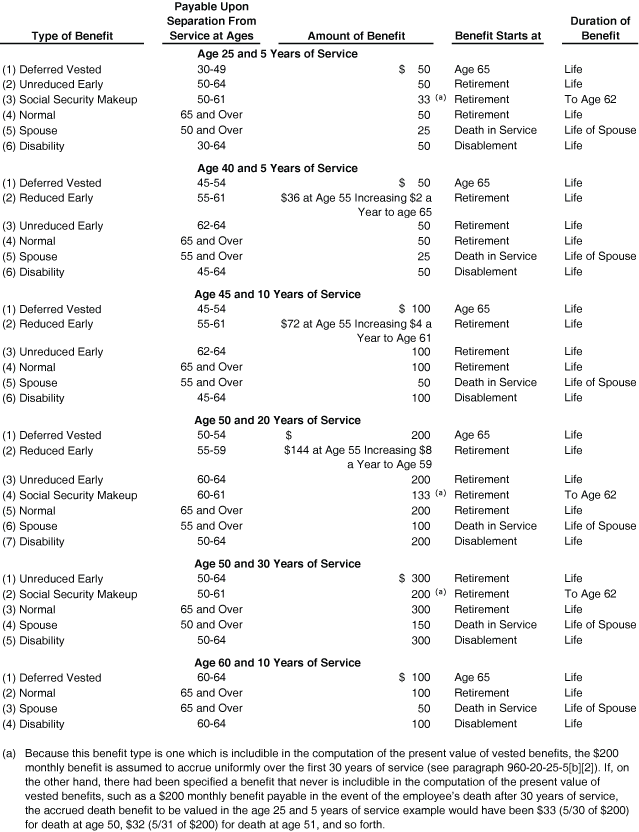 Type of Benefit Payable Upon Separation From Service at Ages Amount of Benefit Benefit Starts at Duration of Benefit Age 25 and 5 Years of Service (1) Deferred Vested 30-49 $50 Age 65 Life (2) Unreduced Early 50-64 50 Retirement Life (3) Social Security Makeup 50-61 33 (a) Retirement To Age 62 (4) Normal 65 and Over 50 Retirement Life (5) Spouse 50 and Over 25 Death in Service Life of Spouse (6) Disability 30-64 50 Disablement Life Age 40 and 5 Years of Service (1) Deferred Vested 45-54 $50 Age 65 Life (2) Reduced Early 55-61 $36 at Age 55 Increasing $2 a Year to age 65 Retirement Life (3) Unreduced Early 62-64 50 Retirement Life (4) Normal 65 and Over 50 Retirement Life (5) Spouse 55 and Over 25 Death in Service Life of Spouse (6) Disability 45-64 50 Disablement Life Age 45 and 10 Years of Service (1) Deferred Vested 45-54 $100 Age 65 Life (2) Reduced Early 55-61 $72 at Age 55 Increasing $4 a Year to Age 61 Retirement Life (3) Unreduced Early 62-64 100 Retirement Life (4) Normal 65 and Over 100 Retirement Life (5) Spouse 55 and Over 50 Death in Service Life of Spouse (6) Disability 45-64 100 Disablement Life Age 50 and 20 Years of Service (1) Deferred Vested 50-54 $200 Age 65 Life (2) Reduced Early 55-59 $144 at Age 55 Increasing $8 a Year to Age 59 Retirement Life (3) Unreduced Early 60-64 200 Retirement Life (4) Social Security Makeup 60-61 133 (a) Retirement To Age 62 (5) Normal 65 and Over 200 Retirement Life (6) Spouse 55 and Over 100 Death in Service Life of Spouse (7) Disability 50-64 200 Disablement Life Age 50 and 30 Years of Service (1) Unreduced Early 50-64 $300 Retirement Life (2) Social Security Makeup 50-61 200 (a) Retirement To Age 62 (3) Normal 65 and Over 300 Retirement Life (4) Spouse 50 and Over 150 Death in Service Life of Spouse (5) Disability 50-64 300 Disablement Life Age 60 and 10 Years of Service (1) Deferred Vested 60-64 $100 Age 65 Life (2) Normal 65 and Over 100 Retirement Life (3) Spouse 65 and Over 50 Death in Service Life of Spouse (4) Disability 60-64 100 Disablement Life (a) "Because this benefit type is one which is includible in the computation of the present value of vested benefits, the $200 monthly benefit is assumed to accrue uniformly over the first 30 years of service (see paragraph 960-20-25-5[b][2]). If, on the other hand, there had been specified a benefit that never is includible in the computation of the present value of vested benefits, such as a $200 monthly benefit payable in the event of the employee's death after 30 years of service, the accrued death benefit to be valued in the age 25 and 5 years of service example would have been $33 (5/30 of $200) for death at age 50, $32 (5/31 of $200) for death at age 51, and so forth."
-
 Age 25 and 5 Years of Service $33 (5/45 of $300) Age 50 and 20 Years of Service $171 (20/35 of $300)
Related subtopics
- 715-60 Defined Benefit Plans—Other PostretirementCompensation—Retirement Benefits
- 715-30 Defined Benefit Plans—PensionCompensation—Retirement Benefits
- 965-30 Plan Benefit ObligationsPlan Accounting—Health and Welfare Benefit Plans
- 205-960 Plan Accounting—Defined Benefit Pension PlansPresentation of Financial Statements
- 715-80 Multiemployer PlansCompensation—Retirement Benefits
- 715-10 OverallCompensation—Retirement Benefits