ASC 205-960
Plan Accounting—Defined Benefit Pension Plans
205 Presentation of Financial Statements
Source downloaded: .Record version c85bd16d2b53. Effective date must be checked in the source.
This Subtopic governs the form and content of the annual financial statements of a defined benefit pension plan. The overriding objective is to provide information useful in assessing the plan's present and future ability to pay benefits when due, with content focused on plan participants' needs (960-205-10-1 through 10-2). Annual statements must present net assets available for benefits, changes in those net assets, the actuarial present value of accumulated plan benefits, and the significant factors causing the year-to-year change in that actuarial present value (960-205-45-1).
Key points (7)
- A plan's annual financial statements must include net assets available for benefits at year-end, changes in net assets during the year, the actuarial present value of accumulated plan benefits as of the beginning or end of the plan year, and the significant effects of factors causing the year-to-year change in that actuarial present value (960-205-45-1).
- The objective is met only if net assets and the actuarial present value of accumulated plan benefits are presented as of the same date, and the changes in each are presented for the same period; if a beginning-of-year benefit information date is used, corresponding beginning-of-year net asset and prior-year change statements must also be presented (960-205-45-3 through 45-4).
- An end-of-year benefit information date is preferable, and interim benefit information dates are not permitted (960-205-45-4).
- A statement of cash flows is not required for a defined benefit pension plan reporting under this Subtopic, though it is encouraged where it would show the plan's ability to meet future obligations (960-205-45-6; 230-10-15-4).
- Each master trust interest and the change in that interest must be presented as separate line items in the statements of net assets available for benefits and of changes in net assets available for benefits (960-205-45-7).
- Required disclosures include a general description of the plan (vesting and benefit provisions), significant plan amendments, the priority order of claims on termination and PBGC guarantees, funding policy (including whether ERISA minimum funding requirements were met), insurance contract policies, tax status if no favorable determination letter, joint transactions with the sponsor/employer/employee organization, and significant post-benefit-information-date events (960-205-50-1).
- A plan with a 401(h) account must disclose the nature of those assets and that they are available only to pay retiree health benefits, and must reconcile net assets per the financial statements to Form 5500 with an explanation that 401(h) assets cannot pay pension benefits (960-205-50-4 through 50-5).
For students. Plan financial statements are unusual: there is no balance sheet/income statement pair and no required cash flow statement—instead the story is net assets versus the actuarial present value of accumulated plan benefits, which must be measured at the same date. A common mistake is thinking the comparison of net assets to accumulated benefits shows what each participant would receive on termination; the required PBGC/priority-order disclosure exists precisely to dispel that.
Machine-generated study aid for ASC 205-960. Check the source paragraphs below.
205-960-00Status
Source downloaded: .Record version b59de81249ba. Effective date must be checked in the source.
205-960-05Overview and Background
Source downloaded: .Record version a74de38f45cd. Effective date must be checked in the source.
205-960-10Objectives
Source downloaded: .Record version 9f4df0360ca1. Effective date must be checked in the source.
- aInformation in addition to that contained in a plan's financial statements is needed in assessing the plan's present and future ability to pay benefits when due.
- bFinancial statements for several plan years can provide information more useful in assessing the plan's future ability to pay benefits than can the financial statements for a single plan year (see paragraph 960-205-05-2).
- aAdvise or represent participants
- bAre present or potential investors or creditors of the employer(s)
- cAre responsible for funding the plan (for example, state legislators)
- dFor other reasons have a derived or indirect interest in the financial status of the plan.
- aPlan resources and how the stewardship responsibility for those resources has been discharged
- bThe accumulated plan benefits of participants
- cThe results of transactions and events that affect the information regarding those resources and benefits
- dOther factors necessary for users to understand the information provided.
205-960-15Scope and Scope Exceptions
Source downloaded: .Record version 92dfed87db19. Effective date must be checked in the source.
Overall Guidance
205-960-45Other Presentation Matters
Source downloaded: .Record version 728c4da731f4. Effective date must be checked in the source.
- a A statement that includes information regarding the net assets available for benefits as of the end of the plan year.
- b A statement that includes information regarding the changes during the year in the net assets available for benefits.
- c Information regarding the actuarial present value of accumulated plan benefits as of either the beginning or end of the plan year. Financial information presented as of the beginning of the year shall be the amounts as of the end of the preceding year. See paragraph 960-20-45-1 for related guidance.
- d Information regarding the effects, if significant, of certain factors affecting the year-to-year change in the actuarial present value of accumulated plan benefits.
Dates Used to Present Information
- a Information regarding both the net assets available for benefits and the actuarial present value of accumulated plan benefits is presented as of the same date.
- b Information regarding both the changes in net assets available for benefits and the changes in the actuarial present value of accumulated plan benefits is presented for the same period.
401(h) Account Information
Statement of Cash Flows
Interests in Master Trusts
205-960-50Disclosure
Source downloaded: .Record version d0507755963f. Effective date must be checked in the source.
- aA brief, general description of the plan agreement, including, but not limited to, vesting and benefit provisions. If a plan agreement or a description thereof providing this information is otherwise published and made available, this description may be omitted provided that reference to such other source is made.
- bA description of significant plan amendments adopted during the year ending on the latest benefit information date. If significant amendments were adopted between the latest benefit information date and the plan's year-end, it shall be indicated that the actuarial present value of accumulated plan benefits does not reflect those amendments.
- cA brief, general description of the priority order of participants' claims to the assets of the plan upon plan termination and benefits guaranteed by the Pension Benefit Guaranty Corporation, including a discussion of the application of its guaranty to any recent plan amendment. Such a description serves to alert participants that a comparison of total net assets with the total actuarial present value of accumulated plan benefits (or with the three minimum required categories of benefit information) does not necessarily indicate which benefits would be covered by plan assets in the event of plan termination. If material providing this information is otherwise published and made available to participants, the descriptions required by this paragraph may be omitted provided that reference to such other source is made and disclosure similar to the following is made in the financial statements.
- Should the plan terminate at some future time, its net assets generally will not be available on a pro rata basis to provide participants' benefits. Whether a particular participant's accumulated plan benefits will be paid depends on both the priority of those benefits and the level of benefits guaranteed by the Pension Benefit Guaranty Corporation at that time. Some benefits may be fully or partially provided for by the then existing assets and the Pension Benefit Guaranty Corporation guaranty while other benefits may not be provided for at all.
- dThe funding policy and any changes in such policy during the plan year. If significant costs of plan administration are being absorbed by the employer(s), that fact shall be disclosed. For a contributory plan, the disclosure shall state the method of determining participants' contributions. Plans subject to the Employee Retirement Income Security Act shall disclose whether the minimum funding requirements of the Act have been met. If a minimum funding waiver has been granted by the Internal Revenue Service (IRS) or if a request for a waiver is pending before the IRS, that fact shall be disclosed.
- eThe policy regarding the purchase of contracts with insurance entities that are excluded from plan assets. The plan's dividend income for the year that is related to excluded contracts shall be disclosed, and for purposes of paragraph 960-30-45-2 may be netted against payments to insurance entities related to such contracts as provided in (g) of that paragraph.
- fThe federal income tax status of the plan, if a favorable letter of determination has not been obtained or maintained. Disclosure of the plan's tax status is not proscribed in other circumstances.
- gSignificant real estate or other transactions in which the plan and any of the following parties are jointly involved:
- hUnusual or infrequent events or transactions occurring after the latest benefit information date but before the financial statements are issued or are available to be issued (as discussed in Section 855-10-25) that might significantly affect the usefulness of the financial statements in an assessment of the plan's present and future ability to pay benefits. For example, a plan amendment adopted after the latest benefit information date that significantly increases future benefits that are attributable to employees' service rendered before that date shall be disclosed. If reasonably determinable, the effects of such events or transactions shall be disclosed. If such effects are not quantified, the reasons why they are not reasonably determinable shall be disclosed. This guidance does not contemplate disclosure of normal changes after the benefit information date, such as benefits attributable to service rendered after that date.
Funding Policy
401(h) Accounts
205-960-55Implementation Guidance and Illustrations
Source downloaded: .Record version 65244e2e374f. Effective date must be checked in the source.
Illustrations
- a An end-of-year versus beginning-of-year benefit information date
- b Separate versus combined statements for presenting information regarding the following:
- 1
- 2 Changes in the net assets available for benefits and changes in the actuarial present value of accumulated plan benefits.
- c A separate statement that reconciles the year-to-year change in the actuarial present value of accumulated plan benefits versus presenting the effects of a change in actuarial assumptions on the face of the statement of accumulated plan benefits.
- Exhibit D-1
-
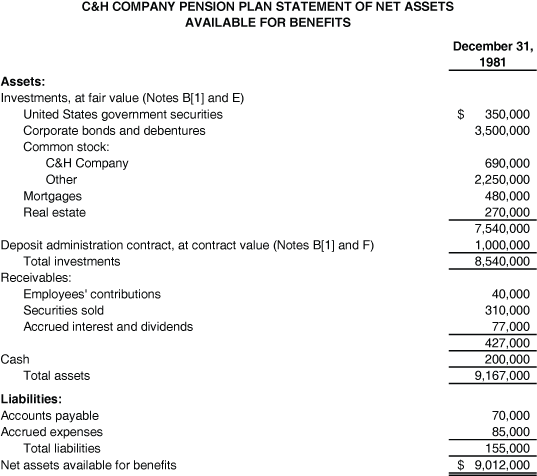 "C&H COMPANY PENSION PLAN STATEMENT OF NET ASSETS AVAILABLE FOR BENEFITS" "December 31, 1981" Assets: "Investments, at fair value (Notes B[1] and E)" United States government securities " $350,000 " Corporate bonds and debentures " 3,500,000 " Common stock: C&H Company " 690,000 " Other " 2,250,000 " Mortgages " 480,000 " Real estate " 270,000 " " 7,540,000 " "Deposit administration contract, at contract value (Notes B[1] and F)" " 1,000,000 " Total investments " 8,540,000 " Receivables: Employees' contributions " 40,000 " Securities sold " 310,000 " Accrued interest and dividends " 77,000 " " 427,000 " Cash " 200,000 " Total assets " 9,167,000 " Liabilities: Accounts payable " 70,000 " Accrued expenses " 85,000 " Total liabilities " 155,000 " Net assets available for benefits " $9,012,000 "
 - The accompanying notes are an integral part of the financial statements.
- Exhibit D-2
-
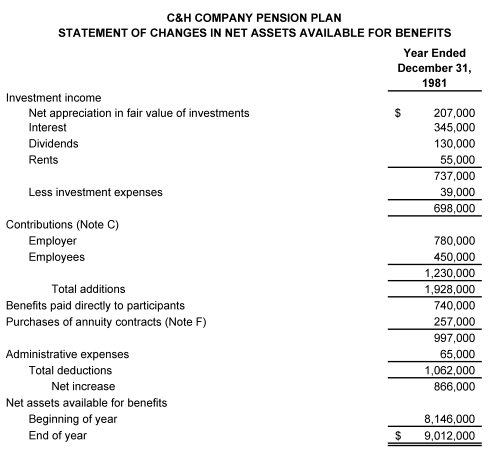 "C&H COMPANY PENSION PLAN STATEMENT OF CHANGES IN NET ASSETS AVAILABLE FOR BENEFITS" "Year Ended December 31, 1981" Investment income Net appreciation in fair value of investments " $207,000 " Interest " 345,000 " Dividends " 130,000 " Rents " 55,000 " " 737,000 " Less investment expenses " 39,000 " " 698,000 " Contributions (Note C) Employer " 780,000 " Employees " 450,000 " " 1,230,000 " Total additions " 1,928,000 " Benefits paid directly to participants " 740,000 " Purchases of annuity contracts (Note F) " 257,000 " " 997,000 " Administrative expenses " 65,000 " Total deductions " 1,062,000 " Net increase " 866,000 " Net assets available for benefits Beginning of year " 8,146,000 " End of year " $9,012,000 "
 - The accompanying notes are an integral part of the financial statements.
- Exhibit D-3
-
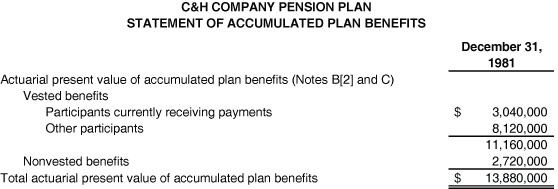 C&H COMPANY PENSION PLAN STATEMENT OF ACCUMULATED PLAN BENEFITS "December 31, 1981" Actuarial present value of accumulated plan benefits (Notes B[2] and C) Vested benefits Participants currently receiving payments " $3,040,000 " Other participants " 8,120,000 " " 11,160,000 " Nonvested benefits " 2,720,000 " Total actuarial present value of accumulated plan benefits " $13,880,000 "
 - The accompanying notes are an integral part of the financial statements.
- Exhibit D-4
-
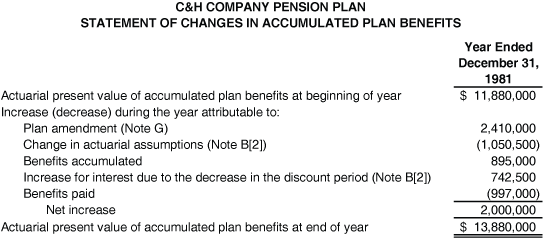 "C&H COMPANY PENSION PLAN STATEMENT OF CHANGES IN ACCUMULATED PLAN BENEFITS" "Year Ended December 31, 1981" Actuarial present value of accumulated plan benefits at beginning of year " $11,880,000 " Increase (decrease) during the year attributable to: Plan amendment (Note G) " 2,410,000 " Change in actuarial assumptions (Note B[2]) " (1,050,500)" Benefits accumulated " 895,000 " Increase for interest due to the decrease in the discount period (Note B[2]) " 742,500 " Benefits paid " (997,000)" Net increase " 2,000,000 " Actuarial present value of accumulated plan benefits at end of year " $13,880,000 "
 - The accompanying notes are an integral part of the financial statements.
- Exhibit D-5
-
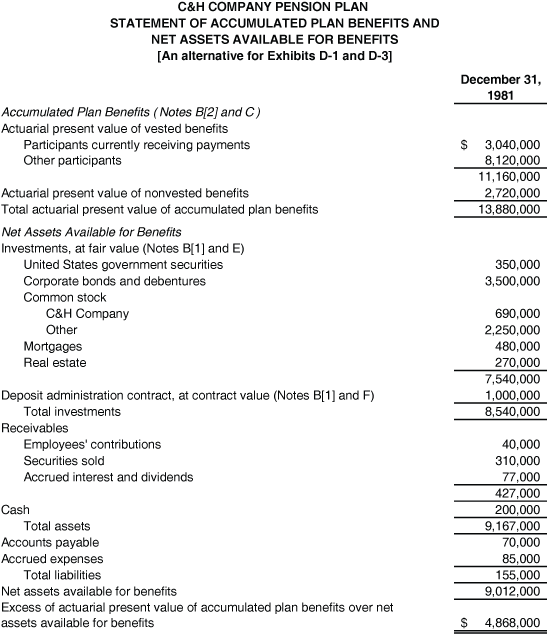 C&H COMPANY PENSION PLAN STATEMENT OF ACCUMULATED PLAN BENEFITS AND NET ASSETS AVAILABLE FOR BENEFITS [An alternative for Exhibits D-1 and D-3] "December 31, 1981" Accumulated Plan Benefits (Notes B[2] and C) Actuarial present value of vested benefits Participants currently receiving payments " $3,040,000 " Other participants " 8,120,000 " " 11,160,000 " Actuarial present value of nonvested benefits " 2,720,000 " Total actuarial present value of accumulated plan benefits " 13,880,000 " Net Assets Available for Benefits "Investments, at fair value (Notes B[1] and E)" United States government securities " 350,000 " Corporate bonds and debentures " 3,500,000 " Common stock C&H Company " 690,000 " Other " 2,250,000 " Mortgages " 480,000 " Real estate " 270,000 " " 7,540,000 " "Deposit administration contract, at contract value (Notes B[1] and F)" " 1,000,000 " Total investments " 8,540,000 " Receivables Employees' contributions " 40,000 " Securities sold " 310,000 " Accrued interest and dividends " 77,000 " " 427,000 " Cash " 200,000 " Total assets " 9,167,000 " Accounts payable " 70,000 " Accrued expenses " 85,000 " Total liabilities " 155,000 " Net assets available for benefits " 9,012,000 " Excess of actuarial present value of accumulated plan benefits over net assets available for benefits " $4,868,000 "
 - The accompanying notes are an integral part of the financial statements.
- Exhibit D-6
-
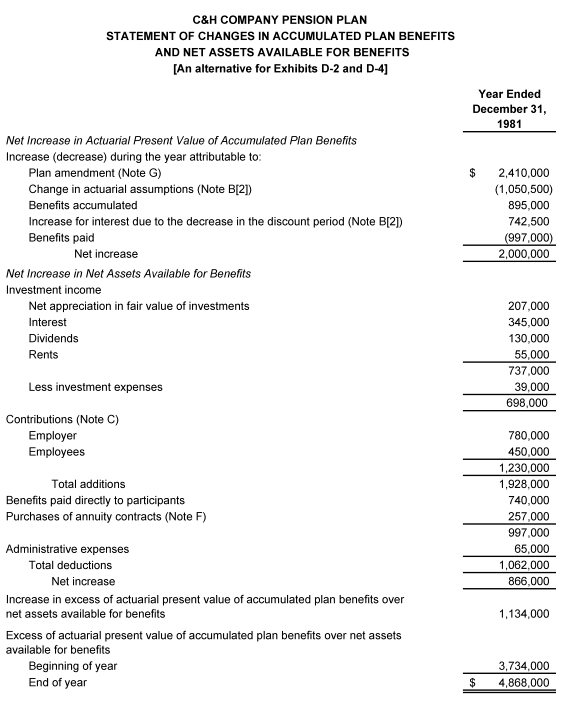 C&H COMPANY PENSION PLAN STATEMENT OF CHANGES IN ACCUMULATED PLAN BENEFITS AND NET ASSETS AVAILABLE FOR BENEFITS [An alternative for Exhibits D-2 and D-4] "Year Ended December 31, 1981" Net Increase in Actuarial Present Value of Accumulated Plan Benefits Increase (decrease) during the year attributable to: Plan amendment (Note G) " $2,410,000 " Change in actuarial assumptions (Note B[2]) " (1,050,500)" Benefits accumulated " 895,000 " Increase for interest due to the decrease in the discount period (Note B[2]) " 742,500 " Benefits paid " (997,000)" Net increase " 2,000,000 " Net Increase in Net Assets Available for Benefits Investment income Net appreciation in fair value of investments " 207,000 " Interest " 345,000 " Dividends " 130,000 " Rents " 55,000 " " 737,000 " Less investment expenses " 39,000 " " 698,000 " Contributions (Note C) Employer " 780,000 " Employees " 450,000 " " 1,230,000 " Total additions " 1,928,000 " Benefits paid directly to participants " 740,000 " Purchases of annuity contracts (Note F) " 257,000 " " 997,000 " Administrative expenses " 65,000 " Total deductions " 1,062,000 " Net increase " 866,000 " Increase in excess of actuarial present value of accumulated plan benefits over net assets available for benefits " 1,134,000 " Excess of actuarial present value of accumulated plan benefits over net assets available for benefits Beginning of year " 3,734,000 " End of year " $4,868,000 "
 - The accompanying notes are an integral part of the financial statements.
- Exhibit D-7
-
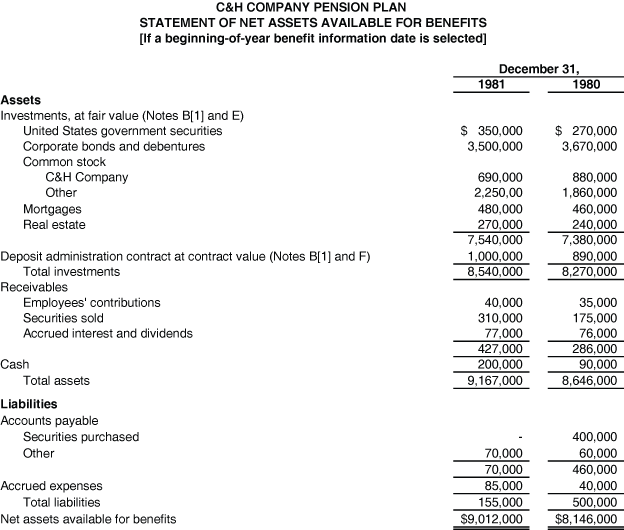 C&H COMPANY PENSION PLAN STATEMENT OF NET ASSETS AVAILABLE FOR BENEFITS [If a beginning-of-year benefit information date is selected] "December 31," 1981 1980 Assets "Investments, at fair value (Notes B[1] and E)" United States government securities " $350,000 " " $270,000 " Corporate bonds and debentures " 3,500,000 " " 3,670,000 " Common stock C&H Company " 690,000 " " 880,000 " Other " 2,250,00 " " 1,860,000 " Mortgages " 480,000 " " 460,000 " Real estate " 270,000 " " 240,000 " " 7,540,000 " " 7,380,000 " Deposit administration contract at contract value (Notes B[1] and F) " 1,000,000 " " 890,000 " Total investments " 8,540,000 " " 8,270,000 " Receivables Employees' contributions " 40,000 " " 35,000 " Securities sold " 310,000 " " 175,000 " Accrued interest and dividends " 77,000 " " 76,000 " " 427,000 " " 286,000 " Cash " 200,000 " " 90,000 " Total assets " 9,167,000 " " 8,646,000 " Liabilities Accounts payable Securities purchased - " 400,000 " Other " 70,000 " " 60,000 " " 70,000 " " 460,000 " Accrued expenses " 85,000 " " 40,000 " Total liabilities " 155,000 " " 500,000 " Net assets available for benefits " $9,012,000 " " $8,146,000 "
 - The accompanying notes are an integral part of the financial statements.
- Exhibit D-8
-
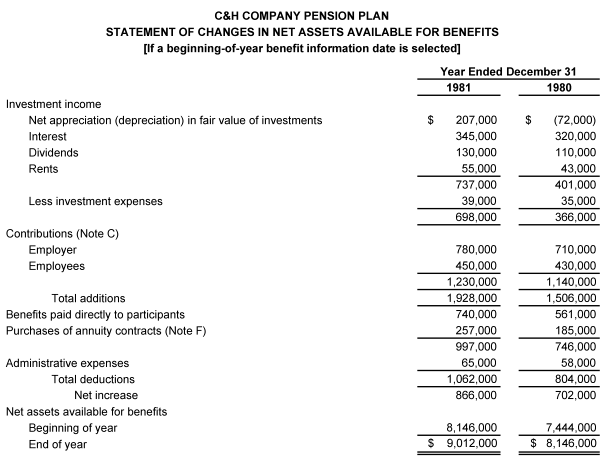 C&H COMPANY PENSION PLAN STATEMENT OF CHANGES IN NET ASSETS AVAILABLE FOR BENEFITS [If a beginning-of-year benefit information date is selected] Year Ended December 31 1981 1980 Investment income Net appreciation (depreciation) in fair value of investments (Note E) " $207,000 " " $(72,000)" Interest " 345,000 " " 320,000 " Dividends " 130,000 " " 110,000 " Rents " 55,000 " " 43,000 " " 737,000 " " 401,000 " Less investment expenses " 39,000 " " 35,000 " " 698,000 " " 366,000 " Contributions (Note C) Employer " 780,000 " " 710,000 " Employees " 450,000 " " 430,000 " " 1,230,000 " " 1,140,000 " Total additions " 1,928,000 " " 1,506,000 " Benefits paid directly to participants " 740,000 " " 561,000 " Purchases of annuity contracts (Note F) " 257,000 " " 185,000 " " 997,000 " " 746,000 " Administrative expenses " 65,000 " " 58,000 " Total deductions " 1,062,000 " " 804,000 " Net increase " 866,000 " " 702,000 " Net assets available for benefits Beginning of year " 8,146,000 " " 7,444,000 " End of year " $9,012,000 " " $8,146,000 "
 - The accompanying notes are an integral part of the financial statements.
- Exhibit D-9
-
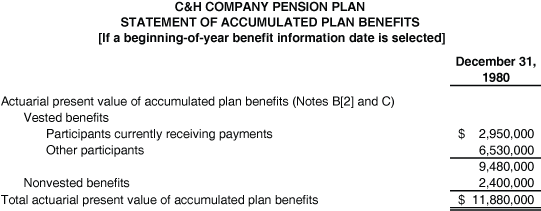 C&H COMPANY PENSION PLAN STATEMENT OF ACCUMULATED PLAN BENEFITS [If a beginning-of-year benefit information date is selected] "December 31, 1980" Actuarial present value of accumulated plan benefits (Notes B[2] and C) Vested benefits Participants currently receiving payments " $2,950,000 " Other participants " 6,530,000 " " 9,480,000 " Nonvested benefits " 2,400,000 " Total actuarial present value of accumulated plan benefits " $11,880,000 "
 - At December 31, 1979, the total actuarial present value of accumulated plan benefits was $10,544,000.
- During 19X0 the actuarial present value of accumulated plan benefits increased $700,000 as a result of a change in actuarial assumptions (Note B(2)). Also see Note G.
- The accompanying notes are an integral part of the financial statements.
- C&H COMPANY PENSION PLAN
- Notes to Financial Statements
- [Note: The notes are for the accompanying illustrative financial statements that use an end-of-year benefit information date. Modifications necessary to accompany the illustrative financial statements that use a beginning-of-year benefit information date are bracketed.]
- A. Description of Plan
- The following brief description of the C&H Company Pension Plan (Plan) is provided for general information purposes only.
- Participants should see the Plan agreement for more complete information.
- 1 General. The Plan is a defined benefit pension plan covering substantially all employees of C&H Company (Company). It is subject to the provisions of the Employee Retirement Income Security Act of 1974.
- 2 Pension Benefits. Employees with 10 or more years of service are entitled to annual pension benefits beginning at normal retirement age (65) equal to 1 1/2% of their final 5-year average annual compensation for each year of service.The Plan permits early retirement at ages 55-64. Employees may elect to receive their pension benefits in the form of a joint and survivor annuity.If employees terminate before rendering 10 years of service, they forfeit the right to receive the portion of their accumulated plan benefits attributable to the Company's contributions.Employees may elect to receive the value of their accumulated plan benefits as a lump-sum distribution upon retirement or termination, or they may elect to receive their benefits as a life annuity payable monthly from retirement.For each employee electing a life annuity, payments will not be less than the greater of the employee's accumulated contributions plus interest or an annuity for five years.
- 3 Death and Disability Benefits. If an active employee dies at age 55 or older, a death benefit equal to the value of the employee's accumulated pension benefits is paid to the employee's beneficiary.Active employees who become totally disabled receive annual disability benefits that are equal to the normal retirement benefits they have accumulated as of the time they become disabled.Disability benefits are paid until normal retirement age at which time disabled participants begin receiving normal retirement benefits computed as though they had been employed to normal retirement age with their annual compensation remaining the same as at the time they became disabled.
- 1
- B. Summary of Accounting Policies
- The following are the significant accounting policies followed by the Plan:
- 1 Valuation of Investments. If available, quoted market prices are used to value investments. The amounts shown in Note E for securities that have no quoted market price represent estimated fair value. Many factors are considered in arriving at that fair value. In general, however, corporate bonds are valued based on yields currently available on comparable securities of issuers with similar credit ratings. Investments in certain restricted common stocks are valued at the quoted market price of the issuer's unrestricted common stock less an appropriate discount. If a quoted market price for unrestricted common stock of the issuer is not available, restricted common stocks are valued at a multiple of current earnings less an appropriate discount. The multiple chosen is consistent with multiples of similar companies based on current market prices.Mortgages have been valued on the basis of their future principal and interest payments discounted at prevailing interest rates for similar instruments. The fair value of real estate investments, principally rental property subject to long-term net leases, has been estimated on the basis of future rental receipts and estimated residual values discounted at interest rates commensurate with the risks involved.The Plan's deposit administration contract with the National Insurance Company (National) (Note F) is valued at contract value. Contract value represents contributions made under the contract, plus interest at the contract rate, less funds used to purchase annuities and pay administration expenses charged by National. Funds under the contract that have been allocated and applied to purchase annuities (that is, National is obligated to pay the related pension benefits) are excluded from the Plan's assets.
- 2 Actuarial Present Value of Accumulated Plan Benefits. Accumulated plan benefits are those future periodic payments, including lump-sum distributions, that are attributable under the Plan's provisions to the service employees have rendered. Accumulated plan benefits include benefits expected to be paid to retired or terminated employees or their beneficiaries, beneficiaries of employees who have died, and present employees or their beneficiaries. Benefits under the Plan are based on employees' compensation during their last five years of credited service. The accumulated plan benefits for active employees are based on their average compensation during the five years ending on the date as of which the benefit information is presented (the valuation date). Benefits payable under all circumstances—retirement, death, disability, and termination of employment—are included, to the extent they are deemed attributable to employee service rendered to the valuation date. Benefits to be provided via annuity contracts excluded from plan assets are excluded from accumulated plan benefits.The actuarial present value of accumulated plan benefits is determined by an actuary from the AAA Company and is that amount that results from applying actuarial assumptions to adjust the accumulated plan benefits to reflect the time value of money (through discounts for interest) and the probability of payment (by means of decrements such as for death, disability, withdrawal, or retirement) between the valuation date and the expected date of payment. The significant actuarial assumptions used in the valuations as of December 31, 1981 [1980], and December 31, 1980 [1979], were life expectancy of participants (the 1971 Group Annuity Mortality Table was used), retirement age assumptions (the assumed average retirement age was 60), and investment return. The 1981 [1980] and 1980 [1979] valuations included assumed average rates of return of 7% [6.25%] and 6.25% [6.75%], respectively, including a reduction of .2% to reflect anticipated administrative expenses associated with providing benefits. The foregoing actuarial assumptions are based on the presumption that the Plan will continue. Were the Plan to terminate, different actuarial assumptions and other factors might be applicable in determining the actuarial present value of accumulated plan benefits.
- 1
- As a condition of participation, employees are required to contribute 3% of their salary to the Plan. Present employees' accumulated contributions at December 31, 1981 [1980], were $2,575,000 [$2,325,000], including interest credited at an interest rate of 5% compounded annually. The Company's funding policy is to make annual contributions to the Plan in amounts that are estimated to remain a constant percentage of employees' compensation each year (approximately 5% for 1981 [and 1980]), such that, when combined with employees' contributions, all employees' benefits will be fully provided for by the time they retire. Beginning in 1982, the Company's contribution is expected to increase to approximately 6% to provide for the increase in benefits attributable to the Plan amendment effective July 1, 1981 (Note G). The Company's contributions for 1981 [and 1980] exceeded the minimum funding requirements of the Employee Retirement Income Security Act.
- Although it has not expressed any intention to do so, the Company has the right under the Plan to discontinue its contributions at any time and to terminate the Plan subject to the provisions set forth in the Employee Retirement Income Security Act.
- D. Plan Termination
- In the event the Plan terminates, the net assets of the Plan will be allocated, as prescribed by the Employee Retirement Income Security Act and its related regulations, generally to provide the following benefits in the order indicated:
- a Benefits attributable to employee contributions, taking into account those paid out before termination.
- b Annuity benefits former employees or their beneficiaries have been receiving for at least three years, or that employees eligible to retire for that three-year period would have been receiving if they had retired with benefits in the normal form of annuity under the Plan. The priority amount is limited to the lowest benefit that was payable (or would have been payable) during those three years. The amount is further limited to the lowest benefit that would be payable under plan provisions in effect at any time during the five years preceding plan termination.
- c Other vested benefits insured by the Pension Benefit Guaranty Corporation (a U.S. governmental agency) up to the applicable limitations (discussed below).
- d All other vested benefits (that is, vested benefits not insured by the Pension Benefit Guaranty Corporation).
- e All nonvested benefits.
- a
- Benefits to be provided via contracts under which National (Note F) is obligated to pay the benefits would be excluded for allocation purposes.
- Certain benefits under the Plan are insured by the Pension Benefit Guaranty Corporation if the Plan terminates. Generally, the Pension Benefit Guaranty Corporation guarantees most vested normal age retirement benefits, early retirement benefits, and certain disability and survivor's pensions. However, the Pension Benefit Guaranty Corporation does not guarantee all types of benefits under the Plan, and the amount of benefit protection is subject to certain limitations. Vested benefits under the Plan are guaranteed at the level in effect on the date of the Plan's termination. However, there is a statutory ceiling on the amount of an individual's monthly benefit that the Pension Benefit Guaranty Corporation guarantees. For plan terminations occurring during 1981 and 1980, that ceiling, which is adjusted periodically, was $X,XXX.XX and $1,159.09 per month, respectively. That ceiling applies to those pensioners who elect to receive their benefits in the form of a single-life annuity and are at least 65 years old at the time of retirement or plan termination (whichever comes later). For younger annuitants or for those who elect to receive their benefits in some form more valuable than a single-life annuity, the corresponding ceilings are actuarially adjusted downward. Benefit improvements attributable to the Plan amendment effective July 1, 1981 (Note G), may not be fully guaranteed even though total benefit entitlements fall below the aforementioned ceilings. For example, none of the improvement would be guaranteed if the plan were to terminated before July 1, 1982. After that date the Pension Benefit Guaranty Corporation would guarantee 20% of any benefit improvements that resulted in benefits below the ceiling, with an additional 20% guaranteed each year the plan continued beyond July 1, 1982. If the amount of the benefit increase below the ceiling is also less than $100, $20 of the increase (rather than 20%) becomes guaranteed by the Pension Benefit Guaranty Corporation each year following the effective date of the amendment. As a result, only the primary ceiling would be applicable after July 1, 1986.
- Whether all participants receive their benefits should the Plan terminate at some future time will depend on the sufficiency, at that time, of the Plan's net assets to provide those benefits and may also depend on the level of benefits guaranteed by the Pension Benefit Guaranty Corporation.
- E. Investments Other Than Contract with Insurance Entity
- Except for its deposit administration contract (Note F), the Plan's investments are held by a bank-administered trust fund. (See paragraph 962-325-55-17 for a detailed Example of plan investment disclosures.)
- F. Contract with Insurance Entity
- In 1978, the Company entered into a deposit administration contract with the National Insurance Company under which the Plan deposits a minimum of $100,000 a year. National maintains the contributions in an unallocated fund to which it adds interest at a rate of 8%. The interest rate is guaranteed through 1983 but is subject to change for each succeeding five-year period. When changed, the new rate applies only to funds deposited from the date of change. At the direction of the Plan's administrator, a single premium to buy an annuity for a retiring employee is withdrawn by National from the unallocated fund. Purchased annuities are contracts under which National is obligated to pay benefits to named employees or their beneficiaries. The premium rates for such annuities to be purchased in the future and maximum administration expense charges against the fund are also guaranteed by National on a five-year basis. The annuity contracts provide for periodic dividends at National's discretion on the basis of its experience under the contracts. Such dividends received by the Plan for the year[s] ended December 31, 1981, [and 1980] were $25,000 [and $24,000, respectively]. In reporting changes in net assets, those dividends have been netted against amounts paid to National for the purchase of annuity contracts.
- G. Plan Amendment
- Effective July 1, 1981, the Plan was amended to increase future annual pension benefits from 1 1/4% to 1 1/2% of final 5-year average annual compensation for each year of service, including service rendered before the effective date. The retroactive effect of the Plan amendment, an increase in the actuarial present value of accumulated plan benefits of $2,410,000, was accounted for in the year ended December 31, 1981. [The actuarial present values of accumulated plan benefits at December 31, 1980, and December 31, 1979, do not reflect the effect of that Plan amendment. The Plan's actuary estimates that the amendment's retroactive effect on the actuarial present value of accumulated plan benefits at December 31, 1980, was an increase of approximately $1,750,000, of which approximately $1,300,000 represents an increase in vested benefits.]
- H. Accounting Changes
- In 1981, the Plan changed its method of accounting and reporting to comply with the provisions of the defined benefit plan accounting standard issued by the Financial Accounting Standards Board. Previously reported financial information pertaining to 1980 [and 1979] has been restated to present that information on a comparable basis.
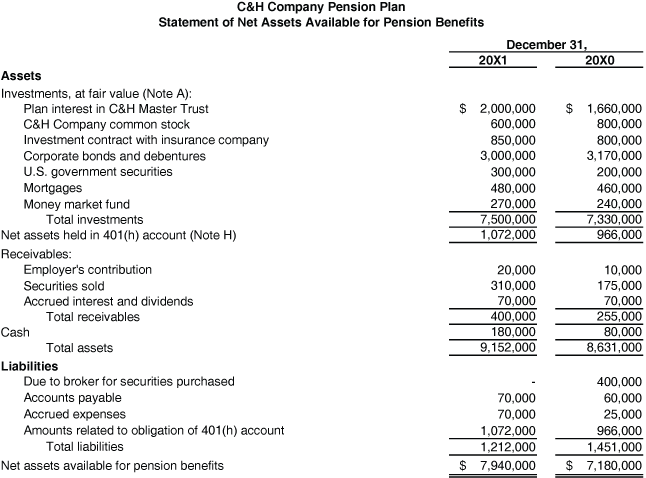 C&H Company Pension Plan Statement of Net Assets Available for Pension Benefits "December 31," 20X1 20X0 Assets "Investments, at fair value (Note A):" Plan interest in C&H Master Trust " $2,000,000 " " $1,660,000 " C&H Company common stock " 600,000 " " 800,000 " Investment contract with insurance company " 850,000 " " 800,000 " Corporate bonds and debentures " 3,000,000 " " 3,170,000 " U.S. government securities " 300,000 " " 200,000 " Mortgages " 480,000 " " 460,000 " Money market fund " 270,000 " " 240,000 " Total investments " 7,500,000 " " 7,330,000 " Net assets held in 401(h) account (Note H) " 1,072,000 " " 966,000 " Receivables: Employer's contribution " 20,000 " " 10,000 " Securities sold " 310,000 " " 175,000 " Accrued interest and dividends " 70,000 " " 70,000 " Total receivables " 400,000 " " 255,000 " Cash " 180,000 " " 80,000 " Total assets " 9,152,000 " " 8,631,000 " Liabilities Due to broker for securities purchased - " 400,000 " Accounts payable " 70,000 " " 60,000 " Accrued expenses " 70,000 " " 25,000 " Amounts related to obligation of 401(h) account " 1,072,000 " " 966,000 " Total liabilities " 1,212,000 " " 1,451,000 " Net assets available for pension benefits " $7,940,000 " " $7,180,000 "
- The accompanying notes are an integral part of the financial statements.
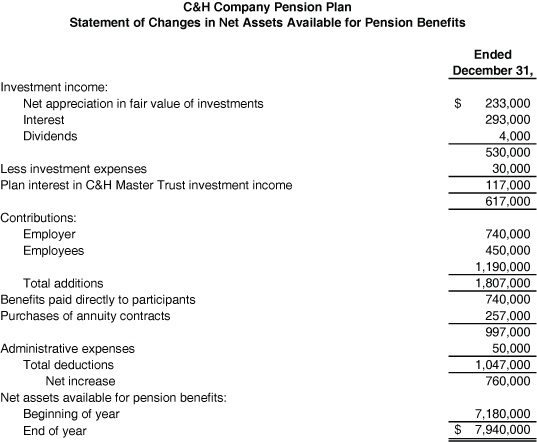 C&H Company Pension Plan Statement of Changes in Net Assets Available for Pension Benefits "For the Year Ended December 31, 20X1" Investment income: Net appreciation in fair value of investments " $233,000 " Interest " 293,000 " Dividends " 4,000 " " 530,000 " Less investment expenses " 30,000 " Plan interest in C&H Master Trust investment income " 117,000 " " 617,000 " Contributions: Employer " 740,000 " Employees " 450,000 " " 1,190,000 " Total additions " 1,807,000 " Benefits paid directly to participants " 740,000 " Purchases of annuity contracts " 257,000 " " 997,000 " Administrative expenses " 50,000 " Total deductions " 1,047,000 " Net increase " 760,000 " Net assets available for pension benefits: Beginning of year " 7,180,000 " End of year " $7,940,000 "
- The accompanying notes are an integral part of the financial statements.
- Notes to Financial Statements
- A. 401 (h) Account
- Effective January 1, 19X0, the Plan was amended to include a medical-benefit component in addition to the normal retirement benefits to fund a portion of the postretirement obligations for retirees and their beneficiaries in accordance with Section 401(h) of the Internal Revenue Code. A separate account has been established and maintained in the Plan for the net assets related to the medical-benefit component (401(h) account). In accordance with Internal Revenue Code Section 401(h), the Plan's investments in the 401(h) account may not be used for, or diverted to, any purpose other than providing health benefits for retirees and their beneficiaries. Any assets transferred to the 401(h) account from the defined benefit pension plan in a qualified transfer of excess pension plan assets (and any income allocable thereto) that are not used during the plan year must be transferred out of the account to the pension plan. The related obligations for health benefits are not included in this Plan's obligations in the statement of accumulated plan benefits but are reflected as obligations in the financial statements of the health and welfare benefit plan. Plan participants do not contribute to the 401(h) account. Employer contributions or qualified transfers to the 401(h) account are determined annually and are at the discretion of the Plan Sponsor. Certain of the Plan's net assets are restricted to fund a portion of postretirement health benefits for retirees and their beneficiaries in accordance with Internal Revenue Code Section 401(h).
- H. Reconciliation of Financial Statements to Form 5500
- [Note: The reconciliation of amounts reported in the plan's financial statements to amounts reported in Form 5500 is required by the Employee Retirement Income Security Act.]
- The following is a reconciliation of net assets available for pension benefits per the financial statements to the Form 5500.
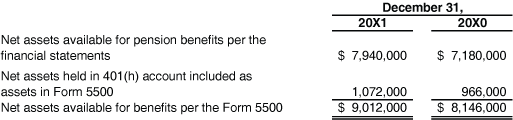 "December 31," 20X1 20X0 Net assets available for pension benefits per the financial statements " $7,940,000 " " $7,180,000 " "Net assets held in 401(h) account included as assets in Form 5500" " 1,072,000 " " 966,000 " Net assets available for benefits per the Form 5500 " $9,012,000 " " $8,146,000 "
- The net assets of the 401(h) account included in Form 5500 are not available to pay pension benefits but can be used only to pay retiree health benefits.
- The following is a reconciliation of the changes in net assets per the financial statements to the Form 5500.
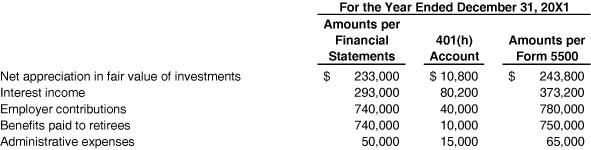 "For the Year Ended December 31, 20X1" Amounts per Financial Statements 401(h) Account Amounts per Form 5500 Net appreciation in fair value of investments " $233,000 " " $10,800 " " $243,800 " Interest income " 293,000 " " 80,200 " " 373,200 " Employer contributions " 740,000 " " 40,000 " " 780,000 " Benefits paid to retirees " 740,000 " " 10,000 " " 750,000 " Administrative expenses " 50,000 " " 15,000 " " 65,000 "
- H. Reconciliation of Financial Statements to Form 5500
- [Note: The reconciliation of amounts reported in plan financial statements to amounts reported in Form 5500 is required by the Employee Retirement Income Security Act.]
- The following is a reconciliation of net assets available for benefits per the financial statements to the Form 5500.
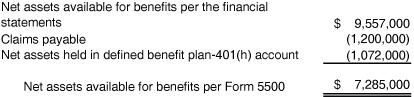 Net assets available for benefits per the financial statements " $9,557,000 " Claims payable " (1,200,000)" Net assets held in defined benefit plan-401(h) account " (1,072,000)" Net assets available for benefits per Form 5500 " $7,285,000 "
Related subtopics
- 325-962 Plan Accounting—Defined Contribution Pension PlansInvestments—Other
- 205-965 Plan Accounting—Health and Welfare Benefit PlansPresentation of Financial Statements
- 960-20 Accumulated Plan BenefitsPlan Accounting—Defined Benefit Pension Plans
- 205-962 Plan Accounting—Defined Contribution Pension PlansPresentation of Financial Statements
- 715-80 Multiemployer PlansCompensation—Retirement Benefits
- 715-20 Defined Benefit Plans—GeneralCompensation—Retirement Benefits