ASC 205-40
Going Concern
205 Presentation of Financial Statements
Source downloaded: .Record version 0d6bad2d386b. Effective date must be checked in the source.
ASC 205-40 requires management of every entity, in connection with preparing annual and interim financial statements, to evaluate whether conditions and events considered in the aggregate raise substantial doubt about the entity's ability to continue as a going concern within one year after the date the financial statements are issued (or are available to be issued). Substantial doubt exists when it is probable the entity will be unable to meet its obligations as they become due in that lookforward period, assessed initially without regard to unimplemented management plans. Depending on whether management's plans alleviate that doubt, prescribed note disclosures — including an express "substantial doubt" statement when doubt is not alleviated — are required.
Key points (7)
- The going concern basis of accounting is presumed unless and until liquidation becomes imminent, at which point the liquidation basis under Subtopic 205-30 applies (205-40-05-1).
- Management must perform the going concern evaluation each annual and interim reporting period, using a one-year-after-issuance lookforward period and conditions known and reasonably knowable at the issuance date (205-40-50-1; 205-40-50-3).
- Substantial doubt exists when relevant conditions and events, in the aggregate, indicate it is probable the entity will be unable to meet its obligations as they become due within one year after issuance; the initial evaluation excludes the mitigating effect of plans not fully implemented (205-40-50-4).
- Management's plans may be considered in alleviating substantial doubt only if it is probable both that the plans will be effectively implemented and that, when implemented, they will mitigate the relevant conditions or events (205-40-50-7); approval of the plan before the issuance date is generally required (205-40-50-8).
- A plan to meet obligations through liquidation cannot be considered in evaluating whether substantial doubt is alleviated, even if liquidation is probable (205-40-50-11).
- If plans alleviate substantial doubt, disclose the principal conditions or events, management's evaluation of their significance, and the plans that alleviated the doubt (205-40-50-12); if doubt is not alleviated, additionally include an explicit statement that substantial doubt exists (205-40-50-13).
- Disclosures continue and become more extensive in subsequent periods, with context and continuity, and in the period substantial doubt no longer exists the entity discloses how the conditions or events were resolved (205-40-50-14).
For students. Exam favorite: the assessment window runs one year from the date the financial statements are ISSUED (not the balance sheet date), and the threshold is "probable," not "reasonably possible." The most common mistake is netting management's unimplemented rescue plans into the initial assessment — plans are considered only in the second step, and only if both implementation and mitigation are probable.
Machine-generated study aid for ASC 205-40. Check the source paragraphs below.
205-40-00Status
Source downloaded: .Record version b5193c16b48e. Effective date must be checked in the source.
205-40-05Overview and Background
Source downloaded: .Record version 441eb68fbcb4. Effective date must be checked in the source.
205-40-15Scope and Scope Exceptions
Source downloaded: .Record version a6da67a1bd93. Effective date must be checked in the source.
Entities
205-40-50Disclosure
Source downloaded: .Record version da932bcb4bbc. Effective date must be checked in the source.
Evaluating Conditions and Events That May Raise Substantial Doubt
- aThe entity's current financial condition, including its liquidity sources at the date that the financial statements are issued (for example, available liquid funds and available access to credit)
- bThe entity's conditional and unconditional obligations due or anticipated within one year after the date that the financial statements are issued (regardless of whether those obligations are recognized in the entity's financial statements)
- cThe funds necessary to maintain the entity's operations considering its current financial condition, obligations, and other expected cash flows within one year after the date that the financial statements are issued
- dThe other conditions and events, when considered in conjunction with (a), (b), and (c) above, that may adversely affect the entity's ability to meet its obligations within one year after the date that the financial statements are issued. See paragraph 205-40-55-2 for examples of those conditions and events.
Consideration of Management's Plans When Substantial Doubt Is Raised
- aIt is probable that management's plans will be effectively implemented within one year after the date that the financial statements are issued.
- bIt is probable that management's plans, when implemented, will mitigate the relevant conditions or events that raise substantial doubt about the entity's ability to continue as a going concern within one year after the date that the financial statements are issued.
Disclosures When Substantial Doubt Is Raised but Is Alleviated by Management's Plans (Substantial Doubt Does Not Exist)
- aPrincipal conditions or events that raised substantial doubt about the entity's ability to continue as a going concern (before consideration of management's plans)
- bManagement's evaluation of the significance of those conditions or events in relation to the entity's ability to meet its obligations
- cManagement's plans that alleviated substantial doubt about the entity's ability to continue as a going concern.
- aPrincipal conditions or events that raised substantial doubt about the entity's ability to continue as a going concern (before consideration of management's plans)
- bManagement's evaluation of the significance of those conditions or events in relation to the entity's ability to meet its obligations
- cManagement's plans that alleviated substantial doubt about the entity's ability to continue as a going concern.
Disclosures When Substantial Doubt Is Raised and Is Not Alleviated (Substantial Doubt Exists)
- aPrincipal conditions or events that raise substantial doubt about the entity's ability to continue as a going concern
- bManagement's evaluation of the significance of those conditions or events in relation to the entity's ability to meet its obligations
- cManagement's plans that are intended to mitigate the conditions or events that raise substantial doubt about the entity's ability to continue as a going concern.
- aPrincipal conditions or events that raise substantial doubt about the entity's ability to continue as a going concern
- bManagement's evaluation of the significance of those conditions or events in relation to the entity's ability to meet its obligations
- cManagement's plans that are intended to mitigate the conditions or events that raise substantial doubt about the entity's ability to continue as a going concern.
205-40-55Implementation Guidance and Illustrations
Source downloaded: .Record version 8814a193fe23. Effective date must be checked in the source.
Implementation Guidance
-
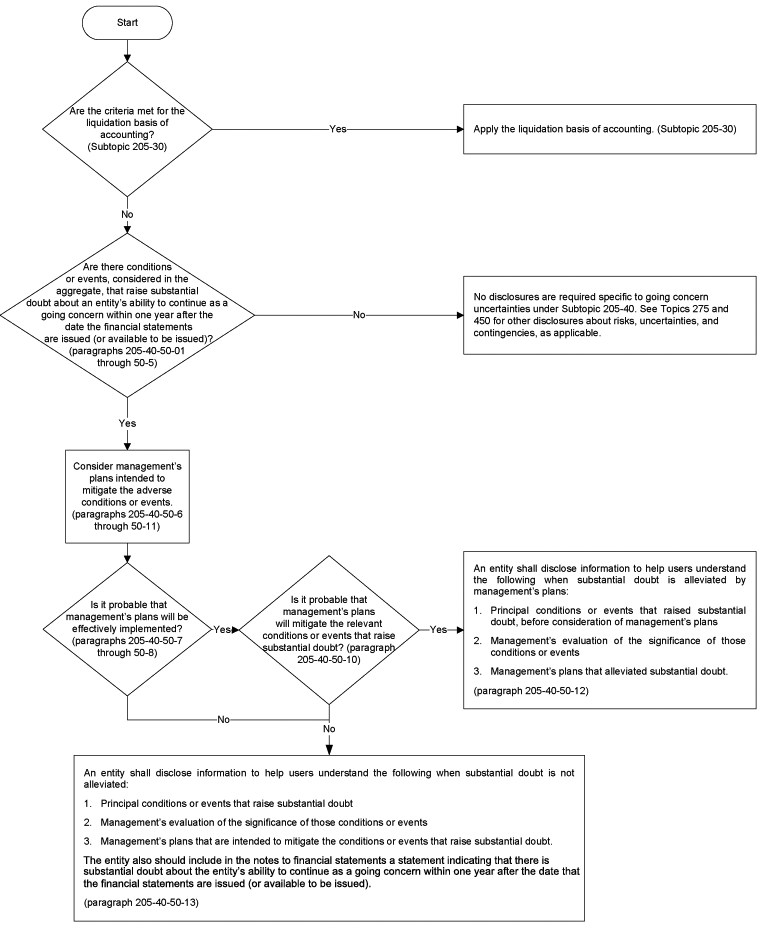 No "Are the criteria met for the liquidation basis of accounting? (Subtopic 205-30)" "Are there conditions or events, considered in the aggregate, that raise substantial doubt about an entity's ability to continue as a going concern within one year after the date the financial statements are issued (or available to be issued)? (paragraphs 205-40-50-01 through 50-5)" "An entity shall disclose information to help users understand the following when substantial doubt is alleviated by management's plans: 1. Principal conditions or events that raised substantial doubt, before consideration of management's plans 2. Management's evaluation of the significance of those conditions or events 3. Management's plans that alleviated substantial doubt. (paragraph 205-40-50-12)" Apply the liquidation basis of accounting. (Subtopic 205-30) "No disclosures are required specific to going concern uncertainties under Subtopic 205-40. See Topics 275 and 450 for other disclosures about risks, uncertainties, and contingencies, as applicable." "Is it probable that management's plans will be effectively implemented? (paragraphs 205-40-50-7 through 50-8)" Yes No No Yes Yes Start "An entity shall disclose information to help users understand the following when substantial doubt is not alleviated: 1. Principal conditions or events that raise substantial doubt 2. Management's evaluation of the significance of those conditions or events 3. Management's plans that are intended to mitigate the conditions or events that raise substantial doubt. The entity also should include in the footnotes a statement indicating that there is substantial doubt about the entity's ability to continue as a going concern within one year after the date that the financial statements are issued (or available to be issued). (paragraph 205-40-50-13)" No "Consider management's plans intended to mitigate the adverse conditions or events. (paragraphs 205-40-50-6 through 50-11)" "Is it probable that management's plans will mitigate the relevant conditions or events that raise substantial doubt? (paragraph 205-40-50-10)" Yes
- a Negative financial trends, for example, recurring operating losses, working capital deficiencies, negative cash flows from operating activities, and other adverse key financial ratios
- b Other indications of possible financial difficulties, for example, default on loans or similar agreements, arrearages in dividends, denial of usual trade credit from suppliers, a need to restructure debt to avoid default, noncompliance with statutory capital requirements, and a need to seek new sources or methods of financing or to dispose of substantial assets
- c Internal matters, for example, work stoppages or other labor difficulties, substantial dependence on the success of a particular project, uneconomic long-term commitments, and a need to significantly revise operations
- d External matters, for example, legal proceedings, legislation, or similar matters that might jeopardize the entity's ability to operate; loss of a key franchise, license, or patent; loss of a principal customer or supplier; and an uninsured or underinsured catastrophe such as a hurricane, tornado, earthquake, or flood.
- a Plans to dispose of an asset or business:
- 1 Restrictions on disposal of an asset or business, such as covenants that limit those transactions in loan or similar agreements, or encumbrances against the asset or business
- 2 Marketability of the asset or business that management plans to sell
- 3 Possible direct or indirect effects of disposal of the asset or business
- 1
- b Plans to borrow money or restructure debt:
- 1 Availability and terms of new debt financing, or availability and terms of existing debt refinancing, such as term debt, lines of credit, or arrangements for factoring receivables or sale and leaseback of assets
- 2 Existing or committed arrangements to restructure or subordinate debt or to guarantee loans to the entity
- 3 Possible effects on management's borrowing plans of existing restrictions on additional borrowing or the sufficiency of available collateral
- 1
- c Plans to reduce or delay expenditures:
- 1 Feasibility of plans to reduce overhead or administrative expenditures, to postpone maintenance or research and development projects, or to lease rather than purchase assets
- 2 Possible direct or indirect effects on the entity and its cash flows of reduced or delayed expenditures
- 1
- d Plans to increase ownership equity:
- 1 Feasibility of plans to increase ownership equity, including existing or committed arrangements to raise additional capital
- 2 Existing or committed arrangements to reduce current dividend requirements or to accelerate cash infusions from affiliates or other investors.
- 1
205-40-65Transition Date and Open Effective Date Information
Source downloaded: .Record version 471eda4e65ab. Effective date must be checked in the source.