ASC 205-946
Financial Services—Investment Companies
205 Presentation of Financial Statements
Source downloaded: .Record version b9fc7a2d22fd. Effective date must be checked in the source.
This subtopic governs how investment companies present the statement of changes in net assets and financial highlights. The statement of changes in net assets must separately show operations (net investment income, realized gains/losses, change in unrealized appreciation), net equalization credits/debits, distributions to shareholders (with tax return of capital separate), and capital share transactions. Financial highlights—per-share data, expense and net investment income ratios, total return (or since-inception IRR for certain limited-life funds), and capital commitment data—must be presented as a separate schedule or in the notes for each class of common shares.
Key points (7)
- The statement of changes in net assets summarizes operations, net equalization credits or debits, distributions to shareholders (tax return of capital shown separately), capital share transactions, and capital contributions; temporary tax/GAAP differences that become permanent are reclassified to paid-in capital (205-946-45-3).
- Financial highlights are presented as a separate schedule or in the notes for each class of common shares; funds that are not unitized present only investment returns (total return or IRR) and net investment income and expense ratios (205-946-50-1; 205-946-50-5; 205-946-45-2).
- Per-share data for registered funds and funds computing unitized NAV runs from beginning NAV through net investment income, realized/unrealized gains and losses (a balancing amount), total from investment operations, distributions, capital items, payments by affiliates, to ending NAV (205-946-50-7).
- Expense and net investment income ratios follow the statement of operations: an incentive structured as a fee is in the expense ratio, but an incentive allocation of profits is not, though all incentives must be reflected in the financial highlights disclosure (205-946-50-13 through 50-14).
- Total return is required for all investment companies; unitized funds compute it from change in NAV per share assuming reinvestment, while non-unitized funds use a theoretical investment with returns geometrically linked at capital cash flow dates and reported before and after incentive allocations (205-946-50-18 through 50-22).
- Limited-life, non-continuously-offered funds meeting the five criteria must disclose since-inception internal rate of return net of all incentives, and commitment funds must disclose total committed capital, year of formation, and the ratio of contributed to committed capital (205-946-50-23; 205-946-50-25).
- In master-feeder structures the feeder's ratios include its proportionate share of master fund expenses (and no portfolio turnover), while funds-of-funds compute ratios only at the reporting fund level with disclosure that underlying investee fund income and expenses are excluded (205-946-50-16 through 50-17; 205-946-50-28 through 50-30).
For students. Investment company reporting substitutes financial highlights and the statement of changes in net assets for the ordinary income-statement/equity presentation, so know which items appear where. The classic trap is the incentive arrangement: an incentive fee hits the expense ratio but an incentive allocation of profits does not—yet both must still be reflected in the financial highlights and in the before/after incentive total return.
Machine-generated study aid for ASC 205-946. Check the source paragraphs below.
205-946-00Status
Source downloaded: .Record version d39778b52e77. Effective date must be checked in the source.
| Paragraph | Action | Accounting Standards Update | Date |
| 946-205-45-1 | Amended | Accounting Standards Update No. 2016-19 | 12/14/2016 |
| 946-205-45-1 | Amended | Maintenance Update 2016-05 (PDF) | 04/12/2016 |
| 946-205-45-3 | Amended | Maintenance Update 2018-12 (PDF) | 09/10/2018 |
205-946-05Overview and Background
Source downloaded: .Record version 8efa730d597f. Effective date must be checked in the source.
- aThe statement of changes in net assets
- bFinancial highlights.
205-946-15Scope and Scope Exceptions
Source downloaded: .Record version d0185e8b07be. Effective date must be checked in the source.
Overall Guidance
205-946-45Other Presentation Matters
Source downloaded: .Record version 6a13b6223d77. Effective date must be checked in the source.
-
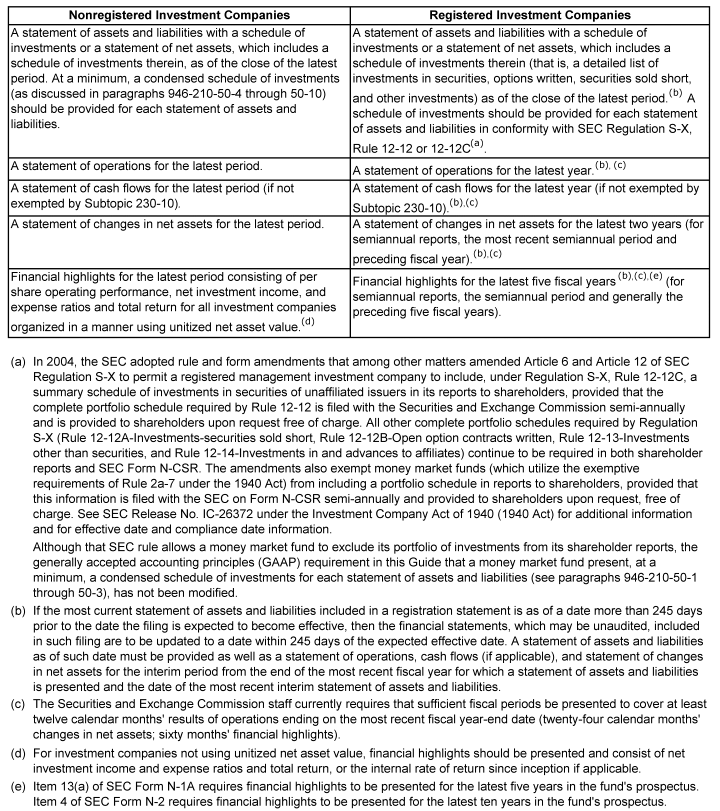 Nonregistered Investment Companies Registered Investment Companies "A statement of assets and liabilities with a schedule of investments or a statement of net assets, which includes a schedule of investments therein, as of the close of the latest period. At a minimum, a condensed schedule of investments (as discussed in paragraphs 946-210-50-4 through 50-10) should be provided for each statement of assets and liabilities." "A statement of assets and liabilities with a schedule of investments or a statement of net assets, which includes a schedule of investments therein (that is, a detailed list of investments in securities, options written, securities sold short, and other investments) as of the close of the latest period.(b) A schedule of investments should be provided for each statement of assets and liabilities in conformity with SEC Regulation S-X, Rule 12-12 or 12-12(a)." A statement of operations for the latest period. "A statement of operations for the latest year.(b), (c)" A statement of cash flows for the latest period (if not exempted by Subtopic 230-10). "A statement of cash flows for the latest year (if not exempted by Subtopic 230-10).(b),(c)" A statement of changes in net assets for the latest period. "A statement of changes in net assets for the latest two years (for semiannual reports, the most recent semiannual period and preceding fiscal year).(b),(c)" "Financial highlights for the latest period consisting of per share operating performance, net investment income, and expense ratios and total return for all investment companies organized in a manner using unitized net asset value.(d)" "Financial highlights for the latest five fiscal years(b),(c),(e) (for semiannual reports, the semiannual period and generally the preceding five fiscal years)." (a) "In 2004, the SEC adopted rule and form amendments that among other matters amended Article 6 and Article 12 of SEC Regulation S-X to permit a registered management investment company to include, under Regulation S-X, Rule 12-12C, a summary schedule of investments in securities of unaffiliated issuers in its reports to shareholders, provided that the complete portfolio schedule required by Rule 12-12 is filed with the Securities and Exchange Commission semi-annually and is provided to shareholders upon request free of charge. All other complete portfolio schedules required by Regulation S-X (Rule 12-12A-Investments-securities sold short, Rule 12-12B-Open option contracts written, Rule 12-13-Investments other than securities, and Rule 12-14-Investments in and advances to affiliates) continue to be required in both shareholder reports and SEC Form N-CSR. The amendments also exempt money market funds (which utilize the exemptive requirements of Rule 2a-7 under the 1940 Act) from including a portfolio schedule in reports to shareholders, provided that this information is filed with the SEC on Form N-CSR semi-annually and provided to shareholders upon request, free of charge. See SEC Release No. IC-26372 under the Investment Company Act of 1940 (1940 Act) for additional information and for effective date and compliance date information." "Although that SEC rule allows a money market fund to exclude its portfolio of investments from its shareholder reports, the generally accepted accounting principles (GAAP) requirement in this Guide that a money market fund present, at a minimum, a condensed schedule of investments for each statement of assets and liabilities (see paragraphs 946-210-50-1 through 50-3), has not been modified." (b) "If the most current statement of assets and liabilities included in a registration statement is as of a date more than 245 days prior to the date the filing is expected to become effective, then the financial statements, which may be unaudited, included in such filing are to be updated to a date within 245 days of the expected effective date. A statement of assets and liabilities as of such date must be provided as well as a statement of operations, cash flows (if applicable), and statement of changes in net assets for the interim period from the end of the most recent fiscal year for which a statement of assets and liabilities is presented and the date of the most recent interim statement of assets and liabilities." (c) The Securities and Exchange Commission staff currently requires that sufficient fiscal periods be presented to cover at least twelve calendar months' results of operations ending on the most recent fiscal year-end date (twenty-four calendar months' changes in net assets; sixty months' financial highlights). (d) "For investment companies not using unitized net asset value, financial highlights should be presented and consist of net investment income and expense ratios and total return, or the internal rate of return since inception if applicable." (e) Item 8(a) of SEC Form N-1A requires financial highlights to be presented for the latest five years in the fund's prospectus. Item 4 of SEC Form N-2 requires financial highlights to be presented for the latest ten years in the fund's prospectus.
Statement of Changes in Net Assets
- a Operations. Net investment income or loss, net realized gains or losses from investments and foreign currency transactions, and changes in unrealized appreciation or depreciation on investments and translation of assets and liabilities in foreign currencies, as shown in the statement of operations, shall be presented separately to arrive at the net change in net assets resulting from operations.
- b Net equalization debits or credits. If equalization accounting is used, undistributed investment income included in the price of capital shares issued or reacquired shall be shown as a separate line item.
- c Distributions to shareholders. Distributions shall be disclosed as a single line item, except for tax return of capital distributions, which shall be presented separately. Distributions made by regulated investment companies often differ from aggregate undistributed net investment income (including net equalization credits or debits and undistributed net investment income) determined in accordance with generally accepted accounting principles (GAAP) and accumulated net realized gains (total net realized gains determined in accordance with GAAP). The principal cause is that required minimum fund distributions are based on income and gain amounts determined in accordance with federal income tax regulations, rather than GAAP. The differences created can be temporary, meaning that they will reverse in the future, or they can be permanent. If in a subsequent period all or a portion of a temporary difference becomes a permanent difference, the amount of the permanent difference shall be reclassified to paid-in capital.
- a Multiple class funds. Dividends and distributions paid to shareholders and capital share transactions for each class are required to be presented (or disclosed in the notes to financial statements).
- b Master-feeder funds:
- 1 Master funds. The statement of changes in net assets of a master fund shall report capital transactions from or to feeder funds as contributions and withdrawals, respectively. Dividend distributions are normally not made by the master fund when the master fund is treated as a partnership for tax purposes. In those situations where the master fund is treated as a registered investment company and is taxed either as a corporation or trust, there may be distributions to the feeder funds to eliminate any accumulated taxable income at the master fund level.
- 2 Feeder funds. For feeder funds, the standard reporting format for investment companies with simple capital structures is used. If the feeder fund is a multiple-class fund, the guidance for multiple-class funds in (a) and elsewhere in this Topic shall be followed.
- 1
205-946-50Disclosure
Source downloaded: .Record version b48cd891ce3e. Effective date must be checked in the source.
Financial Highlights
- aPer-share information
- bRatios
- cTotal return
- dCapital commitments.
- a Net asset value at the beginning of the period.
- b Per-share net investment income or loss. Other methods, such as dividing net investment income by the average or weighted average number of shares outstanding during the period, are acceptable.
- c Realized and unrealized gains and losses per share, which are balancing amounts necessary to reconcile the change in net asset value per share with the other per-share information presented. The amount shown in this caption might not agree with the change in aggregate gains and losses for the period. If such is the case, the reasons shall be disclosed.
- d Total from investment operations, which represents the sum of net investment income or loss and realized and unrealized gain or loss.
- e Distributions to shareholders shall be disclosed as a single line item except that tax return of capital distributions shall be disclosed separately. Details of distributions shall conform to those shown in the statement of changes in net assets.
- f Purchase premiums, redemption fees, or other capital items.
- g Payments by affiliates (see paragraphs ).
- h Net asset value at the end of the period.
- a Have limited lives
- b Do not continuously raise capital and are not required to redeem their interests upon investor request (obtaining initial capital commitments from investors at time of organization and subsequently drawing on those commitments to make investments is not considered continuous for this purpose)
- c Have as a predominant operating strategy the return of the proceeds from disposition of investments to investors
- d Have limited opportunities, if any, for investors to withdraw before termination of the entity
- e Do not routinely acquire (directly or indirectly) as part of their investment strategy market-traded securities and derivative instruments.
Complex Capital Structures
Separate Accounts
- a Each contract expense level that results in a distinct net unit value and for which units were issued or outstanding during each reporting period
- b The range of the lowest and highest level of expense ratio and the related total return and unit fair values during each reporting period.
205-946-S00StatusSEC
Source downloaded: .Record version 513152adb01e. Effective date must be checked in the source.
| Paragraph | Action | Accounting Standards Update | Date |
| 946-205-S99-1 | Amended | Accounting Standards Update No. 2019-07 | 07/26/2019 |
205-946-S45Other Presentation MattersSEC
Source downloaded: .Record version a5d3392951d0. Effective date must be checked in the source.
Content of Financial Statements
Consolidated and Combined Financial Statements
Series Companies
Inapplicable Captions
Required Schedules
205-946-S50DisclosureSEC
Source downloaded: .Record version 87854f21f0ed. Effective date must be checked in the source.
Management Investment Companies
Unit Investment Trusts
Face-Amount Certificate Investment Companies
205-946-S99SEC MaterialsSEC
Source downloaded: .Record version ac5b85950cbb. Effective date must be checked in the source.
SEC Rules, Regulations, and Interpretations
- (a) When information is required in schedules for both the person and its subsidiaries consolidated, it may be presented in the form of a single schedule, provided that items pertaining to the registrant are separately shown and that such single schedule affords a properly summarized presentation of the facts.
- (b) The schedules shall be examined by an independent accountant if the related financial statements are so examined.
- (c) Management investment companies.
- (1) Except as otherwise provided in the applicable form, the schedules specified in this paragraph shall be filed for management investment companies as of the dates of the most recent audited balance sheet and any subsequent unaudited statement being filed for each person or group.
- Schedule I—Investments in securities of unaffiliated issuers. The schedule prescribed by § 210.12-12 shall be filed in support of caption 1 of each balance sheet.
- Schedule II—Investments in and advances to affiliates. The schedule prescribed by § 210.12-14 shall be filed in support of caption 2 of each balance sheet.
- Schedule III—Investments—securities sold short. The schedule prescribed by § 210.12-12A shall be filed in support of caption 9(a) of each balance sheet.
- Schedule IV—Open option contracts written. The schedule prescribed by § 210.12-13 shall be filed in support of caption 9(b) of each balance sheet.
- Schedule V—Open futures contracts. The schedule prescribed by §210.12-13A shall be filed in support of captions 3(a) and 9(c) of each balance sheet.
- Schedule VI—Open forward foreign currency contracts. The schedule prescribed by §210.12-13B shall be filed in support of captions 3(b) and 9(d) of each balance sheet.
- Schedule VII—Open swap contracts. The schedule prescribed by §210.12-13C shall be filed in support of captions 3(c) and 9(e) of each balance sheet.
- Schedule VIII—Investments—other than those presented in §§210.12-12, 12-12A, 12-12B, 12-13, 12-13A, 12-13B and 12-13C. The schedule prescribed by §210.12-13D shall be filed in support of captions 3(d) and 9(f) of each balance sheet.
- (2) When permitted by the applicable form, the schedule specified in this paragraph may be filed for management investment companies as of the dates of the most recent audited balance sheet and any subsequent unaudited statement being filed for each person or group.
- Schedule IX—Summary schedule of investments in securities of unaffiliated issuers. The schedule prescribed by § 210.12-12B may be filed in support of caption 1 of each balance sheet.
- (d) Unit investment trusts. Except as otherwise provided in the applicable form:
- (1) Schedules I and II, specified below in this section, shall be filed for unit investment trusts as of the dates of the most recent audited balance sheet and any subsequent unaudited statement being filed for each person or group.
- (2) Schedule III, specified below in this section, shall be filed for unit investment trusts for each period for which a statement of operations is required to be filed for each person or group.
- Schedule I—Investment in securities. The schedule prescribed by § 210.12-12 shall be filed in support of caption 1 of each balance sheet (§ 210.6-04).
- Schedule II—Allocation of trust assets to series of trust shares. If the trust assets are specifically allocated to different series of trust shares, and if such allocation is not shown in the balance sheet in columnar form or by the filing of separate statements for each series of trust shares, a schedule shall be filed showing the amount of trust assets, indicated by each balance sheet filed, which is applicable to each series of trust shares.
- Schedule III—Allocation of trust income and distributable funds to series of trust shares. If the trust income and distributable funds are specifically allocated to different series of trust shares and if such allocation is not shown in the statement of operations in columnar form or by the filing of separate statements for each series of trust shares, a schedule shall be submitted showing the amount of income and distributable funds, indicated by each statement of operations filed, which is applicable to each series of trust shares.
- (e) Face-amount certificate investment companies. Except as otherwise provided in the applicable form:
- (1) Schedules I, V and X, specified below, shall be filed for face-amount certificate investment companies as of the dates of the most recent audited balance sheet and any subsequent unaudited statement being filed for each person or group.
- (2) All other schedules specified below in this section shall be filed for face-amount certificate investment companies for each period for which a statement of operations is filed, except as indicated for Schedules III and IV.
- Schedule I—Investment in securities of unaffiliated issuers. The schedule prescribed by § 210.12-21 shall be filed in support of caption 1 and, if applicable, caption 5(a) of each balance sheet. Separate schedules shall be furnished in support of each caption, if applicable.
- Schedule II—Investments in and advances to affiliates and income thereon. The schedule prescribed by § 210.12-22 shall be filed in support of captions 1 and 5(b) of each balance sheet and caption 1 of each statement of operations. Separate schedules shall be furnished in support of each caption, if applicable.
- Schedule III—Mortgage loans on real estate and interest earned on mortgages. The schedule prescribed by § 210.12-23 shall be filed in support of captions 1 and 5(c) of each balance sheet and caption 1 of each statement of operations, except that only the information required by Column G and note 8 of the schedule need be furnished in support of statements of operations for years for which related balance sheets are not required.
- Schedule IV—Real estate owned and rental income. The schedule prescribed by § 210.12-24 shall be filed in support of captions 1 and 5(a) of each balance sheet and caption 1 of each statement of operations for rental income included therein, except that only the information required by Columns H, I and J, and item "Rent from properties sold during the period" and note 4 of the schedule need be furnished in support of statements of operations for years for which related balance sheets are not required.
- Schedule V—Qualified assets on deposit. The schedule prescribed by § 210.12-27 shall be filed in support of the information required by caption 4 of § 210.6-06 as to total amount of qualified assets on deposit.
- Schedule VI—Certificate reserves. The schedule prescribed by § 210.12-26 shall be filed in support of caption 7 of each balance sheet.
- Schedule VII—Valuation and qualifying accounts. The schedule prescribed by § 210.12-09 shall be filed in support of all other reserves included in the balance sheet.
- [81 FR 82013, Nov. 18, 2016]
Related subtopics
- 205-962 Plan Accounting—Defined Contribution Pension PlansPresentation of Financial Statements
- 210-946 Financial Services—Investment CompaniesBalance Sheet
- 220-946 Financial Services—Investment CompaniesIncome Statement—Reporting Comprehensive Income
- 946-10 OverallFinancial Services—Investment Companies
- 235-946 Financial Services—Investment CompaniesNotes to Financial Statements
- 944-10 OverallFinancial Services—Insurance