ASC

ASC 946-20

Investment Company Activities

946 Financial Services—Investment Companies

Source downloaded: .Record version 2d98f0e7afd9. Effective date must be checked in the source.

ASC 946-20 governs specific "investment company activities" — payments by affiliates to reimburse fund losses or cure investment-restriction violations, Rule 12b-1 distribution plans, expense limitation/waiver arrangements, offering costs, shareholder and distribution transactions, and related presentation and disclosure. Its core rules: affiliate payments and gains/losses on non-conforming investments are combined in one line within net realized/unrealized gains (losses) and quantified in the financial highlights (946-20-45-1; 946-20-50-2); a fund with an enhanced 12b-1 plan (or a board-contingent plan once the board commits) accrues a liability and expense for the distributor's excess distribution costs (946-20-25-3), while an excess of fees collected over distributor costs may never be booked as an asset (946-20-45-2). Offering costs are charged to paid-in capital for closed-end funds, partnerships and unit investment trusts, but deferred and amortized straight-line over 12 months for open-end funds and continuously offered closed-end funds (946-20-25-5 through 25-6; 35-5; 35-6).

Key points (7)
  • Affiliate payments to reimburse investment losses or losses from investments violating fund guidelines are combined into a single statement of operations line, 'net increase from payments by affiliates and net gains (losses) realized on the disposal of investments in violation of restrictions,' within net realized and unrealized gains (losses) (946-20-45-1), with amounts, circumstances, and the effect on total return disclosed (946-20-50-2).
  • A credit enhancement provided by an affiliate is recognized when it becomes available to the fund (946-20-25-2), measured initially at the cost of obtaining a similar enhancement in an arm's-length transaction (946-20-30-1), with subsequent changes in value recorded as unrealized appreciation or depreciation (946-20-35-1).
  • Funds with enhanced 12b-1 plans must accrue a liability and expense for the distributor's excess costs, and board-contingent plans accrue only when the board commits to pay; the liability equals cumulative distribution costs less cumulative 12b-1 fees, cumulative CDSL payments, and reasonably estimable future CDSL payments by current shareholders, discounted only if cash flows are reliably determinable and not subject to a reasonable interest charge (946-20-25-3; 30-3 through 30-5; 35-3).
  • An excess of cumulative 12b-1 fees and CDSL payments (including estimated future CDSL) over the distributor's cumulative costs shall not be reported as an asset (946-20-45-2); principal plan terms and recoverable distribution costs must be disclosed for board-contingent and enhanced plans (946-20-50-3).
  • Excess expenses potentially reimbursable to the adviser under an expense limitation agreement are recorded as a liability only if the Concepts Statement 6 liability criteria and ASC 450-20-25-2 are met — usually they are not — but the agreements and carryover amounts must be disclosed (946-20-25-4; 50-6).
  • Offering costs of closed-end funds and investment partnerships are charged to paid-in capital upon sale of shares/units; open-end funds and continuously offered closed-end funds defer them and amortize straight-line over 12 months from commencement of operations; unit investment trust offering costs are charged to paid-in capital pro rata as units are sold and written off when issuance is no longer probable (presumed after one year) (946-20-25-5; 25-6; 35-5; 35-6; 40-1).
  • Shareholder purchases and redemptions of open-end funds are recorded on trade date with an offsetting receivable/payable for fund shares (946-20-25-7); distribution liabilities are recorded on the ex-dividend date rather than the declaration date (946-20-25-9); and all voluntary and involuntary fee waivers are shown on the face of the statement of operations as a reduction of total expenses, with the effect of voluntary waivers disclosed in the financial highlights (946-20-50-7).

For students. This subtopic is where fund-specific quirks live: trade-date share accounting, ex-dividend-date distribution liabilities, and the asymmetric 12b-1 rule that a distributor's excess costs can create a fund liability while excess fees collected can never be an asset. A common misunderstanding is assuming adviser expense-reimbursement carryovers are automatically liabilities — under 946-20-25-4 they usually are only disclosed, not accrued.

Machine-generated study aid for ASC 946-20. Check the source paragraphs below.

946-20-00Status

Source downloaded: .Record version 57c93ac74f32. Effective date must be checked in the source.

946-20-05Overview and Background

Source downloaded: .Record version 019a5288735b. Effective date must be checked in the source.

Background Information about Investment Company Activities

946-20-05-1A
Typically, an investment company sells its ownership interests, invests the proceeds to achieve its investment objectives, and provides returns to its investors from the net income earned on its investments and net gains realized on the disposal of its investments.
946-20-05-1B
Several kinds of investment companies exist: management investment companies, unit investment trusts, common (collective) trust funds, exchange-traded funds, investment partnerships, certain separate accounts of life insurance companies, and offshore funds. Management investment companies may be open-end funds (commonly known as mutual funds), closed-end funds, special purpose funds, venture capital investment companies, small business investment companies, and business development companies. Investment companies are organized as corporations (in the case of mutual funds, under the laws of certain states that authorize the issuance of common shares redeemable on demand of individual shareholders), common law trusts (sometimes called business trusts), limited partnerships, limited liability investment partnerships and companies, and other more specialized entities, such as separate accounts of insurance companies that are not in themselves legal entities.
946-20-05-1C
Once an investment company has been organized to do business, it usually engages immediately in its planned principal operations, that is, the sale of capital stock and investment of funds. Employee training, development of markets for the sale of capital stock, and similar activities are usually performed by the investment adviser or other agent, and the costs of these activities are not borne directly by the investment company. However, an investment company, particularly one not engaging an agent to manage its portfolio and to perform other essential functions, may engage in such activities and may bear those costs directly during its development stage.
946-20-05-1D
Multiple-class funds issue more than one class of shares. Each class of shares typically has a different kind of sales charge, such as a front-end load, contingent-deferred sales load, 12b-1 fee (referring to Rule 12b-1 in Chapter 17 of the Code of Federal Regulations, which implements the Investment Company Act of 1940), or combinations thereof. Multiple-class funds may charge different classes of shares for specific or incremental expenses, such as transfer-agent, registration, and printing expenses related to each class.
946-20-05-1E
Venture capital investment companies, including most small business investment companies and private equity investment companies, differ from other types of investment companies. The typical open-end or closed-end investment company is a more passive investor, whereas a venture capital investment company is more actively involved with its investees. In addition to providing funds, whether in the form of loans or equity, a venture capital investment company often provides technical and management assistance to its investees as needed and requested. That assistance is provided for maximizing the overall value of the investment rather than for other benefits. The portfolio of a venture capital investment company may be illiquid by the very nature of the investments, which are usually securities with no public market. Often, gains on those investments are realized over a relatively long holding period. The nature of the investments therefore requires valuation procedures that may differ from those used by the typical investment company primarily addressed by this Subtopic. Venture capital investment companies also may incur liabilities not generally found in other investment companies.

Payments by Affiliates

946-20-05-2
Affiliates may make payments to a fund related to investment losses for either of the following reasons:
  1. a
    Payments by affiliates. To reimburse the effect of a loss (realized or unrealized) on a portfolio investment, often caused by a situation outside the fund's, or its affiliates', direct control, such as an issuer default or a decline in fair value.
  2. b
    Investment restriction violations (investments not meeting investment guidelines). Occasionally, a fund adviser may purchase an investment for a fund that clearly violates the fund's investment restrictions (investment restrictions are described in the prospectus or statement of additional information for registered funds and in partnership agreements or offering memorandums for nonregistered funds). The investment held in violation of the fund's investment restrictions may appreciate or depreciate in value. In the case where the investment has depreciated in value and the fund has consequently incurred a loss, the fund adviser may make a payment to the fund in lieu of settlement of a potential claim resulting from the violation of the fund's investment restrictions. This payment, in effect, makes the fund whole relative to the loss that it has incurred. This type of transaction is in essence a payment to put the fund's shareholders in the position they would have been in had the violation not occurred.
946-20-05-3
Payments by affiliates may take several forms, such as any of the following:
  1. a
    A direct cash contribution to the fund to offset the effect of a realized loss on a portfolio investment
  2. b
    Purchase of securities from the fund at prices in excess of the securities' current fair value
  3. c
    Provision of a credit enhancement to maintain the investment's value.

Certain Distribution Costs

946-20-05-4
Open-end investment companies, also known as funds, are permitted to finance the distribution of their shares under a plan pursuant to Rule 12b-1 in Chapter 17 of the Code of Federal Regulations. (Rule 12b-1 is one of the regulations implementing the Investment Company Act of 1940.) Under Rule 12b-1, a fund's board of directors is required to perform an annual review of the plan and determine whether to continue or terminate it. Under a traditional 12b-1 plan, a fund's distributor may be compensated or reimbursed for its distribution costs or efforts through any of the following methods:
  1. a
    A 12b-1 fee, payable by the fund, based on an annual percentage of the fund's average net assets (a compensation plan) or based on an annual percentage of the fund's average net assets limited to actual costs incurred, after deducting contingent-deferred sales loads received by the distributor (a reimbursement plan). Therefore, a compensation plan differs from a reimbursement plan only in that the latter provides for annual or cumulative limits, or both, on fees paid. Fees for both kinds of plans are treated as expenses in a fund's statement of operations.
  2. b
    A front-end load, which is assessed on purchasing shareholders at the time fund shares are sold.
  3. c
    A contingent-deferred sales load imposed directly on redeeming shareholders. The contingent-deferred sales load usually is expressed as a percentage, which declines with the passage of time, of the lesser of redemption proceeds or original cost. The contingent-deferred sales load normally ranges from 4 percent to 6 percent and typically is reduced by 1 percent (for example, from 6 percent to 5 percent) a year until the sales charge reaches 0 percent.
946-20-05-5
Rule 12b-1 plans historically have provided that a fund's board of directors may terminate the plan with no penalty to the fund. (Termination of the plan does not necessitate termination of the fund.) Redeeming shareholders still would be subject to the contingent-deferred sales load, which would be paid to the distributor that sold the shares to those shareholders. However, with a traditional 12b-1 plan, the 12b-1 fees normally would be discontinued on plan termination. Some traditional reimbursement 12b-1 plans provide that, when the plan is terminated, the fund's board of directors has the option, but not the requirement, to pay the distributor for any costs incurred by the distributor in excess of the cumulative contingent-deferred sales load and 12b-1 fees the distributor has received. Such a plan is referred to as a board-contingent plan. Under traditional reimbursement 12b-1 plans, including board-contingent plans, contingent-deferred sales load payments by shareholders continue to be remitted to the distributor until excess costs are fully recovered, after which the contingent-deferred sales load payments usually are remitted to the fund instead of the distributor.
946-20-05-6
With an enhanced 12b-1 plan, the fund is required to continue paying the 12b-1 fee after termination of the plan to the extent the distributor has excess costs. Contingent-deferred sales load payments by shareholders would continue to be remitted to the distributor to further offset excess costs. Thus, the major distinction between traditional and enhanced 12b-1 plans is the requirement for the fund to continue such payments upon plan termination.
946-20-05-7
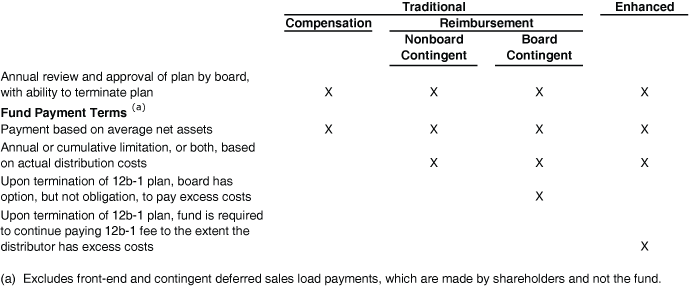
The following table summarizes the 12b-1 plan attributes.
  • Traditional Enhanced Compensation Reimbursement Nonboard Contingent Board Contingent "Annual review and approval of plan by board, with ability to terminate plan" X X X X Fund Payment Terms (a) Payment based on average net assets X X X X "Annual or cumulative limitation, or both, based on actual distribution costs" X X X "Upon termination of 12b-1 plan, board has option, but not obligation, to pay excess costs" X "Upon termination of 12b-1 plan, fund is required to continue paying 12b-1 fee to the extent the distributor has excess costs" X (a) "Excludes front-end and contingent deferred sales load payments, which are made by shareholders and not the fund."

Expense Limitation Agreements

946-20-05-8
Some expense limitation agreements may provide that reimbursements by the fund adviser of expenses incurred by the fund in excess of the maximum permitted by the prospectus or offering document will be carried over to a future period and reimbursed to the fund adviser when, and to the extent that, the total expense ratio falls below the permitted maximum. Such agreements may provide that reimbursement of excess expenses to the fund adviser is not required after a specified date or upon conclusion of a specified period from the time the fund initially incurred, or the adviser initially reimbursed, the expenses, such as three years. Under most excess expense plans, a fund is obligated to repay a servicer for expenses incurred previously only if, during a defined period, the fund retains the service provider and can reduce its expense ratio to a low enough level to permit payment, and maintain that ratio at a sufficiently low level thereafter. Many substantive conditions could cause the fund to have no obligation to the servicer, including failure to attract assets, significant redemptions of shares by investors, market depreciation, and significant increases in other expenses, all of which could drive expenses up to or beyond the maximum under which payment would otherwise be made.

Brokerage Service Arrangements

946-20-05-9
An investment company may have a brokerage service arrangement with a broker-dealer or an affiliate of a broker-dealer under which the broker-dealer (or its affiliate), in connection with the investment company's brokerage transactions directed to the broker-dealer, provides or pays for services to the investment company (other than brokerage and research services as those terms are used in section 28(e) of the Securities Exchange Act of 1934).

General Partner Advisory Services

946-20-05-10
Investment companies organized as limited partnerships typically receive advisory services from the general partner. For such services, a number of partnerships pay fees chargeable as expenses to the partnership, whereas others allocate net income from the limited partners' capital accounts to the general partner's capital account, and still others employ a combination of the two methods.

Fee Waivers

946-20-05-11
An adviser or a third party may voluntarily or involuntarily waive its fee and reimburse expenses (waivers). An example of an involuntary waiver is when the advisory agreement (or other regulation or agreements that are either outside the adviser's control or require shareholder approval) provides that the adviser should reimburse the investment company for expenses in excess of a specified percentage of average net assets.

Portfolio Insurance

946-20-05-12
Many municipal bond funds, primarily those organized as unit investment trusts with fixed portfolios, arrange for insurance for the payment of principal and interest when due. The insurance applies to portfolio securities only while they are owned by the fund, and its coverage is not transferable to buyers of the securities. That arrangement differs from those in which the issuer of the securities acquires the insurance, making the insurance feature an element of the securities and transferable on changes in ownership.

946-20-15Scope and Scope Exceptions

Source downloaded: .Record version c1267e5d2791. Effective date must be checked in the source.

Overall Guidance

946-20-15-1
This Subtopic follows the same Scope and Scope Exceptions as outlined in the Overall Subtopic, see Section 946-10-15.

946-20-25Recognition

Source downloaded: .Record version 4f03611f64a5. Effective date must be checked in the source.

Payments by Affiliates

946-20-25-2
A credit enhancement provided by an affiliate to maintain an investment's value shall be recognized when the enhancement becomes available to the fund.

Certain Distribution Costs

946-20-25-3
The guidance in this paragraph applies to annual and interim financial statements of investment companies that adopt plans that comply with Rule 12b-1. A liability, with a corresponding charge to expense, shall be recognized by a fund with an enhanced 12b-1 plan for excess costs. A liability for excess costs, computed in the same way as for an enhanced 12b-1 plan, shall be recorded by a fund with a board-contingent plan when the fund's board commits to pay such costs. Example 1 (see paragraph 946-20-55-1) illustrates this guidance.

Expense Limitation Agreements

946-20-25-4
A liability for excess expenses shall be recognized if, and to the extent that, the expense limitation agreement's established terms for repayment of the excess expenses to the adviser by the fund and the attendant circumstances meet the criteria in paragraphs 36(a), 36(b), and 36(c) of FASB Concepts Statement No. 6, Elements of Financial Statements, and the criteria in paragraph 450-20-25-2. In most instances, a liability will not be recorded because it is not likely that excess expenses under such plans will meet those criteria before amounts are actually due to the adviser under the reimbursement agreement. If an assessment of the specific circumstances (such as an agreement to reimburse for either an unlimited period or a period substantially greater than that necessary for the fund to demonstrate its economic viability or an obligation to reimburse the servicer remains even after the cancellation of the fund's contract with the servicer) indicates that those criteria are met, a liability shall be recorded.
Transition date:(P) December 16, 2024; (N) December 16, 2025Transition guidance:
105-10-65-9A liability for excess expenses shall be recognized if, and to the extent that, the expense limitation agreement's established terms for repayment of the excess expenses to the adviser by the fund and the attendant circumstances meet all of the following criteria:
  1. a
    The excess expense or expenses embody a present duty or responsibility to one or more other entities that entails settlement by probable future transfer or use of assets at a specified or determinable date, on occurrence of a specified event, or on demand.
  2. b
    The duty or responsibility obligates a particular entity, leaving it little or no discretion to avoid the future sacrifice.
  3. c
    The transaction or other event obligating the entity has already happened.
  4. d
    The guidance in paragraph 450-20-25-2.
In most instances, a liability will not be recorded because it is not likely that excess expenses under such plans will meet those criteria before amounts are actually due to the adviser under the reimbursement agreement. If an assessment of the specific circumstances (such as an agreement to reimburse for either an unlimited period or a period substantially greater than that necessary for the fund to demonstrate its economic viability or an obligation to reimburse the servicer remains even after the cancellation of the fund's contract with the servicer) indicates that those criteria are met, a liability shall be recorded.

Offering Costs

946-20-25-5
Offering costs of closed-end funds and investment partnerships shall be charged to paid-in capital upon sale of the shares or units.
946-20-25-6
Offering costs of open-end investment companies and of closed-end funds with a continuous offering period shall be recognized as a deferred charge.

Capital Share Transactions

946-20-25-7
Accounting for shareholder transactions of open-end funds differs from the accounting followed by commercial entities in several key aspects. Sales of fund shares are recorded daily by crediting capital stock for the par value of the stock to be issued and additional paid-in capital for the amount paid over the par value; redemptions are recorded daily by debiting those accounts. The offsetting debit (credit), however, is made to an asset (liability) account, typically captioned as receivable for fund shares sold (payable for fund shares redeemed). These entries are made on or as of the date the order to purchase or sell fund shares is received (trade date), not on the day the payment is due (settlement date) as is typical practice for the recording of issuance of equity shares by commercial entities.
946-20-25-8
Investment partnerships shall record capital subscription and redemption commitments as of the date required by the partnership agreement. Cash received before this date shall be recorded as an advance capital contribution liability.

Dividends

946-20-25-9
Both closed-end and open-end investment companies record distribution liabilities on the ex-dividend date rather than the declaration date. For closed-end investment companies, a purchaser typically is not entitled to a dividend for shares purchased on the ex-dividend date. Open-end investment companies record the liability on the ex-dividend date to properly state the net asset value at which sales and redemptions are made. When large (in excess of 15 percent of a closed-end fund's net asset value) dividends or distributions are declared, it is the policy of some exchanges to postpone the ex-dividend date until the dividend has been paid. In such circumstances, the liability for the dividend distribution would be recorded on the books of the fund on the payment date.

Performance Fees

946-20-25-10
Performance fees by an investment adviser under an investment advisory agreement shall be accrued at interim dates based on actual performance through the accrual date.

Portfolio Insurance

946-20-25-11
If insurance applies only to the fund's portfolio, it does not have a measurable fair value in the absence of default of the underlying securities or of indications of the probability of default and, accordingly, the cost of the policy should be treated as an operating expense.

946-20-30Initial Measurement

Source downloaded: .Record version a1a236d51afa. Effective date must be checked in the source.

Payments by Affiliates

946-20-30-1
The amount of the payment from a credit enhancement to maintain the investment's value shall be measured initially by the cost of obtaining a similar enhancement in an arm's-length transaction.

Certain Distribution Costs

946-20-30-2
The guidance in paragraphs applies to annual and interim financial statements of investment companies that adopt plans that comply with Rule 12b-1.
946-20-30-3
The liability and expense recognized under paragraph 946-20-25-3 shall be measured initially in an amount equal to the cumulative distribution costs incurred by the distributor less the sum of all of the following:
  1. a
    Cumulative 12b-1 fees paid
  2. b
    Cumulative contingent-deferred sales load payments
  3. c
    Future cumulative contingent-deferred sales load payments by current shareholders, if reasonably estimable.
946-20-30-4
The liability and expense recognized under paragraph 946-20-25-3 shall be measured at its present value, calculated using an appropriate current interest rate, if both of the following criteria are met:
  1. a
    The amount and timing of cash flows are reliably determinable.
  2. b
    The distribution costs are not subject to a reasonable interest charge.
946-20-30-5
If these conditions are not met, the liability recognized under paragraph 946-20-25-3 shall be calculated without discounting to present value.

946-20-35Subsequent Measurement

Source downloaded: .Record version 16f2d63b7048. Effective date must be checked in the source.

Payments by Affiliates

946-20-35-1
Any subsequent change in the value of a credit enhancement to maintain the investment's value shall be accounted for as unrealized appreciation or depreciation.

Certain Distribution Costs

946-20-35-2
The guidance in the following paragraph and paragraph 946-20-35-4 applies to annual and interim financial statements of investment companies that adopt plans that comply with Rule 12b-1.
946-20-35-3
The liability recognized under paragraph 946-20-25-3 shall be subsequently measured using the guidance in paragraphs . Changes in the liability shall be recognized in the statement of operations as an expense or reduction in expense.
946-20-35-4
Any future cumulative contingent-deferred sales load payments shall be based on all of the following:
  1. a
  2. b
    The number of shares currently outstanding and the number of years that they have been outstanding
  3. c
    Estimated shareholder persistency based on historical fund data or, if historical fund data are not available, group or industry data for a similar class of shares.

Offering Costs

946-20-35-5
Offering costs recognized as a deferred charge under paragraph 946-20-25-6 shall be amortized to expense over 12 months on a straight-line basis when operations begin.
946-20-35-6
Offering costs of unit investment trusts shall be charged to paid-in capital on a pro rata basis as the units or shares are issued or sold by the trust (when the units are purchased by the underwriters). Units sold to underwriters on a firm basis are considered sold by the trust, and the offering costs associated with those units shall be charged to paid-in capital when the units are purchased by the underwriters. Offering costs that remain unamortized at the end of the year shall be reviewed for impairment. (For guidance concerning organization and offering costs, see Subtopic 720-15.)

946-20-40Derecognition

Source downloaded: .Record version 3ec1619d8cf6. Effective date must be checked in the source.

Offering Costs

946-20-40-1
Offering costs of unit investment trusts that have not yet been charged to paid-in capital shall be written off when it is no longer probable that the shares to which the offering costs relate will be issued in the future. It is presumed that those costs will not have a future benefit one year from the initial offering.

946-20-45Other Presentation Matters

Source downloaded: .Record version c21df030be9b. Effective date must be checked in the source.

Payments by Affiliates

946-20-45-1
Payments made by affiliates for the two reasons in paragraph 946-20-05-2 shall be combined and reported as a separate line item entitled net increase from payments by affiliates and net gains (losses) realized on the disposal of investments in violation of restrictions in the statement of operations as part of net realized and unrealized gains (losses) from investments and foreign currency. That separate line item would comprise amounts related to all of the following:
  1. a
    Voluntary reimbursements by the affiliate for investment transaction losses
  2. b
    Realized and unrealized losses on investments not meeting the investment guidelines of the fund
  3. c
    Reimbursements from the affiliate for losses on investments not meeting the investment guidelines of the fund
  4. d
    Realized and unrealized gains on investments not meeting the investment guidelines of the fund.

Certain Distribution Costs

946-20-45-2
The guidance in this paragraph applies to annual and interim financial statements of investment companies that adopt plans that comply with Rule 12b-1. An excess of cumulative 12b-1 fees and contingent-deferred sales load payments to date and future contingent-deferred sales load payments by current shareholders over the cumulative costs incurred by the distributor shall not be reported as an asset.

Brokerage Service Arrangements

946-20-45-3
The relevant expense caption on the statement of operations and the expense ratio in the financial highlights shall include the amount that would have been incurred by the investment company for brokerage services had it paid for the services directly in an arm's-length transaction. Such amounts shall also be shown as a corresponding reduction in total expenses, captioned as fees paid indirectly.

General Partner Advisory Services

946-20-45-4
The amounts of any payments or allocations for advisory services from the general partner shall be presented in either the statement of operations or the statement of changes in partners' capital.

Expense Offset Arrangements

946-20-45-5
Expense offset arrangements, under which a third party explicitly reduces its fees by a specified or readily ascertainable amount for services provided to the investment company in exchange for use of the investment company's assets, shall be presented in the statement of operations, the expense ratio in the financial highlights, and notes to financial statements in the same manner as brokerage service arrangements.

Small Business Investment Companies

946-20-45-6
The unique features (primarily the existence of significant debt) of small business investment companies often make it desirable that their financial statements be presented in a conventional balance sheet format.

Venture Capital Investment Companies

946-20-45-7
Though all venture capital investment companies shall prepare their financial statements in conformity with generally accepted accounting principles (GAAP), the statement presentation of some venture capital investment companies may need to be tailored to present the information in a manner most meaningful to their particular group of investors. For example, if debt is a significant item, a balance sheet might be more appropriate than a statement of net assets.

946-20-50Disclosure

Source downloaded: .Record version 3be31c489c21. Effective date must be checked in the source.

Payments by Affiliates

946-20-50-2
The amounts and circumstances of payments by affiliates to reimburse the fund for losses on investment transactions shall be described in the notes to financial statements. The gains and losses on investments not meeting investment guidelines of the fund shall also be disclosed in the notes to financial statements. In addition, the effect on total return of the payments, as well as any gains or losses on investments not meeting investment guidelines of the fund, shall be quantified and disclosed in the financial highlights in a manner similar to disclosure of the effect of voluntary waivers of fees and expenses on expense ratios. (See Subtopic 850-10.) Total return shall be presented in the financial highlights.

Certain Distribution Costs

946-20-50-3
The guidance in this paragraph applies to annual and interim financial statements of investment companies that adopt plans that comply with Rule 12b-1. For both board-contingent plans and enhanced 12b-1 plans, funds shall disclose in their financial statements the principal terms of such plans and any plan provisions permitting or requiring payments of excess costs after plan termination. For board-contingent and enhanced plans, the aggregate amount of distribution costs subject to recovery through future payments by the fund pursuant to the plan and through future contingent-deferred sales load payments by current shareholders shall be disclosed. For enhanced plans, funds shall disclose the methodology used to estimate future contingent-deferred sales load payments by current shareholders.
946-20-50-4
If a 12b-1 distribution reimbursement plan provides for the carryover of unreimbursed costs to subsequent periods, the terms of reimbursement and the unreimbursed amount shall be disclosed.

General Partner Advisory Services

946-20-50-5
The method of computing payments or allocations for advisory services from the general partner shall be described in the notes to financial statements.

Expense Limitation Agreements

946-20-50-6
The existence of reimbursement agreements and the carryover of excess expenses potentially reimbursable to the adviser but not recorded as a liability shall be disclosed in the notes to financial statements.

Fee Waivers

946-20-50-7
All voluntary and involuntary fee waivers shall be disclosed on the face of the statement of operations as a reduction of total expenses. The expense ratio in the financial highlights shall be shown net of voluntary and involuntary waivers. The effect of only voluntary waivers on the expense ratio shall be disclosed (either as the basis point effect on the ratio or as the gross expense ratio) in a note to, or as part of, the financial highlights. In addition, the terms of all voluntary and involuntary waivers shall be disclosed in the notes to financial statements.

Dividends

946-20-50-8
Dividends paid to investors shall be disclosed as a single line item in the statement of changes in net assets, except tax return of capital distributions, which shall be disclosed separately. The notes shall disclose the tax basis components of the dividends paid (that is, either from ordinary income, capital gains, or tax return of capital). Disclosing dividends on a tax basis is consistent with how dividends are reported to shareholders during and at the end of the calendar year. The financial highlights table would disclose per-share information that is consistent with the statement of changes in net assets.
946-20-50-9
Dividends from affiliates and controlled companies shall be disclosed.
946-20-50-10
If management of a fund determines that a tax return of capital is likely to occur for the fund's fiscal year, although the exact amount may not be estimable, that fact shall be disclosed in a note to the interim financial statements.

Components of Capital and Distributable Earnings

946-20-50-11
This guidance requires all investment companies to disclose only two components of capital on the balance sheet: shareholder capital and distributable earnings. The components of distributable earnings, on a tax basis, shall be disclosed in a note to financial statements. This information enables investors to determine the amount of accumulated and undistributed earnings they potentially could receive in the future and on which they could be taxed.
Transition date:(P) June 30, 2027; (N) June 30, 2027Transition guidance:
105-10-65-7 This guidance requires all investment companies to disclose two components of capital on the balance sheet: shareholder capital and distributable earnings. The components of distributable earnings, on a tax basis, shall be disclosed in a note to financial statements. This information enables investors to determine the amount of accumulated and undistributed earnings they potentially could receive in the future and on which they could be taxed.
946-20-50-12
The notes shall disclose all of the following tax-basis components of distributable earnings as of the most recent tax year end:
  1. a
    Undistributed ordinary income
  2. b
    Undistributed long-term capital gains
  3. c
    Capital loss carryforwards
  4. d
    Unrealized appreciation (depreciation).
946-20-50-13
Paragraphs 946-740-35-1 and 946-740-50-1 require that, if a provision for deferred income taxes on unrealized appreciation exists, it be charged against the unrealized gains account and disclosed as such in the statement of operations. Explanations shall be provided for the differences between the total of these amounts and distributable earnings (accumulated losses).
946-20-50-14
Investment partnerships and other pass-through entities shall aggregate all elements of equity into partners' capital, because the results from operations are deemed distributed to each partner.

Financial Support to Investees

946-20-50-15
If, during the periods presented, an investment company provides financial support to an investee, it shall disclose information about both of the following items, disaggregated by financial support that it was contractually required to provide and financial support that it was not previously contractually required to provide:
  1. a
    The type and amount of financial support provided, including situations in which the investment company assisted the investee in obtaining financial support
  2. b
    The primary reasons for providing the financial support.
946-20-50-16
An investment company also shall separately disclose both of the following items about financial support that it is contractually required to provide to any of its investees but has not yet provided:
  1. a
    The type and amount of financial support to be provided, including situations in which the investment company must assist the investee in obtaining financial support
  2. b
    The primary reasons for the contractual requirement to provide the financial support.

946-20-55Implementation Guidance and Illustrations

Source downloaded: .Record version 0052115d52df. Effective date must be checked in the source.

Illustrations

946-20-55-1
This Example illustrates application of the guidance in paragraph 946-20-50-2. An entity might disclose the following.
  • In 20XX, a.aa% of the fund's total return consists of a voluntary reimbursement by the adviser for a realized investment loss, and another b.bb% consists of a gain on an investment not meeting the fund's investment restrictions. Excluding these items, total return would have been c.cc%. Additionally, the adviser fully reimbursed the fund for a loss on a transaction not meeting the fund's investment guidelines, which otherwise would have reduced total return by d.dd%.

Related subtopics