ASC 946-10
Overall
946 Financial Services—Investment Companies
Source downloaded: .Record version e9bdc72a74cb. Effective date must be checked in the source.
ASC 946-10 sets the scope of the Financial Services—Investment Companies Topic by defining which entities qualify as investment companies and therefore apply the Topic's specialized (fair value) accounting and reporting. Any entity regulated under the Investment Company Act of 1940 is automatically an investment company (946-10-15-4); all others must possess the two fundamental characteristics in 946-10-15-6 and are assessed against five typical characteristics in 946-10-15-7, applying judgment when a typical characteristic is absent. Status is determined at formation and reassessed only upon a change in purpose and design (or loss of 1940 Act regulation), with prescribed prospective or cumulative-effect accounting and disclosure for a change in status.
Key points (7)
- An entity regulated under the Investment Company Act of 1940 is an investment company (946-10-15-4); REITs are excluded from the Topic (946-10-15-3).
- The two fundamental characteristics (946-10-15-6) are: obtaining funds from investors and providing investment management services with a committed business purpose of investing solely for capital appreciation and/or investment income, and not obtaining (or seeking) returns or benefits from an investee that are not normally attributable to ownership interests.
- The five typical characteristics (946-10-15-7) are more than one investment, more than one investor, unrelated investors, ownership in the form of equity or partnership interests, and managing substantially all investments on a fair value basis; absence of one or more does not necessarily preclude investment company status but requires judgment (946-10-15-8).
- An entity investing for capital appreciation must have identified potential exit strategies; disposal only in liquidation or to satisfy redemptions is not an exit strategy, though a fund investing only for investment income needs no exit strategy (946-10-55-7).
- Relationships such as an affiliate holding an option to buy investees or investee assets at other than fair value, joint development/marketing arrangements, or non-arm's-length transactions with investees are inconsistent with investment company status (946-10-55-8).
- Status is determined at formation and reassessed only if there is a change in the entity's purpose and design or it ceases to be regulated under the 1940 Act (946-10-25-1); an entity losing status accounts prospectively using fair value at that date as the new carrying amount (946-10-25-2), and an entity gaining status records a cumulative-effect adjustment to net assets (946-10-25-3).
- Disclosure is required of investment company status (946-10-50-1), that a change in status occurred and why (946-10-50-2), and the effect of becoming an investment company on reported investment amounts (946-10-50-3).
For students. This scope test is the gateway to investment company accounting (fair value measurement of investments and no consolidation of operating investees), so getting it wrong distorts the entire financial statements. The most common misunderstanding is treating the five "typical" characteristics as bright-line requirements—they are judgment factors, while only the two "fundamental" characteristics in 946-10-15-6 are mandatory.
Machine-generated study aid for ASC 946-10. Check the source paragraphs below.
946-10-00Status
Source downloaded: .Record version ca798e65d248. Effective date must be checked in the source.
946-10-05Overview and Background
Source downloaded: .Record version cf84ecd6f141. Effective date must be checked in the source.
- aOverall
- bInvestment Company Activities
- cPresentation of Financial Statements
- dBalance Sheet
- eIncome Statement
- fStatement of Cash Flows
- gNotes to Financial Statements
- hCash and Cash Equivalents
- iReceivables
- jInvestments—Debt and Equity Securities
- kInvestments—Equity Method and Joint Ventures
- kkInvestments—Other
- lLiabilities
- mEquity
- nRevenue Recognition
- oIncome Taxes
- pConsolidation
- qForeign Currency Matters.
946-10-15Scope and Scope Exceptions
Source downloaded: .Record version ce4d3c5f28b6. Effective date must be checked in the source.
Overall Guidance
Entities
- a
- b
- c
- d
- a It is an entity that does both of the following:
- 1 Obtains funds from one or more investors and provides the investor(s) with investment management services
- 2 Commits to its investor(s) that its business purpose and only substantive activities are investing the funds solely for returns from capital appreciation, investment income, or both.
- 1
- b The entity or its affiliates do not obtain or have the objective of obtaining returns or benefits from an investee or its affiliates that are not normally attributable to ownership interests or that are other than capital appreciation or investment income.
- a It has more than one investment.
- b It has more than one investor.
- c It has investors that are not related parties of the parent (if there is a parent) or the investment manager.
- d It has ownership interests in the form of equity or partnership interests.
- e It manages substantially all of its investments on a fair value basis.
946-10-25Recognition
Source downloaded: .Record version 1e60fcec6f7e. Effective date must be checked in the source.
Reassessment of Investment Company Status
- a The difference between the fair value and the carrying amount of the entity's investees (or parent's portion of the assets minus liabilities for consolidated investments) at the date of the change in status
- b Any amounts previously recognized in accumulated other comprehensive income.
946-10-50Disclosure
Source downloaded: .Record version 1390fcf3e41a. Effective date must be checked in the source.
Investment Company Status
946-10-55Implementation Guidance and Illustrations
Source downloaded: .Record version 66abcf25121d. Effective date must be checked in the source.
Implementation Guidance
- a Fundamental characteristics of an investment company
- b Typical characteristics of an investment company
- c Illustrative examples.
- a The entity or its affiliates acquire, use, exchange, or exploit the processes, assets, or technology of an investee or its affiliates. This includes the entity or its affiliates having disproportionate or exclusive rights to acquire assets, technology, products, or services of an investee or its affiliates (for example, by holding an option to purchase an asset from an investee if the asset's development is deemed successful).
- b There are other arrangements between the entity or its affiliates and an investee or its affiliates to jointly develop, produce, market, or provide products or services.
- c An investee or its affiliates provide financing guarantees or assets to serve as collateral for borrowing arrangements of the entity or its affiliates to provide returns or with the objective of providing returns other than capital appreciation or investment income. The guidance in this paragraph does not prohibit an investment company from using its investments in its investees as collateral for any of its borrowings.
- d An affiliate of the entity holds an option to purchase from the entity ownership interests in an investee at an amount other than fair value.
- e There are transactions between the entity or its affiliates and an investee or its affiliates that meet any of the following:
- 1 They are on terms that are unavailable to entities that are not affiliates of the investee.
- 2 They are not at fair value or are not conducted at arm's length.
- 3 They represent a substantive portion of the investee's or the entity's business activities, including business activities of affiliates of the entity or affiliates of the investee.
- 1
- a Assistance with day-to-day management of the operations of an investee
- b Financial support, such as a loan, capital commitment, or guarantee.
- a It is in its start-up period and has not yet identified suitable investments and, therefore, has not yet executed its investment plan to acquire multiple investments.
- b It has not yet made other investments to replace those it has disposed of.
- c It is in the process of liquidation.
- d It is established to pool investors' funds to invest in a single investment when that investment is unobtainable by individual investors (for example, when the required minimum investment is too high for an individual investor).
- a It is in its initial offering period, which has not expired, and it is actively identifying suitable investors.
- b It is actively identifying investors but has not yet identified suitable investors to replace those that have redeemed their ownership interests.
- c It is in the process of liquidation.
- a The parent or its related parties have a written option to acquire another investor's ownership interests in the entity at an amount other than fair value.
- b The parent finances another investor's ownership interests, and the ownership interests are collateral for the debt.
- a How the entity evaluates the performance of its investments
- b How the entity transacts with its investors
- c How asset-based fees are calculated.
Illustrations
- a Example 1: Limited partnership
- b Example 2: Technology fund
- c Example 3: Master-feeder structure.
- a Entity A obtained funds from investors (the general partner and the limited partners) and is providing those investors with investment management services.
- b Entity A's business purpose and only substantive activity is acquiring interests in operating companies with the objective of realizing returns over its life from the capital appreciation of the investments. Entity A has identified exit strategies for its investments to realize the capital appreciation.
- c Entity A does not have an objective of obtaining returns or benefits other than capital appreciation from its investments.
- a Entity A is funded by multiple investors.
- b The limited partners of Entity A hold a significant interest in the partnership and are not related to the investment manager (the general partner).
- c Ownership in Entity A is represented by partnership interests acquired through capital contributions.
- d Investments are managed, and their performance is evaluated on a fair value basis.
- a Entity D, the parent of Entity C, holds options at amounts other than fair value to acquire investees of the fund and assets of the investees if the technology developed by the investee is successful and would benefit Entity D's operations. That provides Entity D with a benefit that is other than returns from capital appreciation or investment income.
- b The investment plans of Entity C do not include exit strategies for its investments to realize returns from the capital appreciation of investees.
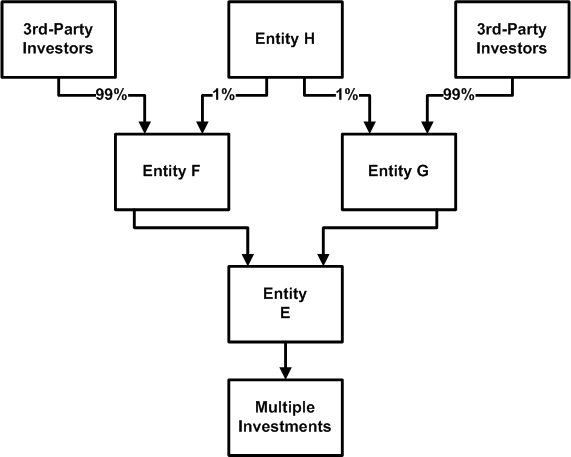
- a Entity E, Entity F, and Entity G obtained funds from investors and are providing those investors with investment management services.
- b The master-feeder structure's business purpose and only substantive activities, which were communicated to investors of Entity F and Entity G, are investing solely for returns from capital appreciation and investment income.
- c Entity E has identified exit strategies for the investments it holds for returns from capital appreciation. Although Entity F and Entity G do not have an exit strategy for their interests in Entity E, they are considered to have an exit strategy for their investments because Entity E was formed in conjunction with Entity F and Entity G and holds investments on behalf of them.
- d Entity E, Entity F, and Entity G do not have an objective of obtaining returns or benefits other than capital appreciation and investment income from their investments.
- a Entity E holds more than one investment. Both Entity F and Entity G also are considered to hold more than one investment because they were formed in conjunction with Entity E.
- b Both Entity F and Entity G are funded by multiple investors. Entity E also is considered to be funded by multiple investors because it was formed in conjunction with Entity F and Entity G.
- c Both Entity F and Entity G have investors that hold a significant interest in the partnership and are not related to the investment manager (Entity H). Although Entity F and Entity G are related to Entity E, Entity E is considered to have unrelated investors because it was formed in conjunction with Entity F and Entity G, which have unrelated investors.
- d Ownership in Entity E and Entity G are represented by equity interests acquired through capital contributions. Ownership in Entity F is represented by partnership interests acquired through capital contributions.
- e Entity E manages and evaluates the performance of investments on a fair value basis. Additionally, investors of Entity F and Entity G are provided with periodic financial information about the investing activities of Entity E, which includes information about the change in fair value of investments held.
946-10-65Transition and Open Effective Date Information
Source downloaded: .Record version 1ba8945e83da. Effective date must be checked in the source.
946-10-S00StatusSEC
Source downloaded: .Record version 913365ec0379. Effective date must be checked in the source.
| Paragraph | Action | Accounting Standards Update | Date |
| Amended | Accounting Standards Update No. 2021-06 | 08/09/2021 | |
| Amended | Accounting Standards Update No. 2019-07 | 07/26/2019 | |
| 946-10-S99-3A | Added | Accounting Standards Update No. 2021-06 | 08/09/2021 |
946-10-S15Scope and Scope ExceptionsSEC
Source downloaded: .Record version 115f1a9e6041. Effective date must be checked in the source.
Entities
946-10-S25RecognitionSEC
Source downloaded: .Record version 8aa75c707cd5. Effective date must be checked in the source.
Organization and Offering Expenses and Selling Commissions
946-10-S99SEC MaterialsSEC
Source downloaded: .Record version a756bcbcb6ca. Effective date must be checked in the source.
SEC Rules, Regulations, and Interpretations
- Sections 210.6-01 through 210.6-11 shall be applicable to financial statements filed for registered investment companies and business development companies.
- The following terms shall have the meaning indicated in this rule unless the context otherwise requires. (Also see § 210.1-02 of this part.)
- (a) Affiliate. The term affiliate means an affiliated person as defined in section 2(a)(3) of the Investment Company Act of 1940 unless otherwise indicated. The term control has the meaning in section 2(a)(9) of that Act.
- (b) Value. As used in §§ 210.6-01 through 210.6-11, the term value shall have the meaning given in section 2(a)(41)(B) of the Investment Company Act of 1940.
- (c) Balance sheets; statements of net assets. As used in §§ 210.6-01 through 210.6-11, the term balance sheets shall include statements of assets and liabilities as well as statements of net assets unless the context clearly indicates the contrary.
- (d) Qualified assets.
- (1) For companies issuing face-amount certificates subsequent to December 31, 1940 under the provisions of section 28 of the Investment Company Act of 1940, the term qualified assets means qualified investments as that term is defined in section 28(b) of the Act. A statement to that effect shall be made in the balance sheet.
- (2) For other companies, the term qualified assets means cash and investments which such companies do maintain or are required, by applicable governing legal instruments, to maintain in respect of outstanding face-amount certificates.
- (3) Loans to certificate holders may be included as qualified assets in an amount not in excess of certificate reserves carried on the books of account in respect of each individual certificate upon which the loans were made.
- (e) Swing pricing. The term swing pricing shall have the meaning given in §270.22c-1(a)(3)(v)(C) of this chapter.
- The financial statements filed for persons to which §§ 210.6-01 through 210.6-11 are applicable shall be prepared in accordance with the following special rules in addition to the general rules in §§ 210.1-01 to 210.4-10 (Articles 1, 2, 3, and 4). Where the requirements of a special rule differ from those prescribed in a general rule, the requirements of the special rule shall be met.
- (a) Content of financial statements. The financial statements shall be prepared in accordance with the requirements of this part (Regulation S-X) notwithstanding any provision of the articles of incorporation, trust indenture or other governing legal instruments specifying certain accounting procedures inconsistent with those required in §§ 210.6-01 through 210.6-11.
- (b) Audited financial statements. Where, under Article 3 of this part, financial statements are required to be audited, the independent accountant shall have been selected and ratified in accordance with section 32 of the Investment Company Act of 1940 (15 U.S.C. 80a-31).
- (c) Consolidated and combined statements.
- (1) Consolidated and combined statements filed for registered investment companies and business development companies shall be prepared in accordance with §§ 210.3A-02 and 210.3A-03 (Article 3A) except that:
- (i) [Reserved]
- (ii) A consolidated statement of the registrant and any of its investment company subsidiaries shall not be filed unless accompanied by a consolidating statement which sets forth the individual statements of each significant subsidiary included in the consolidated statement: Provided, however, That a consolidating statement need not be filed if all included subsidiaries are totally held; and
- (iii) Consolidated or combined statements filed for subsidiaries not consolidated with the registrant shall not include any investment companies unless accompanied by consolidating or combining statements which set forth the individual statements of each included investment company which is a significant subsidiary.
- (2) If consolidating or combining statements are filed, the amounts included under each caption in which financial data pertaining to affiliates is required to be furnished shall be subdivided to show separately the amounts:
- (i) Eliminated in consolidation; and
- (ii) Not eliminated in consolidation.
- (d) Valuation of investments. The balance sheets of registered investment companies, other than issuers of face-amount certificates, and business development companies, shall reflect all investments at value, with the aggregate cost of each category of investment reported under §§ 210.6-04.1, 6-04.2, 6-04.3, and 6.04.9 or the aggregate cost of each category of investment reported under § 210.6-05.1 shown parenthetically.
- State in a note the methods used in determining value of investments.
- As required by section 28(b) of the Investment Company Act of 1940 (15 U.S.C. 80a-28(b)), qualified assets of face-amount certificate companies shall be valued in accordance with certain provisions of the Code of the District of Columbia.
- (e) Qualified assets. State in a note the nature of any investments and other assets maintained or required to be maintained, by applicable legal instruments, in respect of outstanding face-amount certificates. If the nature of the qualifying assets and amount thereof are not subject to the provisions of section 28 of the Investment Company Act of 1940 (15 U.S.C. 80a-28), a statement to that effect shall be made.
- (f) Restricted securities. State in a note unless disclosed elsewhere the following information as to investment securities which cannot be offered for public sale without first being registered under the Securities Act of 1933 (15 U.S.C. 77a et seq) (restricted securities):
- (1) The policy of the person with regard to acquisition of restricted securities.
- (2) The policy of the person with regard to valuation of restricted securities. Specific comments shall be given as to the valuation of an investment in one or more issues of securities of a company or group of affiliated companies if any part of such investment is restricted and the aggregate value of the investment in all issues of such company or affiliated group exceeds five percent of the value of total assets. (As used in this paragraph, the term affiliated shall have the meaning given in § 210.6-02(a).)
- (3) A description of the person's rights with regard to demanding registration of any restricted securities held at the date of the latest balance sheet.
- (g) Income recognition. Dividends shall be included in income on the ex-dividend date; interest shall be accrued on a daily basis. Dividends declared on short positions existing on the record date shall be recorded on the ex-dividend date and included as an expense of the period.
- (h) Federal income taxes.
- (1) The company's status as a regulated investment company as defined in subtitle A, chapter 1, subchapter M of the Internal Revenue Code, as amended, shall be stated in a note referred to in the appropriate statements. Such note shall also indicate briefly the principal assumptions on which the company relied in making or not making provisions for income taxes. However, a company which retains realized capital gains and designates such gains as a distribution to shareholders in accordance with section 852(b)(3)(D) of the Internal Revenue Code shall, on the last day of its taxable year (and not earlier), make provision for taxes on such undistributed capital gains realized during such year.
- (2) State the following amounts based on cost for Federal income tax purposes:
- (i) Aggregate gross unrealized appreciation for all investments in which there is an excess of value over tax cost;
- (ii) The aggregate gross unrealized depreciation for all investments in which there is an excess of tax cost over value;
- (iii) The net unrealized appreciation or depreciation; and
- (iv) The aggregate cost of investments for Federal income tax purposes.
- (i) Issuance and repurchase by a registered investment company or business development company of its own securities. Disclose for each class of the company's securities:
- (1) The number of shares, units, or principal amount of bonds sold during the period of report, the amount received therefor, and, in the case of shares sold by closed-end management investment companies, the difference, if any, between the amount received and the net asset value or preference in involuntary liquidation (whichever is appropriate) of securities of the same class prior to such sale; and
- (2) The number of shares, units, or principal amount of bonds repurchased during the period of report and the cost thereof. Closed-end management investment companies shall furnish the following additional information as to securities repurchased during the period of report:
- (i) As to bonds and preferred shares, the aggregate difference between cost and the face amount or preference in involuntary liquidation and, if applicable net assets taken at value as of the date of repurchase were less than such face amount or preference, the aggregate difference between cost and such net asset value;
- (ii) As to common shares, the weighted average discount per share, expressed as a percentage, between cost of repurchase and the net asset value applicable to such shares at the date of repurchases.
- Note to paragraphs (h)(2)(i) and (ii): The information required by paragraphs (h)(2)(i) and (ii) of this section may be based on reasonable estimates if it is impracticable to determine the exact amounts involved.
- (j) Series companies.
- (1) The information required by this part shall, in the case of a person which in essence is comprised of more than one separate investment company, be given as if each class or series of such investment company were a separate investment company; this shall not prevent the inclusion, at the option of such person, of information applicable to other classes or series of such person on a comparative basis, except as to footnotes which need not be comparative.
- (2) If the particular class or series for which information is provided may be affected by other classes or series of such investment company, such as by the offset of realized gains in one series with realized losses in another, or through contingent liabilities, such situation shall be disclosed.
- (k) Certificate reserves.
- (1) For companies issuing face-amount certificates subsequent to December 31, 1940 under the provisions of section 28 of the Investment Company Act of 1940 (15 U.S.C. 80a-28), balance sheets shall reflect reserves for outstanding certificates computed in accordance with the provisions of section 28(a) of the Act.
- (2) For other companies, balance sheets shall reflect reserves for outstanding certificates determined as follows:
- (i) For certificates of the installment type, such amount which, together with the lesser of future payments by certificate holders as and when accumulated at a rate not to exceed 3 1/2 per centum per annum (or such other rate as may be appropriate under the circumstances of a particular case) compounded annually, shall provide the minimum maturity or face amount of the certificate when due.
- (ii) For certificates of the fully-paid type, such amount which, as and when accumulated at a rate not to exceed 3 1/2 per centum per annum (or such other rate as may be appropriate under the circumstances of a particular case) compounded annually, shall provide the amount or amounts payable when due.
- (iii) Such amount or accrual therefor, as shall have been credited to the account of any certificate holder in the form of any credit, or any dividend, or any interest in addition to the minimum maturity or face amount specified in the certificate, plus any accumulations on any amount so credited or accrued at rates required under the terms of the certificate.
- (iv) An amount equal to all advance payments made by certificate holders, plus any accumulations thereon at rates required under the terms of the certificate.
- (v) Amounts for other appropriate contingency reserves, for death and disability benefits or for reinstatement rights on any certificate providing for such benefits or rights.
- (l) Inapplicable captions. Attention is directed to the provisions of §§ 210.4-02 and 210.4-03 which permit the omission of separate captions in financial statements as to which the items and conditions are not present, or the amounts involved not significant. However, amounts involving directors, officers, and affiliates shall nevertheless be separately set forth except as otherwise specifically permitted under a particular caption.
- (m) Swing pricing. For a registered investment company that has adopted swing pricing policies and procedures, state in a note to the company's financial statements:
- (1) The general methods used in determining whether the company's net asset value per share will swing;
- (2) Whether the company's net asset value per share has swung during the year; and
- (3) A general description of the effects of swing pricing.
- (a) Financial statements required.
- (1) Financial statements described in §§210.3-01 and 210.3-02, or §210.3-18, as applicable, including the schedules specified in §§210.12-01 through 210.12-29 (Article 12), prepared and audited in accordance with Regulation S-X (including the independence standards in §210.2-01 or, alternatively if the fund is not a registrant, the applicable independence standards) for the periods specified in paragraph (b) of this section and the supplemental information specified in paragraph (d) of this section must be filed if any of the following conditions exist:
- (i) During the most recent fiscal year or subsequent interim period for which a balance sheet is required by §210.3-01 or §210.3-18, a fund acquisition has occurred; or
- (ii) After the date of the most recent balance sheet filed pursuant to §210.3-01 or §210.3-18 or, if no relevant balance sheet has been filed in connection with a post-effective amendment for a new series submitted pursuant to §230.485(a)(2) of this chapter (Rule 485(a)(2) under the Securities Act), the filing of such amendment, consummation of a fund acquisition has occurred or is probable.
- (2) For purposes of this section:
- (i) The term fund includes any investment company as defined in section 3(a) of the Investment Company Act of 1940, including a business development company, or any company that would be an investment company but for the exclusions provided by sections 3(c)(1) or 3(c)(7) of that Act, or any private account managed by an investment adviser.
- (ii) The determination of whether a fund has been acquired or will be acquired should be evaluated in light of the facts and circumstances involved. Among the facts and circumstances which should be considered in evaluating whether a fund acquisition has occurred or will occur are whether it will result in the acquisition by the registrant of all or substantially all of the portfolio investments held by another fund.
- (3) Acquisitions of a group of related funds that are probable or that have occurred subsequent to the latest fiscal year-end for which audited financial statements of the registrant have been filed will be treated under this section as if they are a single acquisition. For purposes of this section, funds will be deemed to be related if:
- (i) They are under common control or management;
- (ii) The acquisition of one fund is conditional on the acquisition of each other fund; or
- (iii) Each acquisition is conditioned on a single common event.
- (4) This section does not apply to a fund which is totally held by the registrant prior to consummation of the transaction.
- (b) Periods to be presented.
- (1) If securities are being registered to be offered to the security holders of the fund to be acquired, the financial statements specified in §§210.3-01 and 210.3-02 or §210.3-18 for the fund to be acquired and the supplemental information specified in paragraph (d) of this section must be filed, except as provided otherwise for filings on Form N-14 (§239.23 of this chapter). The financial statements covering the fiscal year must be audited except as provided in Item 14 of Schedule 14A (§240.14a-101 of this chapter) with respect to certain proxy statements or in registration statements filed on Form N-14 (§239.23 of this chapter ).
- (2) In all cases not specified in paragraph (b)(1) of this section, financial statements of the fund acquired or to be acquired for the periods specified in this paragraph (b)(2) or such shorter period as the fund has been in existence and the supplemental information specified in paragraph (d) of this section must be filed. Whether such financial statements and supplemental information are to be filed must be determined using the conditions specified in the definition of significant subsidiary in §210.1-02(w)(2)(i) and (w)(2)(ii)(B) as follows:
- (i) If none of the conditions set forth in §210.1-02(w)(2)(i) and (w)(2)(ii)(B), substituting 20 percent for 10 percent each place it appears therein, are satisfied, the financial statements and supplemental financial information in paragraph (d) of this section are not required.
- (ii) If any of the conditions set forth in §210.1-02(w)(2)(i) and (w)(2)(ii)(B), substituting 20 percent for 10 percent each place it appears therein, are satisfied, the financial statements of the acquired fund must be filed. If the acquired fund is subject to §210.3-18, then the financial statements for the periods described therein must be filed. For all other acquired funds, the financial statements for the most recent fiscal year and the most recent interim period must be filed. The registrant must also provide the supplemental financial information in paragraph (d) of this section.
- (iii) If the aggregate impact of funds acquired or to be acquired since the date of the most recent audited balance sheet filed for the registrant, for which financial statements are not required by paragraph (b)(2)(i) of this section, satisfies any of the conditions set forth in §210.1-02(w)(2)(i) and (w)(2)(ii)(B), substituting 50 percent for 10 percent each place it appears therein, the registrant must provide financial statements for any fund acquired or to be acquired for which financial statements are not yet required by paragraph (b)(2)(i) of this section. If any of the acquired funds are subject to §210.3-18, then the financial statements for the periods described therein must be filed. For any other acquired funds, the financial statements for the most recent fiscal year and the most recent interim period must be filed. The registrant must also provide the supplemental financial information in paragraph (d) of this section for such funds.
- (3) The determination must be made by comparing the most recent annual financial statement of each such fund, or for acquisitions each group of related funds on a combined basis, to the registrant's most recent annual financial statements filed at or prior to the date of acquisition. However, the determination may be made by using pro forma amounts as calculated by the registrant for the periods specified in §210.1-02(w)(2) that only give effect to an acquisition consummated after the latest fiscal year-end for which the registrant's financial statements are required to be filed when the registrant has filed audited financial statements of such acquired fund and provided the supplemental financial information for the periods required by this section.
- (4) Separate financial statements of the acquired fund and the supplemental information specified in paragraph (d) of this section need only to be filed once and not included in any subsequent filing or shareholder report.
- (c) Acquisitions involving private funds or private accounts. If the fund acquired or to be acquired would be an investment company under the Investment Company Act but for the exclusion provided from that definition by either sections 3(c)(1) or 3(c)(7) of that Act, then the required financial statements may comply with U.S. Generally Accepted Accounting Principles and only Article 12. In situations of any private account managed by an investment adviser provide the schedules specified in Article 12 for the assets acquired or to be acquired.
- (d) Supplemental financial information.
- (1) Supplemental financial information must consist of:
- (i) A table showing the current fees for the registrant and the acquired fund and pro forma fees, if different, for the registrant after giving effect to the acquisition using the format prescribed in the appropriate registration statement under the Investment Company Act;
- (ii) If the transaction will result in a material change in the acquired fund's investment portfolio due to investment restrictions, a schedule of investments of the acquired fund modified to reflect such change and accompanied by narrative disclosure describing the change; and
- (iii) Narrative disclosure about material differences in accounting policies of the acquired fund when compared to the registrant.
- (2) With respect to any fund acquisition, registered investment companies and business development companies must provide the supplemental financial information required in this section in lieu of any pro forma financial information required by §§210.11-01 through 210.11-03 .
SEC Staff Guidance
- Facts: Partnerships formed for the purpose of engaging in speculative trading in commodity futures contracts sell limited partnership interests to the public and frequently have a general partner who is an affiliate of the partnership's commodity broker or the principal underwriter selling the limited partnership interests. The commodity broker or a subsidiary typically assumes the liability for all or part of the organization and offering expenses and selling commissions in connection with the sale of limited partnership interests. Funds raised from the sale of partnership interests are deposited in a margin account with the commodity broker and are invested in Treasury Bills or similar securities. The arrangement further provides that interest earned on the investments for an initial period is to be retained by the broker until it has been reimbursed for all or a specified portion of the aforementioned expenses and commissions and that thereafter interest earned accrues to the partnership.
- In some instances, there may be no reference to reimbursement of the broker for expenses and commissions to be assumed. The arrangements may provide that all interest earned on investments accrues to the partnership but that commissions on commodity transactions paid to the broker are at higher rates for a specified initial period and at lower rates subsequently.
- Question 1: Should the partnership recognize a commitment to reimburse the commodity broker for the organization and offering expenses and selling commissions?
- Interpretive Response: Yes. A commitment should be recognized by reducing partnership capital and establishing a liability for the estimated amount of expenses and commissions for which the broker is to be reimbursed.
- Question 2: Should the interest income retained by the broker for reimbursement of expenses be recognized as income by the partnership?
- Interpretive Response: Yes. All the interest income on the margin account investments should be recognized as accruing to the partnership as earned. The portion of income retained by the broker and not actually realized by the partnership in cash should be applied to reduce the liability for the estimated amount of reimbursable expenses and commissions.
- Question 3: If the broker retains all of the interest income for a specified period and thereafter it accrues to the partnership, should an equivalent amount of interest income be reflected on the partnership's financial statements during the specified period?
- Interpretive Response: Yes. If it appears from the terms of the arrangement that it was the intent of the parties to provide for full or partial reimbursement for the expenses and commissions paid by the broker, then a commitment to reimbursement should be recognized by the partnership and an equivalent amount of interest income should be recognized on the partnership's financial statements as earned.
- Question 4: Under the arrangements where commissions on commodity transactions are at a lower rate after a specified period and there is no reference to reimbursement of the broker for expenses and commissions, should recognition be given on the partnership's financial statements to a commitment to reimburse the broker for all or part of the expenses and commissions?
- Interpretive Response: If it appears from the terms of the arrangement that the intent of the parties was to provide for full or partial reimbursement of the broker's expenses and commissions, then the estimated commitment should be recognized on the partnership's financial statements. During the specified initial period commissions on commodity transactions should be charged to operations at the lower commission rate with the difference applied to reduce the aforementioned commitment.
Related subtopics
- 320-946 Financial Services—Investment CompaniesInvestments—Debt Securities
- 210-946 Financial Services—Investment CompaniesBalance Sheet
- 220-946 Financial Services—Investment CompaniesIncome Statement—Reporting Comprehensive Income
- 235-946 Financial Services—Investment CompaniesNotes to Financial Statements
- 205-946 Financial Services—Investment CompaniesPresentation of Financial Statements
- 205-962 Plan Accounting—Defined Contribution Pension PlansPresentation of Financial Statements