ASC 205-10
Overall
205 Presentation of Financial Statements
Source downloaded: .Record version 34d8feaa45ef. Effective date must be checked in the source.
ASC 205-10 sets the pervasive scope for the Presentation of Financial Statements Topic (applying to both business entities and NFPs) and governs comparative financial statements. It explains that presenting statements for a series of periods is more meaningful than a single period, lists the elements of a full set of financial statements, and requires that prior-period figures actually be comparable, with any change in presentation basis or reclassification explained.
Key points (7)
- Topic 205 comprises four subtopics: Overall, Discontinued Operations, Liquidation Basis of Accounting, and Going Concern (205-10-05-1), and the Overall Subtopic's scope applies pervasively to all of them (205-10-15-1).
- The guidance applies to both business entities and not-for-profit entities (205-10-15-2).
- A full set of financial statements shall show financial position at period-end, earnings (net income), comprehensive income (if required to report it), cash flows, and investments by and distributions to owners (205-10-45-1A).
- It is ordinarily desirable that the statement of financial position, income statement, and statement of changes in equity be presented for one or more preceding years as well as the current year (205-10-45-2).
- Prior-year comparative figures must in fact be comparable with the most recent period, and any exceptions to comparability must be clearly brought out as described in Topic 250 (205-10-45-3).
- Changes in the manner or basis of presenting corresponding items for two or more periods (including reclassifications) must be explained, because any change in practice affecting comparability must be disclosed (205-10-50-1).
- Notes, explanations, and accountants' report qualifications from preceding years must be repeated or at least referred to in the comparative statements to the extent they remain significant (205-10-45-4; 205-10-50-2).
For students. This is the foundational "what goes in a complete set of financial statements" guidance and the source of the comparability/reclassification disclosure requirement. A common misunderstanding is thinking GAAP mandates comparative statements — 205-10-45-2 says it is "ordinarily desirable," while SEC rules (Regulation S-X) are what actually compel comparative presentation for registrants.
Machine-generated study aid for ASC 205-10. Check the source paragraphs below.
205-10-00Status
Source downloaded: .Record version 5774951e8aa5. Effective date must be checked in the source.
205-10-05Overview and Background
Source downloaded: .Record version b62ed5e2b745. Effective date must be checked in the source.
- aOverall
- bDiscontinued Operations
- cLiquidation Basis of Accounting
- dGoing Concern.
- aA component of an entity that either has been disposed of or is classified as held for sale
- bA business or nonprofit activity that, on acquisition or upon formation of a joint venture, is classified as held for sale.
205-10-15Scope and Scope Exceptions
Source downloaded: .Record version 08854faa1e00. Effective date must be checked in the source.
Overall Guidance
Entities
205-10-45Other Presentation Matters
Source downloaded: .Record version 8e2f8da529d5. Effective date must be checked in the source.
Comparative Financial Statements
- aFinancial position at the end of the period
- bEarnings (net income) for the period, (which may be presented as a separate statement or within a continuous statement of comprehensive income [see paragraph 220-10-45-1A])
- cComprehensive income (total nonowner changes in equity) for the period in one statement or two separate but consecutive statements (if the reporting entity is required to report comprehensive income, see paragraph 220-10-15-3)
- dCash flows during the period
- eInvestments by and distributions to owners during the period.
- aFinancial position at the end of the period
- bEarnings (net income) for the period, (which may be presented as a separate statement or within a continuous statement of comprehensive income [see paragraph 220-10-45-1A])
- cComprehensive income (total nonowner changes in equity) for the period in one statement or two separate but consecutive statements (if the reporting entity is required to report comprehensive income, see paragraph 220-10-15-3)
- dCash flows during the period
- eInvestments by and distributions to owners during the period.
205-10-50Disclosure
Source downloaded: .Record version 407f94dd9612. Effective date must be checked in the source.
Changes Affecting Comparability
205-10-60Relationships
Source downloaded: .Record version a3021a8f97b9. Effective date must be checked in the source.
Foreign Currency Matters
205-10-S00StatusSEC
Source downloaded: .Record version 800335efa9b1. Effective date must be checked in the source.
| Paragraph | Action | Accounting Standards Update | Date |
| Amended | Accounting Standards Update No. 2019-07 | 07/26/2019 | |
| 205-10-S99-1 | Amended | Accounting Standards Update No. 2012-03 | 08/27/2012 |
| 205-10-S99-5 | Amended | Accounting Standards Update No. 2021-06 | 08/09/2021 |
| 205-10-S99-6 | Amended | Accounting Standards Update No. 2010-21 | 08/02/2010 |
| 205-10-S99-8 | Amended | Accounting Standards Update No. 2012-03 | 08/27/2012 |
205-10-S15Scope and Scope ExceptionsSEC
Source downloaded: .Record version ddbd2c89b14f. Effective date must be checked in the source.
Entities
205-10-S45Other Presentation MattersSEC
Source downloaded: .Record version 34ad9807fa7b. Effective date must be checked in the source.
Form and Order of Financial Statements
Supplemental Schedules
205-10-S50DisclosureSEC
Source downloaded: .Record version 050405332241. Effective date must be checked in the source.
Supplemental Schedules
Changes Affecting Comparability
205-10-S55Implementation Guidance and IllustrationsSEC
Source downloaded: .Record version 6e0296829928. Effective date must be checked in the source.
Parent Entity Disclosures and Supplemental Schedules
205-10-S99SEC MaterialsSEC
Source downloaded: .Record version 731bb576a813. Effective date must be checked in the source.
SEC Rules, Regulations, and Interpretations
- (a) Financial statements should be filed in such form and order, and should use such generally accepted terminology, as will best indicate their significance and character in the light of the provisions applicable thereto. The information required with respect to any statement shall be furnished as a minimum requirement to which shall be added such further material information as is necessary to make the required statements, in the light of the circumstances under which they are made, not misleading.
- (1) Financial statements filed with the Commission which are not prepared in accordance with generally accepted accounting principles will be presumed to be misleading or inaccurate, despite footnote or other disclosures, unless the Commission has otherwise provided. This article and other articles of Regulation S-X provide clarification of certain disclosures which must be included in any event, in financial statements filed with the Commission.
- (2) In all filings of foreign private issuers (see § 230.405 of this chapter), except as stated otherwise in the applicable form, the financial statements may be prepared according to a comprehensive set of accounting principles other than those generally accepted in the United States or International Financial Reporting Standards as issued by the International Accounting Standards Board, if a reconciliation to U.S. Generally Accepted Accounting Principles and the provisions of Regulation S-X of the type specified in Item 18 of Form 20-F (§ 249.220f of this chapter) is also filed as part of the financial statements. Alternatively, the financial statements may be prepared according to U.S. Generally Accepted Accounting Principles or International Financial Reporting Standards as issued by the International Accounting Standards Board.
- (b) All money amounts required to be shown in financial statements may be expressed in whole dollars or multiples thereof, as appropriate: Provided, That, when stated in other than whole dollars, an indication to that effect is inserted immediately beneath the caption of the statement or schedule, at the top of the money columns, or at an appropriate point in narrative material.
- (c) Negative amounts (red figures) shall be shown in a manner which clearly distinguishes the negative attribute. When determining methods of display, consideration should be given to the limitations of reproduction and microfilming processes.
- [45 FR 63669, Sept. 25, 1980, as amended at 47 FR 54767, Dec. 6, 1982; 70 FR 20719, Apr. 21, 2005; 73 FR 953, Jan. 4, 2008; 73 FR 1009, Jan. 4, 2008; 76 FR 50119, Aug. 12, 2011; 83 FR 50200, Oct. 4, 2018]
- If the amount which would otherwise be required to be shown with respect to any item is not material, it need not be separately set forth. The combination of insignificant amounts is permitted.
- (a) No caption should be shown in any financial statement as to which the items and conditions are not present.
- (b) Financial statements not required or inapplicable because the required matter is not present need not be filed.
- (c) The reasons for the omission of any required financial statements shall be indicated.
- If a note covering substantially the same subject matter is required with respect to two or more financial statements relating to the same or affiliated persons, for which separate sets of notes are presented, the required information may be shown in a note to only one of such statements: Provided, That a clear and specific reference thereto is made in each of the other statements with respect to which the note is required.
- Sections 210.5-01 to 210.5-04 shall be applicable to financial statements filed for all persons except
- (a) Registered investment companies (see §§ 210.6-01 through 210.6-11).
- (b) Employee stock purchase, savings and similar plans (see §§ 210.6A-01 to 210.6A-05).
- (c) Insurance companies (see §§ 210.7-01 to 210.7-05).
- (d) Bank holding companies and banks (see §§ 210.9-01 to 210.9-07).
- (e) Brokers and dealers when filing Form X-17A-5 [249.617] (see §§ 240.17a-5 and 240.17a-10 under the Securities Exchange Act of 1934).
- [50 FR 49533, Dec. 3, 1985, as amended at 85 FR 54064, Aug. 31, 2020]
- (a) Except as expressly provided otherwise in the applicable form:
- (1) The schedules specified below in this Section as Schedules II and III shall be filed as of the date of the most recent audited balance sheet for each person or group.
- (2) Schedule II of this section shall be filed for each period for which an audited statement of comprehensive income is required to be filed for each person or group.
- (3) Schedules I and IV shall be filed as of the date and for periods specified in the schedule.
- (b) When information is required in schedules for both the registrant and the registrant and its subsidiaries consolidated it may be presented in the form of a single schedule: Provided, That items pertaining to the registrant are separately shown and that such single schedule affords a properly summarized presentation of the facts. If the information required by any schedule (including the notes thereto) may be shown in the related financial statement or in a note thereto without making such statement unclear or confusing, that procedure may be followed and the schedule omitted.
- (c) The schedules shall be examined by the independent accountant if the related financial statements are so examined.
- Schedule I—Condensed financial information of registrant. The schedule prescribed by § 210.12-04 shall be filed when the restricted net assets (§210.1-02(dd)) of consolidated subsidiaries exceed 25 percent of consolidated net assets as of the end of the most recently completed fiscal year.
- Schedule II—Valuation and qualifying accounts. The schedule prescribed by § 210.12-09 shall be filed in support of valuation and qualifying accounts included in each balance sheet but not included in Schedule VI. (See § 210.4-02.)
- Schedule III—Real estate and accumulated depreciation. The schedule prescribed by § 210.12-28 shall be filed for real estate (and the related accumulated depreciation) held by persons a substantial portion of whose business is that of acquiring and holding for investment real estate or interests in real estate, or interests in other persons a substantial portion of whose business is that of acquiring and holding real estate or interests in real estate for investment. Real estate used in the business shall be excluded from the schedule.
- Schedule IV—Mortgage loans on real estate. The schedule prescribed by § 210.12-29 shall be filed by persons specified under Schedule XI for investments in mortgage loans on real estate.
- Schedule V—Supplemental Information Concerning Property-casualty Insurance Operations. The schedule prescribed by § 210.12-18 shall be filed when a registrant, its subsidiaries or 50%-or-less-owned equity basis investees, have liabilities for property-casualty ("P/C") insurance claims. The required information shall be presented as of the same dates and for the same periods for which the information is reflected in the audited consolidated financial statements required by §§ 210.3-01 and 3-02. The schedule may be omitted if reserves for unpaid P/C claims and claims adjustment expenses of the registrant and its consolidated subsidiaries, its unconsolidated subsidiaries and its 50%-or-less-owned equity basis investees did not, in the aggregate, exceed one-half of common stockholders' equity of the registrant and its consolidated subsidiaries as of the beginning of the fiscal year. For purposes of this test only the proportionate share of the registrant and its other subsidiaries in the reserves for unpaid claims and claim adjustment expenses of 50%-or-less-owned equity basis investees taken in the aggregate after intercompany eliminations shall be taken into account.
- [45 FR 63671, Sept. 25, 1980, as amended at 46 FR 48137, Oct. 1, 1981; 46 FR 56180, Nov. 16, 1981; 49 FR 47598, Dec. 6, 1984; 50 FR 25215, June 18, 1985; 59 FR 65636, Dec. 20, 1994; 74 FR 18615, Apr. 23, 2009; 83 FR 50202, Oct. 4, 2018]
SEC Staff Guidance
- Question: What disclosure should be made if the registrant's historical financial statements are not indicative of the ongoing entity (e. g., tax or other cost sharing agreements will be terminated or revised)?
- Interpretive Response: The registration statement should include pro forma financial information that is in accordance with Article 11 of Regulation S-X and reflects the impact of terminated or revised cost sharing agreements and other significant changes.
- a. Computation of restricted net assets of subsidiaries.
- Facts: The revised rules for parent company disclosures adopted in ASR 302 require, in certain circumstances, (1) footnote disclosure in the consolidated financial statements about the nature and amount of significant restrictions on the ability of subsidiaries to transfer funds to the parent through intercompany loans, advances or cash dividends [Rule 4-08(e)(3)], and (2) the presentation of condensed parent company financial information and other data in a schedule (Rule 12-04). To determine which disclosures, if any, are required, a registrant must compute its proportionate share of the net assets of its consolidated and unconsolidated subsidiary companies as of the end of the most recent fiscal year which are restricted as to transfer to the parent company because the consent of a third party (a lender, regulatory agency, foreign government, etc.) is required. If the registrant's proportionate share of the restricted net assets of consolidated subsidiaries exceeds 25% of the registrant's consolidated net assets, both the footnote and schedule information are required. If the amount of such restrictions is less than 25%, but the sum of these restrictions plus the amount of the registrant's proportionate share of restricted net assets of unconsolidated subsidiaries plus the registrant's equity in the undistributed earnings of 50% or less owned persons (investees) accounted for by the equity method exceed 25% of consolidated net assets, the footnote disclosure is required.
- Question 1: How are restricted net assets of subsidiaries computed?
- Interpretative Response: The calculation of restricted net assets requires an evaluation of each subsidiary to identify any circumstances where third parties may limit the subsidiary's ability to loan, advance or dividend funds to the parent. This evaluation normally comprises a review of loan agreements, statutory and regulatory requirements, etc., to determine the dollar amount of each subsidiary's restrictions. The related amount of the subsidiary's net assets designated as restricted, however, should not exceed the amount of the subsidiary's net assets included in consolidated net assets, since parent company disclosures are triggered when a significant amount of consolidated net assets are restricted. The amount of each subsidiary's net assets included in consolidated net assets is determined by allocating (pushing down) to each subsidiary any related consolidation adjustments such as intercompany balances, intercompany profits, and differences between fair value and historical cost arising from a business combination accounted for as a purchase. This amount is referred to as the subsidiary's adjusted net assets. If the subsidiary's adjusted net assets are less than the amount of its restrictions because the push down of consolidating adjustments reduced its net assets, the subsidiary's adjusted net assets is the amount of the subsidiary's restricted net assets used in the tests.
- Registrants with numerous subsidiaries and investees may wish to develop approaches to facilitate the determination of its parent company disclosure requirements. For example, if the parent company's adjusted net assets (excluding any interest in its subsidiaries) exceed 75% of consolidated net assets, or if the total of all of the registrant's consolidated and unconsolidated subsidiaries' restrictions and its equity in investees' earnings is less than 25% of consolidated net assets, then the allocation of consolidating adjustments to the subsidiaries to determine the amount of their adjusted net assets would not be necessary since no parent company disclosures would be required.
- Question 2: If a registrant makes a decision that it will permanently reinvest the undistributed earnings of a subsidiary, and thus does not provide for income taxes thereon because it meets the criteria set forth in FASB ASC Subtopic 740-30, Income Taxes—Other Considerations or Special Areas, is there considered to be a restriction for purposes of the test?
- Interpretive Response: No. The rules require that only third party restrictions be considered. Restrictions on subsidiary net assets imposed by management are not included.
- b. Application of tests for parent company disclosures.
- Facts: The balance sheet of the registrant's 100%-owned subsidiary at the most recent fiscal year-end is summarized as follows:
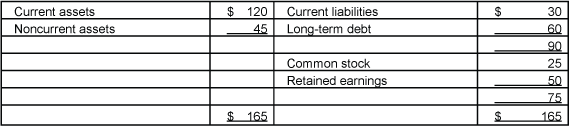 Current assets $120 Current liabilities $30 Noncurrent assets 45 Long-term debt 60 90 Common stock 25 Retained earnings 50 75 $165 $165
- Net assets of the subsidiary are $75. Assume there are no consolidating adjustments to be allocated to the subsidiary. Restrictive covenants of the subsidiary's debt agreements provide that:
- Net assets, excluding intercompany loans, cannot be less than $35.
- 60% of accumulated earnings must be maintained.
- Question 1: What is the amount of the subsidiary's restricted net assets?
- Interpretive Response:
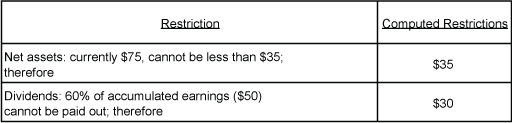 Restriction Computed Restrictions "Net assets: currently $75, cannot be less than $35; therefore " $35 Dividends: 60% of accumulated earnings ($50) cannot be paid out; therefore $30
- Restricted net assets for purposes of the test are $35. The maximum amount that can be loaned or advanced to the parent without violating the net asset covenant is $40 ($75 - 35). Alternatively, the subsidiary could pay a dividend of up to $20 ($50 - 30) without violating the dividend covenant, and loan or advance up to $20, without violating the net asset provision.
- Facts: The registrant has one 100%-owned subsidiary. The balance sheet of the subsidiary at the latest fiscal year-end is summarized as follows:
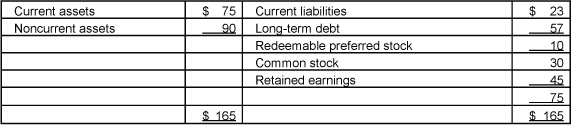 Current assets $75 Current liabilities $23 Noncurrent assets 90 Long-term debt 57 Redeemable preferred stock 10 Common stock 30 Retained earnings 45 75 $165 $165
- Assume that the registrant's consolidated net assets are $130 and there are no consolidating adjustments to be allocated to the subsidiary. The subsidiary's net assets are $75. The subsidiary's noncurrent assets are comprised of $40 in operating plant and equipment used in the subsidiary's business and a $50 investment in a 30% investee. The subsidiary's equity in this investee's undistributed earnings is $18. Restrictive covenants of the subsidiary's debt agreements are as follows:
- 1. Net assets, excluding intercompany balances, cannot be less than $20.
- 2. 80% of accumulated earnings must be reinvested in the subsidiary.
- 3. Current ratio of 2:1 must be maintained.
- Question 2: Are parent company footnote or schedule disclosures required?
- Interpretive Response: Only the parent company footnote disclosures are required. The subsidiary's restricted net assets are computed as follows:
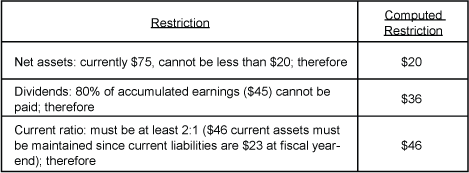 Restriction Computed Restriction "Net assets: currently $75, cannot be less than $20; therefore " $20 Dividends: 80% of accumulated earnings ($45) cannot be paid; therefore $36 Current ratio: must be at least 2:1 ($46 current assets must be maintained since current liabilities are $23 at fiscal year-end); therefore $46
- Restricted net assets for purposes of the test are $20. The amount computed from the dividend restriction ($36) and the current ratio requirement ($46) are not used because net assets may be transferred by the subsidiary up to the limitation imposed by the requirement to maintain net assets of at least $20, without violating the other restrictions. For example, a transfer to the parent of up to $55 of net assets could be accomplished by a combination of dividends of current assets of $9 ($45-36), and loans or advances of current assets of up to $20 and noncurrent assets of up to $26.
- Parent company footnote disclosures are required in this example since the restricted net assets of the subsidiary and the registrant's equity in the earnings of its 100%-owned subsidiary's investee exceed 25% of consolidated net assets [($20 + 18)/$130 = 29%]. The parent company schedule information is not required since the restricted net assets of the subsidiary are only 15% of consolidated net assets ($20/$130 = 15%).
- Although the subsidiary's noncurrent assets are not in a form which is readily transferable to the parent company, the illiquid nature of the assets is not relevant for purposes of the parent company tests. The objective of the tests is to require parent company disclosures when the parent company does not have control of its subsidiaries' funds because it does not have unrestricted access to their net assets. The tests trigger parent company disclosures only when there are significant third party restrictions on transfers by subsidiaries of net assets and the subsidiaries' net assets comprise a significant portion of consolidated net assets. Practical limitations, other than third party restrictions on transferability at the measurement date (most recent fiscal year-end), such as subsidiary illiquidity, are not considered in computing restricted net assets. However, the potential effect of any limitations other than those imposed by third parties should be considered for inclusion in Management's Discussion and Analysis of liquidity.
 Net assets Subsidiary A $ (500) Subsidiary B "$2,000 " Consolidated "$3,700 "
- Subsidiaries A and B are 100% owned by the registrant. Assume there are no consolidating adjustments to be allocated to the subsidiaries. Subsidiary A has restrictions amounting to $200. Subsidiary B's restrictions are $1,000.
- Question 3: What parent company disclosures are required for the registrant?
- Interpretive Response: Since subsidiary A has an excess of liabilities over assets, it has no restricted net assets for purposes of the test. However, both parent company footnote and schedule disclosures are required, since the restricted net assets of subsidiary B exceed 25% of consolidated net assets ($1,000/3,700 = 27%).
 Net assets Subsidiary A $ 850 Subsidiary B $ 300 Consolidated $ 3700
- The registrant owns 80% of subsidiary A. Subsidiary A owns 100% of subsidiary B. Assume there are no consolidating adjustments to be allocated to the subsidiaries. A may not pay any dividends or make any affiliate loans or advances. B has no restrictions. A's net assets of $850 do not include its investment in B.
- Question 4: Are parent company footnote or schedule disclosures required for this registrant?
- Interpretive Response: No. All of the registrant's share of subsidiary A's net assets ($680) are restricted. Although B may pay dividends and loan or advance funds to A, the parent's access to B's funds through A is restricted. However, since there are no limitations on B's ability to loan or advance funds to the parent, none of the parent's share of B's net assets are restricted. Since A's restricted net assets are less than 25% of consolidated net assets ($680/3700 = 18%), no parent company disclosures are required.
- Facts: The consolidating balance sheet of the registrant at the latest fiscal year-end is summarized as follows:
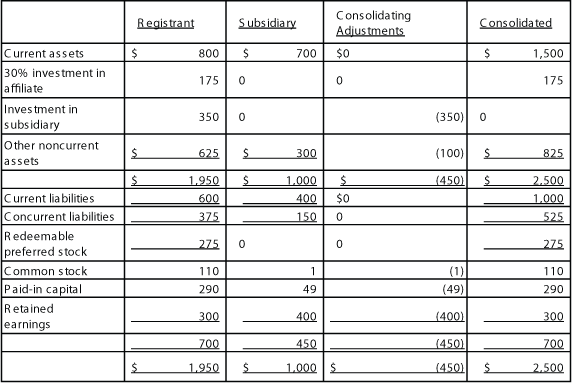 Registrant Subsidiary Consolidating Adjustments Consolidated Current assets $800 $700 $0 " $1,500 " 30% investment in affiliate 175 0 0 175 Investment in subsidiary 350 0 (350) 0 Other noncurrent assets $625 $300 (100) $825 " $1,950 " " $1,000 " $(450) " $2,500 " Current liabilities 600 400 $0 " 1,000 " Concurrent liabilities 375 150 0 525 Redeemable preferred stock 275 0 0 275 Common stock 110 1 (1) 110 Paid-in capital 290 49 (49) 290 "Retained earnings " 300 400 (400) 300 700 450 (450) 700 " $1,950 " " $1,000 " $(450) " $2,500 "
- The acquisition of the 100%-owned subsidiary was consummated on the last day of the most recent fiscal year. Immediately preceding the acquisition, the registrant had net assets of $700, which included its equity in the undistributed earnings of its 30% investee of $75. Immediately after acquiring the subsidiary's net assets, which had an historical cost of $450 and a fair value of $350, the registrant's net assets were still $700 since debt and preferred stock totaling $350 were issued in the purchase. The subsidiary has debt covenants which permit dividends, loans or advances, to the extent, if any, that net assets exceed an amount which is determined by the sum of $100 plus 75% of the subsidiary's accumulated earnings.
- Question 5: What is the amount of the subsidiary's restricted net assets? Are parent company footnote or schedule disclosures required?
- Interpretive Response: Restricted net assets for purposes of the test are $350, and both the parent company footnote and schedule disclosures are required.
- The amount of the subsidiary's restrictions at year-end is $400 [$100 + (75% x $400)]. The subsidiary's adjusted net assets after the push down of the consolidation entry to the subsidiary to record the noncurrent assets acquired at their fair value is $350 ($450 - $100). Since the subsidiary's adjusted net assets ($350) are less than the amount of its restrictions ($400), restricted net assets are $350. The computed percentages applicable to each of the disclosure tests is in excess of 25%. Therefore, both parent company footnote and schedule information are required. The percentage applicable to the footnote disclosure test is 61% [($75 + 350)/$700]. The computed percentage for the schedule disclosure is 50% ($350/$700).
- Question: Does the staff have any preference in what order data are presented (e. g., the most current data displayed first, etc.)?
- Interpretive Response: The staff has no preference as to order; however, financial statements and other data presented in tabular form should read consistently from left to right in the same chronological order throughout the filing. Similarly, numerical data included in narrative sections should be consistently ordered.
Related subtopics
- 235-10 OverallNotes to Financial Statements
- 210-10 OverallBalance Sheet
- 942-10 OverallFinancial Services—Depository and Lending
- 210-942 Financial Services—Depository and LendingBalance Sheet
- 210-946 Financial Services—Investment CompaniesBalance Sheet
- 946-10 OverallFinancial Services—Investment Companies