ASC 205-965
Plan Accounting—Health and Welfare Benefit Plans
205 Presentation of Financial Statements
Source downloaded: .Record version 370ed0c1c122. Effective date must be checked in the source.
ASC 965-205 (indexed here as 205-965) prescribes the financial statement presentation for health and welfare benefit plans. Defined benefit plans must present, on the accrual basis, a statement of net assets available for benefits, a statement of changes in net assets available for benefits, information about the plan's benefit obligations, and the significant factors causing year-to-year changes in those obligations; defined contribution plans present only the two net-asset statements because the obligation is limited to participants' account balances. It also governs how retiree health benefits funded through a 401(h) account in the sponsor's defined benefit pension plan are reported in the health and welfare plan's financial statements, plus an extensive list of required note disclosures.
Key points (7)
- A defined benefit health and welfare plan's GAAP financial statements are prepared on the accrual basis and include a statement of net assets available for benefits, a statement of changes in net assets available for benefits, information on benefit obligations at year-end, and the significant effects of factors changing those obligations (965-205-45-1).
- Benefit obligation information may be shown in a separate statement, combined with another statement, or in the notes, but it must be presented in its entirety in the same location and in enough detail to identify the nature and classification of the obligations (965-205-45-2; 965-205-50-6).
- A defined contribution health and welfare plan presents only a statement of net assets available for benefits and a statement of changes in net assets available for benefits; benefit obligation information is not applicable because the obligation is limited to the amounts in participants' accounts (965-205-45-3 through 45-4).
- Health and welfare plans are not required to present a statement of cash flows if they provide information similar to that required by Topic 960, though one is encouraged when assets are not highly liquid or investments are financed (965-205-45-5; 230-10-15-4).
- 401(h) account assets, liabilities, and changes therein used to fund retiree health benefits are reported in the health and welfare plan's financial statements, either as a single line item or within individual line items with note disclosure; 401(h) obligations go in the plan's statement of benefit obligations and claims paid through the account go in the statement of changes in benefit obligations (965-205-45-6 through 45-8).
- Because ERISA requires 401(h) accounts to be reported as pension plan assets, the health and welfare plan must reconcile net assets to Form 5500 and disclose that the assets are available only to pay retiree health benefits and the significant components of the account's net assets and changes; Topic 815 and 820 investment disclosures are not required for 401(h) assets if the pension plan providing them is named (965-205-50-3 through 50-5).
- Required disclosures include a description of the plan and amendments, funding policy and the portion of estimated postretirement cost funded by retiree contributions, tax status, insurance policies, party-in-interest transactions, subsequent events, assumed health care cost-trend rates, and the effect of a one-percentage-point increase in those trend rates on the postretirement benefit obligation (965-205-50-1).
For students. Exam questions often turn on the difference between defined benefit and defined contribution health and welfare plans: only defined benefit plans report benefit obligations, because a defined contribution plan's obligation is capped at the participant's account balance. A second common trap is the 401(h) account — even though ERISA treats it as a pension plan asset (hence the Form 5500 reconciliation), GAAP requires it and the related retiree health obligations to be reported in the health and welfare plan's statements, not the pension plan's.
Machine-generated study aid for ASC 205-965. Check the source paragraphs below.
205-965-00Status
Source downloaded: .Record version 308e3167ffe5. Effective date must be checked in the source.
205-965-05Overview and Background
Source downloaded: .Record version abf9375d623a. Effective date must be checked in the source.
401(h) Accounts
- aBenefits are subordinate (as defined in Section 401(h) of the Internal Revenue Code) to the retirement benefits provided by the plan.
- bA separate account is established and maintained for such benefits.
- cThe employer's contributions to the separate account are reasonable and ascertainable.
- dIt is impossible, at any time before the satisfaction of all obligations under the plan to provide such benefits, for any part of the corpus or income of the separate account to be (within the taxable year or thereafter) used for or diverted to any purpose other than the providing of such benefits.
- eNotwithstanding the provisions of certain Internal Revenue Code sections, upon satisfaction of all obligations under the plan to provide such benefits, any amount remaining in the separate account must, under the terms of the plan, be returned to the employer.
- fIn the case of an employee who is a key employee (as defined in Section 416(i)), a separate account is established and maintained for such benefits payable to such employee (and the spouse and dependents) and such benefits (to the extent attributable to plan years beginning after March 31, 1984, for which the employee is a key employee) are payable only to such employee (and the spouse and dependents) from that separate account.
205-965-10Objectives
Source downloaded: .Record version 56d574585b3b. Effective date must be checked in the source.
Defined Benefit Health and Welfare Plans
- aPlan resources and the manner in which the stewardship responsibility for those resources has been discharged
- bBenefit obligations
- cThe results of transactions and events that affect the information about those resources and obligations
- dOther factors necessary for users to understand the information provided.
Defined Contribution Health and Welfare Plans
- aPlan resources and the manner in which the stewardship responsibility for those resources has been discharged
- bThe results of transactions and events that affect the information about those resources
- cOther factors necessary for users to understand the information provided. For example vacation, holiday, and legal are typical plans whose benefits are limited to the balance in the participant's accounts.
205-965-15Scope and Scope Exceptions
Source downloaded: .Record version ed4a9e52e3a9. Effective date must be checked in the source.
Overall Guidance
205-965-45Other Presentation Matters
Source downloaded: .Record version 86e99ec88124. Effective date must be checked in the source.
Defined Benefit Health and Welfare Plans
- a A statement of net assets available for benefits as of the end of the plan year (see paragraphs )
- b A statement of changes in net assets available for benefits for the year then ended (see paragraphs )
- c Information regarding the plan's benefit obligations as of the end of the plan year (see Subtopic 965-30)
- d Information regarding the effects, if significant, of certain factors affecting the year-to-year change in the plan's benefit obligations (see paragraphs ).
Defined Contribution Health and Welfare Plans
- a A statement of net assets available for benefits of the plan as of the end of the plan year (see Subtopic 965-30)
- b A statement of changes in net assets available for benefits of the plan for the year then ended (see paragraphs ).
Cash Flows
401(h) Accounts
- a As a single line item on the face of the statements
- b Included in individual line items with separate disclosure in the notes to financial statements about the 401(h) amounts included in those individual line items.
Employees' Beneficiary Association Trust
Interests in Master Trusts
205-965-50Disclosure
Source downloaded: .Record version be4caad3ca79. Effective date must be checked in the source.
- a A brief, general description of the plan agreement, including, but not limited to, participants covered, vesting, and benefit provisions. If a plan agreement or a description thereof providing this information is otherwise published or made available, the description in the financial statement disclosures may be omitted, provided that a reference to the other source is made.
- b A description of significant plan amendments adopted during the period, as well as significant changes in the nature of the plan (for example, a plan spinoff or merger with another plan) and changes in actuarial assumptions.
- c The funding policy and any changes in the policy made during the plan year. If the benefit obligations exceed the net assets of the plan, the method of funding this deficit, as provided for in the plan agreement or collective bargaining agreement, also shall be disclosed. If significant plan administration or related costs are being borne by the employer, that fact shall be disclosed. For a contributory plan, the disclosure shall state the method of determining participants' contributions. For each year for which a year-end statement of net assets available for benefits is presented, the plan shall disclose a description of the portion of the plan's estimated cost of providing postretirement benefits funded by retiree contributions. The plan's estimated cost of postretirement benefits is the plan's expected claims cost for the year. It excludes benefit costs paid by Medicare and costs, such as deductibles and copayments, paid directly to the medical provider by participants. The portion of the plan's estimated cost that is funded by retiree contributions is determined at the beginning of the year based on the plan sponsor's cost-sharing policy. In determining that amount, the retirees' required contribution for the year shall be reduced by any amounts intended to recover a shortfall (or increased by amounts intended to compensate for an overcharge) in attaining the desired cost-sharing in prior year(s). If the plan terms provide that a shortfall in attaining the intended cost sharing in the prior year(s) is to be recovered by increasing the retiree contribution in the current year, that incremental contribution shall be separately disclosed. Similarly, if the plan terms provide that participant contributions in the current year are to be reduced by the amount by which participant contributions in the prior year exceeded the amount needed to attain the desired cost-sharing, the resulting reduction in the current year contribution shall be separately disclosed. The information about retiree contributions shall be provided for each significant group of retired participants to the extent their contributions differ.
- d The federal income tax status of the plan.
- e The policy regarding the purchase of contracts with insurance entities that are excluded from plan assets. Consideration should be given to disclosing the type and extent of insurance coverage, as well as the extent to which risk is transferred (for example, coverage period and claims reported or claims incurred).
- f The amounts and types of securities of the employer and related parties included in plan assets, and the approximate amount of future annual benefits of plan participants covered by insurance contracts issued by the employer and related parties.
- g Significant real estate or other transactions in which the plan and any of the following parties are jointly involved:
- 1 The sponsor
- 2 The plan administrator
- 3 Employers
- 4 Employee organizations.
- 1
- h Unusual or infrequent events or transactions occurring after the financial statement date, but before the financial statements are issued or are available to be issued (as discussed in Section 855-10-25), that might significantly affect the usefulness of the financial statements in an assessment of the plan's present and future ability to pay benefits. For example, all of the following shall be disclosed:
- 1 A plan amendment adopted after the latest financial statement date that significantly increases future benefits attributable to an employee's service rendered before that date
- 2 A significant change in the fair value of a significant portion of the plan's assets
- 3 The emergence of a catastrophic claim.
If reasonably determinable, the effects of such events or transactions shall be disclosed. If such effects are not reasonably determinable, the reasons why they are not quantifiable shall be disclosed. - 1
- i Any of the following commitments or contingencies:
- 1 Material lease commitments
- 2 Other commitments
- 3 Contingent liabilities.
- 1
- j The assumed health care cost-trend rate(s) used to measure the expected cost of benefits covered by the plan for the next year, including both of the following:
- 1 A general description of the direction and pattern of change in the assumed trend rates thereafter
- 2 The ultimate trend rate(s) and when that rate is expected to be achieved.
- 1
- k For health and welfare benefit plans providing postretirement health care benefits, the effect of a one-percentage-point increase in the assumed health care cost-trend rates for each future year on the postretirement benefit obligation
- l Any modification of the existing cost-sharing provisions that are encompassed by the substantive plan(s) and the existence and nature of any commitment to increase monetary benefits provided by the plan and their effect on the plan's financial statements.
- m Termination provisions of the plan and priorities for distribution of assets, if applicable.
- n Restrictions, if any, on plan assets (for example, legal restrictions on multiple trusts)
- o For a defined contribution health and welfare plan, the accounting policy for, and the amount and disposition of, forfeited nonvested accounts. Specifically, identification of whether those amounts will be used to reduce future employer contributions, employer expenses, or will be allocated to participants' accounts.
401(h) Accounts
Defined Benefit Health and Welfare Plans
205-965-55Implementation Guidance and Illustrations
Source downloaded: .Record version 90324d1c8fe5. Effective date must be checked in the source.
Illustrations
- ALLIED INDUSTRIES HEALTH CARE BENEFIT PLAN Allied Industries Health Care Benefit Plan Statements of Net Assets Available for Benefits December 31, 20X2 and 20X1
-
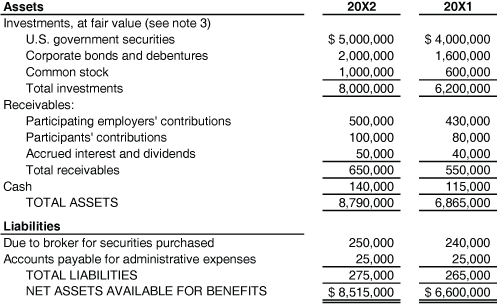 Assets 20X2 20X1 "Investments, at fair value (see note 3)" U.S. government securities " $5,000,000 " " $4,000,000 " Corporate bonds and debentures " 2,000,000 " " 1,600,000 " Common stock " 1,000,000 " " 600,000 " Total investments " 8,000,000 " " 6,200,000 " Receivables: Participating employers' contributions " 500,000 " " 430,000 " Participants' contributions " 100,000 " " 80,000 " Accrued interest and dividends " 50,000 " " 40,000 " Total receivables " 650,000 " " 550,000 " Cash " 140,000 " " 115,000 " TOTAL ASSETS " 8,790,000 " " 6,865,000 " Liabilities Due to broker for securities purchased " 250,000 " " 240,000 " Accounts payable for administrative expenses " 25,000 " " 25,000 " TOTAL LIABILITIES " 275,000 " " 265,000 " NET ASSETS AVAILABLE FOR BENEFITS " $8,515,000 " " $6,600,000 "
-
- The accompanying notes are an integral part of the financial statements.
- Allied Industries Health Care Benefit Plan Statements of Changes in Net Assets Available for Benefits Years Ended December 31, 20X2 and 20X1
-
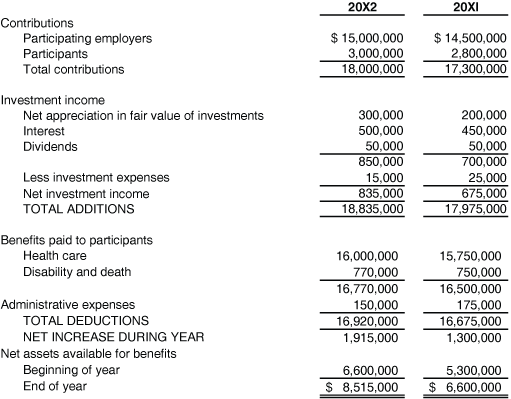 20X2 20XI Contributions Participating employers " $15,000,000 " " $14,500,000 " Participants " 3,000,000 " " 2,800,000 " Total contributions " 18,000,000 " " 17,300,000 " Investment income Net appreciation in fair value of investments " 300,000 " " 200,000 " Interest " 500,000 " " 450,000 " Dividends " 50,000 " " 50,000 " " 850,000 " " 700,000 " Less investment expenses " 15,000 " " 25,000 " Net investment income " 835,000 " " 675,000 " TOTAL ADDITIONS " 18,835,000 " " 17,975,000 " Benefits paid to participants Health care " 16,000,000 " " 15,750,000 " Disability and death " 770,000 " " 750,000 " " 16,770,000 " " 16,500,000 " Administrative expenses " 150,000 " " 175,000 " TOTAL DEDUCTIONS " 16,920,000 " " 16,675,000 " NET INCREASE DURING YEAR " 1,915,000 " " 1,300,000 " Net assets available for benefits Beginning of year " 6,600,000 " " 5,300,000 " End of year " $8,515,000 " " $6,600,000 "
-
- The accompanying notes are an integral part of the financial statements.
- Allied Industries Health Care Benefit Plan Statements of Plan's Benefit Obligations December 31, 20X1, and 20X0
-
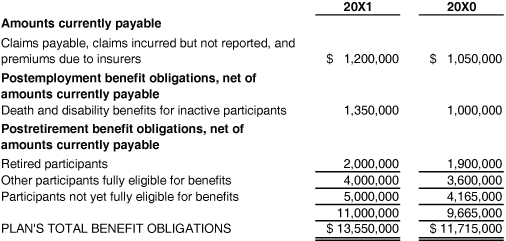 20X1 20X0 Amounts currently payable "Claims payable, claims incurred but not reported, and premiums due to insurers" " $1,200,000 " " $1,050,000 " "Postemployment benefit obligations, net of amounts currently payable" Death and disability benefits for inactive participants " 1,350,000 " " 1,000,000 " "Postretirement benefit obligations, net of amounts currently payable" Retired participants " 2,000,000 " " 1,900,000 " Other participants fully eligible for benefits " 4,000,000 " " 3,600,000 " Participants not yet fully eligible for benefits " 5,000,000 " " 4,165,000 " " 11,000,000 " " 9,665,000 " PLAN'S TOTAL BENEFIT OBLIGATIONS " $13,550,000 " " $11,715,000 "
-
- The accompanying notes are an integral part of the financial statements.
- Allied Industries Health Care Benefit Plan Statements of Changes in Plan's Benefit Obligations Year Ended December 31, 20X1
-
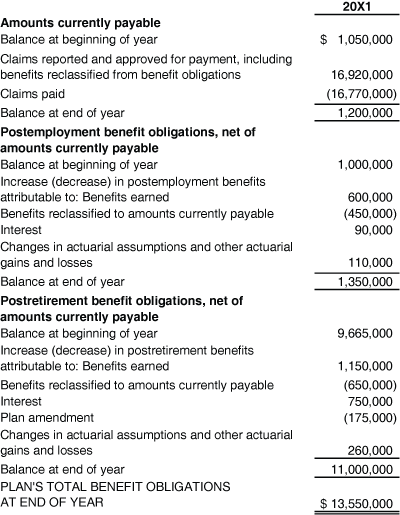 20X1 Amounts currently payable Balance at beginning of year " $1,050,000 " "Claims reported and approved for payment, including benefits reclassified from benefit obligations" " 16,920,000 " Claims paid " (16,770,000)" Balance at end of year " 1,200,000 " "Postemployment benefit obligations, net of amounts currently payable" Balance at beginning of year " 1,000,000 " Increase (decrease) in postemployment benefits attributable to: Benefits earned " 600,000 " Benefits reclassified to amounts currently payable " (450,000)" Interest " 90,000 " Changes in actuarial assumptions and other actuarial gains and losses " 110,000 " Balance at end of year " 1,350,000 " "Postretirement benefit obligations, net of amounts currently payable" Balance at beginning of year " 9,665,000 " Increase (decrease) in postretirement benefits attributable to: Benefits earned " 1,150,000 " Benefits reclassified to amounts currently payable " (650,000)" Interest " 750,000 " Plan amendment " (175,000)" Changes in actuarial assumptions and other actuarial gains and losses " 260,000 " Balance at end of year " 11,000,000 " "PLAN'S TOTAL BENEFIT OBLIGATIONS AT END OF YEAR" " $13,550,000 "
-
- The accompanying notes are an integral part of the financial statements.
- Allied Industries Health Care Benefit Plan Notes to Financial Statements
- NOTE 1: DESCRIPTION OF PLAN
- The following description of the Allied Industries Benefit Plan (the Plan) provides only general information. Participants should refer to the Plan agreement for a complete description of the Plan's provisions.
- General. The Plan provides health and other benefits covering all participants in the widgets industry in the Greater Metropolis area. The Plan and related trust were established on May 8, 1966, pursuant to a collective bargaining agreement between the Allied Employers' Trade Association and the Allied Union, Local 802. It is subject to the provisions of the Employee Retirement Income Security Act of 1974, as amended.
- Benefits. The Plan provides health benefits (medical, hospital, surgical, major medical, and dental), permanent disability benefits, and death benefits to full-time participants (with at least 450 hours of work in the industry during a consecutive3-month period) and to their beneficiaries and covered dependents. Retired employees are entitled to similar health benefits (in excess of Medicare coverage) provided they have attained at least age 62 and have 15 years of service with participating employers before retirement.
- The Plan also provides health benefits to participants during periods of unemployment, provided they have accumulated in the current year or in prior years credit amounts (expressed in hours) in excess of the hours required for current coverage. Accumulated eligibility credits equal to one year's coverage may be carried forward.
- Health, disability, and death claims of active and retired participants, dependents, and beneficiaries are processed by the Administrator Group, but the responsibility for payments to participants and providers is retained by the Plan.
- In 20X2 the board of trustees amended the Plan to increase the deductible under major medical coverage from $100 to $300 and to extend dental coverage to employees retiring after December 31, 20X2. The amendment will not affect participating employers' contributions to the Plan in 20X3 under the current collective bargaining agreement.
- Contributions. Participating employers contribute 5.5 percent of wages pursuant to the current collective bargaining agreement between employers and the union (expiring February 19, 20X5). Employees may contribute specified amounts, determined periodically by the Plan's actuary, to extend coverage to eligible dependents. The costs of the postretirement benefit plan are shared by the Plan's participating employers and retirees. In addition to deductibles and copayments, participant contributions in the current (and prior, if applicable) year were as follows.
-
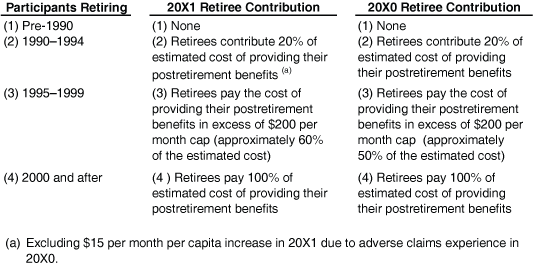 Participants Retiring 20X1 Retiree Contribution 20X0 Retiree Contribution (1) Pre-1990 (1) None (1) None (2) 1990-1994 (2) Retirees contribute 20% of estimated cost of providing their postretirement benefits (a) (2) Retirees contribute 20% of estimated cost of providing their postretirement benefits (3) 1995-1999 (3) Retirees pay the cost of providing their postretirement benefits in excess of $200 per month cap (approximately 60% of the estimated cost) (3) Retirees pay the cost of providing their postretirement benefits in excess of $200 per month cap (approximately 50% of the estimated cost) (4) 2000 and after (4 ) Retirees pay 100% of estimated cost of providing their postretirement benefits (4) Retirees pay 100% of estimated cost of providing their postretirement benefits (a) "Excluding $15 per month per capita increase in 20X1 due to adverse claims experience in 20X0. "
-
- Other. The Plan's board of trustees, as Sponsor, has the right under the Plan to modify the benefits provided to active employees. The Plan may be terminated only by joint agreement between industry and union, subject to the provisions set forth in the Employee Retirement Income Security Act.
- NOTE 2: SUMMARY OF ACCOUNTING POLICIES
- A. Valuation of Investments. The Plan's investments are stated at fair value less costs to sell, if significant. Securities traded on the national securities exchange are valued at the last reported sales price on the last business day of the plan year. Investments traded in the over-the-counter market and listed securities for which no sale was reported on that date are valued at the average of the last reported bid and asked prices. The Plan also holds certain corporate bonds that do not have an observable price. These bonds have maturities ranging from 5 to 7 years, and a weighted average coupon rate of 9 percent. The Plan's board of trustees has measured fair value for these bonds using an income approach that discounts contractual cash flows at a weighted average yield of 12 percent, which is based on yields currently available on comparable securities of issuers with similar credit ratings.
- B. Postretirement Benefits. The amount reported as the postretirement benefit obligation represents the actuarial present value of those estimated future benefits that are attributed by the terms of the plan to employees' service rendered to the date of the financial statements, reduced by the actuarial present value of contributions expected to be received in the future from current plan participants. Postretirement benefits include future benefits expected to be paid to or for both of the following:
- a Currently retired or terminated employees and their beneficiaries and dependents
- b Active employees and their beneficiaries and dependents after retirement from service with participating employers.
- a
- The postretirement benefit obligation represents the amount that is to be funded by contributions from the plan's participating employers and from existing plan assets. Before an active employee's full eligibility date, the postretirement benefit obligation is the portion of the expected postretirement benefit obligation that is attributed to that employee's service in the industry rendered to the valuation date.
- The actuarial present value of the expected postretirement benefit obligation is determined by an actuary and is the amount that results from applying actuarial assumptions to historical claims-cost data to estimate future annual incurred claims costs per participant and to adjust such estimates for the time value of money (through discounts for interest) and the probability of payment (by means of decrements such as those for death, disability, withdrawal, or retirement) between the valuation date and the expected date of payment.
- For measurement purposes, a 9.5 percent annual rate of increase in the per capita cost of covered health care benefits was assumed for 20X3; the rate was assumed to decrease gradually to 8.0 percent for 20X8 and to remain at that level thereafter. These assumptions are consistent with those used to measure the benefit obligation at December 31, 20X1.
- The following were other significant assumptions used in the valuations as of December 31, 20X2 and 20X1.
-
 Weighted-average discount rate 8.0%—20X2; 8.25%—20X1 Average retirement age 60 Mortality 1971 Group Annuity Mortality Table
-
- The foregoing assumptions are based on the presumption that the Plan will continue. Were the Plan to terminate, different actuarial assumptions and other factors might be applicable in determining the actuarial present value of the postretirement benefit obligation.
- C. Other Plan Benefits. Plan obligations at December 31 for health claims incurred by active participants but not reported at that date, for accumulated eligibility of participants, and for future disability payments to members considered permanently disabled at December 31 are estimated by the Plan's actuary in accordance with accepted actuarial principles. Such estimated amounts are reported in the accompanying statement of the Plan's benefit obligations at present value, based on an 8.0 percent discount rate. Health claims incurred by retired participants but not reported at year end are included in the postretirement benefit obligation.
- NOTE 3: INVESTMENTS
- The Plan's investments are held by a bank-administered trust fund. (See paragraph 962-325-55-17 for a detailed Example of plan investment disclosures.)
- NOTE 4: BENEFIT OBLIGATIONS
- The Plan's deficiency of net assets over benefit obligations at December 31, 20X2, and 20X1, relates primarily to the postretirement benefit obligation, the funding of which is not covered by the contribution rate provided by the current bargaining agreement. It is expected that the deficiency will be funded through future increases in the collectively bargained contribution rates.
- The weighted-average health care cost-trend rate assumption (see note 2B) has a significant effect on the amounts reported in the accompanying financial statements. If the assumed rates increased by one percentage point in each year, it would increase the obligation as of December 31, 20X2, and 20X1, by $2,600,000 and $2,500,000, respectively.
- NOTE 5: OTHER MATTERS
- The trust established under the Plan to hold the Plan's assets is qualified pursuant to Section 501(c)9 of the Internal Revenue Code, and, accordingly, the trust's net investment income is exempt from income taxes. The Plan has obtained a favorable tax determination letter from the Internal Revenue Service (IRS), and the Plan sponsor believes that the Plan, as amended, continues to qualify and to operate as designed.
- CLASSIC ENTERPRISES BENEFIT PLAN
- Classic Enterprises Benefit Plan Statements of Benefit Obligations and Net Assets Available for Benefits December 31, 20X2, and 20X1
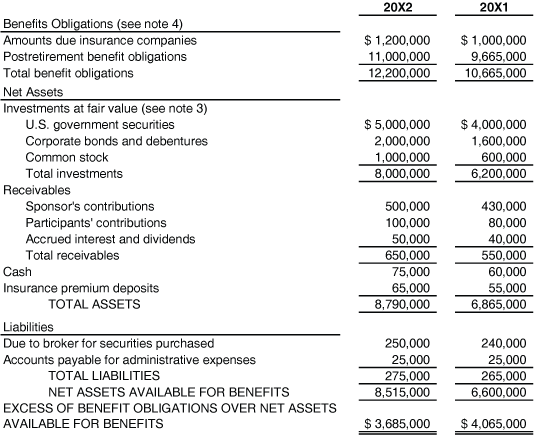 20X2 20X1 Benefits Obligations (see note 4) Amounts due insurance companies " $1,200,000 " " $1,000,000 " Postretirement benefit obligations " 11,000,000 " " 9,665,000 " Total benefit obligations " 12,200,000 " " 10,665,000 " Net Assets Investments at fair value (see note 3) U.S. government securities " $5,000,000 " " $4,000,000 " Corporate bonds and debentures " 2,000,000 " " 1,600,000 " Common stock " 1,000,000 " " 600,000 " Total investments " 8,000,000 " " 6,200,000 " Receivables Sponsor's contributions " 500,000 " " 430,000 " Participants' contributions " 100,000 " " 80,000 " Accrued interest and dividends " 50,000 " " 40,000 " Total receivables " 650,000 " " 550,000 " Cash " 75,000 " " 60,000 " Insurance premium deposits " 65,000 " " 55,000 " TOTAL ASSETS " 8,790,000 " " 6,865,000 " Liabilities Due to broker for securities purchased " 250,000 " " 240,000 " Accounts payable for administrative expenses " 25,000 " " 25,000 " TOTAL LIABILITIES " 275,000 " " 265,000 " NET ASSETS AVAILABLE FOR BENEFITS " 8,515,000 " " 6,600,000 " EXCESS OF BENEFIT OBLIGATIONS OVER NET ASSETS AVAILABLE FOR BENEFITS " $3,685,000 " " $4,065,000 "
- The accompanying notes are an integral part of the financial statements.
- Classic Enterprises Benefit Plan Statement of Changes in Benefit Obligations and Net Assets Available for Benefits Years Ended December 31, 20X2, and 20X1
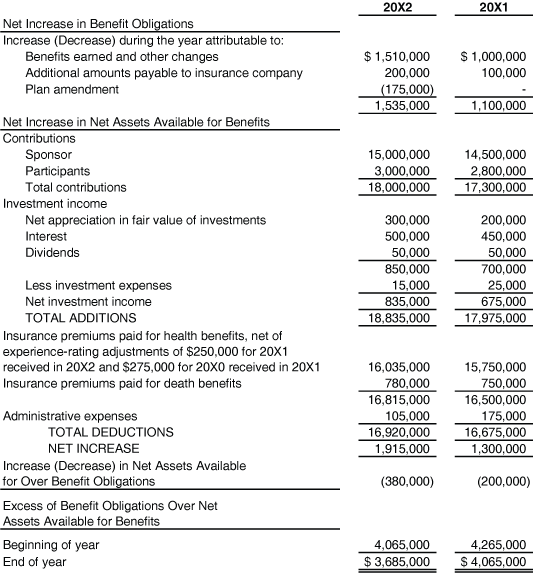 20X2 20X1 Net Increase in Benefit Obligations Increase (Decrease) during the year attributable to: Benefits earned and other changes " $1,510,000 " " $1,000,000 " Additional amounts payable to insurance company " 200,000 " " 100,000 " Plan amendment " (175,000)" - " 1,535,000 " " 1,100,000 " Net Increase in Net Assets Available for Benefits Contributions Sponsor " 15,000,000 " " 14,500,000 " Participants " 3,000,000 " " 2,800,000 " Total contributions " 18,000,000 " " 17,300,000 " Investment income Net appreciation in fair value of investments " 300,000 " " 200,000 " Interest " 500,000 " " 450,000 " Dividends " 50,000 " " 50,000 " " 850,000 " " 700,000 " Less investment expenses " 15,000 " " 25,000 " Net investment income " 835,000 " " 675,000 " TOTAL ADDITIONS " 18,835,000 " " 17,975,000 " "Insurance premiums paid for health benefits, net of experience-rating adjustments of $250,000 for 20X1 received in 20X2 and $275,000 for 20X0 received in 20X1" " 16,035,000 " " 15,750,000 " Insurance premiums paid for death benefits " 780,000 " " 750,000 " " 16,815,000 " " 16,500,000 " Administrative expenses " 105,000 " " 175,000 " TOTAL DEDUCTIONS " 16,920,000 " " 16,675,000 " NET INCREASE " 1,915,000 " " 1,300,000 " "Increase (Decrease) in Net Assets Available for Over Benefit Obligations" " (380,000)" " (200,000)" "Excess of Benefit Obligations Over Net Assets Available for Benefits" Beginning of year " 4,065,000 " " 4,265,000 " End of year " $3,685,000 " " $4,065,000 "
- The accompanying notes are an integral part of the financial statements.
- Classic Enterprises Benefit Plan Notes to Financial Statements
- NOTE 1: DESCRIPTION OF PLAN
- The following description of the Classic Enterprises Benefit Plan (the Plan) provides only general information. Participants should refer to the Plan agreement for a complete description of the Plan's provisions.
- General. The Plan provides health and death benefits covering substantially all active and retired employees of Classic Enterprises (the Sponsor). It is subject to the provisions of the Employee Retirement Income Security Act of 1974, as amended.
- Benefits. The Plan provides health benefits (medical, hospital, surgical, major medical, and dental) and death benefits to full-time employees of the Sponsor (with at least 1,000 hours of service each year) and to their beneficiaries and covered dependents. Retired employees are entitled to similar health and death benefits provided they have attained at least age 55 and have at least10 years of service with the Sponsor.
- Current health claims of active and retired participants and their dependents and beneficiaries are provided under group insurance contracts with ABC Carrier, which are experience rated after the anniversary dates of the policies (generally March 31). Death benefits are covered by a group-term policy with DEF Carrier.
- Contributions. The Sponsor's policy is to contribute the maximum amounts allowed as a tax deduction by the Internal Revenue Code. Under present law, the Sponsor is not permitted to deduct amounts for future benefits to current employees and retirees.
- Employees and retirees may contribute specified amounts, determined periodically by the Plan's insurance companies, to extend coverage to eligible dependents.
- In 20X2 the Plan was amended to increase the deductible under major medical coverage from $100 to $300 and to extend dental coverage to employees retiring after December 31, 20X2. The amendment is not expected to significantly affect the Sponsor's contribution to the Plan in 20X3.
- Other. Although it has not expressed any intention to do so, the Sponsor has the right under the Plan to modify the benefits provided to active employees, to discontinue its contributions at any time, and to terminate the Plan subject to the provisions set forth in the Employee Retirement Income Security Act.
- NOTE 2: SUMMARY OF ACCOUNTING POLICIES
- Valuation of Investments. The Plan's investments are stated at fair value. Securities traded on the national securities exchange are valued at the last reported sales price on the last business day of the plan year. Investments traded in the over-the-counter market and listed securities for which no sale was reported on that date are valued at the average of the last reported bid and asked prices. The Plan also holds certain corporate bonds that do not have an observable price. These bonds have maturities ranging from 5 to 7 years, and a weighted average coupon rate of 9 percent. The Classic Enterprises Benefits Committee has measured fair value for these bonds using an income approach that discounts contractual cash flows at a weighted average yield of 12 percent, which is based on yields currently available on comparable securities of issuers with similar credit ratings.
- B. Plan Benefits. The postretirement benefit obligation (see note 4) represents the actuarial present value of those estimated future benefits that are attributed to employee service rendered to December 31. Postretirement benefits include future benefits expected to be paid to or for both of the following:
- 1Currently retired employees and their beneficiaries and dependents
- 2Active employees and their beneficiaries and dependents after retirement from service with the Sponsor.
Before an active employee's full eligibility date, the postretirement benefit obligation is the portion of the expected postretirement benefit obligation that is attributed to that employee's service rendered to the valuation date. - 1
- The actuarial present value of the expected postretirement benefit obligation is determined by an actuary and is the amount that results from applying actuarial assumptions to historical claims-cost data to estimate future annual incurred claims costs per participant and to adjust such estimates for the time value of money (through discounts for interest) and the probability of payment (by means of decrements such as those for death, disability, withdrawal, or retirement) between the valuation date and the expected date of payment, and to reflect the portion of those costs expected to be borne by Medicare, the retired participants, and other providers.
- For measurement purposes at December 31, 20X2, a 9.5 percent annual rate of increase in the per capita cost of covered health care benefits was assumed for 20X3; the rate was assumed to decrease gradually to 8.0 percent for 20X8 and to remain at that level thereafter. These assumptions are consistent with those used to measure the benefit obligation at December 31, 20X1.
- The following were other significant assumptions used in the valuations as of December 31, 20X2, and 20X1.
 Weighted-average discount rate 8.0% Average retirement age 60 Mortality 1971 Group Annuity Mortality Table
- The foregoing assumptions are based on the presumption that the Plan will continue. Were the Plan to terminate, different actuarial assumptions and other factors might be applicable in determining the actuarial present value of the postretirement benefit obligation.
- NOTE 3: INVESTMENTS
- The Plan's investments are held by a bank-administered trust fund. (See paragraph 962-325-55-17 for a detailed Example of plan investment disclosures.)
- NOTE 4: BENEFIT OBLIGATIONS
- Health costs incurred by participants and their beneficiaries and dependents are covered by insurance contracts maintained by the Plan. It is the present intention of the Sponsor and the Plan to continue obtaining insurance coverage for benefits. As stated in note 1, the Sponsor is not permitted under present tax law to deduct amounts for future benefits (beyond one year). Insurance premiums for future years in respect of the Plan's postretirement benefit obligation will be funded by Sponsor contributions to the Plan in those later years.
- The postretirement benefit obligation at December 31, 20X2, and 20X1, principally health benefits, related to the following categories of participants (including their beneficiaries and dependents).
 20X2 20X1 Current retirees " $3,900,000 " " $3,500,000 " Other participants fully eligible for benefits " 2,100,000 " " 2,000,000 " Participants not yet fully eligible for benefits " 5,000,000 " " 4,165,000 " " $11,000,000 " " $9,665,000 "
- The health care cost-trend rate assumption (see note 2B) has a significant effect on the amounts reported. If the assumed rates increased by one percentage point in each year, that would increase the obligation as of December 31, 20X2, and 20X1, by $2,600,000 and $2,500,000, respectively.
- NOTE 5: OTHER MATTERS
- The trust established under the Plan to hold the Plan's net assets is qualified pursuant to Section 501(c)9 of the Internal Revenue Code, and, accordingly, the trust's net investment income is exempt from income taxes. The Sponsor has obtained a favorable tax determination letter from the Internal Revenue Service and the Sponsor believes that the Plan, as amended, continues to qualify and to operate as designed.
- ABC COMPANY SUPPLEMENTAL UNEMPLOYMENT BENEFIT PLAN
- Supplemental Unemployment Benefit Plan for Employees of ABC Company Established Pursuant to Agreement With United Workers of America Statements of Net Assets Available for Benefits December 31, 20X1,and 20X0
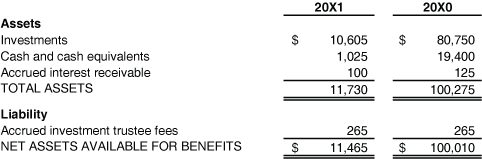 20X1 20X0 Assets Investments " $10,605 " " $80,750 " Cash and cash equivalents " 1,025 " " 19,400 " Accrued interest receivable 100 125 TOTAL ASSETS " 11,730 " " 100,275 " Liability Accrued investment trustee fees 265 265 NET ASSETS AVAILABLE FOR BENEFITS " $11,465 " " $100,010 "
- The accompanying notes are an integral part of the financial statements.
- Supplemental Unemployment Benefit Plan for Employees of ABC Company Established Pursuant to Agreement With United Workers of America Statement of Changes in Net Assets Available for Benefits Year Ended December 31, 20X1
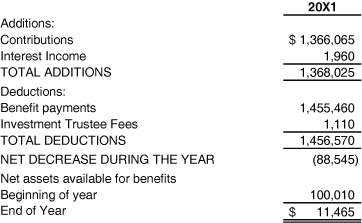 20X1 Additions: Contributions " $1,366,065 " Interest Income " 1,960 " TOTAL ADDITIONS " 1,368,025 " Deductions: Benefit payments " 1,455,460 " Investment Trustee Fees " 1,110 " TOTAL DEDUCTIONS " 1,456,570 " NET DECREASE DURING THE YEAR " (88,545)" Net assets available for benefits Beginning of year " 100,010 " End of Year " $11,465 "
- The accompanying notes are an integral part of the financial statements.
- Supplemental Unemployment Benefit Plan for Employees of ABC Company Established Pursuant to Agreement With United Workers of America Notes to Financial Statements
- NOTE 1: DESCRIPTION OF PLAN
- In connection with a negotiated contract, the Supplemental Unemployment Benefit Plan for Employees of ABC Company Established Pursuant to Agreement with United Workers of America (the Plan) provides for payment of supplemental unemployment benefits to covered employees who have completed two years of continuous service. Payments are made to both of the following:
- aEmployees on layoff
- bCertain employees who work less than 32 hours in any week.
- a
- The following description is provided for general information purposes. The Plan document should be referred to for specific information regarding benefits and other Plan matters.
- NOTE 2: SUMMARY OF ACCOUNTING POLICIES
- Basis of Accounting. The financial statements of the Plan are prepared under the accrual method of accounting.
- Investment Valuation. The Plan's investments consist of shares of a money market portfolio. The investments are reported at fair value.
- Use of Estimates. The preparation of financial statements in conformity with generally accepted accounting principles (GAAP) requires management to make estimates and assumptions that affect the reported amounts of assets and liabilities and disclosure of contingent assets and liabilities at the date of the financial statements and the reported amounts of revenues and expenses during the reporting period. Actual results could differ from those estimates.
- Benefit Obligations. The Plan's obligation for accumulated eligibility credits is discounted using a weighted-average assumed rate of 7.5 percent.
- NOTE 3: FUNDING AND OPERATION OF THE PLAN
- Funding of the Plan. Contributions funded by ABC Company, the Plan's sponsor, pursuant to the Plan are invested in assets held in a trust fund (the Fund). General Bank, the trustee of the Fund (the Trustee), invests the Fund's money as set forth in the Plan document. Investments consist of money market funds and are reported in the accompanying financial statements at fair value. Interest income from investments is recognized when earned.
- The ABC Company Benefit Plan Administrative Committee has responsibility for administering the Plan. The ABC Company Benefit Plan Asset Review Committee has responsibility for the management and control of the assets of the Trust.
- Benefits Under the Plan. The Plan provides for the payment of weekly and short-week supplemental unemployment benefits. The benefits payable are reduced by any state unemployment benefits or any other compensation received. Also, a waiting-week benefit of $100 will be payable if a participant fails to receive a state unemployment benefit solely because of the state's waiting-week requirement. Benefits paid for any week for which the employee received state unemployment benefits are limited to $180. Benefits paid for all other weeks are limited to $235. The Plan provides for a possible reduction of weekly benefits for employees with less than 20 years of service based on a percentage determined generally by dividing the net assets of the Plan, as defined in the Plan document, by the "maximum financing" (see "ABC's Obligations Under the Plan"). Employees earn one-half credit unit for each week in which hours are worked or, in some situations, in which hours are not worked (vacation, disability, serving on grievance committee, and so on) up to a maximum of 52 credit units for employees with less than 20 years of service and 104 credit units for employees with 20 or more years of service. Generally, one credit unit is cancelled for each weekly benefit paid and one-half credit unit is cancelled for each short-week benefit paid.
- ABC's Obligations Under the Plan. The "maximum financing" of the Plan at any month end is the lesser of the following:
- aThe product of $.40 and the number of hours worked by covered employees during the first 12 of the 14 months next preceding the first day of the month
- b100 times the sum of the monthly benefits paid for the 60 of the preceding 62 months divided by 60.
- a
- ABC's monthly contribution to the Plan is computed as the lesser of the following:
- aThe product of $.175 and the number of hours worked by covered employees in the month
- bThe amount that, when added to the net assets of the Plan, as defined by the Plan document, as of the end of the preceding month, will equal the "maximum financing."
In addition, ABC contributes an income security contribution of $.25 per hour worked by covered employees in the month. In the event of a plan deficit, ABC intends to make sufficient contributions to fund benefits as they become payable. - a
- The following tables present the components of the plan's benefit obligations and the related changes in the plan's benefit obligations.
 Benefit Obligations "December 31, 20X1 and 20X0" 20X1 20X0 Accumulated eligibility credits and total benefit obligations " $1,107,777 " " $1,095,620 "
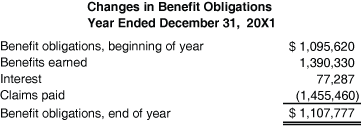 Changes in Benefit Obligations " Year Ended December 31, 20X1" "Benefit obligations, beginning of year" " $1,095,620 " Benefits earned " 1,390,330 " Interest " 77,287 " Claims paid " (1,455,460)" "Benefit obligations, end of year" " $1,107,777 "
- Plan Expenses. ABC bears all administrative costs, except trustee fees, that are paid by the Plan.
- NOTE 4: TAX STATUS
- The Plan obtained its latest determination letter in 1990, in which the Internal Revenue Service (IRS) stated that the Plan, as then designed, was in compliance with the applicable requirements of the Internal Revenue Code. The Plan has been amended since receiving the determination letter. Plan management and Plan's tax counsel believe that the Plan is currently designed and being operated in compliance with the applicable requirements of the Internal Revenue Code. Therefore, no provision for income taxes has been included in the Plan's financial statements.
- NOTE 5: TRANSACTIONS WITH PARTIES IN INTEREST
- ABC provides to the Plan certain accounting and administrative services for which no fees are charged.
- NOTE 6: TERMINATION OF THE PLAN
- Under certain conditions, the Plan may be terminated. Upon termination, the assets then remaining shall be subject to the applicable provisions of the Plan then in effect and shall be used until exhausted to pay benefits to employees in the order of their entitlement.
- C&H Company Welfare Benefit Plan Statement of Net Assets Available for Plan Benefits
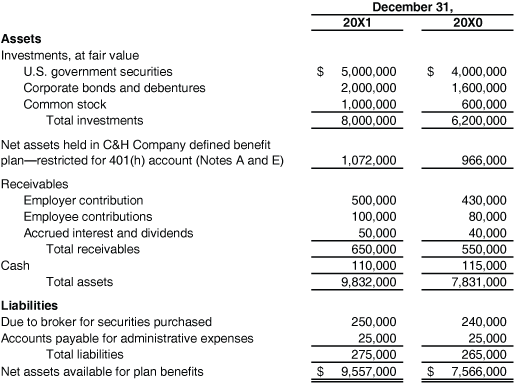 "December 31," 20X1 20X0 Assets "Investments, at fair value" U.S. government securities " $5,000,000 " " $4,000,000 " Corporate bonds and debentures " 2,000,000 " " 1,600,000 " Common stock " 1,000,000 " " 600,000 " Total investments " 8,000,000 " " 6,200,000 " Net assets held in C&H Company defined benefit plan—restricted for 401(h) account (Notes A and E) " 1,072,000 " " 966,000 " Receivables Employer contribution " 500,000 " " 430,000 " Employee contributions " 100,000 " " 80,000 " Accrued interest and dividends " 50,000 " " 40,000 " Total receivables " 650,000 " " 550,000 " Cash " 110,000 " " 115,000 " Total assets " 9,832,000 " " 7,831,000 " Liabilities Due to broker for securities purchased " 250,000 " " 240,000 " Accounts payable for administrative expenses " 25,000 " " 25,000 " Total liabilities " 275,000 " " 265,000 " Net assets available for plan benefits " $9,557,000 " " $7,566,000 "
- The accompanying notes are an integral part of the financial statements.
- C&H Company Welfare Benefit Plan Statement of Changes in Net Assets Available for Plan Benefits
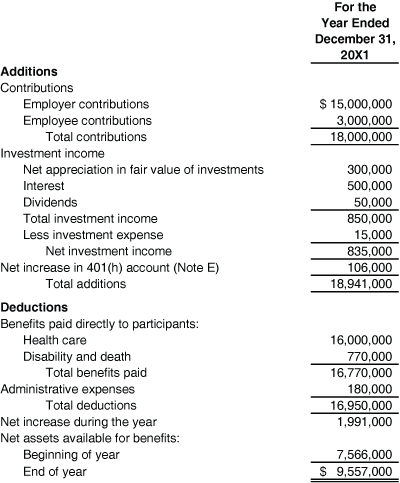 "For the Year Ended December 31, 20X1" Additions Contributions Employer contributions " $15,000,000 " Employee contributions " 3,000,000 " Total contributions " 18,000,000 " Investment income Net appreciation in fair value of investments " 300,000 " Interest " 500,000 " Dividends " 50,000 " Total investment income " 850,000 " Less investment expense " 15,000 " Net investment income " 835,000 " Net increase in 401(h) account (Note E) " 106,000 " Total additions " 18,941,000 " Deductions Benefits paid directly to participants: Health care " 16,000,000 " Disability and death " 770,000 " Total benefits paid " 16,770,000 " Administrative expenses " 180,000 " Total deductions " 16,950,000 " Net increase during the year " 1,991,000 " Net assets available for benefits: Beginning of year " 7,566,000 " End of year " $9,557,000 "
- The accompanying notes are an integral part of the financial statements.
- C&H Welfare Benefit Plan Statement of Benefit Obligations
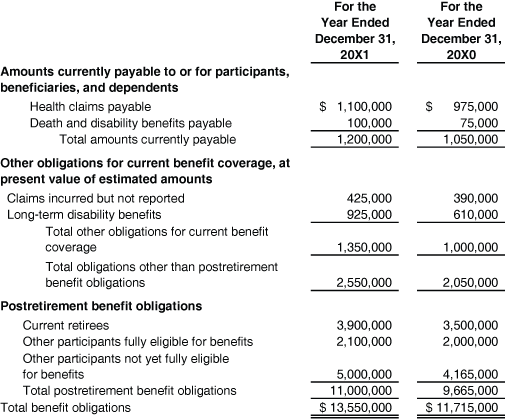 "For the Year Ended December 31, 20X1" "For the Year Ended December 31, 20X0" "Amounts currently payable to or for participants, beneficiaries, and dependents" Health claims payable " $1,100,000 " " $975,000 " Death and disability benefits payable " 100,000 " " 75,000 " Total amounts currently payable " 1,200,000 " " 1,050,000 " "Other obligations for current benefit coverage, at present value of estimated amounts" Claims incurred but not reported " 425,000 " " 390,000 " Long-term disability benefits " 925,000 " " 610,000 " Total other obligations for current benefit coverage " 1,350,000 " " 1,000,000 " Total obligations other than postretirement benefit obligations " 2,550,000 " " 2,050,000 " Postretirement benefit obligations Current retirees " 3,900,000 " " 3,500,000 " Other participants fully eligible for benefits " 2,100,000 " " 2,000,000 " "Other participants not yet fully eligible for benefits" " 5,000,000 " " 4,165,000 " Total postretirement benefit obligations " 11,000,000 " " 9,665,000 " Total benefit obligations " $13,550,000 " " $11,715,000 "
- The accompanying notes are an integral part of the financial statements.
- C&H Company Welfare Benefit Plan Statement of Changes in Benefit Obligations
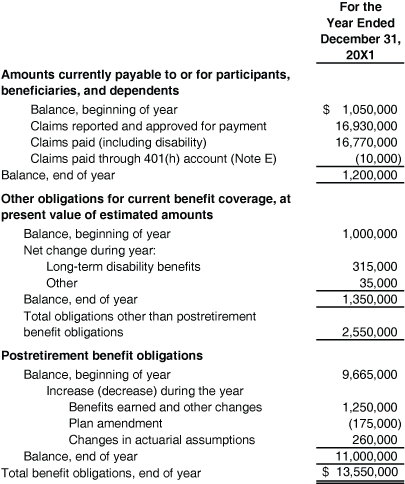 "For the Year Ended December 31, 20X1" "Amounts currently payable to or for participants, beneficiaries, and dependents" " Balance, beginning of year" " $1,050,000 " Claims reported and approved for payment " 16,930,000 " Claims paid (including disability) " 16,770,000 " Claims paid through 401(h) account (Note E) " (10,000)" "Balance, end of year" " 1,200,000 " "Other obligations for current benefit coverage, at present value of estimated amounts" "Balance, beginning of year" " 1,000,000 " Net change during year: Long-term disability benefits " 315,000 " Other " 35,000 " "Balance, end of year" " 1,350,000 " Total obligations other than postretirement benefit obligations " 2,550,000 " Postretirement benefit obligations "Balance, beginning of year" " 9,665,000 " Increase (decrease) during the year attributable to: Benefits earned and other changes " 1,250,000 " Plan amendment " (175,000)" Changes in actuarial assumptions " 260,000 " "Balance, end of year" " 11,000,000 " "Total benefit obligations, end of year" " $13,550,000 "
- The accompanying notes are an integral part of the financial statements.
- Notes to Financial Statements
- A. 401(h) Account
- Effective January 1, 19X0, the [Company's defined benefit pension plan] was amended to include a medical-benefit component in addition to normal retirement benefits to fund a portion of the postretirement obligations for retirees and their beneficiaries in accordance with Section 401(h) of the Internal Revenue Code. A separate account has been established and maintained in the [defined benefit pension plan] for such contributions. In accordance with Internal Revenue Code Section 401(h), the Plan's investments in the 401(h) account may not be used for, or diverted to, any purpose other than providing health benefits for retirees and their beneficiaries. The related obligations for health benefits are not included in the [defined benefit pension plan's] obligations in the statement of accumulated plan benefits but are reported as obligations in the financial statements of the [health and welfare benefit plan].
- E. 401(h) Account
- A portion of the Plan's obligations are funded through contributions to the Company's [defined benefit pension plan]in accordance with Internal Revenue Code Section 401(h). The following table presents the components of the net assets available for such obligations and the related changes in net assets available.
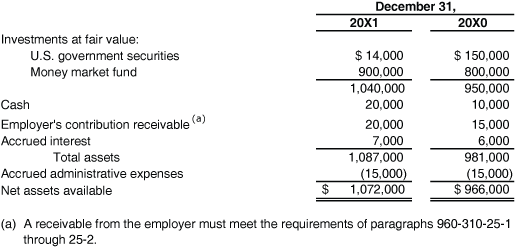 "December 31," 20X1 20X0 Investments at fair value: U.S. government securities " $ 14,000 " " $ 150,000 " Money market fund " 900,000 " " 800,000 " " 1,040,000 " " 950,000 " Cash " 20,000 " " 10,000 " Employer's contribution receivable (a) " 20,000 " " 15,000 " Accrued interest " 7,000 " " 6,000 " Total assets " 1,087,000 " " 981,000 " Accrued administrative expenses " (15,000) " " (15,000)" Net assets available " $1,072,000 " " $ 966,000 " (a) A receivable from the employer must meet the requirements of paragraphs 960-310-25-1 through 25-2.
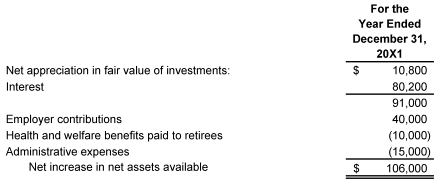 "For the Year Ended December 31, 20X1" Net appreciation in fair value of investments: U.S. government securities " $10,800 " Interest " 80,200 " " 91,000 " Employer contributions " 40,000 " Health and welfare benefits paid to retirees " (10,000)" Administrative expenses " (15,000)" Net increase in net assets available " $106,000 "
- H. Reconciliation of Financial Statements to Form 5500
- The following is a reconciliation of net assets available for benefits per the financial statements to the Form 5500.
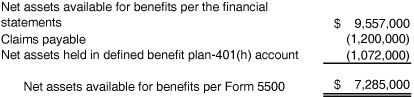 Net assets available for benefits per the financial statements " $9,557,000 " Claims payable " (1,200,000)" Net assets held in defined benefit plan-401(h) account " (1,072,000)" Net assets available for benefits per Form 5500 " $7,285,000 "
- The following is a reconciliation of claims paid per the financial statements and net investment income related to the changes in the investments of the 401(h) assets to the Form 5500.
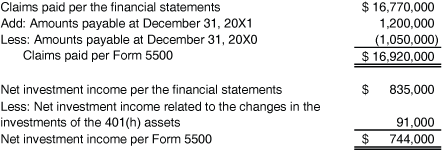 Claims paid per the financial statements " $16,770,000 " "Add: Amounts payable at December 31, 20X1" " 1,200,000 " "Less: Amounts payable at December 31, 20X0" " (1,050,000)" Claims paid per Form 5500 " $16,920,000 " Net investment income per the financial statements " $835,000 " Less: Net investment income related to the changes in the investments of the 401(h) assets " 91,000 " Net investment income per Form 5500 " $744,000 "
205-965-60Relationships
Source downloaded: .Record version 8b686284d434. Effective date must be checked in the source.
Comprehensive Income
Related subtopics
- 205-960 Plan Accounting—Defined Benefit Pension PlansPresentation of Financial Statements
- 325-962 Plan Accounting—Defined Contribution Pension PlansInvestments—Other
- 715-80 Multiemployer PlansCompensation—Retirement Benefits
- 965-30 Plan Benefit ObligationsPlan Accounting—Health and Welfare Benefit Plans
- 960-20 Accumulated Plan BenefitsPlan Accounting—Defined Benefit Pension Plans
- 715-60 Defined Benefit Plans—Other PostretirementCompensation—Retirement Benefits