ASC 230-10
Overall
230 Statement of Cash Flows
Source downloaded: .Record version f2ef28dadc1b. Effective date must be checked in the source.
ASC 230-10 governs the statement of cash flows, which every entity presenting both financial position and results of operations must provide for each period results of operations are presented (230-10-15-3). It requires cash receipts and payments to be classified as operating, investing, or financing activities and requires the statement to explain the change in the total of cash, cash equivalents, restricted cash, and restricted cash equivalents (230-10-45-4, 45-10, 45-24). Operating cash flows may be presented by the direct method (encouraged) or the indirect method, but a business entity must reconcile net income to net cash flow from operating activities either way (230-10-45-25, 45-28, 45-29).
Key points (7)
- Every business entity or NFP presenting both financial position and results of operations must present a statement of cash flows; limited exemptions exist for defined benefit pension plans under Topic 960 and for investment companies and similar funds meeting the Level 1/Level 2 fair value, little-or-no-debt, and statement of changes in net assets conditions (230-10-15-3, 15-4).
- Cash receipts and payments are classified as operating, investing, or financing; investing includes loans made and collected, purchases/sales of other entities' debt and equity instruments and PP&E (230-10-45-12, 45-13), financing includes issuing equity and debt, dividends and distributions to owners, debt repayments, debt issue costs, and debt prepayment/extinguishment costs (230-10-45-14, 45-15), and operating is the residual, including interest and dividends received and interest and income taxes paid (230-10-45-16, 45-17).
- The statement must reconcile the beginning and ending totals of cash, cash equivalents, and amounts generally described as restricted cash or restricted cash equivalents; transfers among those items are not reported as cash flow activities (230-10-45-4, 45-5, 45-24).
- Gross reporting is the default, but net reporting is permitted for cash equivalents and for investments (other than cash equivalents), loans receivable, and debt with original maturities of three months or less, and for items where the entity is substantively holding or disbursing cash for customers (230-10-45-7 through 45-9).
- Financial statements shall not report cash flow per share (230-10-45-3).
- For receipts and payments with aspects of more than one class, apply specific guidance first, then separate by identifiable source or use based on the nature of the cash flows; if inseparable, classify based on the predominant source or use (230-10-45-22, 45-22A).
- Required disclosures include the cash equivalents policy (230-10-50-1), interest paid net of capitalized amounts (and income taxes paid) under the indirect method (230-10-50-2), all noncash investing and financing activities affecting recognized assets or liabilities (230-10-50-3, 50-4), the nature of restrictions on cash (230-10-50-7), and a reconciliation of balance sheet line items to the cash totals when presented in more than one line item (230-10-50-8).
For students. Classification questions dominate exams: know that interest and dividends received and interest paid are operating, dividends paid are financing, and capitalized interest on self-constructed assets is investing. A frequent misunderstanding is thinking the reconciliation of net income to operating cash flow is optional under the direct method — for business entities it is always required (230-10-45-29), and only NFPs using the direct method are excused.
Machine-generated study aid for ASC 230-10. Check the source paragraphs below.
230-10-00Status
Source downloaded: .Record version ec50911b86cf. Effective date must be checked in the source.
230-10-05Overview and Background
Source downloaded: .Record version 8ec15521d7ef. Effective date must be checked in the source.
- aClassifying in the statement of cash flows of cash receipts and payments as either operating activities, investing activities, or financing activities
- bApplying the direct method and the indirect method of reporting cash flows
- cPresenting the required information about noncash investing and financing activity and other events
- dClassifying cash receipts and payments related to hedging activities.
- aForeign Currency Matters, Subtopic 830-230
- b
- cEntertainment—Films, Subtopic 926-230
- dFinancial Services—Depository and Lending, Subtopic 942-230
- eFinancial Services—Investment Companies, Subtopic 946-230
- fNot-for-Profit Entities, Subtopic 958-230
- gReal Estate—General, Subtopic 970-230
- hReal Estate—Time Sharing Activities, Subtopic 978-230.
230-10-10Objectives
Source downloaded: .Record version f2b11e361a4f. Effective date must be checked in the source.
- aAssess the entity's ability to generate positive future net cash flows
- bAssess the entity's ability to meet its obligations, its ability to pay dividends, and its needs for external financing
- cAssess the reasons for differences between net income and associated cash receipts and payments
- dAssess the effects on an entity's financial position of both its cash and noncash investing and financing transactions during the period.
230-10-15Scope and Scope Exceptions
Source downloaded: .Record version 3f9765e6be7a. Effective date must be checked in the source.
Overall Guidance
Entities
- aA statement of cash flows is not required to be provided by a defined benefit pension plan that presents financial information in accordance with the provisions of Topic 960. Other employee benefit plans that present financial information similar to that required by Topic 960 (including the presentation of plan investments at fair value) also are not required to provide a statement of cash flows. Employee benefit plans are encouraged to include a statement of cash flows with their annual financial statements when that statement would provide relevant information about the ability of the plan to meet future obligations (for example, when the plan invests in assets that are not highly liquid or obtains financing for investments).
- bProvided that the conditions in (c) are met, a statement of cash flows is not required to be provided by the following entities:
- 1An investment company within the scope of Topic 946 on investment companies
- 2
- 3A common trust fund, variable annuity account, or similar fund maintained by a bank, insurance entity, or other entity in its capacity as a trustee, administrator, or guardian for the collective investment and reinvestment of funds.
- 1
- cFor an investment company specified in (b) to be exempt from the requirement to provide a statement of cash flows, all of the following conditions must be met:
- 1
- 2During the period, substantially all of the entity's investments were carried at fair value and classified in accordance with Topic 820 as Level 1 or Level 2 measurements or were measured using the practical expedient in paragraph 820-10-35-59 to determine their fair values and are redeemable in the near term at all times.
- 3The entity had little or no debt, based on the average debt outstanding during the period, in relation to average total assets. For the purpose of determining average debt outstanding, obligations resulting from redemptions of shares by the entity from unsettled purchases of securities or similar assets, or from covered options written generally may be excluded. However, any extension of credit by the seller that is not in accordance with standard industry practices for redeeming shares or for settling purchases of investments shall be included in average debt outstanding.
- 4The entity provides a statement of changes in net assets.
230-10-45Other Presentation Matters
Source downloaded: .Record version bc8dff4ece49. Effective date must be checked in the source.
Form and Content
- aInvestments (other than cash equivalents)
- bLoans receivable
- cDebt.
Classification
- aReceipts from collections or sales of loans made by the entity and of other entities' debt instruments (other than cash equivalents, certain debt instruments that are acquired specifically for resale as discussed in paragraph 230-10-45-21, and certain donated debt instruments received by not-for-profit entities (NFPs) as discussed in paragraph 230-10-45-21A) and collections on a transferor's beneficial interests in a securitization of the transferor's trade receivables
- bReceipts from sales of equity instruments of other entities (other than certain equity instruments carried in a trading account as described in paragraph 230-10-45-18and certain donated equity instruments received by NFPs as discussed in paragraph 230-10-45-21A) and from returns of investment in those instruments
- cReceipts from sales of property, plant, and equipment and other productive assets
- d
- eReceipts from sales of loans that were not specifically acquired for resale. That is, if loans were acquired as investments, cash receipts from sales of those loans shall be classified as investing cash inflows regardless of a change in the purpose for holding those loans.
- aDisbursements for loans made by the entity and payments to acquire debt instruments of other entities (other than cash equivalents and certain debt instruments that are acquired specifically for resale as discussed in paragraph 230-10-45-21).
- bPayments to acquire equity instruments of other entities (other than certain equity instruments carried in a trading account as described in paragraph 230-10-45-18).
- cPayments at the time of purchase or soon before or after purchase to acquire property, plant, and equipment and other productive assets, including interest capitalized as part of the cost of those assets. Generally, only advance payments, the down payment, or other amounts paid at the time of purchase or soon before or after purchase of property, plant, and equipment and other productive assets are investing cash outflows. However, incurring directly related debt to the seller is a financing transaction (see paragraphs ), and subsequent payments of principal on that debt thus are financing cash outflows.
- dPayments made soon after the acquisition date of a business combination by an acquirer to settle a contingent consideration liability.
- aProceeds from issuing equity instruments
- bProceeds from issuing bonds, mortgages, notes, and from other short- or long-term borrowing
- cReceipts from contributions and investment income that by donor stipulation are restricted for the purposes of acquiring, constructing, or improving property, plant, equipment, or other long-lived assets or establishing or increasing a donor-restricted endowment fund
- dProceeds received from derivative instruments that include financing elements at inception, whether the proceeds were received at inception or over the term of the derivative instrument, other than a financing element inherently included in an at-the-market derivative instrument with no prepayments
- e
- aPayments of dividends or other distributions to owners, including outlays to reacquire the entity's equity instruments. Cash paid to a tax authority by a grantor when withholding shares from a grantee's award for tax-withholding purposes shall be considered an outlay to reacquire the entity's equity instruments.
- bRepayments of amounts borrowed, including the portion of the repayments made to settle zero-coupon debt instruments that is attributable to the principal or the portion of the repayments made to settle other debt instruments with coupon interest rates that are insignificant in relation to the effective interest rate of the borrowing that is attributable to the principal.
- cOther principal payments to creditors who have extended long-term credit. See paragraph 230-10-45-13(c), which indicates that most principal payments on seller-financed debt directly related to a purchase of property, plant, and equipment or other productive assets are financing cash outflows.
- dDistributions to counterparties of derivative instruments that include financing elements at inception, other than a financing element inherently included in an at-the-market derivative instrument with no prepayments. The distributions may be either at inception or over the term of the derivative instrument.
- ePayments for debt issue costs.
- fPayments, or the portion of the payments, not made soon after the acquisition date of a business combination by an acquirer to settle a contingent consideration liability up to the amount of the contingent consideration liability recognized at the acquisition date, including measurement-period adjustments, less any amounts paid soon after the acquisition date to settle the contingent consideration liability. See also paragraph 230-10-45-17(ee).
- gPayments for debt prepayment or debt extinguishment costs, including third-party costs, premiums paid, and other fees paid to lenders that are directly related to the debt prepayment or debt extinguishment, excluding accrued interest.
- aCash receipts from sales of goods or services, including receipts from collection or sale of accounts and both short- and long-term notes receivable from customers arising from those sales. The term goods includes certain loans and other debt and equity instruments of other entities that are acquired specifically for resale, as discussed in paragraph 230-10-45-21.
- bCash receipts from returns on loans, other debt instruments of other entities, and equity securities—interest and dividends.
- cAll other cash receipts that do not stem from transactions defined as investing or financing activities, such as amounts received to settle lawsuits and refunds from suppliers.
- aCash payments to acquire materials for manufacture or goods for resale, including principal payments on accounts and both short- and long-term notes payable to suppliers for those materials or goods. The term goods includes certain loans and other debt and equity instruments of other entities that are acquired specifically for resale, as discussed in paragraph 230-10-45-21.
- bCash payments to other suppliers and employees for other goods or services.
- cCash payments to governments for taxes, duties, fines, and other fees or penalties.
- dCash payments to lenders and other creditors for interest, including the portion of the payments made to settle zero-coupon debt instruments that is attributable to accreted interest related to the debt discount or the portion of the payments made to settle other debt instruments with coupon interest rates that are insignificant in relation to the effective interest rate of the borrowing that is attributable to accreted interest related to the debt discount. For all other debt instruments, an issuer shall not bifurcate cash payments to lenders and other creditors at settlement for amounts attributable to accreted interest related to the debt discount, nor classify such amounts as cash outflows for operating activities.
- eCash payment made to settle an asset retirement obligation.
- eeCash payments, or the portion of the payments, not made soon after the acquisition date of a business combination by an acquirer to settle a contingent consideration liability that exceed the amount of the contingent consideration liability recognized at the acquisition date, including measurement-period adjustments, less any amounts paid soon after the acquisition date to settle the contingent consideration liability. See also paragraph 230-10-45-15(f).
- fAll other cash payments that do not stem from transactions defined as investing or financing activities, such as payments to settle lawsuits, cash contributions to charities, and cash refunds to customers.
- aCumulative earnings approach: Distributions received are considered returns on investment and shall be classified as cash inflows from operating activities unless the investor's cumulative distributions received less distributions received in prior periods that were determined to be returns of investment exceed cumulative equity in earnings recognized by the investor (as adjusted for amortization of basis differences). When such an excess occurs, the current-period distribution up to this excess is considered a return of investment and shall be classified as cash inflows from investing activities.
- bNature of the distribution approach: Distributions received shall be classified on the basis of the nature of the activity or activities of the investee that generated the distribution as either a return on investment (classified as a cash inflow from operating activities) or a return of investment (classified as a cash inflow from investing activities) when such information is available.
- aCash collected from customers, including lessees, licensees, and the like
- bInterest and dividends received. Interest and dividends that are donor restricted for long-term purposes as included in the list of financing activities and paragraph 230-10-45-14(c) are not part of operating cash receipts.
- cOther operating cash receipts, if any
- dCash paid to employees and other suppliers of goods or services, including suppliers of insurance, advertising, and the like
- eInterest paid, including the portion of the payments made to settle zero-coupon debt instruments that is attributable to accreted interest related to the debt discount or the portion of the payments made to settle other debt instruments with coupon interest rates that are insignificant in relation to the effective interest rate of the borrowing that is attributable to accreted interest related to the debt discount
- fIncome taxes paid
- gOther operating cash payments, if any.
Reconciliation of Net Income and Net Cash Flow from Operating Activities
- aThe effects of all deferrals of past operating cash receipts and payments, such as changes during the period in inventory, deferred income, and the like, and all accruals of expected future operating cash receipts and payments, such as changes during the period in receivables and payables. Adjustments to net income of a business entity or change in net assets of an NFP to determine net cash flow from operating activities shall reflect accruals for interest earned but not received and interest incurred but not paid. Those accruals may be reflected in the statement of financial position in changes in assets and liabilities that relate to investing or financing activities, such as loans or deposits. However, interest credited directly to a deposit account that has the general characteristics of cash is a cash outflow of the payor and a cash inflow of the payee when the entry is made.
- bAll items that are included in net income of a business entity or change in net assets of an NFP that do not affect net cash provided from, or used for, operating activities such as depreciation of property, plant, and equipment and amortization of finite-life intangible assets. This includes all items whose cash effects are related to investing or financing cash flows, such as gains or losses on sales of property, plant, and equipment and discontinued operations (which relate to investing activities), and gains or losses on extinguishment of debt (which relate to financing activities).
230-10-50Disclosure
Source downloaded: .Record version e49e7c48cbc7. Effective date must be checked in the source.
Cash Equivalents Policy
Interest and Income Taxes Paid
Noncash Investing and Financing Activities
Restrictions on Cash and Cash Equivalents
Accounting Policy for Derivative Instruments
230-10-55Implementation Guidance and Illustrations
Source downloaded: .Record version 74ed1364e90b. Effective date must be checked in the source.
Implementation Guidance
Illustrations
-
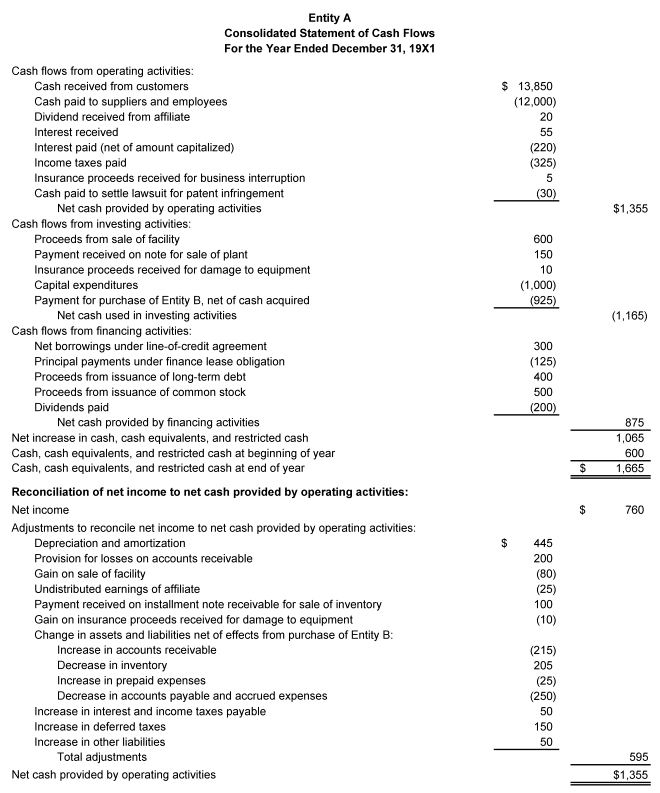 Entity A Consolidated Statement of Cash Flows "For the Year Ended December 31, 19X1" Cash flows from operating activities: Cash received from customers " $13,850 " Cash paid to suppliers and employees " (12,000)" Dividend received from affiliate 20 Interest received 55 Interest paid (net of amount capitalized) (220) Income taxes paid (325) Insurance proceeds received for business interruption 5 Cash paid to settle lawsuit for patent infringement (30) Net cash provided by operating activities "$1,355" Cash flows from investing activities: Proceeds from sale of facility 600 Payment received on note for sale of plant 150 Insurance proceeds received for damage to equipment 10 Capital expenditures " (1,000)" "Payment for purchase of Entity B, net of cash acquired" (925) Net cash used in investing activities "(1,165)" Cash flows from financing activities: Net borrowings under line-of-credit agreement 300 Principal payments under finance lease obligation (125) Proceeds from issuance of long-term debt 400 Proceeds from issuance of common stock 500 Dividends paid (200) Net cash provided by financing activities 875 "Net increase in cash, cash equivalents, and restricted cash" " 1,065 " "Cash, cash equivalents, and restricted cash at beginning of year" 600 "Cash, cash equivalents, and restricted cash at end of year" " $1,665 " Reconciliation of net income to net cash provided by operating activities: Net income $760 Adjustments to reconcile net income to net cash provided by operating activities: Depreciation and amortization $445 Provision for losses on accounts receivable 200 Gain on sale of facility (80) Undistributed earnings of affiliate (25) Payment received on installment note receivable for sale of inventory 100 Gain on insurance proceeds received for damage to equipment (10) Change in assets and liabilities net of effects from purchase of Entity B: Increase in accounts receivable (215) Decrease in inventory 205 Increase in prepaid expenses (25) Decrease in accounts payable and accrued expenses (250) Increase in interest and income taxes payable 50 Increase in deferred taxes 150 Increase in other liabilities 50 Total adjustments 595 Net cash provided by operating activities "$1,355"
- Entity A purchased all of the capital stock of Entity B for $950. In conjunction with the acquisition, liabilities were assumed as follows.
-
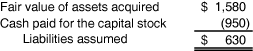 Fair value of assets acquired " $1,580 " Cash paid for the capital stock (950) Liabilities assumed $630
-
- A finance lease obligation of $850 was incurred when Entity A entered into a lease for new equipment.
- Additional common stock was issued upon the conversion of $500 of long-term debt.
- For purposes of the statement of cash flows, the entity considers all highly liquid debt instruments purchased with a maturity of three months or less to be cash equivalents.
- The following table provides a reconciliation of cash, cash equivalents, and restricted cash reported within the statement of financial position that sum to the total of the same such amounts shown in the statement of cash flows.
-
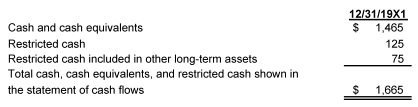 12/31/19X1 Cash and cash equivalents " $1,465 " Restricted cash 125 Restricted cash included in other long-term assets 75 "Total cash, cash equivalents, and restricted cash shown in the statement of cash flows" " $1,665 "
-
- Amounts included in restricted cash represent those required to be set aside by a contractual agreement with an insurer for the payment of specific workers' compensation claims. Restricted cash included in other long-term assets on the statement of financial position represents amounts pledged as collateral for long-term financing arrangements as contractually required by a lender. The restriction will lapse when the related long-term debt is paid off.
-
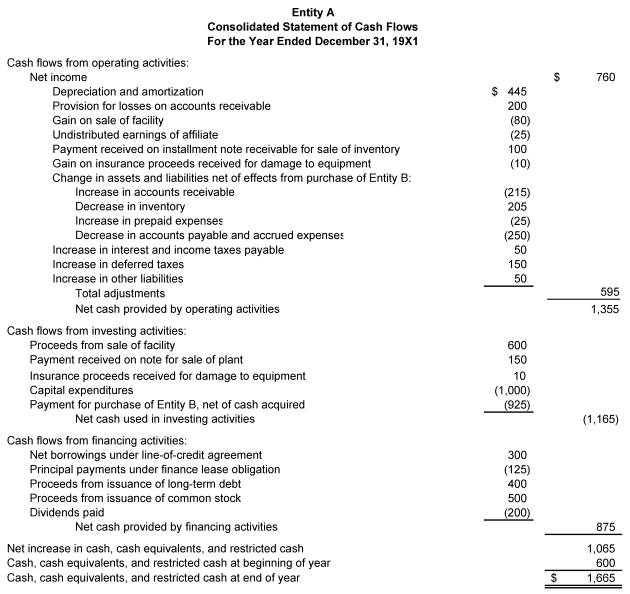 Entity A Consolidated Statement of Cash Flows "For the Year Ended December 31, 19X1" Cash flows from operating activities: Net income $760 Depreciation and amortization $445 Provision for losses on accounts receivable 200 Gain on sale of facility (80) Undistributed earnings of affiliate (25) Payment received on installment note receivable for sale of inventory 100 Gain on insurance proceeds received for damage to equipment (10) Change in assets and liabilities net of effects from purchase of Entity B: Increase in accounts receivable (215) Decrease in inventory 205 Increase in prepaid expenses (25) Decrease in accounts payable and accrued expenses (250) Increase in interest and income taxes payable 50 Increase in deferred taxes 150 Increase in other liabilities 50 Total adjustments 595 Net cash provided by operating activities "1,355" Cash flows from investing activities: Proceeds from sale of facility 600 Payment received on note for sale of plant 150 Insurance proceeds received for damage to equipment 10 Capital expenditures " (1,000)" "Payment for purchase of Entity B, net of cash acquired" (925) Net cash used in investing activities "(1,165)" Cash flows from financing activities: Net borrowings under line-of-credit agreement 300 Principal payments under finance lease obligation (125) Proceeds from issuance of long-term debt 400 Proceeds from issuance of common stock 500 Dividends paid (200) Net cash provided by financing activities 875 "Net increase in cash, cash equivalents, and restricted cash" " 1,065 " "Cash, cash equivalents, and restricted cash at beginning of year" 600 "Cash, cash equivalents, and restricted cash at end of year" " $1,665 "
-
 Cash paid during the year for: Interest (net of amount capitalized) $220 Income taxes 325
- Cash paid during the year for: Interest (net of amount capitalized) $220 Income taxes 325
- Entity A purchased all of the capital stock of Entity B for $950. In conjunction with the acquisition, liabilities were assumed as follows.
-
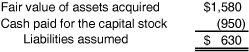 Fair value of assets acquired " $1,580 " Cash paid for the capital stock (950) Liabilities assumed $630
-
- A finance lease obligation of $850 was incurred when Entity A entered into a lease for new equipment.
- Additional common stock was issued upon the conversion of $500 of long-term debt.
- For purposes of the statement of cash flows, the Entity considers all highly liquid debt instruments purchased with a maturity of three months or less to be cash equivalents.
- The following table provides a reconciliation of cash, cash equivalents, and restricted cash reported within the statement of financial position that sum to the total of the same such amounts shown in the statement of cash flows.
-
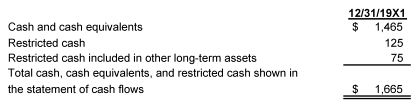 12/31/19X1 Cash and cash equivalents " $1,465 " Restricted cash 125 Restricted cash included in other long-term assets 75 "Total cash, cash equivalents, and restricted cash shown in the statement of cash flows" " $1,665 "
-
- Amounts included in restricted cash represent those required to be set aside by a contractual agreement with an insurer for the payment of specific workers' compensation claims. Restricted cash included in other long-term assets on the statement of financial position represents amounts pledged as collateral for long-term financing arrangements as contractually required by a lender. The restriction will lapse when the related long-term debt is paid off.
-
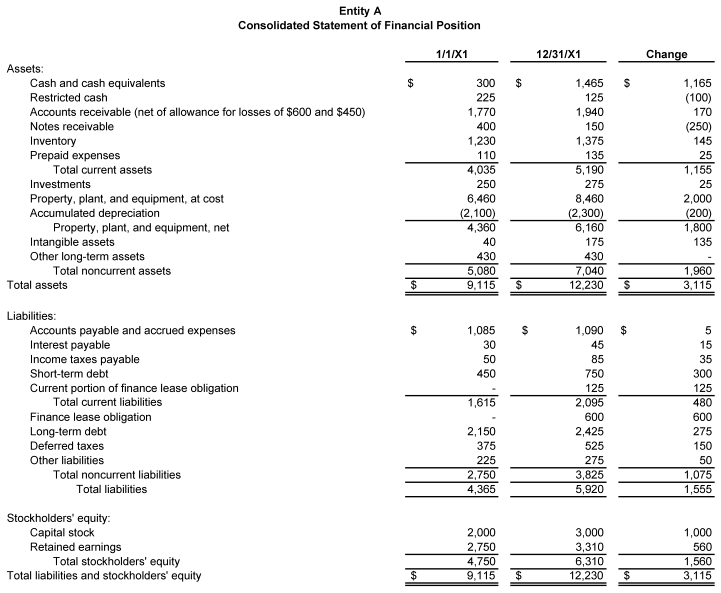 Entity A Consolidated Statement of Financial Position 1/1/X1 12/31/X1 Change Assets: Cash and cash equivalents $ 300 "$ 1,465" "$ 1,165" Restricted cash 225 125 (100) Accounts receivable (net of allowance for losses of $600 and $450) "1,770" "1,940" 170 Notes receivable 400 150 (250) Inventory "1,230" "1,375" 145 Prepaid expenses 110 135 25 Total current assets "4,035" "5,190" "1,155" Investments 250 275 25 "Property, plant, and equipment, at cost" "6,460" "8,460" "2,000" Accumulated depreciation "(2,100)" "(2,300)" (200) "Property, plant, and equipment, net" "4,360" "6,160" "1,800" Intangible assets 40 175 135 Other long-term assets 430 430 - Total noncurrent assets 5080 "7,040" "1,960" Total assets "$ 9,115" "$ 12,230" "$ 3,115" Liabilities: Accounts payable and accrued expenses "$ 1,085" "$ 1,090" $ 5 Interest payable 30 45 15 Income taxes payable 50 85 35 Short-term debt 450 750 300 Current portion of finance lease obligation - 125 125 Total current liabilities "1,615" "2,095" 480 Finance lease obligation - 600 600 Long-term debt "2,150" "2,425" 275 Deferred taxes 375 525 150 Other liabilities 225 275 50 Total noncurrent liabilities "2,750" "3,825" "1,075" Total liabilities "4,365" "5,920" "1,555" Stockholders' equity: Capital stock "2,000" "3,000" "1,000" Retained earnings "2,750" "3,310" 560 Total stockholders' equity "4,750" "6,310" "1,560" Total liabilities and stockholders' equity "$ 9,115" "$ 12,230" "$ 3,115" Entity A Consolidated Statement of Income "For the Year Ended December 31, 19X1" Sales " $13,965 " Cost of sales " (10,290)" Depreciation and amortization (445) "Selling, general, and administrative expenses" " (1,890)" Interest expense (235) Equity in earnings of affiliate 45 Gain on sale of facility 80 Interest income 55 Insurance proceeds 15 Loss from patent infringement lawsuit (30) Income before income taxes " 1,270 " Provision for income taxes (510) Net income $760
 -
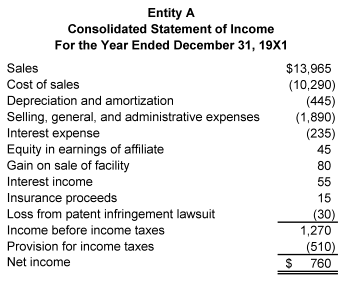 Entity A Consolidated Statement of Income "For the Year Ended December 31, 19X1" Sales " $13,965 " Cost of sales " (10,290)" Depreciation and amortization (445) "Selling, general, and administrative expenses" " (1,890)" Interest expense (235) Equity in earnings of affiliate 45 Gain on sale of facility 80 Interest income 55 Insurance proceeds 15 Loss from patent infringement lawsuit (30) Income before income taxes " 1,270 " Provision for income taxes (510) Net income $760
- a Entity A wrote off $350 of accounts receivable when a customer filed for bankruptcy. A provision for losses on accounts receivable of $200 was included in Entity A's selling, general, and administrative expenses.
- b Entity A collected the third and final annual installment payment of $100 on a note receivable for the sale of inventory and collected the third of four annual installment payments of $150 each on a note receivable for the sale of a plant. Interest on these notes through December 31 totaling $55 was also collected.
- c Entity A received a distribution of $20 from an affiliate accounted for under the equity method of accounting. Entity A made an accounting policy election to apply the cumulative earnings approach described in paragraph 230-10-45-21D(a) and determined that the distribution was a return on investment.
- d Entity A sold a facility with a book value of $520 and an original cost of $750 for $600 cash.
- e Entity A constructed a new facility for its own use and placed it in service. Accumulated expenditures during the year of $1,000 included capitalized interest of $10.
- f Entity A entered into a capital lease for new equipment with a fair value of $850. The entity classified the lease as a finance lease. Principal payments under the lease obligation totaled $125.
- g Entity A purchased all of the capital stock of Entity B for $950 in a business combination. The fair values of Entity B's assets and liabilities at the date of acquisition are presented below.
-
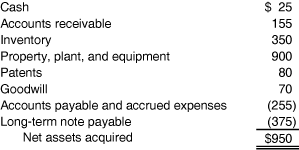 Cash $25 Accounts receivable 155 Inventory 350 "Property, plant, and equipment" 900 Patents 80 Goodwill 70 Accounts payable and accrued expenses (255) Long-term note payable (375) Net assets acquired $950
-
- h Entity A borrowed and repaid various amounts under a line-of-credit agreement in which borrowings are payable 30 days after demand. The net increase during the year in the amount borrowed against the line-of-credit totaled $300.
- i Entity A issued $400 of long-term debt securities.
- j Entity A's provision for income taxes included a deferred provision of $150.
- k Entity A's depreciation of property, plant, and equipment and amortization of right-of-use assets arising from a finance lease totaled $430, and amortization of intangible assets totaled $15.
- l Entity A's selling, general, and administrative expenses included an accrual for incentive compensation of $50 that has been deferred by executives until their retirement. The related obligation was included in other liabilities.
- m Entity A collected insurance proceeds of $15 ($5 from a business interruption claim that resulted when a storm precluded shipment of inventory for one week and $10 from a property claim that resulted when fully depreciated manufacturing equipment was damaged by a fire).
- n Entity A paid $30 to settle a lawsuit for patent infringement.
- o Entity A issued $1,000 of additional common stock of which $500 was issued for cash and $500 was issued upon conversion of long-term debt.
- p Entity A paid dividends of $200.
- q Entity A paid $100 from its restricted cash for workers' compensation claims accrued before January 1, 19X1. Before January 1, 19X1, Entity A's insurer required $225 to be set aside by a contractual arrangement for the payment of specific workers' compensation claims.
-
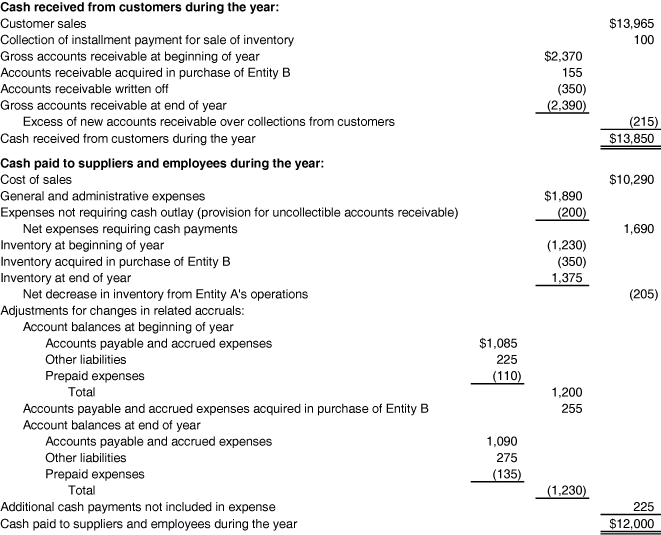 Cash received from customers during the year: Customer sales " $13,965 " Collection of installment payment for sale of inventory 100 Gross accounts receivable at beginning of year " $2,370 " Accounts receivable acquired in purchase of Entity B 155 Accounts receivable written off (350) Gross accounts receivable at end of year " (2,390)" Excess of new accounts receivable over collections from customers (215) Cash received from customers during the year " $13,850 " Cash paid to suppliers and employees during the year: Cost of sales " $10,290 " General and administrative expenses " $1,890 " Expenses not requiring cash outlay (provision for uncollectible accounts receivable) (200) Net expenses requiring cash payments " 1,690 " Inventory at beginning of year " (1,230)" Inventory acquired in purchase of Entity B (350) Inventory at end of year " 1,375 " Net decrease in inventory from Entity A's operations (205) Adjustments for changes in related accruals: Account balances at beginning of year Accounts payable and accrued expenses " $1,085 " Other liabilities 225 Prepaid expenses (110) Total " 1,200 " Accounts payable and accrued expenses acquired in purchase of Entity B 255 Account balances at end of year Accounts payable and accrued expenses " 1,090 " Other liabilities 275 Prepaid expenses (135) Total " (1,230)" Additional cash payments not included in expense 225 Cash paid to suppliers and employees during the year " $12,000 "
230-10-60Relationships
Source downloaded: .Record version c40789ce5ce5. Effective date must be checked in the source.
Investments—Debt Securities
Investments—Equity Securities
Investments—Other
Foreign Currency Matters
230-10-65Transition and Open Effective Date Information
Source downloaded: .Record version 9416925b673b. Effective date must be checked in the source.
Related subtopics
- 230-958 Not-for-Profit EntitiesStatement of Cash Flows
- 220-958 Not-for-Profit EntitiesIncome Statement—Reporting Comprehensive Income
- 230-942 Financial Services—Depository and LendingStatement of Cash Flows
- 205-958 Not-for-Profit EntitiesPresentation of Financial Statements
- 255-10 OverallChanging Prices
- 210-20 OffsettingBalance Sheet