ASC 250-10
Overall
250 Accounting Changes and Error Corrections
Source downloaded: .Record version 8a07fe6bfaef. Effective date must be checked in the source.
In brief
IntermediatePresentationDisclosureFinancial statement presentationTransition and effective datesASC 250-10 governs how entities report the three types of accounting changes (change in accounting principle, change in accounting estimate, change in reporting entity) and the correction of errors in previously issued financial statements. The default rule is retrospective application for changes in principle and changes in reporting entity, prospective treatment (current and future periods) for changes in estimate, and restatement for error corrections. A change in principle is permitted only if required by a Codification update or justified as preferable, and retrospective application may be limited only where it is "impracticable" under the narrow conditions in 250-10-45-9.
Key points (7)
- An entity may change an accounting principle only if the change is required by a newly issued Codification update or the entity can justify the alternative principle as preferable (250-10-45-2; 250-10-45-12); specific transition provisions in an update override the general model (250-10-45-3).
- Retrospective application requires the cumulative effect on pre-presented periods to adjust asset/liability carrying amounts at the beginning of the first period presented with an offsetting adjustment to opening retained earnings, and each prior period presented adjusted for period-specific effects (250-10-45-5).
- Retrospective application includes only direct effects (and related income tax effects); indirect effects are recognized in the period of the change (250-10-45-8).
- Impracticability exists only if, after every reasonable effort, the entity cannot apply the requirement, or retrospective application requires unsubstantiable assumptions about prior management intent or estimates that cannot be objectively separated from hindsight (250-10-45-9); if only period-specific effects are impracticable, apply cumulative effect at the earliest practicable period (250-10-45-6), and if the cumulative effect is impracticable, apply prospectively from the earliest date practicable (250-10-45-7).
- A change in accounting estimate is accounted for in the period of change and future periods affected and never by restatement or pro forma amounts (250-10-45-17); a change in depreciation, amortization, or depletion method is a change in estimate effected by a change in principle and must still be justified as preferable (250-10-45-18 through 45-19).
- A change in reporting entity is retrospectively applied to all prior periods presented, but previously capitalized interest cost under Subtopic 835-20 is not changed (250-10-45-21); errors discovered after issuance are corrected by restating prior-period financial statements (250-10-45-23) and are excluded from current net income (250-10-45-22).
- Disclosures include nature of and reason for the change plus why it is preferable, method of application, effects on income from continuing operations, net income and per-share amounts, and the cumulative effect on opening equity (250-10-50-1); restatements require disclosure that prior statements were restated, the nature of the error, line-item and per-share effects, and cumulative effect on opening retained earnings (250-10-50-7), with no repetition in subsequent periods (250-10-50-10).
For students. Exam questions almost always hinge on classifying the event first: principle (retrospective), estimate (prospective), reporting entity (retrospective), or error (restatement). The classic trap is a change in depreciation method — it looks like a change in principle but is accounted for prospectively as a change in estimate effected by a change in principle, while still requiring a preferability justification and the principle-change disclosures.
Machine-generated study aid for ASC 250-10. Check the source paragraphs below.
250-10-00Status
Source downloaded: .Record version 53e2b787025b. Effective date must be checked in the source.
250-10-05Overview and Background
Source downloaded: .Record version f45fc3a9803a. Effective date must be checked in the source.
Accounting Changes
Error Corrections
- aSpecifies the method of treating error corrections in comparative statements for two or more periods
- bSpecifies the disclosures required when previously issued statements of income are restated
- cRecommends methods of presentation of historical, statistical-type financial summaries that are affected by error corrections.
250-10-15Scope and Scope Exceptions
Source downloaded: .Record version 9f8a1f4b4ee6. Effective date must be checked in the source.
Overall Guidance
Entities
Other Considerations
- aFinancial statements
- bHistorical summaries of information based on primary financial statements that include an accounting period in which an accounting change or error correction is reflected.
250-10-45Other Presentation Matters
Source downloaded: .Record version f9314da8c6c9. Effective date must be checked in the source.
Accounting Changes
- aInitial adoption of an accounting principle in recognition of events or transactions occurring for the first time or that previously were immaterial in their effect
- bAdoption or modification of an accounting principle necessitated by transactions or events that are clearly different in substance from those previously occurring.
- aThe change is required by a newly issued Codification update.
- bThe entity can justify the use of an allowable alternative accounting principle on the basis that it is preferable.
- aThe cumulative effect of the change to the new accounting principle on periods prior to those presented shall be reflected in the carrying amounts of assets and liabilities as of the beginning of the first period presented.
- bAn offsetting adjustment, if any, shall be made to the opening balance of retained earnings (or other appropriate components of equity or net assets in the statement of financial position) for that period.
- cFinancial statements for each individual prior period presented shall be adjusted to reflect the period-specific effects of applying the new accounting principle.
- aAfter making every reasonable effort to do so, the entity is unable to apply the requirement.
- bRetrospective application requires assumptions about management's intent in a prior period that cannot be independently substantiated.
- cRetrospective application requires significant estimates of amounts, and it is impossible to distinguish objectively information about those estimates that both:
- 1Provides evidence of circumstances that existed on the date(s) at which those amounts would be recognized, measured, or disclosed under retrospective application
- 2Would have been available when the financial statements for that prior period were issued.
- 1
Correction of an Error in Previously Issued Financial Statements
- aThe cumulative effect of the error on periods prior to those presented shall be reflected in the carrying amounts of assets and liabilities as of the beginning of the first period presented.
- bAn offsetting adjustment, if any, shall be made to the opening balance of retained earnings (or other appropriate components of equity or net assets in the statement of financial position) for that period.
- cFinancial statements for each individual prior period presented shall be adjusted to reflect correction of the period-specific effects of the error.
- aThe effect of the adjustment or settlement is material in relation to income from continuing operations of the current fiscal year or in relation to the trend of income from continuing operations or is material by other appropriate criteria.
- bAll or part of the adjustment or settlement can be specifically identified with and is directly related to business activities of specific prior interim periods of the current fiscal year.
- cThe amount of the adjustment or settlement could not be reasonably estimated prior to the current interim period but becomes reasonably estimable in the current interim period.
- aThe portion of the item that is directly related to business activities of the entity during the current interim period, if any, shall be included in the determination of net income for that period.
- bPrior interim periods of the current fiscal year shall be restated to include the portion of the item that is directly related to business activities of the entity during each prior interim period in the determination of net income for that period.
- cThe portion of the item that is directly related to business activities of the entity during prior fiscal years, if any, shall be included in the determination of net income of the first interim period of the current fiscal year.
Materiality Considerations for Correction of an Error
Historical Summaries of Financial Data
250-10-50Disclosure
Source downloaded: .Record version 7a90d36906da. Effective date must be checked in the source.
Accounting Changes
- aThe nature of and reason for the change in accounting principle, including an explanation of why the newly adopted accounting principle is preferable.
- bThe method of applying the change, including all of the following:
- 1A description of the prior-period information that has been retrospectively adjusted, if any.
- 2The effect of the change on income from continuing operations, net income (or other appropriate captions of changes in the applicable net assets or performance indicator), any other affected financial statement line item, and any affected per-share amounts for the current period and any prior periods retrospectively adjusted. Presentation of the effect on financial statement subtotals and totals other than income from continuing operations and net income (or other appropriate captions of changes in the applicable net assets or performance indicator) is not required.
- 3The cumulative effect of the change on retained earnings or other components of equity or net assets in the statement of financial position as of the beginning of the earliest period presented.
- 4If retrospective application to all prior periods is impracticable, disclosure of the reasons therefore, and a description of the alternative method used to report the change (see paragraphs ).
- 1
- cIf indirect effects of a change in accounting principle are recognized both of the following shall be disclosed:
- 1A description of the indirect effects of a change in accounting principle, including the amounts that have been recognized in the current period, and the related per-share amounts, if applicable
- 2Unless impracticable, the amount of the total recognized indirect effects of the accounting change and the related per-share amounts, if applicable, that are attributable to each prior period presented. Compliance with this disclosure requirement is practicable unless an entity cannot comply with it after making every reasonable effort to do so.
- 1
- aThe nature of and reason for the change in accounting principle, including an explanation of why the newly adopted accounting principle is preferable.
- bThe method of applying the change, including all of the following:
- 1A description of the prior-period information that has been retrospectively adjusted, if any.
- 2The effect of the change on income from continuing operations, net income (or other appropriate captions of changes in the applicable net assets or performance indicator), any other affected financial statement line item, and any affected per-share amounts for the current period and any prior periods retrospectively adjusted. Presentation of the effect on financial statement subtotals and totals other than income from continuing operations and net income (or other appropriate captions of changes in the applicable net assets or performance indicator) is not required.
- 3The cumulative effect of the change on retained earnings or other components of equity or net assets in the statement of financial position as of the beginning of the earliest period presented.
- 4If retrospective application to all prior periods is impracticable, disclosure of the reasons therefore, and a description of the alternative method used to report the change (see paragraphs ).
- 1
- cIf indirect effects of a change in accounting principle are recognized both of the following shall be disclosed:
- 1A description of the indirect effects of a change in accounting principle, including the amounts that have been recognized in the current period, and the related per-share amounts, if applicable
- 2Unless impracticable, the amount of the total recognized indirect effects of the accounting change and the related per-share amounts, if applicable, that are attributable to each prior period presented. Compliance with this disclosure requirement is practicable unless an entity cannot comply with it after making every reasonable effort to do so.
- 1
Correction of an Error in Previously Issued Financial Statements
- aThe effect of the correction on each financial statement line item and any per-share amounts affected for each prior period presented
- bThe cumulative effect of the change on retained earnings or other appropriate components of equity or net assets in the statement of financial position, as of the beginning of the earliest period presented.
- aThe effect of the correction on each financial statement line item and any per-share amounts affected for each prior period presented
- bThe cumulative effect of the change on retained earnings or other appropriate components of equity or net assets in the statement of financial position, as of the beginning of the earliest period presented.
- aThe effect on income from continuing operations, net income, and related per-share amounts for each prior interim period of the current fiscal year
- bIncome from continuing operations, net income, and related per-share amounts for each prior interim period restated in accordance with paragraph 250-10-45-26.
<strong class="ph b">Materiality Considerations for Correction of an Error</strong>
250-10-55Implementation Guidance and Illustrations
Source downloaded: .Record version fdc7bad6d9f5. Effective date must be checked in the source.
Implementation Guidance
Illustrations
-
 Inventory Determined by Cost of Sales Determined by Date LIFO Method FIFO Method LIFO Method FIFO Method 1/1/20X5 $- $- $- $- 12/31/20X5 100 80 800 820 12/31/20X6 200 240 " 1,000 " 940 12/31/20X7 320 390 " 1,130 " " 1,100 "
- a For each year presented, sales are $3,000 and selling, general, and administrative costs are $1,000. Entity A's effective income tax rate for all years is 40 percent, and there are no permanent or temporary differences under Subtopic 740-10 prior to the change.
- b Entity A has a nondiscretionary profit-sharing agreement in place for all years. Under that agreement, Entity A is required to contribute 10 percent of its reported income before tax and profit sharing to a profit-sharing pool to be distributed to employees. For simplicity, it is assumed that the profit-sharing contribution is not an inventoriable cost.
- c Entity A determined that its profit-sharing expense would have decreased by $2 in 20X5 and increased by $6 in 20X6 if it had used the FIFO method to compute its inventory cost since inception. The terms of the profit-sharing agreement do not address whether Entity A is required to adjust its profit-sharing accrual for the incremental amounts. At the time of the accounting change, Entity A decides to contribute the additional $6 attributable to 20X6 profit and to make no adjustment related to 20X5 profit. The $6 payment is made in 20X7.
- d Profit sharing and income taxes accrued at each year-end under the LIFO method are paid in cash at the beginning of each following year.
- e Entity A's annual report to shareholders provides two years of financial results, and Entity A is not subject to the requirements of Subtopic 260-10.
-
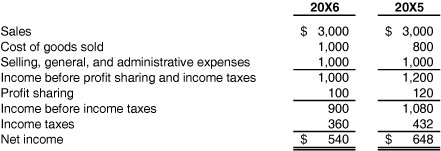 20X6 20X5 Sales " $3,000 " " $3,000 " Cost of goods sold " 1,000 " 800 "Selling, general, and administrative expenses" " 1,000 " " 1,000 " Income before profit sharing and income taxes " 1,000 " " 1,200 " Profit sharing 100 120 Income before income taxes 900 " 1,080 " Income taxes 360 432 Net income $540 $648
-
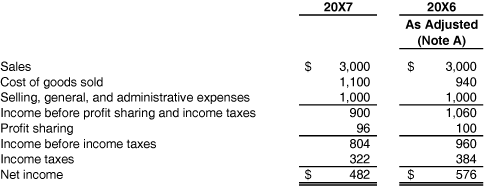 20X7 20X6 As Adjusted (Note A) Sales " $3,000 " " $3,000 " Cost of goods sold " 1,100 " 940 "Selling, general, and administrative expenses" " 1,000 " " 1,000 " Income before profit sharing and income taxes 900 " 1,060 " Profit sharing 96 100 Income before income taxes 804 960 Income taxes 322 384 Net income $482 $576
- NOTE A:
- Change in Method of Accounting for Inventory Valuation
- On January 1, 20X7, Entity A elected to change its method of valuing its inventory to the FIFO method, whereas in all prior years inventory was valued using the LIFO method. The new method of accounting for inventory was adopted [state justification for change in accounting principle] and comparative financial statements of prior years have been adjusted to apply the new method retrospectively. The following financial statement line items for fiscal years 20X7 and 20X6 were affected by the change in accounting principle.
- Income Statement
-
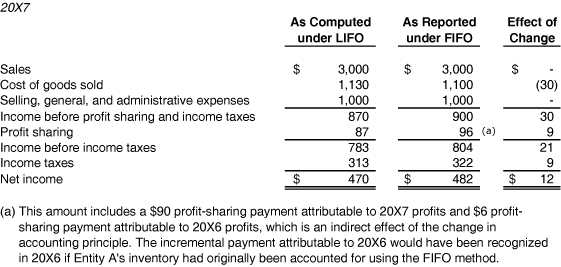 20X7 As Computed under LIFO As Reported under FIFO Effect of Change Sales " $3,000 " " $3,000 " $- Cost of goods sold " 1,130 " " 1,100 " (30) "Selling, general, and administrative expenses" " 1,000 " " 1,000 " - Income before profit sharing and income taxes 870 900 30 Profit sharing 87 96 (a) 9 Income before income taxes 783 804 21 Income taxes 313 322 9 Net income $470 $482 $12 (a) "This amount includes a $90 profit-sharing payment attributable to 20X7 profits and $6 profit-sharing payment attributable to 20X6 profits, which is an indirect effect of the change in accounting principle. The incremental payment attributable to 20X6 would have been recognized in 20X6 if Entity A's inventory had originally been accounted for using the FIFO method."
 -
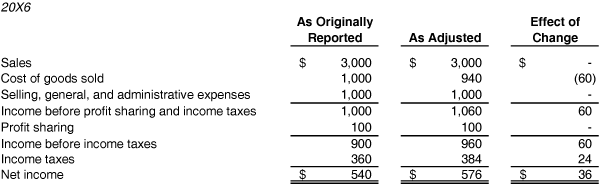 20X6 As Originally Reported As Adjusted Effect of Change Sales " $3,000 " " $3,000 " $- Cost of goods sold " 1,000 " 940 (60) "Selling, general, and administrative expenses" " 1,000 " " 1,000 " - Income before profit sharing and income taxes " 1,000 " " 1,060 " 60 Profit sharing 100 100 - Income before income taxes 900 960 60 Income taxes 360 384 24 Net income $540 $576 $36
 - Balance Sheet
-
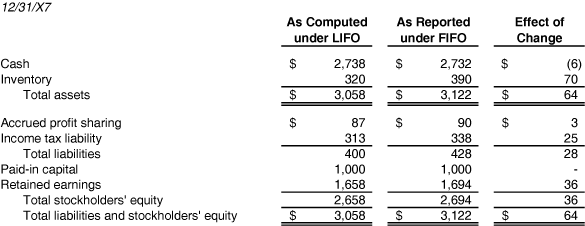 12/31/X7 As Computed under LIFO As Reported under FIFO Effect of Change Cash " $2,738 " " $2,732 " $(6) Inventory 320 390 70 Total assets " $3,058 " " $3,122 " $64 Accrued profit sharing $87 $90 $3 Income tax liability 313 338 25 Total liabilities 400 428 28 Paid-in capital " 1,000 " " 1,000 " - Retained earnings " 1,658 " " 1,694 " 36 Total stockholders' equity " 2,658 " " 2,694 " 36 Total liabilities and stockholders' equity " $3,058 " " $3,122 " $64
 -
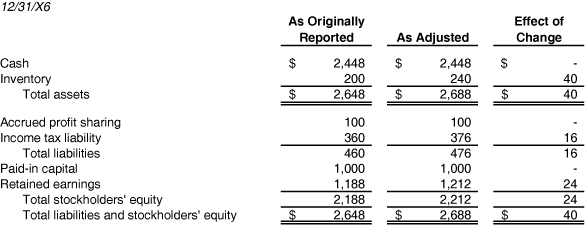 12/31/X6 As Originally Reported As Adjusted Effect of Change Cash " $2,448 " " $2,448 " $- Inventory 200 240 40 Total assets " $2,648 " " $2,688 " $40 Accrued profit sharing 100 100 - Income tax liability 360 376 16 Total liabilities 460 476 16 Paid-in capital " 1,000 " " 1,000 " - Retained earnings " 1,188 " " 1,212 " 24 Total stockholders' equity " 2,188 " " 2,212 " 24 Total liabilities and stockholders' equity " $2,648 " " $2,688 " $40
 - As a result of the accounting change, retained earnings as of January 1, 20X6, decreased from $648, as originally reported using the LIFO method, to $636 using the FIFO method.
- Statement of Cash Flows
-
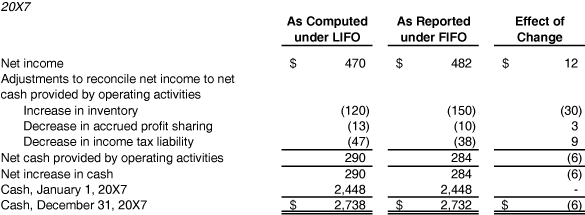 20X7 As Computed under LIFO As Reported under FIFO Effect of Change Net income $470 $482 $12 Adjustments to reconcile net income to net cash provided by operating activities Increase in inventory (120) (150) (30) Decrease in accrued profit sharing (13) (10) 3 Decrease in income tax liability (47) (38) 9 Net cash provided by operating activities 290 284 (6) Net increase in cash 290 284 (6) "Cash, January 1, 20X7" " 2,448 " " 2,448 " - "Cash, December 31, 20X7" " $2,738 " " $2,732 " $(6)
 -
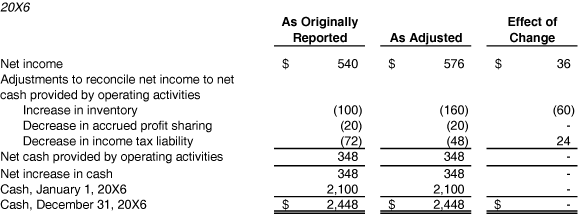 20X6 As Originally Reported As Adjusted Effect of Change Net income $540 $576 $36 Adjustments to reconcile net income to net cash provided by operating activities Increase in inventory (100) (160) (60) Decrease in accrued profit sharing (20) (20) - Decrease in income tax liability (72) (48) 24 Net cash provided by operating activities 348 348 - Net increase in cash 348 348 - "Cash, January 1, 20X6" " 2,100 " " 2,100 " - "Cash, December 31, 20X6" " $2,448 " " $2,448 " $-
250-10-60Relationships
Source downloaded: .Record version 04a97c926793. Effective date must be checked in the source.
Earnings per Share
Investments—Equity Method and Joint Ventures
250-10-S00StatusSEC
Source downloaded: .Record version 8f179a82f9c8. Effective date must be checked in the source.
| Paragraph | Action | Accounting Standards Update | Date |
| Amended | Accounting Standards Update No. 2012-03 | 08/27/2012 | |
| 250-10-S99-6 | Added | Accounting Standards Update No. 2017-03 | 01/23/2017 |
250-10-S50DisclosureSEC
Source downloaded: .Record version f863eb5762c8. Effective date must be checked in the source.
Disclosure of the Impact that Recently Issued Accounting Standards Will Have on the Financial Statements of the Registrant when Adopted in a Future Period
Retrospective Accounting Changes
Adjustments Made to Beginning Stockholders' Equity for Retroactive Adjustments
Interim Financial Statement Disclosure of Date and Reasons for Material Accounting Changes
250-10-S55Implementation Guidance and IllustrationsSEC
Source downloaded: .Record version d4339faed421. Effective date must be checked in the source.
Materiality
Accounting for Changes Not Retroactively Applied Due to Immateriality
Considering the Effects of Prior Year Misstatements when Quantifying Misstatements in Current Year Financial Statements
Reporting Requirements for Accounting Changes
A Change by an Insurance Entity in Its Method of Selecting a Discount Rate Used to Discount Claims Liabilities Related to Short-Duration Contracts
250-10-S99SEC MaterialsSEC
Source downloaded: .Record version 89d4776c3660. Effective date must be checked in the source.
SEC Staff Guidance
- 1. Assessing materiality
- Facts: During the course of preparing or auditing year-end financial statements, financial management or the registrant's independent auditor becomes aware of misstatements in a registrant's financial statements. When combined, the misstatements result in a 4% overstatement of net income and a $.02 (4%) overstatement of earnings per share. Because no item in the registrant's consolidated financial statements is misstated by more than 5%, management and the independent auditor conclude that the deviation from GAAP is immaterial and that the accounting is permissible. FN24
- FN24 AU 312 states that the auditor should consider audit risk and materiality both in (a) planning and setting the scope for the audit and (b) evaluating whether the financial statements taken as a whole are fairly presented in all material respects in conformity with GAAP. The purpose of this SAB is to provide guidance to financial management and independent auditors with respect to the evaluation of the materiality of misstatements that are identified in the audit process or preparation of the financial statements (i. e., (b) above). This SAB is not intended to provide definitive guidance for assessing "materiality" in other contexts, such as evaluations of auditor independence, as other factors may apply. There may be other rules that address financial presentation. See, e.g., Rule 2a-4, 17 CFR 270.2a-4, under the Investment Company Act of 1940.
- Question: FASB ASC paragraph 105-10-05-6 (Generally Accepted Accounting Principles Topic) states, "The provisions of the Codification need not be applied to immaterial items." In the staff's view, may a registrant or the auditor of its financial statements assume the immateriality of items that fall below a percentage threshold set by management or the auditor to determine whether amounts and items are material to the financial statements?
- Interpretive Response: No. The staff is aware that certain registrants, over time, have developed quantitative thresholds as "rules of thumb" to assist in the preparation of their financial statements, and that auditors also have used these thresholds in their evaluation of whether items might be considered material to users of a registrant's financial statements. One rule of thumb in particular suggests that the misstatement or omission FN25 of an item that falls under a 5% threshold is not material in the absence of particularly egregious circumstances, such as self-dealing or misappropriation by senior management. The staff reminds registrants and the auditors of their financial statements that exclusive reliance on this or any percentage or numerical threshold has no basis in the accounting literature or the law.
- FN25 As used in this SAB, "misstatement" or "omission" refers to a financial statement assertion that would not be in conformity with GAAP.
- The use of a percentage as a numerical threshold, such as 5%, may provide the basis for a preliminary assumption that - without considering all relevant circumstances - a deviation of less than the specified percentage with respect to a particular item on the registrant's financial statements is unlikely to be material. The staff has no objection to such a "rule of thumb" as an initial step in assessing materiality. But quantifying, in percentage terms, the magnitude of a misstatement is only the beginning of an analysis of materiality; it cannot appropriately be used as a substitute for a full analysis of all relevant considerations. Materiality concerns the significance of an item to users of a registrant's financial statements. A matter is "material" if there is a substantial likelihood that a reasonable person would consider it important. In its Concepts Statement 2, Qualitative Characteristics of Accounting Information, the FASB stated the essence of the concept of materiality as follows:
- The omission or misstatement of an item in a financial report is material if, in the light of surrounding circumstances, the magnitude of the item is such that it is probable that the judgment of a reasonable person relying upon the report would have been changed or influenced by the inclusion or correction of the item. FN26
- FN26 Concepts Statement 2, paragraph 132. See also Concepts Statement 2, Glossary of Terms - Materiality.
- This formulation in the accounting literature is in substance identical to the formulation used by the courts in interpreting the federal securities laws. The Supreme Court has held that a fact is material if there is -
- a substantial likelihood that the...fact would have been viewed by the reasonable investor as having significantly altered the "total mix" of information made available. FN27
- FN27 TSC Industries v. Northway, Inc., 426 U.S. 438, 449 (1976). See also Basic, Inc. v. Levinson, 485 U.S. 224 (1988). As the Supreme Court has noted, determinations of materiality require "delicate assessments of the inferences a `reasonable shareholder' would draw from a given set of facts and the significance of those inferences to him...." TSC Industries, 426 U.S. at 450.
- Under the governing principles, an assessment of materiality requires that one views the facts in the context of the "surrounding circumstances," as the accounting literature puts it, or the "total mix" of information, in the words of the Supreme Court. In the context of a misstatement of a financial statement item, while the "total mix" includes the size in numerical or percentage terms of the misstatement, it also includes the factual context in which the user of financial statements would view the financial statement item. The shorthand in the accounting and auditing literature for this analysis is that financial management and the auditor must consider both "quantitative" and "qualitative" factors in assessing an item's materiality. FN28 Court decisions, Commission rules and enforcement actions, and accounting and auditing literature FN29 have all considered "qualitative" factors in various contexts.
- FN28 See, e.g., Concepts Statement 2, paragraphs 123-124; AU 312A.10 (materiality judgments are made in light of surrounding circumstances and necessarily involve both quantitative and qualitative considerations); AU 312A.34 ("Qualitative considerations also influence the auditor in reaching a conclusion as to whether misstatements are material."). As used in the accounting literature and in this SAB, "qualitative" materiality refers to the surrounding circumstances that inform an investor's evaluation of financial statement entries. Whether events may be material to investors for non-financial reasons is a matter not addressed by this SAB.
- FN29 See, e.g., Rule 1-02(o) of Regulation S-X, 17 CFR 210.1-02(o), Rule 405 of Regulation C, 17 CFR 230.405, and Rule 12b-2, 17 CFR 240.12b-2; AU 312A.10 -.11, 317.13, 411.04 n. 1, and 508.36; In re Kidder Peabody Securities Litigation, 10 F. Supp. 2d 398 (S.D.N.Y. 1998); Parnes v. Gateway 2000, Inc., 122 F.3d 539 (8th Cir. 1997); In re Westinghouse Securities Litigation, 90 F.3d 696 (3d Cir. 1996); In the Matter of W.R. Grace & Co., Accounting and Auditing Enforcement Release ("AAER") 1140 (June 30, 1999); In the Matter of Eugene Gaughan, AAER 1141 (June 30, 1999); In the Matter of Thomas Scanlon, AAER 1142 (June 30, 1999); and In re Sensormatic Electronics Corporation, Sec. Act Rel. No. 7518 (March 25, 1998).
- The FASB has long emphasized that materiality cannot be reduced to a numerical formula. In its Concepts Statement 2, the FASB noted that some had urged it to promulgate quantitative materiality guides for use in a variety of situations. The FASB rejected such an approach as representing only a "minority view, stating -
- The predominant view is that materiality judgments can properly be made only by those who have all the facts. The Board's present position is that no general standards of materiality could be formulated to take into account all the considerations that enter into an experienced human judgment. FN30
- FN30 Concepts Statement 2, paragraph 131.
- The FASB noted that, in certain limited circumstances, the Commission and other authoritative bodies had issued quantitative materiality guidance, citing as examples guidelines ranging from one to ten percent with respect to a variety of disclosures. FN31 And it took account of contradictory studies, one showing a lack of uniformity among auditors on materiality judgments, and another suggesting widespread use of a "rule of thumb" of five to ten percent of net income. FN32 The FASB also considered whether an evaluation of materiality could be based solely on anticipating the market's reaction to accounting information. FN33
- FN31 Concepts Statement 2, paragraphs 131 and 166.
- FN32 Concepts Statement 2, paragraph 167.
- FN33 Concepts Statement 2, paragraphs 168-169.
- The FASB rejected a formulaic approach to discharging "the onerous duty of making materiality decisions" FN34 in favor of an approach that takes into account all the relevant considerations. In so doing, it made clear that -
- FN34 Concepts Statement 2, paragraph 170.
- [M]agnitude by itself, without regard to the nature of the item and the circumstances in which the judgment has to be made, will not generally be a sufficient basis for a materiality judgment. FN35
- FN35 Concepts Statement 2, paragraph 125.
- Evaluation of materiality requires a registrant and its auditor to consider all the relevant circumstances, and the staff believes that there are numerous circumstances in which misstatements below 5% could well be material. Qualitative factors may cause misstatements of quantitatively small amounts to be material; as stated in the auditing literature:
- As a result of the interaction of quantitative and qualitative considerations in materiality judgments, misstatements of relatively small amounts that come to the auditor's attention could have a material effect on the financial statements. FN36
- FN36 AU 312.11.
- Among the considerations that may well render material a quantitatively small misstatement of a financial statement item are -
- whether the misstatement arises from an item capable of precise measurement or whether it arises from an estimate and, if so, the degree of imprecision inherent in the estimate FN37.
- FN37 As stated in Concepts Statement 2, paragraph 130: Another factor in materiality judgments is the degree of precision that is attainable in estimating the judgment item. The amount of deviation that is considered immaterial may increase as the attainable degree of precision decreases. For example, accounts payable usually can be estimated more accurately than can contingent liabilities arising from litigation or threats of it, and a deviation considered to be material in the first case may be quite trivial in the second. This SAB is not intended to change current law or guidance in the accounting literature regarding accounting estimates. See, e.g., Accounting Principles Board Opinion 20, Accounting Changes 10, 11, 31-33 (July 1971) [Subtopic 250-10].
- whether the misstatement masks a change in earnings or other trends.
- whether the misstatement hides a failure to meet analysts' consensus expectations for the enterprise.
- whether the misstatement changes a loss into income or vice versa.
- whether the misstatement concerns a segment or other portion of the registrant's business that has been identified as playing a significant role in the registrant's operations or profitability.
- whether the misstatement affects the registrant's compliance with regulatory requirements.
- whether the misstatement affects the registrant's compliance with loan covenants or other contractual requirements.
- whether the misstatement has the effect of increasing management's compensation - for example, by satisfying requirements for the award of bonuses or other forms of incentive compensation.
- whether the misstatement involves concealment of an unlawful transaction.
- This is not an exhaustive list of the circumstances that may affect the materiality of a quantitatively small misstatement. FN38 Among other factors, the demonstrated volatility of the price of a registrant's securities in response to certain types of disclosures may provide guidance as to whether investors regard quantitatively small misstatements as material. Consideration of potential market reaction to disclosure of a misstatement is by itself "too blunt an instrument to be depended on" in considering whether a fact is material. FN39 When, however, management or the independent auditor expects (based, for example, on a pattern of market performance) that a known misstatement may result in a significant positive or negative market reaction, that expected reaction should be taken into account when considering whether a misstatement is material. FN40
- FN38 The staff understands that the Big Five Audit Materiality Task Force ("Task Force") was convened in March of 1998 and has made recommendations to the Auditing Standards Board including suggestions regarding communications with audit committees about unadjusted misstatements. See generally Big Five Audit Materiality Task Force. "Materiality in a Financial Statement Audit - Considering Qualitative Factors When Evaluating Audit Findings" (August 1998).
- FN39 See Concepts Statement 2, paragraph 169.
- FN40 If management does not expect a significant market reaction, a misstatement still may be material and should be evaluated under the criteria discussed in this SAB.
- For the reasons noted above, the staff believes that a registrant and the auditors of its financial statements should not assume that even small intentional misstatements in financial statements, for example those pursuant to actions to "manage" earnings, are immaterial. FN41 While the intent of management does not render a misstatement material, it may provide significant evidence of materiality. The evidence may be particularly compelling where management has intentionally misstated items in the financial statements to "manage" reported earnings. In that instance, it presumably has done so believing that the resulting amounts and trends would be significant to users of the registrant's financial statements. FN42 The staff believes that investors generally would regard as significant a management practice to over- or under-state earnings up to an amount just short of a percentage threshold in order to "manage" earnings. Investors presumably also would regard as significant an accounting practice that, in essence, rendered all earnings figures subject to a management-directed margin of misstatement.
- FN41 Intentional management of earnings and intentional misstatements, as used in this SAB, do not include insignificant errors and omissions that may occur in systems and recurring processes in the normal course of business. See notes 37 and 49 infra.
- FN42 Assessments of materiality should occur not only at year-end, but also during the preparation of each quarterly or interim financial statement. See, e.g., In the Matter of Venator Group, Inc., AAER 1049 (June 29, 1998).
- The materiality of a misstatement may turn on where it appears in the financial statements. For example, a misstatement may involve a segment of the registrant's operations. In that instance, in assessing materiality of a misstatement to the financial statements taken as a whole, registrants and their auditors should consider not only the size of the misstatement but also the significance of the segment information to the financial statements taken as a whole. FN43 "A misstatement of the revenue and operating profit of a relatively small segment that is represented by management to be important to the future profitability of the entity" FN44 is more likely to be material to investors than a misstatement in a segment that management has not identified as especially important. In assessing the materiality of misstatements in segment information - as with materiality generally -
- FN43 See, e.g., In the Matter of W.R. Grace & Co., AAER 1140 (June 30, 1999).
- FN44 AU 9326.33.
- situations may arise in practice where the auditor will conclude that a matter relating to segment information is qualitatively material even though, in his or her judgment, it is quantitatively immaterial to the financial statements taken as a whole. FN45
- FN45 Id.
- Aggregating and Netting Misstatements.
- In determining whether multiple misstatements cause the financial statements to be materially misstated, registrants and the auditors of their financial statements should consider each misstatement separately and the aggregate effect of all misstatements. FN46 A registrant and its auditor should evaluate misstatements in light of quantitative and qualitative factors and "consider whether, in relation to individual amounts, subtotals, or totals in the financial statements, they materially misstate the financial statements taken as a whole." FN47 This requires consideration of -
- FN46 The auditing literature notes that the "concept of materiality recognizes that some matters, either individually or in the aggregate, are important for fair presentation of financial statements in conformity with generally accepted accounting principles." AU 312.03. See also AU 312.04.
- FN47 AU 312.34. Quantitative materiality assessments often are made by comparing adjustments to revenues, gross profit, pretax and net income, total assets, stockholders' equity, or individual line items in the financial statements. The particular items in the financial statements to be considered as a basis for the materiality determination depend on the proposed adjustment to be made and other factors, such as those identified in this SAB. For example, an adjustment to inventory that is immaterial to pretax income or net income may be material to the financial statements because it may affect a working capital ratio or cause the registrant to be in default of loan covenants.
- the significance of an item to a particular entity (for example, inventories to a manufacturing company), the pervasiveness of the misstatement (such as whether it affects the presentation of numerous financial statement items), and the effect of the misstatement on the financial statements taken as a whole.... FN48
- FN48 AU 508.36.
- Registrants and their auditors first should consider whether each misstatement is material, irrespective of its effect when combined with other misstatements. The literature notes that the analysis should consider whether the misstatement of "individual amounts" causes a material misstatement of the financial statements taken as a whole. As with materiality generally, this analysis requires consideration of both quantitative and qualitative factors.
- If the misstatement of an individual amount causes the financial statements as a whole to be materially misstated, that effect cannot be eliminated by other misstatements whose effect may be to diminish the impact of the misstatement on other financial statement items. To take an obvious example, if a registrant's revenues are a material financial statement item and if they are materially overstated, the financial statements taken as a whole will be materially misleading even if the effect on earnings is completely offset by an equivalent overstatement of expenses.
- Even though a misstatement of an individual amount may not cause the financial statements taken as a whole to be materially misstated, it may nonetheless, when aggregated with other misstatements, render the financial statements taken as a whole to be materially misleading. Registrants and the auditors of their financial statements accordingly should consider the effect of the misstatement on subtotals or totals. The auditor should aggregate all misstatements that affect each subtotal or total and consider whether the misstatements in the aggregate affect the subtotal or total in a way that causes the registrant's financial statements taken as a whole to be materially misleading. FN49
- FN49 AU 312.34.
- The staff believes that, in considering the aggregate effect of multiple misstatements on a subtotal or total, registrants and the auditors of their financial statements should exercise particular care when considering whether to offset (or the appropriateness of offsetting) a misstatement of an estimated amount with a misstatement of an item capable of precise measurement. As noted above, assessments of materiality should never be purely mechanical; given the imprecision inherent in estimates, there is by definition a corresponding imprecision in the aggregation of misstatements involving estimates with those that do not involve an estimate.
- Registrants and auditors also should consider the effect of misstatements from prior periods on the current financial statements. For example, the auditing literature states,
- Matters underlying adjustments proposed by the auditor but not recorded by the entity could potentially cause future financial statements to be materially misstated, even though the auditor has concluded that the adjustments are not material to the current financial statements. FN50
- FN50 AU 380.09.
- This may be particularly the case where immaterial misstatements recur in several years and the cumulative effect becomes material in the current year.
- 2. Immaterial Misstatements that are Intentional
- Facts: A registrant's management intentionally has made adjustments to various financial statement items in a manner inconsistent with GAAP. In each accounting period in which such actions were taken, none of the individual adjustments is by itself material, nor is the aggregate effect on the financial statements taken as a whole material for the period. The registrant's earnings "management" has been effected at the direction or acquiescence of management in the belief that any deviations from GAAP have been immaterial and that accordingly the accounting is permissible.
- Question: In the staff's view, may a registrant make intentional immaterial misstatements in its financial statements?
- Interpretive Response: No. In certain circumstances, intentional immaterial misstatements are unlawful.
- Considerations of the books and records provisions under the Exchange Act.
- Even if misstatements are immaterial, FN51 registrants must comply with Sections 13(b)(2) - (7) of the Securities Exchange Act of 1934 (the "Exchange Act"). FN52 Under these provisions, each registrant with securities registered pursuant to Section 12 of the Exchange Act, FN53 or required to file reports pursuant to Section 15(d), FN54 must make and keep books, records, and accounts, which, in reasonable detail, accurately and fairly reflect the transactions and dispositions of assets of the registrant and must maintain internal accounting controls that are sufficient to provide reasonable assurances that, among other things, transactions are recorded as necessary to permit the preparation of financial statements in conformity with GAAP. FN55 In this context, determinations of what constitutes "reasonable assurance" and "reasonable detail" are based not on a "materiality" analysis but on the level of detail and degree of assurance that would satisfy prudent officials in the conduct of their own affairs. FN56 Accordingly, failure to record accurately immaterial items, in some instances, may result in violations of the securities laws.
- FN51 FASB ASC paragraph 105-10-05-6 states that "[t]he provisions of the Codification need not be applied to immaterial items." This SAB is consistent with that provision of the Codification. In theory, this language is subject to the interpretation that the registrant is free intentionally to set forth immaterial items in financial statements in a manner that plainly would be contrary to GAAP if the misstatement were material. The staff believes that the FASB did not intend this result.
- FN52 15 U.S.C. 78m(b)(2) - (7).
- FN53 15 U.S.C. 78l.
- FN54 15 U.S.C. 78o(d).
- FN55 Criminal liability may be imposed if a person knowingly circumvents or knowingly fails to implement a system of internal accounting controls or knowingly falsifies books, records or accounts. 15 U.S.C. 78m(4) and (5). See also Rule 13b2-1 under the Exchange Act, 17 CFR 240.13b2-1, which states, "No person shall, directly or indirectly, falsify or cause to be falsified, any book, record or account subject to Section 13(b)(2)(A) of the Securities Exchange Act."
- FN56 15 U.S.C. 78m(b)(7). The books and records provisions of section 13(b) of the Exchange Act originally were passed as part of the Foreign Corrupt Practices Act ("FCPA"). In the conference committee report regarding the 1988 amendments to the FCPA, the committee stated: The conference committee adopted the prudent man qualification in order to clarify that the current standard does not connote an unrealistic degree of exactitude or precision. The concept of reasonableness of necessity contemplates the weighing of a number of relevant factors, including the costs of compliance. Cong. Rec. H2116 (daily ed. April 20, 1988).
- The staff recognizes that there is limited authoritative guidance FN57 regarding the "reasonableness" standard in Section 13(b)(2) of the Exchange Act. A principal statement of the Commission's policy in this area is set forth in an address given in 1981 by then Chairman Harold M. Williams. FN58 In his address, Chairman Williams noted that, like materiality, "reasonableness" is not an "absolute standard of exactitude for corporate records." FN59 Unlike materiality, however, "reasonableness" is not solely a measure of the significance of a financial statement item to investors. "Reasonableness," in this context, reflects a judgment as to whether an issuer's failure to correct a known misstatement implicates the purposes underlying the accounting provisions of Sections 13(b)(2) - (7) of the Exchange Act. FN60
- FN57 So far as the staff is aware, there is only one judicial decision that discusses Section 13(b)(2) of the Exchange Act in any detail, SEC v. World-Wide Coin Investments, Ltd., 567 F. Supp. 724 (N.D. Ga. 1983), and the courts generally have found that no private right of action exists under the accounting and books and records provisions of the Exchange Act. See e.g., Lamb v. Phillip Morris Inc., 915 F.2d 1024 (6th Cir. 1990) and JS Service Center Corporation v. General Electric Technical Services Company, 937 F. Supp. 216 (S.D.N.Y. 1996).
- FN58 The Commission adopted the address as a formal statement of policy in Securities Exchange Act Release No. 17500 (January 29, 1981), 46 FR 11544 (February 9, 1981), 21 SEC Docket 1466 (February 10, 1981).
- FN59 Id. at 46 FR 11546.
- FN60 Id.
- In assessing whether a misstatement results in a violation of a registrant's obligation to keep books and records that are accurate "in reasonable detail," registrants and their auditors should consider, in addition to the factors discussed above concerning an evaluation of a misstatement's potential materiality, the factors set forth below.
- The significance of the misstatement. Though the staff does not believe that registrants need to make finely calibrated determinations of significance with respect to immaterial items, plainly it is "reasonable" to treat misstatements whose effects are clearly inconsequential differently than more significant ones.
- How the misstatement arose. It is unlikely that it is ever "reasonable" for registrants to record misstatements or not to correct known misstatements - even immaterial ones - as part of an ongoing effort directed by or known to senior management for the purposes of "managing" earnings. On the other hand, insignificant misstatements that arise from the operation of systems or recurring processes in the normal course of business generally will not cause a registrant's books to be inaccurate "in reasonable detail." FN61
- FN61 For example, the conference report regarding the 1988 amendments to the FCPA stated: The Conferees intend to codify current Securities and Exchange Commission (SEC) enforcement policy that penalties not be imposed for insignificant or technical infractions or inadvertent conduct. The amendment adopted by the Conferees [Section 13(b)(4)] accomplishes this by providing that criminal penalties shall not be imposed for failing to comply with the FCPA's books and records or accounting provisions. This provision [Section 13(b)(5)] is meant to ensure that criminal penalties would be imposed where acts of commission or omission in keeping books or records or administering accounting controls have the purpose of falsifying books, records or accounts, or of circumventing the accounting controls set forth in the Act. This would include the deliberate falsification of books and records and other conduct calculated to evade the internal accounting controls requirement. Cong. Rec. H2115 (daily ed. April 20, 1988).
- The cost of correcting the misstatement. The books and records provisions of the Exchange Act do not require registrants to make major expenditures to correct small misstatements. FN62 Conversely, where there is little cost or delay involved in correcting a misstatement, failing to do so is unlikely to be "reasonable."
- FN62 As Chairman Williams noted with respect to the internal control provisions of the FCPA, "[t]housands of dollars ordinarily should not be spent conserving hundreds." 46 FR 11546.
- The clarity of authoritative accounting guidance with respect to the misstatement. Where reasonable minds may differ about the appropriate accounting treatment of a financial statement item, a failure to correct it may not render the registrant's financial statements inaccurate "in reasonable detail." Where, however, there is little ground for reasonable disagreement, the case for leaving a misstatement uncorrected is correspondingly weaker.
- There may be other indicators of "reasonableness" that registrants and their auditors may ordinarily consider. Because the judgment is not mechanical, the staff will be inclined to continue to defer to judgments that "allow a business, acting in good faith, to comply with the Act's accounting provisions in an innovative and cost-effective way." FN63
- FN63 Id., at 11547.
- The Auditor's Response to Intentional Misstatements.
- Section 10A(b) of the Exchange Act requires auditors to take certain actions upon discovery of an "illegal act." FN64 The statute specifies that these obligations are triggered "whether or not [the illegal acts are] perceived to have a material effect on the financial statements of the issuer...." Among other things, Section 10A(b)(1) requires the auditor to inform the appropriate level of management of an illegal act (unless clearly inconsequential) and assure that the registrant's audit committee is "adequately informed" with respect to the illegal act.
- FN64 Section 10A(f) defines, for purposes of Section 10A, an "illegal act" as "an act or omission that violates any law, or any rule or regulation having the force of law." This is broader than the definition of an "illegal act" in AU 317.02, which states, "Illegal acts by clients do not include personal misconduct by the entity's personnel unrelated to their business activities.".
- As noted, an intentional misstatement of immaterial items in a registrant's financial statements may violate Section 13(b)(2) of the Exchange Act and thus be an illegal act. When such a violation occurs, an auditor must take steps to see that the registrant's audit committee is "adequately informed" about the illegal act. Because Section 10A(b)(1) is triggered regardless of whether an illegal act has a material effect on the registrant's financial statements, where the illegal act consists of a misstatement in the registrant's financial statements, the auditor will be required to report that illegal act to the audit committee irrespective of any "netting" of the misstatements with other financial statement items.
- The requirements of Section 10A echo the auditing literature. See, e.g. Statement on Auditing Standards (SAS) Nos. 54 and 99. Pursuant to paragraph 77 of SAS 99, if the auditor determines there is evidence that fraud may exist, the auditor must discuss the matter with the appropriate level of management that is at least one level above those involved, and with senior management and the audit committee. The auditor must report directly to the audit committee fraud involving senior management and fraud that causes a material misstatement of the financial statements. Paragraph 6 of SAS 99 states that "misstatements arising from fraudulent financial reporting are intentional misstatements or omissions of amounts or disclosures in financial statements designed to deceive financial statement users..." FN65 SAS 99 further states that fraudulent financial reporting may involve falsification or alteration of accounting records; misrepresenting or omitting events, transactions or other information in the financial statements; and the intentional misapplication of accounting principles relating to amounts, classifications, the manner of presentation, or disclosures in the financial statements. FN66 The clear implication of SAS 99 is that immaterial misstatements may be fraudulent financial reporting. FN67
- FN65 An unintentional illegal act triggers the same procedures and considerations by the auditor as a fraudulent misstatement if the illegal act has a direct and material effect on the financial statements. See AU 110 n. 1, 317.05 and 317.07. Although distinguishing between intentional and unintentional misstatements is often difficult, the auditor must plan and perform the audit to obtain reasonable assurance that the financial statements are free of material misstatements in either case.
- FN66 Although the auditor is not required to plan or perform the audit to detect misstatements that are immaterial to the financial statements, SAS 99 requires the auditor to evaluate several fraud "risk factors" that may bring such misstatements to his or her attention. For example, an analysis of fraud risk factors under SAS 99 must include, among other things, consideration of management's interest in maintaining or increasing the registrant's stock price or earnings trend through the use of unusually aggressive accounting practices, whether management has a practice of committing to analysts or others that it will achieve unduly aggressive or clearly unrealistic forecasts, and the existence of assets, liabilities, revenues, or expenses based on significant estimates that involve unusually subjective judgments or uncertainties.
- FN67 In requiring the auditor to consider whether fraudulent misstatements are material, and in requiring differing responses depending on whether the misstatement is material, SAS 99 makes clear that fraud can involve immaterial misstatements. Indeed, a misstatement can be "inconsequential" and still involve fraud. Under SAS 99, assessing whether misstatements due to fraud are material to the financial statements is a "cumulative process" that should occur both during and at the completion of the audit. SAS 99 further states that this accumulation is primarily a "qualitative matter" based on the auditor's judgment. The staff believes that in making these assessments, management and auditors should refer to the discussion in Part 1 of this SAB.
- Auditors that learn of intentional misstatements may also be required to (1) re-evaluate the degree of audit risk involved in the audit engagement, (2) determine whether to revise the nature, timing, and extent of audit procedures accordingly, and (3) consider whether to resign. FN68
- FN68 Auditors should document their determinations in accordance with SAS 96, SAS 99, and other appropriate sections of the audit literature.
- Intentional misstatements also may signal the existence of reportable conditions or material weaknesses in the registrant's system of internal accounting control designed to detect and deter improper accounting and financial reporting. FN69 As stated by the National Commission on Fraudulent Financial Reporting, also known as the Treadway Commission, in its 1987 report,
- FN69 See, e.g., SAS 99.
- The tone set by top management—the corporate environment or culture within which financial reporting occurs - is the most important factor contributing to the integrity of the financial reporting process. Notwithstanding an impressive set of written rules and procedures, if the tone set by management is lax, fraudulent financial reporting is more likely to occur. FN70
- FN70 Report of the National Commission on Fraudulent Financial Reporting at 32 (October 1987). See also Report and Recommendations of the Blue Ribbon Committee on Improving the Effectiveness of Corporate Audit Committees (February 8, 1999).
- An auditor is required to report to a registrant's audit committee any reportable conditions or material weaknesses in a registrant's system of internal accounting control that the auditor discovers in the course of the examination of the registrant's financial statements. FN71
- FN71 AU 325.02. See also AU 380.09, which, in discussing matters to be communicated by the auditor to the audit committee, states: The auditor should inform the audit committee about adjustments arising from the audit that could, in his judgment, either individually or in the aggregate, have a significant effect on the entity's financial reporting process. For purposes of this section, an audit adjustment, whether or not recorded by the entity, is a proposed correction of the financial statements.
- GAAP precedence over industry practice.
- Some have argued to the staff that registrants should be permitted to follow an industry accounting practice even though that practice is inconsistent with authoritative accounting literature. This situation might occur if a practice is developed when there are few transactions and the accounting results are clearly inconsequential, and that practice never changes despite a subsequent growth in the number or materiality of such transactions. The staff disagrees with this argument. Authoritative literature takes precedence over industry practice that is contrary to GAAP. FN72
- FN72 See AU 411.05.
- General comments.
- This SAB is not intended to change current law or guidance in the accounting or auditing literature. FN73 This SAB and the authoritative accounting literature cannot specifically address all of the novel and complex business transactions and events that may occur. Accordingly, registrants may account for, and make disclosures about, these transactions and events based on analogies to similar situations or other factors. The staff may not, however, always be persuaded that a registrant's determination is the most appropriate under the circumstances. When disagreements occur after a transaction or an event has been reported, the consequences may be severe for registrants, auditors, and, most importantly, the users of financial statements who have a right to expect consistent accounting and reporting for, and disclosure of, similar transactions and events. The staff, therefore, encourages registrants and auditors to discuss on a timely basis with the staff proposed accounting treatments for, or disclosures about, transactions or events that are not specifically covered by the existing accounting literature.
- FN73 The FASB Discussion Memorandum, "Criteria for Determining Materiality," states that the financial accounting and reporting process considers that "a great deal of the time might be spent during the accounting process considering insignificant matters.... If presentations of financial information are to be prepared economically on a timely basis and presented in a concise intelligible form, the concept of materiality is crucial." This SAB is not intended to require that misstatements arising from insignificant errors and omissions (individually and in the aggregate) arising from the normal recurring accounting close processes, such as a clerical error or an adjustment for a missed accounts payable invoice, always be corrected, even if the error is identified in the audit process and known to management. Management and the auditor would need to consider the various factors described elsewhere in this SAB in assessing whether such misstatements are material, need to be corrected to comply with the FCPA, or trigger procedures under Section 10A of the Exchange Act. Because this SAB does not change current law or guidance in the accounting or auditing literature, adherence to the principles described in this SAB should not raise the costs associated with recordkeeping or with audits of financial statements.
- (Added by SAB 108).
- Facts: During the course of preparing annual financial statements, a registrant is evaluating the materiality of an improper expense accrual (e. g., overstated liability) in the amount of $100, which has built up over 5 years, at $20 per year. FN74 The registrant previously evaluated the misstatement as being immaterial to each of the prior year financial statements (i. e., years 1-4). For the purpose of evaluating materiality in the current year (i. e., year 5), the registrant quantifies the error as a $20 overstatement of expenses.
- FN74 For purposes of these facts, assume the registrant properly determined that the overstatement of the liability resulted from an error rather than a change in accounting estimate. See the FASB ASC Master Glossary for the distinction between an error and a change in accounting estimate.
- Question 1: Has the registrant appropriately quantified the amount of this error for the purpose of evaluating materiality for the current year?
- Interpretive Response: No. In this example, the registrant has only quantified the effects of the identified unadjusted error that arose in the current year income statement. The staff believes a registrants materiality evaluation of an identified unadjusted error should quantify the effects of the identified unadjusted error on each financial statement and related financial statement disclosure.
- Topic 1M notes that a materiality evaluation must be based on all relevant quantitative and qualitative factors. FN75 This analysis generally begins with quantifying potential misstatements to be evaluated. There has been diversity in practice with respect to this initial step of a materiality analysis.
- FN75 Topic 1N addresses certain of these quantitative issues, but does not alter the analysis required by Topic 1M.
- The diversity in approaches for quantifying the amount of misstatements primarily stems from the effects of misstatements that were not corrected at the end of the prior year (prior year misstatements). These prior year misstatements should be considered in quantifying misstatements in current year financial statements.
- The techniques most commonly used in practice to accumulate and quantify misstatements are generally referred to as the rollover and iron curtain approaches.
- The rollover approach, which is the approach used by the registrant in this example, quantifies a misstatement based on the amount of the error originating in the current year income statement. Thus, this approach ignores the effects of correcting the portion of the current year balance sheet misstatement that originated in prior years (i. e., it ignores the carryover effects of prior year misstatements).
- The iron curtain approach quantifies a misstatement based on the effects of correcting the misstatement existing in the balance sheet at the end of the current year, irrespective of the misstatements year(s) of origination. Had the registrant in this fact pattern applied the iron curtain approach, the misstatement would have been quantified as a $100 misstatement based on the end of year balance sheet misstatement. Thus, the adjustment needed to correct the financial statements for the end of year error would be to reduce the liability by $100 with a corresponding decrease in current year expense.
- As demonstrated in this example, the primary weakness of the rollover approach is that it can result in the accumulation of significant misstatements on the balance sheet that are deemed immaterial in part because the amount that originates in each year is quantitatively small. The staff is aware of situations in which a registrant, relying on the rollover approach, has allowed an erroneous item to accumulate on the balance sheet to the point where eliminating the improper asset or liability would itself result in a material error in the income statement if adjusted in the current year. Such registrants have sometimes concluded that the improper asset or liability should remain on the balance sheet into perpetuity.
- In contrast, the primary weakness of the iron curtain approach is that it does not consider the correction of prior year misstatements in the current year (i. e., the reversal of the carryover effects) to be errors. Therefore, in this example, if the misstatement was corrected during the current year such that no error existed in the balance sheet at the end of the current year, the reversal of the $80 prior year misstatement would not be considered an error in the current year financial statements under the iron curtain approach. Implicitly, the iron curtain approach assumes that because the prior year financial statements were not materially misstated, correcting any immaterial errors that existed in those statements in the current year is the correct accounting, and is therefore not considered an error in the current year. Thus, utilization of the iron curtain approach can result in a misstatement in the current year income statement not being evaluated as an error at all.
- The staff does not believe the exclusive reliance on either the rollover or iron curtain approach appropriately quantifies all misstatements that could be material to users of financial statements.
- In describing the concept of materiality, Concepts Statement 2, Qualitative Characteristics of Accounting Information, indicates that materiality determinations are based on whether it is probable that the judgment of a reasonable person relying upon the report would have been changed or influenced by the inclusion or correction of the item (emphasis added). FN76 The staff believes registrants must quantify the impact of correcting all misstatements, including both the carryover and reversing effects of prior year misstatements, on the current year financial statements. The staff believes that this can be accomplished by quantifying an error under both the rollover and iron curtain approaches as described above and by evaluating the error measured under each approach. Thus, a registrants financial statements would require adjustment when either approach results in quantifying a misstatement that is material, after considering all relevant quantitative and qualitative factors.
- FN76 Concepts Statement 2, paragraph 132. See also Concepts Statement 2, Glossary of Terms - Materiality.
- As a reminder, a change from an accounting principle that is not generally accepted to one that is generally accepted is a correction of an error. FN77
- FN77 See definition of “error in previously issued financial statements” in the FASB ASC Master Glossary.
- The staff believes that the registrant should quantify the current year misstatement in this example using both the iron curtain approach (i. e., $100) and the rollover approach (i. e., $20). Therefore, if the $100 misstatement is considered material to the financial statements, after all of the relevant quantitative and qualitative factors are considered, the registrants financial statements would need to be adjusted.
- It is possible that correcting an error in the current year could materially misstate the current years income statement. For example, correcting the $100 misstatement in the current year will:
- Correct the $20 error originating in the current year;
- Correct the $80 balance sheet carryover error that originated in Years 1 through 4; but also
- Misstate the current year income statement by $80.
- If the $80 understatement of current year expense is material to the current year, after all of the relevant quantitative and qualitative factors are considered, the prior year financial statements should be corrected, even though such revision previously was and continues to be immaterial to the prior year financial statements. Correcting prior year financial statements for immaterial errors would not require previously filed reports to be amended. Such correction may be made the next time the registrant files the prior year financial statements.
- The following example further illustrates the staff's views on quantifying misstatements, including the consideration of the effects of prior year misstatements:
- Facts: During the course of preparing annual financial statements, a registrant is evaluating the materiality of a sales cut-off error in which $50 of revenue from the following year was recorded in the current year, thereby overstating accounts receivable by $50 at the end of the current year. In addition, a similar sales cut-off error existed at the end of the prior year in which $110 of revenue from the current year was recorded in the prior year. As a result of the combination of the current year and prior year cut-off errors, revenues in the current year are understated by $60 ($110 understatement of revenues at the beginning of the current year partially offset by a $50 overstatement of revenues at the end of the current year). The prior year error was evaluated in the prior year as being immaterial to those financial statements.
- Question 2: How should the registrant quantify the misstatement in the current year financial statements?
- Interpretive Response: The staff believes the registrant should quantify the current year misstatement in this example using both the iron curtain approach (i. e., $50) and the rollover approach (i. e., $60). Therefore, assuming a $60 misstatement is considered material to the financial statements, after all relevant quantitative and qualitative factors are considered, the registrants financial statements would need to be adjusted.
- Further, in this example, recording an adjustment in the current year could alter the amount of the error affecting the current year financial statements. For instance:
- If only the $60 understatement of revenues were to be corrected in the current year, then the overstatement of current year end accounts receivable would increase to $110; or,
- If only the $50 overstatement of accounts receivable were to be corrected in the current year, then the understatement of current year revenues would increase to $110.
- If the misstatement that exists after recording the adjustment in the current year financial statements is material (considering all relevant quantitative and qualitative factors), the prior year financial statements should be corrected, even though such revision previously was and continues to be immaterial to the prior year financial statements. Correcting prior year financial statements for immaterial errors would not require previously filed reports to be amended. Such correction may be made the next time the registrant files the prior year financial statements.
- If the cut-off error that existed in the prior year was not discovered until the current year, a separate analysis of the financial statements of the prior year (and any other prior year in which previously undiscovered errors existed) would need to be performed to determine whether such prior year financial statements were materially misstated. If that analysis indicates that the prior year financial statements are materially misstated, they would need to be restated in accordance with FASB ASC Topic 250, Accounting Changes and Error Corrections. FN78
- FN78 FASB ASC paragraph 250-10-45-23.
- Facts: When preparing its financial statements for years ending on or before November 15, 2006, a registrant quantified errors by using either the iron curtain approach or the rollover approach, but not both. Based on consideration of the guidance in this Staff Accounting Bulletin, the registrant concludes that errors existing in previously issued financial statements are material.
- Question 3: Will the staff expect the registrant to restate prior period financial statements when first applying this guidance?
- Interpretive Response: The staff will not object if a registrant FN79 does not restate financial statements for fiscal years ending on or before November 15, 2006, if management properly applied its previous approach, either iron curtain or rollover, so long as all relevant qualitative factors were considered.
- FN79 If a registrants initial registration statement is not effective on or before November 15, 2006, and the registrants prior year(s) financial statements are materially misstated based on consideration of the guidance in this Staff Accounting Bulletin, the prior year financial statements should be restated in accordance with FASB ASC paragraph 250-10-45-23. If a registrants initial registration statement is effective on or before November 15, 2006, the guidance in the interpretive response to Question 3 is applicable.
- To provide full disclosure, registrants electing not to restate prior periods should reflect the effects of initially applying the guidance in Topic 1N in their annual financial statements covering the first fiscal year ending after November 15, 2006. The cumulative effect of the initial application should be reported in the carrying amounts of assets and liabilities as of the beginning of that fiscal year, and the offsetting adjustment should be made to the opening balance of retained earnings for that year. Registrants should disclose the nature and amount of each individual error being corrected in the cumulative adjustment. The disclosure should also include when and how each error being corrected arose and the fact that the errors had previously been considered immaterial.
- Early application of the guidance in Topic 1N is encouraged in any report for an interim period of the first fiscal year ending after November 15, 2006, filed after the publication of this Staff Accounting Bulletin. In the event that the cumulative effect of application of the guidance in Topic 1N is first reported in an interim period other than the first interim period of the first fiscal year ending after November 15, 2006, previously filed interim reports need not be amended. However, comparative information presented in reports for interim periods of the first year subsequent to initial application should be adjusted to reflect the cumulative effect adjustment as of the beginning of the year of initial application. In addition, the disclosures of selected quarterly information required by Item 302 of Regulation S-K should reflect the adjusted results.
- Facts: A registrant is required to adopt an accounting principle by means of retrospective adjustment of prior periods' financial statements. However, the registrant determines that the accounting change does not have a material effect on prior periods' financial statements and, accordingly, decides not to retrospectively adjust such financial statements.
- Question: In these circumstances, is it acceptable to adjust the beginning balance of retained earnings of the period in which the change is made for the cumulative effect of the change on the financial statements of prior periods?
- Interpretive Response: No. If prior periods are not retrospectively adjusted, the cumulative effect of the change should be included in the statement of income for the period in which the change is made. Even in cases where the total cumulative effect is not significant, the staff believes that the amount should be reflected in the results of operations for the period in which the change is made. However, if the cumulative effect is material to current operations or to the trend of the reported results of operations, then the individual income statements of the earlier years should be retrospectively adjusted.
- b. Reporting requirements for accounting changes.
- 1. Preferability.
- Facts: Rule 10-01(b)(6) of Regulation S-X requires that a registrant who makes a material change in its method of accounting shall indicate the date of and the reason for the change. The registrant also must include as an exhibit in the first Form 10-Q filed subsequent to the date of an accounting change, a letter from the registrant's independent accountants indicating whether or not the change is to an alternative principle which in his judgment is preferable under the circumstances. A letter from the independent accountant is not required when the change is made in response to a standard adopted by the Financial Accounting Standards Board which requires such a change.
- Question 1: For some alternative accounting principles, authoritative bodies have specified when one alternative is preferable to another. However, for other alternative accounting principles, no authoritative body has specified criteria for determining the preferability of one alternative over another. In such situations, how should preferability be determined?
- Interpretive Response: In such cases, where objective criteria for determining the preferability among alternative accounting principles have not been established by authoritative bodies, the determination of preferability should be based on the particular circumstances described by and discussed with the registrant. In addition, the independent accountant should consider other significant information of which he is aware. FN5
- FN5 Registrants also are reminded that FASB ASC paragraph 250-10-50-1 (Accounting Changes and Error Corrections Topic) requires that companies disclose the nature of and justification for the change as well as the effects of the change on net income for the period in which the change is made. Furthermore, the justification for the change should explain clearly why the newly adopted principle is preferable to the previously-applied principle.
- Question 2: Management may offer, as justification for a change in accounting principle, circumstances such as: their expectation as to the effect of general economic trends on their business (e. g., the impact of inflation), their expectation regarding expanding consumer demand for the company's products, or plans for change in marketing methods. Are these circumstances which enter into the determination of preferability?
- Interpretive Response: Yes. Those circumstances are examples of business judgment and planning and should be evaluated in determining preferability. In the case of changes for which objective criteria for determining preferability have not been established by authoritative bodies, business judgment and business planning often are major considerations in determining that the change is to a preferable method because the change results in improved financial reporting.
- Question 3: What responsibility does the independent accountant have for evaluating the business judgment and business planning of the registrant?
- Interpretive Response: Business judgment and business planning are within the province of the registrant. Thus, the independent accountant may accept the registrant's business judgment and business planning and express reliance thereon in his letter. However, if either the plans or judgment appear to be unreasonable to the independent accountant, he should not accept them as justification. For example, an independent accountant should not accept a registrant's plans for a major expansion if he believes the registrant does not have the means of obtaining the funds necessary for the expansion program.
- Question 4: If a registrant, who has changed to an accounting method which was preferable under the circumstances, later finds that it must abandon its business plans or change its business judgment because of economic or other factors, is the registrant's justification nullified?
- Interpretive Response: No. A registrant must in good faith justify a change in its method of accounting under the circumstances which exist at the time of the change. The existence of different circumstances at a later time does not nullify the previous justification for the change.
- Question 5: If a registrant justified a change in accounting method as preferable under the circumstances, and the circumstances change, may the registrant revert to the method of accounting used before the change?
- Interpretive Response: Any time a registrant makes a change in accounting method, the change must be justified as preferable under the circumstances. Thus, a registrant may not change back to a principle previously used unless it can justify that the previously used principle is preferable in the circumstances as they currently exist.
- Question 6: If one client of an independent accounting firm changes its method of accounting and the accountant submits the required letter stating his view of the preferability of the principle in the circumstances, does this mean that all clients of that firm are constrained from making the converse change in accounting (e. g., if one client changes from FIFO to LIFO, can no other client change from LIFO to FIFO)?
- Interpretive Response: No. Each registrant must justify a change in accounting method on the basis that the method is preferable under the circumstances of that registrant. In addition, a registrant must furnish a letter from its independent accountant stating that in the judgment of the independent accountant the change in method is preferable under the circumstances of that registrant. If registrants in apparently similar circumstances make changes in opposite directions, the staff has a responsibility to inquire as to the factors which were considered in arriving at the determination by each registrant and its independent accountant that the change was preferable under the circumstances because it resulted in improved financial reporting. The staff recognizes the importance, in many circumstances, of the judgments and plans of management and recognizes that such management judgments may, in good faith, differ. As indicated above, the concern relates to registrants in apparently similar circumstances, no matter who their independent accountants may be.
- Question 7: If a registrant changes its accounting to one of two methods specifically approved by the FASB in the Accounting Standards Codification, need the independent accountant express his view as to the preferability of the method selected?
- Interpretive Response: If a registrant was formerly using a method of accounting no longer deemed acceptable, a change to either method approved by the FASB may be presumed to be a change to a preferable method and no letter will be required from the independent accountant. If, however, the registrant was formerly using one of the methods approved by the FASB for current use and wishes to change to an alternative approved method, then the registrant must justify its change as being one to a preferable method in the circumstances and the independent accountant must submit a letter stating that in his view the change is to a principle that is preferable in the circumstances.
- 2. Filing of a letter from the accountants.
- Facts: The registrant makes an accounting change in the fourth quarter of its fiscal year. Rule 10-01(b)(6) of Regulation S-X requires that the registrant file a letter from its independent accountants stating whether or not the change is preferable in the circumstances in the next Form 10-Q. Item 601(b)(18) of Regulation S-K provides that the independent accountant's preferability letter be filed as an exhibit to reports on Forms 10-K or 10-Q.
- Question: When the independent accountant's letter is filed with the Form 10-K, must another letter also be filed with the first quarter's Form 10-Q in the following year?
- Interpretive Response: No. A letter is not required to be filed with Form 10-Q if it has been previously filed as an exhibit to the Form 10-K.
- Facts: An accounting standard has been issued FN5 that does not require adoption until some future date. A registrant is required to include financial statements in filings with the Commission after the issuance of the standard but before it is adopted by the registrant.
- FN5 Some registrants may want to disclose the potential effects of proposed accounting standards not yet issued, (e. g., exposure drafts). Such disclosures, which generally are not required because the final standard may differ from the exposure draft, are not addressed by this SAB. See also FRR 26.
- Question 1: Does the staff believe that these filings should include disclosure of the impact that the recently issued accounting standard will have on the financial position and results of operations of the registrant when such standard is adopted in a future period?
- Interpretive Response: Yes. The Commission addressed a similar issue and concluded that registrants should discuss the potential effects of adoption of recently issued accounting standards in registration statements and reports filed with the Commission. FN6 The staff believes that this disclosure guidance applies to all accounting standards which have been issued but not yet adopted by the registrant unless the impact on its financial position and results of operations is not expected to be material. FN7 MD&A FN8 requires registrants to provide information with respect to liquidity, capital resources and results of operations and such other information that the registrant believes to be necessary to understand its financial condition and results of operations. In addition, MD&A requires disclosure of presently known material changes, trends and uncertainties that have had or that the registrant reasonably expects will have a material impact on future sales, revenues or income from continuing operations. The staff believes that disclosure of impending accounting changes is necessary to inform the reader about expected impacts on financial information to be reported in the future and, therefore, should be disclosed in accordance with the existing MD&A requirements. With respect to financial statement disclosure, GAAS FN9 specifically address the need for the auditor to consider the adequacy of the disclosure of impending changes in accounting principles if (a) the financial statements have been prepared on the basis of accounting principles that were acceptable at the financial statement date but that will not be acceptable in the future and (b) the financial statements will be retrospectively adjusted in the future as a result of the change. The staff believes that recently issued accounting standards may constitute material matters and, therefore, disclosure in the financial statements should also be considered in situations where the change to the new accounting standard will be accounted for in financial statements of future periods, prospectively or with a cumulative catch-up adjustment.
- FN6 FRR 6, Section 2.
- FN7 In those instances where a recently issued standard will impact the preparation of, but not materially affect, the financial statements, the registrant is encouraged to disclose that a standard has been issued and that its adoption will not have a material effect on its financial position or results of operations.
- FN8 Item 303 of Regulation S-K.
- FN9 See AU 9410.13-18.
- Question 2: Does the staff have a view on the types of disclosure that would be meaningful and appropriate when a new accounting standard has been issued but not yet adopted by the registrant?
- Interpretive Response: The staff believes that the registrant should evaluate each new accounting standard to determine the appropriate disclosure and recognizes that the level of information available to the registrant will differ with respect to various standards and from one registrant to another. The objectives of the disclosure should be to (1) notify the reader of the disclosure documents that a standard has been issued which the registrant will be required to adopt in the future and (2) assist the reader in assessing the significance of the impact that the standard will have on the financial statements of the registrant when adopted. The staff understands that the registrant will only be able to disclose information that is known.
- The following disclosures should generally be considered by the registrant:
- A brief description of the new standard, the date that adoption is required and the date that the registrant plans to adopt, if earlier.
- A discussion of the methods of adoption allowed by the standard and the method expected to be utilized by the registrant, if determined.
- A discussion of the impact that adoption of the standard is expected to have on the financial statements of the registrant, unless not known or reasonably estimable. In that case, a statement to that effect may be made.
- Disclosure of the potential impact of other significant matters that the registrant believes might result from the adoption of the standard (such as technical violations of debt covenant agreements, planned or intended changes in business practices, etc.) is encouraged.
- This announcement applies to Accounting Standards Update (ASU) No. 2014-09, Revenue from Contracts with Customers (Topic 606); ASU No. 2016-02, Leases (Topic 842); and ASU No. 2016-13, Financial Instruments—Credit Losses (Topic 326): Measurement of Credit Losses on Financial Instruments. FN1
- SAB Topic 11.M provides the SEC staff view that a registrant should evaluate ASUs that have not yet been adopted to determine the appropriate financial statement disclosures FN2 about the potential material effects of those ASUs on the financial statements when adopted. Consistent with Topic 11.M, if a registrant does not know or cannot reasonably estimate the impact that adoption of the ASUs referenced in this announcement is expected to have on the financial statements, then in addition to making a statement to that effect, that registrant should consider additional qualitative financial statement disclosures to assist the reader in assessing the significance of the impact that the standard will have on the financial statements of the registrant when adopted. In this regard, the SEC staff expects the additional qualitative disclosures to include a description of the effect of the accounting policies that the registrant expects to apply, if determined, and a comparison to the registrant's current accounting policies. Also, a registrant should describe the status of its process to implement the new standards and the significant implementation matters yet to be addressed.
- FN 1 This announcement also applies to any subsequent amendments to guidance in the ASUs that are issued prior to a registrant's adoption of the aforementioned ASUs.
- FN 2 Topic 11.M provides SEC staff views on disclosures that registrants should consider in both Management's Discussion & Analysis (MD&A) and the notes to the financial statements. MD&A may contain cross references to these disclosures that appear within the notes to the financial statements.