ASC

ASC 805-50

Related Issues

805 Business Combinations

Download JSONDownload Markdown71 paragraphs · 16 sectionsIncludes SEC contentJump to summary

Source downloaded: .Record version c1356ead8968. Effective date must be checked in the source.

ASC 805-50 collects the transactions that fall outside the acquisition method of Topic 805: asset acquisitions that are not businesses, transfers between entities under common control, formation of master limited partnerships, and pushdown accounting. Asset acquisitions are recorded at cost (including transaction costs) and allocated to the individual assets on a relative fair value basis with no goodwill; common-control transfers are recorded by the receiving entity at the transferor's (or parent's) carrying amounts with retrospective presentation for periods under common control. Pushdown accounting is an optional, irrevocable election by an acquiree to reflect the acquirer's new basis in its separate financial statements.

Key points (7)
  • The Subtopic has its own discrete scope separate from 805-10-15 (805-50-15-1); asset acquisition guidance does not apply to a primary beneficiary's initial measurement of a non-business VIE (805-50-15-4) or to joint venture formations, which follow 805-60 (805-50-15-4A).
  • In an asset acquisition, assets are recognized at their cost to the acquiring entity, which generally includes transaction costs, and no gain or loss is recognized unless the fair value of noncash assets given differs from their carrying amounts (805-50-30-1; 805-50-30-2).
  • The cost of a group of assets acquired outside a business combination is allocated to the individual assets and liabilities based on their relative fair values and shall not give rise to goodwill (805-50-30-3).
  • In a common-control transfer, the receiving entity initially recognizes the transferred assets and liabilities at the transfer date (805-50-25-2) and measures them at the transferring entity's carrying amounts—or the parent's historical cost if those differ (805-50-30-5).
  • The receiving entity presents results as though the transfer occurred at the beginning of the period, eliminating intra-entity effects, and retrospectively adjusts prior-year comparatives, but only for periods during which the entities were under common control (805-50-45-2 through 45-5).
  • No new basis of accounting is appropriate for master limited partnership rollups (with transaction costs expensed), specified dropdowns, rollouts, or reorganizations (805-50-30-7); units issued for services not carrying over are compensation (805-50-30-9).
  • Pushdown accounting is an option an acquiree (and any of its subsidiaries, independently) may elect upon a change-in-control event, must be elected before the financial statements are issued or available to be issued, is applied as of the acquisition date, and is irrevocable (805-50-25-4 through 25-9); goodwill is recognized but any bargain purchase gain goes to additional paid-in capital, not income (805-50-30-11).

For students. Exam favorite: the asset-acquisition vs. business-combination fork—transaction costs are capitalized (not expensed) and no goodwill arises in an asset acquisition, the opposite of the acquisition method. Also commonly missed: common-control comparatives are restated only for periods the entities were actually under common control, and pushdown bargain purchase gains hit APIC rather than earnings.

Machine-generated study aid for ASC 805-50. Check the source paragraphs below.

805-50-00Status

Source downloaded: .Record version a5503b1bce32. Effective date must be checked in the source.

805-50-00-1
The following table identifies the changes made to this Subtopic.
ParagraphActionAccounting Standards UpdateDate
AcquireeAmendedAccounting Standards Update No. 2010-0701/28/2010
AcquirerAmendedAccounting Standards Update No. 2025-0305/12/2025
BusinessAmendedAccounting Standards Update No. 2017-0101/05/2017
Business CombinationAmendedAccounting Standards Update No. 2010-0701/28/2010
Change in Accounting PrincipleAddedAccounting Standards Update No. 2014-1711/18/2014
Conduit Debt SecuritiesAddedAccounting Standards Update No. 2014-1711/18/2014
Control (3rd def.)AddedAccounting Standards Update No. 2014-1711/18/2014
Corporate Joint VentureAddedAccounting Standards Update No. 2023-0508/23/2023
DropdownAmendedAccounting Standards Update No. 2015-0604/30/2015
Equity InterestsAmendedAccounting Standards Update No. 2010-0701/28/2010
Financial Statements Are Available to Be IssuedAddedAccounting Standards Update No. 2014-1711/18/2014
Financial Statements Are IssuedAddedAccounting Standards Update No. 2014-1711/18/2014
GoodwillAmendedAccounting Standards Update No. 2023-0508/23/2023
GoodwillAmendedAccounting Standards Update No. 2010-0701/28/2010
In Substance Nonfinancial AssetAddedAccounting Standards Update No. 2017-0502/22/2017
Joint VentureAddedAccounting Standards Update No. 2023-0508/23/2023
Not-for-Profit EntityAddedAccounting Standards Update No. 2010-0701/28/2010
Primary BeneficiaryAddedAccounting Standards Update No. 2025-0305/12/2025
Pushdown AccountingAmendedAccounting Standards Update No. 2014-1711/18/2014
Securities and Exchange Commission (SEC) FilerAddedAccounting Standards Update No. 2014-1711/18/2014
805-50-05-1SupersededAccounting Standards Update No. 2014-1711/18/2014
805-50-05-2AmendedAccounting Standards Update No. 2014-1711/18/2014
805-50-05-6AmendedAccounting Standards Update No. 2014-1711/18/2014
805-50-05-7AmendedAccounting Standards Update No. 2014-1711/18/2014
805-50-05-8SupersededAccounting Standards Update No. 2014-1711/18/2014
805-50-05-9AddedAccounting Standards Update No. 2014-1711/18/2014
805-50-15-4AAddedAccounting Standards Update No. 2023-0508/23/2023
805-50-15-6AmendedAccounting Standards Update No. 2010-0701/28/2010
805-50-15-6BAddedAccounting Standards Update No. 2010-0701/28/2010
805-50-15-7AmendedAccounting Standards Update No. 2014-1711/18/2014
805-50-15-8SupersededAccounting Standards Update No. 2014-1711/18/2014
805-50-15-9SupersededAccounting Standards Update No. 2014-1711/18/2014
805-50-15-10AddedAccounting Standards Update No. 2014-1711/18/2014
805-50-15-11AddedAccounting Standards Update No. 2014-1711/18/2014
805-50-25-1AmendedMaintenance Update 2021-09 (PDF)08/20/2021
805-50-25-1AmendedAccounting Standards Update No. 2017-0502/22/2017
805-50-25-3SupersededAccounting Standards Update No. 2014-1711/18/2014
AddedAccounting Standards Update No. 2014-1711/18/2014
805-50-25-5AmendedAccounting Standards Update No. 2025-0305/12/2025
AmendedAccounting Standards Update No. 2010-0802/02/2010
805-50-30-1AmendedAccounting Standards Update No. 2017-0502/22/2017
805-50-30-2AmendedAccounting Standards Update No. 2017-0502/22/2017
AddedAccounting Standards Update No. 2014-1711/18/2014
805-50-35-2AddedAccounting Standards Update No. 2014-1711/18/2014
805-50-50-5AddedAccounting Standards Update No. 2014-1711/18/2014
805-50-50-6AddedAccounting Standards Update No. 2014-1711/18/2014
805-50-55-1AddedAccounting Standards Update No. 2010-0802/02/2010
805-50-65-1AddedAccounting Standards Update No. 2014-1711/18/2014

805-50-05Overview and Background

Source downloaded: .Record version 3841992e2f6f. Effective date must be checked in the source.

805-50-05-2
This Subtopic presents guidance in the following Subsections:
  1. a
    General
  2. b
    Acquisition of Assets Rather than a Business
  3. c
    Transactions Between Entities Under Common Control
  4. d
    Formation of a Master Limited Partnership
  5. e
    Pushdown Accounting.

Acquisition of Assets Rather than a Business

805-50-05-3
The Acquisition of Assets Rather than a Business Subsections address a transaction in which the assets acquired and liabilities assumed do not constitute a business and require such a transaction to be accounted for as an asset acquisition. However, these Subsections do not provide guidance for the primary beneficiary of a variable interest entity (VIE) if the VIE does not constitute a business.

Transactions between Entities under Common Control

805-50-05-4
As noted in paragraph 805-10-15-4(c), the guidance related to business combinations does not apply to combinations between entities or businesses under common control.
805-50-05-5
Some transfers of net assets or exchanges of shares between entities under common control result in a change in the reporting entity. In practice, the method that many entities have used to account for those transactions is similar to the pooling-of-interests method. The Transactions Between Entities Under Common Control Subsections provide guidance on preparing financial statements and related disclosures for the entity that receives the net assets.

Formation of a Master Limited Partnership

805-50-05-6
The Formation of a Master Limited Partnership Subsections provide guidance on when a new basis of accounting may be recorded for the assets and liabilities of a master limited partnership.

Master Limited Partnership Transactions

805-50-05-7
Master limited partnerships are partnerships in which interests are publicly traded. Most master limited partnerships are formed from assets in existing businesses. Typically, the general partner of the master limited partnership is affiliated with the existing business (that is, the master limited partnership is usually operated as an extension of or complementary to the business of the general partner). The purposes for forming a master limited partnership vary. They can be formed to realize the value of undervalued assets, to pass income and tax-deductible losses directly through to owners, to raise capital, to combine several existing partnerships, or as a vehicle to enable entities to sell, spin off, or liquidate existing operations. A master limited partnership may be created in a variety of ways. Whether a particular transaction is a business combination that should be accounted for using the acquisition method or a transaction between entities under common control can be determined only after a careful analysis of all facts and circumstances. The Formation of a Master Limited Partnership Subsections identify specific transactions involving master limited partnerships and provide guidance on whether a new basis of accounting is appropriate.

Pushdown Accounting

805-50-05-9
The guidance in the Pushdown Accounting Subsections addresses whether and at what threshold an acquiree that is a business or nonprofit activity can apply pushdown accounting in its separate financial statements.

805-50-15Scope and Scope Exceptions

Source downloaded: .Record version cb506faa8b1b. Effective date must be checked in the source.

Overall Guidance

805-50-15-1
This Subtopic has its own discrete scope, which is separate and distinct from the pervasive scope for this Topic as outlined in Section 805-10-15.

Acquisition of Assets Rather than a Business

Entities

805-50-15-2
The guidance in the Acquisition of Assets Rather than a Business Subsections applies to all entities.

Transactions

805-50-15-3
The guidance in the Acquisition of Assets Rather than a Business Subsections applies to a transaction or event in which assets acquired and liabilities assumed do not constitute a business.
805-50-15-4
The guidance in the Acquisition of Assets Rather than a Business Subsections does not apply to the initial measurement and recognition by a primary beneficiary of the assets and liabilities of a variable interest entity (VIE) when the VIE does not constitute a business. Guidance for such a VIE is provided in Section 810-10-30.
805-50-15-4A
The guidance in the Acquisition of Assets Rather than a Business Subsections does not apply to the initial measurement and recognition of assets and liabilities by a joint venture upon formation. Guidance for joint venture formations is provided in Subtopic 805-60.

Transactions between Entities under Common Control

Entities

805-50-15-5
The guidance in the Transactions between Entities under Common Control Subsections applies to all entities.

Transactions

805-50-15-6
The guidance in the Transactions between Entities under Common Control Subsections applies to combinations between entities or businesses under common control. The following are examples of those types of transactions:
  1. a
    An entity charters a newly formed entity and then transfers some or all of its net assets to that newly chartered entity.
  2. b
    A parent transfers the net assets of a wholly owned subsidiary into the parent and liquidates the subsidiary. That transaction is a change in legal organization but not a change in the reporting entity.
  3. c
    A parent transfers its controlling interest in several partially owned subsidiaries to a new wholly owned subsidiary. That also is a change in legal organization but not in the reporting entity.
  4. d
    A parent exchanges its ownership interests or the net assets of a wholly owned subsidiary for additional shares issued by the parent's less-than-wholly-owned subsidiary, thereby increasing the parent's percentage of ownership in the less-than-wholly-owned subsidiary but leaving all of the existing noncontrolling interest outstanding.
  5. e
    A parent's less-than-wholly-owned subsidiary issues its shares in exchange for shares of another subsidiary previously owned by the same parent, and the noncontrolling shareholders are not party to the exchange. That is not a business combination from the perspective of the parent.
  6. f
    A limited liability company is formed by combining entities under common control.
  7. g
    Two or more not-for-profit entities (NFPs) that are effectively controlled by the same board members transfer their net assets to a new entity, dissolve the former entities, and appoint the same board members to the newly combined entity.
805-50-15-6A
The guidance in the Transactions between Entities under Common Control Subsections does not apply to the initial measurement by a primary beneficiary of the assets, liabilities, and noncontrolling interests of a VIE if the primary beneficiary of a VIE and the VIE are under common control. Guidance for such a VIE is provided in Section 810-10-30.
805-50-15-6B
Mergers and acquisitions between or among two or more NFPs, all of which benefit a particular group of citizens, shall not be considered common control transactions solely because those entities benefit a particular group. The mission, operations, and historical sources of support of two or more NFPs may be closely linked to benefiting a particular group of citizens. However, that group neither owns nor controls the NFPs.

Formation of a Master Limited Partnership

Entities

805-50-15-7
The guidance in the Formation of a Master Limited Partnership Subsections applies to a publicly traded master limited partnership formed from assets of existing businesses. Paragraph 805-50-05-7 explains that, typically, the general partner of the master limited partnership is affiliated with the existing business.

Pushdown Accounting

805-50-15-10
The guidance in the Pushdown Accounting Subsections applies to the separate financial statements of an acquiree and its subsidiaries.

Transactions

805-50-15-11
The guidance in the Pushdown Accounting Subsections does not apply to transactions in paragraph 805-10-15-4.

805-50-25Recognition

Source downloaded: .Record version 02606db6789a. Effective date must be checked in the source.

Acquisition of Assets Rather than a Business

Acquisition Date Recognition of Consideration Exchanged

805-50-25-1
Assets commonly are acquired in exchange transactions that trigger the initial recognition of the assets acquired and any liabilities assumed. If the consideration given in exchange for the assets (or net assets) acquired is in the form of assets surrendered (such as cash), the assets surrendered shall be derecognized at the date of acquisition. If the consideration given is in the form of liabilities incurred or equity interests issued, the liabilities incurred and equity interests issued shall be initially recognized at the date of acquisition. However, if the assets surrendered are nonfinancial assets or in substance nonfinancial assets within the scope of Subtopic 610-20 on gains and losses from the derecognition of nonfinancial assets, the assets surrendered shall be derecognized in accordance with the guidance in Subtopic 610-20 and the assets acquired shall be treated as noncash consideration in accordance with Subtopic 610-20.

Transactions between Entities under Common Control

Transfer Date Recognition

805-50-25-2
When accounting for a transfer of assets or exchange of shares between entities under common control, the entity that receives the net assets or the equity interests shall initially recognize the assets and liabilities transferred at the date of transfer. See the Transactions between Entities under Common Control Subsection of Section 805-50-45 for guidance on the presentation of financial statements for the period of transfer and comparative financial statements for prior years.

New Basis of Accounting (Pushdown)

Pushdown Accounting

805-50-25-4
An acquiree shall have the option to apply pushdown accounting in its separate financial statements when an acquirer—an entity or individual—obtains control of the acquiree. An acquirer might obtain control of an acquiree in a variety of ways, including any of the following:
  1. a
    By transferring cash or other assets
  2. b
    By incurring liabilities
  3. c
    By issuing equity interests
  4. d
    By providing more than one type of consideration
  5. e
    Without transferring consideration, including by contract alone as discussed in paragraph 805-10-25-11.
805-50-25-5
The guidance in the General Subsections of Subtopic 810-10 on consolidation, related to determining the existence of a controlling financial interest shall be used to identify the acquirer. If a business combination has occurred but applying that guidance does not clearly indicate which of the combining entities is the acquirer, the factors in paragraphs shall be considered in identifying the acquirer. However, if the acquiree is a variable interest entity (VIE), the primary beneficiary of the acquiree always is the acquirer. The determination of which party, if any, is the primary beneficiary of a VIE shall be made in accordance with the guidance in the Variable Interest Entities Subsections of Subtopic 810-10, not by applying the guidance in the General Subsections of that Subtopic relating to a controlling financial interest or the guidance in paragraphs .
Transition date:(P) December 16, 2026; (N) December 16, 2026Transition guidance:
805-10-65-5The guidance in the General Subsections of Subtopic 810-10 on consolidation, related to determining the existence of a controlling financial interest shall be used to identify the acquirer. If a business combination has occurred but applying that guidance does not clearly indicate which of the combining entities is the acquirer, the factors in paragraphs shall be considered in identifying the acquirer. However, if the acquiree is a variable interest entity (VIE), the primary beneficiary of the acquiree is the acquirer unless the business combination is effected primarily by exchanging equity interests. The determination of which party, if any, is the primary beneficiary of a VIE shall be made in accordance with the guidance in the Variable Interest Entities Subsections of Subtopic 810-10, not by applying the guidance in the General Subsections of that Subtopic relating to a controlling financial interest or the guidance in paragraphs . For a business combination that is effected primarily by exchanging equity interests in which a VIE is acquired, the factors in paragraphs shall be considered in determining which entity is the accounting acquirer.
805-50-25-6
The option to apply pushdown accounting may be elected each time there is a change-in-control event in which an acquirer obtains control of the acquiree. An acquiree shall make an election to apply pushdown accounting before the financial statements are issued (for a Securities and Exchange Commission (SEC) filer and a conduit bond obligor for conduit debt securities that are traded in a public market) or the financial statements are available to be issued (for all other entities) for the reporting period in which the change-in-control event occurred. If the acquiree elects the option to apply pushdown accounting, it must apply the accounting as of the acquisition date.
805-50-25-7
If the acquiree does not elect to apply pushdown accounting upon a change-in-control event, it can elect to apply pushdown accounting to its most recent change-in-control event in a subsequent reporting period as a change in accounting principle in accordance with Topic 250 on accounting changes and error corrections. Pushdown accounting shall be applied as of the acquisition date of the change-in-control event.
805-50-25-8
Any subsidiary of an acquiree also is eligible to make an election to apply pushdown accounting to its separate financial statements in accordance with the guidance in paragraphs irrespective of whether the acquiree elects to apply pushdown accounting.
805-50-25-9
The decision to apply pushdown accounting to a specific change-in-control event if elected by an acquiree is irrevocable.

805-50-30Initial Measurement

Source downloaded: .Record version 4f04af8a7047. Effective date must be checked in the source.

Acquisition of Assets Rather than a Business

Determining Cost

805-50-30-1
Paragraph 805-50-25-1 discusses exchange transactions that trigger the initial recognition of assets acquired and liabilities assumed. Assets are recognized based on their cost to the acquiring entity, which generally includes the transaction costs of the asset acquisition, and no gain or loss is recognized unless the fair value of noncash assets given as consideration differs from the assets' carrying amounts on the acquiring entity's books. For transactions involving nonmonetary consideration within the scope of Topic 845, an acquirer must first determine if any of the conditions in paragraph 845-10-30-3 apply. If the consideration given is nonfinancial assets or in substance nonfinancial assets within the scope of Subtopic 610-20 on gains and losses from the derecognition of nonfinancial assets, the assets acquired shall be treated as noncash consideration and any gain or loss shall be recognized in accordance with Subtopic 610-20.
805-50-30-2
Asset acquisitions in which the consideration given is cash are measured by the amount of cash paid, which generally includes the transaction costs of the asset acquisition. However, if the consideration given is not in the form of cash (that is, in the form of noncash assets, liabilities incurred, or equity interests issued) and no other generally accepted accounting principles (GAAP) apply (for example, Topic 845 on nonmonetary transactions or Subtopic 610-20), measurement is based on either the cost which shall be measured based on the fair value of the consideration given or the fair value of the assets (or net assets) acquired, whichever is more clearly evident and, thus, more reliably measurable. For transactions involving nonmonetary consideration within the scope of Topic 845, an acquirer must first determine if any of the conditions in paragraph 845-10-30-3 apply. If the consideration given is nonfinancial assets or in substance nonfinancial assets within the scope of Subtopic 610-20, the assets acquired shall be treated as noncash consideration and any gain or loss shall be recognized in accordance with Subtopic 610-20.

Allocating Cost

805-50-30-3
Acquiring assets in groups requires not only ascertaining the cost of the asset (or net asset) group but also allocating that cost to the individual assets (or individual assets and liabilities) that make up the group. The cost of such a group is determined using the concepts described in the preceding two paragraphs. The cost of a group of assets acquired in an asset acquisition shall be allocated to the individual assets acquired or liabilities assumed based on their relative fair values and shall not give rise to goodwill. The allocated cost of an asset that the entity does not intend to use or intends to use in a way that is not its highest and best use, such as a brand name, shall be determined based on its relative fair value. See paragraph 805-50-55-1 for an illustration of the relative fair value method to assets acquired outside a business combination.
805-50-30-4
See paragraphs for guidance on the accounting for acquired temporary differences in certain purchase transactions that are not accounted for as business combinations.

Transactions between Entities under Common Control

Transfer Date Measurement

805-50-30-5
When accounting for a transfer of assets or exchange of shares between entities under common control, the entity that receives the net assets or the equity interests shall initially measure the recognized assets and liabilities transferred at their carrying amounts in the accounts of the transferring entity at the date of transfer. If the carrying amounts of the assets and liabilities transferred differ from the historical cost of the parent of the entities under common control, for example, because pushdown accounting had not been applied, then the financial statements of the receiving entity shall reflect the transferred assets and liabilities at the historical cost of the parent of the entities under common control.
805-50-30-6
In some instances, the entity that receives the net assets or equity interests (the receiving entity) and the entity that transferred the net assets or equity interests (the transferring entity) may account for similar assets and liabilities using different accounting methods. In such circumstances, the carrying amounts of the assets and liabilities transferred may be adjusted to the basis of accounting used by the receiving entity if the change would be preferable. Any such change in accounting method shall be applied retrospectively, and financial statements presented for prior periods shall be adjusted unless it is impracticable to do so. Section 250-10-45 provides guidance if retrospective application is impracticable.

Formation of a Master Limited Partnership

805-50-30-7
Because of such factors as the consideration of common ownership and changes in control, a new basis of accounting is not appropriate for any of the following transactions that create a master limited partnership:
  1. a
    A rollup in which the general partner of the new master limited partnership was also the general partner in some or all of the predecessor limited partnerships and no cash is involved in the transaction. Transaction costs in a rollup shall be charged to expense.
  2. b
    A dropdown in which the sponsor receives 1 percent of the units in the master limited partnership as the general partner and 24 percent of the units as a limited partner, the remaining 75 percent of the units are sold to the public, and a two-thirds vote of the limited partners is required to replace the general partner.
  3. c
  4. d
805-50-30-8
In other situations, it is possible that a new basis of accounting would be appropriate.
805-50-30-9
The issuance of master limited partnership units to a general partner of a predecessor limited partnership who will not be the general partner of the new master limited partnership in settlement of management contracts or for other services that will not carry over to the new master limited partnership has characteristics of compensation rather than of equity and shall be accounted for accordingly by the new master limited partnership.

Pushdown Accounting

805-50-30-10
If an acquiree elects the option in this Subtopic to apply pushdown accounting, the acquiree shall reflect in its separate financial statements the new basis of accounting established by the acquirer for the individual assets and liabilities of the acquiree by applying the guidance in other Subtopics of Topic 805. If the acquirer did not establish a new basis of accounting for the individual assets and liabilities of the acquiree because it was not required to apply Topic 805 (for example, if the acquirer was an individual or an investment company—see Topic 946 on investment companies), the acquiree shall reflect in its separate financial statements the new basis of accounting that would have been established by the acquirer had the acquirer applied the guidance in other Subtopics of Topic 805.
805-50-30-11
An acquiree shall recognize goodwill that arises because of the application of pushdown accounting in its separate financial statements. However, bargain purchase gains recognized by the acquirer, if any, shall not be recognized in the acquiree's income statement. The acquiree shall recognize the bargain purchase gains recognized by the acquirer as an adjustment to additional paid-in capital (or net assets of a not-for-profit acquiree).
805-50-30-12
An acquiree shall recognize in its separate financial statements any acquisition-related liability incurred by the acquirer only if the liability represents an obligation of the acquiree in accordance with other applicable Topics.

805-50-35Subsequent Measurement

Source downloaded: .Record version e5a57b404179. Effective date must be checked in the source.

Acquisition of Assets Rather than a Business

Accounting After Acquisition

805-50-35-1
After the acquisition, the acquiring entity accounts for the asset or liability in accordance with the appropriate generally accepted accounting principles (GAAP). The basis for measuring the asset acquired or liability assumed has no effect on the subsequent accounting for the asset or liability.

Pushdown Accounting

805-50-35-2
An acquiree shall follow the subsequent measurement guidance in other Subtopics of Topic 805 and other applicable Topics to subsequently measure and account for its assets, liabilities, and equity instruments, as applicable.

805-50-45Other Presentation Matters

Source downloaded: .Record version f33435f1b262. Effective date must be checked in the source.

Transactions between Entities under Common Control

805-50-45-1
Paragraph 805-50-25-2 establishes that the assets and liabilities transferred between entities under common control are to be initially recognized by the receiving entity at the transfer date. This Subsection provides guidance on the presentation of financial statements for the period of transfer and comparative financial statements for prior years.

Financial Statement Presentation in Period of Transfer

805-50-45-2
The financial statements of the receiving entity shall report results of operations for the period in which the transfer occurs as though the transfer of net assets or exchange of equity interests had occurred at the beginning of the period. Results of operations for that period will thus comprise those of the previously separate entities combined from the beginning of the period to the date the transfer is completed and those of the combined operations from that date to the end of the period. By eliminating the effects of intra-entity transactions in determining the results of operations for the period before the combination, those results will be on substantially the same basis as the results of operations for the period after the date of combination. The effects of intra-entity transactions on current assets, current liabilities, revenue, and cost of sales for periods presented and on retained earnings at the beginning of the periods presented shall be eliminated to the extent possible.
805-50-45-3
The nature of and effects on earnings per share (EPS) of nonrecurring intra-entity transactions involving long-term assets and liabilities need not be eliminated. However, paragraph 805-50-50-2 requires disclosure.
805-50-45-4
Similarly, the receiving entity shall present the statement of financial position and other financial information as of the beginning of the period as though the assets and liabilities had been transferred at that date.

Comparative Financial Statement Presentation for Prior Years

805-50-45-5
Financial statements and financial information presented for prior years also shall be retrospectively adjusted to furnish comparative information. All adjusted financial statements and financial summaries shall indicate clearly that financial data of previously separate entities are combined. However, the comparative information in prior years shall only be adjusted for periods during which the entities were under common control.

805-50-50Disclosure

Source downloaded: .Record version 2434c013405d. Effective date must be checked in the source.

Transactions between Entities under Common Control

805-50-50-1
Paragraphs provide guidance on financial statement presentation in the period of transfer and for periods before the transfer of assets and liabilities between entities under common control. This Subsection addresses incremental disclosures related to such a transaction.
805-50-50-2
The nature of and effects on earnings per share (EPS) of nonrecurring intra-entity transactions involving long-term assets and liabilities is not required to be eliminated under the guidance in paragraph 805-50-45-3 but shall be disclosed.
805-50-50-3
The notes to financial statements of the receiving entity shall disclose the following for the period in which the transfer of assets and liabilities or exchange of equity interests occurred:
  1. a
    The name and brief description of the entity included in the reporting entity as a result of the net asset transfer or exchange of equity interests
  2. b
    The method of accounting for the transfer of net assets or exchange of equity interests.
805-50-50-4
The receiving entity also shall consider whether additional disclosures are required in accordance with Section 850-10-50, which provides guidance on related party transactions and certain common control relationships.

Pushdown Accounting

805-50-50-5
If an acquiree elects the option to apply pushdown accounting in its separate financial statements, it shall disclose information in the period in which the pushdown accounting was applied (or in the current reporting period if the acquiree recognizes adjustments that relate to pushdown accounting) that enables users of financial statements to evaluate the effect of pushdown accounting. To meet this disclosure objective, the acquiree shall consider the disclosure requirements in other Subtopics of Topic 805.
805-50-50-6
Information to evaluate the effect of pushdown accounting may include the following:
  1. a
    The name and a description of the acquirer and a description of how the acquirer obtained control of the acquiree.
  2. b
  3. c
    The acquisition-date fair value of the total consideration transferred by the acquirer.
  4. d
    The amounts recognized by the acquiree as of the acquisition date for each major class of assets and liabilities as a result of applying pushdown accounting. If the initial accounting for pushdown accounting is incomplete for any amounts recognized by the acquiree, the reasons why the initial accounting is incomplete.
  5. e
    A qualitative description of the factors that make up the goodwill recognized, such as expected synergies from combining operations of the acquiree and the acquirer, or intangible assets that do not qualify for separate recognition, or other factors. In a bargain purchase (see paragraphs ), the amount of the bargain purchase recognized in additional paid-in capital (or net assets of a not-for-profit acquiree) and a description of the reasons why the transaction resulted in a gain.
  6. f
    Information to evaluate the financial effects of adjustments recognized in the current reporting period that relate to pushdown accounting that occurred in the current or previous reporting periods (including those adjustments made as a result of the initial accounting for pushdown accounting being incomplete [see paragraphs ]).
The information in this paragraph is not an exhaustive list of disclosure requirements. The acquiree shall disclose whatever additional information is necessary to meet the disclosure objective set out in paragraph 805-50-50-5.

805-50-55Implementation Guidance and Illustrations

Source downloaded: .Record version dac9b6d57fda. Effective date must be checked in the source.

Illustrations

805-50-55-1
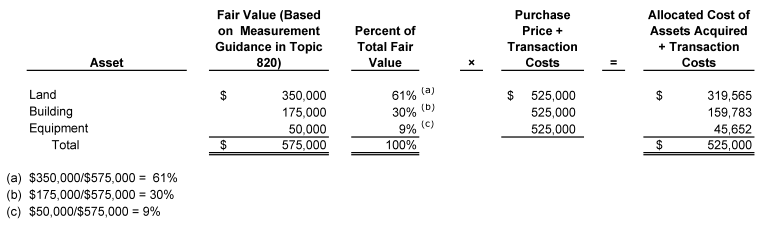
This Example illustrates the application of the relative fair value method when assets are acquired in a group outside a business combination as discussed in paragraph 805-50-30-3.
  • On January 1, 20X9, Entity A purchased land, building, and equipment for $500,000 in cash. Transaction costs of $25,000 were incurred.
  • To allocate the cost, the fair value of the individual assets is determined based on the guidance in Topic 820.
  • Asset Fair Value (Based on Measurement Guidance in Topic 820) Percent of Total Fair Value × Purchase Price + Transaction Costs = Allocated Cost of Assets Acquired + Transaction Costs Land " $350,000 " 61% (a) " $525,000 " " $319,565 " Building " 175,000 " 30% (b) " 525,000 " " 159,783 " Equipment " 50,000 " 9% (c) " 525,000 " " 45,652 " Total " $575,000 " 100% " $525,000 " (a) "$350,000/$575,000 = 61%" (b) "$175,000/$575,000 = 30%" (c) "$50,000/$575,000 = 9%"

805-50-65Transition and Open Effective Date Information

Source downloaded: .Record version 9d3350c544cd. Effective date must be checked in the source.

805-50-65-1
Paragraph superseded on 06/26/2015 after the end of the transition period stated in Accounting Standards Update No. 2014-17, Business Combinations (Topic 805): Pushdown Accounting.

805-50-S00StatusSEC

Source downloaded: .Record version 4ac3aacc5da7. Effective date must be checked in the source.

805-50-S25RecognitionSEC

Source downloaded: .Record version 1941b3c7e640. Effective date must be checked in the source.

New Basis of Accounting (Pushdown)

805-50-S30Initial MeasurementSEC

Source downloaded: .Record version 3df072b74d71. Effective date must be checked in the source.

Transactions between Entities under Common Control

Measurement of Certain Transfers Between Entities Under Common Control in the Separate Financial Statements of Each Entity

805-50-S30-3
See paragraph 805-50-S99-4, SEC Observer Comment: Measurement of Certain Transfers Between Entities Under Common Control in the Separate Financial Statements of Each Entity for SEC Staff views on carrying over historical cost to record, in the separate financial statements of each entity, certain transfers between companies under common control or between a parent and its subsidiary.

805-50-S50DisclosureSEC

Source downloaded: .Record version 407b8bad80bb. Effective date must be checked in the source.

805-50-S55Implementation Guidance and IllustrationsSEC

Source downloaded: .Record version de6a86612f20. Effective date must be checked in the source.

805-50-S99SEC MaterialsSEC

Source downloaded: .Record version 300f5b86d66d. Effective date must be checked in the source.

Transactions between Entities under Common Control

SEC Staff Guidance

805-50-S99-4
The following is the text of the SEC Observer Comment: Measurement of Certain Transfers Between Entities Under Common Control in the Separate Financial Statements of Each Entity.
  • The SEC staff's views on carrying over historical cost to record, in the separate financial statements of each entity, transfers between companies under common control or between a parent and its subsidiary are focused on transfers of net assets (as in a business combination) or long-lived assets. Those views would not normally apply to recurring transactions for which valuation is not in question (such as routine transfers of inventory) in the separate financial statements of each entity that is a party to the transaction.

Related subtopics