ASC 845-10
Overall
845 Nonmonetary Transactions
Source downloaded: .Record version 4b026bf6b6cd. Effective date must be checked in the source.
ASC 845-10 governs nonmonetary transactions — reciprocal exchanges of nonmonetary assets and nonreciprocal transfers of nonmonetary assets to owners or others. The default rule is that such transactions are measured at the fair value of the asset surrendered (or received, if more clearly evident) with gain or loss recognized (845-10-30-1), subject to three exceptions requiring carryover (recorded amount) accounting: fair value not determinable within reasonable limits, an exchange of product held for sale to facilitate sales to customers, or a transaction lacking commercial substance (845-10-30-3). Special subsections address purchases and sales of inventory with the same counterparty, barter credits, and exchanges involving boot.
Key points (7)
- Default measurement: a nonmonetary asset acquired in exchange is recorded at the fair value of the asset surrendered (or the fair value of the asset received if more clearly evident), and gain or loss is recognized (845-10-30-1); nonreciprocal transfers to stockholders or others are also recorded at fair value with gain or loss (845-10-30-1).
- Carryover (recorded amount) measurement is required if fair value of neither asset is determinable within reasonable limits, the exchange is of product held for sale in the same line of business to facilitate sales to customers other than the parties, or the transaction lacks commercial substance (845-10-30-3).
- An exchange has commercial substance if the entity's future cash flows are expected to significantly change, tested by a significant difference in the configuration (risk, timing, amount) of cash flows or in entity-specific values relative to the fair values exchanged (845-10-30-4); tax cash flows arising solely from a financial-reporting-driven business purpose are ignored (845-10-30-5).
- Boot of at least 25 percent of the fair value of the exchange makes the transaction monetary in its entirety and outside the Subtopic, both parties recording at fair value; if boot is less than 25 percent, the receiver of boot recognizes a pro rata gain and the payer of boot recognizes none (845-10-25-6; 845-10-30-6; 845-10-30-21), but an entire indicated loss is always recognized (845-10-30-6).
- Inventory purchase and sales transactions with the same counterparty are combined as a single exchange if legally contingent or entered into in contemplation of one another, judged by indicators such as legal right of offset, simultaneity, off-market terms, and certainty of the reciprocal transaction (845-10-15-6; 845-10-25-4); combined exchanges of finished goods for raw materials or work-in-process may be at fair value if determinable and the transaction has commercial substance (845-10-30-15), while all other same-line-of-business inventory swaps are at carrying amount (845-10-30-16).
- Spinoffs and other distributions of nonmonetary assets to owners in reorganizations, liquidations, or rescissions of a prior business combination are recorded at the recorded amount with no gain or loss (845-10-30-10; 845-10-55-1); non-pro-rata split-offs of a segment in a plan of reorganization are recorded at fair value (845-10-30-12), and a distribution of a nonbusiness subsidiary is a dividend-in-kind measured at fair value (845-10-25-3; 845-10-30-14).
- Disclose the nature of nonmonetary transactions, the basis of accounting for assets transferred, and gains or losses recognized (845-10-50-1), plus revenue and costs (or gains and losses) from inventory exchanges recognized at fair value (845-10-50-3); scope excludes business combinations, common-control transfers, share-based payment, stock dividends/splits, financial asset transfers, involuntary conversions, and noncash consideration in Topic 606 or Subtopic 610-20 transactions (845-10-15-4).
For students. Exam questions almost always turn on two switches: does the exchange have commercial substance (fair value plus full gain/loss) or not (carryover basis), and how much boot is involved (25% or more makes it fully monetary; less than 25% gives the boot receiver only a pro rata gain). A common misunderstanding is thinking losses can also be deferred — an entire indicated loss is recognized immediately regardless of commercial substance or boot.
Machine-generated study aid for ASC 845-10. Check the source paragraphs below.
845-10-00Status
Source downloaded: .Record version 68ed5df8238a. Effective date must be checked in the source.
845-10-05Overview and Background
Source downloaded: .Record version 5c8f74cf0722. Effective date must be checked in the source.
- aGeneral
- bPurchases and sales of inventory with the same counterparty
- cBarter transactions
- dExchanges involving monetary considerations
- e
- aAn exchange with another entity (reciprocal transfer) that involves principally nonmonetary assets or liabilities
- bA transfer of nonmonetary assets for which no assets are received or relinquished in exchange (nonreciprocal transfer).
- aNonreciprocal transfers with owners
- bNonreciprocal transfers with other than owners
- cNonmonetary exchanges.
Nonreciprocal Transfers with Owners
- aMarketable equity securities as dividends
- bMarketable equity securities, to redeem or acquire outstanding capital stock of the entity
- cCapital stock of subsidiaries, in corporate liquidations or plans of reorganization that involve disposing of all or a significant segment of the entity (the plans are variously referred to as spinoffs, split-ups, and split-offs)
- dNonmonetary assets pursuant to plans of rescission or other settlements relating to a prior business combination, to redeem or acquire shares of capital stock previously issued in a business combination.
Nonreciprocal Transfers with Other than Owners
Nonmonetary Exchanges
- aExchange of product held for sale in the ordinary course of business (inventory) for other property as a means of selling the product to a customer
- bExchange of product held for sale in the ordinary course of business (inventory) for similar product as an accommodation - that is, at least one party to the exchange reduces transportation costs, meets immediate inventory needs, or otherwise reduces costs or facilitates ultimate sale of the product—and not as a means of selling the product to a customer
- cExchange of productive assets—assets employed in production rather than held for sale in the ordinary course of business - for other productive assets or for an equivalent interest in other productive assets. For example:
- 1Trade of player contracts by professional sports organizations
- 2Exchange of leases on mineral properties
- 3Exchange of one form of interest in an oil-producing property for another form of interest
- 4Exchange of real estate for real estate.
- 1
Other Considerations
Purchases and Sales of Inventory with the Same Counterparty
Barter Transactions
Exchanges Involving Monetary Consideration
- a
- b
- c
Exchanges of a Nonfinancial Asset for a Noncontrolling Ownership Interest
845-10-15Scope and Scope Exceptions
Source downloaded: .Record version 6a61a55d0934. Effective date must be checked in the source.
Overall Guidance
Entities
Transactions
- aNonmonetary exchanges involving boot. Some exchanges of nonmonetary assets involve a small monetary consideration, referred to as boot, even though the exchange is essentially nonmonetary.(See the Exchanges Involving Monetary Consideration Subsection of Section 845-10-15 for situations outside the scope of this Subtopic.)
- aA business combination accounted for by an entity according to the provisions of Topic 805or a combination accounted for by a not-for-profit entity according to the provisions of Subtopic 958-805
- bA transfer of nonmonetary assets solely between entities or persons under common control, such as between a parent and its subsidiaries or between two subsidiaries of the same parent, or between a joint venture or a corporate joint ventureand its owners(see Subtopic 805-60 for accounting for transfers of nonmonetary assets upon formation of a joint venture)
- cAcquisition of goods or services or consideration payable to customers involving issuance of the capital stock of an entity under Subtopic 718-10
- dStock issued or received in stock dividends and stock splits that are accounted for in accordance with Subtopic 505-20
- e
- fA pooling of assets in a joint undertaking intended to find, develop, or produce oil or gas from a particular property or group of properties, as described in paragraph 932-360-40-7
- gThe exchange of a part of an operating interest owned for a part of an operating interest owned by another party that is subject to paragraph 932-360-55-6
- hThe transfer of a financial asset within the scope of Section 860-10-15
- iInvoluntary conversions specified in paragraph 610-30-15-2
- j
- kThe transfer of a nonfinancial asset within the scope of Subtopic 610-20 in exchange for noncash consideration (see paragraphs , which require measurement consistent with paragraphs ).
- aA business combination accounted for by an entity according to the provisions of Topic 805or a combination accounted for by a not-for-profit entity according to the provisions of Subtopic 958-805
- bA transfer of nonmonetary assets solely between entities or persons under common control, such as between a parent and its subsidiaries or between two subsidiaries of the same parent, or between a joint venture or a corporate joint ventureand its owners(see Subtopic 805-60 for accounting for transfers of nonmonetary assets upon formation of a joint venture)
- cAcquisition of goods or services or consideration payable to customers involving issuance of the capital stock of an entity under Subtopic 718-10
- dStock issued or received in stock dividends and stock splits that are accounted for in accordance with Subtopic 505-20
- e
- fA pooling of assets in a joint undertaking intended to find, develop, or produce oil or gas from a particular property or group of properties, as described in paragraph 932-360-40-7
- gThe exchange of a part of an operating interest owned for a part of an operating interest owned by another party that is subject to paragraph 932-360-55-6
- hThe transfer of a financial asset within the scope of Section 860-10-15
- iInvoluntary conversions specified in paragraph 610-30-15-2
- j
- kThe transfer of a nonfinancial asset within the scope of Subtopic 610-20 in exchange for noncash consideration (see paragraphs , which require measurement consistent with paragraphs )
- lA government grant within the scope of Topic 832.
Purchases and Sales of Inventory with the Same Counterparty
Overall Guidance
Transactions
- aTwo or more inventory purchase and sales transactions with the same counterparty that are entered into in contemplation of one another and are combined
- bSituations in which one inventory transaction is legally contingent upon the performance of another inventory transaction with the same counterparty. In these situations the two transactions are deemed to have been entered into in contemplation of one another and would be considered a single exchange transaction subject to the scope of the Purchases and Sales of Inventory with the Same Counterparty Subsections.
- a
Barter Transactions
Overall Guidance
Transactions
- aTransactions in which nonmonetary assets are exchanged for barter credits.
Exchanges Involving Monetary Consideration
Overall Guidance
Transactions
- a
- b
Exchanges of a Nonfinancial Asset for a Noncontrolling Ownership Interest
845-10-25Recognition
Source downloaded: .Record version ee73bea317e6. Effective date must be checked in the source.
Basic Principle
Spinoffs or Other Distributions of Loans Receivable to Shareholders
Purchases and Sales of Inventory with the Same Counterparty
- a There is a specific legal right of offset of obligations between counterparties involved in inventory purchase and sales transactions. The ability to offset the payable(s) and receivable(s) related to the separately documented inventory purchase and sales transactions indicates that there is a link between them and, therefore, it is an indicator that the separately documented inventory transactions were entered into in contemplation of one another. This indicator is more relevant to settlement provisions relating to inventory purchase and sales transactions that are specifically identified (specified legal right of offset) by both counterparties than to inventory transactions that are netted as part of a master netting agreement that encompasses all transactions (inventory and noninventory) between the two counterparties.
- b Inventory purchase and sales transactions with the same counterparty are entered into simultaneously. If an inventory purchase transaction is simultaneously entered into with an inventory sales transaction with the same counterparty that is an indication that the transactions were entered into in contemplation of one another.
- c Inventory purchase and sales transactions were entered into at terms that were off-market when the arrangement was agreed to between counterparties. If an entity enters into an off-market inventory transaction with a counterparty, that is an indication that the transaction is linked to, and entered into, in contemplation of another inventory transaction with that same counterparty. This indicator may be more relevant for transactions with products that have readily determinable market prices, such as exchange-traded commodities, than for transactions with products that are subject to greater discretionary pricing.
- d Relative certainty that reciprocal inventory transactions with the same counterparty will occur. An entity may sell inventory to a counterparty and enter into another arrangement with that same counterparty whereby that counterparty may, but is not contractually required to, deliver an agreed-upon inventory amount. If that counterparty chooses to deliver its product to the entity, the entity is obligated to purchase that product. The more certain it is that both inventory transactions will occur, the stronger the indication that the two inventory transactions were entered into in contemplation of one another.
Exchanges Involving Monetary Consideration
845-10-30Initial Measurement
Source downloaded: .Record version e2d722105bc6. Effective date must be checked in the source.
Basic Principle
Modifications of the Basic Principle
- a The fair value of neither the asset(s) received nor the asset(s) relinquished is determinable within reasonable limits.
- b The transaction is an exchange of a product or property held for sale in the ordinary course of business for a product or property to be sold in the same line of business to facilitate sales to customers other than the parties to the exchange.
- c The transaction lacks commercial substance (see the following paragraph).
Commercial Substance
- a The configuration (risk, timing, and amount) of the future cash flows of the asset(s) received differs significantly from the configuration of the future cash flows of the asset(s) transferred. The configuration of future cash flows is composed of the risk, timing, and amount of the cash flows. A change in any one of those elements would be a change in configuration.
- b The entity-specific value of the asset(s) received differs from the entity-specific value of the asset(s) transferred, and the difference is significant in relation to the fair values of the assets exchanged. An entity-specific value (referred to as an entity-specific measurement in FASB Concepts Statement No. 7, Using Cash Flow Information and Present Value in Accounting Measurements) is different from a fair value measurement. As described in paragraph 24(b) of Concepts Statement No. 7, an entity-specific value attempts to capture the value of an asset or liability in the context of a particular entity. For example, an entity computing an entity-specific value of an asset would use its expectations about its use of that asset rather than the use assumed by marketplace participants. If it is determined that the transaction has commercial substance, the exchange would be measured at fair value, rather than at the entity-specific value.
- a The configuration (risk, timing, and amount) of the future cash flows of the asset(s) received differs significantly from the configuration of the future cash flows of the asset(s) transferred. The configuration of future cash flows is composed of the risk, timing, and amount of the cash flows. A change in any one of those elements would be a change in configuration.
- b The entity-specific value of the asset(s) received differs from the entity-specific value of the asset(s) transferred, and the difference is significant in relation to the fair values of the assets exchanged. An entity-specific value is different from a fair value measurement. An entity-specific value attempts to capture the value of an asset or liability in the context of a particular entity. For example, an entity computing an entity-specific value of an asset would use its expectations about its use of that asset rather than the use assumed by marketplace participants. If it is determined that the transaction has commercial substance, the exchange would be measured at fair value, rather than at the entity-specific value.
Applying the Basic Principle
Nonreciprocal Transfers with Owners
Purchases and Sales of Inventory with the Same Counterparty
- aFair value is determinable within reasonable limits.
- bThe transaction has commercial substance (see paragraph 845-10-30-4).
- aThe transfer of raw materials or work-in-process inventory in exchange for the receipt of raw materials, work-in-process, or finished goods inventory
- bThe transfer of finished goods inventory for the receipt of finished goods inventory.
Barter Credit Transactions
- aThe fair value of any remaining barter credits is less than the carrying amount.
- bIt is probable that the entity will not use all of the remaining barter credits.
Exchanges Involving Monetary Consideration
Overall Guidance
Exchanges of a Nonfinancial Asset for a Noncontrolling Ownership Interest
845-10-45Other Presentation Matters
Source downloaded: .Record version 2cfb38cd6726. Effective date must be checked in the source.
Purchases and Sales of Inventory with the Same Counterparty
845-10-50Disclosure
Source downloaded: .Record version 1626358220e9. Effective date must be checked in the source.
- aThe nature of the transactions
- bThe basis of accounting for the assets transferred
- cGains or losses recognized on transfers.
- aThe nature of the transactions
- bThe basis of accounting for the assets transferred
- cGains or losses recognized on transfers.
Purchase and Sales of Inventory
845-10-55Implementation Guidance and Illustrations
Source downloaded: .Record version 3a4d49448675. Effective date must be checked in the source.
Implementation Guidance
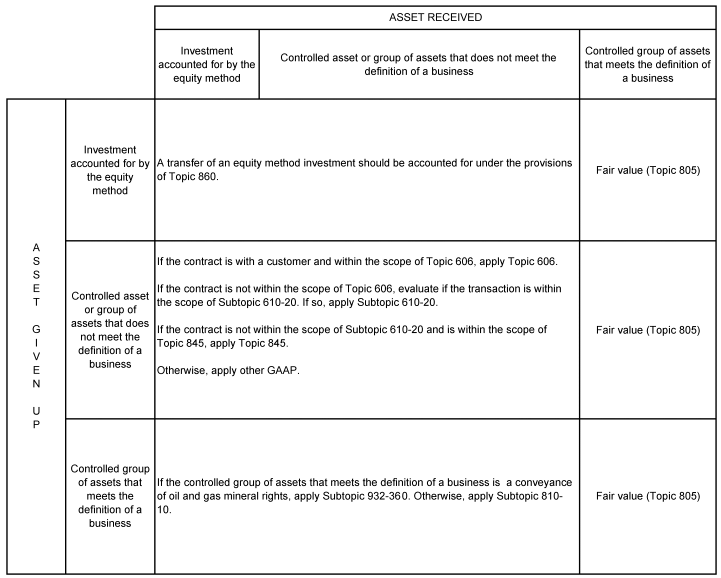 ASSET RECEIVED Investment accounted for by the equity method Controlled asset or group of assets that does not meet the definition of a business Controlled group of assets that meets the definition of a business ASSET GIVEN UP Investment accounted for by the equity method A transfer of an equity method investment should be accounted for under the provisions of Topic 860. Fair value (Topic 805) Controlled asset or group of assets that does not meet the definition of a business "If the contract is with a customer and within the scope of Topic 606, apply Topic 606. If the contract is not within the scope of Topic 606, evaluate if the transaction is within the scope of Subtopic 610-20. If so, apply Subtopic 610-20. If the contract is not within the scope of Subtopic 610-20 and is within the scope of Topic 845, apply Topic 845. Otherwise, apply other GAAP. " Fair value (Topic 805) Controlled group of assets that meets the definition of a business "If the controlled group of assets that meets the definition of a business is a conveyance of oil and gas mineral rights, apply Subtopic 932-360. Otherwise, apply Subtopic 810-10." Fair value (Topic 805)
Illustrations
- aAccounting for a transfer of a pension benefit obligation only (Case A)
- bAccounting for a transfer of a plan assets and a pension benefit obligation (Case B).
-
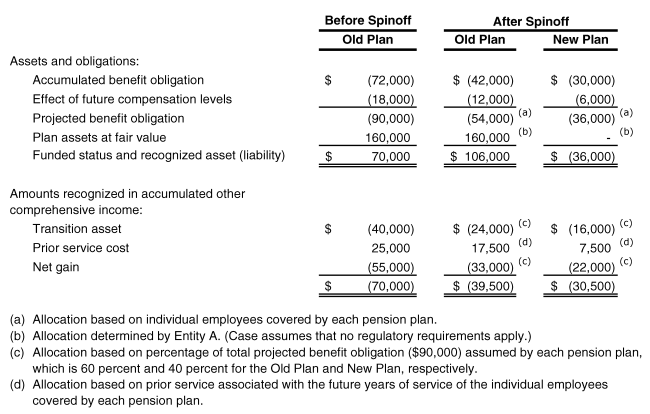 Before Spinoff After Spinoff Old Plan Old Plan New Plan Assets and obligations: Accumulated benefit obligation " $(72,000)" " $(42,000)" " $(30,000)" Effect of future compensation levels " (18,000)" " (12,000)" " (6,000)" Projected benefit obligation " (90,000)" " (54,000)" (a) " (36,000)" (a) Plan assets at fair value " 160,000 " " 160,000 " (b) - (b) Funded status and recognized asset (liability) " $70,000 " " $106,000 " " $(36,000)" Amounts recognized in accumulated other comprehensive income: Transition asset " $(40,000)" " $(24,000)" (c) " $(16,000)" (c) Prior service cost " 25,000 " " 17,500 " (d) " 7,500 " (d) Net gain " (55,000)" " (33,000)" (c) " (22,000)" (c) " $(70,000)" " $(39,500)" " $(30,500)" (a) Allocation based on individual employees covered by each pension plan. (b) Allocation determined by Entity A. (Case assumes that no regulatory requirements apply.) (c) "Allocation based on percentage of total projected benefit obligation ($90,000) assumed by each pension plan, which is 60 percent and 40 percent for the Old Plan and New Plan, respectively." (d) "Allocation based on prior service associated with the future years of service of the individual employees covered by each pension plan. "
- Entity A
-
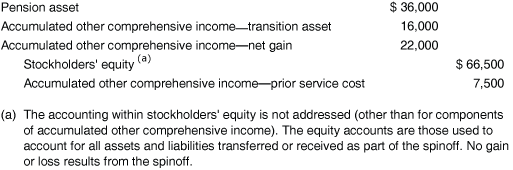 Pension asset " $36,000 " Accumulated other comprehensive income—transition asset " 16,000 " Accumulated other comprehensive income—net gain " 22,000 " Stockholders' equity (a) " $66,500 " Accumulated other comprehensive income—prior service cost " 7,500 " (a) The accounting within stockholders' equity is not addressed (other than for components of accumulated other comprehensive income). The equity accounts are those used to account for all assets and liabilities transferred or received as part of the spinoff. No gain or loss results from the spinoff.
- To record the transfer of a pension benefit obligation and net deferred amounts from Entity A to Entity B
-
- Entity B
-
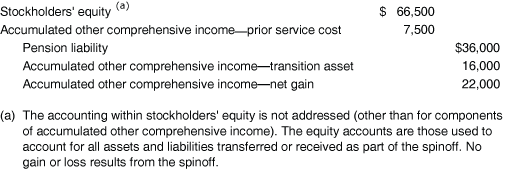 Stockholders' equity (a) " $66,500 " Accumulated other comprehensive income—prior service cost " 7,500 " Pension liability " $36,000 " Accumulated other comprehensive income—transition asset " 16,000 " Accumulated other comprehensive income—net gain " 22,000 " (a) The accounting within stockholders' equity is not addressed (other than for components of accumulated other comprehensive income). The equity accounts are those used to account for all assets and liabilities transferred or received as part of the spinoff. No gain or loss results from the spinoff.
- To record the receipt of a pension benefit obligation and net deferred amounts from Entity A (Entity B should not recognize the effects of assuming the pension benefit obligation as the cost of either a pension plan amendment or an initiation of a pension plan that is subject to amortization.)
-
-
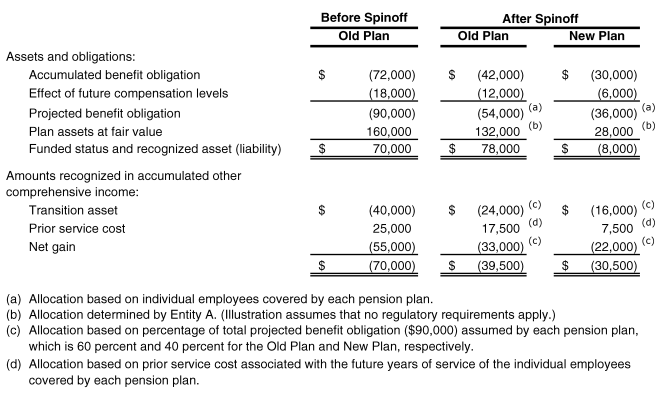 Before Spinoff After Spinoff Old Plan Old Plan New Plan Assets and obligations: Accumulated benefit obligation " $(72,000)" " $(42,000)" " $(30,000)" Effect of future compensation levels " (18,000)" " (12,000)" " (6,000)" Projected benefit obligation " (90,000)" " (54,000)" (a) " (36,000)" (a) Plan assets at fair value " 160,000 " " 132,000 " (b) " 28,000 " (b) Funded status and recognized asset (liability) " $70,000 " " $78,000 " " $(8,000)" Amounts recognized in accumulated other comprehensive income: Transition asset " $(40,000)" " $(24,000)" (c) " $(16,000)" (c) Prior service cost " 25,000 " " 17,500 " (d) " 7,500 " (d) Net gain " (55,000)" " (33,000)" (c) " (22,000)" (c) " $(70,000)" " $(39,500)" " $(30,500)" (a) Allocation based on individual employees covered by each pension plan. (b) Allocation determined by Entity A. (Illustration assumes that no regulatory requirements apply.) (c) "Allocation based on percentage of total projected benefit obligation ($90,000) assumed by each pension plan, which is 60 percent and 40 percent for the Old Plan and New Plan, respectively." (d) Allocation based on prior service cost associated with the future years of service of the individual employees covered by each pension plan.
- Entity A
-
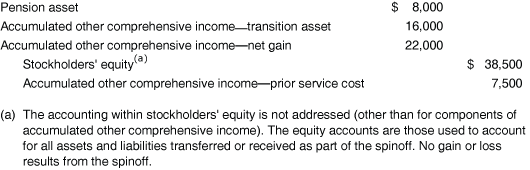 Pension asset " $8,000 " Accumulated other comprehensive income—transition asset " 16,000 " Accumulated other comprehensive income—net gain " 22,000 " Stockholders' equity(a) " $38,500 " Accumulated other comprehensive income—prior service cost " 7,500 " (a) The accounting within stockholders' equity is not addressed (other than for components of accumulated other comprehensive income). The equity accounts are those used to account for all assets and liabilities transferred or received as part of the spinoff. No gain or loss results from the spinoff.
- To record the transfer of plan assets, a pension benefit obligation, and net deferred amounts from Entity A to Entity B
-
- Entity B
-
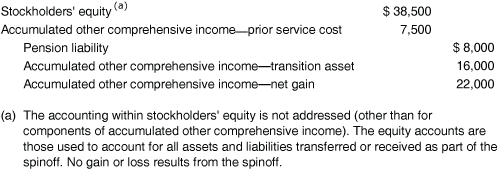 Stockholders' equity (a) " $38,500 " Accumulated other comprehensive income—prior service cost " 7,500 " Pension liability " $8,000 " Accumulated other comprehensive income—transition asset " 16,000 " Accumulated other comprehensive income—net gain " 22,000 " (a) The accounting within stockholders' equity is not addressed (other than for components of accumulated other comprehensive income). The equity accounts are those used to account for all assets and liabilities transferred or received as part of the spinoff. No gain or loss results from the spinoff.
- To record the receipt of plan assets, a pension benefit obligation, and net deferred amounts from Entity A (Entity B should not recognize the effects of assuming the pension benefit obligation as the cost of either a pension plan amendment or an initiation of a pension plan that is subject to amortization or the receipt of cash as a gain subject to amortization.)
-
Purchases and Sales of Inventory with the Same Counterparty
- aWhether the described transaction shall be viewed as a single exchange transaction as discussed in paragraphs
- bWhether the nonmonetary exchange of inventory within the same line of business shall be recognized at fair value as discussed in paragraphs .
-
 Entity Demand/Location Supply/Location Entity A West Texas intermediate crude oil/Texas Heavy crude oil/California Entity B Heavy crude oil/California Sweet crude oil/Oklahoma Entity C Sweet crude oil/Oklahoma West Texas intermediate crude oil/Texas
- aWhether the described transaction shall be viewed as a single exchange transaction as discussed in paragraphs
- bWhether the nonmonetary exchange of inventory within the same line of business shall be recognized at fair value as discussed in paragraphs .
- aWhether the described transaction shall be viewed as a single exchange transaction as discussed in paragraphs
- bWhether the nonmonetary exchange of inventory within the same line of business shall be recognized at fair value as discussed in paragraphs .
Exchanges Involving Monetary Consideration
845-10-60Relationships
Source downloaded: .Record version 196c088b2a92. Effective date must be checked in the source.
Other Expenses
Barter Transactions
Revenue Recognition
Exchanges Involving Monetary Consideration
845-10-S00StatusSEC
Source downloaded: .Record version 7588a2c169d9. Effective date must be checked in the source.
| Paragraph | Action | Accounting Standards Update | Date |
| 845-10-S99-1 | Amended | Accounting Standards Update No. 2012-03 | 08/27/2012 |
845-10-S30Initial MeasurementSEC
Source downloaded: .Record version 47138b704352. Effective date must be checked in the source.
Exchanges of a Nonfinancial Asset for a Noncontrolling Ownership Interest
Transfers of Nonmonetary Assets by Promoters or Shareholders
845-10-S99SEC MaterialsSEC
Source downloaded: .Record version 7854218d6bb2. Effective date must be checked in the source.
SEC Staff Guidance
- Facts: Nonmonetary assets are exchanged by promoters or shareholders for all or part of a company's common stock just prior to or contemporaneously with a first-time public offering.
- Question: Since FASB ASC paragraph 845-10-15-4 (Nonmonetary Transactions Topic) states that the guidance in this Topic is not applicable to transactions involving the acquisition of nonmonetary assets or services on issuance of the capital stock of an enterprise, what value should be ascribed to the acquired assets by the company?
- Interpretive Response: The staff believes that transfers of nonmonetary assets to a company by its promoters or shareholders in exchange for stock prior to or at the time of the company's initial public offering normally should be recorded at the transferors' historical cost basis determined under GAAP.
- The staff will not always require that predecessor cost be used to value nonmonetary assets received from an enterprise's promoters or shareholders. However, deviations from this policy have been rare applying generally to situations where the fair value of either the stock issued FN1 or assets acquired is objectively measurable and the transferor's stock ownership following the transaction was not so significant that the transferor had retained a substantial indirect interest in the assets as a result of stock ownership in the company.
- FN1 Estimating the fair value of the common stock issued, however, is not appropriate when the stock is closely held and/or seldom or ever traded.
- The SEC staff will object to a conclusion that did not result in the application of Topic 805 to transactions in which businesses are contributed to a newly formed, jointly controlled entity if that entity is not a joint venture. The SEC staff also would object to a conclusion that joint control is the only defining characteristic of a joint venture.
- The SEC staff will require registrants to account for the exchange of consolidated businesses, even if in the same line of business, as a fair value transaction under the guidance of Topic 805. The SEC staff believes that Topic governs the acquisition of a consolidated business when acquired for nonmonetary assets, including equity method investments.