ASC

ASC 860-50

Servicing Assets and Liabilities

860 Transfers and Servicing

Source downloaded: .Record version 466ab55182ae. Effective date must be checked in the source.

ASC 860-50 governs when a servicer must separately recognize a servicing asset or servicing liability and how to measure it. A servicing contract is recognized separately each time an entity undertakes an obligation to service financial assets through a qualifying sale of an entire financial asset, group of entire financial assets, or participating interest, or through an acquisition/assumption of servicing for others' assets (860-50-25-1); it is initially measured at fair value (860-50-30-1) whether or not explicit consideration is exchanged. Subsequently, each class of servicing assets and liabilities is measured using either the amortization method (with impairment tested by stratum via a valuation allowance) or the irrevocable fair value measurement method (860-50-35-1).

Key points (7)
  • Recognition is required each time an entity undertakes a servicing obligation via a transfer of an entire financial asset, group of entire financial assets, or participating interest that qualifies for sale accounting, or via acquisition/assumption of servicing for assets not its own (860-50-25-1); no servicing asset or liability is recognized when the transfer is accounted for as a secured borrowing (860-50-25-2).
  • Servicing assets and liabilities are initially measured at fair value regardless of whether explicit consideration was exchanged; a servicing liability arises when benefits of servicing are not expected to be adequate compensation, and the initial measure may be zero when benefits just equal adequate compensation (860-50-30-1 through 30-2).
  • Adequate compensation is determined by what the marketplace demands, not by the servicer's own cost of servicing or the contractual replacement-servicer fee (860-50-30-3 through 30-4).
  • Rights to future interest income exceeding contractually specified servicing fees are not servicing assets but interest-only strips accounted for under 860-20-35-2; the test is whether the servicer would still receive the cash flows if a substitute servicer took over (860-50-25-6 through 25-7), while ancillary cash flows like late fees contingent on satisfactory servicing go into the servicing asset (860-50-25-8).
  • Subsequent measurement is elected by class—amortization in proportion to and over estimated net servicing income/loss with impairment testing, or fair value through earnings; the fair value election is irrevocable and may be made at the beginning of any fiscal year with a cumulative-effect adjustment to retained earnings (860-50-35-1, 35-3).
  • Under the amortization method, servicing assets are stratified within a class by predominant risk characteristics of the underlying financial assets and impairment is recognized through a valuation allowance per stratum, with no recognition of fair value in excess of carrying amount (860-50-35-9); increased servicing liabilities are recognized as a loss but not reduced below the amortized initial measurement (860-50-35-11).
  • Fair-value-measured servicing must be presented separately on the face of the statement of financial position from amortization-method servicing, either as separate line items or parenthetically (860-50-45-1 through 45-2); a transfer of servicing rights qualifies as a sale only if title has passed, substantially all risks and rewards have irrevocably passed, and retained protection provisions are minor (no more than 10 percent of sales price and prepayment risk retained no longer than 120 days) (860-50-40-3 through 40-4).

For students. Mortgage servicing rights are a classic exam and practice trap: students often assume the servicer's own cost of servicing determines whether an asset or liability exists, but the test is marketplace "adequate compensation," and excess interest that a substitute servicer would not receive is a servicing asset while excess interest that continues regardless of who services is an interest-only strip. Also remember the class-by-class election between amortization and fair value is irrevocable in the fair value direction only.

Machine-generated study aid for ASC 860-50. Check the source paragraphs below.

860-50-00Status

Source downloaded: .Record version b02da5a836cc. Effective date must be checked in the source.

860-50-00-1
The following table identifies the changes made to this Subtopic.
ParagraphActionAccounting Standards UpdateDate
Beneficial InterestsAmendedAccounting Standards Update No. 2009-1612/23/2009
Consolidated AffiliateSupersededAccounting Standards Update No. 2009-1612/23/2009
Consolidated Affiliate of the TransferorAmendedAccounting Standards Update No. 2009-1612/23/2009
Contractually Specified Servicing FeesAmendedAccounting Standards Update No. 2009-1612/23/2009
Financial Asset (2nd def.)AmendedAccounting Standards Update No. 2016-1912/14/2016
Financial AssetAddedAccounting Standards Update No. 2009-1612/23/2009
Guaranteed Mortgage SecuritizationSupersededAccounting Standards Update No. 2009-1612/23/2009
TransfereeAmendedAccounting Standards Update No. 2009-1612/23/2009
TransferorAmendedAccounting Standards Update No. 2009-1612/23/2009
860-50-05-3AmendedAccounting Standards Update No. 2009-1612/23/2009
860-50-05-4AmendedAccounting Standards Update No. 2009-1612/23/2009
860-50-15-3AmendedAccounting Standards Update No. 2016-1912/14/2016
860-50-25-1AmendedAccounting Standards Update No. 2009-1612/23/2009
860-50-25-2AmendedAccounting Standards Update No. 2009-1612/23/2009
860-50-25-4AmendedAccounting Standards Update No. 2009-1612/23/2009
860-50-25-7AmendedAccounting Standards Update No. 2009-1612/23/2009
860-50-25-9AmendedAccounting Standards Update No. 2009-1612/23/2009
860-50-25-10AmendedAccounting Standards Update No. 2009-1612/23/2009
860-50-30-1AmendedAccounting Standards Update No. 2009-1612/23/2009
860-50-30-5SupersededAccounting Standards Update No. 2009-1612/23/2009
860-50-30-6AmendedAccounting Standards Update No. 2009-1612/23/2009
860-50-30-7AmendedAccounting Standards Update No. 2009-1612/23/2009
860-50-30-8SupersededAccounting Standards Update No. 2009-1612/23/2009
860-50-30-9SupersededAccounting Standards Update No. 2009-1612/23/2009
860-50-35-8AmendedAccounting Standards Update No. 2009-1612/23/2009
860-50-35-15SupersededAccounting Standards Update No. 2009-1612/23/2009
860-50-35-16SupersededAccounting Standards Update No. 2009-1612/23/2009
860-50-40-6AmendedAccounting Standards Update No. 2016-1912/14/2016
860-50-50-1AmendedMaintenance Update No. 2025-05 (PDF)06/20/2025
AmendedAccounting Standards Update No. 2009-1612/23/2009
AmendedAccounting Standards Update No. 2025-1112/08/2025
860-50-50-2AmendedAccounting Standards Update No. 2014-0905/28/2014
860-50-50-3AmendedMaintenance Update 2020-18 (PDF)11/25/2020
860-50-50-4AmendedMaintenance Update 2018-02 (PDF)02/02/2018
860-50-50-5AmendedMaintenance Update 2014-20 (PDF)09/29/2014
860-50-50-6 through 50-9SupersededAccounting Standards Update No. 2009-1612/23/2009
860-50-55-1SupersededAccounting Standards Update No. 2009-1612/23/2009
860-50-55-2SupersededAccounting Standards Update No. 2009-1612/23/2009
AmendedAccounting Standards Update No. 2009-1612/23/2009
860-50-55-9SupersededAccounting Standards Update No. 2009-1612/23/2009
860-50-55-10AmendedAccounting Standards Update No. 2009-1612/23/2009
860-50-55-11AmendedAccounting Standards Update No. 2009-1612/23/2009
860-50-55-12 through 55-19SupersededAccounting Standards Update No. 2009-1612/23/2009
AmendedAccounting Standards Update No. 2009-1612/23/2009
860-50-55-23SupersededAccounting Standards Update No. 2009-1612/23/2009
860-50-55-24SupersededAccounting Standards Update No. 2009-1612/23/2009
860-50-55-26AmendedAccounting Standards Update No. 2009-1612/23/2009
860-50-55-27SupersededAccounting Standards Update No. 2009-1612/23/2009

860-50-05Overview and Background

Source downloaded: .Record version 171e5f8d67c7. Effective date must be checked in the source.

860-50-05-1
This Subtopic provides accounting guidance for servicing assets and servicing liabilities.
860-50-05-2
Servicing is inherent in all financial assets; it becomes a distinct asset or liability for accounting purposes only in the circumstances described in paragraph 860-50-25-1.
860-50-05-3
Servicing of mortgage loans, credit card receivables, or other financial assets commonly includes, but is not limited to, the following activities:
  1. a
    Collecting principal, interest, and escrow payments from borrowers
  2. b
    Paying taxes and insurance from escrowed funds
  3. c
    Monitoring delinquencies
  4. d
    Executing foreclosure if necessary
  5. e
    Temporarily investing funds pending distribution
  6. f
    Remitting fees to guarantors, trustees, and others providing services
  7. g
    Accounting for and remitting principal and interest payments to the holders of beneficial interests or participating interests in the financial assets.
860-50-05-4
A servicer of financial assets commonly receives the following benefits of servicing:
  1. a
  2. b
    A portion of the interest from the financial assets
  3. c
    Late charges
  4. d
    Other ancillary sources, including float.
A servicer is entitled to receive all of those benefits of servicing only if it performs the servicing and incurs the costs of servicing the financial assets.

860-50-15Scope and Scope Exceptions

Source downloaded: .Record version a7de36e5b0c8. Effective date must be checked in the source.

Overall Guidance

860-50-15-1
This Subtopic has its own discrete scope, which is separate and distinct from the pervasive scope for this Topic as outlined in Section 860-10-15.

Entities

860-50-15-2
The guidance in this Subtopic applies to all entities.

Transactions

860-50-15-3
The guidance in this Subtopic applies to transactions in which servicing assets are obtained and servicing liabilities are incurred, including transactions in which loans are transferred with servicing retained by the transferor. The guidance in this Subtopic also applies to transactions in which servicing assets are transferred with loans retained by the transferor.

860-50-25Recognition

Source downloaded: .Record version d779cb4178b0. Effective date must be checked in the source.

860-50-25-1
An entity shall recognize a servicing asset or servicing liability each time it undertakes an obligation to service a financial asset by entering into a servicing contract in any of the following situations:
  1. a
    A servicer's transfer of any of the following, if that transfer meets the requirements for sale accounting:
    1. 1
      An entire financial asset
    2. 2
      A group of entire financial assets
    3. 3
      A participating interest in an entire financial asset, in which circumstance the transferor shall recognize a servicing asset or a servicing liability only related to the participating interest sold.
  2. b
  3. c
    An acquisition or assumption of a servicing obligation that does not relate to financial assets of the servicer or its consolidated affiliates included in the financial statements being presented.
Example 1 (see paragraph 860-50-55-20) illustrates accounting for a sale of receivables with servicing obtained by the transferor.
860-50-25-2
A servicer that transfers or securitizes financial assets in a transaction that does not meet the requirements for sale accounting and is accounted for as a secured borrowing with the underlying financial assets remaining on the transferor's balance sheet shall not recognize a servicing asset or a servicing liability.
860-50-25-3
A servicer that recognizes a servicing asset or servicing liability shall account for the contract to service financial assets separately from those financial assets.
860-50-25-4
An entity that transfers its financial assets to an unconsolidated entity in a transfer that qualifies as a sale in which the transferor obtains the resulting securities and classifies them as debt securities held to maturity in accordance with Topic 320 may either separately recognize its servicing assets or servicing liabilities or report those servicing assets or servicing liabilities together with the asset being serviced.
860-50-25-5
The guidance in this Section is organized as follows:
  1. a
    Distinguishing servicing from an interest-only strip
  2. b
  3. c
    Regaining control of previously transferred assets.

Distinguishing Servicing from an Interest-Only Strip

860-50-25-6
A servicer shall account separately for rights to future interest income from the serviced assets that exceed contractually specified servicing fees. Those rights are not servicing assets; they are financial assets, effectively interest-only strips to be accounted for in accordance with paragraph 860-20-35-2.
860-50-25-7
Whether a right to future interest income from serviced assets should be accounted for as an interest-only strip, a servicing asset, or a combination thereof, depends on whether a servicer would continue to receive that amount (that is, the value of the right to future interest income) if a substitute servicer began servicing the assets. Therefore, any portion of the right to future interest income from the serviced assets that would continue to be received even if the servicing were shifted to another servicer would be reported separately as a financial asset in accordance with paragraph 860-20-35-2. For guidance on why an interest-only strip precludes a portion of a financial asset from meeting the definition of a participating interest, see paragraph 860-10-55-17K.
860-50-25-8
The value of the right to receive future cash flows from ancillary sources such as late fees shall be included in the measurement of the servicing asset, not the interest-only strip, if retention of the right to receive the cash flows from those fees depends on servicing being performed satisfactorily, as is generally the case.

Revolving-Period Securitizations

860-50-25-9
Recognition of servicing assets or servicing liabilities for revolving-period receivables shall be limited to the servicing for the receivables that exist and have been sold. As new receivables are sold, rights to service them may become assets or liabilities that are recognized. Therefore, additional transfers under revolving-period securitizations (for example, home equity loans or credit card receivables) may result in the recognition of additional servicing assets or servicing liabilities.

Regaining Control of Financial Assets Sold

860-50-25-10
Paragraph 860-20-25-10(b) explains that, after a paragraph 860-10-40-41 change, the transferor shall not change, the accounting for the servicing asset related to the previously sold financial assets and provides related guidance.

860-50-30Initial Measurement

Source downloaded: .Record version c61935c797cf. Effective date must be checked in the source.

860-50-30-1
An entity shall initially measure at fair value, a servicing asset or servicing liability that qualifies for separate recognition regardless of whether explicit consideration was exchanged.
860-50-30-2
Typically, the benefits of servicing are expected to be more than adequate compensation to a servicer for performing the servicing, and the contract results in a servicing asset. However, if the benefits of servicing are not expected to adequately compensate a servicer for performing the servicing, the contract results in a servicing liability. Paragraph 860-50-35-1A states that a servicing asset may become a servicing liability, or vice versa, if circumstances change. The initial measure for servicing may be zero if the benefits of servicing are just adequate to compensate the servicer for its servicing responsibilities. A servicing contract that entitles the servicer to receive benefits of servicing just equal to adequate compensation, regardless of the servicer's own servicing costs, does not result in recognizing a servicing asset or a servicing liability. A purchaser would neither pay nor receive payment to obtain the right to service for a rate just equal to adequate compensation.
860-50-30-3
The determination of whether the servicer is adequately compensated for servicing specified assets is based on the amount demanded by the marketplace, not the contractual amount to be paid to a replacement servicer. However, that contractual provision would be relevant for determining the amount of contractually specified servicing fees. Therefore, the amount that would be paid to a replacement servicer under the terms of the servicing contract can be more or less than adequate compensation.
860-50-30-4
Whether a servicing asset or servicing liability is recorded is a function of the marketplace, not the servicer's cost of servicing. For example, a loss shall not be recognized if a servicing fee that is equal to or greater than adequate compensation is to be received but the servicer's anticipated cost of servicing would exceed the fee.
860-50-30-6
When valuing the right to receive future cash flows from ancillary sources such as late fees, an entity shall estimate the value of the right to benefit from the cash flows of potential future transactions, not the value of the expected cash flows to be derived from future transactions.
860-50-30-7
Entities shall consider the nature of the assets being serviced as a factor in determining the fair value of a servicing asset or servicing liability. The types of assets being serviced affect the amount required to adequately compensate the servicer. Several variables, including the nature of the underlying assets, shall be considered in determining whether a servicer is adequately compensated. For example, the amount of effort required to service a home equity loan likely would be different from the amount of effort required to service a credit card receivable or a small business administration loan.

860-50-35Subsequent Measurement

Source downloaded: .Record version cc0e3b0a0ffd. Effective date must be checked in the source.

860-50-35-1
An entity shall subsequently measure each class of servicing assets and servicing liabilities using either of the following methods:
  1. a
    Amortization method. Amortize servicing assets or servicing liabilities in proportion to and over the period of estimated net servicing income (if servicing revenues exceed servicing costs) or net servicing loss (if servicing costs exceed servicing revenues), and assess servicing assets or servicing liabilities for impairment or increased obligation based on fair value at each reporting date.
  2. b
    Fair value measurement method. Measure servicing assets or servicing liabilities at fair value at each reporting date and report changes in fair value of servicing assets and servicing liabilities in earnings in the period in which the changes occur.
860-50-35-1A
A servicing asset may become a servicing liability, or vice versa, if circumstances change.
860-50-35-2
The election described in paragraphs shall be made separately for each class of servicing assets and servicing liabilities.
860-50-35-3
The following guidance applies to the election of a method for subsequent measurement of servicing assets and servicing liabilities:
  1. a
    Once an entity elects the fair value measurement method for a class of servicing assets and servicing liabilities, that election shall not be reversed.
  2. b
    Different elections can be made for different classes of servicing assets and servicing liabilities.
  3. c
    Once a servicing asset or a servicing liability is reported in a class of servicing assets and servicing liabilities that an entity elects to subsequently measure at fair value, that servicing asset or servicing liability shall not be placed in a class of servicing assets and servicing liabilities that is subsequently measured using the amortization method.
  4. d
    An entity may make an irrevocable decision to subsequently measure a class of servicing assets and servicing liabilities at fair value at the beginning of any fiscal year.
  5. e
    Transferring servicing assets and servicing liabilities from a class subsequently measured using the amortization method to a class subsequently measured at fair value is permitted as of the beginning of any fiscal year. If an entity makes such a transfer, subsequent measurement of servicing assets and servicing liabilities at fair value shall be applied prospectively with a cumulative-effect adjustment to retained earnings as of the beginning of the fiscal year to reflect the difference between the fair value and the carrying amount, net of any related valuation allowance, of the servicing assets and servicing liabilities that exist at the beginning of the fiscal year in which the entity makes the fair value election.
  6. f
    If an entity recognizes a new class of servicing assets and servicing liabilities, and no servicing assets and servicing liabilities that would belong to this class had previously been recognized by the entity, the entity may elect to subsequently measure that new class of servicing assets and servicing liabilities at fair value at the date of initial recognition of those servicing assets and servicing liabilities.
860-50-35-4
An entity shall apply the same subsequent measurement method to each servicing asset and servicing liability in a class.
860-50-35-5
Classes of servicing assets and servicing liabilities shall be identified based on any of the following:
  1. a
    The availability of market inputs used in determining the fair value of servicing assets or servicing liabilities
  2. b
    An entity's method for managing the risks of its servicing assets or servicing liabilities.
860-50-35-6
Under the approach in the preceding paragraph, a servicer may or may not consider the major asset type of the underlying financial asset being serviced when identifying its classes of separately recognized servicing assets and servicing liabilities. Further, this approach for defining classes of servicing assets and servicing liabilities is not analogous to the stratification guidance for determining impairment of servicing assets or servicing liabilities that are subsequently measured using the amortization method.
860-50-35-7
An entity shall first identify its classes of separately recognized servicing assets and servicing liabilities under the approach in paragraph 860-50-35-5. For any class subsequently measured using the amortization method, an entity shall then stratify that class to determine if impairment has occurred, as discussed in paragraph 860-50-35-9(a).
860-50-35-8
The remainder of this Section discusses the following matters:
  1. a
    Amortization method—measurement of impairment or increased obligation
  2. b
  3. c
    Obligation to service refinanced financial assets.

Amortization Method—Measurement of Impairment or Increased Obligation

860-50-35-9
An entity shall evaluate and measure impairment of each class of separately recognized servicing assets that are subsequently measured using the amortization method described in paragraph 860-50-35-1(a) as follows:
  1. a
    Stratify servicing assets within a class based on one or more of the predominant risk characteristics of the underlying financial assets. Those characteristics may include financial asset type, size, interest rate, date of origination, term, and geographic location. For mortgage loans, financial asset type refers to the various conventional or government guaranteed or insured mortgage loans and adjustable-rate or fixed-rate mortgage loans.
  2. b
    Recognize impairment through a valuation allowance for an individual stratum. The amount of impairment recognized separately shall be the amount by which the carrying amount of servicing assets for a stratum exceeds their fair value. The fair value of servicing assets that have not been recognized shall not be used in the evaluation of impairment.
  3. c
    Adjust the valuation allowance to reflect changes in the measurement of impairment after the initial measurement of impairment. Fair value in excess of the carrying amount of servicing assets for that stratum, however, shall not be recognized.
860-50-35-10
This Subtopic does not address when an entity should record a direct write-down of recognized servicing assets.
860-50-35-11
For servicing liabilities subsequently measured using the amortization method, if subsequent events have increased the fair value of the liability above the carrying amount, for example, because of significant changes in the amount or timing of actual or expected future cash flows relative to the cash flows previously projected, the servicer shall revise its earlier estimates and recognize the increased obligation as a loss in earnings. That is, if subsequent events increase the fair value of a stratum of servicing liabilities within a class that an entity has elected to subsequently measure using the amortization method, that increase shall be recognized in earnings as a loss. Similar to the accounting for changes in a valuation allowance for an impaired asset, increases in the servicing obligation may be recovered, but the obligation shall not be reduced below the amortized measurement of the initially recognized servicing liability.
860-50-35-12
The impairment provisions of paragraphs 860-50-35-9 and 860-50-35-11 for classes of servicing assets and servicing liabilities subsequently measured using the amortization method are based on the fair value of the contract rather than the gain or loss from subsequently carrying out the terms of the contract.
860-50-35-13
An entity is not required to use either the most predominant risk characteristic or more than one predominant risk characteristic to stratify the servicing assets for purposes of evaluating and measuring impairment. An entity must exercise judgment when determining how to stratify servicing assets (that is, when selecting the most appropriate characteristic[s] for stratification). An entity may use different stratification criteria for the purposes of impairment testing under this Subtopic and for the purposes of grouping similar assets to be designated as a hedged portfolio in a fair value hedge under Subtopic 815-20. If an entity chooses not to restratify servicing assets for impairment testing under this Subtopic consistent with any restratification done for compliance with hedging criteria under Subtopic 815-20, the entity shall record any adjustments resulting from a fair value hedge to the risk strata used for impairment testing under paragraph 860-50-35-9.
860-50-35-14
Once an entity has determined the predominant risk characteristics to be used in identifying the resulting stratums within each class of servicing assets subsequently measured using the amortization method, that decision shall be applied consistently unless significant changes in economic facts and circumstances clearly indicate that the predominant risk characteristics and resulting stratums should be changed. If a significant change in economic facts and circumstances occurs, that change shall be accounted for prospectively as a change in accounting estimate in accordance with paragraphs and 250-10-50-4.

Obligation to Service Refinanced Mortgage Loans

860-50-35-17
When an entity that is servicing mortgage loans refinances a mortgage loan that is being serviced (resulting in prepayment of the old mortgage loan and origination of a new mortgage loan), the entity shall not consider the estimated future net servicing income (that is, servicing revenue in excess of servicing costs) from the new mortgage loan in determining how to amortize any capitalized cost related to acquiring the mortgage servicing asset for the old mortgage loan. The mortgage servicing asset represents a contractual relationship between the servicer and the investor in the mortgage loan, not between the servicer and the borrower.
860-50-35-18
The cost of a mortgage servicing asset that is subsequently measured using the amortization method may require adjustment as a result of the refinancing transaction depending on the servicer's assumptions in recording the servicing asset. If the refinancing transaction represents prepayment activity anticipated by the servicer when the servicing asset was recorded, an adjustment would not be necessary. However, if actual prepayments differ from anticipated prepayments, an adjustment to the servicing asset would be required. If the servicing assets or liabilities are subsequently measured using the fair value measurement method, the entity shall recognize any adjustment as a result of the refinancing transaction directly in earnings.

860-50-40Derecognition

Source downloaded: .Record version b78db759fdca. Effective date must be checked in the source.

860-50-40-1
This Section is organized as follows:
  1. a
    Overall
  2. b
    Transfers with a subservicing contract
  3. c
    Transfers involving participation in an income stream.

Overall

860-50-40-2
The following criteria shall be considered when evaluating whether a transfer of servicing rights qualifies as a sale:
  1. a
    Whether the transferor has received written approval from the investor if required.
  2. b
    Whether the transferee is a currently approved transferor-servicer and is not at risk of losing approved status.
  3. c
    If the transferor finances a portion of the sales price, whether an adequate nonrefundable down payment has been received (necessary to demonstrate the transferee's commitment to pay the remaining sales price) and whether the note receivable from the transferee provides full recourse to the transferee. Nonrecourse notes or notes with limited recourse (such as to the servicing) do not satisfy this criterion.
  4. d
    Temporary servicing performed by the transferor for a short period of time shall be compensated in accordance with a subservicing contract that provides adequate compensation.
860-50-40-3
Also, the following additional criteria shall be considered when evaluating whether a transfer of servicing rights qualifies as a sale:
  1. a
    Title has passed.
  2. b
    Substantially all risks and rewards of ownership have irrevocably passed to the buyer.
  3. c
    Any protection provisions retained by the seller are minor and can be reasonably estimated.
860-50-40-4
If a sale is recognized and minor protection provisions exist, a liability shall be accrued for the estimated obligation associated with those provisions. The seller retains only minor protection provisions if both of the following conditions are met:
  1. a
    The obligation associated with those provisions is estimated to be no more than 10 percent of the sales price.
  2. b
    Risk of prepayment is retained for no longer than 120 days.
860-50-40-5
A temporary subservicing contract in which the subservicing will be performed by the transferor for a short period of time would not necessarily preclude recognizing a sale at the closing date.
860-50-40-6
The criteria in paragraphs apply to transfers of servicing rights relating to loans previously sold and to transfers of servicing rights relating to loans that are retained by the transferor. The carrying amount of servicing rights sold relating to loans that have been retained shall be allocated at the date of sale between the servicing rights and the loans retained using relative fair values.

Sales of Servicing Rights with a Subservicing Contract

860-50-40-7
A sale of mortgage servicing rights with a subservicing contract shall be treated as a sale with gain deferred if substantially all the risks and rewards inherent in owning the mortgage servicing rights have been effectively transferred to the transferee, as discussed in paragraph 860-50-40-3. Attributes of the transferee (for example, ability to perform servicing) would not be significant to the accounting for the transaction. The risks and rewards associated with a transferor performing purely administrative functions under a subservicing contract would not necessarily preclude sales treatment. A loss shall be recognized currently if the transferor determines that prepayments of the underlying mortgage loans may result in performing the future servicing at a loss.
860-50-40-8
Substantially all the risks and rewards inherent in owning the mortgage servicing rights have not been transferred to the transferee and, therefore, the transaction shall be accounted for as a financing if any of the following factors are present:
  1. a
    The transferor-subservicer directly or indirectly guarantees a yield to the transferee. For example, the transferor-subservicer guarantees prepayment speeds or maximum loan default ratios to the buyer.
  2. b
    The transferor-subservicer is obligated to advance a portion or all of the servicing fees on a nonrecoverable basis to the transferee before receipt of the loan payment from the mortgagor.
  3. c
    The transferor-subservicer indemnifies the transferee for damages due to causes other than failure to perform its duties under the terms of the subservicing contract.
  4. d
    The transferor-subservicer absorbs losses on mortgage loan foreclosures not covered by the Federal Housing Administration, Department of Veterans Affairs, or other guarantors, if any, including absorption of foreclosure costs and costs of managing foreclosed property.
  5. e
    Title to the servicing rights is retained by the transferor-subservicer.
860-50-40-9
The presence of any of the following factors creates a rebuttable presumption that substantially all the risks and rewards inherent in owning the mortgage servicing rights have not been transferred to the transferee and that the transaction shall be accounted for as a financing:
  1. a
    The transferor-subservicer directly or indirectly provides financing or guarantees the transferee's financing. Nonrecourse financing, for example, would indicate that risks have not been transferred to the transferee. Topic 450 requires a guarantor to recognize, at inception of the guarantee, a liability for the obligation undertaken in issuing the guarantee.
  2. b
    The terms of the subservicing contract unduly limit the transferee's ability to exercise ownership control over the servicing rights or result in the seller's retaining some of the risks and rewards of ownership. For example, if the transferee cannot cancel or decline to renew the subservicing contract after a reasonable period of time, the transferee is precluded from exercising certain rights of ownership. Conversely, if the transferor cannot cancel the subservicing contract after a reasonable period of time, the transferor has not transferred substantially all of the risks of ownership.
  3. c
    The transferee is a special-purpose entity without substantive capital at risk.

Sales of Servicing Rights for Participation in an Income Stream

860-50-40-10
The following addresses a situation in which an entity sells the right to service mortgage loans that are owned by other parties. The related mortgage loans have been previously sold, with servicing retained, in a separate transaction. Because of the ability to invest the float that results from payments received from borrowers but not yet passed to the owners of the mortgages, the mortgage servicing rights can be sold for immediate cash or for a participation in the future interest stream of the loans.
860-50-40-11
If a transfer of mortgage servicing rights qualifies as a sale under the criteria beginning in paragraph 860-50-40-2 and the sale is for a participation in the future interest income stream, gain recognition is appropriate at the sale date. There are difficulties in measuring the amount of the gain if the sales price is based on a participation in future payments and there is no specified upper limit on the computed sales price. The transferor of mortgage servicing rights shall consider all available information, including the amount of gain that would be recognized if the servicing rights were to be sold outright for a fixed cash price.

860-50-45Other Presentation Matters

Source downloaded: .Record version 3f9dab319fac. Effective date must be checked in the source.

860-50-45-1
An entity shall report recognized servicing assets and servicing liabilities that are subsequently measured using the fair value measurement method in a manner that separates those carrying amounts on the face of the statement of financial position from the carrying amounts for separately recognized servicing assets and servicing liabilities that are subsequently measured using the amortization method.
860-50-45-2
To accomplish that separate reporting, an entity may do either of the following:
  1. a
    Display separate line items for the amounts that are subsequently measured using the fair value measurement method and amounts that are subsequently measured using the amortization method
  2. b
    Present the aggregate of those amounts that are subsequently measured at fair value and those amounts that are subsequently measured using the amortization method (see paragraphs ) and disclose parenthetically the amount that is subsequently measured at fair value that is included in the aggregate amount.

860-50-50Disclosure

Source downloaded: .Record version 500c5b265736. Effective date must be checked in the source.

All Entities within the Scope of Subtopic

860-50-50-1
This Section is organized as follows:
  1. a
  2. b
    Servicing assets and servicing liabilities subsequently measured at fair value
  3. c
    Servicing assets and servicing liabilities subsequently amortized
  4. d
    Servicing assets and servicing liabilities for which subsequent measurement at fair value is elected as of the beginning of the fiscal year.
For overall guidance on Topic 860's disclosures, see Section 860-10-50.
860-50-50-2
For all servicing assets and servicing liabilities, all of the following shall be disclosed:
  1. a
    Management's basis for determining its classes of servicing assets and servicing liabilities.
  2. b
    A description of the risks inherent in servicing assets and servicing liabilities and, if applicable, the instruments used to mitigate the income statement effect of changes in fair value of the servicing assets and servicing liabilities.
  3. c
    The amount of contractually specified servicing fees, late fees, and ancillary fees recognized for each period for which results of operations are presented, including a description of where each amount is reported in the statement of income.
  4. d
    Quantitative and qualitative information about the assumptions used to estimate fair value (for example, discount rates, anticipated credit losses, and prepayment speeds).
Disclosure of quantitative information about the instruments used to manage the risks inherent in servicing assets and servicing liabilities, including the fair value of those instruments at the beginning and end of the period, is encouraged but not required. An entity that provides such quantitative information is also encouraged, but not required, to disclose quantitative and qualitative information about the assumptions used to estimate the fair value of those instruments. Section 235-10-50 provides guidance on disclosures of accounting policies.
Transition date:(P) December 16, 2027; (N) December 16, 2028Transition guidance:
270-10-65-1For all servicing assets and servicing liabilities, all of the following shall be disclosed in interim and annual reporting periods:
  1. a
    Management's basis for determining its classes of servicing assets and servicing liabilities.
  2. b
    A description of the risks inherent in servicing assets and servicing liabilities and, if applicable, the instruments used to mitigate the income statement effect of changes in fair value of the servicing assets and servicing liabilities.
  3. c
    The amount of contractually specified servicing fees, late fees, and ancillary fees recognized for each period for which results of operations are presented, including a description of where each amount is reported in the statement of income.
  4. d
    Quantitative and qualitative information about the assumptions used to estimate fair value (for example, discount rates, anticipated credit losses, and prepayment speeds).
Disclosure of quantitative information about the instruments used to manage the risks inherent in servicing assets and servicing liabilities, including the fair value of those instruments at the beginning and end of the period, is encouraged but not required. An entity that provides such quantitative information is also encouraged, but not required, to disclose quantitative and qualitative information about the assumptions used to estimate the fair value of those instruments. Section 235-10-50 provides guidance on disclosures of accounting policies.
860-50-50-3
For servicing assets and servicing liabilities subsequently measured at fair value, the following shall be disclosed:
  1. a
    For each class of servicing assets and servicing liabilities, the activity in the balance of servicing assets and the activity in the balance of servicing liabilities (including a description of where changes in fair value are reported in the statement of income for each period for which results of operations are presented), including, but not limited to, the following:
    1. 1
      The beginning and ending balances
    2. 2
      Additions through any of the following:
      1. i
        Purchases of servicing assets
      2. ii
        Assumptions of servicing obligations
      3. iii
        Recognition of servicing obligations that result from transfers of financial assets.
    3. 3
      Disposals
    4. 4
      Changes in fair value during the period resulting from either of the following:
      1. i
        Changes in valuation inputs or assumptions used in the valuation model
      2. ii
        Other changes in fair value and a description of those changes.
    5. 5
      Other changes that affect the balance and a description of those changes.
  2. b
Transition date:(P) December 16, 2027; (N) December 16, 2028Transition guidance:
270-10-65-1For servicing assets and servicing liabilities subsequently measured at fair value, the following shall be disclosed in interim and annual reporting periods:
  1. a
    For each class of servicing assets and servicing liabilities, the activity in the balance of servicing assets and the activity in the balance of servicing liabilities (including a description of where changes in fair value are reported in the statement of income for each period for which results of operations are presented), including, but not limited to, the following:
    1. 1
      The beginning and ending balances
    2. 2
      Additions through any of the following:
      1. i
        Purchases of servicing assets
      2. ii
        Assumptions of servicing obligations
      3. iii
        Recognition of servicing obligations that result from transfers of financial assets.
    3. 3
      Disposals
    4. 4
      Changes in fair value during the period resulting from either of the following:
      1. i
        Changes in valuation inputs or assumptions used in the valuation model
      2. ii
        Other changes in fair value and a description of those changes.
    5. 5
      Other changes that affect the balance and a description of those changes.
  2. b
860-50-50-4
For servicing assets and servicing liabilities measured subsequently under the amortization method in paragraph 860-50-35-1(a), all of the following shall be disclosed:
  1. a
    For each class of servicing assets and servicing liabilities, the activity in the balance of servicing assets and the activity in the balance of servicing liabilities (including a description of where changes in the carrying amount are reported in the statement of income for each period for which results of operations are presented), including, but not limited to, the following:
    1. 1
      The beginning and ending balances
    2. 2
      Additions through any of the following:
      1. i
        Purchases of servicing assets
      2. ii
        Assumptions of servicing obligations
      3. iii
        Recognition of servicing obligations that result from transfers of financial assets.
    3. 3
      Disposals
    4. 4
      Amortization
    5. 5
      Application of valuation allowance to adjust carrying value of servicing assets
    6. 6
      Other-than-temporary impairments
    7. 7
      Other changes that affect the balance and a description of those changes.
  2. b
    For each class of servicing assets and servicing liabilities, the fair value of recognized servicing assets and servicing liabilities at the beginning and end of the period.
  3. c
  4. d
    The risk characteristics of the underlying financial assets used to stratify recognized servicing assets for purposes of measuring impairment in accordance with paragraph 860-50-35-9. If the predominant risk characteristics and resulting stratums are changed, that fact and the reasons for those changes shall be included in the disclosures about the risk characteristics of the underlying financial assets used to stratify the recognized servicing assets in accordance with this paragraph.
  5. e
    For each period for which results of operations are presented, the activity by class in any valuation allowance for impairment of recognized servicing assets, including all of the following:
    1. 1
      Beginning and ending balances
    2. 2
      Aggregate additions charged and recoveries credited to operations
    3. 3
      Aggregate write-downs charged against the allowance.
Transition date:(P) December 16, 2027; (N) December 16, 2028Transition guidance:
270-10-65-1For servicing assets and servicing liabilities measured subsequently under the amortization method in paragraph 860-50-35-1(a), all of the following shall be disclosed in interim and annual reporting periods:
  1. a
    For each class of servicing assets and servicing liabilities, the activity in the balance of servicing assets and the activity in the balance of servicing liabilities (including a description of where changes in the carrying amount are reported in the statement of income for each period for which results of operations are presented), including, but not limited to, the following:
    1. 1
      The beginning and ending balances
    2. 2
      Additions through any of the following:
      1. i
        Purchases of servicing assets
      2. ii
        Assumptions of servicing obligations
      3. iii
        Recognition of servicing obligations that result from transfers of financial assets.
    3. 3
      Disposals
    4. 4
      Amortization
    5. 5
      Application of valuation allowance to adjust carrying value of servicing assets
    6. 6
      Other-than-temporary impairments
    7. 7
      Other changes that affect the balance and a description of those changes.
  2. b
    For each class of servicing assets and servicing liabilities, the fair value of recognized servicing assets and servicing liabilities at the beginning and end of the period.
  3. c
  4. d
    The risk characteristics of the underlying financial assets used to stratify recognized servicing assets for purposes of measuring impairment in accordance with paragraph 860-50-35-9. If the predominant risk characteristics and resulting stratums are changed, that fact and the reasons for those changes shall be included in the disclosures about the risk characteristics of the underlying financial assets used to stratify the recognized servicing assets in accordance with this paragraph.
  5. e
    For each period for which results of operations are presented, the activity by class in any valuation allowance for impairment of recognized servicing assets, including all of the following:
    1. 1
      Beginning and ending balances
    2. 2
      Aggregate additions charged and recoveries credited to operations
    3. 3
      Aggregate write-downs charged against the allowance.
860-50-50-5
If an entity elects under paragraph 860-50-35-3(d) to subsequently measure a class of servicing assets and servicing liabilities at fair value at the beginning of the fiscal year, the amount of the cumulative-effect adjustment to retained earnings shall be separately disclosed.
Transition date:(P) December 16, 2027; (N) December 16, 2028Transition guidance:
270-10-65-1If an entity elects under paragraph 860-50-35-3(d) to subsequently measure a class of servicing assets and servicing liabilities at fair value at the beginning of the fiscal year, the amount of the cumulative-effect adjustment to retained earnings shall be separately disclosed in the interim or annual reporting period in which the adjustment is recorded.

860-50-55Implementation Guidance and Illustrations

Source downloaded: .Record version e3768fd5791d. Effective date must be checked in the source.

Implementation Guidance

860-50-55-3
The following guidance addresses the accounting for servicing assets and servicing liabilities in certain transactions, specifically:
  1. a
    Recognition of servicing upon sale of a participating interest
  2. b
    Servicer not entitled to receive a contractually specified servicing fee
  3. c
    Servicing assets assumed without cash payment
  4. d
    Subservicing contracts.
860-50-55-4
If the entity that transfers a portion of a loan under a participation agreement that meets the definition of a participating interest and qualifies for sale accounting under Subtopic 860-10 obtains the right to receive benefits of servicing that more than adequately compensate it for servicing the loan, and the entity would continue to service the loan regardless of the transfer because it retains part of the participated loan, the entity shall record a servicing asset for the portion of the loan it sold. The assumption that the entity would service the loan because it retains part of the participated loan does not affect the requirement to recognize a servicing asset. Conversely, an entity could not avoid recording a servicing liability if the benefits of servicing are not expected to adequately compensate the servicer for performing the servicing. However, if the benefits of servicing are significantly above an amount that would fairly compensate a substitute service provider, should one be required, the transferred portion does not meet the definition of a participating interest, and, therefore, the transfer does not qualify for sale accounting (see paragraph 860-10-40-6A(b)).
860-50-55-5
The following guidance addresses whether an entity should recognize a servicing liability if it transfers all or some of a financial asset that meets the definition of a participating interest that is accounted for as a sale and undertakes an obligation to service the asset but is not entitled to receive a contractually specified servicing fee. In the circumstances described, the transferor-servicer would be required to recognize a servicing liability at fair value if the benefits of servicing are less than adequate compensation. The requirements in paragraph 860-50-25-1 apply even if it is not customary to charge a contractually specified servicing fee. Example 1, Case C (paragraph 860-50-55-25) illustrates a transaction in which a transferor agrees to service loans without explicit compensation.
860-50-55-6
The following guidance addresses transactions in which servicing assets are assumed without cash payment, and the appropriate offsetting entry by the transferee.
860-50-55-7
The offsetting entry depends on whether an exchange or capital transaction has occurred. If an exchange has occurred, then the transaction should be recorded based on the facts and circumstances. For example, the servicing asset may represent consideration for goods or services provided by the transferee to the transferor of the servicing. In that case, the offsetting entry by the transferee would be the same as if cash was received in exchange for the goods and services (that is, revenue or a liability as appropriate).
860-50-55-8
The servicing assets also might be received in full or partial satisfaction of a receivable from the transferor of the servicing. In those cases, the offsetting entry by the transferee would be to derecognize all or part of the receivable satisfied in the exchange. Another possibility is that an investor is in substance making a capital contribution to the investee (the party receiving the servicing asset, that is, the transferee) in exchange for an increased ownership interest. In that case, the investee should recognize an increase in equity from a contribution by owner.
860-50-55-10
A transferor may transfer mortgage loans in their entirety to a third party in a transfer that is accounted for as a sale and undertake an obligation to service the loans. After the transfer, the transferor enters into a subservicing arrangement with a third party.
860-50-55-11
If the transferor's benefits of servicing exceed its obligation under the subservicing contract, that differential shall not be accounted for as an interest-only strip. Rather, the transferor should account for the two transactions separately. First, the transferor should account for the transfer of mortgage loans in accordance with Subtopic 860-20. The obligation to service the loans should be initially recognized and measured at fair value according to paragraph 860-50-30-1 as proceeds obtained from the sale of the mortgage loans. Second, the transferor should account for the subcontract with the subservicer.

Illustrations

860-50-55-20
The following Cases illustrate the guidance in paragraph 860-50-25-1:
  1. a
    Transferor continues to service the loans (Case A).
  2. b
  3. c
    Future benefits of servicing do not provide adequate compensation (Case C).
860-50-55-21
Entity A originates $1,000 of loans that yield 10 percent interest income for their estimated lives of 9 years. Entity A transfers the entire loans to an unconsolidated entity and the transfer is accounted for as a sale.
860-50-55-22
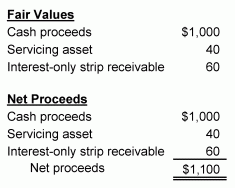
Entity A receives as proceeds $1,000 cash, a beneficial interest to receive 1 percent of the contractual interest on the loans (an interest-only strip receivable), and an additional 1 percent of the contractual interest as compensation for servicing the loans. The fair values of the servicing asset and the interest-only strip receivable are $40 and $60, respectively. This Case illustrates Entity A's (the transferor's) accounting for a sale with the servicing obtained by Entity A (the transferor), as follows.
  • Fair Values Cash proceeds " $1,000 " Servicing asset 40 Interest-only strip receivable 60 Net Proceeds Cash proceeds " $1,000 " Servicing asset 40 Interest-only strip receivable 60 Net proceeds " $1,100 "
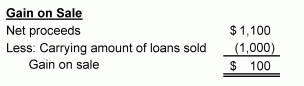
  • Gain on Sale Net proceeds " $1,100" Less: Carrying amount of loans sold " (1,000)" Gain on sale $100
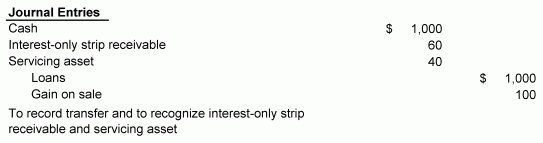
  • Journal Entries Cash " $1,000 " Interest-only strip receivable 60 Servicing asset 40 Loans " $1,000 " Gain on sale 100 To record transfer and to recognize interest-only strip receivable and servicing asset
860-50-55-25
Transferors sometimes agree to take on servicing responsibilities when the future benefits of servicing are not expected to adequately compensate them for performing that servicing. In that circumstance, the result is a servicing liability rather than a servicing asset.
860-50-55-26
For example, if in the transaction illustrated in paragraphs , the transferor (Entity A) had agreed to service the loans without explicit compensation and it estimated the fair value of that servicing obligation at $50, net proceeds would be reduced to $980, gain on sale would become a loss on sale of $20, and the transferor would report a servicing liability of $50.

860-50-60Relationships

Source downloaded: .Record version aa16049bda38. Effective date must be checked in the source.

Derivatives and Hedging

860-50-60-1
For guidance on whether an entity may designate as the hedged item in a fair value hedge a portion of a recognized servicing right asset subsequently measured using the amortization method, see paragraph 815-20-55-65.

Financial Services—Mortgage Banking

860-50-60-2
For guidance on the capitalization of interest costs on certain Government National Mortgage Association (GNMA) securities, and the determination of net future servicing income for this purpose, see paragraph 948-340-30-1.

Related subtopics