ASC 860-10
Overall
860 Transfers and Servicing
Source downloaded: .Record version ac2c2f8125b3. Effective date must be checked in the source.
ASC 860-10 is the Overall subtopic for Transfers and Servicing; it sets the scope for the whole topic and, critically, states the derecognition test for transferred financial assets. Under 860-10-40-5, a transfer of an entire financial asset, group of entire financial assets, or a participating interest is a sale if and only if (a) the assets are legally isolated from the transferor even in bankruptcy, (b) each transferee (or beneficial interest holder) can pledge or exchange what it received without a constraint that gives the transferor more than a trivial benefit, and (c) the transferor does not maintain effective control. If any condition fails, the transfer is accounted for as a secured borrowing under 860-30.
Key points (7)
- Sale accounting requires surrender of control, which exists only if all three conditions in 860-10-40-5 are met—legal isolation, the transferee's unconstrained right to pledge or exchange, and no maintained effective control—and the analysis must first ask whether the transferor would consolidate the transferee (860-10-40-4).
- An entire financial asset generally cannot be split before transfer unless every component is a participating interest, and a transfer may not be accounted for partly as a sale and partly as a secured borrowing (860-10-40-4D); non-participating portions are accounted for under 860-30-25-2 (860-10-40-4E).
- A participating interest requires pro rata ownership from the transfer date, proportionate sharing of all cash flows (excluding fair servicing compensation), equal priority with no subordination or recourse beyond standard reps and warranties, and no unilateral right to pledge or exchange the entire asset (860-10-40-6A).
- Effective control is maintained by, among other things, an agreement that both entitles and obligates the transferor to repurchase the same or substantially the same assets before maturity at a fixed or determinable price (860-10-40-24), a unilateral ability to reclaim specific assets that gives more than a trivial benefit (other than a cleanup call), or a put so favorable that exercise is probable (860-10-40-5(c)).
- A repurchase-to-maturity transaction must be accounted for as a secured borrowing as if the transferor maintained effective control (860-10-40-5A; 860-10-40-24A), and a transfer with a related repurchase financing is accounted for separately from the initial transfer (860-10-40-4C).
- Isolation must hold regardless of how remote bankruptcy is (860-10-40-11) and is typically supported by a true sale opinion and, for affiliated transfers, a nonconsolidation opinion (860-10-55-18A), though a legal opinion may be unnecessary for routine transfers with no continuing involvement (860-10-55-18B).
- The topic applies to all entities (860-10-15-2) but excludes transfers of nonfinancial assets, unrecognized financial assets, custody transfers for safekeeping, contributions, in substance nonfinancial assets, owner investments/distributions, and certain lease transactions (860-10-15-4).
For students. This is the gatekeeper test for whether a securitization, factoring, repo, or loan participation is a sale (off-balance-sheet) or a financing; missing any one of the three conditions in 860-10-40-5 forces secured-borrowing treatment. The most common mistake is assuming a partial transfer qualifies for sale accounting—unless the piece transferred meets every element of the participating interest definition (pro rata, proportionate cash flows, equal priority, no recourse), the whole thing is a borrowing.
Machine-generated study aid for ASC 860-10. Check the source paragraphs below.
860-10-00Status
Source downloaded: .Record version 686fa7d2144a. Effective date must be checked in the source.
860-10-05Overview and Background
Source downloaded: .Record version 6ef43032be09. Effective date must be checked in the source.
- aOverall
- bSales of Financial Assets
- cSecured Borrowings and Collateral
- d
- eServicing Assets and Liabilities.
Transfers of Financial Assets
- a Servicing arrangements
- aa Recourse arrangements
- aaa Guarantee arrangements
- b
- c Agreements to purchase or redeem transferred financial assets
- d Options written or held
- dd Derivative financial instruments that are entered into contemporaneously with, or in contemplation of, the transfer
- ddd Arrangements to provide financial support
- e Pledges of collateral
- f The transferor's beneficial interests in the transferred financial assets.
Types of Transfers
- a
- b Factoring
- c Transfers of receivables with recourse
- d Securities lending transactions
- e
- f
- g Banker's acceptances.
- a
- b
- c
860-10-10Objectives
Source downloaded: .Record version 9bffe57e1833. Effective date must be checked in the source.
860-10-15Scope and Scope Exceptions
Source downloaded: .Record version 621a9cd00620. Effective date must be checked in the source.
Overall Guidance
Entities
Transactions
- aExcept for transfers of servicing assets (see Section 860-50-40) and for the transfers noted in the following paragraph, transfers of nonfinancial assets
- bTransfers of unrecognized financial assets, for example, lease payments to be received under operating leases
- cTransfers of custody of financial assets for safekeeping
- dContributions (for guidance on accounting for contributions, see Subtopic 958-605)
- eTransfers of in substance nonfinancial assets, see Subtopic 610-20
- fInvestments by owners or distributions to owners of a business entity
- gEmployee benefits subject to the provisions of Topic 712
- hLeveraged leases subject to Topic 842
- iMoney-over-money and wrap lease transactions involving nonrecourse debt subject to Topic 842.
860-10-30Initial Measurement
Source downloaded: .Record version 5894b05b1c39. Effective date must be checked in the source.
860-10-35Subsequent Measurement
Source downloaded: .Record version 756310bc4763. Effective date must be checked in the source.
860-10-40Derecognition
Source downloaded: .Record version b423dbec59fe. Effective date must be checked in the source.
- a
- bConditions for a sale of financial assets
- cApplication of the sale criteria to instruments that have the potential to be assets or liabilities
- dCircumstances that result in a transferor regaining control of assets previously sold
- e
Conditions for a Sale of Financial Assets
- a Shall first consider whether the transferee would be consolidated by the transferor (for implementation guidance, see paragraph 860-10-55-17D)
- b Shall consider the transferor's continuing involvement in the transferred financial assets
- c Requires the use of judgment that shall consider all arrangements or agreements made contemporaneously with, or in contemplation of, the transfer, even if they were not entered into at the time of the transfer.
- aIsolation of transferred financial assets. The transferred financial assets have been isolated from the transferor—put presumptively beyond the reach of the transferor and its creditors, even in bankruptcy or other receivership. Transferred financial assets are isolated in bankruptcy or other receivership only if the transferred financial assets would be beyond the reach of the powers of a bankruptcy trustee or other receiver for the transferor or any of its consolidated affiliates included in the financial statements being presented. For multiple step transfers, a bankruptcy-remote entity is not considered a consolidated affiliate for purposes of performing the isolation analysis. Notwithstanding the isolation analysis, each entity involved in the transfer is subject to the applicable guidance on whether it shall be consolidated (see paragraphs and the guidance beginning in paragraph 860-10-55-18). A set-off right is not an impediment to meeting the isolation condition.
- bTransferee's rights to pledge or exchange. This condition is met if both of the following conditions are met:
- 1Each transferee (or, if the transferee is an entity whose sole purpose is to engage in securitization or asset-backed financing activities and that entity is constrained from pledging or exchanging the assets it receives, each third-party holder of its beneficial interests) has the right to pledge or exchange the assets (or beneficial interests) it received.
- 2No condition does both of the following:
- iConstrains the transferee (or third-party holder of its beneficial interests) from taking advantage of its right to pledge or exchange
- iiProvides more than a trivial benefit to the transferor (see paragraphs ).
If the transferor, its consolidated affiliates included in the financial statements being presented, and its agents have no continuing involvement with the transferred financial assets, the condition under paragraph 860-10-40-5(b) is met. - i
- 1
- cEffective control. The transferor, its consolidated affiliates included in the financial statements being presented, or its agents do not maintain effective control over the transferred financial assets or third-party beneficial interests related to those transferred assets (see paragraph 860-10-40-22A). A transferor's effective control over the transferred financial assets includes, but is not limited to, any of the following:
- 1An agreement that both entitles and obligates the transferor to repurchase or redeem the transferred financial assets before their maturity (see paragraphs )
- 2An agreement, other than through a cleanup call (see paragraphs ), that provides the transferor with both of the following:
- iThe unilateral ability to cause the holder to return specific financial assets
- iiA more-than-trivial benefit attributable to that ability.
- i
- 3An agreement that permits the transferee to require the transferor to repurchase the transferred financial assets at a price that is so favorable to the transferee that it is probable that the transferee will require the transferor to repurchase them (see paragraph 860-10-55-42D).
- 1
- a From the date of the transfer, it represents a proportionate (pro rata) ownership interest in an entire financial asset. The percentage of ownership interests held by the transferor in the entire financial asset may vary over time, while the entire financial asset remains outstanding as long as the resulting portions held by the transferor (including any participating interest retained by the transferor, its consolidated affiliates included in the financial statements being presented, or its agents) and the transferee(s) meet the other characteristics of a participating interest. For example, if the transferor's interest in an entire financial asset changes because it subsequently sells another interest in the entire financial asset, the interest held initially and subsequently by the transferor must meet the definition of a participating interest.
- b From the date of the transfer, all cash flows received from the entire financial asset are divided proportionately among the participating interest holders (including any interest retained by the transferor, its consolidated affiliates included in the financial statements being presented, or its agents) in an amount equal to their share of ownership. An allocation of specified cash flows is not an allowed characteristic of a participating interest unless each cash flow is proportionately allocated to the participating interest holders. In determining proportionate cash flows:
- 1 Cash flows allocated as compensation for services performed, if any, shall not be included provided those cash flows meet both of the following conditions:
- i They are not subordinate to the proportionate cash flows of the participating interest.
- ii They are not significantly above an amount that would fairly compensate a substitute service provider, should one be required, which includes the profit that would be demanded in the marketplace.
- i
- 2 Any cash flows received by the transferor as proceeds of the transfer of the participating interest shall be excluded provided that the transfer does not result in the transferor receiving an ownership interest in the financial asset that permits it to receive disproportionate cash flows.
- 1
- c The priority of cash flows has all of the following characteristics:
- 1 The rights of each participating interest holder (including the transferor in its role as a participating interest holder) have the same priority.
- 2 No participating interest holder's interest is subordinated to the interest of another participating interest holder.
- 3 The priority does not change in the event of bankruptcy or other receivership of the transferor, the original debtor, or any other participating interest holder.
- 4 Participating interest holders have no recourse to the transferor (or its consolidated affiliates included in the financial statements being presented or its agents) or to each other, other than any of the following:
- i
- ii Ongoing contractual obligations to service the entire financial asset and administer the transfer contract
- iii Contractual obligations to share in any set-off benefits received by any participating interest holder.
That is, no participating interest holder is entitled to receive cash before any other participating interest holder under its contractual rights as a participating interest holder. For example, if a participating interest holder also is the servicer of the entire financial asset and receives cash in its role as servicer, that arrangement would not violate this requirement.
- 1
- d No party has the right to pledge or exchange the entire financial asset unless all participating interest holders agree to pledge or exchange the entire financial asset.
- a Whether a transfer of financial assets would likely be deemed a true sale at law (see paragraph 860-10-55-18A) or otherwise isolated (see paragraph 860-10-55-18C)
- b Whether the transferor is affiliated with the transferee
- c Other factors pertinent under applicable law.
- aA provision that prohibits selling or pledging a transferred loan receivable. This condition not only constrains the transferee but also provides the transferor with the more-than-trivial benefit of knowing who holds the financial asset (a prerequisite to repurchasing the financial asset) and of being able to block the financial asset from being transferred to a competitor for the loan customer's business.
- bTransferor-imposed contractual constraints that narrowly limit timing or terms, for example, allowing a transferee to pledge only on the day assets are obtained or only on terms agreed to with the transferor.
- cSome rights or obligations to reacquire transferred financial assets or beneficial interests, including all of the following:
- 1A freestanding call option written by a transferee to the transferor. Such an option may benefit the transferor and, if the transferred financial assets are not readily obtainable in the marketplace, is likely to constrain a transferee because the transferee might have to default if the call option was exercised and the transferee had pledged or exchanged the financial assets.
- 1aA call option to repurchase third-party beneficial interests at the price paid plus a stated return if the third-party holders of its beneficial interests are constrained from pledging or exchanging their beneficial interests due to that call option.
- 2A call option written by a transferee to the transferor that is sufficiently deep-in-the-money, if the transferred financial assets are not readily obtainable in the marketplace, because the transferee would be more likely to have to hold the assets to comply with a potential exercise of the call option.
- 3A freestanding forward purchase-sale contract between the transferor and the transferee on transferred financial assets not readily obtainable in the marketplace would benefit the transferor and is likely to constrain a transferee.
- 4
- 1
- a A transferor's right of first refusal on the occurrence of a bona fide offer to the transferee from a third party, because the right in itself does not enable the transferor to compel the transferee to sell the financial asset and the transferee would be in a position to receive the sum offered by exchanging the financial asset, albeit possibly from the transferor rather than the third party
- b A requirement to obtain the transferor's permission to sell or pledge that is not to be unreasonably withheld
- c A prohibition on sale to the transferor's competitor if other potential willing buyers exist
- d A regulatory limitation such as on the number or nature of eligible transferees (as in the circumstance of securities issued under Securities Act Rule 144A or debt placed privately)
- e Illiquidity, for example, the absence of an active market
- f
- g Freestanding rights to reacquire transferred assets that are readily obtainable.
- a The financial assets to be repurchased or redeemed are the same or substantially the same as those transferred. To be substantially the same, the financial asset that was transferred and the financial asset that is to be repurchased or redeemed need to have all of the following characteristics:
- 1 The same primary obligor (except for debt guaranteed by a sovereign government, central bank, government-sponsored enterprise or agency thereof, in which circumstance the guarantor and the terms of the guarantee must be the same)
- 2 Identical form and type so as to provide the same risks and rights
- 3 The same maturity (or in the circumstance of mortgage-backed pass-through and pay-through securities, similar remaining weighted-average maturities that result in approximately the same market yield)
- 4 Identical contractual interest rates
- 5 Similar assets as collateral
- 6 The same aggregate unpaid principal amount or principal amounts within accepted good delivery standards for the type of security involved. Participants in the mortgage-backed securities market have established parameters for what is considered acceptable delivery. These specific standards are defined by the Securities Industry and Financial Markets Association and can be found in Uniform Practices for the Clearance and Settlement of Mortgage-Backed Securities and Other Related Securities, which is published by the Securities Industry and Financial Markets Association.
See paragraph 860-10-55-35 for implementation guidance related to these conditions. - 1
- b
- c The agreement is to repurchase or redeem the financial assets before maturity, at a fixed or determinable price.
- d The agreement is entered into contemporaneously with, or in contemplation of, the transfer.
- aA call option or other right conveys more than a trivial benefit (that is, fails the condition in paragraph 860-10-40-5(c)(2)(ii)) if the price to be paid is fixed, determinable, or otherwise potentially advantageous, unless because that price is so far out of the money or for other reasons it is probable when the option is written that the transferor will not exercise it.
- bA transferor's unilateral ability to cause a securitization entity to return to the transferor or otherwise dispose of specific transferred financial assets, for example, in response to its decision to exit a market or a particular activity, has the characteristic in paragraph 860-10-40-5(c)(2)(i) and, thus, would provide the transferor with effective control over the transferred financial assets if it also has the characteristic in paragraph 860-10-40-5(c)(2)(ii)—that is, if it also provides more than a trivial benefit to the transferor.
- cA call option on readily obtainable assets at fair value may not provide the transferor with more than a trivial benefit.
- a An unconditional removal-of-accounts provision or repurchase agreement that allows the transferor to specify the financial assets that may be removed and that provides a more-than-trivial benefit to the transferor, because such a provision allows the transferor unilaterally to remove specific financial assets
- b A removal-of-accounts provision conditioned on a transferor's decision to exit some portion of its business that provides a more-than-trivial benefit to the transferor, because whether it can be triggered by canceling an affinity relationship, spinning off a business segment, or accepting a third party's bid to purchase a specified (for example, geographic) portion of the transferor's business, such a provision allows the transferor unilaterally to remove specific financial assets.
- a A removal-of-accounts provision for random removal of excess financial assets, if the provision is sufficiently limited so that the transferor cannot remove specific transferred financial assets, for example, by limiting removals to the amount of the transferor's interests and to one removal per month
- b A removal-of-accounts provision for defaulted receivables, because the removal would be allowed only after a third party's action (default) and could not be caused unilaterally by the transferor
- c A removal-of-accounts provision conditioned on a third-party cancellation, or expiration without renewal, of an affinity or private-label arrangement, because the removal would be allowed only after a third party's action (cancellation) or decision not to act (expiration) and could not be caused unilaterally by the transferor
- d A removal-of-accounts provision that does not allow the transferor to unilaterally reclaim specific financial assets from the transferee.For related implementation guidance, see paragraph 860-10-55-41.
Application of the Sale Criteria for Financial Instruments That Have the Potential to Be Assets or Liabilities
Circumstances That Result in a Transferor Regaining Control of Financial Assets Previously Sold
860-10-50Disclosure
Source downloaded: .Record version 6df4aa25e2dc. Effective date must be checked in the source.
- aDisclosure objectives
- bAggregation of certain disclosures
- cInvolvements by others.
- aA transferor's continuing involvement, if any, with transferred financial assets
- bThe nature of any restrictions on assets reported by an entity in its statement of financial position that relate to a transferred financial asset, including the carrying amounts of those assets
- cHow servicing assets and servicing liabilities are reported under Subtopic 860-50
- dFor both of the following, how the transfer of financial assets affects an entity's financial position, financial performance, and cash flows:
- 1Transfers accounted for as sales, if a transferor has continuing involvement with the transferred financial assets
- 2Transfers of financial assets accounted for as secured borrowings.
- 1
- aThe facts and circumstances of a transfer
- bThe nature of an entity's continuing involvement with the transferred financial assets
- cThe effect of an entity's continuing involvement on the transferor's financial position, financial performance, and cash flows.
- aDisclose how similar transfers are aggregated
- bDistinguish between transfers that are accounted for as secured borrowings and transfers that are accounted for as sales.
- aDisclose how similar transfers are aggregated
- bDistinguish between transfers that are accounted for as secured borrowings and transfers that are accounted for as sales.
- aThe nature of the transferor's continuing involvement
- bThe types of financial assets transferred
- cRisks related to the transferred financial assets to which the transferor continues to be exposed after the transfer and the change in the transferor's risk profile as a result of the transfer
- dThe guidance in paragraph 310-10-50-25 (for risks and uncertainties) and paragraphs (for concentrations involving loan product terms).
Involvements by Others
860-10-55Implementation Guidance and Illustrations
Source downloaded: .Record version 9cff3536c3d1. Effective date must be checked in the source.
Implementation Guidance
- aScope
- aaConsolidation of transferee by transferor
- aaaApplication of the term transferred financial assets
- bIsolation of transferred financial assets
- cTransferee's right to pledge or exchange transferred financial assets
- dEffective control
- eApplication of sale conditions to specific transactions
- fClassification of transferred debt securities
- gRecognition of a sale in separate-entity financial statements.
- h
- aExamples of transactions and activities that are included in the scope
- bApplication of the term transfer
- cApplication of the term financial asset
- dReacquisition by an entity of its own securities
- eExchange of one form of beneficial interest for another
- fDollar-roll repurchase transactions
- g
- a
- bTransfers of equity method investments
- cTransfers of cost-method investments
- dWith respect to the guidance in paragraph 860-10-40-5 only, transfers of financial assets in desecuritization transactions.
- a
- bTransfers of equity method investments
- cTransfers of investments accounted for in accordance with Topic 321 on investments—equity securities
- dWith respect to the guidance in paragraph 860-10-40-5 only, transfers of financial assets in desecuritization transactions.
- a
- bSecuritized stranded costs
- cJudgment from litigation
- dForward contract on a financial instrument
- eOwnership interest in a consolidated subsidiary by its parent if the subsidiary holds nonfinancial assets
- fInvestment in a nonconsolidated investee.
- a
- bSecuritized stranded costs
- cJudgment from litigation
- dForward contract on a financial instrument
- eOwnership interest in a consolidated subsidiary by its parent if the subsidiary holds nonfinancial assets
- fInvestment in a nonconsolidated investee.
- g
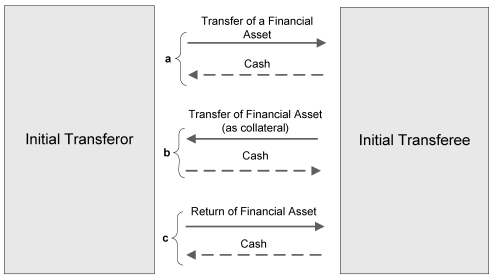 Transfer of a Financial Asset Initial Transferor a Cash Initial transferee Transfer of a Financial Asset b (as collateral) Cash c Return of Financial Asset Cash
- aThe initial transferor transfers a financial asset to the initial transferee in return for cash.
- bThe initial transferee enters into a repurchase financing with the initial transferor. The initial transferee transfers the previously transferred financial asset to the initial transferor as collateral for the financing. The initial transferee receives cash from the initial transferor. As part of the repurchase financing, the initial transferee is obligated to repurchase the financial asset (or substantially the same financial asset) at a fixed price within a prescribed time period.
- cThe initial transferee makes the required payment to the initial transferor under the terms of the repurchase financing. Upon receipt of payment, the initial transferor returns the transferred asset (or substantially the same asset) to the initial transferee.
- aIn the circumstance of an individual loan in which the borrower is required to make a contractual payment that consists of a principal amount and interest amount on the loan, the transferor and transferee shall share in the principal and interest payments on the basis of their proportionate ownership interest in the loan.
- bIn contrast, if the transferor is entitled to receive an amount that represents the principal payments and the transferee is entitled to receive an amount that represents the interest payments on the loan, that arrangement would not be consistent with the participating interest definition because the transferor and transferee do not share proportionately in the cash flows received from the loan.
- cIn other circumstances, a transferor may transfer a portion of an individual loan that represents either a senior interest or a junior interest in an individual loan. In both of those circumstances, the transferor would account for the transfer as a secured borrowing because the senior interest or junior interest in the loan do not meet the requirements to be participating interests (see paragraph 860-10-40-6A(c)).
- aLoan origination fees paid by the borrower to the transferor
- bFees necessary to arrange and complete the transfer paid by the transferee to the transferor
- cFees for servicing the financial asset.
- aThe characteristics, nature, and quality of the underlying financial asset, including any of the following:
- 1Characteristics of the underlying borrower
- 2The type and nature of the collateral securing the underlying financial asset.
- 1
- bThe quality, accuracy, and delivery of documentation relating to the transfer and the underlying financial asset
- cThe accuracy of the transferor's representations in relation to the underlying financial asset.
- aA true sale opinion is an attorney's conclusion that the transferred financial assets have been sold and are beyond the reach of the transferor's creditors and that a court would conclude that the transferred financial assets would not be included in the transferor's bankruptcy estate.
- bA nonconsolidation opinion is an attorney's conclusion that a court would recognize that an entity holding the transferred financial assets exists separately from the transferor. Additionally, a nonconsolidation opinion is an attorney's conclusion that a court would not order the substantive consolidation of the assets and liabilities of the entity holding the transferred financial assets and the assets and liabilities of the transferor (and its consolidated affiliates included in the financial statements being presented) in the event of the transferor's bankruptcy or receivership.
- aThe transfer is a routine transfer of financial assets that does not result in any continuing involvement by the transferor.
- bThe transferor had experience with other transfers with similar facts and circumstances under the same applicable laws and regulations.
- aFirst, the corporation transfers a group of financial assets to a special-purpose corporation that, although wholly owned, is so designed that the possibility is remote that the transferor, its consolidated affiliates (that are not bankruptcy-remote entities) included in the financial statements being presented, or its creditors could reclaim the financial assets. This first transfer is designed to be judged to be a true sale at law, in part because the transferor does not provide excessive credit or yield protection to the special-purpose corporation, and the transferred financial assets are likely to be judged beyond the reach of the transferor, its consolidated affiliates (that are not bankruptcy-remote entities) included in the financial statements being presented, or the transferor's creditors even in bankruptcy or other receivership.
- bSecond, the special-purpose corporation transfers a group of financial assets to a trust or other legal vehicle with a sufficient increase in the credit or yield protection on the second transfer (provided by a transferor's junior beneficial interest or other means) to merit the high credit rating sought by third-party investors who buy senior beneficial interests in the trust. Because of that aspect of its design, that second transfer might not be judged to be a true sale at law and, thus, the transferred financial assets could at least in theory be reached by a bankruptcy trustee for the special-purpose corporation.
- cHowever, the special-purpose corporation is designed to make remote the possibility that it would enter bankruptcy, either by itself or by substantive consolidation into a bankruptcy of its parent should that occur. For example, its charter forbids it from undertaking any other business or incurring any liabilities, so that there can be no creditors to petition to place it in bankruptcy. Furthermore, its dedication to a single purpose is intended to make it extremely unlikely, even if it somehow entered bankruptcy, that a receiver under the U.S. Bankruptcy Code could reclaim the transferred financial assets because it has no other assets to substitute for the transferred financial assets.
- aTransferee is precluded from exchanging the transferred financial assets but has the unconstrained right to pledge them.
- bTransferee is significantly limited in its ability to pledge or exchange the transferred financial assets.
- cTransferor's approval is required for transferee's subsequent transfers or pledges.
- dTransactions involving Rule 144A securities.
- aAn agreement that both entitles and obligates the transferor to repurchase or redeem the transferred financial assets before their maturity (see paragraph 860-10-40-5(c)(1)):
- 1Whether financial assets exchanged are substantially the same
- 2
- 1
- bAn agreement that provides the transferor with the unilateral ability to cause the holder to return specific financial assets, other than through a cleanup call (see paragraph 860-10-40-5(c)(2)):
- 1Rights to reacquire (call) transferred assets.
- 1
- cAn agreement that permits the transferee to require the transferor to repurchase the transferred financial asset at a price that is so favorable to the transferee that it is probable that the transferee will require the transferor to repurchase the transferred financial asset.
- aThe same primary obligor (see paragraph 860-10-40-24(a)(1)). The exchange of pools of single-family loans would not meet this criterion because the mortgages comprising the pool do not have the same primary obligor, and would therefore not be considered substantially the same.
- bIdentical form and type (see paragraph 860-10-40-24(a)(2)). The following exchanges would not meet this criterion:
- 1GNMA I securities for GNMA II securities
- 2Loans to foreign debtors that are otherwise the same except for different U.S. foreign tax credit benefits (because such differences in the tax receipts associated with the loans result in instruments that vary in form and type)
- 3Commercial paper for redeemable preferred stock.
- 1
- cThe same maturity (or in the case of mortgage-backed pass-through and pay-through securities, similar remaining weighted-average maturities that result in approximately the same market yield) (see paragraph 860-10-40-24(a)(3)). The exchange of a fast-pay GNMA certificate (that is, a certificate with underlying mortgage loans that have a high prepayment record) for a slow-pay GNMA certificate would not meet this criterion because differences in the expected remaining lives of the certificates result in different market yields.
- dSimilar assets as collateral (see paragraph 860-10-40-24(a)(5)). Mortgage-backed pass-through and pay-through securities must be collateralized by a similar pool of mortgages, such as single-family residential mortgages, to meet this characteristic.
- aRemoval-of-accounts provisions (see paragraphs )
- bCall options (see paragraphs 860-10-40-28 and 860-10-40-34)
- cOther arrangements.
- aAn unconditional removal-of-accounts provision that allows the transferor to specify the financial assets that may be removed from a group of financial assets precludes sale accounting for all financial assets in the group that might be specified if such a provision allows the transferor unilaterally to remove specific financial assets and provides a more-than-trivial benefit to the transferor (see paragraph 860-10-40-37(a)), even if the transferor's right to remove specific financial assets from a group of transferred financial assets is limited, for example, to 10 percent of the fair value of the financial assets transferred and all of the financial assets are smaller than that 10 percent. In that circumstance, none of the transferred financial assets would be derecognized at the time of transfer because no transferred financial asset is beyond the reach of the transferor. If the transferor reclaims all the financial assets it can and thereby extinguishes its option, its control has expired and the rest of the financial assets have been sold at that time.
- bA removal-of-accounts provision that provides the right to random removal of excess financial assets from a group of transferred financial assets up to 10 percent of the fair value of the financial assets transferred (all financial assets in the group are less than this 10 percent of the fair value of transferred financial assets) does not preclude sale accounting if the transferor has no other interest in the group. The transferor has, in essence, obtained a 10 percent beneficial interest in the group and should account for it as such. This treatment is permitted because the removal-of-accounts provision is sufficiently limited and the transferor cannot unilaterally remove specific transferred financial assets, because the timing of the removal (when the excess develops) and the assets being removed (which are randomly determined) are not under the control of the transferor (see paragraph 860-10-40-38).
- cA removal-of-accounts provision conditioned on a transferor's decision to exit some portion of its business precludes sale accounting for all financial assets that might be affected, because it permits the transferor unilaterally to remove specific financial assets and provides a more-than-trivial-benefit to the transferor (see paragraph 860-10-40-37(b)).
- dA removal-of-accounts provision for defaulted receivables does not preclude sale accounting at the time of transfer, because the removal would be allowed only after a third party's action (default) and could not be caused unilaterally by the transferor (see paragraph 860-10-40-38(b)). However, once the default has occurred, the transferor would have the unilateral ability to remove those specific financial assets and would need to recognize the defaulted receivable if that ability provides a more-than-trivial benefit to the transferor.
- eA removal-of-accounts provision conditioned on a third-party cancellation, or expiration without renewal, of an affinity or private-label arrangement does not preclude sale accounting at the time of transfer, because the removal would be allowed only after a third party's action (cancellation) or decision not to act (expiration) and could not be caused unilaterally by the transferor (see paragraph 860-10-40-38(c)). However, once the cancellation or expiration has occurred, the transferor would have the unilateral ability to remove specific financial assets and would need to recognize those financial assets if that ability provides a more-than-trivial benefit to the transferor.
- fBecause the transferor could not cause the reacquisition unilaterally a transferor does not maintain effective control through a removal-of-accounts provision that obligates the transferor to reacquire transferred financial assets from a securitization entity only after either:
- 1A specified failure of the servicer to properly service the transferred financial assets that could result in the loss of a third-party guarantee
- 2Third-party beneficial interest holders require a securitization entity to repurchase that beneficial interest.
- 1
- aIn a loan participation, the lead bank (that is also the transferor) allows the participating bank to resell but reserves the right to call at any time from whoever holds it and can enforce the call option by cutting off the flow of interest at the call date; such a call option precludes sale accounting.
- bIn a securitization, a call option permits the transferor to reclaim all of the transferred financial assets from the securitization entity at any time; such a call option precludes sale accounting unless both of the following conditions exist:
- 1The call option is an option to call, at fair value, a financial asset that is readily obtainable in the marketplace.
- 2The transferor does not hold a residual beneficial interest in the transferred financial assets (see paragraph 860-10-40-35).
- 1
- cA transferor-servicer transfers a group of entire financial assets to a securitization entity and has the right to call all of the financial assets when the group amortizes to 20 percent of its value (determined at the date of transfer). The transferor-servicer determines that at that level of financial assets, its cost of servicing them would not be burdensome in relation to the benefits of servicing, and therefore that the call option is not a cleanup call. Such a call option precludes sale accounting for the entire group of transferred financial assets (see paragraph 860-10-55-70).
- dIf the third-party beneficial interests contain an embedded option and the transferor holds the residual interest in the securitization entity, the combination has the same kind of effective control as a scheduled auction provision if the transferor holds a residual beneficial interest. Sale accounting would be precluded for all of the transferred financial assets affected by the call option.
- eIf the third-party beneficial interests in a securitization entity pay off first (a so-called turbo structure, where principal payments and prepayments are allocated on a non-pro rata basis, as discussed in paragraph 860-10-05-13), the transferor may not maintain effective control over transferred financial assets (see paragraph 860-10-40-32). To some extent, these repayments are contractual cash flows of the underlying assets, but repayments also result from prepayments in the underlying assets (that is, the prepayment options in the underlying assets are mirrored in the third-party beneficial interests). In this circumstance, call options embedded in the third-party beneficial interests result from the options embedded in the underlying assets (that is, they are held by the underlying borrowers rather than the transferor), and thus do not preclude sale accounting.
- fA transferor's contractual right to repurchase, at any time, a loan that is not a readily obtainable financial asset would preclude sale accounting, because the transferor's contractual right to repurchase is effectively a call option of the type described in paragraph 860-10-40-17(c)(2).
- aA put option written to the transferee generally does not provide the transferor with effective control over the transferred financial asset under paragraph 860-10-40-5(c)(3).
- bA put option that is sufficiently deep in the money when it is written would, under that paragraph, provide the transferor effective control over the transferred financial asset because it is probable that the transferee will exercise the option and the transferor will be required to repurchase the transferred financial asset.
- cA sufficiently out-of-the-money put option held by the transferee would not provide the transferor with effective control over the transferred financial asset if it is probable when the option is written that the option will not be exercised.
- dA put option held by the transferee at fair value would not provide the transferor with effective control over the transferred financial asset.
- aPass-through, pay-through, and revolving-period securitizations
- bFactoring arrangements
- cTransfers of receivables with recourse
- dSecurities lending transactions
- eRepurchase agreements
- fWash sales
- gDollar rolls
- hLoan participations
- iBanker's acceptances and risk participations in them
- j
- kTransfers involving certain transferor powers
- lTransferor option to repurchase individual financial assets
- mTransfer of a short-term loan made under a long-term credit commitment
- nTransfer of bad-debt recovery rights.
- o
- aTransfer consists of an entire financial asset or a group of entire financial assets. Before the method of recourse can be evaluated to determine the appropriate accounting treatment, the entity shall first determine whether a sale has occurred because in some jurisdictions recourse might mean that the transferred financial assets have not been isolated beyond the reach of the transferor, its consolidated affiliates (that are not entities designed to make remote the possibility that it would enter bankruptcy or other receivership) included in the financial statements being presented, and its creditors. A transfer of receivables in their entireties with recourse shall be accounted for as a sale, with the proceeds of the sale reduced by the fair value of the recourse obligation, if the conditions in paragraph 860-10-40-5 are met. Otherwise, a transfer of receivables with recourse shall be accounted for as a secured borrowing.
- bTransfer does not consist of an entire financial asset or a group of entire financial assets. The transferred financial asset must meet the definition of a participating interest.A transfer of a portion of a receivable with recourse, other than that permitted in paragraph 860-10-40-6A(c)(4), does not meet the requirements of a participating interest and shall be accounted for as a secured borrowing.
- aIsolation. Paragraph 860-10-40-5(a) requires an assessment of whether the transferred financial assets are isolated from the transferor. Paragraphs 860-10-40-5(a) and 860-10-40-8 require that the transferred financial assets be placed beyond the reach of all consolidated affiliates, except for certain bankruptcy-remote entities, included in the financial statements being presented.
- bTransferee's rights to pledge or exchange. Paragraph 860-10-40-5(b) requires an assessment of the transferee's rights to pledge or exchange the transferred financial assets. If a transferor has transferred financial assets to an independent third-party custodian, or to a transferee, under conditions that preclude the transferee from selling or repledging the assets during the term of the repurchase agreement, the transferor has not surrendered control over those assets. In a securities lending transaction, to the extent that the collateral consists of letters of credit or other financial instruments that the holder is not permitted by contract or custom to sell or repledge, the transaction does not satisfy the sale conditions and is accounted for as a loan of securities by the transferor to the transferee.
- cEffective control. Paragraph 860-10-40-5(c) requires an assessment of whether the transferor maintains effective control over transferred financial assets. An agreement that both entitles and obligates the transferor to repurchase transferred financial assets from the transferee in accordance with paragraph 860-10-40-5(c)(1) that meets the criteria in paragraph 860-10-40-24 maintains the transferor's effective control over transferred financial assets. Therefore, transfers with agreements to repurchase transferred financial assets that either meet the effective control criteria or qualify for the repurchase-to-maturity transaction exception need not be assessed under the remaining conditions for derecognition and should be accounted for as a secured borrowing. Paragraph 860-10-55-51A illustrates the application of the effective control condition in paragraph 860-10-40-5(c)(1).
- aRepurchase agreements and securities lending transactions—assets that are identical. The following illustrates agreements for which the transferor maintains effective control over the transferred financial asset:
- 1A financial asset is transferred under a contemporaneous agreement with the same counterparty that requires the transferor to repurchase or redeem it before its maturity at a fixed price or at the sale price plus or minus a lender's return.
- 2A financial asset is transferred under a securities lending transaction that requires the transferee to return to the transferor the identical asset before its maturity at a fixed price.
- 1
- bRepurchase agreements and securities lending transactions—assets that are substantially the same. The following illustrates agreements for which the transferor maintains effective control over the transferred financial asset:
- 1A financial asset is transferred under a contemporaneous agreement with the same counterparty to repurchase or redeem an asset that is substantially the same as the initially transferred asset (in accordance with paragraph 860-10-40-24(a)) before its maturity at a fixed price or at the sale price plus or minus a lender's return.
- 2A financial asset is transferred under a securities lending transaction that requires the transferee to return to the transferor an asset that is substantially the same as the initially transferred financial asset (in accordance with paragraph 860-10-40-24(a)) before its maturity at a fixed price.
- 3Fixed-coupon and dollar-roll repurchase agreements, and other contracts under which the securities to be repurchased are substantially the same in accordance with paragraph 860-10-40-24(a) as the securities initially transferred.
- 1
- cRepurchase-to-maturity transactions. A repurchase-to-maturity transaction is accounted for as a secured borrowing as if it maintains the transferor's effective control over the transferred financial asset. A transfer of a financial asset with a contemporaneous total return swap to maturity does not meet the definition of repurchase-to-maturity transaction.
- dCash-settled repurchase agreements. If a financial asset is transferred under a contemporaneous agreement with the same counterparty to repurchase or redeem it before its maturity at a fixed repurchase price or a price equal to the sale price plus or minus a lender's return and the agreement requires the transferee to settle the agreement in cash, the agreement does not maintain the transferor's effective control over the transferred financial assets. An exception is a repurchase-to-maturity transaction as discussed in (c).
- aBy the transferor as a sale of the loaned securities for proceeds consisting of the cash collateral and a forward repurchase commitment. If the collateral in a transaction that meets the conditions in paragraph 860-10-40-5 is a financial asset that the holder is permitted by contract or custom to sell or repledge, that financial asset is proceeds of the sale of the loaned securities.
- bBy the transferee as a purchase of the borrowed securities in exchange for the collateral and a forward resale commitment.
- aTypes 1-3 of dollar rolls would qualify for secured borrowing treatment if the redemption of securities on substantially the same terms is assured (see paragraph 860-10-40-24). In that circumstance, the forward contracts embedded in the Types 1-3 securities are outside the scope of Topic 815 because of the scope exception provided in paragraph 815-10-15-63 for derivative instruments that serve as impediments to sale accounting.
- bTypes 2 and 3 securities that involve repurchase of other than substantially-the-same securities are considered sales of securities and forward contracts. The forward contract would need to be evaluated under Subtopic 815-10 because it has terms that would generally meet the definition of a derivative instrument. If the dollar-roll repurchase agreement is accounted for as a sale under this Subtopic, Subtopic 815-10 provides guidance on the subsequent accounting for the forward contract.
- a
- bThe transferor's current ability to dissolve the securitization entity and reassume control of the transferred financial assets entitles it to unilaterally cause the return of the transferred financial assets, indicating that the transferor has maintained control over the transferred financial assets which precludes sale accounting under paragraph 860-10-40-5(c).
- aThe unilateral ability to cause the holder to return specific financial assets
- bA more-than-trivial-benefit attributable to that ability.
- aThe beneficial interests are issued in the form of debt securities.
- bBefore the transfer, the debt securities were accounted for as available-for-sale securities in accordance with Topic 320.
- aSale. If a transfer of a group of entire financial assets satisfies the conditions to be accounted for as a sale, Subtopic 860-20 requires that any assets obtained or liabilities incurred in the transfer be recognized (see paragraph 860-20-25-1) and initially measured at fair value (see paragraph 860-20-30-1). If the transfer in the example is accounted for as a sale, the transferor would account for the debt securities received as new assets and would have the option to classify the debt securities received as trading securities.
- bSecured borrowing. If the transfer is accounted for as a secured borrowing, paragraph 860-30-25-2 requires the transferor to continue to report the transferred debt securities in its statement of financial position with no change in their measurement (that is, basis of accounting). Paragraph 320-10-35-12, which explains that transfers into or from the trading category should be rare, would continue to apply.
- aAll of the conditions in paragraph 860-10-40-5 (including the condition on isolation of the transferred financial assets) are met.
- bThe transferee's assets and liabilities are not consolidated into the separate-entity financial statements of the transferor.
- aExplicit written arrangements
- bCommunications between the transferor and the transferee or its beneficial interest holders
- cUnwritten arrangements customary in similar transfers.
- aServicing arrangements
- bRecourse or guarantee arrangements
- cAgreements to purchase or redeem transferred financial assets
- ccOptions written or held
- dDerivative instruments that are entered into contemporaneously with, or in contemplation of, the transfer
- eArrangements to provide financial support
- fPledges of collateral
- gThe transferor's beneficial interests in the transferred financial assets.
Illustrations
- aFace value of the draft provided to the vendor: $1,000
- bTerm of the draft provided to the vendor: 90 days
- cCommission with an annual rate of 10 percent: 25
- dFee paid for risk participation: 10.
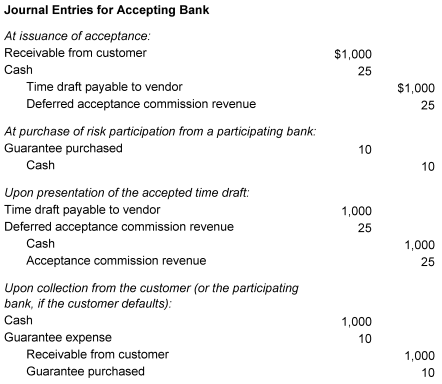 Journal Entries for Accepting Bank At issuance of acceptance: Receivable from customer " $1,000 " Cash 25 Time draft payable to vendor " $1,000 " Deferred acceptance commission revenue 25 At purchase of risk participation from a participating bank: Guarantee purchased 10 Cash 10 Upon presentation of the accepted time draft: Time draft payable to vendor " 1,000 " Deferred acceptance commission revenue 25 Cash " 1,000 " Acceptance commission revenue 25 "Upon collection from the customer (or the participating bank, if the customer defaults):" Cash " 1,000 " Guarantee expense 10 Receivable from customer " 1,000 " Guarantee purchased 10
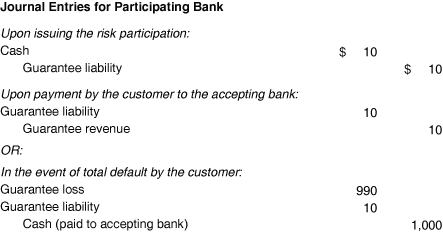 Journal Entries for Participating Bank Upon issuing the risk participation: Cash $10 Guarantee liability $10 Upon payment by the customer to the accepting bank: Guarantee liability 10 Guarantee revenue 10 OR: In the event of total default by the customer: Guarantee loss 990 Guarantee liability 10 Cash (paid to accepting bank) " 1,000 "
860-10-60Relationships
Source downloaded: .Record version eb35e473abc3. Effective date must be checked in the source.
Consolidation
860-10-65Transition and Open Effective Date Information
Source downloaded: .Record version 23dfbe5ca754. Effective date must be checked in the source.
860-10-S40DerecognitionSEC
Source downloaded: .Record version 0c791085e34a. Effective date must be checked in the source.
Sale of Mortgage Servicing Rights with a Subservicing Agreement
Transfer of Certain Nonperforming Assets by Distribution to Shareholders or a Contribution of Assets to Unrelated Third Parties
860-10-S50DisclosureSEC
Source downloaded: .Record version 2156bfdc1dc5. Effective date must be checked in the source.
Repurchase and Reverse Repurchase Agreements
860-10-S99SEC MaterialsSEC
Source downloaded: .Record version 369e4f3f261e. Effective date must be checked in the source.
SEC Staff Guidance
- In accordance with paragraph 860-50-40-7, a sale of mortgage servicing rights with a subservicing contract could be treated as a sale with the gain deferred if substantially all of the risks and rewards have been transferred to the transferree. In the view of the SEC staff, a transaction that, in substance, transfers only a portion of the servicing revenues does not result in transfer of substantially all of the risks and rewards of ownership and the accounting for those transactions should be guided by the guidance in paragraph 470-10-25-1.
Related subtopics
- 860-20 Sales of Financial AssetsTransfers and Servicing
- 860-50 Servicing Assets and LiabilitiesTransfers and Servicing
- 860-30 Secured Borrowing and CollateralTransfers and Servicing
- 470-50 Modifications and ExtinguishmentsDebt
- 810-942 Financial Services—Depository and LendingConsolidation
- 480-10 OverallDistinguishing Liabilities from Equity