ASC 470-10
Overall
470 Debt
Source downloaded: .Record version f898f591fca0. Effective date must be checked in the source.
ASC 470-10 is the Overall subtopic of the Debt topic and governs a borrower's balance sheet classification (current vs. noncurrent) of specific obligations: short-term obligations expected to be refinanced, due-on-demand loans, callable debt and covenant violations, revolving credit agreements with lock-box arrangements and subjective acceleration clauses, increasing-rate debt, sales of future revenue, and indexed debt. Core rules: callable and demand obligations are current unless a waiver/cure exception applies (470-10-45-10 through 45-11), and a short-term obligation may be excluded from current liabilities only if the entity intends to refinance long term and demonstrates ability via post-balance-sheet issuance of long-term debt/equity or a qualifying financing agreement (470-10-45-14). It also sets debt-versus-deferred-income classification for proceeds from sales of future revenue and disclosure requirements for maturities, unused lines of credit, and refinancings.
Key points (7)
- Obligations due on demand, or that will become due on demand within one year (or operating cycle, if longer) of the balance sheet date, are current liabilities even if liquidation is not expected; a demand provision is not a subjective acceleration clause (470-10-45-10).
- Long-term obligations that are or will be callable because of a covenant violation at the balance sheet date are current liabilities unless the creditor has waived or lost the right to demand repayment for more than one year, or it is probable the violation will be cured within a stated grace period (470-10-45-11).
- Where a lender waives its call right for more than one year while retaining future covenant tests, the debt is noncurrent unless both a violation existed (or would have absent modification) at the balance sheet date and it is probable the borrower cannot cure at measurement dates within the next 12 months (470-10-45-1; Example 1 at 470-10-55-2).
- A short-term obligation is excluded from current liabilities only if the entity intends to refinance on a long-term basis and that intent is supported by post-balance-sheet-date issuance of long-term debt or equity securities, or by a financing agreement meeting the noncancelable/objectively determinable-covenant, no-violation, and financially capable lender conditions (470-10-45-14); the excluded amount is capped by proceeds or amounts available (470-10-45-16 through 45-19).
- Repaying a short-term obligation with current assets after the balance sheet date and later replenishing working capital with long-term financing does not permit exclusion from current liabilities (470-10-45-15; Example 5 at 470-10-55-33).
- Revolver borrowings subject to both a subjective acceleration clause and a lock-box arrangement are short-term obligations classified as current unless the 470-10-45-14 refinancing conditions are met under a separate agreement (470-10-45-5); a springing lock-box arrangement leaves the borrowings long term, with the subjective acceleration clause evaluated under 470-10-45-2.
- For sales of future revenue, factors such as the transaction not purporting to be a sale, significant continuing involvement, cancelability, a capped investor return, or investor recourse create a rebuttable presumption of debt classification (470-10-25-2); debt is amortized under the interest method and deferred income under the units-of-revenue method (470-10-35-3).
For students. Balance sheet classification of debt is a recurring exam and practice issue: the classic trap is assuming that a post-year-end covenant waiver or a rollover of short-term borrowings automatically supports noncurrent classification — the waiver must extend more than one year (or a grace-period cure must be probable), and refinancing ability must be demonstrated by an actual long-term issuance or a qualifying, noncancelable financing agreement before the statements are issued.
Machine-generated study aid for ASC 470-10. Check the source paragraphs below.
470-10-00Status
Source downloaded: .Record version 7e08ea693d20. Effective date must be checked in the source.
470-10-05Overview and Background
Source downloaded: .Record version aa7364508f35. Effective date must be checked in the source.
- aLiabilities
- bDebt
- cDistinguishing Liabilities from Equity.
- aOverall
- bDebt with Conversion and Other Options
- cParticipating Mortgage Loans
- dProduct Financing Arrangements
- eModifications and Extinguishments
- fTroubled Debt Restructurings by Debtors.
- aShort-term obligations expected to be refinanced on a long-term basis
- bDue-on-demand loan arrangements
- cCallable debt
- dSales of future revenue
- eIncreasing rate debt
- fDebt that includes covenants
- gRevolving credit agreements subject to lock-box arrangements and subjective acceleration clauses
- hIndexed debt.
470-10-15Scope and Scope Exceptions
Source downloaded: .Record version 703e7a8d0955. Effective date must be checked in the source.
Entities
Transactions
470-10-25Recognition
Source downloaded: .Record version becd8ab8c570. Effective date must be checked in the source.
Sales of Future Revenues or Various Other Measures of Income
- aThe transaction does not purport to be a sale (that is, the form of the transaction is debt).
- bThe entity has significant continuing involvement in the generation of the cash flows due the investor (for example, active involvement in the generation of the operating revenues of a product line, subsidiary, or business segment).
- cThe transaction is cancelable by either the entity or the investor through payment of a lump sum or other transfer of assets by the entity.
- dThe investor's rate of return is implicitly or explicitly limited by the terms of the transaction.
- eVariations in the entity's revenue or income underlying the transaction have only a trifling impact on the investor's rate of return.
- fThe investor has any recourse to the entity relating to the payments due the investor.
Indexed Debt
470-10-35Subsequent Measurement
Source downloaded: .Record version 88b5e2b41a8f. Effective date must be checked in the source.
Increasing Rate Debt
Sale of Future Revenues or Various Other Measures of Income
Indexed Debt
470-10-45Other Presentation Matters
Source downloaded: .Record version 8a0f9bdbdd67. Effective date must be checked in the source.
Classification of Debt That Includes Covenants
- aA covenant violation that gives the lender the right to call the debt has occurred at the balance sheet date or would have occurred absent a loan modification.
- bIt is probable that the borrower will not be able to cure the default (comply with the covenant) at measurement dates that are within the next 12 months.
Subjective Acceleration Clauses and Debt Classification
Classification of Revolving Credit Agreements Subject to Lock-Box Arrangements and Subjective Acceleration Clauses
Classification of Increasing-Rate Debt
Due on Demand Loan Arrangements
- a"The term note shall mature in monthly installments as set forth therein or on demand, whichever is earlier."
- b"Principal and interest shall be due on demand, or if no demand is made, in quarterly installments beginning on...."
Callable Debt
- aThe creditor has waived or subsequently lost (for example, the debtor has cured the violation after the balance sheet date and the obligation is not callable at the time the financial statements are issued or are available to be issued [as discussed in Section 855-10-25]) the right to demand repayment for more than one year (or operating cycle, if longer) from the balance sheet date. If the obligation is callable because of violations of certain provisions of the debt agreement, the creditor needs to waive its right with regard only to those violations.
- bFor long-term obligations containing a grace period within which the debtor may cure the violation, it is probable that the violation will be cured within that period, thus preventing the obligation from becoming callable.
Short-Term Obligations Expected to Be Refinanced
Intent and Ability to Refinance on a Long-Term Basis
- aPost-balance-sheet-date issuance of a long-term obligation or equity securities. After the date of an entity's balance sheet but before that balance sheet is issued or is available to be issued (as discussed in Section 855-10-25), a long-term obligation or equity securities have been issued for the purpose of refinancing the short-term obligation on a long-term basis. If equity securities have been issued, the short-term obligation, although excluded from current liabilities, shall not be included in owners' equity.
- bFinancing agreement. Before the balance sheet is issued or is available to be issued (as discussed in Section 855-10-25), the entity has entered into a financing agreement that clearly permits the entity to refinance the short-term obligation on a long-term basis on terms that are readily determinable, and all of the following conditions are met:
- 1The agreement does not expire within one year (or operating cycle) from the date of the entity's balance sheet and during that period the agreement is not cancelable by the lender or the prospective lender or investor (and obligations incurred under the agreement are not callable during that period) except for violation of a provision with which compliance is objectively determinable or measurable. For purposes of this Subtopic, violation of a provision means failure to meet a condition set forth in the agreement or breach or violation of a provision such as a restrictive covenant, representation, or warranty, whether or not a grace period is allowed or the lender is required to give notice. Financing agreements cancelable for violation of a provision that can be evaluated differently by the parties to the agreement (such as a material adverse change or failure to maintain satisfactory operations) do not comply with this condition.
- 2No violation of any provision in the financing agreement exists at the balance sheet date and no available information indicates that a violation has occurred thereafter but before the balance sheet is issued or is available to be issued (as discussed in Section 855-10-25), or, if one exists at the balance sheet date or has occurred thereafter, a waiver has been obtained.
- 3The lender or the prospective lender or investor with which the entity has entered into the financing agreement is expected to be financially capable of honoring the agreement.
- 1
Transactions after the Balance Sheet Date
470-10-50Disclosure
Source downloaded: .Record version 689b12956531. Effective date must be checked in the source.
Disclosure of Long-Term Obligations
Subjective Acceleration Clauses
Short-Term Obligations Expected to Be Refinanced
Summary Disclosure of Securities Outstanding
Unused Commitments and Lines of Credit
- aThe amount and terms of unused commitments for long-term financing arrangements (including commitment fees and the conditions under which commitments may be withdrawn)
- bThe amount and terms of unused lines of credit for short-term financing arrangements (including commitment fees and the conditions under which lines may be withdrawn) and the amount of those lines of credit that support commercial paper borrowing arrangements or similar arrangements.
Weighted-Average Interest Rate on Short-Term Borrowings
470-10-55Implementation Guidance and Illustrations
Source downloaded: .Record version 2d3e8f714b2d. Effective date must be checked in the source.
Implementation Guidance
Illustrations
- aThe debt covenants are applicable only after the balance sheet date, and it is probable that the borrower will fail to meet the covenant requirement at the compliance date three months after the balance sheet date.
- bThe borrower meets the current covenant requirement at the balance sheet date, and it is probable that the borrower will fail to meet the same covenant requirement at the compliance date in three months.
- cThe borrower meets the current covenant requirement, and it is probable that the borrower will fail to meet a more restrictive covenant requirement applicable at the compliance date in three months.
- dThe borrower has met the covenant requirement in the prior quarter but before the balance sheet date negotiates a modification of the loan agreement that eliminates the covenant requirement at the balance sheet date or modifies the requirement so that the borrower will comply. Absent the modification, the borrower would have been in violation of the covenant at the balance sheet date. The same or a more restrictive covenant must be met at the compliance date in three months, and it is probable that the borrower will fail to meet that requirement at that subsequent date.
- eThe borrower is in violation of the current covenant requirement at the balance sheet date and, after the balance sheet date but before the financial statements are issued or are available to be issued (as discussed in Section 855-10-25), obtains a waiver. The same or a more restrictive covenant must be met at the compliance date in three months, and it is probable that the borrower will fail to meet that requirement at that subsequent date.
- aThe debt has a long-term maturity (for example, 30 to 40 years).
- bThe debt holder may redeem or put the bond on short notice (7 to 30 days).
- cThe issuer has a remarketing agreement that states that the agent will make its best effort to remarket the bond when redeemed.
- dThe debt is secured by a short-term letter of credit that provides protection to the debt holder in the event that the redeemed debt cannot be remarketed. (Amounts drawn against the letter of credit are payable back to the issuer of the letter of credit by the issuer of the redeemable debt instrument on the same day that the drawdown occurs.)
- Maturities and sinking fund requirements on long-term loans and convertible debt and sinking fund requirements on preferred stock subject to mandatory redemption are as follows (in thousands).
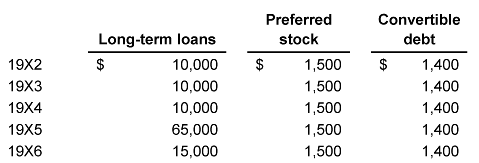 Long-term loans Preferred stock Convertible debt 19X2 " $10,000 " " $1,500 " " $1,400 " 19X3 " 10,000 " " 1,500 " " 1,400 " 19X4 " 10,000 " " 1,500 " " 1,400 " 19X5 " 65,000 " " 1,500 " " 1,400 " 19X6 " 15,000 " " 1,500 " " 1,400 "
- aEntity refinances on long-term basis the current maturity of long-term debt and notes payable (Case A).
- bLaws prohibit the transfer of funds (Case B).
- cEntity issues debentures to liquidate the debt (Case C).
- dEntity negotiates a revolving credit agreement (Case D).
- eEntity negotiates a revolving credit agreement with borrowing limits (Case E).
- fEntity refinances commercial paper (Case F).
- gCase illustrates balance sheet presentation (Case G).
- aEntity A's fiscal year-end is December 31, 19X5.
- bThe date of issuance of the December 31, 19X5, financial statements is March 31, 19X6; the Entity's practice is to issue a classified balance sheet.
- cAt December 31, 19X5, short-term obligations include $5,000,000 representing the portion of 6 percent long-term debt maturing in February 19X6 and $3,000,000 of 9 percent notes payable issued in November 19X5 and maturing in July 19X6.
- dThe Entity intends to refinance on a long-term basis both the current maturity of long-term debt and the 9 percent notes payable.
- eAccounts other than the long-term debt maturing in February 19X6 and the notes payable maturing in July 19X6 are as follows.
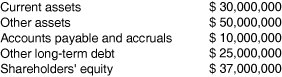 Current assets " $30,000,000 " Other assets " $50,000,000 " Accounts payable and accruals " $10,000,000 " Other long-term debt " $25,000,000 " Shareholders' equity " $37,000,000 "
- fUnless otherwise indicated, the Cases also assume that the lender or prospective lender is expected to be capable of honoring the agreement, that there is no evidence of a violation of any provision, and that the terms of borrowings available under the agreement are readily determinable.
- aBorrowings are available at Entity A's request for such purposes as it deems appropriate and will mature three years from the date of borrowing.
- bAmounts borrowed will bear interest at the bank's prime rate.
- cAn annual commitment fee of 1/2 of 1 percent is payable on the difference between the amount borrowed and $8,000,000.
- dThe agreement is cancelable by the lender only if any of the following occur:
- 1The Entity's working capital, excluding borrowings under the agreement, falls below $10,000,000.
- 2The Entity becomes obligated under lease agreements to pay an annual rental in excess of $1,000,000.
- 3Treasury stock is acquired without the prior approval of the prospective lender.
- 4The Entity guarantees indebtedness of unaffiliated persons in excess of $500,000.
- 1
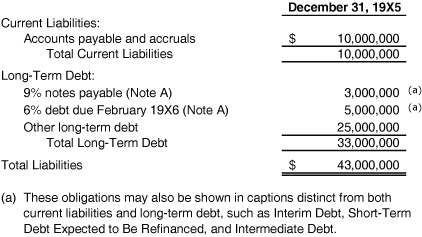 "December 31, 19X5 " Current Liabilities: Accounts payable and accruals " $10,000,000 " Total Current Liabilities " 10,000,000 " Long-Term Debt: 9% notes payable (Note A) " 3,000,000 " (a) 6% debt due February 19X6 (Note A) " 5,000,000 " (a) Other long-term debt " 25,000,000 " Total Long-Term Debt " 33,000,000 " Total Liabilities " $43,000,000 " (a) "These obligations may also be shown in captions distinct from both current liabilities and long-term debt, such as Interim Debt, Short-Term Debt Expected to Be Refinanced, and Intermediate Debt."
- Note A
- The Entity has entered into a financing agreement with a commercial bank that permits the Entity to borrow at any time through 19X7 up to $8,000,000 at the bank's prime rate of interest. The Entity must pay an annual commitment fee of 1/2 of 1 percent of the unused portion of the commitment. Borrowings under the financing agreement mature three years after the date of the loan. Among other things, the agreement prohibits the acquisition of treasury stock without prior approval by the bank, requires maintenance of working capital of $10,000,000 exclusive of borrowings under the agreement, and limits the annual rental under lease agreements to $1,000,000. In February 19X6, the Entity borrowed $5,000,000 at 8 percent and liquidated the 6 percent long-term debt, and it intends to borrow additional funds available under the agreement to refinance the 9 percent notes payable maturing in July 19X6.
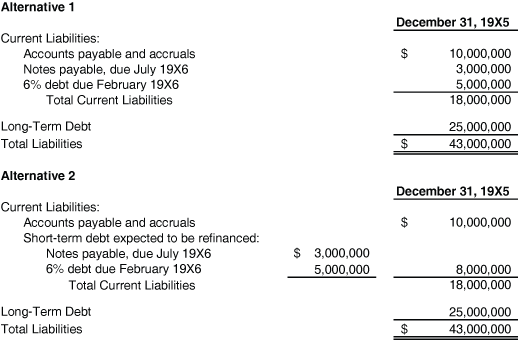 Alternative 1 "December 31, 19X5" Current Liabilities: Accounts payable and accruals " $10,000,000 " "Notes payable, due July 19X6" " 3,000,000 " 6% debt due February 19X6 " 5,000,000 " Total Current Liabilities " 18,000,000 " Long-Term Debt " 25,000,000 " Total Liabilities " $43,000,000 " Alternative 2 "December 31, 19X5" Current Liabilities: Accounts payable and accruals " $10,000,000 " Short-term debt expected to be refinanced: "Notes payable, due July 19X6" " $3,000,000 " 6% debt due February 19X6 " 5,000,000 " " 8,000,000 " Total Current Liabilities " 18,000,000 " Long-Term Debt " 25,000,000 " Total Liabilities " $43,000,000 "
- aAn Entity has issued $3,000,000 of short-term commercial paper during the year to finance construction of a plant.
- bAt June 30, 1976, the Entity's fiscal year end, the Entity intends to refinance the commercial paper by issuing long-term debt. However, because the Entity temporarily has excess cash, in July 1976 it liquidates $1,000,000 of the commercial paper as the paper matures.
- cIn August 1976, the Entity completes a $6,000,000 long-term debt offering.
- dLater during the month of August, it issues its June 30, 1976, financial statements.
- eThe proceeds of the long-term debt offering are to be used to do all of the following:
- 1Replenish $1,000,000 in working capital
- 2Pay $2,000,000 of commercial paper as it matures in September 1976
- 3Pay $3,000,000 of construction costs expected to be incurred later that year to complete the plant.
- 1
470-10-60Relationships
Source downloaded: .Record version 181f2ef32abc. Effective date must be checked in the source.
Balance Sheet
Interest
Leases
470-10-S00StatusSEC
Source downloaded: .Record version f48a63feb4d4. Effective date must be checked in the source.
470-10-S15Scope and Scope ExceptionsSEC
Source downloaded: .Record version ad5ada039e6e. Effective date must be checked in the source.
Compensating Balance Arrangements
470-10-S35Subsequent MeasurementSEC
Source downloaded: .Record version d9a02ab5e354. Effective date must be checked in the source.
Debt Issue Costs in Conjunction with a Business Combination
470-10-S45Other Presentation MattersSEC
Source downloaded: .Record version dd20a52dc8e7. Effective date must be checked in the source.
Subsidiary's Loan Payable
Long-Term Debt
Construction Loans
Subordinated Debt
470-10-S50DisclosureSEC
Source downloaded: .Record version bc3b370bbeb0. Effective date must be checked in the source.
Disclosure of Long-Term Obligations
Short-Term Obligations
Defaults
Repurchase and Reverse Repurchase Agreements
Guarantors and Issuers of Guaranteed Securities Registered or Being Registered
Affiliates Whose Securities Collateralize Securities Registered or Being Registered
470-10-S65Transition and Open Effective Date InformationSEC
Source downloaded: .Record version 5367736e46c5. Effective date must be checked in the source.
470-10-S99SEC MaterialsSEC
Source downloaded: .Record version 7c601dc9f634. Effective date must be checked in the source.
SEC Rules, Regulations, and Interpretations
- (a) If an issuer or guarantor of a guaranteed security that is registered or being registered is required to file financial statements required by Regulation S-X with respect to the guarantee or guaranteed security, such financial statements may be omitted if the issuer or guarantor is a consolidated subsidiary of the parent company, the parent company's consolidated financial statements have been filed, and the conditions in paragraphs (a)(1) and (2) of this section have been met:
- (1) The guaranteed security is debt or debt-like; and
- (i) The parent company issues the security or co-issues the security, jointly and severally, with one or more of its consolidated subsidiaries; or
- (ii) A consolidated subsidiary issues the security or co-issues the security with one or more other consolidated subsidiaries of the parent company, and the security is guaranteed fully and unconditionally by the parent company; and
-
- (2) The parent company provides the disclosures specified in §210.13-01.
-
- (b) For the purposes of this section and §210.13-01:
- (1) The “parent company” is the entity that:
- (i) Is an issuer or guarantor of the guaranteed security;
- (ii) Is, or as a result of the subject Securities Act registration statement will be, an Exchange Act reporting company; and
- (iii) Consolidates each subsidiary issuer and/or subsidiary guarantor of the guaranteed security in its consolidated financial statements.
-
- (2) A security is “debt or debt-like” if it has the following characteristics:
- (i) The issuer has a contractual obligation to pay a fixed sum at a fixed time; and
- (ii) Where the obligation to make such payments is cumulative, a set amount of interest must be paid.
-
- Note 1 to paragraph (b)(2). Neither the form of the security nor its title will determine whether a security is debt or debt-like. Instead, the substance of the obligation created by the security will be determinative.
- Note 2 to paragraph (b)(2). The phrase “set amount of interest” is not intended to mean “fixed amount of interest.” Floating and adjustable rate securities, as well as indexed securities, may meet the criteria specified in paragraph (b)(2)(ii) of this section as long as the payment obligation is set in the debt instrument and can be determined from objective indices or other factors that are outside the discretion of the obligor.
- (3) A guarantee is “full and unconditional,” if, when an issuer of a guaranteed security has failed to make a scheduled payment, the guarantor is obligated to make the scheduled payment immediately and, if it does not, any holder of the guaranteed security may immediately bring suit directly against the guarantor for payment of all amounts due and payable.
-
- [65 FR 51707, Aug. 24, 2000, as amended at 73 FR 952, Jan. 4, 2008; 73 FR 1009, Jan. 4, 2008; 74 FR 18615, Apr. 23, 2009; 85 FR 21999, Apr. 20, 2020]
- (a) For each guaranteed security subject to Section 13(a) or 15(d) of the Securities Exchange Act of 1934, and for each guaranteed security the offer and sale of which is being registered under the Securities Act of 1933, for which the registrant is the parent company (as that term is defined in §210.3-10(b)(1)) of one or more subsidiaries that issue or guarantee the guaranteed security, provide the following disclosures to the extent material:
- (1) A description of the issuers and guarantors of the guaranteed security;
- (2) A description of the terms and conditions of the guarantees, and how payments to holders of the guaranteed security may be affected by the composition of and relationships among the issuers, guarantors, and subsidiaries of the parent company that are not issuers or guarantors of the guaranteed security;
- (3) A description of other factors that may affect payments to holders of the guaranteed security, such as contractual or statutory restrictions on dividends, guarantee enforceability, or the rights of a noncontrolling interest holder;
- (4) Summarized financial information as specified in §210.1-02(bb)(1) of each issuer and guarantor of the guaranteed security as follows, with an accompanying note that briefly describes the basis of presentation:
- (i) The summarized financial information of each such issuer and guarantor consolidated in the parent company's consolidated financial statements may be presented on a combined basis with the summarized financial information of the parent company;
- (ii) Intercompany balances and transactions between issuers and guarantors whose summarized financial information is presented on a combined basis shall be eliminated;
- (iii) The summarized financial information shall exclude subsidiaries that are not issuers or guarantors. An issuer's or guarantor's investment in a subsidiary that is not an issuer or guarantor shall not be presented. An issuer's or guarantor's amounts due from, amounts due to, and transactions with any of the following shall be presented in separate line items:
- (A) Subsidiaries that are not issuers or guarantors; and
- (B) Related parties;
- (iv) If the information provided in response to the requirements of this section (e.g., factors that may affect payments to holders of the guaranteed security) is applicable to one or more, but not all, issuers and/or guarantors, separately disclose the summarized financial information applicable to those issuers and/or guarantors. In limited circumstances (i.e., where the separate financial information applicable to those issuers and/or guarantors can be easily explained and understood), narrative disclosure may be provided in lieu of the separate summarized financial information otherwise required by this paragraph (a)(4)(iv);
- (v) Disclose this summarized financial information as of and for the most recently ended fiscal year and year-to-date interim period included in the parent company's consolidated financial statements; and
- (vi) Notwithstanding that a parent company may omit this summarized financial information if not material, it may also be omitted if one of the following in paragraphs (a)(4)(vi)(A) through (D) of this section is true and disclosed. However, paragraph (a)(4)(vi)(A) does not apply if separate disclosure of summarized financial information applicable to one or more, but not all, issuers and/or guarantors is required by paragraph (a)(4)(iv) of this section. For the purposes of this section, a finance subsidiary is a subsidiary that has no assets or operations other than those related to the issuance, administration and repayment of the security being registered and any other securities guaranteed by its parent company:
- (A) The assets, liabilities and results of operations of the combined issuers and guarantors of the guaranteed security are not materially different than corresponding amounts presented in the consolidated financial statements of the parent company;
- (B) The combined issuers and guarantors, excluding investments in subsidiaries that are not issuers or guarantors, have no material assets, liabilities or results of operations;
- (C) The issuer is a finance subsidiary of the parent company, the parent company has fully and unconditionally guaranteed the security, and no other subsidiary of the parent company guarantees the security; or
- (D) The issuer is a finance subsidiary that co-issued the security, jointly and severally, with the parent company, and no other subsidiary of the parent company guarantees the security;
- (5) In a Securities Act registration statement filed in connection with the offer and sale of the guaranteed security, if the parent company acquired a significant business after the date of the parent company's most recent balance sheet included in its consolidated financial statements and the acquired business, one or more of the acquired business's subsidiaries, or the acquired business and one or more of its subsidiaries are issuers or guarantors of the guaranteed securities, disclose pre-acquisition summarized financial information as specified in paragraph (a)(4) of this section for each such issuer or guarantor. The acquired business is significant if it meets any of the conditions specified in the definition of significant subsidiary in §210.1-02(w), substituting 20 percent for 10 percent each place it appears therein, based on a comparison of the most recent annual financial statements of the acquired business and the parent company's most recent annual consolidated financial statements filed at or prior to the date of acquisition. The determination of whether a business has been acquired shall be made in accordance with the guidance set forth in §210.11-01(d). Acquisitions of a group of related businesses shall be treated as if they are a single business acquisition for purposes of this comparison. The determination of whether a group of businesses are related shall be made in a manner consistent with §210.3-05(a)(3);
- (6) Any financial and narrative information about each guarantor if the information would be material for investors to evaluate the sufficiency of the guarantee; and
- (7) Sufficient information so as to make the financial and non-financial information presented not misleading.
-
- (b) The parent company may elect to provide the disclosures required by this section in a footnote to its consolidated financial statements or alternatively, in management's discussion and analysis of financial condition and results of operations described in §229.303 (Item 303 of Regulation S-K) of this chapter. If not otherwise included in the consolidated financial statements or in management's discussion and analysis of financial condition and results of operations, the parent company must include the disclosures in its prospectus immediately following “Risk Factors,” if any, or otherwise, immediately following pricing information described in §229.105 (Item 105 of Regulation S-K) of this chapter.
- The requirements of this section shall apply to each security registered or being registered that is issued on or after January 4, 2021, and to each registered security issued and outstanding before January 4, 2021, for which the registrant had prior to that date provided the financial statements specified in §210.3-16.
- (a) For each security subject to Section 13(a) or 15(d) of the Securities Exchange Act of 1934, and for each security the offer and sale of which is being registered under the Securities Act of 1933, that is collateralized by a security of the registrant's affiliate or affiliates, provide the following disclosures to the extent material:
- (1) A description of the securities pledged as collateral and the affiliates whose securities are pledged as collateral;
- (2) A description of the terms and conditions of the collateral arrangement, including the events or circumstances that would require delivery of the collateral;
- (3) A description of the trading market for the affiliate's security pledged as collateral or a statement that there is no market;
- (4) Summarized financial information as specified in §210.1-02(bb)(1) of each affiliate whose securities are pledged as collateral as follows, with an accompanying note that briefly describes the basis of presentation:
- (i) The summarized financial information of each such affiliate consolidated in the registrant's financial statements may be presented on a combined basis;
- (ii) Intercompany balances and transactions between affiliates whose summarized financial information is presented on a combined basis shall be eliminated;
- (iii) An affiliate's amounts due from, amounts due to, and transactions with any of the following shall be presented in separate line items:
- (A) The registrant;
- (B) Any of the registrant's subsidiaries not included in the summarized financial information of the affiliate(s); and
- (C) Related parties;
- (iv) If the information provided in response to the requirements of this section (e.g., the trading market for the affiliate's security pledged as collateral or a statement that there is no market) is applicable to one or more, but not all, affiliates, separately disclose the summarized financial information applicable to those affiliates. In limited circumstances (i.e., where the separate financial information applicable to those affiliates can be easily explained and understood), narrative disclosure may be provided in lieu of the separate summarized financial information otherwise required by this paragraph (a)(4)(iv);
- (v) Disclose this summarized financial information as of and for the most recently ended fiscal year and year-to-date interim period included in the registrant's consolidated financial statements; and
- (vi) Notwithstanding that a registrant may omit this summarized financial information if not material, it may also be omitted if one of the following in paragraph (a)(4)(vi)(A) or (B) of this section is true and disclosed. However, paragraph (a)(4)(vi)(A) does not apply if separate disclosure of summarized financial information applicable to one or more, but not all, affiliates is required by paragraph (a)(4)(iv) of this section:
- (A) The assets, liabilities and results of operations of the combined affiliates whose securities are pledged as collateral are not materially different than the corresponding amounts presented in the consolidated financial statements of the registrant; or
- (B) The combined affiliates whose securities are pledged as collateral have no material assets, liabilities or results of operations;
- (5) In a Securities Act registration statement filed in connection with the offer and sale of the collateralized security, if the registrant acquired a significant business after the date of the registrant's most recent balance sheet included in its consolidated financial statements and the acquired business, one or more of the acquired business's subsidiaries, or the acquired business and one or more of its subsidiaries are affiliates whose securities collateralize the registrant's collateralized security, disclose pre-acquisition summarized financial information as specified in paragraph (a)(4) of this section for each such affiliate. The acquired business is significant if it meets any of the conditions specified in the definition of significant subsidiary in §210.1-02(w), substituting 20 percent for 10 percent each place it appears therein, based on a comparison of the most recent annual financial statements of the acquired business and the registrant's most recent annual consolidated financial statements filed at or prior to the date of acquisition. The determination of whether a business has been acquired shall be made in accordance with the guidance set forth in §210.11-01(d). Acquisitions of a group of related businesses shall be treated as if they are a single business acquisition for purposes of this comparison. The determination of whether a group of businesses are related shall be made in a manner consistent with §210.3-05(a)(3);
- (6) Any financial and narrative information about each such affiliate if the information would be material for investors to evaluate the pledge of the affiliate's securities as collateral; and
- (7) Sufficient information so as to make the financial and non-financial information presented not misleading.
-
- (b) The registrant may elect to provide the disclosures required by this section in a footnote to its consolidated financial statements or alternatively, in management's discussion and analysis of financial condition and results of operations described in §229.303 (Item 303 of Regulation S-K) of this chapter. If not otherwise included in the consolidated financial statements or in management's discussion and analysis of financial condition and results of operations, the registrant must include the disclosures in its prospectus immediately following “Risk Factors,” if any, or otherwise, immediately following pricing information described in §229.105 (Item 105 of Regulation S-K) of this chapter.
- [85 FR 22001, Apr. 20, 2020]
SEC Staff Guidance
- Facts: Company E proposes to include in its registration statement a balance sheet showing its subordinate debt as a portion of stockholders' equity.
- Question: Is this presentation appropriate?
- Interpretive Response: Subordinated debt may not be included in the stockholders' equity section of the balance sheet. Any presentation describing such debt as a component of stockholders' equity must be eliminated. Furthermore, any caption representing the combination of stockholders' equity and only subordinated debts must be deleted.
- Facts: Companies engaging in significant long-term construction programs frequently arrange for revolving cover loans which extend until the completion of long-term construction projects. Such revolving cover loans are typically arranged with substantial financial institutions and typically have the following characteristics:
- 1. A firm long-term mortgage commitment is obtained for each project.
- 2. Interest rates and terms are in line with the company's normal borrowing arrangements.
- 3. Amounts are equal to the expected full mortgage amount of all projects.
- 4. The company may draw down funds at its option up to the maximum amount of the agreement.
- 5. The company uses short-term interim construction financing (commercial paper, bank loans, etc.) against the revolving cover loan. Such indebtedness is rolled over or drawn down on the revolving cover loan at the company's option. The company typically has regular bank lines of credit, but these generally are not legally enforceable.
- Question: Under FASB ASC Subtopic 470-10, Debt—Overall, will the classification of loans such as described above as long-term be acceptable?
- Interpretive Response: Where such conditions exist providing for a firm commitment throughout the construction program as well as a firm commitment for permanent mortgage financing, and where there are no contingencies other than the completion of construction, the guideline criteria are met and the borrowing under such a program should be classified as long-term with appropriate disclosure.
- Issues periodically occur related to classification of a subsidiary's loan payable in a consolidated balance sheet when the subsidiary's and parent's fiscal years differ. For example, assume that a consolidated balance sheet prepared as of February 29, 1988, comprised of the parent company's balance sheet as of that date and the subsidiary's balance sheet as of December 31, 1987. The subsidiary's balance sheet included a material loan payable to a bank due January 31, 1989. The SEC staff would expect the debt in this case to be classified as current because to do otherwise would result in a material misclassification.