ASC 470-20
Debt with Conversion and Other Options
470 Debt
Source downloaded: .Record version 4aa49f3b9165. Effective date must be checked in the source.
ASC 470-20 governs the issuer's accounting for debt with detachable warrants, convertible debt instruments, interest forfeited on conversion, induced conversions, conversions triggered by the issuer's call, and own-share lending arrangements entered into in contemplation of a convertible debt offering. After ASU 2020-06 eliminated the cash conversion and beneficial conversion feature models, the default rule is that convertible debt is accounted for in its entirety as a liability with no proceeds allocated to the conversion feature (470-20-25-12), unless the feature must be bifurcated as a derivative under 815-15 or the debt was issued at a substantial premium (470-20-25-13). Proceeds of debt issued with detachable warrants, by contrast, are allocated between the debt and the warrants based on relative fair values (470-20-25-2).
Key points (7)
- Proceeds from debt sold with detachable stock purchase warrants are allocated between the debt and the warrants based on their relative fair values at issuance, with the warrant portion credited to paid-in capital and the resulting debt discount accounted for under Topic 835 (470-20-25-2; 470-20-30-1); nondetachable warrants requiring surrender of the debt are treated like convertible debt (470-20-25-3).
- A convertible debt instrument is accounted for in its entirety as a liability with no proceeds allocated to the conversion feature, unless the feature must be separated as an embedded derivative under Subtopic 815-15 or the instrument was issued at a substantial premium, which is presumed to be paid-in capital (470-20-25-12; 470-20-25-13).
- Scope is applied only after considering the fair value option in 825-10 and embedded derivative bifurcation in 815-15; debt with a conversion option that continuously resets to deliver a fixed value of stock is stock-settled debt under Subtopic 480-10 or other Subtopics (470-20-15-2A through 15-2B; 470-20-25-14; 470-20-55-19).
- On conversion under the instrument's own terms, the carrying amount (including unamortized premium, discount, and issuance costs) is reduced by any cash or other assets transferred and the remainder is credited to the capital accounts, with no gain or loss recognized (470-20-40-4); forfeited accrued interest is charged to interest expense and credited to capital (470-20-35-11; 470-20-40-11).
- When equity is issued to settle debt that became convertible only upon the issuer's exercise of a call option, the transaction is a contractual conversion if the instrument had a substantive conversion feature at issuance and a debt extinguishment if it did not; a feature is substantive only if exercise was at least reasonably possible as of issuance (470-20-40-5 through 40-9).
- An induced conversion (changed conversion privileges exercisable for a limited time that still deliver all consideration issuable under the existing conversion privileges) requires the issuer to recognize debt conversion expense equal to the fair value of consideration transferred in excess of that issuable under the existing terms, measured at the date the offer is accepted (470-20-40-13 through 40-17).
- A share-lending arrangement on an entity's own shares executed in contemplation of a convertible debt offering is measured at fair value under Topic 820 and recognized as an issuance cost with an offset to APIC; loaned shares are excluded from basic and diluted EPS unless default becomes probable, at which point an expense equal to the fair value of unreturned shares net of probable recoveries is recognized (470-20-25-20A; 470-20-35-11A; 470-20-45-2A).
For students. ASU 2020-06 gutted this Subtopic: the cash conversion and beneficial conversion feature separation models are gone, so most convertible debt is now a single liability — students who memorized the old bifurcation rules will get the answer wrong. Also remember the asymmetry: detachable warrants get proceeds allocated by relative fair value, while an embedded conversion option generally does not.
Machine-generated study aid for ASC 470-20. Check the source paragraphs below.
470-20-00Status
Source downloaded: .Record version a2c2e84524b2. Effective date must be checked in the source.
470-20-05Overview and Background
Source downloaded: .Record version 0fd89de3aa62. Effective date must be checked in the source.
- aDebt instruments with detachable warrants
- bConvertible debt instruments
- c
- dInterest forfeiture
- eInduced conversions
- fConversion upon issuer's exercise of call option
- g
- hOwn-share lending arrangements issued in contemplation of convertible debt issuance or other financing.
Debt Instruments with Detachable Warrants
Convertible Debt Instruments
- aA liquidation or a change in control of an entity
- bA subsequent round of financing at a price lower than the convertible security'soriginal conversion price
- cAn initial public offering at a share price lower than an agreed-upon amount.
Interest Forfeiture
Induced Conversions
Conversion Upon Issuer's Exercise of Call Option
Own-Share Lending Arrangements Issued in Contemplation of Convertible Debt Issuance or Other Financing
Cash Conversion
470-20-10Objectives
Source downloaded: .Record version 0d08e4f00c49. Effective date must be checked in the source.
Cash Conversion
470-20-15Scope and Scope Exceptions
Source downloaded: .Record version ca8df116030a. Effective date must be checked in the source.
Entities
Instruments
- aIt is a mandatorily redeemable financial instrument.
- bIt is classified as a liability under Subtopic 480-10.
Cash Conversion
470-20-25Recognition
Source downloaded: .Record version ba5952da4fdc. Effective date must be checked in the source.
Overall
- aDebt instruments with detachable warrants
- b
- c
- dConvertible debt instruments
- e
- fOwn-share lending arrangements issued in contemplation of convertible debt issuance.
Debt Instruments with Detachable Warrants
Convertible Debt Instruments
Own-Share Lending Arrangements Issued in Contemplation of Convertible Debt Issuance
Cash Conversion
470-20-30Initial Measurement
Source downloaded: .Record version 4ddd57e9bff3. Effective date must be checked in the source.
Debt Instruments with Detachable Warrants
Own-Share Lending Arrangements Issued in Contemplation of Convertible Debt Issuance
Cash Conversion
470-20-35Subsequent Measurement
Source downloaded: .Record version 814bfd60787d. Effective date must be checked in the source.
Interest Expense
- a
- b
- c
Own-Share Lending Arrangements Issued in Contemplation of Convertible Debt Issuance
Cash Conversion
470-20-40Derecognition
Source downloaded: .Record version 212e2be433a1. Effective date must be checked in the source.
Contractual Conversion
Conversion upon Issuer's Exercise of Call Option
- aSubstantive conversion feature. If the debt instrument contained a substantive conversion feature as of time of issuance, the issuance of equity securities shall be accounted for as a contractual conversion. That is, no gain or loss shall be recognized related to the equity securities issued to settle the instrument.
- bNo substantive conversion feature. If the debt instrument did not contain a substantive conversion feature as of time of issuance, the issuance of equity securities shall be accounted for as a debt extinguishment. That is, the fair value of the equity securities issued should be considered a component of the reacquisition price of the debt.
- aThe fair value of the conversion feature relative to the fair value of the debt instrument. Comparing the fair value of a conversion feature to the fair value of the debt instrument (that is, the complete instrument as issued) may provide evidence that the conversion feature is substantive.
- bThe effective annual interest rate per the terms of the debt instrument relative to the estimated effective annual rate of a nonconvertible debt instrument with an equivalent expected term and credit risk. Comparing the effective annual interest rate of the debt instrument to the effective annual rate the issuer estimates it could obtain on a similar nonconvertible instrument may provide evidence that a conversion feature is substantive.
- cThe fair value of the debt instrument relative to an instrument that is identical except for which the conversion option is not contingent. Comparing the fair value of the debt instrument to the fair value of an identical instrument for which conversion is not contingent isolates the effect of the contingencies and may provide evidence about the substance of a conversion feature. If the fair value of the debt instrument is similar to the fair value of an identical convertible debt instrument for which conversion is not contingent, then it may indicate that the conversion feature is substantive. However, this approach may not be appropriate unless it is clear that the conversion feature, not considering the contingencies, is substantive.
- dQualitative evaluation of the conversion provisions. The nature of the conditions under which the instrument may become convertible may provide evidence that the conversion feature is substantive. For example, if an instrument may become convertible upon the occurrence of a specified contingent event, the likelihood that the contingent event will occur before the instrument's maturity date may indicate that the conversion feature is substantive. However, this approach may not be appropriate unless it is clear that the conversion feature, not considering the contingencies, is substantive.
Interest Forfeiture
Induced Conversions
- aOccur pursuant to changed conversion privileges that are exercisable only for a limited period of time (inducements offered without a restrictive time limit on their exercisability are not, by their structure, changes made to induce prompt conversion)
- bInclude the issuance of all of the equity securities issuable pursuant to conversion privileges included in the terms of the debt at issuance for each debt instrument that is converted, regardless of the party that initiates the offer or whether the offer relates to all debt holders.
- aThe conversion occurs pursuant to changed conversion privileges that are exercisable only for a limited period of time (inducements offered without a restrictive time limit on their exercisability are not, by their structure, changes made to induce prompt conversion).
- bThe conversion includes the issuance of all of the consideration (in form and amount) issuable pursuant to conversion privileges provided in the terms of the existing debt instrument for each debt instrument that is converted, regardless of the party that initiates the offer or whether the offer relates to all debt holders. See paragraph 470-20-40-13A for additional guidance applicable to debt instruments whose conversion privileges permit the entity to issue cash (or other assets) or a combination of shares and cash (or other assets) upon conversion. The examples in paragraphs illustrate the application of this guidance.
- cThe existing debt instrument, regardless of whether it is currently convertible, contained a substantive conversion feature as of both the time of issuance and the date the inducement offer is accepted by the convertible debt holder. See paragraphs for additional guidance on determining whether a conversion feature is substantive.
- aFor purposes of comparing the amount of cash (or other assets) and number of shares issuable, if the settlement terms under either the existing conversion privileges or the inducement offer are based on a future share price or average of future share prices (such as a volume-weighted average price), then an entity shall use the fair value of the shares as of the date the inducement offer is accepted. For example, the incorporation, elimination, or modification of a volume-weighted average price formula that is based on future share prices does not affect the determination of the amount of cash or number of shares issuable for the induced conversion assessment because the fair value of the shares as of the date the inducement offer is accepted would be used instead of the future volume-weighted average price. A future share price refers to a share price measured after the inducement offer is accepted.
- bChanges that result in the amount of cash (or other assets) and number of shares being indexed to something other than the future price of the issuer’s shares (for example, the fair value of a commodity) shall be considered a change in the form of settlement.
- cIf within the one-year period preceding the date the inducement offer is accepted by the convertible debt holder the existing debt has been exchanged or modified (without being deemed to be substantially different in accordance with the guidance in Subtopic 470-50), then the conversion privileges provided in the debt terms that existed one year before the date the offer is accepted by the convertible debt holder shall be used in place of the conversion privileges provided in the terms of the existing debt instrument.
- aA reduction of the original conversion price thereby resulting in the issuance of additional shares of stock
- bAn issuance of warrants or other securities not provided for in the original conversion terms
- cA payment of cash or other consideration to those debt holders that convert during the specified time period.
- aA reduction of the conversion price thereby resulting in the issuance of additional shares of stock
- bAn issuance of warrants or other securities not provided for in the conversion privileges in the terms of the existing instrument
- cA payment of cash or other consideration to those debt holders that convert during the specified time period.
Modifications and Extinguishments
Cash Conversion
470-20-45Other Presentation Matters
Source downloaded: .Record version aaadab765151. Effective date must be checked in the source.
Own-Share Lending Arrangements Issued in Contemplation of Convertible Debt Issuance
Cash Conversion
470-20-50Disclosure
Source downloaded: .Record version c874d583a854. Effective date must be checked in the source.
Convertible Debt Instruments
- aInformation about the terms and features of convertible debt instruments
- bAn understanding of how those instruments have been reported in an entity's statement of financial position and statement of financial performance
- cInformation about events, conditions, and circumstances that can affect how to assess the amount or timing of an entity's future cash flows related to those instruments.
- aPrincipal amount
- bCoupon rate
- cConversion or exercise prices or rates and number of shares into which the instrument is potentially convertible
- dPertinent dates, such as conversion date(s) and maturity date
- eParties that control the conversion rights
- fManner of settlement upon conversion and any alternative settlement methods, such as cash, shares, or a combination of cash and shares
- gTerms that may change conversion or exercise prices, number of shares to be issued, or other conversion rights and the timing of those rights (excluding standard antidilution provisions)
- hLiquidation preference and unusual voting rights, if applicable
- iOther material terms and features of the instrument that are not listed above.
- aEvents or changes in circumstances that would adjust or change the contingency or would cause the contingency to be met
- bInformation on whether the shares that would be issued if the contingently convertible securities were converted are included in the calculation of diluted earnings per share (EPS) and the reasons why or why not
- cOther information that is helpful in understanding both the nature of the contingencies and the potential impact of conversion.
- aThe unamortized premium, discount, or issuance costs and, if applicable, the premium amount recorded as paid-in capital in accordance with paragraph 470-20-25-13
- bThe net carrying amount
- cFor public business entities, the fair value of the entire instrument and the level of the fair value hierarchy in accordance with paragraphs .
- aChanges to conversion or exercise prices that occur during the reporting period other than changes due to standard antidilution provisions
- bEvents or changes in circumstances that occur during the reporting period that cause conversion contingencies to be met or conversion terms to be significantly changed
- cNumber of shares issued upon conversion, exercise, or satisfaction of required conditions during the reporting period
- dMaturities and sinking fund requirements for convertible debt instruments for each of the five years following the date of most recent statement of financial position presented in accordance with paragraph 470-10-50-1.
- aThe effective interest rate for the period
- bThe amount of interest recognized for the period disaggregated by both of the following (see Example 12 [paragraph 470-20-55-69D] for an illustration of this disclosure requirement):
- 1The contractual interest expense
- 2The amortization of the premium, discount, or issuance costs.
- 1
- aThe terms of those derivative transactions (including the terms of settlement)
- bHow those derivative transactions relate to the instruments within the scope of this Subtopic
- cThe number of shares underlying the derivative transactions
- dThe reasons for entering into those derivative transactions.
EPS
Own-Share Lending Arrangements Issued in Contemplation of Convertible Debt Issuance
- aA description of any outstanding share-lending arrangements on the entity's own stock
- bAll significant terms of the share-lending arrangement including all of the following:
- 1The number of shares
- 2The term
- 3The circumstances under which cash settlement would be required
- 4Any requirements for the counterparty to provide collateral.
- 1
- cThe entity's reason for entering into the share-lending arrangement
- dThe fair value of the outstanding loaned shares as of the balance sheet date
- eThe treatment of the share-lending arrangement for the purposes of calculating earnings per share
- fThe unamortized amount of the issuance costs associated with the share-lending arrangement at the balance sheet date
- gThe classification of the issuance costs associated with the share-lending arrangement at the balance sheet date
- hThe amount of interest cost recognized relating to the amortization of the issuance cost associated with the share-lending arrangement for the reporting period
- iAny amounts of dividends paid related to the loaned shares that will not be reimbursed.
Cash Conversion
470-20-55Implementation Guidance and Illustrations
Source downloaded: .Record version 2e9c1f34d21a. Effective date must be checked in the source.
Implementation Guidance
Illustrations
- aReduced conversion price for conversion before determination date, increase in bond fair value (Case A)
- bReduced conversion price for conversion before determination date, decrease in bond fair value (Case B).
- aReduced conversion price for conversion, increase in bond fair value (Case A)
- bReduced conversion price for conversion, decrease in bond fair value (Case B).
- aOffer to settle convertible debt instrument in cash and warrants (Case C)
- bOffer to settle convertible debt instrument in cash and shares (Case D)
- cOffer to settle convertible debt instrument in shares and warrants (Case E).
| Editor's Note: The heading that precedes paragraph 470-20-55-3 will be amended upon transition as shown below. The content of the paragraph will not change. |
| • • > Case A: Reduced Conversion Price, Increase in Bond Fair Value |
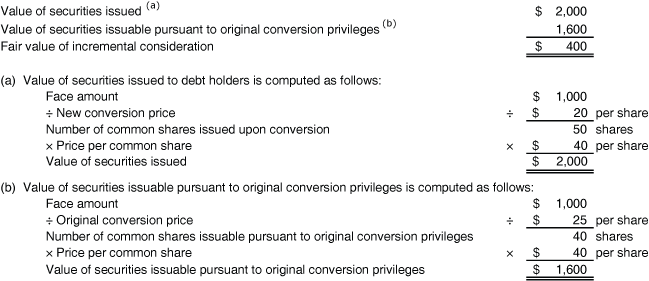 Value of securities issued (a) " $2,000 " Value of securities issuable pursuant to original conversion privileges (b) " 1,600 " Fair value of incremental consideration $400 (a) Value of securities issued to debt holders is computed as follows: Face amount " $1,000 " ÷ New conversion price ÷ $20 per share Number of common shares issued upon conversion 50 shares × Price per common share × $40 per share Value of securities issued " $2,000 " (b) Value of securities issuable pursuant to original conversion privileges is computed as follows: Face amount " $1,000 " ÷ Original conversion price ÷ $25 per share Number of common shares issuable pursuant to original conversion privileges 40 shares × Price per common share × $40 per share Value of securities issuable pursuant to original conversion privileges " $1,600 "
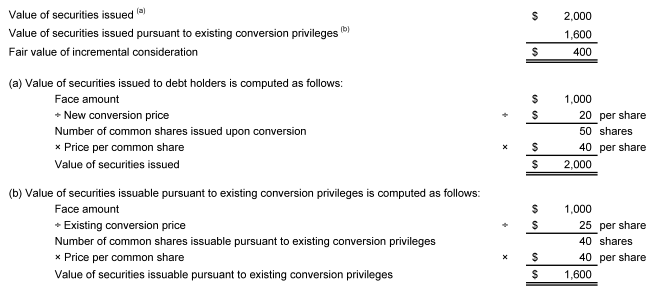 Value of securities issued (a) " $2,000 " Value of securities issuable pursuant to existing conversion privileges (b) " 1,600 " Fair value of incremental consideration $400 (a) Value of securities issued to debt holders is computed as follows: Face amount " $1,000 " ÷ New conversion price ÷ $20 per share Number of common shares issued upon conversion 50 shares × Price per common share × $40 per share Value of securities issued " $2,000 " (b) Value of securities issuable pursuant to existing conversion privileges is computed as follows: Face amount " $1,000 " ÷ Existing conversion price ÷ $25 per share Number of common shares issuable pursuant to existing conversion privileges 40 shares × Price per common share × $40 per share Value of securities issuable pursuant to existing conversion privileges " $1,600 "
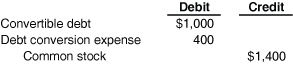 Debit Credit Convertible debt " $1,000 " Debt conversion expense 400 Common stock " $1,400 "
- Debit Credit Convertible debt " $1,000 " Debt conversion expense 400 Common stock " $1,400 "
| Editor's Note: The heading that precedes paragraph 470-20-55-6 will be amended upon transition as shown below. The content of the paragraph will not change. |
| • • > Case B: Reduced Conversion Price, Decrease in Bond Fair Value |
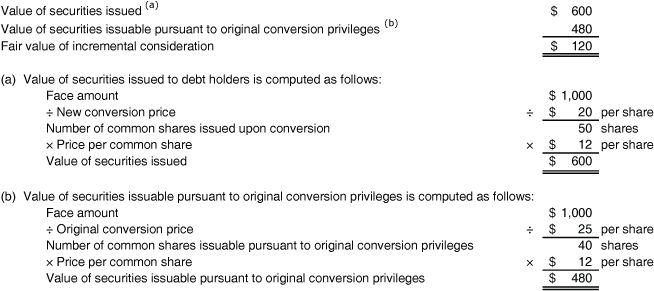 Value of securities issued (a) $600 Value of securities issuable pursuant to original conversion privileges (b) 480 Fair value of incremental consideration $120 (a) Value of securities issued to debt holders is computed as follows: Face amount " $1,000 " ÷ New conversion price ÷ $20 per share Number of common shares issued upon conversion 50 shares × Price per common share × $12 per share Value of securities issued $600 (b) Value of securities issuable pursuant to original conversion privileges is computed as follows: Face amount " $1,000 " ÷ Original conversion price ÷ $25 per share Number of common shares issuable pursuant to original conversion privileges 40 shares × Price per common share × $12 per share Value of securities issuable pursuant to original conversion privileges $480
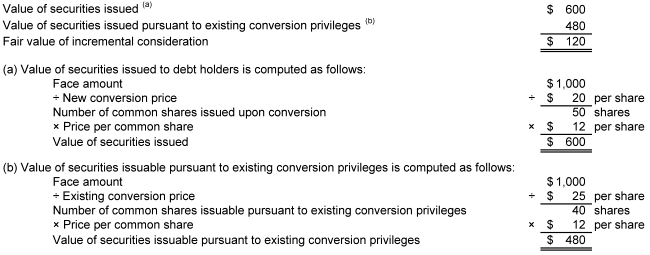 Value of securities issued (a) $600 Value of securities issuable pursuant to existing conversion privileges (b) 480 Fair value of incremental consideration $120 (a) Value of securities issued to debt holders is computed as follows: Face amount " $1,000 " ÷ New conversion price ÷ $20 per share Number of common shares issued upon conversion 50 shares × Price per common share × $12 per share Value of securities issued $600 (b) Value of securities issuable pursuant to existing conversion privileges is computed as follows: Face amount " $1,000 " ÷ Existing conversion price ÷ $25 per share Number of common shares issuable pursuant to existing conversion privileges 40 shares × Price per common share × $12 per share Value of securities issuable pursuant to existing conversion privileges $480
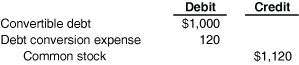 Debit Credit Convertible debt " $1,000 " Debt conversion expense 120 Common stock " $1,120 "
- Debit Credit Convertible debt " $1,000 " Debt conversion expense 120 Common stock " $1,120 "
- aA cash payment equal to 40 shares multiplied by the volume-weighted average price of Entity A’s common stock calculated over a period of 15 days (beginning the day after the holder accepts the inducement offer)
- bFive warrants (offered as a sweetener). Each warrant enables the holder to acquire a share of Entity A’s common stock at a fixed exercise price of $40. The warrants are exercisable upon issuance and expire five years after issuance.
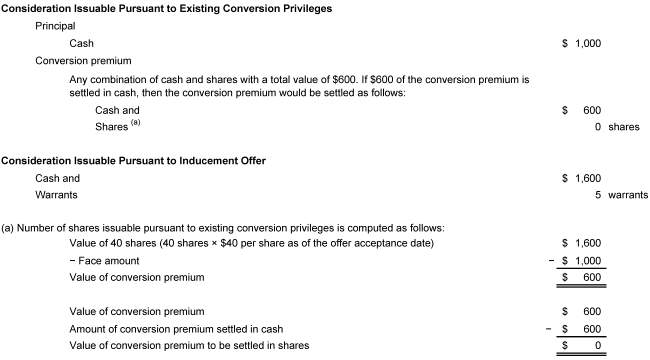 Consideration Issuable Pursuant to Existing Conversion Privileges Principal Cash " $1,000 " Conversion premium "Any combination of cash and shares with a total value of $600. If $600 of the conversion premium is settled in cash, then the conversion premium would be settled as follows:" Cash and $600 Shares (a) 0 shares Consideration Issuable Pursuant to Inducement Offer Cash and " $1,600 " Warrants 5 warrants (a) Number of shares issuable pursuant to existing conversion privileges is computed as follows: Value of 40 shares (40 shares × $40 per share as of the offer acceptance date) " $1,600 " − Face amount − " $1,000 " Value of conversion premium $600 Value of conversion premium $600 Amount of conversion premium settled in cash − $600 Value of conversion premium to be settled in shares $0
- aA cash payment of $1,400
- bTen shares of Entity A’s common stock.
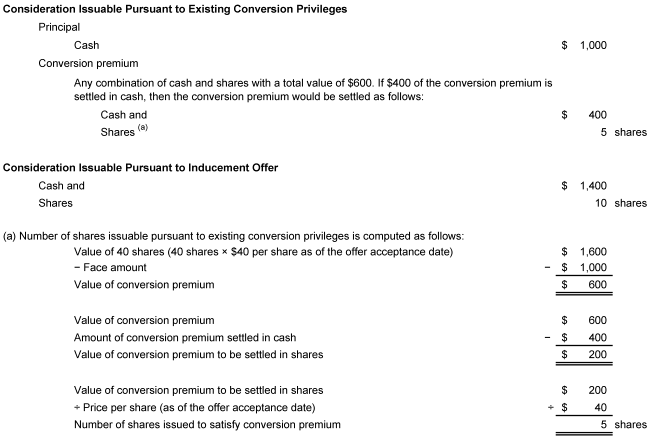 Consideration Issuable Pursuant to Existing Conversion Privileges Principal Cash " $1,000 " Conversion premium "Any combination of cash and shares with a total value of $600. If $400 of the conversion premium is settled in cash, then the conversion premium would be settled as follows:" Cash and $400 Shares (a) 5 shares Consideration Issuable Pursuant to Inducement Offer Cash and " $1,400 " Shares 10 shares (a) Number of shares issuable pursuant to existing conversion privileges is computed as follows: Value of 40 shares (40 shares × $40 per share as of the offer acceptance date) " $1,600 " − Face amount − " $1,000 " Value of conversion premium $600 Value of conversion premium $600 Amount of conversion premium settled in cash − $400 Value of conversion premium to be settled in shares $200 Value of conversion premium to be settled in shares $200 ÷ Price per share (as of the offer acceptance date) ÷ $40 Number of shares issued to satisfy conversion premium 5 shares
- aForty shares of Entity A’s common stock
- bFive warrants (offered as a sweetener). Each warrant enables the holder to acquire a share of Entity A’s common stock at a fixed exercise price of $40. The warrants are exercisable upon issuance and expire five years after issuance.
Example 9: Illustration of a Conversion of an Instrument that Becomes Convertible Upon the Issuer's Exercise of a Call Option
Example 11: Disclosure of the Information in the Statement of Financial Position
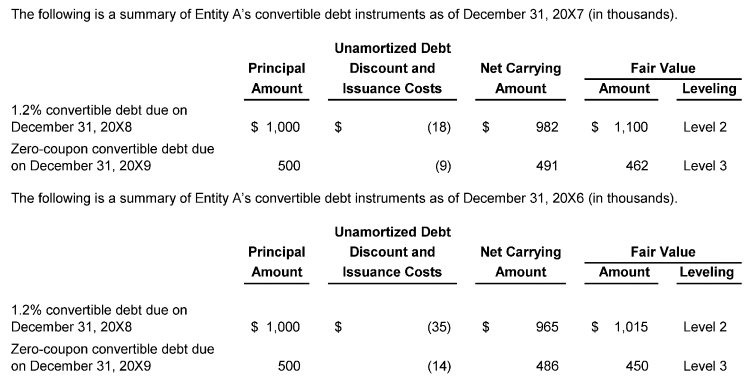 "The following is a summary of Entity A's convertible debt instruments as of December 31, 20X7 (in thousands)." Unamortized Debt Principal Discount and Net Carrying Fair Value Amount Issuance Costs Amount Amount Leveling Leveling "1.2% convertible debt due on December 31, 20X8" " $1,000 " $(18) $982 " $1,100 " Level 2 "Zero-coupon convertible debt due on December 31, 20X9" 500 (9) 491 462 Level 3 "The following is a summary of Entity A's convertible debt instruments as of December 31, 20X6 (in thousands)." Unamortized Debt Principal Discount and Net Carrying Fair Value Amount Issuance Costs Amount Amount Leveling Leveling "1.2% convertible debt due on December 31, 20X8" " $1,000 " $(35) $965 " $1,015 " Level 2 "Zero-coupon convertible debt due on December 31, 20X9" 500 (14) 486 450 Level 3
- 1.2 Percent Convertible Debt Instrument Due on December 31, 20X8
- As of December 31, 20X7, and 20X6, the net carrying amount of the convertible debt instrument was $982,000 and $965,000, respectively, with unamortized debt discount and issuance costs of $18,000 and $35,000. The estimated fair value (Level 2) of the convertible debt instrument was $1,100,000 and $1,015,000, respectively, as of December 31, 20X7, and 20X6.
- Zero-Coupon Convertible Debt Instrument Due on December 31, 20X9
- As of December 31, 20X7, and 20X6, the net carrying amount of the convertible debt instrument was $491,000 and $486,000, respectively, with unamortized debt discount and issuance costs of $9,000 and $14,000. The estimated fair value (Level 3) of the convertible debt instrument was $462,000 and $450,000, respectively, as of December 31, 20X7, and 20X6.
Example 12: Disclosure of the Information in the Statement of Financial Performance
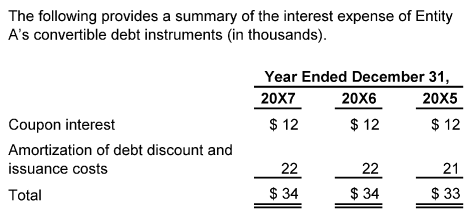 The following provides a summary of the interest expense of Entity A's convertible debt instruments (in thousands). "Year Ended December 31, " 20X7 20X6 20X5 Coupon interest $12 $12 $12 Amortization of debt discount and issuance costs 22 22 21 Total $34 $34 $33
- For the years ended December 31, 20X7, 20X6, and 20X5, the total interest expense was $34,000, $34,000, and $33,000 with coupon interest expense of $12,000 for each year and the amortization of debt discount and issuance costs of $22,000, $22,000, and $21,000, respectively.
Cash Conversion
470-20-65Transition and Open Effective Date Information
Source downloaded: .Record version 196a1dc8f8ca. Effective date must be checked in the source.
Transition Related to Accounting Standards Update No. 2024-04, <em class="ph i">Debt—Debt with Conversion and Other Options (Subtopic 470-20): Induced Conversions of Convertible Debt Instruments</em>
- aAll entities shall apply the pending content that links to this paragraph for annual reporting periods beginning after December 15, 2025, and interim reporting periods within those annual reporting periods.
- bEarly adoption of the pending content that links to this paragraph is permitted in an interim or annual reporting period in which financial statements have not yet been issued (or made available for issuance), but no earlier than the adoption of the pending content that links to paragraph 815-40-65-1. If an entity adopts the pending content that links to this paragraph in an interim reporting period, it shall adopt the pending content as of the beginning of the annual reporting period that includes that interim reporting period.
- cAn entity shall apply the pending content that links to this paragraph prospectively to settlements of convertible debt instruments that occur during annual reporting periods (and interim reporting periods within those annual reporting periods) beginning after the effective date of the pending content.
- dAn entity may elect to apply the pending content that links to this paragraph retrospectively as of the beginning of the first comparative reporting period in accordance with the guidance on accounting changes in paragraphs . This transition method shall be applied only to convertible debt instruments settled after the adoption of the pending content that links to paragraph 815-40-65-1.
- eAn entity that applies the pending content that links to this paragraph prospectively in accordance with (c) shall disclose the nature of and reason for the change in accounting principle in the financial statements of both the interim reporting period (if applicable) and the annual reporting period of the change.
- fAn entity applying the pending content that links to this paragraph retrospectively in accordance with (d) shall provide the following transition disclosures in the financial statements of both the interim reporting period (if applicable) and the annual reporting period of the change:
- 1The nature of the change in accounting principle, including an explanation of the newly adopted accounting principle
- 2The method of applying the change
- 3The cumulative effect of the change on retained earnings or other components of equity in the statement of financial position as of the beginning of the first period for which the pending content that links to this paragraph is initially applied
- 4The effect of the change on income from continuing operations, net income (or other appropriate captions of changes in the applicable net assets or performance indicator), any other affected financial statement line item, and any affected per-share amounts for any prior periods retrospectively adjusted.
- 1
470-20-S25RecognitionSEC
Source downloaded: .Record version 3a29de6605e8. Effective date must be checked in the source.
Debt Exchangeable for the Stock of Another Entity
470-20-S99SEC MaterialsSEC
Source downloaded: .Record version 1b9c17d89e91. Effective date must be checked in the source.
SEC Staff Guidance
- An issue has been discussed involving an enterprise that holds investments in common stock of other enterprises and issues debt securities that permit the holder to acquire a fixed number of shares of such common stock. These types of transactions are commonly affected through the sale of either debt with detachable warrants that can be exchanged for the stock investment or debt without detachable warrants (the debt itself must be exchanged for the stock investment - also referred to as "exchangeable" debt). Those debt issues differ from traditional warrants or convertible instruments because the traditional instruments involve exchanges for the equity securities of the issuer. There have been questions as to whether the exchangeable debt should be treated similar to traditional convertibles as specified in Subtopic 470-20 or whether the transaction requires separate accounting for the exchangeability feature. The SEC staff believes that Subtopic 470-20 does not apply to the accounting for debt that is exchangeable for the stock of another entity and therefore separation of the debt element and exchangeability feature is required