ASC 815-40
Contracts in Entity's Own Equity
815 Derivatives and Hedging
Source downloaded: .Record version 91c686d0ddf1. Effective date must be checked in the source.
ASC 815-40 governs contracts (freestanding or embedded) that are indexed to, and potentially settled in, an entity's own stock — warrants, written/purchased options, forward sale and purchase contracts, and conversion features. It supplies the two-part test for the derivative scope exception in 815-10-15-74(a): whether the instrument is "indexed to the entity's own stock" (two-step analysis in 815-40-15-7 through 15-7I) and whether it would be classified in stockholders' equity (conditions in 815-40-25-7 through 25-30). Equity-classified contracts stay in permanent equity with no remeasurement; contracts failing either part are assets or liabilities measured at fair value through earnings, with classification reassessed every balance sheet date.
Key points (7)
- Indexation is tested in two steps: Step 1 evaluates exercise contingencies, which do not preclude indexation unless based on an observable market other than the market for the issuer's stock or an observable index not measured solely by reference to the issuer's own operations (815-40-15-7A); Step 2 evaluates settlement provisions (815-40-15-7C).
- Under Step 2 an instrument is indexed to the entity's own stock if its settlement amount equals the difference between the fair value of a fixed number of shares and a fixed monetary amount, or if the only variables affecting settlement are inputs to the fair value of a fixed-for-fixed forward or option (strike price, term, dividends, stock borrow cost, interest rates, volatility, credit spread, hedgeability) (815-40-15-7D through 15-7F); a strike price denominated in a currency other than the issuer's functional currency precludes indexation (815-40-15-7I), and a down round feature is excluded from the Step 2 analysis (815-40-15-5D).
- Classification defaults: contracts requiring net cash settlement, or giving the counterparty a choice of net cash settlement, are assets or liabilities; contracts requiring physical or net share settlement, or giving the entity the choice, are equity — unless settlement alternatives lack the same economic value, in which case economic substance controls (815-40-25-1 through 25-4).
- Equity classification requires all of the conditions in 815-40-25-10: sufficient authorized and unissued shares after other commitments, an explicit share limit, no required net cash settlement if the entity fails to make timely SEC filings, and no cash-settled top-off or make-whole provisions; registered-share delivery requirements, superior counterparty rights, and collateral posting do not preclude equity classification (815-40-25-10A).
- Any provision that could require net cash settlement precludes equity classification, except where holders of the underlying shares would also receive cash (e.g., certain change-in-control or nationalization provisions) (815-40-25-7 through 25-9; 815-40-55-2 through 55-6); likelihood of the triggering event is irrelevant except for payments due only on final liquidation.
- All contracts in scope are initially measured at fair value (815-40-30-1); equity-classified contracts remain in permanent equity with no recognition of fair value changes (815-40-35-2), while asset/liability contracts are remeasured at fair value through earnings (815-40-35-4).
- Classification must be reassessed at each balance sheet date with no limit on reclassifications (815-40-35-8); reclassification out of equity adjusts stockholders' equity for the equity-period change, and prior gains/losses are not reversed on reclassification into equity (815-40-35-9 through 35-10); modifications or exchanges of freestanding equity-classified written call options are treated as an exchange of the old instrument for a new one, with the fair value effect recognized as equity issuance cost, debt discount/issuance cost, a debt modification, or a dividend (815-40-35-16 through 35-17).
For students. This is the gatekeeper for whether warrants, convertible-debt conversion features, and SPAC-style instruments sit in equity or get marked to market through earnings — a frequent source of restatements. The common misunderstanding is treating "indexed to own stock" (Section 15) and "would be classified in equity" (Section 25) as one test; both parts of the 815-10-15-74(a) scope exception must be satisfied, and any potential adjustment to the strike price or share count — however remote or within the entity's control — defeats "fixed."
Machine-generated study aid for ASC 815-40. Check the source paragraphs below.
815-40-00Status
Source downloaded: .Record version 57695a5f0752. Effective date must be checked in the source.
815-40-05Overview and Background
Source downloaded: .Record version f91d7ef73bb0. Effective date must be checked in the source.
815-40-15Scope and Scope Exceptions
Source downloaded: .Record version be4d08a6647a. Effective date must be checked in the source.
Entities
Instruments
- a
- bContracts that are issued to compensate grantees in a share-based payment arrangementwithin the scope of Topic 718
- c
- dA written put option and a purchased call option embedded in the shares of a noncontrolling interest of a consolidated subsidiary if the arrangement is accounted for as a financing under the guidance beginning in paragraph 480-10-55-53
- eFinancial instruments that are within the scope of Topic 480 (see paragraph 815-40-15-12).
Evaluating Whether an Instrument or Embedded Feature Is Considered Indexed to an Entity's Own Stock
- aEvaluate the instrument's contingent exercise provisions, if any.
- bEvaluate the instrument's settlement provisions.
- aAn observable market, other than the market for the issuer's stock (if applicable)
- bAn observable index, other than an index calculated or measured solely by reference to the issuer's own operations (for example, sales revenue of the issuer; earnings before interest, taxes, depreciation, and amortization of the issuer; net income of the issuer; or total equity of the issuer).
- aThe fair value of a fixed number of the entity's equity shares
- bA fixed monetary amount or a fixed amount of a debt instrument issued by the entity.
- aStrike price of the instrument
- bTerm of the instrument
- cExpected dividends or other dilutive activities
- dStock borrow cost
- eInterest rates
- fStock price volatility
- gThe entity's credit spread
- hThe ability to maintain a standard hedge position in the underlying shares.
- aThe instrument's settlement calculation incorporates variables other than those used to determine the fair value of a fixed-for-fixed forward or option on equity shares.
- bThe instrument contains a feature (such as a leverage factor) that increases exposure to the additional variables listed in the preceding paragraph in a manner that is inconsistent with a fixed-for-fixed forward or option on equity shares.
Other Considerations
815-40-25Recognition
Source downloaded: .Record version f15b820da5aa. Effective date must be checked in the source.
- aContracts that require net cash settlement are assets or liabilities.
- bContracts that require settlement in shares are equity instruments.
- aIf the contract provides the counterparty with a choice of net cash settlement or settlement in shares, this Subtopic assumes net cash settlement.
- bIf the contract provides the entity with a choice of net cash settlement or settlement in shares, this Subtopic assumes settlement in shares.
- aContracts shall be initially classified as either assets or liabilities in both of the following situations:
- 1Contracts that require net cash settlement (including a requirement to net cash settle the contract if an event occurs and if that event is outside the control of the entity)
- 2Contracts that give the counterparty a choice of net cash settlement or settlement in shares (physical settlement or net share settlement).
- 1
- bContracts shall be initially classified as equity in both of the following situations:
- 1Contracts that require physical settlement or net share settlement
- 2Contracts that give the entity a choice of net cash settlement or settlement in its own shares (physical settlement or net share settlement), assuming that all the criteria set forth in paragraphs and have been met.
- 1
- aAdditional conditions necessary for equity classification
- bSettlement alternatives that differ in gain and loss positions
- cApplication of additional criteria to convertible debt and other hybrid instruments
- dEffect of a registration payment arrangement.
Additional Conditions Necessary for Equity Classification
- a
- bEntity has sufficient authorized and unissued shares. The entity has sufficient authorized and unissued shares available to settle the contract after considering all other commitments that may require the issuance of stock during the maximum period the derivative instrument could remain outstanding.
- cContract contains an explicit share limit. The contract contains an explicit limit on the number of shares to be delivered in a share settlement.
- dNo required cash payment (with the exception of penalty payments) if entity fails to timely file. There is no requirement to net cash settle the contract in the event the entity fails to make timely filings with the Securities and Exchange Commission (SEC).
- eNo cash-settled top-off or make-whole provisions. There are no cash settled top-off or make-whole provisions.
- f
- g
- aWhether settlement is required in registered shares, unless the contract explicitly states that an entity must settle in cash if registered shares are unavailable. Requirements to deliver registered shares do not, by themselves, imply that an entity does not have the ability to deliver shares and, thus, do not require a contract that otherwise qualifies as equity to be classified as a liability.
- bWhether counterparty rights rank higher than shareholder rights. If the provisions of the contract indicate that the counterparty has rights that rank higher than the rights of a shareholder of the stock underlying the contract, this provision does not preclude equity classification.
- cWhether collateral is required. A provision requiring the entity to post collateral at any time for any reason does not preclude equity classification.
- aThe number of currently authorized but unissued shares, less the maximum number of shares that could be required to be delivered during the contract period under existing commitments, including any of the following:
- 1Outstanding convertible debt that is convertible during the contract period
- 2Outstanding stock options that are or will become exercisable during the contract period
- 3Other derivative financial instruments indexed to, and potentially settled in, an entity's own stock.
- 1
- bThe maximum number of shares that could be required to be delivered under share settlement (either net share or physical) of the contract.
- aThe provision can be net share settled.
- bThe maximum number of shares that could be required to be delivered under the contract (including any top-off or make-whole provisions) is both:
- 1Fixed
- 2Less than the number of available authorized shares (authorized and unissued shares less the maximum number of shares that could be required to be delivered during the contract period under existing commitments as discussed in paragraph 815-40-25-20).
- 1
Settlement Alternatives Differ in Gain and Loss Positions
- aNet cash payment required in loss position
- bNet-stock alternative in loss position.
Application of Additional Criteria to Convertible Debt Instruments and Other Hybrid Instruments
Effect of a Registration Payment Arrangement
815-40-30Initial Measurement
Source downloaded: .Record version e840d2c2e0c7. Effective date must be checked in the source.
815-40-35Subsequent Measurement
Source downloaded: .Record version 5a86877d4ddf. Effective date must be checked in the source.
Overall
- aContracts that require that the entity deliver shares as part of a physical settlement or a net share settlement
- bContracts that give the entity a choice of either of the following:
- 1Net cash settlement or settlement in shares (including net share settlement and physical settlement that requires that the entity deliver shares)
- 2Either net share settlement or physical settlement that requires that the entity deliver cash.
- 1
Settlement Assumptions
- aNet share settlement
- bPhysical settlement that may require that the entity deliver cash.
- aNet share settlement
- bPhysical settlement that may require that the entity deliver cash.
Reclassification of Contracts
- aPartial reclassification of all contracts on a proportionate basis
- bReclassification of contracts with the earliest inception date first
- cReclassification of contracts with the earliest maturity date first
- dReclassification of contracts with the latest inception or maturity date first
- eReclassification of contracts with the latest maturity date first.
Issuer's Accounting for Modifications or Exchanges of Freestanding Equity-Classified Written Call Options
- aEquity issuance. An entity shall recognize the effect of a modification or an exchange that is directly attributable to a proposed or actual equity offering as an equity issuance cost. For additional guidance see SAB Topic 5.A, Expenses of Offering (paragraph 340-10-S99-1).
- bDebt origination. An entity shall recognize the effect of a modification or an exchange that is a part of or directly related to an issuance of a debt instrument as a debt discount or debt issuance cost in accordance with the guidance in Topic 835 on interest.
- cDebt modification. An entity shall recognize the effect of a modification or an exchange that is a part of or directly related to a modification or an exchange of an existing debt instrument in accordance with the guidance in Subtopic 470-50 on debt modifications and extinguishments and Subtopic 470-60 on troubled debt restructurings by debtors.
- dOther. An entity shall recognize the effect of a modification or an exchange that is not related to a financing transaction in (a) through (c) and is not within the scope of any other Topics (such as Topic 718) as a dividend. Additionally, for an entity that presents earnings per share (EPS) in accordance with Topic 260, that effect shall be treated as a reduction of income available to common stockholders in basic earnings per share in accordance with the guidance in paragraph 260-10-45-15.
815-40-40Derecognition
Source downloaded: .Record version 38394e5f45ec. Effective date must be checked in the source.
815-40-50Disclosure
Source downloaded: .Record version 319aedb64b1d. Effective date must be checked in the source.
- aInformation about the terms and features of contracts in an entity's own equity within the scope of this Subtopic
- bHow those instruments have been reflected in the issuer's statement of financial position and statement of financial performance
- cInformation about events, conditions, and circumstances that can affect how to assess the amount or timing of an entity's future cash flows but has not yet been reflected in the financial statements.
Fair Value Disclosures
Reclassifications and Related Accounting Policy Disclosures
Interaction with Disclosures about Capital Structure
- aIn the case of an option or forward contract indexed to the issuer's equity, the pertinent information to be disclosed under Section 505-10-50 about the contract includes all of the following:
- 1The forward rate
- 2The option strike price
- 3The number of issuer's shares to which the contract is indexed
- 4The settlement date or dates of the contract
- 5The issuer's accounting for the contract (that is, as an asset, liability, or equity).
- 1
- bIf the terms of the contract provide settlement alternatives, those settlement alternatives shall be disclosed under Section 505-10-50, including all of the following:
- 1Who controls the settlement alternatives and a description of those alternatives
- 2The maximum number of shares that could be required to be issued to net share settle a contract, if applicable. Paragraph 505-10-50-3 requires additional disclosures for actual issuances and settlements that occurred during the accounting period.
- 1
- cIf a contract does not have a fixed or determinable maximum number of shares that may be required to be issued, the fact that a potentially infinite number of shares could be required to be issued to settle the contract shall be disclosed under Section 505-10-50.
- dFor each settlement alternative, the amount that would be paid, or the number of shares that would be issued and their fair value, determined under the conditions specified in the contract if the settlement were to occur at the reporting date and how changes in the fair value of the issuer's equity shares affect those settlement amounts (for example, the issuer is obligated to issue an additional X shares or pay an additional Y dollars in cash for each $1 decrease in the fair value of one share) shall be disclosed under Section 505-10-50. (For some issuers, a tabular format may provide the most concise and informative presentation of these data.)
- eThe disclosures required by paragraph 505-10-50-11 shall be made for any equity instrument in the scope of this Subtopic that is (or would be if the issuer were a public entity) classified as temporary equity. (That paragraph applies to redeemable stock issued by nonpublic entities, regardless of whether the private entity chooses to classify those securities as temporary equity.)
- fThe disclosures required by paragraph 505-10-50-18 also shall be made for an equity-classified contract within the scope of this Subtopic that is entered into in connection with the issuance of convertible preferred stock.
Issuer's Accounting for Modifications or Exchanges of Freestanding Equity-Classified Written Call Options
- aInformation about the nature of the modification or exchange transaction (see paragraph 815-40-35-15)
- bThe amount of the effect of the modification or exchange (see paragraph 815-40-35-16)
- cThe manner in which the effect of the modification or exchange has been recognized (see paragraph 815-40-35-17).
815-40-55Implementation Guidance and Illustrations
Source downloaded: .Record version 8c7a5cbccfbd. Effective date must be checked in the source.
Implementation Guidance
- a
- bForward sale contracts, written call options or warrants, and purchased put options
- cPurchased call options
- dDetachable stock purchase warrants
- ePut warrants.
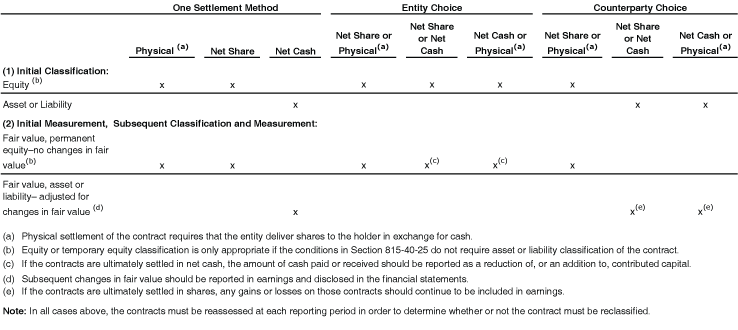 One Settlement Method Entity Choice Counterparty Choice Physical (a) Net Share Net Cash Net Share or Physical(a) Net Share or Net Cash Net Cash or Physical(a) Net Share or Physical(a) Net Share or Net Cash Net Cash or Physical(a) (1) Initial Classification: Equity (b) x x x x x x Asset or Liability x x x "(2) Initial Measurement, Subsequent Classification and Measurement:" "Fair value, permanent equity-no changes in fair value(b)" x x x x(c) x(c) x "Fair value, asset or liability- adjusted for changes in fair value (d)" x x(e) x(e) (a) Physical settlement of the contract requires that the entity deliver shares to the holder in exchange for cash. (b) Equity or temporary equity classification is only appropriate if the conditions in Section 815-40-25 do not require asset or liability classification of the contract. (c) "If the contracts are ultimately settled in net cash, the amount of cash paid or received should be reported as a reduction of, or an addition to, contributed capital." (d) Subsequent changes in fair value should be reported in earnings and disclosed in the financial statements. (e) "If the contracts are ultimately settled in shares, any gains or losses on those contracts should continue to be included in earnings." "Note: In all cases above, the contracts must be reassessed at each reporting period in order to determine whether or not the contract must be reclassified."
- aExercise the warrant feature to acquire the common stock of the entity at a specified price
- bExercise the put option feature to put the instrument back to the entity for a cash payment
- cExercise both the warrant feature to acquire the common stock and the put option feature to put that stock back to the entity for a cash payment.
Illustrations
- aStep 1. The exercise contingency (that is, the initial public offering) is not an observable market or an observable index, so the evaluation of Step 1 does not preclude the warrants from being considered indexed to the entity's own stock. Proceed to Step 2.
- bUpon exercise, the settlement amount would equal the difference between the fair value of a fixed number of the entity's equity shares (100 shares) and a fixed strike price ($10 per share).
- aStep 1. The exercise contingency (that is, the accumulation of $100 million in sales to third parties) is an observable index. However, it can only be calculated or measured by reference to Entity A's sales, so the evaluation of Step 1 does not preclude the warrants from being considered indexed to the entity's own stock. Proceed to Step 2.
- bStep 2. Upon exercise, the settlement amount would equal the difference between the fair value of a fixed number of the entity's equity shares (100 shares) and a fixed strike price ($10 per share).
- aStep 1. The exercise contingency (that is, the increase of 500 points in Standard & Poor's S&P 500 Index) is based on an observable index that is not measured solely by reference to the issuer's own operations.
- bStep 2. It is not necessary to evaluate Step 2.
- aStep 1. The exercise contingency (that is, the initial public offering) is not an observable market or an observable index, so the evaluation of Step 1 does not preclude the warrants from being considered indexed to the entity's own stock. Proceed to Step 2.
- bStep 2. The settlement amount would not equal the difference between the fair value of a fixed number of the entity's equity shares (100 shares) and a fixed strike price. Although the number of shares that would be issued at settlement is fixed, the strike price varies based on the price of one ounce of gold. The price of gold is not an input to the fair value of a fixed-for-fixed option on equity shares.
- aStep 1. The instruments do not contain an exercise contingency. Proceed to Step 2.
- bStep 2. The settlement amount would equal the difference between the fair value of a fixed number of the entity's equity shares (100 shares) and a fixed strike price ($10 per share), unless there is a merger announcement. If there is a merger announcement, the settlement amount would be adjusted to offset the effect of the merger announcement on the fair value of the warrants. In that circumstance, the only variables that could affect the settlement amount would be inputs to the fair value of a fixed-for-fixed option on equity shares. For further discussion, see paragraphs 815-40-15-7E and 815-40-15-7G.
- aStep 1. The instruments do not contain an exercise contingency. Proceed to Step 2.
- bStep 2. The settlement amount would not equal the difference between the fair value of a fixed number of the entity's equity shares (100 shares) and a fixed strike price. Although the number of shares that would be issued at settlement is fixed, the strike price would be adjusted after any year in which Entity A does not achieve revenues of at least $100 million. The amount of an entity's annual revenues is not an input to the fair value of a fixed-for-fixed option on equity shares.
- aStep 1. The instruments do not contain an exercise contingency. Proceed to Step 2.
- bStep 2. The settlement amount would equal the difference between the fair value of a fixed number of the entity's equity shares (100 shares) and a fixed strike price when Entity A's stock price is between the $10 stated exercise price and the $15 price cap. However, whenever Entity A's stock price exceeds $15, the strike price of the call options increases and decreases in amounts equal to the corresponding increases and decreases in Entity A's stock price, such that the intrinsic value of each call option always equals $5. Because the only variable that can affect the settlement amount is the entity's stock price, which is an input to the fair value of a fixed-for-fixed option contract, the call options are considered indexed to the entity's own stock.
- aIf the entity sells shares of its common stock for an amount less than $10 per share, the strike price of the warrants is reduced to equal the issuance price of those shares.
- bIf the entity issues an equity-linked financial instrument with a strike price below $10 per share, the strike price of the warrants is reduced to equal the strike price of the newly issued equity-linked financial instrument.
- aStep 1. The instruments do not contain an exercise contingency. Proceed to Step 2.
- bStep 2. In accordance with paragraph 815-40-15-5D, when classifying a financial instrument with a down round feature, an entity shall exclude that feature when considering whether the instrument is indexed to the entity's own stock for the purposes of applying paragraphs (Step 2). The instrument does not contain any other features to be assessed under Step 2.
- aStep 1. The instruments do not contain an exercise contingency. Proceed to Step 2.
- bStep 2. The settlement amount would equal the difference between the fair value of a fixed number of the entity's equity shares (100 shares) and a fixed strike price ($10 per share), unless regulatory approval of a particular drug compound is not obtained within 5 years. If that approval is not obtained within the allotted time period, the holder could elect to surrender the warrants to Entity A in exchange for $2 per warrant. The contingent obligation to settle the warrants by transferring consideration with a fixed monetary value if regulatory approval of a particular drug compound is not obtained within a specified time period does not represent an input to the fair value of a fixed-for-fixed option on equity shares. A freestanding equity-linked instrument that provides for a fixed payoff upon the occurrence of a contingent event which is not based on the issuer's share price is not indexed to an entity's own stock.
- aStep 1. The instruments do not contain an exercise contingency. Proceed to Step 2.
- bStep 2. The strike price of the warrants is denominated in a currency other than the entity's functional currency, so the warrants are not considered indexed to the entity's own stock.
- aStep 1. The instrument does not contain an exercise contingency. Proceed to Step 2.
- bStep 2. The only circumstances in which the settlement amount will not equal the difference between the fair value of 100 shares and $1,000 ($10 per share) are if dividends per common share differ from $0.10 during any 3-month period or if there is an increased cost of borrowing Entity A's shares in the stock loan market. The adjustments to the strike price resulting from those events are intended to offset their effects on the instrument's fair value. In those circumstances, the only variables that could affect the settlement amount (dividends and stock borrow cost) would be inputs to the fair value of a fixed-for-fixed forward contract on equity shares.
- aStep 1. The instrument does not contain an exercise contingency. Proceed to Step 2.
- bStep 2. The settlement amount will not equal the difference between the fair value of a fixed number of the entity's equity shares (100 shares) and a fixed strike price. However, the only variables that cause the settlement amount to differ from a fixed-for-fixed settlement amount are the 30-day volume-weighted average daily market price of Entity A's common stock and an interest rate index. The pricing inputs of a fixed-for-fixed forward contract include the entity's stock price and interest rates. Additionally, the floating interest rate feature does not introduce a leverage factor or otherwise increase the effects of interest rate changes on the instrument's fair value.
- aStep 1. The instrument does not contain an exercise contingency. Proceed to Step 2.
- bStep 2. The settlement amount will not equal the difference between the fair value of a fixed number of the entity's equity shares (100 shares) and a fixed strike price. Although the number of shares that would be issued at settlement is fixed, the strike price varies inversely with changes in an interest rate index. The inverse floating interest rate feature increases the effects of interest rate changes on the instrument's fair value (that is, the feature increases the instrument's fair value exposure to interest rate changes) when compared to the exposure to interest rate changes of a fixed-for-fixed forward contract.
- aStep 1. The instrument does not contain an exercise contingency. Proceed to Step 2.
- bStep 2. The settlement amount would equal the difference between the fair value of a fixed number of the entity's equity shares (100 shares) and a fixed strike price ($1,000) when Entity A's stock price is between $5 and $15. However, whenever Entity A's stock price is greater than or equal to $15 at maturity, the amount payable to the counterparty always equals $500. Additionally, whenever Entity A's stock price is less than or equal to $5 at maturity, the amount receivable from the counterparty always equals $500. Because the only variable that can affect the settlement amount is the entity's stock price, which is an input to the fair value of a fixed-for-fixed forward contract, the instrument is considered indexed to the entity's own stock.
- aStep 1. The instrument does not contain an exercise contingency. Proceed to Step 2.
- bStep 2. The settlement amount will not equal the difference between the fair value of a fixed number of the entity's equity shares and a fixed strike price ($1,000). Although the strike price to be received at settlement is fixed, the number of shares to be issued to the counterparty varies based on the entity's stock price on the settlement date. Because the only variable that can affect the settlement amount is the entity's stock price, which is an input to the fair value of a fixed-for-fixed forward contract on equity shares, the instrument is considered indexed to the entity's own stock.
- aDistributes a stock dividend or ordinary cash dividend
- bExecutes a stock split, spinoff, rights offering, or recapitalization through a large, nonrecurring cash dividend
- cIssues shares for an amount below the then-current market price
- dRepurchases shares for an amount above the then-current market price.
- aStep 1. The instrument does not contain an exercise contingency. Proceed to Step 2.
- bStep 2. The only circumstances in which the settlement amount will not equal the difference between the fair value of 100 shares and $1,000 ($10 per share) are upon the occurrence of any of the following:
- 1The distribution of a stock dividend or ordinary cash dividend
- 2The execution of a stock split, spinoff, rights offering, or recapitalization through a large, nonrecurring cash dividend
- 3The issuance of shares for an amount below the then-current market price
- 4The repurchase of shares for an amount above the then-current market price.
- 1
- aStep 1. The instrument does not contain an exercise contingency. Proceed to Step 2.
- bStep 2. The strike price of the forward contract is denominated in a currency other than the entity's functional currency, so the forward contract is not considered indexed to the entity's own stock.
- aEntity A's stock price exceeds $13 per share (market price trigger).
- bThe convertible debt instrument trades for an amount that is less than 98 percent of its if-converted value (parity provision).
- cThere is an announcement of a merger involving Entity A.
- aStep 1. The market price trigger and parity provision exercise contingencies are based on observable markets; however, those contingencies relate solely to the market prices of the entity's own stock and its own convertible debt. Also, the merger announcement exercise contingency is not an observable market or an index. Therefore, Step 1 does not preclude the warrants from being considered indexed to the entity's own stock. Proceed to Step 2.
- bStep 2. An acquisition for cash before the specified date is the only circumstance in which the settlement amount will not equal the difference between the fair value of 100 shares and a fixed strike price ($1,000 fixed par value of the debt). The settlement amount if Entity A is acquired for cash before the specified date is equal to the sum of the fixed conversion ratio (100 shares per bond) and the make-whole shares. The number of make-whole shares is determined based on a table with axes of stock price and time, which would both be inputs in a fair value measurement of a fixed-for-fixed option on equity shares.
- aStep 1. The embedded conversion option does not contain an exercise contingency. Proceed to Step 2.
- bStep 2. Upon exercise of the embedded conversion option, the settlement amount would equal the difference between the fair value of a fixed number of the entity's equity shares (100 shares) and a fixed strike price denominated in its functional currency (CNY 1,000 fixed par value of the debt). The determination of whether the embedded conversion option is indexed to the entity's own stock is not affected by the currency (or currencies) in which the underlying shares trade.
- aStep 1. The analysis of the exercise contingency (or contingencies) depends on the particular terms and features of the instrument. However, as indicated in Step 2 below, a market-based stock option valuation instrument would not be considered indexed to the entity's own stock.
- bStep 2. The settlement amount will not equal the difference between the fair value of a fixed number of the entity's equity shares and a fixed strike price. The instrument provides for variable quarterly payments to investors that are based on actual stock option exercises for the period. Because a variable that affects the instrument's settlement amount is stock option exercise behavior, which is not an input to the fair value of a fixed-for-fixed option or forward contract on equity shares, the instrument is not considered indexed to the entity's own stock.
815-40-65Transition and Open Effective Date Information
Source downloaded: .Record version 08c4113bea96. Effective date must be checked in the source.
815-40-S50DisclosureSEC
Source downloaded: .Record version 13bf7967942d. Effective date must be checked in the source.