ASC 210-20
Offsetting
210 Balance Sheet
Source downloaded: .Record version 82473ddfffb7. Effective date must be checked in the source.
ASC 210-20 states the general principle that offsetting assets and liabilities on the balance sheet is improper unless a right of setoff exists, and sets the four conditions for a right of setoff (210-20-45-1): two parties owe each other determinable amounts, the reporting party has the right to set off, intends to set off, and the right is enforceable at law (including in bankruptcy). It also provides a narrow exception permitting (but not requiring) offsetting of payables and receivables under same-counterparty, same-settlement-date repurchase and reverse repurchase agreements accounted for as collateralized borrowings that meet all conditions in 210-20-45-11, and it imposes extensive netting disclosures for derivatives, repos/reverse repos, and securities borrowing/lending subject to enforceable master netting arrangements.
Key points (7)
- Offsetting is improper unless a right of setoff exists; all four conditions of 210-20-45-1 must be met (mutual determinable amounts owed, right to set off, intent to set off, and enforceability at law), and a debtor with a valid right of setoff may report the net amount (210-20-45-2).
- Ability to set off is not enough: if the reporting party does not intend to set off, net presentation is not representationally faithful (210-20-45-4); intent is evidenced by management's acknowledgment and, if applicable, demonstrated execution of setoff in similar situations (210-20-45-5).
- 'Enforceable at law' means the right should be upheld in bankruptcy; offsetting is appropriate only if all available positive and negative evidence gives reasonable assurance the right would be upheld in bankruptcy, considering state law and the U.S. Bankruptcy Code (210-20-45-8 and 45-9).
- Cash or other assets generally may not be offset against taxes or other amounts owed to governmental bodies, except where the purchase of tax-acceptable government securities is in substance a prepayment of taxes payable in the near future (210-20-45-6 through 45-7).
- Notwithstanding the intent condition, an entity may elect to offset repo payables against reverse repo receivables accounted for as collateralized borrowings only if all conditions of 210-20-45-11 are met (same counterparty, same explicit settlement date, master netting arrangement, book entry securities, qualifying securities transfer system and banking arrangements, and same settlement account); the election must be applied consistently and net receivables may not be offset against net payables (210-20-45-12).
- Where maturities differ, only the party with the nearer maturity may offset (210-20-45-3); the general two-party setoff principle is not modified by the specialized offsetting regimes listed in 210-20-15-3 (e.g., 715-30, 715-60, 740-10, 815-10-45-1 through 45-7, 842-50).
- Entities must disclose, in tabular format separately for assets and liabilities, gross amounts, amounts offset, net amounts presented, amounts subject to an enforceable master netting arrangement not otherwise offset (including financial and cash collateral), and the resulting net amount (210-20-50-3 and 50-4), plus a description of the nature of the rights of setoff (210-20-50-5).
For students. Balance sheet netting materially shrinks reported assets and liabilities for financial institutions, so examiners love the four-part test in 210-20-45-1. The most common mistake is assuming a master netting agreement alone permits offsetting — it does not; you still need intent plus legal enforceability (including in bankruptcy), except for the narrow repo/reverse repo election in 210-20-45-11 and the derivative collateral rules in 815-10-45.
Machine-generated study aid for ASC 210-20. Check the source paragraphs below.
210-20-00Status
Source downloaded: .Record version 1638ada1f70e. Effective date must be checked in the source.
210-20-05Overview and Background
Source downloaded: .Record version 17bb9a2f7cc6. Effective date must be checked in the source.
Repurchase and Reverse Repurchase Agreements
210-20-15Scope and Scope Exceptions
Source downloaded: .Record version 80eb74e3a5d1. Effective date must be checked in the source.
Entities
Transactions
- aThe derecognition or nonrecognition of assets and liabilities. Derecognition by sale of an asset or extinguishment of a liability results in removal of a recognized asset or liability and generally results in the recognition of gain or loss. Although conceptually different, offsetting that results in a net amount of zero and derecognition with no gain or loss are indistinguishable in their effects on the statement of financial position. Likewise, not recognizing assets and liabilities of the same amount in financial statements achieves similar reported results.
Other Considerations
- a Subtopic 842-50 (leveraged leases)
- b Subtopic 715-30 (accounting for pension plan assets and liabilities)
- c Subtopic 715-60 (accounting for plan assets and liabilities)
- d Subtopic 740-10 (net tax asset or liability amounts reported)
- dd Paragraphs (derivative instruments with the right to reclaim cash collateral or the obligation to return cash collateral)
- e
- f Paragraph 942-210-45-3A (reciprocal balances with other banks).
210-20-45Other Presentation Matters
Source downloaded: .Record version 1004ee2ebd55. Effective date must be checked in the source.
Right of Setoff Conditions
- a Each of two parties owes the other determinable amounts.
- b The reporting party has the right to set off the amount owed with the amount owed by the other party.
- c The reporting party intends to set off.
- d The right of setoff is enforceable at law.
Offsetting Securities Against Taxes Payable
Assurance that Right of Setoff Is Enforceable in a Bankruptcy
Repurchase and Reverse Repurchase Agreements
- a The repurchase and reverse repurchase agreements are executed with the same counterparty.
- b The repurchase and reverse repurchase agreements have the same explicit settlement date specified at the inception of the agreement.
- c The repurchase and reverse repurchase agreements are executed in accordance with a master netting arrangement.
- d The securities underlying the repurchase and reverse repurchase agreements exist in book entry form and can be transferred only by means of entries in the records of the transfer system operator or securities custodian. Book entry securities meeting the criterion in this paragraph exist only as items in accounting records maintained by a transfer system operator. This requirement does not preclude offsetting of securities held in book entry form solely because other securities of the same issue exist in other forms.
- e The repurchase and reverse repurchase agreements will be settled on a securities transfer system that operates in the manner described in paragraphs , and the entity must have associated banking arrangements in place as described in those paragraphs. Cash settlements for securities transferred shall be made under established banking arrangements that provide that the entity will need available cash on deposit only for any net amounts that are due at the end of the business day. It must be probable that the associated banking arrangements will provide sufficient daylight overdraft or other intraday credit at the settlement date for each of the parties. The term probable is used in this Subtopic consistent with its use in paragraph 450-20-25-1 to mean that a transaction or event is likely to occur.
- f The entity intends to use the same account at the clearing bank or other financial institution at the settlement date in transacting both the cash inflows resulting from the settlement of the reverse repurchase agreement and the cash outflows in settlement of the offsetting repurchase agreement.
Securities Transfer System
210-20-50Disclosure
Source downloaded: .Record version dc5415a4bd3a. Effective date must be checked in the source.
Offsetting of Derivatives, Repurchase Agreements, and Securities Lending Transactions
- a
- b
- cRecognized derivative instruments accounted for in accordance with Topic 815, including bifurcated embedded derivatives, repurchase agreements accounted for as collateralized borrowings and reverse repurchase agreements, and securities borrowing and securities lending transactions that are offset in accordance with either Section 210-20-45 or Section 815-10-45
- dRecognized derivative instruments accounted for in accordance with Topic 815, including bifurcated embedded derivatives, repurchase agreements and reverse repurchase agreements, and securities borrowing and securities lending transactions that are subject to an enforceable master netting arrangement or similar agreement, irrespective of whether they are offset in accordance with either Section 210-20-45 or Section 815-10-45.
- a
- b
- cRecognized derivative instruments accounted for in accordance with Topic 815, including bifurcated embedded derivatives, repurchase agreements accounted for as collateralized borrowings and reverse repurchase agreements, and securities borrowing and securities lending transactions that are offset in accordance with either Section 210-20-45 or Section 815-10-45
- dRecognized derivative instruments accounted for in accordance with Topic 815, including bifurcated embedded derivatives, repurchase agreements and reverse repurchase agreements, and securities borrowing and securities lending transactions that are subject to an enforceable master netting arrangement or similar agreement, irrespective of whether they are offset in accordance with either Section 210-20-45 or Section 815-10-45.
- aThe gross amounts of those recognized assets and those recognized liabilities
- b
- cThe net amounts presented in the statement of financial position
- dThe amounts subject to an enforceable master netting arrangement or similar agreement not otherwise included in (b):
- 1The amounts related to recognized financial instruments and other derivative instruments that either:
- iManagement makes an accounting policy election not to offset.
- ii
- i
- 2The amounts related to financial collateral (including cash collateral).
- 1
- eThe net amount after deducting the amounts in (d) from the amounts in (c).
- aThe gross amounts of those recognized assets and those recognized liabilities
- b
- cThe net amounts presented in the statement of financial position
- dThe amounts subject to an enforceable master netting arrangement or similar agreement not otherwise included in (b):
- 1The amounts related to recognized financial instruments and other derivative instruments that either:
- iManagement makes an accounting policy election not to offset.
- ii
- i
- 2The amounts related to financial collateral (including cash collateral).
- 1
- eThe net amount after deducting the amounts in (d) from the amounts in (c).
210-20-55Implementation Guidance and Illustrations
Source downloaded: .Record version 4f68777ea67e. Effective date must be checked in the source.
Implementation Guidance
Illustrations
- a Counterparty A:
- 1 The reporting entity has a derivative asset (fair value of $100 million) and a derivative liability (fair value of $80 million) with Counterparty A. Assume that the entity qualifies for and makes an accounting policy election to offset in accordance with Section 815-10-45. Cash collateral also has been received from Counterparty A for a portion of the net derivative asset ($10 million). The derivative liability and the cash collateral received are set off against the derivative asset in the statement of financial position, resulting in the presentation of a net derivative asset of $10 million.
- 1
- b Counterparty B:
- 1 The reporting entity had entered into a sale and repurchase agreement with Counterparty B that is accounted for as a collateralized borrowing. The carrying value of the financial asset (bonds) used as collateral and held by the reporting entity for the transaction is $79 million, and their fair value is $85 million. The carrying value of the collateralized borrowing (repo payable) is $80 million.
- 2 The reporting entity also has entered into a reverse sale and repurchase agreement with Counterparty B that is accounted for as a collateralized lending. The fair value of the asset (bonds) received as collateral (and not recognized in the statement of financial position) is $105 million. The carrying value of the secured lending (reverse repo receivable) is $90 million.
- 3 Assume that the transactions are not offset.
- 1
-
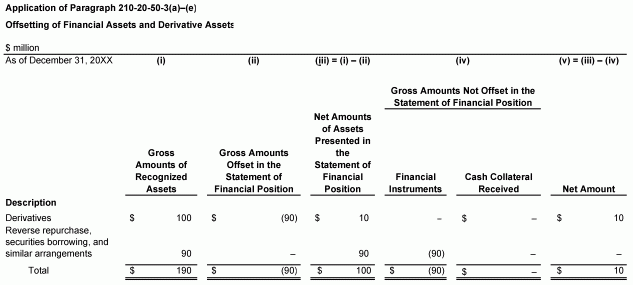 Application of Paragraph 210-20-50-3(a)-(e) Offsetting of Financial Assets and Derivative Assets $ million "As of December 31, 20XX " (i) (ii) (iii) = (i) - (ii) (iv) (v) = (iii) - (iv) Gross Amounts Not Offset in the Statement of Financial Position Gross Amounts of Recognized Assets Gross Amounts Offset in the Statement of Financial Position Net Amounts of Assets Presented in the Statement of Financial Position Financial Instruments Cash Collateral Received Net Amount Description Derivatives $100 $(90) $10 $ - $ - $10 "Reverse repurchase, securities borrowing, and similar arrangements " 90 - 90 (90) - - Total $190 $(90) $100 $(90) $ - $10
-
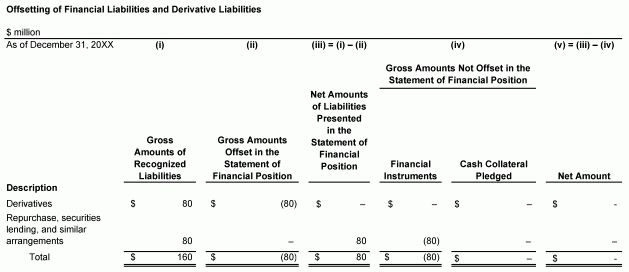 Offsetting of Financial Liabilities and Derivative Liabilities $ million "As of December 31, 20XX " (i) (ii) (iii) = (i) - (ii) (iv) (v) = (iii) - (iv) Gross Amounts Not Offset in the Statement of Financial Position Gross Amounts of Recognized Liabilities Gross Amounts Offset in the Statement of Financial Position "Net Amounts of Liabilities Presented in the Statement of Financial Position" Financial Instruments Cash Collateral Pledged Net Amount Description Derivatives $80 $(80) $ - $ - $ - $- "Repurchase, securities lending, and similar arrangements" 80 - 80 (80) - - Total $160 $(80) $80 $(80) $ - $-
-
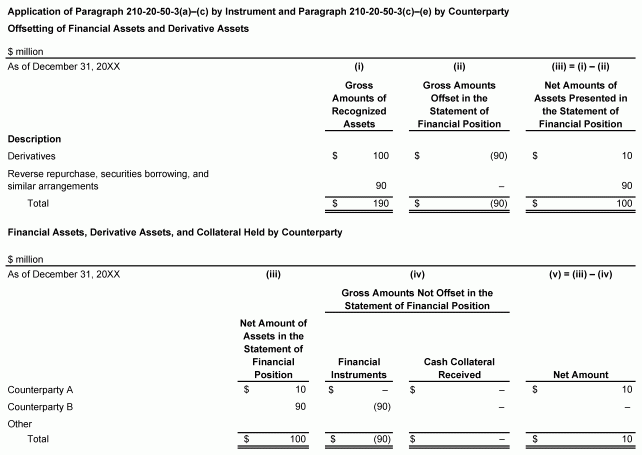 Application of Paragraph 210-20-50-3(a)-(c) by Instrument and Paragraph 210-20-50-3(c)-(e) by Counterparty Offsetting of Financial Liabilities and Derivative Liabilities $ million "As of December 31, 20XX" (i) (ii) (iii) = (i) - (ii) Gross Amounts of Recognized Liabilities Gross Amounts Offset in the Statement of Financial Position Net Amounts of Liabilities Presented in the Statement of Financial Position Description Derivatives $80 $(80) $ - "Repurchase, securities lending, and similar arrangements" 80 - 80 Total $160 $(80) $80 "Financial Liabilities, Derivative Liabilities, and Collateral Pledged by Counterparty " $ million "As of December 31, 20XX" (iii) (iv) (v) = (iii) - (iv) Gross Amounts Not Offset in the Statement of Financial Position Net Amounts of Liabilities Presented in the Statement of Financial Position Financial Instruments "Cash Collateral Pledged" Net Amount Counterparty A $ - $ - $ - $ - Counterparty B 80 (80) - - Other Total $80 $(80) $ - $ -
-
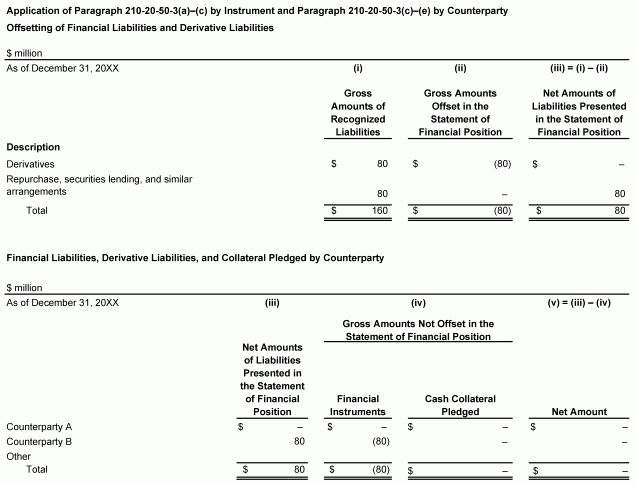 Application of Paragraph 210-20-50-3(a)-(c) by Instrument and Paragraph 210-20-50-3(c)-(e) by Counterparty Offsetting of Financial Assets and Derivative Assets $ million "As of December 31, 20XX" (i) (ii) (iii) = (i) - (ii) Gross Amounts of Recognized Assets Gross Amounts Offset in the Statement of Financial Position Net Amounts of Assets Presented in the Statement of Financial Position Description Derivatives $100 $(90) $10 "Reverse repurchase, securities borrowing, and similar arrangements" 90 - 90 Total $190 $(90) $100 "Financial Assets, Derivative Assets, and Collateral Held by Counterparty " $ million "As of December 31, 20XX" (iii) (iv) (v) = (iii) - (iv) Gross Amounts Not Offset in the Statement of Financial Position Net Amount of Assets in the Statement of Financial Position Financial Instruments "Cash Collateral Received" Net Amount Counterparty A $10 $ - $ - $10 Counterparty B 90 (90) - - Other Total $100 $(90) $ - $10
-
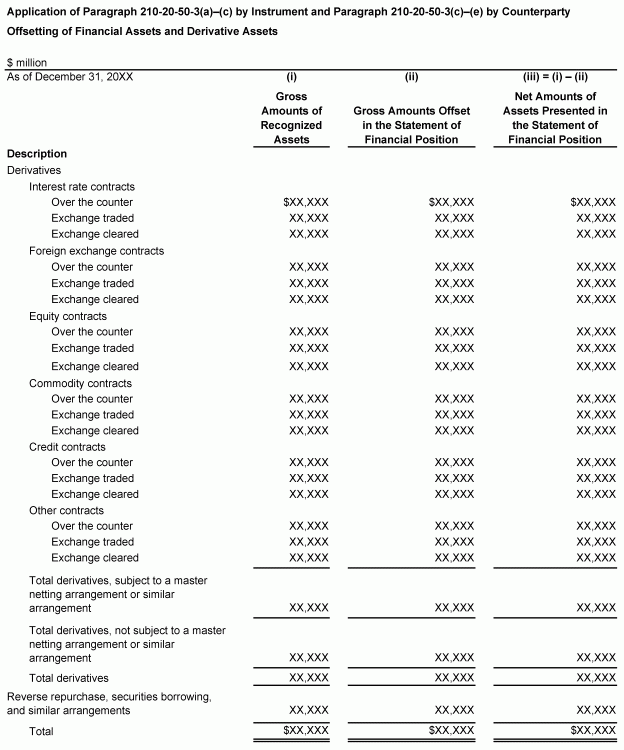 Application of Paragraph 210-20-50-3(a)-(c) by Instrument and Paragraph 210-20-50-3(c)-(e) by Counterparty Offsetting of Financial Assets and Derivative Assets $ million "As of December 31, 20XX" (i) (ii) (iii) = (i) - (ii) Gross Amounts of Recognized Assets Gross Amounts Offset in the Statement of Financial Position Net Amounts of Assets Presented in the Statement of Financial Position Description Derivatives Interest rate contracts Over the counter " $XX,XXX " " $XX,XXX " " $XX,XXX " Exchange traded " XX,XXX " " XX,XXX " " XX,XXX " Exchange cleared " XX,XXX " " XX,XXX " " XX,XXX " Foreign exchange contracts Over the counter " XX,XXX " " XX,XXX " " XX,XXX " Exchange traded " XX,XXX " " XX,XXX " " XX,XXX " Exchange cleared " XX,XXX " " XX,XXX " " XX,XXX " Equity contracts Over the counter " XX,XXX " " XX,XXX " " XX,XXX " Exchange traded " XX,XXX " " XX,XXX " " XX,XXX " Exchange cleared " XX,XXX " " XX,XXX " " XX,XXX " Commodity contracts Over the counter " XX,XXX " " XX,XXX " " XX,XXX " Exchange traded " XX,XXX " " XX,XXX " " XX,XXX " Exchange cleared " XX,XXX " " XX,XXX " " XX,XXX " Credit contracts Over the counter " XX,XXX " " XX,XXX " " XX,XXX " Exchange traded " XX,XXX " " XX,XXX " " XX,XXX " Exchange cleared " XX,XXX " " XX,XXX " " XX,XXX " Other contracts Over the counter " XX,XXX " " XX,XXX " " XX,XXX " Exchange traded " XX,XXX " " XX,XXX " " XX,XXX " Exchange cleared " XX,XXX " " XX,XXX " " XX,XXX " "Total derivatives, subject to a master netting arrangement or similar arrangement" " XX,XXX " " XX,XXX " " XX,XXX " "Total derivatives, not subject to a master netting arrangement or similar arrangement" " XX,XXX " " XX,XXX " " XX,XXX " Total derivatives " XX,XXX " " XX,XXX " " XX,XXX " "Reverse repurchase, securities borrowing, and similar arrangements " " XX,XXX " " XX,XXX " " XX,XXX " Other financial instruments " XX,XXX " " XX,XXX " " XX,XXX " Total " $XX,XXX " " $XX,XXX " " $XX,XXX "
-
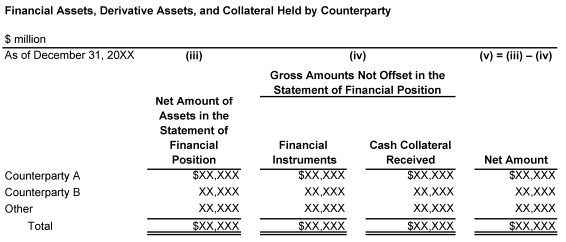 "Financial Assets, Derivative Assets, and Collateral Held by Counterparty " $ million "As of December 31, 20XX" (iii) (iv) (v) = (iii) - (iv) Gross Amounts Not Offset in the Statement of Financial Position Net Amount of Assets in the Statement of Financial Position "Financial Instruments" Cash Collateral Received Net Amount Counterparty A "$XX,XXX" "$XX,XXX" "$XX,XXX" "$XX,XXX" Counterparty B "XX,XXX" "XX,XXX" "XX,XXX" "XX,XXX" Other "XX,XXX" "XX,XXX" "XX,XXX" "XX,XXX" Total "$XX,XXX" "$XX,XXX" "$XX,XXX" "$XX,XXX"
-
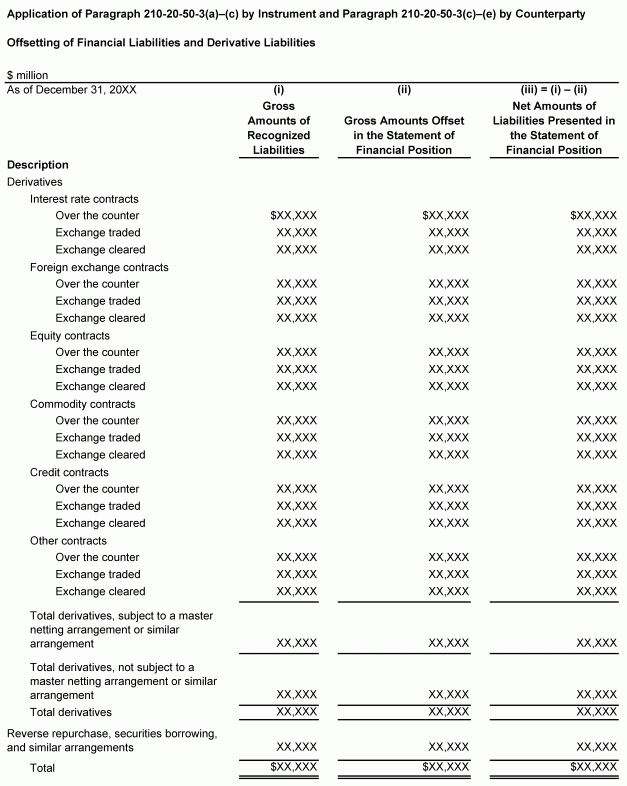 Application of Paragraph 210-20-50-3(a)-(c) by Instrument and Paragraph 210-20-50-3(c)-(e) by Counterparty Offsetting of Financial Liabilities and Derivative Liabilities $ million "As of December 31, 20XX" (i) (ii) (iii) = (i) - (ii) Gross Amounts of Recognized Liabilities Gross Amounts Offset in the Statement of Financial Position Net Amounts of Liabilities Presented in the Statement of Financial Position Description Derivatives Interest rate contracts Over the counter " $XX,XXX " " $XX,XXX " " $XX,XXX " Exchange traded " XX,XXX " " XX,XXX " " XX,XXX " Exchange cleared " XX,XXX " " XX,XXX " " XX,XXX " Foreign exchange contracts Over the counter " XX,XXX " " XX,XXX " " XX,XXX " Exchange traded " XX,XXX " " XX,XXX " " XX,XXX " Exchange cleared " XX,XXX " " XX,XXX " " XX,XXX " Equity contracts Over the counter " XX,XXX " " XX,XXX " " XX,XXX " Exchange traded " XX,XXX " " XX,XXX " " XX,XXX " Exchange cleared " XX,XXX " " XX,XXX " " XX,XXX " Commodity contracts Over the counter " XX,XXX " " XX,XXX " " XX,XXX " Exchange traded " XX,XXX " " XX,XXX " " XX,XXX " Exchange cleared " XX,XXX " " XX,XXX " " XX,XXX " Credit contracts Over the counter " XX,XXX " " XX,XXX " " XX,XXX " Exchange traded " XX,XXX " " XX,XXX " " XX,XXX " Exchange cleared " XX,XXX " " XX,XXX " " XX,XXX " Other contracts Over the counter " XX,XXX " " XX,XXX " " XX,XXX " Exchange traded " XX,XXX " " XX,XXX " " XX,XXX " Exchange cleared " XX,XXX " " XX,XXX " " XX,XXX " "Total derivatives, subject to a master netting arrangement or similar arrangement" " XX,XXX " " XX,XXX " " XX,XXX " "Total derivatives, not subject to a master netting arrangement or similar arrangement" " XX,XXX " " XX,XXX " " XX,XXX " Total derivatives " XX,XXX " " XX,XXX " " XX,XXX " "Reverse repurchase, securities borrowing, and similar arrangements " " XX,XXX " " XX,XXX " " XX,XXX " Total " $XX,XXX " " $XX,XXX " " $XX,XXX "
-
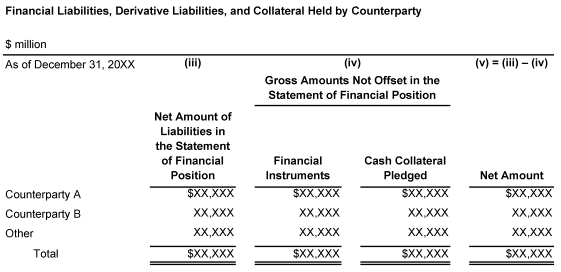 "Financial Liabilities, Derivative Liabilities, and Collateral Held by Counterparty " $ million "As of December 31, 20XX" (iii) (iv) (v) = (iii) - (iv) Gross Amounts Not Offset in the Statement of Financial Position Net Amount of Liabilities in the Statement of Financial Position "Financial Instruments" Cash Collateral Pledged Net Amount Counterparty A " $XX,XXX " " $XX,XXX " " $XX,XXX " " $XX,XXX " Counterparty B " XX,XXX " " XX,XXX " " XX,XXX " " XX,XXX " Other " XX,XXX " " XX,XXX " " XX,XXX " " XX,XXX " Total " $XX,XXX " " $XX,XXX " " $XX,XXX " " $XX,XXX "
210-20-60Relationships
Source downloaded: .Record version 2f3b084ee954. Effective date must be checked in the source.
Compensation—Retirement Benefits
Income Taxes
Derivatives and Hedging
Leases
Contractors—Federal Government
Financial Services—Brokers and Dealers
Financial Services—Depository and Lending
210-20-65Transition and Open Effective Date Information
Source downloaded: .Record version e150d3306f6c. Effective date must be checked in the source.
Related subtopics
- 860-30 Secured Borrowing and CollateralTransfers and Servicing
- 825-10 OverallFinancial Instruments
- 220-10 OverallIncome Statement—Reporting Comprehensive Income
- 210-942 Financial Services—Depository and LendingBalance Sheet
- 815-40 Contracts in Entity's Own EquityDerivatives and Hedging
- 210-10 OverallBalance Sheet