ASC 815-10
Overall
815 Derivatives and Hedging
Source downloaded: .Record version 57816aad9a5e. Effective date must be checked in the source.
ASC 815-10 is the Overall subtopic of the derivatives and hedging Topic: it defines what a derivative instrument is, sets the scope (including a long list of scope exceptions), and requires that derivatives be recognized as assets or liabilities on the statement of financial position and measured at fair value. A contract is a derivative only if it has (1) one or more underlyings and one or more notional amounts or payment provisions, (2) no or a smaller-than-usual initial net investment, and (3) the ability to be settled net (815-10-15-83). If conditions are met, an entity may elect to designate a derivative as a fair value hedge, cash flow hedge, or hedge of foreign currency exposure (including a net investment in a foreign operation).
Key points (7)
- A derivative instrument must have all three characteristics: (1) one or more underlyings plus one or more notional amounts or payment provisions, (2) no initial net investment or one smaller than for other contracts with a similar response to market factors, and (3) net settlement by contract terms, by a means outside the contract, or through delivery of an asset that leaves the recipient in a position not substantially different from net settlement (815-10-15-83).
- All derivatives, including embedded derivatives separated under 815-15-25-1, must be recognized as assets or liabilities and measured at fair value; hedge designation (fair value hedge, cash flow hedge, or foreign currency/net investment hedge) is elective and only for qualifying items with an expectation of effective offset (815-10-05-4; 815-10-10-1).
- Scope exceptions in 815-10-15-13 remove specified contracts even if the derivative definition is met: regular-way security trades, normal purchases and normal sales, certain insurance contracts and market risk benefits, certain financial guarantees, certain non-exchange-traded contracts, derivatives that impede sales accounting, investments in life insurance, certain investment contracts, certain loan commitments, certain IO/PO strips, certain contracts in an entity's own equity, leases, residual value guarantees, registration payment arrangements, and certain fixed-odds wagering contracts.
- The normal purchases and normal sales exception requires normal terms and quantity, an underlying in any price adjustment that is clearly and closely related to the asset bought or sold, probable physical (not net) settlement at inception and throughout the term, and contemporaneous documentation; failure to document precludes the exception, and once elected it cannot be revoked (815-10-15-22 through 15-51, 15-37 through 15-39).
- Freestanding options attached to debt by a third party or transferable independent of the debt are attached freestanding derivatives, not embedded derivatives, because an embedded derivative refers to provisions in a single contract between the same counterparties (815-10-15-5 through 15-7).
- Two or more legally separate transactions must be viewed as a unit if entered into contemporaneously and in contemplation of one another, with the same counterparty (or through an intermediary), relating to the same risk, and with no substantive business purpose for separate structuring (815-10-15-9).
- Contracts indexed to the reporting entity's own stock and classified in stockholders' equity, share-based payment awards under Topic 718, contracts to enter into a business combination, and physically settled forward purchases of own shares under Topic 480 are not derivatives for the issuer, but the exceptions do not extend to counterparties or to instruments indexed in part to something other than the entity's own stock (815-10-15-74 through 15-75).
For students. This is the gateway analysis for every derivative question: first test the three-part definition in 815-10-15-83, then run the scope exceptions in 815-10-15-13 before considering hedge accounting. Students commonly assume that meeting the derivative definition automatically means fair value accounting through earnings, forgetting the exceptions (e.g., normal purchases and normal sales, own-equity contracts, leases) and that hedge designation is elective, not automatic.
Machine-generated study aid for ASC 815-10. Check the source paragraphs below.
815-10-00Status
Source downloaded: .Record version 194aec6dac79. Effective date must be checked in the source.
815-10-05Overview and Background
Source downloaded: .Record version 9bf781065e68. Effective date must be checked in the source.
- aOverall
- bEmbedded Derivatives
- cHedging—General
- dFair Value Hedges
- eCash Flow Hedges
- fNet Investment Hedges
- gContracts in Entity's Own Equity
- hWeather Derivatives.
- aGeneral
- bCertain Contracts on Debt and Equity Securities.
- aA hedge of the exposure to changes in the fair value of a recognized asset or liability, or of an unrecognized firm commitment, that are attributable to a particular risk (referred to as a fair value hedge)
- bA hedge of the exposure to variability in the cash flows of a recognized asset or liability, or of a forecasted transaction, that is attributable to a particular risk (referred to as a cash flow hedge)
- cA hedge of the foreign currency exposure of any one of the following:
- 1An unrecognized firm commitment (a foreign currency fair value hedge)
- 2An available-for-sale debt security (a foreign currency fair value hedge)
- 3A forecasted transaction (a foreign currency cash flow hedge)
- 4A net investment in a foreign operation.
- 1
- aThe changes in the fair value of the hedged asset or liability that are attributable to the hedged risk
- bThe earnings effect of the hedged forecasted transaction.
Synthetic Guaranteed Investment Contracts
- aBuy-and-hold. Typically, a buy-and-hold synthetic contract covers a limited class of assets, usually high-quality bonds expected to be held to maturity. There is no stated rate guarantee; instead, the interest rate is reset periodically as specified in the contract, subject to a specified floor—for example, 3 percent or 0 percent. The term of the contract generally is consistent with the maturity of the underlying assets. Although buy-and-hold contracts are structured to permit participant withdrawals and transfers at book value, generally no withdrawals are expected. The arrangements between the benefit plan or other institutional investor and the wrap provider typically contain provisions outlining operating and investing guidelines for the customer. These guidelines are designed to ensure the availability of other sources of liquidity sufficient to satisfy expected levels of net participant-directed withdrawals and transfers, without the need to access the assets wrapped by the synthetic guaranteed investment contract. While participants can make withdrawals or transfers at book value, in most cases, the customer can terminate the contract at the value of the assets at any time, but it can withdraw at contract value only at maturity or earlier with a specified notification period.
- bActively managed. With an actively managed synthetic guaranteed investment contract, the assets often are managed by an outside investment manager, but may be managed by the insurer. Generally, the contract is evergreen—that is, there is no specified maturity date—and there is no stated rate guarantee; instead, the interest rate is reset periodically as specified in the contract, subject to a specified floor, frequently zero percent and typically not less than zero percent. Participant-directed withdrawals and transfers are made at book value, with future interest returns adjusted to recognize the difference between the fair value and book value of the remaining assets covered by the synthetic guaranteed investment contract, but typically not below a zero interest rate. Customer-initiated withdrawal provisions are similar to those for buy-and-hold guaranteed investment contracts.
- cFixed-rate, fixed-maturity. This contract is essentially the same as a traditional general account guaranteed investment contract. The synthetic guaranteed investment contract issuer guarantees a fixed rate for a fixed and certain term and assumes the investment risks and rewards of the assets. If the assets earn less than the guaranteed return, the insurance entity absorbs the loss. If the assets earn more than was assumed in pricing, the income recognized by the insurer will be greater than the wrap fee assumed in the pricing. Typically, the insurer also will be the investment manager because of the assumption of investment risk. Note that participant-initiated withdrawals and transfers of fixed-rate, fixed-maturity contracts are permitted at book value but are expected to occur infrequently. Withdrawals initiated by the customer generally are permitted only at the value of the assets and the guarantee is not activated.
- aA swap agreement whereby the synthetic guaranteed investment contract issuer exchanges a fixed return for the value of supporting assets, if needed for benefit payments
- bAn agreement by the issuer to buy assets at book value if a sale is needed to make benefit payments
- cA payment upon termination of the contract equal to the difference between a hypothetical book value of plan assets and their value. (Provisions of benefit-responsive traditional guaranteed investment contracts and synthetic guaranteed investment contracts generally prohibit the benefit plan and its sponsor from taking any actions that would encourage participant withdrawals and transfers.)
- aReset of the crediting rate or maturity date. Cash flow volatility (for example, timing of benefit payments) as well as asset underperformance can be passed through to the policyholder through adjustments to future contract crediting rates and/or contract maturities. Formulas are typically provided in the contract that adjust renewal crediting rates to recognize the difference between the fair value and book value of remaining assets in the segregated portfolio.
- bExclusion of impaired securities. Impaired securities may also be excluded directly from book value guarantees.
- cInvestment guidelines. Carefully structured investment policy can limit significantly the cash volatility of assets in the segregated portfolio (for example, limit callable securities, mortgage backed securities, and so forth).
- dBuffer funds. Cash and cash equivalents are maintained and are accessed first to fund benefit payments and thus limit the potential for synthetic guaranteed investment contract issuer's assets to be accessed to make benefit payments.
- eLiquidation structure of pension plan. Pro rata or tiered structures dictate the order of accessing various plan assets, including synthetic guaranteed investment contract assets, for benefit payments.
Certain Contracts on Debt and Equity Securities
815-10-10Objectives
Source downloaded: .Record version cc10d5e06426. Effective date must be checked in the source.
- aDerivative instruments represent rights or obligations that meet the definitions of assets or liabilities and should be reported in financial statements.
- bFair value is the most relevant measure for financial instruments and the only relevant measure for derivative instruments. Derivative instruments should be measured at fair value, and adjustments to the carrying amount of hedged items should reflect changes in their fair value (that is, gains or losses) that are attributable to the risk being hedged and that arise while the hedge is in effect.
- cOnly items that are assets or liabilities should be reported as such in financial statements.
- dSpecial accounting for items designated as being hedged should be provided only for qualifying items. One aspect of qualification should be an assessment of the expectation of effective offsetting changes in fair values or cash flows during the term of the hedge for the risk being hedged.
815-10-15Scope and Scope Exceptions
Source downloaded: .Record version 107216572228. Effective date must be checked in the source.
Entities
Instruments
- aViewing a contract as freestanding or embedded. Whether a feature should be viewed as freestanding or embedded in determining the scope application of this Subtopic and Subtopic 815-15 is addressed beginning in paragraph 815-10-15-5.
- bViewing two or more contracts as a unit in applying the scope of this Subtopic. Whether two or more legally separate transactions should be viewed as a unit in determining the scope application of this Subtopic is addressed beginning in paragraph 815-10-15-8.
- aViewing two freestanding derivative instruments as a unit. Whether two or more contracts that are derivative instruments within the scope application of this Subtopic should be viewed as a unit for recognition and other purposes—including for hedge accounting purposes—is addressed beginning in paragraph 815-10-25-6.
- bViewing combinations of options as separate options or as a single forward contract. Whether combinations of options that individually are within the scope application of this Subtopic or Subtopic 815-15 should be viewed as separate options or as a single forward is addressed beginning in paragraph 815-10-25-7.
- aThe transactions were entered into contemporaneously and in contemplation of one another.
- bThe transactions were executed with the same counterparty (or structured through an intermediary).
- cThe transactions relate to the same risk.
- dThere is no apparent economic need or substantive business purpose for structuring the transactions separately that could not also have been accomplished in a single transaction.
| Editor's Note: The content of paragraph 815-10-15-10 will change upon transition, together with a change in the heading noted below. |
| •> Instruments within Scope |
- aRegular-way security trades
- bNormal purchases and normal sales
- cCertain insurance contracts and market risk benefits
- dCertain financial guarantee contracts
- eCertain contracts that are not traded on an exchange
- fDerivative instruments that impede sales accounting
- gInvestments in life insurance
- hCertain investment contracts
- iCertain loan commitments
- jCertain interest-only strips and principal-only strips
- kCertain contracts involving an entity's own equity
- lLeases
- mResidual value guarantees
- n
- oCertain fixed-odds wagering contracts.
- aIt requires or permits net settlement (as discussed in paragraphs ).
- bA market mechanism exists to facilitate net settlement of that contract (as discussed in paragraphs ).
- aIf an entity is required, or has a continuing policy, to account for a contract to purchase or sell an existing security on a trade-date basis, rather than a settlement-date basis, and thus recognizes the acquisition (or disposition) of the security at the inception of the contract, then the entity shall apply the regular-way security trades scope exception to that contract.
- bIf an entity is required, or has a continuing policy, to account for a contract for the purchase or sale of when-issued securities or other securities that do not yet exist on a trade-date basis, rather than a settlement-date basis, and thus recognizes the acquisition or disposition of the securities at the inception of the contract, that entity shall apply the regular-way security trades scope exception to those contracts.
- cContracts for the purchase or sale of when-issued securities or other securities that do not yet exist, except for those contracts accounted for on a trade-date basis, are excluded from the requirements of this Subtopic as a regular-way security trade only if all of the following are true:
- 1There is no other way to purchase or sell that security.
- 2Delivery of that security and settlement will occur within the shortest period possible for that type of security.
- 3It is probable at inception and throughout the term of the individual contract that the contract will not settle net and will result in physical delivery of a security when it is issued. (The entity shall document the basis for concluding that it is probable that the contract will not settle net and will result in physical delivery.)
- 1
- aThat contract permits net settlement (as discussed in paragraphs ).
- bA market mechanism exists to facilitate net settlement of that contract (as discussed in paragraphs ).
- aNormal terms (including normal quantity)
- bClearly and closely related underlying
- cProbable physical settlement
- dDocumentation.
- aFreestanding option contracts
- bForward (non-option-based) contracts
- cForward contracts that contain optionality features
- dPower purchase or sale agreements.
- aThe quantities provided under the contract and the entity's need for the related assets
- bThe locations to which delivery of the items will be made
- cThe period of time between entering into the contract and delivery
- dThe entity's prior practices with regard to such contracts.
- aPast trends
- bExpected future demand
- cOther contracts for delivery of similar items
- dAn entity's and industry's customs for acquiring and storing the related commodities
- eAn entity's operating locations.
- aThe underlying is extraneous (that is, irrelevant and not pertinent) to both the changes in the cost and the changes in the fair value of the asset being sold or purchased, including being extraneous to an ingredient or direct factor in the customary or specific production of that asset.
- bIf the underlying is not extraneous as discussed in (a), the magnitude and direction of the impact of the price adjustment are not consistent with the relevancy of the underlying. That is, the magnitude of the price adjustment based on the underlying is significantly disproportionate to the impact of the underlying on the fair value or cost of the asset being purchased or sold (or of an ingredient or direct factor, as appropriate).
- cThe underlying is a currency exchange rate involving a foreign currency that meets none of the criteria in paragraph 815-15-15-10(b) for that reporting entity.
- aFor contracts that qualify for the normal purchases and normal sales exception under paragraph 815-10-15-41 or , the entity shall document the basis for concluding that it is probable that the contract will not settle net and will result in physical delivery.
- bFor contracts that qualify for the normal purchases and normal sales exception under paragraphs , the entity shall document the basis for concluding that the agreement meets the criteria in that paragraph, including the basis for concluding that the agreement is a capacity contract.
- aFor both parties to the contract, both of the following criteria are met:
- 1The terms of the contract require physical delivery of electricity. That is, the contract does not permit net settlement, as described in paragraphs . For an option contract, physical delivery is required if the option contract is exercised. Certain contracts for the purchase or sale of electricity on a forward basis that necessitate transmission through, or delivery to a location within, an electricity grid operated by an independent system operator result in one of the contracting parties incurring charges (or credits) for the transmission of that electricity based in part on locational marginal pricing differences payable to (or receivable from) the independent system operator. For example, this is the case when the delivery location under the contract (for example, a hub location) is not the same location as the point of ultimate consumption of the electricity or the point from which the electricity exits the electricity grid for transmission to a customer load zone. Delivery to the point of ultimate consumption or the exit point is facilitated by the independent system operator of the grid. The use of locational marginal pricing to determine the transmission charge (or credit) does not constitute net settlement, even in situations in which legal title to the associated electricity is conveyed to the independent system operator during transmission.
- 2The power purchase or sales agreement is a capacity contract. Differentiating between a capacity contract and a traditional option contract (that is, a financial option on electricity) is a matter of judgment that depends on the facts and circumstances. For power purchase or sale agreements that contain option features, the characteristics of an option contract that is a capacity contract and a traditional option contract, which are set forth in paragraph 815-10-55-31 shall be considered in that evaluation; however, other characteristics not listed in that paragraph may also be relevant to that evaluation.
- 1
- bFor the seller of electricity: The electricity that would be deliverable under the contract involves quantities that are expected to be sold by the reporting entity in the normal course of business.
- cFor the buyer of electricity, all of the following criteria are met:
- 1The electricity that would be deliverable under the contract involves quantities that are expected to be used or sold by the reporting entity in the normal course of business.
- 2The buyer of the electricity under the power purchase or sales agreement is an entity that meets both of the following criteria:
- iThe entity is engaged in selling electricity to retail or wholesale customers.
- iiThe entity is statutorily or otherwise contractually obligated to maintain sufficient capacity to meet electricity needs of its customer base.
- i
- 3The contracts are entered into to meet the buyer's obligation to maintain a sufficient capacity, including a reasonable reserve margin established by or based on a regulatory commission, local standards, regional reliability councils, or regional transmission organizations.
- 1
- aTraditional life insurance contracts. The payment of death benefits is the result of an identifiable insurable event (death of the insured) instead of changes in a variable.
- bTraditional property and casualty contracts. The payment of benefits is the result of an identifiable insurable event (for example, theft or fire) instead of changes in a variable.
- aBenefits or claims are paid only if an identifiable insurable event occurs (for example, theft or fire).
- bThe amount of the payment is limited to the amount of the policyholder's incurred insured loss.
- cThe contract does not involve essentially assured amounts of cash flows (regardless of the timing of those cash flows) based on insurable events highly probable of occurrence because the insured would nearly always receive the benefits (or suffer the detriment) of changes in the variable.
- aThose minimum payment cash flows are indexed to or altered by changes in a variable.
- bThose minimum payment amounts are expected to be paid each policy year (or on another predictable basis).
- aThey provide for payments to be made solely to reimburse the guaranteed party for failure of the debtor to satisfy its required payment obligations under a nonderivative contract, either:
- 1At prespecified payment dates
- 2At accelerated payment dates as a result of either the occurrence of an event of default (as defined in the financial obligation covered by the guarantee contract) or notice of acceleration being made to the debtor by the creditor.
- 1
- bPayment under the financial guarantee contract is made only if the debtor's obligation to make payments as a result of conditions as described in (a) is past due.
- cThe guaranteed party is, as a precondition in the contract (or in the back-to-back arrangement, if applicable) for receiving payment of any claim under the guarantee, exposed to the risk of nonpayment both at inception of the financial guarantee contract and throughout its term either through direct legal ownership of the guaranteed obligation or through a back-to-back arrangement with another party that is required by the back-to-back arrangement to maintain direct ownership of the guaranteed obligation.
- aA climatic or geological variable or other physical variable. Climatic, geological, and other physical variables include things like the number of inches of rainfall or snow in a particular area and the severity of an earthquake as measured by the Richter scale. (See Example 13 [paragraph 815-10-55-135].)
- bThe price or value of a nonfinancial asset of one of the parties to the contract provided that the asset is not readily convertible to cash. This scope exception applies only if both of the following are true:
- 1The nonfinancial assets are unique.
- 2The nonfinancial asset related to the underlying is owned by the party that would not benefit under the contract from an increase in the fair value of the nonfinancial asset. (If the contract is a call option, the scope exception applies only if that nonfinancial asset is owned by the party that would not benefit under the contract from an increase in the fair value of the nonfinancial asset above the option's strike price.)
- 1
- cThe fair value of a nonfinancial liability of one of the parties to the contract provided that the liability does not require delivery of an asset that is readily convertible to cash.
- dSpecified volumes of sales or service revenues of one of the parties to the contract. (This scope exception applies to contracts with settlements based on the volume of items sold or services rendered, for example, royalty agreements. This scope exception does not apply to contracts based on changes in sales or revenues due to changes in market prices.)
- aA climatic or geological variable or other physical variable. Climatic, geological, and other physical variables include things like the number of inches of rainfall or snow in a particular area and the severity of an earthquake as measured by the Richter scale. (See Example 13 [paragraph 815-10-55-135].)
- bThe price or value of a nonfinancial asset of one of the parties to the contract provided that the asset is not readily convertible to cash. This scope exception applies only if both of the following are true:
- 1The nonfinancial assets are unique.
- 2The nonfinancial asset related to the underlying is owned by the party that would not benefit under the contract from an increase in the fair value of the nonfinancial asset. (If the contract is a call option, the scope exception applies only if that nonfinancial asset is owned by the party that would not benefit under the contract from an increase in the fair value of the nonfinancial asset above the option's strike price.)
- 1
- cThe fair value of a nonfinancial liability of one of the parties to the contract provided that the liability does not require delivery of an asset that is readily convertible to cash.
- dSpecified volumes of sales or service revenues of one of the parties to the contract. (This scope exception applies to contracts with settlements based on the volume of items sold or services rendered, for example, royalty agreements. This scope exception does not apply to contracts based on changes in sales or revenues due to changes in market prices.)
- eAn underlying that is based on operations or activities specific to one of the parties to the contract. This scope exception applies to underlyings based on the financial operating results (or components of those results) of one of the parties to the contract. This scope exception also applies to underlyings based on the occurrence or nonoccurrence of an event specific to the operations or activities of one of the parties to the contract (such as obtaining regulatory approval, achieving a product development milestone, or achieving a greenhouse gas emissions reduction target). When evaluating whether operations or activities are specific to one of the parties to the contract, an entity does not need to consider whether the outcome is within its control. This scope exception does not apply to any of the following:
- 1Underlyings that are based on a market rate, market price, or market index (including those in paragraph 815-10-15-88(a) through (f)). (See Example 14A—Case F [paragraph 815-10-55-143K] and Case I [paragraphs ] that illustrate the application of this exclusion to the scope exception.)
- 2Underlyings that are based on the price or performance (including default) of a financial asset or financial liability of one of the parties to the contract. For example, the scope exception does not apply to underlyings based on (i) a rate of return or a default rate on a pool of loans held by one of the parties to the contract or (ii) the occurrence or nonoccurrence of an event of default or other credit event by a borrower (or reference entity) on a loan held by one of the parties to the contract. (See Example 14A—Case J [paragraphs ] that illustrates the application of this exclusion to the scope exception.)
- 3Contracts involving an entity’s own equity that are subject to paragraph 815-10-15-74(a) and Subtopic 815-40.
- 4Call options and put options on debt instruments that are subject to paragraphs .
Solely for purposes of applying the scope exception in (e), the term party to the contract includes the parent, subsidiaries, or other entities consolidated by the parent for both consolidated financial statements and the standalone financial statements of individual entities within the consolidated group. - 1
- aIt represents the right to receive only a specified proportion of the contractual interest cash flows of a specific debt instrument or a specified proportion of the contractual principal cash flows of that debt instrument.
- bIt does not incorporate any terms not present in the original debt instrument.
- aContracts issued or held by that reporting entity that are both:
- bContracts issued by the entity that are subject to Topic 718. If any such contract ceases to be subject to Topic 718 in accordance with paragraphs , the terms of that contract shall then be analyzed to determine whether the contract is subject to this Subtopic. An award that ceases to be subject to Topic 718 in accordance with those paragraphs shall be analyzed to determine whether it is subject to this Subtopic.
- cAny of the following contracts:
- 1A contract between an acquirer and a seller to enter into a business combination
- 2A contract to enter into an acquisition by a not-for-profit entity
- 3A contract between one or more NFPs to enter into a merger of not-for-profit entities
- 4In a joint venture’s separate financial statements, a contract between a joint venture and its venturers related to the formation of the joint venture accounted for in accordance with Subtopic 805-60.
- 1
- dForward contracts that require settlement by the reporting entity's delivery of cash in exchange for the acquisition of a fixed number of its equity shares (forward purchase contracts for the reporting entity's shares that require physical settlement) that are accounted for under paragraphs , 480-10-35-3, and 480-10-45-3.
- aContracts issued or held by that reporting entity that are both:
- bContracts issued by the entity that are subject to Topic 718. If any such contract ceases to be subject to Topic 718 in accordance with paragraphs , the terms of that contract shall then be analyzed to determine whether the contract is subject to this Subtopic. An award that ceases to be subject to Topic 718 in accordance with those paragraphs shall be analyzed to determine whether it is subject to this Subtopic.
- cAny of the following contracts:
- 1A contract between an acquirer and a seller to enter into a business combination
- 2A contract to enter into an acquisition by a not-for-profit entity
- 3A contract between one or more NFPs to enter into a merger of not-for-profit entities
- 4In a joint venture’s separate financial statements, a contract between a joint venture and its venturers related to the formation of the joint venture accounted for in accordance with Subtopic 805-60.
- 1
- dForward contracts that require settlement by the reporting entity's delivery of cash in exchange for the acquisition of a fixed number of its equity shares (forward purchase contracts for the reporting entity's shares that require physical settlement) that are accounted for under paragraphs , 480-10-35-3, and 480-10-45-3.
- aThe counterparty in those contracts. For example, the scope exception in (b) in the preceding paragraph related to share-based compensation arrangements does not apply to equity instruments (including stock options) received by nonemployees as compensation for goods and services.
- bA contract that an entity either can or must settle by issuing its own equity instruments but that is indexed in part or in full to something other than its own stock. That contract can be a derivative instrument for the issuer under paragraphs , in which case it would be accounted for as a liability or an asset in accordance with the requirements of this Subtopic. For example, a forward contract that is indexed to both an entity's own stock and currency exchange rates does not qualify for the exception in (a) in the preceding paragraph with respect to that entity's accounting because the forward contract is indexed in part to something other than that entity's own stock (namely, currency exchange rates).
- aThe counterparty in those contracts. For example, the scope exception in (b) in paragraph 815-10-15-74related to share-based compensation arrangements does not apply to equity instruments (including stock options) received by nonemployees as compensation for goods and services.
- bA contract that an entity either can or must settle by issuing its own equity instruments but that is indexed in part or in full to something other than its own stock. That contract can be a derivative instrument for the issuer under paragraphs and , in which case it would be accounted for as a liability or an asset in accordance with the requirements of this Subtopic. For example, a forward contract that is indexed to both an entity's own stock and currency exchange rates does not qualify for the exception in (a) in paragraph 815-10-15-74with respect to that entity's accounting because the forward contract is indexed in part to something other than that entity's own stock (namely, currency exchange rates).
Definition of Derivative Instrument
- aUnderlying, notional amount, payment provision. The contract has both of the following terms, which determine the amount of the settlement or settlements, and, in some cases, whether or not a settlement is required:
- 1One or more underlyings
- 2One or more notional amounts or payment provisions or both.
- 1
- bInitial net investment. The contract requires no initial net investment or an initial net investment that is smaller than would be required for other types of contracts that would be expected to have a similar response to changes in market factors.
- cNet settlement. The contract can be settled net by any of the following means:
- 1Its terms implicitly or explicitly require or permit net settlement.
- 2It can readily be settled net by a means outside the contract.
- 3It provides for delivery of an asset that puts the recipient in a position not substantially different from net settlement.
- 1
- aA derivative instrument included within the scope of this Subtopic by this Subsection
- bAn embedded derivative that has been separated from a host contract as required by paragraph 815-15-25-1.
- aUnderlying, notional amount, payment provision
- bInitial net investment
- cNet settlement.
- aUnderlying
- bNotional amount
- cPayment provision.
- aA security price or security price index
- bA commodity price or commodity price index
- cAn interest rate or interest rate index
- dA credit rating or credit index
- eAn exchange rate or exchange rate index
- fAn insurance index or catastrophe loss index
- gA climatic or geological condition (such as temperature, earthquake severity, or rainfall), another physical variable, or a related index
- hThe occurrence or nonoccurrence of a specified event (such as a scheduled payment under a contract).
- aTime value (for example, a premium on an option)
- bTerms that are more or less favorable than market conditions (for example, a premium on a forward purchase contract with a price less than the current forward price).
- aA commodity futures contract generally requires no net investment, while purchasing the same commodity requires an initial net investment equal to its market price. However, both contracts reflect changes in the price of the commodity in the same way (that is, similar gains or losses will be incurred).
- bA swap or forward contract generally does not require an initial net investment unless the terms favor one party over the other.
- cAn option generally requires that one party make an initial net investment (a premium) because that party has the rights under the contract and the other party has the obligations.
- aNet settlement under contract terms
- bNet settlement through a market mechanism
- cNet settlement by delivery of derivative instrument or asset readily convertible to cash.
- aNet share settlement
- bNet settlement in the event of nonperformance or default
- cStructured settlement as net settlement
- dNet settlement of a debt instrument through exercise of an embedded put option or call option.
- aA penalty for nonperformance in a purchase order is a net settlement provision if the amount of the penalty is based on changes in the price of the items that are the subject of the contract.
- bA fixed penalty for nonperformance is not a net settlement provision.
- cA contract that contains a variable penalty for nonperformance based on changes in the price of the items that are the subject of the contract does not contain a net settlement provision as discussed beginning in paragraph 815-10-15-100 if it also contains an incremental penalty of a fixed amount (or fixed amount per unit) that would be expected to be significant enough at all dates during the remaining term of the contract to make the possibility of nonperformance remote. If a contract includes such a provision, it effectively requires performance, that is, requires the party to deliver an asset that is associated with the underlying. The assessment of the fixed incremental penalty shall be performed only at the contract's inception. The magnitude of the fixed incremental penalty shall be assessed on a standalone basis as a disincentive for nonperformance, not in relation to the overall penalty.
- dAn asymmetrical default provision does not give a commodity forward contract the characteristic described as net settlement beginning in paragraph 815-10-15-100. For related implementation guidance, see the discussion beginning in paragraph 815-10-55-10.
- aThe debtor does not receive an asset when it settles the debt obligation in conjunction with exercise of the put option or call option.
- bThe creditor does not receive an asset associated with the underlying.
- aWhen applying paragraph 815-15-25-1(c) to a put option or call option (including a prepayment option) embedded in a debt instrument
- bWhen analyzing the net settlement criterion (see guidance beginning in paragraph 815-10-15-100) for a freestanding call option held by the debtor on its own debt instrument and for a freestanding put option issued by the debtor on its own debt instrument.
- aTo put or call options that are added to a debt instrument by a third party contemporaneously with or after the issuance of a debt instrument. (In that circumstance, see paragraph 815-10-15-6.)
- bBy analogy to an embedded put or call option in a hybrid instrument that does not contain a debt host contract.
- aPrimary characteristics of market mechanism
- bIndicators of primary characteristics of market mechanism
- cEffects of an assignment clause on market mechanism
- dOngoing evaluation of market mechanism.
- aIt is a means to settle a contract that enables one party to readily liquidate its net position under the contract. A market mechanism is a means to realize the net gain or loss under a particular contract through a net payment. Net settlement may occur in cash or any other asset. A method of settling a contract that results only in a gross exchange or delivery of an asset for cash (or other payment in kind) does not satisfy the requirement that the mechanism facilitate net settlement.
- bIt results in one party to the contract becoming fully relieved of its rights and obligations under the contract. A market mechanism enables one party to the contract to surrender all future rights or avoid all future performance obligations under the contract. Contracts that do not permit assignment of the contract from the original issuer to another party do not meet the characteristic of net settlement through a market mechanism. The ability to enter into an offsetting contract, in and of itself, does not constitute a market mechanism because the rights and obligations from the original contract survive. The fact that an entity has offset its rights and obligations under an original contract with a new contract does not by itself indicate that its rights and obligations under the original contract have been relieved. This applies to contracts regardless of whether either of the following conditions exists:
- 1The asset associated with the underlying is financial or nonfinancial.
- 2The offsetting contract is entered into with the same counterparty as the original contract or a different counterparty (unless an offsetting contract with the same counterparty relieves the entity of its rights and obligations under the original contract, in which case the arrangement does constitute a market mechanism). (Example 6 [see paragraph 815-10-55-91] illustrates this guidance.)
- 1
- cLiquidation of the net position does not require significant transaction costs. For purposes of assessing whether a market mechanism exists, an entity shall consider transaction costs to be significant if they are 10 percent or more of the fair value of the contract. Whether assets deliverable under a group of futures contracts exceeds the amount of assets that could rapidly be absorbed by the market without significantly affecting the price is not relevant to this characteristic. The lack of a liquid market for a group of contracts does not affect the determination of whether there is a market mechanism that facilitates net settlement because the test focuses on a singular contract. An exchange offers a ready opportunity to sell each contract, thereby providing relief of the rights and obligations under each contract. The possible reduction in price due to selling a large futures position is not considered to be a transaction cost.
- dLiquidation of the net position under the contract occurs without significant negotiation and due diligence and occurs within a time frame that is customary for settlement of the type of contract. A market mechanism facilitates easy and expedient settlement of the contract. As discussed under the primary characteristic in (a), those qualities of a market mechanism do not preclude net settlement in assets other than cash.
- aAccess to potential counterparties is available regardless of the seller's size or market position.
- bRisks assumed by a market maker as a result of acquiring a contract can be transferred by a means other than by repackaging the original contract into a different form.
- aThere are multiple market participants willing and able to enter into a transaction at market prices to assume the seller's rights and obligations under a contract.
- bThere is sufficient liquidity in the market for the contract, as indicated by the transaction volume as well as a relatively narrow observable bid-ask spread.
- aBinding prices for the contract are readily obtainable.
- bTransfers of the instrument involve standardized documentation (rather than contracts with entity-specific modifications) and standardized settlement procedures.
- cIndividual contract sales do not require significant negotiation and unique structuring.
- dThe closing period is not extensive because of the need to permit legal consultation and document review.
- aEffect of conversion costs
- bContracts involving multiple deliveries
- cAsset's suitability as collateral does not equate to asset being readily convertible to cash
- dDetermining whether shares of stock are readily convertible to cash
- eOngoing evaluation of readily convertible to cash.
- aThe stock purchase warrant is issued by an entity for only its own stock (or stock of its consolidated subsidiaries).
- bThe sale or transfer of the issued shares is restricted (other than in connection with being pledged as collateral) for a period of 32 days or more from the date the stock purchase warrant is exercised.
- aWhether an active market can rapidly absorb the quantity of stock to be received upon exercise of the warrant without significantly affecting the price
- bWhether the other estimated costs to convert the stock to cash are expected to be not significant. (The assessment of the significance of those conversion costs shall be performed only at inception of the contract.)
Certain Contracts on Debt and Equity Securities
Overall Guidance
Instruments
- a
- b The contract's terms require physical settlement of the contract by delivery of the securities.
- c The contract is not a derivative instrument otherwise subject to this Subtopic.
- d The contract, if a purchased option, has no intrinsic value at acquisition.
- a The equity method in accordance with Topic 323
- b
815-10-25Recognition
Source downloaded: .Record version 18ca49cb5ebe. Effective date must be checked in the source.
- aUnit of accounting for recognition purposes
- b
- cForward commitment dollar rolls
- dDerivative financial instruments subject to a registration payment arrangement.
- aUnit of accounting for recognition purposes
- b
- cForward commitment dollar rolls
- dDerivative financial instruments subject to a registration payment arrangement
- eShare-based noncash consideration from a customer for the transfer of goods or services under Topic 606
- fShare-based noncash consideration from a counterparty for the transfer of nonfinancial assets or in substance nonfinancial assets under Subtopic 610-20.
Unit of Accounting for Recognition Purposes
- aViewing two freestanding derivative instruments as a unit. Whether two or more contracts that are derivative instruments within the scope application of this Subtopic should be viewed as a unit for recognition and other purposes—including for hedge accounting purposes—is addressed beginning in paragraph 815-10-25-6.
- bViewing combinations of options as separate options or as a single forward contract. Whether combinations of options that individually are within the scope application of this Subtopic or Subtopic 815-15 should be viewed as separate options or as a single forward is addressed beginning in paragraph 815-10-25-7.
- aViewing a contract as freestanding or embedded. Whether a feature should be viewed as freestanding or embedded in determining the scope application of this Subtopic and Subtopic 815-15 is addressed beginning in paragraph 815-10-15-5.
- bViewing two or more contracts as a unit in applying the scope of this Subtopic. Whether two or more legally separate transactions should be viewed as a unit in determining the scope application of this Subtopic is addressed beginning in paragraph 815-10-15-8.
- aThey are entered into contemporaneously and in contemplation of one another. (See Example 18 [paragraph 815-10-55-171] for an illustration.)
- bThey are entered into with the same counterparty.
- cThey relate to the same risk.
- dThere is no substantive business purpose for structuring the transactions separately.
- aThey have the same strike price, notional amount, and exercise date.
- bThey have the same underlying.
- cNeither is required to be exercised.
- aCombinations of two freestanding options or a freestanding and embedded option
- bCombinations of two embedded options.
- aThe options have the same terms.
- bThe options have the same underlying.
- cThe options are entered into contemporaneously with the same counterparty at inception.
- aThe options have the same terms.
- bThe options have the same underlying.
- cThe options are entered into contemporaneously with different counterparties at inception.
- aThey convey rights (to the holder) and obligations (to the writer) that are equivalent from an economic and risk perspective to an embedded forward contract.
- bThey cannot be separated from the hybrid instrument in which they are embedded.
- aTwo embedded option contracts that are exercisable only on the actual maturity date
- bAn embedded forward contract that is a combination of an embedded purchased call (put) and a written put (call) with the same terms.
Forward Commitment Dollar Rolls
Derivative Financial Instruments Subject to a Registration Payment Arrangement
Share-Based Noncash Consideration from a Customer for the Transfer of Goods or Services under Topic 606
Share-Based Noncash Consideration from a Counterparty for the Transfer of Nonfinancial Assets or In Substance Nonfinancial Assets under Subtopic 610-20
Certain Contracts on Debt and Equity Securities
815-10-30Initial Measurement
Source downloaded: .Record version d0889d37a8df. Effective date must be checked in the source.
Contract that Is a Derivative Instrument After Acquisition
Forward Commitment Dollar Rolls
Certain Contracts on Debt and Equity Securities
815-10-35Subsequent Measurement
Source downloaded: .Record version fff333ba5a92. Effective date must be checked in the source.
Forward Commitment Dollar Rolls
Certain Contracts on Debt and Equity Securities
- aHeld to maturity:
- 1Changes in the fair value of the forward contract or purchased option shall not be recognized. Credit losses on the underlying securities in a forward contract shall be recorded through an allowance for credit losses in accordance with Subtopic 326-20 on financial instruments measured at amortized cost. Credit losses on the underlying securities in a purchased option shall be recorded through an allowance for credit losses in accordance with Subtopic 326-20 and shall be limited by the amount of the option premium.
- 2Debt securities purchased under a forward contract shall be recorded at the forward contract price at the settlement date.
- 3Debt securities purchased by exercising an option shall be recorded at the option strike price plus any remaining carrying amount for the option premium at the exercise date.
- 4If an option expires worthless and the same debt security is purchased in the market, the security shall be recorded at its market price plus any remaining carrying amount for the option premium.
- 5If an entity does not take delivery under the forward contract or purchase the same security in the market if the option expires worthless, the entity's intent to hold other debt securities to maturity will be called into question.
- 1
- bAvailable for sale:
- 1Changes in the fair value of the forward contract or purchased option shall be recognized as part of the separate component of shareholders' equity under Topic 320 as they occur. Credit losses on the underlying securities in a forward contract shall be recorded through an allowance for credit losses in accordance with Subtopic 326-30 on measuring credit losses on available-for-sale debt securities. Credit losses on the underlying securities in a purchased option shall be recorded through an allowance for credit losses in accordance with Subtopic 326-30 and shall be limited by the amount of the option premium.
- 2Debt securities purchased under a forward contract shall be recorded at their fair values at the settlement date.
- 3Debt securities purchased by exercising an option shall be recorded at the option strike price plus the fair value of the option at the exercise date.
- 4If the option expires worthless and the same debt security is purchased in the market, the security shall be recorded at its market price plus any remaining carrying amount for the option premium.
- 1
- c
- 1Changes in the fair value of the forward contract or purchased option shall be recognized in earnings as they occur.
- 2Debt securities purchased under a forward contract or by exercising an option shall be recorded at their fair values at the settlement date.
- 1
815-10-40Derecognition
Source downloaded: .Record version 30d7175e9d5e. Effective date must be checked in the source.
815-10-45Other Presentation Matters
Source downloaded: .Record version faab4f8b9234. Effective date must be checked in the source.
Balance Sheet—Netting
- a Were not fair value amounts
- b Arose from instruments in a master netting arrangement that are not eligible to be offset.
Income Statement Classification
Cash Flow Statement Classification
815-10-50Disclosure
Source downloaded: .Record version 89738863c8b2. Effective date must be checked in the source.
- aHow and why an entity uses derivative instruments (or such nonderivative instruments)
- bHow derivative instruments (or such nonderivative instruments) and related hedged items are accounted for under Topic 815
- cHow derivative instruments (or such nonderivative instruments) and related hedged items affect all of the following:
- 1An entity's financial position
- 2An entity's financial performance
- 3An entity's cash flows.
- 1
- aHow and why an entity uses derivative instruments (or such nonderivative instruments)
- bHow derivative instruments (or such nonderivative instruments) and related hedged items are accounted for under Topic 815
- cHow derivative instruments (or such nonderivative instruments) and related hedged items affect all of the following:
- 1An entity's financial position
- 2An entity's financial performance
- 3An entity's cash flows.
- 1
- aIts objectives for holding or issuing those instruments
- bThe context needed to understand those objectives
- cIts strategies for achieving those objectives
- dInformation that would enable users of its financial statements to understand the volume of its activity in those instruments.
- aDerivative instruments (and nonderivative instruments as noted in items (1)(i) and (1)(iii) of this paragraph) used for risk management purposes, distinguished between each of the following:
- 1Derivative instruments (and nonderivative instruments) designated as hedging instruments, distinguished between each of the following:
- iDerivative instruments (and nonderivative instruments) designated as fair value hedging instruments
- iiDerivative instruments designated as cash flow hedging instruments
- iiiDerivative instruments (and nonderivative instruments) designated as hedging instruments for hedges of the foreign currency exposure of a net investment in a foreign operation.
- i
- 2Derivative instruments used as economic hedges and for other purposes related to the entity's risk exposures.
- 1
- bDerivative instruments used for other purposes.
- aDerivative instruments (and nonderivative instruments as noted in items (1)(i) and (1)(iii) of this paragraph) used for risk management purposes, distinguished between each of the following:
- 1Derivative instruments (and nonderivative instruments) designated as hedging instruments, distinguished between each of the following:
- iDerivative instruments (and nonderivative instruments) designated as fair value hedging instruments
- iiDerivative instruments designated as cash flow hedging instruments
- iiiDerivative instruments (and nonderivative instruments) designated as hedging instruments for hedges of the foreign currency exposure of a net investment in a foreign operation.
- i
- 2Derivative instruments used as economic hedges and for other purposes related to the entity's risk exposures.
- 1
- bDerivative instruments used for other purposes.
Overall Quantitative Disclosures
- aThe location and fair value amounts of derivative instruments (and such nonderivative instruments) reported in the statement of financial position
- bThe location and amount of the gains and losses on derivative instruments (and such nonderivative instruments) and related hedged items reported in any of the following:
- 1The statement of financial performance
- 2The statement of financial position (for example, gains and losses initially recognized in other comprehensive income).
- 1
- cThe total amount of each income and expense line item presented in the statement of financial performance in which the results of fair value or cash flow hedges are recorded.
- aThe location and fair value amounts of derivative instruments (and such nonderivative instruments) reported in the statement of financial position
- bThe location and amount of the gains and losses on derivative instruments (and such nonderivative instruments) and related hedged items reported in any of the following:
- 1The statement of financial performance
- 2The statement of financial position (for example, gains and losses initially recognized in other comprehensive income).
- 1
- cThe total amount of each income and expense line item presented in the statement of financial performance in which the results of fair value or cash flow hedges are recorded.
- aThe fair value of derivative instruments (and nonderivative instruments that are designated and qualify as hedging instruments pursuant to paragraphs 815-20-25-58 and 815-20-25-66) shall be presented on a gross basis, even when those instruments are subject to master netting arrangements and qualify for net presentation in the statement of financial position in accordance with Subtopic 210-20 or paragraphs , as applicable.
- bCash collateral payables and receivables associated with those instruments shall not be added to or netted against the fair value amounts.
- cFair value amounts shall be presented as separate asset and liability values segregated between each of the following:
- 1Those instruments designated and qualifying as hedging instruments under Subtopic 815-20, presented separately by type of contract (for example, interest rate contracts, foreign exchange contracts, equity contracts, commodity contracts, credit contracts, other contracts, and so forth)
- 2Those instruments not designated as hedging instruments, presented separately by type of contract.
- 1
- dThe disclosure shall identify the line item(s) in the statement of financial position in which the fair value amounts for these categories of derivative instruments are included.
- aThe fair value of derivative instruments (and nonderivative instruments that are designated and qualify as hedging instruments pursuant to paragraphs 815-20-25-58 and 815-20-25-66) shall be presented on a gross basis, even when those instruments are subject to master netting arrangements and qualify for net presentation in the statement of financial position in accordance with Subtopic 210-20 or paragraphs , as applicable.
- bCash collateral payables and receivables associated with those instruments shall not be added to or netted against the fair value amounts.
- cFair value amounts shall be presented as separate asset and liability values segregated between each of the following:
- 1Those instruments designated and qualifying as hedging instruments under Subtopic 815-20, presented separately by type of contract (for example, interest rate contracts, foreign exchange contracts, equity contracts, commodity contracts, credit contracts, other contracts, and so forth)
- 2Those instruments not designated as hedging instruments, presented separately by type of contract.
- 1
- dThe disclosure shall identify the line item(s) in the statement of financial position in which the fair value amounts for these categories of derivative instruments are included.
- aDerivative instruments (and nonderivative instruments) designated and qualifying as hedging instruments in fair value hedges and related hedged items designated and qualifying in fair value hedges.
- bThe gains and losses on derivative instruments designated and qualifying in cash flow hedges included in the assessment of effectiveness that were recognized in other comprehensive income during the current period.
- bbAmounts excluded from the assessment of effectiveness that were recognized in other comprehensive income during the period for which an amortization approach is applied in accordance with paragraph 815-20-25-83A.
- cThe gains and losses on derivative instruments designated and qualifying in cash flow hedges that are included in the assessment of effectiveness and recorded in accumulated other comprehensive income during the term of the hedging relationship and reclassified into earnings during the current period.
- dThe portion of gains and losses on derivative instruments designated and qualifying in fair value and cash flow hedges representing the amount, if any, excluded from the assessment of hedge effectiveness that is recognized in earnings. When disclosing this amount, an entity shall disclose separately amounts that are recognized in earnings through an amortization approach in accordance with paragraph 815-20-25-83A and amounts recognized through changes in fair value in earnings in accordance with paragraph 815-20-25-83B.
- 1
- 2
- e
- fThe gains and losses reclassified into earnings as a result of the discontinuance of cash flow hedges because it is probable that the original forecasted transactions will not occur by the end of the originally specified time period or within the additional period of time discussed in paragraphs .
- gThe amount of net gain or loss recognized in earnings when a hedged firm commitment no longer qualifies as a fair value hedge.
- aDerivative instruments (and nonderivative instruments) designated and qualifying as hedging instruments in fair value hedges and related hedged items designated and qualifying in fair value hedges.
- bThe gains and losses on derivative instruments designated and qualifying in cash flow hedges included in the assessment of effectiveness that were recognized in other comprehensive income during the current period.
- bbAmounts excluded from the assessment of effectiveness that were recognized in other comprehensive income during the period for which an amortization approach is applied in accordance with paragraph 815-20-25-83A.
- cThe gains and losses on derivative instruments designated and qualifying in cash flow hedges that are included in the assessment of effectiveness and recorded in accumulated other comprehensive income during the term of the hedging relationship and reclassified into earnings during the current period.
- dThe portion of gains and losses on derivative instruments designated and qualifying in fair value and cash flow hedges representing the amount, if any, excluded from the assessment of hedge effectiveness that is recognized in earnings. When disclosing this amount, an entity shall disclose separately amounts that are recognized in earnings through an amortization approach in accordance with paragraph 815-20-25-83A and amounts recognized through changes in fair value in earnings in accordance with paragraph 815-20-25-83B.
- 1
- 2
- e
- fThe gains and losses reclassified into earnings as a result of the discontinuance of cash flow hedges because it is probable that the original forecasted transactions will not occur by the end of the originally specified time period or within the additional period of time discussed in paragraphs .
- gThe amount of net gain or loss recognized in earnings when a hedged firm commitment no longer qualifies as a fair value hedge.
- aThe gains and losses on derivative instruments (and nonderivative instruments) designated and qualifying in net investment hedges that were recognized in the cumulative translation adjustment section of other comprehensive income during the current period
- bThe gains and losses on derivative instruments (and nonderivative instruments) designated and qualifying in net investment hedges recorded in the cumulative translation adjustment section of accumulated other comprehensive income during the term of the hedging relationship and reclassified into earnings during the current period
- cThe portion of gains and losses on derivative instruments (and nonderivative instruments) designated and qualifying in net investment hedges representing the amount, if any, excluded from the assessment of hedge effectiveness.
- aThe gains and losses on derivative instruments (and nonderivative instruments) designated and qualifying in net investment hedges that were recognized in the cumulative translation adjustment section of other comprehensive income during the current period
- bThe gains and losses on derivative instruments (and nonderivative instruments) designated and qualifying in net investment hedges recorded in the cumulative translation adjustment section of accumulated other comprehensive income during the term of the hedging relationship and reclassified into earnings during the current period
- cThe portion of gains and losses on derivative instruments (and nonderivative instruments) designated and qualifying in net investment hedges representing the amount, if any, excluded from the assessment of hedge effectiveness.
- aBe presented separately by type of contract, for example:
- 1Interest rate contracts
- 2Foreign exchange contracts
- 3Equity contracts
- 4Commodity contracts
- 5Credit contracts
- 6Other contracts.
- 1
- bIdentify the line item(s) in the statement of financial performance in which the gains and losses for these categories of derivative instruments (and nonderivative instruments that are designated and qualify as hedging instruments pursuant to paragraphs 815-20-25-58 and 815-20-25-66) are included.
- aBe presented separately by type of contract, for example:
- 1Interest rate contracts
- 2Foreign exchange contracts
- 3Equity contracts
- 4Commodity contracts
- 5Credit contracts
- 6Other contracts.
- 1
- bIdentify the line item(s) in the statement of financial performance in which the gains and losses for these categories of derivative instruments (and nonderivative instruments that are designated and qualify as hedging instruments pursuant to paragraphs 815-20-25-58 and 815-20-25-66) are included.
- aThe carrying amount of hedged assets and liabilities recognized in the statement of financial position. For an available-for-sale debt security, the amount disclosed is the amortized cost basis.
- bThe cumulative amount of fair value hedging adjustments to hedged assets and liabilities included in the carrying amount of the hedged assets and liabilities recognized in the statement of financial position.
- cThe line item in the statement of financial position that includes the hedged assets and liabilities.
- dThe cumulative amount of fair value hedging adjustments remaining for any hedged assets and liabilities for which hedge accounting has been discontinued.
- aThe carrying amount of hedged assets and liabilities recognized in the statement of financial position. For an available-for-sale debt security, the amount disclosed is the amortized cost basis.
- bThe cumulative amount of fair value hedging adjustments to hedged assets and liabilities included in the carrying amount of the hedged assets and liabilities recognized in the statement of financial position.
- cThe line item in the statement of financial position that includes the hedged assets and liabilities.
- dThe cumulative amount of fair value hedging adjustments remaining for any hedged assets and liabilities for which hedge accounting has been discontinued.
- aThe amortized cost basis of the closed portfolio(s) of financial assets or the beneficial interest(s)
- b
- cThe basis adjustment associated with the hedged item(s) (that is, the hedged layer or layers).
- aThe amortized cost basis of the closed portfolio(s) of financial assets or the beneficial interest(s)
- b
- cThe basis adjustment associated with the hedged item(s) (that is, the hedged layer or layers).
- aThe gains and losses on its trading activities (including both derivative instruments and nonderivative instruments) recognized in the statement of financial performance, separately by major types of items, for example:
- 1Fixed income/interest rates
- 2Foreign exchange
- 3Equity
- 4Commodity
- 5Credit.
- 1
- bThe line items in the statement of financial performance in which trading activities gains and losses are included
- cA description of the nature of its trading activities and related risks, and how the entity manages those risks.
- aThe gains and losses on its trading activities (including both derivative instruments and nonderivative instruments) recognized in the statement of financial performance, separately by major types of items, for example:
- 1Fixed income/interest rates
- 2Foreign exchange
- 3Equity
- 4Commodity
- 5Credit.
- 1
- bThe line items in the statement of financial performance in which trading activities gains and losses are included
- cA description of the nature of its trading activities and related risks, and how the entity manages those risks.
Credit-Risk-Related Contingent Features
- aThe existence and nature of credit-risk-related contingent features
- bThe circumstances in which credit-risk-related contingent features could be triggered in derivative instruments (or such nonderivative instruments) that are in a net liability position at the end of the reporting period
- cThe aggregate fair value amounts of derivative instruments (or such nonderivative instruments) that contain credit-risk-related contingent features that are in a net liability position at the end of the reporting period
- dThe aggregate fair value of assets that are already posted as collateral at the end of the reporting period
- eThe aggregate fair value of additional assets that would be required to be posted as collateral if the credit-risk-related contingent features were triggered at the end of the reporting period
- fThe aggregate fair value of assets needed to settle the instrument immediately if the credit-risk-related contingent features were triggered at the end of the reporting period.
Information in More than One Note
Credit Derivatives
- aA guarantor in a guarantee type contract
- bAny party that provides the credit protection in an option type contract, a credit default swap, or any other credit derivative contract.
- aThe nature of the credit derivative, including all of the following:
- 1The approximate term of the credit derivative
- 2The reason(s) for entering into the credit derivative
- 3The events or circumstances that would require the seller to perform under the credit derivative
- 4The current status (that is, as of the date of the statement of financial position) of the payment/performance risk of the credit derivative, which could be based on either recently issued external credit ratings or current internal groupings used by the seller to manage its risk
- 5If the entity uses internal groupings for purposes of item (a)(4), how those groupings are determined and used for managing risk.
- 1
- bAll of the following information about the maximum potential amount of future payments under the credit derivative:
- 1The maximum potential amount of future payments (undiscounted) that the seller could be required to make under the credit derivative, which shall not be reduced by the effect of any amounts that may possibly be recovered under recourse or collateralization provisions in the credit derivative (which are addressed in items (c) through (f))
- 2The fact that the terms of the credit derivative provide for no limitation to the maximum potential future payments under the contract, if applicable
- 3If the seller is unable to develop an estimate of the maximum potential amount of future payments under the credit derivative, the reasons why it cannot estimate the maximum potential amount.
- 1
- cThe fair value of the credit derivative as of the date of the statement of financial position
- dThe nature of any recourse provisions that would enable the seller to recover from third parties any of the amounts paid under the credit derivative
- eThe nature of any assets held either as collateral or by third parties that, upon the occurrence of any specified triggering event or condition under the credit derivative, the seller can obtain and liquidate to recover all or a portion of the amounts paid under the credit derivative
- fIf estimable, the approximate extent to which the proceeds from liquidation of assets held either as collateral or by third parties would be expected to cover the maximum potential amount of future payments under the credit derivative. In its estimate of potential recoveries, the seller of credit protection shall consider the effect of any purchased credit protection with identical underlying(s).
- aThe nature of the credit derivative, including all of the following:
- 1The approximate term of the credit derivative
- 2The reason(s) for entering into the credit derivative
- 3The events or circumstances that would require the seller to perform under the credit derivative
- 4The current status (that is, as of the date of the statement of financial position) of the payment/performance risk of the credit derivative, which could be based on either recently issued external credit ratings or current internal groupings used by the seller to manage its risk
- 5If the entity uses internal groupings for purposes of item (a)(4), how those groupings are determined and used for managing risk.
- 1
- bAll of the following information about the maximum potential amount of future payments under the credit derivative:
- 1The maximum potential amount of future payments (undiscounted) that the seller could be required to make under the credit derivative, which shall not be reduced by the effect of any amounts that may possibly be recovered under recourse or collateralization provisions in the credit derivative (which are addressed in items (c) through (f))
- 2The fact that the terms of the credit derivative provide for no limitation to the maximum potential future payments under the contract, if applicable
- 3If the seller is unable to develop an estimate of the maximum potential amount of future payments under the credit derivative, the reasons why it cannot estimate the maximum potential amount.
- 1
- cThe fair value of the credit derivative as of the date of the statement of financial position
- dThe nature of any recourse provisions that would enable the seller to recover from third parties any of the amounts paid under the credit derivative
- eThe nature of any assets held either as collateral or by third parties that, upon the occurrence of any specified triggering event or condition under the credit derivative, the seller can obtain and liquidate to recover all or a portion of the amounts paid under the credit derivative
- fIf estimable, the approximate extent to which the proceeds from liquidation of assets held either as collateral or by third parties would be expected to cover the maximum potential amount of future payments under the credit derivative. In its estimate of potential recoveries, the seller of credit protection shall consider the effect of any purchased credit protection with identical underlying(s).
Qualitative Disclosures
- aInterest rate risk
- bForeign exchange risk
- cCommodity price risk
- dCredit risk
- eEquity price risk.
Basis Adjustment Considerations under the Portfolio Layer Method
- aThe amount of the hedge basis adjustment recognized in current-period interest income because of the breach
- bThe circumstances that led to the breach.
- aThe amount of the hedge basis adjustment recognized in current-period interest income because of the breach
- bThe circumstances that led to the breach.
Unconditional Purchase Obligations
Balance Sheet Offsetting
- a
- bSubject to an enforceable master netting arrangement or similar agreement.
- aA reporting entity that has made an accounting policy decision to offset fair value amounts shall separately disclose amounts recognized for the right to reclaim cash collateral or the obligation to return cash collateral that have been offset against net derivative positions in accordance with paragraph 815-10-45-5.
- bA reporting entity shall separately disclose amounts recognized for the right to reclaim cash collateral or the obligation to return cash collateral under master netting arrangements that have not been offset against net derivative instrument positions.
- cA reporting entity that has made an accounting policy decision to not offset fair value amounts shall separately disclose the amounts recognized for the right to reclaim cash collateral or the obligation to return cash collateral under master netting arrangements.
- aA reporting entity that has made an accounting policy decision to offset fair value amounts shall separately disclose amounts recognized for the right to reclaim cash collateral or the obligation to return cash collateral that have been offset against net derivative positions in accordance with paragraph 815-10-45-5.
- bA reporting entity shall separately disclose amounts recognized for the right to reclaim cash collateral or the obligation to return cash collateral under master netting arrangements that have not been offset against net derivative instrument positions.
- cA reporting entity that has made an accounting policy decision to not offset fair value amounts shall separately disclose the amounts recognized for the right to reclaim cash collateral or the obligation to return cash collateral under master netting arrangements.
Convertible Securities
Accounting Policy for Statement of Cash Flows
Certain Contracts on Debt and Equity Securities
815-10-55Implementation Guidance and Illustrations
Source downloaded: .Record version 083fc7a3b5da. Effective date must be checked in the source.
Implementation Guidance
- aDetermining whether a contract is within the scope of this Subtopic
- bUnit of accounting—a transferable option is considered freestanding, not embedded
- cDefinition of derivative instrument
- dInstruments not within scope
- eScope application to certain contracts
- fOther presentation matters
- gSynthetic guaranteed investment contracts.
- h
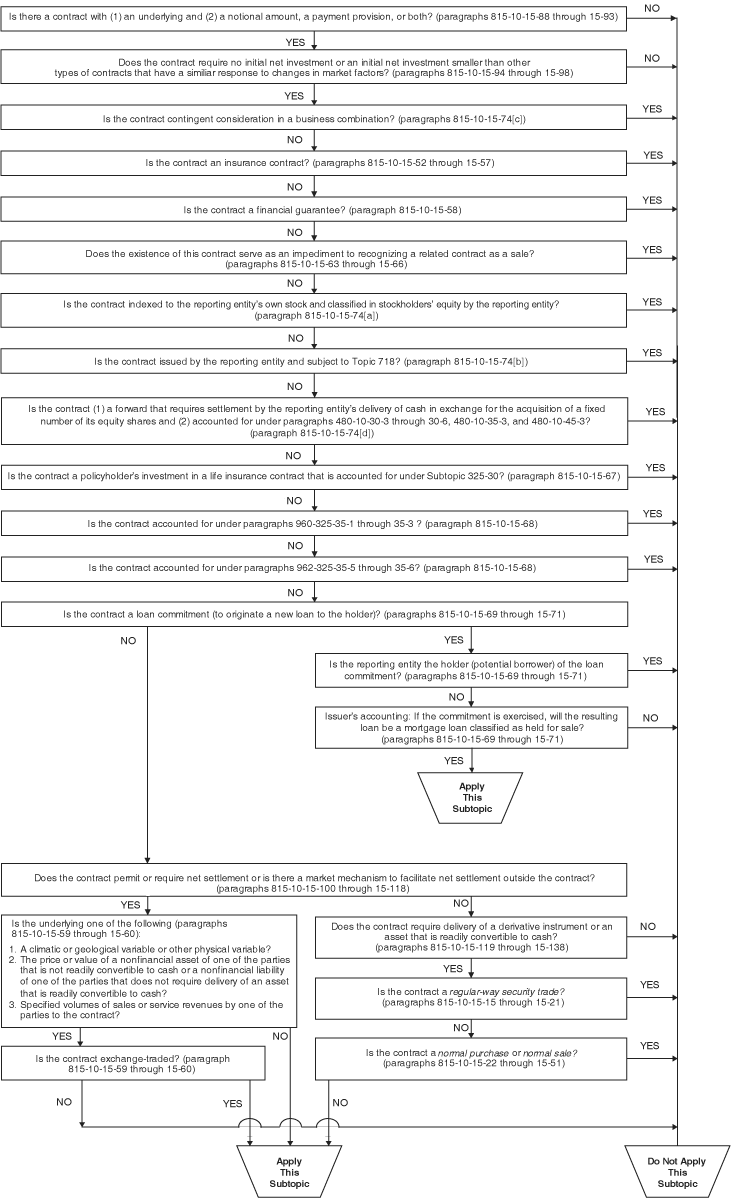
| Editor's Note: The content of paragraph 815-10-55-2 will change upon transition, together with a change in the heading noted below. |
| • > Determining Whether a Contract Is within the Scope of This Subtopic |
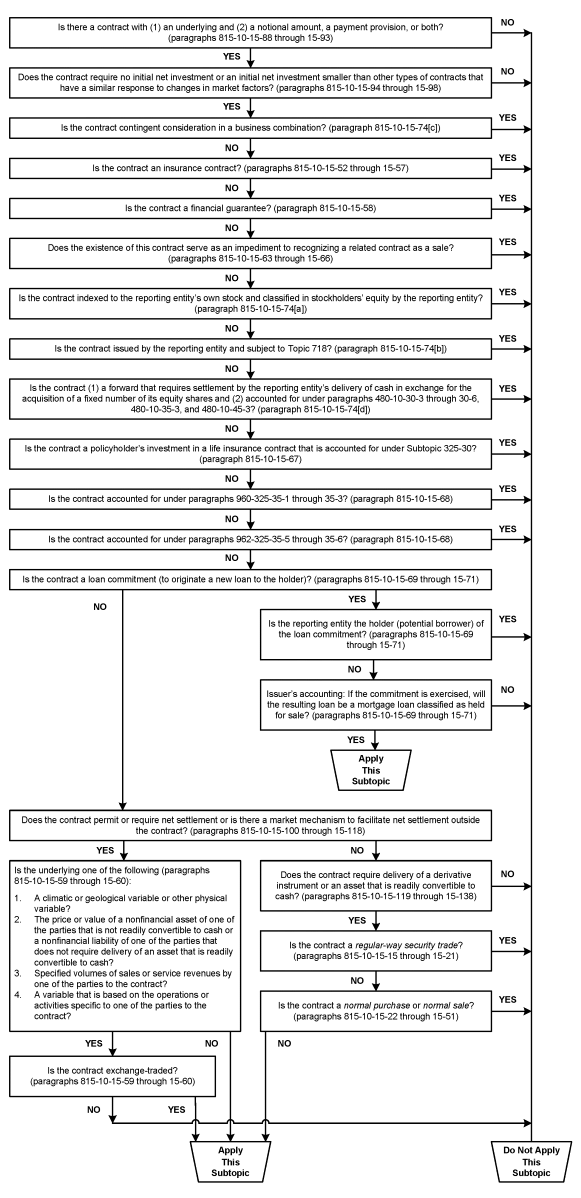
- aNotional amount—identifying a commodity contract's notional amount
- bInitial net investment—initial exchange under currency swap not an initial net investment
- cNet settlement.
- aContract 1: As many units as required to satisfy its actual needs (that is, to be used or consumed) for the commodity during the period of the contract (a requirements contract). The party is not permitted to buy more than its actual needs (for example, the party cannot buy excess units for resale).
- bContract 2: Only as many units as needed to satisfy its actual needs up to a maximum of 100 units. The party is not permitted to buy more than its actual needs (for example, the party cannot buy excess units for resale).
- cContract 3: A minimum of 60 units and as many units needed to satisfy its actual needs in excess of 60 units. The party is not permitted to buy more than its actual needs (for example, the party cannot buy excess units for resale).
- dContract 4: A minimum of 60 units and as many units needed to satisfy its actual needs in excess of 60 units up to a maximum of 100 units. The party is not permitted to buy more than its actual needs (for example, the party cannot buy excess units for resale).
- aContract 1—requirements contract. The identification of a requirements contract's notional amount may require the consideration of volumes or formulas contained in attachments or appendixes to the contract or other legally binding side agreements. The determination of a requirements contract's notional amount must be performed over the life of the contract and could result in the fluctuation of the notional amount if, for instance, the default provisions reference a rolling cumulative average of historical usage. If the notional amount is not determinable, making the quantification of such an amount highly subjective and relatively unreliable (for example, if a contract does not contain settlement and default provisions that explicitly reference quantities or provide a formula based on historical usage), such contracts are considered not to contain a notional amount as that term is used in this Subtopic. One technique to quantify and validate the notional amount in a requirements contract is to base the estimated volumes on the contract's settlement and default provisions. Often the default provisions of requirements contracts will specifically refer to anticipated quantities to utilize in the calculation of penalty amounts in the event of nonperformance. Other default provisions stipulate penalty amounts in the event of nonperformance based on average historical usage quantities of the buyer. If those amounts are determinable, they shall be considered the notional amount of the contract.
- bContract 2—requirements contract with a specified maximum quantity. Whether the contract has a notional amount depends. The same considerations discussed in (a) with respect to Contract 1 also apply to Contract 2; however, the notional amount cannot exceed 100 units.
- cContract 3—requirements contract with a specified minimum quantity. The contract has a notional amount. The same considerations discussed in (a) with respect to Contract 1 also apply to Contract 3; however, the notional amount of Contract 3 cannot be less than 60 units. A contract that specifies a minimum number of units always has a notional amount at least equal to the required minimum number of units. Only that portion of the requirements contract with a determinable notional amount would be accounted for as a derivative instrument under this Subtopic.
- dContract 4—requirements contract with a specified maximum and minimum quantities. The contract has a notional amount. The same considerations discussed in (a) with respect to Contract 1 also apply to Contract 4; however, the notional amount of Contract 4 cannot be less than 60 units or greater than 100 units. A contract that specifies a minimum number of units always has a notional amount at least equal to the required minimum number of units. Only that portion of the requirements contract with a determinable notional amount would be accounted for as a derivative instrument under this Subtopic.
- aAsymmetrical default provision does not constitute net settlement.
- bDetermining whether a structured payout constitutes net settlement.
- aIf the buyer under the forward contract (Buyer) defaults (that is, does not take physical delivery of the commodity), the seller under that contract (Seller) will have to find another buyer in the market to take delivery. If the price received by Seller in the market is less than the contract price, Seller incurs a loss equal to the quantity of the commodity that would have been delivered under the forward contract multiplied by the difference between the contract price and the current market price. Buyer must pay Seller a penalty for nonperformance equal to that loss.
- bIf Seller defaults (that is, does not deliver the commodity physically), Buyer will have to find another seller in the market. If the price paid by Buyer in the market is more than the contract price, Seller must pay Buyer a penalty for nonperformance equal to the quantity of the commodity that would have been delivered under the forward contract multiplied by the difference between the contract price and the current market price.
- aAssume Buyer defaults on the forward contract by not taking delivery and Seller must sell the 100 units in the market at the prevailing market price of $.75 per unit. To compensate Seller for the loss incurred due to Buyer's default, Buyer must pay Seller a penalty of $25.00—that is, 100 units × ($1.00 - $.75).
- bSimilarly, assume that Seller defaults and Buyer must buy the 100 units it needs in the market at the prevailing market price of $1.30 per unit. To compensate Buyer for the loss incurred due to Seller's default, Seller must pay Buyer a penalty of $30.00—that is, 100 units × ($1.30 - $1.00).
- aBy taking delivery of the physical commodity
- bIn the event of default by Seller (which is an event beyond the control of Buyer).
- aBy making delivery of the physical commodity
- bIn the event of default by Buyer, which is an event beyond the control of Seller.
- aNormal purchases and normal sales—application to power purchase or sales agreements
- bDual-trigger financial guarantee contracts
- cCertain insurance contracts—dual-trigger property and casualty insurance contracts
- dDerivative instrument that impedes sale accounting
- e
- aContracts that combine a forward contract and a purchased option contract
- bDistinguishing between options that are capacity contracts and financial options on electricity.
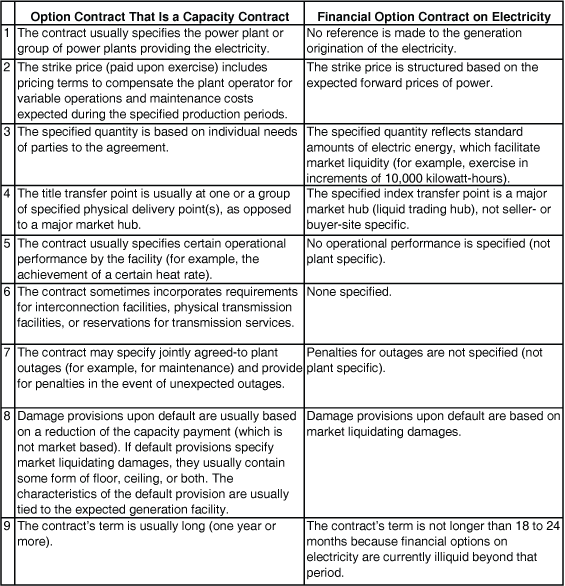 Option Contract That Is a Capacity Contract Financial Option Contract on Electricity 1 The contract usually specifies the power plant or group of power plants providing the electricity. No reference is made to the generation origination of the electricity. 2 The strike price (paid upon exercise) includes pricing terms to compensate the plant operator for variable operations and maintenance costs expected during the specified production periods. The strike price is structured based on the expected forward prices of power. 3 The specified quantity is based on individual needs of parties to the agreement. "The specified quantity reflects standard amounts of electric energy, which facilitate market liquidity (for example, exercise in increments of 10,000 kilowatt-hours)." 4 "The title transfer point is usually at one or a group of specified physical delivery point(s), as opposed to a major market hub." "The specified index transfer point is a major market hub (liquid trading hub), not seller- or buyer-site specific." 5 "The contract usually specifies certain operational performance by the facility (for example, the achievement of a certain heat rate)." No operational performance is specified (not plant specific). 6 "The contract sometimes incorporates requirements for interconnection facilities, physical transmission facilities, or reservations for transmission services." None specified. 7 "The contract may specify jointly agreed-to plant outages (for example, for maintenance) and provide for penalties in the event of unexpected outages." Penalties for outages are not specified (not plant specific). 8 "Damage provisions upon default are usually based on a reduction of the capacity payment (which is not market based). If default provisions specify market liquidating damages, they usually contain some form of floor, ceiling, or both. The characteristics of the default provision are usually tied to the expected generation facility." Damage provisions upon default are based on market liquidating damages. 9 The contract's term is usually long (one year or more). The contract's term is not longer than 18 to 24 months because financial options on electricity are currently illiquid beyond that period.
- aEntity ABC's actual credit losses
- bThe credit losses on a customized pool or index of consumer loans.
- aThe provision that limits any claims to the extent that Entity ABC's actual credit losses exceed a specified minimum level
- bThe provision that limits any payments for those claims to the amount by which the credit losses on a customized pool or index of consumer loans exceed that same specified minimum level.
- aContract A—electric utility. A dual-trigger policy pays for a level of actual losses caused by the following two events occurring simultaneously:
- 1A power outage resulting from equipment failure or storm-related damage causes more than 500 megawatts of lost power.
- 2The spot market price for power exceeds $65 per megawatt hour during the storm or equipment-failure period.
The contract pays the difference between the strike price and the actual market price for the lost power (that is, the cost of replacement power). - 1
- bContract B—trucking delivery entity. A dual-trigger policy pays extra expenses associated with rerouting trucks over a certain time period if snowfall exceeds a specified level during that time period. The snowfall causes delays and creates the need to reroute trucks to meet delivery demands.
- cContract C—hospital.A dual-trigger policy pays actual medical malpractice claims above a specified level only if the value of the hospital's equity portfolio falls below a specified level during the same period.
- dContract D—iron ore mining entity. A dual-trigger policy pays a specified level of workers' compensation claims (not to exceed actual claims) if the claims exceed a specified level at the same time iron ore prices decrease below a specified level.
- eContract E—golf resort in Florida. A dual-trigger policy pays property damage from hurricanes incurred by a specific golf resort in Florida; however, the losses are covered only if other golf courses in the region incur hurricane-related losses and the claims cannot exceed the average property damages incurred by the other golf resorts in the county.
- fContract F—cherry orchard in Michigan. A dual-trigger policy pays crop losses incurred due to bad weather during growing season, and the claims are at risk of being reduced based on changes in the inflation rate in Brazil. The cherry producer has no operations in Brazil or any transactions in Brazilian currency. However, a Brazilian cherry producer exports cherries to the United States and is a competitor of the Michigan cherry producer.
- gContract G—property-casualty reinsurance contract. Reinsurance contracts, which indemnify the holder of the contract (the reinsured) against loss or liability relating to insurance risk, are accounted for under the provisions of Topic 944. Reinsurance contract provisions often adjust the amount at risk or the price of the amount at risk for a number of events or circumstances, such as loss experience or premium volume, while continuing to provide indemnification related to insurance risk. One type of reinsurance contract, an excess contract, provides the reinsured with indemnification against a finite amount of insured losses in excess of a defined level of insured losses retained by the reinsured. Example 11 (see paragraph 815-10-55-132) illustrates a reinsurance contract with a provision that adjusts the retention amount downward based on the performance of a specified equity index.
- aIf a transferor transfers financial assets but retains a call option on those assets, the net settlement criterion (as discussed beginning in paragraph 815-10-15-119) may be satisfied because the assets transferred are readily obtainable; however, the transfer may fail the isolation criterion in paragraph 860-10-40-5(a) because of significant continued involvement by the transferor. In that example, because the transferor is required to continue to recognize the assets transferred, recognition of the call option on those assets would effectively result in recording the assets twice. Therefore, the derivative instrument is not subject to the scope of this Subtopic.
- bIn the situation described in (a), the transferor may have sold to the transferee a put option. Exercise of the put option by the transferee would result in the transferor repurchasing certain assets that it has transferred, but which it still records as assets in its balance sheet. Because the transferor is required to recognize the borrowing, recognition of the put option would result in recording the liability twice. Therefore, the derivative instrument is not subject to the scope of this Subtopic.
- cA transferor may transfer fixed-rate financial assets to a transferee and guarantee a variable-rate return. If the transfer is accounted for as a sale and an interest-rate swap is entered into as part of the contractual provisions of the transfer, the transferor records the interest rate swap as one of the financial components. In that case, the interest rate swap should be accounted for separately in accordance with this Subtopic. However, if the transfer is accounted for as a financing, the transferor records on its balance sheet the issuance of variable-rate debt and continues to report the fixed-rate financial assets; no derivative instrument is recognized under this Subtopic.
- dIn a securitization transaction, a transferor transfers $100 of fixed-rate financial assets and the contractual terms of the beneficial interests incorporate an interest rate swap with a notional principal of $1 million. If the transfer is accounted for as a sale and the interest rate swap is entered into as part of the contractual provisions of the transfer, the transferor identifies and records the interest rate swap as one of the financial components. In that case, the interest rate swap would be accounted for separately in accordance with this Subtopic. However, if the transfer is accounted for as a financing, the transferor records in its balance sheet a $100 variable-rate borrowing and continues to report the $100 of fixed-rate financial assets. In this instance, because the liability is leveraged, requiring computation of interest flows based on a $1 million notional amount, the liability (which does not meet the definition of a derivative instrument in its entirety) is a hybrid instrument that contains an embedded derivative—such as an interest rate swap with a notional amount of $999,900. That embedded derivative is not clearly and closely related to the host contract under Section 815-15-25 (see paragraph 815-15-25-1[c]) because it could result in a rate of return on the counterparty's asset that is at least double the initial rate and that is at least twice what otherwise would be the then-current market return for a contract that has the same terms as the host contract and that involves a debtor with credit quality similar to the issuer's credit quality at inception. Therefore, the derivative instrument must be recorded separately under paragraph 815-15-25-1.
- aContract with payment provision
- bCredit derivatives
- cEquity options issued to employees and nonemployees
- d
- eRepurchase agreements and wash sales
- fShort sales (sales of borrowed securities)
- gTake-or-pay contracts.
- a
- bCredit derivatives
- cEquity options issued to employees and nonemployees
- d
- eRepurchase agreements and wash sales
- fShort sales (sales of borrowed securities)
- gTake-or-pay contracts.
| Editor's Note: Paragraph 815-10-55-44 will be will be superseded upon transition, together with its heading. |
| • • > Contract with Payment Provision |
- aEntity A awards an option to a grantee.
- bThe terms of the option award provide that, if the grantee continues to provide services to Entity A for 3 years, the grantee may exercise the option and purchase 1 share of common stock of Entity B, a publicly traded entity, for $10 from Entity A.
- cEntity B is unrelated to Entity A and, therefore, is not a subsidiary or accounted for by the equity method.
- aSelling a security (by the short seller to the purchaser)
- bBorrowing a security (by the short seller from the lender)
- cDelivering the borrowed security (by the short seller to the purchaser)
- dPurchasing a security (by the short seller from the market)
- eDelivering the purchased security (by the short seller to the lender).
- aThe economic substance of the transaction
- bThe guidance set forth in Topic 845 relative to nonmonetary exchanges
- cThe principal versus agent considerations provided in paragraphs .
Illustrations
- aAttached call option (Case A)
- bTransferable call option (Case B).
- aA commodity contract between two parties to transact a fixed quantity at a specified future date at a fixed price (such as the commodity's forward price at the inception of the contract) (Case A)
- bA commodity contract between two parties to transact a fixed quantity at a specified future date at whatever the prevailing market price might be at that future date (Case B)
- cA commodity contract having features of both a fixed-price contract and variable-price contract; specifically, an agreement to purchase a commodity in the future at the prevailing market index price at that future date plus or minus a fixed basis differential set at the inception of the contract (Case C).
- aMarket mechanism develops after contract inception (Case A).
- bInitial public offering makes shares readily convertible to cash after contract inception (Case B).
- cIncreased trading activity makes shares readily convertible to cash after contract inception (Case C).
- dDelisting makes shares not readily convertible to cash after contract inception (Case D).
- aMarket mechanism relieves rights and obligations (Case A).
- bMechanism to offset does not relieve rights and obligations (Case B).
- cMechanism to offset relieves rights and obligations (Case C).
- aSingle bond with multiple conversion options (Case A)
- bMultiple bonds each having single conversion option (Case B).
- aIt is not exchange-traded and can be converted into common stock of the debtor, which is traded on an exchange.
- bIt has a face amount of $100 million and is convertible into 10 million shares of common stock.
- cIt may be converted in full or in increments of $1,000 immediately or at any time during the next 2 years.
- dIf it were converted in a $1,000 increment, Investor A would receive 100 shares of common stock.
- aOptionality feature involving price floor (cash-settled put option) written by purchaser and price cap (cash-settled call option) written by seller (Case A)
- bOptionality feature involving cash-settled put option written by purchaser (Case B)
- cOptionality feature involving physically settled put option written by purchaser (Case C).
- aParties: Reinsurer and Reinsured
- bCoverage: Property losses
- cPeriod: January 1, X1, through December 31, X1
- dRetention: $20 million per occurrence, adjusted downward in the same percentage as period-to-date (from January 1, X1, to measurement date) decreases in the Dow Jones Industrial Average, not to exceed 50%
- eLimit: $15 million per occurrence, $15 million per annum
- fPremium: $1.4 million per annum.
 Scenario 1 Scenario 2 7/1/X1 9/1/X1 7/1/X1 9/1/X1 Property-casualty losses " $25,000,000 " " $25,000,000 " " $15,000,000 " " $15,000,000 " Dow Jones Industrial Average " 10,000 " " 8,000 " " 10,000 " " 7,000 " Retention " 20,000,000 " " 16,000,000 " " 20,000,000 " " 14,000,000 " Recovery under contract " 5,000,000 " " 9,000,000 " - " 1,000,000 "
- aContract containing both a physical variable and a financial variable (Case A)
- bContract containing only a physical variable (Case B)
- cContract containing only a financial variable (Case C).
| Editor's Note: The heading that precedes paragraph 815-10-55-135 will be amended upon transition as shown below. The content of the paragraph will not change. |
| •> Example 13: Certain Contracts That Are Not Traded on an Exchange—Distinguishing between Physical and Financial Variables |
- aContract containing both a physical variable and a financial variable (Case A)
- bContract containing only a physical variable (Case B)
- cContract containing only a financial variable (Case C).
| Editor's Note: The content of paragraph 815-10-55-136 will change upon transition, together with a change in the heading noted below. |
| ••> Case A: Contract Containing both a Physical Variable and a Financial Variable |
- aThe contract's settlement is based on an underlying associated with a nonfinancial asset that is not unique (because it is based on the price or value of an interchangeable, nonfinancial unit).
- bThe entity that owns the nonfinancial asset related to the underlying (that is, Entity A) is the buyer of the units and thus would benefit from the forward contract if the price or value increases.
- aResearch and Development Funding Arrangement—Underlyings based on the occurrence of regulatory approval and achieving an earnings target (Case A)
- bMonetization Transaction—Underlyings based on the occurrence of regulatory approval and achieving a sales target (Case B)
- cSustainability-Linked Bond—Underlying based on the failure to meet a greenhouse gas emissions reduction target (Case C)
- dLitigation Funding Arrangement between Litigant and Funder—Underlying based on the occurrence of a successful litigation outcome (Case D)
- eLitigation Funding Arrangement between Law Firm and Funder—Underlying based on the occurrence of a successful litigation outcome (Case E)
- fCommodities-Based Arrangement—Underlying based on a market price of gold (Case F)
- gVariable Payment Arrangement—Underlying based on the occurrence of regulatory approval (Case G)
- hEarnout Arrangement—Underlying based on earnings activity (Case H)
- iVariable Payment Arrangement—Underlying based on stock price differential (Case I)
- jCredit Default Swap Arrangement—Underlying based on the occurrence of a credit event by the reference entity (Case J).
- (EUR 150 - EUR 120) × 100 shares = EUR 3,000
- EUR 3,000 ÷ EUR 150 per share = 20 shares
- aPrepaid interest rate swap (Case A)
- bPrepaid interest rate swap that must be bifurcated (Case B)
- cPrepaid interest rate swap variation (Case C).
- aThe bond price decreased to $48,342,000.
- bAll plan participants requested that their funds be transferred to another plan fund.
- cXYZ exercised its put option to transfer the bond to ABC in exchange for a $50 million cash payment.
- dABC honored its synthetic guaranteed investment contract obligation and acquired the bond for $50 million.
- eXYZ used the $50 million proceeds to make the transfer of participant funds to the newly selected fund.
- aSwaps that should be viewed as a unit (Case A)
- bSwaps that should not be viewed as a unit (Case B).
- aTwo forward contracts viewed as a unit (Case A)
- bBorrowing and lending transactions viewed as a unit (Case B).
- The Entity is exposed to certain risks relating to its ongoing business operations. The primary risks managed by using derivative instruments are commodity price risk and interest rate risk. Forward contracts on various commodities are entered into to manage the price risk associated with forecasted purchases of materials used in the Entity's manufacturing process. Interest rate swaps are entered into to manage interest rate risk associated with fixed-rate loans issued by the Entity's financing subsidiary.
- FASB ASC 815-10 requires that an entity recognize all derivative instruments as either assets or liabilities at fair value in the statement of financial position. In accordance with that Subtopic, the Entity designates commodity forward contracts as cash flow hedges of forecasted purchases of commodities and interest rate swaps as fair value hedges of fixed-rate receivables.
- Cash flow hedges
- For derivative instruments that are designated and qualify as a cash flow hedge, the gain or loss on the derivative instrument is reported as a component of other comprehensive income and reclassified into earnings in the same period or periods during which the hedged transaction affects earnings and is presented in the same income statement line item as the earnings effect of the hedged item. Gains and losses on the derivative instrument representing hedge components excluded from the assessment of effectiveness are recognized currently in earnings and are presented in the same line of the income statement expected for the hedged item.
- As of December 31, 20X2, the Entity had the following outstanding commodity forward contracts that were entered into to hedge forecasted purchases:
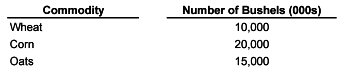 Commodity Number of Bushels (000s) Wheat "10,000" Corn "20,000" Oats "15,000"
- Fair value hedges
- For derivative instruments that are designated and qualify as a fair value hedge, the gain or loss on the derivative instrument as well as the offsetting loss or gain on the hedged item attributable to the hedged risk are recognized in current earnings. The Entity includes the gain or loss on the hedged items (that is, fixed-rate receivables) in the same line item—interest income—as the offsetting loss or gain on the related interest rate swaps.
- As of December 31, 20X2, and 20X1, the following amounts were recorded on the balance sheet related to cumulative basis adjustments for fair value hedges.
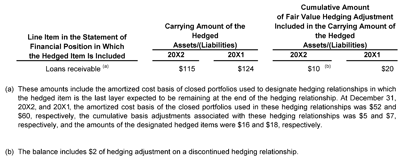 "Line Item in the Statement of Financial Position in Which the Hedged Item Is Included" "Carrying Amount of the Hedged Assets/(Liabilities)" "Cumulative Amount of Fair Value Hedging Adjustment Included in the Carrying Amount of the Hedged Assets/(Liabilities)" 20X2 20X1 20X2 20X1 Loans receivable (a) $115 $124 $10 (b) $20 (a) "These amounts include the amortized cost basis of closed portfolios of loans receivable used to designate hedging relationships in which the hedged item is the stated amount of assets in the closed portfolios anticipated to be outstanding for the designated hedge period . At December 31, 20X2, and 20X1, the amortized cost basis of the closed portfolios used in these hedging relationships was $52 and $60, respectively, the cumulative basis adjustments associated with these hedging relationships was $5 and $7, respectively, and the amounts of the designated hedged items were $16 and $18, respectively." (b) The balance includes $2 of hedging adjustment on a discontinued hedging relationship.
- As of December 31, 20X2, and 20X1, the total notional amount of the Entity's pay-fixed/receive-variable interest rate swaps was $79 and $82, respectively.
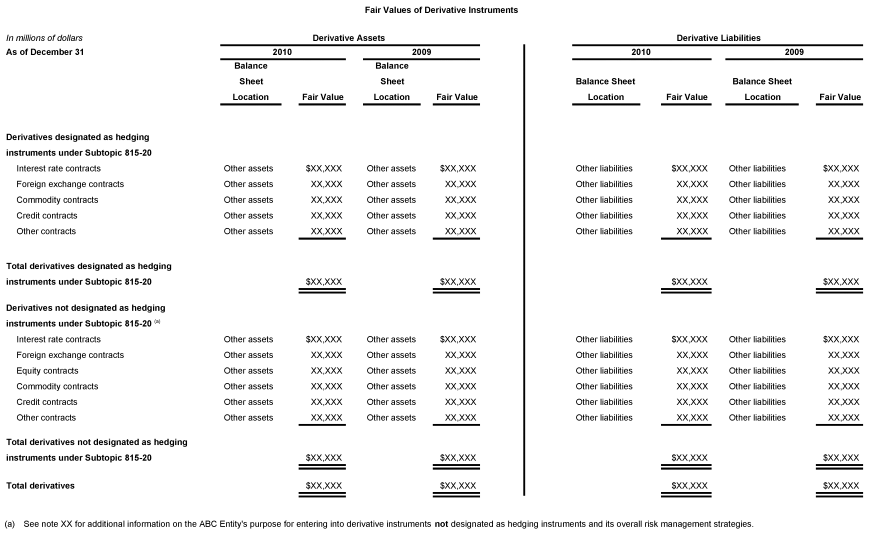 Fair Values of Derivative Instruments In millions of dollars Derivative Assets Derivative Liabilities As of December 31 2010 2009 2010 2009 Balance Sheet Location Fair Value Balance Sheet Location Fair Value Balance Sheet Location Fair Value Balance Sheet Location Fair Value Derivatives designated as hedging instruments under Subtopic 815-20 Interest rate contracts Other assets " $XX,XXX " Other assets " $XX,XXX " Other liabilities " $XX,XXX " Other liabilities " $XX,XXX " Foreign exchange contracts Other assets " XX,XXX " Other assets " XX,XXX " Other liabilities " XX,XXX " Other liabilities " XX,XXX " Commodity contracts Other assets " XX,XXX " Other assets " XX,XXX " Other liabilities " XX,XXX " Other liabilities " XX,XXX " Credit contracts Other assets " XX,XXX " Other assets " XX,XXX " Other liabilities " XX,XXX " Other liabilities " XX,XXX " Other contracts Other assets " XX,XXX " Other assets " XX,XXX " Other liabilities " XX,XXX " Other liabilities " XX,XXX " Total derivatives designated as hedging instruments under Subtopic 815-20 " $XX,XXX " " $XX,XXX " " $XX,XXX " " $XX,XXX " Derivatives not designated as hedging instruments under Subtopic 815-20 (a) Interest rate contracts Other assets " $XX,XXX " Other assets " $XX,XXX " Other liabilities " $XX,XXX " Other liabilities " $XX,XXX " Foreign exchange contracts Other assets " XX,XXX " Other assets " XX,XXX " Other liabilities " XX,XXX " Other liabilities " XX,XXX " Equity contracts Other assets " XX,XXX " Other assets " XX,XXX " Other liabilities " XX,XXX " Other liabilities " XX,XXX " Commodity contracts Other assets " XX,XXX " Other assets " XX,XXX " Other liabilities " XX,XXX " Other liabilities " XX,XXX " Credit contracts Other assets " XX,XXX " Other assets " XX,XXX " Other liabilities " XX,XXX " Other liabilities " XX,XXX " Other contracts Other assets " XX,XXX " Other assets " XX,XXX " Other liabilities " XX,XXX " Other liabilities " XX,XXX " Total derivatives not designated as hedging instruments under Subtopic 815-20 " $XX,XXX " " $XX,XXX " " $XX,XXX " " $XX,XXX " Total derivatives " $XX,XXX " " $XX,XXX " " $XX,XXX " " $XX,XXX " (a) See note XX for additional information on the ABC Entity's purpose for entering into derivative instruments not designated as hedging instruments and its overall risk management strategies.
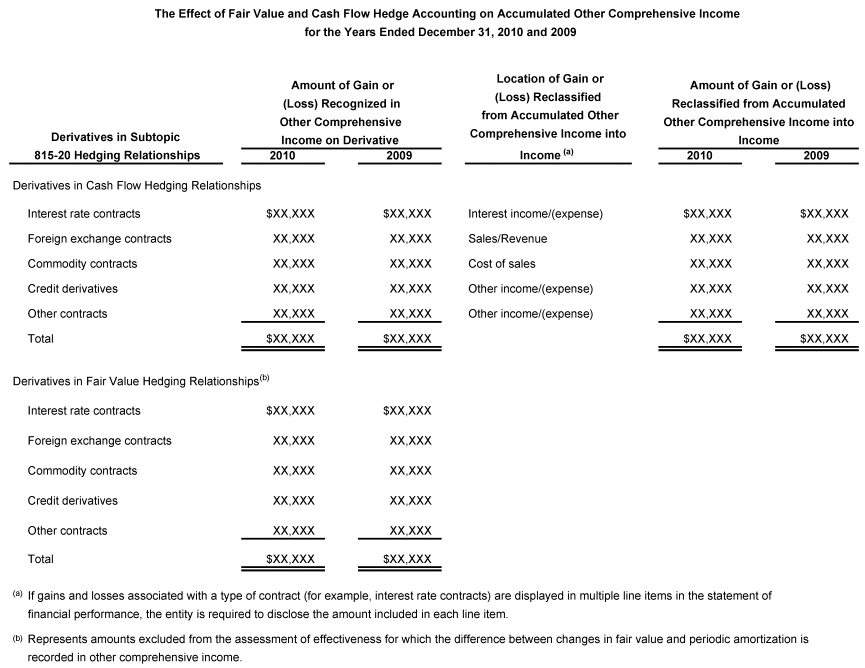 "The Effect of Fair Value and Cash Flow Hedge Accounting on Accumulated Other Comprehensive Income for the Years Ended December 31, 2010 and 2009" "Derivatives in Subtopic 815-20 Hedging Relationships" "Amount of Gain or (Loss) Recognized in Other Comprehensive Income on Derivative" "Location of Gain or (Loss) Reclassified from Accumulated Other Comprehensive Income into Income (a)" Amount of Gain or (Loss) Reclassified from Accumulated Other Comprehensive Income into Income 2010 2009 2010 2009 Derivatives in Cash Flow Hedging Relationships Interest rate contracts " $XX,XXX " " $XX,XXX " Interest income/(expense) " $XX,XXX " " $XX,XXX " Foreign exchange contracts " XX,XXX " " XX,XXX " Sales/Revenue " XX,XXX " " XX,XXX " Commodity contracts " XX,XXX " " XX,XXX " Cost of sales " XX,XXX " " XX,XXX " Credit derivatives " XX,XXX " " XX,XXX " Other income/(expense) " XX,XXX " " XX,XXX " Other contracts " XX,XXX " " XX,XXX " Other income/(expense) " XX,XXX " " XX,XXX " Total " $XX,XXX " " $XX,XXX " " $XX,XXX " " $XX,XXX " Derivatives in Fair Value Hedging Relationships(b) Interest rate contracts " $XX,XXX " " $XX,XXX " Foreign exchange contracts " XX,XXX " " XX,XXX " Commodity contracts " XX,XXX " " XX,XXX " Credit derivatives " XX,XXX " " XX,XXX " Other contracts " XX,XXX " " XX,XXX " Total " $XX,XXX " " $XX,XXX " (a) "If gains and losses associated with a type of contract (for example, interest rate contracts) are displayed in multiple line items in the income statement of financial performance, the entity is required to disclose the amount included in each line item." (b) Represents amounts excluded from the assessment of effectiveness for which the difference between changes in fair value and periodic amortization is recorded in other comprehensive income.
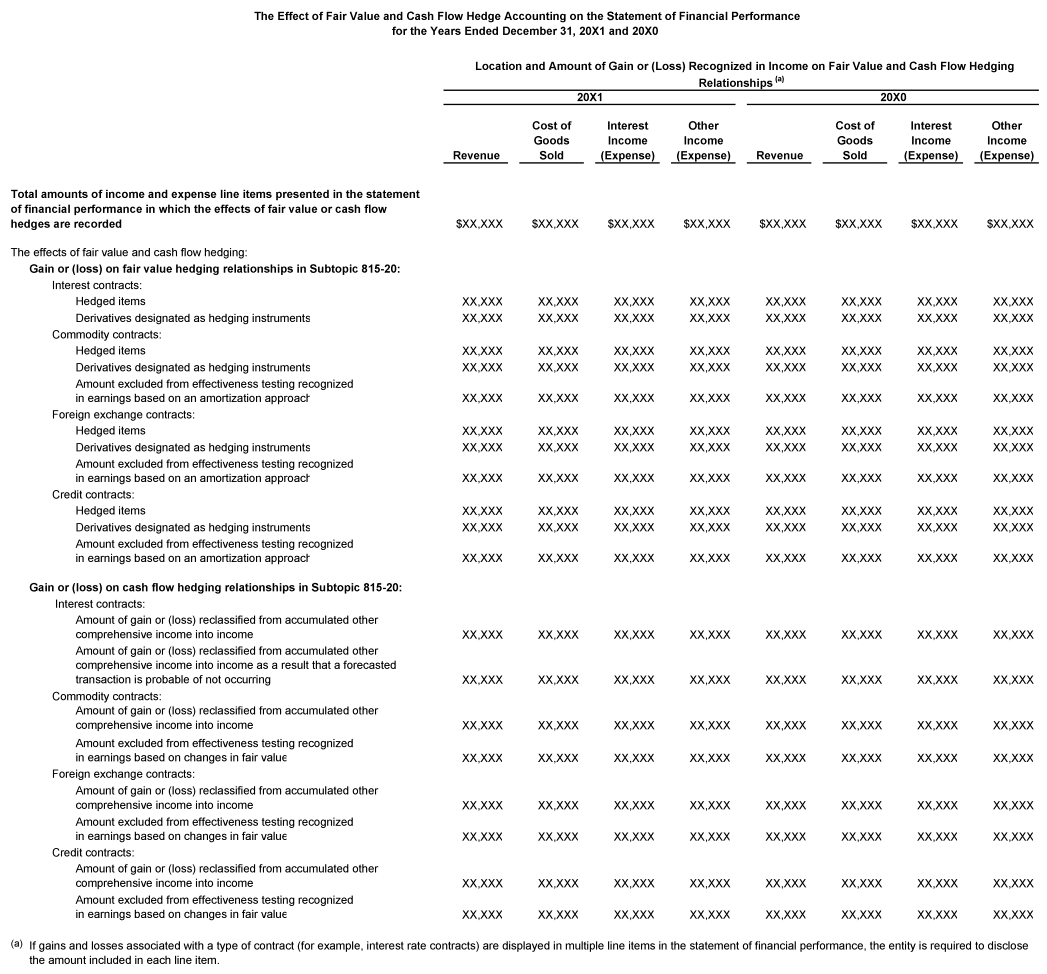 "The Effect of Fair Value and Cash Flow Hedge Accounting on the Statement of Financial Performance for the Years Ended December 31, 20X1 and 20X0" Location and Amount of Gain or (Loss) Recognized in Income on Fair Value and Cash Flow Hedging Relationships (a) 20X1 20X0 Revenue Cost of Goods Sold Interest Income (Expense) Other Income (Expense) Revenue Cost of Goods Sold Interest Income (Expense) Other Income (Expense) Total amounts of income and expense line items presented in the statement of financial performance in which the effects of fair value or cash flow hedges are recorded " $XX,XXX " " $XX,XXX " " $XX,XXX " " $XX,XXX " " $XX,XXX " " $XX,XXX " " $XX,XXX " " $XX,XXX " The effects of fair value and cash flow hedging: Gain or (loss) on fair value hedging relationships in Subtopic 815-20: Interest contracts: Hedged items " XX,XXX " " XX,XXX " " XX,XXX " " XX,XXX " " XX,XXX " " XX,XXX " " XX,XXX " " XX,XXX " Derivatives designated as hedging instruments " XX,XXX " " XX,XXX " " XX,XXX " " XX,XXX " " XX,XXX " " XX,XXX " " XX,XXX " " XX,XXX " Commodity contracts: Hedged items " XX,XXX " " XX,XXX " " XX,XXX " " XX,XXX " " XX,XXX " " XX,XXX " " XX,XXX " " XX,XXX " " XX,XXX " " XX,XXX " " XX,XXX " Derivatives designated as hedging instruments " XX,XXX " " XX,XXX " " XX,XXX " " XX,XXX " " XX,XXX " " XX,XXX " " XX,XXX " " XX,XXX " " XX,XXX " " XX,XXX " " XX,XXX " Amount excluded from effectiveness testing recognized in earnings based on an amortization approach " XX,XXX " " XX,XXX " " XX,XXX " " XX,XXX " " XX,XXX " " XX,XXX " " XX,XXX " " XX,XXX " Foreign exchange contracts: Hedged items " XX,XXX " " XX,XXX " " XX,XXX " " XX,XXX " " XX,XXX " " XX,XXX " " XX,XXX " " XX,XXX " " XX,XXX " " XX,XXX " " XX,XXX " " XX,XXX " " XX,XXX " " XX,XXX " Derivatives designated as hedging instruments " XX,XXX " " XX,XXX " " XX,XXX " " XX,XXX " " XX,XXX " " XX,XXX " " XX,XXX " " XX,XXX " " XX,XXX " " XX,XXX " " XX,XXX " " XX,XXX " " XX,XXX " " XX,XXX " Amount excluded from effectiveness testing recognized in earnings based on an amortization approach " XX,XXX " " XX,XXX " " XX,XXX " " XX,XXX " " XX,XXX " " XX,XXX " " XX,XXX " " XX,XXX " Credit contracts: Hedged items " XX,XXX " " XX,XXX " " XX,XXX " " XX,XXX " " XX,XXX " " XX,XXX " " XX,XXX " " XX,XXX " " XX,XXX " " XX,XXX " " XX,XXX " " XX,XXX " " XX,XXX " Derivatives designated as hedging instruments " XX,XXX " " XX,XXX " " XX,XXX " " XX,XXX " " XX,XXX " " XX,XXX " " XX,XXX " " XX,XXX " Amount excluded from effectiveness testing recognized in earnings based on an amortization approach " XX,XXX " " XX,XXX " " XX,XXX " " XX,XXX " " XX,XXX " " XX,XXX " " XX,XXX " " XX,XXX " Gain or (loss) on cash flow hedging relationships in Subtopic 815-20: Interest contracts: Amount of gain or (loss) reclassified from accumulated other comprehensive income into income " XX,XXX " " XX,XXX " " XX,XXX " " XX,XXX " " XX,XXX " " XX,XXX " " XX,XXX " " XX,XXX " Amount of gain or (loss) reclassified from accumulated other comprehensive income into income as a result that a forecasted transaction is no longer probable of occurring " XX,XXX " " XX,XXX " " XX,XXX " " XX,XXX " " XX,XXX " " XX,XXX " " XX,XXX " " XX,XXX " Commodity contracts: Amount of gain or (loss) reclassified from accumulated other comprehensive income into income " XX,XXX " " XX,XXX " " XX,XXX " " XX,XXX " " XX,XXX " " XX,XXX " " XX,XXX " " XX,XXX " Amount excluded from effectiveness testing recognized in earnings based on changes in fair value " XX,XXX " " XX,XXX " " XX,XXX " " XX,XXX " " XX,XXX " " XX,XXX " " XX,XXX " " XX,XXX " Foreign exchange contracts: Amount of gain or (loss) reclassified from accumulated other comprehensive income into income " XX,XXX " " XX,XXX " " XX,XXX " " XX,XXX " " XX,XXX " " XX,XXX " " XX,XXX " " XX,XXX " Amount excluded from effectiveness testing recognized in earnings based on changes in fair value " XX,XXX " " XX,XXX " " XX,XXX " " XX,XXX " " XX,XXX " " XX,XXX " " XX,XXX " " XX,XXX " Credit contracts: Amount of gain or (loss) reclassified from accumulated other comprehensive income into income " XX,XXX " " XX,XXX " " XX,XXX " " XX,XXX " " XX,XXX " " XX,XXX " " XX,XXX " " XX,XXX " Amount excluded from effectiveness testing recognized in earnings based on changes in fair value " XX,XXX " " XX,XXX " " XX,XXX " " XX,XXX " " XX,XXX " " XX,XXX " " XX,XXX " " XX,XXX " (a) "If gains and losses associated with a type of contract (for example, interest rate contracts) are displayed in multiple line items in the income statement of financial performance, the entity is required to disclose the amount included in each line item."
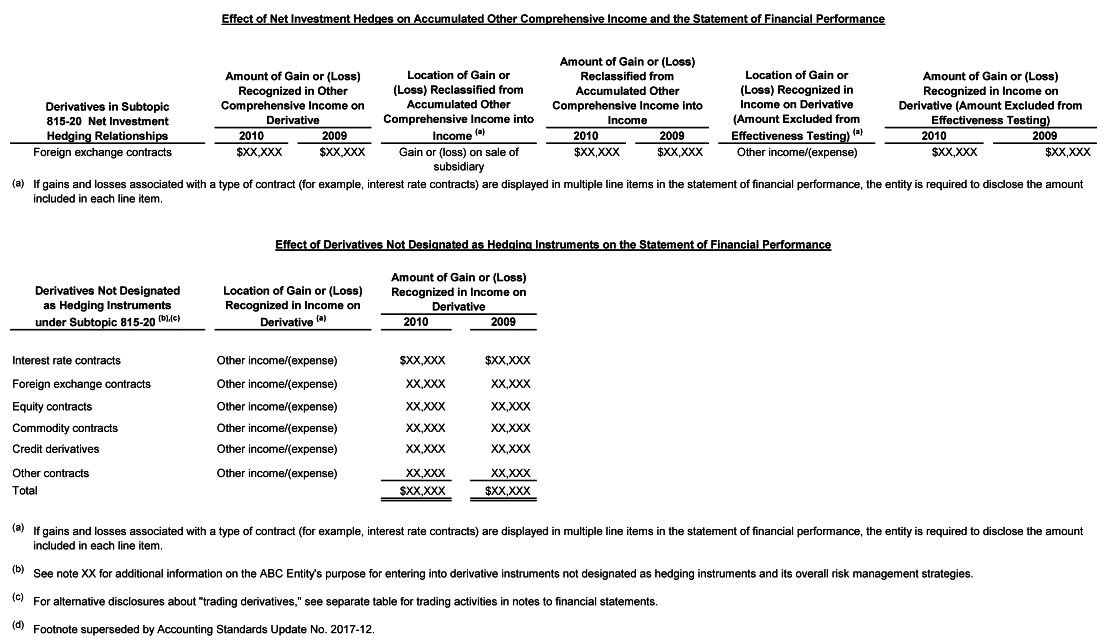 Fair Values of Derivative Instruments In millions of dollars Derivative Assets Derivative Liabilities As of December 31 2010 2009 2010 2009 Balance Sheet Location Fair Value Balance Sheet Location Fair Value Balance Sheet Location Fair Value Balance Sheet Location Fair Value Derivatives designated as hedging instruments under Subtopic 815-20 Interest rate contracts Other assets " $XX,XXX " Other assets " $XX,XXX " Other liabilities " $XX,XXX " Other liabilities " $XX,XXX " Foreign exchange contracts Other assets " XX,XXX " Other assets " XX,XXX " Other liabilities " XX,XXX " Other liabilities " XX,XXX " Commodity contracts Other assets " XX,XXX " Other assets " XX,XXX " Other liabilities " XX,XXX " Other liabilities " XX,XXX " Credit contracts Other assets " XX,XXX " Other assets " XX,XXX " Other liabilities " XX,XXX " Other liabilities " XX,XXX " Other contracts Other assets " XX,XXX " Other assets " XX,XXX " Other liabilities " XX,XXX " Other liabilities " XX,XXX " Total derivatives designated as hedging instruments under Subtopic 815-20 " $XX,XXX " " $XX,XXX " " $XX,XXX " " $XX,XXX " Derivatives not designated as hedging instruments under Subtopic 815-20 (a) Interest rate contracts Other assets " $XX,XXX " Other assets " $XX,XXX " Other liabilities " $XX,XXX " Other liabilities " $XX,XXX " Foreign exchange contracts Other assets " XX,XXX " Other assets " XX,XXX " Other liabilities " XX,XXX " Other liabilities " XX,XXX " Equity contracts Other assets " XX,XXX " Other assets " XX,XXX " Other liabilities " XX,XXX " Other liabilities " XX,XXX " Commodity contracts Other assets " XX,XXX " Other assets " XX,XXX " Other liabilities " XX,XXX " Other liabilities " XX,XXX " Credit contracts Other assets " XX,XXX " Other assets " XX,XXX " Other liabilities " XX,XXX " Other liabilities " XX,XXX " Other contracts Other assets " XX,XXX " Other assets " XX,XXX " Other liabilities " XX,XXX " Other liabilities " XX,XXX " Total derivatives not designated as hedging instruments under Subtopic 815-20 " $XX,XXX " " $XX,XXX " " $XX,XXX " " $XX,XXX " Total derivatives " $XX,XXX " " $XX,XXX " " $XX,XXX " " $XX,XXX " (a) See note XX for additional information on the ABC Entity's purpose for entering into derivative instruments not designated as hedging instruments and its overall risk management strategies.
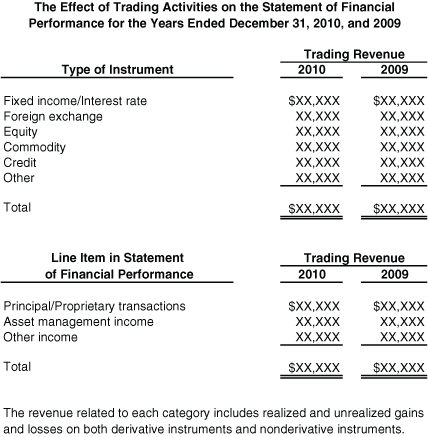 "The Effect of Trading Activities on the Statement of Financial Performance for the Years Ended December 31, 2010, and 2009 " Trading Revenue Type of Instrument 2010 2009 Fixed income/Interest rate "$XX,XXX" "$XX,XXX" Foreign exchange " XX,XXX" "XX,XXX" Equity " XX,XXX" "XX,XXX" Commodity "XX,XXX" "XX,XXX" Credit "XX,XXX" "XX,XXX" Other "XX,XXX" "XX,XXX" Total "$XX,XXX" "$XX,XXX" Line Item in Statement Trading Revenue " of Financial Performance" 2010 2009 Principal/Proprietary transactions "$XX,XXX" "$XX,XXX" Asset management income "XX,XXX" "XX,XXX" Other income "XX,XXX" "XX,XXX" Total "$XX,XXX" "$XX,XXX" The revenue related to each category includes realized and unrealized gains and losses on both derivative instruments and nonderivative instruments.
- Contingent Features
- Certain of the Entity's derivative instruments contain provisions that require the Entity's debt to maintain an investment grade credit rating from each of the major credit rating agencies. If the Entity's debt were to fall below investment grade, it would be in violation of these provisions, and the counterparties to the derivative instruments could request immediate payment or demand immediate and ongoing full overnight collateralization on derivative instruments in net liability positions. The aggregate fair value of all derivative instruments with credit-risk-related contingent features that are in a liability position on December 31, 2009, is $XX million for which the Entity has posted collateral of $X million in the normal course of business. If the credit-risk-related contingent features underlying these agreements were triggered on December 31, 2009, the Entity would be required to post an additional $XX million of collateral to its counterparties.
815-10-60Relationships
Source downloaded: .Record version 0652d0a69f50. Effective date must be checked in the source.
Statement of Cash Flows
Compensation—Stock Compensation
Fair Value Measurements and Disclosures
815-10-65Transition and Open Effective Date Information
Source downloaded: .Record version 810f878ef6ee. Effective date must be checked in the source.
Transition Related to Accounting Standards Update No. 2014-03, <em class="ph i">Derivatives and Hedging (Topic 815): Accounting for Certain Receive-Variable, Pay-Fixed Interest Rate Swaps—Simplified Hedge Accounting Approach</em>
- a
- bUpon adoption of the simplified hedge accounting approach in this Subtopic and adoption of the guidance in paragraphs 825-10-50-3 and 825-10-50-8, that guidance shall be applied as of the beginning of the first fiscal year in which the approach is elected and in either of the following ways:
- 1Using a modified retrospective approach in which corresponding adjustments shall be made to the assets, liabilities, and opening balance of accumulated other comprehensive income and retained earnings (or other appropriate components of equity) of the current period presented to reflect application of hedge accounting under this Topic from the date the receive-variable, pay-fixed interest rate swap was entered into (or acquired) by the entity.
- 2Using a full retrospective approach in which:
- iThe financial statements for each individual prior period presented shall be adjusted to reflect the period-specific effects of applying hedge accounting under this Topic from the date the receive-variable, pay-fixed interest rate swap was entered into (or acquired) by the entity.
- iiCorresponding adjustments shall be made to the assets, liabilities, and opening balance of accumulated other comprehensive income and retained earnings (or other appropriate components of equity) of the earliest period presented to reflect application of hedge accounting under this Topic from the date the receive-variable, pay-fixed interest rate swap was entered into (or acquired) by the entity.
- i
- 1
- cThe simplified hedge accounting approach may be elected for any qualifying receive-variable, pay-fixed interest rate swap, whether existing at the date of its adoption or entered into after that date. The election to apply the simplified hedge accounting approach to an existing swap shall be made upon its adoption and can be applied only to existing swaps the first time the election is made. After the initial election is made to apply the simplified hedge accounting approach to existing swaps, no further retrospective applications to existing swaps (full or modified) are permitted. In determining whether an existing swap meets all of the conditions in paragraph 815-20-25-131D to qualify for applying the simplified hedge accounting approach, the condition that the swap's fair value at the time of application of this approach is at or near zero need not be considered. Instead, as long as the swap's fair value was at or near zero at the time the swap was entered into (or acquired) by the entity, the entity may apply the simplified hedge accounting approach. For an existing swap, the documentation required by paragraph 815-20-25-3 to qualify for hedge accounting must be completed in the period of adoption by the date on which the first annual financial statements are available to be issued rather than concurrently at hedge inception.
- d
- eAn entity shall provide the required disclosures in paragraphs in the period that the entity adopts the simplified hedge accounting approach in this Subtopic.
- fA private company that makes an accounting policy election to apply the simplified hedge accounting approach for the first time need not justify that the use of that approach is preferable as described in paragraph 250-10-45-2.
Transition Related to Accounting Standards Update No. 2025-07, <em class="ph i">Derivatives and Hedging (Topic 815) and Revenue from Contracts with Customers (Topic 606): Derivatives Scope Refinements and Scope Clarification for Share-Based Noncash Consideration from a Customer in a Revenue Contract</em>
- aAll entities shall apply the pending content that links to this paragraph for annual reporting periods beginning after December 15, 2026, and interim reporting periods within those annual reporting periods.
- bEarly adoption of the pending content that links to this paragraph is permitted in both interim and annual reporting periods in which financial statements have not yet been issued or made available for issuance. If an entity early adopts the pending content that links to this paragraph in an interim reporting period, it shall apply the pending content as of the beginning of the annual reporting period that includes that interim reporting period. If an entity early adopts the pending content that links to this paragraph, it also shall early adopt the pending content that links to paragraph 606-10-65-3 simultaneously.
- cAn entity shall apply the pending content that links to this paragraph using one of the following transition methods:
- 1Prospectively to new contracts entered into on or after the date of adoption.
- 2On a modified retrospective basis through a cumulative-effect adjustment to the opening balance of retained earnings (or other appropriate components of equity or net assets in the statement of financial position) as of the beginning of the annual reporting period of adoption for contracts existing as of the beginning of the annual reporting period of adoption.
- 1
- dIf an entity applies the transition method in (c)(2) and the entity had contracts or embedded features that were accounted for as derivatives but are no longer accounted for as derivatives as a result of applying the pending content that links to this paragraph, the entity has an option as of the beginning of the annual reporting period for which the pending content is adopted to elect to apply the fair value option on an instrument-by-instrument basis and measure the contract in its entirety at fair value with changes in fair value recognized in earnings if that instrument is within the scope of paragraph 825-10-15-4. For financial liabilities, an entity shall present separately in accumulated other comprehensive income the portion of the total change in the fair value of the liability that results from a change in the instrument-specific credit risk. If an entity had previously elected the fair value option for contracts that contained embedded derivatives that otherwise would have been bifurcated but are no longer required to be bifurcated as a result of applying the pending content that links to this paragraph upon adoption, the entity has an option on an instrument-by-instrument basis to revoke the fair value option as of the beginning of the annual reporting period for which the pending content is adopted and measure the contract in accordance with other generally accepted accounting principles. For those instruments for which the entity elects or revokes its election of the fair value option, the effects of initially complying with the pending content that links to this paragraph shall be reported as a cumulative-effect adjustment directly to the opening balance of retained earnings (or other appropriate components of equity or net assets in the statement of financial position) as of the beginning of the annual reporting period in which the pending content is adopted.
- eAn entity that applies the transition method in (c)(1) shall disclose the nature of and reason for the change in accounting principle in both the interim reporting period and the annual reporting period in which the entity adopts the pending content that links to this paragraph.
- fAn entity that applies the transition method in (c)(2) shall disclose the following in both the interim reporting period and the annual reporting period in which the entity adopts the pending content that links to this paragraph:
- 1The nature of and reason for the change in accounting principle
- 2The cumulative effect of the change on retained earnings or other components of equity or net assets in the statement of financial position as of the beginning of the annual reporting period of adoption and a description of the financial statement line items affected by the adjustment.
- 1
815-10-S00StatusSEC
Source downloaded: .Record version f20840aebced. Effective date must be checked in the source.
| Paragraph | Action | Accounting Standards Update | Date |
| 815-10-S45-1 | Superseded | Accounting Standards Update No. 2010-04 | 01/15/2010 |
| 815-10-S55-1 | Superseded | Accounting Standards Update No. 2016-11 | 05/02/2016 |
| 815-10-S99-1 | Amended | Accounting Standards Update No. 2012-03 | 08/27/2012 |
| 815-10-S99-2 | Superseded | Accounting Standards Update No. 2010-04 | 01/15/2010 |
| 815-10-S99-3 | Superseded | Accounting Standards Update No. 2016-11 | 05/02/2016 |
| 815-10-S99-3 | Amended | Accounting Standards Update No. 2010-04 | 01/15/2010 |
815-10-S30Initial MeasurementSEC
Source downloaded: .Record version d4f13d99bfb7. Effective date must be checked in the source.
Written Loan Commitments Recorded at Fair Value through Earnings
Accounting for Written Options
815-10-S35Subsequent MeasurementSEC
Source downloaded: .Record version 07683a067b4e. Effective date must be checked in the source.
Accounting for Written Options
815-10-S45Other Presentation MattersSEC
Source downloaded: .Record version 9a50cab132db. Effective date must be checked in the source.
815-10-S50DisclosureSEC
Source downloaded: .Record version 3ba0277ac3e3. Effective date must be checked in the source.
Accounting Policies for Certain Derivative Instruments
815-10-S55Implementation Guidance and IllustrationsSEC
Source downloaded: .Record version 258c8b2ac378. Effective date must be checked in the source.
815-10-S99SEC MaterialsSEC
Source downloaded: .Record version d2d57cd1a05d. Effective date must be checked in the source.
SEC Staff Guidance
- Facts: Bank A enters into a loan commitment with a customer to originate a mortgage loan at a specified rate. As part of this written loan commitment, Bank A expects to receive future net cash flows related to servicing rights from servicing fees (included in the loan's interest rate or otherwise), late charges, and other ancillary sources, or from selling the servicing rights to a third party. If Bank A intends to sell the mortgage loan after it is funded, pursuant to FASB ASC paragraph 815-10-15-83 (Derivatives and Hedging Topic), the written loan commitment is accounted for as a derivative instrument and recorded at fair value through earnings (referred to hereafter as a "derivative loan commitment"). If Bank A does not intend to sell the mortgage loan after it is funded, the written loan commitment is not accounted for as a derivative under FASB ASC Subtopic 815-10, Derivatives and Hedging—Overall. However, FASB ASC subparagraph 825-10-15-4(c) (Financial Instruments Topic), permits Bank A to record the written loan commitment at fair value through earnings (referred to hereafter as a "written loan commitment"). Pursuant to FASB ASC Subtopic 825-10, Financial Instruments—Overall, the fair value measurement for a written loan commitment would include the expected net future cash flows related to the associated servicing of the loan.
- Question 1: In measuring the fair value of a derivative loan commitment accounted for under FASB ASC Subtopic 815-10, should Bank A include the expected net future cash flows related to the associated servicing of the loan?
- Interpretive Response: Yes. The staff believes that, consistent with FASB ASC Subtopic 860-50, Transfers and Servicing—Servicing Assets and Liabilities, FN60, and FASB ASC Subtopic 825-10, the expected net future cash flows related to the associated servicing of the loan should be included in the fair value measurement of a derivative loan commitment. The expected net future cash flows related to the associated servicing of the loan that are included in the fair value measurement of a derivative loan commitment or a written loan commitment should be determined in the same manner that the fair value of a recognized servicing asset or liability is measured under FASB ASC Subtopic 860-50. However, as discussed in FASB ASC paragraph 860-50-25-1, a separate and distinct servicing asset or liability is not recognized for accounting purposes until the servicing rights have been contractually separated from the underlying loan by sale or securitization of the loan with servicing retained.
- FN60 FASB ASC Subtopic 860-50 permits an entity to subsequently measure recognized servicing assets and servicing liabilities (which are nonfinancial instruments) at fair value through earnings.
- The views in Question 1 apply to all loan commitments that are accounted for at fair value through earnings. However, for purposes of electing fair value accounting pursuant to FASB ASC Subtopic 825-10, the views in Question 1 are not intended to be applied by analogy to any other instrument that contains a nonfinancial element.
- Interpretive Response: No. The staff does not believe that internally-developed intangible assets (such as customer relationship intangible assets) should be recorded as part of the fair value of a derivative loan commitment or a written loan commitment. Such nonfinancial elements of value should not be considered a component of the related instrument. Recognition of such assets would only be appropriate in a third-party transaction. For example, in the purchase of a portfolio of derivative loan commitments in a business combination, a customer relationship intangible asset is recorded separately from the fair value of such loan commitments. Similarly, when an entity purchases a credit card portfolio, FASB ASC paragraph 310-10-25-7 (Receivables Topic) requires an allocation of the purchase price to a separately recorded cardholder relationship intangible asset.
- The view in Question 2 applies to all loan commitments that are accounted for at fair value through earnings.
- SEC staff's longstanding position is that written options that do not qualify for equity classification initially should be reported at fair value and subsequently marked to fair value through earnings.
Related subtopics
- 815-980 Regulated OperationsDerivatives and Hedging
- 815-15 Embedded DerivativesDerivatives and Hedging
- 815-40 Contracts in Entity's Own EquityDerivatives and Hedging
- 980-10 OverallRegulated Operations
- 815-944 Financial Services—InsuranceDerivatives and Hedging
- 815-25 Fair Value HedgesDerivatives and Hedging