ASC 815-45
Weather Derivatives
815 Derivatives and Hedging
Source downloaded: .Record version 67de1601a0ad. Effective date must be checked in the source.
ASC 815-45 governs the accounting for weather derivatives that are not exchange-traded (exchange-traded weather derivatives fall under ASC 815-10), and excludes insurance contracts that pay only upon an insurable event causing a liability or adverse change in value of a specific asset or liability. If entered into for nontrading purposes, forward-based weather derivatives are accounted for under the intrinsic value method, purchased options are recorded as a premium asset amortized to expense plus intrinsic value measurement, and written options are recorded as a premium liability remeasured to fair value through earnings. All weather derivatives entered into for trading or speculative activities are recognized as assets or liabilities at fair value with subsequent changes in fair value in earnings.
Key points (7)
- Scope: applies to all entities and all non-exchange-traded weather derivatives, but not to insurance contracts that compensate the holder only upon an insurable event causing a liability or adverse change in the value of a specific asset or liability at risk (815-45-15-1 through 15-2).
- Nontrading forward-based (e.g., degree-day swap) weather derivatives are accounted for under the intrinsic value method (815-45-25-1; 815-45-35-1).
- The intrinsic value method allocates the cumulative strike amount to individual periods at inception using external statistical data (e.g., National Weather Service), and that initial allocation is never adjusted for actual results; interim intrinsic value equals cumulative actual-versus-allocated differences times the contract price (815-45-30-3; 815-45-35-2).
- A purchased non-exchange-traded option-based weather derivative is recognized as an asset measured initially at the premium paid, then amortized to expense in a rational and systematic manner while the intrinsic value method is applied at each interim balance sheet date (815-45-25-2; 815-45-30-1; 815-45-35-4).
- A written non-exchange-traded option-based weather derivative is recognized as a liability initially measured at the premium received; the premium is not amortized and all subsequent fair value changes go to earnings (815-45-25-3; 815-45-30-2; 815-45-35-5).
- Off-market contracts may contain an embedded premium or discount (e.g., a cumulative strike inconsistent with historical weather data); it must be quantified, removed from the benchmark strike, and accounted for separately (815-45-30-3A).
- Trading/speculative classification turns on the entity's intent and an evaluation of its activities, assessed via Category A fundamental indicators (815-45-55-5) and Category B management-and-control indicators (815-45-55-6); such contracts are measured initially and subsequently at fair value with changes in earnings (815-45-25-5 through 25-6; 815-45-30-4; 815-45-35-7).
For students. This is the rare corner of ASC 815 where a derivative is NOT measured at fair value: nontrading, non-exchange-traded weather derivatives use the intrinsic value method instead. The common mistake is assuming all derivatives get fair value treatment, or forgetting the asymmetry—purchased option premiums are amortized while written option premiums are not and are simply remeasured to fair value through earnings.
Machine-generated study aid for ASC 815-45. Check the source paragraphs below.
815-45-00Status
Source downloaded: .Record version cec2718cbfe7. Effective date must be checked in the source.
| Paragraph | Action | Accounting Standards Update | Date |
| 815-45-55-6 | Amended | Accounting Standards Update No. 2012-04 | 10/01/2012 |
815-45-05Overview and Background
Source downloaded: .Record version 4a9738446709. Effective date must be checked in the source.
815-45-15Scope and Scope Exceptions
Source downloaded: .Record version 9a5758e811a5. Effective date must be checked in the source.
Entities
Instruments
815-45-25Recognition
Source downloaded: .Record version 23c985f577e4. Effective date must be checked in the source.
Nontrading Activities
Trading Activities
815-45-30Initial Measurement
Source downloaded: .Record version 1db2d5a21603. Effective date must be checked in the source.
Nontrading Activities
Trading Activities
815-45-35Subsequent Measurement
Source downloaded: .Record version 22abb146f3a3. Effective date must be checked in the source.
Nontrading Activities
Trading Activities
815-45-50Disclosure
Source downloaded: .Record version 09eee49a3364. Effective date must be checked in the source.
815-45-55Implementation Guidance and Illustrations
Source downloaded: .Record version e0c5d44f2371. Effective date must be checked in the source.
Implementation Guidance
- a The operation's primary business is not inherently exposed to the specific weather-related risk stated as a variable (for example, temperature, wind velocity, and humidity) in the weather derivative contracts it holds.
- b The volume of weather derivative contracts exceeds a reasonable or supportable level of weather-related risk inherent in the operation's primary business.
- c The change in value of the weather derivative contract (for example, based on a temperature variable) is expected to move in a direction that does not mitigate or offset the risk of the underlying exposure (for example, fuel consumption).
- d The operation develops and uses its own proprietary models to price the weather derivative contracts it offers or trades.
- a Compensation and/or performance measures are tied to the short-term results generated from weather derivative contracts (that is, the operation is measured based on trading profits or changes in the fair values of its positions as opposed to profitable management of income-producing assets).
- b The operation communicates internally in terms of trading strategy (that is, management reports identify contractual positions, fair values, risk exposure, and so forth).
- c The word trading is in the name of the operation for internal or external purposes.
- d Employees of the operation are referred to as traders or have prior experience in derivative trading or risk-management activities.
- e Assessment of net market positions of the operation is done on a regular basis.
- f Infrastructure of the operation is similar to that of a trading operation of a bank or investment bank—front office, middle office, and back office (that is, there is a segregation of back-office processing and front-office trading functions).
- g An infrastructure exists that enables the operation to capture price and other risks on a real-time basis.
- h The activities are managed on a portfolio or book basis.
Illustrations
- aA degree-day swap (Case A)
- bA degree-day option (Case B).
- aEntity A is a construction materials entity that has its sales decrease during cold winters or a chemical manufacturer that has its natural gas consumption costs increase during cold winters. Entity B is a natural gas distribution entity that experiences lower revenues during warm winters.
- bNeither Entity A nor Entity B is a dealer in weather derivatives (that is, the operations of both entities that entered into this contract are nontrading).
- cAt inception of each contract, the reporting entity constructs the allocation (as presented in the table in paragraph 815-45-55-11) of the strike level of heating degree days across the contract period based on historical heating degree day averages (the weather-related index) for the respective months. That allocation is not part of the contract terms. (Heating degree days is the winter measure of average daily temperature below 65 degrees Fahrenheit.)
- dActual heating degree days (as presented in the table in paragraph 815-45-55-11) reflect the measure of actual average daily temperatures below 65 degrees Fahrenheit based on weather service readings. If the average of the daily high and the daily low temperatures is 34 degrees Fahrenheit, then there are 31 heating degree days for that day. To determine the number of heating degree days for a period, add heating degree days for each day of the period.
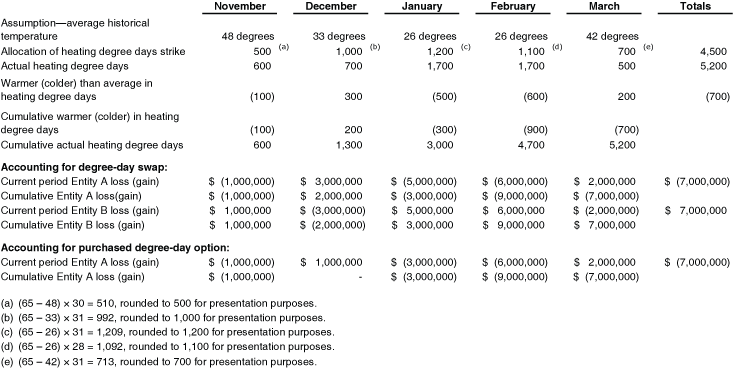 November December January February March Totals Assumption—average historical temperature 48 degrees 33 degrees 26 degrees 26 degrees 42 degrees Allocation of heating degree days strike 500 (a) " 1,000 " (b) " 1,200 " (c) " 1,100 " (d) 700 (e) " 4,500 " Actual heating degree days 600 700 " 1,700 " " 1,700 " 500 " 5,200 " Warmer (colder) than average in heating degree days (100) 300 (500) (600) 200 (700) Cumulative warmer (colder) in heating degree days (100) 200 (300) (900) (700) Cumulative actual heating degree days 600 " 1,300 " " 3,000 " " 4,700 " " 5,200 " Accounting for degree-day swap: Current period Entity A loss (gain) " $(1,000,000)" " $3,000,000 " " $(5,000,000)" " $(6,000,000)" " $2,000,000 " " $(7,000,000)" Cumulative Entity A loss(gain) " $(1,000,000)" " $2,000,000 " " $(3,000,000)" " $(9,000,000)" " $(7,000,000)" Current period Entity B loss (gain) " $1,000,000 " " $(3,000,000)" " $5,000,000 " " $6,000,000 " " $(2,000,000)" " $7,000,000 " Cumulative Entity B loss (gain) " $1,000,000 " " $(2,000,000)" " $3,000,000 " " $9,000,000 " " $7,000,000 " Accounting for purchased degree-day option: Current period Entity A loss (gain) " $(1,000,000)" " $1,000,000 " " $(3,000,000)" " $(6,000,000)" " $2,000,000 " " $(7,000,000)" Cumulative Entity A loss (gain) " $(1,000,000)" - " $(3,000,000)" " $(9,000,000)" " $(7,000,000)" (a) "(65 - 48) × 30 = 510, rounded to 500 for presentation purposes." (b) "(65 - 33) × 31 = 992, rounded to 1,000 for presentation purposes." (c) "(65 - 26) × 31 = 1,209, rounded to 1,200 for presentation purposes." (d) "(65 - 26) × 28 = 1,092, rounded to 1,100 for presentation purposes." (e) "(65 - 42) × 31 = 713, rounded to 700 for presentation purposes."
815-45-60Relationships
Source downloaded: .Record version 6b891120f050. Effective date must be checked in the source.
Fair Value Measurements and Disclosures
Related subtopics
- 815-25 Fair Value HedgesDerivatives and Hedging
- 815-10 OverallDerivatives and Hedging
- 815-944 Financial Services—InsuranceDerivatives and Hedging
- 815-932 Extractive Activities—Oil and GasDerivatives and Hedging
- 815-980 Regulated OperationsDerivatives and Hedging
- 815-30 Cash Flow HedgesDerivatives and Hedging