ASC 815-15
Embedded Derivatives
815 Derivatives and Hedging
Source downloaded: .Record version df979d77a04b. Effective date must be checked in the source.
ASC 815-15 governs when a derivative-like feature embedded in a contract that is not itself a derivative in its entirety (a "hybrid instrument") must be separated ("bifurcated") from the host contract and accounted for as a standalone derivative under Subtopic 815-10. Bifurcation is required if and only if all three criteria in 815-15-25-1 are met: the embedded feature's economic characteristics and risks are not clearly and closely related to the host, the hybrid is not already remeasured at fair value through earnings, and a freestanding instrument with the same terms would be a derivative. As an alternative, an entity may irrevocably elect to measure the entire hybrid financial instrument at fair value through earnings (815-15-25-4), and if it cannot reliably identify and measure the embedded derivative it must measure the whole contract at fair value through earnings (815-15-25-53).
Key points (7)
- Bifurcation is required if and only if all three criteria in 815-15-25-1 are met: (a) not clearly and closely related, (b) the hybrid is not already remeasured at fair value through earnings, and (c) a separate instrument with the same terms would be a derivative under Section 815-10-15.
- An embedded derivative exists only within a single contract; an option added or attached to existing debt by a different counterparty is a freestanding instrument, not an embedded derivative (815-15-25-2; 815-10-15-6).
- An entity may irrevocably elect at initial recognition (or at a remeasurement/new basis event) to measure the entire hybrid financial instrument at fair value through earnings, but only after determining that an embedded derivative requiring bifurcation exists (815-15-25-4 through 25-6); such a contract may not be designated as a hedging instrument (815-15-35-1).
- Multiple bifurcatable features in one hybrid must be bundled and accounted for as a single compound embedded derivative and may not be split by risk type (815-15-25-7 through 25-9); clearly-and-closely-related features are excluded from the compound derivative (815-15-25-10).
- For debt hosts, interest-rate-only embedded features are clearly and closely related unless the investor could fail to recover substantially all of its initial recorded investment or the feature could at least double the investor's initial rate of return and produce twice the then-current market return (815-15-25-26); commodity-, equity-, and third-party-credit-indexed features are not clearly and closely related (815-15-25-47 through 25-49, 25-51), while creditworthiness of the obligor and nonleveraged inflation indexing are (815-15-25-46, 25-50).
- Call/put options that accelerate settlement of debt are tested under the four-step decision sequence in 815-15-25-42 (index adjustment, underlying other than interest rate or credit risk, substantial premium or discount, contingently exercisable acceleration of principal).
- On separation, the embedded derivative is recorded at fair value and the host is assigned the residual carrying amount (815-15-30-2); non-option embedded derivatives are calibrated to a fair value of zero at inception (815-15-30-4), but option-based embedded derivatives use the stated strike and are not adjusted to be at the money (815-15-30-6).
For students. Bifurcation analysis is a staple of structured finance and convertible debt questions: memorize the three-part test in 815-15-25-1 and the debt-host "clearly and closely related" examples. The most common mistake is skipping criterion (c) — many features (e.g., conversion options on the issuer's own stock, equity kickers indexed to non-readily-convertible assets) fail bifurcation because a freestanding instrument with the same terms would not be a derivative at all.
Machine-generated study aid for ASC 815-15. Check the source paragraphs below.
815-15-00Status
Source downloaded: .Record version 6c11f6117aba. Effective date must be checked in the source.
815-15-05Overview and Background
Source downloaded: .Record version 9ddbc2e219fa. Effective date must be checked in the source.
815-15-15Scope and Scope Exceptions
Source downloaded: .Record version bdd0d3a84db7. Effective date must be checked in the source.
Entities
Instruments
- aNormal purchases and normal sales contracts
- bUnsettled foreign currency transactions
- cPlain-vanilla servicing rights
- dFeatures involving certain aspects of credit risk
- eFeatures involving certain currencies.
- a They are monetary items.
- b They have their principal payments, interest payments, or both denominated in a foreign currency.
- c They are subject to the requirement in Subtopic 830-20 to recognize any foreign currency transaction gain or loss in earnings.
- a An embedded derivative feature relating to another type of risk (including another type of credit risk) is present in the securitized financial instruments.
- b The holder of an interest in a tranche of that securitized financial instrument is exposed to the possibility (however remote) of being required to make potential future payments (not merely receive reduced cash inflows) because the possibility of those future payments is not created by subordination. (Note, however, that the securitized financial instrument may involve other tranches that are not exposed to potential future payments and, thus, those other tranches might qualify for the scope exception.)
- c The holder owns an interest in a single-tranche securitization vehicle; therefore, the subordination of one tranche to another is not relevant.
- a The host contract is not a financial instrument.
- b The host contract requires payment(s) denominated in any of the following currencies:
- 1 The functional currency of any substantial party to that contract
- 2 The currency in which the price of the related good or service that is acquired or delivered is routinely denominated in international commerce (for example, the U.S. dollar for crude oil transactions)
- 3 The local currency of any substantial party to the contract
- 4 The currency used by a substantial party to the contract as if it were the functional currency because the primary economic environment in which the party operates is highly inflationary (as discussed in paragraph 830-10-45-11).
- 1
- c Other aspects of the embedded foreign currency derivative are clearly and closely related to the host contract.
- a Consider all facts and circumstances pertaining to that contract (including whether the contracting party possesses the requisite knowledge, resources, and technology to fulfill the contract without relying on related parties)
- b Look through the legal form to evaluate the substance of the underlying relationships.
- a The nonfinancial contract requires payment(s) denominated in any of the currencies permitted by paragraphs 815-15-15-10(b).
- b The embedded cap or floor (or combination thereof) does not contain leverage features.
- c The embedded cap or floor (or combination thereof) does not represent a written or net written option.
815-15-25Recognition
Source downloaded: .Record version 9a370e03408b. Effective date must be checked in the source.
- aThe economic characteristics and risks of the embedded derivative are not clearly and closely related to the economic characteristics and risks of the host contract.
- bThe hybrid instrument is not remeasured at fair value under otherwise applicable generally accepted accounting principles (GAAP) with changes in fair value reported in earnings as they occur.
- cA separate instrument with the same terms as the embedded derivative would, pursuant to Section 815-10-15, be a derivative instrument subject to the requirements of Subtopic 815-10 and this Subtopic. (The initial net investment for the hybrid instrument shall not be considered to be the initial net investment for the embedded derivative.)
- aFair value election for hybrid financial instruments
- bCompound embedded derivative
- cInterests in securitized financial assets—holder's accounting
- dApplying the separate instrument criterion
- eApplying the clearly and closely related criterion
- fEntity unable to reliably identify and measure embedded derivative
- gHost contract after separation.
Fair Value Election for Hybrid Financial Instruments
Compound Embedded Derivative
Interests in Securitized Financial Assets—Holder's Accounting
Applying the Separate Instrument Criterion
Applying the Clearly-and-Closely Related Criterion
- aThe characteristics of the relevant terms and features themselves (for example, contingent versus noncontingent, in-the-money versus out-of-the-money)
- bThe circumstances under which the hybrid financial instrument was issued or acquired (for example, issuer-specific characteristics, such as whether the issuer is thinly capitalized or profitable and well-capitalized)
- cThe potential outcomes of the hybrid financial instrument (for example, the instrument may be settled by the issuer issuing a fixed number of shares, the instrument may be settled by the issuer transferring a specified amount of cash, or the instrument may remain legal-form equity), as well as the likelihood of those potential outcomes. The assessment of the potential outcomes may be qualitative in nature.
- aRedemption rights. The ability for an issuer or investor to redeem a hybrid financial instrument issued in the form of a share at a fixed or determinable price generally is viewed as a debt-like characteristic. However, not all redemption rights are of equal importance. For example, a noncontingent redemption option may be given more weight in the analysis than a contingent redemption option. The relative importance (and, therefore, weight) of redemption rights among other terms and features in a hybrid financial instrument may be evaluated on the basis of information about the following (among other relevant) facts and circumstances:
- 1Whether the redemption right is held by the issuer or investors
- 2Whether the redemption is mandatory
- 3Whether the redemption right is noncontingent or contingent
- 4Whether (and the degree to which) the redemption right is in-the-money or out-of-the-money
- 5Whether there are any laws that would restrict the issuer or investors from exercising the redemption right (for example, if redemption would make the issuer insolvent)
- 6Issuer-specific considerations (for example, whether the hybrid financial instrument is effectively the residual interest in the issuer [due to the issuer being thinly capitalized or the common equity of the issuer having already incurred losses] or whether the instrument was issued by a well-capitalized, profitable entity)
- 7If the hybrid financial instrument also contains a conversion right, the extent to which the redemption price (formula) is more or less favorable than the conversion price (formula), that is, a consideration of the economics of the redemption price (formula) and the conversion price (formula), not simply the form of the settlement upon redemption or conversion.
- 1
- bConversion rights. The ability for an investor to convert, for example, a preferred share into a fixed number of common shares generally is viewed as an equity-like characteristic. However, not all conversion rights are of equal importance. For example, a conversion option that is noncontingent or deeply in-the-money may be given more weight in the analysis than a conversion option that is contingent on a remote event or deeply out-of-the-money. The relative importance (and, therefore, weight) of conversion rights among other terms and features in a hybrid financial instrument may be evaluated on the basis of information about the following (among other relevant) facts and circumstances:
- 1Whether the conversion right is held by the issuer or investors
- 2Whether the conversion is mandatory
- 3Whether the conversion right is noncontingent or contingent
- 4Whether (and the degree to which) the conversion right is in-the-money or out-of-the-money
- 5If the hybrid financial instrument also contains a redemption right held by the investors, whether conversion is more likely to occur before redemption (for example, because of an expected initial public offering or change-in-control event before the redemption right becoming exercisable).
- 1
- cVoting rights. The ability for a class of stock to exercise voting rights generally is viewed as an equity-like characteristic. However, not all voting rights are of equal importance. For example, voting rights that allow a class of stock to vote on all significant matters may be given more weight in the analysis than voting rights that are only protective in nature. The relative importance (and, therefore, weight) of voting rights among other terms and features in a hybrid financial instrument may be evaluated on the basis of information about the following (among other relevant) facts and circumstances:
- 1On which matters the voting rights allow the investor's class of stock to vote (relative to common stock shareholders)
- 2How much influence the investor's class of stock can exercise as a result of the voting rights.
- 1
- dDividend rights. The nature of dividends can be viewed as a debt-like or equity-like characteristic. For example, mandatory fixed dividends generally are viewed as a debt-like characteristic, while discretionary dividends based on earnings generally are viewed as an equity-like characteristic. The relative importance (and, therefore, weight) of dividend terms among other terms and features in a hybrid financial instrument may be evaluated on the basis of information about the following (among other relevant) facts and circumstances:
- 1Whether the dividends are mandatory or discretionary
- 2The basis on which dividends are determined and whether the dividends are stated or participating
- 3Whether the dividends are cumulative or noncumulative.
- 1
- eProtective covenants. Protective covenants generally are viewed as a debt-like characteristic. However, not all protective covenants are of equal importance. Covenants that provide substantive protective rights may be given more weight than covenants that provide only limited protective rights. The relative importance (and, therefore, weight) of protective covenants among other terms and features in a hybrid financial instrument may be evaluated on the basis of information about the following (among other relevant) facts and circumstances:
- 1Whether there are any collateral requirements akin to collateralized debt
- 2If the hybrid financial instrument contains a redemption option held by the investor, whether the issuer's performance upon redemption is guaranteed by the parent of the issuer
- 3Whether the instrument provides the investor with certain rights akin to creditor rights (for example, the right to force bankruptcy or a preference in liquidation).
- 1
- aPurchase contracts—price cap and price floor
- bHost contracts with equity characteristics
- cHost contracts that are leases
- dHost contracts with debt characteristics
- eHybrid instruments that are beneficial interests in securitized financial assets.
- aCharacteristics of a debt host contract
- bInterest-rate-related underlyings
- cCall options and put options on debt instruments
- dTerm-extending options
- eCredit-sensitive payments
- fCommodity-indexed interest or principal payments
- gEquity-indexed interest payments
- hInflation-indexed principal payments
- iConvertible debt.
- aIdentify a variable-rate debt host contract and an interest rate swap component that has a comparable variable-rate leg in an embedded compound derivative, in lieu of identifying a fixed-rate debt host contract
- bIdentify a fixed-rate debt host contract and a fixed-to-variable interest rate swap component in an embedded compound derivative in lieu of identifying a variable-rate debt host contract.
- aThe hybrid instrument can contractually be settled in such a way that the investor (the holder or the creditor) would not recover substantially all of its initial recorded investment (that is, the embedded derivative contains a provision that permits any possibility whatsoever that the investor's [the holder's or the creditor's] undiscounted net cash inflows over the life of the instrument would not recover substantially all of its initial recorded investment in the hybrid instrument under its contractual terms).
- bThe embedded derivative meets both of the following conditions:
- 1There is a possible future interest rate scenario (even though it may be remote) under which the embedded derivative would at least double the investor's initial rate of return on the host contract (that is, the embedded derivative contains a provision that could under any possibility whatsoever at least double the investor's initial rate of return on the host contract).
- 2For any of the possible interest rate scenarios under which the investor's initial rate of return on the host contract would be doubled (as discussed in (b)(1)), the embedded derivative would at the same time result in a rate of return that is at least twice what otherwise would be the then-current market return (under the relevant future interest rate scenario) for a contract that has the same terms as the host contract and that involves a debtor with a credit quality similar to the issuer's credit quality at inception.
- 1
- aInterest rate floors, caps, and collars
- bException for certain securitized interest in prepayable financial assets
- cException for call options exercisable only by the debtor.
- aThe right to accelerate the settlement of the securitized interest cannot be controlled by the investor.
- bThe securitized interest itself does not contain an embedded derivative (including an interest-rate-related derivative instrument) for which bifurcation would be required other than an embedded derivative that results solely from the embedded call options in the underlying financial assets.
- Step 1: Is the amount paid upon settlement (also referred to as the payoff) adjusted based on changes in an index? If yes, continue to Step 2. If no, continue to Step 3.
- Step 2: Is the payoff indexed to an underlying other than interest rates or credit risk? If yes, then that embedded feature is not clearly and closely related to the debt host contract and further analysis under Steps 3 and 4 is not required. If no, then that embedded feature shall be analyzed further under Steps 3 and 4.
- Step 3: Does the debt involve a substantial premium or discount? If yes, continue to Step 4. If no, further analysis of the contract under paragraph 815-15-25-26 is required, if applicable.
- Step 4: Does a contingently exercisable call (put) option accelerate the repayment of the contractual principal amount? If yes, the call (put) option is not clearly and closely related to the debt instrument. If not contingently exercisable, further analysis of the contract under paragraph 815-15-25-26 is required, if applicable.
- aDefault (such as violation of a credit-risk-related covenant)
- bA change in the debtor's published credit rating
- cA change in the debtor's creditworthiness indicated by a change in its spread over U.S. Treasury bonds.
Entity Unable to Reliably Identify and Measure Embedded Derivative
Host Contract After Separation
815-15-30Initial Measurement
Source downloaded: .Record version e4a95ec3e16b. Effective date must be checked in the source.
Hybrid Instruments That Are Not Separated
- aA hybrid financial instrument that under paragraph 815-15-25-1 would be required to be separated into a host contract and a derivative instrument that an entity irrevocably elects to initially and subsequently measure in its entirety at fair value (with changes in fair value recognized in earnings)
- bAn entire hybrid instrument if an entity cannot reliably identify and measure the embedded derivative that paragraph 815-15-25-1 requires be separated from the host contract.
Hybrid Instruments That Are Separated
- aThe bifurcation of the option-based embedded derivative by a holder who has acquired the hybrid instrument from a third party either at inception or after inception of that hybrid instrument
- bThe bifurcation of the option-based embedded derivative by the issuer when separate accounting for that embedded derivative is required.
815-15-35Subsequent Measurement
Source downloaded: .Record version eb28e04c0631. Effective date must be checked in the source.
Hybrid Instruments That Are Not Separated
Hybrid Instruments That Are Separated
Embedded Conversion Option That No Longer Meets Bifurcation Criteria
815-15-40Derecognition
Source downloaded: .Record version 3fdd112c00d4. Effective date must be checked in the source.
Embedded Conversion Option that No Longer Meets Bifurcation Criteria
- aThe portion of the reacquisition price equal to the fair value of the conversion option at the date of the extinguishment shall be allocated to equity.
- bThe remaining reacquisition price shall be allocated to the extinguishment of the debt to determine the amount of gain or loss.
815-15-45Other Presentation Matters
Source downloaded: .Record version de64176b5654. Effective date must be checked in the source.
- a Display separate line items for the fair value and non-fair-value carrying amounts
- b Present the aggregate of the fair value and non-fair-value amounts and parenthetically disclose the amount of fair value included in the aggregate amount.
815-15-50Disclosure
Source downloaded: .Record version 14a1585e26e6. Effective date must be checked in the source.
Hybrid Instruments That Are Not Separated
Embedded Conversion Option that Is No Longer Bifurcated
- aA description of the principal changes causing the embedded conversion option to no longer require bifurcation under this Subtopic
- bThe amount of the liability for the conversion option reclassified to stockholders' equity.
815-15-55Implementation Guidance and Illustrations
Source downloaded: .Record version 7b3933470915. Effective date must be checked in the source.
Implementation Guidance
- aThe rate of exchange as of the settlement date (payment date) of the claim
- bThe rate of exchange as of the loss occurrence date
- cThe rate of exchange at inception of the contract.
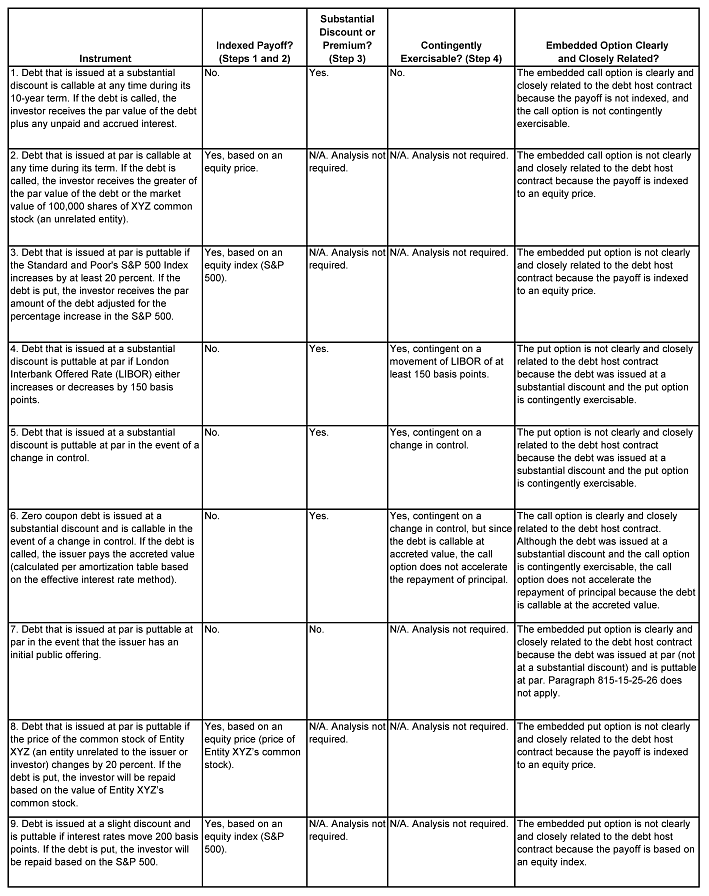 Instrument "Indexed Payoff? (Steps 1 and 2)" "Substantial Discount or Premium? (Step 3)" "Contingently Exercisable? (Step 4)" "Embedded Option Clearly and Closely Related?" "1. Debt that is issued at a substantial discount is callable at any time during its 10-year term. If the debt is called, the investor receives the par value of the debt plus any unpaid and accrued interest." No. Yes. No. "The embedded call option is clearly and closely related to the debt host contract because the payoff is not indexed, and the call option is not contingently exercisable. " "2. Debt that is issued at par is callable at any time during its term. If the debt is called, the investor receives the greater of the par value of the debt or the market value of 100,000 shares of XYZ common stock (an unrelated entity)." "Yes, based on an equity price." N/A. Analysis not required. N/A. Analysis not required. The embedded call option is not clearly and closely related to the debt host contract because the payoff is indexed to an equity price. "3. Debt that is issued at par is puttable if the Standard and Poor's S&P 500 Index increases by at least 20 percent. If the debt is put, the investor receives the par amount of the debt adjusted for the percentage increase in the S&P 500." "Yes, based on an equity index (S&P 500)." N/A. Analysis not required. N/A. Analysis not required. The embedded put option is not clearly and closely related to the debt host contract because the payoff is indexed to an equity price. 4. Debt that is issued at a substantial discount is puttable at par if London Interbank Offered Rate (LIBOR) either increases or decreases by 150 basis points. No. Yes. "Yes, contingent on a movement of LIBOR of at least 150 basis points." The put option is not clearly and closely related to the debt host contract because the debt was issued at a substantial discount and the put option is contingently exercisable. 5. Debt that is issued at a substantial discount is puttable at par in the event of a change in control. No. Yes. "Yes, contingent on a change in control." The put option is not clearly and closely related to the debt host contract because the debt was issued at a substantial discount and the put option is contingently exercisable. "6. Zero coupon debt is issued at a substantial discount and is callable in the event of a change in control. If the debt is called, the issuer pays the accreted value (calculated per amortization table based on the effective interest rate method)." No. Yes. "Yes, contingent on a change in control, but since the debt is callable at accreted value, the call option does not accelerate the repayment of principal." "The call option is clearly and closely related to the debt host contract. Although the debt was issued at a substantial discount and the call option is contingently exercisable, the call option does not accelerate the repayment of principal because the debt is callable at the accreted value." 7. Debt that is issued at par is puttable at par in the event that the issuer has an initial public offering. No. No. N/A. Analysis not required. The embedded put option is clearly and closely related to the debt host contract because the debt was issued at par (not at a substantial discount) and is puttable at par. Paragraph 815-15-25-26 does not apply. "8. Debt that is issued at par is puttable if the price of the common stock of Entity XYZ (an entity unrelated to the issuer or investor) changes by 20 percent. If the debt is put, the investor will be repaid based on the value of Entity XYZ's common stock." "Yes, based on an equity price (price of Entity XYZ's common stock)." N/A. Analysis not required. N/A. Analysis not required. The embedded put option is not clearly and closely related to the debt host contract because the payoff is indexed to an equity price. "9. Debt is issued at a slight discount and is puttable if interest rates move 200 basis points. If the debt is put, the investor will be repaid based on the S&P 500." "Yes, based on an equity index (S&P 500)." N/A. Analysis not required. N/A. Analysis not required. The embedded put option is not clearly and closely related to the debt host contract because the payoff is based on an equity index.
- aVolumetric production payments
- bInterest-rate-related underlyings—call options that are exercisable only by the debtor
- cRemarketable put bonds
- dVariable annuity products in general
- ePayment alternatives for variable annuity contracts
- fEquity-indexed annuity contracts
- gEquity-indexed life insurance contracts.
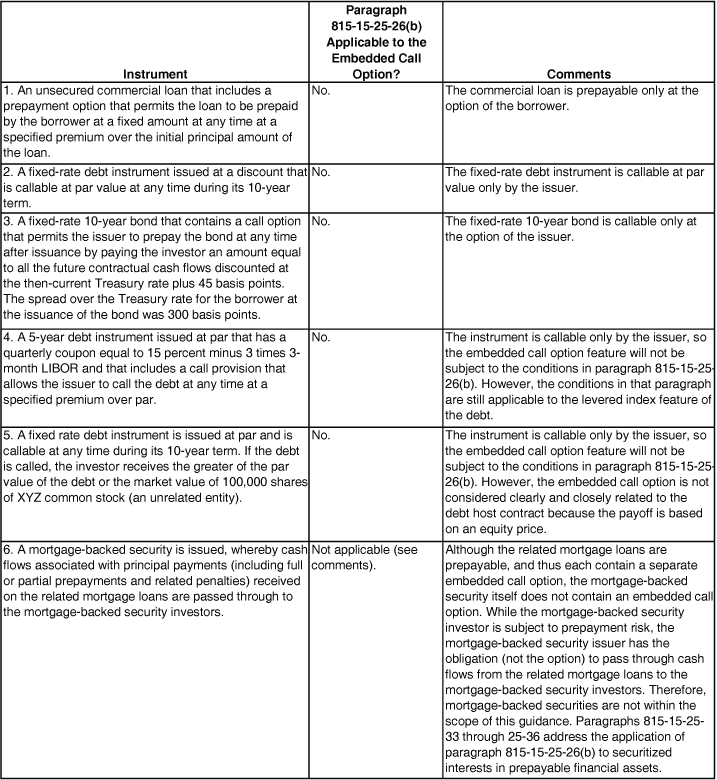 Instrument "Paragraph 815-15-25-26(b) Applicable to the Embedded Call Option?" Comments 1. An unsecured commercial loan that includes a prepayment option that permits the loan to be prepaid by the borrower at a fixed amount at any time at a specified premium over the initial principal amount of the loan. No. The commercial loan is prepayable only at the option of the borrower. 2. A fixed-rate debt instrument issued at a discount that is callable at par value at any time during its 10-year term. No. The fixed-rate debt instrument is callable at par value only by the issuer. 3. A fixed-rate 10-year bond that contains a call option that permits the issuer to prepay the bond at any time after issuance by paying the investor an amount equal to all the future contractual cash flows discounted at the then-current Treasury rate plus 45 basis points. The spread over the Treasury rate for the borrower at the issuance of the bond was 300 basis points. No. The fixed-rate 10-year bond is callable only at the option of the issuer. 4. A 5-year debt instrument issued at par that has a quarterly coupon equal to 15 percent minus 3 times 3-month LIBOR and that includes a call provision that allows the issuer to call the debt at any time at a specified premium over par. No. "The instrument is callable only by the issuer, so the embedded call option feature will not be subject to the conditions in paragraph 815-15-25-26(b). However, the conditions in that paragraph are still applicable to the levered index feature of the debt." "5. A fixed rate debt instrument is issued at par and is callable at any time during its 10-year term. If the debt is called, the investor receives the greater of the par value of the debt or the market value of 100,000 shares of XYZ common stock (an unrelated entity)." No. "The instrument is callable only by the issuer, so the embedded call option feature will not be subject to the conditions in paragraph 815-15-25-26(b). However, the embedded call option is not considered clearly and closely related to the debt host contract because the payoff is based on an equity price." "6. A mortgage-backed security is issued, whereby cash flows associated with principal payments (including full or partial prepayments and related penalties) received on the related mortgage loans are passed through to the mortgage-backed security investors." Not applicable (see comments). "Although the related mortgage loans are prepayable, and thus each contain a separate embedded call option, the mortgage-backed security itself does not contain an embedded call option. While the mortgage-backed security investor is subject to prepayment risk, the mortgage-backed security issuer has the obligation (not the option) to pass through cash flows from the related mortgage loans to the mortgage-backed security investors. Therefore, mortgage-backed securities are not within the scope of this guidance. Paragraphs 815-15-25-33 through 25-36 address the application of paragraph 815-15-25-26(b) to securitized interests in prepayable financial assets."
- aA debtor issues a contract comprising a bond and a written put option.
- bThe option allows the investor to put the bond back to the debtor at a specific date in exchange for the bond's par value.
- cIn exchange for giving the investor the right to redeem the bond at par before maturity, the debtor pays a lower effective interest rate than would be demanded for a nonputtable bond.
- aAn investment bank obtains a call option—a right to buy the bond from the investor on the put date for the par amount.
- bThe investment bank usually is either the underwriter of the bond issuance or an affiliate of the underwriter.
- cThe bond will automatically be put back to the debtor if the investment bank does not exercise its call option to purchase the bond.
- dThe strike prices and the exercise dates of the investor's written call option and purchased put option are the same.
- eThe exercise dates are before the stated maturity of the bond.
- fThe bond has an interest-rate-reset feature under which, if the bond is not put, the bond's contractual interest rate for the remaining term to maturity will reset at the put date based on the sum of the following:
- 1The yield, at the issuance date of the puttable bond, of U.S. Treasury bonds of the same remaining maturity as the bond
- 2The debtor's credit spread as of the put date.
- 1
- gThe proceeds from issuance exceed the par amount of the bond, net of issuance costs.
- aIf market interest rates increase, both of the following will occur:
- 1The fair value of the bond (absent the effect of the put option) will decrease.
- 2The put option is in the money; therefore, the investors will put the bonds to the debtor.
- 1
- bIf market interest rates decrease, both of the following will occur:
- 1The fair value of the bond (absent the effect of the call option) will increase.
- 2The call option is in the money; therefore, the investment bank will call the bonds from investors and resell the repriced bonds in the market at a premium.
- 1
- aA debtor issues a resettable, puttable bond to an investment bank.
- bThe investment bank sells to an investor that resettable, puttable bond with an attached call option.
- cThe attached call option is a written option from the perspective of the investor and a purchased option from the perspective of the investment bank.
- aInvestment bank's held call option. The debtor should not account for the call option purchased by the investment bank from the investor. The debtor is not a party to the call option. The investor's accounting for Structure 1 is addressed in Example 1, Case A (see paragraph 815-10-55-67), which requires that an option that is added to a debt instrument by a third party contemporaneously with or after the issuance of the debt instrument be separately accounted for as a derivative instrument by the investor. That is, it shall be reported at fair value with changes in value recognized currently in earnings. The investment bank shall also account for a freestanding purchased call option.
- bInvestor's written call option. The carrying value of the investor's attached freestanding written call option to the investment bank should be its fair value in accordance with paragraphs 815-10-30-1 and 815-10-35-1. The remaining proceeds would be allocated to the carrying amount of the puttable bond.
- cInvestor's held put option. Neither the debtor nor the investor is required to account separately for the embedded put option written by the debtor to the investor. Under paragraphs , the put option is considered clearly and closely related to the economic characteristics of the bond because it simply accelerates the repayment of principal, involves no substantial premium or discount, and is not contingent.
- aA debtor issues a resettable, puttable bond to an investor.
- bContemporaneously, the investor writes a freestanding call option that permits the debtor to call the bond on the put date.
- cThe debtor immediately sells the purchased call option to an investment bank.
- aInvestment bank's held call option. The debtor should not account separately for the call option that is purchased from the investor after it is transferred to the investment bank. The debtor is no longer a party to the call option. The investor's accounting for Structure 2 is addressed in Example 1, Case B (see paragraph 815-10-55-70), which indicates that the investor's written call option is a separate freestanding derivative instrument that shall be reported at fair value with changes in value recognized currently in earnings. The investment bank shall also account for a freestanding purchased call option.
- bInvestor's written call option. The carrying value of the investor's freestanding written call option to the investment bank should be its fair value in accordance with paragraphs 815-10-30-1 and 815-10-35-1. The remaining proceeds would be allocated to the carrying amount of the puttable bond.
- cInvestor's held put option. Neither the debtor nor the investor is required to account separately for the embedded put option written by the debtor to the investor. Under paragraphs , the put option is considered clearly and closely related to the economic characteristics of the bond because it simply accelerates the repayment of principal, involves no substantial premium or discount, and is not contingent.
- aA debtor issues a resettable bond to an investor.
- bThe bond is puttable by the investor and callable by the debtor.
- cThe terms of the agreement stipulate that if the debtor does not exercise its purchased call option, the investor's purchased put option is automatically exercised.
- dContemporaneously, the debtor writes a separate, freestanding call option to an investment bank giving the investment bank the right to require the debtor to call the bond from the investor and deliver the bond to the investment bank.
- eTo deliver the bond to the investment bank, the debtor must obtain the bond from the investor pursuant to either its purchased call option or its written put option.
- fThe debtor has a resulting obligation to make the investment bank whole if it fails to deliver the bond, and the investment bank has no right to pursue the investor if the investor fails to deliver the bond to the debtor.
- aInvestment bank's held call option. The debtor shall account separately for the freestanding call option written to the investment bank, and the investment bank shall account for a freestanding purchased call option, in accordance with the guidance for a derivative instrument in Subtopic 815-10. The investor is not a party to that freestanding written call option and therefore should not account for that option. In addition to the freestanding call option held by the investment bank, Structure 3 also involves an embedded call option written by the investor to the debtor. That embedded call option is not required to be accounted for separately by either the debtor or the investor. Under paragraphs , that embedded call option is considered clearly and closely related to the economic characteristics of the bond. Consistent with the guidance in paragraph 815-20-25-43(c)(7), the debtor may not designate its freestanding call option written to the investment bank as a hedge of its embedded call option purchased from the investor. Because the terms of the contractual agreement require the debtor to settle its obligation to the investor on the embedded options' exercise date, that exercise date is essentially the bond's actual maturity date. Thus, in this structure, there is no embedded option in the bond that would qualify as the hedged item in a fair value hedge in which the hedging instrument is the debtor's freestanding written call option to the investment bank. However, the debtor may designate its freestanding written call option as a hedge of another asset or liability provided that all applicable requirements, including those in paragraph 815-20-25-94, are met.
- bInvestor's held put option. Neither the debtor nor the investor is required to account separately for the embedded put option written by the debtor to the investor. Under paragraphs , the put option is considered clearly and closely related to the economic characteristics of the bond because it simply accelerates the repayment of principal, involves no substantial premium or discount, and is not contingent.
- aA debtor issues resettable, puttable bonds to a trust.
- bThe trust issues beneficial interests that mature on the put date.
- cThe trust also writes a call option to an investment bank giving the investment bank the right to call the bonds on the put date.
- aInvestment bank's held call option. Neither the debtor nor the investor should account for the call option purchased by the investment bank from the trust because neither is a party to that call option. (However, if either the debtor or the investor is required to consolidate the trust, that consolidation will require recognition of the call option written by the trust to the investment bank.) The investment bank shall account for a freestanding purchased call option.
- bInvestor's held put option. Neither the debtor nor the investor should account separately for the embedded put option written by the debtor to the trust. From the debtor's perspective, the put option is considered clearly and closely related to the economic characteristics of the bond under paragraphs because it simply accelerates the repayment of principal, involves no substantial premium or discount, and is not contingent. The investor is not a party to the embedded put option; rather, the investor simply purchased beneficial interests that mature on the put date.
- aA debtor issues to an investor a bond that is both puttable (by the investor) and callable (by the holder of the option).
- bAs part of the transaction, the investment bank acquires the exclusive right to purchase the bond from the investor in the future and to remarket the repriced bond.
- cThe investment bank's right to purchase the bond from the investor is set forth in the note or the indenture itself and in a separate document (a remarketing agreement) that is not part of the indenture, and is also described in the prospectus supplement.
- dThe explicit inclusion in the indenture of the investment bank's right to purchase the bond is designed to obligate initial and future investors to deliver the bond in response to the investment bank's exercise of its right.
- eWhen the bond is issued, the trustee, in conformity with the transaction documents, shall view the investment bank as the only party with a right to call the bond from the investor at the call-put date. Thus, the trustee does not require any involvement by the debtor when enforcing the investment bank's right to purchase the bond from the investor.
- fThe debtor's only remaining obligation is to pay interest at the reset rate if the bond remains outstanding.
- aInvestment bank's held call option. The debtor should not account separately for the call option held by the investment bank. For accounting purposes, the transaction should be viewed as a purchase of a transferable, freestanding call option by the debtor from the investor and a concurrent transfer by the debtor of that option to the investment bank. Upon that transfer, the debtor is no longer a party to the call option and has surrendered its right to prepay the debt. The investment bank acquired the debtor's right to call the bond and relieved the debtor of the obligation to pay the investor the par amount of the bond upon exercise of the call option. The call option is a contract between the investment bank and the investor that permits the investment bank to purchase the bonds from the investor at par. From the investor's perspective, that contract is a freestanding written call option that shall be accounted for in accordance with paragraphs 815-10-25-1, 815-10-30-1, and . That is consistent with the guidance in paragraph 815-10-15-7—an option on a bond incorporated into the terms of the bond at inception that, by the terms of the agreement, is exercisable by a party other than either the debtor or the investor should be considered an attached freestanding derivative instrument. The investment bank shall also account for a freestanding purchased call option.
- bInvestor's written call option. The carrying value of the investor's freestanding written call option to the investment bank should be its fair value in accordance with paragraphs 815-10-30-1 and 815-10-35-1. In the remarketing format, the transfer of the purchased call option is concurrent with the issuance of the bond. The remaining proceeds would be allocated to the carrying amount of the puttable bond. The debtor recognizes no gain or loss upon the transfer of the option to the investment bank.
- cInvestor's held put option. Neither the debtor nor the investor should account separately for the embedded put option written by the debtor to the investor. Under paragraphs , the put option is considered clearly and closely related to the economic characteristics of the bond because it simply accelerates the repayment of principal, involves no substantial premium or discount, and is not contingent.
- aA debtor issues to an investor a bond that is both puttable (by the investor) and callable (by the holder of the option).
- bThe indenture and the note itself create an assignable right to purchase the bond from the investor and remarket the repriced bond.
- cA legal assignment of that right by the debtor to an investment bank, in exchange for a payment to the debtor, is executed as part of the underwriting process as an amendment to the note. The assignment typically occurs at the time the bond is issued.
- dUpon receipt of the notice of assignment (which typically occurs upon issuance of the bonds), the indenture trustee must view the assignee (that is, the investment bank) as the call option holder and does not require any involvement of the debtor when enforcing the assignee's right to call the bond from the investor.
- eThe debtor's only remaining obligation is to pay interest at the reset rate.
- aInvestment bank's held call option. The debtor is not required to account separately for the call option after its transfer to the investment bank. The debtor purchased a transferable freestanding call option from the investor and transferred that option to the investment bank. Therefore, after the transfer, the debtor is no longer a party to the call option and has surrendered its right to prepay the debt. The investment bank acquired the debtor's right to call the bond and relieved the debtor of the obligation to pay the investor the par amount of the bond upon exercise of the call option. Ultimately, the call option is a contract between the investment bank and the investor that permits the investment bank to purchase the bond from the investor at par. From the investor's perspective, that contract is a freestanding written call option that shall be accounted for in accordance with the guidance for a derivative instrument in Subtopic 815-10. That is consistent with the guidance in paragraph 815-10-15-7 that an option on a bond incorporated into the terms of the bond at inception that is explicitly transferable should be considered an attached, freestanding derivative instrument. The investment bank shall also account for a freestanding purchased call option.
- bInvestor's written call option. The carrying value of the investor's freestanding written call option to the investment bank should be its fair value in accordance with paragraphs 815-10-30-1 and 815-10-35-1 with the remaining proceeds allocated to the carrying amount of the puttable bond. In the assignment format, the transfer of the purchased call option by the debtor to the investment bank may not be concurrent with the issuance of the bond. The debtor recognizes no gain or loss upon the transfer of the call option. In transactions involving a delay between the issuance of the bond and the transfer of the assignable call option to the investment bank, the allocation of the initial proceeds to the carrying value of the option would be equal to the fair value of the option. The remaining proceeds would be allocated to the carrying amount of the puttable bond. During any period of time between the initial issuance of the bond and the transfer of the call option to the investment bank, the call option shall be measured at fair value with changes in value recognized in earnings as required by paragraph 815-20-35-1. As a result of the requirement to measure the call option at fair value during the time period before it is assigned to the investment bank, the debtor would not recognize a gain or loss upon the assignment because the proceeds paid by the investment bank would be the option's current fair value on the date of the assignment, which would be the option's carrying amount at that point in time. Any change in the fair value of the option during the time period before it is assigned to the investment bank would be attributable to the passage of time and changes in market conditions.
- cInvestor's held put option. Neither the debtor nor the investor should account separately for the embedded put option written by the debtor to the investor. Under paragraphs , the put option is considered clearly and closely related to the economic characteristics of the bond because it simply accelerates the repayment of principal, involves no substantial premium or discount, and is not contingent.
- aThe repriced bond from the investment bank at its then fair value
- bThe unexercised call option held by the investment bank at its then fair value, which in turn would permit the debtor to purchase the bond at par from the investor.
- aDeath benefit component. Paragraph 815-10-15-53(a) excludes a death benefit from the scope of Subtopic 815-10 because the payment of the death benefit is the result of an identifiable insurable event instead of changes in an underlying. Additionally, the death benefit may meet the criteria of a market risk benefit, which is excluded from the scope of this Topic. The death benefit in this example is limited to the floor guarantee of the investment account, calculated as the premiums paid into the investment account plus a guaranteed rate of return, less the account fair value. Topic 944 remains the applicable guidance for the insurance-related accounting.
- bInvestment component. The policyholder directs certain premium investments in the investment account that includes equities, bonds, or both, which are held in separate accounts that are distinct from the insurance entity's general account assets. This component is not considered a derivative instrument because of the unique attributes of traditional variable annuity contracts issued by insurance entities. Furthermore, any embedded derivatives within those investments shall not be separated from the host contract by the insurance entity because the separate account assets are already marked to fair value under Topic 944. In contrast, if the product were an equity-index-based interest annuity (rather than a traditional variable annuity), the investment component may contain an embedded derivative (the equity index-based derivative instrument) that meets all the requirements of paragraph 815-15-25-1 for separate accounting. Before concluding that the investment component contains an embedded derivative, the insurance entity should first evaluate whether the equity-index-based interest annuity contains a market risk benefit (see paragraph 944-40-25-25C).
- cInvestment account surrender right at fair value. Because this right is exercised only at the fund fair value (without the insurance entity's floor guarantee) and relates to a traditional variable annuity contract issued by an insurance entity, this right is not within the scope of Subtopic 815-10.
- dPayment alternatives at the end of the accumulation period. Payment alternatives that are market risk benefits accounted for under Topic 944 on insurance are not within the scope of this Topic.
- aThe periodic ratchet design, where in the annual version, the customer receives the greater of the appreciation in the equity index during a series of one-year periods (ending on each policy anniversary date) or the guaranteed minimum fixed rate of return over that period
- bThe point-to-point design, where the customer receives the greater of the appreciation in the equity index during a specified period (for example, five or seven years, starting on the policy issue date) or the guaranteed minimum fixed rate of return over that period.
- aThe contract holder receives only a portion of the appreciation in the S&P 500 Index (or other index, as applicable) during the specified period (a participation rate).
- bThe contract has an upper limit on the amount of appreciation that will be credited during any period (a cap rate).
- aFuture S&P 500 Index (or other index, as applicable) values will need to be estimated to determine both the future notional amounts at each ratchet date and the future strike prices of the future forward starting options.
- bFuture annual cap and participation rates, which are often at the discretion of the contract issuer, subject to contractually specified minimums and maximums, will need to be estimated.
- cNoneconomic factors related to policyholder-driven developments such as policy surrenders or mortality.
- aStep 1. Identify embedded features, including the embedded conversion option that must be evaluated under Subtopic 815-15.
- bStep 2. Apply the guidance in Subtopic 815-15 to determine whether any of the embedded features identified in Step 1 must be separately accounted for as derivative instruments.
- cStep 3. Apply the guidance in Subtopic 470-20 to account for the convertible debt instrument (including the embedded conversion option and any other embedded features, which are not separately accounted for as a derivative instrument in Step 2) as a liability.
- dStep 4. If one or more embedded features are required to be separately accounted for as a derivative instrument based on the analysis performed in Step 2, that embedded derivative shall be separated from the host contract in accordance with the guidance in this Subtopic.
Illustrations
- aGuarantor not a substantial party to a two-party lease (Case A)
- bRequisite knowledge, resources, and technology (Case B)
- cHighly inflationary environment (Case C).
- aThe contractual payments are denominated in a currency that, while not the functional currency, is used as if it were the functional currency due to a highly inflationary economy (Case C1).
- bThe economy of the primary economic environment ceases to be highly inflationary after the inception of the contract (Case C2).
- aCredit-linked note (Case A)
- bReinsurer's receivable arising from a modified coinsurance arrangement (Case B).
- aAn entity (Entity A) issues a 5-year debt instrument with a principal amount of $1,000,000 indexed to the stock of an unrelated publicly traded entity (Entity B).
- bAt maturity, the holder of the instrument will receive the principal amount plus any appreciation or minus any depreciation in the fair value of 10,000 shares of Entity B, with changes in fair value measured from the issuance date of the debt instrument.
- cNo separate interest payments are made.
- dThe market price of Entity B shares to which the debt instrument is indexed is $100 per share at the issuance date.
- aSingle premium deposit: $100,000 on December 31, 1998
- bMaturity date: December 31, 2007 (9-year term)
- cGuaranteed fixed rate: 7%
- dFixed maturity value: $183,846 ($100,000 at 7% compounded for 9 years)
- eMarket value adjustment formula: discount future fixed maturity value to present value at surrender date using currently offered market value annuity rate for the period of time left until maturity.
 12/31/99 Valuation Date 5% 9% (1) Fixed rate account value @7% " $107,000 " " $107,000 " (2) Market adjusted value " 124,434 " " 92,266 " (3) Market value adjustment " $17,434 " " $(14,734)"
- aNote A (Case A)
- bNote B (Case B)
- cNote C (Case C).
- aSecuritized pool of guaranteed single-class mortgage pass-through securities (Case A)
- bSecuritized pool of guaranteed single-class mortgage pass-through securities (Case B)
- cInverse floater collateralized mortgage obligation (Case C).
- aGuaranteed single-class mortgage pass-through security (Case A1)
- bSecuritization trust includes a freestanding derivative instrument (Case A2).
- aA fixed-rate guaranteed single-class mortgage pass-through security is issued.
- bBoth the interest and principal payments are guaranteed by a third party for a fixed market-based guarantee fee, and a servicer receives a market-based servicing fee that is expected to be more than adequate compensation.
- cBoth the guarantee fee and the servicing fee have priority over the payments to the investors.
- dThe investor does not have the right to accelerate the settlement of the securitized interest.
- aSequential-pay collateralized mortgage obligation (Case B1)
- bPlanned-amortization-class and companion collateralized mortgage obligation (Case B2)
- cInterest-only strip and principal-only strip (Case B3).
- aNote 1: Entity A is entitled to receive at the end of 1 year $954 plus any excess (or minus any shortfall) of the current per-share market price of XYZ Corporation's common stock over (or under) $200.
- bNote 2: Entity A is entitled to receive at the end of 1 year $955 plus any excess (or minus any shortfall) of the current per-share market price of XYZ Corporation's common stock over (or under) $201.
- cNote 3: Entity A is entitled to receive at the end of 1 year $755 plus any excess (or minus any shortfall) of the current per-share market price of XYZ Corporation's common stock over (or under) $1.
- dNote 4: Entity A is entitled to receive at the end of 1 year $1,054 plus any excess (or minus any shortfall) of the current per-share market price of XYZ Corporation's common stock over (or under) $300.
- eNote 5: Entity A is entitled to receive at the end of 1 year $1,060 plus any excess (or minus any shortfall) of the current per-share market price of XYZ Corporation's common stock over (or under) $306.
- aInverse floater (Case A)
- bLevered inverse floater (Case B)
- cDelevered floater (Case C)
- dRange floater (Case D)
- eRatchet floater (Case E)
- fFixed-to-variable note (Case F)
- gIndexed amortizing note (Case G)
- hEquity-indexed note (Case H)
- iVariable principal redemption bond (Case I)
- jCrude oil knock-in note (Case J)
- kGold-linked bull note (Case K)
- lStep-up bond (Case L)
- mCredit-sensitive bond (Case M)
- nInflation bond (Case N)
- oDisaster bond (Case O)
- pSpecific equity-linked bond (Case P)
- qDual currency bond (Case Q)
- rShort-term loan with a foreign currency option (Case R)
- sLease payment in foreign currency (Case S)
- tCertain purchases in a foreign currency (Case T)
- uConvertible debt (Case U)
- vDollar-denominated variable-rate interest issued by a special-purpose entity that holds yen-denominated variable-rate bonds and a cross-currency swap (Case V)
- wVariable-rate interest issued by a special-purpose entity that holds fixed-rate bonds and a pay-fixed, receive-variable interest rate swap (Case W)
- xSecuritization involving subordination and variable-rate tranches (Case X)
- ySecuritization involving subordination and fixed-rate tranches (Case Y)
- zPartially funded synthetic collateralized debt obligation with multiple tranches (Case Z)
- aaFully funded synthetic collateralized debt obligation with multiple tranches (Case AA)
- abFully funded synthetic collateralized debt obligation with a single-tranche structure (Case AB).
- aProvides a brief discussion of the terms of an instrument that contains an embedded derivative
- bAnalyzes the instrument (as of the date of inception) in relation to the provisions of this Subtopic that require an embedded derivative to be accounted for according to this Subtopic if it is not clearly and closely related to the host contract.
- aIf the embedded derivative and host portions of the contract are not clearly and closely related, a separate instrument with the same terms as the embedded derivative would meet the scope requirements in Section 815-10-15.
- bThe contract is not remeasured at fair value under otherwise applicable GAAP with changes in fair value currently included in earnings.
- aAn option based on the entity's stock price is not clearly and closely related to an interest-bearing debt instrument.
- bThe option would not be considered an equity instrument of the issuer (see paragraph 815-40-25-4(a)(2)).
- aAn option based on another entity's stock price is not clearly and closely related to an investment in an interest-bearing note.
- bThe option would not be considered an equity instrument of the issuer.
- aA senior, variable-rate financial instrument (with a limited exposure to credit losses on the fixed-rate bonds)
- bA subordinated financial instrument that is entitled to 90 percent of the difference between the fixed rate received from the bonds and the variable rate paid to the senior financial instrument (with a limited exposure to credit losses on the fixed-rate bonds)
- cA residual financial instrument that is entitled to the remainder of the fixed-rate payment from the bonds after any credit losses on the fixed-rate bonds.
- aA senior, fixed-rate financial instrument that is entitled to receive fixed-rate interest payments and all the prepayments and repayments of principal amounts received from the debtors (with a limited exposure to credit losses on the fixed-rate loans)
- bA subordinated, fixed-rate financial instrument that is entitled to receive fixed-rate interest payments and the prepayments and repayments of principal amounts received from the debtors only after the holders of the senior financial instrument have been paid in full (with a limited exposure to credit losses on the fixed-rate loans)
- cA residual financial instrument that is entitled to the remainder of the fixed-rate interest payments from the loans and the prepayments and repayments of principal amounts received from the debtors only after the holders of both the senior financial instrument and the subordinated financial instrument have been paid in full. All credit losses on the fixed-rate loans are absorbed first by the holders of the residual financial instrument.
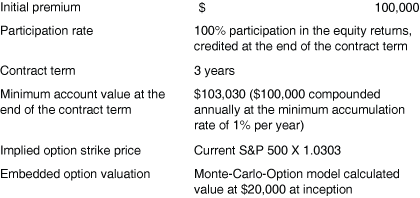 Initial premium " $100,000 " Participation rate "100% participation in the equity returns, credited at the end of the contract term" Contract term 3 years Minimum account value at the end of the contract term "$103,030 ($100,000 compounded annually at the minimum accumulation rate of 1% per year)" Implied option strike price Current S&P 500 X 1.0303 Embedded option valuation "Monte-Carlo-Option model calculated value at $20,000 at inception"
 Cash " $100,000 " Embedded derivative " $20,000 " Host zero-coupon debt obligation " 80,000 "
- aStandard and Poor's Index increases (Case A).
- bStandard and Poor's Index decreases (Case B).
 Embedded derivative " $28,968 " (Assumed) Accreted value of host contract " 87,032 " "($80,000 x 1.088)" Value of hybrid instrument " $116,000 "
- Value under Topic 944 (in absence of this Subtopic): $115,000 ($100,000 at 15% return)
 Embedded derivative " $7,968 " Accreted value of host contract " 87,032 " Value of hybrid instrument " $95,000 "
- Value under Topic 944 (in absence of this Subtopic): $101,000 ($100,000 at 1% return)
 When USD 1.00 equals . . . The JPY price per widget is . . . More than JPY 125 The JPY equivalent to USD 11.00 Between JPY 100 and JPY 125 "JPY 1,100" Less than JPY 100 The JPY equivalent to USD 8.80
 Scenario 1 Scenario 2 Scenario 3 Scenario 4 Scenario 5 Foreign exchange rate (JPY/USD) 110/1 125/1 100/1 80/1 135/1 Purchase price (JPY) " 1,100 " " 1,100 " " 1,100 " 880 " 1,188 " USD-equivalent purchase price 10.00 8.80 11.00 11.00 8.80
- aThe options are denominated in JPY and USD (the functional currencies of both parties to the contract).
- bThere is no leverage feature within the options.
- cThe combination of foreign currency options represents a net purchased option.
815-15-65Transition and Open Effective Date Information
Source downloaded: .Record version 127c8c103841. Effective date must be checked in the source.
Related subtopics
- 815-40 Contracts in Entity's Own EquityDerivatives and Hedging
- 815-10 OverallDerivatives and Hedging
- 470-20 Debt with Conversion and Other OptionsDebt
- 480-10 OverallDistinguishing Liabilities from Equity
- 815-944 Financial Services—InsuranceDerivatives and Hedging
- 815-20 Hedging—GeneralDerivatives and Hedging