ASC

ASC 815-25

Fair Value Hedges

815 Derivatives and Hedging

Source downloaded: .Record version df69f1fd2da5. Effective date must be checked in the source.

ASC 815-25 supplies the incremental accounting rules for fair value hedges that qualify under the designation criteria in ASC 815-20. The core mechanic (815-25-35-1) is that the gain or loss on the hedging instrument goes to current earnings, and the change in fair value of the hedged item attributable to the hedged risk adjusts the hedged item's carrying amount and also goes to current earnings, both presented in the same income statement line item as the hedged item's earnings effect; any mismatch therefore falls automatically into earnings. The Subtopic also governs basis adjustments and their amortization, portfolio layer method hedges of closed portfolios, interaction with impairment/credit loss rules, and mandatory or voluntary discontinuation of hedge accounting.

Key points (7)
  • Under 815-25-35-1, the hedging instrument's gain or loss is recognized currently in earnings (except excluded components amortized under 815-20-25-83A), and the hedged item's fair value change attributable to the hedged risk adjusts its carrying amount and is recognized currently in earnings, all in the same income statement line item as the earnings effect of the hedged item.
  • Hedge accounting need not produce perfect offset; any nonoffsetting amount is recognized in earnings in the same line item as the hedged item (815-25-35-4), and for an AFS debt security the hedged item's basis adjustment goes to earnings rather than OCI (815-25-35-6).
  • For portfolio layer method hedges under 815-20-25-12A, the basis adjustment is maintained on a closed-portfolio basis and does not adjust the carrying amount or amortized cost of individual assets or beneficial interests (815-25-35-1(c), 35-10, 35-11); the entity must document at each assessment date that the hedged layer(s) are still anticipated to be outstanding (815-25-35-7A).
  • Basis adjustments to hedged interest-bearing financial instruments are amortized to earnings beginning no later than when the hedged item ceases to be adjusted for hedged-risk fair value changes (815-25-35-9), with partial-term and portfolio layer adjustments fully amortized by the assumed maturity date (815-25-35-9A).
  • A hedged asset or liability remains subject to normal impairment/credit loss requirements, applied after the hedge accounting basis adjustment, and the hedging instrument's fair value is not considered in that assessment (815-25-35-10); the credit loss discount rate becomes the new effective rate based on the adjusted amortized cost basis (815-25-35-11).
  • Hedge accounting must be discontinued prospectively if any 815-20-25 criterion is no longer met, the derivative expires or is sold, terminated or exercised, or the entity removes the designation (815-25-40-1); a change in counterparty alone is not a termination (815-25-40-1A).
  • For portfolio layer method hedges, discontinuation is required when a breach is anticipated or has occurred (815-25-40-8); the basis adjustment for a voluntary or anticipated-breach dedesignation is allocated to remaining assets and amortized (815-25-40-9), while the portion associated with an actual breach is immediately recognized in interest income and disclosed (815-25-40-9A).

For students. Fair value hedging is heavily tested because it is the one place GAAP lets you remeasure a hedged item (even an amortized-cost loan or inventory) for a single risk; the classic misunderstanding is thinking ineffectiveness is separately computed and reported — post-ASU 2017-12 the entire change in the hedging instrument goes to the same line item as the hedged item, so mismatch shows up automatically. Also remember that portfolio layer basis adjustments live at the portfolio level and are ignored when testing individual assets for impairment.

Machine-generated study aid for ASC 815-25. Check the source paragraphs below.

815-25-00Status

Source downloaded: .Record version 0f4d3df87211. Effective date must be checked in the source.

815-25-00-1
The following table identifies the changes made to this Subtopic.
ParagraphActionAccounting Standards UpdateDate
Beneficial InterestsAddedAccounting Standards Update No. 2022-0103/28/2022
Financial InstrumentAmendedAccounting Standards Update No. 2024-0203/29/2024
Hedged LayerAddedAccounting Standards Update No. 2022-0103/28/2022
Interest Rate RiskAmendedAccounting Standards Update No. 2017-1208/28/2017
London Interbank Offered Rate (LIBOR) Swap RateAddedAccounting Standards Update No. 2018-1610/25/2018
London Interbank Offered Rate Swap RateSupersededAccounting Standards Update No. 2018-1610/25/2018
Other Comprehensive IncomeAddedMaintenance Update 2014-20 (PDF)09/29/2014
Readily Convertible to CashAmendedAccounting Standards Update No. 2024-0203/29/2024
Recorded InvestmentAmendedAccounting Standards Update No. 2015-1006/12/2015
Spot RateAddedAccounting Standards Update No. 2014-0603/14/2014
TransactionAmendedAccounting Standards Update No. 2024-0203/29/2024
815-25-05-1AmendedAccounting Standards Update No. 2017-1208/28/2017
815-25-35-1AmendedAccounting Standards Update No. 2022-0103/28/2022
815-25-35-1AmendedAccounting Standards Update No. 2017-1208/28/2017
815-25-35-2SupersededAccounting Standards Update No. 2017-1208/28/2017
815-25-35-3SupersededAccounting Standards Update No. 2017-1208/28/2017
815-25-35-4AmendedAccounting Standards Update No. 2017-1208/28/2017
815-25-35-5SupersededAccounting Standards Update No. 2017-1208/28/2017
815-25-35-6AmendedAccounting Standards Update No. 2022-0103/28/2022
815-25-35-6AmendedAccounting Standards Update No. 2016-0101/05/2016
815-25-35-6AmendedMaintenance Update 2014-20 (PDF)09/29/2014
815-25-35-7AmendedAccounting Standards Update No. 2017-1208/28/2017
815-25-35-7AAmendedAccounting Standards Update No. 2022-0103/28/2022
815-25-35-7AAddedAccounting Standards Update No. 2017-1208/28/2017
AmendedAccounting Standards Update No. 2022-0103/28/2022
815-25-35-9AAmendedAccounting Standards Update No. 2019-0404/25/2019
815-25-35-9AAddedAccounting Standards Update No. 2017-1208/28/2017
AmendedAccounting Standards Update No. 2016-1306/16/2016
AmendedAccounting Standards Update No. 2017-1208/28/2017
815-25-35-11AmendedAccounting Standards Update No. 2015-1006/12/2015
815-25-35-13AAddedAccounting Standards Update No. 2017-1208/28/2017
815-25-35-13BAmendedAccounting Standards Update No. 2022-0103/28/2022
815-25-35-13BAmendedAccounting Standards Update No. 2019-0404/25/2019
815-25-35-13BAddedAccounting Standards Update No. 2017-1208/28/2017
815-25-35-19AmendedAccounting Standards Update No. 2017-1208/28/2017
815-25-40-1AAddedAccounting Standards Update No. 2016-0503/10/2016
815-25-40-2AmendedAccounting Standards Update No. 2017-1208/28/2017
AddedAccounting Standards Update No. 2017-1208/28/2017
815-25-40-7AAddedAccounting Standards Update No. 2022-0103/28/2022
815-25-40-8AmendedAccounting Standards Update No. 2022-0103/28/2022
815-25-40-8AAddedAccounting Standards Update No. 2022-0103/28/2022
815-25-40-9AmendedAccounting Standards Update No. 2022-0103/28/2022
815-25-40-9AAddedAccounting Standards Update No. 2022-0103/28/2022
815-25-50-1AmendedAccounting Standards Update No. 2017-1208/28/2017
815-25-55-1SupercededAccounting Standards Update No. 2022-0103/28/2022
815-25-55-1AmendedAccounting Standards Update No. 2017-1208/28/2017
AddedAccounting Standards Update No. 2022-0103/28/2022
815-25-55-4AmendedAccounting Standards Update No. 2017-1208/28/2017
AmendedAccounting Standards Update No. 2017-1208/28/2017
815-25-55-17AmendedAccounting Standards Update No. 2017-1208/28/2017
SupersededAccounting Standards Update No. 2016-0101/05/2016
815-25-55-23AmendedAccounting Standards Update No. 2017-1208/28/2017
815-25-55-26AmendedAccounting Standards Update No. 2017-1208/28/2017
815-25-55-27AmendedAccounting Standards Update No. 2017-1208/28/2017
AmendedAccounting Standards Update No. 2017-1208/28/2017
815-25-55-38AmendedAccounting Standards Update No. 2017-1208/28/2017
815-25-55-39AmendedAccounting Standards Update No. 2017-1208/28/2017
815-25-55-42AmendedAccounting Standards Update No. 2017-1208/28/2017
815-25-55-43AmendedAccounting Standards Update No. 2017-1208/28/2017
815-25-55-46AmendedAccounting Standards Update No. 2017-1208/28/2017
815-25-55-49AmendedAccounting Standards Update No. 2017-1208/28/2017
815-25-55-51AmendedAccounting Standards Update No. 2017-1208/28/2017
815-25-55-52AmendedAccounting Standards Update No. 2017-1208/28/2017
AmendedAccounting Standards Update No. 2017-1208/28/2017
815-25-55-56AAddedAccounting Standards Update No. 2017-1208/28/2017
815-25-55-56BAddedAccounting Standards Update No. 2017-1208/28/2017
815-25-55-61AmendedAccounting Standards Update No. 2017-1208/28/2017
AddedAccounting Standards Update No. 2017-1208/28/2017
AmendedAccounting Standards Update No. 2017-1208/28/2017
AmendedMaintenance Update 2014-07 (PDF)03/17/2014
815-25-55-65AmendedAccounting Standards Update No. 2016-0101/05/2016
815-25-55-65AmendedAccounting Standards Update No. 2014-0603/14/2014
815-25-55-71AmendedAccounting Standards Update No. 2017-1208/28/2017
815-25-55-72AmendedAccounting Standards Update No. 2017-1208/28/2017
AmendedAccounting Standards Update No. 2017-1208/28/2017
SupersededAccounting Standards Update No. 2017-1208/28/2017
AmendedAccounting Standards Update No. 2017-1208/28/2017
815-25-55-85AmendedAccounting Standards Update No. 2016-1306/16/2016
815-25-55-88AmendedAccounting Standards Update No. 2016-1306/16/2016
815-25-55-88AAddedAccounting Standards Update No. 2017-1208/28/2017
815-25-55-89AmendedAccounting Standards Update No. 2017-1208/28/2017
815-25-55-89AmendedAccounting Standards Update No. 2016-1306/16/2016
AddedAccounting Standards Update No. 2017-1208/28/2017
815-25-55-99AmendedAccounting Standards Update No. 2019-0404/25/2019

815-25-05Overview and Background

Source downloaded: .Record version a4fcdaea3273. Effective date must be checked in the source.

815-25-05-1
This Subtopic provides incremental guidance on accounting for and financial reporting of fair value hedges established under the criteria in Subtopic 815-20, such as subsequent measurement and dedesignation of a fair value hedging relationship. Implementation guidance and examples specific to fair value hedges are included in both Subtopic 815-20 and this Subtopic.

815-25-15Scope and Scope Exceptions

Source downloaded: .Record version 3c54b75bf748. Effective date must be checked in the source.

Overall Guidance

815-25-15-1
This Subtopic follows the same Scope and Scope Exceptions as outlined in Subtopic 815-20, see Section 815-20-15.

815-25-25Recognition

Source downloaded: .Record version 343c2b18b553. Effective date must be checked in the source.

815-25-25-1
See Section 815-20-25 for the criteria under which an entity may designate a derivative instrument as hedging the exposure to changes in the fair value of an asset or a liability or an identified portion thereof (hedged item) that is attributable to a particular risk. Paragraph 815-10-05-5 states that references to an asset or a liability in this Topic include a firm commitment.

815-25-30Initial Measurement

Source downloaded: .Record version 15d4f43dbed4. Effective date must be checked in the source.

815-25-35Subsequent Measurement

Source downloaded: .Record version fa4621fc4ebe. Effective date must be checked in the source.

Changes in Fair Value in General

815-25-35-1
Gains and losses on a qualifying fair value hedge shall be accounted for as follows:
  1. a
    The gain or loss on the hedging instrument shall be recognized currently in earnings, except for amounts excluded from the assessment of effectiveness that are recognized in earnings through an amortization approach in accordance with paragraph 815-20-25-83A. All amounts recognized in earnings shall be presented in the same income statement line item as the earnings effect of the hedged item.
  2. b
    The gain or loss (that is, the change in fair value) on the hedged item attributable to the hedged risk shall adjust the carrying amount of the hedged item and be recognized currently in earnings except as described in (c).
  3. c
    For one or more existing hedged layer or layers that are designated under the portfolio layer method in accordance with paragraph 815-20-25-12A, the gain or loss (that is, the change in fair value) on the hedged item attributable to the hedged risk shall not adjust the carrying value of the individual beneficial interest or individual assets in or removed from the closed portfolio. Instead, that amount shall be maintained on a closed portfolio basis and recognized currently in earnings.
815-25-35-4
Although a hedging relationship must comply with an entity's established policy range of what is considered highly effective pursuant to paragraphs for that relationship to qualify for hedge accounting, that compliance does not assure perfect offset between the gain or loss on the hedging instrument and the hedged item attributable to the hedged risk. Any gain or loss on the hedging instrument that does not offset the gain or loss on the hedged item attributable to the hedged risk is recognized in earnings in the same income statement line item as the earnings effect of the hedged item in accordance with paragraph 815-20-45-1A.
815-25-35-6
If a hedged item is otherwise measured at fair value with changes in fair value reported in other comprehensive income (such as an available-for-sale debt security), the adjustment of the hedged item's carrying amount discussed in paragraph 815-25-35-1(b) shall be recognized in earnings rather than in other comprehensive income to offset the gain or loss on the hedging instrument. If the hedged item is a hedged layer designated in a portfolio layer method hedge on a closed portfolio in accordance with paragraph 815-20-25-12A and the closed portfolio includes only available-for-sale debt securities, the entire gain or loss (that is, the change in fair value) on the hedged item attributable to the hedged risk shall be recognized in earnings rather than in other comprehensive income to offset the gain or loss on the hedging instrument. If the closed portfolio includes available-for-sale debt securities and assets that are not available-for-sale debt securities, an entity shall determine the portion of the change in fair value on the hedged item attributable to the hedged risk associated with the available-for-sale debt securities using a systematic and rational method. That amount shall be recognized in earnings rather than in other comprehensive income. However, an entity shall not adjust the carrying amount of the individual available-for-sale debt securities included in the closed portfolio in accordance with paragraph 815-25-35-1(c).
815-25-35-7
If an entity has designated and documented that it will assess effectiveness and measure hedge results on an after-tax basis as permitted by paragraph 815-20-25-3(b)(2)(vi),the portion of the gain or loss on the hedging instrument that exceeded the loss or gain on the hedged item shall be included as an offset to the related tax effects in the period in which those tax effects are recognized.

Existing Portfolio Layer Method Hedges

815-25-35-7A
For each closed portfolio with one or more hedging relationships designated and accounted for under the portfolio layermethod in accordance with paragraph 815-20-25-12A, an entity shall perform and document at each effectiveness assessment date an analysis that supports the entity's expectation that the hedged layer or layers in aggregate is still anticipated to be outstanding for the designated hedge period. That analysis shall incorporate the entity's current expectations of prepayments, defaults, and other factors affecting the timing and amount of cash flows associated with the closed portfoliousing a method consistent with the method used to perform the analysis in paragraph 815-20-25-12A(a) and (b).

Changes in Fair Value of Hedged Item

815-25-35-8
The adjustment of the carrying amount of a hedged asset or liability required by paragraph 815-25-35-1(b) shall be accounted for in the same manner as other components of the carrying amount of that asset or liability. For example, an adjustment of the carrying amount of a hedged asset held for sale (such as inventory) would remain part of the carrying amount of that asset until the asset is sold, at which point the entire carrying amount of the hedged asset would be recognized as the cost of the item sold in determining earnings.
815-25-35-9
An adjustment of the carrying amount of a hedged interest-bearing financial instrument that is required by paragraph 815-25-35-1(b) and an adjustment that is maintained on a closed portfolio basis in a portfolio layer method hedge in accordance with paragraph 815-25-35-1(c) shall be amortized to earnings. Amortization shall begin no later than when the hedged item ceases to be adjusted for changes in its fair value attributable to the risk being hedged.
815-25-35-9A
If, as permitted by paragraph 815-25-35-9, an entity amortizes the adjustment to the carrying amount of the hedged item during an existing partial-term hedge of an interest-bearing financial instrument or amortizes the basis adjustment in an existing portfolio layer method hedge, the entity shall fully amortize that adjustment by the hedged item's assumed maturity date in accordance with paragraph 815-25-35-13B. For a discontinued hedging relationship, all remaining adjustments to the carrying amount of the hedged item shall be amortized over a period that is consistent with the amortization of other discounts or premiums associated with the hedged item in accordance with other Topics (for example, Subtopic Check output number.310-20 on receivables—nonrefundable fees and other costs). See paragraphs for further guidance on accounting for a basis adjustment attributable to a discontinued portfolio layer method hedge.
815-25-35-10
An asset or liability that has been designated as being hedged and accounted for pursuant to this Section remains subject to the applicable requirements in generally accepted accounting principles (GAAP) for assessing impairment or credit losses for that type of asset or for recognizing an increased obligation for that type of liability. Those impairment or credit loss requirements shall be applied after hedge accounting has been applied for the period and the carrying amount of the hedged asset or liability has been adjusted pursuant to paragraph 815-25-35-1(b). A portfolio layer method basis adjustment that is maintained on a closed portfolio basis for an existing hedge in accordance with paragraph 815-25-35-1(c) shall not be considered when assessing the individual assets or individual beneficial interest included in the closed portfolio for impairment or when assessing a portfolio of assets for impairment. An entity may not apply this guidance by analogy to other components of amortized cost basis. Because the hedging instrument is recognized separately as an asset or liability, its fair value or expected cash flows shall not be considered in applying those impairment or credit loss requirements to the hedged asset or liability.
815-25-35-11
This Subtopic implicitly affects the measurement of credit losses under Subtopic 326-20 on financial instruments measured at amortized cost by requiring the present value of expected future cash flows to be discounted by the new effective rate based on the adjusted amortized cost basis in a hedged loan. Paragraph 326-20-55-9 requires that, when the amortized cost basis of a loan has been adjusted under fair value hedge accounting, the effective rate is the discount rate that equates the present value of the loan's future cash flows with that adjusted amortized cost basis. That paragraph states that the adjustment under fair value hedge accounting for changes in fair value attributable to the hedged risk under this Subtopic shall be considered to be an adjustment of the loan's amortized cost basis. As discussed in that paragraph, the loan's original effective interest rate becomes irrelevant once the recorded amount of the loan is adjusted for any changes in its fair value. Because paragraph 815-25-35-10 requires that the loan's amortized cost basis be adjusted for hedge accounting before the requirements of Subtopic 326-20 are applied, this Subtopic implicitly supports using the new effective rate and the adjusted amortized cost basis. A portfolio layer method basis adjustment that is maintained on a closed portfolio basis for an existing hedge in accordance with paragraph 815-25-35-1(c) shall not adjust the amortized cost basis of the individual assets or individual beneficial interest included in the closed portfolio. An entity may not apply this guidance by analogy to other components of amortized cost basis.
815-25-35-12
This guidance applies to all entities applying Subtopic 326-20 to financial assets that are hedged items in a fair value hedge, regardless of whether those entities have delayed amortizing to earnings the adjustments of the loan's amortized cost basis arising from fair value hedge accounting until the hedging relationship is dedesignated. The guidance on recalculating the effective rate is not intended to be applied to all other circumstances that result in an adjustment of a loan's amortized cost basis and is not intended to be applied to the individual assets or individual beneficial interest in an existing portfolio layer method hedge closed portfolio.
815-25-35-13
In calculating the change in the hedged item's fair value attributable to changes in the benchmark interest rate (see paragraph 815-20-25-12(f)(2)), the estimated coupon cash flows used in calculating fair value shall be based on either the full contractual coupon cash flows or the benchmark rate component of the contractual coupon cash flows of the hedged item determined at hedge inception.
815-25-35-13A
In a hedge of interest rate risk in which the hedged item is a prepayable instrument in accordance with paragraph 815-20-25-6, the factors incorporated for the purpose of adjusting the carrying amount of the hedged item shall be the same factors that the entity incorporated for the purpose of assessing hedge effectiveness in accordance with paragraph 815-20-25-6B. For example, if an entity considers only how changes in the benchmark interest rate affect an obligor's decision to prepay a debt instrument when assessing hedge effectiveness, it shall consider only that factor when adjusting the carrying amount of the hedged item. The election to consider only how changes in the benchmark interest rate affect an obligor's decision to prepay a debt instrument does not affect an entity's election to use either the full contractual coupon cash flows or the benchmark rate component of the contractual coupon cash flows determined at hedge inception for purposes of measuring the change in fair value of the hedged item in accordance with paragraph 815-25-35-13.
815-25-35-13B
For a fair value hedge of interest rate risk in which the hedged item is designated for a partial term in accordance with paragraph 815-20-25-12(b)(2)(ii), an entity may measure the change in the fair value of the hedged item attributable to interest rate risk using an assumed term that begins when the first hedged cash flow begins to accrue and ends at the end of the designated hedge period. The assumed issuance of the hedged item occurs on the date that the first hedged cash flow begins to accrue. The assumed maturity of the hedged item occurs at the end of the designated hedge period.An entity may measure the change in fair value of the hedged item attributable to interest rate risk in accordance with this paragraph when the entity is designating the hedged item in a hedge of both interest rate risk and foreign exchange risk. In that hedging relationship, the change in carrying value of the hedged item attributable to foreign exchange risk shall be measured on the basis of changes in the foreign currency spot rate in accordance with paragraph 815-25-35-18. Additionally, an entity may have one or more separately designated partial-term hedging relationships outstanding at the same time for the same debt instrument (for example, 2 outstanding hedging relationships for consecutive interest cash flows in Years 1-3 and consecutive interest cash flows in Years 5-7 of a 10-year debt instrument).
815-25-35-14
Amounts recorded in an entity's income statement as interest costs shall be reflected in the capitalization rate under Subtopic 835-20. Those amounts could include amortization of the adjustments of the carrying amount of the hedged liability, under paragraphs 815-25-35-9 through 35-9A, if an entity elects to begin amortization of those adjustments during the period in which interest is eligible for capitalization.
815-25-35-15
Gains and losses on a qualifying foreign currency fair value hedge shall be accounted for as specified in Section 815-25-40 and paragraphs .
815-25-35-16
If a nonderivative instrument qualifies as a hedging instrument under paragraph 815-20-25-58, the gain or loss on the nonderivative hedging instrument attributable to foreign currency risk shall be the foreign currency transaction gain or loss as determined under Subtopic 830-20. The foreign currency transaction gain or loss on a hedging instrument shall be determined, consistent with paragraph 830-20-35-1, as the increase or decrease in functional currency cash flows attributable to the change in spot exchange rates between the functional currency and the currency in which the hedging instrument is denominated. That foreign currency transaction gain or loss shall be recognized currently in earnings along with the change in the carrying amount of the hedged firm commitment.
815-25-35-18
Remeasurement of hedged foreign-currency-denominated assets and liabilities is based on the guidance in Subtopic 830-20, which requires remeasurement based on spot exchange rates, regardless of whether a fair value hedging relationship exists.

Entities That Do Not Report Earnings

815-25-35-19
An entity that does not report earnings as a separate caption in a statement of financial performance (for example, a not-for-profit entity [NFP] or a defined benefit pension plan) shall recognize the gain or loss on a hedging instrument as a change in net assets in the period of change unless the hedging instrument is designated as a hedge of the foreign currency exposure of a net investment in a foreign operation. In that circumstance, the provisions of paragraphs 815-20-25-66 and shall be applied. Entities that do not report earnings shall recognize the changes in the carrying amount of the hedged item pursuant to paragraphs 815-25-35-1 and 815-25-35-4 in a fair value hedge as a change in net assets in the period of change.

815-25-40Derecognition

Source downloaded: .Record version acd1ac31c205. Effective date must be checked in the source.

Discontinuing Hedge Accounting

815-25-40-1
An entity shall discontinue prospectively the accounting specified in paragraphs for an existing hedge if any one of the following occurs:
  1. a
    Any criterion in Section 815-20-25 is no longer met.
  2. b
    The derivative instrument expires or is sold, terminated, or exercised.
  3. c
    The entity removes the designation of the fair value hedge.
815-25-40-1A
For the purposes of applying the guidance in paragraph 815-25-40-1, a change in the counterparty to a derivative instrument that has been designated as the hedging instrument in an existing hedging relationship would not, in and of itself, be considered a termination of the derivative instrument.
815-25-40-2
In the circumstances discussed in paragraph 815-25-40-1, the entity may elect to designate prospectively a new hedging relationship with a different hedging instrument or, in the circumstances described in (a) and (c) in paragraph 815-25-40-1, a different hedged item or a hedged transaction if the hedging relationship meets the criteria specified in Section 815-20-25 for a fair value hedge or a cash flow hedge.
815-25-40-3
In general, if a periodic assessment indicates noncompliance with the effectiveness criterion in paragraphs , an entity shall not recognize the adjustment of the carrying amount of the hedged item described in paragraphs after the last date on which compliance with the effectiveness criterion was established.
815-25-40-4
However, if the event or change in circumstances that caused the hedging relationship to fail the effectiveness criterion can be identified, the entity shall recognize in earnings the changes in the hedged item's fair value attributable to the risk being hedged that occurred before that event or change in circumstances.
815-25-40-5
If a fair value hedge of a firm commitment is discontinued because the hedged item no longer meets the definition of a firm commitment, the entity shall do both of the following:
  1. a
    Derecognize any asset or liability previously recognized pursuant to paragraph 815-25-35-1(b) (because of an adjustment to the carrying amount for the firm commitment)
  2. b
    Recognize a corresponding loss or gain currently in earnings.
815-25-40-6
A pattern of discontinuing hedge accounting and derecognizing firm commitments would call into question the firmness of future hedged firm commitments and the entity's accounting for future hedges of firm commitments.
815-25-40-7
When applying the guidance in paragraph 815-20-25-83A, any amounts remaining in accumulated other comprehensive income associated with amounts excluded from the assessment of effectiveness shall be recorded in earnings in the current period if the hedged item is derecognized. For all other discontinued fair value hedges, any amounts associated with the excluded component remaining in accumulated other comprehensive income shall be recorded in earnings in the same manner as other components of the carrying amount of the hedged asset or liability in accordance with paragraphs 815-25-35-8 through 35-9A.
815-25-40-7A
An entity may elect to discontinue (or partially discontinue) hedge accounting prospectively for all or a portion of the hedged layer for one or more hedging relationships associated with the closed portfolio at any time if a breach has not occurred in accordance with paragraph 815-25-40-8(b) and a breach is not anticipated in accordance with paragraph 815-25-40-8(a). If multiple hedged layers are associated with the closed portfolio, the entity may voluntarily elect to dedesignate (or partially dedesignate) any hedges associated with that closed portfolio.
815-25-40-8
For one or more hedging relationships designated under the portfolio layer method in accordance with paragraph 815-20-25-12A, an entity shall discontinue (or partially discontinue) hedge accounting in the following circumstances:
  1. a
    If the entity cannot support on a subsequent testing date that the hedged layer or layers are anticipated to be outstanding for the designated hedge period in accordance with paragraph 815-25-35-7A(that is, a breach is anticipated), it shall discontinue (or partially discontinue) hedge accounting for one or more hedging relationships for the portion of the hedged item that is no longer anticipated to be outstanding for the designated hedge period
  2. b
    If on a subsequent testing date the outstanding amount of the closed portfolio of financial assets or one or more beneficial interests is less than the hedged layer or layers (that is, a breach has occurred), the entity shall discontinue (or partially discontinue) hedge accounting for one or more hedging relationships for the portion of the hedged item that is no longer outstanding.
815-25-40-8A
In the event of either an anticipated breach (as described in paragraph 815-25-40-8(a)) or a breach that has occurred (as described in paragraph 815-25-40-8(b)), if multiple hedged layers are associated with a closed portfolio, an entity shall determine which hedge or hedges to discontinue (or partially discontinue) in accordance with an accounting policy election. That accounting policy election shall specify a systematic and rational approach to determining which hedge or hedges to discontinue (or partially discontinue). An entity shall establish its accounting policy no later than when it first anticipates a breach or when a breach has occurred (whichever comes first). After an entity establishes its accounting policy, it shall consistently apply its accounting policy to all portfolio layer method breaches (anticipated and occurred).
815-25-40-9
If a portfolio layer method hedging relationship is discontinued (or partially discontinued) in a voluntary dedesignation in accordance with paragraph 815-25-40-7A or in anticipation of a breach in accordance with paragraph 815-25-40-8(a), the basis adjustment associated with the dedesignated amount as of the discontinuation date shall be allocated to the remaining individual assets in the closed portfolio that supported the dedesignated hedged layer using a systematic and rational method. An entity shall amortize those amounts over a period that is consistent with the amortization of other discounts or premiums associated with the respective assets in accordance with other Topics (for example, Subtopic 310-20 on receivables-nonrefundable fees and other costs).
815-25-40-9A
For a portfolio layer method hedging relationship that is discontinued because a breach has occurred in accordance with paragraph 815-25-40-8(b), as of the discontinuation date an entity shall:
  1. a
    Determine the portion of the basis adjustment associated with the amount of the hedged layer that exceeds the closed portfolio (that is, the portion of the basis adjustment associated with the breach) using a systematic and rational method and immediately recognize that amount in interest income in accordance with paragraph 815-20-45-1CC
  2. b
    Disclose the information specified in paragraph 815-10-50-5C for the breach.
A closed portfolio may simultaneously have a layer or layers that have been breached and a layer or layers that it anticipates will be breached. In that case, an entity shall apply the guidance in this paragraph for the breach or breaches that have occurred and the guidance in paragraph 815-25-40-9 for the anticipated breach or breaches.

815-25-50Disclosure

Source downloaded: .Record version a67dd1bd5446. Effective date must be checked in the source.

815-25-50-2
For guidance on qualitative disclosures, see paragraph 815-10-50-5.

815-25-55Implementation Guidance and Illustrations

Source downloaded: .Record version 08b14f80fa81. Effective date must be checked in the source.

Implementation Guidance

815-25-55-1A
This implementation guidance demonstrates how an entity should apply the following aspects of the portfolio layer method if it elects to designate multiple hedged layers of a single closed portfolio:
  1. a
    Performing the similar-asset assessment upon initial designation of a portfolio layer method hedge
  2. b
    Evaluating whether the entity may continue to apply the guidance for a portfolio layer method hedge after initial designation.
815-25-55-1B
For the purposes of illustrating the guidance in paragraph 815-25-55-1A, the implementation guidance in paragraphs assumes that Entity A designates multiple hedged layers of a closed portfolio of 5-year and 10-year prepayable loans originated on the hedge inception date.
815-25-55-1C
Entity A designates hedged layers with assumed maturity dates of three years and seven years, respectively. When applying the similar-asset assessment for a portfolio hedge in accordance with paragraph 815-20-25-12(b)(1), Entity A should consider all assets in the closed portfolio for the 3-year hedged layer but consider only the 10-year assets for the 7-year hedged layer. That is, an entity should consider the assets that support the hedged layer.
815-25-55-1D
After initial hedge designation, Entity A should continue to assess whether the individual three-year and seven-year hedged layers meet the requirements in paragraph 815-25-35-7A on the basis of the same assets used to perform the similar-asset assessments in accordance with paragraph 815-25-55-1C. For Years 1–3, the entity should consider whether the hedged layers in aggregate are anticipated to be outstanding.

Illustrations

815-25-55-1E
This Example illustrates the guidance in Sections 815-20-25, 815-20-35, and 815-25-35 for how an entity may assess hedge effectiveness in a fair value hedge of natural gas inventory with futures contracts. Assume that the hedge satisfied all of the criteria for hedge accounting at inception.
815-25-55-2
Entity A has 20,000 million British thermal units of natural gas stored at its location in West Texas. To hedge the fair value exposure of the natural gas, Entity A sells the equivalent of 20,000 million British thermal units of natural gas futures contracts on a national mercantile exchange. The futures contracts prices are based on delivery of natural gas at the Henry Hub gas collection point in Louisiana.
815-25-55-3
The price of Entity A's natural gas inventory in West Texas and the price of the natural gas that is the underlying for the futures contracts it sold will differ as a result of regional factors (such as location, pipeline transmission costs, and supply and demand). Entity A therefore may not automatically assume that the hedge will be highly effective at achieving offsetting changes in fair value, and it cannot assess effectiveness by looking solely to the change in the price of natural gas delivered to the Henry Hub. The use of a hedging instrument with a different underlying basis than the item or transaction being hedged is generally referred to as a cross-hedge. The principles for cross-hedges illustrated in this Example also apply to hedges involving other risks. For example, the effectiveness of a hedge of interest rate risk in which one interest rate is used as a surrogate for another interest rate would be evaluated in the same way as the natural gas cross-hedge in this Example.
815-25-55-4
Both at inception of the hedge and on an ongoing basis, Entity A might assess the hedge's expected effectiveness on a quantitative basis based on the extent of correlation in recent years for periods similar to the spot prices term of the futures contracts between the spot prices of natural gas in West Texas and at the Henry Hub. If those prices have been and are expected to continue to be highly correlated, Entity A might reasonably expect the changes in the fair value of the futures contracts attributable to changes in the spot price of natural gas at the Henry Hub to be highly effective in offsetting the changes in the fair value of its natural gas inventory. In assessing effectiveness during the term of the hedge, Entity A must take into account actual changes in spot prices in West Texas and at the Henry Hub. The period of time over which correlation of prices should be assessed would be based on management's judgment in the particular circumstance.
815-25-55-5
Entity A may not assume that the change in the spot price of natural gas located at Henry Hub, Louisiana, is the same as the change in fair value of its West Texas inventory. The physical hedged item is natural gas in West Texas, not natural gas at the Henry Hub. In identifying the price risk that is being hedged, Entity A also may not assume that its natural gas in West Texas has a Louisiana natural gas component. Use of a price for natural gas located somewhere other than West Texas to assess the effectiveness of a fair value hedge of natural gas in West Texas would be inconsistent with this Subtopic and could result in an assumption that a hedge was highly effective when it was not. If the price of natural gas in West Texas is not readily available, Entity A might use a price for natural gas located elsewhere as a base for estimating the price of natural gas in West Texas. However, that base price must be adjusted to reflect the effects of factors, such as location, transmission costs, and supply and demand, that would cause the price of natural gas in West Texas to differ from the base price.
815-25-55-6
Consistent with Entity A's method of assessing whether the hedge is expected to be highly effective, the hedge would not be perfectly effective and there would be a net earnings effect to the extent that the actual change in the fair value of the futures contracts attributable to changes in the spot price of natural gas at the Henry Hub did not offset the actual change in the spot price of natural gas in West Texas per million British thermal units multiplied by 20,000.
815-25-55-7
That method excludes the change in the fair value of the futures contracts attributable to changes in the difference between the spot price and the forward price of natural gas at the Henry Hub in assessing effectiveness. The excluded amount would be recognized in earnings through an amortization approach in accordance with paragraph 815-20-25-83A or a mark-to-market approach in accordance with paragraph 815-20-25-83B and presented in the same income statement line item as the earnings effect of the hedged item in accordance with paragraph 815-20-45-1A.
815-25-55-8
This Example illustrates the guidance in Sections 815-20-25, 815-20-35, and 815-25-35 for how an entity may assess hedge effectiveness in a fair value hedge of tire inventory with a forward contract. Assume that the hedge satisfied all of the criteria for hedge accounting at inception.
815-25-55-9
Entity B manufactures tires. The production of those tires incorporates a variety of physical components, of which rubber and steel are the most significant, as well as labor and overhead. Entity B hedges its exposure to changes in the fair value of its inventory of 8,000 steel-belted radial tires by entering into a forward contract to sell rubber at a fixed price.
815-25-55-10
Entity B decides to perform subsequent hedge effectiveness assessments on a quantitative basis and bases its assessment on changes in the fair value of the forward contract attributable to changes in the spot price of rubber. To determine whether the forward contract is expected to be highly effective at offsetting the change in fair value of the tire inventory, Entity B could estimate and compare such changes in the fair value of the forward contract and changes in the fair value of the tires (computed as the market price per tire multiplied by 8,000 tires) for different rubber and tire prices. Entity B also should consider the extent to which past changes in the spot prices of rubber and tires have been correlated. Because tires are a nonfinancial asset and rubber is only an ingredient in manufacturing them, Entity B may not assess hedge effectiveness by looking to the change in the fair value of only the rubber component of the steel-belted radial tires (see paragraph 815-20-25-12(e)). Both at inception of the hedge and during its term, Entity B must base its assessment of hedge effectiveness on changes in the market price of steel-belted radial tires and changes in the fair value of the forward contract attributable to changes in the spot price of rubber.
815-25-55-11
It is unlikely that this transaction would be highly effective in achieving offsetting changes in fair value. However, if Entity B concludes that the hedge will be highly effective and the hedge otherwise qualifies for hedge accounting, the hedge would have a net earnings effect to the extent that the actual changes in the following amounts did not offset:
  1. a
    The fair value of the forward contract attributable to the change in the spot price of rubber
  2. b
    The market price of steel-belted radials multiplied by the number of tires in inventory.
815-25-55-12
Because Entity B bases its assessment of effectiveness on changes in spot prices, the change in the fair value of the forward contract attributable to changes in the difference between the spot and forward price of rubber would be excluded from the assessment of effectiveness, recognized in earnings through an amortization approach in accordance with paragraph 815-20-25-83A or a mark-to-market approach in accordance with paragraph 815-20-25-83B, and presented in the same income statement line item as the earnings effect of the hedged item in accordance with paragraph 815-20-45-1A.
815-25-55-13
This Example illustrates the guidance in Sections 815-20-25, 815-20-35, and 815-25-35 for how an entity may assess hedge effectiveness in a fair value hedge of growing wheat with futures contracts. Assume that the hedge satisfied all of the criteria for hedge accounting at inception.
815-25-55-14
Entity C has a tract of land on which it is growing wheat. Historically, Entity C has harvested at least 40,000 bushels of wheat from that tract of land. Two months before its expected harvest, Entity C sells 2-month futures contracts for 40,000 bushels of wheat, which it wants to designate as a fair value hedge of its growing wheat, rather than as a cash flow hedge of the projected sale of the wheat after harvest.
815-25-55-15
Even though the futures contracts are for the same type of wheat that Entity C expects to harvest in two months, the futures contracts and hedged wheat have different bases because the futures contracts are based on fully grown, harvested wheat, while the hedged item is unharvested wheat with two months left in its growing cycle. Entity C therefore may not automatically assume that the hedge will be highly effective in achieving offsetting changes in fair value.
815-25-55-16
To determine whether the futures contracts are expected to be highly effective in providing offsetting changes in fair value for the growing wheat, Entity C would need to estimate and compare the fair value of its growing wheat and of the futures contracts for different levels of wheat prices. Entity C may not base its estimate of the value of its growing wheat solely on the current price of wheat because that price is for grown, harvested wheat. Entity C might, however, use the current price of harvested wheat together with other relevant factors, such as additional production and harvesting costs and the physical condition of the growing wheat, to estimate the current fair value of its growing wheat crop.
815-25-55-17
It is unlikely that wheat futures contracts would be highly effective in offsetting the changes in value of growing wheat.
815-25-55-23
This Example illustrates the guidance in Sections 815-20-25,815-20-35, and 815-25-35 for how an entity may assess hedge effectiveness in a fair value hedge of a U.S. Treasury bond with put options. Assume that the hedge satisfied all of the criteria for hedge accounting at inception.
815-25-55-24
Entity E owns a U.S. Treasury bond and wants to protect itself against the fair value exposure to declines in the price of the bond. Entity E purchases an at-the-money put option on a U.S. Treasury security with the same terms (remaining maturity, notional amount, and interest rate) as the U.S. Treasury bond held and designates the option as a hedge of the fair value exposure of the U.S. Treasury bond. Entity E plans to hold the put option until it expires.
815-25-55-25
Because Entity E plans to hold the put option (a static hedge) rather than manage the position with a delta-neutral strategy, it could assess whether it expects the hedge to be highly effective at achieving offsetting changes in fair value by calculating and comparing the changes in the intrinsic value of the option and changes in the price (fair value) of the U.S. Treasury bond for different possible market prices. In assessing the expectation of effectiveness on an ongoing basis, Entity E also must consider the actual changes in the fair value of the U.S. Treasury bond and in the intrinsic value of the option during the hedge period.
815-25-55-26
However, because the pertinent critical terms of the option and the bond are the same in this Example, Entity E could expect the changes in value of the bond attributable to changes in interest rates and changes in the intrinsic value of the option to offset completely during the period that the option is in the money. That is, the hedging relationship will be perfectly effective because Entity E has chosen to exclude changes in the option's time value from the assessment of hedge effectiveness. Entity E may elect to account for changes in the time value of the option through an amortization approach in accordance with paragraph 815-20-25-83A or through a mark-to-market approach in accordance with paragraph 815-20-25-83B. Under either of those approaches, it should present the portion of excluded components recognized in earnings in the same income statement line item as the earnings effect of the hedged item in accordance with paragraph 815-20-45-1A.
815-25-55-27
This Example illustrates the guidance in Sections 815-20-25, 815-20-35, and 815-25-35 for how an entity may assess hedge effectiveness in a fair value hedge of an embedded purchased option with a written option. Assume that the hedge satisfied all of the criteria for hedge accounting at inception.
815-25-55-28
Entity F issues five-year, fixed-rate debt with an embedded (purchased) call option and, with a different counterparty, writes a call option to neutralize the call feature in the debt. The embedded call option and the written call option have the same effective notional amount, underlying fixed interest rate, and strike price. (The strike price of the option in the debt usually is referred to as the call price.) The embedded option also can be exercised at the same times as the written option. Entity F designates the written option as a fair value hedge of the embedded prepayment option component of the fixed-rate debt.
815-25-55-29
To assess whether the hedge is expected to be highly effective in achieving offsetting changes in fair value, Entity F could estimate and compare the changes in fair values of the two options for different market interest rates. Because this Subtopic does not permit derivative instruments, including embedded derivatives whether or not they are required to be accounted for separately, to be separated into components, Entity F can only designate a hedge of the entire change in fair value of the embedded purchased call option. The resulting changes in fair value will be included currently in earnings. Changes in the fair value of the written option also will be included currently in earnings and presented in the same income statement line item as the earnings effect of the hedged item. Any mismatch between the changes in fair values of the hedging instrument and the hedged item attributable to the hedged risk, thus, will be automatically reflected in earnings. (The hedge is likely to have some earnings effect because the premium for the written call option is unlikely to be the same as the premium for the embedded purchased call option.)
815-25-55-30
The following Cases illustrate application of the guidance in Sections 815-20-25, 815-20-35, and 815-25-35 to a fair value hedge of a commodity inventory:
  1. a
    The terms of the hedging derivative have been negotiated such that the hedging relationship is perfectly effective (Case A).
  2. b
    The hedging relationship is not perfectly effective (Case B).
815-25-55-31
To simplify the illustration and focus on basic concepts, the derivative instrument in Cases A and B is assumed to have no time value. In practice, a derivative instrument used for a fair value hedge of a commodity would have a time value that would change over the term of the hedging relationship. The changes in that time value may be accounted for through an amortization approach in accordance with paragraph 815-20-25-83A or a mark-to-market approach in accordance with paragraph 815-20-25-83B. Under either of those approaches, the portion of excluded components recognized in earnings should be presented in the same income statement line item as the earnings effect of the hedged item in accordance with paragraph 815-20-45-1A.
815-25-55-32
Other Examples in this Section illustrate accounting for the time value component of a derivative instrument.
815-25-55-33
For simplicity, commissions and most other transaction costs, initial margin, and income taxes are ignored unless otherwise stated. Assume that there are no changes in creditworthiness that would alter the effectiveness of the hedging relationship.
815-25-55-34
Cases A and B share all of the following assumptions:
  1. a
    Entity ABC decides to hedge the risk of changes during the period in the overall fair value of its entire inventory of Commodity A by entering into a derivative instrument, Derivative Z.
  2. b
    On the first day of Period 1, Entity ABC enters into Derivative Z and neither receives nor pays a premium (that is, the fair value at inception is zero).
  3. c
    Entity ABC designates the derivative instrument as a hedge of the changes in fair value of the inventory due to changes in the price of Commodity A during Period 1.
  4. d
    The hedging relationship qualifies for fair value hedge accounting. Entity ABC will assess effectiveness on a quantitative basis both initially and subsequently by comparing the entire change in fair value of Derivative Z with the change in the market price of the hedged commodity inventory.
815-25-55-35
In this Case, Entity ABC expects the hedge to be perfectly effective because both of the following conditions exist:
  1. a
    The notional amount of Derivative Z matches the amount of the hedged inventory (that is, Derivative Z is based on the same number of bushels as the number of bushels of the commodity that Entity ABC designated as hedged).
  2. b
    The underlying of Derivative Z is the price of the same variety and grade of Commodity A as the inventory at the same location.
815-25-55-36
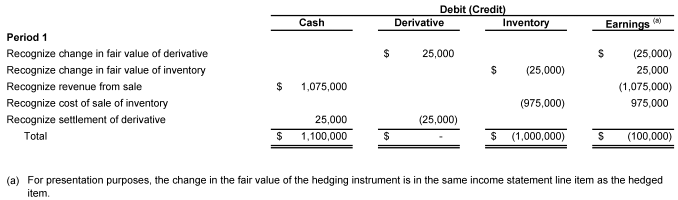
At inception of the hedge, Derivative Z has a fair value of zero and the hedged inventory has a carrying amount of $1,000,000 and a fair value of $1,100,000. On the last day of Period 1, the fair value of Derivative Z has increased by $25,000, and the fair value of the inventory has decreased by $25,000. The inventory is sold, and Derivative Z is settled on the last day of Period 1. The following table illustrates the accounting for the situation described in this Case.
  • Debit (Credit) Cash Derivative Inventory Earnings (a) Period 1 Recognize change in fair value of derivative " $25,000 " " $(25,000)" Recognize change in fair value of inventory " $(25,000)" " 25,000 " Recognize revenue from sale " $1,075,000 " " (1,075,000)" Recognize cost of sale of inventory " (975,000)" " 975,000 " Recognize settlement of derivative " 25,000 " " (25,000)" Total " $1,100,000 " $- " $(1,000,000)" " $(100,000)" (a) "For presentation purposes, the change in the fair value of the hedging instrument is in the same income statement line item as the hedged item."
815-25-55-37
If Entity ABC had sold the hedged inventory at the inception of the hedge, its gross profit on that sale would have been $100,000. This Case illustrates that, by hedging the risk of changes in the overall fair value of its inventory, Entity ABC recognized the same gross profit at the end of the hedge period even though the fair value of its inventory decreased by $25,000.
815-25-55-38
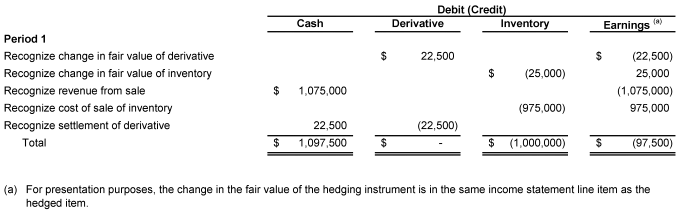
The hedge in Case A was perfectly effective because the gain on Derivative Z exactly offsets the loss on the inventory. However, in this Case, assume the terms of Derivative Z do not perfectly match the inventory and its fair value has increased by $22,500 as compared with the decline in fair value of the inventory of $25,000. The mismatch of $2,500 has to be recognized in earnings and presented in the same income statement line item as the earnings effect of the hedged item. The following table illustrates the accounting for the situation described in this Case.
  • Debit (Credit) Cash Derivative Inventory Earnings (a) Period 1 Recognize change in fair value of derivative " $22,500 " " $(22,500)" Recognize change in fair value of inventory " $(25,000)" " 25,000 " Recognize revenue from sale " $1,075,000 " " (1,075,000)" Recognize cost of sale of inventory " (975,000)" " 975,000 " Recognize settlement of derivative " 22,500 " " (22,500)" Total " $1,097,500 " $- " $(1,000,000)" " $(97,500)" (a) "For presentation purposes, the change in the fair value of the hedging instrument is in the same income statement line item as the hedged item."
815-25-55-39
The difference between the effect on earnings in Case B and the effect on earnings in Case A is $2,500.
815-25-55-40
This Example demonstrates the guidance in Subtopic 815-20 and this Subtopic as applied to the mechanics of reporting an interest rate swap used as a fair value hedge of an interest-bearing liability. It is not intended to demonstrate how to compute the fair value of an interest rate swap or an interest-bearing liability. This Example has been simplified by assuming that the interest rate applicable to a payment due at any future date is the same as the rate for a payment due at any other date (that is, the yield curve is flat). Although that is an unrealistic assumption, it makes the amounts used easier to understand without detracting from the purpose of the Example. For simplicity, commissions and most other transaction costs, initial margin, and income taxes are ignored unless otherwise stated. Assume that there are no changes in creditworthiness that would alter the effectiveness of the hedging relationship.
815-25-55-41
The fair values of the interest rate swap in this Example are determined using the zero-coupon method. The zero-coupon method is not the only acceptable method. Explanations of other acceptable methods of determining the fair value of an interest rate swap can be obtained from various published sources. Fair values also may be available from dealers in interest rate swaps and other derivative instruments.
815-25-55-42
In this Example, the term and notional amount of the interest rate swap match the term and principal amount of the interest-bearing liability being hedged. The fixed and variable interest rates used to determine the net settlements on the interest rate swap match the current yield curve, and the sum of the present values of the expected net settlements is zero at inception. Thus, paragraphs permit the reporting entity to assume perfect effectiveness. Assessment of effectiveness at one of the interest rate swap's repricing dates would confirm the validity of that assumption.
815-25-55-43
A shortcut method (see paragraphs ) can be used to produce the same reporting results as the method illustrated in this Example. This shortcut is only appropriate for a fair value hedge of a fixed-rate asset or liability using an interest rate swap and only if the assumption of perfect effectiveness is appropriate. The steps in the shortcut method are as follows:
  1. a
    Determine the difference between the fixed rate to be received on the interest rate swap and the fixed rate to be paid on the bonds.
  2. b
    Combine that difference with the variable rate to be paid on the interest rate swap.
  3. c
    Compute and recognize interest expense using that combined rate and the fixed-rate liability's principal amount. (Amortization of any purchase premium or discount on the liability also must be considered, although that complication is not incorporated in this Example.)
  4. d
    Determine the fair value of the interest rate swap.
  5. e
    Adjust the carrying amount of the interest rate swap to its fair value and adjust the carrying amount of the liability by an offsetting amount.
815-25-55-44
Amounts determined using the shortcut method and the facts in this Example will match the amounts in paragraph 815-25-55-48 even though the shortcut does not involve explicitly amortizing the hedge accounting adjustments on the debt. That is, the quarterly adjustments of the debt and explicit amortization of previous adjustments will have the same net effect on earnings as the shortcut method.
815-25-55-45
A slightly different shortcut method for interest rate swaps used as cash flow hedges is illustrated in Example 6 (see paragraph 815-30-55-24).
815-25-55-46
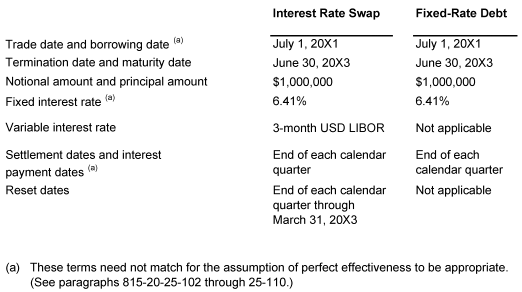
On July 1, 20X1, Entity ABC borrows $1,000,000 to be repaid on June 30, 20X3. On that same date, Entity ABC also enters into a two-year receive-fixed, pay-variable interest rate swap. Entity ABC designates the interest rate swap as a hedge of the changes in the fair value of the fixed-rate debt attributable to changes in the designated benchmark interest rate. Entity ABC designates changes in London Interbank Offered Rate (LIBOR) swap rates as the benchmark interest rate in hedging interest rate risk. The terms of the interest rate swap and the debt are as follows.
  • Interest Rate Swap Fixed-Rate Debt Trade date and borrowing date (a) "July 1, 20X1" "July 1, 20X1" Termination date and maturity date "June 30, 20X3" "June 30, 20X3" Notional amount and principal amount "$1,000,000" "$1,000,000" Fixed interest rate (a) 6.41% 6.41% Variable interest rate 3-month USD LIBOR Not applicable "Settlement dates and interest payment dates (a)" End of each calendar quarter End of each calendar quarter Reset dates "End of each calendar quarter through March 31, 20X3" Not applicable (a) These terms need not match for the assumption of perfect effectiveness to be appropriate. (See paragraphs 815-20-25-102 through 25-110.)
815-25-55-47
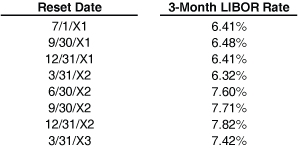
The USD LIBOR rates that are in effect at inception of the hedging relationship and at each of the quarterly reset dates are assumed to be as follows.
  • Reset Date 3-Month LIBOR Rate 7/1/X1 6.41% 9/30/X1 6.48% 12/31/X1 6.41% 3/31/X2 6.32% 6/30/X2 7.60% 9/30/X2 7.71% 12/31/X2 7.82% 3/31/X3 7.42%
815-25-55-48
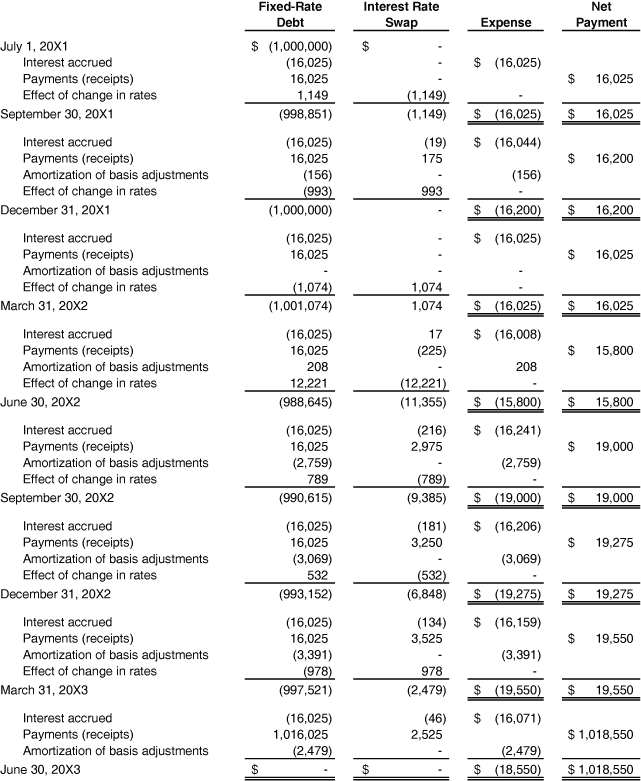
The following table summarizes the fair values of the debt and the interest rate swap at each quarter end, the details of the changes in the fair values during each quarter (including accrual and payment of interest, the effect of changes in rates, and level-yield amortization of hedge accounting adjustments), the expense for each quarter, and the net cash payments for each quarter. The calculations of fair value of both the debt and the interest rate swap are made using LIBOR. (A discussion of the appropriate discount rate appears in paragraph 815-20-25-111.)
  • Fixed-Rate Debt Interest Rate Swap Expense Net Payment "July 1, 20X1" " $(1,000,000)" $- Interest accrued " (16,025)" - " $(16,025)" Payments (receipts) " 16,025 " - " $16,025 " Effect of change in rates " 1,149 " " (1,149)" - "September 30, 20X1" " (998,851)" " (1,149)" " $(16,025)" " $16,025 " Interest accrued " (16,025)" (19) " $(16,044)" Payments (receipts) " 16,025 " 175 " $16,200 " Amortization of basis adjustments (156) - (156) Effect of change in rates (993) 993 - "December 31, 20X1" " (1,000,000)" - " $(16,200)" " $16,200 " Interest accrued " (16,025)" - " $(16,025)" Payments (receipts) " 16,025 " - " $16,025 " Amortization of basis adjustments - - - Effect of change in rates " (1,074)" " 1,074 " - "March 31, 20X2" " (1,001,074)" " 1,074 " " $(16,025)" " $16,025 " Interest accrued " (16,025)" 17 " $(16,008)" Payments (receipts) " 16,025 " (225) " $15,800 " Amortization of basis adjustments 208 - 208 Effect of change in rates " 12,221 " " (12,221)" - "June 30, 20X2" " (988,645)" " (11,355)" " $(15,800)" " $15,800 " Interest accrued " (16,025)" (216) " $(16,241)" Payments (receipts) " 16,025 " " 2,975 " " $19,000 " Amortization of basis adjustments " (2,759)" - " (2,759)" Effect of change in rates 789 (789) - "September 30, 20X2" " (990,615)" " (9,385)" " $(19,000)" " $19,000 " Interest accrued " (16,025)" (181) " $(16,206)" Payments (receipts) " 16,025 " " 3,250 " " $19,275 " Amortization of basis adjustments " (3,069)" - " (3,069)" Effect of change in rates 532 (532) - "December 31, 20X2" " (993,152)" " (6,848)" " $(19,275)" " $19,275 " Interest accrued " (16,025)" (134) " $(16,159)" Payments (receipts) " 16,025 " " 3,525 " " $19,550 " Amortization of basis adjustments " (3,391)" - " (3,391)" Effect of change in rates (978) 978 - "March 31, 20X3" " (997,521)" " (2,479)" " $(19,550)" " $19,550 " Interest accrued " (16,025)" (46) " $(16,071)" Payments (receipts) " 1,016,025 " " 2,525 " " $1,018,550 " Amortization of basis adjustments " (2,479)" - " (2,479)" "June 30, 20X3" $- $- " $(18,550)" " $1,018,550 "
815-25-55-49
The preceding table demonstrates two important points that explain why the shortcut method described in paragraphs produces the same results as the computation in the preceding table if the hedging relationship is perfectly effective:
  1. a
    In every quarter, the effect of changes in rates on the interest rate swap completely offsets the effect of changes in rates on the debt. That is as expected because the hedge is perfectly effective.
  2. b
    In every quarter except the last when the principal is repaid, the expense equals the cash payment.
815-25-55-50
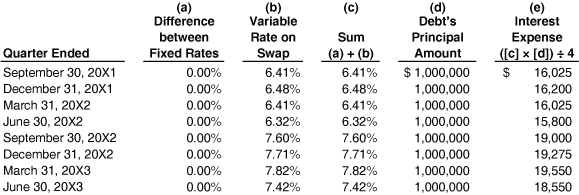
The following table illustrates the computation of interest expense using the shortcut method described in paragraphs . The results are the same as the results computed in the preceding table.
  • (a) (b) (c) (d) (e) Quarter Ended Difference between Fixed Rates Variable Rate on Swap "Sum (a) + (b)" Debt's Principal Amount "Interest Expense ([c] × [d]) ÷ 4" "September 30, 20X1" 0.00% 6.41% 6.41% " $1,000,000 " " $16,025 " "December 31, 20X1" 0.00% 6.48% 6.48% " 1,000,000 " " 16,200 " "March 31, 20X2" 0.00% 6.41% 6.41% " 1,000,000 " " 16,025 " "June 30, 20X2" 0.00% 6.32% 6.32% " 1,000,000 " " 15,800 " "September 30, 20X2" 0.00% 7.60% 7.60% " 1,000,000 " " 19,000 " "December 31, 20X2" 0.00% 7.71% 7.71% " 1,000,000 " " 19,275 " "March 31, 20X3" 0.00% 7.82% 7.82% " 1,000,000 " " 19,550 " "June 30, 20X3" 0.00% 7.42% 7.42% " 1,000,000 " " 18,550 "
815-25-55-51
As stated in the introduction to this Example, a flat yield curve is assumed for simplicity. An upward-sloping yield curve would have made the computations more complex. Paragraph 815-25-55-47 would have shown different interest rates for each quarterly repricing date, and the present value of each future payment would have been computed using a different rate (as described in paragraph 815-25-55-41). However, the basic principles are the same. As long as the hedging relationship meets the criteria for the shortcut method, perfect effectiveness can be assumed.
815-25-55-52
In this Example of a fair value hedge of fixed-rate interest-bearing debt, it is assumed that Entity ABC elects to immediately begin amortizing the adjustments of the carrying amount of the fixed-rate debt while the hedge is still in place. Because the change in fair value of the interest rate swap attributable to the passage of time is recognized as interest expense by Entity ABC, the amounts recorded as expenses in the table in paragraph 815-25-55-48 would be eligible for capitalization under Subtopic 835-20.
815-25-55-53
This Example illustrates one method that could be used pursuant to paragraph 815-20-25-12(f)(2) in determining the hedged item's change in fair value attributable to changes in the benchmark interest rate. Other methods could be used in determining the hedged item's change in fair value attributable to changes in the benchmark interest rate as long as those methods meet the criteria in that paragraph. For simplicity, commissions and most other transaction costs, initial margin, and income taxes are ignored unless otherwise stated. Assume that there are no changes in creditworthiness that would alter the effectiveness of the hedging relationship.
815-25-55-54
On January 1, 20X0, Entity GHI issues at par a $100,000 BBB-quality 5-year fixed-rate noncallable debt instrument with an annual 10 percent interest coupon. On that date, Entity GHI enters into a 5-year interest rate swap based on the LIBOR swap rate and designates it as the hedging instrument in a fair value hedge of the $100,000 liability. Under the terms of the interest rate swap, Entity GHI will receive fixed interest at 7 percent and pay variable interest at LIBOR. The variable leg of the interest rate swap resets each year on December 31 for the payments due the following year. This Example has been simplified by assuming that the interest rate applicable to a payment due at any future date is the same as the rate for a payment at any other date (that is, the yield curve is flat). During the hedge period, the gain or loss on the interest rate swap will be recorded in earnings. The Example assumes that immediately before the interest rate on the variable leg resets on December 31, 20X0, the LIBOR swap rate increased by 50 basis points to 7.50 percent, and the change in fair value of the interest rate swap for the period from January 1 to December 31, 20X0, is a loss in value of $1,675.
815-25-55-55
Under this method, the change in a hedged item's fair value attributable to changes in the benchmark interest rate for a specific period is determined as the difference between two present value calculations that use the remaining cash flows as of the end of the period and reflect in the discount rate the effect of the changes in the benchmark interest rate during the period.
  1. a
  2. b
815-25-55-56
Both present value calculations are computed using the estimated future cash flows for the hedged item, which would be either its remaining contractual coupon cash flows or the LIBOR benchmark rate component of the remaining contractual coupon cash flows determined at hedge inception as illustrated by the following Cases:
  1. a
    Using the full contractual coupon cash flows (Case A)
  2. b
    Using the LIBOR benchmark rate component of the contractual coupon cash flows (Case B).
815-25-55-56A
This Example illustrates two approaches for computing the change in fair value of the hedged item attributable to changes in the benchmark interest rate. This Subtopic does not specify the discount rate that must be used to calculate the change in fair value of the hedged item.
815-25-55-56B
In Cases A and B in this Example, Entity GHI presents the total change in the fair value of the hedging instrument (that is, the interest accruals and all other changes in fair value) in the same income statement line item (in this case, interest expense) that is used by Entity GHI to present the earnings effect of the hedged item before applying hedge accounting in accordance with paragraph 815-20-45-1A.
815-25-55-57
In this Case, assume Entity GHI elected to calculate the change in the fair value of the hedged item attributable to interest rate risk on the basis of the full contractual coupon cash flows of the hedged item. Accordingly, both present value calculations in accordance with paragraph 815-25-55-55 are computed using the remaining contractual coupon cash flows as of the end of the period and the discount rate that reflects the change in the designated benchmark interest rate during the period. The method chosen by Entity GHI in this Case requires that the discount rate be based on the market interest rate for the hedged item at the inception of the hedging relationship. The discount rates used for those present value calculations would be, respectively:
  1. a
    The discount rate equal to the market interest rate for that hedged item at the inception of the hedge adjusted (up or down) for changes in the benchmark rate (designated as the interest rate risk being hedged) from the inception of the hedge to the beginning date of the period for which the change in fair value is being calculated
  2. b
    The discount rate equal to the market interest rate for that hedged item at the inception of the hedge adjusted (up or down) for changes in the designated benchmark rate from the inception of the hedge to the ending date of the period for which the change in fair value is being calculated.

815-25-55-58
Entity GHI elected to subsequently assess hedge effectiveness on a quantitative basis. In Entity GHI's quarterly assessments of hedge effectiveness for each of the first three quarters of year 20X0 in this Example, there was zero change in the hedged item's fair value attributable to changes in the benchmark interest rate because there was no change in the LIBOR swap rate. However, in the assessment for the fourth quarter 20X0, the discount rate for the beginning of the period is 10 percent (the hedged item's original market interest rate with an adjustment of zero), and the discount rate for the end of the period is 10.50 percent (the hedged item's original market interest rate adjusted for the change during the period in the LIBOR swap rate [+ 0.50 percent]).
  • "December 31, 20X0" Calculate the present value using the beginning-of-period discount rate of 10 percent: "$10,000pmt, 10%i, 4n, PV =" " $31,699 " (interest payments) "$100,000fv, 10%i, 4n, PV =" " $68,301 " (principal payment) Total present value " $100,000 "

815-25-55-59
Calculate the present value using the end-of-period discount rate of 10.50 percent (that is, the beginning-of-period discount rate adjusted for the change during the period in the LIBOR swap rate of 50 basis points).
  • "$10,000pmt, 10.50%i, 4n, PV =" " $31,359 " (interest payments) "$100,000fv, 10.50%i, 4n, PV =" " $67,073 " (principal payment) Total present value " $98,432 "
815-25-55-60
The change in fair value of the hedged item attributable to the change in the benchmark interest rate is $100,000 - $98,432 = $1,568 (the fair value decrease in the liability is a gain on debt).
815-25-55-61
When the change in fair value of the hedged item ($1,568 gain) attributable to the risk being hedged is compared with the change in fair value of the hedging instrument ($1,675 loss), a mismatch of $107 results that will be reported in earnings, because both changes in fair value are recorded in earnings. The change in the fair value of the hedging instrument will be presented in the same income statement line item as the earnings effect of the hedged item in accordance with paragraph 815-20-45-1A.
815-25-55-61A
In this Case, assume Entity GHI elected to calculate the change in the fair value of the hedged item attributable to interest rate risk on the basis of the benchmark rate component of the contractual coupon cash flows determined at hedge inception. Accordingly, both present value calculations in accordance with paragraph 815-25-55-55 are computed using the remaining benchmark rate component of contractual coupon cash flows as of the end period and the discount rate that reflects the change in the designated benchmark rate during the period. The discount rates used by Entity GHI in this Case would be, respectively:
  1. a
    The benchmark rate (designated as the interest rate risk being hedged) as of the beginning date of the period for which the change in fair value is being calculated
  2. b
    The designated benchmark rate as of the ending date of the period for which the change in fair value is being calculated.
815-25-55-61B
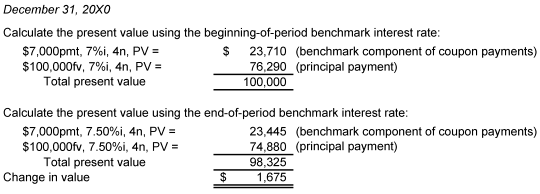
Entity GHI elected to subsequently assess hedge effectiveness on a quantitative basis. In Entity GHI's quarterly assessments of hedge effectiveness for each of the first three quarters of year 20X0, there was no change in the hedged item's fair value attributable to changes in the benchmark interest rate because there was no change in the LIBOR swap rate. However, in the assessment for the fourth quarter 20X0, the discount rate for the beginning of the period is 7 percent, and the discount rate for the end of the period is 7.50 percent reflecting the change during the period in the LIBOR swap rate. The change in fair value of the hedged item attributable to the change in the benchmark interest risk for the period January 1, 20X0, to December 31, 20X0, is a gain of $1,675, calculated as follows.
  • Inputs Inception End of Y1 "December 31, 20X0" Principal " $100,000 " Calculate the present value using the beginning-of-period benchmark interest rate: Interest payment " $10,000 " "$7,000pmt, 7%i, 4n, PV =" " $23,710 " (benchmark component of coupon payments) Benchmark portion " $7,000 " "$100,000fv, 7%i, 4n, PV =" " 76,290 " (principal payment) LIBOR 7.00% 7.50% Total present value " 100,000 " Fixed Coupon 10.00% Fixed swap rate 7.00% Calculate the present value using the end-of-period benchmark interest rate: Remaining term 5 4 "$7,000pmt, 7.50%i, 4n, PV =" " 23,445 " (benchmark component of coupon payments) "$100,000fv, 7.50%i, 4n, PV =" " 74,880 " (principal payment) Swap Valuation Total present value " 98,325 " Swap receives fixed " $7,000 " " $7,000 " Change in value " $1,675 " Swap net CF #REF! #REF! Swap FV - #REF!
815-25-55-61C
Because the change in fair value of the hedged item ($1,675 gain) attributable to the risk being hedged is the same as the change in fair value of the hedging instrument ($1,675 loss), there is perfect offset and, therefore, a zero net earnings effect.
815-25-55-62
This Example illustrates application of the guidance in Sections 815-20-25, 815-20-35, and 815-25-35 to a fair value hedge of a firm commitment to purchase an asset for a price denominated in a foreign currency. In this Example, the hedging instrument and the firm commitment are denominated in different foreign currencies. Consequently, although the hedge is highly effective at achieving offsetting changes in fair value, the hedge is not perfectly effective, and there will be an earnings effect. (The entity in the Example could have designed a perfectly effective hedge by using a hedging instrument denominated in the same foreign currency as the firm commitment with terms that match the appropriate terms in the firm commitment.)
815-25-55-63
Entity MNO's functional currency is the U.S. dollar (USD). On February 3, 20X7, Entity MNO enters into a firm commitment to purchase a machine for delivery on May 1, 20X7. The price of the machine will be 270,000 Swiss francs (CHF 270,000). Also on February 3, 20X7, Entity MNO enters into a forward contract to purchase 240,000 Euros (EUR 240,000) on May 1, 20X7. Entity MNO will pay USD 0.6125 per EUR 1 (a total of USD 147,000), which is the current forward rate for an exchange on May 1, 20X7. Entity MNO designates the forward contract as a hedge of its risk of changes in the fair value of the firm commitment resulting from changes in the USD-CHF forward exchange rate.
815-25-55-64
Entity MNO will assess effectiveness by comparing the overall changes in the fair value of the forward contract to the changes in fair value in USD of the firm commitment due to changes in USD-CHF forward exchange rates. Entity MNO expects the forward contract to be highly effective as a hedge because all of the following conditions exist:
  1. a
    EUR 240,000 is approximately equal to CHF 270,000 at the May 1, 20X1, forward exchange rate in effect on February 3, 20X7.
  2. b
    Settlement of the forward contract and the firm commitment will occur on the same date.
  3. c
    In recent years, changes in the value in USD of EUR over three-month periods have been highly correlated with changes in the value in USD of CHF over those same periods.
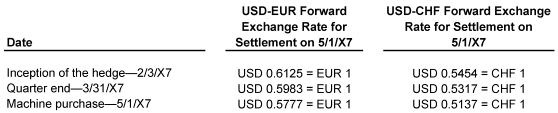
815-25-55-65
Although the hedging relationship has been determined to be highly effective at achieving offsetting changes in fair value, the hedge will not be perfectly effective and the difference between changes in the USD equivalent of EUR 240,000 (the notional amount of the forward contract) and changes in the USD equivalent of CHF 270,000 (the amount to be paid for the machine) will affect earnings. The difference between the spot rate and the forward exchange rate is not excluded from the assessment of hedge effectiveness because changes in the fair value of the firm commitment are being measured using forward exchange rates. Therefore, the entire change in the fair value of the hedging instrument will be presented in earnings in the same income statement line item as the earnings effect of the hedged item. If the hedged item were a foreign-currency-denominated available-for-sale debt security instead of a firm commitment, Topic 830 would have required its carrying value to be measured using the spot exchange rate. In that case, the spot-forward difference would have been recognized currently in earnings in the same income statement line item as the earnings effect of the hedged item if it was included in the assessment of effectiveness. The spot-forward difference also may be excluded from the assessment of effectiveness and accounted for through either an amortization approach or a mark-to-market approach in accordance with paragraph 815-20-25-83A or paragraph 815-20-25-83B.
815-25-55-66
The forward exchange rates in effect on certain key dates are assumed to be as follows.
  • Date USD-EUR Forward Exchange Rate for Settlement on 5/1/X7 USD-CHF Forward Exchange Rate for Settlement on 5/1/X7 Inception of the hedge—2/3/X7 USD 0.6125 = EUR 1 USD 0.5454 = CHF 1 Quarter end—3/31/X7 USD 0.5983 = EUR 1 USD 0.5317 = CHF 1 Machine purchase—5/1/X7 USD 0.5777 = EUR 1 USD 0.5137 = CHF 1
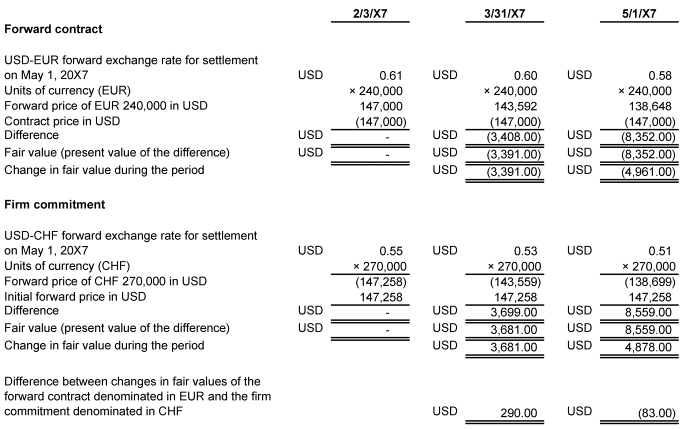
815-25-55-67
The USD equivalent and changes in the USD equivalent of the forward contract and the firm commitment, the changes in fair value of the forward contract and the firm commitment, and the earnings effect of the hedge on those same key dates are shown in the following table. A 6 percent discount rate is used in this Example.
  • 2/3/X7 3/31/X7 5/1/X7 Forward contract "USD-EUR forward exchange rate for settlement on May 1, 20X7" USD 0.61 USD 0.60 USD 0.58 Units of currency (EUR) " × 240,000 " " × 240,000 " " × 240,000 " "Forward price of EUR 240,000 in USD" " 147,000 " " 143,592 " " 138,648 " Contract price in USD " (147,000)" " (147,000)" " (147,000)" Difference USD - USD " (3,408.00)" USD " (8,352.00)" Fair value (present value of the difference) USD - USD " (3,391.00)" USD " (8,352.00)" Change in fair value during the period USD " (3,391.00)" USD " (4,961.00)" Firm commitment "USD-CHF forward exchange rate for settlement on May 1, 20X7" USD 0.55 USD 0.53 USD 0.51 Units of currency (CHF) "× 270,000" "× 270,000" "× 270,000" "Forward price of CHF 270,000 in USD" " (147,258)" " (143,559)" " (138,699)" Initial forward price in USD " 147,258 " " 147,258 " " 147,258 " Difference USD - USD " 3,699.00 " USD " 8,559.00 " Fair value (present value of the difference) USD - USD " 3,681.00 " USD " 8,559.00 " Change in fair value during the period USD " 3,681.00 " USD " 4,878.00 " Difference between changes in fair values of the forward contract denominated in EUR and the firm commitment denominated in CHF USD 290.00 USD (83.00)
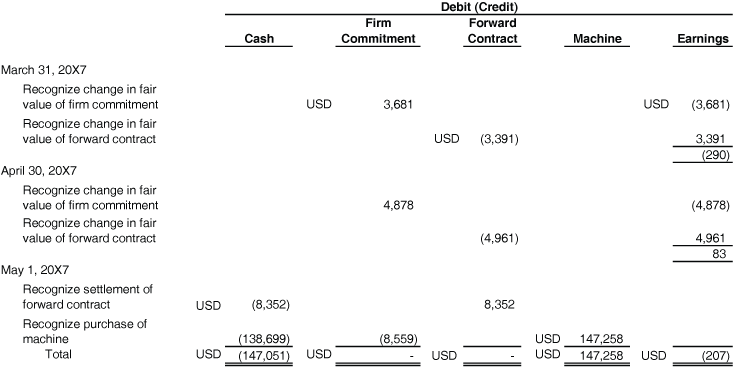
815-25-55-68
This Subtopic requires that Entity MNO recognize currently in earnings all changes in fair values of the forward contract. Because Entity MNO is hedging the risk of changes in fair value of the firm commitment attributable to changes in the forward exchange rates, this Subtopic also requires recognizing those changes currently in earnings. Section 815-20-45 requires that those changes be presented in earnings in the same income statement line item as the earnings effect of the hedged item.
815-25-55-69
On May 1, 20X7, Entity MNO fulfills the firm commitment to purchase the machine and settles the forward contract. The entries illustrating fair value hedge accounting for the hedging relationship and the purchase of the machine are summarized in the following table.
  • Debit (Credit) Cash Firm Commitment Forward Contract Machine Earnings "March 31, 20X7" Recognize change in fair value of firm commitment USD " 3,681 " USD " (3,681)" Recognize change in fair value of forward contract USD " (3,391)" " 3,391 " (290) "April 30, 20X7" Recognize change in fair value of firm commitment " 4,878 " " (4,878)" Recognize change in fair value of forward contract " (4,961)" " 4,961 " 83 "May 1, 20X7" Recognize settlement of forward contract USD " (8,352)" " 8,352 " Recognize purchase of machine " (138,699)" " (8,559)" USD " 147,258 " Total USD " (147,051)" USD - USD - USD " 147,258 " USD (207)
815-25-55-70
To simplify this Example and focus on the effects of the hedging relationship, other amounts that would be involved in the purchase of the machine by Entity MNO (for example, shipping costs and installation costs) have been ignored.
815-25-55-71
The effect of the hedge is to recognize the machine at its price in CHF (CHF 270,000) translated at the forward rate in effect at the inception of the hedge (USD 0.5454 per CHF 1).
815-25-55-72
This Example illustrates application of the guidance in Sections 815-20-25, 815-20-35, and 815-25-35 to a fair value hedge of the LIBOR swap rate in a $100 million A1-quality 5-year fixed-rate noncallable debt. Assume that an entity elected to calculate the change in the fair value of the hedged item attributable to LIBOR interest rate risk using the full contractual coupon cash flows of the hedged item.
815-25-55-73
On April 3, 20X0, Global Tech issues at par a $100 million A1-quality 5-year fixed-rate noncallable debt instrument with an annual 8 percent interest coupon payable semiannually. On that date, Global Tech enters into a 5-year interest rate swap based on the LIBOR swap rate and designates it as the hedging instrument in a fair value hedge of the $100 million liability. Under the terms of the interest rate swap, Global Tech will receive a fixed interest rate at 8 percent and pay variable interest at LIBOR plus 78.5 basis points (current LIBOR 6.29 percent) on a notional amount of $101,970,000 (semiannual settlement and interest reset dates). A duration-weighted hedge ratio was used to calculate the notional amount of the interest rate swap necessary to offset the debt's fair value changes attributable to changes in the LIBOR swap rate.
815-25-55-74
This Example has the following assumptions:
  1. a
    PV01 debt = 4.14
  2. b
    PV01 interest rate swap = 4.06
  3. c
    Hedge ratio = PV01 debt / PV01 interest rate swap = 4.14/4.06 = 1.0197
  4. d
    Interest rate swap notional = 1.0197 x $100 million = $101,970,000.
  5. e
    For simplicity, commissions and most other transaction costs, initial margin, and income taxes are ignored unless otherwise stated. Assume that there are no changes in creditworthiness that would alter the effectiveness of the hedging relationship.
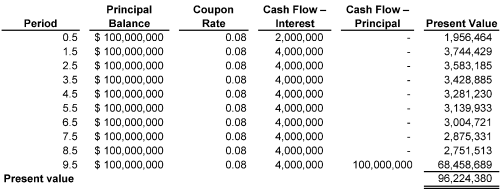
815-25-55-75
The Example assumes that the LIBOR swap rate increased 100 basis points to 7.29 percent on June 30, 20X0. The change in fair value of the interest rate swap for the period from April 3 to June 30, 20X0, is a loss of $4,016,000. The change in fair value of the debt attributable to changes in the benchmark interest rate for the period April 3 to June 30, 20X0, is calculated as follows.
  • Period Principal Balance Coupon Rate Cash Flow - Interest Cash Flow - Principal Present Value 0.5 " $100,000,000 " 0.08 " 2,000,000 " - " 1,956,464 " 1.5 " $100,000,000 " 0.08 " 4,000,000 " - " 3,744,429 " 2.5 " $100,000,000 " 0.08 " 4,000,000 " - " 3,583,185 " 3.5 " $100,000,000 " 0.08 " 4,000,000 " - " 3,428,885 " 4.5 " $100,000,000 " 0.08 " 4,000,000 " - " 3,281,230 " 5.5 " $100,000,000 " 0.08 " 4,000,000 " - " 3,139,933 " 6.5 " $100,000,000 " 0.08 " 4,000,000 " - " 3,004,721 " 7.5 " $100,000,000 " 0.08 " 4,000,000 " - " 2,875,331 " 8.5 " $100,000,000 " 0.08 " 4,000,000 " - " 2,751,513 " 9.5 " $100,000,000 " 0.08 " 4,000,000 " " 100,000,000 " " 68,458,689 " Present value " 96,224,380 "

815-25-55-76
As of June 30, 20X0, 9.5 periods remain and the cash flows are discounted at 9 percent, determined as the initial 8-percent yield plus a 100 basis point increase attributable to the 100 basis point increase in the LIBOR swap rate. The accrual for the first quarter interest was excluded. The following journal entries illustrate the interest rate swap and debt fair value changes, attributable to changes in the LIBOR swap rate, excluding accruals.
  • Debit Credit Debt " $3,775,620 " Interest expense " $3,775,620 " Interest expense " 4,016,000 " Swap liability " 4,016,000 "
815-25-55-77
The net earnings effect of the hedging relationship was $240,380 because of the mismatch between the change in the fair value of the hedging instrument and the change in fair value of the hedged item. In accordance with paragraph 815-20-45-1A, Global Tech presents the entire change in the fair value of the hedging instrument (including interest accruals and all other changes in fair value) in the same income statement line item (in this case, interest expense) that is used by Global Tech to present the earnings effect of the hedged item before applying hedge accounting.
815-25-55-84
This Example illustrates a circumstance in which statutory remedies for default constitute a disincentive for nonperformance in applying the definition of a firm commitment. Entity A enters into an agreement to purchase 4,000 barrels of a common solvent from a chemical entity at $200 per barrel on June 1, 2000. The provisions of the agreement do not include a specific disincentive for nonperformance that is sufficiently large to make performance probable. However, the laws of the legal jurisdiction to which the agreement is subject provide a disincentive for nonperformance if Entity A does not take delivery of the barrels pursuant to the agreement. The solvent is not readily convertible to cash. Therefore, because the governing legal jurisdiction provides statutory rights to pursue remedies for default equivalent to the damages suffered, the agreement includes a disincentive for nonperformance that is sufficiently large to make performance probable for purposes of applying the definition of a firm commitment.
815-25-55-85
This Example illustrates the application of paragraph 815-25-35-11 involving the interaction of hedge accounting and measurement of credit losses in Subtopic 326-20 on financial instruments measured at amortized cost. The following Cases also illustrate the effect of the two approaches to calculate the change in the fair value of the hedged item attributable to interest rate risk discussed in paragraph 815-25-35-13 on that interaction, as follows:
  1. a
    Using the full contractual coupon cash flows (Case A)
  2. b
    Using the benchmark rate component of the contractual coupon cash flows (Case B).
815-25-55-86
Entity A formally documents a qualifying fair value hedge (for fair value changes attributable to changes in the designated benchmark interest rate) between a fixed-rate loan receivable from Entity B and an interest rate swap. The 5-year, fixed-rate loan to Entity B has a principal amount of $1,000,000 payable at maturity and interest payable annually at a 10 percent rate. For simplicity, commissions and most other transaction costs, initial margin, and income taxes are ignored unless otherwise stated. Assume that there are no changes in creditworthiness that would alter the effectiveness of the hedging relationship.
815-25-55-87
One year after inception of the hedging relationship, the following conditions exist:
  1. a
  2. b
    There has been an adverse change to Entity B's creditworthiness.
  3. c
    The LIBOR swap rate (the designated benchmark interest rate) has decreased from 6 percent to 5.5 percent.
815-25-55-88
Assume that the repayment of the loan is not dependent on the underlying collateral. In applying the requirements of Subtopic 326-20 to the loan, Entity A evaluates the loan for credit losses on an individual basis because it does not have similar risk characteristics with other loans in the portfolio and uses a discounted cash flow approach. Entity A determines that the present value of expected future cash flows discounted at the loan's effective interest rate at inception of the loan is $930,000. (See row C in the table in paragraph 815-25-55-90, which presents calculations—at the end of the first year of the loan's term—of the net present value of current estimates of expected future cash flows based on the loan's original effective interest rate.)
815-25-55-88A
In this Case, assume that the entity elected to calculate fair value changes in the hedged item attributable to interest rate risk using the full contractual coupon cash flows of the hedged item. One year after inception of the hedging relationship, the change in the hedged item's fair value attributable to changes in the LIBOR swap rate (the designated benchmark interest rate) is a gain of $16,022. (See row B in the table in paragraph 815-25-55-90, which presents calculations—at the end of the first year of the loan's term—of the net present value of contractual cash flows based on the loan's original effective interest rate adjusted for a 50 basis point decrease in the LIBOR swap rate.)
815-25-55-89
After adjusting the amortized cost basis of the hedged loan by $16,022 (pursuant to paragraph 815-25-35-1(b)) for the increase in the hedged item's fair value attributable to changes in the benchmark interest rate, Entity A should apply the guidance in Subtopic 326-20 by doing both of the following:
  1. a
    Comparing the amortized cost basis of the loan after the effect of the fair value hedge, or $1,016,022, to the $944,901 present value of expected future cash flows discounted using the rate that reflects the rate of return implicit in the loan after adjusting the amortized cost basis of the hedged loan pursuant to paragraph 815-25-35-1(b) (that is, 9.5 percent)
  2. b
    Recording an allowance for credit losses (with the offsetting entry charged to expense) for the difference of $71,121 ($1,016,022 - $944,901).
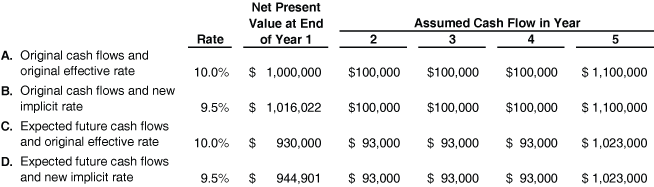
815-25-55-90
Following are calculations (at the end of the first year of the loan's term) of the net present value of the contractual cash flows and the creditor's best estimate of expected future cash flows based on the loan's original effective interest rate and the new implicit rate.
  • Net Present Value at End of Year 1 Assumed Cash Flow in Year Rate 2 3 4 5 A. Original cash flows and original effective rate 10.0% " $1,000,000 " " $100,000 " " $100,000 " " $100,000 " " $1,100,000 " B. Original cash flows and new implicit rate 9.5% " $1,016,022 " " $100,000 " " $100,000 " " $100,000 " " $1,100,000 " C. Expected future cash flows and original effective rate 10.0% " $930,000 " " $93,000 " " $93,000 " " $93,000 " " $1,023,000 " D. Expected future cash flows and new implicit rate 9.5% " $944,901 " " $93,000 " " $93,000 " " $93,000 " " $1,023,000 "

815-25-55-91
In this Case, assume that Entity A elected to calculate fair value changes in the hedged item attributable to interest rate risk using the benchmark rate component of the contractual coupon cash flows of the hedged item determined at hedge inception. One year after inception of the hedging relationship, the change in the hedged item's fair value attributable to changes in the LIBOR swap rate (the designated benchmark interest rate) is a gain of $17,526, which is calculated as follows.
  • Example 14: Interaction with Loan Impairment using Benchmark Cash Flow Approach INPUTS At inception One year later PRINCIPAL & NOTIONAL " $1,000,000 " MARKET RATE 10% 9.2% LIBOR SWAP RATE 6% 50bp decrease CREDIT SPREAD 4% 30bp decrease At the beginning of the loan's term "$60,000pmt, 6%i, 5n, 1,000,000fv, PV =" " $1,000,000 " At the end of the first year of the loan's term "$60,000pmt, 5.5%i, 4n, 1,000,000fv, PV =" " 1,017,526 " " $100,000,000 " Change in value " $(17,526)" New CV of Loan Remaining cash flows at end of Year 1 2 3 4 5 New EIR at end of Year 1 = 9.454% "($1,017,526)" "$100,000 " "$100,000 " "$100,000 " "$1,100,000 " Net Present Value at End of Year 1 Assumed Cash Flow in Year Rate 2 3 4 5 A. Original cash flows and original effective rate 10.00% "$1,000,000 " "$100,000 " "$100,000 " "$100,000 " "$1,100,000 " B. Original cash flows and new Implicit rate 9.45% "$1,017,526 " "$100,000 " "$100,000 " "$100,000 " "$1,100,000 " C. Expected future cash flows and original effective rate 10.00% "$930,000 " "$93,000 " "$93,000 " "$93,000 " "$1,023,000 " D. Expected future cash flows and new implicit rate 9.45% "$946,299 " "$93,000 " "$93,000 " "$93,000 " "$1,023,000 " Impairment Valuation Allowance "$71,226.80 "
815-25-55-92
After adjusting the amortized cost basis of the hedged loan by $17,526 (in accordance with paragraph 815-25-35-1(b)) for the increase in the hedged item's fair value attributable to changes in the benchmark interest rate, Entity A should apply the guidance in Subtopic 326-20 by doing both of the following:
  1. a
    Comparing the amortized cost basis of the loan after the effect of the fair value hedge, or $1,017,526, to the $946,299 present value of expected future cash flows discounted using the rate that reflects the rate of return implicit in the loan after adjusting the amortized cost basis of the hedged loan in accordance with paragraph 815-25-35-1(b) (that is, 9.45 percent that equates the adjusted amortized costs basis of the loan with the present value of the contractual cash flows of the loan)
  2. b
    Recognizing an allowance for credit losses (with the offsetting entry charged to expense) for the difference of $71,227 ($1,017,526 - $946,299).
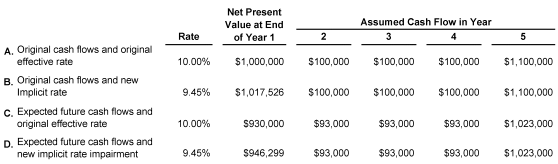
815-25-55-93
Following are calculations (at the end of the first year of the loan's term) of the net present value of the benchmark rate component of the contractual cash flows and the creditor's best estimate of expected future cash flows based on the loan's original effective interest rate and the new implicit rate. In row B, the net present value at the end of the first year is equal to the net present value of the benchmark rate component of the contractual coupon cash flows discounted at the 5.5 percent benchmark rate.
  • Example 14: Interaction with Loan Impairment using Benchmark Cash Flow Approach INPUTS One year later PRINCIPAL & NOTIONAL MARKET RATE 9.2% LIBOR SWAP RATE 50bp decrease CREDIT SPREAD 30bp decrease At the beginning of the loan's term "$60,000pmt, 6%i, 5n, 1,000,000fv, PV=" #REF! At the end of the first year of the loan's term "$60,000pmt, 5.5%i, 4n, 1,000,000fv, PV=" "$1,017,526 " " $100,000,000 " Change in value #REF! New CV of Loan Remaining cash flows at end of Year 1 2 3 4 5 New EIR at end of Year 1 = 9.454% "($1,017,526)" "$100,000 " "$100,000 " "$100,000 " "$1,100,000 " Net Present Value at End of Year 1 Assumed Cash Flow in Year Rate 2 3 4 5 A. Original cash flows and original effective rate 10.00% "$1,000,000 " "$100,000 " "$100,000 " "$100,000 " "$1,100,000 " B. Original cash flows and new Implicit rate 9.45% "$1,017,526 " "$100,000 " "$100,000 " "$100,000 " "$1,100,000 " C. Expected future cash flows and original effective rate 10.00% "$930,000 " "$93,000 " "$93,000 " "$93,000 " "$1,023,000 " D. "Expected future cash flows and new implicit rate impairment impairment " 9.45% "$946,299 " "$93,000 " "$93,000 " "$93,000 " "$1,023,000 " Valuation Allowance "$71,226.80 "

815-25-55-94
This Example illustrates the application of paragraphs 815-20-25-12(b)(2)(ii) and 815-25-35-13B to the designation and measurement of a hedged item as a portion of the term of a financial instrument in a hedge of interest rate risk. Assume that Entity S elected to calculate fair value changes in the hedged item attributable to interest rate risk on the basis of the benchmark rate component of the contractual coupon cash flows of the hedged item determined at hedge inception.
815-25-55-95
On January 1, 20X1, Entity S issues a noncallable, 5-year, $100 million debt instrument with a 3 percent semiannual interest coupon. On that date, the issuer also enters into a 2-year interest rate swap with a notional amount of $100 million. Entity S designates the swap as a fair value hedge of the fixed-rate debt attributable to interest rate risk for the first two years of its term in accordance with the guidance in paragraph 815-20-25-12(b)(2)(ii). The swap pays LIBOR and receives a fixed rate of 2 percent, with semiannual payments. The swap has a fair value of zero at inception. The designated benchmark interest rate is the LIBOR swap rate. For ease of calculation, the yield curve is assumed to be flat at the level of the current benchmark interest rate. For simplicity, commissions and most other transaction costs, initial margin, and income taxes are ignored unless otherwise stated. Assume that there are no changes in creditworthiness that would alter the effectiveness of the hedging relationship.
815-25-55-96
This Example assumes that the LIBOR swap rate increased by 50 basis points to 2.5 percent on June 30, 20X1. The change in fair value of the interest rate swap for the period January 1, 20X1, to June 30, 20X1, is a loss in value of $731,633.
815-25-55-97
In calculating the change in fair value of the debt attributable to changes in the benchmark interest rate in accordance with paragraph 815-25-35-13B, Entity S determines that the assumed term of the hedged item is two years because it is hedging only the cash flows associated with the first two years of its debt issuance. The change in fair value of the debt attributable to changes in the benchmark interest rate for the period January 1, 20X1, to June 30, 20X1, is a gain of $731,633, calculated as follows.
  • Example 15: Fair Value Hedge of Fixed-Rate Debt using Partial Term & Benchmark Cash Flows Inputs 1/1/20X1 Principal Amount of Bond and Swap Notional " $100,000,000 " Fixed Coupon Rate on Bond 3.00% Fixed Rate on Swap 2.00% LIBOR Rate 2.00% Remaining Payment Periods on Bond 10 Remaining Payment Periods on Swap 4 Change in the Fair Value of the Swap Date Discount Swap Swap Swap Swap Rate Payment (LIBOR) Net Payment FV FV Changes 1/1/20X1 1.00% " 1,000,000 " - 6/30/20X1 Change in Value of 5 Year Bond "January 1, 20X1—beginning balance" "$1,000,000pmt, 1.00%i, 4n, 100,000,000fv, PV =" " $100,000,000 " "June 30, 20X1—ending balance" "$1,000,000pmt, 1.25%i, 3n, 100,000,000fv, PV =" " 99,268,367 " Change in value " $731,633 "
815-25-55-98
As of June 30, 20X1, the change in fair value of the debt attributable to the benchmark interest rate is calculated by discounting the benchmark rate component of the contractual coupon cash flows using the benchmark interest rate at June 30, 20X1 (2.5 percent annual rate and 1.25 percent for each semiannual period). The change in fair value of the debt and the change in fair value of the swap result in perfect offset in current-period earnings. In accordance with paragraph 815-20-45-1A, Entity S presents the total change in the fair value of the hedging instrument (that is, the interest accruals and all other changes in fair value) in the same income statement line item (in this case, interest expense) that is used by Entity S to present the earnings effect of the hedged item before applying hedge accounting.
815-25-55-99
Although this Example illustrates the hedged item as the first two years of interest payments associated with an existing debt instrument, paragraph 815-20-25-12(b)(2)(ii) permits one interest payment or any consecutive interest payments associated with an existing debt instrument to be designated as the hedged item. An entity also may have one or more separately designated partial-term hedging relationships outstanding at the same time for the same debt instrument. For example, an entity may have 2 outstanding hedging relationships for consecutive interest cash flows in Years 1 and 2 and consecutive interest cash flows in Years 4 and 5 of the 5-year debt instrument.
815-25-55-100
The following Cases illustrate application of the guidance in Sections 815-20-25, 815-20-35, and 815-25-35 to a fair value hedge of the LIBOR swap rate in a $100 million A1-quality 5-year fixed-rate noncallable debt:
  1. a
    Using the full contractual coupon cash flows (Case A)
  2. b
    Using the benchmark rate component of the contractual coupon cash flows (Case B).

815-25-55-101
On July 2, 20X0, Entity XYZ issues at par a $100 million A1-quality 5-year fixed-rate noncallable debt instrument with an annual 8 percent interest coupon payable semiannually. On that date, Entity XYZ enters into a 5-year interest rate swap based on the LIBOR swap rate and designates it as the hedging instrument in a fair value hedge of interest rate risk of the $100 million liability. Under the terms of the interest rate swap, Entity XYZ will receive a fixed interest rate at 8 percent and pay variable interest at LIBOR plus 200 basis points (current LIBOR 6 percent) on a notional amount of $100 million (semiannual settlement and interest reset dates). For simplicity, commissions and most other transaction costs, initial margin, and income taxes are ignored unless otherwise stated. Assume that there are no changes in creditworthiness that would alter the effectiveness of the hedging relationship. The Example also assumes that the yield curve is flat and that the LIBOR swap rate increased 100 basis points to 7 percent on December 31, 20X0. The change in fair value of the interest rate swap for the period from July 2, 20X0, to December 31, 20X0, is a loss of $3,803,843.
815-25-55-102
In both Cases A and B in this Example, Entity XYZ presents the total change in the fair value of the hedging instrument (that is, the interest accruals and all other changes in fair value) in the same income statement line item (in this case, interest expense) that is used by Entity XYZ to present the earnings effect of the hedged item before applying hedge accounting in accordance with paragraph 815-20-45-1A.
815-25-55-103
In this Case, assume that Entity XYZ elected to calculate fair value changes in the hedged item attributable to interest rate risk using the full contractual coupon cash flows of the hedged item. The change in fair value of the debt attributable to changes in the benchmark interest rate for the period July 2, 20X0, to December 31, 20X0, is a gain of $3,634,395, calculated as follows.
  • "July 2, 20X0—beginning balance" Principal " $100,000,000 " "$4,000,000pmt, 4.0%i, 10n, 100,000,000fv, PV =" " $100,000,000 " Interest payment " $8,000,000 " "December 31, 20X0—ending balance" "$4,000,000pmt, 4.5%i, 9n, 100,000,000fv, PV =" " 96,365,605 " Change in value " $3,634,395 " LIBOR 6.00% 7.00% Fixed Coupon 8.00% Fixed swap rate 8.00% Credit Spread 2.00% 2.00% Discount rate 8.00% 9.00% Swap Valuation t = 0 1 Pay Libor +200 " $(4,000,000)" " $(4,500,000)" Receive 8% " 4,000,000 " " 4,000,000 " Net Payment - " (500,000)" FV - " 3,803,843 " Change in FV " 3,803,843 "

815-25-55-104
As of December 31, 20X0, the fair value of the debt attributable to interest rate risk is calculated by discounting the full contractual coupon cash flows at the debt's original market rate with a 100 basis point adjustment related to the increase in the LIBOR swap rate (50 basis point adjustment on a semiannual basis). The following journal entries illustrate the interest rate swap and debt fair value changes attributable to changes in the LIBOR swap rate.
  • Debt " $3,634,395 " Interest expense " $3,634,395 " Interest expense " 3,803,843 " Swap liability " 3,803,843 "

815-25-55-105
The net earnings effect of the hedge is $169,448 due to the mismatch between the changes in fair value of the hedging instrument and the hedged item attributable to the changes in the benchmark interest rate.
815-25-55-106
In this Case, assume that Entity XYZ elected to calculate fair value changes in the hedged item attributable to interest rate risk using the benchmark rate component of the contractual coupon cash flows of the hedged item determined at hedge inception. The change in fair value of the debt attributable to changes in the benchmark interest rate for the period July 2, 20X0, to December 31, 20X0, is a gain of $3,803,843, calculated as follows.
  • Fair value of the debt - Case B Inputs Principal " $100,000,000 " "July 2, 20X0—beginning balance" Interest payment " $8,000,000 " "$3,000,000pmt, 3.0%i, 10n, 100,000,000fv, PV =" " $100,000,000 " Benchmark portion " $6,000,000 " "December 31, 20X0—ending balance" "$3,000,000pmt, 3.5%i, 9n, 100,000,000fv, PV =" " 96,196,157 " at inception 6 months later LIBOR 6.00% 7.00% Change in value " $3,803,843 " Fixed Coupon 8.00% Fixed swap rate 8.00% Credit Spread? 2.00% Swap Valuation t = 0 1 Pay Libor +200 " $(4,000,000)" " $(4,500,000)" Receive 8% " 4,000,000 " " 4,000,000 " Net Payment - " (500,000)" FV - " 3,803,843 " Change in FV " 3,803,843 "

815-25-55-107
As of December 31, 20X0, the fair value of the debt attributable to interest rate risk is calculated by discounting the benchmark rate component of the contractual coupon cash flows using the benchmark interest rate at December 31, 20X0 (7 percent annual rate; 3.5 percent for each semiannual period). The following journal entries illustrate the interest rate swap and debt fair value changes attributable to changes in the LIBOR swap rate.
  • Fair value of the debt Inputs Principal " $100,000,000 " "July 2, 20X0 — beginning balance" " $100,000,000 " Interest payment " $8,000,000 " "December 31, 20X0 — ending balance" Benchmark portion " $6,000,000 " "$3,000,000pmt, 3.5%i, 9n, 100,000,000fv, PV =" " 96,196,157 " at inception 6 months later Change in value " $3,803,843 " LIBOR 6.00% 7.00% Fixed Coupon 8.00% Fixed swap rate 8.00% Credit Spread? 2.00% Debt " $3,803,843 " Interest expense " $3,803,843 " Interest expense " 3,803,843 " Swap Valuation Swap liability " 3,803,843 " t = 0 1 Pay Libor +200 " $(4,000,000)" " $(4,500,000)" Receive 8% " 4,000,000 " " 4,000,000 " Net Payment - " (500,000)" FV - " 3,803,843 " Change in FV " 3,803,843 "
815-25-55-108
The net earnings effect of the hedge is zero due to the perfect offset in fair value changes between the hedging instrument and the hedged item attributable to the changes in the benchmark interest rate.

Related subtopics