ASC 480-10
Overall
480 Distinguishing Liabilities from Equity
Source downloaded: .Record version d992caf38dae. Effective date must be checked in the source.
ASC 480-10 tells an issuer when a freestanding financial instrument with characteristics of both liabilities and equity must be classified as a liability (or, in some cases, an asset) rather than equity. It captures three classes of instruments: (1) mandatorily redeemable financial instruments (480-10-25-4); (2) obligations, other than outstanding shares, to repurchase the issuer's own equity shares by transferring assets (480-10-25-8); and (3) certain obligations settleable in a variable number of shares whose monetary value is fixed, indexed to something other than the issuer's shares, or varies inversely with the issuer's share price (480-10-25-14). Measurement is generally fair value, except that mandatorily redeemable instruments and physically settled fixed-share forward purchase contracts are accreted to the settlement amount with the change recognized as interest cost.
Key points (7)
- Scope is limited to freestanding financial instruments applied in their entirety; the Subtopic does not apply to a feature embedded in an instrument that is not a derivative in its entirety, and nonsubstantive or minimal features are disregarded (480-10-15-3, 15-5, 25-1, 25-2).
- A mandatorily redeemable financial instrument is a liability unless redemption is required only upon liquidation or termination of the reporting entity; term extensions or provisions delaying redemption until a liquidity level is reached do not change that classification (480-10-25-4, 25-6).
- A conditionally redeemable instrument is not mandatorily redeemable, but must be reassessed each period and reclassified to a liability at fair value (with a corresponding reduction of equity and no gain or loss) once the event occurs or becomes certain (480-10-25-5, 25-7, 30-2, 55-10).
- Any instrument other than an outstanding share that embodies (or is indexed to) an obligation to repurchase the issuer's equity shares and requires or may require settlement by transferring assets is a liability or asset—e.g., physically settled or net-cash-settled forward purchase contracts, written put options, and warrants for puttable or mandatorily redeemable shares (480-10-25-8 through 25-13, 55-30 through 55-33).
- An obligation the issuer must or may settle by issuing a variable number of shares is a liability if, at inception, its monetary value is based solely or predominantly on a fixed monetary amount known at inception, variations in something other than the issuer's share fair value, or variations inversely related to the issuer's share fair value (480-10-25-14).
- Initial measurement is fair value generally (480-10-30-1, 30-7), but physically settled fixed-share forward purchase contracts for cash are measured at the fair value of the shares at inception adjusted for unstated rights or privileges (480-10-30-3 through 30-5); those contracts and mandatorily redeemable instruments are measured subsequently at present value accreted at the implicit rate or at the current settlement amount, with the change recognized as interest cost (480-10-35-3, 45-3).
- Items in scope are presented as liabilities (or assets) and never between the liabilities and equity sections; entities whose only shares are mandatorily redeemable label them 'shares subject to mandatory redemption,' and shares to be redeemed or repurchased are excluded from basic and diluted EPS (480-10-45-1, 45-2, 45-4).
For students. ASC 480-10 is the first gate in any equity-versus-liability analysis: if a freestanding instrument fails one of the three tests in 480-10-25-4, 25-8, or 25-14, it is a liability and you never reach ASC 815-40. The classic traps are (1) assuming anything called "stock" is equity—mandatorily redeemable preferred and stock redeemable upon the holder's death are liabilities—and (2) forgetting the analysis applies to the freestanding instrument in its entirety and cannot be applied to embedded features or combined with other freestanding instruments (480-10-25-15), plus the nonpublic-entity scope exception in 480-10-15-7A.
Machine-generated study aid for ASC 480-10. Check the source paragraphs below.
480-10-00Status
Source downloaded: .Record version 025aa91b051e. Effective date must be checked in the source.
480-10-05Overview and Background
Source downloaded: .Record version 2b4001f71521. Effective date must be checked in the source.
- aAn entity incurs a conditional obligation to transfer assets by issuing (writing) a put option that would, if exercised, require the entity to repurchase its equity shares by physical settlement. (Further, an instrument that requires the issuer to settle its obligation by issuing another instrument [for example, a note payable in cash] ultimately requires settlement by a transfer of assets.)
- bAn entity incurs a conditional obligation to transfer assets by issuing a similar contract that requires or could require net cash settlement.
- cAn entity incurs a conditional obligation to issue its equity shares by issuing a similar contract that requires net share settlement.
480-10-10Objectives
Source downloaded: .Record version d5e8da5998c3. Effective date must be checked in the source.
480-10-15Scope and Scope Exceptions
Source downloaded: .Record version d16cc4753536. Effective date must be checked in the source.
Overall Guidance
Entities
Instruments
- a Comprises more than one option or forward contract
- b Has characteristics of both a liability and equity and, in some circumstances, also has characteristics of an asset (for example, a forward contract to purchase the issuer's equity shares that is to be net cash settled). Accordingly, this Topic does not address an instrument that has only characteristics of an asset.
- a They are issued by nonpublic entities that are not Securities and Exchange Commission (SEC) registrants.
- b They are mandatorily redeemable, but not on fixed dates or not for amounts that either are fixed or are determined by reference to an interest rate index, currency index, or another external index.
- a The classification and measurement provisions of this Subtopic do not apply to mandatorily redeemable noncontrolling interests that would not have to be classified as liabilities by the subsidiary, under the only upon liquidation exception in paragraphs 480-10-25-4 and 480-10-25-6, but would be classified as liabilities by the parent in consolidated financial statements.
- b The measurement provisions of this Subtopic do not apply to other mandatorily redeemable noncontrolling interests that were issued before November 5, 2003, both for the parent in consolidated financial statements and for the subsidiary that issued the instruments that result in the mandatorily redeemable noncontrolling interest. For those instruments, the measurement guidance for redeemable shares and noncontrolling interests in other predecessor literature (for example, in paragraph 480-10-S99-3A) continues to apply.
Topics and Subtopics Not within Scope
- a Registration payment arrangements within the scope of Subtopic 825-20.
- a
- b
480-10-25Recognition
Source downloaded: .Record version 08737eb7877e. Effective date must be checked in the source.
Mandatorily Redeemable Financial Instruments
- a A term extension option
- b A provision that defers redemption until a specified liquidity level is reached
- c A similar provision that may delay or accelerate the timing of a mandatory redemption.
Obligations to Repurchase Issuer's Equity Shares by Transferring Assets
- a It embodies an obligation to repurchase the issuer's equity shares, or is indexed to such an obligation.
- b It requires or may require the issuer to settle the obligation by transferring assets.
- a Net-cash-settled or net-share-settled forward purchase contracts
- b Certain combined options to repurchase the issuer's shares.
- a When applying paragraphs , this also would apply for an instrument settled with another instrument that ultimately may require settlement by a transfer of assets (warrants for puttable shares).
- b It is clear that a warrant for mandatorily redeemable shares would be a liability under this Subtopic.
Certain Obligations to Issue a Variable Number of Shares
- a A fixed monetary amount known at inception (for example, a payable settleable with a variable number of the issuer's equity shares)
- b Variations in something other than the fair value of the issuer's equity shares (for example, a financial instrument indexed to the Standard and Poor's S&P 500 Index and settleable with a variable number of the issuer's equity shares)
- c Variations inversely related to changes in the fair value of the issuer's equity shares (for example, a written put option that could be net share settled).
Prohibition on Combining Freestanding Financial Instruments
480-10-30Initial Measurement
Source downloaded: .Record version a9a461f71fd2. Effective date must be checked in the source.
Mandatorily Redeemable Financial Instruments
Certain Physically Settled Forward Purchase Contracts
- aDetermining the amount of cash that would be paid under the conditions specified in the contract if the shares were repurchased immediately
- bDiscounting the settlement amount, at the rate implicit at inception after taking into account any consideration or unstated rights or privileges that may have affected the terms of the transaction.
All Other Financial Instruments
480-10-35Subsequent Measurement
Source downloaded: .Record version 89fd0fbff9f0. Effective date must be checked in the source.
Derivative Financial Instruments
Certain Physically Settled Forward Purchase Contracts and Mandatorily Redeemable Financial Instruments
- aIf both the amount to be paid and the settlement date are fixed, those instruments shall be measured subsequently at the present value of the amount to be paid at settlement, accruing interest cost using the rate implicit at inception.
- bIf either the amount to be paid or the settlement date varies based on specified conditions, those instruments shall be measured subsequently at the amount of cash that would be paid under the conditions specified in the contract if settlement occurred at the reporting date, recognizing the resulting change in that amount from the previous reporting date as interest cost.
Contingent Consideration in a Business Combination
All Other Financial Instruments
480-10-45Other Presentation Matters
Source downloaded: .Record version 15a79fed363a. Effective date must be checked in the source.
Presentation
EPS
480-10-50Disclosure
Source downloaded: .Record version 40297b66d3ea. Effective date must be checked in the source.
- aThe nature and terms of the financial instruments
- bThe rights and obligations embodied in those instruments, including both:
- 1Settlement alternatives, if any, in the contract
- 2The entity that controls the settlement alternatives.
- 1
- aThe amount that would be paid, or the number of shares that would be issued and their fair value, determined under the conditions specified in the contract if the settlement were to occur at the reporting date
- bHow changes in the fair value of the issuer's equity shares would affect those settlement amounts (for example, "the issuer is obligated to issue an additional X shares or pay an additional Y dollars in cash for each $1 decrease in the fair value of one share")
- cThe maximum amount that the issuer could be required to pay to redeem the instrument by physical settlement, if applicable
- dThe maximum number of shares that could be required to be issued, if applicable
- eThat a contract does not limit the amount that the issuer could be required to pay or the number of shares that the issuer could be required to issue, if applicable
- fFor a forward contract or an option indexed to the issuer's equity shares, all of the following:
- 1The forward price or option strike price
- 2The number of issuer's shares to which the contract is indexed
- 3The settlement date or dates of the contract, as applicable.
- 1
480-10-55Implementation Guidance and Illustrations
Source downloaded: .Record version 969a34a79ae0. Effective date must be checked in the source.
Implementation Guidance
- a Settlement either by transfer of $100,000 in cash or by issuance of $100,000 worth of equity shares, the monetary value is fixed at $100,000, even if the share price changes.
- b Physical settlement by transfer of $100,000 in cash in exchange for the issuer's equity shares, the monetary value is fixed at $100,000, even if the fair value of the equity shares changes.
- c Net share settlement by issuance of a variable number of shares based on the change in the fair value of a fixed number of the issuer's equity shares, the monetary value varies based on the number of shares required to be issued to satisfy the obligation. For example, if the exercise price of a net-share-settled written put option entitling the holder to put back 10,000 of the issuer's equity shares is $11, and the fair value of the issuing entity's equity shares on the exercise date decreases from $13 to $10, that change in fair value of the issuer's shares increases the monetary value of that obligation at settlement from $0 to $10,000 ($110,000 minus $100,000), and the option would be settled by issuance of 1,000 shares ($10,000 divided by $10).
- d Net cash settlement based on the change in the fair value of a fixed number of the issuer's equity shares, the monetary value varies in the same manner as in (c) for net share settlement, but the obligation is settled with cash. In a net-cash-settled variation of the previous example, the option would be settled by delivery of $10,000.
- e Settlement by issuance of a variable number of shares that is based on variations in something other than the issuer's equity shares, the monetary value varies based on changes in the price of another variable. For example, a net-share-settled obligation to deliver the number of shares equal in value at settlement to the change in fair value of 100 ounces of gold has a monetary value that varies based on the price of gold and not on the price of the issuer's equity shares.
- a Certain forms of trust-preferred securities (those that are required to be redeemed at specified or determinable dates)
- b Stock that must be redeemed upon the death or termination of the individual who holds it, which is an event that is certain to occur.
- a A written put option on its equity shares
- b A purchased call option on its equity shares
- c Outstanding shares of stock.
- a A contract that combines a written put option at one strike price and a purchased call option at another strike price on its equity shares
- b Outstanding shares of stock.
- a Puttable by the holder any time after five years or upon a change in control
- b Callable by the issuer any time after five years.
- a The redemption is optional (conditional).
- b A written put option and a purchased call option issued together with the same terms differ from a forward purchase contract under this Subtopic.
- a Identify any component obligations that, if freestanding, would be liabilities under paragraph 480-10-25-14. Also identify the other component obligation(s) of the financial instrument.
- b Assess whether the monetary value of any obligations embodied in components that, if freestanding, would be liabilities under paragraph 480-10-25-14 is (collectively) predominant over the (collective) monetary value of other component obligation(s). If so, account for the entire instrument under that paragraph. If not, the financial instrument is not in the scope of this Subtopic and other guidance applies.
- a Entity C's share price is well below the $10 exercise price of the warrant at inception of the instrument.
- b The warrant has a short life.
- c Entity C's stock is determined to have very low volatility.
- a The parent has a fixed-price forward contract to buy the other 20 percent at a stated future date. (Derivative 1)
- b The parent has a call option to buy the other 20 percent at a fixed price at a stated future date, and the noncontrolling interest holder has a put option to sell the other 20 percent to the parent under those same terms, that is, the fixed price of the call is equal to the fixed price of the put option. (Derivative 2)
- c The parent and the noncontrolling interest holder enter into a total return swap. The parent will pay to the counterparty (initially the noncontrolling interest holder) an amount computed based on the London Interbank Offered Rate (LIBOR), plus an agreed spread, plus, at the termination date, any net depreciation of the fair value of the 20 percent interest since inception of the swap. The counterparty will pay to the parent an amount equal to dividends paid on the 20 percent interest and, at the termination date, any net appreciation of the fair value of the 20 percent interest since inception of the swap. At the termination date, the net change in the fair value of the 20 percent interest may be determined through an appraisal or the sale of the stock. (Derivative 3)
-
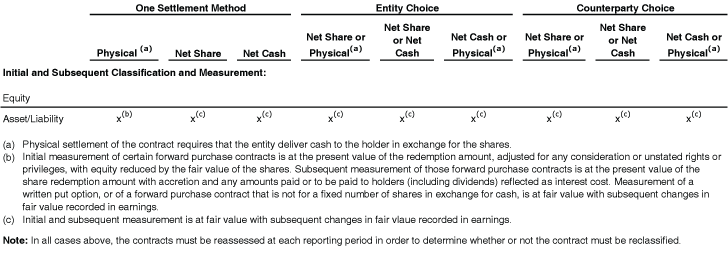 One Settlement Method Entity Choice Counterparty Choice Physical (a) Net Share Net Cash Net Share or Physical(a) Net Share or Net Cash Net Cash or Physical(a) Net Share or Physical(a) Net Share or Net Cash Net Cash or Physical(a) Initial and Subsequent Classification and Measurement: Equity Asset/Liability x(b) x(c) x(c) x(c) x(c) x(c) x(c) x(c) x(c) (a) Physical settlement of the contract requires that the entity deliver cash to the holder in exchange for the shares. (b) "Initial measurement of certain forward purchase contracts is at the present value of the redemption amount, adjusted for any consideration or unstated rights or privileges, with equity reduced by the fair value of the shares. Subsequent measurement of those forward purchase contracts is at the present value of the share redemption amount with accretion and any amounts paid or to be paid to holders (including dividends) reflected as interest cost. Measurement of a written put option, or of a forward purchase contract that is not for a fixed number of shares in exchange for cash, is at fair value with subsequent changes in fair value recorded in earnings." (c) Initial and subsequent measurement is at fair value with subsequent changes in fair vlaue recorded in earnings. "Note: In all cases above, the contracts must be reassessed at each reporting period in order to determine whether or not the contract must be reclassified."
Illustrations
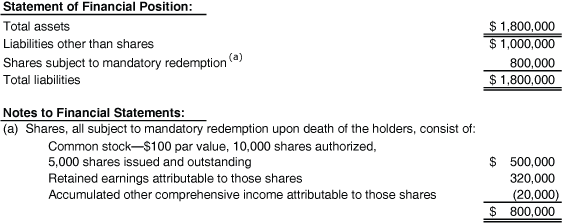 Statement of Financial Position: Total assets " $1,800,000 " Liabilities other than shares " $1,000,000 " Shares subject to mandatory redemption (a) " 800,000 " Total liabilities " $1,800,000 " Notes to Financial Statements: (a) "Shares, all subject to mandatory redemption upon death of the holders, consist of:" "Common stock—$100 par value, 10,000 shares authorized, 5,000 shares issued and outstanding" " $500,000 " Retained earnings attributable to those shares " 320,000 " Accumulated other comprehensive income attributable to those shares " (20,000)" " $800,000 "
480-10-65Transition and Open Effective Date Information
Source downloaded: .Record version 3d581a742d96. Effective date must be checked in the source.
480-10-S00StatusSEC
Source downloaded: .Record version ad08bfa6e5a4. Effective date must be checked in the source.
| Paragraph | Action | Accounting Standards Update | Date |
| 480-10-S30-1 | Amended | Accounting Standards Update No. 2009-04 | 08/26/2009 |
| 480-10-S30-2 | Amended | Accounting Standards Update No. 2009-04 | 08/25/2009 |
| 480-10-S35-2 | Amended | Accounting Standards Update No. 2009-04 | 08/26/2009 |
| 480-10-S45-3 | Amended | Accounting Standards Update No. 2009-04 | 08/26/2009 |
| 480-10-S50-3 | Amended | Accounting Standards Update No. 2009-04 | 08/26/2009 |
| 480-10-S55-1 | Amended | Accounting Standards Update No. 2009-04 | 08/26/2009 |
| 480-10-S99-2 | Amended | Accounting Standards Update No. 2012-03 | 08/27/2012 |
| 480-10-S99-3 | Superseded | Accounting Standards Update No. 2009-04 | 08/26/2009 |
| 480-10-S99-3A | Amended | Accounting Standards Update No. 2023-03 | 07/14/2023 |
| 480-10-S99-3A | Amended | Accounting Standards Update No. 2015-10 | 06/12/2015 |
| 480-10-S99-3A | Added | Accounting Standards Update No. 2009-04 | 08/26/2009 |
| 480-10-S99-4 | Amended | Accounting Standards Update No. 2009-04 | 08/26/2009 |
480-10-S30Initial MeasurementSEC
Source downloaded: .Record version cff095870fee. Effective date must be checked in the source.
Initial Carrying Amount of Redeemable Preferred Stock
Initial Carrying Amount of Certain Employee Share-Based Payment Arrangements with Redemption Provisions
480-10-S35Subsequent MeasurementSEC
Source downloaded: .Record version a63afd224c0e. Effective date must be checked in the source.
Subsequent Adjustments to Redeemable Securities and the Treatment of Changes in Carrying Amount on Income Applicable to Common Stockholders
Impact of CFRR 211 on Shares Granted Under Share-Based Payment Arrangements
480-10-S45Other Presentation MattersSEC
Source downloaded: .Record version 8f9289f629d0. Effective date must be checked in the source.
Form and Content
Redeemable Preferred Stock
Classification of Redeemable Securities
480-10-S50DisclosureSEC
Source downloaded: .Record version 345d12766ed1. Effective date must be checked in the source.
Preferred Stock Subject to Mandatory Redemption Requirements or Whose Redemption is Outside the Control of the Issuer
Redeemable Preferred Stock
Disclosure of Measurement Policy Selected for Redeemable Securities and Application Thereof
480-10-S55Implementation Guidance and IllustrationsSEC
Source downloaded: .Record version 47abe22b64a5. Effective date must be checked in the source.
Illustrations of Consideration of Facts and Circumstances in Determining Appropriate Classification of Equity Securities with Redemption Features
480-10-S99SEC MaterialsSEC
Source downloaded: .Record version 1df47a60b230. Effective date must be checked in the source.
SEC Rules, Regulations, and Interpretations
- .01 General : ASR 268:
- On July 27, 1979, the Commission amended Regulation S-X to modify the financial statement presentation of preferred stocks subject to mandatory redemption requirements or whose redemption is outside the control of the issuer. The rules adopted do not impact reporting practices of registrants not having such securities outstanding. Registrants having such securities outstanding are required to present separately, in balance sheets, amounts applicable to the following three general classes of securities: (i) preferred stocks subject to mandatory redemption requirements or whose redemption is outside the control of the issuer; (ii) preferred stocks which are not redeemable or are redeemable solely at the option of the issuer; and (iii) common stocks. A general heading, "Stockholders' Equity," is not to be used and presentation of a combined total for equity securities, inclusive of redeemable preferred stocks, is prohibited. In addition, the rules require disclosure of redemption terms, five-year maturity data, and changes in redeemable preferred stocks in a separate note to the financial statements captioned "Redeemable Preferred Stocks."
- There is a significant difference between a security with mandatory redemption requirements or whose redemption is outside the control of the issuer and conventional equity capital. The Commission believes that it is necessary to highlight the future cash obligations attached to this type of security so as to distinguish it from permanent capital. It is expected that the rules will provide more meaningful presentation of the financial obligations of those companies which finance operations through the use of such securities.
- The Commission noted an increase in the issuance, by registrants, of preferred stocks to finance operations, consummate mergers and acquisitions, or to restructure existing debt arrangements. Many of the preferred stock issues included terms which required the issuer to redeem the stock at a fixed or determinable price on a fixed or determinable date. Other issues required the issuer to redeem the stock at the option of the holder at the time certain prescribed conditions are met which are not necessarily within the control of the issuer, such as attainment of a specified level of earnings.
- The Commission believes that redeemable preferred stocks are significantly different from conventional equity capital. Such securities have characteristics similar to debt and should, in the opinion of the Commission, be distinguished from permanent capital. The Commission believes that traditional financial reporting practices do not provide the most meaningful presentation of the financial obligations attached to these types of securities and that improvement in the financial statement presentation of redeemable preferred stocks is necessary.
- The rules are intended to highlight the future cash obligations attached to redeemable preferred stock through appropriate balance sheet presentation and footnote disclosure. They do not attempt to deal with the conceptual question of whether such a security is a liability. Further, the rules do not attempt to deal with the income statement treatment of payments to holders of such a security or with any related income statement matters, including accounting for its extinguishment. The Commission is cognizant of these conceptual problems in determining the appropriate accounting for and reporting of redeemable preferred stock and believes that these matters can best be addressed by the FASB. As an interim measure, the rules require that the amounts applicable to redeemable preferred stock be presented in financial statements as a separate item—and not combined with equity investments not having similar redemption requirements. The Commission believes the presentation required by the rules will highlight the redemption obligation and the fact that amounts attributable to these securities are not part of permanent capital.
- .02 Definitions
- ASR 268:
- The following definitions apply to the terms listed below as they are used in this section:
- Preferred Stock Subject to Mandatory Redemption Requirements or Whose Redemption is Outside the Control of the Issuer ("Redeemable Preferred Stock"). The term means any stock which (i) the issuer undertakes to redeem at a fixed or determinable price on the fixed or determinable date or dates, whether by operation of a sinking fund or otherwise; (ii) is redeemable at the option of the holders, or (iii) has conditions for redemption which are not solely within the control of the issuer, such as stocks which must be redeemed out of future earnings. FN*.
- FN* Under this definition, preferred stock which meet one or more of the above criteria would be classified as redeemable preferred stock regardless of their other attributes such as voting rights, dividend rights or conversion features.
- Preferred Stocks Which Are Not Redeemable or Are Redeemable Solely at the Option of the Issuer ("Non-Redeemable Preferred Stock "). The term means any preferred stock which does not meet the criteria for classification as a "redeemable preferred stock."
- .03 Exemption
- ASR 268:
- The Commission has concluded that the necessary refinements concerning the presentation in financial statements of amounts applicable to redeemable preferred stocks should not impact the present reporting practices of registrants who do not use such securities to finance their operations. Therefore, registrants not having such securities may continue to use the general heading "Stockholders' Equity" and show a combined total. Where redeemable preferred stocks are outstanding, the Commission will not prohibit the combining of non-redeemable preferred stocks, common stocks and other equity accounts under an appropriate designated caption (e. g., "Non-Redeemable Preferred Stocks, Common Stocks, and Other Stockholders' Equity") provided that any combinations be exclusive of redeemable preferred stocks.
- .04 Footnote Disclosure of Future Cash Obligations
- ASR 268:
- In the interest of clear and prominent disclosure of the future cash obligations attendant with these types of securities, the rules require disclosure of the term of redemption, five-year maturity data, and changes in these securities in a separate note to the financial statements captioned "Redeemable Preferred Stocks." It should be noted that although in the past a registrant may have disclosed changes in redeemable preferred stocks in a statement of stockholders' equity, such changes are now required to be disclosed in a separate note as described above.
- .05 Existing Agreements
- ASR 268:
- It is not the Commission's present intention to establish whether redeemable preferred stocks are liabilities or components of equity. Therefore, the rules should not require any change in the calculations of debt-equity ratios under existing loan agreements. Further, the Commission believes that creditors already consider the distinctive characteristics of the types of securities which comprise a company's capital structure when evaluating a potential loan.
- .06 Ratios and Materiality Tests (ASR 268)
- ASR 268: (7/27/79).
- Where certain ratios or other data involving amounts attributable to stockholder's equity are presented as required or are optionally presented in filings with the Commission, such ratios or other data should be accompanied by an explanation as to their basis of calculation. If material amounts of redeemable preferred stock are combined with amounts applicable to non-redeemable preferred and common stocks for purposes of computing a ratio, there should also be represented a similar ratio which excludes amounts applicable to redeemable preferred stock from equity and includes such amounts as debt. This would also apply to any financial information such as tables, charts, graphic illustrations and ratios presented in annual reports to shareholders if such reports are to meet the requirements to Rule 14a-3 of the General Rules and Regulations under the Exchange Act.
- In addition, the Commission did not amend its rules, regulations and releases to the extent that they provide for various materiality tests for disclosure purposes using a percentage of total stockholders' equity. In making these tests, registrants may use amounts applicable to all classes of capital stock.
SEC Staff Guidance
- Facts: Rule 5-02.27 of Regulation S-X states that redeemable preferred stocks are not to be included in amounts reported as stockholders' equity, and that their redemption amounts are to be shown on the face of the balance sheet. However, the Commission's rules and regulations do not address the carrying amount at which redeemable preferred stock should be reported, or how changes in its carrying amount should be treated in calculations of earnings per share and the ratio of earnings to combined fixed charges and preferred stock dividends.
- Question 1: How should the carrying amount of redeemable preferred stock be determined?
- Interpretive Response: The initial carrying amount of redeemable preferred stock should be its fair value at date of issue. Where fair value at date of issue is less than the mandatory redemption amount, the carrying amount shall be increased by periodic accretions, using the interest method, so that the carrying amount will equal the mandatory redemption amount at the mandatory redemption date. The carrying amount shall be further periodically increased by amounts representing dividends not currently declared or paid, but which will be payable under the mandatory redemption features, or for which ultimate payment is not solely within the control of the registrant (e. g., dividends that will be payable out of future earnings). Each type of increase in carrying amount shall be effected by charges against retained earnings or, in the absence of retained earnings, by charges against paid-in capital.
- The accounting described in the preceding paragraph would apply irrespective of whether the redeemable preferred stock may be voluntarily redeemed by the issuer prior to the mandatory redemption date, or whether it may be converted into another class of securities by the holder. Companies also should consider the guidance in FASB ASC paragraph 480-10-S99-3A (Distinguishing Liabilities from Equity Topic).
- Question 2: How should periodic increases in the carrying amount of redeemable preferred stock be treated in calculations of earnings per share and ratios of earnings to combined fixed charges and preferred stock dividends?
- Interpretive Response: Each type of increase in carrying amount described in the Interpretive Response to Question 1 should be treated in the same manner as dividends on nonredeemable preferred stock.
- Background
- 1. This SEC staff announcement provides the SEC staff's views regarding the application of Accounting Series Release No. 268, Presentation in Financial Statements of "Redeemable Preferred Stocks."FN1
- FN1 ASR 268 (SEC Financial Reporting Codification, Section No. 211, Redeemable Preferred Stocks) is incorporated into SEC Regulation S-X, Articles 5-02.27, 7-03.21, and 9-03.19. Hereafter, reference is made only to ASR 268.
- Scope
- 2. ASR 268 requires preferred securities that are redeemable for cash or other assets to be classified outside of permanent equity if they are redeemable (1) at a fixed or determinable price on a fixed or determinable date, (2) at the option of the holder, or (3) upon the occurrence of an event that is not solely within the control of the issuer. As noted in ASR 268, the Commission reasoned that "[t]here is a significant difference between a security with mandatory redemption requirements or whose redemption is outside the control of the issuer and conventional equity capital. The Commission believes that it is necessary to highlight the future cash obligations attached to this type of security so as to distinguish it from permanent capital."
- 3. Although ASR 268 specifically describes and discusses preferred securities, the SEC staff believes that ASR 268 also provides analogous guidance for other redeemable equity instruments including, for example, common stock, derivative instruments, noncontrolling interests FN2, securities held by an employee stock ownership plan FN3, and share-based payment arrangements with employees FN4. The SEC staff's views regarding the applicability of ASR 268 in certain situations is described below.
- FN2 The Master Glossary defines noncontrolling interest as "The portion of equity (net assets) in a subsidiary not attributable, directly or indirectly, to a parent. A noncontrolling interest is sometimes called a minority interest." ASR 268 applies to redeemable noncontrolling interests (provided the redemption feature is not considered a freestanding option within the scope of Subtopic 480-10). Where relevant, specific classification and measurement guidance pertaining to redeemable noncontrolling interests has been included in this SEC staff announcement.
- FN3 ASR 268 applies to equity securities held by an employee stock ownership plan (whether or not allocated) that, by their terms, can be put to the registrant (sponsor) for cash or other assets. Where relevant, specific classification and measurement guidance pertaining to employee stock ownership plans has been included in this SEC staff announcement.
- FN4 As indicated in Section 718-10-S99, ASR 268 applies to redeemable equity-classified instruments granted in conjunction with share-based payment arrangements with employees. Where relevant, specific classification and measurement guidance pertaining to share-based payment arrangements with employees has been included in this SEC staff announcement.
- a. Freestanding financial instruments classified as assets or liabilities. Freestanding financial instruments that are classified as assets or liabilities pursuant to Subtopic 480-10 or other applicable GAAP (including those that contain separated derivative assets or derivative liabilities) are not subject to ASR 268. FN5 Mandatorily redeemable equity instruments for which the relevant portions Subtopic 480-10 have been deferred are subject to ASR 268.
- FN5 An equity instrument subject to potential redemption under a freestanding written put option is not subject to ASR 268 (since the put option liability is considered a separate unit of account). However, as discussed in paragraph 3(b), when an embedded written put option has been separated from a hybrid financial instrument with an equity host contract, the host equity instrument is subject to ASR 268.
- b. Freestanding derivative instruments classified in stockholders' equity. Freestanding derivative instruments that are classified in stockholders' equity pursuant to Subtopic 815-40 are not subject to ASR 268. FN6 Equity-classified freestanding financial instruments that were previously classified outside of permanent equity under Subtopic 815-40 are now classified as assets or liabilities pursuant to Subtopic 480-10. However, Subtopic 815-40 continues to apply to embedded derivatives indexed to, and potentially settled in, a company's own stock. Accordingly, when a hybrid financial instrument that is not classified in its entirety as an asset or liability under Subtopic 480-10 or other applicable GAAP contains an embedded derivative within the scope of Subtopic 815-40, the registrant should consider the applicability of ASR 268 to:
- • The hybrid financial instrument when the embedded derivative is not separated under Subtopic 815-15, or
- • The host contract when the embedded derivative is separated under Subtopic 815-15.
- FN6 A freestanding derivative instrument would not meet the conditions in Subtopic 815-40 to be classified as an equity instrument if it was subject to redemption for cash or other assets on a specified date or upon the occurrence of an event that is not within the control of the issuer.
- c. Equity instruments subject to registration payment arrangements. The determination of whether an equity instrument subject to a registration payment arrangement (as defined in Paragraph 825-20-15-3) is subject to ASR 268 should be made without regard to the existence of the registration payment arrangement (that is, the registration payment arrangement is a separate unit of account). However, in determining the applicability of ASR 268 to an equity instrument with any other related arrangement, a conclusion that the related arrangement is a separate unit of account should not be based on an analogy to Paragraph 815-10-25-16.
- d. Share-based payment awards. Equity-classified share-based payment arrangements with employees are not subject to ASR 268 due solely to either of the following:
- • Net cash settlement would be assumed pursuant to Paragraphs solely because of an obligation to deliver registered shares. FN7
- • A provision in an instrument for the direct or indirect repurchase of shares issued to an employee exists solely to satisfy the employer's statutory tax withholding requirements (as discussed in Paragraph 718-10-25-18).
- FN7 See footnote 84 of Section 718-10-S99.
- e. Convertible debt instruments that contain a separately classified equity component. Other applicable GAAP may require a convertible debt instrument to be separated into a liability component and an equity component. FN8 In these situations, the equity-classified component of the convertible debt instrument should be considered redeemable if at the balance sheet date the issuer can be required to settle the convertible debt instrument for cash or other assets (that is, the instrument is currently redeemable or convertible for cash or other assets). For these instruments, an assessment of whether the convertible debt instrument will become redeemable or convertible for cash or other assets at a future date should not be made. For example, a convertible debt instrument that is not redeemable at the balance sheet date but could become redeemable by the holder of the instrument in the future based on the passage of time or upon the occurrence of a contingent event is not considered currently redeemable at the balance sheet date.
- FN8 See Subtopics 470-20 and 470-50; and Paragraph 815-15-35-4.
- f. Certain redemptions upon liquidation events. Ordinary liquidation events, which involve the redemption and liquidation of all of an entity's equity instruments for cash or other assets of the entity, do not result in an equity instrument being subject to ASR 268. In other words, if the payment of cash or other assets is required only from the distribution of net assets upon the final liquidation or termination of an entity (which may be a less-than-wholly-owned consolidated subsidiary), then that potential event need not be considered when applying ASR 268. Other transactions are considered deemed liquidation events. For example, the contractual provisions of an equity instrument may require its redemption by the issuer upon the occurrence of a change-in-control that does not result in the liquidation or termination of the issuing entity, a delisting of the issuer's securities from an exchange, or the violation of a debt covenant. Deemed liquidation events that require (or permit at the holder's option) the redemption of only one or more particular class of equity instrument for cash or other assets cause those instruments to be subject to ASR 268. However, as a limited exception, a deemed liquidation event does not cause a particular class of equity instrument to be classified outside of permanent equity if all of the holders of equally and more subordinated equity instruments of the entity would always be entitled to also receive the same form of consideration (for example, cash or shares) upon the occurrence of the event that gives rise to the redemption (that is, all subordinate classes would also be entitled to redeem).
- g. Certain redemptions covered by insurance proceeds. As a limited exception that should not be analogized to, an equity instrument that becomes redeemable upon the death of the holder (at the option of the holder's heir or estate FN9) or upon the disability of the holder is not subject to ASR 268 if the redemption amount will be funded from the proceeds of an insurance policy that is currently in force and which the registrant has the intent and ability to maintain in force.
- FN9 If an equity instrument is required to be redeemed for cash or other assets upon the death of the holder, the instrument is classified as a liability pursuant to Subtopic 480-10 even if an insurance policy would fund the redemption.
- Classification
- 4. ASR 268 requires equity instruments with redemption features that are not solely within the control of the issuer to be classified outside of permanent equity (often referred to as classification in "temporary equity"). The SEC staff does not believe it is appropriate to classify a financial instrument (or host contract) that meets the conditions for temporary equity classification under ASR 268 as a liability. FN10
- FN10 At the June 14, 2007 EITF meeting, the SEC Observer stated that a financial instrument (or host contract) that otherwise meets the conditions for temporary equity classification may continue to be classified as a liability provided the financial instrument (or host contract) was classified and accounted for as a liability in fiscal quarters beginning before September 15, 2007 and has not subsequently been modified or subject to a remeasurement (new basis) event.
- 5. Determining whether an equity instrument is redeemable at the option of the holder or upon the occurrence of an event that is solely within the control of the issuer can be complex. The SEC staff believes that all of the individual facts and circumstances surrounding events that could trigger redemption should be evaluated separately and that the possibility that any triggering event that is not solely within the control of the issuer could occur—without regard to probability—would require the instrument to be classified in temporary equity. Paragraphs 6-11 provide examples of the application of ASR 268.
- Examples in which temporary equity classification is appropriate
- 6. Example 1. A preferred security that is not required to be classified as a liability under other applicable GAAP may be redeemable at the option of the holder or upon the occurrence of an event that is not solely within the control of the issuer. Upon redemption (in other than a liquidation event that meets the exception in paragraph 3(f)), the issuer may have the choice to settle the redemption amount in cash or by delivery of a variable number of its own common shares with an equivalent value. For this instrument, the guidance in Section 815-40-25 should be used to evaluate whether the issuer controls the actions or events necessary to issue the maximum number of common shares that could be required to be delivered under share settlement of the contract. If the issuer does not control settlement by delivery of its own common shares (because, for example, there is no cap on the maximum number of common shares that could be potentially issuable upon redemption), cash settlement of the instrument would be presumed and the instrument would be classified as temporary equity.
- 7. Example 2. A preferred security that is not required to be classified as a liability under other applicable GAAP may have a redemption provision that states it may be called by the issuer upon an affirmative vote by the majority of its board of directors. While some might view the decision to call the security as an event that is within the control of the company because the governance structure of the company is vested with the power to avoid redemption, if the preferred security holders control a majority of the votes of the board of directors through direct representation on the board of directors or through other rights, the preferred security is redeemable at the option of the holder and classification in temporary equity is required. In other words, any provision that requires approval by the board of directors cannot be assumed to be within the control of the issuer. All of the relevant facts and circumstances should be considered.
- 8. Example 3. A preferred security that is not required to be classified as a liability under other applicable GAAP may contain a deemed liquidation clause that provides that the security becomes redeemable if the common stockholders of the issuing company (that is, those immediately prior to a merger or consolidation) hold, immediately after such merger or consolidation, common stock representing less than a majority of the voting power of the outstanding common stock of the surviving corporation. This change-in-control provision would require the preferred security to be classified in temporary equity if a purchaser could acquire a majority of the voting power of the outstanding common stock without company approval, thereby triggering redemption.
- 9. Example 4. An equity instrument may contain provisions that allow the holder to redeem the instrument for cash or other assets upon the occurrence of events that are not solely within the issuer's control. Such events may include:
- • The failure to have a registration statement declared effective by the SEC by a designated date
- • The failure to maintain compliance with debt covenants
- • The failure to achieve specified earnings targets
- • A reduction in the issuer's credit rating.
- Since these events are not solely within the control of the issuer, the equity instrument is required to be classified in temporary equity.
- Examples in which permanent equity classification is appropriate
- 10. Example 5. A preferred security may have a provision that the decision by the issuing company to sell all or substantially all of a company's assets and a subsequent distribution to common stockholders triggers redemption of the security. In this case, the security would be appropriately classified in permanent equity if the preferred stockholders cannot trigger or otherwise require the sale of the assets through representation on the board of directors, or through other rights, because the decision to sell all or substantially all of the issuer's assets and the distribution to common stockholders is solely within the issuer's control. In other words, if there could not be a "hostile" asset sale whereby all or substantially all of the issuer's assets are sold, and a dividend or other distribution is declared on the issuer's common stock, without the issuer's approval, then classifying the security in permanent equity would be appropriate.
- 11. Example 6. A preferred security may have a provision that provides for redemption in cash or other assets if the issuing company is merged with or consolidated into another company, and pursuant to state law, approval of the board of directors is required before any merger or consolidation can occur. In that case, assuming the preferred stockholders cannot control the vote of the board of directors through direct representation or through other rights, the security would be appropriately classified in permanent equity because the decision to merge with or consolidate into another company is within the control of the issuer. Again, all of the relevant facts and circumstances should be considered when determining whether the preferred stockholders can control the vote of the board of directors.
- Measurement
- 12. Initial measurement. The SEC staff believes the initial carrying amount of a redeemable equity instrument that is subject to ASR 268 should be its issuance date fair value, except as follows: FN12
- FN12 SAB Topic 3C, Redeemable Preferred Stock, states that the initial carrying amount of redeemable preferred stock should be its fair value at date of issue. The SEC staff believes this guidance should also be applied to other similar redeemable equity instruments. Consistent with Paragraph 820-10-30-3, the transaction price will generally represent the initial fair value of the equity instrument when the issuance occurs in an arm's-length transaction with an unrelated party and there are no other unstated rights or privileges.
- a. For share-based payment arrangements with employees, the initial amount presented in temporary equity should be based on the redemption provisions of the instrument and the proportion of consideration received in the form of employee services at initial recognition. For example, upon issuance of a fully vested option that allows the holder to put the option back to the issuer at its intrinsic value upon a change in control, an amount representing the intrinsic value of the option at the date of issuance should be presented in temporary equity.
- b. For employee stock ownership plans where the cash redemption obligation relates only to a market value guarantee feature, the registrant may elect as an accounting policy to present in temporary equity either (i) the entire guaranteed market value amount of the equity securities or (ii) the maximum cash obligation based on the fair value of the underlying equity securities at the balance sheet date.
- c. For noncontrolling interests, the initial amount presented in temporary equity should be the initial carrying amount of the noncontrolling interest pursuant to Section 805-20-30.
- d. For convertible debt instruments that contain a separately classified equity component, an amount should initially be presented in temporary equity only if the instrument is currently redeemable or convertible at the issuance date for cash or other assets (see paragraph 3(e)). The portion of the equity-classified component that is presented in temporary equity (if any) is measured as the excess of (1) the amount of cash or other assets that would be required to be paid to the holder upon a redemption or conversion at the issuance date over (2) the carrying amount of the liability-classified component of the convertible debt instrument at the issuance date.
- e. For host equity contracts (see paragraph 3(b)), the initial amount presented in temporary equity should be the initial carrying amount of the host contract pursuant to Section 815-15-30. Similarly, the initial amount presented in temporary equity for a preferred stock instrument that contains a beneficial conversion feature or is issued with other instruments should be the amount allocated to the instrument in its entirety pursuant to Subtopic 470-20 less any beneficial conversion feature recorded at the issuance date.
- 13. Subsequent measurement. The SEC staff's views regarding the subsequent measurement of a redeemable equity instrument that is subject to ASR 268 are included in paragraphs 14-16. Paragraphs 14 and 15 discuss the general views regarding subsequent measurement. Paragraph 16 discusses the application of those general views in the context of certain types of redeemable equity instruments.
- 14. If an equity instrument subject to ASR 268 is currently redeemable (for example, at the option of the holder), it should be adjusted to its maximum redemption amount at the balance sheet date. If the maximum redemption amount is contingent on an index or other similar variable (for example, the fair value of the equity instrument at the redemption date or a measure based on historical EBITDA), the amount presented in temporary equity should be calculated based on the conditions that exist as of the balance sheet date (for example, the current fair value of the equity instrument or the most recent EBITDA measure). The redemption amount at each balance sheet date should also include amounts representing dividends not currently declared or paid but which will be payable under the redemption features or for which ultimate payment is not solely within the control of the registrant (for example, dividends that will be payable out of future earnings). FN13
- FN13 See also Section 260-10-45.
- 15. If an equity instrument subject to ASR 268 is not currently redeemable (for example, a contingency has not been met), subsequent adjustment of the amount presented in temporary equity is unnecessary if it is not probable that the instrument will become redeemable. If it is probable that the equity instrument will become redeemable (for example, when the redemption depends solely on the passage of time), the SEC staff will not object to either of the following measurement methods provided the method is applied consistently:
- a. Accrete changes in the redemption value over the period from the date of issuance (or from the date that it becomes probable that the instrument will become redeemable, if later) to the earliest redemption date of the instrument using an appropriate methodology, usually the interest method. Changes in the redemption value are considered to be changes in accounting estimates.
- b. Recognize changes in the redemption value (for example, fair value) immediately as they occur and adjust the carrying amount of the instrument to equal the redemption value at the end of each reporting period. This method would view the end of the reporting period as if it were also the redemption date for the instrument.
- 16. The following additional guidance is relevant to the application of the SEC staff's views in paragraphs 14 and 15:
- a. For share-based payment arrangements with employees, the amount presented in temporary equity at each balance sheet date should be based on the redemption provisions of the instrument and should take into account the proportion of consideration received in the form of employee services (that is, the pattern of recognition of compensation cost pursuant to Topic 718). FN14
- FN14 See also the Interpretative Response to Question 2 in Section E of Section 718-10-S99.
- b. For employee stock ownership plans where the cash redemption obligation relates only to a market value guarantee feature, the registrant may elect as an accounting policy to present in temporary equity either (i) the entire guaranteed market value amount of the equity securities or (ii) the maximum cash obligation based on the fair value of the underlying equity securities at the balance sheet date.
- c. For noncontrolling interests, the adjustment to the carrying amount presented in temporary equity is determined after the attribution of net income or loss of the subsidiary pursuant to Subtopic 810-10.
- d. For convertible debt instruments that contain a separately classified equity component, an amount should be presented in temporary equity only if the instrument is currently redeemable or convertible at the balance sheet date for cash or other assets (see paragraph 3(e)). The portion of the equity-classified component that is presented in temporary equity (if any) is measured as the excess of (1) the amount of cash or other assets that would be required to be paid to the holder upon a redemption or conversion at the balance sheet date over (2) the carrying amount of the liability-classified component of the convertible debt instrument at the balance sheet date. FN15
- FN15 ASR 268 does not impact the application of other applicable GAAP to the accounting for the liability component or the accounting upon derecognition of the liability and/or equity component.
- e. For a redeemable equity instrument other than those discussed in (a), (b), and (d) of this paragraph, regardless of the accounting method applied in paragraphs 14 and 15, the amount presented in temporary equity should be no less than the initial amount reported in temporary equity for the instrument. That is, reductions in the carrying amount of a redeemable equity instrument from the application of paragraphs 14 and 16 are appropriate only to the extent that the registrant has previously recorded increases in the carrying amount of the redeemable equity instrument from the application of paragraphs 14 and 15.
- 17. Application of the fair value option. Measurement of a redeemable equity instrument (or host contract) subject to ASR 268 at fair value through earnings in lieu of the measurement guidance provided in paragraphs 14-16 is not appropriate. FN16
- FN16 Paragraph 825-10-15-5(f) prohibits the election of the fair value option for financial instruments that are, in whole or in part, classified in stockholder's equity (including temporary equity).
- Reclassifications into Permanent Equity
- 18. If classification of an equity instrument as temporary equity is no longer required (if, for example, a redemption feature lapses, or there is a modification of the terms of the instrument), the existing carrying amount of the equity instrument should be reclassified to permanent equity at the date of the event that caused the reclassification. Prior financial statements are not adjusted. Additionally, the SEC staff believes that it would be inappropriate to reverse any adjustments previously recorded to the carrying amount of the equity instrument (pursuant to paragraphs 14-16) in conjunction with such reclassifications.
- Deconsolidation of a Subsidiary
- 19. Section 810-10-40 provides guidance on the measurement of the gain or loss that is recognized in net income when a parent deconsolidates a subsidiary. As indicated in Paragraph 810-10-40-5, that gain or loss calculation is impacted by the carrying amount of any noncontrolling interest in the former subsidiary. Since adjustments to the carrying amount of a noncontrolling interest from the application of paragraphs 14-16 do not initially enter into the determination of net income, the SEC staff believes that the carrying amount of the noncontrolling interest that is referred to in Paragraph 810-10-40-5 should similarly not include any adjustments made to that noncontrolling interest from the application of paragraphs 14-16. Rather, previously recorded adjustments to the carrying amount of a noncontrolling interest from the application of paragraphs 14-16 should be eliminated in the same manner in which they were initially recorded (that is, by recording a credit to equity of the parent).
- Earnings per Share
- 20. Preferred stock instruments issued by a parent (or single reporting entity). Regardless of the accounting method selected in paragraph 15 and the redemption terms (that is, fixed price or fair value), the resulting increases or decreases in the carrying amount of a redeemable instrument other than common stock should be treated in the same manner as dividends on nonredeemable stock and should be effected by charges against retained earnings or, in the absence of retained earnings, by charges against paid-in capital. Increases or decreases in the carrying amount should reduce or increase income available to common stockholders in the calculation of earnings per share and the ratio of earnings to combined fixed charges and preferred stock dividends. Additionally, Paragraph 260-10-S99-2, provides guidance on the accounting at the date of a redemption or induced conversion of a preferred stock instrument.
- 21. Common stock instruments issued by a parent (or single reporting entity). Regardless of the accounting method selected in paragraph 15, the resulting increases or decreases in the carrying amount of redeemable common stock should be treated in the same manner as dividends on nonredeemable stock and should be effected by charges against retained earnings or, in the absence of retained earnings, by charges against paid-in capital. However, increases or decreases in the carrying amount of a redeemable common stock should not affect income available to common stockholders. Rather, the SEC staff believes that to the extent that a common shareholder has a contractual right to receive at share redemption (in other than a liquidation event that meets the exception in paragraph 3(f)) an amount that is other than the fair value of the issuer's common shares, then that common shareholder has, in substance, received a distribution different from other common shareholders. Under Paragraph 260-10-45-59A, entities with capital structures that include a class of common stock with different dividend rates from those of another class of common stock but without prior or senior rights, should apply the two-class method of calculating earnings per share. Therefore, when a class of common stock is redeemable at other than fair value, increases or decreases in the carrying amount of the redeemable instrument should be reflected in earnings per share using the two-class method. FN17 For common stock redeemable at fair value FN18, the SEC staff would not expect the use of the two-class method, as a redemption at fair value does not amount to a distribution different from other common shareholders. FN19
- FN17 The two-class method of computing earnings per share is addressed in Section 260-10-45. The SEC staff believes that there are two acceptable approaches for allocating earnings under the two-class method when a common stock instrument is redeemable at other than fair value. The registrant may elect to: (a) treat the entire periodic adjustment to the instrument's carrying amount (from the application of paragraphs 14-16) as being akin to a dividend or (b) treat only the portion of the periodic adjustment to the instrument's carrying amount (from the application of paragraphs 14-16) that reflects a redemption in excess of fair value as being akin to a dividend. Under either approach, decreases in the instrument's carrying amount should be reflected in the application of the two-class method only to the extent they represent recoveries of amounts previously reflected in the application of the two-class method.
- FN18 Common stock that is redeemable based on a specified formula is considered to be redeemable at fair value if the formula is designed to equal or reasonably approximate fair value. The SEC staff believes that a formula based solely on a fixed multiple of earnings (or other similar measure) is not considered to be designed to equal or reasonably approximate fair value.
- FN19 Similarly, the two-class method is not required when share-based payment awards granted to employees are redeemable at fair value (provided those awards are in the form of common shares or options on common shares). However, those share-based payment awards may still be subject to the two-class method pursuant to Section 260-10-45.
- 22. Noncontrolling interests. Paragraph 810-10-45-23 indicates that changes in a parent's ownership interest while the parent retains control of its subsidiary are accounted for as equity transactions, and do not impact net income or comprehensive income in the consolidated financial statements. Consistent with Paragraph 810-10-45-23, an adjustment to the carrying amount of a noncontrolling interest from the application of paragraphs 14-16 does not impact net income or comprehensive income in the consolidated financial statements. Rather, such adjustments are treated akin to the repurchase of a noncontrolling interest (although they may be recorded to retained earnings instead of additional paid-in capital). The SEC staff believes the guidance in paragraphs 20 and 21 should be applied to noncontrolling interests as follows:
- a. Noncontrolling interest in the form of preferred stock instrument. The impact on income available to common stockholders of the parent arising from adjustments to the carrying amount of a redeemable noncontrolling interest other than common stock depends upon whether the redemption feature in the equity instrument was issued, or is guaranteed, by the parent. If the redemption feature was issued, or is guaranteed, by the parent, the entire adjustment under paragraph 20 reduces or increases income available to common stockholders of the parent. Otherwise, the adjustment is attributed to the parent and the noncontrolling interest in accordance with Paragraphs .
- b. Noncontrolling interest in the form of common stock instrument. Adjustments to the carrying amount of a noncontrolling interest issued in the form of a common stock instrument to reflect a fair value redemption feature do not impact earnings per share. Adjustments to the carrying amount of a noncontrolling interest issued in the form of a common stock instrument to reflect a non-fair value redemption feature do impact earnings per share; however, the manner in which those adjustments reduce or increase income available to common stockholders of the parent may differ. FN20 If the terms of the redemption feature are fully considered in the attribution of net income under Paragraph 810-10-45-21, application of the two-class method is unnecessary. If the terms of the redemption feature are not fully considered in the attribution of net income under Paragraph 810-10-45-20, application of the two-class method at the subsidiary level is necessary in order to determine net income available to common stockholders of the parent.
- FN20 Subtopic 810-10 does not provide detailed guidance on the attribution of net income to the parent and the noncontrolling interest. The SEC staff understands that when a noncontrolling interest is redeemable at other than fair value some registrants consider the terms of the redemption feature in the calculation of net income attributable to the parent (as reported on the face of the income statement), while others only consider the impact of the redemption feature in the calculation of income available to common stockholders of the parent (which is the control number for earnings per share purposes).
- 23. Convertible debt instruments that contain a separately classified equity component. For convertible debt instruments subject to ASR 268 (see paragraph 3(e)), there should be no incremental earnings per share accounting from the application of this SEC staff announcement. Subtopic 260-10 addresses the earnings per share accounting.
- Disclosures
- 24. ASR 268 and SEC Regulation S-X require certain disclosures about redeemable equity instruments. In addition, the SEC staff expects the following disclosures to be provided in the notes to the financial statements:
- a. A description of the accounting method used to adjust the redemption amount of a redeemable equity instrument (as discussed in paragraphs 14-16).
- b. When a registrant elects to accrete changes in the redemption amount of a redeemable equity instrument in accordance with paragraph 15(a), the redemption amount of the equity instrument as if it were currently redeemable.
- c. For a redeemable equity instrument that is not adjusted to its redemption amount, the reasons why it is not probable that the instrument will become redeemable.
- d. When charges or credits discussed in paragraphs 20 and 22(a) are material, a reconciliation between net income and income available to common stockholders.
- e. The amount credited to equity of the parent upon the deconsolidation of a subsidiary (as discussed in paragraph 19).
- ASR 268 (see also paragraph 480-10-S99-3A) requires that to the extent that there are conditions (regardless of their probability of occurrence) whereby holders of equity securities may demand cash in exchange for their securities, the sponsor must reflect the maximum possible cash obligation related to those securities outside of permanent equity. Thus, securities held by an ESOP (whether or not allocated) must be reported outside of permanent equity if by their terms they can be put to the sponsor for cash. With respect to ESOP securities where the cash obligation relates only to market value guarantee features, the SEC staff would not object to registrants only classifying outside of permanent equity an amount that represents the maximum cash obligation of the sponsor based on market prices of the underlying security as of the reporting date; accordingly, reclassifications of equity amounts would be required based on the market values of the underlying security. Alternatively, the SEC staff would not object to classifying the entire guaranteed value amount outside of permanent equity due to the uncertainty of the ultimate cash obligation because of a possible market value decline in the underlying security.
Related subtopics
- 815-40 Contracts in Entity's Own EquityDerivatives and Hedging
- 718-10 OverallCompensation—Stock Compensation
- 718-30 Awards Classified as LiabilitiesCompensation—Stock Compensation
- 260-10 OverallEarnings Per Share
- 470-20 Debt with Conversion and Other OptionsDebt
- 825-20 Registration Payment ArrangementsFinancial Instruments