ASC

ASC 260-10

Overall

260 Earnings Per Share

Download JSONDownload Markdown258 paragraphs · 15 sectionsIncludes SEC contentJump to summary

Source downloaded: .Record version 9a52c7d9d081. Effective date must be checked in the source.

ASC 260-10 governs the computation, presentation, and disclosure of basic and diluted earnings per share (EPS) by entities with publicly traded common stock or potential common stock (or entities in registration). Basic EPS divides income available to common stockholders (income less preferred dividends) by the weighted-average common shares outstanding (260-10-45-10 through 45-11); diluted EPS adds all dilutive potential common shares using the treasury stock method for options/warrants, the reverse treasury stock method for written puts and forward purchases, and the if-converted method for convertible securities, never assuming antidilutive conversions (260-10-45-16 through 45-45). The subtopic also covers the two-class method for participating securities, contingently issuable shares, down round features, and master limited partnership earnings per unit.

Key points (7)
  • Entities with only common stock outstanding present basic per-share amounts for income from continuing operations and net income; all other entities present basic and diluted amounts with equal prominence on the face of the income statement (260-10-45-2), and EPS is not required of investment companies under Topic 946 or in wholly owned subsidiary statements (260-10-15-3).
  • Basic EPS = income available to common stockholders (income from continuing operations and net income, reduced by preferred dividends declared and cumulative preferred dividends accumulated, excluding income attributable to noncontrolling interests) ÷ weighted-average common shares outstanding (260-10-45-10, 45-11, 45-11A).
  • Diluted EPS uses the treasury stock method for options, warrants, and share-based awards (assumed exercise at period-beginning with proceeds used to repurchase shares at the average market price) (260-10-45-22 through 45-23, 45-28A through 45-29) and the if-converted method for convertible securities (add back preferred dividends or after-tax interest and assume conversion at the beginning of the period) (260-10-45-40).
  • Antidilutive securities are excluded; each issue is tested separately and sequenced from most to least dilutive, and income (loss) from continuing operations is the control number, so when a loss from continuing operations exists no potential common shares are included in any diluted per-share amount (260-10-45-17 through 45-20).
  • Contingently issuable shares enter basic EPS only when all conditions are satisfied (260-10-45-13) but enter diluted EPS based on whether conditions would be met if the reporting period end were the end of the contingency period (260-10-45-48 through 45-54); contingently convertible instruments are included if dilutive regardless of whether a market price trigger is met (260-10-45-44).
  • All participating securities—including unvested share-based payment awards with nonforfeitable dividend rights—must be included in basic EPS using the two-class method, allocating declared dividends and then undistributed earnings as if all earnings had been distributed (260-10-45-60A, 45-60B, 45-61A, 45-65).
  • When a down round feature in an equity-classified freestanding instrument or convertible preferred stock is triggered, its value (the fair value difference before and after the strike price reduction, per 260-10-30-1) is treated as a dividend reducing income available to common stockholders and is not subsequently remeasured or amortized (260-10-25-1, 45-12B, 35-1); required disclosures include a numerator/denominator reconciliation and antidilutive securities excluded (260-10-50-1).

For students. EPS is a favorite exam topic because it combines mechanical computation with judgment about dilution; the most common mistakes are including potential common shares when there is a loss from continuing operations (the control number governs all diluted per-share amounts) and forgetting that participating securities must be run through the two-class method even in basic EPS.

Machine-generated study aid for ASC 260-10. Check the source paragraphs below.

260-10-00Status

Source downloaded: .Record version 159428c847ca. Effective date must be checked in the source.

260-10-00-1
The following table identifies the changes made to this Subtopic.
Paragraph Action Accounting Standards Update Date
Down Round Feature Added Accounting Standards Update No. 2017-11 07/13/2017
Dropdown Added Accounting Standards Update No. 2015-06 04/30/2015
Equity Restructuring Added Accounting Standards Update No. 2017-11 07/13/2017
Financial Instrument Amended Accounting Standards Update No. 2024-02 03/29/2024
Financial Instrument Added Accounting Standards Update No. 2017-11 07/13/2017
Not-for-Profit Entity Added Accounting Standards Update No. 2017-11 07/13/2017
Option Amended Accounting Standards Update No. 2018-07 06/20/2018
Public Business Entity Added Accounting Standards Update No. 2017-11 07/13/2017
Share-Based Payment Arrangements Added Accounting Standards Update No. 2018-07 06/20/2018
Standard Antidilution Provisions Added Accounting Standards Update No. 2017-11 07/13/2017
260-10-05-1A Added Accounting Standards Update No. 2017-11 07/13/2017
260-10-25-1 Amended Accounting Standards Update No. 2020-06 08/05/2020
260-10-25-1 Added Accounting Standards Update No. 2017-11 07/13/2017
260-10-30-1 Amended Maintenance Update 2020-18 (PDF) 11/25/2020
260-10-30-1 Amended Accounting Standards Update No. 2020-06 08/05/2020
260-10-30-1 Added Accounting Standards Update No. 2017-11 07/13/2017
260-10-30-2 Added Accounting Standards Update No. 2017-11 07/13/2017
260-10-35-1 Amended Maintenance Update 2020-18 (PDF) 11/25/2020
260-10-35-1 Amended Accounting Standards Update No. 2020-06 08/05/2020
260-10-35-1 Added Accounting Standards Update No. 2017-11 07/13/2017
260-10-45-3 Amended Accounting Standards Update No. 2015-01 01/09/2015
260-10-45-5 Amended Accounting Standards Update No. 2020-10 10/29/2020
260-10-45-12A Superseded Accounting Standards Update No. 2017-11 07/13/2017
260-10-45-12B Amended Accounting Standards Update No. 2020-06 08/05/2020
260-10-45-12B Added Accounting Standards Update No. 2017-11 07/13/2017
260-10-45-12C Added Accounting Standards Update No. 2017-11 07/13/2017
260-10-45-15 Added Accounting Standards Update No. 2021-04 05/03/2021
260-10-45-16 Amended Accounting Standards Update No. 2020-06 08/05/2020
Amended Accounting Standards Update No. 2025-12 12/17/2025
260-10-45-18 Amended Accounting Standards Update No. 2015-01 01/09/2015
260-10-45-20 Amended Accounting Standards Update No. 2015-01 01/09/2015
260-10-45-21A Added Accounting Standards Update No. 2020-06 08/05/2020
260-10-45-22 Amended Accounting Standards Update No. 2018-07 06/20/2018
260-10-45-23 Amended Accounting Standards Update No. 2020-06 08/05/2020
260-10-45-28 Amended Accounting Standards Update No. 2019-08 11/11/2019
260-10-45-28 Amended Accounting Standards Update No. 2018-07 06/20/2018
260-10-45-28A Amended Accounting Standards Update No. 2018-07 06/20/2018
Amended Accounting Standards Update No. 2018-07 06/20/2018
260-10-45-29 Amended Accounting Standards Update No. 2016-09 03/30/2016
260-10-45-30 Amended Maintenance Update 2020-18 (PDF) 11/25/2020
260-10-45-32 Amended Accounting Standards Update No. 2018-07 06/20/2018
260-10-45-40 Amended Accounting Standards Update No. 2020-06 08/05/2020
260-10-45-44 Amended Accounting Standards Update No. 2020-06 08/05/2020
260-10-45-45 Amended Accounting Standards Update No. 2025-12 12/17/2025
260-10-45-45 Amended Accounting Standards Update No. 2020-06 08/05/2020
260-10-45-45 Amended Accounting Standards Update No. 2018-07 06/20/2018
260-10-45-45A Added Accounting Standards Update No. 2020-06 08/05/2020
260-10-45-46 Amended Accounting Standards Update No. 2020-06 08/05/2020
260-10-45-60B Amended Accounting Standards Update No. 2018-09 07/16/2018
260-10-45-61 Amended Maintenance Update 2020-18 (PDF) 11/25/2020
260-10-45-64 Superseded Accounting Standards Update No. 2020-06 08/05/2020
260-10-45-68B Amended Accounting Standards Update No. 2016-09 03/30/2016
260-10-45-70B Added Accounting Standards Update No. 2009-15 10/13/2009
260-10-50-1 Amended Accounting Standards Update No. 2025-11 12/08/2025
260-10-50-1 Amended Accounting Standards Update No. 2023-06 10/09/2023
260-10-50-1A Added Accounting Standards Update No. 2020-10 10/29/2020
260-10-50-2 Amended Accounting Standards Update No. 2025-11 12/08/2025
260-10-50-3 Amended Accounting Standards Update No. 2025-11 12/08/2025
260-10-50-3 Added Accounting Standards Update No. 2015-06 04/30/2015
260-10-55-3 Amended Accounting Standards Update No. 2020-06 08/05/2020
260-10-55-3A Amended Accounting Standards Update No. 2025-12 12/17/2025
260-10-55-3B Superseded Accounting Standards Update No. 2025-12 12/17/2025
260-10-55-3C Added Accounting Standards Update No. 2025-12 12/17/2025
260-10-55-4 Amended Accounting Standards Update No. 2020-06 08/05/2020
260-10-55-6 Amended Accounting Standards Update No. 2020-06 08/05/2020
260-10-55-7 Amended Accounting Standards Update No. 2020-06 08/05/2020
260-10-55-16A Added Accounting Standards Update No. 2015-06 04/30/2015
Amended Accounting Standards Update No. 2020-06 08/05/2020
260-10-55-33 Amended Accounting Standards Update No. 2018-07 06/20/2018
260-10-55-36 Superseded Accounting Standards Update No. 2020-06 08/05/2020
260-10-55-36A Amended Accounting Standards Update No. 2020-06 08/05/2020
260-10-55-38 Amended Accounting Standards Update No. 2015-01 01/09/2015
260-10-55-39 Amended Accounting Standards Update No. 2015-01 01/09/2015
260-10-55-44 Amended Accounting Standards Update No. 2015-01 01/09/2015
260-10-55-45 Amended Accounting Standards Update No. 2025-12 12/17/2025
260-10-55-45 Amended Accounting Standards Update No. 2015-01 01/09/2015
260-10-55-46 Amended Accounting Standards Update No. 2025-12 12/17/2025
Amended Accounting Standards Update No. 2015-01 01/09/2015
260-10-55-51 Amended Accounting Standards Update No. 2025-11 12/08/2025
260-10-55-51 Amended Accounting Standards Update No. 2023-06 10/09/2023
260-10-55-52 Amended Accounting Standards Update No. 2023-06 10/09/2023
260-10-55-62 Amended Accounting Standards Update No. 2018-09 07/16/2018
260-10-55-69 Amended Accounting Standards Update No. 2018-07 06/20/2018
260-10-55-69 Amended Accounting Standards Update No. 2016-09 03/30/2016
260-10-55-69A Added Accounting Standards Update No. 2016-09 03/30/2016
260-10-55-70 Amended Accounting Standards Update No. 2016-09 03/30/2016
260-10-55-76A Amended Accounting Standards Update No. 2016-09 03/30/2016
260-10-55-78 Amended Accounting Standards Update No. 2020-06 08/05/2020
260-10-55-79 Amended Accounting Standards Update No. 2020-06 08/05/2020
260-10-55-82 Amended Accounting Standards Update No. 2020-06 08/05/2020
260-10-55-84A Amended Accounting Standards Update No. 2020-06 08/05/2020
260-10-55-84B Amended Accounting Standards Update No. 2020-06 08/05/2020
Added Accounting Standards Update No. 2020-06 08/05/2020
Amended Accounting Standards Update No. 2025-12 12/17/2025
260-10-55-90 Amended Accounting Standards Update No. 2025-12 12/17/2025
260-10-55-91 Amended Accounting Standards Update No. 2025-12 12/17/2025
260-10-55-91A Added Accounting Standards Update No. 2025-12 12/17/2025
260-10-55-94 Amended Maintenance Update 2020-18 (PDF) 11/25/2020
Added Accounting Standards Update No. 2017-11 07/13/2017
260-10-55-111 Added Accounting Standards Update No. 2015-06 04/30/2015
260-10-60-1A Amended Accounting Standards Update No. 2018-07 06/20/2018
260-10-65-3 Added Accounting Standards Update No. 2015-06 04/30/2015
260-10-65-4 Amended Accounting Standards Update No. 2020-06 08/05/2020
260-10-65-4 Added Accounting Standards Update No. 2017-11 07/13/2017
260-10-65-5 Added Accounting Standards Update No. 2025-12 12/17/2025

260-10-05Overview and Background

Source downloaded: .Record version 02b011f0a202. Effective date must be checked in the source.

260-10-05-1
The Earnings Per Share Topic contains only the Overall Subtopic. The Overall Subtopic specifies the computation, presentation, and disclosure requirements for earnings per share (EPS) for entities with publicly held common stock or potential common stock.Computation of EPS is included in Section 260-10-55.
260-10-05-1A
An entity may issue a freestanding financial instrument (for example, a warrant) with a down round feature that is classified in equity. This Subtopic provides guidance on earnings per share and recognition and measurement of the effect of a down round feature when it is triggered.

Master Limited Partnerships

260-10-05-2
The Master Limited Partnerships Subsections clarify the application of the General Subsection of the Other Presentation Matters Subtopic to master limited partnerships.
260-10-05-3
Publicly traded master limited partnerships often issue multiple classes of securities that may participate in partnership distributions according to a formula specified in the partnership agreement. A typical master limited partnership consists of publicly traded common units held by limited partners, a general partner interest, and incentive distribution rights. Depending on the structure of the master limited partnership, the incentive distribution rights may be a separate class of nonvoting limited partner interest that the general partner initially holds but generally may transfer or sell apart from its overall interest. Alternatively, the incentive distribution rights may be embedded in the general partner interest such that they cannot be detached and transferred apart from the general partner's overall interest.
260-10-05-4
Generally, the partnership agreement obligates the general partner to distribute 100 percent of the partnership's available cash (as defined in the partnership agreement) at the end of each reporting period to the general partner and limited partners via a distribution waterfall (that is, a schedule that prescribes distributions to the general partner and limited partners at each threshold) within a contractually determined period of time following the end of a reporting period. When certain thresholds are met, the distribution waterfall further allocates available cash to the holder of the separate class of nonvoting limited partner interest (the incentive distribution right holder) or, when the incentive distribution right is embedded in the general partner interest, to the general partner. The net income (or loss) of the partnership is allocated to the capital accounts of the general partner and limited partners based on their respective sharing of income or losses specified in the partnership agreement, but only after taking into account any priority income allocations resulting from incentive distributions.
260-10-05-5
Paragraphs address the use of the two-class method to calculate earnings per unit for capital structures that are not convertible into a class of common stock.

260-10-10Objectives

Source downloaded: .Record version b2e37b9d95a7. Effective date must be checked in the source.

Basic EPS

260-10-10-1
The objective of basic earnings per share (EPS) is to measure the performance of an entity over the reporting period.

Diluted EPS

260-10-10-2
The objective of diluted EPS is consistent with that of basic EPS—to measure the performance of an entity over the reporting period—while giving effect to all dilutive potential common shares that were outstanding during the period.

260-10-15Scope and Scope Exceptions

Source downloaded: .Record version 4ff0f6dc0937. Effective date must be checked in the source.

Overall Guidance

260-10-15-1
The Scope Section of the Overall Subtopic establishes the pervasive scope for the Earnings per Share Topic.

Entities

260-10-15-2
The guidance in the Earnings per Share Topic requires presentation of earnings per share (EPS) by all entities that have issued common stock or potential common stock (that is, securities such as options, warrants, convertible securities, or contingent stock agreements) if those securities trade in a public market either on a stock exchange (domestic or foreign) or in the over-the-counter market, including securities quoted only locally or regionally. This Topic also requires presentation of EPS by an entity that has made a filing or is in the process of filing with a regulatory agency in preparation for the sale of those securities in a public market.
260-10-15-3
The guidance in this Topic does not require presentation of EPS for investment companies that comply with the requirements of Topic 946 or in statements of wholly owned subsidiaries. Any entity that is not required to present EPS in its financial statements that chooses to present EPS in its financial statements shall do so in accordance with the provisions of this Topic.

Master Limited Partnerships

Overall Guidance

260-10-15-4
The Master Limited Partnership Subsections follow the same Scope and Scope Exceptions as outlined in the General Subsection of this Subtopic. See paragraphs , with specific qualifications noted in the following paragraph.

Entities

260-10-15-5
A master limited partnership may issue incentive distribution rights that are a separate class of nonvoting limited partner interest that the general partner initially holds or incentive distribution rights that are embedded in the general partner interest and therefore cannot be detached or transferred apart from the general partner's overall interest. Incentive distribution rights that are a separate class of non-voting limited partner interest generally may be transferred or sold apart from the general partner interest. The Master Limited Partnership Subsections apply to all master limited partnerships that meet both of the following criteria:
  1. a
    The partnership is required to make incentive distributions when certain thresholds have been met (regardless of whether the incentive distribution rights are a separate limited partner interest or embedded in the general partner interest)
  2. b
    The partnership accounts for the incentive distributions as equity distributions (as opposed to compensation costs).
The determination of whether the incentive distribution is an equity distribution or compensation cost is outside the scope of the Master Limited Partnership Subsection.

260-10-25Recognition

Source downloaded: .Record version acbc959941cd. Effective date must be checked in the source.

Financial Instruments That Include a Down Round Feature

260-10-25-1
An entity that presents earnings per share (EPS) in accordance with this Topic shall recognize the value of the effect of a down round feature in an equity-classified freestanding financial instrumentand an equity-classified convertible preferred stock (if the conversion feature has not been bifurcated in accordance with other guidance) when the down round feature is triggered. That effect shall be treated as a dividend and as a reduction of income available to common stockholders in basic earnings per share, in accordance with the guidance in paragraph 260-10-45-12B. See paragraphs for an illustration of this guidance.

260-10-30Initial Measurement

Source downloaded: .Record version 6cf436dacb1e. Effective date must be checked in the source.

Financial Instruments That Include a Down Round Feature

260-10-30-1
As of the date that a down round feature is triggered (that is, upon the occurrence of the triggering event that results in a reduction of the strike price) in an equity-classified freestanding financial instrumentand an equity-classified convertible preferred stock (if the conversion feature has not been bifurcated in accordance with other guidance), an entity shall measure the value of the effect of the feature as the difference between the following amounts determined immediately after the down round feature is triggered:
  1. a
    The fair value of the financial instrument (without the down round feature) with a strike price corresponding to the currently stated strike price of the issued instrument (that is, before the strike price reduction)
  2. b
    The fair value of the financial instrument (without the down round feature) with a strike price corresponding to the reduced strike price upon the down round feature being triggered.
260-10-30-2
The fair values of the financial instruments in paragraph 260-10-30-1 shall be measured in accordance with the guidance in Topic 820 on fair value measurement. See paragraph 260-10-45-12B for related earnings per share guidance and paragraphs 505-10-50-3 through 50-3A for related disclosure guidance.

260-10-35Subsequent Measurement

Source downloaded: .Record version 6278393343e9. Effective date must be checked in the source.

Financial Instruments That Include a Down Round Feature

260-10-35-1
An entity shall recognize the value of the effect of a down round feature in an equity-classified freestanding financial instrumentand an equity-classified convertible preferred stock (if the conversion feature has not been bifurcated in accordance with other guidance) each time it is triggered but shall not otherwise subsequently remeasure the value of a down round feature that it has recognized and measured in accordance with paragraphs 260-10-25-1 and . An entity shall not subsequently amortize the amount in additional paid-in capital arising from recognizing the value of the effect of the down round feature.

260-10-45Other Presentation Matters

Source downloaded: .Record version 94fab73a1d3c. Effective date must be checked in the source.

260-10-45-1
This Section provides guidance pertaining to presentation of basic and diluted earnings per share (EPS).

Required EPS Presentation on the Face of the Income Statement

260-10-45-2
Entities with simple capital structures, that is, those with only common stock outstanding, shall present basic per-share amounts for income from continuing operations and for net income on the face of the income statement. All other entities shall present basic and diluted per-share amounts for income from continuing operations and for net income on the face of the income statement with equal prominence.
260-10-45-3
An entity that reports a discontinued operation in a period shall present basic and diluted per-share amounts for that line item either on the face of the income statement or in the notes to the financial statements.
260-10-45-4
The terms basic EPS and diluted EPS are used to identify EPS data to be presented and are not required to be captions used in the income statement. There are no explicit requirements for the terms to be used in the presentation of basic and diluted EPS; terms such as earnings per common share and earnings per common share—assuming dilution, respectively, are appropriate.
260-10-45-5
Per-share amounts not required to be presented by this Subtopic that an entity chooses to disclose shall be computed in accordance with this Subtopic and disclosed only in the notes to financial statements; it shall be noted whether the per-share amounts are pretax or net of tax. (See paragraph 260-10-50-1A.)
260-10-45-6
Paragraph 230-10-45-3 prohibits reporting an amount of cash flow per share.
260-10-45-7
EPS data shall be presented for all periods for which an income statement or summary of earnings is presented. If diluted EPS data are reported for at least one period, they shall be reported for all periods presented, even if they are the same amounts as basic EPS. If basic and diluted EPS are the same amount, dual presentation can be accomplished in one line on the income statement.
260-10-45-8
See Example 1 (paragraph 260-10-55-38) for an illustration of this guidance.

Basic EPS

260-10-45-10
Basic EPS shall be computed by dividing income available to common stockholders (the numerator) by the weighted-average number of common shares outstanding (the denominator) during the period. Shares issued during the period and shares reacquired during the period shall be weighted for the portion of the period that they were outstanding. See Example 1 (paragraph 260-10-55-38) for an illustration of this guidance.
260-10-45-11
Income available to common stockholders shall be computed by deducting both the dividends declared in the period on preferred stock (whether or not paid) and the dividends accumulated for the period on cumulative preferred stock (whether or not earned) from income from continuing operations (if that amount appears in the income statement) and also from net income. If there is a loss from continuing operations or a net loss, the amount of the loss shall be increased by those preferred dividends. An adjustment to net income or loss for preferred stock dividends is required for all preferred stock dividends, regardless of the form of payment. Preferred dividends that are cumulative only if earned shall be deducted only to the extent that they are earned.
260-10-45-11A
For purposes of computing EPS in consolidated financial statements (both basic and diluted), if one or more less-than-wholly-owned subsidiaries are included in the consolidated group, income from continuing operations and net income shall exclude the income attributable to the noncontrolling interest in subsidiaries. Example 7 (see paragraph 260-10-55-64) provides an example of calculating EPS when there is a noncontrolling interest in a subsidiary in the consolidated group.
260-10-45-12
Preferred stock dividends that an issuer has paid or intends to pay in its own common shares shall be deducted from net income (or added to the amount of a net loss) in computing income available to common stockholders. In certain cases, the dividends may be payable in common shares or cash at the issuer's option. The adjustment to net income (or net loss) for preferred stock dividends payable in common stock in computing income available to common stockholders is consistent with the treatment of common stock issued for goods or services.
260-10-45-12B
For a freestanding equity-classified financial instrumentand an equity-classified convertible preferred stock (if the conversion feature has not been bifurcated in accordance with other guidance) with a down round feature, an entity shall deduct the value of the effect of a down round feature (as recognized in accordance with paragraph 260-10-25-1 and measured in accordance with paragraphs ) in computing income available to common stockholders when that feature has been triggered (that is, upon the occurrence of the triggering event that results in a reduction of the strike price).
260-10-45-12C
Contractual agreements (usually associated with purchase business combinations) sometimes provide for the issuance of additional common shares contingent upon certain conditions being met. Consistent with the objective that basic EPS should represent a measure of the performance of an entity over a specific reporting period, contingently issuable shares should be included in basic EPS only when there is no circumstance under which those shares would not be issued and basic EPS should not be restated for changed circumstances.
260-10-45-13
Shares issuable for little or no cash consideration upon the satisfaction of certain conditions (contingently issuable shares) shall be considered outstanding common shares and included in the computation of basic EPS as of the date that all necessary conditions have been satisfied (in essence, when issuance of the shares is no longer contingent). Outstanding common shares that are contingently returnable (that is, subject to recall) shall be treated in the same manner as contingently issuable shares. Thus, contingently issuable shares include shares that meet any of the following criteria:
  1. a
    They will be issued in the future upon the satisfaction of specified conditions.
  2. b
    They have been placed in escrow and all or part must be returned if specified conditions are not met.
  3. c
    They have been issued but the holder must return all or part if specified conditions are not met.
260-10-45-14
See paragraph 710-10-05-8 for guidance related to rabbi trust shares.
260-10-45-15
For a modification or an exchange of a freestanding equity-classified written call option described in paragraph 815-40-35-17(d), an entity shall deduct the effect of the modification or exchange (as measured in accordance with paragraph 815-40-35-16) in computing income available to common stockholders when the modification or exchange is executed by the issuer and the holder or unilaterally by the issuer (see paragraph 815-40-15-7H).
260-10-45-16
The computation of diluted EPS is similar to the computation of basic EPS except that the denominator is increased to include the number of additional common shares that would have been outstanding if the dilutive potential common shares had been issued. In computing the dilutive effect of convertible securities, the numerator is adjusted in accordance with the guidance in paragraph 260-10-45-40. Adjustments also may be necessary for certain contracts that provide the issuer or holder with a choice between settlement methods. See Example 1 (paragraph 260-10-55-38) for an illustration of this guidance.
260-10-45-17
The computation of diluted EPS shall not assume conversion, exercise, or contingent issuance of securities that would have an antidilutive effect on EPS. Shares issued on actual conversion, exercise, or satisfaction of certain conditions for which the underlying potential common shares were antidilutive shall be included in the computation as outstanding common shares from the date of conversion, exercise, or satisfaction of those conditions, respectively. In determining whether potential common shares are dilutive or antidilutive, each issue or series of issues of potential common shares shall be considered separately rather than in the aggregate.
260-10-45-18
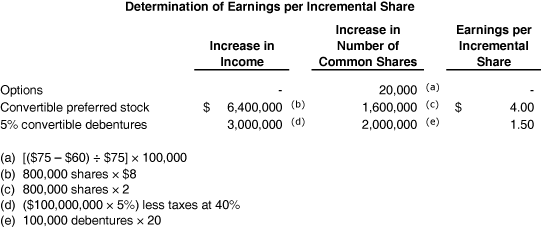
Convertible securities may be dilutive on their own but antidilutive when included with other potential common shares in computing diluted EPS. To reflect maximum potential dilution, each issue or series of issues of potential common shares shall be considered in sequence from the most dilutive to the least dilutive. That is, dilutive potential common shares with the lowest earnings per incremental share shall be included in diluted EPS before those with a higher earnings per incremental share. Example 4 (see paragraph 260-10-55-57) illustrates that provision. Options and warrants generally will be included first because use of the treasury stock method does not affect the numerator of the computation. An entity that reports a discontinued operation in a period shall use income from continuing operations (adjusted for preferred dividends as described in paragraph 260-10-45-11) as the control number in determining whether those potential common shares are dilutive or antidilutive. That is, the same number of potential common shares used in computing the diluted per-share amount for income from continuing operations shall be used in computing all other reported diluted per-share amounts even if those amounts will be antidilutive to their respective basic per-share amounts. (See paragraph 260-10-45-3.) The control number excludes income from continuing operations attributable to the noncontrolling interest in a subsidiary in accordance with paragraph 260-10-45-11A. Example 14 (see paragraph 260-10-55-90) provides an illustration of this guidance.
Transition date:(P) December 16, 2026; (N) December 16, 2026Transition guidance:
260-10-65-5Convertible securities may be dilutive on their own but antidilutive when included with other potential common shares in computing diluted EPS. To reflect maximum potential dilution, each issue or series of issues of potential common shares shall be considered in sequence from the most dilutive to the least dilutive. That is, dilutive potential common shares with the lowest earnings per incremental share shall be included in diluted EPS before those with a higher earnings per incremental share. Example 4 (see paragraph 260-10-55-57) illustrates that provision. Options and warrants generally will be included first because use of the treasury stock method does not affect the numerator of the computation (however, certain contracts also may require an adjustment to the numerator in accordance with the guidance in paragraphs 260-10-45-45 and 260-10-45-46). An entity that reports a discontinued operation in a period shall use income from continuing operations (adjusted for preferred dividends as described in paragraph 260-10-45-11) as the control number in determining whether those potential common shares are dilutive or antidilutive. That is, the same number of potential common shares used in computing the diluted per-share amount for income from continuing operations shall be used in computing all other reported diluted per-share amounts even if those amounts will be antidilutive to their respective basic per-share amounts. (See paragraph 260-10-45-3.) The control number excludes income from continuing operations attributable to the noncontrolling interest in a subsidiary in accordance with paragraph 260-10-45-11A. Example 14 (see paragraph 260-10-55-90) provides an illustration of this guidance.
260-10-45-19
Including potential common shares in the denominator of a diluted per-share computation for continuing operations always will result in an antidilutive per-share amount when an entity has a loss from continuing operations or a loss from continuing operations available to common stockholders (that is, after any preferred dividend deductions). Although including those potential common shares in the other diluted per-share computations may be dilutive to their comparable basic per-share amounts, no potential common shares shall be included in the computation of any diluted per-share amount when a loss from continuing operations exists, even if the entity reports net income.
Transition date:(P) December 16, 2026; (N) December 16, 2026Transition guidance:
260-10-65-5Including potential common shares in the denominator of a diluted per-share computation for continuing operations generally will result in an antidilutive per-share amount when an entity has a loss from continuing operations or a loss from continuing operations available to common stockholders (that is, after any preferred dividend deductions). However, certain contracts also may require an adjustment to the numerator, such as contracts accounted for in accordance with the guidance in paragraphs 260-10-45-45 and 260-10-45-46. In those circumstances, an entity shall determine whether including the potential common shares would have a dilutive effect on the diluted EPS computation even if a loss from continuing operations exists by evaluating the combined effect of the adjustments to the numerator and denominator.
260-10-45-20
The control number for determining whether including potential common shares in the diluted EPS computation would be antidilutive should be income from continuing operations (or a similar line item above net income if it appears on the income statement). As a result, if there is a loss from continuing operations, diluted EPS would be computed in the same manner as basic EPS is computed, even if an entity has net income after adjusting for a discontinued operation. Similarly, if an entity has income from continuing operations but its preferred dividend adjustment made in computing income available to common stockholders in accordance with paragraph 260-10-45-11 results in a loss from continuing operations available to common stockholders, diluted EPS would be computed in the same manner as basic EPS.
Transition date:(P) December 16, 2026; (N) December 16, 2026Transition guidance:
260-10-65-5The control number for determining whether including potential common shares in the diluted EPS computation would be antidilutive should be income (or loss) from continuing operations (or a similar line item above net income if it appears on the income statement). When there is a loss from continuing operations, diluted EPS would be computed in the same manner as basic EPS is computed if the combined effect of the adjustments to the numerator and denominator is antidilutive. This would be the case even if an entity has net income after adjusting for a discontinued operation. Similarly, if an entity has income from continuing operations but its preferred dividend adjustment made in computing income available to common stockholders in accordance with paragraph 260-10-45-11 results in a loss from continuing operations available to common stockholders, diluted EPS would be computed in the same manner as basic EPS if the combined effect of the adjustments to the numerator and denominator is antidilutive.
260-10-45-21
Diluted EPS shall be based on the most advantageous conversion rate or exercise price from the standpoint of the security holder. Previously reported diluted EPS data shall not be retroactively adjusted for subsequent conversions or subsequent changes in the market price of the common stock.
260-10-45-21A
Changes in an entity's share price may affect the exercise price of a financial instrument or the number of shares that would be used to settle the financial instrument. For example, when the principal of a convertible debt instrument is required to be settled in cash but the conversion premium is required to (or may) be settled in shares, the number of shares to be included in the diluted EPS denominator is affected by the entity's share price. In applying both the treasury stock method and the if-converted method of calculating diluted EPS, the average market price shall be used for purposes of calculating the denominator for diluted EPS when the number of shares that may be issued is variable, except for contingently issuable shares within the scope of the guidance in paragraphs . See paragraphs for implementation guidance on determining an average market price.
260-10-45-22
The dilutive effect of outstanding call options and warrants (and their equivalents) issued by the reporting entity shall be reflected in diluted EPS by application of the treasury stock method unless the provisions of paragraphs and require that another method be applied. Equivalents of options and warrants include nonvested stock granted under a share-based payment arrangement, stock purchase contracts, and partially paid stock subscriptions (see paragraph 260-10-55-23). Antidilutive contracts, such as purchased put options and purchased call options, shall be excluded from diluted EPS.
260-10-45-23
Under the treasury stock method:
  1. a
    Exercise of options and warrants shall be assumed at the beginning of the period (or at time of issuance, if later) and common shares shall be assumed to be issued.
  2. b
    The proceeds from exercise shall be assumed to be used to purchase common stock at the average market price during the period. (See paragraphs 260-10-45-29 and .)
  3. c
    The incremental shares (the difference between the number of shares assumed issued and the number of shares assumed purchased) shall be included in the denominator of the diluted EPS computation.
Example 15 (see paragraph 260-10-55-92) provides an illustration of this guidance. See paragraph 260-10-45-21A if the exercise price of a financial instrument or the number of shares that would be used to settle the financial instrument is variable.
260-10-45-25
Options and warrants will have a dilutive effect under the treasury stock method only when the average market price of the common stock during the period exceeds the exercise price of the options or warrants (they are in the money). Previously reported EPS data shall not be retroactively adjusted as a result of changes in market prices of common stock.
260-10-45-26
Dilutive options or warrants that are issued during a period or that expire or are cancelled during a period shall be included in the denominator of diluted EPS for the period that they were outstanding. Likewise, dilutive options or warrants exercised during the period shall be included in the denominator for the period prior to actual exercise. The common shares issued upon exercise of options or warrants shall be included in the denominator for the period after the exercise date. Consequently, incremental shares assumed issued shall be weighted for the period the options or warrants were outstanding, and common shares actually issued shall be weighted for the period the shares were outstanding.
260-10-45-27
Paragraphs provide additional guidance on the application of the treasury stock method.
260-10-45-28
The provisions in paragraphs apply to share-based awards issued to grantees under a share-based payment arrangement in exchange for goods and services or as consideration payable to a customer.
260-10-45-28A
Awards of share options and nonvested shares (as defined in Topic 718) to be issued to a grantee under a share-based payment arrangement are considered options for purposes of computing diluted EPS. Such share-based awards shall be considered to be outstanding as of the grant date for purposes of computing diluted EPS even though their exercise may be contingent upon vesting. Those share-based awards are included in the diluted EPS computation even if the grantee may not receive (or be able to sell) the stock until some future date. Accordingly, all shares to be issued shall be included in computing diluted EPS if the effect is dilutive. The dilutive effect of share-based payment arrangements shall be computed using the treasury stock method. If the equity share options or other equity instruments are outstanding for only part of a period, the shares issuable shall be weighted to reflect the portion of the period during which the equity instruments were outstanding. See Example 8 (paragraph 260-10-55-68).
260-10-45-28B
In applying the treasury stock method, all dilutive potential common shares, regardless of whether they are exercisable, are treated as if they had been exercised. The treasury stock method assumes that the proceeds upon exercise are used to repurchase the entity's stock, reducing the number of shares to be added to outstanding common stock in computing EPS.
260-10-45-29
In applying the treasury stock method described in paragraph 260-10-45-23, the assumed proceeds shall be the sum of both of the following:
  1. a
    The amount, if any, the grantee must pay upon exercise.
  2. b
    The amount of cost attributed to share-based payment awards (within the scope of Topic 718 on stock compensation) not yet recognized. This amount includes share-based payment awards that are not contingent upon satisfying certain conditions as described in paragraph 260-10-45-32 and contingently issuable shares that have been determined to be included in the computation of diluted EPS as described in paragraphs
  3. c
260-10-45-29A
Under paragraphs 718-10-35-1D and 718-10-35-3, the effect of forfeitures is taken into account by recognizing compensation cost for those instruments for which the employee's requisite service has been rendered or the nonemployee's vesting conditions have been met and no compensation cost shall be recognized for instruments that grantees forfeit because a service or performance condition is not satisfied. See Example 8 (paragraph 260-10-55-68) for an illustration of this guidance.
260-10-45-30
If share-based payment arrangements are payable in common stock or in cash at the election of either the entity or the grantee, the determination of whether such share-based awards are potential common shares shall be made based on the provisions in paragraph 260-10-45-45. If an entity has a tandem award (as defined in Topic 718) that allows the entity or the grantee to make an election involving two or more types of equity instruments, diluted EPS for the period shall be computed based on the terms used in the computation of compensation cost for that period.
260-10-45-31
Awards with a market condition, a performance condition, or any combination thereof (as defined in Topic 718) shall be included in diluted EPS pursuant to the contingent share provisions in paragraphs .
260-10-45-32
Fixed grantee stock options (fixed awards) and nonvested stock (including restricted stock) shall be included in the computation of diluted EPS based on the provisions for options and warrants in paragraphs . Even though their issuance may be contingent upon vesting, they shall not be considered to be contingently issuable shares (see Section 815-15-55 and paragraph 260-10-45-48). However, because issuance of performance-based stock options (and performance-based nonvested stock) is contingent upon satisfying conditions in addition to the mere passage of time, those options and nonvested stock shall be considered to be contingently issuable shares in the computation of diluted EPS. A distinction shall be made only between time-related contingencies and contingencies requiring specific achievement.
260-10-45-35
Contracts that require that the reporting entity repurchase its own stock, such as written put options and forward purchase contracts other than forward purchase contracts accounted for under paragraphs and 480-10-35-3, shall be reflected in the computation of diluted EPS if the effect is dilutive. If those contracts are in the money during the reporting period (the exercise price is above the average market price for that period), the potential dilutive effect on EPS shall be computed using the reverse treasury stock method. Under that method:
  1. a
    Issuance of sufficient common shares shall be assumed at the beginning of the period (at the average market price during the period) to raise enough proceeds to satisfy the contract.
  2. b
    The proceeds from issuance shall be assumed to be used to satisfy the contract (that is, to buy back shares).
  3. c
    The incremental shares (the difference between the number of shares assumed issued and the number of shares received from satisfying the contract) shall be included in the denominator of the diluted EPS computation.
260-10-45-36
For example, an entity sells 100 put options with an exercise price of $25; the average market price for the period is $20. In computing diluted EPS at the end of the period, the entity assumes it issues 125 shares at $20 per share to satisfy its put obligation of $2,500. The difference between the 125 shares issued and the 100 shares received from satisfying the put option (25 incremental shares) would be added to the denominator of diluted EPS.
260-10-45-37
Contracts such as purchased put options and purchased call options (options held by the entity on its own stock) shall not be included in the computation of diluted EPS because including them would be antidilutive. That is, the put option would be exercised only when the exercise price is higher than the market price and the call option would be exercised only when the exercise price is lower than the market price; in both instances, the effect would be antidilutive under both the treasury stock method and the reverse treasury stock method, respectively.
260-10-45-40
The dilutive effect of convertible securities shall be reflected in diluted EPS by application of the if-converted method. Under that method:
  1. a
    If an entity has convertible preferred stock outstanding, the preferred dividends applicable to convertible preferred stock shall be added back to the numerator. The amount of preferred dividends added back will be the amount of preferred dividends for convertible preferred stock deducted from income from continuing operations (and from net income) in computing income available to common stockholders pursuant to paragraph 260-10-45-11.
  2. b
    If an entity has convertible debt outstanding:
    1. 1
      Interest charges applicable to the convertible debt shall be added back to the numerator. For convertible debt for which the principal is required to be paid in cash, the interest charges shall not be added back to the numerator.
    2. 2
      To the extent nondiscretionary adjustments based on income made during the period would have been computed differently had the interest on convertible debt never been recognized, the numerator shall be appropriately adjusted. Nondiscretionary adjustments include any expenses or charges that are determined based on the income (loss) for the period, such as profit-sharing and royalty agreements.
    3. 3
      The numerator shall be adjusted for the income tax effect of (b)(1) and (b)(2).
  3. c
    The convertible preferred stock or convertible debt shall be assumed to have been converted at the beginning of the period (or at time of issuance, if later), and the resulting common shares shall be included in the denominator. See paragraph 260-10-45-21A if the incremental shares are variable (such as when calculating a conversion premium).
260-10-45-41
In applying the if-converted method, conversion shall not be assumed for purposes of computing diluted EPS if the effect would be antidilutive. Convertible preferred stock is antidilutive whenever the amount of the dividend declared in or accumulated for the current period per common share obtainable on conversion exceeds basic EPS. Similarly, convertible debt is antidilutive whenever its interest (net of tax and nondiscretionary adjustments) per common share obtainable on conversion exceeds basic EPS.
260-10-45-42
Dilutive securities that are issued during a period and dilutive convertible securities for which conversion options lapse, for which preferred stock is redeemed, or for which related debt is extinguished during a period, shall be included in the denominator of diluted EPS for the period that they were outstanding. Likewise, dilutive convertible securities converted during a period shall be included in the denominator for the period prior to actual conversion. The common shares issued upon actual conversion shall be included in the denominator for the period after the date of conversion. Consequently, shares assumed issued shall be weighted for the period the convertible securities were outstanding, and common shares actually issued shall be weighted for the period the shares were outstanding.
260-10-45-43
While the terms of contingently convertible instruments vary, a typical instrument includes a market price trigger that exceeds a specified conversion price of the issuer's underlying stock price on the date of issuance by a specified percentage (for example, 10 percent, 20 percent, or 30 percent). Some contingently convertible instruments have floating market price triggers for which conversion is dependent upon the market price of the issuer's stock exceeding the conversion price by a specified percentage or percentages at specified times during the term of the debt. Other contingently convertible instruments require that the market price of the issuer's stock exceed a specified level for a specified period (for example, 20 percent above the conversion price for a 30-day period). In addition, contingently convertible instruments may have additional features such as parity features, issuer call options, and investor put options.
260-10-45-44
Contingently convertible instruments shall be included in diluted EPS (if dilutive) regardless of whether the market price trigger has been met. There is no substantive economic difference between contingently convertible instruments and convertible instruments with a market price conversion premium. The treatment for diluted EPS shall not differ because of a contingent market price trigger. The guidance provided in this paragraph also shall be applied to instruments that have multiple contingencies if one of the contingencies is a market price trigger and the instrument is convertible or settleable in shares based on meeting a market condition—that is, the conversion is not dependent (or no longer dependent) on a substantive non-market-based contingency. For example, this guidance applies if an instrument is convertible upon meeting a market price trigger or a substantive non-market-based contingency (for example, a change in control). Alternatively, if the instrument is convertible upon achieving both a market price trigger and a substantive non-market-based contingency, this guidance would not apply until the non-market-based contingency has been met. See Example 11 (paragraph 260-10-55-78) for an illustration of this guidance.
260-10-45-45
The effect of potential share settlement shall be included in the diluted EPS calculation (if the effect is more dilutive) for an otherwise cash-settleable instrument that contains a provision that requires or permits share settlement (regardless of whether the election is at the option of an entity or the holder, or the entity has a history or policy of cash settlement). An example of such a contract accounted for in accordance with this paragraph and paragraph 260-10-45-46 is a written call option that gives the holder a choice of settling in common stock or in cash. An election to share settle an instrument, for purposes of applying the guidance in this paragraph, does not include circumstances in which share settlement is contingent upon the occurrence of a specified event or circumstance (such as contingently issuable shares). In those circumstances (other than if the contingency is an entity's own share price), the guidance on contingently issuable shares should first be applied, and, if the contingency would be considered met, then the guidance in this paragraph should be applied. Share-based payment arrangements that are payable in common stock or in cash at the election of either the entity or the grantee shall be accounted for pursuant to this paragraph and paragraph 260-10-45-46, unless the share-based payment arrangement is classified as a liability because of the requirements in paragraph 718-10-25-15 (see paragraph 260-10-45-45A for guidance for those instruments). If the payment of cash is required only upon the final liquidation of an entity, then the entity shall include the effect of potential share settlement in the diluted EPS calculation until the liquidation occurs.
Transition date:(P) December 16, 2026; (N) December 16, 2026Transition guidance:
260-10-65-5The effect of potential share settlement shall be included in the diluted EPS calculation (if the effect is dilutive) for an otherwise cash-settleable instrument that contains a provision that requires or permits share settlement (regardless of whether the election is at the option of an entity or the holder, the entity has a history or policy of cash settlement, or a loss from continuing operations exists). See paragraph 260-10-45-19 for guidance on the effect of potential share settlement when an entity has a loss from continuing operations. An example of such a contract accounted for in accordance with this paragraph and paragraph 260-10-45-46 is a written call option that gives the holder a choice of settling in common stock or in cash. An election to share settle an instrument, for purposes of applying the guidance in this paragraph, does not include circumstances in which share settlement is contingent upon the occurrence of a specified event or circumstance (such as contingently issuable shares). In those circumstances (other than if the contingency is an entity's own share price), the guidance on contingently issuable shares should first be applied, and, if the contingency would be considered met, then the guidance in this paragraph should be applied. Share-based payment arrangements that are payable in common stock or in cash at the election of either the entity or the grantee shall be accounted for pursuant to this paragraph and paragraph 260-10-45-46, unless the share-based payment arrangement is classified as a liability because of the requirements in paragraph 718-10-25-15 (see paragraph 260-10-45-45A for guidance for those instruments). If the payment of cash is required only upon the final liquidation of an entity, then the entity shall include the effect of potential share settlement in the diluted EPS calculation until the liquidation occurs.
260-10-45-45A
For a share-based payment arrangement that is classified as a liability because of the requirements in paragraph 718-10-25-15 and may be settled in common stock or in cash at the election of either the entity or the holder, determining whether that contract shall be reflected in the computation of diluted EPS shall be prepared on the basis of the facts available each period. It shall be presumed that the contract will be settled in common stock and the resulting potential common shares included in diluted EPS (in accordance with the relevant guidance of this Topic) if the effect is more dilutive. The presumption that the contract will be settled in common stock may be overcome if past experience or a stated policy provides a reasonable basis to conclude that the contract will be paid partially or wholly in cash.
260-10-45-46
A contract that is reported as an asset or liability for accounting purposes may require an adjustment to the numerator for any changes in income or loss that would result if the contract had been reported as an equity instrument for accounting purposes during the period. That adjustment is similar to the adjustments required for convertible debt in paragraph 260-10-45-40(b).
260-10-45-47
Paragraphs 260-10-55-32 through 55-36A provide additional guidance on contracts that may be settled in stock or cash.
260-10-45-48
Shares whose issuance is contingent upon the satisfaction of certain conditions shall be considered outstanding and included in the computation of diluted EPS as follows:
  1. a
    If all necessary conditions have been satisfied by the end of the period (the events have occurred), those shares shall be included as of the beginning of the period in which the conditions were satisfied (or as of the date of the contingent stock agreement, if later).
  2. b
    If all necessary conditions have not been satisfied by the end of the period, the number of contingently issuable shares included in diluted EPS shall be based on the number of shares, if any, that would be issuable if the end of the reporting period were the end of the contingency period (for example, the number of shares that would be issuable based on current period earnings or period-end market price) and if the result would be dilutive. Those contingently issuable shares shall be included in the denominator of diluted EPS as of the beginning of the period (or as of the date of the contingent stock agreement, if later).
260-10-45-49
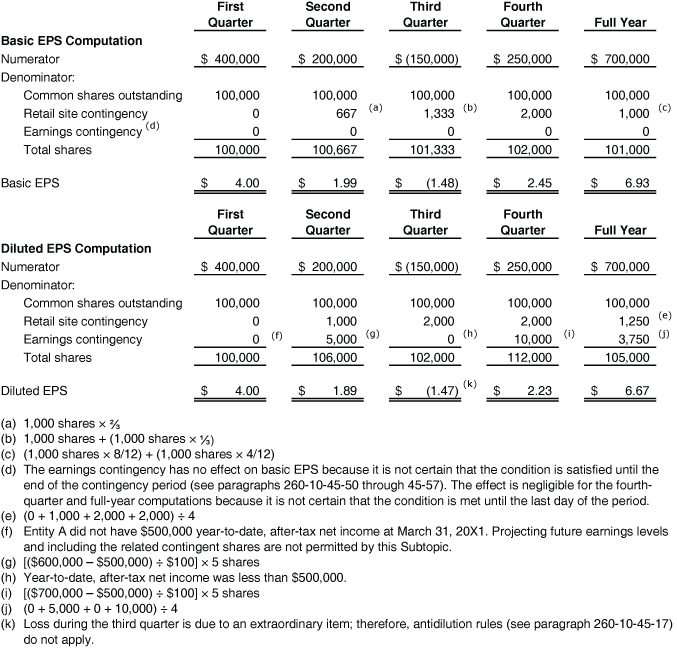
For year-to-date computations, contingent shares shall be included on a weighted-average basis. That is, contingent shares shall be weighted for the interim periods in which they were included in the computation of diluted EPS.
260-10-45-50
Paragraphs provide general guidelines that shall be applied in determining the EPS impact of different types of contingencies that may be included in contingent stock agreements.
260-10-45-51
If attainment or maintenance of a specified amount of earnings is the condition and if that amount has been attained, the additional shares shall be considered to be outstanding for the purpose of computing diluted EPS if the effect is dilutive. The diluted EPS computation shall include those shares that would be issued under the conditions of the contract based on the assumption that the current amount of earnings will remain unchanged until the end of the agreement, but only if the effect would be dilutive. Because the amount of earnings may change in a future period, basic EPS shall not include such contingently issuable shares because all necessary conditions have not been satisfied. Example 3 (see paragraph 260-10-55-53) illustrates that provision.
260-10-45-52
The number of shares contingently issuable may depend on the market price of the stock at a future date. In that case, computations of diluted EPS shall reflect the number of shares that would be issued based on the current market price at the end of the period being reported on if the effect is dilutive. If the condition is based on an average of market prices over some period of time, the average for that period shall be used. Because the market price may change in a future period, basic EPS shall not include such contingently issuable shares because all necessary conditions have not been satisfied.
260-10-45-53
In some cases, the number of shares contingently issuable may depend on both future earnings and future prices of the shares. In that case, the determination of the number of shares included in diluted EPS shall be based on both conditions, that is, earnings to date and current market price—as they exist at the end of each reporting period. If both conditions are not met at the end of the reporting period, no contingently issuable shares shall be included in diluted EPS.
260-10-45-54
If the contingency is based on a condition other than earnings or market price (for example, opening a certain number of retail stores), the contingent shares shall be included in the computation of diluted EPS based on the assumption that the current status of the condition will remain unchanged until the end of the contingency period. Example 3 (see paragraph 260-10-55-53) illustrates that provision.
260-10-45-55
Contingently issuable potential common shares (other than those covered by a contingent stock agreement, such as contingently issuable convertible securities) shall be included in diluted EPS as follows:
  1. a
    An entity shall determine whether the potential common shares may be assumed to be issuable based on the conditions specified for their issuance pursuant to the contingent share provisions in paragraphs .
  2. b
    If those potential common shares should be reflected in diluted EPS, an entity shall determine their impact on the computation of diluted EPS by following the provisions for options and warrants in paragraphs , the provisions for convertible securities in paragraphs , and the provisions for contracts that may be settled in stock or cash in paragraph 260-10-45-45, as appropriate.
260-10-45-56
Neither interest nor dividends shall be imputed for the additional contingently issuable convertible securities because any imputed amount would be reversed by the if-converted adjustments for assumed conversions.
260-10-45-57
However, exercise or conversion shall not be assumed for purposes of computing diluted EPS unless exercise or conversion of similar outstanding potential common shares that are not contingently issuable is assumed. See Example 3 (paragraph 260-10-55-53) for an illustration of this guidance.

Special Issues Affecting Basic and Diluted EPS

260-10-45-58
These special issues may affect both basic and diluted EPS.
260-10-45-59A
The capital structures of some entities include:
  1. a
    Securities that may participate in dividends with common stocks according to a predetermined formula (for example, two for one) with, at times, an upper limit on the extent of participation (for example, up to, but not beyond, a specified amount per share)
  2. b
    A class of common stock with different dividend rates from those of another class of common stock but without prior or senior rights.
260-10-45-60
The two-class method is an earnings allocation formula that treats a participating security as having rights to earnings that otherwise would have been available to common shareholders but does not require the presentation of basic and diluted EPS for securities other than common stock. The presentation of basic and diluted EPS for a participating security other than common stock is not precluded.
260-10-45-60A
All securities that meet the definition of a participating security, irrespective of whether the securities are convertible, nonconvertible, or potential common stock securities, shall be included in the computation of basic EPS using the two-class method.
260-10-45-60B
Under the two-class method:
  1. a
    Income from continuing operations (or net income) shall be reduced by the amount of dividends declared in the current period for each class of stock and by the contractual amount of dividends (or interest on participating income bonds) that must be paid for the current period (for example, unpaid cumulative dividends). Dividends declared in the current period do not include dividends declared in respect of prior-year unpaid cumulative dividends. Preferred dividends that are cumulative only if earned are deducted only to the extent that they are earned.
  2. b
    The remaining earnings shall be allocated to common stock and participating securities to the extent that each security may share in earnings as if all of the earnings for the period had been distributed. The total earnings allocated to each security shall be determined by adding together the amount allocated for dividends and the amount allocated for a participation feature.
  3. c
    The total earnings allocated to each security shall be divided by the number of outstanding shares of the security to which the earnings are allocated to determine the EPS for the security.
  4. d
    Basic and diluted EPS data shall be presented for each class of common stock.
For the diluted EPS computation, outstanding common shares shall include all potential common shares assumed issued. Example 6 (see paragraph 260-10-55-62) illustrates the two-class method.
260-10-45-61
Fully vested share-based compensation subject to the provisions of Topic 718, including fully vested options and fully vested stock, that contain a right to receive dividends declared on the common stock of the issuer, are subject to the guidance in paragraph 260-10-45-60A.
260-10-45-61A
Unvested share-based payment awards that contain nonforfeitable rights to dividends or dividend equivalents (whether paid or unpaid) are participating securities and shall be included in the computation of EPS pursuant to the two-class method under the requirements of paragraph 260-10-45-60A.
260-10-45-62
Dividends or dividend equivalents transferred to the holder of a convertible security in the form of a reduction to the conversion price or an increase in the conversion ratio of the security do not represent participation rights. This guidance applies similarly to other contracts (securities) to issue an entity's common stock if these contracts (securities) provide for an adjustment to the exercise price that is tied to the declaration of dividends by the issuer. The scope of the guidance in this paragraph excludes forward contracts to issue an entity's own equity shares.
260-10-45-63
In a forward contract to issue an entity's own equity shares, a provision that reduces the contract price per share when dividends are declared on the issuing entity's common stock represents a participation right. Such a provision constitutes a participation right because it results in a noncontingent transfer of value to the holder of the forward contract for dividends declared during the forward contract period. That is, the forward contract holder has a right to participate in the undistributed earnings of the issuing entity because a dividend declaration by the issuing entity results in a transfer of value to the holder of the forward contract through a reduction in the forward purchase price per share. Because that value transfer is not contingent-as opposed to a similar reduction in the exercise price of an option or warrant-the forward contract is a participating security, regardless of whether, during the period the contract is outstanding, a dividend is declared.
260-10-45-65
Undistributed earnings for a period shall be allocated to a participating security based on the contractual participation rights of the security to share in those current earnings as if all of the earnings for the period had been distributed. If the terms of the participating security do not specify objectively determinable, nondiscretionary participation rights, then undistributed earnings would not be allocated based on arbitrary assumptions. For example, if an entity could avoid distribution of earnings to a participating security, even if all of the earnings for the year were distributed, then no allocation of that period's earnings to the participating security would be made. Paragraphs provide additional guidance on participating securities and undistributed earnings.
260-10-45-66
Under the two-class method the remaining earnings shall be allocated to common stock and participating securities to the extent that each security may share in earnings as if all of the earnings for the period had been distributed. This allocation is required despite its pro forma nature and that it may not reflect the economic probabilities of actual distributions to the participating security holders.
260-10-45-67
An entity would allocate losses to a nonconvertible participating security in periods of net loss if, based on the contractual terms of the participating security, the security had not only the right to participate in the earnings of the issuer, but also a contractual obligation to share in the losses of the issuing entity on a basis that was objectively determinable. Determination of whether a participating security holder has an obligation to share in the losses of the issuing entity in a given period shall be made on a period-by-period basis, based on the contractual rights and obligations of the participating security. The holder of a participating security would have a contractual obligation to share in the losses of the issuing entity if either of the following conditions is present:
  1. a
    The holder is obligated to fund the losses of the issuing entity (that is, the holder is obligated to transfer assets to the issuer in excess of the holder's initial investment in the participating security without any corresponding increase in the holder's investment interest).
  2. b
    The contractual principal or mandatory redemption amount of the participating security is reduced as a result of losses incurred by the issuing entity.
260-10-45-68
A convertible participating security should be included in the computation of basic EPS in periods of net loss if, based on its contractual terms, the convertible participating security has the contractual obligation to share in the losses of the issuing entity on a basis that is objectively determinable. The guidance in this paragraph also applies to the inclusion of convertible participating securities in basic EPS, irrespective of the differences that may exist between convertible and nonconvertible securities. That is, an entity should not automatically exclude a convertible participating security from the computation of basic EPS if an entity has a net loss from continuing operations. Determination of whether a participating security holder has an obligation to share in the losses of the issuing entity in a given period shall be made on a period-by-period basis, based on the contractual rights and obligations of the participating security.
260-10-45-68B
Paragraph 718-10-55-45 requires that nonrefundable dividends or dividend equivalents paid on awards for which the requisite service is not (or is not expected to be) rendered be recognized as additional compensation cost and that dividends or dividend equivalents paid on awards for which the requisite service is (or is expected to be) rendered be charged to retained earnings. As a result, an entity shall not include dividends or dividend equivalents that are accounted for as compensation cost in the earnings allocation in computing EPS. To do so would include the dividend as a reduction of earnings available to common shareholders from both compensation cost and distributed earnings. Undistributed earnings shall be allocated to all share-based payment awards outstanding during the period, including those for which the requisite service is not expected to be rendered (or is not rendered because of forfeiture during the period, if an entity elects to account for forfeitures when they occur in accordance with paragraph 718-10-35-3). An entity's estimate of the number of awards for which the requisite service is not expected to be rendered (or no estimate, if the entity has elected to account for forfeitures when they occur in accordance with paragraph 718-10-35-3) for the purpose of determining EPS under this Topic shall be consistent with the estimate used for the purposes of recognizing compensation cost under Topic 718. Paragraph 718-10-35-3 requires that an entity apply a change in the estimate of the number of awards for which the requisite service is not expected to be rendered in the period that the change in estimate occurs. This change in estimate will affect net income in the current period; however, a current-period change in an entity's expected forfeiture rate would not affect prior-period EPS calculations. See Example 9 for an illustration of this guidance.
260-10-45-70
See Example 9 (paragraph 260-10-55-71) for an illustration of this guidance.
260-10-45-70A
Paragraph 480-10-45-4 provides guidance on calculating basic and diluted EPS if an entity has mandatorily redeemable shares of common stock or has entered into certain forward contracts that require physical settlement by repurchase of a fixed number of the issuer's equity shares of common stock.

Own-Share Lending Arrangements Issued in Contemplation of Convertible Debt Issuance or Other Financing

260-10-45-70B
Paragraph 470-20-45-2A provides guidance on calculating basic and diluted earnings per share if an entity has entered into own-share lending arrangements issued in contemplation of convertible debt issuance or other financing.

Master Limited Partnerships

260-10-45-71
This Subsection provides guidance pertaining to the presentation of earnings per unit for master limited partnerships.

Incentive Distribution Rights That Are a Separate Class of Limited Partner Interest

260-10-45-72
Incentive distribution rights that are a separate class of limited partner interest are participating securities because they have a right to participate in earnings with common equity holders. Therefore, current-period earnings shall be allocated to the general partner, limited partner, and incentive distribution right holder using the two-class method to calculate earnings per unit.

Incentive Distribution Rights That Are Embedded in the General Partner Interest

260-10-45-73
Incentive distribution rights that are embedded in the general partner interest are not separate participating securities. However, because the general partner and limited partner interests are separate classes of equity, the two-class method shall be applied in computing earnings per unit for the general partner and limited partner interests.

260-10-50Disclosure

Source downloaded: .Record version eefce6b0e4f5. Effective date must be checked in the source.

260-10-50-1
For each period for which an income statement is presented, an entity shall disclose all of the following:
  1. a
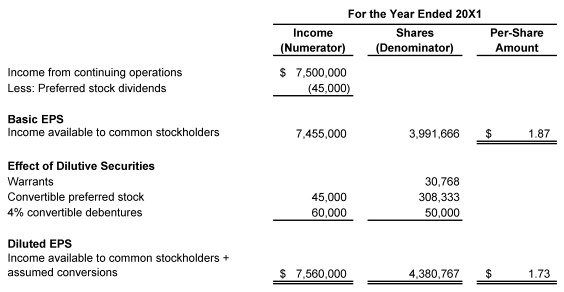
    A reconciliation of the numerators and the denominators of the basic and diluted per-share computations for income from continuing operations. The reconciliation shall include the individual income and share amount effects of all securities that affect earnings per share (EPS). Example 2 (see paragraph 260-10-55-51) illustrates that disclosure. (See paragraph 260-10-45-3.) An entity is encouraged to refer to pertinent information about securities included in the EPS computations that is provided elsewhere in the financial statements as prescribed by Subtopic 505-10.
  2. b
    The effect that has been given to preferred dividends in arriving at income available to common stockholders in computing basic EPS.
  3. c
    Securities (including those issuable pursuant to contingent stock agreements) that could potentially dilute basic EPS in the future that were not included in the computation of diluted EPS because to do so would have been antidilutive for the period(s) presented. Full disclosure of the terms and conditions of these securities is required even if a security is not included in diluted EPS in the current period.
Transition date:(P) June 30, 2027; (N) June 30, 2027Transition guidance:
105-10-65-7For each period for which an income statement is presented, including interim periods, an entity shall disclose all of the following:
  1. a
    A reconciliation of the numerators and the denominators of the basic and diluted per-share computations for income from continuing operations. The reconciliation shall include the individual income and share amount effects of all securities that affect earnings per share (EPS). Example 2 (see paragraph 260-10-55-51) illustrates that disclosure. (See paragraph 260-10-45-3.) An entity is encouraged to refer to pertinent information about securities included in the EPS computations that is provided elsewhere in the financial statements as prescribed by Subtopic 505-10.
  2. b
    The effect that has been given to preferred dividends in arriving at income available to common stockholders in computing basic EPS.
  3. c
    Securities (including those issuable pursuant to contingent stock agreements) that could potentially dilute basic EPS in the future that were not included in the computation of diluted EPS because to do so would have been antidilutive for the period(s) presented. Full disclosure of the terms and conditions of these securities is required even if a security is not included in diluted EPS in the current period.
  4. d
    The methods used in the diluted EPS computation for each type of dilutive instrument (for example, treasury stock method, if-converted method, two-class method, or reverse treasury stock method).
Transition date:(P) December 16, 2027; (N) December 16, 2028Transition guidance:
270-10-65-1For each period for which an income statement is presented, including interim periods, an entity shall disclose all of the following:
  1. a
    A reconciliation of the numerators and the denominators of the basic and diluted per-share computations for income from continuing operations. The reconciliation shall include the individual income and share amount effects of all securities that affect earnings per share (EPS). Example 2 (see paragraph 260-10-55-51) illustrates that disclosure. (See paragraph 260-10-45-3.) An entity is encouraged to refer to pertinent information about securities included in the EPS computations that is provided elsewhere in the financial statements as prescribed by Subtopic 505-10.
  2. b
    The effect that has been given to preferred dividends in arriving at income available to common stockholders in computing basic EPS.
  3. c
    Securities (including those issuable pursuant to contingent stock agreements) that could potentially dilute basic EPS in the future that were not included in the computation of diluted EPS because to do so would have been antidilutive for the period(s) presented. Full disclosure of the terms and conditions of these securities is required even if a security is not included in diluted EPS in the current period.
  4. d
    The methods used in the diluted EPS computation for each type of dilutive instrument (for example, treasury stock method, if-converted method, two-class method, or reverse treasury stock method).
260-10-50-1A
Per-share amounts not required to be presented by this Subtopic that an entity chooses to disclose shall be computed in accordance with this Subtopic and disclosed only in the notes to financial statements; it shall be noted whether the per-share amounts are pretax or net of tax. (See paragraph 260-10-45-5.)
260-10-50-2
For the latest period for which an income statement is presented, an entity shall provide a description of any transaction that occurs after the end of the most recent period but before the financial statements are issued or are available to be issued (as discussed in Section 855-10-25) that would have changed materially the number of common shares or potential common shares outstanding at the end of the period if the transaction had occurred before the end of the period. Examples of those transactions include the issuance or acquisition of common shares; the issuance of warrants, options, or convertible securities; the resolution of a contingency pursuant to a contingent stock agreement; and the conversion or exercise of potential common shares outstanding at the end of the period into common shares.
Transition date:(P) December 16, 2027; (N) December 16, 2028Transition guidance:
270-10-65-1For the latest period for which an income statement is presented, an entity shall provide a description of any transaction that occurs after the end of the most recent period but before the financial statements are issued or are available to be issued (as discussed in Section 855-10-25) that would have changed materially the number of common shares or potential common shares outstanding at the end of the period if the transaction had occurred before the end of the period. Examples of those transactions include the issuance or acquisition of common shares; the issuance of warrants, options, or convertible securities; the resolution of a contingency pursuant to a contingent stock agreement; and the conversion or exercise of potential common shares outstanding at the end of the period into common shares. The disclosures in this paragraph are required in interim and annual reporting periods.

Master Limited Partnerships

260-10-50-3
In the period in which a dropdown transaction occurs that is accounted for under the Transactions between Entities under Common Control Subsections of Subtopic 805-50, a reporting entity shall disclose in narrative format how the rights to the earnings (losses) of the transferred net assets differ before and after the dropdown transaction occurs for purposes of computing earnings per unit under the two-class method.
Transition date:(P) December 16, 2027; (N) December 16, 2028Transition guidance:
270-10-65-1In the period in which a dropdown transaction occurs that is accounted for under the Transactions between Entities under Common Control Subsections of Subtopic 805-50, a reporting entity shall disclose in interim and annual reporting periods in narrative format how the rights to the earnings (losses) of the transferred net assets differ before and after the dropdown transaction occurs for purposes of computing earnings per unit under the two-class method.

260-10-55Implementation Guidance and Illustrations

Source downloaded: .Record version dbca43b2ef1c. Effective date must be checked in the source.

Implementation Guidance

260-10-55-1
This Section, which is an integral part of the requirements of this Subtopic, provides general guidance to be used in the computation of earnings per share (EPS).
260-10-55-2
The weighted-average number of shares is an arithmetical mean average of shares outstanding and assumed to be outstanding for EPS computations. The most precise average would be the sum of the shares determined on a daily basis divided by the number of days in the period. Less-precise averaging methods may be used, however, as long as they produce reasonable results. Methods that introduce artificial weighting, such as the Rule of 78 method, are not acceptable for computing a weighted-average number of shares for EPS computations.
260-10-55-3
The number of incremental shares included in quarterly diluted EPS shall be computed using the average market prices during the three months included in the reporting period. For year-to-date diluted EPS, the number of incremental shares to be included in the denominator shall be determined by computing a year-to-date weighted average of the number of incremental shares included in each quarterly diluted EPS computation. Example 1 (see paragraph 260-10-55-38) provides an illustration of that provision.
260-10-55-3A
Computation of year-to-date diluted EPS when an entity has a year-to-date loss from continuing operations including one or more quarters with income from continuing operations and when in-the-money options or warrants were not included in one or more quarterly diluted EPS computations because there was a loss from continuing operations in those quarters is as follows. In computing year-to-date diluted EPS, year-to-date income (or loss) from continuing operations shall be the basis for determining whether or not dilutive potential common shares not included in one or more quarterly computations of diluted EPS shall be included in the year-to-date computation.
Transition date:(P) December 16, 2026; (N) December 16, 2026Transition guidance:
260-10-65-5Computation of year-to-date diluted EPS when an entity has a loss from continuing operations in one or more quarters (regardless of whether the entity has a year-to-date income or loss from continuing operations) and when in-the-money options or warrants were not included in one or more quarterly diluted EPS computations because the effect was antidilutive (for example, there was a loss from continuing operations in those quarters) is as follows. In computing year-to-date diluted EPS, year-to-date income (or loss) from continuing operations shall be the basis for determining whether or not dilutive potential common shares not included in one or more quarterly computations of diluted EPS shall be included in the year-to-date computation on a weighted-average basis.
260-10-55-3B
Therefore:
  1. a
    When there is a year-to-date loss, potential common shares should never be included in the computation of diluted EPS, because to do so would be antidilutive.
  2. b
    When there is year-to-date income, if in-the-money options or warrants were excluded from one or more quarterly diluted EPS computations because the effect was antidilutive (there was a loss from continuing operations in those periods), then those options or warrants should be included in the diluted EPS denominator (on a weighted-average basis) in the year-to-date computation as long as the effect is not antidilutive. Similarly, contingent shares that were excluded from a quarterly computation solely because there was a loss from continuing operations should be included in the year-to-date computation unless the effect is antidilutive.
Example 12 (see paragraph 260-10-55-85) illustrates this guidance.
Transition date:(P) December 16, 2026; (N) December 16, 2026Transition guidance:
260-10-65-5Paragraph superseded by Accounting Standards Update No. 2025-12.
260-10-55-3C
Transition date:(P) December 16, 2026; (N) December 16, 2026Transition guidance:
260-10-65-5If in-the-money options or warrants were excluded from one or more quarterly diluted EPS computations because the effect was antidilutive, then those options or warrants should be included in the diluted EPS denominator (on a weighted-average basis) in the year-to-date computation as long as the effect is dilutive. Similarly, contingent shares that were excluded from a quarterly computation because the effect was antidilutive to that quarter should be included in the year-to-date computation if the effect is dilutive to the year-to-date period. Example 12 (see paragraph 260-10-55-85) illustrates this guidance.
260-10-55-4
The average market price of common stock shall represent a meaningful average. Theoretically, every market transaction for an entity's common stock could be included in determining the average market price. As a practical matter, however, a simple average of weekly or monthly prices usually will be adequate.
260-10-55-5
Generally, closing market prices are adequate for use in computing the average market price. When prices fluctuate widely, however, an average of the high and low prices for the period that the price represents usually would produce a more representative price. The method used to compute the average market price shall be used consistently unless it is no longer representative because of changed conditions. For example, an entity that uses closing market prices to compute the average market price for several years of relatively stable market prices might need to change to an average of high and low prices if prices start fluctuating greatly and the closing market prices no longer produce a representative average market price.
260-10-55-6
Options or warrants to purchase convertible securities shall be assumed to be exercised to purchase the convertible security whenever the average prices of both the convertible security and the common stock obtainable upon conversion are above the exercise price of the options or warrants. However, exercise shall not be assumed unless conversion of similar outstanding convertible securities, if any, also is assumed. The treasury stock method shall be applied to determine the incremental number of convertible securities that are assumed to be issued and immediately converted into common stock. Interest or dividends shall not be imputed for the incremental convertible securities because any imputed amount would be reversed by the if-converted adjustments for assumed conversions.
260-10-55-7
Paragraphs provide guidance on how certain options and warrants should be included in the computation of diluted EPS. Exercise of the potential common shares discussed in those paragraphs shall not be reflected in diluted EPS unless the effect is dilutive. Those potential common shares will have a dilutive effect if either of the following conditions is met:
  1. a
    The average market price of the related common stock for the period exceeds the exercise price.
  2. b
    The security to be tendered is selling at a price below that at which it may be tendered under the option or warrant agreement and the resulting discount is sufficient to establish an effective exercise price below the market price of the common stock obtainable upon exercise.
260-10-55-8
When several conversion alternatives exist, the computation shall give effect to the alternative that is most advantageous to the holder of the convertible security. Similar treatment shall be given to preferred stock that has similar provisions or to other securities that have conversion options that permit the investor to pay cash for a more favorable conversion rate.
260-10-55-9
Options or warrants may permit or require the tendering of debt or other securities of the issuer (or its parent or its subsidiary) in payment of all or a portion of the exercise price. In computing diluted EPS, those options or warrants shall be assumed to be exercised and the debt or other securities shall be assumed to be tendered. If tendering cash would be more advantageous to the option holder or warrant holder and the contract permits tendering cash, the treasury stock method shall be applied. Interest (net of tax) on any debt assumed to be tendered shall be added back as an adjustment to the numerator. The numerator also shall be adjusted for any nondiscretionary adjustments based on income (net of tax). The treasury stock method shall be applied for proceeds assumed to be received in cash.
260-10-55-10
The underlying terms of certain options or warrants may require that the proceeds received from the exercise of those securities be applied to retire debt or other securities of the issuer (or its parent or its subsidiary). In computing diluted EPS, those options or warrants shall be assumed to be exercised and the proceeds applied to purchase the debt at its average market price rather than to purchase common stock under the treasury stock method. The treasury stock method shall be applied, however, for excess proceeds received from the assumed exercise. Interest, net of tax, on any debt assumed to be purchased shall be added back as an adjustment to the numerator. The numerator also shall be adjusted for any nondiscretionary adjustments based on income (net of tax).
260-10-55-11
Convertible securities that permit or require the payment of cash by the holder of the security at conversion are considered the equivalent of warrants. In computing diluted EPS, the proceeds assumed to be received shall be assumed to be applied to purchase common stock under the treasury stock method and the convertible security shall be assumed to be converted under the if-converted method. See Example 11 (paragraph 260-10-55-78) for guidance on the effects of contingently convertible instruments on diluted EPS.
260-10-55-12
If the number of common shares outstanding increases as a result of a stock dividend or stock split (see Subtopic 505-20) or decreases as a result of a reverse stock split, the computations of basic and diluted EPS shall be adjusted retroactively for all periods presented to reflect that change in capital structure. If changes in common stock resulting from stock dividends, stock splits, or reverse stock splits occur after the close of the period but before the financial statements are issued or are available to be issued (as discussed in Section 855-10-25), the per-share computations for those and any prior-period financial statements presented shall be based on the new number of shares. If per-share computations reflect such changes in the number of shares, that fact shall be disclosed.
260-10-55-13
A rights issue whose exercise price at issuance is less than the fair value of the stock contains a bonus element that is somewhat similar to a stock dividend. If a rights issue contains a bonus element and the rights issue is offered to all existing stockholders, basic and diluted EPS shall be adjusted retroactively for the bonus element for all periods presented. If the ability to exercise the rights issue is contingent on some event other than the passage of time, the provisions of this paragraph shall not be applicable until that contingency is resolved.
260-10-55-14
The number of common shares used in computing basic and diluted EPS for all periods prior to the rights issue shall be the number of common shares outstanding immediately prior to the issue multiplied by the following factor: (fair value per share immediately prior to the exercise of the rights)/(theoretical ex-rights fair value per share). Theoretical ex-rights fair value per share shall be computed by adding the aggregate fair value of the shares immediately prior to the exercise of the rights to the proceeds expected from the exercise of the rights and dividing by the number of shares outstanding after the exercise of the rights. Example 5 (see paragraph 260-10-55-60) illustrates that provision. If the rights themselves are to be publicly traded separately from the shares prior to the exercise date, fair value for the purposes of this computation shall be established at the close of the last day on which the shares are traded together with the rights.
260-10-55-15
If authoritative literature requires that a restatement of the results of operations of a prior period be included in the income statement or summary of earnings, then EPS data given for the prior period or periods shall be restated. The effect of the restatement, expressed in per-share terms, shall be disclosed in the period of restatement.
260-10-55-16
Restated EPS data shall be computed as if the restated income or loss had been reported originally in the prior period or periods. Thus, it is possible that common stock assumed to be issued upon exercise, conversion, or issuance of potential common shares in accordance with the provisions of this Subtopic may not be included in the computation of restated EPS amounts. That is, retroactive restatement of income from continuing operations could cause potential common shares originally determined to be dilutive to become antidilutive pursuant to the control number provision in paragraph 260-10-45-18. The reverse also is true. Retroactive restatement also may cause the numerator of the EPS computation to change by an amount that differs from the amount of the retroactive adjustment.
260-10-55-16A
See paragraph 260-10-55-111 for guidance on the presentation of prior-period earnings per unit for entities within the scope of the Master Limited Partnerships Subsections that retrospectively adjust their financial statements and financial information for prior periods as a result of a dropdown transaction accounted for under the Transactions Between Entities Under Common Control Subsections of Subtopic 805-50.
260-10-55-17
When common shares are issued to acquire a business in a business combination, the computations of EPS shall recognize the existence of the new shares only from the acquisition date. In reorganizations, EPS computations shall be based on analysis of the particular transaction and the provisions of this Subtopic.
260-10-55-20
The effect on consolidated EPS of options, warrants, and convertible securities issued by a subsidiary depends on whether the securities issued by the subsidiary enable their holders to obtain common stock of the subsidiary or common stock of the parent entity. The following general guidelines shall be used for computing consolidated diluted EPS by entities with subsidiaries that have issued common stock or potential common shares to parties other than the parent entity
  1. a
    Securities issued by a subsidiary that enable their holders to obtain the subsidiary's common stock shall be included in computing the subsidiary's EPS data. Those per-share earnings of the subsidiary shall then be included in the consolidated EPS computations based on the consolidated group's holding of the subsidiary's securities. Example 7 (see paragraph 260-10-55-64) illustrates that provision.
  2. b
    Securities of a subsidiary that are convertible into its parent entity's common stock shall be considered among the potential common shares of the parent entity for the purpose of computing consolidated diluted EPS. Likewise, a subsidiary's options or warrants to purchase common stock of the parent entity shall be considered among the potential common shares of the parent entity in computing consolidated diluted EPS. Example 7 (see paragraph 260-10-55-64) illustrates that provision.
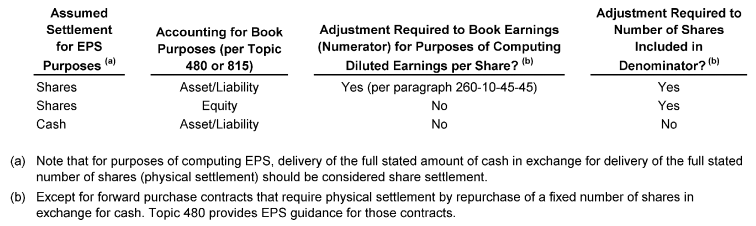
260-10-55-21
The preceding provisions also apply to investments in common stock of corporate joint ventures and investee companies accounted for under the equity method.
260-10-55-22
The if-converted method shall be used in determining the EPS impact of securities issued by a parent entity that are convertible into common stock of a subsidiary or an investee entity accounted for under the equity method. That is, the securities shall be assumed to be converted and the numerator (income available to common stockholders) adjusted as necessary in accordance with the provisions in paragraph 260-10-45-40(a) through (b). In addition to those adjustments, the numerator shall be adjusted appropriately for any change in the income recorded by the parent (such as dividend income or equity method income) due to the increase in the number of common shares of the subsidiary or equity method investee outstanding as a result of the assumed conversion. The denominator of the diluted EPS computation would not be affected because the number of shares of parent entity common stock outstanding would not change upon assumed conversion.
260-10-55-23
If an entity has common shares issued in a partially paid form (permitted in some countries) and those shares are entitled to dividends in proportion to the amount paid, the common-share equivalent of those partially paid shares shall be included in the computation of basic EPS to the extent that they were entitled to participate in dividends. Partially paid stock subscriptions that do not share in dividends until fully paid are considered the equivalent of warrants and shall be included in diluted EPS by use of the treasury stock method. That is, the unpaid balance shall be assumed to be proceeds used to purchase stock under the treasury stock method. The number of shares included in diluted EPS shall be the difference between the number of shares subscribed and the number of shares assumed to be purchased.
260-10-55-23A
Paragraphs provide additional guidance on the requirements in paragraph 260-10-45-65 related to the allocation of undistributed earnings to participating securities.
260-10-55-24
In all of the following circumstances, the participation rights of the securities may be required to be disclosed in accordance with the provisions of Subtopic 505-10, regardless of whether undistributed earnings are allocated to the participating security.
260-10-55-25
If a participating security provides the holder with the ability to participate in all dividends declared with the holders of common stock on a one-to-one per-share basis, then the undistributed earnings should be allocated between the common stock and the participating security on a one-to-one per-share basis.
260-10-55-26
If a participating security provides the holder with the ability to participate with the holders of common stock in dividends declared contingent upon the occurrence of a specified event, the occurrence of which is subject to management discretion or is not objectively determinable (for example, liquidation of the entity or management determination of an extraordinary dividend), then the terms of the participating security do not specify objectively determinable, nondiscretionary participation rights; therefore, undistributed earnings would not be allocated to the participating security.
260-10-55-27
If a participating security provides the holder with the ability to participate with the holders of common stock in earnings for a period in which a specified event occurs, regardless of whether a dividend is paid during the period (for example, achievement of a target market price of a security or achievement of a certain earnings level), then undistributed earnings would be allocated to common stock and the participating security based on the assumption that all of the earnings for the period are distributed. Undistributed earnings would be allocated to the participating security if the contingent condition would have been satisfied at the reporting date, irrespective of whether an actual distribution was made for the period.
260-10-55-28
If a participating security provides the holder with the ability to participate in extraordinary dividends and the classification of dividends as extraordinary is predetermined by a formula, for example, any dividend per common share in excess of 5 percent of the current market price of the stock is defined as extraordinary, then undistributed earnings would be allocated to common stock and the participating security based on the assumption that all of the earnings for the period are distributed. If earnings for a given period exceed the specified threshold above which the participating security would participate (that is, earnings for the period are in excess of 5 percent of the current market price of the stock), undistributed earnings would be allocated to the participating security according to its terms.
260-10-55-29
If a participating security provides the holder with the ability to participate in extraordinary dividends and the classification of dividends as extraordinary is within the sole discretion of the board of directors, then undistributed earnings would be allocated only to common stock. Since the classification of dividends as extraordinary is within the sole discretion of the board of directors, undistributed earnings would not be allocated to the participating security as the participation in the undistributed earnings would not be objectively determinable.
260-10-55-30
If a participating security provides the holder with the ability to participate in all dividends up to a specified threshold (for example, the security participates in dividends per common share up to 5 percent of the current market price of the stock), then undistributed earnings would be allocated to common stock and the participating security based on the assumption that all of the earnings for the period are distributed. In this example, undistributed earnings would be allocated to common stock and to the participating security up to 5 percent of the current market price of the common stock, as the amount of the threshold for participation by the participating security is objectively determinable. The remaining undistributed earnings for the period would be allocated to common stock.
260-10-55-31
See Example 9 (paragraph 260-10-55-71) for an illustration of this guidance.
260-10-55-32
Adjustments shall be made to the numerator for contracts that are asset or liability classified, in accordance with Section 815-40-25, but for which the potential common shares are included in the denominator in accordance with the guidance in paragraph 260-10-45-45. For purposes of computing diluted EPS, the adjustments to the numerator are only permitted for instruments for which the effect on net income (the numerator) is different depending on whether the instrument is accounted for as an equity instrument or as an asset or liability (for example, those that are within the scope of Subtopics 480-10 and 815-40).
260-10-55-33
The references in paragraphs 260-10-45-30 and 260-10-45-45 for share-based payment arrangements that are payable in common stock or in cash at the election of either the entity or the grantee refer to using the guidance in paragraph 260-10-45-45Afor purposes of determining whether shares issuable in accordance with such plans are included in the denominator for purposes of computing diluted EPS amounts. Accordingly, the numerator is not adjusted in those circumstances. Paragraph 260-10-55-36A illustrates these requirements.
260-10-55-34
Year-to-date diluted EPS calculations may require an adjustment to the numerator in certain circumstances. For example, for contracts that are share settled for EPS purposes, the numerator adjustment is equal to the earnings effect of the change in the fair value of the asset or liability recorded pursuant to Section 815-40-35 during the year-to-date period. In that example, the number of incremental shares included in the denominator should be determined in accordance with the guidance in paragraph 260-10-55-3.
260-10-55-36A
The following table illustrates the guidance in paragraphs and for the effects of contracts that may be settled in stock or cash on the computation of diluted EPS.
  • Assumed Settlement for EPS Purposes (a) Accounting for Book Purposes (per Topic 480 or 815) Adjustment Required to Book Earnings (Numerator) for Purposes of Computing Diluted Earnings per Share? (b) Adjustment Required to Number of Shares Included in Denominator? (b) Shares Asset/Liability Yes (per paragraph 260-10-45-45) Yes Shares Equity No Yes Cash Asset/Liability No No (a) "Note that for purposes of computing EPS, delivery of the full stated amount of cash in exchange for delivery of the full stated number of shares (physical settlement) should be considered share settlement." (b) Except for forward purchase contracts that require physical settlement by repurchase of a fixed number of shares in exchange for cash. Topic 480 provides EPS guidance for those contracts.

Illustrations

260-10-55-37
The following Examples illustrate this Subtopic's application to entities with complex capital structures. Certain assumptions have been made to simplify the computations and focus on the issue at hand in each Example.
260-10-55-38
This Example illustrates the quarterly and annual computations of basic and diluted EPS in the year 20X1 for Entity A, which has a complex capital structure. The control number used in this Example (and in Example 2) is income from continuing operations. Paragraph 260-10-55-49 illustrates the presentation of basic and diluted EPS on the face of the income statement. The facts assumed are as follows:
  1. a
    Average market price of common stock. The average market prices of common stock for the calendar-year 20X1 were as follows.
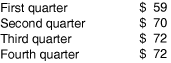
    • First quarter $59 Second quarter $70 Third quarter $72 Fourth quarter $72
  2. b
    The average market price of common stock from July 1 to September 1, 20X1 was $71.
  3. c
    Common stock. The number of shares of common stock outstanding at the beginning of 20X1 was 3,300,000. On March 1, 20X1, 100,000 shares of common stock were issued for cash.
  4. d
    Convertible debentures. In the last quarter of 20X0, 4 percent convertible debentures with a principal amount of $10,000,000 due in 20 years were sold for cash at $1,000 (par). Interest is payable semiannually on November 1 and May 1. Each $1,000 debenture is convertible into 20 shares of common stock. No debentures were converted in 20X0. The entire issue was converted on April 1, 20X1, because the issue was called by Entity A.
  5. e
    Convertible preferred stock. In the second quarter of 20X0, 600,000 shares of convertible preferred stock were issued for assets in a purchase transaction. The quarterly dividend on each share of that convertible preferred stock is $0.05, payable at the end of the quarter. Each share is convertible into one share of common stock. Holders of 500,000 shares of that convertible preferred stock converted their preferred stock into common stock on June 1, 20X1.
  6. f
    Warrants. Warrants to buy 500,000 shares of common stock at $60 per share for a period of 5 years were issued on January 1, 20X1. All outstanding warrants were exercised on September 1, 20X1.
  7. g
    Options. Options to buy 1,000,000 shares of common stock at $85 per share for a period of 10 years were issued on July 1, 20X1. No options were exercised during 20X1 because the exercise price of the options exceeded the market price of the common stock.
  8. h
    Tax rate. The tax rate was 40 percent for 20X1.
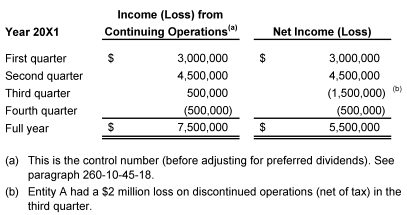
260-10-55-39
The following table illustrates the income (loss) from continuing operations.
  • Year 20X1 Income (Loss) from Continuing Operations(a) Net Income (Loss) First quarter " $3,000,000 " " $3,000,000 " Second quarter " 4,500,000 " " 4,500,000 " Third quarter " 500,000 " " (1,500,000)" (b) Fourth quarter " (500,000)" " (500,000)" Full year " $7,500,000 " " $5,500,000 " (a) This is the control number (before adjusting for preferred dividends). See paragraph 260-10-45-18. (b) Entity A had a $2 million loss on discontinued operations (net of tax) in the third quarter.
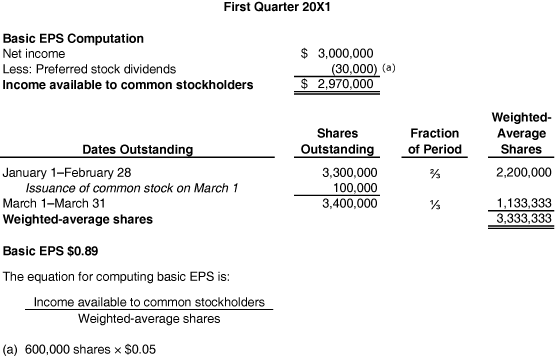
260-10-55-40
The following tables illustrate calculation of basic EPS for the first quarter.
  • First Quarter 20X1 Basic EPS Computation Net income " $3,000,000 " Less: Preferred stock dividends " (30,000)" (a) Income available to common stockholders " $2,970,000 " Dates Outstanding Shares Outstanding Fraction of Period Weighted-Average Shares January 1-February 28 "3,300,000" ⅔ "2,200,000" Issuance of common stock on March 1 "100,000" March 1-March 31 "3,400,000" ⅓ "1,133,333" Weighted-average shares "3,333,333" Basic EPS $0.89 The equation for computing basic EPS is: Income available to common stockholders Weighted-average shares (a) "600,000 shares × $0.05"
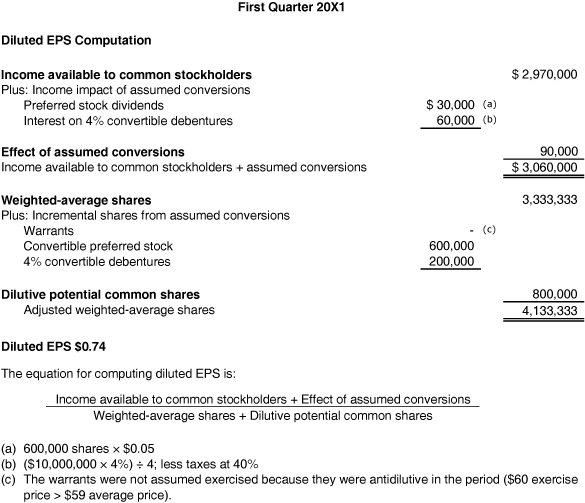
260-10-55-41
The following table illustrates calculation of diluted EPS for the first quarter.
  • First Quarter 20X1 Diluted EPS Computation Income available to common stockholders " $2,970,000 " Plus: Income impact of assumed conversions Preferred stock dividends " $30,000 " (a) Interest on 4% convertible debentures " 60,000 " (b) Effect of assumed conversions " 90,000 " Income available to common stockholders + assumed conversions " $3,060,000 " Weighted-average shares "3,333,333 " Plus: Incremental shares from assumed conversions Warrants - (c) Convertible preferred stock "600,000 " 4% convertible debentures "200,000 " Dilutive potential common shares "800,000 " Adjusted weighted-average shares "4,133,333 " Diluted EPS $0.74 The equation for computing diluted EPS is: Income available to common stockholders + Effect of assumed conversions Weighted-average shares + Dilutive potential common shares (a) "600,000 shares × $0.05" (b) "($10,000,000 × 4%) ÷ 4; less taxes at 40%" (c) The warrants were not assumed exercised because they were antidilutive in the period ($60 exercise price > $59 average price).
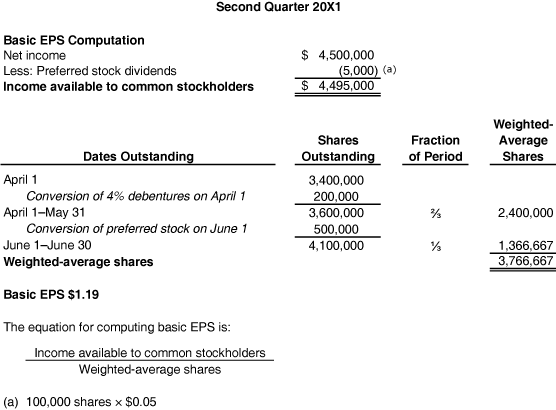
260-10-55-42
The following tables illustrate calculation of basic EPS for the second quarter.
  • Second Quarter 20X1 Basic EPS Computation Net income " $4,500,000 " Less: Preferred stock dividends " (5,000)" (a) Income available to common stockholders " $4,495,000 " Dates Outstanding Shares Outstanding Fraction of Period Weighted-Average Shares April 1 "3,400,000 " Conversion of 4% debentures on April 1 "200,000 " April 1-May 31 "3,600,000 " ⅔ "2,400,000" Conversion of preferred stock on June 1 "500,000 " June 1-June 30 "4,100,000 " ⅓ "1,366,667" Weighted-average shares "3,766,667" Basic EPS $1.19 The equation for computing basic EPS is: Income available to common stockholders Weighted-average shares (a) "100,000 shares × $0.05"
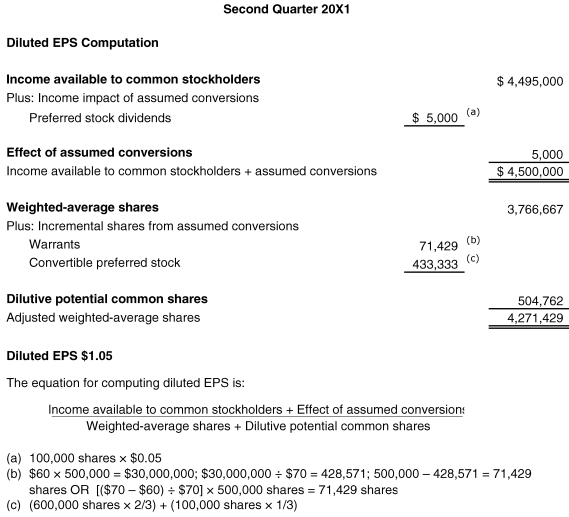
260-10-55-43
The following table illustrates calculation of diluted EPS for the second quarter.
  • Second Quarter 20X1 Diluted EPS Computation Income available to common stockholders " $4,495,000 " Plus: Income impact of assumed conversions Preferred stock dividends " $5,000 " (a) Effect of assumed conversions " 5,000 " Income available to common stockholders + assumed conversions " $4,500,000 " Weighted-average shares " 3,766,667 " Plus: Incremental shares from assumed conversions Warrants " 71,429 " (b) Convertible preferred stock " 433,333 " (c) Dilutive potential common shares " 504,762 " Adjusted weighted-average shares " 4,271,429 " Diluted EPS $1.05 The equation for computing diluted EPS is: Income available to common stockholders + Effect of assumed conversions Weighted-average shares + Dilutive potential common shares (a) "100,000 shares × $0.05" (b) "$60 × 500,000 = $30,000,000; $30,000,000 ÷ $70 = 428,571; 500,000 - 428,571 = 71,429 shares OR [($70 - $60) ÷ $70] × 500,000 shares = 71,429 shares" (c) "(600,000 shares × 2/3) + (100,000 shares × 1/3)"
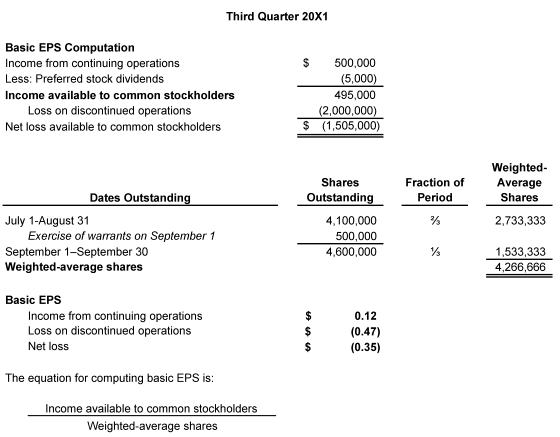
260-10-55-44
The following tables illustrate calculation of basic EPS for the third quarter.
  • Third Quarter 20X1 Basic EPS Computation Income from continuing operations " $500,000 " Less: Preferred stock dividends " (5,000)" Income available to common stockholders " 495,000 " Loss on discontinued operations " (2,000,000)" Net loss available to common stockholders " $(1,505,000)" Dates Outstanding Shares Outstanding Fraction of Period Weighted- Average Shares July 1-August 31 "4,100,000 " ⅔ "2,733,333 " Exercise of warrants on September 1 "500,000 " September 1-September 30 "4,600,000 " ⅓ "1,533,333 " Weighted-average shares "4,266,666 " Basic EPS Income from continuing operations $0.12 Loss on discontinued operations $(0.47) Net loss $(0.35) The equation for computing basic EPS is: Income available to common stockholders Weighted-average shares
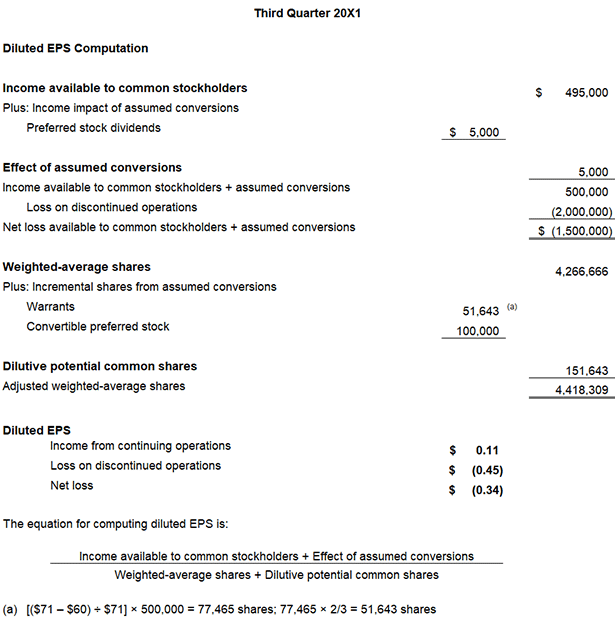
260-10-55-45
The following tables illustrate calculation of diluted EPS for the third quarter.
  • Third Quarter 20X1 Diluted EPS Computation Income available to common stockholders " $495,000 " Plus: Income impact of assumed conversions Preferred stock dividends " $5,000 " Effect of assumed conversions " 5,000 " Income available to common stockholders + assumed conversions " 500,000 " Loss on discontinued operations " (2,000,000)" Net loss available to common stockholders + assumed conversions " $(1,500,000)" Weighted-average shares " 4,266,666 " Plus: Incremental shares from assumed conversions Warrants " 51,643 " (a) Convertible preferred stock " 100,000 " Dilutive potential common shares " 151,643 " Adjusted weighted-average shares " 4,418,309 " Diluted EPS Income from continuing operations $0.11 Loss on discontinued operations $(0.45) Net loss $(0.34) The equation for computing diluted EPS is: Income available to common stockholders + Effect of assumed conversions Weighted-average shares + Dilutive potential common shares (a) "[($71 - $60) ÷ $71] × 500,000 = 77,465 shares; 77,465 × 2/3 = 51,643 shares"
  • Note that the incremental shares from assumed conversions are included in computing the diluted per-share amounts for the discontinued operation and net loss even though they are antidilutive. This is because the control number (income from continuing operations, adjusted for preferred dividends) was income, not a loss. (See paragraphs .)
Transition date:(P) December 16, 2026; (N) December 16, 2026Transition guidance:
260-10-65-5The following tables illustrate calculation of diluted EPS for the third quarter.
  • Third Quarter 20X1 Diluted EPS Computation Income available to common stockholders " $495,000 " Plus: Income impact of assumed conversions Preferred stock dividends " $5,000 " Effect of assumed conversions " 5,000 " Income available to common stockholders + assumed conversions " 500,000 " Loss on discontinued operations " (2,000,000)" Net loss available to common stockholders + assumed conversions " $(1,500,000)" Weighted-average shares " 4,266,666 " Plus: Incremental shares from assumed conversions Warrants " 51,643 " (a) Convertible preferred stock " 100,000 " Dilutive potential common shares " 151,643 " Adjusted weighted-average shares " 4,418,309 " Diluted EPS Income from continuing operations $0.11 Loss on discontinued operations $(0.45) Net loss $(0.34) The equation for computing diluted EPS is: Income available to common stockholders + Effect of assumed conversions Weighted-average shares + Dilutive potential common shares (a) "[($71 - $60) ÷ $71] × 500,000 = 77,465 shares; 77,465 × 2/3 = 51,643 shares"
  • Note that the incremental shares from assumed conversions are included in computing the diluted per-share amounts for the discontinued operation and net loss even though they are antidilutive. This is because the incremental shares are dilutive to the control number (income from continuing operations, adjusted for preferred dividends). (See paragraphs .)
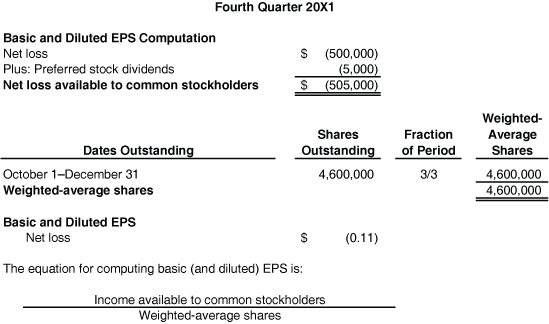
260-10-55-46
The following tables illustrate calculation of basic and diluted EPS for the fourth quarter.
  • Fourth Quarter 20X1 Basic and Diluted EPS Computation Net loss " $(500,000)" Plus: Preferred stock dividends " (5,000)" Net loss available to common stockholders " $(505,000)" Dates Outstanding Shares Outstanding Fraction of Period Weighted- Average Shares October 1-December 31 " 4,600,000 " 3/3 " 4,600,000 " Weighted-average shares " 4,600,000 " Basic and Diluted EPS Net loss $(0.11) The equation for computing basic (and diluted) EPS is: Income available to common stockholders Weighted-average shares
  • Note that the incremental shares from assumed conversions are not included in computing the diluted per-share amounts for net loss because the control number (net loss adjusted for preferred dividends) was a loss, not income. (See paragraphs .)
Transition date:(P) December 16, 2026; (N) December 16, 2026Transition guidance:
260-10-65-5The following tables illustrate calculation of basic and diluted EPS for the fourth quarter.
  • Fourth Quarter 20X1 Basic and Diluted EPS Computation Net loss " $(500,000)" Plus: Preferred stock dividends " (5,000)" Net loss available to common stockholders " $(505,000)" Dates Outstanding Shares Outstanding Fraction of Period Weighted- Average Shares October 1-December 31 " 4,600,000 " 3/3 " 4,600,000 " Weighted-average shares " 4,600,000 " Basic and Diluted EPS Net loss $(0.11) The equation for computing basic (and diluted) EPS is: Income available to common stockholders Weighted-average shares
  • Note that the incremental shares from assumed conversions are not included in computing the diluted per-share amounts for net loss because the effect of including those incremental shares would be antidilutive to the control number (net loss adjusted for preferred dividends). (See paragraphs .)
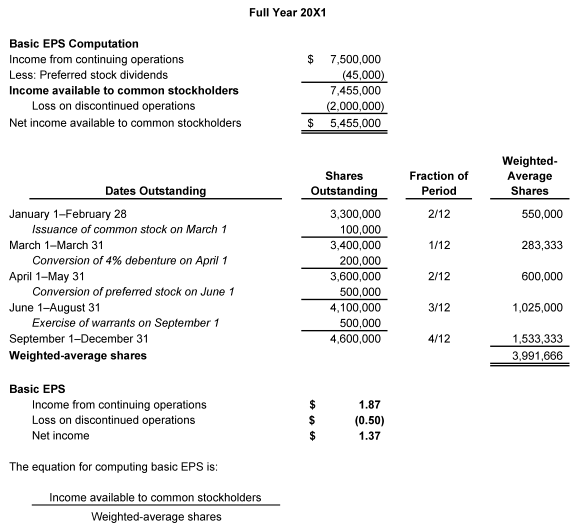
260-10-55-47
The following tables illustrate calculation of basic EPS for the full year 20X1.
  • Full Year 20X1 Basic EPS Computation Income from continuing operations " $7,500,000 " Less: Preferred stock dividends " (45,000)" Income available to common stockholders " 7,455,000 " Loss on discontinued operations " (2,000,000)" Net income available to common stockholders " $5,455,000 " Dates Outstanding Shares Outstanding Fraction of Period Weighted-Average Shares January 1-February 28 " 3,300,000 " 2/12 " 550,000 " Issuance of common stock on March 1 " 100,000 " March 1-March 31 " 3,400,000 " 1/12 " 283,333 " Conversion of 4% debenture on April 1 " 200,000 " April 1-May 31 " 3,600,000 " 2/12 " 600,000 " Conversion of preferred stock on June 1 " 500,000 " June 1-August 31 " 4,100,000 " 3/12 " 1,025,000 " Exercise of warrants on September 1 " 500,000 " September 1-December 31 " 4,600,000 " 4/12 " 1,533,333 " Weighted-average shares " 3,991,666 " Basic EPS Income from continuing operations $1.87 Loss on discontinued operations $(0.50) Net income $1.37 The equation for computing basic EPS is: Income available to common stockholders Weighted-average shares
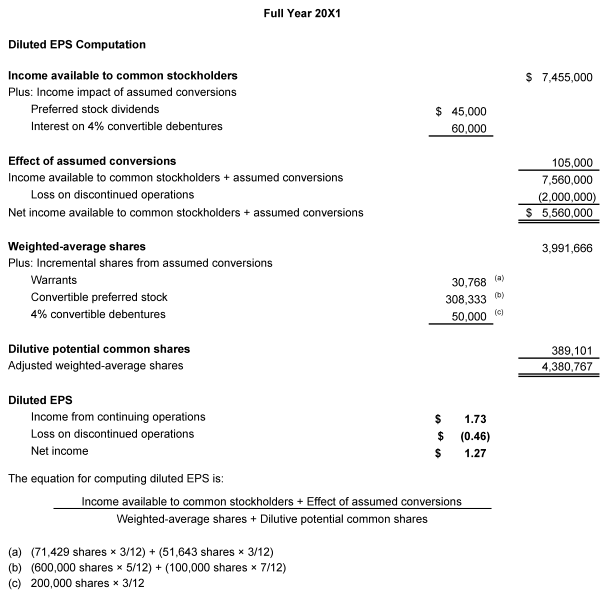
260-10-55-48
The following tables illustrate calculation of diluted EPS for the full year 20X1.
  • Full Year 20X1 Diluted EPS Computation Income available to common stockholders " $7,455,000 " Plus: Income impact of assumed conversions Preferred stock dividends " $45,000 " Interest on 4% convertible debentures " 60,000 " Effect of assumed conversions " 105,000 " Income available to common stockholders + assumed conversions " 7,560,000 " Loss on discontinued operation " (2,000,000)" Net income available to common stockholders + assumed conversions " $5,560,000 " Weighted-average shares " 3,991,666 " Plus: Incremental shares from assumed conversions Warrants " 30,768 " (a) Convertible preferred stock " 308,333 " (b) 4% convertible debentures " 50,000 " (c) Dilutive potential commons shares " 389,101 " Adjusted weighted-average shares " 4,380,767 " Diluted EPS Income from continuing operation $1.73 Loss on discontinued operation $(0.46) Net income $1.27 The equation for computing diluted EPS is: Income available to common stockholders + Effect of assumed conversions Weighted-average shares + Dilutive potential common shares (a) "(71,429 shares × 3/12) + (51,643 shares × 3/12)" (b) "(600,000 shares × 5/12) + (100,000 shares × 7/12)" (c) "200,000 shares × 3/12"
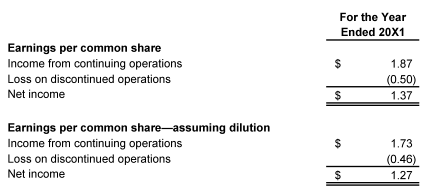
260-10-55-49
The following table illustrates how Entity A might present its EPS data on its income statement. Note that the per-share amount for the discontinued operation is not required to be shown on the face of the income statement.
  • For the Year Ended 20X1 Earnings per common share Income from continuing operation $1.87 Loss on discontinued operations (0.50) Net income $1.37 Earnings per common share—assuming dilution Income from continuing operation $1.73 Loss on discontinued operations (0.46) Net income $1.27
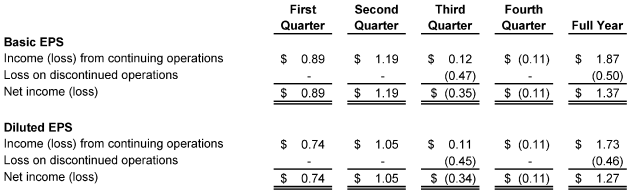
260-10-55-50
The following table includes the quarterly and annual EPS data for Entity A. The purpose of this table is to illustrate that the sum of the four quarters' EPS data will not necessarily equal the annual EPS data. This Subtopic does not require disclosure of this information.
  • First Quarter Second Quarter Third Quarter Fourth Quarter Full Year Basic EPS Income (loss) from continuing operations $0.89 $1.19 $0.12 $(0.11) $1.87 Loss on discontinued operations - - (0.47) - (0.50) Net income (loss) $0.89 $1.19 $(0.35) $(0.11) $1.37 Diluted EPS Income (loss) from continuing operations $0.74 $1.05 $0.11 $(0.11) $1.73 Loss on discontinued operations - - (0.45) - (0.46) Net income (loss) $0.74 $1.05 $(0.34) $(0.11) $1.27
260-10-55-51
This Example illustrates the reconciliation of the numerators and denominators of the basic and diluted EPS computations for income from continuing operations and other related disclosures required by paragraph 260-10-50-1 for Entity A in Example 1. Note that Topic 718 has specific disclosure requirements related to share-based compensation arrangements.
Transition date:(P) June 30, 2027; (N) June 30, 2027Transition guidance:
105-10-65-7
Editor's Note: The pending content for paragraph 260-10-55-51 linked to paragraph 105-10-65-7 will be removed upon transition of paragraph 270-10-65-1.
This Example illustrates the reconciliation of the numerators and denominators of the basic and diluted EPS computations for income from continuing operations and other related disclosures required by paragraph 260-10-50-1 for Entity A in Example 1. This disclosure is required in both interim and annual periods. Note that Topic 718 has specific disclosure requirements related to share-based compensation arrangements.
Transition date:(P) December 16, 2027; (N) December 16, 2028Transition guidance:
270-10-65-1This Example illustrates the reconciliation of the numerators and denominators of the basic and diluted EPS computations for income from continuing operations and other related disclosures required by paragraph 260-10-50-1 for Entity A in Example 1. This disclosure is required in both interim and annual periods. Note that Topic 718 has specific disclosure requirements related to share-based compensation arrangements.
260-10-55-52
The following table illustrates the computation of basic and diluted EPS for the year ended 20X1.
  • For the Year Ended 20X1 Income (Numerator) Shares (Denominator) Per-Share Amount Income from continuing operations " $7,500,000 " Less: Preferred stock dividends " (45,000)" Basic EPS Income available to common stockholders " 7,455,000 " "3,991,666" $1.87 Effect of Dilutive Securities Warrants "30,768" Convertible preferred stock " 45,000 " "308,333" 4% convertible debentures " 60,000 " "50,000" Diluted EPS Income available to common stockholders + assumed conversions " $7,560,000 " "4,380,767" $1.73
  • Options to purchase 1,000,000 shares of common stock at $85 per share were outstanding during the second half of 20X1 but were not included in the computation of diluted EPS because the options' exercise price was greater than the average market price of the common shares. The options, which expire on June 30, 20Y1, were still outstanding at the end of year 20X1.
Transition date:(P) June 30, 2027; (N) June 30, 2027Transition guidance:
105-10-65-7The following table illustrates the computation of basic and diluted EPS for the year ended 20X1.
  • For the Year Ended 20X1 Income (Numerator) Shares (Denominator) Per-Share Amount Income from continuing operations " $7,500,000 " Less: Preferred stock dividends " (45,000)" Basic EPS Income available to common stockholders " 7,455,000 " "3,991,666" $1.87 Effect of Dilutive Securities Warrants "30,768" Convertible preferred stock " 45,000 " "308,333" 4% convertible debentures " 60,000 " "50,000" Diluted EPS Income available to common stockholders + assumed conversions " $7,560,000 " "4,380,767" $1.73
Diluted EPS was computed using the treasury stock method for warrants and the if-converted method for convertible instruments. Options to purchase 1,000,000 shares of common stock at $85 per share were outstanding during the second half of 20X1 but were not included in the computation of diluted EPS because the options' exercise price was greater than the average market price of the common shares. The options, which expire on June 30, 20Y1, were still outstanding at the end of year 20X1.
260-10-55-53
This Example illustrates the contingent share provisions described in paragraphs 260-10-45-13 and . This Example has the following assumptions:
  1. a
    Entity A had 100,000 shares of common stock outstanding during the entire year ended December 31, 20X1. It had no options, warrants, or convertible securities outstanding during the period.
  2. b
    Terms of a contingent stock agreement related to a recent business combination provided the following to certain shareholders of Entity A:
    1. 1
      1,000 additional common shares for each new retail site opened during 20X1
    2. 2
      5 additional common shares for each $100 of consolidated, after-tax net income in excess of $500,000 for the year ended December 31, 20X1.
  3. c
    Entity A opened two new retail sites during the year:
    1. 1
      One on May 1, 20X1
    2. 2
      One on September 1, 20X1.
  4. d
    Entity A's consolidated, year-to-date after-tax net income was:
    1. 1
      $400,000 as of March 31, 20X1
    2. 2
      $600,000 as of June 30, 20X1
    3. 3
      $450,000 as of September 30, 20X1
    4. 4
      $700,000 as of December 31, 20X1.
260-10-55-54
Note that in computing diluted EPS for an interim period, contingent shares are included as of the beginning of the period. For year-to-date computations, paragraph 260-10-45-49 requires that contingent shares be included on a weighted-average basis.
260-10-55-55
The following table illustrates the quarterly and annual calculation of basic and diluted EPS.
260-10-55-56
First Quarter Second Quarter Third Quarter Fourth Quarter Full Year Basic EPS Computation Numerator " $400,000 " " $200,000 " " $(150,000)" " $250,000 " " $700,000 " Denominator: Common shares outstanding "100,000 " "100,000 " "100,000 " "100,000 " "100,000 " Retail site contingency 0 667 (a) "1,333 " (b) "2,000 " "1,000 " (c) Earnings contingency (d) 0 0 0 0 0 Total shares "100,000 " "100,667 " "101,333 " "102,000 " "101,000 " Basic EPS $4.00 $1.99 $(1.48) $2.45 $6.93 First Quarter Second Quarter Third Quarter Fourth Quarter Full Year Diluted EPS Computation Numerator " $400,000 " " $200,000 " " $(150,000)" " $250,000 " " $700,000 " Denominator: Common shares outstanding "100,000 " "100,000 " "100,000 " "100,000 " "100,000 " Retail site contingency 0 "1,000 " "2,000 " "2,000 " "1,250 " (e) Earnings contingency 0 (f) "5,000 " (g) 0 (h) "10,000 " (i) "3,750 " (j) Total shares "100,000 " "106,000 " "102,000 " "112,000 " "105,000 " Diluted EPS $4.00 $1.89 $(1.47) (k) $2.23 $6.67 (a) "1,000 shares × ⅔" (b) "1,000 shares + (1,000 shares × ⅓)" (c) "(1,000 shares × 8/12) + (1,000 shares × 4/12)" (d) The earnings contingency has no effect on basic EPS because it is not certain that the condition is satisfied until the end of the contingency period (see paragraphs 260-10-45-50 through 45-57). The effect is negligible for the fourth-quarter and full-year computations because it is not certain that the condition is met until the last day of the period. (e) "(0 + 1,000 + 2,000 + 2,000) ÷ 4" (f) "Entity A did not have $500,000 year-to-date, after-tax net income at March 31, 20X1. Projecting future earnings levels and including the related contingent shares are not permitted by this Subtopic." (g) "[($600,000 - $500,000) ÷ $100] × 5 shares" (h) "Year-to-date, after-tax net income was less than $500,000." (i) "[($700,000 - $500,000) ÷ $100] × 5 shares" (j) "(0 + 5,000 + 0 + 10,000) ÷ 4" (k) "Loss during the third quarter is due to an extraordinary item; therefore, antidilution rules (see paragraph 260-10-45-17) do not apply."
260-10-55-57
This Example illustrates the antidilution sequencing provisions described in paragraph 260-10-45-18 for Entity A for the year ended December 31, 20X0. This Example has the following assumptions:
  1. a
    Entity A had income available to common stockholders of $10,000,000 for the year 20X0.
  2. b
    2,000,000 shares of common stock were outstanding for the entire year 20X0.
  3. c
    The average market price of the common stock was $75.
  4. d
    Entity A had the following potential common shares outstanding during the year:
    1. 1
      Options (not compensation- related) to buy 100,000 shares of common stock at $60 per share.
    2. 2
      800,000 shares of convertible preferred stock entitled to a cumulative dividend of $8 per share. Each preferred share is convertible into two shares of common stock.
    3. 3
      5 percent convertible debentures with a principal amount of $100,000,000 (issued at par). Each $1,000 debenture is convertible into 20 shares of common stock.
  5. e
    The tax rate was 40 percent for 20X0.
260-10-55-58
The following table illustrates calculation of earnings per incremental share.
  • Determination of Earnings per Incremental Share Increase in Income Increase in Number of Common Shares Earnings per Incremental Share Options - "20,000 " (a) - Convertible preferred stock " $6,400,000 " (b) "1,600,000 " (c) $4.00 5% convertible debentures " 3,000,000 " (d) "2,000,000 " (e) 1.50 (a) "[($75 - $60) ÷ $75] × 100,000" (b) "800,000 shares × $8" (c) "800,000 shares × 2" (d) "($100,000,000 × 5%) less taxes at 40%" (e) "100,000 debentures × 20"
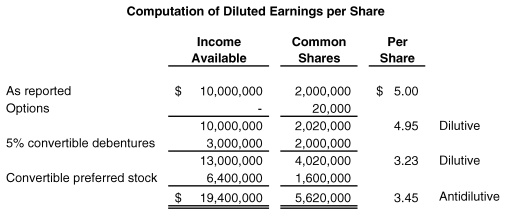
260-10-55-59
The following table illustrates calculation of diluted EPS.
  • Computation of Diluted Earnings per Share Income Available Common Shares Per Share As reported " $10,000,000 " " 2,000,000 " $5.00 Options - " 20,000 " " 10,000,000 " " 2,020,000 " 4.95 Dilutive 5% convertible debentures " 3,000,000 " " 2,000,000 " " 13,000,000 " " 4,020,000 " 3.23 Dilutive Convertible preferred stock " 6,400,000 " " 1,600,000 " " $19,400,000 " " 5,620,000 " 3.45 Antidilutive
  • Note that because diluted EPS increases from $3.23 to $3.45 when convertible preferred shares are included in the computation, those convertible preferred shares are antidilutive and are ignored in the computation of diluted EPS. Therefore, diluted EPS is reported as $3.23.
260-10-55-60
This Example illustrates the provisions for stock rights issues that contain a bonus element as described in paragraphs . This Example has the following assumptions:
  1. a
    Net income was $1,100 for the year ended December 31, 20X0.
  2. b
    500 common shares were outstanding for the entire year ended December 31, 20X0.
  3. c
    A rights issue was offered to all existing shareholders in January 20X1. The last date to exercise the rights was March 1, 20X1. The offer provided 1 common share for each 5 outstanding common shares (100 new shares).
  4. d
    The exercise price for the rights issue was $5 per share acquired.
  5. e
    The fair value of 1 common share was $11 at March 1, 20X1.
  6. f
    Basic EPS for the year 20X0 (prior to the rights issuance) was $2.20.
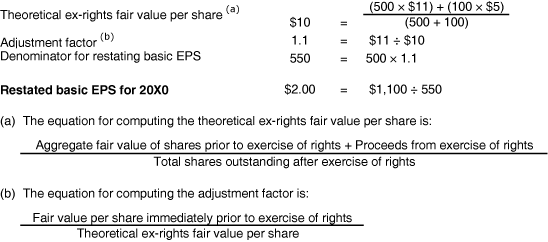
260-10-55-61
As a result of the bonus element in the January 20X1 rights issue, basic and diluted EPS for 20X0 will have to be adjusted retroactively. The number of common shares used in computing basic and diluted EPS is the number of shares outstanding immediately prior to the rights issue (500) multiplied by an adjustment factor. Prior to computing the adjustment factor, the theoretical ex-rights fair value per share must be computed. Those computations follow.
  • Theoretical ex-rights fair value per share (a) $10 = (500 × $11) + (100 × $5) (500 + 100) Adjustment factor (b) 1.1 = $11 ÷ $10 Denominator for restating basic EPS 550 = 500 × 1.1 Restated basic EPS for 20X0 $2.00 = " $1,100 ÷ 550 " (a) The equation for computing the theoretical ex-rights fair value per share is: Aggregate fair value of shares prior to exercise of rights + Proceeds from exercise of rights Total shares outstanding after exercise of rights (b) The equation for computing the adjustment factor is: Fair value per share immediately prior to exercise of rights Theoretical ex-rights fair value per share
  • Diluted EPS would be adjusted retroactively by adding 50 shares to the denominator that was used in computing diluted EPS prior to the restatement.
260-10-55-62
This Example illustrates the two-class method of computing basic EPS (see paragraph 260-10-45-60B) for an entity that has more than one class of nonconvertible securities. This method is described in paragraphs . Diluted EPS would be computed in a similar manner. This Example has the following assumptions for the year 20X0:
  1. a
    Net income was $65,000.
  2. b
    10,000 shares of $50 par value common stock were outstanding.
  3. c
    5,000 shares of $100 par value nonconvertible preferred stock were outstanding.
  4. d
    The preferred stock was entitled to a noncumulative annual dividend of $5 per share before any dividend is paid on common stock.
  5. e
    After common stock has been paid a dividend of $2 per share, the preferred stock then participates in any additional dividends on a 40:60 per-share ratio with common stock. (That is, after preferred and common stock have been paid dividends of $5 and $2 per share, respectively, preferred stock participates in any additional dividends at a rate of two-thirds of the additional amount paid to common stock on a per-share basis.)
  6. f
    Preferred stockholders have been paid $27,000 ($5.40 per share).
  7. g
    Common stockholders have been paid $26,000 ($2.60 per share).
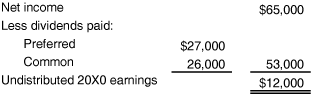
260-10-55-63
Basic EPS for 20X0 would be computed as follows.
  • Net income " $65,000 " Less dividends paid: Preferred " $27,000 " Common " 26,000 " " 53,000 " Undistributed 20X0 earnings " $12,000 "
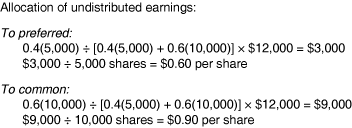
  • Allocation of undistributed earnings: To preferred: "0.4(5,000) ÷ [0.4(5,000) + 0.6(10,000)] × $12,000 = $3,000" "$3,000 ÷ 5,000 shares = $0.60 per share" To common: "0.6(10,000) ÷ [0.4(5,000) + 0.6(10,000)] × $12,000 = $9,000" "$9,000 ÷ 10,000 shares = $0.90 per share"
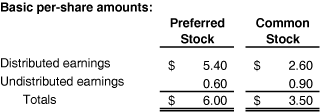
  • Basic per-share amounts: Preferred Stock Common Stock Distributed earnings $5.40 $2.60 Undistributed earnings 0.60 0.90 Totals $6.00 $3.50
260-10-55-64
This Example illustrates the EPS computations for a subsidiary's securities that enable their holders to obtain the subsidiary's common stock based on the provisions in paragraph 260-10-55-20. The facts assumed are as follows:
260-10-55-65
Parent Entity:
  1. a
    Net income was $10,000 (excluding any earnings of or dividends paid by the subsidiary).
  2. b
    10,000 shares of common stock were outstanding; the parent entity had not issued any other securities.
  3. c
    The parent entity owned 900 common shares of a domestic subsidiary entity.
  4. d
    The parent entity owned 40 warrants issued by the subsidiary.
  5. e
    The parent entity owned 100 shares of convertible preferred stock issued by the subsidiary.
260-10-55-66
Subsidiary Entity:
  1. a
    Net income was $3,600.
  2. b
    1,000 shares of common stock were outstanding.
  3. c
    Warrants exercisable to purchase 200 shares of its common stock at $10 per share (assume $20 average market price for common stock) were outstanding.
  4. d
    200 shares of convertible preferred stock were outstanding. Each share is convertible into two shares of common stock.
  5. e
    The convertible preferred stock paid a dividend of $1.50 per share.
  6. f
    No interentity eliminations or adjustments were necessary except for dividends.
  7. g
    Income taxes have been ignored for simplicity.
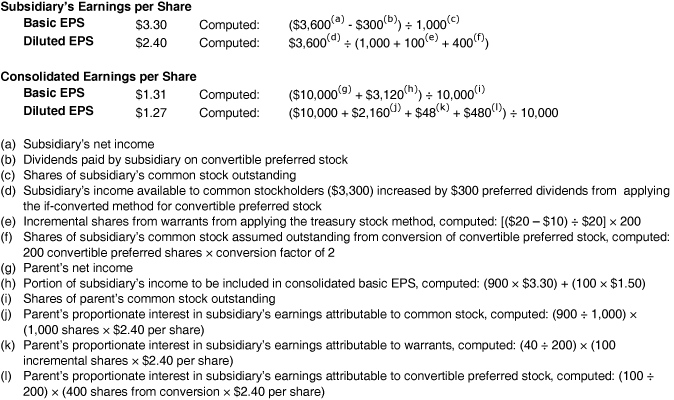
260-10-55-67
The following table illustrates subsidiary's EPS.
  • Subsidiary's Earnings per Share Basic EPS $3.30 Computed: "($3,600(a) - $300(b)) ÷ 1,000(c)" Diluted EPS $2.40 Computed: "$3,600(d) ÷ (1,000 + 100(e) + 400(f))" Consolidated Earnings per Share Basic EPS $1.31 Computed: "($10,000(g) + $3,120(h)) ÷ 10,000(i)" Diluted EPS $1.27 Computed: "($10,000 + $2,160(j) + $48(k) + $480(l)) ÷ 10,000" (a) Subsidiary's net income (b) Dividends paid by subsidiary on convertible preferred stock (c) Shares of subsidiary's common stock outstanding (d) "Subsidiary's income available to common stockholders ($3,300) increased by $300 preferred dividends from applying the if-converted method for convertible preferred stock" (e) "Incremental shares from warrants from applying the treasury stock method, computed: [($20 - $10) ÷ $20] × 200" (f) "Shares of subsidiary's common stock assumed outstanding from conversion of convertible preferred stock, computed: 200 convertible preferred shares × conversion factor of 2" (g) Parent's net income (h) "Portion of subsidiary's income to be included in consolidated basic EPS, computed: (900 × $3.30) + (100 × $1.50)" (i) Shares of parent's common stock outstanding (j) "Parent's proportionate interest in subsidiary's earnings attributable to common stock, computed: (900 ÷ 1,000) × (1,000 shares × $2.40 per share)" (k) "Parent's proportionate interest in subsidiary's earnings attributable to warrants, computed: (40 ÷ 200) × (100 incremental shares × $2.40 per share)" (l) "Parent's proportionate interest in subsidiary's earnings attributable to convertible preferred stock, computed: (100 ÷ 200) × (400 shares from conversion × $2.40 per share)"
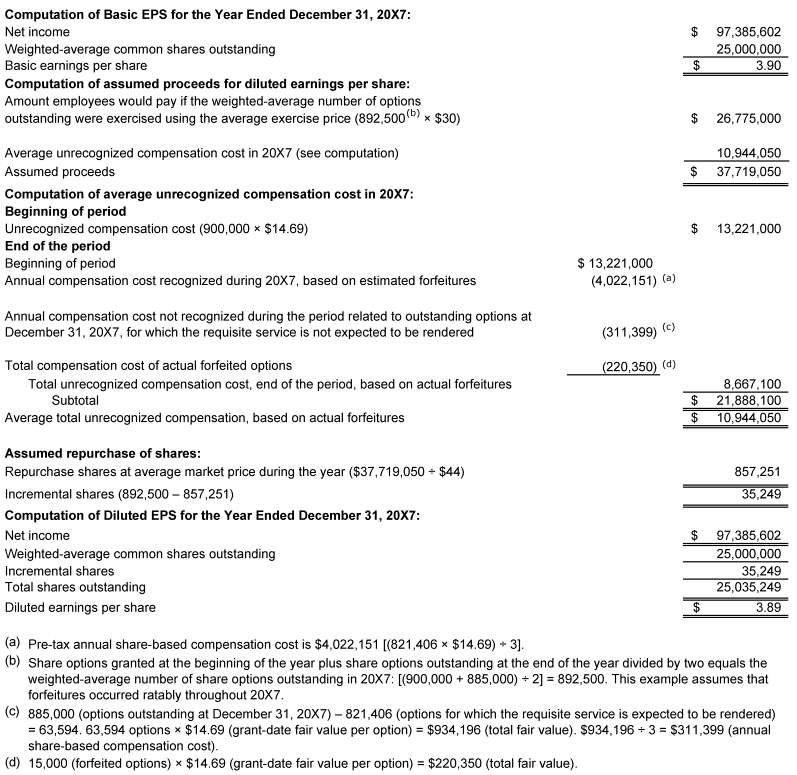
260-10-55-68
This Example illustrates the guidance in paragraph 260-10-45-28A for the application of the treasury stock method when share options are forfeited.
260-10-55-69
Entity A adopted a share option plan on January 1, 20X7, and granted 900,000 at-the-money share options with an exercise price of $30. All share options vest at the end of three years (cliff vesting). Entity A's accounting policy is to estimate the number of forfeitures expected to occur in accordance with paragraph 718-10-35-1D or 718-10-35-3. At the grant date, Entity A assumes an annual forfeiture rate of 3 percent and therefore expects to receive the service for 821,406 [900,000 × (.97 to the third power)] share options. On January 1, 20X7, the fair value of each share option granted is $14.69. Grantees forfeited 15,000 stock options ratably during 20X7.
260-10-55-69A
The average stock price during 20X7 is $44. Net income for the period is $97,385,602. For the year ended December 31, 20X7, there are 25,000,000 weighted-average common shares outstanding. This guidance also applies if the service inception date precedes the grant date.
260-10-55-70
The following table illustrates computation of basic and diluted EPS for the year ended December 31, 20X7.
  • "Computation of Basic EPS for the Year Ended December 31, 20X7:" Net income " $97,385,602 " Weighted-average common shares outstanding " 25,000,000 " Basic earnings per share $3.90 Computation of assumed proceeds for diluted earnings per share: Amount employees would pay if the weighted-average number of options "outstanding were exercised using the average exercise price (892,500 (b) ? $30)" " $26,775,000 " Average unrecognized compensation cost in 20X7 (see computation) " 10,944,050 " Assumed proceeds " $37,719,050 " Computation of average unrecognized compensation cost in 20X7: Beginning of period "Unrecognized compensation cost (900,000 ? $14.69)" " $13,221,000 " End of the period Beginning of period " $13,221,000 " "Annual compensation cost recognized during 20X7, based on estimated forfeitures" " (4,022,151)" (a) "Annual compensation cost not recognized during the period related to outstanding options at December 31, 20X7, for which the requisite service is not expected to be rendered" " (311,399)" (c) Total compensation cost of actual forfeited options " (220,350)" (d) "Total unrecognized compensation cost, end of the period, based on actual forfeitures" " 8,667,100 " Subtotal " $21,888,100 " "Average total unrecognized compensation, based on actual forfeitures" " $10,944,050 " Assumed repurchase of shares: "Repurchase shares at average market price during the year ($37,719,050 ö $44)" " 857,251 " "Incremental shares (892,500 ? 857,251)" " 35,249 " "Computation of Diluted EPS for the Year Ended December 31, 20X7:" Net income " $97,385,602 " Weighted-average common shares outstanding " 25,000,000 " Incremental shares " 35,249 " Total shares outstanding " 25,035,249 " Diluted earnings per share $3.89 (a) "Pre-tax annual share-based compensation cost is $4,022,151 [(821,406 ? $14.69) ö 3]. " (b) "Share options granted at the beginning of the year plus share options outstanding at the end of the year divided by two equals the weighted-average number of share options outstanding in 20X7: [(900,000 + 885,000) ö 2] = 892,500. This example assumes that forfeitures occurred ratably throughout 20X7." (c) "885,000 (options outstanding at December 31, 20X7) ? 821,406 (options for which the requisite service is expected to be rendered) = 63,594. 63,594 options ? $14.69 (grant-date fair value per option) = $934,196 (total fair value). $934,196 ö 3 = $311,399 (annual share-based compensation cost)." (d) "15,000 (forfeited options) ? $14.69 (grant-date fair value per option) = $220,350 (total fair value)."
260-10-55-71
Participating securities should be included in the computation of basic earnings per share using the two-class method. The following Cases illustrate the guidance in paragraphs for the application of the two-class method of computing basic earnings per share when:
  1. a
    An entity has participating convertible preferred stock (Case A).
  2. b
    An entity has participating convertible bonds (Case B).
  3. c
    An entity has participating warrants (Case C).
  4. d
    An entity has participating share-based payment awards (Case D).
260-10-55-72
The application of the two-class method in each of Cases A, B, and C presents an EPS calculation for both the common stock and the participating security. This presentation is for illustrative purposes only. The presentation of EPS is only required for each class of common stock (as clarified by this Example). However, the presentation of basic and diluted EPS for a participating security other than common stock is not precluded. Cases A, B, and C share both of the following assumptions:
  1. a
    10,000 shares of Class A common stock
  2. b
    Reported net income of $65,000 for 20X1.
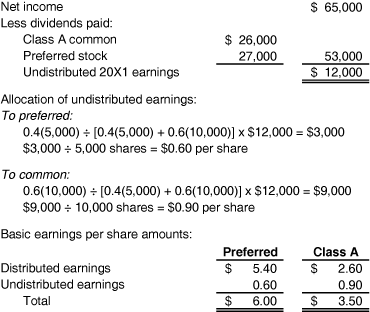
260-10-55-73
Assume that Entity A had 5,000 shares of preferred stock outstanding during 20X1. Each share of preferred stock is convertible into two shares of Class A common stock. The preferred stock is entitled to a noncumulative annual dividend of $5 per share. After Class A has been paid a dividend of $2 per share, the preferred stock then participates in any additional dividends on a 40:60 per share ratio with Class A. For 20X1, the Class A shareholders have been paid $26,000 (or $2.60 per share), and the preferred shareholders have been paid $27,000 (or $5.40 per share). Basic EPS under the two-class method for 20X1 would be computed as follows.
  • Net income " $65,000 " Less dividends paid: Class A common " $26,000 " Preferred stock " 27,000 " " 53,000 " Undistributed 20X1 earnings " $12,000 " Allocation of undistributed earnings: To preferred: "0.4(5,000) ÷ [0.4(5,000) + 0.6(10,000)] x $12,000 = $3,000" "$3,000 ÷ 5,000 shares = $0.60 per share" To common: "0.6(10,000) ÷ [0.4(5,000) + 0.6(10,000)] x $12,000 = $9,000" "$9,000 ÷ 10,000 shares = $0.90 per share" Basic earnings per share amounts: Preferred Class A Distributed earnings $5.40 $2.60 Undistributed earnings 0.60 0.90 Total $6.00 $3.50
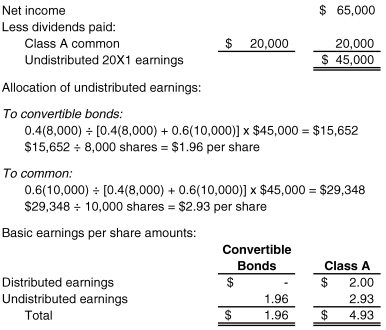
260-10-55-74
Assume that on January 1, 20X1, Entity A issues 1,000 30-year convertible bonds with an aggregate par value of $1,000,000. Each bond is convertible into 8 shares of Class A common stock and carries a coupon rate of 3 percent. After Class A has been paid a dividend of $2 per share, the bondholders then participate in any additional dividends on a 40:60 per share ratio with Class A shareholders. The bondholders receive common stock dividends based on the number of shares of common stock that the bonds are convertible into. The bondholders do not have any voting rights prior to conversion into common stock. For 20X1, the Class A shareholders have been paid $20,000 (or $2.00 per share). Basic EPS under the two-class method for 20X1 would be computed as follows.
  • Net income " $65,000 " Less dividends paid: Class A common " $20,000 " " 20,000 " Undistributed 20X1 earnings " $45,000 " Allocation of undistributed earnings: ` To convertible bonds: "0.4(8,000) ÷ [0.4(8,000) + 0.6(10,000)] x $45,000 = $15,652" "$15,652 ÷ 8,000 shares = $1.96 per share" To common: "0.6(10,000) ÷ [0.4(8,000) + 0.6(10,000)] x $45,000 = $29,348" "$29,348 ÷ 10,000 shares = $2.93 per share" Basic earnings per share amounts: Convertible Bonds Class A Distributed earnings $- $2.00 Undistributed earnings 1.96 2.93 Total $1.96 $4.93
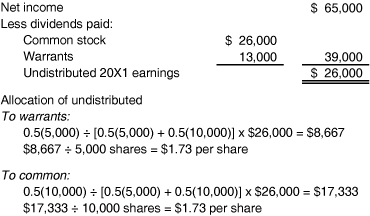
260-10-55-75
Assume that Entity A had warrants to purchase 5,000 shares of common stock outstanding during 20X1 Each warrant entitles the holder to purchase 1 share of common stock at $10 (fair value at date of grant) per share. In addition, the warrant holders receive dividends on the underlying common stock to the extent they are declared. For 20X1, common shareholders have been paid $26,000 (or $2.60 per share), and the warrant holders have been paid $13,000 (or, also, $2.60 per share). Basic EPS under the two-class method for 20X1 would be computed as follows:
  • Net income " $65,000 " Less dividends paid: Common stock " $26,000 " Warrants " 13,000 " " 39,000 " Undistributed 20X1 earnings " $26,000 " Allocation of undistributed earnings: To warrants: "0.5(5,000) ÷ [0.5(5,000) + 0.5(10,000)] x $26,000 = $8,667" "$8,667 ÷ 5,000 shares = $1.73 per share" To common: "0.5(10,000) ÷ [0.5(5,000) + 0.5(10,000)] x $26,000 = $17,333" "$17,333 ÷ 10,000 shares = $1.73 per share"
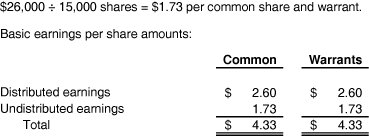
Or, to simplify, since the common shareholders and the warrant holders share in dividends on a one-to-one basis, undistributed earnings could also be calculated as follows.
  • "$26,000 ÷ 15,000 shares = $1.73 per common share and warrant." Basic earnings per share amounts: Common Warrants Distributed earnings $2.60 $2.60 Undistributed earnings 1.73 1.73 Total $4.33 $4.33
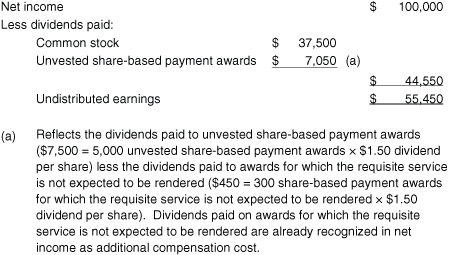
260-10-55-76A
Assume that Entity A had 25,000 shares of common stock and 5,000 unvested share-based payment awards outstanding during 20X8 and reported net income of $100,000. The share-based payment awards participate in any dividends on a 1:1 per-share ratio with common stock, and the dividends are nonforfeitable by the holder of the share-based payment awards. Entity A's accounting policy is to estimate the number of forfeitures expected to occur in accordance with paragraph 718-10-35-3.
260-10-55-76B
As of the beginning of 20X8, Entity A estimated that the requisite service will not be provided for 200 of the 5,000 share-based payment awards outstanding. At the end of 20X8, Entity A adjusts its estimate to reflect an increased expected forfeiture rate and now expects that the requisite service will not be provided for 300 awards. It recognizes the cumulative effect of this change in compensation cost in the current period.
260-10-55-76C
Entity A paid a $1.50 per-share dividend at the end of 20X8. Net income includes an expense of $450 related to dividends paid to the awards for which the requisite service is not expected to be rendered in accordance with paragraph 718-10-55-45. Basic EPS under the two-class method for 20X8 would be computed as follows:
  • Net income " $100,000.00 " Less dividends paid: Common stock " $37,500.00 " Unvested share-based payment awards " $7,050.00 " (a) " $44,550.00 " Undistributed earnings " $55,450.00 " (a) "Reflects the dividends paid to unvested share-based payment awards ($7,500 = 5,000 unvested share-based paymentawards × $1.50 dividend per share) less the dividends paid to awards for which the requisite service is not expected to be rendered ($450 = 300 share-based payment awards for which the requisite service is not expected to be rendered × $1.50 dividend per share). Dividends paid on awards for which the requisite service is not expected to be rendered are already recognized in net income as additional compensation cost."
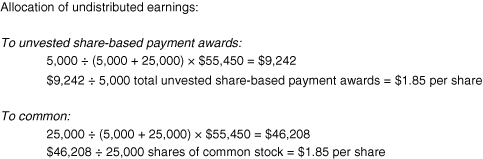
  • Allocation of undistributed earnings: To unvested share-based payment awards: "5,000 ÷ (5,000 + 25,000) × $55,450 = $9,242" "$9,242 ÷ 5,000 total unvested share-based payment awards = $1.85 per share" To common: "25,000 ÷ (5,000 + 25,000) × $55,450 = $46,208" "$46,208 ÷ 25,000 shares of common stock = $1.85 per share"
  • Or, to simplify, because the common shareholders and the share-based payment award holders share in dividends on a 1:1 basis, undistributed earnings could also be calculated as follows:

  • " $55,450 ÷ 30,000 shares(b) = $1.85 per common share and share-based payment award" "(b) 25,000 shares of common stock + 5,000 total unvested share-based payment awards"
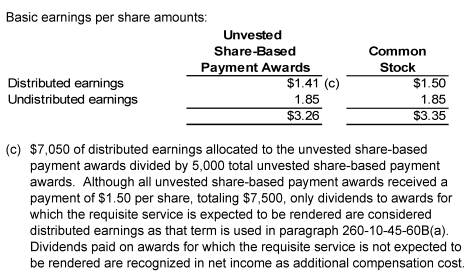
  • Basic earnings per share amounts: (c) "$7,050 of distributed earnings allocated to the unvested share-based payment awards divided by 5,000 total unvested share-based payment awards. Although all unvested share-based payment awards received a payment of $1.50 per share, totaling $7,500, only dividends to awards for which the requisite service is expected to be rendered are considered distributed earnings as that term is used in paragraph 260-10-55-19(a). Dividends paid on awards for which the requisite service is not expected to be rendered are recognized in net income as additional compensation cost."
260-10-55-76D
Note that in this illustrative example, application of the two-class method presents an EPS calculation for both the common stock and the participating security, that is, the unvested share-based payment awards. This presentation is for illustrative purposes only. The presentation of EPS is only required for each class of common stock. However, the presentation of basic and diluted EPS for a participating security other than common stock is not precluded. The disclosure in the notes to financial statements of actual distributions to unvested share-based payment awards, rather than the amount presented as distributed earnings, also is not precluded to reconcile earnings per common share and per unvested share-based payment awards. For example, Entity A in the example above may disclose that actual distributions to unvested share-based payment awards were $7,500 and that $450 of those distributions was included in net income as compensation cost related to awards for which the requisite service is not expected to be rendered. Disclosure on a per-share basis also is not precluded.
260-10-55-78
The following Cases illustrate the guidance in paragraphs related to diluted EPS computations for three examples of contingently convertible instruments:
  1. a
    Contingently convertible debt with a market price trigger (Case A)
  2. b
    Contingently convertible debt with a market price trigger, issuer must settle the principal amount of the debt in cash, but may settle any conversion premium in either cash or stock (Case B)
  3. c
    Convertible debt for which the principal and conversion premium can be settled in any combination of shares or cash (Case C).
260-10-55-79
Cases A, B, and C share all of the following assumptions:
  1. a
    Principal amount of the convertible debt: $1,000
  2. b
    Conversion ratio: 20
  3. c
    Conversion price per share of common stock: $50 Conversion price = (Convertible bond's principal amount) ÷ (Conversion ratio) = $1,000 ÷ 20 = $50.
  4. d
    Share price of common stock at issuance: $40
  5. e
    Market price trigger: average share price for the year must exceed $65 (130% of conversion price)
  6. f
    Interest rate: 4%
  7. g
    Effective tax rate: 35%
  8. h
    Shares of common stock outstanding: 2,000.
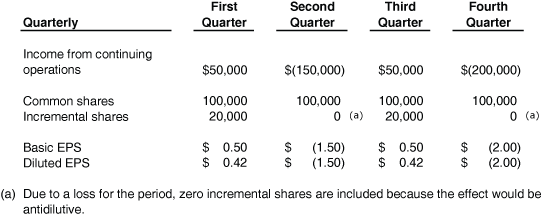
260-10-55-81
The holder of the debt may convert the debt into shares of common stock when the share price exceeds the market price trigger; otherwise, the holder is only entitled to the par value of the debt.
260-10-55-82
The contingently convertible debt is issued on January 1, 200X, income available to common shareholders for the year ended December 31, 200X, is $10,000, and the average share price for the year is $55. The issuer of the contingently convertible debt should apply the guidance in paragraphs which requires the issuer to include the dilutive effect of the convertible debt in diluted EPS even though the market price trigger of $65 has not been met. In this Case, basic EPS is $5.00. (Basic EPS = [Income available to common shareholders (IACS)] ÷ [Shares outstanding (SO)] = $10,000 ÷ 2,000 shares = $5.00 per share) and applying the if-converted method to the debt instrument dilutes EPS to $4.96 (Diluted EPS computed using the if-converted method = [IACS + Interest (1-tax rate)] ÷ (SO + Potential common shares) = ($10,000 + $26) ÷ (2,000 + 20) shares = $4.96 per share.)
260-10-55-84
The issuer of the contingently convertible debt must settle the principal amount of the debt in cash upon conversion and it may settle any conversion premium in either cash or stock. The holder of the instrument is only entitled to the conversion premium if the share price exceeds the market price trigger. The contingently convertible instrument is issued on January 1, 200X, income available to common shareholders for the year ended December 31, 200X is $9,980, and the average share price for the year is $64.
260-10-55-84A
The if-converted method should be used to determine the earnings-per-share implications of convertible debt with the characteristics described in this Case. There would be no adjustment to the numerator in the diluted earnings-per-share computation for the cash-settled portion of the instrument (the principal amount of the debt) because that portion will always be settled in cash (see paragraph 260-10-45-40). The conversion premium should be included in diluted earnings per share based on the provisions of paragraphs and 260-10-55-32 through 55-36A. The convertible debt instrument in this Case is subject to other applicable guidance in Subtopic 260-10 as well, including the antidilution provisions of that Subtopic.
260-10-55-84B
In this Example, basic EPS is $4.99, and diluted earnings per share is $4.98. Basic EPS = IACS ÷ SO = $9,980 ÷ 2,000 shares = $4.99 per share. Diluted EPS would be calculated using the if-converted method by determining the number of shares needed to settle the conversion premium and adding that amount to shares outstanding to calculate the diluted EPS denominator. The average market price is used to determine the dilution in accordance with paragraph 260-10-45-21A. The effect would be dilutive in this case because the average market price of the shares exceeds the conversion price. However, if the average market price of the shares was less than the conversion price, then the conversion premium would be zero and there would be no dilutive effect. Diluted EPS = IACS ÷ (SO + Potential common shares) = ($9,980) ÷ (2,000 + 4.38) shares = $4.98 per share. Potential common shares = (Conversion spread value) ÷ (Average share price) = $14 × 20 shares ÷ $64 = 4.38 shares.
260-10-55-84C
The issuer of the convertible debt can settle the principal and the conversion premium in any combination of cash or shares (the issuer has the option). Consistent with the facts in Case B, the convertible instrument is issued on January 1, 200X, income available to common shareholders for the year ended December 31, 200X, is $9,980, and the average share price for the year is $64.
260-10-55-84D
The if-converted method should be used to determine the earnings-per-share implications of convertible debt. The effect of settling the principal and conversion premium in shares is included for purposes of calculating diluted earnings per share in accordance with the guidance in paragraph 260-10-45-45.
260-10-55-84E
In this case, basic EPS is $4.99 (the same calculation in paragraph 260-10-55-84B), and diluted earnings per share is $4.95. Diluted EPS is calculated using the if-converted method = [IACS + Interest (1-tax rate)] ÷ (SO + Potential common shares) = (9,980 + 26) ÷ (2,000 + 20). See paragraph 260-10-55-82 for interest expense amount.
260-10-55-85
The following Cases illustrate the guidance in paragraphs for the quarterly and annual computations of basic and diluted EPS for a company with options outstanding (equal to 20,000 incremental shares) that were in the money for the entire year (for simplicity purposes, this Example assumes that the stock price never changed). Case A addresses year-to-date loss, and Case B addresses year-to-date income. Note that in Case A, due to a loss for the period, zero incremental shares are included because the effect would be antidilutive. Note that in Case B, zero shares included due to loss in the period.
Transition date:(P) December 16, 2026; (N) December 16, 2026Transition guidance:
260-10-65-5The following Cases illustrate the guidance in paragraphs 260-10-55-3Aand 260-10-55-3Cfor the quarterly and annual computations of basic and diluted EPS for a company with options outstanding (equal to 20,000 incremental shares) that were in the money for the entire year (for simplicity purposes, this Example assumes that the stock price never changed). Case A addresses year-to-date loss, and Case B addresses year-to-date income. Note that in Case A, zero incremental shares are included because the effect would be antidilutive. Note that in Case B, zero incremental shares are included in the quarterly diluted EPS computations for the first and second quarters or in the year-to-date diluted EPS computations for the three- and six-month periods because the effect would be antidilutive.
260-10-55-86
The following tables illustrate the computation of quarterly and year-to-date EPS.
  • Quarterly First Quarter Second Quarter Third Quarter Fourth Quarter Income from continuing operations " $50,000 " " $(150,000)" " $50,000 " " $(200,000)" Common shares "100,000 " "100,000 " "100,000 " "100,000 " Incremental shares "20,000 " 0 (a) "20,000 " 0 (a) Basic EPS $0.50 $(1.50) $0.50 $(2.00) Diluted EPS $0.42 $(1.50) $0.42 $(2.00) (a) "Due to a loss for the period, zero incremental shares are included because the effect would be antidilutive."
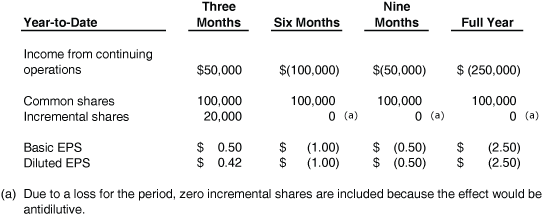
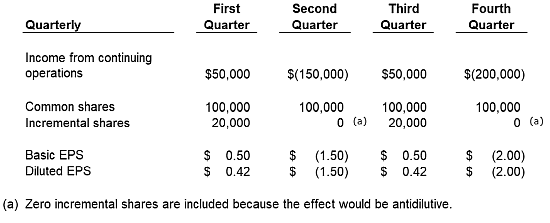
  • Year-to-Date Three Months Six Months Nine Months Full Year Income from continuing operations " $50,000 " " $(100,000)" " $(50,000)" " $(250,000)" Common shares "100,000 " "100,000 " "100,000 " "100,000 " Incremental shares "20,000 " 0 (a) 0 (a) 0 (a) Basic EPS $0.50 $(1.00) $(0.50) $(2.50) Diluted EPS $0.42 $(1.00) $(0.50) $(2.50) (a) "Due to a loss for the period, zero incremental shares are included because the effect would be antidilutive."
Transition date:(P) December 16, 2026; (N) December 16, 2026Transition guidance:
260-10-65-5The following tables illustrate the computation of quarterly and year-to-date EPS.
  • Quarterly First Quarter Second Quarter Third Quarter Fourth Quarter Income from continuing operations " $50,000 " " $(150,000)" " $50,000 " " $(200,000)" Common shares "100,000 " "100,000 " "100,000 " "100,000 " Incremental shares "20,000 " 0 (a) "20,000 " 0 (a) Basic EPS $0.50 $(1.50) $0.50 $(2.00) Diluted EPS $0.42 $(1.50) $0.42 $(2.00) (a) "Zero incremental shares are included because the effect would be antidilutive."
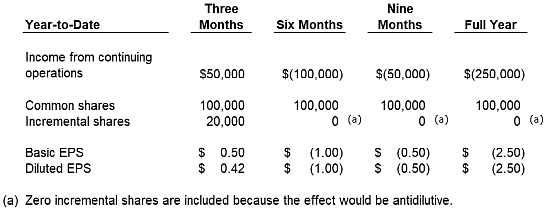
  • Year-to-Date Three Months Six Months Nine Months Full Year Income from continuing operations " $50,000 " " $(100,000)" " $(50,000)" " $(250,000)" Common shares "100,000 " "100,000 " "100,000 " "100,000 " Incremental shares "20,000 " 0 (a) 0 (a) 0 (a) Basic EPS $0.50 $(1.00) $(0.50) $(2.50) Diluted EPS $0.42 $(1.00) $(0.50) $(2.50) (a) "Zero incremental shares are included because the effect would be antidilutive."
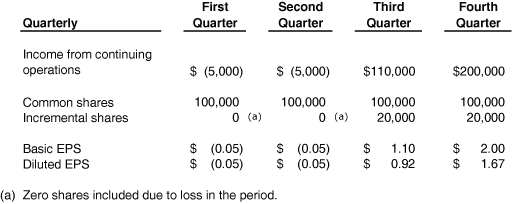
260-10-55-87
The following tables illustrate the computation of quarterly and year-to-date EPS.
  • Quarterly First Quarter Second Quarter Third Quarter Fourth Quarter Income from continuing operations $(5,000) $(5,000) $110,000 $200,000 Common shares 100,000 100,000 100,000 100,000 Incremental shares 0 (a) 0 (a) 20,000 20,000 Basic EPS $(0.05) $(0.05) $1.10 $2.00 Diluted EPS $(0.05) $(0.05) $0.92 $1.67 (a) Zero shares included due to loss in the period.
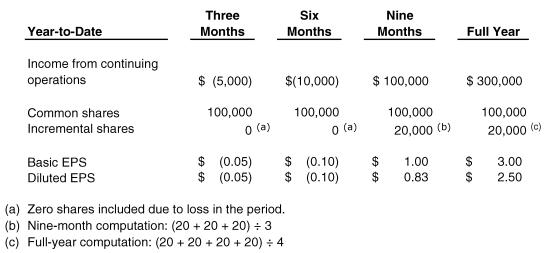
  • Year-to-Date Three Months Six Months Nine Months Full Year Income from continuing operations $(5,000) $(10,000) $100,000 $300,000 Common shares 100,000 100,000 100,000 100,000 Incremental shares 0 (a) 0 (a) 20,000 (b) 20,000 (c) Basic EPS $(0.05) $(0.10) $1.00 $3.00 Diluted EPS $(0.05) $(0.10) $0.83 $2.50 (a) Zero shares included due to loss in the period. (b) Nine-month computation: (20 + 20 + 20) ÷ 3 (c) Full-year computation: (20 + 20 + 20 + 20) ÷ 4
  • Note that if the options had been out of the money in any quarter, zero incremental shares would have been included for that quarter in the year-to-date averaging.
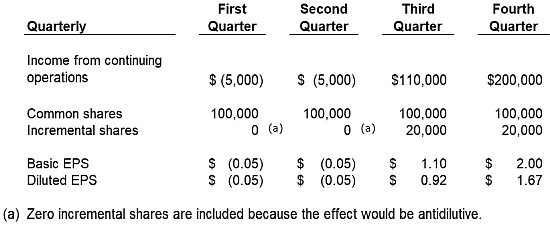
Transition date:(P) December 16, 2026; (N) December 16, 2026Transition guidance:
260-10-65-5The following tables illustrate the computation of quarterly and year-to-date EPS.
  • Quarterly First Quarter Second Quarter Third Quarter Fourth Quarter Income from continuing operations $(5,000) $(5,000) $110,000 $200,000 Common shares 100,000 100,000 100,000 100,000 Incremental shares 0 (a) 0 (a) 20,000 20,000 Basic EPS $(0.05) $(0.05) $1.10 $2.00 Diluted EPS $(0.05) $(0.05) $0.92 $1.67 (a) Zero incremental shares are included because the effect would be antidilutive.
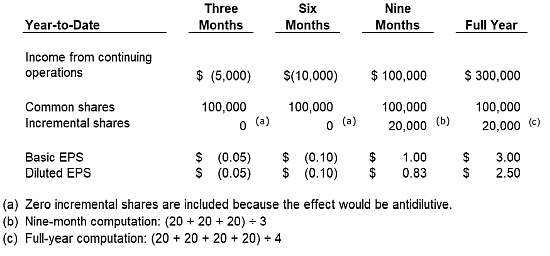
  • Year-to-Date Three Months Six Months Nine Months Full Year Income from continuing operations $(5,000) $(10,000) $100,000 $300,000 Common shares 100,000 100,000 100,000 100,000 Incremental shares 0 (a) 0 (a) 20,000 (b) 20,000 (c) Basic EPS $(0.05) $(0.10) $1.00 $3.00 Diluted EPS $(0.05) $(0.10) $0.83 $2.50 (a) Zero incremental shares are included because the effect would be antidilutive. (b) Nine-month computation: (20 + 20 + 20) ÷ 3 (c) Full-year computation: (20 + 20 + 20 + 20) ÷ 4
  • Note that if the options had been out of the money in any quarter, zero incremental shares would have been included for that quarter in the year-to-date averaging.
260-10-55-88
Example 1 in Subtopic 505-30 (see paragraph 505-30-55-1) illustrates the accounting for what is sometimes described as an accelerated share repurchase program. In that Example, separate transactions involving a treasury stock purchase and a forward contract are addressed. This Example addresses the EPS consequences of those transactions.
260-10-55-89
The treasury stock transaction would result in an immediate reduction of the outstanding shares used to calculate the weighted-average common shares outstanding for both basic and diluted EPS. The effect of the forward contract on diluted EPS would be calculated in accordance with this Subtopic.
260-10-55-90
This Example illustrates the guidance in paragraph 260-10-45-18.
Transition date:(P) December 16, 2026; (N) December 16, 2026Transition guidance:
260-10-65-5
Editor's Note: Paragraph 260-10-55-90 will be amended upon transition, together with its heading:
• > Example 14: Potential Antidilutive Securities
This Example illustrates the guidance in paragraphs .
260-10-55-91
Assume that Entity A has income from continuing operations of $2,400, a loss from discontinued operations of $(3,600), a net loss of $(1,200), and 1,000 common shares and 200 potential common shares outstanding. Entity A's basic per-share amounts would be $2.40 for continuing operations, $(3.60) for the discontinued operation, and $(1.20) for the net loss. Entity A would include the 200 potential common shares in the denominator of its diluted per-share computation for continuing operations because the resulting $2.00 per share is dilutive. (For illustrative purposes, assume no numerator impact of those 200 potential common shares.) Because income from continuing operations is the control number, Entity A also must include those 200 potential common shares in the denominator for the other per-share amounts, even though the resulting per-share amounts [$(3.00) per share for the loss from discontinued operation and $(1.00) per share for the net loss] are antidilutive to their comparable basic per-share amounts; that is, the loss per-share amounts are less.
Transition date:(P) December 16, 2026; (N) December 16, 2026Transition guidance:
260-10-65-5Assume that Entity A has income from continuing operations of $2,400, a loss from discontinued operations of $(3,600), a net loss of $(1,200), and 1,000 common shares outstanding and 200 potential common shares outstanding. Entity A's basic per-share amounts would be $2.40 for continuing operations, $(3.60) for the discontinued operation, and $(1.20) for the net loss. Entity A would include the 200 potential common shares in the denominator of its diluted per-share computation for continuing operations because the resulting $2.00 per share is dilutive. (For illustrative purposes, assume no numerator impact of those 200 potential common shares because they are from an equity classified instrument.) Because income from continuing operations is the control number, Entity A also must include those 200 potential common shares in the denominator for the other per-share amounts, even though the resulting per-share amounts [$(3.00) per share for the loss from discontinued operation and $(1.00) per share for the net loss] are antidilutive to their comparable basic per-share amounts; that is, the loss per-share amounts are less.
260-10-55-91A
Transition date:(P) December 16, 2026; (N) December 16, 2026Transition guidance:
260-10-65-5However, assume that Entity A has a loss from continuing operations of $(380), a loss from discontinued operations of $(3,600), a net loss of $(3,980), and 1,000 common shares outstanding and 200 potential common shares outstanding from a liability classified instrument. During the period, Entity A recognized a fair value gain of $200, net of income tax, for the liability classified instrument. Entity A’s basic per-share amounts would be $(0.38) for continuing operations, $(3.60) for the discontinued operation, and $(3.98) for the net loss. For the diluted per-share computation, Entity A would make the following adjustments:
  1. a
    Adjust the numerator to remove the effect of the fair value gain of $200 recognized in the period for the liability classified instrument, resulting in an adjusted loss from continuing operations of $(580) and an adjusted net loss of $(4,180)
  2. b
    Adjust the denominator by including the 200 potential common shares.
Because loss from continuing operations is the control number and the combined effect of the adjustments has a dilutive effect, Entity A must include those adjustments in the diluted per-share computations and would report diluted per-share amounts of $(0.48) for continuing operations, $(3.00) for discontinued operations, and $(3.48) for the net loss for the period.
260-10-55-92
This Example illustrates the guidance in paragraphs .
260-10-55-93
Consider Entity A that has 10,000 warrants outstanding exercisable at $54 per share; the average market price of the common stock during the reporting period is $60. Exercise of the warrants and issuance of 10,000 shares of common stock would be assumed. The $540,000 that would be realized from exercise of the warrants ($54 × 10,000) would be an amount sufficient to acquire 9,000 shares ($540,000/$60). Thus, 1,000 incremental shares (10,000 - 9,000) would be added to the outstanding common shares in computing diluted EPS for the period.
260-10-55-94
The following is a shortcut formula for that computation (note that this formula may not be appropriate for share-based compensation awards [see paragraph 260-10-45-29]):
  • Incremental shares = [(market price - exercise price)/market price] x shares assumed issued under option; thus, [($60 - $54)/$60] x10,000 = 1,000 incremental shares.

260-10-55-95
Assume Entity A issues warrants that permit the holder to buy 100 shares of its common stock for $10 per share and that Entity A presents EPS in accordance with the guidance in this Topic. The warrants have a 10-year term, are exercisable at any time, and contain a down round feature. The warrants are classified as equity by Entity A because they are indexed to the entity's own stock and meet the additional conditions necessary for equity classification in accordance with the guidance in Subtopic 815-40 on derivatives and hedging—contracts in entity's own equity (see paragraphs 815-40-55-33 through 55-34A for an illustration of the guidance in Subtopic 815-40 applied to a warrant with a down round feature). Because the warrants are an equity-classified freestanding financial instrument, they are within the scope of the recognition and measurement guidance in this Topic. The terms of the down round feature specify that if Entity A issues additional shares of its common stock for an amount less than $10 per share or issues an equity-classified financial instrument with a strike price below $10 per share, the strike price of the warrants would be reduced to the most recent issuance price or strike price, but the terms of the down round feature are such that the strike price cannot be reduced below $8 per share. After issuing the warrants, Entity A issues shares of its common stock at $7 per share. Because of the subsequent round of financing occurring at a share price below the strike price of the warrants, the down round feature in the warrants is triggered and the strike price of the warrants is reduced to $8 per share.
260-10-55-96
In accordance with the measurement guidance in paragraphs , Entity A determines that the fair value of the warrants (without the down round feature) with a strike price of $10 per share immediately after the down round feature is triggered is $600 and that the fair value of the warrants (without the down round feature) with a strike price of $8 per share immediately after the down round feature is triggered is $750. The increase in the value of $150 is the value of the effect of the triggering of the down round feature.
260-10-55-97
The $150 increase is the value of the effect of the down round feature to be recognized in equity in accordance with paragraph 260-10-25-1, as follows:
  • Retained earnings $150 Additional paid-in capital $150
Additionally, Entity A reduces income available to common stockholders in its basic EPS calculation by $150 in accordance with the guidance in paragraph 260-10-45-12B. Entity A applies the treasury stock method in accordance with paragraphs to calculate diluted EPS. Accordingly, the $150 is added back to income available to common stockholders when calculating diluted EPS. However, the treasury stock method would not be applied if the effect were to be antidilutive.

Master Limited Partnerships

260-10-55-102
This Subsection, which is an integral part of the requirements of this Subtopic, provides general guidance used to compute earnings per unit for master limited partnerships.

Implementation Guidance

260-10-55-103
When calculating earnings per unit under the two-class method for a master limited partnership, net income (or loss) for the current reporting period shall be reduced (or increased) by the amount of available cash that has been or will be distributed to the general partner, limited partners, and incentive distribution right holder for that reporting period. For example, assume a partnership agreement requires the general partner to distribute available cash within 60 days following the end of each fiscal quarter. The master limited partnership is required to file financial statements with a regulatory agency within 45 days following the end of each fiscal quarter. In order to compute earnings per unit for the first quarter, the general partner determines the amount of available cash that will be distributed to the general partner, limited partners, and incentive distribution right holder for that first quarter. The master limited partnership would reduce (or increase) net income (or loss) by that amount in computing undistributed earnings that are allocated to the general partner, limited partners, and incentive distribution right holder in calculating earnings per unit for the first quarter.
260-10-55-104
Undistributed earnings shall be allocated to the general partner, limited partners, and incentive distribution right holder utilizing the contractual terms of the partnership agreement. The distribution waterfall (that is, a schedule that prescribes distributions to the various interest holders at each threshold) for available cash specified in the partnership agreement contractually mandates the way in which earnings are distributed for the period presented. The undistributed earnings shall be allocated to the incentive distribution right holder based on the contractual participation rights of the incentive distribution right to share in current period earnings. Therefore, if the partnership agreement includes a specified threshold as described in paragraph 260-10-55-30, a master limited partnership shall not allocate undistributed earnings to the incentive distribution right holder once the specified threshold has been met.
260-10-55-105
In determining whether a specified threshold exists, a master limited partnership shall evaluate whether distributions to the incentive distribution right holder would be contractually limited to available cash as defined in the partnership agreement if all earnings for the period were distributed. For example, if the partnership agreement contractually limits distributions to the incentive distribution right holder to the holder's share of available cash as defined in the partnership agreement, then the specified threshold for the current reporting period would be the holder's share of available cash that has been or will be distributed for that reporting period. The master limited partnership would not allocate undistributed earnings to the incentive distribution right holder because the holder's share of available cash is the maximum amount that the incentive distribution right holder would be contractually entitled to receive if all earnings for the current reporting period were distributed. However, if the partnership agreement is silent or does not explicitly limit distributions to the incentive distribution right holder to available cash, then the master limited partnership would allocate undistributed earnings to the incentive distribution right holder utilizing the distribution waterfall for available cash specified in the partnership agreement.
260-10-55-106
Any excess of distributions over earnings shall be allocated to the general partner and limited partners based on their respective sharing of losses specified in the partnership agreement (that is, the provisions for allocation of losses to the partners' capital accounts for the period presented). If the incentive distribution right holders do not share in losses, the excess of distribution over earnings amount would not be allocated to the incentive distribution right holders. However, if the incentive distribution right holders have a contractual obligation to share in the losses of the master limited partnership on a basis that is objectively determinable (as described in paragraph 260-10-45-68), the excess of distributions over earnings shall be allocated to the general partner, limited partners, and incentive distribution right holders based on their respective sharing of losses specified in the partnership agreement for the period presented.
260-10-55-107
When calculating earnings per unit under the two-class method for a master limited partnership, net income (or loss) for the current reporting period shall be reduced (or increased) by the amount of available cash that has been or will be distributed to the general partner (including the distribution rights of the embedded incentive distribution rights) and limited partners for that reporting period. For example, assume that a partnership agreement requires the general partner to distribute available cash within 60 days following the end of each fiscal quarter. The master limited partnership is required to file financial statements with a regulatory agency within 45 days following the end of each fiscal quarter. In order to compute earnings per unit for the first quarter, the general partner determines the amount of available cash that will be distributed to the general partner and limited partners for that first quarter. The master limited partnership would reduce (or increase) net income (or loss) by that amount in computing undistributed earnings that are allocated to the general partner (including the distribution rights of the embedded incentive distribution rights) and limited partners in calculating earnings per unit for the first quarter.
260-10-55-108
Undistributed earnings shall be allocated to the general partner (including the distribution rights of the embedded incentive distribution rights) and limited partners utilizing the contractual terms of the partnership agreement. The distribution waterfall for available cash specified in the partnership agreement contractually mandates the way in which earnings are distributed for the period presented. The undistributed earnings shall be allocated to the general partner (with respect to the distribution rights of an embedded incentive distribution right) based on the contractual participation rights of the incentive distribution right to share in current period earnings. Therefore, if the partnership agreement includes a specified threshold as described in paragraph 260-10-55-30, a master limited partnership shall not allocate undistributed earnings to the general partner (with respect to the distribution rights of an embedded incentive distribution right) once the specified threshold has been met.
260-10-55-109
In determining whether a specified threshold exists, a master limited partnership shall evaluate whether distributions to the general partner (with respect to the distribution rights of an embedded incentive distribution right) would be contractually limited to available cash as defined in the partnership agreement if all earnings for the period were distributed. For example, if the partnership agreement contractually limits distributions to the general partner (with respect to the distribution rights of an embedded incentive distribution right) to the holder's share of available cash as defined in the partnership agreement, then the specified threshold for the current reporting period would be the general partner's share (with respect to the distribution rights of an embedded incentive distribution right) of available cash that has been or will be distributed for that reporting period. The master limited partnership would not allocate undistributed earnings to the general partner (with respect to the distribution rights of an embedded incentive distribution right) because the general partner's share (with respect to the distribution rights of an embedded incentive distribution right) of available cash is the maximum amount that the general partner (with respect to the distribution rights of an embedded incentive distribution right) would be contractually entitled to receive if all earnings for the current reporting period were distributed. However, if the partnership agreement is silent or does not explicitly limit distributions to the general partner (with respect to the distribution rights of an embedded incentive distribution right) to available cash, then the master limited partnership would allocate undistributed earnings to the general partner (with respect to the distribution rights of an embedded incentive distribution right) utilizing the distribution waterfall for available cash specified in the partnership agreement.
260-10-55-110
Any excess of distributions over earnings shall be allocated to the general partner and limited partners based on their respective sharing of losses specified in the partnership agreement for the period presented.
260-10-55-111
A general partner may transfer net assets to a master limited partnership as part of a dropdown transaction that occurs after formation of the master limited partnership. If the master limited partnership accounts for the dropdown transaction under the Transactions Between Entities Under Common Control Subsections of Subtopic 805-50, in calculating the historical earnings per unit under the two-class method, the earnings (losses) of the transferred net assets before the date of the dropdown transaction should be allocated entirely to the general partner. In that circumstance, the previously reported earnings per unit of the limited partners for periods before the date of the dropdown transaction should not change as a result of the dropdown transaction.

260-10-60Relationships

Source downloaded: .Record version fd1e7a149cf3. Effective date must be checked in the source.

Compensation—General

260-10-60-1
For the effects of employer shares held by a rabbi trust in computing basic and diluted EPS, see Section 710-10-45.

Compensation—Stock Compensation

260-10-60-1A
For the effects of equity share options granted in share-based payment arrangements, nonvested shares, and similar equity instruments in computing diluted EPS, see Section 718-10-45.
260-10-60-2
For the effects of issues resulting from the existence of employee stock ownership plans in computing basic and diluted EPS and the related disclosure requirements, see Sections 718-40-45 and 718-40-50.

260-10-65Transition and Open Effective Date Information

Source downloaded: .Record version 5a0179a8e988. Effective date must be checked in the source.

260-10-65-1
Paragraph superseded on 07/01/2010 after the end of the transition period stated in EITF Issue No. 07-4, "Application of the Two-Class Method under FASB Statement No. 128 to Master Limited Partnerships."
260-10-65-2
Paragraph superseded on 07/01/2010 after the end of the transition period stated in FSP EITF 03-6-1.
260-10-65-3
Paragraph superseded on 07/05/2017 after the end of the transition period stated in Accounting Standards Update No. 2015-06, Earnings Per Share (Topic 260): Effects on Historical Earnings per Unit of Master Limited Partnership Dropdown Transactions.
260-10-65-4
Paragraph superseded on 06/30/2025 after the end of the transition period stated in Accounting Standards Update No. 2017-11, Earnings Per Share (Topic 260) and Derivatives and Hedging (Topic 815): Part I, Accounting for Certain Financial Instruments with Down Round Features.
260-10-65-5
Accounting Standards Update 2025-12
2028-06-13
2026-12-16
2026-12-16
2026-12-16
2026-12-16
2026-12-16
2026-12-16
2026-12-16
2026-12-16
2026-12-16
2026-12-16
2026-12-16
2026-12-16
2026-12-16
2026-12-16
The following represents the transition and effective date information related to the Topic 260 amendments in Accounting Standards Update No. 2025-12, Codification Improvements:
Effective date and early adoption
  1. a
    For all entities, the pending content that links to this paragraph shall be effective for annual reporting periods beginning after December 15, 2026, and interim reporting periods within those annual reporting periods.
  2. b
    Early adoption of the pending content that links to this paragraph is permitted.
Transition method
  1. c
    In the period of adoption, an entity shall apply the pending content that links to this paragraph retrospectively to each prior reporting period presented. When an adjustment affects both the numerator and denominator in a prior period, an entity shall recast the diluted per-share computation when the adjustment has a dilutive effect on the computation but shall not recast when the adjustment has an antidilutive effect.
Transition disclosures
  1. d
    An entity applying the pending content that links to this paragraph shall provide the transition disclosures required by paragraph 250-10-50-1(a) through (b)(1), (b)(2) for any prior periods recast, and (b)(3) through (b)(4), in both the interim reporting period (if applicable) and the annual reporting period of the change.

260-10-S00StatusSEC

Source downloaded: .Record version faeed09e46dd. Effective date must be checked in the source.

260-10-S00-1
The following table identifies the changes that have been made to this Subtopic.

260-10-S55Implementation Guidance and IllustrationsSEC

Source downloaded: .Record version 8962acd5ab4b. Effective date must be checked in the source.

Effect of Preferred Stock Dividends and Accretion of Carrying Amount of Preferred Stock on Earnings Per Share

260-10-S55-1
See paragraph 220-10-S99-5, SAB Topic 6.B, for SEC Staff views on this topic.

Effect on Earnings Per Share (EPS) Calculation for a Period That Includes the Redemption or Induced Conversion of Preferred Stock

260-10-S55-2
See paragraph 260-10-S99-2, SEC Staff Announcement: The Effect on the Calculation of Earnings Per Share for a Period That Includes the Redemption or Induced Conversion of Preferred Stock, for SEC Staff views on this topic.

Redemption or Induced Conversion of a Portion of a Class of Preferred Stock

260-10-S55-3
See paragraph 260-10-S99-2, SEC Staff Announcement: The Effect on the Calculation of Earnings Per Share for a Period That Includes the Redemption or Induced Conversion of Preferred Stock, for SEC Staff views on this topic.

Effect of Subsequent Increases or Decreases in the Carrying Amount of Redeemable Securities on EPS

260-10-S55-4
See paragraph 480-10-S99-3A, SEC Staff Announcement: Classification and Measurement of Redeemable Securities, for SEC Staff views on the classification and measurement of securities subject to mandatory redemption requirements or whose redemption is outside control of the issuer.
260-10-S55-5
See paragraph 480-10-S99-2, SAB Topic 3.C, Question 2, for SEC Staff views on how periodic increases in the carrying amount of redeemable preferred stock be treated in the calculation of EPS.

Nominal Issuances and Initial Public Offerings

260-10-S55-6
See paragraph 260-10-S99-1, SAB Topic 4.D, for SEC Staff views on the treatment of "nominal issuances" in the calculation of EPS.

260-10-S99SEC MaterialsSEC

Source downloaded: .Record version fdb36e363598. Effective date must be checked in the source.

SEC Staff Guidance

260-10-S99-1
The following is the text of SAB Topic 4.D. Earnings Per Share Computations in an Initial Public Offering.
  • Facts: A registration statement is filed in connection with an initial public offering (IPO) of common stock. During the periods covered by income statements that are included in the registration statement or in the subsequent period prior to the effective date of the IPO, the registrant issued for nominal consideration FN1 common stock, options or warrants to purchase common stock or other potentially dilutive instruments (collectively, referred to hereafter as "nominal issuances").
    • FN1 Whether a security was issued for nominal consideration should be determined based on facts and circumstances. The consideration the entity receives for the issuance should be compared to the security's fair value to determine whether the consideration is nominal.
  • Prior to the effective date of FASB ASC Topic 260, Earnings Per Share, the staff believed that certain stock and warrants FN2 should be treated as outstanding for all reporting periods in the same manner as shares issued in a stock split or a recapitalization effected contemporaneously with the IPO. The dilutive effect of such stock and warrants could be measured using the treasury stock method.
    • FN2 The stock and warrants encompasses by the prior guidance were those issuances of common stock at prices below the IPO price and options or warrants with exercise prices below the IPO price that were issued within a one-year period prior to the initial filing of the registration statement relating to the IPO through the registration statement's effective date.
  • Question 1: Does the staff continue to believe that such treatment for stock and warrants would be appropriate upon adoption of FASB ASC Topic 260?
  • Interpretive Response: Generally, no. Historical EPS should be prepared and presented in conformity with FASB ASC Topic 260.
  • In applying the requirements of FASB ASC Topic 260, the staff believes that nominal issuances are recapitalizations in substance. In computing basic EPS for the periods covered by income statements included in the registration statement and in subsequent filings with the SEC, nominal issuances of common stock should be reflected in a manner similar to a stock split or stock dividend for which retroactive treatment is required by FASB ASC paragraph 260-10-55-12. In computing diluted EPS for such periods, nominal issuances of common stock and potential common stock FN3 should be reflected in a manner similar to a stock split or stock dividend.
    • FN3 The FASB ASC Master Glossary defines potential common stock as "a security or other contract that may entitle its holder to obtain common stock during the reporting period or after the end of the reporting period."
  • Registrants are reminded that disclosure about materially dilutive issuances is required outside the financial statements. Item 506 of Regulation S-K requires presentation of the dilutive effects of those issuances on net tangible book value. The effects of dilutive issuances on the registrant's liquidity, capital resources and results of operations should be addressed in Management's Discussion and Analysis.
  • Question 2: Does reflecting nominal issuances as outstanding for all historical periods in the computation of earnings per share alter the registrant's responsibility to determine whether compensation expense must be recognized for such issuances to employees?
  • Interpretive Response: No. Registrants must follow GAAP in determining whether the recognition of compensation expense for any issuances of equity instruments to employees is necessary. FN4 Reflecting nominal issuances as outstanding for all historical periods in the computation of earnings per share does not alter that existing responsibility under GAAP.
    • FN4 As prescribed by FASB ASC Topic 718, Compensation—Stock Compensation.
260-10-S99-2
The following is the text of SEC Staff Announcement: The Effect on Calculation of Earnings Per Share for a Period That Includes the Redemption or Induced Conversion of Preferred Stock.
  • Scope
  • This SEC staff announcement applies to redemptions and induced conversions of equity-classified preferred stock instruments. For purposes of this announcement:
    • 1. Modifications and exchanges of preferred stock instruments that are accounted for as extinguishments, resulting in a new basis of accounting for the modified or exchanged preferred stock instrument, are considered redemptions.
    • 2. A preferred stock instrument classified within temporary equity pursuant to the guidance in ASR 268 and paragraph 480-10-S99-3A is considered equity-classified, and redemptions and induced conversions of such securities would be subject to this guidance.
    • 3. If an equity-classified security is subsequently required to be reclassified as a liability based on the provisions of other GAAP (for example, because a preferred share becomes mandatorily redeemable pursuant to Subtopic 480-10), the reclassification is considered a redemption of equity by issuance of a debt instrument.
  • The accounting for conversions of preferred stock instruments into other equity-classified securities pursuant to conversion privileges provided in the terms of the instruments at issuance is not affected by this announcement.
  • The Effect on Income Available to Common Stockholders of a Redemption or Induced Conversion of Preferred Stock
  • If a registrant redeems its preferred stock, the SEC staff believes that the difference between (1) the fair value of the consideration transferred to the holders of the preferred stock and (2) the carrying amount of the preferred stock in the registrant's balance sheet (net of issuance costs) should be subtracted from (or added to) net income to arrive at income available to common stockholders in the calculation of earnings per share. The SEC staff believes that the difference between the fair value of the consideration transferred to the holders of the preferred stock and the carrying amount of the preferred stock in the registrant's balance sheet represents a return to (from) the preferred stockholder that should be treated in a manner similar to the treatment of dividends paid on preferred stock. This calculation guidance applies to redemptions of convertible preferred stock regardless of whether the embedded conversion feature is "in-the-money" or "out-of-the-money" at the time of redemption. The fair value of the consideration transferred is reduced by the commitment date intrinsic value of the conversion option if the redemption includes the reacquisition of a previously recognized beneficial conversion feature in a convertible preferred stock instrument.
  • If convertible preferred stock is converted into other securities issued by the registrant pursuant to an inducement offer, the SEC staff believes that the excess of (1) the fair value of all securities and other consideration transferred in the transaction by the registrant to the holders of the convertible preferred stock over (2) the fair value of securities issuable pursuant to the original conversion terms should be subtracted from net income to arrive at income available to common stockholders in the calculation of earnings per share. Registrants should consider the guidance provided in Subtopic 470-20 to determine whether the conversion of preferred stock is pursuant to an inducement offer.
  • The Effect on Diluted Earnings per Share of a Redemption or Induced Conversion of Only a Portion of a Class of Preferred Stock
  • When a registrant effects a redemption or induced conversion of only a portion of the outstanding securities of a class of preferred stock, the SEC staff believes that, for the purpose of determining whether the "if-converted" method is dilutive for the period, the shares redeemed or converted should be considered separately from the other shares of the same class that are not redeemed or converted. The SEC staff does not believe that it is appropriate to aggregate securities with different effective dividend yields when determining whether the "if-converted" method is dilutive, which would be the result if a single, aggregate computation was made for the entire series of preferred stock.
  • For example, assume a registrant has 100 shares of convertible preferred stock outstanding at the beginning of the period. The convertible preferred stock was issued at fair value, which was equal to its par value of $10 per share, and has a stated dividend of 5 percent, and each share of preferred stock is convertible into 1 share of common stock. During the period, 20 preferred shares were redeemed by the registrant for $12 per share.
  • In this example, the SEC staff believes that the registrant should determine whether conversion is dilutive (1) for 80 of the preferred shares by applying the "if-converted" method from the beginning of the period to the end of the period using the stated dividend of 5 percent and (2) for 20 of the preferred shares by applying the "if-converted" method from the beginning of the period to the date of redemption using both the stated dividend of 5 percent and the $2 per share redemption premium.
  • Accordingly, assuming that the dividend for the period for the preferred stock was $0.125 per share, a determination of whether the 20 redeemed shares are dilutive should be made by comparing the $2.125 per-share effect of assuming those shares are not converted to the effect of assuming those 20 shares were converted into 20 shares of common stock, weighted for the period for which they were outstanding. The determination of the "if-converted" effect of the 80 shares not redeemed should be made separately, by comparing the EPS effect of the $0.125 per-share dividend to the effect of assuming conversion into 80 shares of common stock.

Related subtopics