ASC 718-10
Overall
718 Compensation—Stock Compensation
Source downloaded: .Record version 7a2e07371aae. Effective date must be checked in the source.
ASC 718-10 is the "Overall" subtopic for share-based payment arrangements, setting the pervasive scope, recognition, measurement, classification, and disclosure principles that apply to both equity- and liability-classified awards granted to employees and nonemployees (and, by cross-reference, to customers). Its core rule is that cost must be recognized for all share-based payment transactions using a fair-value-based measurement method, generally grant-date fair value of the equity instruments issued (or fair value of liabilities incurred), recognized as the goods are obtained or services are received (718-10-10-2; 718-10-25-2; 718-10-30-3). Classification as liability or equity follows Topic 480 criteria as modified by 718-10-25-8 through 25-19A, and performance conditions are accrued based on the probable outcome while market conditions are reflected in grant-date fair value.
Key points (7)
- Scope covers all entities and all transactions in which a grantor acquires goods or services (or provides consideration payable to a customer) by issuing shares, share options, or other equity instruments, or by incurring liabilities whose amount is based at least in part on the entity's share price or that may require settlement in the entity's equity shares (718-10-15-2 through 15-3); awards to lenders/investors providing financing are excluded (718-10-15-5) and ESOP-held equity instruments are outside the Overall Subtopic (718-10-15-7).
- Recognition: the entity recognizes the goods acquired or services received when it obtains the goods or as services are received, with a corresponding credit to equity or a liability; services are never recognized before received, and cost may be capitalized into another asset (hence 'compensation cost,' not 'expense') (718-10-25-2 through 25-2A).
- Measurement objective is grant-date fair value of the equity instruments issued (or fair value of liabilities incurred), net of any amount the grantee pays for the instrument; option fair value uses an observable market price if available, otherwise an option-pricing model (718-10-30-3, 30-6, 30-7, 30-9).
- Classification applies Topic 480 criteria as modified: puttable/callable shares are liabilities if the grantee can avoid the risks and rewards of ownership for a reasonable period (six months or more) or the grantor probably will prevent that (718-10-25-9); options are liabilities if the underlying shares are liabilities or the entity can be required to settle in cash (718-10-25-11); indexation to a factor that is not a market, performance, or service condition forces liability classification (718-10-25-13).
- Substance over form governs: accounting reflects the rights conveyed and obligations imposed regardless of structure, and a practice of cash settlement creates a substantive liability even if written terms give the entity a share-settlement choice (718-10-25-3, 25-15); withholding in excess of the maximum statutory tax rates in the employee's jurisdiction requires liability classification of the entire award (718-10-25-18).
- Conditions: cost for a performance condition is accrued based on the probable outcome (718-10-25-20); performance and service conditions affecting vesting are excluded from grant-date fair value but a market condition is reflected in it, so cost is recognized for a market-condition award as long as the requisite service is rendered even if the condition is never satisfied (718-10-30-14, 30-27, 35-4).
- Cost is recognized over the requisite service period (explicit, implicit, or derived) based on the number of instruments for which requisite service is rendered, with an entity-wide policy election to estimate forfeitures or recognize them as they occur (718-10-35-1D, 35-2, 35-3); graded-vesting service-only awards may be attributed as in-substance multiple awards or straight-line over the whole award, but recognized cost must at least equal the vested portion (718-10-35-8).
For students. ASC 718-10 is heavily tested because it forces you to separate two distinct questions: how the award is classified (equity vs. liability) and how conditions affect measurement versus recognition. The classic misunderstanding is treating market conditions like performance conditions—market conditions are priced into grant-date fair value and cost is not reversed if unmet (so long as requisite service is rendered), whereas performance conditions are accrued only when probable.
Machine-generated study aid for ASC 718-10. Check the source paragraphs below.
718-10-00Status
Source downloaded: .Record version c77869dbcd04. Effective date must be checked in the source.
718-10-05Overview and Background
Source downloaded: .Record version 6d7d4cd9ed97. Effective date must be checked in the source.
- aOverall
- bAwards Classified as Equity
- cAwards Classified as Liabilities
- d
- eEmployee Stock Purchase Plans
- fIncome Taxes.
718-10-10Objectives
Source downloaded: .Record version 7d26dd19f57c. Effective date must be checked in the source.
718-10-15Scope and Scope Exceptions
Source downloaded: .Record version 0fb4adae5921. Effective date must be checked in the source.
Overall Guidance
Entities
Transactions
- aThe amounts are based, at least in part, on the price of the entity's shares or other equity instruments. (The phrase at least in part is used because an award of share-based compensation may be indexed to both the price of an entity's shares and something else that is neither the price of the entity's shares nor a market, performance, or service condition.)
- bThe awards require or may require settlement by issuing the entity's equity shares or other equity instruments.
- a
- bIncurring liabilities to an employee or a nonemployee that meet either of the following conditions:
- 1The amounts are based, at least in part, on the price of the entity's shares or other equity instruments. (The phrase at least in part is used because an award of share-based compensation may be indexed to both the price of an entity's shares and something else that is neither the price of the entity's shares nor a market, performance, or service condition.)
- 2The awards require or may require settlement by issuing the entity's equity shares or other equity instruments.
- 1
- a
- b
- c
718-10-25Recognition
Source downloaded: .Record version 6d8b0442a1c1. Effective date must be checked in the source.
- aRecognition principle for share-based payment transactions
- bDetermining the grant date
- cDetermining whether to classify a financial instrument as a liability or as equity
- d
- e
- fPayroll taxes.
Recognition Principle for Share-Based Payment Transactions
Determining the Grant Date
- a The award is a unilateral grant and, therefore, the recipient does not have the ability to negotiate the key terms and conditions of the award with the grantor.
- b The key terms and conditions of the award are expected to be communicated to an individual recipient within a relatively short time period from the date of approval. A relatively short time period is that period in which an entity could reasonably complete all actions necessary to communicate the awards to the recipients in accordance with the entity's customary practices.
Determining Whether to Classify a Financial Instrument as a Liability or as Equity
- a The repurchase feature permits the grantee to avoid bearing the risks and rewards normally associated with equity share ownership for a reasonable period of time from the date the good is delivered or the service is rendered and the share is issued. A grantee begins to bear the risks and rewards normally associated with equity share ownership when all the goods are delivered or all the service has been rendered and the share is issued. A repurchase feature that can be exercised only upon the occurrence of a contingent event that is outside the grantee's control (such as an initial public offering) would not meet this condition until it becomes probable that the event will occur within the reasonable period of time.
- b It is probable that the grantor would prevent the grantee from bearing those risks and rewards for a reasonable period of time from the date the share is issued.
- a The underlying shares are classified as liabilities.
- b The entity can be required under any circumstances to settle the option or similar instrument by transferring cash or other assets. A cash settlement feature that can be exercised only upon the occurrence of a contingent event that is outside the grantee's control (such as an initial public offering) would not meet this condition until it becomes probable that event will occur.
- a It has the ability to deliver the shares. (Requirements to deliver registered shares do not, by themselves, imply that an entity does not have the ability to deliver shares and thus do not require an award that otherwise qualifies as equity to be classified as a liability.)
- b It is required to pay cash if a contingent event occurs (see paragraphs ).
- a The cashless exercise requires a valid exercise of the share options.
- b The grantee is the legal owner of the shares subject to the option (even though the grantee has not paid the exercise price before the sale of the shares subject to the option).
Market, Performance, and Service Conditions
Payroll Taxes
718-10-30Initial Measurement
Source downloaded: .Record version f89c073ee042. Effective date must be checked in the source.
Fair-Value-Based
Measurement Objective—Fair Value at Grant Date
Factors or Restrictions That Impact the Determination of Fair Value at Grant Date
Nonpublic Entity—Calculated Value for Nonemployee Awards
Nonpublic Entity—Calculated Value
Nonpublic Entity—Practical Expedient for Expected Term
- a If vesting is only dependent upon a service condition, a nonpublic entity shall estimate the expected term as the midpoint between the employee's requisite service period or the nonemployee's vesting period and the contractual term of the award.
- b If vesting is dependent upon satisfying a performance condition, a nonpublic entity first would determine whether the performance condition is probable of being achieved.
- 1 If the nonpublic entity concludes that the performance condition is probable of being achieved, the nonpublic entity shall estimate the expected term as the midpoint between the employee's requisite service period (a nonpublic entity shall consider the guidance in paragraphs when determining the requisite service period of the award) or the nonemployee's vesting period and the contractual term.
- 2 If the nonpublic entity concludes that the performance condition is not probable of being achieved, the nonpublic entity shall estimate the expected term as either:
- i The contractual term if the service period is implied (that is, the requisite service period or the nonemployee's vesting period is not explicitly stated but inferred based on the achievement of the performance condition at some undetermined point in the future)
- ii The midpoint between the employee's requisite service period or the nonemployee's vesting period and the contractual term if the requisite service period is stated explicitly.
- i
- 1
- a The share option or similar award is granted at the money.
- b The grantee has only a limited time to exercise the award (typically 30-90 days) if the grantee no longer provides goods, terminates service after vesting, or ceases to be a customer.
- c The grantee can only exercise the award. The grantee cannot sell or hedge the award.
- d The award does not include a market condition.
Nonpublic Entity—Practical Expedient for Current Price
- a The value of tangible and intangible assets of the nonpublic entity
- b The present value of anticipated future cash flows of the nonpublic entity
- c The market value of stock or equity interests in similar corporations and other entities engaged in trades or businesses substantially similar to those engaged in by the nonpublic entity for which the stock is to be valued, the value of which can be readily determined through nondiscretionary, objective means (such as through trading prices on an established securities market or an amount paid in an arm's-length private transaction)
- d Recent arm's-length transactions involving the sale or transfer of stock or equity interests of the nonpublic entity
- e Other relevant factors such as control premiums or discounts for lack of marketability and whether the valuation method is used for other purposes that have a material economic effect on the nonpublic entity, its stockholders, or its creditors
- f The nonpublic entity's consistent use of a valuation method to determine the value of its stock or assets for other purposes, including for purposes unrelated to compensation of service providers.
- a The calculation fails to reflect information available after the date of the calculation that may materially affect the value of the nonpublic entity (for example, the resolution of material litigation or the issuance of a patent).
- b The value was calculated with respect to a date that is more than 12 months earlier than the date for which the valuation is being used.
Difficulty of Estimation
Reload and Contingent Features
Requisite Service Period
- a All vesting and exercisability conditions
- b All explicit, implicit, and derived service periods
- c The probability that performance or service conditions will be satisfied.
Market, Performance, and Service Conditions
718-10-35Subsequent Measurement
Source downloaded: .Record version 87d54551f32e. Effective date must be checked in the source.
Recognition of Nonemployee Compensation Costs
- aEstimate the number of forfeitures expected to occur. The entity shall base initial accruals of compensation cost on the estimated number of nonemployee share-based payment awards for which a good is expected to be delivered or a service is expected to be rendered. The entity shall revise that estimate if subsequent information indicates that the actual number of instruments is likely to differ from previous estimates. The cumulative effect on current and prior periods of a change in the estimates shall be recognized in compensation cost in the period of the change.
- bRecognize the effect of forfeitures in compensation cost when they occur. Previously recognized compensation cost for a nonemployee share-based payment award shall be reversed in the period that the award is forfeited.
- aEstimate the number of forfeitures expected to occur. The entity shall base initial accruals of compensation cost on the estimated number of nonemployee share-based payment awards for which a good is expected to be delivered or a service is expected to be rendered. The entity shall revise that estimate if subsequent information indicates that the actual number of instruments is likely to differ from previous estimates. The cumulative effect on current and prior periods of a change in the estimates shall be recognized in compensation cost in the period of the change.
- bRecognize the effect of forfeitures in compensation cost when they occur. Previously recognized compensation cost for a nonemployee share-based payment award shall be reversed in the period that the award is forfeited.
Recognition of Employee Compensation Costs over the Requisite Service Period
- aEstimate the number of awards for which the requisite service will not be rendered (that is, estimate the number of forfeitures expected to occur). The entity shall base initial accruals of compensation cost on the estimated number of instruments for which the requisite service is expected to be rendered. The entity shall revise that estimate if subsequent information indicates that the actual number of instruments is likely to differ from previous estimates. The cumulative effect on current and prior periods of a change in the estimated number of instruments for which the requisite service is expected to be or has been rendered shall be recognized in compensation cost in the period of the change.
- bRecognize the effect of awards for which the requisite service is not rendered when the award is forfeited (that is, recognize the effect of forfeitures in compensation cost when they occur). Previously recognized compensation cost for an award shall be reversed in the period that the award is forfeited.
Estimating the Requisite Service Period for Employee Awards
Graded Vesting Employee Awards
- aOn a straight-line basis over the requisite service period for each separately vesting portion of the award as if the award was, in-substance, multiple awards
- bOn a straight-line basis over the requisite service period for the entire award (that is, over the requisite service period of the last separately vesting portion of the award).
Awards May Become Subject to Other Guidance
- a
- b
- cA grantee vests in the award and is no longer providing goods or services.
- dA grantee vests in the award and is no longer a customer.
- eA grantee is no longer an employee.
- aThere is no increase in fair value of the award (or the ratio of intrinsic value to the exercise price of the award is preserved, that is, the holder is made whole) or the antidilution provision is not added to the terms of the award in contemplation of an equity restructuring.
- bAll holders of the same class of equity instruments (for example, stock options) are treated in the same manner.
Change in Classification Due to Change in Probable Settlement Outcome
718-10-45Other Presentation Matters
Source downloaded: .Record version 46ece3f530f8. Effective date must be checked in the source.
Earnings per Share
Classification of Assets Other Than a Note or a Receivable for Nonemployee Awards
718-10-50Disclosure
Source downloaded: .Record version d26568288e8d. Effective date must be checked in the source.
- aThe nature and terms of such arrangements that existed during the period and the potential effects of those arrangements on shareholders
- bThe effect of compensation cost arising from share-based payment arrangements on the income statement
- cThe method of estimating the fair value of the equity instruments granted (or offered to grant), during the period
- dThe cash flow effects resulting from share-based payment arrangements.
- aThe nature and terms of such arrangements that existed during the period and the potential effects of those arrangements on shareholders
- bThe effect of compensation cost arising from share-based payment arrangements on the income statement
- cThe method of estimating the fair value of the equity instruments granted (or offered to grant), during the period
- dThe cash flow effects resulting from share-based payment arrangements.
- aA description of the share-based payment arrangement(s), including the general terms of awards under the arrangement(s), such as:
- 1The employee's requisite service period(s) and, if applicable, the nonemployee's vesting period and any other substantive conditions (including those related to vesting)
- 2The maximum contractual term of equity (or liability) share options or similar instruments
- 3The number of shares authorized for awards of equity share options or other equity instruments.
- 1
- bThe method it uses for measuring compensation cost from share-based payment arrangements.
- cFor the most recent year for which an income statement is provided, both of the following:
- 1The number and weighted-average exercise prices (or conversion ratios) for each of the following groups of share options (or share units):
- iThose outstanding at the beginning of the year
- iiThose outstanding at the end of the year
- iiiThose exercisable or convertible at the end of the year
- ivThose that during the year were:
- 01Granted
- 02Exercised or converted
- 03Forfeited
- 04Expired.
- 01
- i
- 2The number and weighted-average grant-date fair value (or calculated value for a nonpublic entity that uses that method or intrinsic value for awards measured pursuant to paragraph 718-10-30-21) of equity instruments not specified in (c)(1), for all of the following groups of equity instruments:
- iThose nonvested at the beginning of the year
- iiThose nonvested at the end of the year
- iiiThose that during the year were:
- 01Granted
- 02Vested
- 03Forfeited.
- 01
- i
- 1
- dFor each year for which an income statement is provided, both of the following:
- 1The weighted-average grant-date fair value (or calculated value for a nonpublic entity that uses that method or intrinsic value for awards measured at that value pursuant to paragraphs ) of equity options or other equity instruments granted during the year
- 2The total intrinsic value of options exercised (or share units converted), share-based liabilities paid, and the total fair value of shares vested during the year.
- 1
- eFor fully vested share options (or share units) and share options expected to vest (or unvested share options for which the employee's requisite service period or the nonemployee's vesting period has not been rendered but that are expected to vest based on the achievement of a performance condition, if an entity accounts for forfeitures when they occur in accordance with paragraph 718-10-35-1D or 718-10-35-3) at the date of the latest statement of financial position, both of the following:
- 1The number, weighted-average exercise price (or conversion ratio), aggregate intrinsic value (except for nonpublic entities), and weighted-average remaining contractual term of options (or share units) outstanding
- 2The number, weighted-average exercise price (or conversion ratio), aggregate intrinsic value (except for nonpublic entities), and weighted-average remaining contractual term of options (or share units) currently exercisable (or convertible).
- 1
- fFor each year for which an income statement is presented, both of the following (An entity that uses the intrinsic value method pursuant to paragraphs is not required to disclose the following information for awards accounted for under that method):
- 1A description of the method used during the year to estimate the fair value (or calculated value) of awards under share-based payment arrangements
- 2A description of the significant assumptions used during the year to estimate the fair value (or calculated value) of share-based compensation awards, including (if applicable):
- iExpected term of share options and similar instruments, including a discussion of the method used to incorporate the contractual term of the instruments and grantees' expected exercise and postvesting termination behavior into the fair value (or calculated value) of the instrument.
- iiExpected volatility of the entity's shares and the method used to estimate it. An entity that uses a method that employs different volatilities during the contractual term shall disclose the range of expected volatilities used and the weighted-average expected volatility. A nonpublic entity that uses the calculated value method shall disclose the reasons why it is not practicable for it to estimate the expected volatility of its share price, the appropriate industry sector index that it has selected, the reasons for selecting that particular index, and how it has calculated historical volatility using that index.
- iiiExpected dividends. An entity that uses a method that employs different dividend rates during the contractual term shall disclose the range of expected dividends used and the weighted-average expected dividends.
- ivRisk-free rate(s). An entity that uses a method that employs different risk-free rates shall disclose the range of risk-free rates used.
- vDiscount for postvesting restrictions and the method for estimating it.
- viPractical expedient for current price input. A nonpublic entity that elects to apply the practical expedient in paragraphs shall disclose that election.
- i
- 1
- gAn entity that grants equity or liability instruments under multiple share-based payment arrangements shall provide the information specified in paragraph (a) through (f) separately for different types of awards (including nonemployee versus employee) to the extent that the differences in the characteristics of the awards make separate disclosure important to an understanding of the entity's use of share-based compensation. For example, separate disclosure of weighted-average exercise prices (or conversion ratios) at the end of the year for options (or share units) with a fixed exercise price (or conversion ratio) and those with an indexed exercise price (or conversion ratio) could be important. It also could be important to segregate the number of options (or share units) not yet exercisable into those that will become exercisable (or convertible) based solely on fulfilling a service condition and those for which a performance condition must be met for the options (share units) to become exercisable (convertible). It could be equally important to provide separate disclosures for awards that are classified as equity and those classified as liabilities. In addition, an entity that has multiple share-based payment arrangements shall disclose information separately for different types of awards under those arrangements to the extent that differences in the characteristics of the awards make separate disclosure important to an understanding of the entity's use of share-based compensation.
- hFor each year for which an income statement is presented, both of the following:
- 1Total compensation cost for share-based payment arrangements
- iRecognized in income as well as the total recognized tax benefit related thereto
- iiCapitalized as part of the cost of an asset.
- i
- 2A description of significant modifications, including:
- iThe terms of the modifications
- iiThe number of grantees affected
- iiiThe total (or lack of) incremental compensation cost resulting from the modifications.
- i
- 1
- iAs of the latest balance sheet date presented, the total compensation cost related to nonvested awards not yet recognized and the weighted-average period over which it is expected to be recognized
- j
- kIf not separately disclosed elsewhere, the amount of cash used to settle equity instruments granted under share-based payment arrangements
- lA description of the entity's policy, if any, for issuing shares upon share option exercise (or share unit conversion), including the source of those shares (that is, new shares or treasury shares). If as a result of its policy, an entity expects to repurchase shares in the following annual period, the entity shall disclose an estimate of the amount (or a range, if more appropriate) of shares to be repurchased during that period.
- mIf not separately disclosed elsewhere, the policy for estimating expected forfeitures or recognizing forfeitures as they occur.
- aIf not separately disclosed elsewhere, the amount of cash received from exercise of share options and similar instruments granted under share-based payment arrangements and the tax benefit from stock options exercised during the annual period
718-10-55Implementation Guidance and Illustrations
Source downloaded: .Record version a91479ba6fd7. Effective date must be checked in the source.
Implementation Guidance
- aFair value measurement objectives and application
- bFair-value-based instruments in a share-based transaction
- cValuation techniques
- dSelecting assumptions for use in an option pricing model
- 1Consistent use of valuation techniques and methods for selecting assumptions
- 2Selecting or estimating the risk-free rate for the expected term
- 3Selecting or estimating the expected term
- 4Selecting or estimating the expected volatility
- 5Selecting or estimating expected dividends
- 6Dividend protected awards
- 7Selecting or considering credit risk
- 8Contingency features that affect the option pricing model
- 9Consider dilution.
- 1
- ddNonpublic entity—practical expedient for expected term
- eCalculated value for certain nonpublic entities
- f
- 1Market, performance, and service conditions that affect vesting and exercisability
- 2Market, performance, and service conditions that affect factors other than vesting and exercisability
- 3Estimating the employee's requisite service period
- 4Explicit, implicit, and derived employee's requisite service periods.
- 1
- gDetermination of grant date
- hService inception date and grant date
- i
- jClassification of certain awards with repurchase features
- kEmployee of a physician practice.
- aIt is applied in a manner consistent with the fair value measurement objective and the other requirements of this Topic.
- bIt is based on established principles of financial economic theory and generally applied in that field (see paragraph 718-10-55-16). Established principles of financial economic theory represent fundamental propositions that form the basis of modern corporate finance (for example, the time value of money and risk-neutral valuation).
- cIt reflects all substantive characteristics of the instrument (except for those explicitly excluded by this Topic, such as vesting conditions and reload features).
- aThe exercise price of the option.
- bThe expected term of the option. This should take into account both the contractual term of the option and the effects of grantees' expected exercise and postvesting termination behavior. In a closed-form model, the expected term is an assumption used in (or input to) the model, while in a lattice model, the expected term is an output of the model (see paragraphs , which provide further explanation of the expected term in the context of a lattice model).
- cThe current price of the underlying share.
- dThe expected volatility of the price of the underlying share for the expected term of the option.
- eThe expected dividends on the underlying share for the expected term of the option (except as provided in paragraphs ).
- fThe risk-free interest rate(s) for the expected term of the option.
- aSelecting consistent assumptions
- bSelecting or estimating the risk-free rate for the expected term
- cSelecting or estimating the expected term
- dSelecting or estimating the expected volatility
- eSelecting or estimating expected dividends
- fDividend protected awards
- gSelecting or considering credit risk
- hContingency features that affect the option pricing model
- iConsider dilution.
- aThe vesting period of the award. An option's expected term must at least include the vesting period. Under some share option arrangements, an option holder may exercise an option prior to vesting (usually to obtain a specific tax treatment); however, such arrangements generally require that any shares received upon exercise be returned to the entity (with or without a return of the exercise price to the holder) if the vesting conditions are not satisfied. Such an exercise is not substantive for accounting purposes.
- bEmployees' historical exercise and post-vesting employment termination behavior for similar grants.
- cExpected volatility of the price of the underlying share. An entity also might consider whether the evolution of the share price affects an employee's exercise behavior (for example, an employee may be more likely to exercise a share option shortly after it becomes in-the-money if the option had been out-of-the-money for a long period of time).
- dBlackout periods and other coexisting arrangements such as agreements that allow for exercise to automatically occur during blackout periods if certain conditions are satisfied.
- eEmployees' ages, lengths of service, and home jurisdictions (that is, domestic or foreign).
- aVolatility of the share price, including changes in that volatility and possible mean reversion of that volatility. Mean reversion refers to the tendency of a financial variable, such as volatility, to revert to some long-run average level. Statistical models have been developed that take into account the mean-reverting tendency of volatility. In computing historical volatility, for example, an entity might disregard an identifiable period of time in which its share price was extraordinarily volatile because of a failed takeover bid if a similar event is not expected to recur during the expected or contractual term. If an entity's share price was extremely volatile for an identifiable period of time, due to a general market decline, that entity might place less weight on its volatility during that period of time because of possible mean reversion. Volatility over the most recent period is generally commensurate with either of the following:
- 1The contractual term of the option if a lattice model is being used to estimate fair value
- 2The expected term of the option if a closed-form model is being used. An entity might evaluate changes in volatility and mean reversion over that period by dividing the contractual or expected term into regular intervals and evaluating evolution of volatility through those intervals.
- 1
- bThe implied volatility of the share price determined from the market prices of traded options or other traded financial instruments such as outstanding convertible debt, if any.
- cFor a public entity, the length of time its shares have been publicly traded. If that period is shorter than the expected or contractual term of the option, the term structure of volatility for the longest period for which trading activity is available shall be more relevant. A newly public entity also might consider the expected volatility of similar entities. In evaluating similarity, an entity would likely consider factors such as industry, stage of life cycle, size, and financial leverage. A nonpublic entity might base its expected volatility on the expected volatilities of entities that are similar except for having publicly traded securities.
- dAppropriate and regular intervals for price observations. If an entity considers historical volatility in estimating expected volatility, it shall use intervals that are appropriate based on the facts and circumstances and that provide the basis for a reasonable fair value estimate. For example, a publicly traded entity would likely use daily price observations, while a nonpublic entity with shares that occasionally change hands at negotiated prices might use monthly price observations.
- eCorporate and capital structure. An entity's corporate structure may affect expected volatility (see paragraph 718-10-55-24). An entity's capital structure also may affect expected volatility; for example, highly leveraged entities tend to have higher volatilities.
- aShall comprehend an identification of information available to the entity and applicable factors such as those described in paragraph 718-10-55-37
- bShall include a procedure for evaluating and weighting that information.
- aFor all of its equity share options or similar instruments
- bIn each accounting period.
- aMarket, performance, and service conditions that affect vesting and exercisability
- bMarket, performance, and service conditions that affect factors other than vesting and exercisability
- cEstimating the employee's requisite service period
- dExplicit, implicit, and derived employee's requisite service periods.
- Accounting for Awards with Market, Performance, or Service Conditions
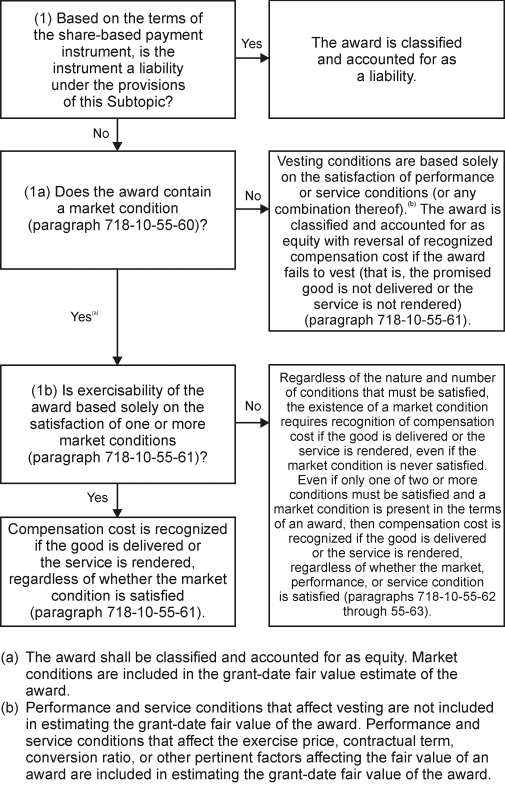
- aAll vesting and exercisability conditions
- bAll explicit, implicit, and derived service periods
- cThe probability that performance or service conditions will be satisfied.
- aThe market condition is satisfied before the end of the derived service period
- bSatisfying the market condition is no longer the basis for determining the requisite service period.
- aA formal, written agreement
- bAn informal, oral arrangement
- cAn entity's past practice.
- aAn employee of a physician practice that is consolidated by the physician practice management entity shall be considered an employee of the physician practice management entity and its subsidiaries.
- bAn employee of a physician practice that is not consolidated by the physician practice management entity shall not be considered an employee of the physician practice management entity and its subsidiaries.
Illustrations
- aThe nonemployee directors acting in their role as members of a parent entity's board of directors
- bNonemployee members of a consolidated subsidiary's board of directors to the extent that those members are elected by shareholders that are not controlled directly or indirectly by the parent or another member of the consolidated group.
- aPerformance targets are set at the inception of the arrangement (Case A).
- bPerformance targets are established at some time in the future (Case B).
- cPerformance targets established up front but vesting is tied to the vesting of a preceding award (Case C).
- aOn January 1, 20X5, Entity T enters into an arrangement with its chief executive officer relating to 40,000 share options on its stock with an exercise price of $30 per option.
- bThe arrangement is structured such that 10,000 share options will vest or be forfeited in each of the next 4 years (20X5 through 20X8) depending on whether annual performance targets relating to Entity T's revenues and net income are achieved.
- aExercise price established at subsequent dates (Case A)
- bExercise price established at inception (Case B).
- aWhen only one condition must be met (Case A)
- bWhen both conditions must be met (Case B).
- aThe share price reaching and maintaining at least $70 per share for 30 consecutive trading days
- bThe completion of eight years of service.
- aAn award is authorized. (Compensation cost would not be recognized before receiving all necessary approvals unless approval is essentially a formality [or perfunctory].)
- bService begins before a mutual understanding of the key terms and conditions of a share-based payment award is reached.
- cEither of the following conditions applies:
- 1The award's terms do not include a substantive future requisite service condition that exists at the grant date (see paragraph 718-10-55-113 for an example illustrating that condition).
- 2The award contains a market or performance condition that if not satisfied during the service period preceding the grant date and following the inception of the arrangement results in forfeiture of the award (see paragraph 718-10-55-114 for an example illustrating that condition).
- 1
- aShare option or cash settled stock appreciation rights (Case A)
- bPhantom shares or share options (Case B).
- a1,000 phantom share units (units) whose value is always equal to the value of 1,000 shares of Entity T's common stock
- bShare options on 3,000 shares of Entity T's stock with an exercise price of $30 per share.
 Units Exercise of Options Market value " $45,000 " "($45 × 1,000)" " $135,000 " " ($45 × 3,000)" Purchase price - " 90,000 " " ($30 × 3,000)" Net cash value " $45,000 " " $45,000 "
- a1,000 units with a value at grant of $30,000
- b2,000 options with a strike price of $45 per share.
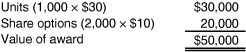 "Units (1,000 × $30)" " $30,000 " "Share options (2,000 × $10)" " 20,000 " Value of award " $50,000 "
- The Entity's 20X4 employee share option plan, which is shareholder-approved, permits the grant of share options and shares to its employees for up to 8 million shares of common stock. Entity A believes that such awards better align the interests of its employees with those of its shareholders. Option awards are generally granted with an exercise price equal to the market price of Entity A's stock at the date of grant; those option awards generally vest based on 5 years of continuous service and have 10-year contractual terms. Share awards generally vest over five years. Certain option and share awards provide for accelerated vesting if there is a change in control (as defined in the employee share option plan).
- The fair value of each option award is estimated on the date of grant using a lattice-based option valuation model that uses the assumptions noted in the following table. Because lattice-based option valuation models incorporate ranges of assumptions for inputs, those ranges are disclosed. Expected volatilities are based on implied volatilities from traded options on Entity A's stock, historical volatility of Entity A's stock, and other factors. Entity A uses historical data to estimate option exercise and employee termination within the valuation model; separate groups of employees that have similar historical exercise behavior are considered separately for valuation purposes. The expected term of options granted is derived from the output of the option valuation model and represents the period of time that options granted are expected to be outstanding; the range given below results from certain groups of employees exhibiting different behavior. The risk-free rate for periods within the contractual life of the option is based on the U.S. Treasury yield curve in effect at the time of grant.
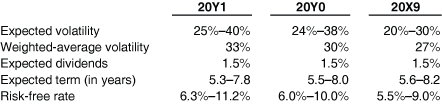 20Y1 20Y0 20X9 Expected volatility 25%-40% 24%-38% 20%-30% Weighted-average volatility 33% 30% 27% Expected dividends 1.5% 1.5% 1.5% Expected term (in years) 5.3-7.8 5.5-8.0 5.6-8.2 Risk-free rate 6.3%-11.2% 6.0%-10.0% 5.5%-9.0%
- A summary of option activity under the employee share option plan as of December 31, 20Y1, and changes during the year then ended is presented below.
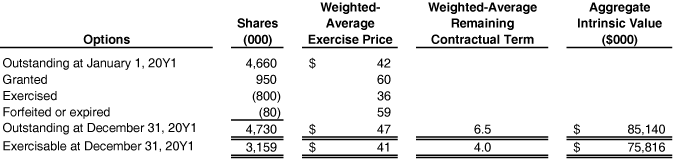 Options Shares (000) Weighted- Average Exercise Price Weighted-Average Remaining Contractual Term Aggregate Intrinsic Value ($000) "Outstanding at January 1, 20Y1" " 4,660 " $42 Granted 950 60 Exercised (800) 36 Forfeited or expired (80) 59 "Outstanding at December 31, 20Y1" " 4,730 " $47 6.5 " $85,140 " "Exercisable at December 31, 20Y1" " 3,159 " $41 4.0 " $75,816 "
- The weighted-average grant-date fair value of options granted during the years 20Y1, 20Y0, and 20X9 was $19.57, $17.46, and $15.90, respectively. The total intrinsic value of options exercised during the years ended December 31, 20Y1, 20Y0, and 20X9, was $25.2 million, $20.9 million, and $18.1 million, respectively.
- A summary of the status of Entity A's nonvested shares as of December 31, 20Y1, and changes during the year ended December 31, 20Y1, is presented below.
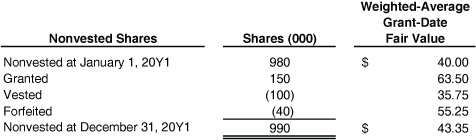 Nonvested Shares Shares (000) "Weighted-Average Grant-Date Fair Value" "Nonvested at January 1, 20Y1" 980 $40.00 Granted 150 63.50 Vested (100) 35.75 Forfeited (40) 55.25 "Nonvested at December 31, 20Y1" 990 $43.35
- As of December 31, 20Y1, there was $25.9 million of total unrecognized compensation cost related to nonvested share-based compensation arrangements granted under the employee share option plan. That cost is expected to be recognized over a weighted-average period of 4.9 years. The total fair value of shares vested during the years ended December 31, 20Y1, 20Y0, and 20X9, was $22.8 million, $21 million, and $20.7 million, respectively.
- During 20Y1, Entity A extended the contractual life of 200,000 fully vested share options held by 10 employees. As a result of that modification, the Entity recognized additional compensation expense of $1.0 million for the year ended December 31, 20Y1.
- Under its 20X7 performance share option plan, which is shareholder-approved, each January 1 Entity A grants selected executives and other key employees share option awards whose vesting is contingent upon meeting various departmental and company-wide performance goals, including decreasing time to market for new products, revenue growth in excess of an index of competitors' revenue growth, and sales targets for Segment X. Share options under the performance share option plan are generally granted at-the-money, contingently vest over a period of 1 to 5 years, depending on the nature of the performance goal, and have contractual lives of 7 to 10 years. The number of shares subject to options available for issuance under this plan cannot exceed 5 million.
- The fair value of each option grant under the performance share option plan was estimated on the date of grant using the same option valuation model used for options granted under the employee share option plan and assumes that performance goals will be achieved. If such goals are not met, no compensation cost is recognized and any recognized compensation cost is reversed. The inputs for expected volatility, expected dividends, and risk-free rate used in estimating those options' fair value are the same as those noted in the table related to options issued under the employee share option plan. The expected term for options granted under the performance share option plan in 20Y1, 20Y0, and 20X9 is 3.3 to 5.4 years, 2.4 to 6.5 years, and 2.5 to 5.3 years, respectively.
- A summary of the activity under the performance share option plan as of December 31, 20Y1, and changes during the year then ended is presented below.
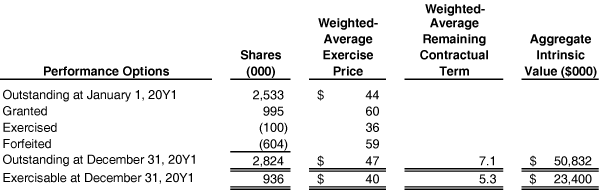 Performance Options Shares (000) Weighted-Average Exercise Price Weighted-Average Remaining Contractual Term Aggregate Intrinsic Value ($000) "Outstanding at January 1, 20Y1" "2,533 " $44 Granted 995 60 Exercised (100) 36 Forfeited (604) 59 "Outstanding at December 31, 20Y1" "2,824 " $47 7.1 " $50,832 " "Exercisable at December 31, 20Y1" 936 $40 5.3 " $23,400 "
- The weighted-average grant-date fair value of options granted during the years 20Y1, 20Y0, and 20X9 was $17.32, $16.05, and $14.25, respectively. The total intrinsic value of options exercised during the years ended December 31, 20Y1, 20Y0, and 20X9, was $5 million, $8 million, and $3 million, respectively. As of December 31, 20Y1, there was $16.9 million of total unrecognized compensation cost related to nonvested share-based compensation arrangements granted under the performance share option plan; that cost is expected to be recognized over a period of 4 years.
- Cash received from option exercise under all share-based payment arrangements for the years ended December 31, 20Y1, 20Y0, and 20X9, was $32.4 million, $28.9 million, and $18.9 million, respectively. The actual tax benefit for the tax deductions from option exercise of the share-based payment arrangements totaled $11.3 million, $10.1 million, and $6.6 million, respectively, for the years ended December 31, 20Y1, 20Y0, and 20X9.
- Entity A has a policy of repurchasing shares on the open market to satisfy share option exercises and expects to repurchase approximately 1 million shares during 20Y2, based on estimates of option exercises for that period.
- aEntity X is a partnership. Before June 1, 20X1, Entity X had Class A units outstanding. On June 1, 20X1, Entity X grants Class B incentive units to employees of a subsidiary of Entity X in exchange for services.
- bAn exit event may include an initial public offering, a change in control, or a liquidation of Entity X's assets.
- aThe Class B units are profits interest units that are subordinated to the Class A units because after vesting they participate pro rata with the Class A units once the holders of the Class A units have received distributions equal to a predetermined distribution threshold established on the grant date of the Class B units.
- bThe Class B units cliff vest at the end of three years of service.
- cUpon an exit event, the Class B units vest immediately if a grantee is still providing services to the subsidiary of Entity X. Upon such an event, the grantee would retain the vested Class B units, or if Class B units are settled through the exit event, Entity X would distribute proceeds to the Class B unit holders in the same manner as is described in (a).
- dIf a grantee of the Class B units terminates employment with the subsidiary of Entity X (whether voluntarily, upon death, disability, or retirement or at the election of Entity X for reasons other than cause), any unvested Class B units will be forfeited for no consideration. If a grantee of the Class B units terminates employment after vesting, the grantee retains ownership of the vested Class B units, but upon the grantee’s termination of employment, Entity X has a call right to repurchase the Class B units. If the call right is exercised, Entity X would pay the grantee of the Class B units an amount of cash equal to the fair value of the Class B units on the call date.
- aEither upon three years of service or an exit event, the grantor will have received the agreed-upon consideration (that is, the service will have been provided and the performance condition will have been met, if applicable) and the award will vest.
- bHolding the vested Class B units provides the grantee with the right to participate in the residual interest of Entity X through periodic distributions, upon an exit event, or upon settlement proportionate to ownership of Class B units of Entity X in accordance with the distribution waterfall described in paragraph 718-10-55-140(a).
- aThe Class B units are profits interest units that are subordinated to the Class A units because once granted, they participate pro rata with the Class A units once the holders of the Class A units have received distributions equal to a predetermined distribution threshold established on the grant date of the Class B units.
- bThe grantee of the Class B units is eligible to begin participating in nonforfeitable operating distributions at the grant date.
- cThe Class B units only vest upon an exit event. Upon such an event, the grantee would retain the vested Class B units, or if Class B units are settled through the exit event, Entity X would distribute proceeds to the Class B unit holders in the same manner as is described in (a). Class B units are forfeitable upon the grantee’s termination for any reason at any time before an exit event.
- aUpon an exit event, the grantor will have received the agreed-upon consideration (that is, the service will have been provided and the performance condition will have been met) and the award will vest.
- bHolding the vested Class B units provides the grantee with the right to participate in the residual interest of Entity X through periodic distributions, upon an exit event, or upon settlement proportionate to ownership of Class B units of Entity X in accordance with the distribution waterfall described in paragraph 718-10-55-142(a).
- aThe Class B units do not entitle the grantee to receive equity instruments of Entity X. This type of unit is often referred to as a phantom share unit.
- bThe grantee of the Class B units is not eligible to participate in distributions in the ordinary course of business.
- cThe grantee of the Class B units is eligible to receive cash upon an exit event. Upon an exit event, the Class B units vest immediately and must be settled in cash on the basis of the fair value of the Class B units. The fair value of the Class B units is calculated by reference to the price of Class A units of Entity X as determined at the date of the exit event.
- dThe grantee of the Class B units must be providing services when the exit event occurs to receive any proceeds, and the Class B units are forfeitable upon the grantee’s termination for any reason at any time before an exit event.
- aThe Class B units do not entitle the grantee to receive equity instruments of Entity X. This type of unit is often referred to as a phantom share unit.
- bThe grantee of the Class B units is eligible to participate in operating distributions made by Entity X equal to 1 percent of the preceding fiscal year’s net income. The grantee of the Class B units is eligible to begin participating in these operating distributions after three years of service.
- cThe grantee of the Class B units is not eligible to participate in any proceeds distributed upon an exit event.
- dThe Class B units are forfeitable upon the grantee’s termination for any reason at any time (including after the grantee has rendered three years of service).
718-10-60Relationships
Source downloaded: .Record version 41da4fe61bea. Effective date must be checked in the source.
Equity
Business Combinations
Derivatives and Hedging
718-10-65Transition and Open Effective Date Information
Source downloaded: .Record version fe60a2e7e36c. Effective date must be checked in the source.
Transition Related to Accounting Standards Update No. 2024-01, <em class="ph i">Compensation—Stock Compensation (Topic 718): Scope Application of Profits Interest and Similar Awards</em>
- aThe pending content that links to this paragraph shall be effective for public business entities for annual periods beginning after December 15, 2024, and interim periods within those annual periods.
- bFor entities other than public business entities, the pending content that links to this paragraph shall be effective for annual periods beginning after December 15, 2025, and interim periods within those annual periods.
- cEarly adoption of the pending content that links to this paragraph is permitted for both interim and annual financial statements that have not yet been issued or made available for issuance. If an entity adopts the pending content that links to this paragraph in an interim period, it shall adopt the pending content as of the beginning of the annual period that includes that interim period.
- dAn entity shall apply the pending content that links to this paragraph either:
- 1Retrospectively to all prior periods presented in the financial statements in accordance with paragraphs . An entity that selects retrospective application shall provide the disclosures in paragraphs in the period of adoption.
- 2Prospectively to profits interest or similar awards granted or modified on or after the date at which the entity first applies the pending content that links to this paragraph with disclosure that describes the nature of and reason for the change in accounting principle.
- 1
718-10-S00StatusSEC
Source downloaded: .Record version e5c7a5ba6190. Effective date must be checked in the source.
| Paragraph | Action | Accounting Standards Update | Date |
| 718-10-S25-1 | Added | Accounting Standards Update No. 2010-05 | 01/15/2010 |
| 718-10-S30-1 | Amended | Accounting Standards Update No. 2009-04 | 08/26/2009 |
| 718-10-S45-2 | Amended | Accounting Standards Update No. 2009-04 | 08/26/2009 |
| 718-10-S50-1 | Amended | Accounting Standards Update No. 2009-07 | 09/15/2009 |
| 718-10-S99-1 | Amended | Accounting Standards Update No. 2023-03 | 07/14/2023 |
| 718-10-S99-1 | Amended | Accounting Standards Update No. 2012-03 | 08/27/2012 |
| 718-10-S99-1 | Amended | Accounting Standards Update No. 2009-07 | 09/15/2009 |
| 718-10-S99-1 | Amended | Accounting Standards Update No. 2009-03 | 08/24/2009 |
| 718-10-S99-2 | Added | Accounting Standards Update No. 2010-05 | 01/15/2010 |
718-10-S15Scope and Scope ExceptionsSEC
Source downloaded: .Record version 754bbe38bcef. Effective date must be checked in the source.
Applicability of Topic 718 to Share-Based Transactions with Nonemployees
718-10-S25RecognitionSEC
Source downloaded: .Record version 980a0465494d. Effective date must be checked in the source.
Escrowed Share Arrangements and the Presumption of Compensation
718-10-S30Initial MeasurementSEC
Source downloaded: .Record version 1c544e1b1720. Effective date must be checked in the source.
Initial Carrying Amount of Certain Employee Share-Based Payment Arrangements with Redemption Provisions
718-10-S45Other Presentation MattersSEC
Source downloaded: .Record version 0ad33843ebe9. Effective date must be checked in the source.
Presentation of Compensation Expense Associated with Share-Based Payment Arrangements
Consideration of Redemption Features on Classification of Certain Employee Share-Based Payment Awards
718-10-S50DisclosureSEC
Source downloaded: .Record version ea55617323f9. Effective date must be checked in the source.
Disclosures Upon Becoming a Public Entity
Changes in Valuation Technique or Model Used to Value Instruments
Changes in Assumptions Used in Valuation Models
Expected Volatility Assumptions
Expected Term
First Time Adoption of Topic 718 in an Interim Period
Modification of Employee Share Options Before Adoption of Topic 718
718-10-S55Implementation Guidance and IllustrationsSEC
Source downloaded: .Record version c27045944870. Effective date must be checked in the source.
Accounting Issues Upon Transition from Nonpublic to Public Entity
Valuation Methods
Certain Assumptions Used in Valuation Methods
Modification of Employee Share Options Before Adoption of Topic 718
Application of the Measurement Provisions of Topic 718 to Foreign Private Issuers
718-10-S60RelationshipsSEC
Source downloaded: .Record version 42680bd2c40d. Effective date must be checked in the source.
Accounting by an Investor for Stock-Based Compensation Granted to Employees of an Equity Method Investee
718-10-S99SEC MaterialsSEC
Source downloaded: .Record version a5410918f31d. Effective date must be checked in the source.
SEC Staff Guidance
- The interpretations in this SAB express views of the staff regarding the interaction between FASB ASC Topic 718, Compensation—Stock Compensation, and certain SEC rules and regulations and provide the staff's views regarding the valuation of share-based payment arrangements for public companies. FASB ASC Topic 718 is based on the underlying accounting principle that compensation cost resulting from share-based payment transactions be recognized in financial statements at fair value. FN1 Recognition of compensation cost at fair value will provide investors and other users of financial statements with more complete and comparable financial information.
- FN1 FASB ASC paragraphs .
- FASB ASC Topic 718 addresses a wide range of share-based compensation arrangements including share options, restricted share plans, performance-based awards, share appreciation rights, and employee share purchase plans.
- FASB ASC Topic 718 replaced guidance originally issued in 1995 that established as preferable, but did not require, a fair-value-based method of accounting for share-based payment transactions with employees. It also replaced guidance originally issued in 1996 that provided different recognition and measurement requirements for share-based payment awards granted to nonemployees than for those granted to employees.
- The staff believes the guidance in this SAB will assist issuers in their application of FASB ASC Topic 718 and enhance the information received by investors and other users of financial statements, thereby assisting them in making investment and other decisions. This SAB includes interpretive guidance related to the transition from nonpublic to public entity FN2 status, valuation methods (including assumptions such as expected volatility, expected term, and current price of the underlying share, particularly when valuing spring-loaded awardsFN3), the accounting for certain redeemable financial instruments issued under share-based payment arrangements, the classification of compensation expense, and capitalization of compensation cost related to share-based payment arrangements.
- FN2 Defined in the FASB ASC Master Glossary.
- FN3 A share-based payment award granted when a company is in possession of material nonpublic information to which the market is likely to react positively when the information is announced is sometimes referred to as being "spring-loaded." The interpretive guidance included in this SAB with respect to spring-loaded share-based payment awards is not limited to share options, and applies to all instruments including, for example, restricted stock units.
- The staff recognizes that there is a range of conduct that a reasonable issuer might use to make estimates and valuations and otherwise apply FASB ASC Topic 718, and the interpretive guidance provided by this SAB. Thus, throughout this SAB the use of the terms "reasonable" and "reasonably" is not meant to imply a single conclusion or methodology, but to encompass the full range of potential conduct, conclusions or methodologies upon which an issuer may reasonably base its valuation decisions. Different conduct, conclusions or methodologies by different issuers in a given situation does not of itself raise an inference that any of those issuers is acting unreasonably. While the zone of reasonable conduct is not unlimited, the staff expects that it will be rare, except when observable market prices of identical or similar equity or liability instruments in active markets are available, when there is only one acceptable choice in estimating the fair value of share-based payment arrangements under the provisions of FASB ASC Topic 718 and the interpretive guidance provided by this SAB in any given situation. In addition, as discussed in the Interpretive Response to Question 1 of Section C, Valuation Methods, estimates of fair value are not intended to predict actual future events, and subsequent events are not indicative of the reasonableness of the original estimates of fair value made under FASB ASC Topic 718.
- A. Removed by SAB 120
- B. Transition From Nonpublic to Public Entity Status
- Facts: Company A is a nonpublic entity FN4 that first files a registration statement with the SEC to register its equity securities for sale in a public market on January 2, 20X8. As a nonpublic entity, Company A had been assigning value to its share options FN5 under the calculated value method prescribed by FASB ASC Topic 718, Compensation—Stock Compensation, FN6 and had elected to measure its liability awards based on intrinsic value. Company A is considered a public entity on January 2, 20X8 when it makes its initial filing with the SEC in preparation for the sale of its shares in a public market.
- FN4 Defined in the FASB ASC Master Glossary.
- FN5 For purposes of this staff accounting bulletin, the phrase "share options" is used to refer to "share options or similar instruments."
- FN6 FASB ASC paragraph 718-10-30-20 requires a nonpublic entity to use the calculated value method when it is not able to reasonably estimate the fair value of its equity share options and similar instruments because it is not practicable for it to estimate the expected volatility of its share price. FASB ASC paragraph 718-10-55-51 indicates that a nonpublic entity may be able to identify similar public entities for which share or option price information is available and may consider the historical, expected, or implied volatility of those entities' share prices in estimating expected volatility. The staff would expect an entity that becomes a public entity and had previously measured its share options under the calculated value method to be able to support its previous decision to use calculated value and to provide the disclosures required by FASB ASC subparagraph 718-10-50-2(f)(2)(ii).
- Question 1: How should Company A account for the share options that were granted prior to January 2, 20X8 for which the requisite service has not been rendered by January 2, 20X8?
- Interpretive Response: Prior to becoming a public entity, Company A had been assigning value to its share options under the calculated value method. The staff believes that Company A should continue to follow that approach for those share options that were granted prior to January 2, 20X8, unless those share options are subsequently modified, repurchased or cancelled. FN7 If the share options are subsequently modified, repurchased or cancelled, Company A would assess the event under the public company provisions of FASB ASC Topic 718. For example, if Company A modified the share options on February 1, 20X8, any incremental compensation cost would be measured under FASB ASC subparagraph 718-20-35-3(a), as the fair value of the modified share options over the fair value of the original share options measured immediately before the terms were modified. FN8
- FN7 This view is consistent with the FASB's basis for rejecting full retrospective application of FASB ASC Topic 718 as described in the basis for conclusions of Statement 123R, paragraph B251.
- FN8 FASB ASC paragraph 718-20-55-94. The staff believes that because Company A is a public entity as of the date of the modification, it would be inappropriate to use the calculated value method to measure the original share options immediately before the terms were modified.
- Question 2: How should Company A account for its liability awards granted prior to January 2, 20X8 that are fully vested but have not been settled by January 2, 20X8?
- Interpretive Response: As a nonpublic entity, Company A had elected to measure its liability awards subject to FASB ASC Topic 718 at intrinsic value. FN9 When Company A becomes a public entity, it should measure the liability awards at their fair value determined in accordance with FASB ASC Topic 718. FN10 In that reporting period there will be an incremental amount of measured cost for the difference between fair value as determined under FASB ASC Topic 718 and intrinsic value. For example, assume the intrinsic value in the period ended December 31, 20X7 was $10 per award. At the end of the first reporting period ending after January 2, 20X8 (when Company A becomes a public entity), assume the intrinsic value of the award is $12 and the fair value as determined in accordance with FASB ASC Topic 718 is $15. The measured cost in the first reporting period after December 31, 20X7 would be $5. FN11
- FN9 FASB ASC paragraph 718-30-30-2.
- FN10 FASB ASC paragraph 718-30-35-3.
- FN11 $15 fair value less $10 intrinsic value equals $5 of incremental cost.
- Question 3: After becoming a public entity, may Company A retrospectively apply the fair-value-based method to its awards that were granted prior to the date Company A became a public entity?
- Interpretive Response: No. Before becoming a public entity, Company A did not use the fair-value-based method for either its share options or its liability awards. The staff does not believe it is appropriate for Company A to apply the fair-value-based method on a retrospective basis, because it would require the entity to make estimates of a prior period, which, due to hindsight, may vary significantly from estimates that would have been made contemporaneously in prior periods. FN12
- FN12 This view is consistent with the FASB's basis for rejecting full retrospective application of FASB ASC Topic 718 as described in the basis for conclusions of Statement 123R, paragraph B251.
- Question 4: Upon becoming a public entity, what disclosures should Company A consider in addition to those prescribed by FASB ASC Topic 718? FN13
- FN13 FASB ASC Section 718-10-50.
- Interpretive Response: In the registration statement filed on January 2, 20X8, Company A should clearly describe in MD&A the change in accounting policy that will be required by FASB ASC Topic 718 in subsequent periods and the reasonably likely material future effects. FN14 In subsequent filings, Company A should provide financial statement disclosure of the effects of the changes in accounting policy. In addition, Company A should consider the requirements of Item 303(b)(3) of Regulation S-K regarding critical accounting estimates in MD&A.
- FN14 See Item 303 of Regulation S-K.
- C. Valuation Methods
- FASB ASC paragraph 718-10-30-6 (Compensation—Stock Compensation Topic) indicates that the measurement objective for equity instruments awarded to grantees is to estimate at the grant date the fair value of the equity instruments the entity is obligated to issue when grantees have delivered the good or rendered the service and satisfied any other conditions necessary to earn the right to benefit from the instruments. FN15 The Topic also states that observable market prices of identical or similar equity or liability instruments in active markets are the best evidence of fair value and, if available, should be used as the basis for the measurement for equity and liability instruments awarded in a share-based payment transaction. FN16 However, if observable market prices of identical or similar equity or liability instruments are not available, the fair value shall be estimated by using a valuation technique or model that complies with the measurement objective, as described in FASB ASC Topic 718. FN17
- FN15 FASB ASC paragraph 718-10-30-1 states that this guidance applies equally to awards classified as liabilities.
- FN16 FASB ASC paragraph 718-10-55-10.
- FN17 FASB ASC paragraph 718-10-55-11.
- Question 1: If a valuation technique or model is used to estimate fair value, to what extent will the staff consider a company's estimates of fair value to be materially misleading because the estimates of fair value do not correspond to the value ultimately realized by the grantees who received the share options?
- Interpretive Response: The staff understands that estimates of fair value of share options, while derived from expected value calculations, cannot predict actual future events. FN18 The estimate of fair value represents the measurement of the cost of the grantee’s goods or services to the company. The estimate of fair value should reflect the assumptions marketplace participants would use in determining how much to pay for an instrument on the fair value measurement date FN19. For example, valuation techniques used in estimating the fair value of share options may consider information about a large number of possible share price paths, while, of course, only one share price path will ultimately emerge. If a company makes a good faith fair value estimate in accordance with the provisions of FASB ASC Topic 718 in a way that is designed to take into account the assumptions that underlie the instrument's value that marketplace participants would reasonably make, then subsequent future events that affect the instrument's value do not provide meaningful information about the quality of the original fair value estimate. As long as the share options were originally so measured, changes in a share option's value, no matter how significant, subsequent to its grant date do not call into question the reasonableness of the grant date fair value estimate.
- FN18 FASB ASC paragraph 718-10-55-15states, "The fair value of those instruments at a single point in time is not a forecast of what the estimated fair value of those instruments may be in the future."
- FN19 Generally, the grant date for equity awards or the reporting date for liability-classified awards.
- Question 2: In order to meet the fair value measurement objective in FASB ASC Topic 718, are certain valuation techniques preferred over others?
- Interpretive Response: FASB ASC paragraph 718-10-55-17 clarifies that the Topic does not specify a preference for a particular valuation technique or model. As stated in FASB ASC paragraph 718-10-55-11 in order to meet the fair value measurement objective, a company should select a valuation technique or model that (a) is applied in a manner consistent with the fair value measurement objective and other requirements of FASB ASC Topic 718, (b) is based on established principles of financial economic theory and generally applied in that field and (c) reflects all substantive characteristics of the instrument (except for those explicitly excluded by FASB ASC Topic 718).
- The chosen valuation technique or model must meet all three of the requirements stated above. In valuing a particular instrument, certain techniques or models may meet the first and second criteria but may not meet the third criterion because the techniques or models are not designed to reflect certain characteristics contained in the instrument. For example, for a share option in which the exercisability is conditional on a specified increase in the price of the underlying shares, the Black-Scholes-Merton closed-form model would not generally be an appropriate valuation model because, while it meets both the first and second criteria, it is not designed to take into account that type of market condition. FN20
- FN20 See FASB ASC paragraphs 718-10-55-16 and 718-10-55-20.
- Further, the staff understands that a company may consider multiple techniques or models that meet the fair value measurement objective before making its selection as to the appropriate technique or model. The staff would not object to a company's choice of a technique or model as long as the technique or model meets the fair value measurement objective. For example, a company is not required to use a lattice model simply because that model was the most complex of the models the company considered.
- Question 3: In subsequent periods, may a company change the valuation technique or model chosen to value instruments with similar characteristics? FN21
- FN21 FASB ASC paragraph 718-10-55-17 indicates that an entity may use different valuation techniques or models for instruments with different characteristics.
- Interpretive Response: As long as the new technique or model meets the fair value measurement objective as described in Question 2 above, the staff would not object to a company changing its valuation technique or model. FN22 A change in the valuation technique or model used to meet the fair value measurement objective would not be considered a change in accounting principle.FN23 As such, a company would not be required to file a preferability letter from its independent accountants as described in Rule 10-01(b)(6) of Regulation S-X when it changes valuation techniques or models. However, the staff would not expect that a company would frequently switch between valuation techniques or models, particularly in circumstances where there was no significant variation in the form of share-based payments being valued. Disclosure in the footnotes of the basis for any change in technique or model would be appropriate. FN24
- FN22 The staff believes that a company should take into account the reason for the change in technique or model in determining whether the new technique or model meets the fair value measurement objective. For example, changing a technique or model from period to period for the sole purpose of lowering the fair value estimate of a share option would not meet the fair value measurement objective of the Topic.
- FN23 FASB ASC paragraph 718-10-55-27.
- FN24 See generally FASB ASC paragraph 718-10-50-1.
- Question 4: Must every company that issues share options or similar instruments hire an outside third party to assist in determining the fair value of the share options?
- Interpretive Response: No. However, the valuation of a company's share options or similar instruments should be performed by a person with the requisite expertise.
- D. Certain Assumptions Used in Valuation Methods
- FASB ASC Topic 718's (Compensation—Stock Compensation Topic) fair value measurement objective for equity instruments awarded to grantees for goods or services is to estimate the grant-date fair value of the equity instruments that the entity is obligated to issue when grantees have delivered the good or rendered the service and satisfied any other conditions necessary to earn the right to benefit from the instruments. FN25 In order to meet this fair value measurement objective, management will generally be required to develop estimates regarding (1) the expected volatility of its company's share price; (2) the expected term of the option, taking into account both the contractual term of the option and the effects of grantees’ expected exercise and post-vesting termination behavior; and (3) the determination of the current price of the underlying share. The staff is providing guidance in the following sections related to the expected volatility, expected term and current share price assumptions to assist public entities in applying those requirements.
- FN25 FASB ASC paragraph 718-10-30-6. FASB ASC paragraph 718-10-30-1 states that this guidance applies equally to awards classified as liabilities.
- 1. Expected Volatility
- FASB ASC paragraph 718-10-55-36 states, "Volatility is a measure of the amount by which a financial variable, such as share price, has fluctuated (historical volatility) or is expected to fluctuate (expected volatility) during a period. Option-pricing models require an estimate of expected volatility as an assumption because an option's value is dependent on potential share returns over the option's term. The higher the volatility, the more the returns on the share can be expected to vary—up or down. Because an option's value is unaffected by expected negative returns on the shares, other things [being] equal, an option on a share with higher volatility is worth more than an option on a share with lower volatility."
- Facts: Company B is a public entity whose common shares have been publicly traded for over twenty years. Company B also has multiple options on its shares outstanding that are traded on an exchange ("traded options"). Company B grants share options on January 2, 20X6.
- Question 1: What should Company B consider when estimating expected volatility for purposes of measuring the fair value of its share options?
- Interpretive Response: FASB ASC Topic 718 does not specify a particular method of estimating expected volatility. However, the Topic does clarify that the objective in estimating expected volatility is to ascertain the assumption about expected volatility that marketplace participants would likely use in determining an exchange price for an option. FN26 FASB ASC Topic 718 provides a list of factors entities should consider in estimating expected volatility. FN27 Company B may begin its process of estimating expected volatility by considering its historical volatility. FN28 However, Company B should also then consider, based on available information, how the expected volatility of its share price may differ from historical volatility. FN29 Implied volatility FN30 can be useful in estimating expected volatility because it is generally reflective of both historical volatility and expectations of how future volatility will differ from historical volatility.
- FN26 FASB ASC paragraph 718-10-55-35.
- FN27 FASB ASC paragraph 718-10-55-37.
- FN28 FASB ASC paragraph 718-10-55-40.
- FN29 Ibid.
- FN30 Implied volatility is the volatility assumption inherent in the market prices of a company's traded options or other financial instruments that have option-like features. Implied volatility is derived by entering the market price of the traded financial instrument, along with assumptions specific to the financial options being valued, into a model based on a constant volatility estimate (e.g., the Black-Scholes-Merton closed-form model) and solving for the unknown assumption of volatility.
- The staff believes that companies should make good faith efforts to identify and use sufficient information in determining whether taking historical volatility, implied volatility or a combination of both into account will result in the best estimate of expected volatility. The staff believes companies that have appropriate traded financial instruments from which they can derive an implied volatility should generally consider this measure. The extent of the ultimate reliance on implied volatility will depend on a company's facts and circumstances; however, the staff believes that a company with actively traded options or other financial instruments with embedded options FN31 generally could place greater (or even exclusive) reliance on implied volatility. (See the Interpretive Responses to Questions 3 and 4 below.)
- FN31 The staff believes implied volatility derived from embedded options can be utilized in determining expected volatility if, in deriving the implied volatility, the company considers all relevant features of the instruments (e.g., value of the host instrument, value of the option, etc.). The staff believes the derivation of implied volatility from other than simple instruments (e.g., a simple convertible bond) can, in some cases, be impracticable due to the complexity of multiple features.
- The process used to gather and review available information to estimate expected volatility should be applied consistently from period to period. When circumstances indicate the availability of new or different information that would be useful in estimating expected volatility, a company should incorporate that information.
- Question 2: What should Company B consider if computing historical volatility? FN32
- FN32 See FASB ASC paragraph 718-10-55-37.
- Interpretive Response: The following should be considered in the computation of historical volatility:
- 1. Method of Computing Historical Volatility—
- The staff believes the method selected by Company B to compute its historical volatility should produce an estimate that is representative of a marketplace participant’s expectations about Company B's future volatility over the expected (if using a Black-Scholes-Merton closed-form model) or contractual (if using a lattice model) term FN33 of its share options. Certain methods may not be appropriate for longer term share options if they weight the most recent periods of Company B's historical volatility much more heavily than earlier periods. FN34 For example, a method that applies a factor to certain historical price intervals to reflect a decay or loss of relevance of that historical information emphasizes the most recent historical periods and thus would likely bias the estimate to this recent history. FN35
- FN33 For purposes of this staff accounting bulletin, the phrase "expected or contractual term, as applicable" has the same meaning as the phrase "expected (if using a Black-Scholes-Merton closed-form model) or contractual (if using a lattice model) term of a share option."
- FN34 FASB ASC subparagraph 718-10-55-37(a) states that entities should consider historical volatility over a period generally commensurate with the expected or contractual term, as applicable, of the share option. Accordingly, the staff believes methods that place extreme emphasis on the most recent periods may be inconsistent with this guidance.
- FN35 Generalized Autoregressive Conditional Heteroskedasticity (GARCH) is an example of a method that demonstrates this characteristic.
- 2. Amount of Historical Data—
- FASB ASC subparagraph 718-10-55-37(a) indicates entities should consider historical volatility over a period generally commensurate with the expected or contractual term, as applicable, of the share option. The staff believes Company B could utilize a period of historical data longer than the expected or contractual term, as applicable, if it reasonably believes the additional historical information will improve the estimate. For example, assume Company B decided to utilize a Black-Scholes-Merton closed-form model to estimate the value of the share options granted on January 2, 20X6 and determined that the expected term was six years. Company B would not be precluded from using historical data longer than six years if it concludes that data would be relevant.
- 3. Frequency of Price Observations—
- FASB ASC subparagraph 718-10-55-37(d) indicates an entity should use appropriate and regular intervals for price observations based on facts and circumstances that provide the basis for a reasonable fair value estimate. Accordingly, the staff believes Company B should consider the frequency of the trading of its shares and the length of its trading history in determining the appropriate frequency of price observations. The staff believes using daily, weekly or monthly price observations may provide a sufficient basis to estimate expected volatility if the history provides enough data points on which to base the estimate. FN36 Company B should select a consistent point in time within each interval when selecting data points. FN37
- FN36 Further, if shares of a company are thinly traded the staff believes the use of weekly or monthly price observations would generally be more appropriate than the use of daily price observations. The volatility calculation using daily observations for such shares could be artificially inflated due to a larger spread between the bid and asked quotes and lack of consistent trading in the market.
- FN37 FASB ASC paragraph 718-10-55-40 states that a company should establish a process for estimating expected volatility and apply that process consistently from period to period. In addition, FASB ASC paragraph 718-10-55-27 indicates that assumptions used to estimate the fair value of instruments granted in share-based payment transactions should be determined in a consistent manner from period to period.
- 4. Consideration of Future Events—
- The objective in estimating expected volatility is to ascertain the assumptions that marketplace participants would likely use in determining an exchange price for an option. FN38 Accordingly, the staff believes that Company B should consider those future events that it reasonably concludes a marketplace participant would also consider in making the estimation. For example, if Company B has recently announced a merger with a company that would change its business risk in the future, then it should consider the impact of the merger in estimating the expected volatility if it reasonably believes a marketplace participant would also consider this event.
- The staff believes that careful consideration is required to determine whether material non-public information is currently available (or would be available) to the issuer that would be considered by a marketplace participant in estimating the expected volatility. FN39 For example, if Company B has entered into a material transaction that has not yet been announced prior to its grant of equity instruments, the specific facts and circumstances of the material transaction may lead Company B to conclude that the impact of this event should be included in estimating the expected volatility when determining the grant-date fair value of those equity instruments.
- FN38 FASB ASC paragraph 718-10-55-35.
- FN39 FASB ASC paragraph 718-10-55-13 states "assumptions shall reflect information that is (or would be) available to form the basis for an amount at which the instruments being valued would be exchanged. In estimating fair value, the assumptions used shall not represent the biases of a particular party."
- 5. Exclusion of Periods of Historical Data—
- In some instances, due to a company's particular business situations, a period of historical volatility data may not be relevant in evaluating expected volatility. FN40 In these instances, that period should be disregarded. The staff believes that if Company B disregards a period of historical volatility, it should be prepared to support its conclusion that its historical share price during that previous period is not relevant to estimating expected volatility due to one or more discrete and specific historical events and that similar events are not expected to occur during the expected term of the share option. The staff believes these situations would be rare.
- FN40 FASB ASC paragraph 718-10-55-37.
- Question 3: What should Company B consider when evaluating the extent of its reliance on the implied volatility derived from its traded options?
- Interpretive Response: To achieve the objective of estimating expected volatility as stated in FASB ASC paragraphs , the staff believes Company B generally should consider the following in its evaluation:
- 1) the volume of market activity of the underlying shares and traded options;
- 2) the ability to synchronize the variables used to derive implied volatility;
- 3) the similarity of the exercise prices of the traded options to the exercise price of the newly-granted share options;
- 4) the similarity of the length of the term of the traded and newly-granted share options; FN41 and
- 5) consideration of material non-public information.
- FN41 See generally Options, Futures, and Other Derivatives by John C. Hull (Pearson, 11th Edition, 2021).
- 1. Volume of Market Activity—
- The staff believes Company B should consider the volume of trading in its underlying shares as well as the traded options. For example, prices for instruments in actively traded markets are more likely to reflect a marketplace participant's expectations regarding expected volatility.
- 2. Synchronization of the Variables—
- Company B should synchronize the variables used to derive implied volatility. For example, to the extent reasonably practicable, Company B should use market prices (either traded prices or the average of bid and asked quotes) of the traded options and its shares measured at the same point in time. This measurement should also be synchronized with the grant of the share options; however, when this is not reasonably practicable, the staff believes Company B should derive implied volatility as of a point in time as close to the grant of the share options as reasonably practicable.
- 3. Similarity of the Exercise Prices—
- The staff believes that when valuing an at-the-money share option, the implied volatility derived from at- or near-the-money traded options generally would be most relevant. FN42 If, however, it is not possible to find at- or near-the-money traded options, Company B should select multiple traded options with an average exercise price close to the exercise price of the share option. FN43
- FN42 Implied volatilities of options differ systematically over the "moneyness" of the option. This pattern of implied volatilities across exercise prices is known as the "volatility smile" or "volatility skew." Studies such as "Implied Volatility" by Stewart Mayhew, Financial Analysts Journal, July-August 1995, as well as more recent studies, have found that implied volatilities based on near-the-money options do as well as sophisticated weighted implied volatilities in estimating expected volatility. In addition, the staff believes that because near-the-money options are generally more actively traded, they may provide a better basis for deriving implied volatility.
- FN43 The staff believes a company could use a weighted-average implied volatility based on traded options that are either in-the-money or out-of-the-money. For example, if the share option has an exercise price of $52, but the only traded options available have exercise prices of $50 and $55, then the staff believes that it is appropriate to use a weighted average based on the implied volatilities from the two traded options; for this example, a 40% weight on the implied volatility calculated from the option with an exercise price of $55 and a 60% weight on the option with an exercise price of $50.
- 4. Similarity of Length of Terms—
- The staff believes that when valuing a share option with a given expected or contractual term, as applicable, the implied volatility derived from a traded option with a similar term would be the most relevant. However, if there are no traded options with maturities that are similar to the share option's contractual or expected term, as applicable, then the staff believes Company B could consider traded options with a remaining maturity of six months or greater. FN44 However, when using traded options with a term of less than one year, FN45 the staff would expect the company to also consider other relevant information in estimating expected volatility. In general, the staff believes more reliance on the implied volatility derived from a traded option would be expected the closer the remaining term of the traded option is to the expected or contractual term, as applicable, of the share option.
- FN44 The staff believes it may also be appropriate to consider the entire term structure of volatility provided by traded options with a variety of remaining maturities. If a company considers the entire term structure in deriving implied volatility, the staff would expect a company to include some options in the term structure with a remaining maturity of six months or greater.
- FN45 The staff believes the implied volatility derived from a traded option with a term of one year or greater would typically not be significantly different from the implied volatility that would be derived from a traded option with a significantly longer term.
- 5. Consideration of Material Nonpublic Information—
- When a company is in possession of material non-public information, the staff believes that the related guidance in the interpretive response to Question 2 above would also be relevant in determining whether the implied volatility appropriately reflects a marketplace participant’s expectations of future volatility.
- The staff believes Company B's evaluation of the factors above should assist in determining whether the implied volatility appropriately reflects the market's expectations of future volatility and thus the extent of reliance that Company B reasonably places on the implied volatility.
- Question 4: Are there situations in which it is acceptable for Company B to rely exclusively on either implied volatility or historical volatility in its estimate of expected volatility?
- Interpretive Response: As stated above, FASB ASC Topic 718 does not specify a method of estimating expected volatility; rather, it provides a list of factors that should be considered and requires that an entity's estimate of expected volatility be reasonable and supportable. FN46 Many of the factors listed in FASB ASC Topic 718 are discussed in Questions 2 and 3 above. The objective of estimating volatility, as stated in FASB ASC Topic 718, is to ascertain the assumption about expected volatility that marketplace participants would likely use in determining an exchange price for an option. FN47 The staff believes that a company, after considering the factors listed in FASB ASC Topic 718, could, in certain situations, reasonably conclude that exclusive reliance on either historical or implied volatility would provide an estimate of expected volatility that meets this stated objective.
- FN46 FASB ASC paragraphs .
- FN47 FASB ASC paragraph 718-10-55-35.
- The staff would not object to Company B placing exclusive reliance on implied volatility when the following factors are present, as long as the methodology is consistently applied:
- • Company B utilizes a valuation model that is based upon a constant volatility assumption to value its share options; FN48
- FN48 FASB ASC paragraphs 718-10-55-18 and 718-10-55-39 discuss the incorporation of a range of expected volatilities into option pricing models. The staff believes that a company that utilizes an option pricing model that incorporates a range of expected volatilities over the option's contractual term should consider the factors listed in FASB ASC Topic 718, and those discussed in the Interpretive Responses to Questions 2 and 3 above, to determine the extent of its reliance (including exclusive reliance) on the derived implied volatility.
- • The implied volatility is derived from options that are actively traded;
- • The market prices (trades or quotes) of both the traded options and underlying shares are measured at a similar point in time to each other and on a date reasonably close to the fair value measurement date of the share options;
- • The traded options have exercise prices that are both (a) near-the-money and (b) close to the exercise price of the share options; FN49
- FN49 When near-the-money options are not available, the staff believes the use of a weighted-average approach, as noted previously, may be appropriate.
- • The remaining maturities of the traded options on which the estimate is based are at least one year, and
- • Material nonpublic information that would be considered in a marketplace participant’s expectation of future volatility does not exist.
- The staff would not object to Company B placing exclusive reliance on historical volatility when the following factors are present, so long as the methodology is consistently applied:
- • Company B has no reason to believe that its future volatility over the expected or contractual term, as applicable, is likely to differ from its past; FN50
- FN50 See FASB ASC paragraph 718-10-55-38. A change in a company's business model that results in a material alteration to the company's risk profile is an example of a circumstance in which the company's future volatility would be expected to differ from its historical volatility. Other examples may include, but are not limited to, the introduction of a new product that is central to a company's business model or the receipt of U.S. Food and Drug Administration approval for the sale of a new prescription drug.
- • The computation of historical volatility uses a simple average calculation method;
- • A sequential period of historical data at least equal to the expected or contractual term of the share option, as applicable, is used; and
- • A reasonably sufficient number of price observations are used, measured at a consistent point throughout the applicable historical period. FN51
- FN51 If the expected or contractual term, as applicable, of the employee share option is less than three years, the staff believes monthly price observations would not provide a sufficient amount of data.
- Question 5: What disclosures would the staff expect Company B to include in its financial statements and MD&A regarding its assumption of expected volatility?
- Interpretive Response: FASB ASC paragraph 718-10-50-2 prescribes the minimum information needed to achieve the Topic's disclosure objectives. FN52 Under that guidance, Company B is required to disclose the expected volatility and the method used to estimate it. FN53 Accordingly, the staff expects that, at a minimum, Company B would disclose in a footnote to its financial statements how it determined the expected volatility assumption for purposes of determining the fair value of its share options in accordance with FASB ASC Topic 718. For example, at a minimum, the staff would expect Company B to disclose whether it used only implied volatility, historical volatility, or a combination of both, and how it determined any significant adjustments to historical volatility.
- FN52 FASB ASC paragraph 718-10-50-1.
- FN53 FASB ASC subparagraph 718-10-50-2(f)(2)(ii).
- In addition, Company B should consider the requirements of Regulation S-K Item 303(b)(3) regarding critical accounting estimates in MD&A. A company should determine whether its evaluation of any of the factors listed in Questions 2 and 3 of this section, such as consideration of future events in estimating expected volatility, resulted in an estimate that involves a significant level of estimation uncertainty and has had or is reasonably likely to have a material impact on the financial condition or results of operations of the company.
- Facts: Company C is a newly public entity with limited historical data on the price of its publicly-traded shares and no other traded financial instruments. Company C believes that it does not have sufficient company-specific information regarding the volatility of its share price on which to base an estimate of expected volatility.
- Question 6: What other sources of information should Company C consider in order to estimate the expected volatility of its share price?
- Interpretive Response: FASB ASC Topic 718 provides guidance on estimating expected volatility for newly-public and nonpublic entities that do not have company-specific historical or implied volatility information available. FN54 Company C may base its estimate of expected volatility on the historical, expected or implied volatility of similar entities whose share or option prices are publicly available. In making its determination as to similarity, Company C would likely consider the industry, stage of life cycle, size and financial leverage of such other entities. FN55
- FN54 FASB ASC paragraphs 718-10-55-25 and 718-10-55-51.
- FN55 FASB ASC paragraph 718-10-55-25.
- The staff would not object to Company C looking to an industry sector index (e.g., NASDAQ Computer Index) that is representative of Company C's industry, and possibly its size, to identify one or more similar entities. FN56 Once Company C has identified similar entities, it would substitute a measure of the individual volatilities of the similar entities for the expected volatility of its share price as an assumption in its valuation model. FN57 Because of the effects of diversification that are present in an industry sector index, Company C should not substitute the volatility of an index for the expected volatility of its share price as an assumption in its valuation model. FN58
- FN56 If a company operates in a number of different industries, it could look to several industry indices. However, when considering the volatilities of multiple companies, each operating only in a single industry, the staff believes a company should take into account its own leverage, the leverages of each of the entities, and the correlation of the entities' stock returns.
- FN57 FASB ASC paragraph 718-10-55-51.
- FN58 FASB ASC paragraph 718-10-55-25.
- After similar entities have been identified, Company C should continue to consider the volatilities of those entities unless circumstances change such that the identified entities are no longer similar to Company C. Until Company C has sufficient information available, the staff would not object to Company C basing its estimate of expected volatility on the volatility of similar entities for those periods for which it does not have sufficient information available. FN59 Until Company C has either a sufficient amount of historical information regarding the volatility of its share price or other traded financial instruments are available to derive an implied volatility to support an estimate of expected volatility, it should consistently apply a process as described above to estimate expected volatility based on the volatilities of similar entities. FN60
- FN59 FASB ASC paragraph 718-10-55-37. The staff believes that at least two years of daily or weekly historical data could provide a reasonable basis on which to base an estimate of expected volatility if a company has no reason to believe that its future volatility will differ materially during the expected or contractual term, as applicable, from the volatility calculated from this past information. If the expected or contractual term, as applicable, of a share option is shorter than two years, the staff believes a company should use daily or weekly historical data for at least the length of that applicable term.
- FN60 FASB ASC paragraph 718-10-55-40.
- 2. Expected Term
- FASB ASC paragraph 718-10-55-29 states, "The fair value of a traded (or transferable) share option is based on its contractual term because rarely is it economically advantageous to exercise, rather than sell, a transferable share option before the end of its contractual term. Employee share options generally differ from transferable [or tradable] share options in that employees cannot sell (or hedge) their share options—they can only exercise them; because of this, employees generally exercise their options before the end of the options' contractual term. Thus, the inability to sell or hedge an employee share option effectively reduces the option's value [compared to a transferable option] because exercise prior to the option's expiration terminates its remaining life and thus its remaining time value." Accordingly, FASB ASC Topic 718 requires that when valuing an employee share option under the Black-Scholes-Merton framework the fair value of employee share options be based on the share options' expected term rather than the contractual term.
- FASB ASC paragraph 718-10-55-29A states, "On an award-by-award basis, an entity may elect to use the contractual term as the expected term when estimating the fair value of a nonemployee award to satisfy the measurement objective in paragraph 718-10-30-6. Otherwise, an entity shall apply the guidance in [Topic 718] in estimating the expected term of a nonemployee award, which may result in a term less than the contractual term of the award. If an entity does not elect to use the contractual term as the expected term, similar considerations discussed in paragraph 718-10-55-29, such as the inability to sell or hedge a nonemployee award, apply when estimating its expected term."
- The staff believes the estimate of expected term should be based on the facts and circumstances available in each particular case. Consistent with our Topic 14 introductory guidance regarding reasonableness, the fact that other possible estimates are later determined to have more accurately reflected the term does not necessarily mean that the particular choice was unreasonable. The staff reminds registrants of the expected term disclosure requirements described in FASB ASC subparagraph 718-10-50-2(f)(2)(i).
- Facts: Company D utilizes the Black-Scholes-Merton closed-form model to value its share options for the purposes of determining the fair value of the options under FASB ASC Topic 718. Company D recently granted share options to its employees. Based on its review of various factors, Company D determines that the expected term of the options is six years, which is less than the contractual term of ten years.
- Question 1: When determining the fair value of the share options in accordance with FASB ASC Topic 718, should Company D consider an additional discount for nonhedgability and nontransferability?
- Interpretive Response: No. FASB ASC paragraph 718-10-55-29 indicates that nonhedgability and nontransferability have the effect of increasing the likelihood that an employee share option will be exercised before the end of its contractual term. Nonhedgability and nontransferability therefore factor into the expected term assumption (in this case reducing the term assumption from ten years to six years), and the expected term reasonably adjusts for the effect of these factors. Accordingly, the staff believes that no additional reduction in the term assumption or other discount to the estimated fair value is appropriate for these particular factors. FN61
- FN61 The staff notes the existence of academic literature that supports the assertion that the Black-Scholes-Merton closed-form model, with expected term as an input, can produce reasonable estimates of fair value. Such literature includes J. Carpenter, "The exercise and valuation of executive stock options," Journal of Financial Economics, May 1998, pp.127-158; C. Marquardt, "The Cost of Employee Stock Option Grants: An Empirical Analysis," Journal of Accounting Research, September 2002, p. 1191-1217); and J. Bettis, J. Bizjak and M. Lemmon, "Exercise behavior, valuation, and the incentive effect of employee stock options," Journal of Financial Economics, May 2005, pp. 445-470, as well as more recent studies.
- Question 2: Should forfeitures or terms that stem from forfeitability be factored into the determination of expected term?
- Interpretive Response: No. FASB ASC Topic 718 indicates that the expected term that is utilized as an assumption in a closed-form option-pricing model or a resulting output of a lattice option pricing model when determining the fair value of the share options should not incorporate restrictions or other terms that stem from the pre-vesting forfeitability of the instruments. Under FASB ASC Topic 718, these pre-vesting restrictions or other terms are taken into account by ultimately recognizing compensation cost only for awards for which grantees deliver the good or render the requisite service. FN62
- FN62 FASB ASC paragraph 718-10-30-11.
- Question 3: Can a company's estimate of expected term ever be shorter than the vesting period?
- Interpretive Response: No. The vesting period forms the lower bound of the estimate of expected term. FN63
- FN63 FASB ASC paragraph 718-10-55-31.
- Question 4: FASB ASC paragraph 718-10-55-34indicates that an entity shall aggregate individual awards into relatively homogenous groups with respect to exercise and post-vesting employment termination behaviors for the purpose of determining expected term, regardless of the valuation technique or model used to estimate the fair value. How many groupings are typically considered sufficient?
- Interpretive Response: As it relates to employee groupings, the staff believes that an entity may generally make a reasonable fair value estimate with as few as one or two groupings. FN64
- FN64 The staff believes the focus should be on groups of employees with significantly different expected exercise behavior. Academic research suggests two such groups might be executives and non-executives. A study by S. Huddart found executives and other senior managers to be significantly more patient in their exercise behavior than more junior employees. (Employee rank was proxied for by the number of options issued to that employee.) See S. Huddart, "Patterns of stock option exercise in the United States," in: J. Carpenter and D. Yermack, eds., Executive Compensation and Shareholder Value: Theory and Evidence (Kluwer, Boston, MA, 1999), pp. 115-142. See also S. Huddart and M. Lang, "Employee stock option exercises: An empirical analysis," Journal of Accounting and Economics, 1996, pp. 5-43.
- Question 5: What approaches could a company use to estimate the expected term of its employee share options?
- Interpretive Response: A company should use an approach that is reasonable and supportable under FASB ASC Topic 718's fair value measurement objective, which establishes that assumptions and measurement techniques should be consistent with those that marketplace participants would be likely to use in determining an exchange price for the share options. FN65 If, in developing its estimate of expected term, a company determines that its historical share option exercise experience is the best estimate of future exercise patterns, the staff will not object to the use of the historical share option exercise experience to estimate expected term. FN66
- FN65 FASB ASC paragraph 718-10-55-13.
- FN66 Historical share option exercise experience encompasses data related to share option exercise, post-vesting termination, and share option contractual term expiration.
- A company may also conclude that its historical share option exercise experience does not provide a reasonable basis upon which to estimate expected term. This may be the case for a variety of reasons, including, but not limited to, the life of the company and its relative stage of development, past or expected structural changes in the business, differences in terms of past equity-based share option grants, FN67 or a lack of variety of price paths that the company may have experienced. FN68
- FN67 For example, if a company had historically granted share options that were always in-the-money, and will grant at-the-money options prospectively, the exercise behavior related to the in-the-money options may not be sufficient as the sole basis to form the estimate of expected term for the at-the-money grants.
- FN68 For example, if a company had a history of previous equity-based share option grants and exercises only in periods in which the company's share price was rising, the exercise behavior related to those options may not be sufficient as the sole basis to form the estimate of expected term for current option grants.
- FASB ASC Topic 718 describes other alternative sources of information that might be used in those cases when a company determines that its historical share option exercise experience does not provide a reasonable basis upon which to estimate expected term. For example, a lattice model (which by definition incorporates multiple price paths) can be used to estimate expected term as an input into a Black-Scholes-Merton closed-form model. FN69 In addition, FASB ASC paragraph 718-10-55-32 states that "…expected term might be estimated in some other manner, taking into account whatever relevant and supportable information is available, including industry averages and other pertinent evidence such as published academic research." For example, data about exercise patterns of employees in similar industries and/or situations as the company's might be used.
- FN69 FASB ASC paragraph 718-10-55-30.
- Facts: Company E grants equity share options to its employees that have the following basic characteristics: FN70
- FN70 Employee share options with these features are sometimes referred to as "plain vanilla" options.
- • The share options are granted at-the-money;
- • Exercisability is conditional only on performing service through the vesting date; FN71
- FN71 In this fact pattern the requisite service period equals the vesting period.
- • If an employee terminates service prior to vesting, the employee would forfeit the share options;
- • If an employee terminates service after vesting, the employee would have a limited time to exercise the share options (typically 30-90 days); and
- • The share options are nontransferable and nonhedgeable.
- Company E utilizes the Black-Scholes-Merton closed-form model for valuing its employee share options.
- Question 6: As share options with these "plain vanilla" characteristics have been granted in significant quantities by many companies in the past, is the staff aware of any "simple" methodologies that can be used to estimate expected term?
- Interpretive Response: The staff understands that an entity that is unable to rely on its historical exercise data may find that certain alternative information, such as exercise data relating to employees of other companies, is not easily obtainable. As such, some companies may encounter difficulties in making a refined estimate of expected term. Accordingly, if a company concludes that its historical share option exercise experience does not provide a reasonable basis upon which to estimate expected term, the staff will accept the following "simplified" method for "plain vanilla" options consistent with those in the fact set above: Expected term = ((vesting term + original contractual term) / 2). Assuming a ten year original contractual term and graded vesting over four years (25% of the options in each grant vest annually) for the share options in the fact set described above, the resultant expected term would be 6.25 years. FN72 Academic research on the exercise of options issued to executives provides some general support for outcomes that would be produced by the application of this method. FN73
- FN72 Calculated as [[[1 year vesting term (for the first 25% vested) plus 2 year vesting term (for the second 25% vested) plus 3 year vesting term (for the third 25% vested) plus 4 year vesting term (for the last 25% vested)] divided by 4 total years of vesting] plus 10 year contractual life] divided by 2; that is, (((1+2+3+4)/4) + 10) /2 = 6.25 years.
- FN73 J.N. Carpenter, "The exercise and valuation of executive stock options," Journal of Financial Economics, 1998, pp.127-158 studies a sample of 40 NYSE and AMEX firms over the period 1979-1994 with share option terms reasonably consistent to the terms presented in the fact set and example. The mean time to exercise after grant was 5.83 years and the median was 6.08 years. The "mean time to exercise" is shorter than expected term since the study's sample included only exercised options. Other research on executive options includes (but is not limited to) J. Carr Bettis; John M. Bizjak; and Michael L. Lemmon, "Exercise behavior, valuation, and the incentive effects of employee stock options," Journal of Financial Economics, May 2005, pp. 445-470. One of the few studies on nonexecutive employee options the staff is aware of is S. Huddart, "Patterns of stock option exercise in the United States," in: J. Carpenter and D. Yermack, eds., Executive Compensation and Shareholder Value: Theory and Evidence (Kluwer, Boston, MA, 1999), pp. 115-142.
- Examples of situations in which the staff believes that it may be appropriate to use this simplified method include the following:
- • A company does not have sufficient historical exercise data to provide a reasonable basis upon which to estimate expected term due to the limited period of time its equity shares have been publicly traded.
- • A company significantly changes the terms of its share option grants or the types of employees that receive share option grants such that its historical exercise data may no longer provide a reasonable basis upon which to estimate expected term.
- • A company has or expects to have significant structural changes in its business such that its historical exercise data may no longer provide a reasonable basis upon which to estimate expected term.
- The staff understands that a company may have sufficient historical exercise data for some of its share option grants but not for others. In such cases, the staff will accept the use of the simplified method for only some but not all share option grants. The staff also does not believe that it is necessary for a company to consider using a lattice model before it decides that it is eligible to use this simplified method. Further, the staff will not object to the use of this simplified method in periods prior to the time a company's equity shares are traded in a public market.
- If a company uses this simplified method, the company should disclose in the notes to its financial statements the use of the method, the reason why the method was used, the types of share option grants for which the method was used if the method was not used for all share option grants, and the periods for which the method was used if the method was not used in all periods. Companies that have sufficient historical share option exercise experience upon which to estimate expected term may not apply this simplified method. In addition, this simplified method is not intended to be applied as a benchmark in evaluating the appropriateness of more refined estimates of expected term.
- The staff does not expect that such a simplified method would be used for share option grants when more relevant detailed information becomes widely available.
- 3. Current Price of the Underlying Share (Including Considerations for Spring-Loaded Grants)
- FASB ASC paragraph 718-10-55-21 states that "if an observable market price is not available for a share option or similar instrument with the same or similar terms and conditions, an entity shall estimate the fair value of that instrument using a valuation technique or model that meets the requirements in paragraph718-10-55-11," and requires such valuation technique or model to take into account, at a minimum a number of factors including the current price of the underlying share.
- FASB ASC paragraph 718-10-55-27 states, "Assumptions used to estimate the fair value of equity and liability instruments granted in share-based payment transactions shall be determined in a consistent manner from period to period. For example, an entity might use the closing share price or the share price at another specified time as the current share price on the grant date in estimating fair value, but whichever method is selected, it shall be used consistently."
- For a valuation technique to be consistent with the fair value measurement objective and the other requirements of Topic 718, the staff believes that a consistently applied method to determine the current price of the underlying share should include consideration of whether adjustments to observable market prices (e.g.,the closing share price or the share price at another specified time) are required. Such adjustments may be required, for example, when the observable market price does not reflect certain material non-public information known to the company but unavailable to marketplace participants at the time the market price is observed.
- Determining whether an adjustment to the observable market price is necessary, and if so, the magnitude of any adjustment, requires significant judgment. The staff acknowledges that companies generally possess non-public information when entering into share-based payment transactions. The staff believes that an observable market price on the grant date is generally a reasonable and supportable estimate of the current price of the underlying share in a share-based payment transaction, for example, when estimating the grant-date fair value of a routine annual grant to employees that is not designed to be spring-loaded.
- However, companies should carefully consider whether an adjustment to the observable market price is required, for example, when share-based payments arrangements are entered into in contemplation of or shortly before a planned release of material non-public information, and such information is expected to result in a material increase in share price. The staff believes that non-routine spring-loaded grants merit particular scrutiny by those charged with compensation and financial reporting governance. Additionally, when a company has a planned release of material non-public information within a short period of time after the measurement date of a share-based payment, the staff believes a material increase in the market price of the company’s shares upon release of such information indicates marketplace participants would have considered an adjustment to the observable market price on the measurement date to determine the current price of the underlying share.
- Facts: Company D is a public company that entered into a material contract with a customer after market close. Subsequent to entering into the contract but before the market opens the next trading day, Company D awards share options to its executives. The share option award is non-routine, and the award is approved by the Board of Directors in contemplation of the material contract. Company D expects the share price to increase significantly once the announcement of the contract is made the next day. Company D’s accounting policy is to consistently use the closing share price on the day of the grant as the current share price in estimating the grant-date fair value of share options.
- Question 1: Should Company D make an adjustment to the closing share price to determine the current price of shares underlying share options?
- Interpretive Response: Prior to awarding share options in this fact pattern, the staff expects Company D to consider whether such awards are consistent with its policies and procedures, including the terms of the compensation plan approved by shareholders, other governance policies, and legal requirements. The staff reminds companies of the importance of strong corporate governance and controls in granting share options, as well as the requirements to maintain effective internal control over financial reporting and disclosure controls and procedures.
- In estimating the grant-date fair value of share options in this fact pattern, absent an adjustment to the closing share price to reflect the impact of Company D’s new material contract with a customer, the staff believes the closing share price would not be a reasonable and supportable estimate and, without an adjustment the valuation of the award would not meet the fair value measurement objective of FASB ASC Topic 718 because the closing share price would not reflect a price that is unbiased for marketplace participants at the time of the grant. FN74
- FN74 FASB ASC paragraph 718-10-55-13.
- Question 2: What disclosures would the staff expect Company D to include in its financial statements regarding its determination of the current price of shares underlying newly-granted share options?
- Interpretive Response: FASB ASC paragraph 718-10-50-1 requires disclosure of information that enables users of the financial statements to understand, among other things, the nature and terms of share-based payment arrangements that existed during the period and the potential effects of those arrangements on shareholders. FASB ASC paragraph 718-10-50-2 prescribes the minimum information needed to achieve the Topic’s disclosure objectives, including a description of the method used and significant assumptions used to estimate the fair value of awards under share-based payment arrangements.
- Accordingly, the staff expects that, at a minimum, Company D would disclose in a footnote to its financial statements how it determined the current price of shares underlying share options for purposes of determining the grant-date fair value of its share options in accordance with FASB ASC Topic 718. For example, the staff would expect Company D to disclose its accounting policy related to how it identifies when an adjustment to the closing price is required, how it determined the amount of the adjustment to the closing share price, and any significant assumptions used to determine such adjustment, if material. Further, the characteristics of the share options, including their spring-loaded nature, may differ from Company D’s other share-based payment arrangements to such an extent Company D should disclose information regarding these share options separately from other share-based payment arrangements to allow investors to understand Company D’s use of share-based compensation. FN75
- FN75 FASB ASC paragraphs 718-10-50-1 and 718-10-50-2(g).
- Additionally, Company D should consider the applicability of MD&A and other disclosure requirements, including those related to liquidity and capital resources, results of operations, critical accounting estimates, executive compensation, and transactions with related persons. FN76
- FN76 Items 303, 402, and 404 of Regulation S-K.
- E. FASB ASC Topic 718, Compensation—Stock Compensation, and Certain Redeemable Financial Instruments
- Certain financial instruments awarded in conjunction with share-based payment arrangements have redemption features that require settlement by cash or other assets upon the occurrence of events that are outside the control of the issuer. FN77 FASB ASC Topic 718 provides guidance for determining whether instruments granted in conjunction with share-based payment arrangements should be classified as liability or equity instruments. Under that guidance, most instruments with redemption features that are outside the control of the issuer are required to be classified as liabilities; however, some redeemable instruments will qualify for equity classification. FN78 SEC Accounting Series Release No. 268, Presentation in Financial Statements of "Redeemable Preferred Stocks," FN79 ("ASR 268") and related guidance FN80 address the classification and measurement of certain redeemable equity instruments.
- FN77 The terminology “outside the control of the issuer” is used to refer to any of the three redemption conditions described in Rule 5-02.27 of Regulation S-X that would require classification outside permanent equity. That rule requires preferred securities that are redeemable for cash or other assets to be classified outside of permanent equity if they are redeemable (1) at a fixed or determinable price on a fixed or determinable date, (2) at the option of the holder, or (3) upon the occurrence of an event that is not solely within the control of the issuer.
- FN78 FASB ASC paragraphs .
- FN79 ASR 268, July 27, 1979, Rule 5-02.27 of Regulation S-X.
- FN80 Related guidance includes EITF Topic No. D-98, Classification and Measurement of Redeemable Securities, included in the FASB ASC paragraph 480-10-S99-3A.
- Facts: Under a share-based payment arrangement, Company F grants to an employee shares (or share options) that all vest at the end of four years (cliff vest). The shares (or shares underlying the share options) are redeemable for cash at fair value at the holder's option, but only after six months from the date of share issuance (as defined in FASB ASC Topic 718). Company F has determined that the shares (or share options) would be classified as equity instruments under the guidance of FASB ASC Topic 718. However, under ASR 268 and related guidance, the instruments would be considered to be redeemable for cash or other assets upon the occurrence of events (e. g., redemption at the option of the holder) that are outside the control of the issuer.
- Interpretive Response: Yes. The staff believes that registrants must evaluate whether the terms of instruments granted in conjunction with share-based payment arrangements that are not classified as liabilities under FASB ASC Topic 718 result in the need to present certain amounts outside of permanent equity (also referred to as being presented in "temporary equity") in accordance with ASR 268 and related guidance. FN81
- FN81 Instruments granted in conjunction with share-based payment arrangements with employees that do not by their terms require redemption for cash or other assets (at a fixed or determinable price on a fixed or determinable date, at the option of the holder, or upon the occurrence of an event that is not solely within the control of the issuer) would not be assumed by the staff to require net cash settlement for purposes of applying ASR 268 in circumstances in which FASB ASC Section 815-40-25, Derivatives and Hedging—Contracts in Entity's Own Equity—Recognition, would otherwise require the assumption of net cash settlement. See FASB ASC paragraph 815-40-25-11 (See FASB ASC paragraph 815-10-65-1 for the transition and effective date information related to FASB ASU No. 2020-06, Debt—Debt with Conversion and Other Options (Subtopic 470-20) and Derivatives and Hedging—Contracts in Entity’s Own Equity (Subtopic 815-40): Accounting for Convertible Instruments and Contracts in an Entity’s Own Equity, which superseded FASB ASC paragraph 815-40-25-11.), which states, in part: "…the events or actions necessary to deliver registered shares are not controlled by an entity and, therefore, except under the circumstances described in FASB ASC paragraph 815-40-25-16, if the contract permits the entity to net share or physically settle the contract only by delivering registered shares, it is assumed that the entity will be required to net cash settle the contract." See also FASB ASC subparagraph 718-10-25-15(a).
- When an instrument ceases to be subject to FASB ASC Topic 718 and becomes subject to the recognition and measurement requirements of other applicable GAAP, the staff believes that the company should reassess the classification of the instrument as a liability or equity at that time and consequently may need to reconsider the applicability of ASR 268.
- Question 2: How should Company F apply ASR 268 and related guidance to the shares (or share options) granted under the share-based payment arrangements with employees that may be unvested at the date of grant?
- Interpretive Response: Under FASB ASC Topic 718, when compensation cost is recognized for instruments classified as equity instruments, additional paid-in-capital FN82 is increased. If the award is not fully vested at the grant date, compensation cost is recognized and additional paid-in-capital is increased over time as services are rendered over the requisite service period. A similar pattern of recognition should be used to reflect the amount presented as temporary equity for share-based payment awards that have redemption features that are outside the issuer’s control but are classified as equity instruments under FASB ASC Topic 718. The staff believes Company F should present as temporary equity at each balance sheet date an amount that is based on the redemption amount of the instrument, but takes into account the proportion of consideration received in the form of employee services. Thus, for example, if a nonvested share that qualifies for equity classification under FASB ASC Topic 718 is redeemable at fair value more than six months after vesting, and that nonvested share is 75% vested at the balance sheet date, an amount equal to 75% of the fair value of the share should be presented as temporary equity at that date. Similarly, if an option on a share of redeemable stock that qualifies for equity classification under FASB ASC Topic 718 is 75% vested at the balance sheet date, an amount equal to 75% of the intrinsic FN83 value of the option should be presented as temporary equity at that date.
- FN82 Depending on the fact pattern, this may be recorded as common stock and additional paid in capital.
- FN83 The potential redemption amount of the share option in this illustration is its intrinsic value because the holder would pay the exercise price upon exercise of the option and then, upon redemption of the underlying shares, the company would pay the holder the fair value of those shares. Thus, the net cash outflow from the arrangement would be equal to the intrinsic value of the share option. In situations where there would be no cash inflows from the share option holder, the cash required to be paid to redeem the underlying shares upon the exercise of the put option would be the redemption value.
- Question 3: Would the methodology described for employee awards in the Interpretive Response to Question 2 above apply to nonemployee awards to be issued in exchange for goods or services with similar terms to those described above?
- Interpretive Response: The staff believes it would generally be appropriate to apply the methodology described in the Interpretive Response to Question 2 above to nonemployee awards.
- F. Classification of Compensation Expense Associated with Share-Based Payment Arrangements
- Facts: Company G utilizes both cash and share-based payment arrangements to compensate its employees and nonemployee service providers. Company G would like to emphasize in its income statement the amount of its compensation that did not involve a cash outlay.
- Question: How should Company G present in its income statement the non-cash nature of its expense related to share-based payment arrangements?
- Interpretive Response: The staff believes Company G should present the expense related to share-based payment arrangements in the same line or lines as cash compensation paid to the same employees or nonemployees. FN84 The staff believes a company could consider disclosing the amount of expense related to share-based payment arrangements included in specific line items in the financial statements. Disclosure of this information might be appropriate in a parenthetical note to the appropriate income statement line items, on the cash flow statement, in the footnotes to the financial statements, or within MD&A.
- FN84 FASB ASC 718 does not identify a specific line item in the income statement for presentation of the expense related to share-based payment arrangements, with the exception of the guidance in FASB ASC paragraph 718-10-15-5A on share-based payment awards granted to a customer.
- G. Removed by SAB 114
- H. Removed by SAB 114
- I. Capitalization of Compensation Cost Related to Share-Based Payment Arrangements
- Facts: Company K is a manufacturing company that grants share options to its production employees. Company K has determined that the cost of the production employees' service is an inventoriable cost. As such, Company K is required to initially capitalize the cost of the share option grants to these production employees as inventory and later recognize the cost in the income statement when the inventory is consumed. FN85
- FN85 FASB ASC paragraph 718-10-25-2A.
- Question: If Company K elects to adjust its period end inventory balance for the allocable amount of share-option cost through a period end adjustment to its financial statements, instead of incorporating the share-option cost through its inventory costing system, would this be considered a deficiency in internal controls?
- Interpretive Response: No. FASB ASC Topic 718, Compensation—Stock Compensation, does not prescribe the mechanism a company should use to incorporate a portion of share-option costs in an inventory-costing system. The staff believes Company K may accomplish this through a period end adjustment to its financial statements. Company K should establish appropriate controls surrounding the calculation and recording of this period end adjustment, as it would any other period end adjustment. The fact that the entry is recorded as a period end adjustment, by itself, should not impact management’s ability to determine that the internal control over financial reporting, as defined by the SEC's rules implementing Section 404 of the Sarbanes-Oxley Act of 2002, FN86 is effective.
- FN86 Release No. 34-47986, June 5, 2003, Management’s Report on Internal Control Over Financial Reporting and Certification of Disclosure in Exchange Act Period Reports.
- J. Removed by SAB 114
- K. Removed by SAB 114
- L. Removed by SAB 114
- M. Removed by SAB 114
- The SEC Observer made the following announcement of the SEC staff's position on escrowed share arrangements. The SEC Observer has been asked to clarify SEC staff views on overcoming the presumption that for certain shareholders these arrangements represent compensation.
- Historically, the SEC staff has expressed the view that an escrowed share arrangement involving the release of shares to certain shareholders based on performance-related criteria is presumed to be compensatory, equivalent to a reverse stock split followed by the grant of a restricted stock award under a performance-based plan. FN 1
- When evaluating whether the presumption of compensation has been overcome, registrants should consider the substance of the arrangement, including whether the arrangement was entered into for purposes unrelated to, and not contingent upon, continued employment. For example, as a condition of a financing transaction, investors may request that specific significant shareholders, who also may be officers or directors, participate in an escrowed share arrangement. If the escrowed shares will be released or canceled without regard to continued employment, specific facts and circumstances may indicate that the arrangement is in substance an inducement made to facilitate the transaction on behalf of the company, rather than as compensatory. In such cases, the SEC staff generally believes that the arrangement should be recognized and measured according to its nature and reflected as a reduction of the proceeds allocated to the newly-issued securities. FN 2, 3
- The SEC staff believes that an escrowed share arrangement in which the shares are automatically forfeited if employment terminates is compensation, consistent with the principle articulated in paragraph 805-10-55-25(a).
- FN 1 Under these arrangements, which can be between shareholders and a company or directly between the shareholders and new investors, shareholders agree to place a portion of their shares in escrow in connection with an initial public offering or other capital-raising transaction. Shares placed in escrow are released back to the shareholders only if specified performance-related criteria are met.
- FN 2 The SEC staff notes that discounts on debt instruments are amortized using the effective interest method as discussed in Section 835-30-35, while discounts on common equity are not generally amortized.
- FN 3 Consistent with the views in paragraph 220-10-S99-4, SAB Topic 5.T., Accounting for Expenses or Liabilities Paid by Principal Stockholder(s), and paragraph 220-10-S99-3, SAB Topic 1.B., Allocation of Expenses and Related Disclosure in Financial Statements of Subsidiaries, Divisions or Lesser Business Components of Another Entity, the SEC staff believes that the benefit created by the shareholder's escrow arrangement should be reflected in the company's financial statements even when the company is not party to the arrangement.
Related subtopics
- 718-20 Awards Classified as EquityCompensation—Stock Compensation
- 718-30 Awards Classified as LiabilitiesCompensation—Stock Compensation
- 480-10 OverallDistinguishing Liabilities from Equity
- 815-40 Contracts in Entity's Own EquityDerivatives and Hedging
- 260-10 OverallEarnings Per Share
- 718-50 Employee Share Purchase PlansCompensation—Stock Compensation