ASC

ASC 718-50

Employee Share Purchase Plans

718 Compensation—Stock Compensation

Source downloaded: .Record version 88730ceb0b56. Effective date must be checked in the source.

ASC 718-50 governs employee share purchase plans (ESPPs), including Section 423-style plans. Its core rule is a three-part test in 718-50-25-1: a plan is noncompensatory only if (a) its terms are no more favorable than those available to all holders of the same class of shares or the discount does not exceed the per-share cost of raising capital publicly (a 5% or smaller discount is automatically acceptable), (b) substantially all employees meeting limited employment qualifications may participate on an equitable basis, and (c) the plan has no option features other than two narrow exceptions. If the plan is compensatory (e.g., it has a look-back feature), grant-date fair value is measured by valuing the award as the sum of its separate components, and the requisite service period is the period over which the employee participates and pays for the shares.

Key points (7)
  • A plan is noncompensatory only if it meets all three criteria in 718-50-25-1: no-more-favorable terms (or a justifiable discount), participation by substantially all employees meeting limited employment qualifications on an equitable basis, and no option features beyond the two permitted ones (a 31-day-or-less enrollment window after the price is fixed, or a purchase price based solely on the market price at the purchase date with a refundable cancellation right).
  • A purchase discount of 5% or less needs no further justification; a greater discount must be justified as equal to per-share share issuance costs of a public offering, must be reassessed at least annually (and no later than the first share purchase offer of the fiscal year), and if unjustified the entire discount—not just the excess over 5%—is compensation cost (718-50-25-1(a)(2); 718-50-55-35).
  • A look-back feature (price based on the lesser of grant-date or purchase-date market price) is an option feature that makes the plan compensatory, as is a grant-date-priced plan that permits cancellation and refund before the purchase date (718-50-25-2; 718-50-55-11); the requisite service period is the period over which the employee participates in the plan and pays for the shares (718-50-25-3).
  • A look-back option is valued at grant date as a combination position—0.15 of a share of nonvested stock plus 0.85 of a share option with an exercise price equal to the grant-date share price (718-50-55-13 through 55-17); a Type B plan (variable number of shares) adds 15% of a put option because the employee is guaranteed at least 15% of the grant-date price (718-50-55-5, 55-24).
  • Plans with multiple purchase periods are valued at grant date as a series of linked tranches, like a graded vesting award, with separate lives and consistent assumptions for each tranche (718-50-55-26); compensation cost is measured on the number of shares purchasable with estimated withholdings at the grant-date price (718-50-55-25).
  • Reset or rollover mechanisms becoming effective, and employee elections to increase withholdings for future services, are treated as modifications under 718-20-35-3 through 35-9; automatic increases in withholdings from salary raises, commissions, or bonuses are not modifications and add cost only for the incremental shares at grant-date fair value (718-50-35-1; 718-50-55-28 through 55-29).
  • Decreases in withholding amounts are disregarded for recognizing compensation cost unless the valued employee services will no longer be provided due to termination, and no cost is recognized for awards forfeited for failure to satisfy a service vesting requirement (718-50-35-2).

For students. Exam questions hinge on the three-part noncompensatory test\u2014any option feature (especially a look-back) blows the exemption, and an unjustified discount above 5% makes the ENTIRE discount compensation, not just the excess. A second common trap: an employee's election to increase withholdings is a modification, but an increase caused solely by a salary raise is not.

Machine-generated study aid for ASC 718-50. Check the source paragraphs below.

718-50-00Status

Source downloaded: .Record version 6735bc2f3da7. Effective date must be checked in the source.

718-50-05Overview and Background

Source downloaded: .Record version 4be33576cf2a. Effective date must be checked in the source.

718-50-05-1
This Subtopic provides guidance to entities that use employee share purchase plans. The entity must first determine whether the plan is compensatory or noncompensatory. This is determined by the terms of the plan (see paragraphs ). A plan with an option feature, for example a look-back feature, is considered compensatory. For a compensatory plan the calculation of the amount of the compensation is important (see Section 718-50-55).

718-50-15Scope and Scope Exceptions

Source downloaded: .Record version 021fdee8ff2e. Effective date must be checked in the source.

Overall Guidance

718-50-15-1
This Subtopic has its own discrete scope, which is separate and distinct from the pervasive scope for this Topic as outlined in Section 718-10-15.

Entities

718-50-15-2
The guidance in this Subtopic applies to all entities.

718-50-25Recognition

Source downloaded: .Record version af2ca38653e3. Effective date must be checked in the source.

718-50-25-1
An employee share purchase plan that satisfies all of the following criteria does not give rise to recognizable compensation cost (that is, the plan is noncompensatory):
  1. a
    The plan satisfies either of the following conditions:
    1. 1
      The terms of the plan are no more favorable than those available to all holders of the same class of shares. Note that a transaction subject to an employee share purchase plan that involves a class of equity shares designed exclusively for and held only by current or former employees or their beneficiaries may be compensatory depending on the terms of the arrangement.
    2. 2
      Any purchase discount from the market price does not exceed the per-share amount of share issuance costs that would have been incurred to raise a significant amount of capital by a public offering. A purchase discount of 5 percent or less from the market price shall be considered to comply with this condition without further justification. A purchase discount greater than 5 percent that cannot be justified under this condition results in compensation cost for the entire amount of the discount. Note that an entity that justifies a purchase discount in excess of 5 percent shall reassess at least annually, and no later than the first share purchase offer during the fiscal year, whether it can continue to justify that discount pursuant to this paragraph.
  2. b
    Substantially all employees that meet limited employment qualifications may participate on an equitable basis.
  3. c
    The plan incorporates no option features, other than the following:
    1. 1
      Employees are permitted a short period of time—not exceeding 31 days—after the purchase price has been fixed to enroll in the plan.
    2. 2
      The purchase price is based solely on the market price of the shares at the date of purchase, and employees are permitted to cancel participation before the purchase date and obtain a refund of amounts previously paid (such as those paid by payroll withholdings).
718-50-25-2
A plan provision that establishes the purchase price as an amount based on the lesser of the equity share's market price at date of grant or its market price at date of purchase, commonly called a look-back plan, is an example of an option feature that causes the plan to be compensatory. Similarly, a plan in which the purchase price is based on the share's market price at date of grant and that permits a participating employee to cancel participation before the purchase date and obtain a refund of amounts previously paid contains an option feature that causes the plan to be compensatory. Section 718-50-55 provides guidance on determining whether an employee share purchase plan satisfies the criteria necessary to be considered noncompensatory.
718-50-25-3
The requisite service period for any compensation cost resulting from an employee share purchase plan is the period over which the employee participates in the plan and pays for the shares.

718-50-30Initial Measurement

Source downloaded: .Record version aed7a5ce6e64. Effective date must be checked in the source.

718-50-30-1
Paragraph 718-10-30-6 states that the objective of the fair value measurement method is to estimate the fair value of the equity instruments, based on the share price and other measurement assumptions at the grant date, that are issued in exchange for providing goods or rendering services. Estimating the fair value of equity instruments at the grant date, which are issued in exchange for employee services, also applies to the fair value measurements associated with grants under a compensatory employee share purchase plan and is the basis for the approach described in Example 1, Case A (see paragraph 718-50-55-10).

Look-Back Plans

718-50-30-2
Many employee share purchase plans with a look-back option have features in addition to or different from those of the plan described in Example 1, Case A (see paragraph 718-50-55-10). For example, some plans contain multiple purchase periods, others contain reset mechanisms, and still others allow changes in the withholding amounts or percentages after the grant date (see Example 1, Cases B through E [see paragraphs ]).
718-50-30-3
In some circumstances, applying the measurement approaches described in this Subtopic at the grant date may not be practicable for certain types of employee share purchase plans. Paragraph 718-20-35-1 provides guidance on the measurement requirements if it is not possible to reasonably estimate fair value at the grant date.

718-50-35Subsequent Measurement

Source downloaded: .Record version 5a8c8b60649e. Effective date must be checked in the source.

718-50-35-1
Changes in total employee withholdings during a purchase period that occur solely as a result of salary increases, commissions, or bonus payments are not plan modifications if they do not represent changes to the terms of the award that was offered by the employer and initially agreed to by the employee at the grant (or measurement) date. Under those circumstances, the only incremental compensation cost is that which results from the additional shares that may be purchased with the additional amounts withheld (using the fair value calculated at the grant date). For example, an employee may elect to participate in the plan on the grant date by requesting that 5 percent of the employee's annual salary be withheld for future purchases of stock. If the employee receives an increase in salary during the term of the award, the base salary on which the 5 percent withholding amount is applied will increase, thus increasing the total amount withheld for future share purchases. That increase in withholdings as a result of the salary increase is not considered a plan modification and thus only increases the total compensation cost associated with the award by the grant date fair value associated with the incremental number of shares that may be purchased with the additional withholdings during the period. The incremental number of shares that may be purchased is calculated by dividing the incremental amount withheld by the exercise price as of the grant date (for example, 85 percent of the grant date stock price).
718-50-35-2
Any decreases in the withholding amounts (or percentages) shall be disregarded for purposes of recognizing compensation cost unless the employee services that were valued at the grant date will no longer be provided to the employer due to a termination. However, no compensation cost shall be recognized for awards that an employee forfeits because of failure to satisfy a service requirement for vesting. The accounting for decreases in withholdings is consistent with the requirement in paragraph 718-10-35-3 that the total amount of compensation cost that must be recognized for an award be based on the number of instruments for which the requisite service has been rendered (that is, for which the requisite service period has been completed).

718-50-55Implementation Guidance and Illustrations

Source downloaded: .Record version feb27b39f373. Effective date must be checked in the source.

Implementation Guidance

718-50-55-1
This Section may contain summaries or references to specific tax code or other regulations that existed at the time that the standard was issued. The Financial Accounting Standards Board (FASB) does not monitor such code or regulations and assumes no responsibility for the current accuracy of the summaries or references. Users must evaluate such code or regulations to determine consistency of the current code or regulation with that presented.
718-50-55-2
The following are some of the more common types of employee share purchase plans with a look-back option that currently exist and the features that differentiate each type:
  1. a
    Type A plan—Maximum number of shares. This type of plan permits an employee to have withheld a fixed amount of dollars from the employee's salary (or a stated percentage of the employee's salary) over a one-year period to purchase stock. At the end of the one-year period, the employee may purchase stock at 85 percent of the lower of the grant date stock price or the exercise date stock price. If the exercise date stock price is lower than the grant date stock price, the employee may not purchase additional shares (that is, the maximum number of shares that may be purchased by an employee is established at the grant date based on the stock price at that date and the employee's elected withholdings); any excess cash is refunded to the employee. This is the basic type of employee share purchase plan shown in Example 1, Case A [see paragraph 718-50-55-10]).
  2. b
    Type B plan—Variable number of shares. This type of plan is the same as the Type A plan except that the employee may purchase as many shares as the full amount of the employee's withholdings will permit, regardless of whether the exercise date stock price is lower than the grant date stock price (see Example 1, Case B [paragraph 718-50-55-22]).
  3. c
    Type C plan—Multiple purchase periods. This type of plan permits an employee to have withheld a fixed amount of dollars from the employee's salary (or a stated percentage of the employee's salary) over a two-year period to purchase stock. At the end of each six-month period, the employee may purchase stock at 85 percent of the lower of the grant date stock price or the exercise date stock price based on the amount of dollars withheld during that period (see Example 1, Case C [paragraph 718-50-55-26]).
  4. d
    Type D plan—Multiple purchase periods with a reset mechanism. This type of plan is the same as the Type C plan except that the plan contains a reset feature if the market price of the stock at the end of any six-month purchase period is lower than the stock price at the original grant date. In that case, the plan resets so that during the next purchase period an employee may purchase stock at 85 percent of the lower of the stock price at either the beginning of the purchase period (rather than the original grant date price) or the exercise date (see Example 1, Case D [paragraph 718-50-55-28]).
  5. e
    Type E plan—Multiple purchase periods with a rollover mechanism. This type of plan is the same as the Type C plan except that the plan contains a rollover feature if the market price of the stock at the end of any six-month purchase period is lower than the stock price at the original grant date. In that case, the plan is immediately cancelled after that purchase date, and a new two-year plan is established using the then-current stock price as the base purchase price (see Example 1, Case D [paragraph 718-50-55-28])
  6. f
    Type F plan—Multiple purchase periods with semifixed withholdings. This type of plan is the same as the Type C plan except that the amount (or percentage) that the employee may elect to have withheld is not fixed and may be changed (increased or decreased) at the employee's election immediately after each six-month purchase date for purposes of all future withholdings under the plan (see Example 1, Case D [paragraph 718-50-55-28]).
  7. g
    Type G plan—Single purchase period with variable withholdings. This type of plan permits an employee to have withheld an amount of dollars from the employee's salary (or a stated percentage of the employee's salary) over a one-year period to purchase stock. That amount (or percentage) is not fixed and may be changed (increased or decreased) at the employee's election at any time during the term of the plan for purposes of all future withholdings under the plan. At the end of the one-year period, the employee may purchase stock at 85 percent of the lower of the grant date stock price or the exercise date stock price (see Example 1, Case D [paragraph 718-50-55-28]).
  8. h
    Type H plan—Multiple purchase periods with variable withholdings. This type of plan combines the characteristics of the Type C and Type G plans in that there are multiple purchase periods over the term of the plan and an employee is permitted to change (increase or decrease) withholding amounts (or percentages) at any time during the term of the plan for purposes of all future withholdings under the plan (see Example 1, Case D [paragraph 718-50-55-28]).
  9. i
    Type I plan—Single purchase period with variable withholdings and cash infusions. This type of plan is the same as the Type G plan except that an employee is permitted to remit catch-up amounts to the entity when (and if) the employee increases withholding amounts (or percentages). The objective of the cash infusion feature is to permit an employee to increase withholding amounts (or percentages) during the term of the plan and remit an amount to the entity such that, on the exercise date, it appears that the employee had participated at the new higher amount (or percentage) during the entire term of the plan (see Example 1, Case E [paragraph 718-50-55-32]).
718-50-55-3
The distinguishing characteristic between the Type A plan and the Type B plan is whether the maximum number of shares that an employee is permitted to purchase is fixed at the grant date based on the stock price at that date and the expected withholdings. Each of the remaining plans described above (Type C through Type I plans) incorporates the features of either a Type A plan or a Type B plan. The above descriptions are intended to be representative of the types of features commonly found in many existing plans. The accounting guidance in this Subtopic shall be applied to all plans with characteristics similar to those described above.
718-50-55-4
The measurement approach described in Example 1, Case A (see paragraph 718-50-55-10) was developed to illustrate how the fair value of an award under a basic type of employee share purchase plan with a look-back option could be determined at the grant date by focusing on the substance of the arrangement and valuing separately each feature of the award. Although that general technique of valuing an award as the sum of the values of its separate components applies to all types of employee share purchase plans with a look-back option, the fundamental components of an award may differ from plan to plan thus affecting the individual calculations. For example, the measurement approach described in that Case assumes that the maximum number of shares that an employee may purchase is fixed at the grant date based on the grant date stock price and the employee's elected withholdings (that is, the Type A plan described in paragraph 718-50-55-2). That approach needs to be modified to appropriately determine the fair value of awards under the other types of plans described in that paragraph, including a Type B plan, that do not fix the number of shares that an employee is permitted to purchase.
718-50-55-5
Although many employee share purchase plans with a look-back option initially limit the maximum number of shares of stock that the employee is permitted to purchase under the plan (Type A plans), other employee share purchase plans (Type B plans) do not fix the number of shares that the employee is permitted to purchase if the exercise date stock price is lower than the grant date stock price. In effect, an employee share purchase plan that does not fix the number of shares that may be purchased has guaranteed that the employee can always receive the value associated with at least 15 percent of the stock price at the grant date (the employee can receive much more than 15 percent of the grant date value of the stock if the stock appreciates during the look-back period). That provision provides the employee with the equivalent of a put option on 15 percent of the shares with an exercise price equal to the stock price at the grant date. In contrast, an employee who participates in a Type A plan is only guaranteed 15 percent of the lower of the stock price as of the grant date or the exercise date, which is the equivalent of a call option on 85 percent of the shares (as described more fully in paragraph 718-50-55-16). A participant in a Type B plan receives the equivalent of both a put option and a call option.

Illustrations

718-50-55-6
The following Cases illustrate the guidance in paragraphs .
718-50-55-7
The following Cases illustrate the fundamental differences between different types of look back plans:
  1. a
    Basic look-back plans (Case A)
  2. b
    Look-back plan variable versus maximum number of shares (Case B)
  3. c
    Look-back plan with multiple purchase periods (Case C)
  4. d
    Look-back plans with reset or rollover mechanisms (Case D)
  5. e
    Look-back plans with retroactive cash infusion election (Case E).
718-50-55-8
The assumptions used for the numerical calculations in Cases B—E are not intended to be the same as those in Case A. Rather, they are independent and designed to illustrate how the component measurement approach in Case A would be modified to reflect various features of employee stock purchase plans.
718-50-55-9
This Example does not take into consideration the effect of interest forgone by the employee on the fair value of an award for which the exercise price is paid over time (for instance, through payroll withholdings). Awards for which part or all of the exercise price is paid before the exercise date are less valuable than awards for which the exercise price is paid at the exercise date, and it is appropriate to recognize that difference in applying the guidance in this Subtopic. However, for simplicity, the effect of forgone interest is not reflected in the fair value calculations in this Example.
718-50-55-10
Some entities offer share options to employees under Section 423 of the U.S. Internal Revenue Code, which provides that employees will not be immediately taxed on the difference between the market price of the stock and a discounted purchase price if several requirements are met. One requirement is that the exercise price may not be less than the smaller of either:
  1. a
    85 percent of the stock's market price when the share option is granted
  2. b
    85 percent of the price at exercise.
718-50-55-11
A share option that provides the employee the choice of either option above may not have a term in excess of 27 months. Share options that provide for the more favorable of two (or more) exercise prices are referred to as look-back share options. A look-back share option with a 15 percent discount from the market price at either grant or exercise is worth more than a fixed share option to purchase stock at 85 percent of the current market price because the holder of the look-back share option is assured a benefit. If the share price rises, the holder benefits to the same extent as if the exercise price was fixed at the grant date. If the share price falls, the holder still receives the benefit of purchasing the stock at a 15 percent discount from its price at the date of exercise. An employee share purchase plan offering share options with a look-back feature would be compensatory because the look-back feature is an option feature (see paragraph 718-50-25-1).
718-50-55-12
For example, on January 1, 20X5, when its share price is $30, Entity A offers its employees the opportunity to sign up for a payroll deduction to purchase its stock at either 85 percent of the share's current price or 85 percent of the price at the end of the year when the share options expire, whichever is lower. The exercise price of the share options is the lesser of $25.50 ($30 ×.85) or 85 percent of the share price at the end of the year when the share options expire.
718-50-55-13
The look-back share option can be valued as a combination position. (This Case presents one of several existing valuation techniques for estimating the fair value of a look-back option. In accordance with this Topic, an entity shall use a valuation technique that reflects the substantive characteristics of the instrument being granted in the estimate of fair value.) In this situation, the components are as follows:
  1. a
    0.15 of a share of nonvested stock
  2. b
    0.85 of a 1-year share option held with an exercise price of $30.
718-50-55-14
Supporting analysis for the two components is discussed below.
718-50-55-15
Beginning with the first component, a share option with an exercise price that equals 85 percent of the value of the stock at the exercise date will always be worth 15 percent (100% - 85%) of the share price upon exercise. For a stock that pays no dividends, that share option is the equivalent of 15 percent of a share of the stock. The holder of the look-back share option will receive at least the equivalent of 0.15 of a share of stock upon exercise, regardless of the share price at that date. For example, if the share price falls to $20, the exercise price of the share option will be $17 ($20 ×.85), and the holder will benefit by $3 ($20 - $17), which is the same as receiving 0.15 of a share of stock for each share option.
718-50-55-16
If the share price upon exercise is more than $30, the holder of the look-back share option receives a benefit that is worth more than 15 percent of a share of stock. At prices of $30 or more, the holder receives a benefit for the difference between the share price upon exercise and $25.50—the exercise price of the share option (.85 × $30). If the share price is $40, the holder benefits by $14.50 ($40 - $25.50). However, the holder cannot receive both the $14.50 value of a share option with an exercise price of $25.50 and 0.15 of a share of stock. In effect, the holder gives up 0.15 of a share of stock worth $4.50 ($30 ×.15) if the share price is above $30 at exercise. The result is the same as if the exercise price of the share option was $30 ($25.50 + $4.50) and the holder of the look-back share option held 85 percent of a 1-year share option with an exercise price of $30 in addition to 0.15 of a share of stock that will be received if the share price is $30 or less upon exercise.
718-50-55-17
An option-pricing model can be used to value the 1-year share option on 0.85 of a share of stock represented by the second component. Thus, assuming that the fair value of a share option on one share of Entity A's stock on the grant date is $4, the compensation cost for the look-back option at the grant date is as follows.
  • 0.15 of a share of nonvested stock ($30 × 0.15) $4.50 "Share option on 0.85 of a share of stock, exercise price of $30 ($4 × .85)" 3.40 Total grant date value $7.90
718-50-55-18
For a look-back option on a dividend-paying share, both the value of the nonvested stock component and the value of the share option component would be adjusted to reflect the effect of the dividends that the employee does not receive during the life of the share option. The present value of the dividends expected to be paid on the stock during the life of the share option (one year in this Case) would be deducted from the value of a share that receives dividends. One way to accomplish that is to base the value calculation on shares of stock rather than dollars by assuming that the dividends are reinvested in the stock.
718-50-55-19
For example, if Entity A pays a quarterly dividend of 0.625 percent (2.5% ÷ 4) of the current share price, 1 share of stock would grow to 1.0252 (the future value of 1 using a return of 0.625 percent for 4 periods) shares at the end of the year if all dividends are reinvested. Therefore, the present value of 1 share of stock to be received in 1 year is only 0.9754 of a share today (again applying conventional compound interest formulas compounded quarterly) if the holder does not receive the dividends paid during the year.
718-50-55-20
The value of the share option component is easier to compute; the appropriate dividend assumption is used in an option-pricing model in estimating the value of a share option on a whole share of stock. Thus, assuming the fair value of the share option is $3.60, the compensation cost for the look-back share option if Entity A pays quarterly dividends at the annual rate of 2.5 percent is as follows.
  • 0.15 of a share of nonvested stock ($30 × 0.15 × 0.9754) $4.39 "Share option on 0.85 of a share of stock, $30 exercise price, 2.5% dividend yield ($3.60 × 0.85)" 3.06 Total grant date value $7.45
718-50-55-21
The first component, which is worth $4.39 at the grant date, is the minimum amount of benefits to the holder regardless of the price of the stock at the exercise date. The second component, worth $3.06 at the grant date, represents the additional benefit to the holder if the share price is above $30 at the exercise date.
718-50-55-22
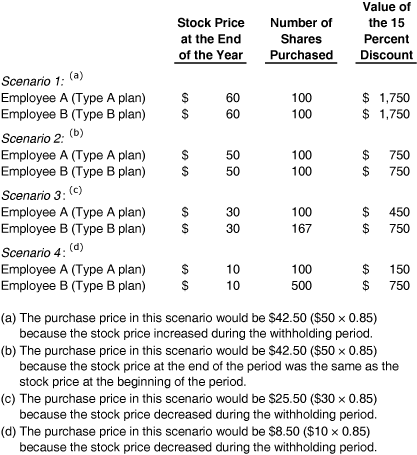
On January 1, 20X0, when its stock price is $50, Entity A offers its employees the opportunity to sign up for a payroll deduction to purchase its stock at the lower of either 85 percent of the stock's current price or 85 percent of the stock price at the end of the year when the options expire. Thus, the exercise price of the options is the lesser of $42.50 ($50x 85 percent) or 85 percent of the stock price at the end of the year when the option is exercised. Two employees each agree to have $4,250 withheld from their salaries; however, Employee A is not allowed to purchase any more shares than the $4,250 would buy on the grant date (that is, 100 shares [$4,250/$42.50]) and Employee B is permitted to buy as many shares as the $4,250 will permit under the terms of the plan. In both cases, the 15 percent purchase price discount at the grant date is worth $750 (100 shares x $50 x 15 percent). Depending on the stock price at the end of the year, the value of the 15 percent discount for each employee is as follows.
  • Stock Price at the End of the Year Number of Shares Purchased Value of the 15 Percent Discount Scenario 1: (a) Employee A (Type A plan) $60 100 " $1,750 " Employee B (Type B plan) $60 100 " $1,750 " Scenario 2: (b) Employee A (Type A plan) $50 100 $750 Employee B (Type B plan) $50 100 $750 Scenario 3: (c) Employee A (Type A plan) $30 100 $450 Employee B (Type B plan) $30 167 $750 Scenario 4: (d) Employee A (Type A plan) $10 100 $150 Employee B (Type B plan) $10 500 $750 (a) The purchase price in this scenario would be $42.50 ($50 × 0.85) because the stock price increased during the withholding period. (b) The purchase price in this scenario would be $42.50 ($50 × 0.85) because the stock price at the end of the period was the same as the stock price at the beginning of the period. (c) The purchase price in this scenario would be $25.50 ($30 × 0.85) because the stock price decreased during the withholding period. (d) The purchase price in this scenario would be $8.50 ($10 × 0.85) because the stock price decreased during the withholding period.
718-50-55-23
As illustrated above, both awards provide the same value to the employee if the stock price at the exercise date has increased (or remained unchanged) from the grant date stock price. However, the award under the Type B plan is more valuable to the employee if the stock price at the exercise date has decreased from the grant date stock price because it guarantees that the employee always will receive at least 15 percent of the stock price at the grant date, whereas the award under the Type A plan only guarantees that the employee will receive 15 percent of the ultimate (lower) stock purchase price.
718-50-55-24
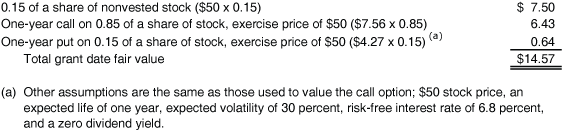
Using the component measurement approach described in Case A as the base, the additional feature associated with a Type B plan that shall be included in the fair value calculation is 15 percent of a put option on the employer's stock (valued by use of a standard option-pricing model, using the same measurement assumptions that were used to value the 85 percent of a call option). If the plan in that Case had the provisions of a Type B plan (that is, a plan that does not fix the number of shares that may be purchased), the fair value of the award would be calculated at the grant date as follows.
  • 0.15 of a share of nonvested stock ($50 x 0.15) $7.50 "One-year call on 0.85 of a share of stock, exercise price of $50 ($7.56 x 0.85)" 6.43 "One-year put on 0.15 of a share of stock, exercise price of $50 ($4.27 x 0.15) (a)" 0.64 Total grant date fair value $14.57 (a) "Other assumptions are the same as those used to value the call option; $50 stock price, an expected life of one year, expected volatility of 30 percent, risk-free interest rate of 6.8 percent, and a zero dividend yield."
With the same values the fair value of the Type A employee share purchase plan award described in Case A is determined as follows:
  • 0.15 of a share of nonvested stock ($50 x 0.15) $7.50 "One-year call on 0.85 of a share of stock, exercise price of $50 ($7.56 x 0.85)" 6.43 Total grant date fair value $13.93
718-50-55-25
In Cases B through E, total compensation cost would be measured at the grant date based on the number of shares that can be purchased using the estimated total withholdings and market price of the stock as of the grant date, and not based on the potentially greater number of shares that may ultimately be purchased if the market price declines. In other words, assume that on January 1, 20X0, Employee A elects to have $850 withheld from his pay for the year to purchase stock. Total compensation cost for the Type B plan award to Employee A would be $291 ($14.57x 20 grant-date-based shares [$850/$42.50]). For purposes of determining the number of shares on which to measure compensation cost, the stock price as of the grant date less the discount, or $50 x 85 percent in this case, is used.
718-50-55-26
In substance, an employee share purchase plan with multiple purchase periods (a Type C plan) is a series of linked awards, similar in nature to how some view a graded vesting stock option plan. Accordingly, the fair value of an award under an employee share purchase plan with multiple purchase periods shall be determined at the grant date in the same manner as an award under a graded vesting stock option plan. Under the graded vesting approach, awards under a two-year plan with purchase periods at the end of each year would be valued as having two separate option tranches both starting on the initial grant date (using the Case A approach if the plan has the characteristics of a Type A plan or using the Case B approach if the plan has the characteristics of a Type B plan) but with different lives of 12 and 24 months, respectively. All other measurement assumptions would need to be consistent with the separate lives of each tranche.
718-50-55-27
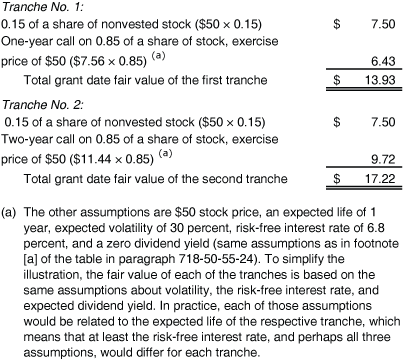
For example, if the plan in Case A was a two-year Type C plan with purchase periods at the end of each year, the fair value of each tranche of the award would be calculated at the grant date as follows.
  • Tranche No. 1: 0.15 of a share of nonvested stock ($50 × 0.15) $7.50 "One-year call on 0.85 of a share of stock, exercise price of $50 ($7.56 × 0.85) (a)" 6.43 Total grant date fair value of the first tranche $13.93 Tranche No. 2: 0.15 of a share of nonvested stock ($50 × 0.15) $7.50 "Two-year call on 0.85 of a share of stock, exercise price of $50 ($11.44 × 0.85) (a)" 9.72 Total grant date fair value of the second tranche $17.22 (a) "The other assumptions are $50 stock price, an expected life of 1 year, expected volatility of 30 percent, risk-free interest rate of 6.8 percent, and a zero dividend yield (same assumptions as in footnote [a] of the table in paragraph 718-50-55-24). To simplify the illustration, the fair value of each of the tranches is based on the same assumptions about volatility, the risk-free interest rate, and expected dividend yield. In practice, each of those assumptions would be related to the expected life of the respective tranche, which means that at least the risk-free interest rate, and perhaps all three assumptions, would differ for each tranche."
718-50-55-28
The basic measurement approach described in Case C for a Type C plan also should be used to value awards under employee share purchase plans with multiple purchase periods that incorporate reset or rollover mechanisms (that is, Type D and Type E plans). The fair value of those awards initially can be determined at the grant date using the graded vesting measurement approach. However, at the date that the reset or rollover mechanism becomes effective, the terms of the award have been modified (the exercise price has been decreased and, for a grant under a Type E plan, the term of the award has been extended), which, in substance, is similar to an exchange of the original award for a new award with different terms. Share-based payment modification accounting (see paragraphs ) shall be applied at the date that the reset or rollover mechanism becomes effective to determine the amount of any incremental fair value associated with the modified grant.
718-50-55-29
Likewise, although not a change to the terms of the employee share purchase plan, an election by an employee to increase withholding amounts (or percentages) for future services (Type F through Type H plans) is a modification of the terms of the award to that employee, which, in substance, is similar to an exchange of the original award for a new award with different terms. Accordingly, the fair value of an award under an employee share purchase plan with variable withholdings shall be determined at the grant date (using the Type A, Type B, or Type C measurement approach, as applicable) based on the estimated amounts (or percentages) that a participating employee initially elects to withhold under the terms of the plan. After the grant date (except as noted in paragraph 718-50-35-1), any increases in withholding amounts (or percentages) for future services shall be accounted for as a plan modification in accordance with the guidance in paragraph 718-20-35-3.
718-50-55-30
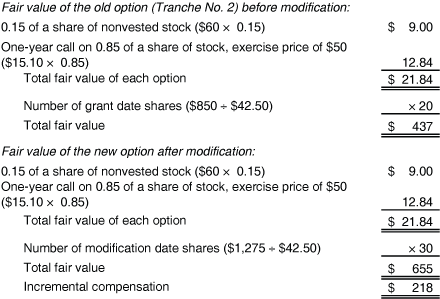
To illustrate, if the plan described in Case C allowed an employee to elect to change withholdings at the end of the first year, modification accounting would be applied at the date the employee elected to increase withholdings to determine the amount, if any, of incremental compensation cost. Assume that on January 1, 20X0, Employee A initially elected to have $850 per year withheld from his pay for each purchase period. However, at the end of Year 1 when the stock price is $60 (and assume that no other factors have changed), Employee A elects to have a total of $1,275 withheld for the second purchase period. At that date, $1,275 is equivalent to 30 shares eligible for purchase at the end of the second year ($1,275/$42.50). At the date Employee A elects to increase withholdings, modification accounting shall be applied to determine the amount of any incremental fair value associated with the modified award as follows.
  • Fair value of the old option (Tranche No. 2) before modification: 0.15 of a share of nonvested stock ($60 × 0.15) $9.00 "One-year call on 0.85 of a share of stock, exercise price of $50 ($15.10 × 0.85)" 12.84 Total fair value of each option $21.84 Number of grant date shares ($850 ÷ $42.50) × 20 Total fair value $437 Fair value of the new option after modification: 0.15 of a share of nonvested stock ($60 × 0.15) $9.00 "One-year call on 0.85 of a share of stock, exercise price of $50 ($15.10 × 0.85)" 12.84 Total fair value of each option $21.84 "Number of modification date shares ($1,275 ÷ $42.50)" × 30 Total fair value $655 Incremental compensation $218
718-50-55-31
The incremental value is determined based on the fair value measurements at the date of the modification using the then-current stock price. To simplify the illustration, the fair value at the modification date is based on the same assumptions about volatility, the risk-free interest rate, and expected dividend yield as at the grant date.
718-50-55-32
As with all employee share purchase plans, the objective of the measurement process for employee share purchase plans with a look-back option is to reasonably measure the fair value of the award at the grant date. Unlike Type F through Type H plans, which permit an employee to increase withholding amounts (or percentages) only prospectively, the Type I plan permits an employee to make a retroactive election to increase withholdings. Under a Type I plan, an employee may elect not to participate (or to participate at a minimal level) in the plan until just before the exercise date, thus making it difficult to determine when there truly is a mutual understanding of the terms of the award, and thus the date at which the grant occurs. For example, assume that the Type A employee share purchase plan in Case A permits an employee to remit catch-up amounts (up to a maximum aggregate withholding of 15 percent of annual salary) to Entity A at any time during the term of the plan. On January 1, 20X0, Employee A elects to participate in the plan by having $100 (0.04 percent) of her $250,000 salary withheld monthly from her pay over the year. On December 20, 20X0, when the stock price is $65, Employee A elects to remit a check to Entity A for $36,300, which, together with the $1,200 withheld during the year, represents 15 percent of her salary.
718-50-55-33
In that situation, December 20, 20X0 is the date at which Entity A and Employee A have a mutual understanding of the terms of the award in exchange for the services already rendered and Entity A becomes contingently obligated to issue equity instruments to Employee A upon the fulfillment of vesting requirements. The fair value of the entire award to Employee A is therefore measured as of December 20, 20X0.
718-50-55-34
Paragraph 718-50-25-1 stipulates the criteria that an employee share purchase plan must satisfy to be considered noncompensatory. One of those criteria specifies that substantially all employees that meet limited employment qualifications may participate on an equitable basis. Examples of limited employment qualifications might include customary employment of greater than 20 hours per week or completion of at least 6 months of service.
718-50-55-35
Another criterion is that the terms are no more favorable than those available to all holders of the same class of shares. For example, Entity A offers all full-time employees and all nonemployee shareholders the right to purchase $10,000 of its common stock at a 5 percent discount from its market price at the date of purchase, which occurs in 1 month. The arrangement is not compensatory because its terms are no more favorable than those available to all holders of the same class of shares. In contrast, assume Entity B has a dividend reinvestment program that permits shareholders of its common stock the ability to reinvest dividends by purchasing shares of its common stock at a 10 percent discount from its market price on the date that dividends are distributed and Entity B offers all full-time employees the right to purchase annually up to $10,000 of its common stock at a 10 percent discount from its market price on the date of purchase. Entity B's common stock is widely held; hence, many shareholders will not receive dividends totaling at least $10,000 during the annual period. Assuming that the 10 percent discount cannot be justified as the per-share amount of share issuance costs that would have been incurred to raise a significant amount of capital by a public offering, the arrangement is compensatory because the number of shares available to shareholders at a discount is based on the quantity of shares held and the amounts of dividends declared. Whereas, the number of shares available to employees at a discount is not dependent on shares held or declared dividends; therefore, the terms of the employee share purchase plan are more favorable than the terms available to all holders of the same class of shares. Consequently, the entire 10 percent discount to employees is compensatory. If, on the other hand, the 10 percent discount can be justified as the per-share amount of share issuance costs that would have been incurred to raise a significant amount of capital by a public offering, then the entire 10 percent discount to employees is not compensatory. If an entity justifies a purchase discount in excess of 5 percent, it would be required to reassess that discount at least annually and no later than the first share purchase offer during the fiscal year. If upon reassessment that discount is not deemed justifiable, subsequent grants using that discount would be compensatory.

Related subtopics