ASC 505-10
Overall
505 Equity
Source downloaded: .Record version c98365de8da0. Effective date must be checked in the source.
ASC 505-10 is the residual "Overall" subtopic for equity — it covers equity matters not addressed in the other Equity subtopics (stock dividends/splits, treasury stock, spinoffs) or in other Topics such as 480 and 815. Its core rules are that transactions in an entity's own capital stock (and quasi-reorganization adjustments and transfers to/from appropriated retained earnings) never affect net income, that additional paid-in capital may not be used to relieve income of charges, and that notes received for stock are generally shown as a deduction from equity rather than as an asset. It also imposes extensive disclosures on the rights and privileges of outstanding securities, convertible preferred stock, redemption requirements, and liquidation preferences.
Key points (7)
- Additional paid-in capital, however created, shall not be used to relieve income of current or future charges that would otherwise hit the income statement (505-10-25-1), except in reorganizations under 852-20-25-2.
- Adjustments, charges, or credits from transactions in the entity's own capital stock, transfers to/from appropriated retained earnings, and quasi-reorganization adjustments are excluded from net income under all circumstances (505-10-25-2).
- A note received as a contribution to equity is generally reported as a deduction from shareholders' equity, not as an asset, unless there is substantial evidence of ability and intent to pay quickly or it is collected in cash before issuance (505-10-45-2); appropriated retained earnings must be shown within equity, with no costs or losses charged to it and no part transferred to income (505-10-45-3 through 45-4).
- Changes in the separate accounts comprising shareholders' equity and in the number of shares must be disclosed for at least the most recent annual period and any subsequent interim period (505-10-50-2), and pertinent rights and privileges of each class of security must be explained (505-10-50-3, 50-13).
- Preferred stock with an involuntary liquidation preference considerably in excess of par or stated value must disclose that preference in the aggregate in the equity section of the balance sheet, not per share or only in the notes (505-10-50-4); call/redemption amounts, cumulative dividend arrearages, dividends declared, and five-year redemption requirements are also required (505-10-50-5, 50-11, 50-15).
- Convertible preferred stock is in scope unless 470-20 or 480-10 requires liability classification, and only after the issuer determines under 815-15 whether an embedded conversion feature must be bifurcated as a derivative; Topic 718 awards are excluded (505-10-15-2(d)); if such stock must be redeemed once the conversion feature expires, it is reclassified as a Topic 480 liability at fair value with a corresponding reduction of equity and no gain or loss (505-10-35-1).
- Pending ASU 2026-01 (annual periods beginning after December 15, 2026): paid-in-kind dividends on equity-classified preferred stock are initially measured using the paid-in-kind dividend rate stated in the preferred stock agreement (505-10-30-1; 505-10-65-1).
For students. The exam favorite here is the bright-line rule that an entity can never recognize gain or loss (or relieve income of charges through APIC) on transactions in its own stock — everything runs through equity. A common misunderstanding is treating a subscription note received for shares as an asset; absent quick collection it must be shown as a contra-equity deduction.
Machine-generated study aid for ASC 505-10. Check the source paragraphs below.
505-10-00Status
Source downloaded: .Record version 9a77719e17bb. Effective date must be checked in the source.
505-10-05Overview and Background
Source downloaded: .Record version 2a8616f829f7. Effective date must be checked in the source.
- aOverall
- bStock Dividends and Stock Splits
- cTreasury Stock
- d
- eSpinoffs and Reverse Spinoffs.
Convertible Preferred Stock
- aA liquidation or a change in control of an entity
- bA subsequent round of financing at a price lower than the convertible security's original conversion price
- cAn initial public offering at a share price lower than an agreed-upon amount.
505-10-15Scope and Scope Exceptions
Source downloaded: .Record version ee4ff7b3bd13. Effective date must be checked in the source.
Entities
Instruments
- aTransactions in an entity's own common stock
- bReceivables related to the issuance of equity interests and the appropriation of retained earnings
- c
- dConvertible preferred stock, unless the guidance in other Subtopics (such as Subtopic 470-20 on debt with conversion and other options or 480-10 on distinguishing liabilities from equity) requires that the convertible preferred stock be classified as a liability. The relevant guidance in this Subtopic shall be considered after an issuer's determination under Subtopic 815-15 on embedded derivatives of whether an embedded conversion option or other embedded feature in convertible preferred stock should be accounted for separately as a derivative instrument (see paragraph 815-15-55-76B). The guidance in this Subtopic does not apply to convertible preferred stock that is issued as awards to a grantee in exchange for goods or services received (or to be received) that are within the scope of Topic 718 on stock compensation unless the instrument is modified in accordance with and no longer subject to the guidance in that Topic.
- aTransactions in an entity's own common stock
- bReceivables related to the issuance of equity interests and the appropriation of retained earnings
- c
- dConvertible preferred stock, unless the guidance in other Subtopics (such as Subtopic 470-20 on debt with conversion and other options or 480-10 on distinguishing liabilities from equity) requires that the convertible preferred stock be classified as a liability. The relevant guidance in this Subtopic shall be considered after an issuer's determination under Subtopic 815-15 on embedded derivatives of whether an embedded conversion option or other embedded feature in convertible preferred stock should be accounted for separately as a derivative instrument (see paragraph 815-15-55-76B). The guidance in this Subtopic does not apply to convertible preferred stock that is issued as awards to a grantee in exchange for goods or services received (or to be received) that are within the scope of Topic 718 on stock compensation unless the instrument is modified in accordance with and no longer subject to the guidance in that Topic.
- ePaid-in-kind dividends on preferred stock (see paragraph 505-10-15-3). The guidance on paid-in-kind dividends on preferred stock applies to preferred stock classified as equity, including preferred stock that is classified as temporary equity in accordance with SEC Staff Announcement, Classification and Measurement of Redeemable Securities (see paragraph 480-10-S99-3A).
Paid-in-Kind Dividends on Preferred Stock
- aDelivering to the holder additional preferred stock with the same terms as the original preferred stock
- bIncreasing the value of the original preferred stock in accordance with the preferred stock agreement (for example, by increasing the original preferred stock’s liquidation value).
- aThe issuer satisfies the dividend obligation by issuing a variable number of shares of the same preferred stock instrument that has a fixed monetary value. For example, a dividend obligation of $1,000 satisfied by delivering a variable number of shares with a current fair value of $1,000 to preferred shareholders would not be within the scope of the guidance in paragraph 505-10-15-2(e).
- bThe transaction represents a deemed dividend (for example, certain redemptions of preferred stock).
505-10-25Recognition
Source downloaded: .Record version 56c55b2329f7. Effective date must be checked in the source.
- a Adjustments or charges or credits resulting from transactions in the entity's own capital stock
- b Transfers to and from accounts properly designated as appropriated retained earnings (see paragraph 505-10-45-3 for what is meant by properly designated as appropriated retained earnings)
- c Adjustments made pursuant to a quasi-reorganization (see Subtopic 852-20 for information concerning quasi-reorganizations).
505-10-30Initial Measurement
Source downloaded: .Record version ccc7bcec3f97. Effective date must be checked in the source.
Paid-in-Kind Dividends on Preferred Stock
505-10-35Subsequent Measurement
Source downloaded: .Record version 617bbc72b624. Effective date must be checked in the source.
505-10-45Other Presentation Matters
Source downloaded: .Record version c2011d50ae00. Effective date must be checked in the source.
Receivables for Issuance of Equity
Appropriations of Retained Earnings
505-10-50Disclosure
Source downloaded: .Record version 6591ef421d4a. Effective date must be checked in the source.
- aThe fact that the feature has been triggered
- bThe value of the effect of the down round feature that has been triggered.
Securities with Preferences
- aThe aggregate or per-share amounts at which preferred stock may be called or is subject to redemption through sinking-fund operations or otherwise
- bThe aggregate and per-share amounts of arrearages in cumulative preferred dividends.
Redeemable Securities
Convertible Preferred Stock
- aInformation about the terms and features of convertible preferred stock
- bAn understanding of how those instruments have been reported in an entity's statement of financial position and statement of financial performance
- cInformation about events, conditions, and circumstances that can affect how to assess the amount or timing of an entity's future cash flows related to those instruments.
- aNumber of shares issued and par value
- bDividends
- cConversion or exercise prices or rates and number of shares into which the instrument is potentially convertible
- dPertinent dates, such as conversion date(s)
- eParties that control the conversion rights
- fManner of settlement upon conversion and any alternative settlement methods, such as cash, shares, or a combination of cash and shares
- gTerms that may change conversion or exercise prices, number of shares to be issued, or other conversion rights and the timing of those rights (excluding standard antidilution provisions)
- hLiquidation preference required by paragraph 505-10-50-4 and unusual voting rights
- iOther material terms and features of the instrument that are not listed above.
- aEvents or changes in circumstances that would adjust or change the contingency or would cause the contingency to be met
- bInformation on whether the shares that would be issued if the contingently convertible securities were converted are included in the calculation of diluted earnings per share (EPS) and the reasons why or why not
- cOther information that is helpful in understanding both the nature of the contingencies and the potential impact of conversion.
- aChanges to conversion or exercise prices that occur during the reporting period other than changes due to standard antidilution provisions
- bEvents or changes in circumstances that occur during the reporting period that cause conversion contingencies to be met or conversion terms to be significantly changed
- cThe number of shares issued upon conversion, exercise, or satisfaction of required conditions during the reporting period.
- aThe terms of those derivative transactions (including the terms of settlement)
- bHow those derivative transactions relate to the instruments within the scope of this Subtopic
- cThe number of shares underlying the derivative transactions
- dThe reasons for entering into those derivative transactions.
505-10-60Relationships
Source downloaded: .Record version bf7dedd046db. Effective date must be checked in the source.
Comprehensive Income
Debt
Distinguishing Liabilities from Equity
Consolidation
Derivatives and Hedging
Financial Instruments
505-10-65Transition and Open Effective Date Information
Source downloaded: .Record version 5313dc60a0ef. Effective date must be checked in the source.
Transition Related to Accounting Standards Update No. 2026-01, <em class="ph i">Equity (Topic 505): Initial Measurement of Paid-in-Kind Dividends on Equity-Classified Preferred Stock</em>
- aAll entities shall apply the pending content that links to this paragraph for annual reporting periods beginning after December 15, 2026, and interim reporting periods within those annual reporting periods.
- bEarly adoption of the pending content that links to this paragraph is permitted in an interim or annual reporting period in which the financial statements have not yet been issued or made available for issuance. If an entity adopts the pending content that links to this paragraph in an interim reporting period, it shall apply the pending content as of the beginning of the annual reporting period that includes that interim reporting period.
- cAn entity shall apply the pending content that links to this paragraph using either of the following transition methods:
- 1On a prospective basis to paid-in-kind dividends recognized on preferred stock on or after the initial application date of the pending content that links to this paragraph.
- 2On a modified retrospective basis through a cumulative-effect adjustment to the opening balance of retained earnings (or other appropriate components of equity) as of the beginning of the earliest period presented. Under this transition method, an entity shall apply the pending content that links to this paragraph to paid-in-kind dividends recognized on preferred stock that is outstanding as of the initial application date of the pending content.
- 1
- dAn entity that applies the pending content that links to this paragraph prospectively in accordance with (c)(1) shall provide the following transition disclosures in the financial statements of both the interim reporting period (if applicable) and the annual reporting period in which the pending content is applied:
- 1The nature of the change in accounting principle, including an explanation of the newly adopted accounting principle
- 2The method of applying the change.
- 1
- eAn entity that applies the pending content that links to this paragraph on a modified retrospective basis in accordance with (c)(2) shall provide the following transition disclosures in the financial statements of both the interim reporting period (if applicable) and the annual reporting period in which the pending content is applied:
- 1The nature of the change in accounting principle, including an explanation of the newly adopted accounting principle
- 2The method of applying the change
- 3The cumulative effect of the change on retained earnings or other components of equity in the statement of financial position as of the beginning of the earliest period presented
- 4The effect of the change on income available to common shareholders, any other affected financial statement line items, and any affected per-share amounts for the current reporting period and any prior reporting periods retrospectively adjusted.
- 1
505-10-S00StatusSEC
Source downloaded: .Record version ac5e25329d96. Effective date must be checked in the source.
| Paragraph | Action | Accounting Standards Update | Date |
| 505-10-S25-2 | Superseded | Accounting Standards Update No. 2012-03 | 08/27/2012 |
| 505-10-S45-10 | Superseded | Accounting Standards Update No. 2012-03 | 08/27/2012 |
| 505-10-S50-4 | Superseded | Accounting Standards Update No. 2012-03 | 08/27/2012 |
| 505-10-S50-5 | Amended | Accounting Standards Update No. 2020-09 | 10/22/2020 |
| 505-10-S50-6 | Amended | Accounting Standards Update No. 2020-09 | 10/22/2020 |
| Superseded | Accounting Standards Update No. 2020-09 | 10/22/2020 | |
| 505-10-S99-1 | Amended | Accounting Standards Update No. 2019-07 | 07/26/2019 |
| 505-10-S99-1 | Amended | Accounting Standards Update No. 2010-21 | 08/02/2010 |
| 505-10-S99-2 | Amended | Accounting Standards Update No. 2019-07 | 07/26/2019 |
| 505-10-S99-6 | Superseded | Accounting Standards Update No. 2010-22 | 08/19/2010 |
| 505-10-S99-7 | Amended | Accounting Standards Update No. 2012-03 | 08/27/2012 |
505-10-S25RecognitionSEC
Source downloaded: .Record version 46f6428cb54f. Effective date must be checked in the source.
Expenses Related to an Equity Offering
505-10-S30Initial MeasurementSEC
Source downloaded: .Record version d7fccf7fc7cc. Effective date must be checked in the source.
Increasing Rate Preferred Stock
505-10-S35Subsequent MeasurementSEC
Source downloaded: .Record version 4df2ded70c46. Effective date must be checked in the source.
Increasing Rate Preferred Stock
505-10-S45Other Presentation MattersSEC
Source downloaded: .Record version 72cd45abe06a. Effective date must be checked in the source.
Discounts on and Unamortized Balances of Shares
Preferred Stock that Is Not Redeemable or Redeemable Solely at the Option of the Issuer
Common Stock
Other Stockholders' Equity
Subordinated Debt
Presentation of S Corporation Undistributed Earnings in Financial Statements upon Termination of S Election
Receivables Arising from the Issuance of Capital Stock to Officers and Other Employees
Presentation of Equity Section in Limited Partnership Financial Statements
Presentation of Notes and Other Receivables in a General Partner's Balance Sheet
505-10-S50DisclosureSEC
Source downloaded: .Record version 6fb93939b861. Effective date must be checked in the source.
Changes in Each Caption of Other Stockholders' Equity
Preferred Shares
Restrictions that Limit the Payment of Dividends by the Registrant
Guarantors and Issuers of Guaranteed Securities Registered or Being Registered
505-10-S99SEC MaterialsSEC
Source downloaded: .Record version 7ebfde6f9481. Effective date must be checked in the source.
SEC Rules, Regulations, and Interpretations
- An analysis of the changes in each caption of stockholders' equity and noncontrolling interests presented in the balance sheets shall be given in a note or separate statement. This analysis shall be presented in the form of a reconciliation of the beginning balance to the ending balance for each period for which a statement of comprehensive income is required to be filed with all significant reconciling items described by appropriate captions with contributions from and distributions to owners shown separately. Also, state separately the adjustments to the balance at the beginning of the earliest period presented for items which were retroactively applied to periods prior to that period. With respect to any dividends, state the amount per share and in the aggregate for each class of shares. Provide a separate schedule in the notes to the financial statements that shows the effects of any changes in the registrant's ownership interest in a subsidiary on the equity attributable to the registrant.
- [83 FR 50199, Oct. 4, 2018]
- Discount on shares, or any unamortized balance thereof, shall be shown separately as a deduction from the applicable account(s) as circumstances require.
SEC Staff Guidance
- Facts: An S corporation has undistributed earnings on the date its S election is terminated.
- Question: How should such earnings be reflected in the financial statements?
- Interpretive Response: Such earnings must be included in the financial statements as additional paid-in capital. This assumes a constructive distribution to the owners followed by a contribution to the capital of the corporation.
- Facts: A capital structure change to a stock dividend, stock split or reverse split occurs after the date of the latest reported balance sheet but before the release of the financial statements or the effective date of the registration statement, whichever is later.
- Question: What effect must be given to such a change?
- Interpretive Response: Such changes in the capital structure must be given retroactive effect in the balance sheet.
- An appropriately cross-referenced note should disclose the retroactive treatment, explain the change made and state the date the change became effective.
- Facts: There exist a number of publicly held partnerships having one or more corporate or individual general partners and a relatively larger number of limited partners. There are no specific requirements or guidelines relating to the presentation of the partnership equity accounts in the financial statements. In addition, there are many approaches to the parallel problem of relating the results of operations to the two classes of partnership equity interests.
- Question: How should the financial statements of limited partnerships be presented so that the two ownership classes can readily determine their relative participations in both the net assets of the partnership and in the results of its operations?
- Interpretive Response: The equity section of a partnership balance sheet should distinguish between amounts ascribed to each ownership class. The equity attributed to the general partners should be stated separately from the equity of the limited partners, and changes in the number of equity units authorized and outstanding should be shown for each ownership class. A statement of changes in partnership equity for each ownership class should be furnished for each period for which an income statement is included.
- The income statements of partnerships should be presented in a manner which clearly shows the aggregate amount of net income (loss) allocated to the general partners and the aggregate amount allocated to the limited partners. The statement of income should also state the results of operations on a per unit basis.
- Facts: A registrant issues Class A and Class B nonredeemable preferred stock FN19 on 1/1/X1. Class A, by its terms, will pay no dividends during the years 20X1 through 20X3. Class B, by its terms, will pay dividends at annual rates of $2, $4 and $6 per share in the years 20X1, 20X2 and 20X3, respectively. Beginning in the year 20X4 and thereafter as long as they remain outstanding, each instrument will pay dividends at an annual rate of $8 per share. In all periods, the scheduled dividends are cumulative.
- FN19 "Nonredeemable" preferred stock, as used in this SAB, refers to preferred stocks which are not redeemable or are redeemable only at the option of the issuer.
- At the time of issuance, eight percent per annum was considered to be a market rate for dividend yield on Class A, given its characteristics other than scheduled cash dividend entitlements (voting rights, liquidation preference, etc.), as well as the registrant's financial condition and future economic prospects. Thus, the registrant could have expected to receive proceeds of approximately $100 per share for Class A if the dividend rate of $8 per share (the "perpetual dividend") had been in effect at date of issuance. In consideration of the dividend payment terms, however, Class A was issued for proceeds of $79 3/8 per share. The difference, $20 5/8, approximated the value of the absence of $8 per share dividends annually for three years, discounted at 8%.
- The issuance price of Class B shares was determined by a similar approach, based on the terms and characteristics of the Class B shares.
- Question 1: How should preferred stocks of this general type (referred to as "increasing rate preferred stocks") be reported in the balance sheet?
- Interpretive Response: As is normally the case with other types of securities, increasing rate preferred stock should be recorded initially at its fair value on date of issuance. Thereafter, the carrying amount should be increased periodically as discussed in the Interpretive Response to Question 2.
- Question 2: Is it acceptable to recognize the dividend costs of increasing rate preferred stocks according to their stated dividend schedules?
- Interpretive Response: No. The staff believes that when consideration received for preferred stocks reflects expectations of future dividend streams, as is normally the case with cumulative preferred stocks, any discount due to an absence of dividends (as with Class A) or gradually increasing dividends (as with Class B) for an initial period represents prepaid, unstated dividend cost. FN20 Recognizing the dividend cost of these instruments according to their stated dividend schedules would report Class A as being cost-free, and would report the cost of Class B at less than its effective cost, from the standpoint of common stock interests (i. e., for purposes of computing income applicable to common stock and earnings per common share) during the years 20X1 through 20X3.
- FN20 As described in the "Facts" section of this issue, a registrant would receive less in proceeds for a preferred stock, if the stock were to pay less than its perpetual dividend for some initial period(s), than if it were to pay the perpetual dividend from date of issuance. The staff views the discount on increasing rate preferred stock as equivalent to a prepayment of dividends by the issuer, as though the issuer had concurrently (a) issued the stock with the perpetual dividend being payable from date of issuance, and (b) returned to the investor a portion of the proceeds representing the present value of certain future dividend entitlements which the investor agreed to forgo.
- Accordingly, the staff believes that discounts on increasing rate preferred stock should be amortized over the period(s) preceding commencement of the perpetual dividend, by charging imputed dividend cost against retained earnings and increasing the carrying amount of the preferred stock by a corresponding amount. The discount at time of issuance should be computed as the present value of the difference between (a) dividends that will be payable, if any, in the period(s) preceding commencement of the perpetual dividend; and (b) the perpetual dividend amount for a corresponding number of periods; discounted at a market rate for dividend yield on preferred stocks that are comparable (other than with respect to dividend payment schedules) from an investment standpoint. The amortization in each period should be the amount which, together with any stated dividend for the period (ignoring fluctuations in stated dividend amounts that might result from variable rates, FN21 results in a constant rate of effective cost vis-a-vis the carrying amount of the preferred stock (the market rate that was used to compute the discount).
- FN21 See Question 3 regarding variable increasing rate preferred stocks.
- Simplified (ignoring quarterly calculations) application of this accounting to the Class A preferred stock described in the "Facts" section of this bulletin would produce the following results on a per share basis:
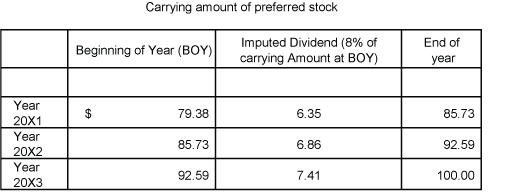 Carrying amount of preferred stock Beginning of Year (BOY) Imputed Dividend (8% of carrying Amount at BOY) "End of year " Year 20X1 $79.38 6.35 85.73 Year 20X2 85.73 6.86 92.59 Year 20X3 92.59 7.41 100.00
- During 20X4 and thereafter, the stated dividend of $8 measured against the carrying amount of $100 FN22 would reflect dividend cost of 8%, the market rate at time of issuance.
- FN22 It should be noted that the $100 per share amount used in this issue is for illustrative purposes, and is not intended to imply that application of this issue will necessarily result in the carrying amount of a nonredeemable preferred stock being accreted to its par value, stated value, voluntary redemption value or involuntary liquidation value.
- The staff believes that existing authoritative literature, while not explicitly addressing increasing rate preferred stocks, implicitly calls for the accounting described in this bulletin.
- The pervasive, fundamental principle of accrual accounting would, in the staff's view, preclude registrants from recognizing the dividend cost on the basis of whatever cash payment schedule might be arranged. Furthermore, recognition of the effective cost of unstated rights and privileges is well-established in accounting, and is specifically called for by FASB ASC Subtopic 835-30, Interest—Imputation of Interest, and Topic 3.C of this codification for unstated interest costs of debt capital and unstated dividend costs of redeemable preferred stock capital, respectively. The staff believes that the requirement to recognize the effective periodic cost of capital applies also to nonredeemable preferred stocks because, for that purpose, the distinction between debt capital and preferred equity capital (whether redeemable FN23 or nonredeemable) is irrelevant from the standpoint of common stock interests.
- FN23 Application of the interest method with respect to redeemable preferred stocks pursuant to Topic 3.C results in accounting consistent with the provisions of this bulletin irrespective of whether the redeemable preferred stocks have constant or increasing stated dividend rates. The interest method, as described in FASB ASC Subtopic 835-30, produces a constant effective periodic rate of cost that is comprised of amortization of discount as well as the stated cost in each period.
- Question 3: Would the accounting for discounts on increasing rate preferred stock be affected by variable stated dividend rates?
- Interpretive Response: No. If stated dividends on an increasing rate preferred stock are variable, computations of initial discount and subsequent amortization should be based on the value of the applicable index at date of issuance and should not be affected by subsequent changes in the index.
- For example, assume that a preferred stock issued 1/1/X1 is scheduled to pay dividends at annual rates, applied to the stock's par value, equal to 20% of the actual (fluctuating) market yield on a particular Treasury security in 20X1 and 20X2, and 90% of the fluctuating market yield in 20X3 and thereafter. The discount would be computed as the present value of a two-year dividend stream equal to 70% (90% less 20%) of the 1/1/X1 Treasury security yield, annually, on the stock's par value. The discount would be amortized in years 20X1 and 20X2 so that, together with 20% of the 1/1/X1 Treasury yield on the stock's par value, a constant rate of cost vis-a-vis the stock's carrying amount would result. Changes in the Treasury security yield during 20X1 and 20X2 would, of course, cause the rate of total reported preferred dividend cost (amortization of discount plus cash dividends) in those years to be more or less than the rate indicated by discount amortization plus 20% of the 1/1/X1 Treasury security yield. However, the fluctuations would be due solely to the impact of changes in the index on the stated dividends for those periods.
- Question 4: Will the staff expect retroactive changes by registrants to comply with the accounting described in this bulletin?
- Interpretive Response: All registrants will be expected to follow the accounting described in this bulletin for increasing rate preferred stocks issued after December 4, 1986. FN24 Registrants that have not followed this accounting for increasing rate preferred stocks issued before that date were encouraged to retroactively change their accounting for those preferred stocks in the financial statements next filed with the Commission. The staff did not object if registrants did not make retroactive changes for those preferred stocks, provided that all presentations of and discussions regarding income applicable to common stock and earnings per share in future filings and shareholders' reports are accompanied by equally prominent supplemental disclosures (on the face of the income statement, in presentations of selected financial data, in MD&A, etc.) of the impact of not changing their accounting and an explanation of such impact (e. g., that dividend cost has been recognized on a cash basis).
- FN24 The staff first publicly expressed its view as to the appropriate accounting at the December 3-4, 1986 meeting of the EITF.