ASC

ASC 323-10

Overall

323 Investments—Equity Method and Joint Ventures

Download JSONDownload Markdown163 paragraphs · 17 sectionsIncludes SEC contentJump to summary

Source downloaded: .Record version 72c09821b247. Effective date must be checked in the source.

ASC 323-10 governs the equity method of accounting for investments in common stock (and in-substance common stock) of corporate joint ventures and other investees over which the investor can exercise significant influence but does not control. An investment of 20% or more of the voting stock creates a rebuttable presumption of significant influence (323-10-15-8); under the method, the investment is initially recorded at cost (323-10-30-2) and then adjusted for the investor's share of investee earnings/losses, dividends, OCI, intra-entity profit eliminations, and basis-difference amortization, and reported as a single line on both the balance sheet and income statement (323-10-45-1). Losses are recognized only down to zero (plus other investments and committed support), and other-than-temporary declines in value must be recognized (323-10-35-32).

Key points (7)
  • Scope covers investments in common stock or in-substance common stock giving the ability to exercise significant influence, including corporate joint ventures (323-10-15-3); it excludes derivatives under 815-10, investments held by nonbusiness entities, investments within Topic 810's scope, and investment-company holdings under Topic 946 (323-10-15-4), as well as partnerships/unincorporated joint ventures (323-30) and certain LLCs (323-10-15-5).
  • Ownership of 20 percent or more of voting stock (based only on currently outstanding securities with present voting privileges, ignoring potential voting rights) presumes significant influence unless overcome by predominant evidence such as standstill agreements, failure to obtain board representation, or concentrated majority ownership (323-10-15-8 through 15-11).
  • In-substance common stock requires substantially similar subordination, risks and rewards of ownership, and no obligation of the investee to transfer substantive value to the investor that common shareholders do not share; failing any one characteristic disqualifies the instrument (323-10-15-13 through 15-14), with a fair-value-covariance backstop test in 323-10-15-15.
  • Initial measurement is at cost per Section 805-50-30, except retained investments in a deconsolidation and investments received on derecognition of nonfinancial assets under 610-20, which are measured at fair value (323-10-30-2); a liability is recognized for contingent consideration when the investor's share of investee net assets exceeds initial cost (323-10-25-2A; 30-2B).
  • The investor recognizes its share of investee earnings/losses when reported by the investee (not when dividends are declared), adjusts carrying amount accordingly, eliminates intra-entity profits on assets still held, amortizes basis differences (equity method goodwill is not amortized and not separately impairment-tested), records dividends as reductions of the carrying amount, and picks up its share of investee OCI (323-10-35-4 through 35-18).
  • Equity method losses are reported up to the carrying amount of the investment plus other investments in the investee applied in order of seniority; the method is suspended at zero unless the investor has guaranteed obligations or is otherwise committed to provide support, and is resumed only after subsequent income equals the unrecognized losses (323-10-35-19 through 35-29).
  • The investment is presented as a single amount on the balance sheet and a single amount of earnings/losses in income (323-10-45-1); disclosures include investee names and ownership percentages, accounting policy (including reasons for 20%+ non-equity-method and sub-20% equity-method treatment), the cost/underlying-equity difference, quoted market values, summarized investee financial information if material, and effects of potential dilutive issuances (323-10-50-3).

For students. The equity method is a classic exam topic: remember it is a "one-line consolidation" that follows influence, not control, and that the 20% threshold is only a rebuttable presumption based on present voting rights. The most common errors are recognizing dividends as income (they reduce the carrying amount), continuing to record losses below zero, and forgetting that upstream and downstream intra-entity profits are eliminated to the same extent.

Machine-generated study aid for ASC 323-10. Check the source paragraphs below.

323-10-00Status

Source downloaded: .Record version fd11c6d0e8b3. Effective date must be checked in the source.

323-10-00-1
The following table identifies the changes made to this Subtopic.
Paragraph Action Accounting Standards Update Date
Corporate Joint Venture Amended Accounting Standards Update No. 2010-08 02/02/2010
Not-for-Profit Entity Added Accounting Standards Update No. 2014-02 01/16/2014
Private Company Superseded Accounting Standards Update No. 2019-06 05/30/2019
Private Company Added Accounting Standards Update No. 2014-02 01/16/2014
Public Business Entity Amended Maintenance Update 2017-06 (PDF) 04/07/2017
Public Business Entity Amended Maintenance Update 2016-11 (PDF) 06/27/2016
Public Business Entity Added Accounting Standards Update No. 2014-02 01/16/2014
323-10-05-1 Amended Accounting Standards Update No. 2016-01 01/05/2016
323-10-05-4 Amended Accounting Standards Update No. 2016-01 01/05/2016
323-10-15-4 Amended Accounting Standards Update No. 2013-08 06/07/2013
323-10-15-4 Amended Accounting Standards Update No. 2012-04 10/01/2012
323-10-25-2 Amended Accounting Standards Update No. 2015-02 02/18/2015
323-10-25-3 Amended Maintenance Update 2020-18 (PDF) 11/25/2020
Amended Accounting Standards Update No. 2018-07 06/20/2018
323-10-25-7 Added Accounting Standards Update No. 2013-08 06/07/2013
323-10-30-2 Amended Accounting Standards Update No. 2017-05 02/22/2017
323-10-30-2 Amended Accounting Standards Update No. 2010-02 01/06/2010
323-10-30-3 Amended Accounting Standards Update No. 2018-07 06/20/2018
323-10-35-2 Amended Accounting Standards Update No. 2015-02 02/18/2015
323-10-35-7 Amended Accounting Standards Update No. 2017-05 02/22/2017
323-10-35-7 Amended Accounting Standards Update No. 2010-02 01/06/2010
323-10-35-13 Amended Accounting Standards Update No. 2021-03 03/30/2021
323-10-35-13 Amended Accounting Standards Update No. 2019-06 05/30/2019
323-10-35-13 Amended Accounting Standards Update No. 2014-02 01/16/2014
323-10-35-24 Amended Accounting Standards Update No. 2019-04 04/25/2019
Amended Accounting Standards Update No. 2016-01 01/05/2016
323-10-35-25 Amended Accounting Standards Update No. 2016-13 06/16/2016
323-10-35-26 Amended Accounting Standards Update No. 2019-04 04/25/2019
323-10-35-33 Amended Accounting Standards Update No. 2020-01 01/16/2020
323-10-35-33 Amended Accounting Standards Update No. 2016-07 03/15/2016
323-10-35-33 Amended Accounting Standards Update No. 2010-08 02/02/2010
323-10-35-36 Amended Accounting Standards Update No. 2020-01 01/16/2020
323-10-35-36 Amended Accounting Standards Update No. 2016-01 01/05/2016
323-10-35-37 Amended Accounting Standards Update No. 2016-01 01/05/2016
323-10-45-1 Amended Accounting Standards Update No. 2015-01 01/09/2015
323-10-45-2 Amended Accounting Standards Update No. 2015-01 01/09/2015
323-10-45-3 Amended Accounting Standards Update No. 2011-05 06/16/2011
323-10-45-4 Superseded Accounting Standards Update No. 2013-08 06/07/2013
323-10-50-3(c) Amended Maintenance Update 2015-11 (PDF) 06/19/2015
Amended Accounting Standards Update No. 2018-07 06/20/2018
323-10-55-19 Amended Accounting Standards Update No. 2016-09 03/30/2016
323-10-55-24 Amended Maintenance Update 2020-18 (PDF) 11/25/2020
323-10-55-27 Amended Accounting Standards Update No. 2017-05 02/22/2017
323-10-55-30 Amended Accounting Standards Update No. 2016-01 01/05/2016
323-10-55-34 Amended Accounting Standards Update No. 2016-13 06/16/2016
323-10-55-34 Amended Accounting Standards Update No. 2012-04 10/01/2012
323-10-55-36 Amended Accounting Standards Update No. 2012-04 10/01/2012
323-10-55-38 Amended Accounting Standards Update No. 2016-13 06/16/2016
323-10-55-38 Amended Accounting Standards Update No. 2012-04 10/01/2012
323-10-55-40 Amended Accounting Standards Update No. 2012-04 10/01/2012
323-10-55-42 Amended Accounting Standards Update No. 2016-13 06/16/2016
323-10-55-42 Amended Accounting Standards Update No. 2012-04 10/01/2012
323-10-55-44 Amended Accounting Standards Update No. 2016-13 06/16/2016
323-10-55-44 Amended Accounting Standards Update No. 2012-04 10/01/2012
323-10-55-46 Amended Accounting Standards Update No. 2016-13 06/16/2016
323-10-65-2 Added Accounting Standards Update No. 2016-07 03/15/2016

323-10-05Overview and Background

Source downloaded: .Record version fee8cefcd0e8. Effective date must be checked in the source.

323-10-05-1
The Codification contains several Topics for investments due to the differing accounting treatment for various forms of investments. The Topics include all of the following:
  1. a
    Topic 320, Investments—Debt Securities
  2. aa
    Topic 321, Investments—Equity Securities
  3. b
    Topic 323, Investments—Equity Method and Joint Ventures
  4. c
    Topic 325, Investments—Other.
323-10-05-2
The Investments—Equity Method and Joint Ventures Topic includes the following Subtopics:
  1. a
    Overall
  2. b
    Partnerships, Joint Ventures, and Limited Liability Entities
  3. c
    Income Taxes.
323-10-05-3
The Overall Subtopic addresses application of the equity method of accounting to investments within its scope.
323-10-05-4
Investments held in stock of entities other than subsidiaries, namely corporate joint ventures and other noncontrolled entities usually are accounted for in accordance with either the recognition and measurement guidance in Subtopic 321-10 or the equity method. This Subtopic provides guidance on application of the equity method.The equity method is an appropriate means of recognizing increases or decreases measured by generally accepted accounting principles (GAAP) in the economic resources underlying the investments. Furthermore, the equity method of accounting closely meets the objectives of accrual accounting because the investor recognizes its share of the earnings and losses of the investee in the periods in which they are reflected in the accounts of the investee. The equity method also best enables investors in corporate joint ventures to reflect the underlying nature of their investment in those ventures.
323-10-05-5
The equity method tends to be most appropriate if an investment enables the investor to influence the operating or financial decisions of the investee. The investor then has a degree of responsibility for the return on its investment, and it is appropriate to include in the results of operations of the investor its share of the earnings or losses of the investee. Influence tends to be more effective as the investor's percent of ownership in the voting stock of the investee increases. Investments of relatively small percentages of voting stock of an investee tend to be passive in nature and enable the investor to have little or no influence on the operations of the investee.
323-10-05-6
In addition to the joint venture guidance included in this Topic, the accounting and reporting for real estate joint ventures is addressed in Subtopic 970-323.

323-10-15Scope and Scope Exceptions

Source downloaded: .Record version e4461eba112d. Effective date must be checked in the source.

Overall Guidance

323-10-15-1
The Scope Section of the Overall Subtopic establishes the pervasive scope for all Subtopics of the Investments—Equity Method and Joint Ventures Topic. Unless explicitly addressed within specific Subtopics, the following scope guidance applies to all Subtopics of the Investments—Equity Method and Joint Ventures Topic.

Entities

323-10-15-2
The guidance in the Investments—Equity Method and Joint Ventures Topic applies to all entities.

Instruments

323-10-15-3
The guidance in the Investments—Equity Method and Joint Ventures Topic applies to investments in common stock or in-substance common stock (or both common stock and in-substance common stock), including investments in common stock of corporate joint ventures(see paragraphs for guidance on identifying in-substance common stock). Subsequent references in this Subtopic to common stock refer to both common stock and in-substance common stock that give the investor the ability to exercise significant influence (see paragraph 323-10-15-6) over operating and financial policies of an investee even though the investor holds 50% or less of the common stock or in-substance common stock (or both common stock and in-substance common stock).
323-10-15-4
The guidance in this Topic does not apply to any of the following:
  1. a
    An investment accounted for in accordance with Subtopic 815-10
  2. b
    An investment in common stock held by a nonbusiness entity, such as an estate, trust, or individual
    1. 1
    2. 2
    3. 3
  3. c
    An investment in common stock within the scope of Topic 810
  4. d
    Except as discussed in paragraph 946-323-45-2, an investment held by an investment company within the scope of Topic 946.
323-10-15-5
The guidance in the Overall Subtopic does not apply to any of the following:
  1. a
    An investment in a partnership or unincorporated joint venture (also called an undivided interest in ventures), see Subtopic 323-30
  2. b
    An investment in a limited liability company that maintains specific ownership accounts for each investor as discussed in Subtopic 272-10.

Other Considerations

323-10-15-6
Ability to exercise significant influence over operating and financial policies of an investee may be indicated in several ways, including the following:
  1. a
    Representation on the board of directors
  2. b
    Participation in policy-making processes
  3. c
    Material intra-entity transactions
  4. d
    Interchange of managerial personnel
  5. e
    Technological dependency
  6. f
    Extent of ownership by an investor in relation to the concentration of other shareholdings (but substantial or majority ownership of the voting stock of an investee by another investor does not necessarily preclude the ability to exercise significant influence by the investor).
323-10-15-7
Determining the ability of an investor to exercise significant influence is not always clear and applying judgment is necessary to assess the status of each investment.
323-10-15-8
An investment (direct or indirect) of 20 percent or more of the voting stock of an investee shall lead to a presumption that in the absence of predominant evidence to the contrary an investor has the ability to exercise significant influence over an investee. Conversely, an investment of less than 20 percent of the voting stock of an investee shall lead to a presumption that an investor does not have the ability to exercise significant influence unless such ability can be demonstrated. The equity method shall not be applied to the investments described in this paragraph insofar as the limitations on the use of the equity method outlined in paragraph 323-10-25-2 would apply to investments other than those in subsidiaries.
323-10-15-9
An investor's voting stock interest in an investee shall be based on those currently outstanding securities whose holders have present voting privileges. Potential voting privileges that may become available to holders of securities of an investee shall be disregarded.
323-10-15-10
Evidence that an investor owning 20 percent or more of the voting stock of an investee may be unable to exercise significant influence over the investee's operating and financial policies requires an evaluation of all the facts and circumstances relating to the investment. The presumption that the investor has the ability to exercise significant influence over the investee's operating and financial policies stands until overcome by predominant evidence to the contrary. Indicators that an investor may be unable to exercise significant influence over the operating and financial policies of an investee include the following:
  1. a
    Opposition by the investee, such as litigation or complaints to governmental regulatory authorities, challenges the investor's ability to exercise significant influence.
  2. b
    The investor and investee sign an agreement (such as a standstill agreement) under which the investor surrenders significant rights as a shareholder. (Under a standstill agreement, the investor usually agrees not to increase its current holdings. Those agreements are commonly used to compromise disputes if an investee is fighting against a takeover attempt or an increase in an investor's percentage ownership. Depending on their provisions, the agreements may modify an investor's rights or may increase certain rights and restrict others compared with the situation of an investor without such an agreement.)
  3. c
    Majority ownership of the investee is concentrated among a small group of shareholders who operate the investee without regard to the views of the investor.
  4. d
    The investor needs or wants more financial information to apply the equity method than is available to the investee's other shareholders (for example, the investor wants quarterly financial information from an investee that publicly reports only annually), tries to obtain that information, and fails.
  5. e
    The investor tries and fails to obtain representation on the investee's board of directors.
323-10-15-11
The list in the preceding paragraph is illustrative and is not all-inclusive. None of the individual circumstances is necessarily conclusive that the investor is unable to exercise significant influence over the investee's operating and financial policies. However, if any of these or similar circumstances exists, an investor with ownership of 20 percent or more shall evaluate all facts and circumstances relating to the investment to reach a judgment about whether the presumption that the investor has the ability to exercise significant influence over the investee's operating and financial policies is overcome. It may be necessary to evaluate the facts and circumstances for a period of time before reaching a judgment.
323-10-15-12
An investment in common stock of an investee that was previously accounted for on other than the equity method may become qualified for use of the equity method in accordance with paragraph 323-10-15-3 by an increase in the level of ownership described in that paragraph (that is, acquisition of additional voting stock by the investor, acquisition or retirement of voting stock by the investee, or other transactions). See paragraph 323-10-35-33 for guidance on all changes in an investor's level of ownership or degree of influence.
323-10-15-13
For purposes of this Topic, in-substance common stock is an investment in an entity that has risk and reward characteristics that are substantially similar to that entity's common stock. An investor shall consider all of the following characteristics when determining whether an investment in an entity is substantially similar to an investment in that entity's common stock:
  1. a
    Subordination. An investor shall determine whether the investment has subordination characteristics that are substantially similar to that entity's common stock. If an investment has a substantive liquidation preference over common stock, it is not substantially similar to the common stock. However, certain liquidation preferences are not substantive. An investor shall determine whether a liquidation preference is substantive. For example, if the investment has a stated liquidation preference that is not significant in relation to the purchase price of the investment, the liquidation preference is not substantive. Further, a stated liquidation preference is not substantive if the investee has little or no subordinated equity (for example, common stock) from a fair value perspective. A liquidation preference in an investee that has little or no subordinated equity from a fair value perspective is nonsubstantive because, in the event of liquidation, the investment will participate in substantially all of the investee's losses.
  2. b
    Risks and rewards of ownership. An investor shall determine whether the investment has risks and rewards of ownership that are substantially similar to an investment in that entity's common stock. If an investment is not expected to participate in the earnings (and losses) and capital appreciation (and depreciation) in a manner that is substantially similar to common stock, the investment is not substantially similar to common stock. If the investee pays dividends on its common stock and the investment participates currently in those dividends in a manner that is substantially similar to common stock, then that is an indicator that the investment is substantially similar to common stock. Likewise, if the investor has the ability to convert the investment into that entity's common stock without any significant restrictions or contingencies that prohibit the investor from participating in the capital appreciation of the investee in a manner that is substantially similar to that entity's common stock, the conversion feature is an indicator that the investment is substantially similar to the common stock. The right to convert certain investments to common stock (such as the exercise of deep-in-the-money warrants) enables the interest to participate in the investee's earnings (and losses) and capital appreciation (and depreciation) on a substantially similar basis to common stock.
  3. c
    Obligation to transfer value. An investment is not substantially similar to common stock if the investee is expected to transfer substantive value to the investor and the common shareholders do not participate in a similar manner. For example, if the investment has a substantive redemption provision (for example, a mandatory redemption provision or a non-fair-value put option) that is not available to common shareholders, the investment is not substantially similar to common stock. An obligation to transfer value at a specious future date, such as preferred stock with a mandatory redemption in 100 years, shall not be considered an obligation to transfer substantive value.
323-10-15-14
If an investment's subordination characteristics and risks and rewards of ownership are substantially similar to the common stock of the investee and the investment does not require the investee to transfer substantive value to the investor in a manner in which the common shareholders do not participate similarly, then the investment is in-substance common stock. If the investor determines that any one of the characteristics in the preceding paragraph indicates that an investment in an entity is not substantially similar to an investment in that entity's common stock, the investment is not in-substance common stock. If an investee has more than one class of common stock, the investor shall perform the analysis described in the preceding paragraph and the following paragraph (if necessary) by comparing its investment to all classes of common stock.
323-10-15-15
If the determination about whether the investment is substantially similar to common stock cannot be reached based solely on the evaluation under paragraph 323-10-15-13, the investor shall also analyze whether the future changes in the fair value of the investment are expected to vary directly with the changes in the fair value of the common stock. If the changes in the fair value of the investment are not expected to vary directly with the changes in the fair value of the common stock, then the investment is not in-substance common stock.
323-10-15-16
The initial determination of whether an investment is substantially similar to common stock shall be made on the date on which the investor obtains the investment if the investor has the ability to exercise significant influence over the operating and financial policies of the investee. That determination shall be reconsidered if any of the following occur:
  1. a
    The contractual terms of the investment are changed resulting in a change to any of its characteristics described in paragraph 323-10-15-13 and the preceding paragraph. An expected change in the contractual terms of an investment that are provided for in the original terms of the contractual agreement shall be considered for purposes of the initial determination under paragraph 323-10-15-13 and not as a reconsideration event. However, a change in the form of the investment (for example, debt to equity or preferred stock to another series of stock) is a reconsideration event.
  2. b
    There is a significant change in the capital structure of the investee, including the investee's receipt of additional subordinated financing.
  3. c
    The investor obtains an additional interest in an investment in which the investor has an existing interest. As a result, the method of accounting for the cumulative interest is based on the characteristics of the investment at the date at which the investor obtains the additional interest (that is, the characteristics that the investor evaluated to make its investment decision), and will result in the investor applying one method of accounting to the cumulative interest in an investment of the same issuance.
323-10-15-17
The determination of whether an investment is similar to common stock shall not be reconsidered solely due to losses of the investee.
323-10-15-18
If an investor obtains the ability to exercise significant influence over the operating and financial policies of an investee after the date the investor obtained the investment, the investor shall perform an initial determination, pursuant to paragraphs 323-10-15-13 and 323-10-15-15, using all relevant and necessary information that exists on the date that the investor obtains significant influence.
323-10-15-19
Example 1 (see paragraph 323-10-55-1) illustrates the application of the guidance in paragraphs 323-10-15-13 and 323-10-15-15.

323-10-25Recognition

Source downloaded: .Record version bd912d71f594. Effective date must be checked in the source.

Terminology

323-10-25-1
Paragraph 323-10-15-3 explains that references in this Subtopic to common stock refer to both common stock and in-substance common stock that give the investor the ability to exercise significant influence over operating and financial policies of an investee even though the investor holds 50% or less of the common stock or in-substance common stock (or both common stock and in-substance common stock).

The Equity Method—Overall Guidance

323-10-25-2
An investor shall recognize an investment in the stock of an investee as an asset. The equity method is not a valid substitute for consolidation. The limitations under which a majority-owned subsidiary shall not be consolidated (see paragraphs ) shall also be applied as limitations to the use of the equity method.
323-10-25-2A
If an equity method investment agreement involves a contingent consideration arrangement in which the fair value of the investor's share of the investee's net assets exceeds the investor's initial cost, a liability shall be recognized.

Share-Based Compensation Granted to Employees and Nonemployees of an Equity Method Investee

323-10-25-3
Paragraphs provide guidance on accounting for share-based payment awards granted by an investor to employees or nonemployees of an equity method investee that provide goods or services to the investee that are used or consumed in the investee's operations when no proportionate funding by the other investors occurs and the investor does not receive any increase in the investor's relative ownership percentage of the investee. That guidance assumes that the investor's grant of share-based payment awards to employees or nonemployees of the equity method investee was not agreed to in connection with the investor's acquisition of an interest in the investee. That guidance applies to share-based payment awards granted to employees or nonemployees of an investee by an investor based on that investor's stock (that is, stock of the investor or other equity instruments indexed to, and potentially settled in, stock of the investor).
323-10-25-4
In the circumstances described in paragraph 323-10-25-3, a contributing investor shall expense the cost of share-based payment awards granted to employees and nonemployees of an equity method investee as incurred (that is, in the same period the costs are recognized by the investee) to the extent that the investor's claim on the investee's book value has not been increased.
323-10-25-5
In the circumstances described in paragraph 323-10-25-3, other equity method investors in an investee (that is, noncontributing investors) shall recognize income equal to the amount that their interest in the investee's net book value has increased (that is, their percentage share of the contributed capital recognized by the investee) as a result of the disproportionate funding of the compensation costs. Further, those other equity method investors shall recognize their percentage share of earnings or losses in the investee (inclusive of any expense recognized by the investee for the share-based compensation funded on its behalf).
323-10-25-6
Example 2 (see paragraph 323-10-55-19) illustrates the application of this guidance for share-based compensation granted to employees of an equity method investee.

Retention of Industry-Specific Accounting

323-10-25-7
For the purposes of applying the equity method of accounting to an investee subject to guidance in an industry-specific Topic, an entity shall retain the industry-specific guidance applied by that investee.

323-10-30Initial Measurement

Source downloaded: .Record version 8352fd0b1efd. Effective date must be checked in the source.

Terminology

323-10-30-1
Paragraph 323-10-15-3 explains that references in this Subtopic to common stock refer to both common stock and in-substance common stock that give the investor the ability to exercise significant influence over operating and financial policies of an investee even though the investor holds 50% or less of the common stock or in-substance common stock (or both common stock or in-substance common stock).

The Equity Method—Overall Guidance

323-10-30-2
Except as provided in the following sentence, an investor shall measure an investment in the common stock of an investee (including a joint venture) initially at cost in accordance with the guidance in Section 805-50-30. An investor shall initially measure, at fair value, the following:
  1. a
    A retained investment in the common stock of an investee (including a joint venture) in a deconsolidation transaction in accordance with paragraphs
  2. b
    An investment in the common stock of an investee (including a joint venture) recognized upon the derecognition of a distinct nonfinancial asset or distinct in substance nonfinancial asset in accordance with Subtopic 610-20.
323-10-30-2A
Contingent consideration shall only be included in the initial measurement of an equity method investment if it is required to be recognized by specific authoritative guidance other than Topic 805.
323-10-30-2B
A liability recognized under paragraph 323-10-25-2A shall be measured initially at an amount equal to the lesser of the following:
  1. a
    The maximum amount of contingent consideration not otherwise recognized
  2. b
    The excess of the investor's share of the investee's net assets over the initial cost measurement (including contingent consideration otherwise recognized).

Share-Based Compensation Granted to Employees and Nonemployees of an Equity Method Investee

323-10-30-3
Share-based compensation cost recognized in accordance with paragraph 323-10-25-4 shall be measured initially at fair value in accordance with Topic 718. Example 2 (see paragraph 323-10-55-19) illustrates the application of this guidance.

323-10-35Subsequent Measurement

Source downloaded: .Record version f16341351dfd. Effective date must be checked in the source.

Terminology

323-10-35-1
Paragraph 323-10-15-3 explains that references in this Subtopic to common stock refer to both common stock and in-substance common stock that give the investor the ability to exercise significant influence over operating and financial policies of an investee even though the investor holds 50% or less of the common stock or in-substance common stock (or both common stock or in-substance common stock).

The Equity Method—Overall Guidance

323-10-35-2
Paragraph 323-10-25-2 states that the equity method is not a valid substitute for consolidation. That paragraph also explains that the limitations under which a majority-owned subsidiary shall not be consolidated (see paragraphs ) shall also be applied as limitations to the use of the equity method.
323-10-35-3
The procedures set forth in this Subtopic shall be followed by an investor in applying the equity method of accounting to investments in common stock of corporate joint ventures and other investees that qualify for the equity method (that is, are within the scope of this Subtopic).
323-10-35-4
Under the equity method, an investor shall recognize its share of the earnings or losses of an investee in the periods for which they are reported by the investee in its financial statements rather than in the period in which an investee declares a dividend. An investor shall adjust the carrying amount of an investment for its share of the earnings or losses of the investee after the date of investment and shall report the recognized earnings or losses in income. An investor's share of the earnings or losses of an investee shall be based on the shares of common stock and in-substance common stock held by that investor. (See paragraphs for guidance on identifying in-substance common stock. Subsequent references in this Section to common stock refer to both common stock and in-substance common stock.)
323-10-35-5
The amount of the adjustment of the carrying amount shall be included in the determination of net income by the investor, and such amount shall reflect adjustments similar to those made in preparing consolidated statements including the following adjustments:
  1. a
    Intra-entity profits and losses. Adjustments to eliminate intra-entity profits and losses.
  2. b
    Basis differences. Adjustments to amortize, if appropriate, any difference between investor cost and underlying equity in net assets of the investee at the date of investment.
  3. c
    Investee capital transactions. Adjustments to reflect the investor's share of changes in the investee's capital.
  4. d
    Other comprehensive income.
323-10-35-6
If financial statements of an investee are not sufficiently timely for an investor to apply the equity method currently, the investor ordinarily shall record its share of the earnings or losses of an investee from the most recent available financial statements. A lag in reporting shall be consistent from period to period.
323-10-35-7
Intra-entity profits and losses shall be eliminated until realized by the investor or investee as if the investee were consolidated. Specifically, intra-entity profits or losses on assets still remaining with an investor or investee shall be eliminated, giving effect to any income taxes on the intra-entity transactions, except for any of the following:
  1. a
    A transaction with an investee (including a joint venture investee) that is accounted for as a deconsolidation of a subsidiary or a derecognition of a group of assets in accordance with paragraphs
  2. b
    A transaction with an investee (including a joint venture investee) that is accounted for as a change in ownership transaction in accordance with paragraphs .
  3. c
    A transaction with an investee (including a joint venture investee) that is accounted for as the derecognition of an asset in accordance with Subtopic 610-20 on gains and losses from the derecognition of nonfinancial assets.
323-10-35-8
Because the equity method is a one-line consolidation, the details reported in the investor's financial statements under the equity method will not be the same as would be reported in consolidated financial statements under Subtopic 810-10. All intra-entity transactions are eliminated in consolidation under that Subtopic, but under the equity method, intra-entity profits or losses are normally eliminated only on assets still remaining on the books of an investor or an investee.
323-10-35-9
Paragraph 810-10-45-18 provides for complete elimination of intra-entity income or losses in consolidation and states that the elimination of intra-entity income or loss may be allocated between the parent and the noncontrolling interests. Whether all or a proportionate part of the intra-entity income or loss shall be eliminated under the equity method depends largely on the relationship between the investor and investee.
323-10-35-10
If an investor controls an investee through majority voting interest and enters into a transaction with an investee that is not at arm's length, none of the intra-entity profit or loss from the transaction shall be recognized in income by the investor until it has been realized through transactions with third parties. The same treatment applies also for an investee established with the cooperation of an investor (including an investee established for the financing and operation or leasing of property sold to the investee by the investor) if control is exercised through guarantees of indebtedness, extension of credit and other special arrangements by the investor for the benefit of the investee, or because of ownership by the investor of warrants, convertible securities, and so forth issued by the investee.
323-10-35-11
In other circumstances, it would be appropriate for the investor to eliminate intra-entity profit in relation to the investor's common stock interest in the investee. In these circumstances, the percentage of intra-entity profit to be eliminated would be the same regardless of whether the transaction is downstream (that is, a sale by the investor to the investee) or upstream (that is, a sale by the investee to the investor).
323-10-35-12
Example 3 (see paragraph 323-10-55-27) illustrates the application of this guidance.
323-10-35-13
A difference between the cost of an investment and the amount of underlying equity in net assets of an investee shall be accounted for as if the investee were a consolidated subsidiary. Paragraph 350-20-35-58 requires that the portion of that difference that is recognized as goodwill not be amortized. However, if an entity within the scope of paragraph 350-20-15-4elects the accounting alternative for amortizing goodwill in Subtopic 350-20, the portion of that difference that is recognized as goodwill shall be amortized on a straight-line basis over 10 years, or less than 10 years if the entity demonstrates that another useful life is more appropriate. Paragraph 350-20-35-59 explains that equity method goodwill shall not be reviewed for impairment in accordance with paragraph 350-20-35-58. However, equity method investments shall continue to be reviewed for impairment in accordance with paragraph 323-10-35-32.
323-10-35-14
See paragraph 323-10-35-34 for related guidance when an investment becomes subject to the equity method.
323-10-35-14A
If a contingency is resolved relating to a liability recognized in accordance with the guidance in paragraph 323-10-25-2A and the consideration is issued or becomes issuable, any excess of the fair value of the contingent consideration issued or issuable over the amount that was recognized as a liability shall be recognized as an additional cost of the investment. If the amount initially recognized as a liability exceeds the fair value of the consideration issued or issuable, that excess shall reduce the cost of the investment.
323-10-35-15
A transaction of an investee of a capital nature that affects the investor's share of stockholders' equity of the investee shall be accounted for on a step-by-step basis.
323-10-35-15A
For guidance on a share issuance by an investee, see paragraph 323-10-40-1.
323-10-35-16
If an investee has outstanding cumulative preferred stock, an investor shall compute its share of earnings (losses) after deducting the investee's preferred dividends, whether or not such dividends are declared.
323-10-35-17
Dividends received from an investee shall reduce the carrying amount of the investment.
323-10-35-18
An investor shall record its proportionate share of the investee's equity adjustments for other comprehensive income (unrealized gains and losses on available-for-sale securities; foreign currency items; and gains and losses, prior service costs or credits, and transition assets or obligations associated with pension and other postretirement benefits to the extent not yet recognized as components of net periodic benefit cost) as increases or decreases to the investment account with corresponding adjustments in equity. See paragraph 323-10-35-37 for related guidance to be applied upon discontinuation of the equity method.

Equity Method Losses

323-10-35-19
An investor's share of losses of an investee may equal or exceed the carrying amount of an investment accounted for by the equity method plus advances made by the investor. An equity method investor shall continue to report losses up to the investor's investment carrying amount, including any additional financial support made or committed to by the investor. Additional financial support made or committed to by the investor may take the form of any of the following:
  1. a
    Capital contributions to the investee
  2. b
    Investments in additional common stock of the investee
  3. c
    Investments in preferred stock of the investee
  4. d
    Loans to the investee
  5. e
    Investments in debt securities (including mandatorily redeemable preferred stock) of the investee
  6. f
    Advances to the investee.
See paragraphs 323-10-35-24 and 323-10-35-28 for additional guidance if the investor has other investments in the investee.
323-10-35-20
The investor ordinarily shall discontinue applying the equity method if the investment (and net advances) is reduced to zero and shall not provide for additional losses unless the investor has guaranteed obligations of the investee or is otherwise committed to provide further financial support for the investee.
323-10-35-21
An investor shall, however, provide for additional losses if the imminent return to profitable operations by an investee appears to be assured. For example, a material, nonrecurring loss of an isolated nature may reduce an investment below zero even though the underlying profitable operating pattern of an investee is unimpaired.
323-10-35-22
If the investee subsequently reports net income, the investor shall resume applying the equity method only after its share of that net income equals the share of net losses not recognized during the period the equity method was suspended.
323-10-35-23
The guidance in the following paragraph applies to situations in which both of the following conditions exist:
  1. a
    An investor is not required to advance additional funds to an investee.
  2. b
    Previous losses have reduced the common stock investment account to zero.
323-10-35-24
In the circumstances described in paragraph 323-10-35-23, the investor shall continue to report its share of equity method losses in its statement of operations to the extent of and as an adjustment to the adjusted basis of the other investments in the investee. The order in which those equity method losses should be applied to the other investments shall follow the seniority of the other investments (that is, priority in liquidation). For each period, the adjusted basis of the other investments shall be adjusted for the equity method losses, then the investor shall apply Subtopic 310-10, 320-10, 321-10, 326-20, or 326-30 to the other investments, as applicable.
323-10-35-25
The cost basis of the other investments is the original cost of those investments adjusted for the effects of write-downs, unrealized holding gains and losses on debt securities classified as trading in accordance with Subtopic 320-10 or equity securities accounted for in accordance with Subtopic 321-10 and amortization of any discount or premium on debt securities or financing receivables. The adjusted basis is the cost basis adjusted for the allowance for credit losses account recorded in accordance with Topic 326 on measurement of credit losses for an investee financing receivable and debt security and the cumulative equity method losses applied to the other investments. Equity method income subsequently recorded shall be applied to the adjusted basis of the other investments in reverse order of the application of the equity method losses (that is, equity method income is applied to the more senior investments first).
323-10-35-26
If the investor has other investments in the investee (including, but not limited to, preferred stock, debt securities, and loans to the investee) that are within the scope of Subtopic 310-10, 320-10, or 321-10, the investor should perform all of the following steps to determine the amount of equity method loss to report at the end of a period:
  1. a
    Apply this Subtopic to determine the maximum amount of equity method losses.
  2. b
    Determine whether the adjusted basis of the other investment(s) in the investee is positive, and do the following:
    1. 1
      If the adjusted basis is positive, the adjusted basis of the other investments shall be adjusted for the amount of the equity method loss based on the investments' seniority. Paragraph 320-10-35-3 explains that, for investments accounted for in accordance with Subtopic 320-10, this adjusted basis becomes the debt security's basis from which subsequent changes in fair value are measured. Paragraph 321-10-35-5 explains that for investments accounted for in accordance with Subtopic 321-10, this adjusted basis becomes the equity security's basis from which subsequent changes in fair value are measured.
    2. 2
      If the adjusted basis reaches zero, equity method losses shall cease being reported; however, the investor shall continue to track the amount of unreported equity method losses for purposes of applying paragraph 323-10-35-20. If one of the other investments is sold at a time when its carrying value exceeds its adjusted basis, the difference between the cost basis of that other investment and its adjusted basis at the time of sale represents equity method losses that were originally applied to that other investment but effectively reversed upon its sale. Accordingly, that excess represents unreported equity method losses that shall continue to be tracked before future equity method income can be reported. Example 4 (see paragraph 323-10-55-30) illustrates the application of (b)(2).
  3. c
    After applying this Subtopic, apply Subtopics 310-10, 320-10, 321-10, 326-20, and 326-30 to the adjusted basis of the other investments in the investee, as applicable.
  4. d
    Apply appropriate generally accepted accounting principles (GAAP) to other investments that are not within the scope of Subtopic 310-10, 320-10, 321-10, 326-20, or 326-30.
Example 4 (see paragraph 323-10-55-30) illustrates the application of this guidance.
323-10-35-27
The guidance in the following paragraph applies if all of the following conditions exist:
  1. a
    An investor owns common stock (or in-substance common stock) and other investments in an investee.
  2. b
    The investor has the ability to exercise significant influence over the operating and financial policies of the investee.
  3. c
    The investor is not required to advance additional funds to the investee.
  4. d
    Previous losses have reduced the common stock investment account to zero.
323-10-35-28
In the circumstances described in the preceding paragraph, the investor shall not recognize equity method losses based solely on the percentage of investee common stock held by the investor. Example 5 (see paragraph 323-10-55-48) illustrates two possible approaches for recognizing equity method losses in such circumstances.
323-10-35-29
If a subsequent investment in an investee does not result in the ownership interest increasing from one of significant influence to one of control and, in whole or in part, represents, in substance, the funding of prior losses, the investor should recognize previously suspended losses only up to the amount of the additional investment determined to represent the funding of prior losses (see (b)). Whether the investment represents the funding of prior losses, however, depends on the facts and circumstances. Judgment is required in determining whether prior losses are being funded and all available information should be considered in performing the related analysis. All of the following factors shall be considered; however, no one factor shall be considered presumptive or determinative:
  1. a
    Whether the additional investment is acquired from a third party or directly from the investee. If the additional investment is purchased from a third party and the investee does not obtain additional funds either from the investor or the third party, it is unlikely that, in the absence of other factors, prior losses are being funded.
  2. b
    The fair value of the consideration received in relation to the value of the consideration paid for the additional investment. For example, if the fair value of the consideration received is less than the fair value of the consideration paid, it may indicate that prior losses are being funded to the extent that there is disparity in the value of the exchange.
  3. c
    Whether the additional investment results in an increase in ownership percentage of the investee. If the investment is made directly with the investee, the investor shall consider the form of the investment and whether other investors are making simultaneous investments proportionate to their interests. Investments made without a corresponding increase in ownership or other interests, or a pro rata equity investment made by all existing investors, may indicate that prior losses are being funded.
  4. d
    The seniority of the additional investment relative to existing equity of the investee. An investment in an instrument that is subordinate to other equity of the investee may indicate that prior losses are being funded.
323-10-35-30
Upon making the additional investment, the investor should evaluate whether it has become otherwise committed to provide financial support to the investee.

Decrease in Investment Value

323-10-35-31
A series of operating losses of an investee or other factors may indicate that a decrease in value of the investment has occurred that is other than temporary and that shall be recognized even though the decrease in value is in excess of what would otherwise be recognized by application of the equity method.
323-10-35-32
A loss in value of an investment that is other than a temporary decline shall be recognized. Evidence of a loss in value might include, but would not necessarily be limited to, absence of an ability to recover the carrying amount of the investment or inability of the investee to sustain an earnings capacity that would justify the carrying amount of the investment. A current fair value of an investment that is less than its carrying amount may indicate a loss in value of the investment. However, a decline in the quoted market price below the carrying amount or the existence of operating losses is not necessarily indicative of a loss in value that is other than temporary. All are factors that shall be evaluated.
323-10-35-32A
An equity method investor shall not separately test an investee's underlying asset(s) for impairment. However, an equity investor shall recognize its share of any impairment charge recorded by an investee in accordance with the guidance in paragraphs 323-10-35-13 and 323-10-45-1 and consider the effect, if any, of the impairment on the investor's basis difference in the assets giving rise to the investee's impairment charge.

Change in Level of Ownership or Degree of Influence

323-10-35-33
Paragraph 323-10-15-12 explains that an investment in common stock of an investee that was previously accounted for on other than the equity method may become qualified for use of the equity method by an increase in the level of ownership described in paragraph 323-10-15-3 (that is, acquisition of additional voting stock by the investor, acquisition or retirement of voting stock by the investee, or other transactions). If an investment qualifies for use of the equity method (that is, falls within the scope of this Subtopic), the investor shall add the cost of acquiring the additional interest in the investee (if any) to the current basis of the investor's previously held interest and adopt the equity method of accounting as of the date the investment becomes qualified for equity method accounting. The current basis of the investor's previously held interest in the investee shall be remeasured in accordance with paragraph 321-10-35-1 or 321-10-35-2, as applicable, immediately before adopting the equity method of accounting. For purposes of applying paragraph 321-10-35-2 to the investor's previously held interest, if the investor identifies observable price changes in orderly transactions for an identical or a similar investment of the same issuer that results in it applying Topic 323, the entity shall remeasure its previously held interest at fair value immediately before applying Topic 323.
323-10-35-34
The carrying amount of an investment in common stock of an investee that qualifies for the equity method of accounting as described in paragraph 323-10-15-12 may differ from the underlying equity in net assets of the investee. The difference shall affect the determination of the amount of the investor's share of earnings or losses of an investee as if the investee were a consolidated subsidiary. However, if the investor is unable to relate the difference to specific accounts of the investee, the difference shall be recognized as goodwill and not be amortized in accordance with Topic 350.
323-10-35-35
Sales of stock of an investee by an investor shall be accounted for as gains or losses equal to the difference at the time of sale between selling price and carrying amount of the stock sold.
323-10-35-36
An investment in voting stock of an investee may fall below the level of ownership described in paragraph 323-10-15-3 from sale of a portion of an investment by the investor, sale of additional stock by an investee, or other transactions and the investor may thereby lose the ability to influence policy, as described in that paragraph. An investor shall discontinue accruing its share of the earnings or losses of the investee for an investment that no longer qualifies for the equity method. The earnings or losses that relate to the stock retained by the investor and that were previously accrued shall remain as a part of the carrying amount of the investment. The investment account shall not be adjusted retroactively under the conditions described in this paragraph. Upon the discontinuance of the equity method, an investor shall remeasure the retained investment in accordance with paragraph 321-10-35-1 or 321-10-35-2, as applicable. For purposes of applying paragraph 321-10-35-2 to the investor's retained investment, if the investor identifies observable price changes in orderly transactions for the identical or a similar investment of the same issuer that results in it discontinuing the equity method, the entity shall remeasure its retained investment at fair value immediately after discontinuing the equity method. Topic 321 also addresses the subsequent accounting for investments in equity securities that are not consolidated or accounted for under the equity method.
323-10-35-37
Paragraph 323-10-35-39 provides guidance on how an investor shall account for its proportionate share of an investee's equity adjustments for other comprehensive income in all of the following circumstances:
  1. a
    A loss of significant influence
  2. b
    A loss of control that results in accounting for the investment in accordance with Topic 321
  3. c
    Discontinuation of the equity method for an investment in a limited partnership because the conditions in paragraph 970-323-25-6 are met for accounting for the investment in accordance with Topic 321.
323-10-35-38
Paragraph 323-10-35-39 does not provide guidance for entities that historically have not recorded their proportionate share of an investee's equity adjustments for other comprehensive income. That paragraph does not provide guidance on the measurement and recognition of a gain or loss on the sale of all or a portion of the underlying investment.
323-10-35-39
In the circumstances described in paragraph 323-10-35-37, an investor's proportionate share of an investee's equity adjustments for other comprehensive income shall be offset against the carrying value of the investment at the time significant influence is lost. To the extent that the offset results in a carrying value of the investment that is less than zero, an investor shall both:
  1. a
    Reduce the carrying value of the investment to zero
  2. b
    Record the remaining balance in income.

323-10-40Derecognition

Source downloaded: .Record version bb207b220a82. Effective date must be checked in the source.

Investee Capital Transactions

323-10-40-1
An equity method investor shall account for a share issuance by an investee as if the investor had sold a proportionate share of its investment. Any gain or loss to the investor resulting from an investee's share issuance shall be recognized in earnings.

323-10-45Other Presentation Matters

Source downloaded: .Record version 67baacf05bc8. Effective date must be checked in the source.

The Equity Method—Overall Guidance

323-10-45-1
Under the equity method, an investment in common stock shall be shown in the balance sheet of an investor as a single amount. Likewise, an investor's share of earnings or losses from its investment shall be shown in its income statement as a single amount.
323-10-45-2
The investor's share of accounting changes reported in the financial statements of the investee shall be classified separately.

Reporting Comprehensive Income

323-10-45-3
An investor may combine its proportionate share of investee other comprehensive income amounts with its own other comprehensive income components and present the aggregate of those amounts in the statement in which other comprehensive income is presented.

323-10-50Disclosure

Source downloaded: .Record version a51586eec2ed. Effective date must be checked in the source.

323-10-50-1
Paragraph 323-10-15-3 explains that references in this Subtopic to common stock refer to both common stock and in-substance common stock that give the investor the ability to exercise significant influence over operating and financial policies of an investee even though the investor holds 50 percent or less of the common stock or in-substance common stock (or both common stock and in-substance common stock).
323-10-50-2
The significance of an investment to the investor's financial position and results of operations shall be considered in evaluating the extent of disclosures of the financial position and results of operations of an investee. If the investor has more than one investment in common stock, disclosures wholly or partly on a combined basis may be appropriate.
323-10-50-3
All of the following disclosures generally shall apply to the equity method of accounting for investments in common stock:
  1. a
    Financial statements of an investor shall disclose all of the following parenthetically, in notes to financial statements, or in separate statements or schedules:
    1. 1
      The name of each investee and percentage of ownership of common stock.
    2. 2
      The accounting policies of the investor with respect to investments in common stock. Disclosure shall include the names of any significant investee entities in which the investor holds 20 percent or more of the voting stock, but the common stock is not accounted for on the equity method, together with the reasons why the equity method is not considered appropriate, and the names of any significant investee corporations in which the investor holds less than 20 percent of the voting stock and the common stock is accounted for on the equity method, together with the reasons why the equity method is considered appropriate.
    3. 3
      The difference, if any, between the amount at which an investment is carried and the amount of underlying equity in net assets and the accounting treatment of the difference.
  2. b
    For those investments in common stock for which a quoted market price is available, the aggregate value of each identified investment based on the quoted market price usually shall be disclosed. This disclosure is not required for investments in common stock of subsidiaries.
  3. c
    If investments in common stock of corporate joint ventures or other investments accounted for under the equity method are, in the aggregate, material in relation to the financial position or results of operations of an investor, it may be necessary for summarized information as to assets, liabilities, and results of operations of the investees to be disclosed in the notes or in separate statements, either individually or in groups, as appropriate.
  4. d
    Conversion of outstanding convertible securities, exercise of outstanding options and warrants, and other contingent issuances of an investee may have a significant effect on an investor's share of reported earnings or losses. Accordingly, material effects of possible conversions, exercises, or contingent issuances shall be disclosed in notes to financial statements of an investor.

323-10-55Implementation Guidance and Illustrations

Source downloaded: .Record version 3fe6dc893cf4. Effective date must be checked in the source.

Illustrations

323-10-55-1
The following Cases illustrate the application of the characteristics described in paragraphs 323-10-15-13 and 323-10-15-15 to various investments:
  1. a
    Subordination substantially similar to common stock (Case A)
  2. b
    Subordination not substantially similar to common stock (Case B)
  3. c
    Investment expected to participate in risks and rewards of ownership (Case C)
  4. d
    Investment not expected to participate in risks and rewards of ownership (Case D)
  5. e
    Investee not obligated to transfer substantive value (Case E)
  6. f
    Investee obligated to transfer substantive value (Case F).
323-10-55-2
Each Case provides sufficient information to reach a conclusion about whether the investment contemplated in the Case has the characteristic of in-substance common stock being demonstrated in the Case. In each Case, assume that the investor is performing the analysis because it has determined that it is not required to consolidate the investee under Subtopic 810-10, that it has the ability to exercise significant influence over the operating and financial policies of the investee, and that its investment does not meet the definition of a derivative instrument under Subtopic 815-10.
323-10-55-3
Investor organized Investee and acquired all of the common stock of Investee on January 1, 2003. On January 1, 2004, Investee sells 100,000 shares of preferred stock to a group of investors in exchange for $10,000,000 ($100 par value; liquidation preference of $100 per share). The fair value of the entity's common stock is approximately $100,000 on January 1, 2004.
323-10-55-4
In this Case, the stated liquidation preference is equal to the fair value of the preferred stock. However, the fair value of the common stock ($100,000), if compared with the fair value of the preferred stock, indicates that Investee has little or no common stock from a fair value perspective. An investor should therefore conclude that the liquidation preference is not substantive and that the subordination characteristics of its preferred stock investment are substantially similar to the subordination characteristics of Investee's common stock. The investor should also evaluate whether the preferred stock has the characteristics in paragraph 323-10-15-13(b) through 15-13(c), and paragraphs (if necessary) to reach a conclusion about whether the preferred stock is in-substance common stock.
323-10-55-5
Assume the same facts and circumstances as in Case A, except that the fair value of Investee's common stock is approximately $15,000,000 on January 1, 2004.
323-10-55-6
In this Case, the stated liquidation preference is equal to the fair value of the preferred stock. In addition, Investee has adequate subordinated equity from a fair value perspective (more than little or no subordinated equity) to indicate that the liquidation preference is substantive. An investor therefore should conclude that the subordination characteristics of its preferred stock investment are not substantially similar to the subordination characteristics of Investee's common stock. Accordingly, the preferred stock investment is not in-substance common stock. Evaluation of the characteristics in paragraph 323-10-15-13(b) through 15-13(c) and paragraphs is not required.
323-10-55-7
Investor purchases a warrant in Investee for $2,003,900 on July 1, 20X4. The warrant enables Investor to acquire 100,000 shares of Investee's common stock at an exercise price of $1.00 per share (total exercise price of $100,000) on or before June 30, 20X5; the warrant does not participate in dividends. The fair value of the common stock is approximately $21.00 per share. The warrant is exercisable at any time. Investor does not expect Investee to declare dividends before exercise.
323-10-55-8
Investor should evaluate whether the warrant is expected to participate in Investee's earnings (and losses) and capital appreciation (and depreciation) in a manner that is substantially similar to common stock. To evaluate the extent to which the warrant is expected to participate with the common shareholders in Investee's earnings (and losses), Investor should evaluate whether the warrant allows Investor to currently participate in dividends on a basis substantially similar to common stock. In this Case, Investor does not participate in dividends. Investor, however, can exercise the warrant (convert into common stock) at any time, thereby enabling Investor to participate in Investee's earnings (and losses) on an equivalent basis to common stock. Because Investor does not expect Investee to declare dividends before exercise, Investor participates in Investee's earnings in a manner substantially similar to common stock. In addition, warrants that are exercisable into common stock are designed to participate equally with the common shareholders in increases in the Investee's fair value. Therefore, the warrant participates in Investee's capital appreciation.
323-10-55-9
Investor should also evaluate whether the warrant is expected to participate in Investee's capital depreciation in a manner substantially similar to common stock. An investor has alternatives for making this evaluation. In this Case, Investor could compare the current fair value of Investee's common stock with the fair value of the warrant (on an equivalent unit basis) to determine whether the warrant is exposed to capital depreciation in a manner that is substantially similar to the entity's common stock. The current fair value of the Investee's common stock of $21.00 is substantially similar to the current fair value of each warrant of $20.04 (on an equivalent unit basis). Therefore, the warrant's expected participation in Investee's capital depreciation is substantially similar to the common shareholders' participation. This comparison of fair values is different from the paragraph 323-10-15-15 evaluation that is performed (if necessary) to determine whether the future changes in fair value of the investment are expected to vary directly with the changes in the fair value of the entity's common stock.
323-10-55-10
Accordingly, Investor should conclude that, before exercise, the warrants are expected to participate in Investee's earnings (and losses) and capital appreciation (and depreciation) in a manner that is substantially similar to common stock. Investor should also evaluate whether the warrant has the characteristics in paragraph 323-10-15-13(a) and 323-10-15-13(c) and paragraphs (if necessary) to reach a conclusion about whether the warrant is in-substance common stock.
323-10-55-11
Investor purchases a warrant in Investee for $288,820 on July 1, 20X4. The warrant enables Investor to acquire 100,000 shares of Investee's common stock at an exercise price of $21.00 per share (total exercise price of $2,100,000) on or before June 30, 20X5; the warrant does not participate in dividends. The fair value of the common stock is approximately $21.00 per share. The warrant is exercisable at any time. Investor does not expect Investee to declare dividends before exercise.
323-10-55-12
Investor should evaluate whether the warrant is expected to participate in Investee's earnings (and losses) and capital appreciation (and depreciation) in a manner that is substantially similar to common stock. To evaluate the extent to which the warrant is expected to participate with the common shareholders in Investee's earnings (and losses), Investor should evaluate whether the warrant allows Investor to currently participate in dividends on a basis substantially similar to common stock. In this Case, Investor does not participate in dividends. Investor, however, can exercise the warrant (convert into common stock) at any time, thereby enabling Investor to participate in Investee's earnings (and losses) on an equivalent basis to common stock. Because Investor does not expect Investee to declare dividends before exercise, Investor participates in Investee's earnings in a manner substantially similar to common stock. In addition, warrants that are exercisable into common stock are designed to participate equally with the common shareholders in increases in Investee's fair value. Therefore, the warrant participates in Investee's capital appreciation.
323-10-55-13
Investor should also evaluate whether the warrant is expected to participate in Investee's capital depreciation in a manner substantially similar to common stock. An investor has alternatives for making this evaluation. In this Case, Investor could compare the current fair value of Investee's common stock with the current fair value of the warrant (on an equivalent unit basis) to determine whether the warrant is exposed to capital depreciation in a manner that is substantially similar to the entity's common stock. The current fair value of the Investee's common stock of $21.00 is substantially different from the current fair value of each warrant of $2.88 (on an equivalent unit basis). Therefore, the warrant's expected participation in Investee's capital depreciation is substantially different from the common shareholders' participation. This comparison of fair values is different from the paragraph 323-10-15-15 evaluation that is performed (if necessary) to determine whether the future changes in fair value of the investment are expected to vary directly with the changes in the fair value of the entity's common stock.
323-10-55-14
Accordingly, Investor should conclude that, before exercise, the warrants are not expected to participate in Investee's earnings (and losses) and capital appreciation (and depreciation) in a manner that is substantially similar to common stock and, accordingly, the warrants are not in-substance common stock. Evaluation of the characteristics in paragraph 323-10-15-13(a) and 323-10-15-13(c) and paragraphs is not required.
323-10-55-15
Investor purchases redeemable convertible preferred stock in Investee for $2,000,000. The investment can be (a) converted into common stock valued at $2,000,000 or (b) redeemed for $10,000 at the option of the Investor. The common shareholders do not have a similar redemption feature.
323-10-55-16
Investor should evaluate whether exercise of the $10,000 redemption feature obligates Investee to transfer substantive value to Investor and whether the common shareholders do not participate in a similar manner. In this Case, the $10,000 redemption feature is not substantive. Accordingly, Investor should conclude that redeemable convertible preferred stock does not require Investee to transfer substantive value to Investor and that common shareholders do not participate. Investor should also evaluate whether the redeemable convertible preferred stock has the characteristics in paragraph 323-10-15-13(a) through 15-13(b) and paragraphs (if necessary) to reach a conclusion about whether the redeemable convertible preferred stock is in-substance common stock.
323-10-55-17
Investor purchases redeemable convertible preferred stock in Investee for $2,000,000. The investment can be (a) converted into common stock valued at $2,000,000 or (b) redeemed for $2,000,000 at the option of the Investor. The common shareholders do not have a similar redemption feature. Investor expects that Investee will have the ability to pay the redemption amount.
323-10-55-18
Investor should evaluate whether exercise of the $2,000,000 redemption feature obligates Investee to transfer substantive value to Investor and whether the common shareholders do not participate in a similar manner. In this Case, the $2,000,000 redemption feature is substantive because the redemption amount is substantive as compared to the fair value of the investment and, based on Investor's expectation as of the date that the investment was made, Investee has the ability to pay the redemption amount. Accordingly, Investor shall conclude that redeemable convertible preferred stock requires Investee to transfer substantive value to Investor and that common shareholders do not participate. Accordingly, the redeemable convertible preferred stock is not in-substance common stock. Evaluation of the characteristics in paragraph 323-10-15-13(a) through 15-13(b) and paragraphs is not required.
323-10-55-19
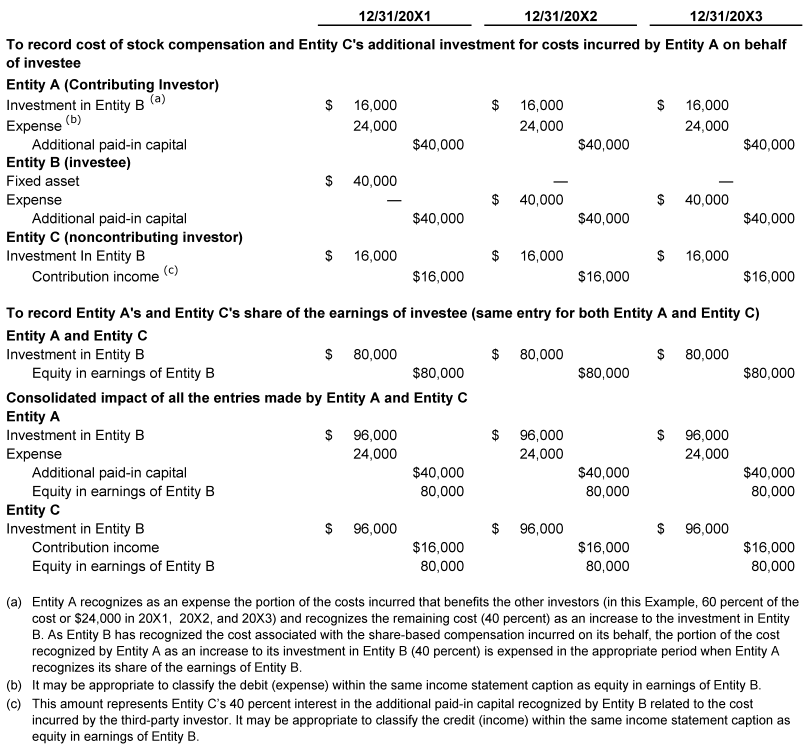
This Example illustrates the guidance in paragraphs 323-10-25-3 and 323-10-30-3 for share-based compensation by an investor granted to employees of an equity method investee. This Example is equally applicable to share-based awards granted by an investor to nonemployees that provide goods or services to an equity method investee that are used or consumed in the investee's operations.
323-10-55-20
Entity A owns a 40 percent interest in Entity B and accounts for its investment under the equity method. On January 1, 20X1, Entity A grants 10,000 stock options (in the stock of Entity A) to employees of Entity B. The stock options cliff-vest in three years. If an employee of Entity B fails to vest in a stock option, the option is returned to Entity A (that is, Entity B does not retain the underlying stock). The owners of the remaining 60 percent interest in Entity B have not shared in the funding of the stock options granted to employees of Entity B on any basis and Entity A was not obligated to grant the stock options under any preexisting agreement with Entity B or the other investors. Entity B will capitalize the share-based compensation costs recognized over the first year of the three-year vesting period as part of the cost of an internally constructed fixed asset (the internally constructed fixed asset will be completed on December 31, 20X1).
323-10-55-21
Before granting the stock options, Entity A's investment balance is $800,000, and the book value of Entity B's net assets equals $2,000,000. Entity B will not begin depreciating the internally constructed fixed asset until it is complete and ready for its intended use and, therefore, no related depreciation expense (or compensation expense relating to the stock options) will be recognized between January 1, 20X1, and December 31, 20X1. For the years ending December 31, 20X2, and December 31, 20X3, Entity B will recognize depreciation expense (on the internally constructed fixed asset) and compensation expense (for the cost of the stock options relating to Years 2 and 3 of the vesting period). After recognizing those expenses, Entity B has net income of $200,000 for the fiscal years ending December 31, 20X1, December 31, 20X2, and December 31, 20X3.
323-10-55-22
Entity C also owns a 40 percent interest in Entity B. On January 1, 20X1, before granting the stock options, Entity C's investment balance is $800,000.
323-10-55-23
Assume that the fair value of the stock options granted by Entity A to employees of Entity B is $120,000 on January 1, 20X1. Under Topic 718, the fair value of share-based compensation should be measured at the grant date. This Example assumes that the stock options issued are classified as equity and ignores the effect of forfeitures.
323-10-55-24
Entity A would make the following journal entries.
  • 12/31/20X1 12/31/20X2 12/31/20X3 To record cost of stock compensation and Entity C's additional investment for costs incurred by Entity A on behalf of investee Entity A (Contributing Investor) Investment in Entity B (a) " $16,000 " " $16,000 " " $16,000 " Expense (b) " 24,000 " " 24,000 " " 24,000 " Additional paid-in capital " $40,000 " " $40,000 " " $40,000 " Entity B (investee) Fixed asset " $40,000 " — — Expense — " $40,000 " " $40,000 " Additional paid-in capital " $40,000 " " $40,000 " " $40,000 " Entity C (noncontributing investor) Investment In Entity B " $16,000 " " $16,000 " " $16,000 " Contribution income (c) " $16,000 " " $16,000 " " $16,000 " To record Entity A's and Entity C's share of the earnings of investee (same entry for both Entity A and Entity C) Entity A and Entity C Investment in Entity B " $80,000 " " $80,000 " " $80,000 " Equity in earnings of Entity B " $80,000 " " $80,000 " " $80,000 " Consolidated impact of all the entries made by Entity A and Entity C Entity A Investment in Entity B " $96,000 " " $96,000 " " $96,000 " Expense " 24,000 " " 24,000 " " 24,000 " Additional paid-in capital " $40,000 " " $40,000 " " $40,000 " Equity in earnings of Entity B " 80,000 " " 80,000 " " 80,000 " Entity C Investment in Entity B " $96,000 " " $96,000 " " $96,000 " Contribution income " $16,000 " " $16,000 " " $16,000 " Equity in earnings of Entity B " 80,000 " " 80,000 " " 80,000 " (a) "Entity A recognizes as an expense the portion of the costs incurred that benefits the other investors (in this Example, 60 percent of the cost or $24,000 in 20X1, 20X2, and 20X3) and recognizes the remaining cost (40 percent) as an increase to the investment in Entity B. As Entity B has recognized the cost associated with the share-based compensation incurred on its behalf, the portion of the cost recognized by Entity A as an increase to its investment in Entity B (40 percent) is expensed in the appropriate period when Entity A recognizes its share of the earnings of Entity B." (b) It may be appropriate to classify the debit (expense) within the same income statement caption as equity in earnings of Entity B. (c) This amount represents Entity C's 40 percent interest in the additional paid-in capital recognized by Entity B related to the cost incurred by the third-party investor. It may be appropriate to classify the credit (income) within the same income statement caption as equity in earnings of Entity B.
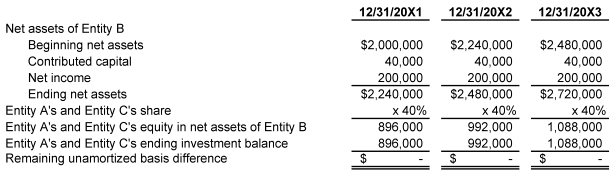
323-10-55-25
A rollforward of Entity B's net assets and a reconciliation to Entity A's and Entity C's ending investment accounts follows.
  • 12/31/20X1 12/31/20X2 12/31/20X3 Net assets of Entity B Beginning net assets " $2,000,000 " " $2,240,000 " " $2,480,000 " Contributed capital " 40,000 " " 40,000 " " 40,000 " Net income " 200,000 " " 200,000 " " 200,000 " Ending net assets " $2,240,000 " " $2,480,000 " " $2,720,000 " Entity A's and Entity C's share x 40% x 40% x 40% Entity A's and Entity C's equity in net assets of Entity B " 896,000 " " 992,000 " " 1,088,000 " Entity A's and Entity C's ending investment balance " 896,000 " " 992,000 " " 1,088,000 " Remaining unamortized basis difference
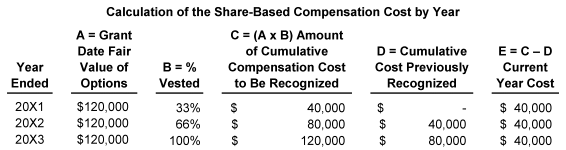
323-10-55-26
A summary of the calculation of share-based compensation cost by year follows.
  • Calculation of the Share-Based Compensation Cost by Year Year Ended A = Grant Date Fair Value of Options B = % Vested C = (A x B) Amount of Cumulative Compensation Cost to Be Recognized D = Cumulative Cost Previously Recognized E = C - D Current Year Cost 20X1 " $120,000 " 33% " $40,000 " $- " $40,000 " 20X2 " $120,000 " 66% " $80,000 " " $40,000 " " $40,000 " 20X3 " $120,000 " 100% " $120,000 " " $80,000 " " $40,000 "
323-10-55-27
The following Cases illustrate how eliminations of intra-entity profits might be made in accordance with paragraph 323-10-35-7. Both Cases assume that an investor owns 30 percent of the common stock of an investee, the investment is accounted for under the equity method, the income tax rate to both the investor and the investee is 40 percent, the inventory is a good that is an output of the entity's ordinary activities, and the contract is with a customer that is within the scope of Topic 606 on revenue from contracts with customers:
  1. a
    Investor sells inventory downstream to investee (Case A)
  2. b
    Investee sells inventory upstream to investor (Case B).
323-10-55-28
Assume an investor sells inventory items to the investee (downstream). At the investee's balance sheet date, the investee holds inventory for which the investor has recorded a gross profit of $100,000. The investor's net income would be reduced $18,000 to reflect a $30,000 reduction in gross profit and a $12,000 reduction in income tax expense. The elimination of intra-entity profit might be reflected in the investor's balance sheet in various ways. The income statement and balance sheet presentations will depend on what is the most meaningful in the circumstances.
323-10-55-29
Assume an investee sells inventory items to the investor (upstream). At the investor's balance sheet date, the investor holds inventory for which the investee has recorded a gross profit of $100,000. In computing the investor's equity pickup, $60,000 ($100,000 less 40 percent of income tax) would be deducted from the investee's net income and $18,000 (the investor's share of the intra-entity gross profit after income tax) would thereby be eliminated from the investor's equity income. Usually, the investor's investment account would also reflect the $18,000 intra-entity profit elimination, but the elimination might also be reflected in various other ways; for example, the investor's inventory might be reduced $18,000.
323-10-55-30
This Example illustrates the application of paragraph 323-10-35-24 to an investment involving all of the following circumstances:
  1. a
    Investor owns 40 percent of the outstanding common stock of Investee.
  2. b
    The common stock investment has been reduced to zero at the beginning of 20X1 because of previous losses.
  3. c
    Investor also has done both of the following:
    1. 1
      Invested $100 in redeemable preferred stock (that meets the definition of debt security and is classified as an available-for-sale debt security) of Investee (40 percent of the outstanding preferred stock of Investee)
    2. 2
      Extended $100 in loans to Investee (which represent 40 percent of all loans extended to Investee).
  4. d
    Investor is not obligated to provide any additional funding to Investee.
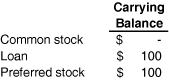
323-10-55-31
In accordance with paragraphs 323-10-35-7 and 323-10-35-16, Investee's operating income and losses in the following table have been adjusted for intra-entity interest on the loan and dividends received or receivable on the preferred stock. As of the beginning of year 20X1, the carrying value of Investor's total combined investment in Investee is $200, as follows.
  • Carrying Balance Common stock $- Loan $100 Preferred stock $100
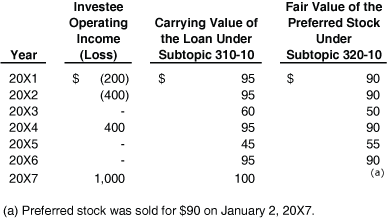
323-10-55-32
Assume the following facts for years 20X1 through 20X7.
  • Year Investee Operating Income (Loss) "Carrying Value of the Loan Under Subtopic 310-10" "Fair Value of the Preferred Stock Under Subtopic 320-10" 20X1 $(200) $95 $90 20X2 (400) 95 90 20X3 - 60 50 20X4 400 95 90 20X5 - 45 55 20X6 - 95 90 20X7 " 1,000 " 100 (a) (a) "Preferred stock was sold for $90 on January 2, 20X7."
323-10-55-33
Following are the steps Investor would follow in applying the equity method of accounting to its investment in Investee during the years 20X1 through 20X7.
323-10-55-34
Investor would make all of the following entries in 20X1:
  1. a
    In accordance with this Subtopic, record the equity method loss (40% × $200 = $80) to the cost basis of the preferred stock (the next level of capital) at the time that the common stock investment becomes zero.

    • Equity method loss $80 Preferred stock investment $80
  2. b
    In accordance with Subtopic 326-20 on financial instruments measured at amortized cost, record an allowance for credit losses on the loan.

    • Credit loss expense $5 Allowance for credit losses $5
  3. c
    In accordance with Subtopic 320-10, record the changes in fair value for the available-for-sale preferred stock investment (market price of $90 less the carrying amount after entry [a] of $20, equals $70 unrealized gain).

    • Preferred stock investment $70 Unrealized gain—other comprehensive income $70
323-10-55-35
In 20X1, the total profit-and-loss charge is $85 ($80 for the equity method loss and $5 for the loan). Other comprehensive income is credited $70 for the preferred stock investment. The carrying amount of the total combined investment in Investee is reduced to $185 ($0 for the common stock investment, $95 for the loan, and $90 for the preferred stock investment), and the balance in accumulated other comprehensive income is a credit of $70. The adjusted basis of the total combined investment in Investee is reduced to $115 ($0 for the common stock investment, $95 for the loan, and $20 for the preferred stock investment).
323-10-55-36
Investor would make both of the following entries in 20X2:
  1. a
    In accordance with this Subtopic, record the equity method loss (40% × $400 = $160) to the adjusted basis of the preferred stock of $20 and, because the adjusted basis of the preferred stock will then be reduced to zero, record the remaining equity method loss to the adjusted basis of the loan (the next level of capital). The total equity method loss recorded would be limited, however, to the adjusted basis of the total combined investment in Investee of $115; therefore, $45 of equity method losses are unreported.

    • Equity method loss $115 Preferred stock investment $20 Loan 95
  2. b
    In accordance with Subtopic 320-10, record the changes in fair value for the available-for-sale preferred stock investment (market price of $90 less the carrying amount after entry [a] of $70, equals $20 unrealized gain).

    • Preferred stock investment $20 Unrealized gain—other comprehensive income $20
323-10-55-37
In 20X2, the total profit-and-loss charge is $115 (equity method loss). Other comprehensive income is credited $20 for the preferred stock investment. The carrying amount of the total combined investment in Investee is reduced to $90 ($0 for the common stock investment, $0 for the loan, and $90 for the preferred stock investment), and the balance in accumulated other comprehensive income is a credit of $90. The adjusted basis of the total combined investment in Investee is reduced to $0 ($0 for the common stock investment, $0 for the loan, and $0 for the preferred stock investment).
323-10-55-38
In 20X3, there is no equity method income or loss (40% × $0 = $0). Investor would make both of the following entries in 20X3:
  1. a
    Because the adjusted basis of the loan was reduced to zero in 20X2 as a result of applying equity method losses to the loan, no entry is needed to reflect the Subtopic 326-20 reduction in carrying amount from $95 to $60.
  2. b
    In accordance with Subtopic 320-10, record the changes in fair value for the available-for-sale preferred stock investment (fair value of $50 less the carrying amount of $90 equals $40 unrealized loss).

    • Unrealized loss—other comprehensive income $40 Preferred stock investment $40
323-10-55-39
In 20X3, other comprehensive income is debited $40 for the preferred stock investment. The carrying amount of the total combined investment in Investee is reduced to $50 ($0 for the common stock investment, $0 for the loan, and $50 for the preferred stock investment), and the balance in accumulated other comprehensive income is a credit of $50. The adjusted basis of the total combined investment in Investee remains $0.
323-10-55-40
Investor would make both of the following entries in 20X4:
  1. a
    In accordance with this Subtopic, record the equity method income (40% × $400 = $160). However, in accordance with this Subtopic, Investor resumes applying the equity method only after its share of that income equals the unreported equity method losses of $45. Therefore, the equity method income to be reported for the period is $115 ($160-$45). The adjusted bases of the other investments are restored in the reverse order of the application of the equity method losses (loan first, then preferred stock).

    • Loan $95 Preferred stock investment 20 Equity method income $115
  2. b
    In accordance with Subtopic 320-10, record the changes in fair value for the available-for-sale preferred stock investment (market price of $90 less the carrying amount of $70 equals $20 unrealized gain).

    • Preferred stock investment $20 Unrealized gain—other comprehensive income $20
323-10-55-41
In 20X4, the total profit-and-loss credit is $115 (the equity method income after Investor's share of unreported equity method losses of $45 in 20X2). Other comprehensive income is credited $20 for the preferred stock investment. The carrying amount of the total combined investment in Investee is increased to $185 ($0 for the common stock investment, $95 for the loan, and $90 for the preferred stock investment), and the balance in accumulated other comprehensive income is a credit of $70. The adjusted basis of the total combined investment in Investee is increased to $115 ($0 for the common stock investment, $95 for the loan, and $20 for the preferred stock investment).
323-10-55-42
In 20X5, there is no equity method income or loss (40% × $0 = $0). Investor would make both of the following entries in 20X5:
  1. a
    In accordance with Subtopic 326-20, record an allowance for credit loss for the loan.

    • credit loss expense $50 allowance for credit losses $50
  2. b
    In accordance with Subtopic 320-10, record the changes in fair value for the available-for-sale preferred stock investment (market price of $55 less the carrying amount of $90 equals $35 unrealized loss).

    • Unrealized loss—other comprehensive income $35 Preferred stock investment $35
323-10-55-43
In 20X5, the total profit-and-loss charge is $50 (from the loan). Other comprehensive income is debited $35 for the preferred stock investment. The carrying amount for the total combined investment in Investee is reduced to $100 ($0 for the common stock investment, $45 for the loan, and $55 for the preferred stock investment), and the balance in accumulated other comprehensive income is a credit of $35. The adjusted basis of the total combined investment in Investee is reduced to $65 ($0 for the common stock investment, $45 for the loan, and $20 for the preferred stock investment).
323-10-55-44
In 20X6, there is no equity method income or loss (40% × $0 = $0). Investor would make both of the following entries in 20X6:
  1. a
    In accordance with Subtopic 326-20, adjust the allowance for credit losses on the loan.

    • allowance for credit losses $50 credit loss expense $50
  2. b
    In accordance with Subtopic 320-10, record the changes in fair value for the available-for-sale preferred stock investment (market price of $90 less the carrying amount of $55 equals $35 unrealized gain).

    • Preferred stock investment $35 Unrealized gain—other comprehensive income $35
323-10-55-45
In 20X6, the total profit-and-loss credit is $50 (from the loan). Other comprehensive income is credited $35 for the preferred stock investment. The carrying amount of the total combined investment in Investee is increased to $185 ($0 for the common stock investment, $95 for the loan, and $90 for the preferred stock investment), and the balance in accumulated other comprehensive income is a credit of $70. The adjusted basis of the total combined investment in Investee is increased to $115 ($0 for the common stock investment, $95 for the loan, and $20 for the preferred stock investment).
323-10-55-46
Investor would make all of the following entries in 20X7:
  1. a
    Record the sale of the preferred stock.
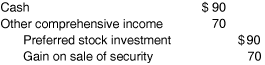
    • Cash $90 Other comprehensive income 70 Preferred stock investment $90 Gain on sale of security 70
  2. b
    In accordance with this Subtopic, record the equity method income (40% × $1,000 = $400). Although Investor has recorded losses for all prior Investee losses, $80 of such recorded losses (representing the difference between the cost basis of the preferred stock investment of $100 and its adjusted basis of $20) have effectively been reversed in entry (a) by recording a $70 gain on the sale of the preferred stock when an actual loss of $10 (representing the difference between the cost basis of the preferred stock investment of $100 and the proceeds of $90) was incurred. Accordingly, only $320 of equity method income should be recorded ($400-$80).

    • Investment in investee (common) $320 Equity method income $320
  3. c
    In accordance with Subtopic 326-20, adjust the allowance for credit losses on the loan.

    • Allowance for credit losses $5 Credit loss expense $5
323-10-55-47
In 20X7, the total profit-and-loss credit is $395 ($70 gain from the sale of the preferred stock, $320 for the equity method income, and $5 from the loan). The carrying value of the total combined investment in Investee is increased to $420 ($320 for the common stock investment and $100 for the loan), and the balance in accumulated other comprehensive income is $0. The adjusted basis of the total combined investment in Investee is increased to $420 ($320 for the common stock investment, $100 for the loan, and $0 for the preferred stock investment).
323-10-55-48
The following Cases illustrate possible approaches to recognizing equity method losses in accordance with paragraph 323-10-35-28:
  1. a
    Ownership level of particular investment (Case A)
  2. b
    Change in investor claim on investee book value (Case B).
323-10-55-49
Cases A and B share all of the following assumptions:
  1. a
    Investee was formed on January 1, 20X0.
  2. b
    Five investors each made investments in and loans to Investee on that date and there have not been any changes in those investment levels (that is, no new money, reacquisition of interests by Investee, principal payments by Investee, or dividends) during the period from January 1, 20X0, through December 31, 20X3.
  3. c
    Investor A owns 40 percent of the outstanding common stock of Investee; the common stock investment has been reduced to zero at the beginning of 20X1 because of previous losses.
  4. d
    Investor A also has invested $100 in preferred stock of Investee (50 percent of the outstanding preferred stock of Investee) and has extended $100 in loans to Investee (which represents 60 percent of all loans extended to Investee).
  5. e
    Investor A is not obligated to provide any additional funding to Investee. As of the beginning of 20X1, the adjusted basis of Investor's total combined investment in Investee is $200, as follows.

    • Common stock $- Preferred stock $100 Loan $100
  6. f
    Investee operating income (loss) from 20X1 through 20X3 is as follows.
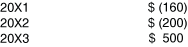
    • 20X1 $(160) 20X2 $(200) 20X3 $500
  7. g
    Investee's balance sheet is as follows.
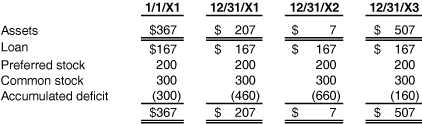
    • 1/1/X1 12/31/X1 12/31/X2 12/31/X3 Assets $367 $207 $7 $507 Loan $167 $167 $167 $167 Preferred stock 200 200 200 200 Common stock 300 300 300 300 Accumulated deficit (300) (460) (660) (160) $367 $207 $7 $507

323-10-55-50
Under this approach, Investor A would recognize equity method losses based on the ownership level of the particular investee security, loan, or advance held by the investor to which equity method losses are being applied.
323-10-55-51
In 20X1, in accordance with this Subtopic, Investor A would record the equity method loss to the adjusted basis of the preferred stock (the next most senior level of capital) after the common stock investment becomes zero (50% × $160 = $80). Investor A would record the following journal entry.
  • Equity method loss $80 Preferred stock investment $80

323-10-55-52
In 20X2, in accordance with this Subtopic, Investor A would record the equity method loss to the extent of the adjusted basis of the preferred stock of $20 (50% × $40 = $20) and, because the adjusted basis of the preferred stock will then be reduced to zero, record the remaining equity method loss to the adjusted basis of the loan (the next most senior level of capital) (60% × $160 [that is, $200-$40 applied to the preferred stock] = $96). Investor A would record the following journal entry.
  • Equity method loss $116 Preferred stock investment $20 Loan 96

323-10-55-53
In 20X3, in accordance with this Subtopic, Investor A would record the equity method income first to the loan until its adjusted basis is restored (60% × $160 = $96), then to the preferred stock until its adjusted basis is restored (50% × $200 = $100), and finally to the common stock (40% × $140 = $56). Investor A would record the following journal entry.
  • Loan $96 Preferred stock 100 Investment in investee 56 Equity method income $252

323-10-55-54
Under this approach, Investor A would recognize equity method losses based on the change in the investor's claim on the investee's book value.
323-10-55-55
With respect to 20X1, if Investee hypothetically liquidated its assets and liabilities at book value at December 31, 20X1, it would have $207 available to distribute. Investor A would receive $120 (Investor A's 60% share of a priority claim from the loan [$100] and a priority distribution of its preferred stock investment of $20 [which is 50% of the $40 remaining to distribute after the creditors are paid]). Investor A's claim on Investee's book value at January 1, 20X1, was $200 (60% × $167 = $100 and 50% × $200 = $100). Therefore, during 20X1, Investor A's claim on Investee's book value decreased by $80 and that is the amount Investor A would recognize in 20X1 as its share of Investee's losses. Investor A would record the following journal entry.
  • Equity method loss $80 Preferred stock investment $80

323-10-55-56
With respect to 20X2, if Investee hypothetically liquidated its assets and liabilities at book value at December 31, 20X2, it would have $7 available to distribute. Investor A would receive $4 (Investor A's 60% share of a priority claim from the loan). Investor A's claim on Investee's book value at December 31, 20X1, was $120 (see the preceding paragraph). Therefore, during 20X2, Investor A's claim on Investee's book value decreased by $116 and that is the amount Investor A would recognize in 20X2 as its share of Investee's losses. Investor A would record the following journal entry.
  • Equity method loss $116 Preferred stock investment $20 Loan 96

323-10-55-57
With respect to 20X3, if Investee hypothetically liquidated its assets and liabilities at book value at December 31, 20X3, it would have $507 available to distribute. Investor A would receive $256 (Investor A's 60% share of a priority claim from the loan [$100], Investor A's 50% share of a priority distribution from its preferred stock investment [$100], and 40% of the remaining cash available to distribute [$140 × 40% = $56]). Investor A's claim on Investee's book value at December 31, 20X2, was $4 (see above). Therefore, during 20X3, Investor A's claim on Investee's book value increased by $252 and that is the amount Investor A would recognize in 20X3 as its share of Investee's earnings. Investor A would record the following journal entry.
  • Loan $96 Preferred stock 100 Investment in investee 56 Equity method income $252

323-10-60Relationships

Source downloaded: .Record version ba081a829536. Effective date must be checked in the source.

Earnings Per Share

323-10-60-1
For guidance on the computation of consolidated earnings per share (EPS) if equity method investees or corporate joint ventures have issued options, warrants, and convertible securities, see paragraph 260-10-55-20.

Not-For-Profit Entities

323-10-60-2
For the use of the equity method if a not-for-profit entity (NFP) has common stock investments that are 50 percent or less of the voting stock of for-profit entities, see paragraph 958-810-15-4.
323-10-60-3
For NFPs that choose to report investment portfolios at fair value instead of applying the equity method, see paragraph 958-810-15-4.

Real Estate—General

323-10-60-4
For the use of the equity method by a real estate investment trust with an investment in a service corporation, see paragraph 974-323-25-1.

323-10-65Transition and Open Effective Date Information

Source downloaded: .Record version def541f62569. Effective date must be checked in the source.

323-10-65-1
Paragraph superseded on 07/01/2010 after the end of the transition period stated in EITF Issue No. 08-6, "Equity Method Investment Accounting Considerations."
323-10-65-2
Paragraph superseded on 06/20/2018 after the end of the transition period stated in Accounting Standards Update No. 2016-07, Investments—Equity Method and Joint Ventures (Topic 323): Simplifying the Transition to the Equity Method of Accounting.

323-10-S00StatusSEC

Source downloaded: .Record version d87468e9c86c. Effective date must be checked in the source.

323-10-S00-1
The following table identifies the changes that have been made to this Subtopic.

323-10-S45Other Presentation MattersSEC

Source downloaded: .Record version 58055000defa. Effective date must be checked in the source.

Stock-Based Compensation Granted to Employees of an Equity Method Investee

323-10-S45-1
See paragraph 323-10-S99-4, SEC Observer Comment: Accounting by an Investor for Stock-based compensation granted to employees of an equity method investee, for staff views on classification of income or expense resulting from the application of guidance in paragraph 323-10-25-3.

323-10-S50DisclosureSEC

Source downloaded: .Record version 5d37440f8ff9. Effective date must be checked in the source.

Summarized Financial Information of Subsidiaries Not Consolidated and 50 Percent or Less Owned Persons

323-10-S50-1
See paragraph 235-10-S99-1, Regulation S-X Rule 4-08(g), for requirements to provide summarized financial information of subsidiaries not consolidated and 50 percent or less owned persons.
323-10-S50-2
See paragraph 270-10-S99-1, Regulation S-X Rule 10-01(b)(1), for requirements to provide summarized financial information in interim financial statements for subsidiaries not consolidated or 50 percent or less owned persons.

323-10-S55Implementation Guidance and IllustrationsSEC

Source downloaded: .Record version cc118132d496. Effective date must be checked in the source.

Undistributed Earnings of 50 Percent or Less Owned Persons

323-10-S55-2
See paragraph 323-10-S99-1, SAB Topic 6.K.3, for SEC Staff views on determining whether footnote disclosure is required about undistributed earnings of 50 percent or less owned persons.

Summarized Financial Statement Requirements for Unconsolidated Subsidiaries and 50 Percent or Less Owned Persons

323-10-S55-3
See paragraph 323-10-S99-2, SAB Topic 6.K.4(b), for SEC Staff views on when providing summarized disclosure required by Regulation S-X Rule 4-08(g) is appropriate.

323-10-S99SEC MaterialsSEC

Source downloaded: .Record version e80b61841286. Effective date must be checked in the source.

SEC Staff Guidance

323-10-S99-1
The following is the text from SAB Topic 6.K.3, Undistributed Earnings of 50% or Less Owned Persons.
  • Facts: Rule 4-08(e)(2) of Regulation SX requires footnote disclosures of the amount of consolidated retained earnings which represents undistributed earnings of 50% or less owned persons (investee) accounted for by the equity method. The test adopted in ASR 302 to trigger disclosures about the registrant's restricted net assets (Rule 4-08(e)(3)) includes the parent's equity in the undistributed earnings of investees.
  • Question: Is the amount required for footnote disclosure the same as the amount included in the test to determine disclosures about restrictions?
  • Interpretive Response: Yes. The amount used in the test in Rule 4-08(e)(3) should be the same as the amount required to be disclosed by Rule 4-08(e)(2). This is the portion of the registrant's consolidated retained earnings which represents the undistributed earnings of an investee since the date(s) of acquisition. It is computed by determining the registrant's cumulative equity in the investee's earnings, adjusted by any dividends received, related goodwill write-downs, and any related income taxes provided.
323-10-S99-2
The following is the text of SAB Topic 6.K.4.b, Application of Significant Subsidiary Test to Investees and Unconsolidated Subsidiaries.
  • b. Summarized financial statement requirements.
  • Facts: Rule 4-08(g) of Regulation S-X requires summarized financial information about unconsolidated subsidiaries and 50% or less owned persons (investee) to be included in the footnotes to the financial statements if, in the aggregate, they meet the tests of a significant subsidiary set forth in Rule 1-02(w).
  • Question 1: Must a registrant which includes separate financial statements or condensed financial statements for unconsolidated subsidiaries or investees in its annual report to shareholders also include in such report the summarized financial information for these entities pursuant to Rule 4-08(g)?
  • Interpretive Response: No. The purpose of the summarized information is to provide minimum standards of disclosure when the impact of such entities on the consolidated financial statements is significant. If the registrant furnishes more information in the annual report than is required by these minimum disclosure standards, such as condensed financial information or separate audited financial statements, the summarized data can be excluded. The Commission's rules are not intended to conflict with the provisions of FASB ASC subparagraph 323-10-50-3(c) (Investments—Equity Method and Joint Ventures Topic) which provide that either separate financial statements of investees be presented with the financial statements of the reporting entity or that summarized information be included in the reporting entity's financial statement footnotes.
  • Question 2: Can summarized information be omitted for individual entities as long as the aggregate information for the omitted entity(s) does not exceed 10% under any of the significance tests of Rule 1-02(w)?
  • Interpretive Response: The 10% measurement level of the significant subsidiary rule was not intended to establish a materiality criteria for omission, and the arbitrary exclusion of summarized information for selected entities up to a 10% level is not appropriate. Rule 4-08(g) requires that the summarized information be included for all unconsolidated subsidiaries and investees. However, the staff recognizes that exclusion of the summarized information for certain entities is appropriate in some circumstances where it is impracticable to accumulate such information and the summarized information to be excluded is de minimis.
323-10-S99-4
The following is the text of SEC Observer Comment: Accounting by an Investor for Stock-Based Compensation Granted to Employees of an Equity Method Investee.
  • Paragraph 323-10-25-3 provides guidance on the accounting by an investor for stock-based compensation based on the investor's stock granted to employees of an equity method investee. Investors that are SEC registrants should classify any income or expense resulting from application of this guidance in the same income statement caption as the equity in earnings (or losses) of the investee.

Related subtopics