ASC

ASC 321-10

Overall

321 Investments—Equity Securities

Source downloaded: .Record version ee8616782e0a. Effective date must be checked in the source.

ASC 321-10 governs the accounting for investments in equity securities and other ownership interests (partnerships, unincorporated joint ventures, LLCs) that are not consolidated, not accounted for under the equity method, and not derivatives. The default rule is fair value measurement in the balance sheet with all unrealized holding gains and losses (and dividend income) recognized in earnings (321-10-35-1, 35-6). As an alternative, an entity may elect, investment by investment, a "measurement alternative" for an equity security without a readily determinable fair value: cost minus impairment, adjusted up or down for observable price changes in orderly transactions for identical or similar investments of the same issuer (321-10-35-2).

Key points (7)
  • Except for the measurement alternative, equity securities are measured at fair value with unrealized holding gains and losses included in earnings; there is no available-for-sale/OCI category (321-10-35-1); dividend income also goes to earnings (321-10-35-6).
  • The measurement alternative under 321-10-35-2 (cost minus impairment plus/minus observable price changes) is available only for equity securities without a readily determinable fair value that do not qualify for the NAV practical expedient in 820-10-35-59, is elected separately for each investment, must be reassessed each reporting period, and a later election to go to fair value is irrevocable and applies to all identical or similar investments of the same issuer, with gains or losses recognized in earnings at the time of election.
  • Securities measured under the alternative are impaired using a one-step qualitative assessment each reporting period considering indicators such as deteriorating investee earnings, credit rating, or business prospects, adverse regulatory/economic/market changes, a bona fide offer below carrying amount, or going-concern doubts (321-10-35-3); if impaired, the loss in net income equals fair value minus carrying amount (321-10-35-4).
  • On discontinuance of the equity method, the previous carrying amount becomes the security's initial basis, with no retroactive adjustment, and the retained investment is remeasured under 321-10-35-1 or 35-2 immediately after Topic 323 ceases to apply (321-10-30-1).
  • Scope excludes derivatives under Topic 815 (though the host instrument of a bifurcated embedded derivative stays in scope), equity method investments, consolidated subsidiaries, certain exchange memberships, and FHLB/Federal Reserve Bank stock (321-10-15-5); specialized industries carrying substantially all investments at fair value through earnings (broker-dealers, benefit plans, investment companies) are also outside the Topic (321-10-15-3).
  • An entity does not look through the form of its investment to the nature of the investee's assets; a limited partnership interest or mutual fund holding only debt securities is still an equity security in scope (321-10-55-6 through 55-7).
  • Entities using the measurement alternative must disclose the carrying amount of such investments and annual and cumulative impairments/downward adjustments and upward adjustments, plus narrative context (321-10-50-3), and all entities (other than those in Topic 958) must disclose the portion of period unrealized gains and losses relating to equity securities still held at the reporting date (321-10-50-4, 50-2A).

For students. Post-ASU 2016-01, there is no available-for-sale classification for equity securities—every fair value change hits earnings, which is the most common carryover error from old Topic 320 thinking. Also remember the measurement alternative is not "cost method": observable price changes for identical or similar securities of the same issuer force remeasurement to fair value at the transaction date, in both directions.

Machine-generated study aid for ASC 321-10. Check the source paragraphs below.

321-10-00Status

Source downloaded: .Record version 421aa17c4dfe. Effective date must be checked in the source.

321-10-00-1
The following table identifies the changes made to this Subtopic.
ParagraphActionAccounting Standards UpdateDate
Equity Security (1st def.)AddedAccounting Standards Update No. 2016-0101/05/2016
Fair Value (2nd def.)AddedAccounting Standards Update No. 2016-0101/05/2016
Holding Gain or LossAmendedAccounting Standards Update No. 2016-1306/16/2016
Holding Gain or LossAddedAccounting Standards Update No. 2016-0101/05/2016
Market ParticipantsAddedAccounting Standards Update No. 2016-0101/05/2016
Orderly TransactionAddedAccounting Standards Update No. 2016-0101/05/2016
Readily Determinable Fair ValueAddedAccounting Standards Update No. 2016-0101/05/2016
Related PartiesAddedAccounting Standards Update No. 2016-0101/05/2016
Security (2nd def.)AddedAccounting Standards Update No. 2016-0101/05/2016
321-10-05-1AddedAccounting Standards Update No. 2016-0101/05/2016
321-10-05-2AddedAccounting Standards Update No. 2016-0101/05/2016
AddedAccounting Standards Update No. 2016-0101/05/2016
321-10-15-3AmendedAccounting Standards Update No. 2019-0404/25/2019
321-10-15-5AmendedMaintenance Update 2017-06 (PDF)04/07/2017
321-10-15-6AmendedAccounting Standards Update No. 2020-0101/16/2020
321-10-15-7AddedAccounting Standards Update No. 2025-0709/29/2025
321-10-30-1AmendedAccounting Standards Update No. 2020-0101/16/2020
321-10-30-1AddedAccounting Standards Update No. 2016-0101/05/2016
AddedAccounting Standards Update No. 2016-0101/05/2016
321-10-35-2AmendedAccounting Standards Update No. 2019-0404/25/2019
321-10-35-2AmendedAccounting Standards Update No. 2018-0302/28/2018
321-10-40-1AddedAccounting Standards Update No. 2016-0101/05/2016
321-10-45-1AddedAccounting Standards Update No. 2016-0101/05/2016
321-10-45-2AddedAccounting Standards Update No. 2016-0101/05/2016
AddedAccounting Standards Update No. 2016-0101/05/2016
321-10-50-2AAmendedMaintenance Update 2018-02 (PDF)02/02/2018
321-10-50-2AAddedAccounting Standards Update No. 2016-1408/18/2016
321-10-50-2BAddedAccounting Standards Update No. 2019-0404/25/2019
321-10-50-3AmendedAccounting Standards Update No. 2025-1112/08/2025
321-10-50-4AmendedAccounting Standards Update No. 2025-1112/08/2025
AddedAccounting Standards Update No. 2016-0101/05/2016
321-10-55-3AmendedAccounting Standards Update No. 2020-0101/16/2020
321-10-55-9AmendedAccounting Standards Update No. 2018-0302/28/2018

321-10-05Background

Source downloaded: .Record version c0874e637a0c. Effective date must be checked in the source.

321-10-05-1
The Codification contains several Topics for investments because of the differing accounting treatment for various forms of investment. The Topics include:
  1. a
    Topic 320, Investments—Debt Securities
  2. b
    Topic 321, Investments—Equity Securities
  3. c
    Topic 323, Investments—Equity Method and Joint Ventures
  4. d
    Topic 325, Investments—Other.
321-10-05-2
This topic addresses the accounting and reporting for investments in equity securities.

321-10-15Scope and Scope Exceptions

Source downloaded: .Record version 7c111821b086. Effective date must be checked in the source.

Overall Guidance

321-10-15-1
The Scope Section of the Overall Subtopic establishes the scope for the Investments—Equity Securities Topic.

Entities

321-10-15-2
The guidance in the Investments—Equity Securities Topic applies to all entities, including the following entities that are not deemed to be specialized industries for purposes of this Topic:
  1. a
    Cooperatives and mutual entities (such as credit unions and mutual insurance entities)
  2. b
    Trusts that do not report substantially all of their securities at fair value.
321-10-15-3
The guidance in this Topic does not apply to entities in certain specialized industries whose specialized accounting practices include accounting for substantially all investments at fair value, with changes in value recognized in earnings (income) or in the change in net assets. Examples of those entities are:
  1. a
    Brokers and dealers in securities (Topic 940)
  2. b
    Defined benefit pension, other postretirement, and health and welfare plans (Topics 960, 962, and 965)
  3. c
    Investment companies (Topic 946).

Instruments

321-10-15-4
The guidance in the Investments—Equity Securities Topic establishes standards of financial accounting and reporting for investments in equity securities and other ownership interests in an entity, including investments in partnerships, unincorporated joint ventures, and limited liability companies as if those other ownership interests are equity securities.
321-10-15-5
The guidance in this Topic does not apply to any of the following:
  1. a
    Derivative instruments that are subject to the requirements of Topic 815, including those that have been separated from a host contract as required by Section 815-15-25. If an investment otherwise would be in the scope of this Topic and it has within it an embedded derivative that is required by that Section to be separated, the host instrument (as described in that Section) remains within the scope of this Topic.
  2. b
    Investments accounted for under the equity method (Topic 323).
  3. c
    Investments in consolidated subsidiaries.
  4. d
    An exchange membership that has the characteristics specified in paragraph 940-340-25-1(b) for an ownership interest in the exchange.
  5. e
    Federal Home Loan Bank and Federal Reserve Bank Stock (Subtopic 942-325).
321-10-15-6
Paragraph 815-10-15-141 explains that the guidance in the Certain Contracts on Debt and Equity Securities Subsections applies to those forward contracts and purchased options that are not derivative instruments subject to Topic 815 but that involve the acquisition of securities that will be accounted for under Topic 321. Paragraph 815-10-15-141A provides guidance on applying the guidance in paragraph 815-10-15-141 to forward contracts and purchased options to purchase securities within the scope of Topic 321.
321-10-15-7
Transition date:(P) December 16, 2026; (N) December 16, 2026Transition guidance:
606-10-65-3An entity shall not apply the guidance in this Topic to share-based noncash consideration from a customer for the transfer of goods or services unless and until the entity’s right to receive or retain the share-based noncash consideration is unconditional under Topic 606 in accordance with paragraph 606-10-15-3A. Similarly, an entity shall not apply the guidance in this Topic to share-based noncash consideration from a counterparty for the transfer of nonfinancial assets or in substance nonfinancial assets unless and until the entity’s right to receive or retain the share-based noncash consideration is unconditional under Subtopic 610-20 in accordance with paragraph 610-20-15-3A.

321-10-30Initial Measurement

Source downloaded: .Record version ed2de7f7149b. Effective date must be checked in the source.

Equity Securities Previously Accounted for under the Equity Method

321-10-30-1
If an equity security no longer qualifies to be accounted for under the equity method (for example, due to a decrease in the level of ownership), the security's initial basis for which subsequent changes in fair value are measured shall be the previous carrying amount of the investment. Paragraph 323-10-35-36 states that the earnings or losses that relate to the stock retained by the investor and that were previously accrued shall remain as a part of the carrying amount of the investment and that the investment account shall not be adjusted retroactively. Upon discontinuance of the equity method, an entity shall remeasure the equity security in accordance with paragraph 321-10-35-1 or 321-10-35-2, as applicable. For purposes of applying paragraph 321-10-35-2 to the investor's retained investment, if the investor identifies observable price changes in orderly transactions for the identical or a similar investment of the same issuer that results in it discontinuing the equity method, the entity shall remeasure its retained investment at fair value immediately after it no longer applies the guidance in Topic 323.

321-10-35Subsequent Measurement

Source downloaded: .Record version 2dd7f9b738ea. Effective date must be checked in the source.

321-10-35-1
Except as provided in paragraph 321-10-35-2, investments in equity securities shall be measured subsequently at fair value in the statement of financial position. Unrealized holding gains and losses for equity securities shall be included in earnings.

Equity Securities without Readily Determinable Fair Values

321-10-35-2
An entity may elect to measure an equity security without a readily determinable fair value that does not qualify for the practical expedient to estimate fair value in accordance with paragraph 820-10-35-59 at its cost minus impairment, if any. If an entity identifies observable price changes in orderly transactions for the identical or a similar investment of the same issuer, it shall measure the equity security at fair value as of the date that the observable transaction occurred. An election to measure an equity security in accordance with this paragraph shall be made for each investment separately. Once an entity elects to measure an equity security in accordance with this paragraph, the entity shall continue to apply the measurement guidance in this paragraph until the investment does not qualify to be measured in accordance with this paragraph (for example, if the investment has a readily determinable fair value or becomes eligible for the practical expedient to estimate fair value in accordance with paragraph 820-10-35-59). The entity shall reassess at each reporting period whether the equity investment without a readily determinable fair value qualifies to be measured in accordance with this paragraph. If an entity measures an equity security in accordance with this paragraph (and the security continues to qualify for measurement in accordance with this paragraph), the entity may subsequently elect to measure the equity security at fair value. If an entity subsequently elects to measure an equity security at fair value, the entity shall measure all identical or similar investments of the same issuer, including future purchases of identical or similar investments of the same issuer, at fair value. The election to measure those securities at fair value shall be irrevocable. Any resulting gains or losses on the securities for which that election is made shall be recorded in earnings at the time of the election.
321-10-35-3
An equity security without a readily determinable fair value that does not qualify for the practical expedient to estimate fair value in accordance with paragraph 820-10-35-59 and is measured in accordance with paragraph 321-10-35-2 shall be written down to its fair value if a qualitative assessment indicates that the investment is impaired and the fair value of the investment is less than its carrying value, as determined using the guidance in paragraph 321-10-35-2. At each reporting period, an entity that holds an equity security shall make a qualitative assessment considering impairment indicators to evaluate whether the investment is impaired. Impairment indicators that an entity considers include, but are not limited to, the following:
  1. a
    A significant deterioration in the earnings performance, credit rating, asset quality, or business prospects of the investee
  2. b
    A significant adverse change in the regulatory, economic, or technological environment of the investee
  3. c
    A significant adverse change in the general market condition of either the geographical area or the industry in which the investee operates
  4. d
    A bona fide offer to purchase, an offer by the investee to sell, or a completed auction process for the same or similar investment for an amount less than the carrying amount of that investment
  5. e
    Factors that raise significant concerns about the investee's ability to continue as a going concern, such as negative cash flows from operations, working capital deficiencies, or noncompliance with statutory capital requirements or debt covenants.
321-10-35-4
If an equity security without a readily determinable fair value is impaired, an entity shall include an impairment loss in net income equal to the difference between the fair value of the investment and its carrying amount. That is, if the investment is deemed to be impaired after conducting the evaluation required by paragraph 321-10-35-3, the entity shall estimate the fair value of the investment to determine the amount of the impairment loss.

Investment in Equity Securities of an Equity Method Investee

321-10-35-5
Paragraphs identify circumstances in which an entity must adjust the basis of its investment in equity securities of an equity method investee for the amount of an equity method loss based on the investment's seniority. For investments accounted for in accordance with this Subtopic, the adjusted basis resulting from the application of paragraphs becomes the equity security's basis from which subsequent changes in fair value are measured.

Dividend Income from Investments in Equity Securities

321-10-35-6
Dividend income from investments in equity securities shall be included in earnings.

321-10-40Derecognition

Source downloaded: .Record version 23edbea5ddfb. Effective date must be checked in the source.

Accounting for Sales of Securities

321-10-40-1
Section 860-10-40 provides guidance on determining whether a transfer of securities shall be accounted for as a sale. With respect to equity securities, because all changes in an equity security's fair value are reported in earnings as they occur, the sale of an equity security does not necessarily give rise to a gain or loss. Generally, a debit to cash (or trade date receivable) is recorded for the sales proceeds, and a credit is recorded to remove the security at its fair value (or sales price). If the entity is not taxed on the changes in fair value, the deferred tax accounts would be adjusted. An entity that has not yet recorded the security's change in fair value to the point of sale (perhaps because fair value changes are recorded at the end of each day) will need to adjust this procedure.

321-10-45Other Presentation Matters

Source downloaded: .Record version d4d8367823dc. Effective date must be checked in the source.

Cash Flow Presentation

321-10-45-1
An entity shall classify cash flows from purchases and sales of equity securities on the basis of the nature and purpose for which it acquired the securities.

Statement of Financial Position

321-10-45-2
An entity also shall refer to guidance in paragraph 825-10-45-1A on disaggregation of financial assets and financial liabilities by measurement category and form of financial asset (that is, securities or loans and receivables).

321-10-50Disclosure

Source downloaded: .Record version 4c1d0f695f94. Effective date must be checked in the source.

321-10-50-1
This Section provides disclosure guidance on information about equity securities that is required to be presented in the financial statements.
321-10-50-2
The disclosures in this Section are required for all interim and annual periods.
321-10-50-2A
The disclosure guidance in paragraph 321-10-50-4 is not required for entities that are within the scope of Topic 958 on not-for-profit entities.
321-10-50-2B
To the extent that the disclosure requirements in this Subtopic achieve the fair value disclosure requirements described in Section 820-10-50 on disclosing fair value measurement, an entity need not duplicate the related fair value disclosure.
321-10-50-3
An entity that applies the guidance in paragraph 321-10-35-2 for equity securities without readily determinable fair values shall disclose all of the following:
  1. a
    The carrying amount of investments without readily determinable fair values
  2. b
    The amount of impairments and downward adjustments, if any, both annual and cumulative
  3. c
    The amount of upward adjustments, if any, both annual and cumulative
  4. d
    As of the date of the most recent statement of financial position, additional information (in narrative form) that is sufficient to permit financial statement users to understand the quantitative disclosures and the information that the entity considered in reaching the carrying amounts and upward or downward adjustments resulting from observable price changes.
Transition date:(P) December 16, 2027; (N) December 16, 2028Transition guidance:
270-10-65-1For interim and annual reporting periods, an entity that applies the guidance in paragraph 321-10-35-2 for equity securities without readily determinable fair values shall disclose all of the following:
  1. a
    The carrying amount of investments without readily determinable fair values
  2. b
    The amount of impairments and downward adjustments, if any, both annual and cumulative
  3. c
    The amount of upward adjustments, if any, both annual and cumulative
  4. d
    As of the date of the most recent statement of financial position, additional information (in narrative form) that is sufficient to permit financial statement users to understand the quantitative disclosures and the information that the entity considered in reaching the carrying amounts and upward or downward adjustments resulting from observable price changes.
321-10-50-4
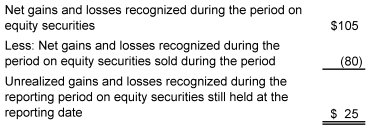
For each period for which the results of operations are presented, an entity shall disclose the portion of unrealized gains and losses for the period that relates to equity securities still held at the reporting date. The portion of unrealized gains and losses for the period related to equity securities still held at the reporting date is calculated as follows.
  • Net gains and losses recognized during the period on equity securities $105 Less: Net gains and losses recognized during the period on equity securities sold during the period (80) Unrealized gains and losses recognized during the reporting period on equity securities still held at the reporting date $25
Transition date:(P) December 16, 2027; (N) December 16, 2028Transition guidance:
270-10-65-1For each interim and annual reporting period for which the results of operations are presented, an entity shall disclose the portion of unrealized gains and losses for the period that relates to equity securities still held at the reporting date. The portion of unrealized gains and losses for the period related to equity securities still held at the reporting date is calculated as follows.
  • Net gains and losses recognized during the period on equity securities $105 Less: Net gains and losses recognized during the period on equity securities sold during the period (80) Unrealized gains and losses recognized during the reporting period on equity securities still held at the reporting date $25

321-10-55Implementation Guidance and Illustrations

Source downloaded: .Record version fb6fa3b5cb28. Effective date must be checked in the source.

Implementation Guidance

321-10-55-1
The implementation guidance in paragraphs discusses the scope application of this Topic to the following instruments and transactions.
  1. a
    Convertible preferred stock
  2. b
    Call options and forward contracts on equity securities
  3. c
    Short sales of equity securities.
321-10-55-2
If convertible preferred stock is not redeemable, it is considered an equity security and, therefore, this Topic would apply.
321-10-55-3
An option to buy an equity security that does not meet the definition of a derivative instrument is within the scope of this Topic. An investment in an option on securities should be accounted for under the requirements of Subtopic 815-10 if the option meets the definition of a derivative instrument, including the criteria for net settlement in paragraph 815-10-15-83(c). This Topic applies to those forward contracts and options that are not derivative instruments subject to Subtopic 815-10 but that involve the acquisition of securities that will be accounted for under this Topic. Paragraph 815-10-15-141A provides guidance on applying the guidance in paragraph 815-10-15-141 to forward contracts and purchased options to purchase securities within the scope of Topic 321.
321-10-55-4
Sales of securities that the seller does not own at the time of sale are obligations to deliver securities, not investments. Short sale obligations are addressed in the guidance for certain industries (see paragraph 940-320-35-1 with respect to broker-dealers and paragraph 942-405-25-1 with respect to depository institutions). For guidance on evaluating whether a short sale transaction involves a derivative instrument, see paragraph 815-10-55-57.
321-10-55-5
Paragraph 970-323-25-10 explains that an investment in a corporate subsidiary that is a real estate venture shall be accounted for by the investor-parent using the principles applicable to investments in subsidiaries rather than those applicable to investments in corporate joint ventures. That is, that paragraph requires that noncontrolling shareholders in such a real estate venture should account for their investment using the principles applicable to investments in common stock set forth in Topic 323 or this Topic as applicable.
321-10-55-6
An entity should not look through the form of its investment to the nature of the securities held by an investee to determine whether the scope of this Topic applies.
321-10-55-7
For example, an entity invests in a limited partnership interest (or a venture capital entity) that meets the definition of an equity security. However, substantially all of the partnership's assets consist of investments in debt securities or equity securities. It is not appropriate to look through the form of an investment to determine whether this Topic applies. In the specific situation described in this paragraph, the investment would be considered an equity security. So, this Topic would apply to that type of investment. (Subtopic 323-30 provides guidance on the accounting for limited partnership investments.) Another example of an investment that is considered an equity security is an investment in a mutual fund that invests only in U.S. government debt securities.
321-10-55-8
To identify observable price changes, an entity should consider relevant transactions that occurred on or before the balance sheet date that are known or can reasonably be known. To identify price changes that can reasonably be known, the entity should make a reasonable effort (that is without expending undue cost and effort) to identify any observable transactions that it may not be readily aware of. The entity need not conduct an exhaustive search for all observable price changes.
321-10-55-9
To identify whether a security issued by the same issuer is similar to the equity security held by the entity, the entity should consider the different rights and obligations of the securities. Differences in rights and obligations could include characteristics such as voting rights, distribution rights and preferences, and conversion features. The entity should adjust the observable price of a similar security for the different rights and obligations to determine the amount that should be recorded as an upward or downward adjustment in the carrying value of the security measured in accordance with paragraph 321-10-35-2 to reflect the fair value of the security as of the date that the observable transaction for the similar security took place.

Related subtopics