ASC 820-10
Overall
820 Fair Value Measurement
Source downloaded: .Record version f61084590dd0. Effective date must be checked in the source.
ASC 820-10 defines fair value as the price that would be received to sell an asset or paid to transfer a liability in an orderly transaction between market participants at the measurement date (an exit price), and provides a single framework for measuring it plus related disclosures. Fair value is a market-based, not entity-specific, measurement, determined in the principal (or, absent one, most advantageous) market using assumptions market participants would use, maximizing observable and minimizing unobservable inputs. Inputs are categorized in a three-level hierarchy (Level 1 quoted prices, Level 2 other observable inputs, Level 3 unobservable inputs), with the whole measurement classified at the lowest level input significant to it.
Key points (7)
- Fair value is the exit price to sell an asset or transfer a liability in an orderly transaction between market participants at the measurement date; the entity's intent to hold or settle is irrelevant (820-10-35-2; 820-10-05-1B through 05-1C).
- The measurement assumes a transaction in the principal market, or absent a principal market, the most advantageous market that the entity can access; the price is not adjusted for transaction costs but is adjusted for transportation costs when location is a characteristic of the asset (820-10-35-5 through 35-6A; 35-9B through 35-9C).
- Nonfinancial assets are measured assuming their highest and best use by market participants (physically possible, legally permissible, financially feasible), with current use presumed to be highest and best use absent contrary evidence (820-10-35-10A through 35-10E).
- Liabilities and instruments classified in shareholders' equity are measured assuming transfer (not settlement or cancellation), using the price of the identical item held by another party as an asset if available, and always reflecting nonperformance risk including the entity's own credit risk; no separate input is added for restrictions preventing transfer (820-10-35-16 through 35-16BB; 35-17 through 35-18C).
- Entities must use valuation techniques (market, cost, income approaches) appropriate in the circumstances, applied consistently; a change in technique is a change in accounting estimate under 250-10-45-17 (820-10-35-24 through 35-26).
- The hierarchy gives highest priority to unadjusted quoted prices in active markets for identical items (Level 1), which generally cannot be adjusted except in the limited cases in 820-10-35-41C; blockage factors are prohibited and a Level 1 position equals quoted price times quantity held (820-10-35-37 through 35-44).
- The Topic applies whenever another Topic requires or permits fair value measurement or disclosure, except for share-based payment under Topic 718 (other than 718-40), Topic 330, Topic 606 revenue, and 610-20 nonfinancial asset derecognition gains/losses (820-10-15-1 through 15-2), and it preserves existing practicability exceptions (820-10-15-3).
For students. Nearly every measurement topic (business combinations, impairment, derivatives, pensions) cross-references ASC 820, so the framework is heavily tested. The most common error is treating fair value as an entity-specific or entry price: transaction price is an entry price and may differ from fair value, and management's intent, blockage factors, and (for non-investment-company holders) contractual sale restrictions on equity securities are ignored.
Machine-generated study aid for ASC 820-10. Check the source paragraphs below.
820-10-00Status
Source downloaded: .Record version bada4b7a6db7. Effective date must be checked in the source.
820-10-05Overview and Background
Source downloaded: .Record version 41723f59db0d. Effective date must be checked in the source.
- aDefines fair value
- bSets out in a single Topic a framework for measuring fair value
- cRequires disclosures about fair value measurements.
820-10-15Scope and Scope Exceptions
Source downloaded: .Record version 8dcd6af921e5. Effective date must be checked in the source.
Overall Guidance
Other Considerations
- a
- bTo Sections, Subtopics, or Topics that require or permit measurements that are similar to fair value but that are not intended to measure fair value, including both of the following:
- 1Sections, Subtopics, or Topics that permit measurements that are determined on the basis of, or otherwise use, standalone selling price
- 2Topic 330.
- 1
- c
- d
- eTo the recognition and measurement of gains and losses upon the derecognition of nonfinancial assets in accordance with Subtopic 610-20.
Practicability Exceptions to This Topic
- a The use of a transaction price (an entry price) to measure fair value (an exit price) at initial recognition, including the following:
- 1 Guarantees in accordance with Topic 460
- 2
- 1
- b
- 1
- 2
- c An exemption to the requirement to measure fair value if fair value is not reasonably determinable, such as all of the following:
- 1
- 2
- 3 Restructuring obligations in accordance with Topic 420
- 4
- d
- e The use of particular measurement methods referred to in paragraph 805-20-30-10 that allow measurements other than fair value for specified assets acquired and liabilities assumed in a business combination.
- ee Financial assets or financial liabilities of a consolidated variable interest entity that is a collateralized financing entity when the financial assets or financial liabilities are measured using the measurement alternative in paragraphs and .
- f An exemption to the requirement to measure fair value if fair value cannot be reasonably estimated, such as the following:
- 1 Noncash consideration promised in a contract in accordance with the guidance in paragraphs .
- 1
- a The investment does not have a readily determinable fair value
- b The investment is in an investment company within the scope of Topic 946 or is an investment in a real estate fund for which it is industry practice to measure investment assets at fair value on a recurring basis and to issue financial statements that are consistent with the measurement principles in Topic 946.
820-10-25Recognition
Source downloaded: .Record version a79e6a2f26b9. Effective date must be checked in the source.
820-10-30Initial Measurement
Source downloaded: .Record version 2cad364194f5. Effective date must be checked in the source.
- a
- b
- c
- d
- aThe transaction is between related parties, although the price in a related party transaction may be used as an input into a fair value measurement if the reporting entity has evidence that the transaction was entered into at market terms.
- bThe transaction takes place under duress or the seller is forced to accept the price in the transaction. For example, that might be the case if the seller is experiencing financial difficulty.
- cThe unit of account represented by the transaction price is different from the unit of account for the asset or liability measured at fair value. For example, that might be the case if the asset or liability measured at fair value is only one of the elements in the transaction (for example, in a business combination), the transaction includes unstated rights and privileges that are measured separately, in accordance with another Topic, or the transaction price includes transaction costs.
- dThe market in which the transaction takes place is different from the principal market (or most advantageous market). For example, those markets might be different if the reporting entity is a dealer that enters into transactions with customers in the retail market, but the principal (or most advantageous) market for the exit transaction is with other dealers in the dealer market.
820-10-35Subsequent Measurement
Source downloaded: .Record version 21f244d64971. Effective date must be checked in the source.
- aDefinition of fair value
- bValuation techniques
- cInputs to valuation techniques
- dFair value hierarchy
- eMeasuring fair value when the volume or level of activity for an asset or a liability has significantly decreased
- fIdentifying transactions that are not orderly
- gUsing quoted prices provided by third parties
- hMeasuring the fair value of investments in certain entities that calculate net asset value per share (or its equivalent).
Definition of Fair Value
- a
- b
- c
- d
- e
- f
- aThe asset or liability
- bThe transaction
- cMarket participants
- dThe price
- eApplication to nonfinancial assets
- fApplication to liabilities and instruments classified in a reporting entity's shareholders' equity
- gApplication to financial assets, financial liabilities, and nonfinancial items accounted for as derivatives under Topic 815with offsetting positions in market risks or counterparty credit risk.
- aThe condition and location of the asset
- bRestrictions, if any, on the sale or use of the asset.
- aA standalone asset or liability (for example, a financial instrument or a nonfinancial asset)
- bA group of assets, a group of liabilities, or a group of assets and liabilities (for example, a reporting unit or a business).
- aIn the principal market for the asset or liability
- bIn the absence of a principal market, in the most advantageous market for the asset or liability.
- aThe asset or liability
- bThe principal (or most advantageous) market for the asset or liability
- cMarket participants with whom the reporting entity would enter into a transaction in that market.
- aA use that is physically possible takes into account the physical characteristics of the asset that market participants would take into account when pricing the asset (for example, the location or size of a property).
- bA use that is legally permissible takes into account any legal restrictions on the use of the asset that market participants would take into account when pricing the asset (for example, the zoning regulations applicable to a property).
- cA use that is financially feasible takes into account whether a use of the asset that is physically possible and legally permissible generates adequate income or cash flows (taking into account the costs of converting the asset to that use) to produce an investment return that market participants would require from an investment in that asset put to that use.
- aThe highest and best use of a nonfinancial asset might provide maximum value to market participants through its use in combination with other assets as a group (as installed or otherwise configured for use) or in combination with other assets and liabilities (for example, a business).
- 1If the highest and best use of the asset is to use the asset in combination with other assets or with other assets and liabilities, the fair value of the asset is the price that would be received in a current transaction to sell the asset assuming that the asset would be used with other assets or with other assets and liabilities and that those assets and liabilities (that is, its complementary assets and the associated liabilities) would be available to market participants.
- 2Liabilities associated with the asset and with the complementary assets include liabilities that fund working capital, but do not include liabilities used to fund assets other than those within the group of assets.
- 3Assumptions about the highest and best use of a nonfinancial asset shall be consistent for all of the assets (for which highest and best use is relevant) of the group of assets or the group of assets and liabilities within which the asset would be used.
- 1
- bThe highest and best use of a nonfinancial asset might provide maximum value to market participants on a standalone basis. If the highest and best use of the asset is to use it on a standalone basis, the fair value of the asset is the price that would be received in a current transaction to sell the asset to market participants that would use the asset on a standalone basis.
- a
- bA liability would remain outstanding and the market participant transferee would be required to fulfill the obligation. The liability would not be settled with the counterparty or otherwise extinguished on the measurement date.
- cAn instrument classified in a reporting entity's shareholders' equity would remain outstanding and the market participant transferee would take on the rights and responsibilities associated with the instrument. The instrument would not be cancelled or otherwise extinguished on the measurement date.
- a
- b
- aUsing the quoted price in an active market for the identical item held by another party as an asset, if that price is available
- bIf that price is not available, using other observable inputs, such as the quoted price in a market that is not active for the identical item held by another party as an asset
- cIf the observable prices in (a) and (b) are not available, using another valuation approach, such as:
- 1An income approach (for example, a present value technique that takes into account the future cash flows that a market participant would expect to receive from holding the liability or equity instrument as an asset; see paragraph 820-10-55-3F)
- 2A market approach (for example, using quoted prices for similar liabilities or instruments classified in shareholders' equity held by other parties as assets; see paragraph 820-10-55-3A).
- 1
- aThe quoted price for the asset relates to a similar (but not identical) liability or equity instrument held by another party as an asset. For example, the liability or equity instrument may have a particular characteristic (for example, the credit quality of the issuer) that is different from that reflected in the fair value of the similar liability or equity instrument held as an asset.
- bThe unit of account for the asset is not the same as for the liability or equity instrument. For example, for liabilities, in some cases the price for an asset reflects a combined price for a package comprising both the amounts due from the issuer and a third-party credit enhancement. If the unit of account for the liability is not for the combined package, the objective is to measure the fair value of the issuer's liability, not the fair value of the combined package. Thus, in such cases, the reporting entity would adjust the observed price for the asset to exclude the effect of the third-party credit enhancement. See paragraph 820-10-35-18A for further guidance.
- aThe quoted price for the asset relates to a similar (but not identical) liability or equity instrument held by another party as an asset. For example, the liability or equity instrument may have a particular characteristic (for example, the credit quality of the issuer) that is different from that reflected in the fair value of the similar liability or equity instrument held as an asset.
- bThe unit of account for the asset is not the same as for the liability or equity instrument. For example, for liabilities, in some cases the price for an asset reflects a combined price for a package comprising both the amounts due from the issuer and a third-party credit enhancement. If the unit of account for the liability is not for the combined package, the objective is to measure the fair value of the issuer's liability, not the fair value of the combined package. Thus, in such cases, the reporting entity would adjust the observed price for the asset to exclude the effect of the third-party credit enhancement. See paragraph 820-10-35-18A for further guidance.
- aThe future cash outflows that a market participant would expect to incur in fulfilling the obligation, including the compensation that a market participant would require for taking on the obligation (see paragraphs ).
- bThe amount that a market participant would receive to enter into or issue an identical liability or equity instrument, using the assumptions that market participants would use when pricing the identical item (for example, having the same credit characteristics) in the principal (or most advantageous) market for issuing a liability or an equity instrument with the same contractual terms.
- aUndertaking the activity (that is, the value of fulfilling the obligation—for example, by using resources that could be used for other activities)
- bAssuming the risk associated with the obligation (that is, a risk premium that reflects the risk that the actual cash outflows might differ from the expected cash outflows; see paragraph 820-10-35-16L).
- aBy adjusting the cash flows (that is, as an increase in the amount of cash outflows)
- bBy adjusting the rate used to discount the future cash flows to their present values (that is, as a reduction in the discount rate).
- aWhether the liability is an obligation to deliver cash (a financial liability) or an obligation to deliver goods or services (a nonfinancial liability)
- bThe terms of credit enhancements related to the liability, if any.
- aManages the group of financial assets, financial liabilities, nonfinancial items accounted for as derivatives in accordance with Topic 815, or combinations of these items on the basis of the reporting entity's net exposure to a particular market risk (or risks) or to the credit risk of a particular counterparty in accordance with the reporting entity's documented risk management or investment strategy
- bProvides information on that basis about the group of financial assets, financial liabilities, nonfinancial items accounted for as derivatives in accordance with Topic 815, or combinations of these items to the reporting entity's management
- cIs required or has elected to measure those financial assets, financial liabilities, nonfinancial items accounted for as derivatives in accordance with Topic 815, or combinations of these items at fair value in the statement of financial position at the end of each reporting period.
Valuation Techniques
- aNew markets develop.
- bNew information becomes available.
- cInformation previously used is no longer available.
- dValuation techniques improve.
- eMarket conditions change.
Inputs to Valuation Techniques
Fair Value Hierarchy
- aThe principal market for the asset or liability or, in the absence of a principal market, the most advantageous market for the asset or liability
- bWhether the reporting entity can enter into a transaction for the asset or liability at the price in that market for the asset or liability at the measurement date.
- aWhen a reporting entity holds a large number of similar (but not identical) assets or liabilities (for example, debt securities) that are measured at fair value and a quoted price in an active market is available but not readily accessible for each of those assets or liabilities individually (that is, given the large number of similar assets or liabilities held by the reporting entity, it would be difficult to obtain pricing information for each individual asset or liability at the measurement date). In that case, as a practical expedient, a reporting entity may measure fair value using an alternative pricing method that does not rely exclusively on quoted prices (for example, matrix pricing). However, the use of an alternative pricing method results in a fair value measurement categorized within a lower level of the fair value hierarchy.
- bWhen a quoted price in an active market does not represent fair value at the measurement date. That might be the case if, for example, significant events (such as transactions in a principal-to-principal market, trades in a brokered market, or announcements) take place after the close of a market but before the measurement date. A reporting entity shall establish and consistently apply a policy for identifying those events that might affect fair value measurements. However, if the quoted price is adjusted for new information, the adjustment results in a fair value measurement categorized within a lower level of the fair value hierarchy.
- cWhen measuring the fair value of a liability or an instrument classified in a reporting entity's shareholders' equity using the quoted price for the identical item traded as an asset in an active market and that price needs to be adjusted for factors specific to the item or the asset (see paragraph 820-10-35-16D). If no adjustment to the quoted price of the asset is required, the result is a fair value measurement categorized within Level 1 of the fair value hierarchy. However, any adjustment to the quoted price of the asset results in a fair value measurement categorized within a lower level of the fair value hierarchy.
- aQuoted prices for similar assets or liabilities in active markets
- bQuoted prices for identical or similar assets or liabilities in markets that are not active
- cInputs other than quoted prices that are observable for the asset or liability, for example:
- 1Interest rates and yield curves observable at commonly quoted intervals
- 2Implied volatilities
- 3
- 4
- 5Credit spreads.
- 6
- 1
- d
- aThe condition or location of the asset
- bThe extent to which inputs relate to items that are comparable to the asset or liability (including those factors described in paragraph 820-10-35-16D)
- cThe volume or level of activity in the markets within which the inputs are observed.
Investments in Certain Entities That Calculate Net Asset Value per Share (or Its Equivalent)
- a
- b
- c
Measuring Fair Value When the Volume or Level of Activity for an Asset or a Liability Has Significantly Decreased
- aThere are few recent transactions.
- bPrice quotations are not developed using current information.
- cPrice quotations vary substantially either over time or among market makers (for example, some brokered markets).
- dIndices that previously were highly correlated with the fair values of the asset or liability are demonstrably uncorrelated with recent indications of fair value for that asset or liability.
- eThere is a significant increase in implied liquidity risk premiums, yields, or performance indicators (such as delinquency rates or loss severities) for observed transactions or quoted prices when compared with the reporting entity's estimate of expected cash flows, taking into account all available market data about credit and other nonperformance risk for the asset or liability.
- fThere is a wide bid-ask spread or significant increase in the bid-ask spread.
- gThere is a significant decline in the activity of, or there is an absence of, a market for new issues (that is, a primary market) for the asset or liability or similar assets or liabilities.
- hLittle information is publicly available (for example, for transactions that take place in a principal-to-principal market).
Identifying Transactions That Are Not Orderly
- aThere was not adequate exposure to the market for a period before the measurement date to allow for marketing activities that are usual and customary for transactions involving such assets or liabilities under current market conditions.
- bThere was a usual and customary marketing period, but the seller marketed the asset or liability to a single market participant.
- cThe seller is in or near bankruptcy or receivership (that is, the seller is distressed).
- dThe seller was required to sell to meet regulatory or legal requirements (that is, the seller was forced).
- eThe transaction price is an outlier when compared with other recent transactions for the same or a similar asset or liability.
- aIf the evidence indicates the transaction is not orderly, a reporting entity shall place little, if any, weight (compared with other indications of fair value) on that transaction price.
- bIf the evidence indicates that a transaction is orderly, a reporting entity shall take into account that transaction price. The amount of weight placed on that transaction price when compared with other indications of fair value will depend on the facts and circumstances, such as the following:
- 1The volume of the transaction
- 2The comparability of the transaction to the asset or liability being measured
- 3The proximity of the transaction to the measurement date.
- 1
- cIf a reporting entity does not have sufficient information to conclude whether a transaction is orderly, it shall take into account the transaction price. However, that transaction price may not represent fair value (that is, the transaction price is not necessarily the sole or primary basis for measuring fair value or estimating market risk premiums). When a reporting entity does not have sufficient information to conclude whether particular transactions are orderly, the reporting entity shall place less weight on those transactions when compared with other transactions that are known to be orderly.
Using Quoted Prices Provided by Third Parties
Measuring the Fair Value of Investments in Certain Entities That Calculate Net Asset Value per Share (or Its Equivalent)
- aManagement, having the authority to approve the action, commits to a plan to sell the investment.
- bAn active program to locate a buyer and other actions required to complete the plan to sell the investment have been initiated.
- cThe investment is available for immediate sale subject only to terms that are usual and customary for sales of such investments (for example, a requirement to obtain approval of the sale from the investee or a buyer's due diligence procedures).
- dActions required to complete the plan indicate that it is unlikely that significant changes to the plan will be made or that the plan will be withdrawn.
820-10-50Disclosure
Source downloaded: .Record version 11c918f25d64. Effective date must be checked in the source.
- aThe valuation techniques and inputs that a reporting entity uses to arrive at its measures of fair value, including judgments and assumptions that the entity makes
- bThe uncertainty in the fair value measurements as of the reporting date
- cHow changes in fair value measurements affect an entity's performance and cash flows.
- aThe level of detail necessary to satisfy the disclosure requirements
- bHow much emphasis to place on each of the various requirements
- cHow much aggregation or disaggregation to undertake
- dWhether users of financial statements need additional information to evaluate the quantitative information disclosed.
- aFor recurring fair value measurements, the fair value measurement at the end of the reporting period, and for nonrecurring fair value measurements, the fair value measurement at the relevant measurement date and the reasons for the measurement. Recurring fair value measurements of assets or liabilities are those that other Topics require or permit in the statement of financial position at the end of each reporting period. Nonrecurring fair value measurements of assets or liabilities are those that other Topics require or permit in the statement of financial position in particular circumstances (for example, when a reporting entity measures a long-lived asset or disposal group classified as held for sale at fair value less costs to sell in accordance with Topic 360 because the asset's fair value less costs to sell is lower than its carrying amount). For nonrecurring measurements estimated at a date during the reporting period other than the end of the reporting period, a reporting entity shall clearly indicate that the fair value information presented is not as of the period's end as well as the date or period that the measurement was taken.
- bFor recurring and nonrecurring fair value measurements, the level of the fair value hierarchy within which the fair value measurements are categorized in their entirety (Level 1, 2, or 3).
- 1
- 2
- 3
- bb
- 1
- 2
- 3
- bbbThe information shall include:
- 1For recurring and nonrecurring fair value measurements categorized within Level 2 and Level 3 of the fair value hierarchy, a description of the valuation technique(s) and the inputs used in the fair value measurement. If there has been a change in either or both a valuation approach and a valuation technique (for example, changing from matrix pricing to the binomial model or the use of an additional valuation technique), the reporting entity shall disclose that change and the reason(s) for making it.
- 2For recurring and nonrecurring fair value measurements categorized within Level 3 of the fair value hierarchy, a reporting entity shall provide quantitative information about the significant unobservable inputs used in the fair value measurement. A reporting entity is not required to create quantitative information to comply with this disclosure requirement if quantitative unobservable inputs are not developed by the reporting entity when measuring fair value (for example, when a reporting entity uses prices from prior transactions or third-party pricing information without adjustment). However, when providing this disclosure, a reporting entity cannot ignore quantitative unobservable inputs that are significant to the fair value measurement and are reasonably available to the reporting entity. Employee benefit plans, other than those plans that are subject to the U.S. Securities and Exchange Commission's (SEC) filing requirements, are not required to provide this disclosure for investments held by an employee benefit plan in their plan sponsor's own nonpublic equity securities, including equity securities of their plan sponsor's nonpublic affiliated entities.
- iIn complying with (bbb)(2), a reporting entity shall provide the range and weighted average of significant unobservable inputs used to develop Level 3 fair value measurements. A reporting entity shall disclose how it calculated the weighted average (for example, weighted by relative fair value). For certain unobservable inputs, a reporting entity may disclose other quantitative information, such as the median or arithmetic average, in lieu of the weighted average, if such information would be a more reasonable and rational method to reflect the distribution of unobservable inputs used to develop the Level 3 fair value measurement. An entity does not need to disclose its reason for omitting the weighted average in these cases.
- iiA nonpublic entity is not required to provide the information described in (bbb)(2)(i), but is required to provide quantitative information about the significant unobservable inputs used in the fair value measurement in accordance with (bbb)(2).
- i
- 1
- cFor recurring fair value measurements categorized within Level 3 of the fair value hierarchy, a reconciliation from the opening balances to the closing balances, disclosing separately changes during the period attributable to the following:
- 1Total gains or losses for the period recognized in earnings (or changes in net assets), and the line item(s) in the statement of income (or activities) in which those gains or losses are recognized
- 1aTotal gains or losses for the period recognized in other comprehensive income, and the line item(s) in other comprehensive income in which those gains or losses are recognized
- 2Purchases, sales, issues, and settlements (each of those types of changes disclosed separately)
- 3The amounts of any transfers into or out of Level 3 of the fair value hierarchy and the reasons for those transfers. Transfers into Level 3 shall be disclosed and discussed separately from transfers out of Level 3. See paragraph 820-10-50-2C for additional guidance.
- i
- ii
- iii
- 1
- dFor recurring fair value measurements categorized within Level 3 of the fair value hierarchy, the amount of the total gains or losses for the period in (c)(1) included in earnings (or changes in net assets) and in (c)(1a) included in other comprehensive income that is attributable to the change in unrealized gains or losses relating to those assets and liabilities held at the end of the reporting period, and the line item(s) in the statement(s) of comprehensive income (or activities) in which those unrealized gains or losses are recognized.
- e
- f
- gFor recurring fair value measurements categorized within Level 3 of the fair value hierarchy, a narrative description of the uncertainty of the fair value measurement from the use of significant unobservable inputs if those inputs reasonably could have been different at the reporting date. For example, how a change in those significant unobservable inputs to a different amount might result in a significantly higher or lower fair value measurement at the reporting date. If there are interrelationships between those inputs and other unobservable inputs used in the fair value measurement, a reporting entity shall also provide a description of those interrelationships and of how they might magnify or mitigate the effect of changes in the unobservable inputs on the fair value measurement. To comply with that disclosure requirement, the narrative description of the uncertainty of the fair value measurement that would result from using unobservable inputs shall include the unobservable inputs disclosed when complying with paragraph 820-10-50-2(bbb).
- hFor recurring and nonrecurring fair value measurements, if the highest and best use of a nonfinancial asset differs from its current use, a reporting entity shall disclose that fact and why the nonfinancial asset is being used in a manner that differs from its highest and best use.
- aFor recurring fair value measurements, the fair value measurement at the end of the reporting period, and for nonrecurring fair value measurements, the fair value measurement at the relevant measurement date and the reasons for the measurement. Recurring fair value measurements of assets or liabilities are those that other Topics require or permit in the statement of financial position at the end of each reporting period. Nonrecurring fair value measurements of assets or liabilities are those that other Topics require or permit in the statement of financial position in particular circumstances (for example, when a reporting entity measures a long-lived asset or disposal group classified as held for sale at fair value less costs to sell in accordance with Topic 360 because the asset's fair value less costs to sell is lower than its carrying amount). For nonrecurring measurements estimated at a date during the reporting period other than the end of the reporting period, a reporting entity shall clearly indicate that the fair value information presented is not as of the period's end as well as the date or period that the measurement was taken.
- bFor recurring and nonrecurring fair value measurements, the level of the fair value hierarchy within which the fair value measurements are categorized in their entirety (Level 1, 2, or 3).
- 1
- 2
- 3
- bb
- 1
- 2
- 3
- bbbThe information shall include:
- 1For recurring and nonrecurring fair value measurements categorized within Level 2 and Level 3 of the fair value hierarchy, a description of the valuation technique(s) and the inputs used in the fair value measurement. If there has been a change in either or both a valuation approach and a valuation technique (for example, changing from matrix pricing to the binomial model or the use of an additional valuation technique), the reporting entity shall disclose that change and the reason(s) for making it.
- 2For recurring and nonrecurring fair value measurements categorized within Level 3 of the fair value hierarchy, a reporting entity shall provide quantitative information about the significant unobservable inputs used in the fair value measurement. A reporting entity is not required to create quantitative information to comply with this disclosure requirement if quantitative unobservable inputs are not developed by the reporting entity when measuring fair value (for example, when a reporting entity uses prices from prior transactions or third-party pricing information without adjustment). However, when providing this disclosure, a reporting entity cannot ignore quantitative unobservable inputs that are significant to the fair value measurement and are reasonably available to the reporting entity. Employee benefit plans, other than those plans that are subject to the U.S. Securities and Exchange Commission's (SEC) filing requirements, are not required to provide this disclosure for investments held by an employee benefit plan in their plan sponsor's own nonpublic equity securities, including equity securities of their plan sponsor's nonpublic affiliated entities.
- iIn complying with (bbb)(2), a reporting entity shall provide the range and weighted average of significant unobservable inputs used to develop Level 3 fair value measurements. A reporting entity shall disclose how it calculated the weighted average (for example, weighted by relative fair value). For certain unobservable inputs, a reporting entity may disclose other quantitative information, such as the median or arithmetic average, in lieu of the weighted average, if such information would be a more reasonable and rational method to reflect the distribution of unobservable inputs used to develop the Level 3 fair value measurement. An entity does not need to disclose its reason for omitting the weighted average in these cases.
- iiA nonpublic entity is not required to provide the information described in (bbb)(2)(i), but is required to provide quantitative information about the significant unobservable inputs used in the fair value measurement in accordance with (bbb)(2).
- i
- 1
- cFor recurring fair value measurements categorized within Level 3 of the fair value hierarchy, a reconciliation from the opening balances to the closing balances, disclosing separately changes during the period attributable to the following:
- 1Total gains or losses for the period recognized in earnings (or changes in net assets), and the line item(s) in the statement of income (or activities) in which those gains or losses are recognized
- 1aTotal gains or losses for the period recognized in other comprehensive income, and the line item(s) in other comprehensive income in which those gains or losses are recognized
- 2Purchases, sales, issues, and settlements (each of those types of changes disclosed separately)
- 3The amounts of any transfers into or out of Level 3 of the fair value hierarchy and the reasons for those transfers. Transfers into Level 3 shall be disclosed and discussed separately from transfers out of Level 3. See paragraph 820-10-50-2C for additional guidance.
- i
- ii
- iii
- 1
- dFor recurring fair value measurements categorized within Level 3 of the fair value hierarchy, the amount of the total gains or losses for the period in (c)(1) included in earnings (or changes in net assets) and in (c)(1a) included in other comprehensive income that is attributable to the change in unrealized gains or losses relating to those assets and liabilities held at the end of the reporting period, and the line item(s) in the statement(s) of comprehensive income (or activities) in which those unrealized gains or losses are recognized.
- e
- f
- gFor recurring fair value measurements categorized within Level 3 of the fair value hierarchy, a narrative description of the uncertainty of the fair value measurement from the use of significant unobservable inputs if those inputs reasonably could have been different at the reporting date. For example, how a change in those significant unobservable inputs to a different amount might result in a significantly higher or lower fair value measurement at the reporting date. If there are interrelationships between those inputs and other unobservable inputs used in the fair value measurement, a reporting entity shall also provide a description of those interrelationships and of how they might magnify or mitigate the effect of changes in the unobservable inputs on the fair value measurement. To comply with that disclosure requirement, the narrative description of the uncertainty of the fair value measurement that would result from using unobservable inputs shall include the unobservable inputs disclosed when complying with paragraph 820-10-50-2(bbb).
- hFor recurring and nonrecurring fair value measurements, if the highest and best use of a nonfinancial asset differs from its current use, a reporting entity shall disclose that fact and why the nonfinancial asset is being used in a manner that differs from its highest and best use.
- aThe nature, characteristics, and risks of the asset or liability
- bThe level of the fair value hierarchy within which the fair value measurement is categorized.
- aThe date of the event or change in circumstances that caused the transfer
- bThe beginning of the reporting period
- cThe end of the reporting period.
- aPurchases and issues (each of those types of changes disclosed separately)
- bThe amounts of any transfers into or out of Level 3 of the fair value hierarchy and the reasons for those transfers. Transfers into Level 3 shall be disclosed and discussed separately from transfers out of Level 3. See paragraph 820-10-50-2C for additional guidance.
- aPurchases and issues (each of those types of changes disclosed separately)
- bThe amounts of any transfers into or out of Level 3 of the fair value hierarchy and the reasons for those transfers. Transfers into Level 3 shall be disclosed and discussed separately from transfers out of Level 3. See paragraph 820-10-50-2C for additional guidance.
- aThe fair value disclosures required by paragraph 820-10-50-2(a) through (b) on a gross basis (which is consistent with the requirement of paragraph 815-10-50-4B(a))
- bThe reconciliation disclosure required by paragraph 820-10-50-2(c) through (d) on either a gross or a net basis.
- aThe fair value disclosures required by paragraph 820-10-50-2(a) through (b) on a gross basis (which is consistent with the requirement of paragraph 815-10-50-4B(a))
- bThe reconciliation disclosure required by paragraph 820-10-50-2(c) through (d) on either a gross or a net basis.
Liability Issued with an Inseparable Third-Party Credit Enhancement
Fair Value Measurements of Investments in Certain Entities That Calculate Net Asset Value per Share (or Its Equivalent)
- aThe fair value measurement (as determined by applying paragraphs ) of the investments in the class at the reporting date and a description of the significant investment strategies of the investee(s) in the class.
- bFor each class of investment that includes investments that can never be redeemed with the investees, but the reporting entity receives distributions through the liquidation of the underlying assets of the investees, the period of time over which the underlying assets are expected to be liquidated by the investees if the investee has communicated the timing to the reporting entity or announced the timing publicly. If the timing is unknown, the reporting entity shall disclose that fact.
- cThe amount of the reporting entity's unfunded commitments related to investments in the class.
- dA general description of the terms and conditions upon which the investor may redeem investments in the class (for example, quarterly redemption with 60 days' notice).
- eThe circumstances in which an otherwise redeemable investment in the class (or a portion thereof) might not be redeemable (for example, investments subject to a lockup or gate). Also, for those otherwise redeemable investments that are restricted from redemption as of the reporting entity's measurement date, the reporting entity shall disclose when the restriction from redemption might lapse if the investee has communicated that timing to the reporting entity or announced the timing publicly. If the timing is unknown, the reporting entity shall disclose that fact and how long the restriction has been in effect.
- fAny other significant restriction on the ability to sell investments in the class at the measurement date.
- g
- hIf a group of investments would otherwise meet the criteria in paragraph 820-10-35-62 but the individual investments to be sold have not been identified (for example, if a reporting entity decides to sell 20 percent of its investments in private equity funds but the individual investments to be sold have not been identified), so the investments continue to qualify for the practical expedient in paragraph 820-10-35-59, the reporting entity shall disclose its plans to sell and any remaining actions required to complete the sale(s).
- aThe fair value measurement (as determined by applying paragraphs ) of the investments in the class at the reporting date and a description of the significant investment strategies of the investee(s) in the class.
- bFor each class of investment that includes investments that can never be redeemed with the investees, but the reporting entity receives distributions through the liquidation of the underlying assets of the investees, the period of time over which the underlying assets are expected to be liquidated by the investees if the investee has communicated the timing to the reporting entity or announced the timing publicly. If the timing is unknown, the reporting entity shall disclose that fact.
- cThe amount of the reporting entity's unfunded commitments related to investments in the class.
- dA general description of the terms and conditions upon which the investor may redeem investments in the class (for example, quarterly redemption with 60 days' notice).
- eThe circumstances in which an otherwise redeemable investment in the class (or a portion thereof) might not be redeemable (for example, investments subject to a lockup or gate). Also, for those otherwise redeemable investments that are restricted from redemption as of the reporting entity's measurement date, the reporting entity shall disclose when the restriction from redemption might lapse if the investee has communicated that timing to the reporting entity or announced the timing publicly. If the timing is unknown, the reporting entity shall disclose that fact and how long the restriction has been in effect.
- fAny other significant restriction on the ability to sell investments in the class at the measurement date.
- g
- hIf a group of investments would otherwise meet the criteria in paragraph 820-10-35-62 but the individual investments to be sold have not been identified (for example, if a reporting entity decides to sell 20 percent of its investments in private equity funds but the individual investments to be sold have not been identified), so the investments continue to qualify for the practical expedient in paragraph 820-10-35-59, the reporting entity shall disclose its plans to sell and any remaining actions required to complete the sale(s).
Equity Securities Subject to Contractual Sale Restrictions
- aThe fair value of equity securities subject to contractual sale restrictions
- bThe nature and remaining duration of the restriction(s)
- cCircumstances that could cause a lapse in the restriction(s).
- aThe fair value of equity securities subject to contractual sale restrictions
- bThe nature and remaining duration of the restriction(s)
- cCircumstances that could cause a lapse in the restriction(s)
- dFor investment companies within the scope of Topic 946, the amount of the discount attributable to contractual sale restrictions included in the fair value measurement of equity securities.
- aThe fair value of equity securities subject to contractual sale restrictions
- bThe nature and remaining duration of the restriction(s)
- cCircumstances that could cause a lapse in the restriction(s)
- dFor investment companies within the scope of Topic 946, the amount of the discount attributable to contractual sale restrictions included in the fair value measurement of equity securities.
Changes in Valuation Techniques or Their Application
Tabular Format Required
820-10-55Implementation Guidance and Illustrations
Source downloaded: .Record version 779bdcd6352a. Effective date must be checked in the source.
Implementation Guidance
- aThe particular asset or liability that is the subject of the measurement (consistent with its unit of account)
- bFor a nonfinancial asset, the valuation premise that is appropriate for the measurement (consistent with its highest and best use)
- cThe principal (or most advantageous) market for the asset or liability
- dThe valuation technique(s) appropriate for the measurement, considering the availability of data with which to develop inputs that represent the assumptions that market participants would use when pricing the asset or liability and the level of the fair value hierarchy within which the inputs are categorized.
- aThe fair value of the asset might be the same whether the asset is used on a standalone basis or in combination with other assets or with other assets and liabilities. That might be the case if the asset is a business that market participants would continue to operate. In that case, the transaction would involve valuing the business in its entirety. The use of the assets as a group in an ongoing business would generate synergies that would be available to market participants (that is, market participant synergies that, therefore, should affect the fair value of the asset on either a standalone basis or in combination with other assets or with other assets and liabilities).
- bAn asset's use in combination with other assets or with other assets and liabilities might be incorporated into the fair value measurement through adjustments to the value of the asset used on a standalone basis. That might be the case if the asset is a machine and the fair value measurement is determined using an observed price for a similar machine (not installed or otherwise configured for use), adjusted for transportation and installation costs so that the fair value measurement reflects the current condition and location of the machine (installed and configured for use).
- cAn asset's use in combination with other assets or with other assets and liabilities might be incorporated into the fair value measurement through the market participant assumptions used to measure the fair value of the asset. For example, if the asset is work-in-process inventory that is unique and market participants would convert the inventory into finished goods, the fair value of the inventory would assume that market participants have acquired or would acquire any specialized machinery necessary to convert the inventory into finished goods.
- dAn asset's use in combination with other assets or with other assets and liabilities might be incorporated into the valuation technique used to measure the fair value of the asset. That might be the case when using the multiperiod excess earnings method to measure the fair value of an intangible asset because that valuation technique specifically takes into account the contribution of any complementary assets and the associated liabilities in the group in which such an intangible asset would be used.
- eIn more limited situations, when a reporting entity uses an asset within a group of assets, the reporting entity might measure the asset at an amount that approximates its fair value when allocating the fair value of the asset group to the individual assets of the group. That might be the case if the valuation involves real property and the fair value of improved property (that is, an asset group) is allocated to its component assets (such as land and improvements).
- aPresent value techniques
- bOption-pricing models, such as the Black-Scholes-Merton formula or a binomial model (that is, a lattice model), that incorporate present value techniques and reflect both the time value and the intrinsic value of an option
- cThe multiperiod excess earnings method, which is used to measure the fair value of some intangible assets.
- aAn estimate of future cash flows for the asset or liability being measured.
- bExpectations about possible variations in the amount and timing of the cash flows representing the uncertainty inherent in the cash flows.
- cThe time value of money, represented by the rate on risk-free monetary assets that have maturity dates or durations that coincide with the period covered by the cash flows and pose neither uncertainty in timing nor risk of default to the holder (that is, a risk-free interest rate). For present value computations denominated in nominal U.S. dollars, the yield curve for U.S. Treasury securities determines the appropriate risk-free interest rate.
- dThe price for bearing the uncertainty inherent in the cash flows (that is, a risk premium).
- eOther factors that market participants would take into account in the circumstances.
- fFor a liability, the nonperformance risk relating to that liability, including the reporting entity's (that is, the obligor's) own credit risk.
- aCash flows and discount rates should reflect assumptions that market participants would use when pricing the asset or liability.
- bCash flows and discount rates should take into account only the factors attributable to the asset or liability being measured.
- cTo avoid double counting or omitting the effects of risk factors, discount rates should reflect assumptions that are consistent with those inherent in the cash flows. For example, a discount rate that reflects the uncertainty in expectations about future defaults is appropriate if using contractual cash flows of a loan (that is, a discount rate adjustment technique). That same rate should not be used if using expected (that is, probability-weighted) cash flows (that is, an expected present value technique) because the expected cash flows already reflect assumptions about the uncertainty in future defaults; instead, a discount rate that is commensurate with the risk inherent in the expected cash flows should be used.
- dAssumptions about cash flows and discount rates should be internally consistent. For example, nominal cash flows, which include the effect of inflation, should be discounted at a rate that includes the effect of inflation. The nominal risk-free interest rate includes the effect of inflation. Real cash flows, which exclude the effect of inflation, should be discounted at a rate that excludes the effect of inflation. Similarly, after-tax cash flows should be discounted using an after-tax discount rate. Pretax cash flows should be discounted at a rate consistent with those cash flows.
- eDiscount rates should be consistent with the underlying economic factors of the currency in which the cash flows are denominated.
- aThe discount rate adjustment technique (see paragraphs ) uses a risk-adjusted discount rate and contractual, promised, or most likely cash flows.
- bMethod 1 of the expected present value technique (see paragraph 820-10-55-15) uses risk-adjusted expected cash flows and a risk-free rate.
- cMethod 2 of the expected present value technique (see paragraph 820-10-55-16) uses expected cash flows that are not risk adjusted and a discount rate adjusted to include the risk premium that market participants require. That rate is different from the rate used in the discount rate adjustment technique.
- a
- b
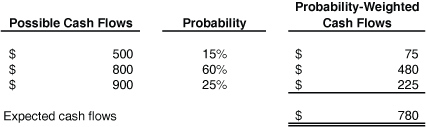 Possible Cash Flows Probability Probability-Weighted Cash Flows $500 15% $75 $800 60% $480 $900 25% $225 Expected cash flows $780
- aUsing Method 1, the expected cash flows are adjusted for systematic (that is, market) risk. In the absence of market data directly indicating the amount of the risk adjustment, such adjustment could be derived from an asset pricing model using the concept of certainty equivalents. For example, the risk adjustment (that is, the cash risk premium of $22) could be determined using the systematic risk premium of 3 percent ($780 - [$780 × (1.05/1.08)]), which results in risk-adjusted expected cash flows of $758 ($780 - $22). The $758 is the certainty equivalent of $780 and is discounted at the risk-free interest rate (5 percent). The present value (that is, the fair value) of the asset is $722 ($758/1.05).
- bUsing Method 2, the expected cash flows are not adjusted for systematic (that is, market) risk. Rather, the adjustment for that risk is included in the discount rate. Thus, the expected cash flows are discounted at an expected rate of return of 8 percent (that is, the 5 percent risk-free interest rate plus the 3 percent systematic risk premium). The present value (that is, the fair value) of the asset is $722 ($780/1.08).
- aReceive-fixed, pay-variable interest rate swap based on the London Interbank Offered Rate (LIBOR) swap rate. A Level 2 input would be the LIBOR swap rate if that rate is observable at commonly quoted intervals for substantially the full term of the swap.
- bReceive-fixed, pay-variable interest rate swap based on a yield curve denominated in a foreign currency. A Level 2 input would be the swap rate based on a yield curve denominated in a foreign currency that is observable at commonly quoted intervals for substantially the full term of the swap. That would be the case if the term of the swap is 10 years and that rate is observable at commonly quoted intervals for 9 years, provided that any reasonable extrapolation of the yield curve for Year 10 would not be significant to the fair value measurement of the swap in its entirety.
- cReceive-fixed, pay-variable interest rate swap based on a specific bank's prime rate. A Level 2 input would be the bank's prime rate derived through extrapolation if the extrapolated values are corroborated by observable market data, for example, by correlation with an interest rate that is observable over substantially the full term of the swap.
- dThree-year option on exchange-traded shares. A Level 2 input would be the implied volatility for the shares derived through extrapolation to Year 3 if both of the following conditions exist:
- 1Prices for one-year and two-year options on the shares are observable.
- 2The extrapolated implied volatility of a three-year option is corroborated by observable market data for substantially the full term of the option.
In that case, the implied volatility could be derived by extrapolating from the implied volatility of the one-year and two-year options on the shares and corroborated by the implied volatility for three-year options on comparable entities' shares, provided that correlation with the one-year and two-year implied volatilities is established. - 1
- eLicensing arrangement. For a licensing arrangement that is acquired in a business combination and was recently negotiated with an unrelated party by the acquired entity (the party to the licensing arrangement), a Level 2 input would be the royalty rate in the contract with the unrelated party at inception of the arrangement.
- fFinished goods inventory at a retail outlet. For finished goods inventory that is acquired in a business combination, a Level 2 input would be either a price to customers in a retail market or a price to retailers in a wholesale market, adjusted for differences between the condition and location of the inventory item and the comparable (that is, similar) inventory items so that the fair value measurement reflects the price that would be received in a transaction to sell the inventory to another retailer that would complete the requisite selling efforts. Conceptually, the fair value measurement will be the same, whether adjustments are made to a retail price (downward) or to a wholesale price (upward). Generally, the price that requires the least amount of subjective adjustments should be used for the fair value measurement.
- gBuilding held and used. A Level 2 input would be the price per square foot for the building (a valuation multiple) derived from observable market data, for example, multiples derived from prices in observed transactions involving comparable (that is, similar) buildings in similar locations.
- hReporting unit. A Level 2 input would be a valuation multiple (for example, a multiple of earnings or revenue or a similar performance measure) derived from observable market data, for example, multiples derived from prices in observed transactions involving comparable (that is, similar) businesses, taking into account operational, market, financial, and nonfinancial factors.
- aLong-dated currency swap. A Level 3 input would be an interest rate in a specified currency that is not observable and cannot be corroborated by observable market data at commonly quoted intervals or otherwise for substantially the full term of the currency swap. The interest rates in a currency swap are the swap rates calculated from the respective countries' yield curves.
- bThree-year option on exchange-traded shares. A Level 3 input would be historical volatility, that is, the volatility for the shares derived from the shares' historical prices. Historical volatility typically does not represent current market participants' expectations about future volatility, even if it is the only information available to price an option.
- cInterest rate swap. A Level 3 input would be an adjustment to a mid-market consensus (nonbinding) price for the swap developed using data that are not directly observable and cannot otherwise be corroborated by observable market data.
- dAsset retirement obligation at initial recognition. A Level 3 input would be a current estimate using the reporting entity's own data about the future cash outflows to be paid to fulfill the obligation (including market participants' expectations about the costs of fulfilling the obligation and the compensation that a market participant would require for taking on the asset retirement obligation) if there is no reasonably available information that indicates that market participants would use different assumptions. That Level 3 input would be used in a present value technique together with other inputs, for example, a current risk-free interest rate or a credit-adjusted risk-free rate if the effect of the reporting entity's credit standing on the fair value of the liability is reflected in the discount rate rather than in the estimate of future cash outflows.
- eReporting unit. A Level 3 input would be a financial forecast (for example, of cash flows or earnings) developed using the reporting entity's own data if there is no reasonably available information that indicates that market participants would use different assumptions.
Illustrations
- a
- b
- c
- aStrategic buyer asset group. The reporting entity determines that strategic buyers have related assets that would enhance the value of the group within which the assets would be used (that is, market participant synergies). Those assets include a substitute asset for Asset C (the billing software), which would be used for only a limited transition period and could not be sold on its own at the end of that period. Because strategic buyers have substitute assets, Asset C would not be used for its full remaining economic life. The indicated fair values of Assets A, B, and C within the strategic buyer asset group (reflecting the synergies resulting from the use of the assets within that group) are $360, $260, and $30, respectively. The indicated fair value of the assets as a group within the strategic buyer asset group is $650.
- bFinancial buyer asset group. The reporting entity determines that financial buyers do not have related or substitute assets that would enhance the value of the group within which the assets would be used. Because financial buyers do not have substitute assets, Asset C (that is, the billing software) would be used for its full remaining economic life. The indicated fair values of Assets A, B, and C within the financial buyer asset group are $300, $200, and $100, respectively. The indicated fair value of the assets as a group within the financial buyer asset group is $600.
- aThe value of the land as currently developed for industrial use (that is, the land would be used in combination with other assets, such as the factory, or with other assets and liabilities)
- bThe value of the land as a vacant site for residential use, taking into account the costs of demolishing the factory and other costs (including the uncertainty about whether the reporting entity would be able to convert the asset to the alternative use) necessary to convert the land to a vacant site (that is, the land is to be used by market participants on a standalone basis).
- aThe highest and best use of the in-process research and development project would be to continue development if market participants would continue to develop the project and that use would maximize the value of the group of assets or of assets and liabilities in which the project would be used (that is, the asset would be used in combination with other assets or with other assets and liabilities). That might be the case if market participants do not have similar technology, either in development or commercialized. The fair value of the project would be measured on the basis of the price that would be received in a current transaction to sell the project, assuming that the in-process research and development would be used with its complementary assets and the associated liabilities and that those assets and liabilities would be available to market participants.
- bThe highest and best use of the in-process research and development project would be to cease development if, for competitive reasons, market participants would lock up the project and that use would maximize the value of the group of assets or of assets and liabilities in which the project would be used. That might be the case if market participants have technology in a more advanced stage of development that would compete with the project if completed and the project would be expected to improve the prospects for their own competing technology if locked up. The fair value of the project would be measured on the basis of the price that would be received in a current transaction to sell the project, assuming that the in-process research and development would be used (that is, locked up) with its complementary assets and the associated liabilities and that those assets and liabilities would be available to market participants.
- cThe highest and best use of the in-process research and development project would be to cease development if market participants would discontinue its development. That might be the case if the project is not expected to provide a market rate of return if completed and would not otherwise provide defensive value if locked up. The fair value of the project would be measured on the basis of the price that would be received in a current transaction to sell the project on its own (which might be zero).
- aAsset B is a contractual right to receive $1,200 in 1 year and has a market price of $1,083. Thus, the implied annual rate of return (that is, a 1-year market rate of return) is 10.8 percent [($1,200/$1,083) - 1].
- bAsset C is a contractual right to receive $700 in 2 years and has a market price of $566. Thus, the implied annual rate of return (that is, a 2-year market rate of return) is 11.2 percent [($700/$566)^0.5 - 1].
- cAll three assets are comparable with respect to risk (that is, dispersion of possible payoffs and credit).
- a
- b
- aThe market approach is applied using quoted prices for similar machines adjusted for differences between the machine (as customized) and the similar machines. The measurement reflects the price that would be received for the machine in its current condition (used) and location (installed and configured for use). The fair value indicated by that approach ranges from $40,000 to $48,000.
- bThe cost approach is applied by estimating the amount that would be required currently to construct a substitute (customized) machine of comparable utility. The estimate takes into account the condition of the machine and the environment in which it operates, including physical wear and tear (that is, physical deterioration), improvements in technology (that is, functional obsolescence), conditions external to the condition of the machine such as a decline in the market demand for similar machines (that is, economic obsolescence), and installation costs. The fair value indicated by that approach ranges from $40,000 to $52,000.
- aThe inputs used in the market approach (quoted prices for similar machines) require fewer and less subjective adjustments than the inputs used in the cost approach.
- bThe range indicated by the market approach overlaps with, but is narrower than, the range indicated by the cost approach.
- cThere are no known unexplained differences (between the machine and the similar machines) within that range.
- aThe cost that a market participant buyer would incur to acquire or construct a substitute machine of comparable utility
- bThe economic benefit that a market participant buyer would derive from the use of the machine.
- aThe income approach is applied using a present value technique. The cash flows used in that technique reflect the income stream expected to result from the software asset (license fees from customers) over its economic life. The fair value indicated by that approach is $15 million.
- bThe cost approach is applied by estimating the amount that currently would be required to construct a substitute software asset of comparable utility (that is, taking into account functional and economic obsolescence). The fair value indicated by that approach is $10 million.
- a
- b
- aThe nature and remaining duration of the restriction
- bThe extent to which buyers are limited by the restriction (for example, there might be a large number of qualifying investors)
- cQualitative and quantitative factors specific to both the instrument and the issuer.
- aDonor restriction on use of land. Because in this situation the donor restriction on the use of the land is specific to the association, the restriction would not be transferred to market participants. Therefore, the fair value of the land would be the higher of its fair value used as a playground (that is, the fair value of the asset would be maximized through its use by market participants in combination with other assets or with other assets and liabilities) and its fair value as a site for residential development (that is, the fair value of the asset would be maximized through its use by market participants on a standalone basis), regardless of the restriction on the use of the land by the association.
- bEasement for utility lines. Because the easement for utility lines is specific to (that is, a characteristic of) the land, it would be transferred to market participants with the land. Therefore, the fair value measurement of the land would take into account the effect of the easement, regardless of whether the highest and best use is as a playground or as a site for residential development.
- a
- b
- aEntity X and Entity Y each enter into a contractual obligation to pay cash ($500) to Entity Z in 5 years.
- bEntity X has a AA credit rating and can borrow at 6 percent, and Entity Y has a BBB credit rating and can borrow at 12 percent.
- c
- d
- aFair value at January 1, 20X7. The expected cash flows used in the expected present value technique are discounted at the risk-free rate using the treasury yield curve at January 1, 20X7, plus the current market observable AA corporate bond spread to treasuries, if nonperformance risk is not already reflected in the cash flows, adjusted (either up or down) for Entity A's specific credit risk (that is, resulting in a credit-adjusted risk-free rate). Therefore, the fair value of Entity A's obligation at initial recognition takes into account nonperformance risk, including that reporting entity's credit risk, which presumably is reflected in the proceeds.
- bFair value at March 31, 20X7. During March 20X7, the credit spread for AA corporate bonds widens, with no changes to the specific credit risk of Entity A. The expected cash flows used in the expected present value technique are discounted at the risk-free rate using the treasury yield curve at March 31, 20X7, plus the current market observable AA corporate bond spread to treasuries if nonperformance risk is not already reflected in the cash flows, adjusted for Entity A's specific credit risk (that is, resulting in a credit-adjusted risk-free rate). Entity A's specific credit risk is unchanged from initial recognition. Therefore, the fair value of Entity A's obligation changes as a result of changes in credit spreads generally. Changes in credit spreads reflect current market participant assumptions about changes in nonperformance risk generally, changes in liquidity risk, and the compensation required for assuming those risks.
- cFair value at June 30, 20X7. As of June 30, 20X7, there have been no changes to the AA corporate bond spreads. However, on the basis of structured note issues corroborated with other qualitative information, Entity A determines that its own specific creditworthiness has strengthened within the AA credit spread. The expected cash flows used in the expected present value technique are discounted at the risk-free rate using the treasury yield curve at June 30, 20X7, plus the current market observable AA corporate bond spread to treasuries (unchanged from March 31, 20X7), if nonperformance risk is not already reflected in the cash flows, adjusted for Entity A's specific credit risk (that is, resulting in a credit-adjusted risk-free rate). Therefore, the fair value of the obligation of Entity A changes as a result of the change in its own specific credit risk within the AA corporate bond spread.
- aLabor costs
- bAllocation of overhead costs
- cThe compensation that a market participant would require for undertaking the activity and for assuming the risk associated with the obligation to dismantle and remove the asset. Such compensation includes both of the following:
- 1Profit on labor and overhead costs
- 2The risk that the actual cash outflows might differ from those expected, excluding inflation.
- 1
- dEffect of inflation on estimated costs and profits
- eTime value of money, represented by the risk-free rate
- fNonperformance risk relating to the risk that Entity A will not fulfill the obligation, including Entity A's own credit risk.
- aLabor costs are developed on the basis of current marketplace wages, adjusted for expectations of future wage increases, required to hire contractors to dismantle and remove offshore oil platforms. Entity A assigns probability assessments to a range of cash flow estimates as follows.
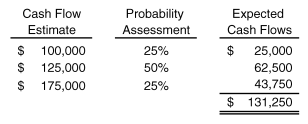 "Cash Flow Estimate" Probability Assessment Expected Cash Flows " $100,000 " 25% " $25,000 " " $125,000 " 50% " 62,500 " " $175,000 " 25% " 43,750 " " $131,250 "
The probability assessments are developed on the basis of Entity A's experience with fulfilling obligations of this type and its knowledge of the market. - bEntity A estimates allocated overhead and equipment operating costs using the rate it applies to labor costs (80 percent of expected labor costs). This is consistent with the cost structure of market participants.
- cEntity A estimates the compensation that a market participant would require for undertaking the activity and for assuming the risk associated with the obligation to dismantle and remove the asset as follows:
- 1A third-party contractor typically adds a markup on labor and allocated internal costs to provide a profit margin on the job. The profit margin used (20 percent) represents Entity A's understanding of the operating profit that contractors in the industry generally earn to dismantle and remove offshore oil platforms. Entity A concludes that this rate is consistent with the rate that a market participant would require as compensation for undertaking the activity.
- 2A contractor would typically require compensation for the risk that the actual cash outflows might differ from those expected because of the uncertainty inherent in locking in today's price for a project that will not occur for 10 years. Entity A estimates the amount of that premium to be 5 percent of the expected cash flows, including the effect of inflation.
- 1
- dEntity A assumes a rate of inflation of 4 percent over the 10-year period on the basis of available market data.
- eThe risk-free rate of interest for a 10-year maturity on January 1, 20X1, is 5 percent. Entity A adjusts that rate by 3.5 percent to reflect its risk of nonperformance (that is, the risk that it will not fulfill the obligation), including its credit risk. Therefore, the discount rate used to compute the present value of the cash flows is 8.5 percent.
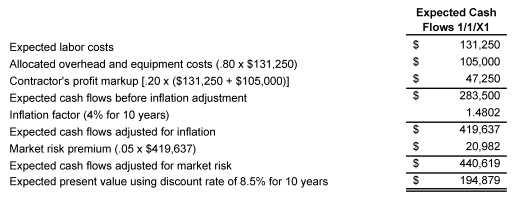 Expected Cash Flows 1/1/X1 Expected labor costs " $131,250 " "Allocated overhead and equipment costs (.80 x $131,250)" " $105,000 " "Contractor's profit markup [.20 x ($131,250 + $105,000)]" " $47,250 " Expected cash flows before inflation adjustment " $283,500 " Inflation factor (4% for 10 years) 1.4802 Expected cash flows adjusted for inflation " $419,637 " "Market risk premium (.05 x $419,637)" " $20,982 " Expected cash flows adjusted for market risk " $440,619 " Expected present value using discount rate of 8.5% for 10 years " $194,879 "
- aThe terms of the debt instrument, including all of the following:
- 1Coupon rate of 10 percent
- 2Principal amount of $2 million
- 3Term of 4 years.
- 1
- bThe market rate of interest of 10.5 percent (which includes a change of 50 basis points in the risk of nonperformance from the date of issue).
- aEntity A invests in a junior AAA-rated tranche of a residential mortgage-backed security on January 1, 20X8 (the issue date of the security).
- bThe junior tranche is the third most senior of a total of seven tranches.
- cThe underlying collateral for the residential mortgage-backed security is unguaranteed nonconforming residential mortgage loans that were issued in the second half of 20X6.
- dAt March 31, 20X9 (the measurement date), the junior tranche is now A-rated. This tranche of the residential mortgage-backed security was previously traded through a brokered market. However, trading volume in that market was infrequent, with only a few transactions taking place per month from January 1, 20X8, to June 30, 20X8, and little, if any, trading activity during the nine months before March 31, 20X9.
- aThe risk-free rate of interest
- bEstimated adjustments for differences between the available market data and the junior tranche of the residential mortgage-backed security in which Entity A has invested. Those adjustments reflect available market data about expected nonperformance and other risks (for example, default risk, collateral value risk, and liquidity risk) that market participants would take into account when pricing the asset in an orderly transaction at the measurement date under current market conditions.
- aThe credit spread for the junior tranche of the residential mortgage-backed security at the issue date as implied by the original transaction price
- bThe change in credit spread implied by any observed transactions from the issue date to the measurement date for comparable residential mortgage-backed securities or on the basis of relevant indices
- cThe characteristics of the junior tranche of the residential mortgage-backed security compared with comparable residential mortgage-backed securities or indices, including all of the following:
- 1The quality of the underlying assets, that is, information about all of the following:
- iDelinquency rates
- iiForeclosure rates
- iiiLoss experience
- ivPrepayment rates.
- i
- 2The seniority or subordination of the residential mortgage-backed security tranche held
- 3Other relevant factors.
- 1
- dRelevant reports issued by analysts and rating agencies
- eQuoted prices from third parties such as brokers or pricing services.
- aBegin with 300 basis points for the relevant risk-free rate of interest at March 31, 20X9.
- bAdd 250 basis points for the credit spread over the risk-free rate when the junior tranche was issued in January 20X8.
- cAdd 700 basis points for the estimated change in the credit spread over the risk-free rate of the junior tranche between January 1, 20X8, and March 31, 20X9. This estimate was developed on the basis of the change in the most comparable index available for that time period.
- dSubtract 50 basis points (net) to adjust for differences between the index used to estimate the change in credit spreads and the junior tranche. The referenced index consists of subprime mortgage loans, whereas Entity A's residential mortgage-backed security consists of similar mortgage loans with a more favorable credit profile (making it more attractive to market participants). However, the index does not reflect an appropriate liquidity risk premium for the junior tranche under current market conditions. Thus, the 50 basis point adjustment is the net of two adjustments.
- 1The first adjustment is a 350 basis point subtraction, which was estimated by comparing the implied yield from the most recent transactions for the residential mortgage-backed security in June 20X8 with the implied yield in the index price on those same dates. There was no information available that indicated that the relationship between Entity A's security and the index has changed.
- 2The second adjustment is a 300 basis point addition, which is Entity A's best estimate of the additional liquidity risk inherent in its security (a cash position) when compared with the index (a synthetic position). This estimate was derived after taking into account liquidity risk premiums implied in recent cash transactions for a range of similar securities.
- 1
- aEntity A concluded that its own estimate appropriately incorporated the risks (for example, default risk, collateral value risk, and liquidity risk) that market participants would use when pricing the asset in an orderly transaction under current market conditions.
- bThe broker quotes were nonbinding and did not reflect the results of transactions, and Entity A was unable to evaluate the valuation technique(s) or inputs used to develop the quotes.
- aAssets measured at fair value (Case A)
- bReconciliation of fair value measurements categorized within Level 3 of the fair value hierarchy (Case B)
- cInformation about fair value measurements categorized within Level 3 of the fair value hierarchy (Case C)
- dFair value measurements of investments that are measured at net asset value per share (or its equivalent) as a practical expedient (Case D).
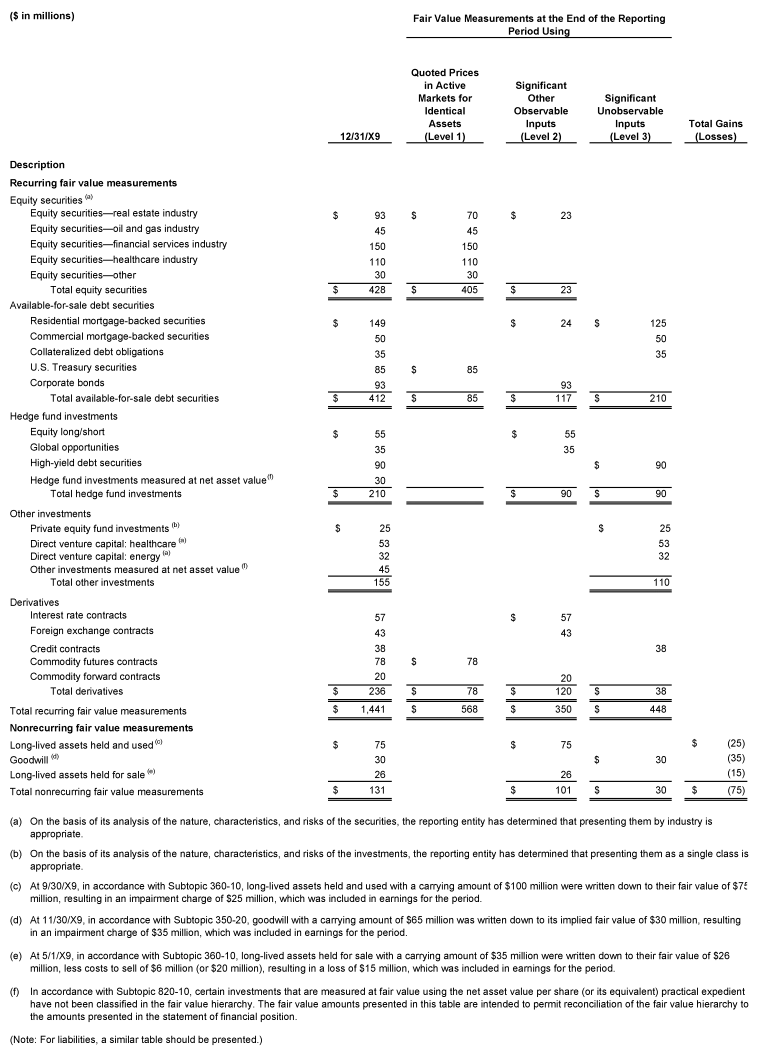 ($ in millions) Fair Value Measurements at the End of the Reporting Period Using 12/31/X9 "Quoted Prices in Active Markets for Identical Assets (Level 1)" "Significant Other Observable Inputs (Level 2)" "Significant Unobservable Inputs (Level 3)" Total Gains (Losses) Description Recurring fair value measurements Equity securities (a) Equity securities—real estate industry $93 $70 $23 Equity securities—oil and gas industry 45 45 Equity securities—financial services industry 150 150 Equity securities—healthcare industry 110 110 Equity securities—other 30 30 Total equity securities $428 $405 $23 Available-for-sale debt securities Residential mortgage-backed securities $149 $24 $125 Commercial mortgage-backed securities 50 50 Collateralized debt obligations 35 35 U.S. Treasury securities 85 $85 Corporate bonds 93 93 Total available-for-sale debt securities $412 $85 $117 $210 Hedge fund investments Equity long/short $55 $ 55 Global opportunities 35 35 High-yield debt securities 90 $90 Hedge fund investments measured at net asset value (f) 30 Total hedge fund investments $210 $90 $90 Other investments Private equity fund investments (b) $ 25 $25 Direct venture capital: healthcare (a) 53 53 Direct venture capital: energy (a) 32 32 Other investments measured at net asset value (f) 45 Total other investments 155 110 Derivatives Interest rate contracts 57 $57 Foreign exchange contracts 43 43 Credit contracts 38 38 Commodity futures contracts 78 $78 Commodity forward contracts 20 20 Total derivatives $236 $78 $120 $38 Total recurring fair value measurements " $1,441 " $568 $350 $448 Nonrecurring fair value measurements Long-lived assets held and used (c) $75 $75 $(25) Goodwill (d) 30 $30 (35) Long-lived assets held for sale (e) 26 26 (15) Total nonrecurring fair value measurements $131 $101 $30 $(75) (a) "On the basis of its analysis of the nature, characteristics, and risks of the securities, the reporting entity has determined that presenting them by industry is appropriate." (b) "On the basis of its analysis of the nature, characteristics, and risks of the investments, the reporting entity has determined that presenting them as a single class is appropriate." (c) "In accordance with Subtopic 360-10, long-lived assets held and used with a carrying amount of $100 million were written down to their fair value of $75 million, resulting in an impairment charge of $25 million, which was included in earnings for the period." (d) "In accordance with Subtopic 350-20, goodwill with a carrying amount of $65 million was written down to its implied fair value of $30 million, resulting in an impairment charge of $35 million, which was included in earnings for the period." (e) "In accordance with Subtopic 360-10, long-lived assets held for sale with a carrying amount of $35 million were written down to their fair value of $26 million, less costs to sell of $6 million (or $20 million), resulting in a loss of $15 million, which was included in earnings for the period." "(Note: For liabilities, a similar table should be presented.)"
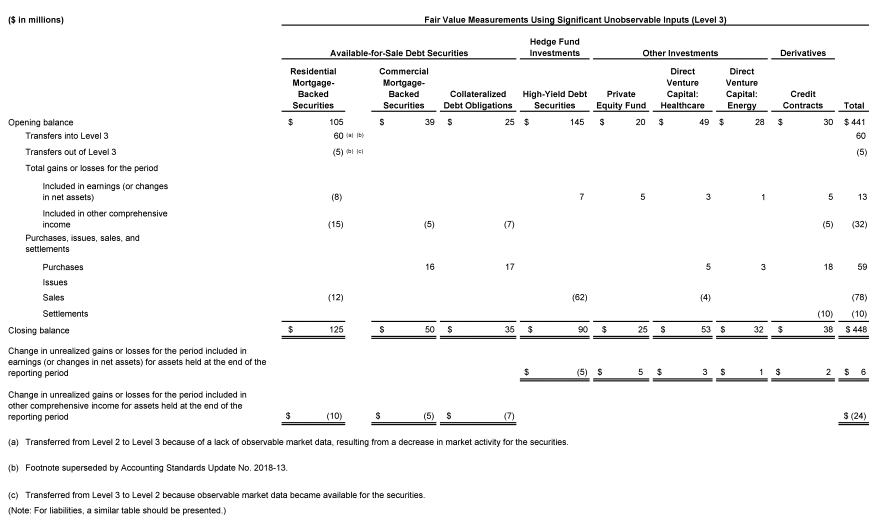 ($ in 000s) Assets Measured on a Recurring Basis Using Significant Unobservable Inputs (Level 3) ($ in millions) Fair Value Measurements Using Significant Unobservable Inputs (Level 3) Available-for-Sale Debt Securities Hedge Fund Investments Other Investments Derivatives Residential Mortgage-Backed Securities Commercial Mortgage-Backed Securities Collateralized Debt Obligations High-Yield Debt Securities Private Equity Fund Direct Venture Capital: Healthcare Direct Venture Capital: Energy " Credit Contracts" Total Opening balance $105 $39 $25 $145 $20 $49 $ 28 $30 $441 Transfers into Level 3 60 (a) (b) 60 Transfers out of Level 3 (5) (b) (c) (5) Total gains or losses for the period "Included in earnings (or changes in net assets)" (8) 7 5 3 1 5 13 "Included in other comprehensive income " (15) (5) (7) (5) (32) "Purchases, issues, sales, and settlements" Purchases 16 17 5 3 18 59 Issues Sales (12) (62) (4) (78) Settlements (10) (10) Closing balance $125 $50 $35 $90 $25 $53 $32 $38 $448 Change in unrealized gains or losses for the period included in earnings (or changes in net assets) for assets held at the end of the reporting period $(5) $5 $3 $1 $2 $6 Change in unrealized gains or losses for the period included in other comprehensive income for assets held at the end of the reporting period $(10) $(5) $(7) $(24) (a) "Transferred from Level 2 to Level 3 because of a lack of observable market data, resulting from a decrease in market activity for the securities." (b) Footnote superseded by Accounting Standards Update No. 2018-13. (c) Transferred from Level 3 to Level 2 because observable market data became available for the securities. "(Note: For liabilities, a similar table should be presented.)"
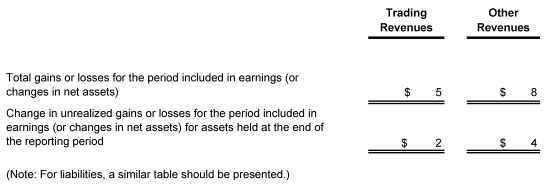 Trading Revenues Other Revenues Total gains or losses for the period included in earnings (or changes in net assets) $ 5 $ 8 Change in unrealized gains or losses for the period included in earnings (or changes in net assets) for assets held at the end of the reporting period $ 2 $ 4 "(Note: For liabilities, a similar table should be presented.)"
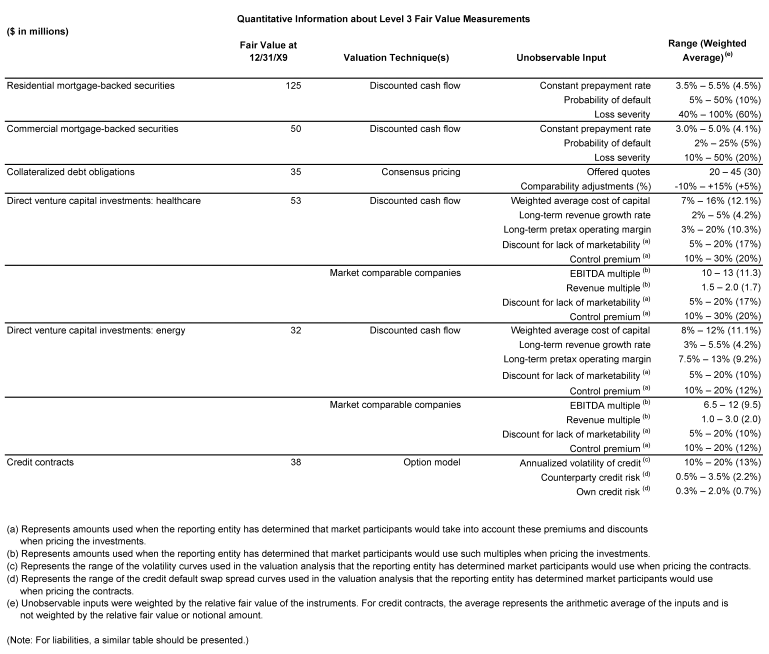 Quantitative Information about Level 3 Fair Value Measurements ($ in millions) Fair Value at 12/31/X9 Valuation Technique(s) Unobservable Input Range (Weighted Average) (e) Residential mortgage-backed securities 125 Discounted cash flow Constant prepayment rate 3.5% - 5.5% (4.5%) Probability of default 5% - 50% (10%) Loss severity 40% - 100% (60%) Commercial mortgage-backed securities 50 Discounted cash flow Constant prepayment rate 3.0% - 5.0% (4.1%) Probability of default 2% - 25% (5%) Loss severity 10% - 50% (20%) Collateralized debt obligations 35 Consensus pricing Offered quotes 20 - 45 (30) Comparability adjustments (%) -10% - +15% (+5%) Direct venture capital investments: healthcare 53 Discounted cash flow Weighted average cost of capital 7% - 16% (12.1%) Long-term revenue growth rate 2% - 5% (4.2%) Long-term pretax operating margin 3% - 20% (10.3%) Discount for lack of marketability (a) 5% - 20% (17%) Control premium (a) 10% - 30% (20%) Market comparable companies EBITDA multiple (b) 10 - 13 (11.3) Revenue multiple (b) 1.5 - 2.0 (1.7) Discount for lack of marketability (a) 5% - 20% (17%) Control premium (a) 10% - 30% (20%) Direct venture capital investments: energy 32 Discounted cash flow Weighted average cost of capital 8% - 12% (11.1%) Long-term revenue growth rate 3% - 5.5% (4.2%) Long-term pretax operating margin 7.5% - 13% (9.2%) Discount for lack of marketability (a) 5% - 20% (10%) Control premium (a) 10% - 20% (12%) Market comparable companies EBITDA multiple (b) 6.5 - 12 (9.5) Revenue multiple (b) 1.0 - 3.0 (2.0) Discount for lack of marketability (a) 5% - 20% (10%) Control premium (a) 10% - 20% (12%) Credit contracts 38 Option model Annualized volatility of credit (c) 10% - 20% (13%) Counterparty credit risk (d) 0.5% - 3.5% (2.2%) Own credit risk (d) 0.3% - 2.0% (0.7%) (a) Represents amounts used when the reporting entity has determined that market participants would take into account these premiums and discounts when pricing the investments. (b) Represents amounts used when the reporting entity has determined that market participants would use such multiples when pricing the investments. (c) Represents the range of the volatility curves used in the valuation analysis that the reporting entity has determined market participants would use when pricing the contracts. (d) Represents the range of the credit default swap spread curves used in the valuation analysis that the reporting entity has determined market participants would use when pricing the contracts. "(e) Unobservable inputs were weighted by the relative fair value of the instruments. For credit contracts, the average represents the arithmetic average of the inputs and is " not weighted by the relative fair value or notional amount. "(Note: For liabilities, a similar table should be presented.)"
- aThe nature of the item being measured at fair value, including the characteristics of the item being measured that are taken into account in the determination of relevant inputs. For example, for residential mortgage-backed securities, a reporting entity might disclose the following:
- 1The types of underlying loans (for example, prime loans or subprime loans)
- 2Collateral
- 3Guarantees or other credit enhancements
- 4Seniority level of the tranches of securities
- 5The year of issue
- 6The weighted-average coupon rate of the underlying loans and the securities
- 7The weighted-average maturity of the underlying loans and the securities
- 8The geographical concentration of the underlying loans
- 9Information about the credit ratings of the securities.
- 1
- bHow third-party information such as broker quotes, pricing services, net asset values, and relevant market data was taken into account when measuring fair value.
- The significant unobservable inputs used in the fair value measurement of the reporting entity's residential mortgage-backed securities are prepayment rates, probability of default, and loss severity in the event of default. Significant increases (decreases) in any of those inputs in isolation would have resulted in a significantly lower (higher) fair value measurement. Generally, a change in the assumption used for the probability of default would have been accompanied by a directionally similar change in the assumption used for the loss severity and a directionally opposite change in the assumption used for prepayment rates.
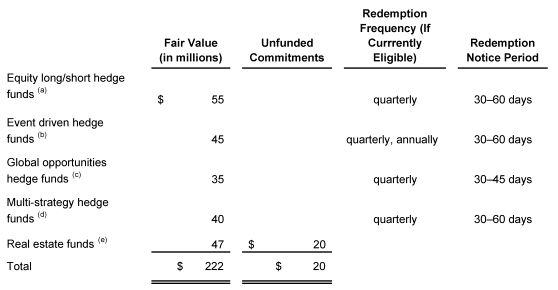 "Fair Value (in millions)" "Unfunded Commitments " Redemption Frequency (If Currrently Eligible) Redemption Notice Period Equity long/short hedge funds (a) $55 quarterly 30-60 days "Event driven hedge funds (b)" 45 "quarterly, annually" 30-60 days "Global opportunities hedge funds (c) " 35 quarterly 30-45 days "Multi-strategy hedge funds (d)" 40 quarterly 30-60 days Real estate funds (e) 47 $20 Total $ 222 $ 20
- aThis class includes investments in hedge funds that invest both long and short primarily in U.S. common stocks. Management of the hedge funds has the ability to shift investments from value to growth strategies, from small to large capitalization stocks, and from a net long position to a net short position. The fair values of the investments in this class have been estimated using the net asset value per share of the investments. Investments representing approximately 22 percent of the value of the investments in this class cannot be redeemed because the investments include restrictions that do not allow for redemption in the first 12 to 18 months after acquisition. The remaining restriction period for these investments ranged from three to seven months at December 31, 20X3.
- bThis class includes investments in hedge funds that invest in approximately 60 percent equities and 40 percent bonds to profit from economic, political, and government driven events. A majority of the investments are targeted at economic policy decisions. The fair values of the investments in this class have been estimated using the net asset value per share of the investments.
- cThis class includes investments in hedge funds that hold approximately 80 percent of the funds' investments in non-U.S. common stocks in the healthcare, energy, information technology, utilities, and telecommunications sectors and approximately 20 percent of the funds' investments in diversified currencies. The fair values of the investments in this class have been estimated using the net asset value per share of the investments. For one investment, valued at $8.75 million, a gate has been imposed by the hedge fund manager and no redemptions are currently permitted. This redemption restriction has been in place for six months and the time at which the redemption restriction might lapse is unknown.
- dThis class invests in hedge funds that pursue multiple strategies to diversify risks and reduce volatility. The hedge funds' composite portfolio for this class includes investments in approximately 50 percent U.S. common stocks, 30 percent global real estate projects, and 20 percent arbitrage investments. The fair values of the investments in this class have been estimated using the net asset value per share of the investments. Investments representing approximately 15 percent of the value of the investments in this class cannot be redeemed because the investments include restrictions that do not allow for redemption in the first year after acquisition. The remaining restriction period for these investments ranged from four to six months at December 31, 20X3.
- eThis class includes several real estate funds that invest primarily in U.S. commercial real estate. The fair values of the investments in this class have been estimated using the net asset value of the Company's ownership interest in partners' capital. These investments can never be redeemed with the funds. Distributions from each fund will be received as the underlying investments of the funds are liquidated. Twenty percent of the total investment in this class is planned to be sold within the next three years. However, the individual investments that will be sold have not yet been determined. Because it is not probable that any individual investment will be sold, the fair value of each individual investment has been estimated using the net asset value of the Company's ownership interest in partners' capital. Once it has been determined which investments will be sold and whether those investments will be sold individually or in a group, the investments will be sold in an auction process. The investee fund's management must approve of the buyer before the sale of the investments can be completed.
- f
820-10-60Relationships
Source downloaded: .Record version 1cd8c31b1d8f. Effective date must be checked in the source.
Financial Instruments
820-10-65Transition and Open Effective Date Information
Source downloaded: .Record version 00dc412cbec2. Effective date must be checked in the source.
Transition Related to Accounting Standards Update No. 2026-03, <em class="ph i">Fair Value Measurement (Topic 820): Investment Companies with Equity Securities Subject to Contractual Sale Restrictions</em>
- aFor investment companies within the scope of Topic 946, the pending content that links to this paragraph shall be effective for annual reporting periods beginning after December 15, 2027, and interim reporting periods within those annual reporting periods.
- bEarly adoption of the pending content that links to this paragraph is permitted on any date on or after September 9, 2026. That is, the date of adoption shall not precede September 9, 2026. An investment company within the scope of Topic 946 that adopts the pending content that links to this paragraph shall apply it prospectively in accordance with (c) beginning on the date of adoption.
- cAn investment company within the scope of Topic 946 shall apply the pending content that links to this paragraph on a prospective basis to all equity securities. Any adjustment as a result of applying the pending content that links to this paragraph shall be recognized as an adjustment to current-period earnings on the date at which the investment company first applies the pending content.
- dAn investment company within the scope of Topic 946 that adopts the pending content that links to this paragraph in accordance with (c) shall disclose the amount recognized as an adjustment to earnings in the period in which the entity first applies the pending content.
Related subtopics
- 825-10 OverallFinancial Instruments
- 410-20 Asset Retirement ObligationsAsset Retirement and Environmental Obligations
- 815-40 Contracts in Entity's Own EquityDerivatives and Hedging
- 480-10 OverallDistinguishing Liabilities from Equity
- 321-10 OverallInvestments—Equity Securities
- 820-940 Financial Services—Brokers and DealersFair Value Measurement