ASC 320-10
Overall
320 Investments—Debt Securities
Source downloaded: .Record version ee5280ec1ccc. Effective date must be checked in the source.
ASC 320-10 governs the accounting and reporting for all investments in debt securities (post-ASU 2016-01, equity securities moved to Topic 321). At acquisition an entity must classify each debt security as trading, available-for-sale, or held-to-maturity (320-10-25-1) and document that classification (320-10-25-2); trading and AFS securities are carried at fair value (unrealized gains/losses in earnings and OCI, respectively) while HTM securities are carried at amortized cost (320-10-35-1). The Subtopic's core tension is the restrictive "positive intent and ability to hold to maturity" standard, the narrow list of sales/transfers that do not "taint" the HTM portfolio, and the required category disclosures.
Key points (7)
- At acquisition, debt securities must be classified as trading, available-for-sale, or held-to-maturity, with AFS as the residual category, and the classification must be documented (320-10-25-1; 320-10-25-2).
- HTM classification requires positive intent and ability to hold to maturity, which is distinct from the mere absence of an intent to sell; securities available to be sold for liquidity, rate changes, tax planning, or asset-liability management, convertible debt, and securities that can be prepaid so the holder would not recover substantially all of its recorded investment cannot be HTM (320-10-25-3 through 25-5).
- Subsequent measurement: trading at fair value with unrealized holding gains and losses in earnings; AFS at fair value with unrealized holding gains and losses in other comprehensive income (except hedged portions under Topic 815); HTM at amortized cost; interest and premium/discount amortization go to earnings for all three (320-10-35-1; 320-10-35-4).
- A sale or transfer of an HTM security for a reason other than those in 320-10-25-6, 25-9, and 25-14 taints the entire HTM portfolio and requires reclassification of remaining HTM securities to available-for-sale in the period of the sale (320-10-35-8 through 35-9).
- Non-tainting events include significant deterioration in issuer creditworthiness, certain tax-law and regulatory changes, a major business combination or disposition, and isolated, nonrecurring, unusual events that could not have been reasonably anticipated; sales near maturity or after collecting at least 85 percent of principal outstanding at acquisition are treated as maturities (320-10-25-6; 320-10-25-9; 320-10-25-14 through 25-15).
- Transfers between categories are recorded at fair value, with specified treatment of unrealized gains/losses and reversal of any existing allowance for credit losses in earnings on HTM-to-AFS and AFS-to-HTM transfers (320-10-35-10; 320-10-35-10A; 320-10-35-10B; 320-10-45-8B).
- Disclosures by major security type (based on nature and risks) include amortized cost basis, aggregate fair value, total allowance for credit losses, gross unrealized gains and losses, and contractual maturity groupings, plus proceeds and gross realized gains/losses from AFS sales and the circumstances of any HTM sale or transfer (320-10-50-1B; 50-2; 50-5; 50-5A; 50-9; 50-10).
For students. Exams love the HTM "tainting" rules: students often assume any sale before maturity destroys HTM classification, but sales due to the enumerated changes in circumstances, isolated/nonrecurring/unusual events, or sales near maturity or after 85% of principal has been collected are permitted. Also remember that after ASU 2016-01 this Topic covers only debt securities (equity securities are in Topic 321) and credit impairment is now handled in Subtopic 326-20/326-30, not here.
Machine-generated study aid for ASC 320-10. Check the source paragraphs below.
320-10-00Status
Source downloaded: .Record version 6d24ea81ab54. Effective date must be checked in the source.
320-10-05Overview and Background
Source downloaded: .Record version 89795b7ce3bc. Effective date must be checked in the source.
320-10-15Scope and Scope Exceptions
Source downloaded: .Record version dcc475d581c5. Effective date must be checked in the source.
Overall Guidance
Entities
- aCooperatives and mutual entities (such as credit unions and mutual insurance entities)
- bTrusts that do not report substantially all of their debt securities at fair value.
- aEntities in certain specialized industries. Entities whose specialized accounting practices include accounting for substantially all investments in debt securities at fair value, with changes in value recognized in earnings (income) or in the change in net assets. Examples of those entities are:
Instruments
- a
- b
- aDerivative instruments that are subject to the requirements of Topic 815, including those that have been separated from a host contract as required by Section 815-15-25. If an investment would otherwise be in the scope of this Topic and it has within it an embedded derivative that is required by that Section to be separated, the host instrument (as described in that Section) remains within the scope of this Topic.
- b
- c
- dInvestments in consolidated subsidiaries.
Other Considerations
320-10-20Glossary
Source downloaded: .Record version bf80daccfc71. Effective date must be checked in the source.
320-10-25Recognition
Source downloaded: .Record version 5bea14e5ee65. Effective date must be checked in the source.
Classification of Debt Securities
- a Trading securities. If a security is acquired with the intent of selling it within hours or days, the security shall be classified as trading. However, at acquisition an entity is not precluded from classifying as trading a security it plans to hold for a longer period. Classification of a security as trading shall not be precluded simply because the entity does not intend to sell it in the near term.
- b Available-for-sale securities. Investments in debt securities not classified as trading securities or as held-to-maturity securities shall be classified as available-for-sale securities.
- c Held-to-maturity securities. Investments in debt securities shall be classified as held-to-maturity only if the reporting entity has the positive intent and ability to hold those securities to maturity.
Restrictions on Classification of a Debt Security as Held-to-Maturity
- a Changes in market interest rates and related changes in the security's prepayment risk
- b Needs for liquidity (for example, due to the withdrawal of deposits, increased demand for loans, surrender of insurance policies, or payment of insurance claims)
- c Changes in the availability of and the yield on alternative investments
- d Changes in funding sources and terms
- e Changes in foreign currency risk.
- aA security shall not be classified as held-to-maturity if that security can contractually be prepaid or otherwise settled in such a way that the holder of the security would not recover substantially all of its recorded investment. The justification for using historical-cost-based measurement for debt securities classified as held-to-maturity is that no matter how market interest rates fluctuate, the holder will recover its recorded investment and thus realize no gains or losses when the issuer pays the amount promised at maturity. However, that justification does not extend to receivables purchased at a substantial premium over the amount at which they can be prepaid, and it does not apply to instruments whose payments derive from prepayable receivables but have no principal balance. Therefore, a callable debt security purchased at a significant premium might be precluded from held-to-maturity classification under paragraph 860-20-35-2 if it can be prepaid or otherwise settled in such a way that the holder of the security would not recover substantially all of its recorded investment. In addition, a mortgage-backed interest-only certificate shall not be classified as held-to-maturity. Paragraphs provide further guidance on application of this paragraph. Note that a debt security that is purchased late enough in its life such that, even if it was prepaid, the holder would recover substantially all of its recorded investment, could be initially classified as held-to-maturity if the conditions of this paragraph and paragraph 320-10-25-1 are met. (A debt security that can contractually be prepaid or otherwise settled in such a way that the holder of the security would not recover substantially all of its recorded investment may contain an embedded derivative. Therefore, such a security should be evaluated in accordance with Subtopic 815-15 to determine whether it contains an embedded derivative that needs to be accounted for separately.)
- bA debt security that is available to be sold in response to changes in market interest rates, changes in the security's prepayment risk, the entity's need for liquidity, changes in foreign exchange risk, or other similar factors shall not be included in the held-to-maturity category because the possibility of a sale is indicative that the entity does not have a positive intent and ability to hold the security to maturity. A debt security that is considered available to be sold as part of an entity's asset-liability management activities shall not be classified as held-to-maturity. Similarly, an entity that maintains a dynamic hedging program in which changes in external factors require that certain securities be sold to maintain an effective hedge would not have the intent and ability to hold those securities to maturity.
- cSecurities that may need to be sold to implement tax-planning strategies (for example, to generate taxable gains to offset existing taxable losses—or vice versa—or in response to changes in the entity's anticipated future profitability—for example, if taxable losses were expected for the next several years) should be classified as available-for-sale, not held-to-maturity.
- dThe sale of a held-to-maturity security in advance of any deterioration in the creditworthiness of the issuer, perhaps based solely on industry statistics, will call into question an investor's stated intent to hold other debt securities to maturity in the future. The sale of a held-to-maturity security must be in response to an actual deterioration, not mere speculation. That deterioration shall be supported by evidence about the issuer's creditworthiness; however, the entity need not await an actual downgrading in the issuer's published credit rating or inclusion on a credit watch list.
- eThe sale of held-to-maturity securities to meet regulatory capital requirements will call into question an investor's stated intent to hold other debt securities to maturity in the future. An entity's ability and intent to hold securities to maturity would be called into question by the sale of held-to-maturity securities to realize gains to replenish regulatory capital that had been reduced by a provision for loan losses. Gains trading with held-to-maturity securities to meet an entity's capital requirements is inconsistent with the held-to-maturity notion.
- fThe exercise of a put option on a security classified as held-to-maturity will call into question an investor's stated intent to hold other debt securities to maturity in the future. Furthermore, a puttable debt security might be precluded from held-to-maturity classification pursuant to paragraph 860-20-35-2.
- gConvertible debt securities shall not be classified as held-to-maturity. Classifying a security as held-to-maturity means that the entity is indifferent to future opportunities to profit from changes in the security's fair value and intends to accept the debt security's stipulated contractual cash flows, including the repayment of principal at maturity. Convertible debt securities generally bear a lower interest rate because the investor hopes to benefit from appreciation in value of the option embedded in the debt security. Given the unique opportunities for profit embedded in a convertible security, it generally would be contradictory to assert the positive intent and ability to hold a convertible debt security to maturity and forego the opportunity to exercise the conversion feature. The exercise of a conversion feature on a security classified as held-to-maturity will call into question an investor's stated intent to hold other debt securities to maturity in the future. (See Section 815-15-25 for additional guidance. If convertible debt is bifurcated into an equity option and a host debt instrument under the requirements of Subtopic 815-15, it generally still would be contradictory to assert the positive intent and ability to hold the debt host contract to maturity and forego the opportunity to exercise the conversion feature.)
- hA documented policy to initially classify all debt securities as held-to-maturity but then automatically transfer every security to available-for-sale when it reaches a predetermined point before maturity (for example, every held-to-maturity security will be transferred to available-for-sale 24 months prior to its stated maturity) so that an entity has the flexibility to sell securities is not consistent with the held-to-maturity classification. Under the policy described, the entity does not intend to hold any security to maturity.
- iAn insurance entity or other regulated entity shall not classify securities as held-to-maturity and also indicate to regulators that those securities could be sold to meet liquidity needs in a defined interest rate scenario whose likelihood of occurrence is reasonably possible but not probable.
- a Evidence of a significant deterioration in the issuer's creditworthiness (for example, a downgrading of an issuer's published credit rating)
- b A change in tax law that eliminates or reduces the tax-exempt status of interest on the debt security (but not a change in tax law that revises the marginal tax rates applicable to interest income)
- c A major business combination or major disposition (such as sale of a component of an entity) that necessitates the sale or transfer of held-to-maturity securities to maintain the entity's existing interest rate risk position or credit risk policy
- d A change in statutory or regulatory requirements significantly modifying either what constitutes a permissible investment or the maximum level of investments in certain kinds of securities, thereby causing an entity to dispose of a held-to-maturity security
- e A significant increase by the regulator in the industry's capital requirements that causes the entity to downsize by selling held-to-maturity securities
- f A significant increase in the risk weights of debt securities used for regulatory risk-based capital purposes.
- aThe event is isolated.
- bThe event is nonrecurring.
- cThe event is unusual for the reporting entity.
- dThe event could not have been reasonably anticipated.
- aSales of held-to-maturity securities only when the combination or disposition necessitates the sale or transfer of held-to-maturity securities to maintain the entity's existing interest rate risk position or credit risk policy. Necessary transfers or sales shall occur concurrent with or shortly after the business combination or disposition. This Subtopic does not define shortly. As time passes, however, it is increasingly difficult to demonstrate that the business combination, and not other events or circumstances, necessitated the transfer or sale of held-to-maturity securities.
- bA sale of a component of an entity is an example of a major disposition.
- aA purchase or sale of a large pool of financial assets (for example, conforming mortgages) or liabilities (for example, deposit liabilities) (which would not be considered a major business combination or disposition)
- bSales of held-to-maturity securities to fund an acquisition (or a disposition, for example, if deposit liabilities are being assumed by the other party)
- cSales of held-to-maturity securities in anticipation of or otherwise before a major business combination or disposition
- dA sale of held-to-maturity securities in response to an unsolicited tender offer from the issuer (which also is not an event that is isolated, nonrecurring, and unusual that could not have been reasonably anticipated).
- a The sale of a security occurs near enough to its maturity date (or call date if exercise of the call is probable) that interest rate risk is substantially eliminated as a pricing factor. That is, the date of sale is so near the maturity or call date (for example, within three months) that changes in market interest rates would not have a significant effect on the security's fair value.
- b The sale of a security occurs after the entity has already collected a substantial portion (at least 85 percent) of the principal outstanding at acquisition due either to prepayments on the debt security or to scheduled payments on a debt security payable in equal installments (both principal and interest) over its term. For variable-rate securities, the scheduled payments need not be equal.
- a Debt securities that are payable in equal installments that comprise both principal and interest, such as certain level-payment mortgage-backed securities. For example, many banks routinely sell their investments in mortgage-backed securities after a substantial portion of the principal has been recovered through prepayments. The tail portion of a mortgage-backed security is sold because it no longer represents an efficient investment to the entity mainly due to the economic costs of accounting for remnants of the original issue.
- b Variable-rate debt securities when the scheduled payments would be payable in equal installments absent a change in interest rates.
- aAlthough its asset-liability management may encompass consideration of the maturity and repricing characteristics of all investments in debt securities, an entity may decide that it can accomplish the necessary adjustments under its asset-liability management without having all of its debt securities available for disposition. In that case, the entity may choose to designate certain debt securities as unavailable to be sold to accomplish those ongoing adjustments deemed necessary under its asset-liability management, thereby enabling those debt securities to be accounted for at amortized cost on the basis of a positive intent and ability to hold them to maturity.
- bThe sale of one or more held-to-maturity securities if an entity chooses to downsize to comply with a significant increase in the industry's capital requirements would not call into question the classification of other held-to-maturity securities.
- cIn some circumstances it may not be possible to hold a security to its original stated maturity, such as when the security is called by the issuer before maturity. The issuer's exercise of the call option effectively accelerates the security's maturity and shall not be viewed as inconsistent with classification in the held-to-maturity category.
- dA puttable debt security shall be classified as held-to-maturity only if the entity has the positive intent and ability to hold it to maturity.
- eIf a transfer of a held-to-maturity debt security is accounted for as a sale under Subtopic 860-20 and it is transferred for a reason other than those specified in paragraphs 320-10-25-6, 320-10-25-9, and 320-10-25-14, then the transfer would taint the held-to-maturity portfolio. However, if the transfer is accounted for as a secured borrowing, then the transfer would not taint the held-to-maturity portfolio. Transactions involving held-to-maturity securities that are not accounted for as sales under Subtopic 860-20 would not contradict an entity's stated intent to hold a security to maturity and, therefore, do not call into question the entity's intent to hold other debt securities to maturity. Examples of such transactions are as follows:
- 1Held-to-maturity securities pledged as collateral, provided that the transaction is not accounted for as a sale under Subtopic 860-20 and the entity intends and expects to be able to satisfy the obligation and recover access to its collateral
- 2Held-to-maturity securities subject to a repurchase agreement or a securities lending agreement, provided that the transaction is accounted for as a secured borrowing under Subtopic 860-20 and the entity intends and expects to be able to repay the borrowing
- 3Beneficial interests classified as held-to-maturity that are desecuritized in a transaction that is not accounted for as a sale if the financial assets received in or that continue to be held after the desecuritization are held to maturity. Unless the debt instrument received or retained as a result of the transaction is held to maturity, the transaction would call into question the entity's intent to hold other debt securities to maturity. Desecuritizations are not specifically included within the scope of this paragraph. Nevertheless, that guidance is also appropriate for desecuritizations that are not accounted for as sales.
- 1
Combinations of Structured Notes
320-10-30Initial Measurement
Source downloaded: .Record version 27d862ad46ed. Effective date must be checked in the source.
320-10-35Subsequent Measurement
Source downloaded: .Record version 2420452aa1fa. Effective date must be checked in the source.
- aTrading securities. Investments in debt securities that are classified as trading shall be measured subsequently at fair value in the statement of financial position. Unrealized holding gains and losses for trading securities shall be included in earnings.
- bAvailable-for-sale securities. Investments in debt securities that are classified as available for sale shall be measured subsequently at fair value in the statement of financial position. Unrealized holding gains and losses for available-for-sale securities (including those classified as current assets) shall be excluded from earnings and reported in other comprehensive income until realized except as indicated in the following sentences.All or a portion of the unrealized holding gain and loss of an available-for-sale security that is designated as being hedged in a fair value hedge that is not a portfolio layer method hedge shall be recognized in earnings during the period of the hedge, pursuant to paragraphs 815-25-35-1(b), 815-25-35-4, and 815-25-35-6. The portion of the unrealized holding gain and loss of a closed portfolio that includes an available-for-sale security or securities that is designated as being hedged in a portfolio layer method hedge pursuant to paragraph 815-20-25-12A shall be recognized in earnings during the period of the hedge pursuant to paragraphs 815-25-35-1(c), 815-25-35-4, and 815-25-35-6.
- cHeld-to-maturity securities. Investments in debt securities classified as held to maturity shall be measured subsequently at amortized cost in the statement of financial position. A transaction gain or loss on a held-to-maturity foreign-currency-denominated debt security shall be accounted for pursuant to Subtopic 830-20.
Reassessment of Classification
- aFor a security transferred from the trading category, the unrealized holding gain or loss at the date of the transfer will have already been recognized in earnings and shall not be reversed.
- bFor a security transferred into the trading category, the portion of the unrealized holding gain or loss at the date of the transfer that has not been previously recognized in earnings shall be recognized in earnings immediately.
- c
- d
- aReverse in earnings any allowance for credit losses previously recorded on the held-to-maturity debt security at the transfer date
- bReclassify and transfer the debt security to the available-for-sale category at its amortized cost basis (which is reduced by any previous writeoffs but excludes any allowance for credit losses)
- cDetermine if an allowance for credit losses is necessary by following the guidance in Subtopic 326-30
- dReport in other comprehensive income any unrealized gain or loss on the available-for-sale debt security at the date of transfer, excluding the amount recorded in the allowance for credit losses in accordance with paragraph (c)
- eConsider whether the transfer of a debt security from the held-to-maturity category to the available-for-sale category calls into question the entity's intent and ability to hold securities that remain in the held-to-maturity category to maturity in accordance with paragraphs .
- aReverse in earnings any allowance for credit losses previously recorded on the available-for-sale debt security at the transfer date
- bReclassify and transfer the debt security to the held-to-maturity category at its amortized cost basis (which is reduced by any previous writeoffs but excludes any allowance for credit losses) plus or minus the amount of any remaining unrealized holding gain or loss reported in accumulated other comprehensive income
- cEvaluate the debt security for an allowance for credit losses by following the guidance in Subtopic 326-20
- dContinue to report the unrealized holding gain or loss at the date of the transfer in a separate component of shareholders' equity, such as accumulated other comprehensive income, but that gain or loss shall be amortized over the remaining life of the security as an adjustment of yield in a manner consistent with the amortization of any premium or discount. The amortization of an unrealized holding gain or loss reported in equity will offset or mitigate the effect on interest income of the amortization of the premium or discount (discussed in the following sentence) for that held-to-maturity security. For a debt security transferred into the held-to-maturity category, the transfer may create a premium or discount that, under amortized cost accounting, shall be amortized thereafter as an adjustment of yield in accordance with Subtopic 310-20 on receivables—nonrefundable fees and other costs.
- aThe subsequent amortization of the historical premium or discount
- bThe comparisons of fair value and amortized cost for the purpose of determining unrealized holding gains and losses under paragraph 320-10-35-1
- cThe required disclosures of amortized cost.
Impairment of Individual Available-for-Sale and Held-to-Maturity Debt Securities
- aWhen determining whether a decline in fair value below the amortized cost basis of a security is other than temporary
- bIf measuring impairment of the individual investments or individual beneficial interest included in a closed portfolio hedged using the portfolio layer method.
Fair Value Changes of Foreign-Currency-Denominated Available-for-Sale Debt Securities
Income Recognition for Certain Structured Notes
- aMortgage loans or other similar debt instruments that do not meet the definition of a security under this Subtopic
- bTraditional convertible bonds that are convertible into the stock of the issuer
- cMulticurrency debt securities
- dDebt securities classified as trading
- e
- fDebt securities participating directly in the results of an issuer's operations (for example, participating mortgages or similar instruments)
- gReverse mortgages
- hStructured note securities that, by their terms, suggest that it is reasonably possible that the entity could lose all or substantially all of its original investment amount (for other than failure of the borrower to pay the contractual amounts due). (Such securities shall be subsequently measured at fair value with all changes in fair value reported in earnings.)
- aEither the contractual principal amount of the note to be paid at maturity or the original investment amount is at risk (for other than failure of the borrower to pay the contractual amounts due). Examples include principal-indexed notes that base principal repayment on movements in the Standard & Poor's S&P 500 Index or notes that base principal repayment on the occurrence of certain events or circumstances.
- bThe note's return on investment is subject to variability (other than due to credit rating changes of the borrower) because of either of the following:
- 1There is no stated coupon rate or the stated coupon is not fixed or prespecified, and the variation in the return on investment or coupon rate is not a constant percentage of, or in the same direction as, changes in market-based interest rates or interest rate index, for example, the London Interbank Offered Rate (LIBOR) or the U.S. Treasury Bill Index.
- 2The variable or fixed coupon rate is below market rates of interest for traditional notes of comparable maturity and a portion of the potential yield (for example, upside potential for principal) is based on the occurrence of future events or circumstances. (Examples of instruments that meet this condition include inverse floating-rate notes, dual-index floating notes, and equity-linked bear notes.)
- 1
- cThe contractual maturity of the bond is based on a specific index or on the occurrence of specific events or circumstances outside the control of the parties to the transaction, excluding the passage of time or events that result in normal covenant violations. Examples of instruments that meet this condition include index amortizing notes and notes that base contractual maturity on the price of oil.
320-10-40Derecognition
Source downloaded: .Record version 0aaf48bb819d. Effective date must be checked in the source.
Accounting for Sales of Securities
Sales of Combinations of Structured Notes
320-10-45Other Presentation Matters
Source downloaded: .Record version 613affa6bb67. Effective date must be checked in the source.
Balance Sheet Classification
- aPresent the aggregate of those fair value and non-fair-value amounts in the same line item and parenthetically disclose the amount of fair value included in the aggregate amount
- bPresent two separate line items to display the fair value and non-fair-value carrying amounts.
Income Statement Classification
Other Comprehensive Income
Cash Flow Presentation
320-10-50Disclosure
Source downloaded: .Record version 5a3b86d099b9. Effective date must be checked in the source.
- a(Shared) activity or business sector
- bVintage
- cGeographic concentration
- dCredit quality
- eEconomic characteristic.
Securities Classified as Available for Sale
- aAmortized cost basis
- aaAggregate fair value
- aaaTotal allowance for credit losses
- bTotal unrealized gains for securities with net gains in accumulated other comprehensive income
- cTotal unrealized losses for securities with net losses in accumulated other comprehensive income
- dInformation about the contractual maturities of those securities as of the date of the most recent statement of financial position presented.
- aAmortized cost basis
- aaAggregate fair value
- aaaTotal allowance for credit losses
- bTotal unrealized gains for securities with net gains in accumulated other comprehensive income
- cTotal unrealized losses for securities with net losses in accumulated other comprehensive income
- dInformation about the contractual maturities of those securities as of the date of the most recent statement of financial position presented.
- aWithin 1 year
- bAfter 1 year through 5 years
- cAfter 5 years through 10 years
- dAfter 10 years.
- aWithin 1 year
- bAfter 1 year through 5 years
- cAfter 5 years through 10 years
- dAfter 10 years.
Securities Classified as Held to Maturity
- aAmortized cost basis
- aa
- aaaTotal allowance for credit losses
- b
- c
- dNet carrying amount
- dd
- eGross gains and losses in accumulated other comprehensive income for any derivatives that hedged the forecasted acquisition of the held-to-maturity securities
- fInformation about the contractual maturities of those securities as of the date of the most recent statement of financial position presented. (Maturity information may be combined in appropriate groupings. In complying with this requirement, financial institutions [see paragraph 942-320-50-1] shall disclose the net carrying amount of debt securities on the basis of at least the following four maturity groupings:
- 1Within one year
- 2After one year through five years
- 3After 5 years through 10 years
- 4After 10 years.
Securities not due at a single maturity date, such as mortgage-backed securities, may be disclosed separately rather than allocated over several maturity groupings; if allocated, the basis for allocation also shall be disclosed.) - 1
- aAmortized cost basis
- aa
- aaaTotal allowance for credit losses
- b
- c
- dNet carrying amount
- dd
- eGross gains and losses in accumulated other comprehensive income for any derivatives that hedged the forecasted acquisition of the held-to-maturity securities
- fInformation about the contractual maturities of those securities as of the date of the most recent statement of financial position presented. (Maturity information may be combined in appropriate groupings. In complying with this requirement, financial institutions [see paragraph 942-320-50-1] shall disclose the net carrying amount of debt securities on the basis of at least the following four maturity groupings:
- 1Within one year
- 2After one year through five years
- 3After 5 years through 10 years
- 4After 10 years.
Securities not due at a single maturity date, such as mortgage-backed securities, may be disclosed separately rather than allocated over several maturity groupings; if allocated, the basis for allocation also shall be disclosed.) - 1
- aAggregate fair value
- bGross unrecognized holding gains
- cGross unrecognized holding losses.
- aAggregate fair value
- bGross unrecognized holding gains
- cGross unrecognized holding losses.
- aWithin 1 year
- bAfter 1 year through 5 years
- cAfter 5 years through 10 years
- dAfter 10 years.
- aWithin 1 year
- bAfter 1 year through 5 years
- cAfter 5 years through 10 years
- dAfter 10 years.
Sales, Transfers, and Related Matters That Occurred during the Period
- aThe proceeds from sales of available-for-sale securities and the gross realized gains and gross realized losses that have been included in earnings as a result of those sales
- bThe basis on which the cost of a security sold or the amount reclassified out of accumulated other comprehensive income into earnings was determined (that is, specific identification, average cost, or other method used)
- cThe gross gains and gross losses included in earnings from transfers of securities from the available-for-sale category into the trading category
- dThe amount of the net unrealized holding gain or loss on available-for-sale securities for the period that has been included in accumulated other comprehensive income and the amount of gains and losses reclassified out of accumulated other comprehensive income into earnings for the period
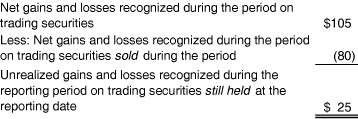
- eThe portion of trading gains and losses for the period that relates to trading securities still held at the reporting date.
- aThe proceeds from sales of available-for-sale securities and the gross realized gains and gross realized losses that have been included in earnings as a result of those sales
- bThe basis on which the cost of a security sold or the amount reclassified out of accumulated other comprehensive income into earnings was determined (that is, specific identification, average cost, or other method used)
- cThe gross gains and gross losses included in earnings from transfers of securities from the available-for-sale category into the trading category
- dThe amount of the net unrealized holding gain or loss on available-for-sale securities for the period that has been included in accumulated other comprehensive income and the amount of gains and losses reclassified out of accumulated other comprehensive income into earnings for the period
- eThe portion of trading gains and losses for the period that relates to trading securities still held at the reporting date.
- aThe net carrying amount of the sold or transferred security
- bThe net gain or loss in accumulated other comprehensive income for any derivative that hedged the forecasted acquisition of the held-to-maturity security
- cThe related realized or unrealized gain or loss
- dThe circumstances leading to the decision to sell or transfer the security. (Such sales or transfers should be rare, except for sales and transfers due to the changes in circumstances identified in paragraph 320-10-25-6(a) through (f).)
- aThe net carrying amount of the sold or transferred security
- bThe net gain or loss in accumulated other comprehensive income for any derivative that hedged the forecasted acquisition of the held-to-maturity security
- cThe related realized or unrealized gain or loss
- dThe circumstances leading to the decision to sell or transfer the security. (Such sales or transfers should be rare, except for sales and transfers due to the changes in circumstances identified in paragraph 320-10-25-6(a) through (f).)
320-10-55Implementation Guidance and Illustrations
Source downloaded: .Record version f62c6d8939c3. Effective date must be checked in the source.
Implementation Guidance
- aCertain debt securities
- b
- c
- dShort sales of debt securities.
- aLoans restructured as securities. For example, any loan that was restructured involving a modification of terms would be subject to the provisions of this Topic if the debt instrument meets the definition of a security. See paragraph 310-20-40-10 for additional information.
- bBeneficial interests in securitized financial assets that are in equity form but that meet the definition of a debt security. For example, some beneficial interests issued in the form of equity represent solely a right to receive a stream of future cash flows to be collected under preset terms and conditions (that is, a creditor relationship), while others, according to the terms of the special-purpose entity, must be redeemed by the issuing entity or must be redeemable at the option of the investor. Consequently, those beneficial interests would be within the scope of both this Topic and Subtopic 325-40 since they are required to be accounted for as debt securities.
- cCertificates of deposit (CDs) or guaranteed investment contracts. For example, certain negotiable jumbo CDs and guaranteed investment contracts might meet the definition of security, which was modeled after the definition provided in the Uniform Commercial Code.
- dRedeemable convertible preferred stock. For example, convertible preferred stock that has mandatory redemption provisions or is redeemable at the option of the investor is considered a debt security and this Topic would apply.
- aDual-index floater. A bond with a coupon rate that is determined by the spread between two different indexes and that usually includes an above-market interest rate in Year 1. These bonds may have a teaser fixed rate for the first period of the bond's life, after which the interest rate floats according to a predetermined formula.
- bInverse floater. A bond with a coupon rate of interest that varies inversely with changes in specified general interest rate levels or indexes, for example, the London Interbank Offered Rate (LIBOR).
- cLevered inverse floater. A bond with a coupon that varies indirectly with changes in general interest rate levels and that applies a multiplier (greater than 1.00) to the specified index in its calculation of interest.
- dDelevered floater. A bond with a coupon rate of interest that lags overall movements in specified general interest rate levels or indexes.
- eRange floater. A bond in which the investor's coupon is dependent on the number of days that a reference rate stays within a preestablished collar; otherwise, the bond pays either 0% interest or a below-market rate.
- fLower-of and higher-of floaters. A bond that pays an interest rate stated as the lower of or higher of two different formulas.
- gRatchet floater. A bond that pays a floating rate of interest and has an adjustable cap and/or floor that moves in sync with each new reset rate.
- hStepped cap-floor floaters. A bond that pays a floating rate of interest, subject to a scheduled cap, scheduled floor, or both.
- iFloating to floating notes. Varying coupon (first-year LIBOR or U.S. Treasury bill based, second-year prime based).
- jFloating to fixed notes. Varying coupon (first-year coupon is fixed, second- and third-year coupons are based on LIBOR, U.S. Treasury bills, or prime).
- kIndexed amortizing notes. A bond that repays principal based on a predetermined amortization schedule or target value. This value is linked to movements within a specific mortgage-backed security or index. The maturity of the bond changes as the related index changes. This instrument includes a varying maturity.
- lEquity indexed notes. Bond return of interest and/or principal is tied to a specified equity index (for example, the Standard & Poor's S&P 500 Index). This instrument may contain fixed or varying coupon rate and may place all or a portion of principal at risk.
- mVariable principal redemption bond. A bond whose principal redemption value at maturity is dependent on the change in an underlying index over a predetermined observation period. A typical scenario would be a bond that guarantees a minimum par redemption value of 100%, and the potential for a supplemental principal payment at maturity as compensation for the below-market rate of interest offered with the instrument (providing that the bond satisfies the indexing requirements as outlined in the terms of the offering).
- nYield curve note. Fixed coupon, principal varies as follows: [(5-year swap rate - 3-month $LIBOR - 1%) × 40 + 100%] × par (but not less than zero).
- oCrude oil knock-in notes. 1% coupon, principal guaranteed with upside potential based on the strength of the oil market.
- pLeveraged gold notes. Coupon is zero, variable principal based on the London Gold Index. These notes are designed to incorporate a collar on gold, whereby the investor buys a call and sells a put, in exchange for the coupon.
- qGold-linked bull note. Fixed 3% coupon, principal is guaranteed with upside potential if the price of gold increases.
- rEquity-linked bear note. Fixed 4% coupon, principal is guaranteed with upside potential if a specified Standard & Poor's index falls.
- sStep-up bonds. Bond provides an introductory above-market yield and the bond then steps up to a new coupon that will be below then-current market rates or, alternatively, the bond may be called.
- tMulti step-ups. A security that pays investors an introductory above-market yield—reflecting an embedded call option—for a short lockout period, and then is either called or steps up to a higher coupon rate (which will be below then-current market rates). These bonds can also take the form of step-down or variable step-up structures.
- uCredit-sensitive bond. A bond that has a coupon rate of interest that resets based on changes in an entity's credit rating.
- vInflation bond. A bond with a contractual principal amount that is indexed to the inflation rate; the coupon rate is typically below that of traditional bonds of similar maturity.
- wDisaster bond. A bond that pays a coupon above that of traditional bonds; however, a substantial portion or all of the principal amount is subject to loss if a specified disaster occurs.
- xSpecific equity-linked bond. A bond that pays a coupon slightly below that of traditional bonds of similar maturity; however, the principal amount is linked to the stock market performance of an equity investee of the issuer. The issuer may settle the obligation by delivering the underlying shares of the equity investee or may deliver the equivalent fair value in cash.
- aCalculate the effective yield that equates all past actual cash flows and current estimates of future cash flows to the initial investment amount.
- bUsing the rate calculated in (a), or zero percent if negative, calculate the present value of the estimated future cash flows. That amount represents the amortized cost at the end of the period.
- cAdjust the amortized cost balance to the amount calculated in (b) with the offsetting amount recognized as income for the period.
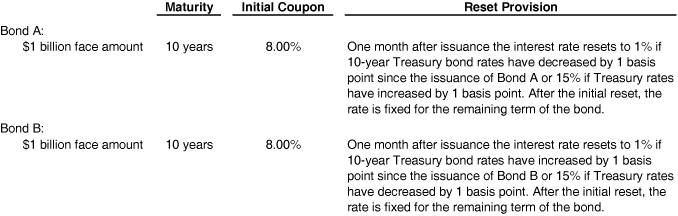
- aThe two securities are related in that their fair values will move in opposite directions based on changes in interest rates on a specified date, or after a specified period after issuance. The fair value changes may be caused by a change in the coupon interest rate of the two securities or by altering the maturities of the securities.
- bThe two securities are issued contemporaneously and in contemplation of one another or are issued separately but the terms for their remaining lives are as described in (a).
- cThe two securities are issued by the same counterparty and/or the same issuer (or issued by different issuers but structured through an intermediary).
- dThe two securities were purchased by the investor for the sole purpose of achieving a desired accounting result, and the transactions considered individually would serve no valid business purpose or would not be entered into otherwise.
Illustrations
- aThe investor purchases a 3-year, $100 par value structured note at par.
- bThe principal to be repaid at maturity is based on the performance of the Standard & Poor's S&P 500 Index, which, based on current Standard & Poor's S&P Futures indexes, is expected to provide the investor with principal of $106 at the end of Year 3, and the coupon interest on the note is fixed at 6 percent per year.
- cOn the acquisition date of the note, the investor expects the following cash flows and income to be recognized over the life of the note.
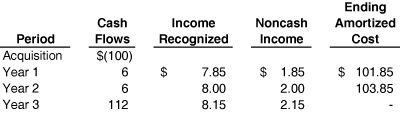 Period Cash Flows Income Recognized Noncash Income Ending Amortized Cost Acquisition $(100) Year 1 6 $7.85 $1.85 $101.85 Year 2 6 8.00 2.00 103.85 Year 3 112 8.15 2.15 -
These cash flows produce an effective yield of 7.85 percent.
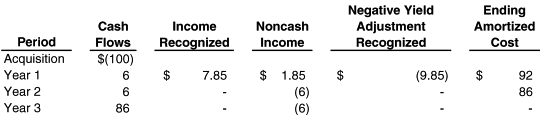 s Cash Flows Income Recognized Noncash Income Negative Yield Adjustment Recognized Ending Amortized Cost Acquisition $(100) Year 1 6 $7.85 $1.85 $(9.85) $92 Year 2 6 - (6) - 86 Year 3 86 - (6) - -
 Maturity Initial Coupon Reset Provision Bond A: $1 billion face amount 10 years 8.00% "One month after issuance the interest rate resets to 1% if 10-year Treasury bond rates have decreased by 1 basis point since the issuance of Bond A or 15% if Treasury rates have increased by 1 basis point. After the initial reset, the rate is fixed for the remaining term of the bond." Bond B: $1 billion face amount 10 years 8.00% "One month after issuance the interest rate resets to 1% if 10-year Treasury bond rates have increased by 1 basis point since the issuance of Bond B or 15% if Treasury rates have decreased by 1 basis point. After the initial reset, the rate is fixed for the remaining term of the bond."
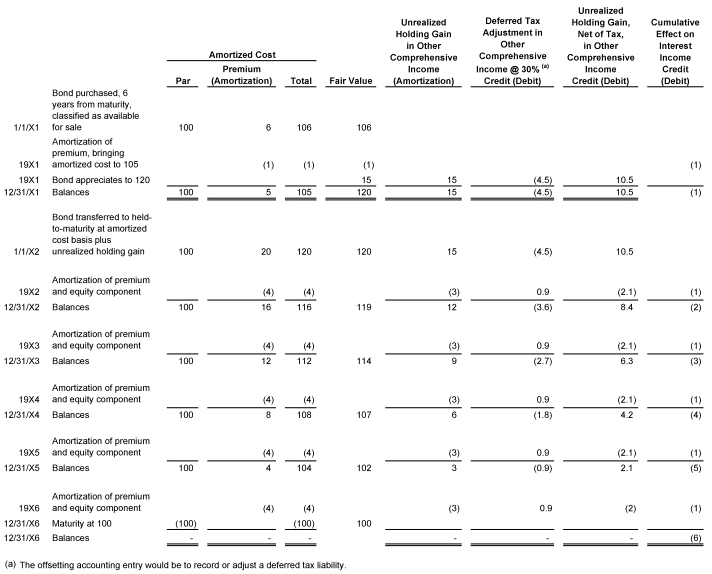 Amortized Cost "Unrealized Holding Gain in Other Comprehensive Income (Amortization)" "Deferred Tax Adjustment in Other Comprehensive Income @ 30% (a) Credit (Debit)" "Unrealized Holding Gain, Net of Tax, in Other Comprehensive Income Credit (Debit)" "Cumulative Effect on Interest Income Credit (Debit)" Par Premium (Amortization) Total Fair Value 1/1/X1 "Bond purchased, 6 years from maturity, classified as available for sale" 100 6 106 106 19X1 "Amortization of premium, bringing amortized cost to 105" (1) (1) (1) (1) 19X1 Bond appreciates to 120 15 15 (4.5) 10.5 12/31/X1 Balances 100 5 105 120 15 (4.5) 10.5 (1) 1/1/X2 Bond transferred to held-to-maturity at amortized cost basis plus unrealized holding gain 100 20 120 120 15 (4.5) 10.5 19X2 Amortization of premium and equity component (4) (4) (3) 0.9 (2.1) (1) 12/31/X2 Balances 100 16 116 119 12 (3.6) 8.4 (2) 19X3 Amortization of premium and equity component (4) (4) (3) 0.9 (2.1) (1) 12/31/X3 Balances 100 12 112 114 9 (2.7) 6.3 (3) 19X4 Amortization of premium and equity component (4) (4) (3) 0.9 (2.1) (1) 12/31/X4 Balances 100 8 108 107 6 (1.8) 4.2 (4) 19X5 Amortization of premium and equity component (4) (4) (3) 0.9 (2.1) (1) 12/31/X5 Balances 100 4 104 102 3 (0.9) 2.1 (5) 19X6 Amortization of premium and equity component (4) (4) (3) 0.9 (2) (1) 12/31/X6 Maturity at 100 (100) (100) 100 12/31/X6 Balances - - - - - - (6) (a) The offsetting accounting entry would be to record or adjust a deferred tax liability.
320-10-65Transition and Open Effective Date Information
Source downloaded: .Record version 8cafbc52df21. Effective date must be checked in the source.
320-10-S00StatusSEC
Source downloaded: .Record version 03d2376d5ecb. Effective date must be checked in the source.
| Paragraph | Action | Accounting Standards Update | Date |
| 320-10-S55-1 | Superseded | Accounting Standards Update No. 2018-04 | 03/09/2018 |
| 320-10-S99-1 | Superseded | Accounting Standards Update No. 2018-04 | 03/09/2018 |
| 320-10-S99-1 | Amended | Accounting Standards Update No. 2012-03 | 08/27/2012 |
| 320-10-S99-2 | Amended | Accounting Standards Update No. 2015-10 | 06/12/2015 |
| 320-10-S99-2 | Amended | Accounting Standards Update No. 2010-04 | 01/15/2010 |
320-10-S35Subsequent MeasurementSEC
Source downloaded: .Record version 0f2771c4e2ef. Effective date must be checked in the source.
Holding Gains and Losses Adjustments to Assets and Liabilities as Related to the Implementation of Topic 320
320-10-S50DisclosureSEC
Source downloaded: .Record version 8926107c9934. Effective date must be checked in the source.
Marketable Securities
Other Investments
320-10-S55Implementation Guidance and IllustrationsSEC
Source downloaded: .Record version 103ffb2af580. Effective date must be checked in the source.
Impairment of Individual Available-for-Sale and Held-to-Maturity Securities
320-10-S99SEC MaterialsSEC
Source downloaded: .Record version 01190cf299c7. Effective date must be checked in the source.
SEC Staff Guidance
- The SEC staff has been asked whether certain assets and liabilities, such as noncontrolling interests, certain life insurance policyholder liabilities, deferred acquisition costs, and intangible assets arising from insurance contracts acquired in business combinations, should be adjusted with a corresponding adjustment to other comprehensive income at the same time unrealized holding gains and losses from securities classified as available-for-sale are recognized in other comprehensive income. That is, should the carrying value of these assets and liabilities be adjusted to the amount that would have been reported had unrealized gains and losses been realized?
- Paragraph 740-20-45-11(b) addresses specifically the classification of the deferred tax effects of unrealized holding gains and losses reported in other comprehensive income. Paragraph 740-20-45-11(b) requires that the tax effects of those gains and losses be reported as charges or credits directly to other comprehensive income. That is, the recognition of unrealized holding gains and losses in equity may create temporary differences for which deferred taxes would be recognized, the effect of which would be reported in accumulated other comprehensive income along with the related unrealized holding gains and losses. Therefore, deferred tax assets and liabilities are required to be recognized for the temporary differences relating to unrealized holding gains and losses as though those gains and losses actually had been realized, except the corresponding charges or credits are reported in other comprehensive income rather than as charges or credits to income in the statement of income.
- By analogy to paragraph 740-20-45-11(b), the SEC staff believes that, in addition to adjusting deferred tax assets and liabilities, registrants should adjust other assets and liabilities that would have been adjusted if the unrealized holding gains and losses from securities classified as available-for-sale actually had been realized. That is, to the extent that unrealized holding gains or losses from securities classified as available-for-sale would result in adjustments of noncontrolling interest, policyholder liabilities, deferred acquisition costs that are amortized using the gross-profits method, or intangible assets arising from insurance contracts acquired in business combinations that are amortized using the gross-profits method had those gains or losses actually been realized, the SEC staff believes that those balance sheet amounts should be adjusted with corresponding credits or charges reported directly to other comprehensive income. As a practical matter, the staff, at this time, would not extend those adjustments to other accounts such as liabilities for compensation to employees. The adjustments to asset accounts should be accomplished by way of valuation allowances that would be adjusted at subsequent balance sheet dates.
- For example, certain policyholder liabilities should be adjusted to the extent that liabilities exist for insurance policies that, by contract, credit or charge the policyholders for either a portion or all of the realized gains or losses of specific securities classified as available-for-sale. Further, asset amounts that are amortized using the gross-profits method, such as deferred acquisition costs accounted for under paragraphs 944-30-35-4 and 944-30-35-11 and certain intangible assets arising from insurance contracts acquired in business combinations, should be adjusted to reflect the effects that would have been recognized had the unrealized holding gains and losses actually been realized. Further, capitalized acquisition costs associated with insurance contracts covered by paragraphs 944-30-35-1A through 35-3A and 944-30-35-17 should not be adjusted for an unrealized holding gain or loss unless a "premium deficiency" would have resulted had the gain or loss actually been realized.
- This announcement should not affect reported net income. It addresses only the adjustment of certain assets and liabilities and the reporting of unrealized holding gains and losses from securities classified as available for sale.
Related subtopics
- 326-30 Available-for-Sale Debt SecuritiesFinancial Instruments—Credit Losses
- 860-30 Secured Borrowing and CollateralTransfers and Servicing
- 325-40 Beneficial Interests in Securitized Financial AssetsInvestments—Other
- 470-20 Debt with Conversion and Other OptionsDebt
- 815-40 Contracts in Entity's Own EquityDerivatives and Hedging
- 310-948 Financial Services—Mortgage BankingReceivables