ASC

ASC 310-20

Nonrefundable Fees and Other Costs

310 Receivables

Source downloaded: .Record version dad86a8f062f. Effective date must be checked in the source.

ASC 310-20 governs how lenders and loan purchasers account for nonrefundable fees, origination costs, commitment fees, syndication fees, credit card fees, and purchase premiums/discounts. The core rule is that loan origination fees and direct loan origination costs are deferred, offset, and recognized only as a net amount over the life of the loan as a yield (interest income) adjustment using the interest method; all other lending-related costs (advertising, solicitation, servicing, unsuccessful efforts, occupancy, equipment) are expensed as incurred. It also prescribes when a refinancing/restructuring is treated as a new loan versus a carryover of unamortized net fees and costs.

Key points (7)
  • Loan origination fees and direct loan origination costs shall be deferred (310-20-25-2), offset against each other with only the net amount deferred (310-20-30-2), and recognized over the life of the loan as an adjustment of yield (310-20-35-2).
  • All other lending-related costs — advertising, soliciting borrowers, servicing, credit policy administration, unsuccessful loan efforts, idle time, and indirect costs such as rent, depreciation, and occupancy — shall be charged to expense as incurred (310-20-25-3); origination software and service-bureau processing fees are not deferrable (310-20-25-4 through 25-5), while bonuses/commissions are deferrable only to the extent allocable to time spent on qualifying activities for completed loans (310-20-25-6 through 25-7).
  • Commitment fees are deferred and, if the commitment is exercised, recognized over the life of the loan as a yield adjustment or, if it expires unexercised, recognized in income upon expiration (310-20-35-3, 310-20-40-1); if exercise is remote the fee is amortized straight-line as service fee income, and if net costs exceed fees with remote exercise those costs are expensed immediately (310-20-35-3(a), 310-20-25-13).
  • Credit card fees are deferred and recognized straight-line over the period the fee entitles the cardholder to use the card; credit card origination costs (including amounts paid to third parties for individually acquired accounts) are netted against the fee and amortized straight-line over the privilege period, which is one year if there is no significant fee (310-20-25-15 through 25-18, 310-20-35-5 through 35-8).
  • A refinanced or restructured loan is accounted for as a new loan — with unamortized net fees, costs, and prepayment penalties recognized in interest income — only if the new loan's terms are at least as favorable as terms for comparable new borrowers and modifications are more than minor (a 10 percent cash flow present value difference test) (310-20-35-9 through 35-11); otherwise those amounts carry forward into the net investment in the new loan (310-20-35-10).
  • The purchaser's initial investment includes amounts paid to the seller plus fees paid less fees received, with the difference from principal recognized as a yield adjustment over the loan's life; all other acquisition costs are expensed as incurred (310-20-30-5, 310-20-25-22 through 25-23, 310-20-35-15).
  • Net fees or costs are amortized by the interest method using contractual payment terms without anticipating prepayments, unless the entity holds a large number of similar loans with probable, reasonably estimable prepayments (310-20-35-18, 310-20-35-26); demand loans and revolving lines of credit use straight-line recognition (310-20-35-22 through 35-25), and no amortization occurs while interest income is not being recognized due to collectibility concerns (310-20-35-17).

For students. This is the classic "points and fees" subtopic: fees are never revenue up front — they ride the loan as a yield adjustment, while marketing and unsuccessful-effort costs hit expense immediately. The most common mistake is deferring all internal loan department costs; only incremental direct costs of specified activities on completed loans (and only the allocable portion of compensation) qualify.

Machine-generated study aid for ASC 310-20. Check the source paragraphs below.

310-20-00Status

Source downloaded: .Record version 52d4c80f4f60. Effective date must be checked in the source.

310-20-00-1
The following table identifies the changes made to this Subtopic.
ParagraphActionAccounting Standards UpdateDate
Debt Security (1st def.)AmendedAccounting Standards Update No. 2016-1912/14/2016
Effective Interest RateAmendedAccounting Standards Update No. 2016-1912/14/2016
Effective Interest RateAmendedAccounting Standards Update No. 2016-1306/16/2016
Financial Asset (1st def.)SupersededAccounting Standards Update No. 2016-1912/14/2016
Financial Asset (1st def.)AddedAccounting Standards Update No. 2016-1306/16/2016
Financial Asset (2nd def.)AddedAccounting Standards Update No. 2016-1912/14/2016
Public Business EntityAddedAccounting Standards Update No. 2017-0803/30/2017
Purchased Financial Assets with Credit DeteriorationAmendedAccounting Standards Update No. 2016-1912/14/2016
Purchased Financial Assets with Credit DeteriorationAddedAccounting Standards Update No. 2016-1306/16/2016
Recorded InvestmentSupersededAccounting Standards Update No. 2022-0203/31/2022
Recorded InvestmentAmendedAccounting Standards Update No. 2015-1006/12/2015
310-20-15-1AmendedAccounting Standards Update No. 2016-0202/25/2016
310-20-15-3AmendedAccounting Standards Update No. 2016-1306/16/2016
310-20-15-3AmendedAccounting Standards Update No. 2012-0410/01/2012
310-20-15-4AmendedAccounting Standards Update No. 2016-1306/16/2016
310-20-15-4AmendedAccounting Standards Update No. 2012-0410/01/2012
310-20-35-2AmendedAccounting Standards Update No. 2022-0203/31/2022
310-20-35-6AmendedAccounting Standards Update No. 2015-1006/12/2015
310-20-35-9AmendedAccounting Standards Update No. 2022-0203/31/2022
310-20-35-9AmendedAccounting Standards Update No. 2016-1306/16/2016
310-20-35-9AmendedAccounting Standards Update No. 2012-0410/01/2012
310-20-35-10AmendedAccounting Standards Update No. 2022-0203/31/2022
310-20-35-12SupersededAccounting Standards Update No. 2022-0203/31/2022
AddedAccounting Standards Update No. 2022-0203/31/2022
310-20-35-33AmendedAccounting Standards Update No. 2020-0810/15/2020
310-20-35-33AmendedAccounting Standards Update No. 2017-0803/30/2017
AddedAccounting Standards Update No. 2022-0203/31/2022
310-20-50-3AmendedMaintenance Update 2016-11 (PDF)06/27/2016
310-20-50-4AmendedAccounting Standards Update No. 2015-1006/12/2015
AddedAccounting Standards Update No. 2022-0203/31/2022
310-20-60-1SupersededAccounting Standards Update No. 2016-1306/16/2016
310-20-60-2AmendedAccounting Standards Update No. 2016-1306/16/2016
310-20-65-1AddedAccounting Standards Update No. 2017-0803/30/2017
310-20-65-2AddedAccounting Standards Update No. 2020-0810/15/2020

310-20-05Overview and Background

Source downloaded: .Record version de4ea32cf4a0. Effective date must be checked in the source.

310-20-05-1
This Subtopic provides guidance on the recognition, measurement, derecognition, and disclosure of nonrefundable fees, origination costs, and acquisition costs associated with lending activities and loan purchases.

Nonrefundable Fees and Costs

310-20-05-2
An entity may acquire a loan by lending (originating the loan) or by purchasing (acquiring a loan from a party other than the borrower). This Subtopic establishes standards of financial accounting and reporting for nonrefundable fees and costs associated with lending activities and loan purchases. The lender's activities that precede the disbursement of funds can generally be distinguished between the following:
  1. a
    Efforts to identify and attract potential borrowers
  2. b
    Efforts necessary to originate a loan or loan commitment after a potential borrower requests a loan or loan commitment.
Nonrefundable fees have many different names in practice, such as origination fees, points, placement fees, commitment fees, application fees, management fees, restructuring fees, and syndication fees, but, for purposes of this Subtopic, they are referred to as loan origination fees, commitment fees, or syndication fees.

Credit Card Arrangements

310-20-05-3
Available lines of credit under credit card and similar charge card arrangements are loan commitments, and fees collected in connection with such cards (credit card fees) are viewed in part as being loan commitment fees. Entities issue credit cards, debit cards, bank charge cards, and other similar cards (collectively, credit cards) with a variety of terms. An issuer may charge an origination fee in connection with the issuance of a credit card and periodic renewal fees for the continued extension of credit card privileges. As part of a promotion to attract new cardholders or retain existing cardholders, some of those issuers may waive the payment of credit card fees for the initial use period or in some cases for a longer period. Other entities issue credit cards that do not require the payment of any fees for the use of the credit card.
310-20-05-4
An entity (credit card issuer) may acquire credit card accounts by paying an amount to a third party. The credit card accounts typically have no outstanding receivable balances at the time acquired. The credit card accounts are acquired individually (one at a time) by paying an amount for each approved credit card agreement. The third party may be any of the following:
  1. a
    A direct marketing specialist
  2. b
    An affinity group (a professional, cultural, or other organization)
  3. c
    A cobrander (an airline entity, automobile manufacturing entity, hotel entity, or other commercial or retailing entity). Under a cobranding arrangement, the third party's name is included on the credit card, and the third party has a continuing obligation to provide goods or services, such as product discounts, to cardholders for an extended period that directly or indirectly benefits the credit card issuer.

310-20-15Scope and Scope Exceptions

Source downloaded: .Record version 0ef121ca6231. Effective date must be checked in the source.

Entities

310-20-15-1
The guidance in this Subtopic applies to entities as follows:
  1. a
    All paragraphs apply to both lenders and purchasers.
  2. b

Transactions

310-20-15-2
The guidance in this Subtopic explicitly includes the following transactions:
  1. a
    The recognition and the balance sheet classification of nonrefundable fees and costs associated with lending activities
  2. b
    The accounting for discounts, premiums, and commitment fees associated with the purchase of loans and other debt securities such as corporate bonds, Treasury notes and bonds, groups of loans, and loan-backed securities (such as pass-through certificates, collateralized mortgage obligations, and other so-called securitized loans)
  3. c
    Loans designated as a hedged item in a fair value hedge under Topic 815 (see paragraphs ).
310-20-15-3
The guidance in this Subtopic does not apply to the following transactions:
  1. a
    Loan origination or commitment fees that are refundable; however, the guidance in this Subtopic does apply when such fees subsequently become nonrefundable.
  2. b
    Costs that are incurred by the lender in transactions with independent third parties if the lender bills those costs directly to the borrower.
  3. c
    Nonrefundable fees and costs associated with originating or acquiring loans that are carried at fair value if the changes in fair value are included in earnings of a business entity or change in net assets of a not-for-profit entity (NFP). The exclusion provided in this paragraph and the preceding paragraph applies to nonrefundable fees and costs associated with originating loans that are reported at fair value and premiums or discounts associated with acquiring loans that are reported at fair value. Loans that are reported at amortized cost basis or the lower of amortized cost basis or fair value, loans or debt securities reported at fair value with changes in fair value reported in other comprehensive income (includes financial assets subject to prepayment as defined in paragraph 860-20-35-2, and debt securities classified as available-for-sale under Topic 320), and loans that have a market interest rate, or adjust to a market interest rate, are not considered to be loans carried at fair value.
  4. d
    Fees and costs related to a commitment to originate, sell, or purchase loans that is accounted for as a derivative instrument under Subtopic 815-10.
  5. e
    Fees and costs related to a standby commitment to purchase loans if the settlement date of that commitment is not within a reasonable period or the entity does not have the intent and ability to accept delivery without selling assets. For guidance on fees and costs related to such a commitment, see paragraph 310-10-30-7.

Instruments
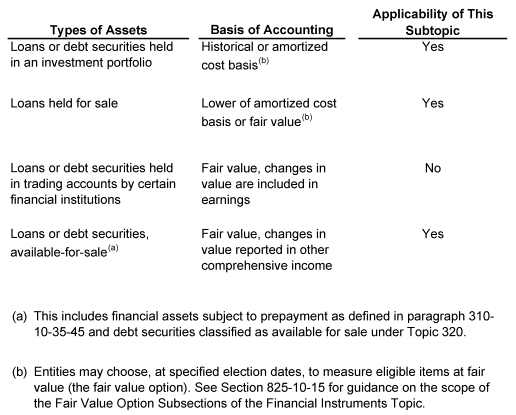
310-20-15-4
The following table outlines the applicability of this Subtopic to various types of assets.
  • Types of Assets Basis of Accounting Applicability of This Subtopic Loans or debt securities held in an investment portfolio Historical or amortized cost basis(b) Yes Loans held for sale Lower of amortized cost basis or fair value(b) Yes Loans or debt securities held in trading accounts by certain financial institutions "Fair value, changes in value are included in earnings" No "Loans or debt securities, available-for-sale(a)" "Fair value, changes in value reported in other comprehensive income" Yes (a) This includes financial assets subject to prepayment as defined in paragraph 310-10-35-45 and debt securities classified as available for sale under Topic 320. (b) "Entities may choose, at specified election dates, to measure eligible items at fair value (the fair value option). See Section 825-10-15 for guidance on the scope of the Fair Value Option Subsections of the Financial Instruments Topic."

Other Considerations

310-20-15-5
This guidance in this Subtopic shall be applied to individual loan contracts. Aggregation of similar loans for purposes of recognizing net fees or costs and purchase premiums or discounts is permitted if the provisions of paragraph 310-20-35-26 are met or if the resulting recognition does not differ materially from the amount that would have been recognized on an individual loan-by-loan basis.

310-20-25Recognition

Source downloaded: .Record version 81848d29a765. Effective date must be checked in the source.

310-20-25-1
This Section addresses the recognition of certain lending fees and costs, specifically:
  1. a
  2. b
    Other lending-related costs
  3. c
    Cost determination
  4. d
  5. e
  6. f
  7. g
    Purchase of a loan or group of loans
  8. h
    Independent third parties.

Loan Origination Fees and Direct Loan Origination Costs

310-20-25-2
Loan origination fees shall be deferred. Likewise, direct loan origination costs shall be deferred.
310-20-25-3
All other lending-related costs, including costs related to activities performed by the lender for advertising, soliciting potential borrowers, servicing existing loans, and other ancillary activities related to establishing and monitoring credit policies, supervision, and administration, shall be charged to expense as incurred. Employees' compensation and fringe benefits related to those activities, unsuccessful loan origination efforts, and idle time shall be charged to expense as incurred. Administrative costs, rent, depreciation, and all other occupancy and equipment costs are considered indirect costs and shall be charged to expense as incurred.
310-20-25-4
Costs for software dedicated to loan processing and origination are not eligible for deferral as direct loan origination costs under the definition of that term. Such costs are not other costs related to those activities that would not have been incurred but for that loan as contemplated in the definition of the term.
310-20-25-5
Fees paid to a service bureau for loan processing are not eligible for deferral as direct loan origination costs under the definition of that term because the services were performed after the loan has already been made; the costs are not origination costs.
310-20-25-6
Bonuses based on successful production of loans that are paid to employees involved in loan origination activities are partially deferrable as direct loan origination costs under the definition of that term. Bonuses are part of an employee's total compensation. The portion of the employee's total compensation that may be deferred as direct loan origination costs is the portion that is directly related to time spent on the activities contemplated in the definition of that term and results in the origination of a loan.
310-20-25-7
If compensation for an employee traditionally paid by salary or hourly wage is switched wholly or partially to commissions on successful loan production, such costs would be partially deferrable as direct loan origination costs under the definition of that term. As specified in the preceding paragraph, only the portion of the employee's total compensation directly related to time spent on activities contemplated in the definition of that term for completed loans would be deferred. Commission-based compensation arrangements between a lender and its employees may be similar to arrangements a lender may have with independent third parties such as loan brokers. However, when origination activities are performed by the lender's employees, the lender must allocate compensation costs applicable to the activities contemplated in the definition of direct loan acquisition costs based on the portion of time spent by employees. An allocation of the employees' total compensation between origination and other activities is made so that only those costs associated with those lending activities contemplated in the definition of that term are deferred for completed loans, even if commissions are 100 percent of such compensation and are based solely on completed loan transactions.

Cost Determination

310-20-25-8
This Subtopic does not specify how costs are to be determined but rather what costs must be deferred. In many instances, standard costing may be used to estimate the costs to be deferred in accordance with the provisions of this Subtopic. For certain loans, the cost of origination may be similar and standard costing may be appropriate for those loans, while other loans may be of such a nature that costs must be identified separately. Lenders may use any one or a combination of methods that will provide adequate information to report financial results in accordance with this Subtopic. Development of a standard costing system will require periodic analysis of variances and, if necessary, adjustment of standard costing estimates. Possible standard cost methods that may be used to measure costs applicable to transactions that have occurred include standard costs, actual costs, job process (for example, homogeneous loans), or job order (for example, specific loans).
310-20-25-9
The successful-efforts accounting notion utilized at an entity-wide level may result in a standard cost system that does not accurately reflect the amount of costs that may be deferred and amortized under the provisions of this Subtopic. Successful loan efforts can be determined as a percentage of each function (for example, application, verification, underwriting, appraisal, closing) and may be based on the percentage, adjusted for idle time and time spent on activities for which the related costs cannot be deferred, of successful and unsuccessful efforts determined for each function.
310-20-25-10
In accounting for costs associated with loan originations on loans that have not yet been closed, judgment is required to estimate the number of loans in process that will result in a successful loan origination. Origination costs on a loan in process may be deferred until the loan is either closed or considered an unsuccessful effort. If a loan in process is determined to be unsuccessful after the balance sheet date but before the financial statements are issued or are available to be issued (as discussed in Section 855-10-25), costs that have been deferred through the balance sheet date shall be charged to expense in the period ending with the balance sheet date.

Commitment Fees

310-20-25-11
Except as set forth in paragraph 310-20-35-3, fees received for a commitment to originate or purchase a loan or group of loans shall be deferred.
310-20-25-12
Direct loan origination costs incurred to make a commitment to originate a loan shall be offset against any related commitment fee and the net amount recognized as set forth in paragraph 310-20-35-3.
310-20-25-13
If qualifying costs associated with commitments exceed commitment fees received (or if no fee is charged), whether or not the resulting net cost may be deferred depends on the likelihood of the commitment being exercised. This Subtopic applies to both nonrefundable fees and costs, and paragraphs 310-20-35-3 and 310-20-25-1 may require that the net of such items be deferred. However, if the likelihood that the commitment will be exercised is remote, any net costs shall be charged to expense immediately rather than deferred and amortized on a straight-line basis over the commitment period.
310-20-25-14
Fees received for providing commercial letters of credit are covered by this Subtopic. Such fees are considered commitment fees, and the accounting is specified in paragraph 310-20-35-3.

Credit Card Fees and Costs

310-20-25-15
Credit card fees generally cover many services to cardholders. Accordingly, fees that are periodically charged to cardholders shall be deferred. This accounting shall also apply to other similar card arrangements that involve an extension of credit by the card issuer.
310-20-25-16
Only the costs of origination that qualify as direct loan origination costs under the definition of that term are eligible for deferral. All other costs shall be charged to expense as incurred. Therefore, costs eligible for deferral would likely exceed fees only when a credit card is first issued.
310-20-25-17
Credit card origination costs shall be netted against the related credit card fee, if any. In situations where a significant fee is charged, the privilege period is the period that the fee entitles the cardholder to use the credit card. If there is no significant fee, the privilege period shall be one year. Significance for this purpose shall be evaluated based on the amount of the fee relative to the related costs.
310-20-25-18
Credit card accounts acquired individually shall be accounted for as originations under this Subtopic. Amounts paid to a third party to acquire individual credit card accounts shall be deferred and netted against the related credit card fee, if any.

Loan Syndication Fees

310-20-25-19
The entity managing a loan syndication (the syndicator) shall recognize loan syndication fees when the syndication is complete unless a portion of the syndication loan is retained. If the yield on the portion of the loan retained by the syndicator is less than the average yield to the other syndication participants after considering the fees passed through by the syndicator, the syndicator shall defer a portion of the syndication fee to produce a yield on the portion of the loan retained that is not less than the average yield on the loans held by the other syndication participants.
310-20-25-20
All transactions that are structured legally as loan syndications shall be accounted for as loan syndications in accordance with the provisions of this Subtopic.

Purchase of a Loan or Group of Loans

310-20-25-22
Paragraph 310-20-30-5 explains that the initial investment in a purchased loan or group of loans shall include the amount paid to the seller plus any fees paid or less any fees received. The initial investment frequently differs from the related loan's principal amount at the date of purchase. All other costs incurred in connection with acquiring purchased loans or committing to purchase loans shall be charged to expense as incurred.
310-20-25-23
Designation of a fee or cost as an origination fee or cost for a loan that is purchased is inappropriate because a purchased loan has already been originated by another party. Costs incurred in connection with acquiring loans or committing to purchase loans, including a participation, shall be charged to expense in accordance with paragraph 310-20-35-15.
310-20-25-24
For the originating lender, net fees and costs associated with a loan participation would become a component of the net loan investment balance to be used in calculating the gain or loss on a subsequent sale as described in paragraph 310-20-35-16.

Independent Third Parties

310-20-25-25
If an entity utilizes a third party for loan originations and the third party is not considered an independent third party for several reasons but also is not an employee of the entity, the entity shall defer those costs directly related to specified activities that can be determined to meet the criteria for direct loan origination costs under the definition of that term as long as those costs would not have been incurred but for that loan.
310-20-25-26
Fees paid to independent third parties for advisory services regarding loan origination activities, even if those same activities are performed internally, are not considered to be incurred for the specified activities set forth in the definition of the direct loan acquisition costs term and shall be charged to expense as incurred whether paid to independent third parties or performed internally.
310-20-25-27
Fees paid to an independent third party, or incurred internally, for portfolio management or investment consultation are considered other costs incurred in connection with acquiring purchased loans or committing to purchase loans because they constitute investment advisory costs, not loan origination costs. Therefore, such costs shall be charged to expense in accordance with paragraph 310-20-35-15 whether the costs are paid to independent third parties or incurred internally. In some circumstances judgment may be necessary to determine if a third party is independent.

310-20-30Initial Measurement

Source downloaded: .Record version 709b21fa85ae. Effective date must be checked in the source.

310-20-30-1
This Section addresses the measurement of certain types of lending fees and costs, specifically:
  1. a
  2. b
    Syndication fees
  3. c
    Purchase of a loan or group of loans.

Loan Origination Fees and Costs

310-20-30-2
Loan origination fees and related direct loan origination costs for a given loan shall be offset and only the net amount shall be deferred.
310-20-30-3
For increasing interest rate loans, the recorded net investment in a loan may exceed the amount by which the borrower could settle the obligation but only if the excess results from a purchase premium (loans purchased) or loan costs that qualify for deferral in excess of loan fees (loans originated).

Syndication Fees

310-20-30-4
Paragraph 310-20-25-19 explains that, if the yield on the portion of the loan retained by the syndicator is less than the average yield to the other syndication participants after considering the fees passed through by the syndicator, the syndicator shall defer a portion of the syndication fee to produce a yield on the portion of the loan retained that is not less than the average yield on the loans held by the other syndication participants.

Purchase of a Loan or Group of Loans

310-20-30-5
The initial investment in a purchased loan or group of loans shall include the amount paid to the seller plus any fees paid or less any fees received. In applying the provisions of this Subtopic to loans purchased as a group, the purchaser may allocate the initial investment to the individual loans or may account for the initial investment in the aggregate.

310-20-35Subsequent Measurement

Source downloaded: .Record version 809240746aa5. Effective date must be checked in the source.

310-20-35-1
This Section addresses measurement issues for certain fees and costs related to various forms of lending, specifically:
  1. a
  2. b
    Commitment fees and costs
  3. c
  4. d
    Loan refinancing or restructuring
  5. e
    Purchase of a loan or group of loans
  6. f
    Interest method and other amortization matters
  7. g
    Estimating principal prepayments
  8. h
    Lending transactions unrelated to the origination of loans
  9. i

Loan Origination Fees and Costs

310-20-35-2
Loan origination fees deferred in accordance with paragraph 310-20-25-2 shall be recognized over the life of the loan as an adjustment of yield (interest income). Likewise, direct loan origination costs deferred in accordance with that paragraph shall be recognized as a reduction in the yield of the loan. Paragraph 310-20-30-2 explains that loan origination fees and related direct loan origination costs for a given loan shall be offset and only the net amount shall be amortized. For loans that are refinanced or restructured, see paragraphs .

Commitment Fees and Costs

310-20-35-3
Except as set forth in this paragraph, fees received for a commitment to originate or purchase a loan or group of loans shall be, if the commitment is exercised, recognized over the life of the loan as an adjustment of yield or, if the commitment expires unexercised, recognized in income upon expiration of the commitment:
  1. a
    If the entity's experience with similar arrangements indicates that the likelihood that the commitment will be exercised is remote, the commitment fee shall be recognized over the commitment period on a straight-line basis as service fee income. If the commitment is subsequently exercised during the commitment period, the remaining unamortized commitment fee at the time of exercise shall be recognized over the life of the loan as an adjustment of yield. The term remote is used here, consistent with its use in Topic 450, to mean that the likelihood is slight that a loan commitment will be exercised before its expiration.
  2. b
    If the amount of the commitment fee is determined retrospectively as a percentage of the line of credit available but unused in a previous period, if that percentage is nominal in relation to the stated interest rate on any related borrowing, and if that borrowing will bear a market interest rate at the date the loan is made, the commitment fee shall be recognized as service fee income as of the determination date.

Credit Card Fees and Costs

310-20-35-4
The following guidance addresses the amortization of deferred origination costs of credit cards with fees, without fees, or when the fees have been waived for a limited period of time.
310-20-35-5
Fees deferred in accordance with paragraph 310-20-25-15 shall be recognized on a straight-line basis over the period the fee entitles the cardholder to use the card. This accounting shall also apply to other similar card arrangements that involve an extension of credit by the card issuer.
310-20-35-6
In connection with the issuance of a credit card that is not a private label credit card, an issuer may incur certain credit card origination costs that qualify as direct loan origination costs pursuant to this Topic. Paragraph 310-20-25-16 explains that only the costs of origination that qualify as direct loan origination costs under the definition of that term are eligible for deferral. That definition explains that all other costs shall be charged to expense as incurred. That definition explains that, therefore, costs eligible for deferral would likely exceed fees only when a credit card is first issued.
310-20-35-7
The net amount of credit card origination costs netted against the related credit card fee, if any, and recognized in accordance with paragraph 310-20-25-17 shall be amortized on a straight-line basis over the privilege period. That paragraph states that significance for this purpose shall be evaluated based on the amount of the fee relative to the related costs and provides related guidance.
310-20-35-8
Any net amount deferred in accordance with paragraph 310-20-25-18 shall be amortized on a straight-line basis over the privilege period.

Loan Refinancing or Restructuring

310-20-35-9
If the terms of the new loan resulting from a loan refinancing or restructuring are at least as favorable to the lender as the terms for comparable loans to other customers with similar collection risks who are not refinancing or restructuring a loan with the lender, the refinanced loan shall be accounted for as a new loan. This condition would be met if the new loan's effective yield is at least equal to the effective yield for such loans and modifications of the original debt instrument are more than minor. Any unamortized net fees or costs and any prepayment penalties from the original loan shall be recognized in interest income when the new loan is granted. The effective yield comparison considers the level of nominal interest rate, commitment and origination fees, and direct loan origination costs and would also consider comparison of other factors where appropriate, such as compensating balance arrangements.
310-20-35-10
If the refinancing or restructuring does not meet the condition set forth in paragraph 310-20-35-9 or if only minor modifications are made to the original loan contract, the unamortized net fees or costs from the original loan and any prepayment penalties shall be carried forward as a part of the net investment in the new loan. In this case, the investment in the new loan shall consist of the remaining net investment in the original loan, any additional funds advanced to the borrower, any fees received, and direct loan origination costs associated with the refinancing or restructuring.
310-20-35-11
A modification of a debt instrument shall be considered more than minor under paragraph 310-20-35-10 if the present value of the cash flows under the terms of the new debt instrument is at least 10 percent different from the present value of the remaining cash flows under the terms of the original instrument. If the difference between the present value of the cash flows under the terms of the new debt instrument and the present value of the remaining cash flows under the terms of the original debt instrument is less than 10 percent, a creditor shall evaluate whether the modification is more than minor based on the specific facts and circumstances (and other relevant considerations) surrounding the modification. The guidance in Topic 470 shall be used to calculate the present value of the cash flows for purposes of applying the 10 percent test.
310-20-35-12A
A loan refinancing or restructuring may involve substituting debt of another business entity, individual, or government entity for that of the debtor or adding another debtor (for example, as a joint debtor). Government entities include, but are not limited to, states, counties, townships, municipalities, school districts, authorities, and commissions. That kind of restructuring should be accounted for according to its substance. For example, a restructuring in which, after the restructuring, the substitute or additional debtor controls, is controlled by (as defined in paragraphs 810-10-15-8 through 15-8A), or is under common control with the original debtor is an example of one that shall be accounted for by the creditor as a loan refinancing or restructuring as prescribed in paragraphs . Similarly, a restructuring in which the substitute or additional debtor and original debtor are related after the restructuring by an agency, trust, or other relationship that in substance earmarks certain of the original debtor's funds or funds flows for the creditor although payments to the creditor may be made by the substitute or additional debtor should be accounted for by the creditor as a loan refinancing or restructuring as prescribed in paragraphs . In contrast, a restructuring in which the substitute or additional debtor and the original debtor do not have any of the relationships described above after the restructuring shall be accounted for by the creditor according to the provisions of paragraphs .
310-20-35-12B
In a partial satisfaction of a receivable (see paragraph 310-20-35-12C), the fair value of the assets received shall be used in all cases to avoid the need to allocate the fair value of the receivable between the part satisfied and the part still outstanding.
310-20-35-12C
A loan refinancing or restructuring may involve receipt of assets (including an equity interest in the debtor) in partial satisfaction of a receivable and a modification of terms of the remaining receivable. Even if the stated terms of the remaining receivable, for example, the stated interest rate and the maturity date or dates, are not changed in connection with the receipt of assets (including an equity interest in the debtor), the restructuring shall be accounted for as prescribed by this paragraph. A creditor shall account for a loan refinancing or restructuring involving a partial satisfaction and modification of terms as prescribed in paragraphs except that, first, the assets received shall be accounted for as prescribed in paragraphs and the amortized cost basis shall be reduced by the fair value less cost to sell of the assets received. If cash is received in a partial satisfaction of a receivable, the amortized cost basis shall be reduced by the amount of cash received.
310-20-35-12D
The Impairment or Disposal of Long-Lived Assets Subsections of Subtopic 360-10 do not allow the lender to look-back to credit losses measured and recorded under Topic 326 for purposes of measuring the cumulative loss previously recognized in determining the gain to be recognized on the increase in fair value less cost to sell of a foreclosed property under paragraph 360-10-35-40.
310-20-35-13
The borrower and lender may enter into an agreement whereby the borrower increases his mortgage payments for a specified period, at the conclusion of which the lender forgives a portion of the remaining principal on the loan. The borrower may terminate the arrangement at any time but receives no principal reduction if he makes less than 12 consecutive increased payments. The guidance in paragraph 310-20-35-11 shall first be used to determine whether the modification is considered more than minor under paragraph 310-20-35-10. If not, and assuming it is probable that the borrower will continue to make the increased payments for the specified period, the expense relating to the partial forgiveness shall be accrued over the period of increased payments.
310-20-35-14
Because of a decline in general interest rates, a lender may reduce the interest rate on an existing loan and collect a loan fee. Because the interest rate modification does not require another loan closing, the borrower is not charged many of the standard closing costs. The effective yield on the new loan shall be compared with the effective yield of comparable loans to the lender's other new customers to determine whether the yield on the new loan is at least as favorable as the effective yield for such loans. If so, the guidance in paragraph 310-20-35-11 shall be used to determine whether the modification is considered more than minor under paragraph 310-20-35-10. If not, the unamortized net fees and costs from the original loan and any prepayment penalties shall be carried forward as part of the net investment in the new loan. However, if the interest rate modification is provided for in the original loan contract, the change in the interest rate shall be accounted for in accordance with paragraph 310-20-35-18 and not considered a refinancing for purposes of paragraphs .

Purchase of a Loan or Group of Loans

310-20-35-15
Paragraph 310-20-30-5 explains that the initial investment in a purchased loan or group of loans shall include the amount paid to the seller plus any fees paid or less any fees received. Paragraph 310-20-25-22 explains that the initial investment frequently differs from the related loan's principal amount at the date of purchase. This difference shall be recognized as an adjustment of yield over the life of the loan.
310-20-35-16
Paragraph 310-20-30-5 explains that, in applying the provisions of this Subtopic to loans purchased as a group, the purchaser may allocate the initial investment to the individual loans or may account for the initial investment in the aggregate. The cash flows provided by the underlying loan contracts shall be used to apply the interest method, except as set forth in paragraph 310-20-35-26. If prepayments are not anticipated pursuant to that paragraph and prepayments occur or a portion of the purchased loans is sold, a proportionate amount of the related deferred fees and purchase premium or discount shall be recognized in income so that the effective interest rate on the remaining portion of loans continues unchanged.

Interest Method and Other Amortization Matters

310-20-35-17
Deferred net fees or costs shall not be amortized during periods in which interest income on a loan is not being recognized because of concerns about the realization of loan principal or interest.
310-20-35-18
Net fees or costs that are required to be recognized as yield adjustments over the life of the related loan(s) shall be recognized by the interest method except as set forth in paragraphs . The objective of the interest method is to arrive at periodic interest income (including recognition of fees and costs) at a constant effective yield on the net investment in the receivable (that is, the principal amount of the receivable adjusted by unamortized fees or costs and purchase premium or discount). The difference between the periodic interest income so determined and the stated interest on the outstanding principal amount of the receivable is the amount of periodic amortization. See paragraphs for guidance concerning the interest method. Under the provisions of this Subtopic, the interest method shall be applied as follows when the stated interest rate is not constant throughout the term of the loan:
  1. a
    If the loan's stated interest rate increases during the term of the loan (so that interest accrued under the interest method in early periods would exceed interest at the stated rate), interest income shall not be recognized to the extent that the net investment in the loan would increase to an amount greater than the amount at which the borrower could settle the obligation. Prepayment penalties shall be considered in determining the amount at which the borrower could settle the obligation only to the extent that such penalties are imposed throughout the loan term. (See Section 310-20-55.) Accordingly, a limit is imposed on the amount of periodic amortization that can be recognized. However, that limitation does not apply to the capitalization of costs incurred (such as direct loan origination costs and purchase premiums) that cause the investment in the loan to be in excess of the amount at which the borrower could settle the obligation. The capitalization of costs incurred is different from increasing the net investment in a loan through accrual of interest income that is only contingently receivable.
  2. b
    If the loan's stated interest rate decreases during the term of the loan, the stated periodic interest received early in the term of the loan would exceed the periodic interest income that is calculated under the interest method. In that circumstance, the excess shall be deferred and recognized in those future periods when the constant effective yield under the interest method exceeds the stated interest rate. (See Section 310-20-55.)
  3. c
    If the loan's stated interest rate varies based on future changes in an independent factor, such as an index or rate (for example, the prime rate, the London Interbank Offered Rate [LIBOR], or the U.S. Treasury bill weekly average rate), the calculation of the constant effective yield necessary to recognize fees and costs shall be based either on the factor (the index or rate) that is in effect at the inception of the loan or on the factor as it changes over the life of the loan. (See Section 310-20-55.) A variable rate loan whose initial rate differs from the rate its base factor would produce is also subject to the provisions of (a) and (b).
310-20-35-19
The preceding paragraph provides that when a loan's stated interest rate varies based on future changes in an independent factor, the lender shall calculate a constant effective yield by using the independent factor in effect at the inception of the loan or the factor as it changes over the life of the loan. In applying the guidance in (c) in the preceding paragraph, the lender may not change from one alternative to the other during the life of the loan. The lender must select one of the two alternatives and apply the method consistently throughout the life of the loan.
310-20-35-20
In a period in which the independent factor on a variable rate loan changes, the constant effective yield is recalculated not from the inception of the loan but from the time of the change. See Example 9 (paragraph 310-20-55-43) for an illustration.
310-20-35-21
Certain loan agreements provide no scheduled payment terms (demand loans); others provide the borrower with the option to make multiple borrowings up to a specified maximum amount, to repay portions of previous borrowings, and then reborrow under the same contract (revolving lines of credit).
310-20-35-22
For a loan that is payable at the lender's demand, any net fees or costs may be recognized as an adjustment of yield on a straight-line basis over a period that is consistent with any of the following:
  1. a
    The understanding between the borrower and lender
  2. b
    If no understanding exists, the lender's estimate of the period of time over which the loan will remain outstanding; any unamortized amount shall be recognized when the loan is paid in full.
Such estimates should be monitored regularly and revised as appropriate. If, contrary to expectation, a loan remains outstanding beyond the anticipated payment date, no adjustment is required.
310-20-35-23
For revolving lines of credit (or similar loan arrangements), the net fees or costs shall be recognized in income on a straight-line basis over the period the revolving line of credit is active, assuming that borrowings are outstanding for the maximum term provided in the loan contract. If the borrower pays all borrowings and cannot reborrow under the contract, any unamortized net fees or costs shall be recognized in income upon payment. The interest method shall be applied to recognize net unamortized fees or costs when the loan agreement provides a schedule for payment and no additional borrowings are provided for under the agreement.
310-20-35-24
For example, if the loan agreement provides the borrower with the option to convert a one-year revolving line of credit to a five-year term loan, during the term of the revolving line of credit the lender would recognize the net fees or costs as income on a straight-line basis using the combined life of the revolving line of credit and term loan. If the borrower elects to convert the line of credit to a term loan, the lender would recognize the unamortized net fees or costs as an adjustment of yield using the interest method. If the revolving line of credit expires and borrowings are extinguished, the unamortized net fees or costs would be recognized in income upon payment.
310-20-35-25
If the borrower continues to have a contractual right to borrow under the revolving line of credit, net fees and costs associated with revolving lines of credit shall be amortized over the term of the revolver even if the revolver is unused for a period of time.

Estimating Principal Prepayments

310-20-35-26
Except as stated in the following sentence, the calculation of the constant effective yield necessary to apply the interest method shall use the payment terms required by the loan contract, and prepayments of principal shall not be anticipated to shorten the loan term. If the entity holds a large number of similar loans for which prepayments are probable and the timing and amount of prepayments can be reasonably estimated, the entity may consider estimates of future principal prepayments in the calculation of the constant effective yield necessary to apply the interest method. If the entity anticipates prepayments in applying the interest method and a difference arises between the prepayments anticipated and actual prepayments received, the entity shall recalculate the effective yield to reflect actual payments to date and anticipated future payments. The net investment in the loans shall be adjusted to the amount that would have existed had the new effective yield been applied since the acquisition of the loans. The investment in the loans shall be adjusted to the new balance with a corresponding charge or credit to interest income.
310-20-35-27
Loans grouped together shall have sufficiently similar characteristics that prepayment experience of the loans can be expected to be similar in a variety of interest rate environments. Loans that are grouped together for purposes of applying the preceding paragraph shall have sufficiently similar levels of net fees or costs so that, in the event that an individual loan is sold, recalculation of that loan's carrying amount will be practicable.
310-20-35-28
For loans that do qualify under paragraph 310-20-35-26, a lender may use either method for different loans and select the most appropriate method for a group of loans based on the characteristics of those loans. (For example, homogeneous mortgage loans might be aggregated while construction loans are accounted for separately.) However, once a lender has selected the appropriate method of accounting for a loan or a group of loans, a lender must continue to use the method throughout the life of the loan or group of loans.
310-20-35-29
If loan-by-loan accounting is used, net fees and costs shall be amortized over the contract life and adjusted based on actual prepayments.
310-20-35-30
There are a number of characteristics to be considered in determining whether the lender holds a large number of similar loans for purposes of estimating prepayments in accordance with paragraph 310-20-35-26. The objective is to evaluate all characteristics that would affect the ability of the lender to estimate the behavior of a group of loans. The following are examples of some characteristics that shall be considered when aggregating loans:
  1. a
    Loan type
  2. b
    Loan size
  3. c
    Nature and location of collateral
  4. d
    Coupon interest rate
  5. e
    Maturity
  6. f
    Period of origination
  7. g
    Prepayment history of the loans (if seasoned)
  8. h
    Level of net fees or costs
  9. i
    Prepayment penalties
  10. j
    Interest rate type (fixed or variable)
  11. k
    Expected prepayment performance in varying interest rate scenarios.
310-20-35-31
If a lender meets the requirements of paragraph 310-20-35-26 for considering principal prepayments in calculating constant effective yield, several factors shall be considered in estimating those principal prepayments. The lender shall consider historical prepayment data in making its estimate of future prepayments. Also, the lender shall consider external information, including existing and forecasted interest rates and economic conditions and published mortality and prepayment tables for similar loans. If periodic changes in estimates occur or actual prepayments are different from estimated prepayments, an adjustment will be necessary.
310-20-35-32
If a lender aggregates loans for purposes of estimating prepayments and subsequently sells some of the loans, generally, the loans that are aggregated have lost their individual distinction. A pro rata calculation of net fees and costs based on the ratio of the outstanding principal balances of the loans sold would be appropriate in the gain or loss calculation. If the lender has sufficiently detailed accounting records for the aggregated loans, specific identification may be used in the gain or loss calculation.
310-20-35-33
For each reporting period, to the extent that the amortized cost basis of an individual callable debt security exceeds the amount repayable by the issuer at the next call date, the excess (that is, the premium) shall be amortized to the next call date, unless the guidance in paragraph 310-20-35-26 is applied to consider estimated prepayments. For purposes of this guidance, the next call date is the first date when a call option at a specified price becomes exercisable. Once that date has passed, the next call date is when the next call option at a specified price becomes exercisable, if applicable. If there is no remaining premium or if there are no further call dates, the entity shall reset the effective yield using the payment terms of the debt security. Securities within the scope of this paragraph are those that have explicit, noncontingent call options that are callable at fixed prices and on preset dates at prices less than the amortized cost basis of the security. Whether a security is subject to this paragraph may change depending on the amortized cost basis of the security and the terms of the next call option.

Lending Transactions Unrelated to the Origination of Loans

310-20-35-34
A lender may receive fees for lending transactions unrelated to the origination of loans. For example, a borrower may pay a fee to the lender for extending the contractual maturity of an existing loan, for converting an adjustable-rate mortgage to a fixed-rate loan, or for the assumption of an existing loan by a new borrower. The fees shall be recognized over the remaining life of the loan as an adjustment of yield. In each situation, the lender has made some form of concession to the initial or underlying borrower by altering the original terms of the initial underwriting; thus, any fees received shall be recognized as an adjustment of yield over the remaining life of the loan.

Blended-Rate Loans

310-20-35-35
A blended-rate loan yields an interest rate between the existing loan rate and the market rate. The resulting loan is subject to the same underwriting standards as all other new loans. This arrangement is considered a refinancing but it does not meet the yield criteria prescribed in paragraph 310-20-35-9. Thus, the unamortized net fees and costs on the existing loan as well as the net fees and costs relating to the refinancing shall carry over to the new loan because the blended rate is below the market rate of loans with similar collection risks made to the lender's other customers.

310-20-40Derecognition

Source downloaded: .Record version efd5110e8447. Effective date must be checked in the source.

Commitment Fees

310-20-40-1
Except as set forth in paragraph 310-20-35-3(a) through (b), fees received for a commitment to originate or purchase a loan or group of loans shall be, if the commitment expires unexercised, recognized in income upon expiration of the commitment.

Receipt of Assets in Full Satisfaction of a Receivable

310-20-40-2
A creditor that receives from a debtor in full satisfaction of a receivable either or both of the following shall account for those assets (including an equity interest) at their fair value at the time of the restructuring:
  1. a
    Receivables from third parties, real estate, or other assets
  2. b
    Shares of stock or other evidence of an equity interest in the debtor.
310-20-40-3
A creditor that receives long-lived assets that will be sold from a debtor in full satisfaction of a receivable shall account for those assets at their fair value less cost to sell, as that term is used in paragraph 360-10-35-43. The excess of the amortized cost basis satisfied over the fair value of assets received (less cost to sell, if required above) is a loss that shall be recognized. For purposes of this paragraph, losses, to the extent they are not offset against allowances for uncollectible amounts or other valuation accounts, shall be included in measuring net income for the period. The amortized cost basis is used in paragraphs ; 310-40-35-7; ; and 310-40-50-1 instead of carrying amount of the receivable because the latter is net of an allowance for estimated uncollectible amounts or other valuation account, if any, while the former is not.
310-20-40-4
That guidance is not intended to preclude using the fair value of the receivable satisfied if more clearly evident than the fair value of the assets received in full satisfaction of a receivable.
310-20-40-5
A creditor shall account for assets received in satisfaction of a receivable the same as if the assets had been acquired for cash.

Foreclosure

310-20-40-6
A restructuring that is in substance a repossession or foreclosure by the creditor, that is, the creditor receives physical possession of the debtor's assets regardless of whether formal foreclosure proceedings take place, or in which the creditor otherwise obtains one or more of the debtor's assets in place of all or part of the receivable, shall be accounted for according to the provisions of paragraphs 310-20-35-12C, , and, if appropriate, 310-20-40-9. See paragraphs for the classification and measurement of certain government-guaranteed mortgage loans. For guidance on when a creditor shall be considered to have received physical possession (resulting from an in substance repossession or foreclosure) of residential real estate property collateralizing a consumer mortgage loan, see paragraph 310-20-55-18F.

Classification and Measurement of Certain Government-Guaranteed Mortgage Loans upon Foreclosure

310-20-40-7
A guaranteed mortgage loan receivable shall be derecognized and a separate other receivable shall be recognized upon foreclosure (that is, when a creditor receives physical possession of real estate property collateralizing a mortgage loan in accordance with the guidance in paragraph 310-20-40-6) if the following conditions are met:
  1. a
    The loan has a government guarantee that is not separable from the loan before foreclosure.
  2. b
    At the time of foreclosure, the creditor has the intent to convey the real estate property to the guarantor and make a claim on the guarantee, and the creditor has the ability to recover under that claim. A creditor would be considered to have the ability to recover under the guarantee at the time of foreclosure if the creditor determines that it has maintained compliance with the conditions and procedures required by the guarantee program.
  3. c
    At the time of foreclosure, any amount of the claim that is determined on the basis of the fair value of the real estate is fixed.
310-20-40-8
Upon foreclosure, the separate other receivable shall be measured based on the amount of the loan balance (principal and interest) expected to be recovered from the guarantor.

Sale of Assets from a Loan Refinancing or Restructuring

310-20-40-9
In the case of a loan refinancing or restructuring deemed to be a new loan in accordance with paragraphs , a receivable from the sale of assets previously obtained in a loan refinancing or restructuring shall be accounted for according to Subtopic 835-30 regardless of whether the assets were obtained in satisfaction (full or partial) of a receivable to which that Topic was not intended to apply. A difference, if any, between the amount of the new receivable and the carrying amount of the assets sold is a gain or loss on sale of assets.

Cost Basis of Debt Security Received in a Restructuring

310-20-40-10
The initial cost basis of a debt security of the original debtor received as part of a debt restructuring shall be the security's fair value at the date of the restructuring. Any excess of the fair value of the security received over the net carrying amount of the loan shall be recorded as a recovery on the loan. Any excess of the net carrying amount of the loan over the fair value of the security received shall be recorded as a charge-off to the allowance for credit losses. Subsequent to the restructuring, the security received shall be accounted for according to the provisions of Topic 320.
310-20-40-11
A security received in a restructuring in settlement of a claim for only the past-due interest on a loan shall be measured at the security's fair value at the date of the restructuring and accounted for in a manner consistent with the entity's policy for recognizing cash received for past-due interest. Subsequent to the restructuring, the security received shall be accounted for according to the provisions of Topic 320.

Cost Basis of a Long-Lived Asset Received in Full Satisfaction of a Receivable

310-20-40-12
A valuation allowance for a loan collateralized by a long-lived asset shall not be carried over as a separate element of the cost basis for purposes of accounting for the long-lived asset under Topic 360 after foreclosure.

310-20-45Other Presentation Matters

Source downloaded: .Record version 6bfbbd7f2e52. Effective date must be checked in the source.

Balance Sheet Classification

310-20-45-1
The unamortized balance of loan origination, commitment, and other fees and costs and purchase premiums and discounts that is being recognized as an adjustment of yield pursuant to this Subtopic shall be reported on the entity's balance sheet as part of the loan balance to which it relates.
310-20-45-2
Commitment fees that meet the criteria of paragraph 310-20-35-3 shall be classified as deferred income in the financial statements.

Income Statement Classification

310-20-45-3
Amounts of loan origination, commitment, and other fees and costs recognized as an adjustment of yield shall be reported as part of interest income. Amortization of other fees, such as commitment fees that are being amortized on a straight-line basis over the commitment period or included in income when the commitment expires, shall be reported as service fee income.

310-20-50Disclosure

Source downloaded: .Record version cceb2dba0c57. Effective date must be checked in the source.

Net Fees and Costs

310-20-50-1
This paragraph requires that the summary of significant accounting policies shall include the method for recognizing interest income on loan and trade receivables, including a statement about the entity's policy for treatment of related fees and costs, including the method of amortizing net deferred fees or costs.
310-20-50-2
Entities that anticipate prepayments in applying the interest method shall disclose that policy and the significant assumptions underlying the prepayment estimates.
310-20-50-3
The unamortized net fees and costs shall be reported as a part of each loan category. Additional disclosures such as unamortized net fees and costs may be included in the notes to financial statements if the lender believes that such information is useful to the users of financial statements.
310-20-50-4
With respect to credit card fees and costs for both purchased and originated credit cards that are not private label credit cards, an entity shall disclose its accounting policy, the net amount capitalized at the balance sheet date, and the amortization period(s).

310-20-55Implementation Guidance and Illustrations

Source downloaded: .Record version 912f11e26011. Effective date must be checked in the source.

Implementation Guidance

310-20-55-1
This Section provides guidance concerning certain fees and costs related to various forms of lending.
310-20-55-2
In automotive lending, it is common practice for a lending institution to pay a fee to an auto dealer for introducing a customer that requires financing for a completed auto sale. Generally, the lender pays the dealer up front an amount equal to the present value of the interest rate differential between the lender's standard loan rate and the rate charged to the auto dealer's customer with the expectation of recovering this amount from the borrower over time. Although this origination cost is recoverable from the borrower, it is not excluded from the scope of this Topic. This Topic does not apply to costs that are incurred by a lender in transactions with independent third parties if the lender bills those costs directly to the borrower. In this case, however, the payments to the auto dealer are not billed directly to the borrower. Instead, they are recovered from the borrower through the interest rate charged to the borrower, as are the lender's other costs. (See the definition of the term for what constitutes incremental direct costs.)
310-20-55-3
Assume that the amount of a commitment fee for a line of credit or credit facility is determined retrospectively as a percentage of the line of credit or commitment available but unused in a previous period. Also assume that the fee is paid periodically during the life of the facility or commitment, but the costs are incurred when the lender establishes the facility or commitment. How a lender should account for those costs depends on several factors. Costs that meet the criteria for direct loan origination costs under the definition of that term shall be deferred and amortized based on the terms of the line of credit or commitment facility. If the commitment agreement is a revolving line of credit, the qualifying costs shall be recognized in income on a straight-line basis over the period that the revolving line of credit is active. If the loan agreement provides the borrower with the option to convert the revolving line of credit to a term loan, the lender shall recognize the costs on a straight-line basis over the combined life of the revolving line of credit and term loan. If the line of credit or commitment facility is not a revolving line of credit, the costs shall be deferred and amortized on a straight-line basis over the commitment period unless the likelihood that the commitment will be exercised is remote, in which case any net costs shall be charged to expense immediately.
310-20-55-4
Some lenders offer loan commitments known as multioption facilities. Those facilities contain several credit structures that borrowers may use in any combination. The lenders may receive a variety of fees in connection with that type of facility. Some fees may be yield related (for example, fees for providing back-up facilities or revolvers), while others may be labeled as compensation for services rendered (for example, management fees or note placement fees). Generally all fees, in accordance with paragraph 310-20-35-3 should be deferred. For amortization purposes, fees received for a multioption facility shall be allocated to each product in the facility because the amortization of certain fees must be reported as service fee income while the amortization of other fees must be reported as interest income. If a portion of the fee is for a line of credit product, the fee allocated shall be recognized in income on a straight-line basis over the period the revolving line of credit is active. If the likelihood that a commitment provided under a multioption facility will be exercised is remote, paragraph 310-20-35-3(a) requires that the fee be recognized over the commitment period on a straight-line basis as service fee income.
310-20-55-5
In a typical credit card solicitation effort, an issuer engages an independent third party to solicit and obtain new customers. For a fee, the solicitor prepares and mails the promotional offer to a group of preselected consumers (for example, 1 million consumers). The expected response rate for new cardholders is generally 1 to 2 percent. Although only a small percentage of the total solicitation effort is expected to be successful, the portion of the solicitation performed by an independent third party that is allocable to successful efforts should not be deferred as direct loan origination costs under the definition of that term. Incremental direct costs to originate a loan are costs that the lender would not have incurred if that lending transaction had not occurred. In this example, the lender would have incurred all of the solicitation costs regardless of the number of credit cards issued. Accordingly, all costs in this example should be charged to expense.
310-20-55-6
Loans may be offered for some initial period at an interest rate below the current market rate with the interest rate scheduled to adjust to a market rate after the initial discount period. Amortization of net loan fees and costs is based on the interest method over the life of the loan and limited by the provisions of paragraph 310-20-35-18(a) and 310-20-35-18(c) during the discount period. Thereafter, the provisions of paragraph 310-20-35-18(c) are applicable. See Examples 5 and 6 (paragraphs ) for illustrations.
310-20-55-7
Assume that an institution originates adjustable rate mortgages that have a below-market interest rate in the first year that subsequently will be adjusted to a market rate in the second year. Also assume that the adjustable rate mortgages are sold to an independent third party at a discount reflecting the below-market interest rate in Year 1. Paragraph 310-20-35-15 provides that the initial investment frequently differs from the related loan's principal amount at the date of purchase. This difference shall be recognized as an adjustment of yield over the life of the loan. The buyer should recognize the discount as an adjustment of yield over the life of the loan in accordance with paragraph 310-20-35-18(a) and 310-20-35-18(c). The purchase discount should be amortized to create a constant effective yield; thus, the majority of the discount would be recognized as interest income in the first year.
310-20-55-8
The following amortization methods shall be applied to the associated types of loan arrangements:
  1. a
    Negative amortization loans: interest method
  2. b
    Biweekly mortgages: interest method
  3. c
    Line of credit loans or arrangements with similar characteristics: straight-line method
  4. d
    Overdraft protection loans: straight-line method
  5. e
    Home equity loans: generally the interest method, but the straight-line method may be used if the arrangement has the characteristics of a revolving line of credit
  6. f
    Acquisition, development, and construction arrangements accounted for as loans before completion of funding, as follows:
    1. 1
      Single project: interest method (For loan contracts in which the timing and amount of payments are not specified, estimates must be made to apply the interest method.)
    2. 2
      Multiple projects with partial drawdowns and payments: generally the interest method, but the straight-line method may be used if the arrangement has the characteristics of a revolving line of credit.
310-20-55-9
Independent third parties generally possess the following characteristics:
  1. a
    They are not employees of the lender.
  2. b
    They are not receiving employee benefits of the lender.
  3. c
    The party is not under the control of the lender.
  4. d
    Generally, the party also would provide similar services to other entities unrelated to the lender and there would not be an agreement between the lender and the party that precludes the party from providing similar services to other entities.
310-20-55-10
In determining if an entity that provided loan origination-related services on behalf of the lender could be considered an independent third party if the lender has an ownership or equity interest in the entity, such ownership interest shall be evaluated based on the level of ownership and influence that could be imposed. Generally, the existence of an ownership interest indicates a relationship that would not qualify as an independent third party. A nominal passive investment from the standpoint of both the lender and the provider of service probably would not affect the provider's independence.
310-20-55-11
Examples of other direct loan origination costs that may be deferred as such under the definition of that term for loans that are granted include all of the following:
  1. a
    Reimbursement of costs for air travel, hotel accommodations, automobile mileage, and similar costs incurred by personnel relating to the specified activities
  2. b
    Costs of itemized long-distance telephone calls related to loan underwriting
  3. c
    Reimbursement for mileage and tolls to personnel involved in on-site reviews of collateral before the loan is granted.
310-20-55-12
Payroll-related fringe benefits include any costs incurred for employees as part of the total compensation and benefits program. Examples of such benefits include all of the following:
  1. a
    Payroll taxes
  2. b
    Dental and medical insurance
  3. c
    Group life insurance
  4. d
    Retirement plans
  5. e
    401(k) plans
  6. f
    Stock compensation plans, such as stock options and stock appreciation rights
  7. g
    Overtime meal allowances.
310-20-55-13
The portion of total compensation of executive employees that relates directly to the time spent approving successful loans prior to funding may be deferred as direct loan origination costs under the definition of that term. For example, the amount of compensation allocable to time spent by members of a loan approval committee is a component of direct loan origination costs.
310-20-55-14
Paragraph 310-20-25-3 specifies that equipment costs (for example, a lender's data processing equipment dedicated to originating loans), depreciation, and maintenance must be charged to expense as incurred. Those costs do not meet the criteria for deferral as direct loan origination costs under the definition of that term as they would have been incurred whether or not a loan was originated.
310-20-55-15
The following are examples of specified activities contemplated as direct loan origination costs under the definition of that term:
  1. a
    Loan counseling, such as discussing alternative borrowing arrangements with borrowers, and negotiating terms
  2. b
    Application processing
  3. c
    Appraisal
  4. d
    Initial credit analysis
  5. e
    Initial credit investigation
  6. f
    Quality control review performed during the underwriting period
  7. g
    Direct approval processing
  8. h
    Loan evaluation and approval committees (all activities involved in origination decisions)
  9. i
    Loan closing.
310-20-55-16
If a lender has fees and costs on a construction loan (assuming the arrangement does not have the characteristics of a revolving line of credit) when the lender also has made a commitment for the permanent financing that the lender believes has more than a remote probability of being exercised, the fees and costs should be accounted for in the following manner. For loan contracts in which the timing and amount of payments are not specified, estimates must be made by the lender to apply the interest method. The net amount of fees received and costs that qualify as direct loan origination costs under the definition of that term should be deferred and recognized as an adjustment of yield over the combined life of the construction and permanent loans. If the commitment to provide permanent financing expires unused, any unamortized fees and costs should be recognized as income at that time.
310-20-55-17
Assume that a lender grants a loan that matures in 90 days and collects a nonrefundable fee that approximates market. Assume also that any future extension of credit would be evaluated at maturity of the original loan and would include an extension fee at that time. Based on experience, the lender anticipates that the credit will be extended an additional 90 days, however; the lender is not committed to provide an extension. The fee, net of qualifying origination costs, should be deferred and amortized over the original 90-day loan contract.
310-20-55-18
If a lender originates a 10-year loan with a callable feature after 3 years, the fees should be amortized over the 10-year contract life.
310-20-55-18A
This implementation guidance addresses the following circumstance: In connection with a loan refinancing or restructuring, a debtor, with the creditor's approval, sells the collateral, which has a fair value less than the creditor's net investment in the related loan, and invests the proceeds in a series of zero coupon bonds that are received and held by the creditor as collateral for the newly restructured loan. The bonds will mature at a value equal to each year's debt service requirement under the newly restructured terms. Specifically, the issue is whether the sale of collateral, the purchase of the zero coupon bonds, and their receipt by the creditor as collateral require the creditor to recognize a loss equal to the amount by which the net investment in the loan exceeds the fair value of the zero coupon bonds.
310-20-55-18B
The excess of the amortized cost basis satisfied over the fair value less cost to sell (as that term is used in paragraph 360-10-35-43) of assets received is a loss to be recognized.
310-20-55-18C
Such losses, to the extent they are not offset against allowances for uncollectible accounts or other valuation accounts, shall be included in measuring net income for the period.
310-20-55-18D
However, if the creditor has the right to sell or pledge the collateral:
  1. a
    Paragraph 860-30-45-1 requires that the debtor reclassify the collateral and report it in its statement of financial position separately from other assets not so encumbered.
  2. b
    Paragraph 860-30-50-1A requires, in part, that the creditor disclose the fair value of that collateral and of the portion that it has sold or repledged.
310-20-55-18E
If the creditor does not have the right to sell or pledge the collateral, paragraph 860-30-50-1A requires that the debtor disclose information about that collateral.
310-20-55-18F
A creditor is considered to have received physical possession (resulting from an in substance repossession or foreclosure) of residential real estate property collateralizing a consumer mortgage loan only upon the occurrence of either of the following:
  1. a
    The creditor obtains legal title to the residential real estate property upon completion of a foreclosure. A creditor may obtain legal title to the residential real estate property even if the borrower has redemption rights that provide the borrower with a legal right for a period of time after a foreclosure to reclaim the real estate property by paying certain amounts specified by law.
  2. b
    The borrower conveys all interest in the residential real estate property to the creditor to satisfy the loan through completion of a deed in lieu of foreclosure or through a similar legal agreement. The deed in lieu of foreclosure or similar legal agreement is completed when agreed-upon terms and conditions have been satisfied by both the borrower and the creditor.

Illustrations
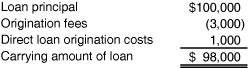
310-20-55-19
The following Examples and estimates are illustrative only and are not intended to modify or limit in any way the provisions of this Subtopic. All Examples assume that principal and interest payments are made on the last day of the year.
310-20-55-20
This Example illustrates the guidance in paragraphs , displaying amortization under the interest method using the contractual payment terms and assuming no prepayments. This Example has the following assumptions.
310-20-55-21
On January 1, 19X7, Entity A originates a 10-year $100,000 loan with a 10 percent stated interest rate. The contract specifies equal annual payments of $16,275 through December 31, 19Y6. The contract also specifies that no penalty will be charged for prepayments of the loan. Entity A charges a 3 percent ($3,000) nonrefundable fee to the borrower and incurs $1,000 in direct loan origination costs (attorney fees, appraisal, title insurance, wages and payroll-related fringe benefits of employees performing origination activities, outside broker's fee). The carrying amount of the loan is computed as follows.
  • Loan principal " $100,000 " Origination fees " (3,000)" Direct loan origination costs " 1,000 " Carrying amount of loan " $98,000 "
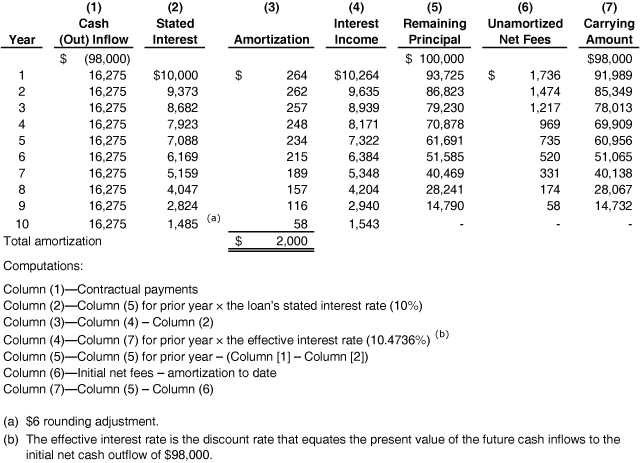
310-20-55-22
Entity A accounts for this loan using contractual payments to apply the interest method of amortization. In calculating the effective rate to apply the interest method, the discount rate necessary to equate 10 annual payments of $16,275 to the initial carrying amount of $98,000 is approximately 10.4736 percent. The amortization if no prepayment occurs is shown in the following table.
  • (1) (2) (3) (4) (5) (6) (7) Year Cash (Out) Inflow Stated Interest Amortization Interest Income Remaining Principal Unamortized Net Fees Carrying Amount " $(98,000)" " $100,000 " " $98,000 " 1 " 16,275 " " $10,000 " $264 " $10,264 " " 93,725 " " $1,736 " " 91,989 " 2 " 16,275 " " 9,373 " 262 " 9,635 " " 86,823 " " 1,474 " " 85,349 " 3 " 16,275 " " 8,682 " 257 " 8,939 " " 79,230 " " 1,217 " " 78,013 " 4 " 16,275 " " 7,923 " 248 " 8,171 " " 70,878 " 969 " 69,909 " 5 " 16,275 " " 7,088 " 234 " 7,322 " " 61,691 " 735 " 60,956 " 6 " 16,275 " " 6,169 " 215 " 6,384 " " 51,585 " 520 " 51,065 " 7 " 16,275 " " 5,159 " 189 " 5,348 " " 40,469 " 331 " 40,138 " 8 " 16,275 " " 4,047 " 157 " 4,204 " " 28,241 " 174 " 28,067 " 9 " 16,275 " " 2,824 " 116 " 2,940 " " 14,790 " 58 " 14,732 " 10 " 16,275 " " 1,485 " (a) 58 " 1,543 " - - - Total amortization " $2,000 " Computations: Column (1)—Contractual payments Column (2)—Column (5) for prior year × the loan's stated interest rate (10%) Column (3)—Column (4) - Column (2) Column (4)—Column (7) for prior year × the effective interest rate (10.4736%) (b) Column (5)—Column (5) for prior year - (Column [1] - Column [2]) Column (6)—Initial net fees - amortization to date Column (7)—Column (5) - Column (6) (a) $6 rounding adjustment. (b) "The effective interest rate is the discount rate that equates the present value of the future cash inflows to the initial net cash outflow of $98,000."
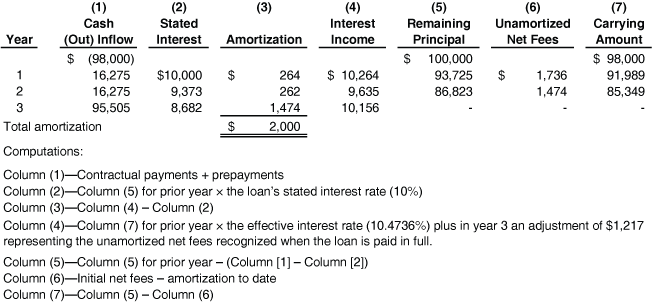
310-20-55-23
This Example illustrates the guidance in paragraphs , displaying amortization under the interest method using contractual payment terms with full prepayment in the third year. This Example has the following assumptions.
310-20-55-24
On January 1, 19X7, Entity B originates a 10-year $100,000 loan with a 10 percent stated interest rate. The contract specifies equal annual payments of $16,275 through December 31, 19Y6. The contract also specifies that no penalty will be charged for prepayments of the loan. Entity B charges a 3 percent ($3,000) nonrefundable fee to the borrower and incurs $1,000 in direct loan origination costs.
310-20-55-25
Entity B accounts for this loan using contractual payments to apply the interest method of amortization. The amortization if the borrower prepays the remaining principal at the end of Year 3 is shown in the following table.
  • (1) (2) (3) (4) (5) (6) (7) Year Cash (Out) Inflow Stated Interest Amortization Interest Income Remaining Principal Unamortized Net Fees Carrying Amount " $(98,000)" " $100,000 " " $98,000 " 1 " 16,275 " " $10,000 " $264 " $10,264 " " 93,725 " " $1,736 " " 91,989 " 2 " 16,275 " " 9,373 " 262 " 9,635 " " 86,823 " " 1,474 " " 85,349 " 3 " 95,505 " " 8,682 " " 1,474 " " 10,156 " - - - Total amortization " $2,000 " Computations: Column (1)—Contractual payments + prepayments Column (2)—Column (5) for prior year × the loan's stated interest rate (10%) Column (3)—Column (4) - Column (2) "Column (4)—Column (7) for prior year × the effective interest rate (10.4736%) plus in year 3 an adjustment of $1,217 representing the unamortized net fees recognized when the loan is paid in full." Column (5)—Column (5) for prior year - (Column [1] - Column [2]) Column (6)—Initial net fees - amortization to date Column (7)—Column (5) - Column (6)
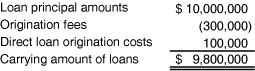
310-20-55-26
This Example illustrates the guidance in paragraph 310-20-35-26, displaying amortization under the interest method using the anticipated prepayment patterns for a large number of loans. This Example has the following assumptions.
310-20-55-27
On January 1, 19X7, Entity C originates 1,000 10-year $10,000 loans with 10 percent stated interest rates. Each contract specifies equal annual payments through December 31, 19Y6. The contracts also specify that no penalty will be charged for prepayments. Entity C charges each borrower a 3 percent ($300) fee and incurs $100 in direct origination costs for each loan. The carrying amount of the loans is computed as follows.
  • Loan principal amounts " $10,000,000 " Origination fees " (300,000)" Direct loan origination costs " 100,000 " Carrying amount of loans " $9,800,000 "
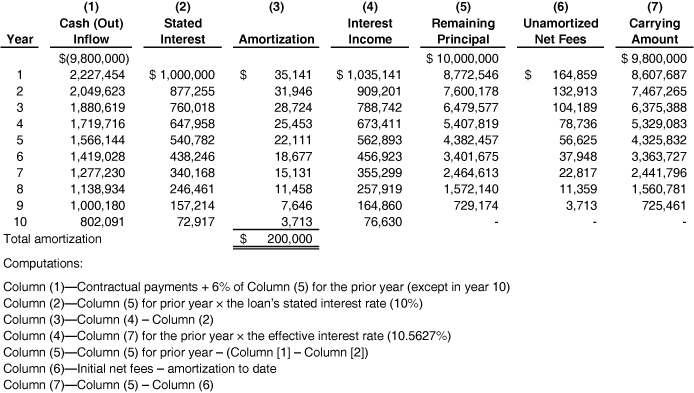
310-20-55-28
Entity C chooses to account for this large number of loans using anticipated prepayment patterns to apply the interest method of amortization. Entity C estimates a constant prepayment rate of 6 percent per year, which is consistent with Entity C's prior experience with similar loans and Entity C's expectation of ongoing experience. The amortization when prepayments occur as anticipated is shown in the following table.
  • (1) (2) (3) (4) (5) (6) (7) Year Cash (Out) Inflow Stated Interest Amortization Interest Income Remaining Principal Unamortized Net Fees Carrying Amount " $(9,800,000)" " $10,000,000 " " $9,800,000 " 1 " 2,227,454 " " $1,000,000 " " $35,141 " " $1,035,141 " " 8,772,546 " " $164,859 " " 8,607,687 " 2 " 2,049,623 " " 877,255 " " 31,946 " " 909,201 " " 7,600,178 " " 132,913 " " 7,467,265 " 3 " 1,880,619 " " 760,018 " " 28,724 " " 788,742 " " 6,479,577 " " 104,189 " " 6,375,388 " 4 " 1,719,716 " " 647,958 " " 25,453 " " 673,411 " " 5,407,819 " " 78,736 " " 5,329,083 " 5 " 1,566,144 " " 540,782 " " 22,111 " " 562,893 " " 4,382,457 " " 56,625 " " 4,325,832 " 6 " 1,419,028 " " 438,246 " " 18,677 " " 456,923 " " 3,401,675 " " 37,948 " " 3,363,727 " 7 " 1,277,230 " " 340,168 " " 15,131 " " 355,299 " " 2,464,613 " " 22,817 " " 2,441,796 " 8 " 1,138,934 " " 246,461 " " 11,458 " " 257,919 " " 1,572,140 " " 11,359 " " 1,560,781 " 9 " 1,000,180 " " 157,214 " " 7,646 " " 164,860 " " 729,174 " " 3,713 " " 725,461 " 10 " 802,091 " " 72,917 " " 3,713 " " 76,630 " - - - Total amortization " $200,000 " Computations: Column (1)—Contractual payments + 6% of Column (5) for the prior year (except in year 10) Column (2)—Column (5) for prior year × the loan's stated interest rate (10%) Column (3)—Column (4) - Column (2) Column (4)—Column (7) for the prior year × the effective interest rate (10.5627%) Column (5)—Column (5) for prior year - (Column [1] - Column [2]) Column (6)—Initial net fees - amortization to date Column (7)—Column (5) - Column (6)
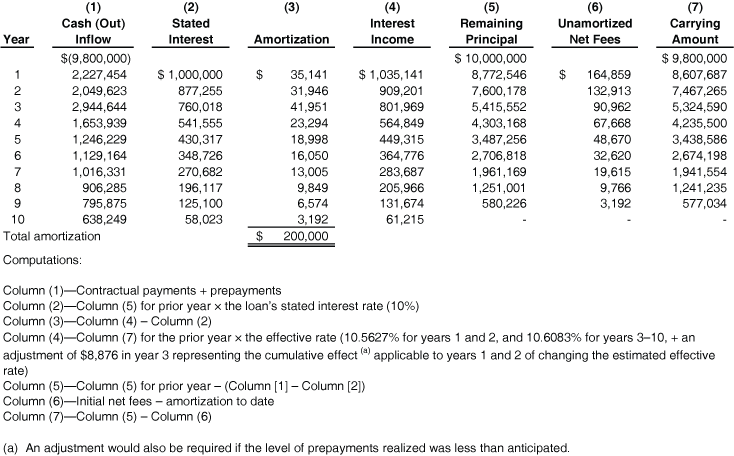
310-20-55-29
This Example illustrates the guidance in paragraph 310-20-35-26, displaying amortization under the interest method using anticipated prepayment patterns with actual prepayment experience that differs from the anticipated amounts. This Example has the following assumptions.
310-20-55-30
On January 1, 19X7, Entity D originates 1,000 10-year $10,000 loans with 10 percent stated interest rates. Each contract specifies equal annual payments through December 31, 19Y6. The contracts also specify that no penalty will be charged for prepayments. Entity D charges each borrower a 3 percent ($300) fee and incurs $100 in direct origination costs for each loan.
310-20-55-31
Entity D chooses to account for this portfolio of loans using anticipated prepayment patterns to apply the interest method of amortization. Entity D estimates a constant prepayment rate of 6 percent per year, which is consistent with Entity D's prior experience with similar loans and Entity D's expectation of ongoing experience.
310-20-55-32
The following table illustrates the adjustment required by paragraph 310-20-35-26 of this Subtopic when an entity's actual prepayment experience differs from the amounts anticipated. The loans have actually prepaid at a rate of 6 percent in Years 1 and 2 and 20 percent in Year 3, and based on the new information at the end of Year 3, Entity D revises its estimate of prepayment experience to anticipate that 10 percent of the loans will prepay in Year 4 and 6 percent of the loans will prepay in remaining years. The carrying amount of the loans at the end of Year 3 is adjusted to the amount that would have existed had the new effective yield been applied since January 1, 19X7. Included in amortization in Year 3 is an adjustment for the difference in the prior effective yield and the new effective yield applied to amounts outstanding in Years 1 and 2. Amortization in Years 4-10 assumes the new estimates of prepayment experience occur as anticipated.
  • (1) (2) (3) (4) (5) (6) (7) Year Cash (Out) Inflow Stated Interest Amortization Interest Income Remaining Principal Unamortized Net Fees Carrying Amount " $(9,800,000)" " $10,000,000 " " $9,800,000 " 1 " 2,227,454 " " $1,000,000 " " $35,141 " " $1,035,141 " " 8,772,546 " " $164,859 " " 8,607,687 " 2 " 2,049,623 " " 877,255 " " 31,946 " " 909,201 " " 7,600,178 " " 132,913 " " 7,467,265 " 3 " 2,944,644 " " 760,018 " " 41,951 " " 801,969 " " 5,415,552 " " 90,962 " " 5,324,590 " 4 " 1,653,939 " " 541,555 " " 23,294 " " 564,849 " " 4,303,168 " " 67,668 " " 4,235,500 " 5 " 1,246,229 " " 430,317 " " 18,998 " " 449,315 " " 3,487,256 " " 48,670 " " 3,438,586 " 6 " 1,129,164 " " 348,726 " " 16,050 " " 364,776 " " 2,706,818 " " 32,620 " " 2,674,198 " 7 " 1,016,331 " " 270,682 " " 13,005 " " 283,687 " " 1,961,169 " " 19,615 " " 1,941,554 " 8 " 906,285 " " 196,117 " " 9,849 " " 205,966 " " 1,251,001 " " 9,766 " " 1,241,235 " 9 " 795,875 " " 125,100 " " 6,574 " " 131,674 " " 580,226 " " 3,192 " " 577,034 " 10 " 638,249 " " 58,023 " " 3,192 " " 61,215 " - - - Total amortization " $200,000 " Computations: Column (1)—Contractual payments + prepayments Column (2)—Column (5) for prior year × the loan's stated interest rate (10%) Column (3)—Column (4) - Column (2) "Column (4)—Column (7) for the prior year × the effective rate (10.5627% for years 1 and 2, and 10.6083% for years 3-10, + an adjustment of $8,876 in year 3 representing the cumulative effect (a) applicable to years 1 and 2 of changing the estimated effective rate)" Column (5)—Column (5) for prior year - (Column [1] - Column [2]) Column (6)—Initial net fees - amortization to date Column (7)—Column (5) - Column (6) (a) An adjustment would also be required if the level of prepayments realized was less than anticipated.
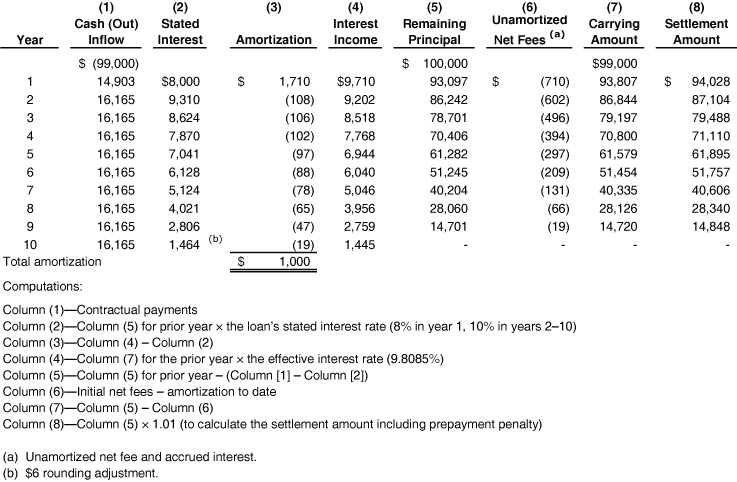
310-20-55-33
This Example illustrates the guidance in paragraph 310-20-35-18(a), displaying amortization under the interest method. The effective yield is used to recognize an amount in excess of net fees for the loan with an increasing stated rate. The excess recognized is permissible only to the extent that the loan agreement provides for a prepayment penalty that is effective through the loan term. This Example has the following assumptions.
310-20-55-34
Entity E grants a 10-year $100,000 loan with an 8 percent stated interest rate in Year 1 and 10 percent in Years 2-10. Entity E receives net fees of $1,000 related to this loan. The contract specifies that the borrower must pay a penalty equal to 1 percent of any principal prepaid. Application of the effective yield to recognize an amount in excess of net fees is appropriate for a loan with an increasing stated interest rate only to the extent that the loan agreement provides for a prepayment penalty that is effective throughout the loan term. The loan would be accounted for as follows.
  • (1) (2) (3) (4) (5) (6) (7) (8) Year Cash (Out) Inflow Stated Interest Amortization Interest Income Remaining Principal Unamortized Net Fees (a) Carrying Amount Settlement Amount " $(99,000)" " $100,000 " " $99,000 " 1 " 14,903 " " $8,000 " " $1,710 " " $9,710 " " 93,097 " $(710) " 93,807 " " $94,028 " 2 " 16,165 " " 9,310 " (108) " 9,202 " " 86,242 " (602) " 86,844 " " 87,104 " 3 " 16,165 " " 8,624 " (106) " 8,518 " " 78,701 " (496) " 79,197 " " 79,488 " 4 " 16,165 " " 7,870 " (102) " 7,768 " " 70,406 " (394) " 70,800 " " 71,110 " 5 " 16,165 " " 7,041 " (97) " 6,944 " " 61,282 " (297) " 61,579 " " 61,895 " 6 " 16,165 " " 6,128 " (88) " 6,040 " " 51,245 " (209) " 51,454 " " 51,757 " 7 " 16,165 " " 5,124 " (78) " 5,046 " " 40,204 " (131) " 40,335 " " 40,606 " 8 " 16,165 " " 4,021 " (65) " 3,956 " " 28,060 " (66) " 28,126 " " 28,340 " 9 " 16,165 " " 2,806 " (47) " 2,759 " " 14,701 " (19) " 14,720 " " 14,848 " 10 " 16,165 " " 1,464 " (b) (19) " 1,445 " - - - - Total amortization " $1,000 " Computations: Column (1)—Contractual payments "Column (2)—Column (5) for prior year × the loan's stated interest rate (8% in year 1, 10% in years 2-10)" Column (3)—Column (4) - Column (2) Column (4)—Column (7) for the prior year × the effective interest rate (9.8085%) Column (5)—Column (5) for prior year - (Column [1] - Column [2]) Column (6)—Initial net fees - amortization to date Column (7)—Column (5) - Column (6) Column (8)—Column (5) × 1.01 (to calculate the settlement amount including prepayment penalty) (a) Unamortized net fee and accrued interest. (b) $6 rounding adjustment.
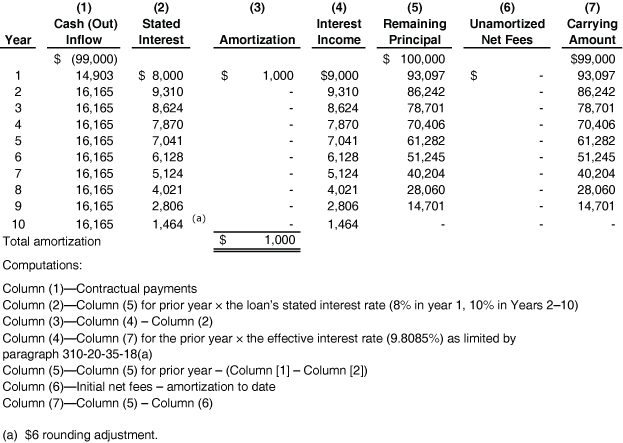
310-20-55-35
This Example illustrates the guidance in paragraph 310-20-35-18(a) for the application of the interest method of amortization with an increasing rate loan and with no penalty charged for prepayment of principal. This Example has the following assumptions.
310-20-55-36
Entity F grants a 10-year $100,000 loan. The contract provides for 8 percent interest in Year 1 and 10 percent interest in Years 2-10. Entity F receives net fees of $1,000 related to this loan. The contract specifies that no penalty will be charged for prepayment of principal.
310-20-55-37
The discount factor that equates the present value of the cash inflows in Column 1 with the initial cash outflow of $99,000 is 9.8085 percent. In Year 1, recognition of interest income on the investment of $99,000 at a rate of 9.8085 percent would cause the investment to be $93,807, or $710 greater than the amount at which the borrower could settle the obligation. Because the condition set forth in paragraph 310-20-35-18(a) is not met, recognition of an amount greater than the net fee is not permitted. The loan would be accounted for as follows.
  • (1) (2) (3) (4) (5) (6) (7) Year Cash (Out) Inflow Stated Interest Amortization Interest Income Remaining Principal Unamortized Net Fees Carrying Amount " $(99,000)" " $100,000 " " $99,000 " 1 " 14,903 " " $8,000 " " $1,000 " " $9,000 " " 93,097 " $- " 93,097 " 2 " 16,165 " " 9,310 " - " 9,310 " " 86,242 " - " 86,242 " 3 " 16,165 " " 8,624 " - " 8,624 " " 78,701 " - " 78,701 " 4 " 16,165 " " 7,870 " - " 7,870 " " 70,406 " - " 70,406 " 5 " 16,165 " " 7,041 " - " 7,041 " " 61,282 " - " 61,282 " 6 " 16,165 " " 6,128 " - " 6,128 " " 51,245 " - " 51,245 " 7 " 16,165 " " 5,124 " - " 5,124 " " 40,204 " - " 40,204 " 8 " 16,165 " " 4,021 " - " 4,021 " " 28,060 " - " 28,060 " 9 " 16,165 " " 2,806 " - " 2,806 " " 14,701 " - " 14,701 " 10 " 16,165 " " 1,464 " (a) - " 1,464 " - - - Total amortization " $1,000 " Computations: Column (1)—Contractual payments "Column (2)—Column (5) for prior year × the loan's stated interest rate (8% in year 1, 10% in Years 2-10)" Column (3)—Column (4) - Column (2) "Column (4)—Column (7) for the prior year × the effective interest rate (9.8085%) as limited by paragraph 310-20-35-18(a)" Column (5)—Column (5) for prior year - (Column [1] - Column [2]) Column (6)—Initial net fees - amortization to date Column (7)—Column (5) - Column (6) (a) $6 rounding adjustment.
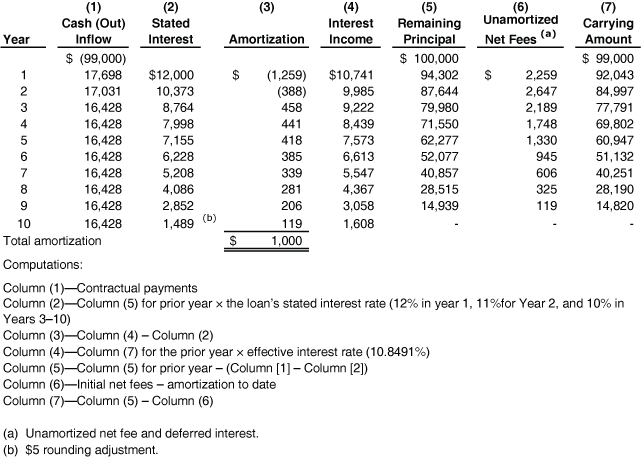
310-20-55-38
This Example illustrates the guidance in paragraph 310-20-35-18(b) for the application of the interest method for a loan with a decreasing interest rate. This Example has the following assumptions.
310-20-55-39
Entity G grants a 10-year $100,000 mortgage. Entity G receives net fees of $1,000 related to this loan. The contract provides for an interest rate of 12 percent in Year 1, 11 percent in Year 2, and 10 percent thereafter. The loan would be accounted for as follows.
  • (1) (2) (3) (4) (5) (6) (7) Year Cash (Out) Inflow Stated Interest Amortization Interest Income Remaining Principal Unamortized Net Fees (a) Carrying Amount " $(99,000)" " $100,000 " " $99,000 " 1 " 17,698 " " $12,000 " " $(1,259)" " $10,741 " " 94,302 " " $2,259 " " 92,043 " 2 " 17,031 " " 10,373 " (388) " 9,985 " " 87,644 " " 2,647 " " 84,997 " 3 " 16,428 " " 8,764 " 458 " 9,222 " " 79,980 " " 2,189 " " 77,791 " 4 " 16,428 " " 7,998 " 441 " 8,439 " " 71,550 " " 1,748 " " 69,802 " 5 " 16,428 " " 7,155 " 418 " 7,573 " " 62,277 " " 1,330 " " 60,947 " 6 " 16,428 " " 6,228 " 385 " 6,613 " " 52,077 " 945 " 51,132 " 7 " 16,428 " " 5,208 " 339 " 5,547 " " 40,857 " 606 " 40,251 " 8 " 16,428 " " 4,086 " 281 " 4,367 " " 28,515 " 325 " 28,190 " 9 " 16,428 " " 2,852 " 206 " 3,058 " " 14,939 " 119 " 14,820 " 10 " 16,428 " " 1,489 " (b) 119 " 1,608 " - - - Total amortization " $1,000 " Computations: Column (1)—Contractual payments "Column (2)—Column (5) for prior year × the loan's stated interest rate (12% in year 1, 11%for Year 2, and 10% in Years 3-10)" Column (3)—Column (4) - Column (2) Column (4)—Column (7) for the prior year × effective interest rate (10.8491%) Column (5)—Column (5) for prior year - (Column [1] - Column [2]) Column (6)—Initial net fees - amortization to date Column (7)—Column (5) - Column (6) (a) Unamortized net fee and deferred interest. (b) $5 rounding adjustment.
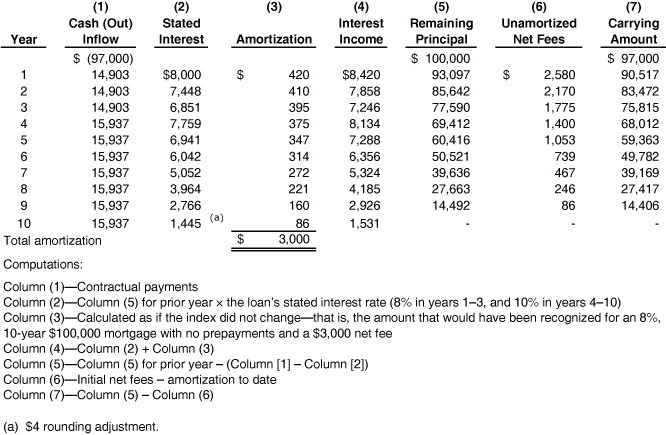
310-20-55-40
This Example illustrates the guidance in paragraph 310-20-35-18(c) for the application of the interest rate method for a variable rate loan with the amortization based on the index at the date the loan is granted ignoring subsequent changes in the factor. This Example has the following assumptions.
310-20-55-41
Entity H grants a 10-year variable rate mortgage. The loan's interest rate and payment are adjusted annually based on the weekly Treasury bill index plus 1 percent. At the date the loan is granted, this index is 7 percent and does not change until the end of Year 3. The first year loan interest rate is 8 percent (equal to the Treasury bill index plus 1 percent). Entity H receives net fees of $3,000. At the end of Year 3 the index changes to 9 percent and does not change again. Therefore, the loan's stated interest rate is 8 percent for Years 1-3 and 10 percent for Years 4-10. Entity H chooses to determine the amortization based on the index at the date the loan is granted and to ignore subsequent changes in the factor. The loan would be accounted for as follows.
  • (1) (2) (3) (4) (5) (6) (7) Year Cash (Out) Inflow Stated Interest Amortization Interest Income Remaining Principal Unamortized Net Fees Carrying Amount " $(97,000)" " $100,000 " " $97,000 " 1 " 14,903 " " $8,000 " $420 " $8,420 " " 93,097 " " $2,580 " " 90,517 " 2 " 14,903 " " 7,448 " 410 " 7,858 " " 85,642 " " 2,170 " " 83,472 " 3 " 14,903 " " 6,851 " 395 " 7,246 " " 77,590 " " 1,775 " " 75,815 " 4 " 15,937 " " 7,759 " 375 " 8,134 " " 69,412 " " 1,400 " " 68,012 " 5 " 15,937 " " 6,941 " 347 " 7,288 " " 60,416 " " 1,053 " " 59,363 " 6 " 15,937 " " 6,042 " 314 " 6,356 " " 50,521 " 739 " 49,782 " 7 " 15,937 " " 5,052 " 272 " 5,324 " " 39,636 " 467 " 39,169 " 8 " 15,937 " " 3,964 " 221 " 4,185 " " 27,663 " 246 " 27,417 " 9 " 15,937 " " 2,766 " 160 " 2,926 " " 14,492 " 86 " 14,406 " 10 " 15,937 " " 1,445 " (a) 86 " 1,531 " - - - Total amortization " $3,000 " Computations: Column (1)—Contractual payments "Column (2)—Column (5) for prior year × the loan's stated interest rate (8% in years 1-3, and 10% in years 4-10)" "Column (3)—Calculated as if the index did not change—that is, the amount that would have been recognized for an 8%, 10-year $100,000 mortgage with no prepayments and a $3,000 net fee" Column (4)—Column (2) + Column (3) Column (5)—Column (5) for prior year - (Column (1) - Column (2]) Column (6)—Initial net fees - amortization to date Column (7)—Column (5) - Column (6) (a) $4 rounding adjustment.
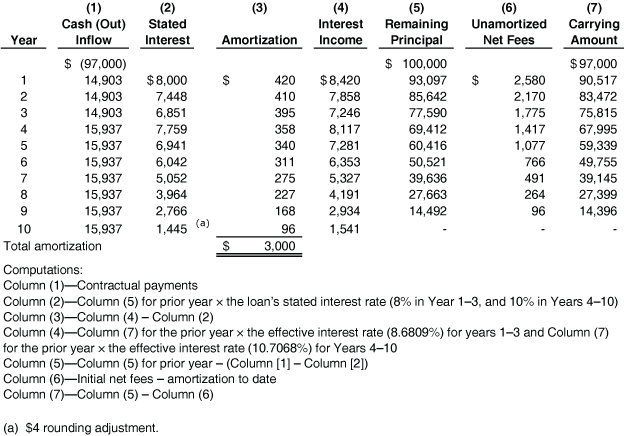
310-20-55-42
This Example illustrates the guidance in paragraph 310-20-35-18(c) for the application of the interest method to a variable rate loan with amortization recalculated for subsequent changes in loan's index. This Example has the following assumptions.
310-20-55-43
Entity I grants a 10-year variable rate mortgage. The loan's interest rate and payment are adjusted annually based on the weekly Treasury bill index plus 1 percent. At the date the loan is granted, this index is 7 percent and does not change until the end of Year 3. The first year loan interest rate is 8 percent (equal to the Treasury bill index plus 1 percent). Entity I receives net fees of $3,000. At the end of Year 3 the index changes to 9 percent and does not change again. Therefore, the loan's stated interest rate is 8 percent for Years 1-3 and 10 percent for Years 4-10. Entity I chooses to recalculate a new amortization schedule each time the loan's index changes. The loan would be accounted for as follows.
  • (1) (2) (3) (4) (5) (6) (7) Year Cash (Out) Inflow Stated Interest Amortization Interest Income Remaining Principal Unamortized Net Fees Carrying Amount " $(97,000)" " $100,000 " " $97,000 " 1 " 14,903 " " $8,000 " $420 " $8,420 " " 93,097 " " $2,580 " " 90,517 " 2 " 14,903 " " 7,448 " 410 " 7,858 " " 85,642 " " 2,170 " " 83,472 " 3 " 14,903 " " 6,851 " 395 " 7,246 " " 77,590 " " 1,775 " " 75,815 " 4 " 15,937 " " 7,759 " 358 " 8,117 " " 69,412 " " 1,417 " " 67,995 " 5 " 15,937 " " 6,941 " 340 " 7,281 " " 60,416 " " 1,077 " " 59,339 " 6 " 15,937 " " 6,042 " 311 " 6,353 " " 50,521 " 766 " 49,755 " 7 " 15,937 " " 5,052 " 275 " 5,327 " " 39,636 " 491 " 39,145 " 8 " 15,937 " " 3,964 " 227 " 4,191 " " 27,663 " 264 " 27,399 " 9 " 15,937 " " 2,766 " 168 " 2,934 " " 14,492 " 96 " 14,396 " 10 " 15,937 " " 1,445 " (a) 96 " 1,541 " - - - Total amortization " $3,000 " Computations: Column (1)—Contractual payments "Column (2)—Column (5) for prior year × the loan's stated interest rate (8% in Year 1-3, and 10% in Years 4-10)" Column (3)—Column (4) - Column (2) Column (4)—Column (7) for the prior year × the effective interest rate (8.6809%) for years 1-3 and Column (7) for the prior year × the effective interest rate (10.7068%) for Years 4-10 Column (5)—Column (5) for prior year - (Column [1] - Column [2]) Column (6)—Initial net fees - amortization to date Column (7)—Column (5) - Column (6) (a) $4 rounding adjustment.
310-20-55-44
The following Cases illustrate the guidance in paragraph 310-20-35-16 for the application of the interest method of amortization using the contract life with a partial prepayment in Year 3.
310-20-55-45
Example 2 (paragraph 310-20-55-23) illustrates the application of the guidance in paragraphs by a lender that is using contract life to amortize net deferred fees and costs for a group of loans with a full prepayment in Year 3. If the lender receives a partial prepayment in Year 3 rather than a full prepayment, the lender has two options to calculate the adjustment to unamortized net fees as required in paragraph 310-20-35-26, which states that a lender using contract life to amortize net fees and costs must adjust the unamortized amount if, and when, loan prepayments occur. Such prepayments should not result in a change in the effective interest rate of the loan. The lender should calculate the adjustment to unamortized net fees under either of the following Cases depending on the terms of the loan contract:
  1. a
    The lender will determine a new annual payment assuming the borrower will continue to make the payments through the original term of the loan contract (Case A).
  2. b
    The borrower will continue to make the original annual payment, however, over a shorter period than the term specified in the loan contract (Case B).
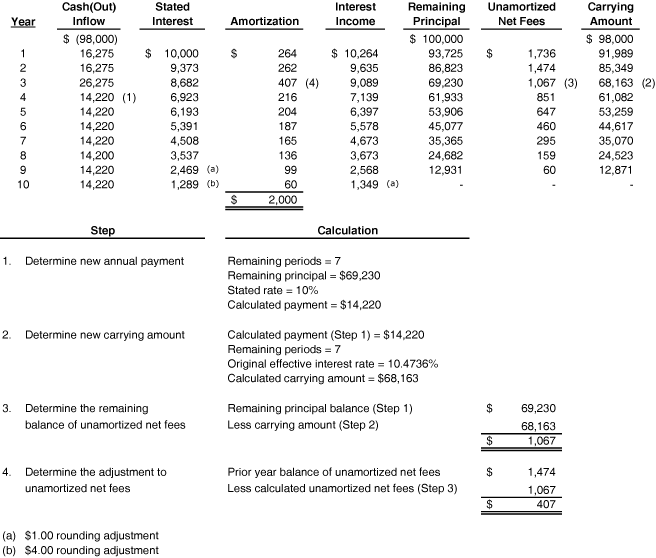
310-20-55-46
The following tables illustrate how the lender should calculate the adjustment to unamortized net fees assuming the borrower will continue to make the payments through the original term of the loan contract.
  • Year Cash(Out) Inflow Stated Interest Amortization Interest Income Remaining Principal Unamortized Net Fees Carrying Amount " $(98,000)" " $100,000 " " $98,000 " 1 " 16,275 " " $10,000 " $264 " $10,264 " " 93,725 " " $1,736 " " 91,989 " 2 " 16,275 " " 9,373 " 262 " 9,635 " " 86,823 " " 1,474 " " 85,349 " 3 " 26,275 " " 8,682 " 407 (4) " 9,089 " " 69,230 " " 1,067 " (3) " 68,163 " (2) 4 " 14,220 " (1) " 6,923 " 216 " 7,139 " " 61,933 " 851 " 61,082 " 5 " 14,220 " " 6,193 " 204 " 6,397 " " 53,906 " 647 " 53,259 " 6 " 14,220 " " 5,391 " 187 " 5,578 " " 45,077 " 460 " 44,617 " 7 " 14,220 " " 4,508 " 165 " 4,673 " " 35,365 " 295 " 35,070 " 8 " 14,200 " " 3,537 " 136 " 3,673 " " 24,682 " 159 " 24,523 " 9 " 14,220 " " 2,469 " (a) 99 " 2,568 " " 12,931 " 60 " 12,871 " 10 " 14,220 " " 1,289 " (b) 60 " 1,349 " (a) - - - " $2,000 " Step Calculation 1. Determine new annual payment Remaining periods = 7 "Remaining principal = $69,230" Stated rate = 10% "Calculated payment = $14,220" 2. Determine new carrying amount "Calculated payment (Step 1) = $14,220" Remaining periods = 7 Original effective interest rate = 10.4736% "Calculated carrying amount = $68,163" 3. Determine the remaining Remaining principal balance (Step 1) " $69,230 " balance of unamortized net fees Less carrying amount (Step 2) " 68,163 " " $1,067 " 4. Determine the adjustment to Prior year balance of unamortized net fees " $1,474 " unamortized net fees Less calculated unamortized net fees (Step 3) " 1,067 " $407 (a) $1.00 rounding adjustment (b) $4.00 rounding adjustment
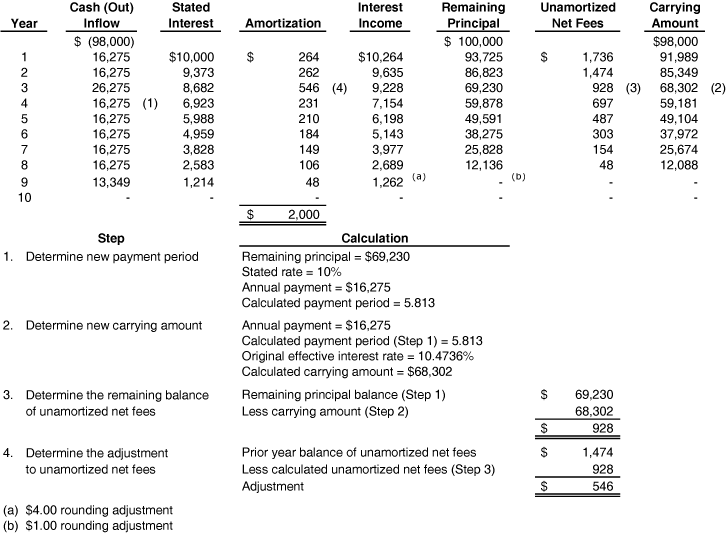
310-20-55-47
The following tables illustrate how the lender should calculate the adjustment to unamortized net fees assuming the borrower will continue to make the original annual payment, however, over a shorter period than the term specified in the loan contract.
  • Year Cash (Out) Inflow Stated Interest Amortization Interest Income Remaining Principal Unamortized Net Fees Carrying Amount " $(98,000)" " $100,000 " " $98,000 " 1 " 16,275 " " $10,000 " $264 " $10,264 " " 93,725 " " $1,736 " " 91,989 " 2 " 16,275 " " 9,373 " 262 " 9,635 " " 86,823 " " 1,474 " " 85,349 " 3 " 26,275 " " 8,682 " 546 (4) " 9,228 " " 69,230 " 928 (3) " 68,302 " (2) 4 " 16,275 " (1) " 6,923 " 231 " 7,154 " " 59,878 " 697 " 59,181 " 5 " 16,275 " " 5,988 " 210 " 6,198 " " 49,591 " 487 " 49,104 " 6 " 16,275 " " 4,959 " 184 " 5,143 " " 38,275 " 303 " 37,972 " 7 " 16,275 " " 3,828 " 149 " 3,977 " " 25,828 " 154 " 25,674 " 8 " 16,275 " " 2,583 " 106 " 2,689 " " 12,136 " 48 " 12,088 " 9 " 13,349 " " 1,214 " 48 " 1,262 " (a) - (b) - - 10 - - - - - - - " $2,000 " Step Calculation 1. Determine new payment period "Remaining principal = $69,230" Stated rate = 10% "Annual payment = $16,275" Calculated payment period = 5.813 2. Determine new carrying amount "Annual payment = $16,275" Calculated payment period (Step 1) = 5.813 Original effective interest rate = 10.4736% "Calculated carrying amount = $68,302" 3. Determine the remaining balance Remaining principal balance (Step 1) " $69,230 " of unamortized net fees Less carrying amount (Step 2) " 68,302 " $928 4. Determine the adjustment Prior year balance of unamortized net fees " $1,474 " to unamortized net fees Less calculated unamortized net fees (Step 3) 928 Adjustment $546 (a) $4.00 rounding adjustment (b) $1.00 rounding adjustment
310-20-55-48
This Example illustrates the guidance in paragraphs .
310-20-55-49
Assume that a credit facility provides for the extension of multiple, unscheduled drawdowns (or loans) with varying maturities. Also assume that the facility does not have the characteristics of a revolving line of credit (for example, repayments of amounts borrowed are not available for reborrowing) and drawdowns are anticipated. The commitment fee shall be deferred until the facility is exercised and a drawdown is made. Given the multiple, unscheduled drawdowns intended under the facility, a pro rata portion of the commitment fee (equal to the percentage of the loan drawn down to the total facility) shall be recognized over the life of the applicable drawdown as an adjustment of its yield.
310-20-55-50
For example, assume that a commitment fee net of deferrable costs of $100,000 is received at the inception of a 2-year facility of $10,000,000 that permits the borrower to make multiple, unscheduled drawdowns of varying maturities during the 2-year commitment period. Assume then that the borrower draws down a $1,000,000 loan due in 3 years in the fourth month of the 2-year commitment period. Assume further that the borrower draws down another $2,000,000 loan due in 5 years in the sixth month of the commitment period. The remainder of the facility expires unused. The commitment fee would be recognized as follows:
  1. a
    At inception of the facility. Qualifying costs to establish the credit facility would be deferred, and no fee income would be recognized because the entire fee is deferred until a drawdown occurs.
  2. b
    Months 1-3. No net fee income would be recognized because no drawdowns have occurred.
  3. c
    Month 4. A pro rata portion of the net commitment fee equal to the ratio of the drawdown to the total facility would be recognized over the life of the drawdown as an adjustment of yield. In this example: Current drawdown/Total facility x Net commitment fee = Amount to be recognized over the life of the drawdown as a yield adjustment. For example: $ 1,000,000/$10,000,000 x $100,000 = $10,000
  4. d
    Month 6. Similar to the month 4 illustration, a pro rata portion of the deferred net fee equal to the ratio of the current drawdown to the total facility would be recognized over the life of the drawdown as an adjustment of yield. In this example: $ 2,000,000/$10,000,000 x $100,000 = $20,000
  5. e
    Months 7-23. No additional net fee income other than amortization of net commitment fees recognized as yield adjustments would be recognized because no further drawdowns have occurred; thus, the remaining $70,000 net commitment fee would continue to be deferred.
  6. f
    Month 24. The remaining deferred net commitment fee of $70,000 would be recognized in income upon expiration of the facility because additional drawdowns are not possible.
310-20-55-51
This Example illustrates the guidance in Subtopic 310-20. The Example has the following assumptions:
  1. a
    At December 31, 20X2, a lender's net real estate loan receivable was $90,000. The net receivable was comprised of (a) $100,000 principal balance and (b) $10,000 allowance for credit losses due to the deterioration of the borrower's credit worthiness; the allowance was based on the underlying value of the real estate since the loan is collateral dependent.
  2. b
    Between December 31, 20X2 and March 31, 20X3, the borrower did not make principal payments. On March 31, 20X3, the real estate's estimated fair value was $75,000. The estimated costs to sell were $4,000.
  3. c
    On May 1, 20X3, the lender foreclosed on the real estate; the real estate's estimated fair value and costs to sell remained unchanged from March 31, 20X3. The real estate was classified as held for sale under Topic 360, subsequent to foreclosure.
  4. d
    At September 30, 20X3, the fair value of the property was $65,000. The estimated costs to sell were $3,000.
  5. e
    At March 31, 20X4, the fair value of the property was $80,000. The estimated costs to sell were $5,000.
310-20-55-52
On March 31, 20X3, the lender estimates expected credit losses using the fair value of the collateral in accordance with paragraphs . Accordingly, the lender should record an allowance for credit losses in the cumulative amount of $29,000 ($19,000 incremental amount plus $10,000 recorded previously) measured as the difference between the amortized cost basis ($100,000) and the fair value less cost to sell ($71,000). Upon foreclosure on May 1, 20X3, the application of paragraph 310-20-40-5 results in the measurement of a new cost basis (also $71,000) for long-lived assets received in full satisfaction of a receivable.
310-20-55-53
The fair value less cost to sell decrease to $62,000 as of September 30, 20X3, requires the lender to recognize an impairment of $9,000 ($71,000 - $62,000) under Topic 360. While the long-lived asset's fair value less cost to sell increased $13,000 ($75,000 - $62,000) as of March 31, 20X4, the lender's gain recognition is limited to the cumulative losses recognized and measured under Topic 360, or $9,000. The $29,000 of credit losses recognized previously under Subtopic 326-20 on financial instruments measured at amortized cost are excluded from the measurement of cumulative losses under Topic 360.
310-20-55-54
This Example illustrates the guidance in paragraph 310-20-35-9 to determine whether the terms of a modified loan are at least as favorable to the lender as the terms for comparable loans to other customers with similar collection risks who are not refinancing or restructuring a loan with the lender. This Example has the following assumptions.
310-20-55-55
On January 1, 20X1, Entity J originates a 10-year $100,000 consumer loan to an individual with a FICO score of 710. The loan’s stated interest rate is 7 percent. On June 30, 20X3, Entity J modifies the loan to reduce the effective interest rate to 3 percent. At the time of the modification, the borrower’s credit score is 650. Between the loan’s origination date and modification date, interest rates have decreased and the at-market interest rate for a borrower with a credit score of 650 is 5 percent at the date of the modification.
310-20-55-56
On the date of the modification, Entity J compares the effective interest rate on the modified loan with the effective interest rate that it has negotiated for new loans with similar characteristics originated to borrowers with a credit score that approximates 650. Entity J concludes that the effective interest rate on the modified loan (3 percent) is lower than the effective interest rate on a similar new loan (5 percent), and, therefore, Entity J does not have to assess whether the modification is more than minor in accordance with paragraph 310-20-35-11. Instead, the modification would be accounted for as a continuation of the existing loan.

310-20-60Relationships

Source downloaded: .Record version 33e4ae0cc1e7. Effective date must be checked in the source.

Investments—Beneficial Interests in Securitized Financial Assets

310-20-60-2
For guidance on the determination of whether a credit loss on beneficial interests exists and on interest income recognition on beneficial interests, see Section 325-40-15.

310-20-65Transition and Open Effective Date Information

Source downloaded: .Record version c177213f1976. Effective date must be checked in the source.

310-20-65-1
Paragraph superseded on 08/19/2021 after the end of the transition period stated in Accounting Standards Update No. 2017-08, Receivables—Nonrefundable Fees and Other Costs (Subtopic 310-20): Premium Amortization on Purchased Callable Debt Securities.
310-20-65-2
Paragraph superseded on 07/10/2023 after the end of the transition period stated in Accounting Standards Update No. 2020-08, Codification Improvements to Subtopic 310-20, Receivables—Nonrefundable Fees and Other Costs.

Related subtopics