ASC 470-50
Modifications and Extinguishments
470 Debt
Source downloaded: .Record version 96b4aef87343. Effective date must be checked in the source.
ASC 470-50 governs the debtor's accounting for extinguishments of debt and for modifications or exchanges of debt instruments with the same creditor (excluding troubled debt restructurings under 470-60 and conversions pursuant to conversion privileges under 470-20). Its core rule is the "10 percent cash flow test": if the present value of cash flows under the new instrument differs by at least 10% from the PV of the remaining cash flows of the original instrument (discounted at the original instrument's effective rate), the terms are substantially different and the transaction is accounted for as an extinguishment, with the new debt recorded at fair value and gain or loss recognized currently in income. If not substantially different, no gain or loss is recognized and a new effective interest rate is computed from the original carrying amount and revised cash flows.
Key points (7)
- Any difference between the reacquisition price of debt and its net carrying amount is recognized in income in the period of extinguishment as a separate item and is never amortized to future periods (470-50-40-2); if the fair value option was elected, net carrying amount equals fair value at the reacquisition date and instrument-specific credit risk amounts in OCI are included in net income (470-50-40-2A).
- An exchange of debt instruments with substantially different terms, or a substantial modification of terms, is accounted for as an extinguishment under 405-20-40-1 (470-50-40-6); otherwise modifications produce gain or loss only if the 405-20-40-1 conditions are met (470-50-40-8).
- Instruments are 'substantially different' if the PV of the new instrument's cash flows differs by at least 10 percent from the PV of the original's remaining cash flows; even if under 10 percent, extinguishment accounting applies if the change in fair value of an embedded conversion option is at least 10 percent of the original debt's carrying amount, or if a substantive conversion option is added or eliminated (470-50-40-10).
- Mechanics of the 10 percent test: include fees paid to or received from the creditor in the new instrument's cash flows, use the variable rate in effect for floating-rate debt, test both exercise and nonexercise of call/put features and use the assumptions producing the smaller change, discount at the original instrument's effective interest rate, and use terms from a year ago if there was a prior nonsubstantial modification within the year (470-50-40-12).
- If substantially different, the new debt is initially recorded at fair value, which determines the gain or loss and the new effective rate (470-50-40-13); if not, a new effective rate is computed from the original carrying amount adjusted for an increase (but not a decrease) in the fair value of an embedded conversion option, with the offset to additional paid-in capital (470-50-40-14 through 40-15).
- Creditor fees are included in extinguishment gain or loss if extinguishment accounting applies, but are deferred with existing premium/discount and amortized over the modified debt's term if not; third-party costs (e.g., legal fees) are capitalized and amortized like debt issue costs under extinguishment accounting but expensed as incurred otherwise (470-50-40-17 through 40-18).
- Line-of-credit and revolving-debt changes are tested by comparing borrowing capacity (remaining term × maximum available credit): if new capacity is greater than or equal to old, unamortized costs, creditor fees, and third-party costs are deferred over the new arrangement; if less, unamortized deferred costs are written off in proportion to the decrease in borrowing capacity (470-50-40-21); an intermediary acting as agent is looked through, while one acting as principal is treated as a creditor (470-50-40-19 through 40-20).
For students. Refinancings are ubiquitous, so the modification-versus-extinguishment analysis and the resulting fee/cost treatment is a recurring practice and exam issue. Common mistakes: discounting at the new instrument's rate instead of the original effective rate, omitting creditor fees from the new cash flows, and assuming that failing the 10 percent test ends the analysis for convertible debt, where the separate conversion-option tests in 470-50-40-10(a)-(b) still apply.
Machine-generated study aid for ASC 470-50. Check the source paragraphs below.
470-50-00Status
Source downloaded: .Record version 7b451ae15396. Effective date must be checked in the source.
470-50-05Overview and Background
Source downloaded: .Record version 5228a9672f9f. Effective date must be checked in the source.
- aRecourse or nonrecourse features
- bPriority of the obligation
- cCollateralized (including changes in collateral) or noncollateralized features
- dDebt covenants or waivers
- eThe guarantor (or elimination of the guarantor)
- fOption features.
470-50-15Scope and Scope Exceptions
Source downloaded: .Record version 9871c9cccc23. Effective date must be checked in the source.
Entities
Transactions
- aExtinguishments of debt effected by issuance of common or preferred stock, including redeemable and fixed-maturity preferred stock, that do not represent the exercise of a conversion right contained in the terms of the debt at issuance.
- aConversions of debt into equity securities of the debtor pursuant to conversion privileges provided in the terms of the debt at issuance. Additionally, the guidance in this Subtopic does not apply to conversions of convertible debt instruments pursuant to terms that reflect changes made by the debtor to the conversion privileges provided in the debt at issuance (including changes that involve the payment of consideration) for the purpose of inducing conversion. Guidance on conversions of debt instruments (including induced conversions) is contained in paragraphs 470-20-40-13 and 470-20-40-15.
- bExtinguishments of debt through a troubled debt restructuring. (See Section 470-60-15 for guidance on determining whether a modification or exchange of debt instruments is a troubled debt restructuring. If it is determined that the modification or exchange does not result in a troubled debt restructuring, the guidance in this Subtopic shall be applied.)
- cTransactions entered into between a debtor or a debtor's agent and a third party that is not the creditor.
- aConversions of debt instruments pursuant to conversion privileges provided in the terms of those instruments. Additionally, the guidance in this Subtopic does not apply to conversions of convertible debt instruments pursuant to terms that reflect changes made by the debtor to the conversion privileges provided in the existing terms of those debt instruments (including changes that involve the payment of consideration) for the purpose of inducing conversion. Guidance on conversions of debt instruments (including induced conversions) is contained in paragraphs 470-20-40-4, 470-20-40-13, and 470-20-40-15.
- bExtinguishments of debt through a troubled debt restructuring. (See Section 470-60-15 for guidance on determining whether a modification or exchange of debt instruments is a troubled debt restructuring. If it is determined that the modification or exchange does not result in a troubled debt restructuring, the guidance in this Subtopic shall be applied.)
- cTransactions entered into between a debtor or a debtor's agent and a third party that is not the creditor.
Other Considerations
470-50-40Derecognition
Source downloaded: .Record version 3c94e2a6de07. Effective date must be checked in the source.
Extinguishments of Debt
Extinguishment of Convertible Debt
Modifications and Exchanges
- aA modification or an exchange affects the terms of an embedded conversion option, from which the change in the fair value of the embedded conversion option (calculated as the difference between the fair value of the embedded conversion option immediately before and after the modification or exchange) is at least 10 percent of the carrying amount of the original debt instrument immediately before the modification or exchange.
- bA modification or an exchange of debt instruments adds a substantive conversion option or eliminates a conversion option that was substantive at the date of the modification or exchange. (For purposes of evaluating whether an embedded conversion option was substantive on the date it was added to or eliminated from a debt instrument, see paragraphs .)
- aThe cash flows of the new debt instrument include all cash flows specified by the terms of the new debt instrument plus any amounts paid by the debtor to the creditor less any amounts received by the debtor from the creditor as part of the exchange or modification. For a modification or an exchange of a freestanding equity-classified written call option held by a creditor that is a part of or directly related to a modification or an exchange of an existing debt instrument held by that same creditor (see paragraphs and 815-40-35-17(c)), an entity shall apply the guidance in paragraph 470-50-40-12A.
- bIf the original debt instrument or the new debt instrument has a floating interest rate, then the variable rate in effect at the date of the exchange or modification shall be used to calculate the cash flows of the variable-rate instrument.
- cIf either the new debt instrument or the original debt instrument is callable or puttable, then separate cash flow analyses shall be performed assuming exercise and nonexercise of the call or put. The cash flow assumptions that generate the smaller change would be the basis for determining whether the 10 percent threshold is met.
- dIf the debt instruments contain contingent payment terms or unusual interest rate terms, judgment shall be used to determine the appropriate cash flows.
- eThe discount rate to be used to calculate the present value of the cash flows is the effective interest rate, for accounting purposes, of the original debt instrument.
- fIf within a year of the current transaction the debt has been exchanged or modified without being deemed to be substantially different, then the debt terms that existed a year ago shall be used to determine whether the current exchange or modification is substantially different.
- gThe change in the fair value of an embedded conversion option resulting from an exchange of debt instruments or a modification in the terms of an existing debt instrument shall not be included in the 10 percent cash flow test. Rather, a separate test shall be performed by comparing the change in the fair value of the embedded conversion option to the carrying amount of the original debt instrument immediately before the modification, as specified in paragraph 470-50-40-10(a).
Subsequent Accounting for Modifications and Exchanges If Extinguishment Accounting Is Applied
Subsequent Accounting for Modifications and Exchanges If Extinguishment Accounting Is Not Applied
Fees between Debtor and Creditor
- aIf the exchange or modification is to be accounted for in the same manner as a debt extinguishment and the new debt instrument is initially recorded at fair value, then the fees paid or received shall be associated with the extinguishment of the old debt instrument and included in determining the debt extinguishment gain or loss to be recognized.
- bIf the exchange or modification is not to be accounted for in the same manner as a debt extinguishment, then the fees shall be associated with the replacement or modified debt instrument and, along with any existing unamortized premium or discount, amortized as an adjustment of interest expense over the remaining term of the replacement or modified debt instrument using the interest method.
Third-Party Costs of Exchange or Modification
- aIf the exchange or modification is to be accounted for in the same manner as a debt extinguishment and the new debt instrument is initially recorded at fair value, then the costs shall be associated with the new debt instrument and amortized over the term of the new debt instrument using the interest method in a manner similar to debt issue costs.
- bIf the exchange or modification is not to be accounted for in the same manner as a debt extinguishment, then the costs shall be expensed as incurred.
Transactions Involving Third-Party Intermediaries
Line-of-Credit or Revolving-Debt Arrangements
- aThe debtor shall compare the product of the remaining term and the maximum available credit of the old arrangement (this product is referred to as the borrowing capacity) with the borrowing capacity of the new arrangement.
- bIf the borrowing capacity of the new arrangement is greater than or equal to the borrowing capacity of the old arrangement, then any unamortized deferred costs, any fees paid to the creditor, and any third-party costs incurred shall be associated with the new arrangement (that is, deferred and amortized over the term of the new arrangement).
- cIf the borrowing capacity of the new arrangement is less than the borrowing capacity of the old arrangement, then:
- 1Any fees paid to the creditor and any third-party costs incurred shall be associated with the new arrangement (that is, deferred and amortized over the term of the new arrangement).
- 2Any unamortized deferred costs relating to the old arrangement at the time of the change shall be written off in proportion to the decrease in borrowing capacity of the old arrangement. The remaining unamortized deferred costs relating to the old arrangement shall be deferred and amortized over the term of the new arrangement.
- 1
- Fees between the debtor and the creditor include an increase or a decrease in the fair value of a freestanding equity-classified written call option held by a creditor (calculated in accordance with paragraph 815-40-35-16) that is modified or exchanged as a part of or is directly related to a modification or an exchange of a line-of-credit or revolving-debt arrangement held by that same creditor (see paragraphs and 815-40-35-17(c)). Third-party costs include an increase (but not a decrease) in the fair value of a freestanding equity-classified written call option held by a third party (calculated in accordance with paragraph 815-40-35-16) that is modified or exchanged as a part of or is directly related to a modification or an exchange of a line-of-credit or revolving-debt arrangement (see paragraphs and 815-40-35-17(c)).
- For fees between the debtor and the creditor or third-party costs not related to exchanges of or modifications to a line-of-credit or revolving-debt arrangements resulting in either a new line-of-credit or revolving-debt arrangement, see paragraphs 470-50-40-17 through 40-18A.
470-50-45Other Presentation Matters
Source downloaded: .Record version dcdd074aeba9. Effective date must be checked in the source.
470-50-50Disclosure
Source downloaded: .Record version b76883a33434. Effective date must be checked in the source.
470-50-55Implementation Guidance and Illustrations
Source downloaded: .Record version 7710ca96f151. Effective date must be checked in the source.
Implementation Guidance
- a If the intermediary's role is restricted to placing or reacquiring debt for the debtor without placing its own funds at risk, that would indicate that the intermediary is an agent. For example, that may be the case if the intermediary's own funds are committed and those funds are not truly at risk because the intermediary is made whole by the debtor (and therefore is indemnified against loss by the debtor). If the intermediary places and reacquires debt for the debtor by committing its funds and is subject to the risk of loss of those funds, that would indicate that the intermediary is acting as principal.
- b In an arrangement where an intermediary places notes issued by the debtor, if the placement is done under a best-efforts agreement, that would indicate that the intermediary is acting as agent. Under a best-efforts agreement, an agent agrees to buy only those securities that it is able to sell to others; if the agent is unable to remarket the debt, the issuer is obligated to pay off the debt. The intermediary may be acting as principal if the placement is done on a firmly committed basis, which requires the intermediary to hold any debt that it is unable to sell to others.
- c If the debtor directs the intermediary and the intermediary cannot independently initiate an exchange or modification of the debt instrument, that would indicate that the intermediary is an agent. The intermediary may be a principal if it acquires debt from or exchanges debt with another debt holder in the market and is subject to loss as a result of the transaction.
- d If the only compensation derived by an intermediary from its arrangement with the debtor is limited to a preestablished fee, that would indicate that the intermediary is an agent. If the intermediary derives gains based on the value of the security issued by the debtor, that would indicate that the intermediary is a principal.
- a An announcement of intent by the debtor to call a debt instrument at the first call date
- b
- c An agreement with a creditor that a debt instrument issued by the debtor and held by a different party will be redeemed.
Illustrations
- a Five-year term (three years remaining)
- b $10 million commitment amount
- c The borrowing capacity under the original arrangement at the time of the change is $30 million, the product of the remaining term (3 years) and the commitment amount ($10 million).
- a The commitment amount is increased to $15 million, the term of the new arrangement remains at 3 years (borrowing capacity is $45 million).
- b The commitment amount is decreased to $2 million, the term of the new arrangement is 5.5 years (borrowing capacity is $11 million).
- c The original revolver is replaced with a 3-year, $7.5 million term loan, with principal due at the end of 3 years (borrowing capacity is $22.5 million).
- d The original revolver is replaced with a 3-year, $10 million term loan, with principal due at the end of 3 years (borrowing capacity is $30 million).
- The following illustrates the various situations described in this Example.
-
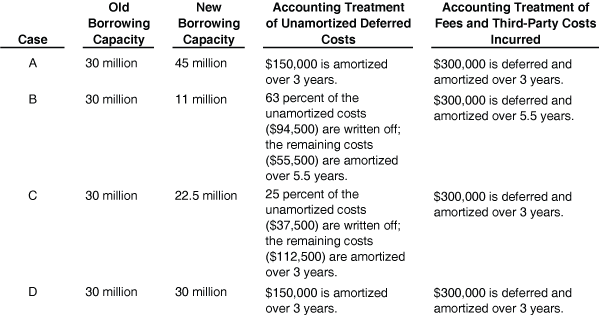 Case Old Borrowing Capacity New Borrowing Capacity Accounting Treatment of Unamortized Deferred Costs Accounting Treatment of Fees and Third-Party Costs Incurred A 30 million 45 million "$150,000 is amortized over 3 years." "$300,000 is deferred and amortized over 3 years." B 30 million 11 million "63 percent of the unamortized costs ($94,500) are written off; the remaining costs ($55,500) are amortized over 5.5 years." "$300,000 is deferred and amortized over 5.5 years." C 30 million 22.5 million "25 percent of the unamortized costs ($37,500) are written off; the remaining costs ($112,500) are amortized over 3 years." "$300,000 is deferred and amortized over 3 years." D 30 million 30 million "$150,000 is amortized over 3 years." "$300,000 is deferred and amortized over 3 years."
-