ASC

ASC 470-60

Troubled Debt Restructurings by Debtors

470 Debt

Source downloaded: .Record version 15f33b23a62a. Effective date must be checked in the source.

ASC 470-60 governs how a debtor accounts for a troubled debt restructuring (TDR) — a restructuring in which the creditor, for economic or legal reasons related to the debtor's financial difficulties, grants a concession it would not otherwise consider (470-60-15-5). Settlements by transfer of assets or grant of an equity interest are measured at fair value, with a gain on restructuring equal to the excess of the payable's carrying amount over that fair value (470-60-35-2, 35-4). Pure modifications of terms are accounted for prospectively with no change in carrying amount and a new effective interest rate, unless total future cash payments (including contingent amounts) are less than the carrying amount, in which case the debtor writes down the payable and recognizes a gain (470-60-35-5 through 35-7).

Key points (7)
  • A restructuring is a TDR only if the creditor grants a concession for reasons related to the debtor's financial difficulties (470-60-15-5); a debtor able to borrow elsewhere at rates near nontroubled market rates generally is not in a TDR (470-60-15-8, 470-60-55-9), and a concession exists if the effective borrowing rate on the restructured debt is lower than on the old debt (470-60-55-10).
  • Substance over form controls: modifications of timing, amounts designated as interest, or amounts designated as face amount are all treated alike, and each payable is accounted for individually even if negotiated jointly (470-60-10-1, 470-60-15-4).
  • Full settlement by transferring assets produces a gain on restructuring equal to carrying amount of the payable less fair value of the assets, plus a separate gain or loss on transfer of assets equal to fair value less the assets' carrying amount (470-60-35-2 through 35-3); equity interests granted are recorded at fair value (470-60-35-4).
  • In a modification-of-terms TDR, the debtor does not change the carrying amount and applies a new effective interest rate that equates the present value of future cash payments (excluding contingent amounts) to that carrying amount (470-60-35-5).
  • If total future cash payments under the new terms are less than the carrying amount, the debtor reduces the payable to that total, recognizes a gain, and thereafter records all payments as reductions of carrying amount with no interest expense (470-60-35-6).
  • Contingent payments are assumed payable and included in total future cash payments to the extent needed to prevent recognizing a gain that could be offset by future interest expense; they are later accrued under 450-20-25-2 (470-60-35-7, 35-10).
  • The Subtopic does not apply where the debtor restates its liabilities generally in bankruptcy or a quasi-reorganization (470-60-15-10, 55-1) and excludes lease modifications and mere payment delays (470-60-15-11); disclosures include principal changes in terms, aggregate gain on restructuring, net gain or loss on asset transfers, and per-share gain (470-60-50-1).

For students. Exam questions hinge on the counterintuitive modification rule: unless undiscounted total future cash payments (including contingent ones) fall below the carrying amount, the debtor recognizes no gain and simply re-solves for a lower effective interest rate — students wrongly assume any concession triggers immediate gain recognition. Also remember the two-part scope test: debtor financial difficulty plus a creditor concession (a decreased effective borrowing rate under 470-60-55-10); if either is absent, apply 470-50 instead.

Machine-generated study aid for ASC 470-60. Check the source paragraphs below.

470-60-00Status

Source downloaded: .Record version c2e0ae4fe44d. Effective date must be checked in the source.

470-60-05Overview and Background

Source downloaded: .Record version 9c783385f45d. Effective date must be checked in the source.

470-60-05-1
This Subtopic addresses measurement, derecognition, disclosure, and implementation guidance issues concerning troubled debt restructurings focused on the debtor's records.

470-60-10Objectives

Source downloaded: .Record version 4559be879a2e. Effective date must be checked in the source.

470-60-10-1
The accounting for restructured debt is based on the substance of the modifications—the effect on cash flows—not on the labels chosen to describe those cash flows. The substance of all modifications of a debt in a troubled debt restructuring is essentially the same whether they involve modifications of any of the following:
  1. a
    Timing
  2. b
    Amounts designated as interest
  3. c
    Amounts designated as face amounts.
470-60-10-2
All of those kinds of modifications affect future cash receipts or payments and therefore affect both of the following:
  1. a
    The creditor's total return on the receivable, its effective interest rate, or both
  2. b
    The debtor's total cost on the payable, its effective interest rate, or both.

470-60-15Scope and Scope Exceptions

Source downloaded: .Record version 220d1b6ba310. Effective date must be checked in the source.

Entities

470-60-15-1
The guidance in this Subtopic applies to all debtors.

Transactions

470-60-15-2
The guidance in this Subtopic applies to all troubled debt restructurings by debtors.
470-60-15-4
The substance rather than the form of the payable shall govern. Payables that may be involved in troubled debt restructurings commonly result from borrowing of cash, or purchasing goods or services on credit. Examples are accounts payable, notes, debentures and bonds (whether those payables are secured or unsecured and whether they are convertible or nonconvertible), and related accrued interest, if any. Typically, each payable is negotiated separately, but sometimes two or more payables are negotiated together. For example, a debtor may negotiate with a group of creditors but sign separate debt instruments with each creditor. For purposes of this Subtopic, restructuring of each payable, including those negotiated and restructured jointly, shall be accounted for individually.
470-60-15-4A
In this Subtopic, a receivable or a payable (collectively referred to as debt) represents a contractual right to receive money or a contractual obligation to pay money on demand or on fixed or determinable dates that is already included as an asset or a liability in the creditor's or debtor's balance sheet at the time of the restructuring.
470-60-15-5
A restructuring of a debt constitutes a troubled debt restructuring for purposes of this Subtopic if the creditor for economic or legal reasons related to the debtor's financial difficulties grants a concession to the debtor that it would not otherwise consider.
470-60-15-6
That concession is granted by the creditor in an attempt to protect as much of its investment as possible. That concession either stems from an agreement between the creditor and the debtor or is imposed by law or a court; for example, either of the following circumstances might occur:
  1. a
    A creditor may restructure the terms of a debt to alleviate the burden of the debtor's near-term cash requirements, and many troubled debt restructurings involve modifying terms to reduce or defer cash payments required of the debtor in the near future to help the debtor attempt to improve its financial condition and eventually be able to pay the creditor.
  2. b
    The creditor may accept cash, other assets, or an equity interest in the debtor in satisfaction of the debt though the value received is less than the amount of the debt because the creditor concludes that step will maximize recovery of its investment.
Although troubled debt that is fully satisfied by foreclosure, repossession, or other transfer of assets or by grant of equity securities by the debtor is, in a technical sense, not restructured, that kind of event is included in the term troubled debt restructuring in this Subtopic.
470-60-15-7
Whatever the form of concession granted by the creditor to the debtor in a troubled debt restructuring, the creditor's objective is to make the best of a difficult situation. That is, the creditor expects to obtain more cash or other value from the debtor, or to increase the probability of receipt, by granting the concession than by not granting it.
470-60-15-8
In general, a debtor that can obtain funds from sources other than the existing creditor at market interest rates at or near those for nontroubled debt is not involved in a troubled debt restructuring. A debtor in a troubled debt restructuring can obtain funds from sources other than the existing creditor in the troubled debt restructuring, if at all, only at effective interest rates (based on market prices) so high that it cannot afford to pay them.
470-60-15-9
A troubled debt restructuring may include, but is not necessarily limited to, one or a combination of the following:
  1. a
    Transfer from the debtor to the creditor of receivables from third parties, real estate, or other assets to satisfy fully or partially a debt (including a transfer resulting from foreclosure or repossession)
  2. b
    Issuance or other granting of an equity interest to the creditor by the debtor to satisfy fully or partially a debt unless the equity interest is granted pursuant to existing terms for converting the debt into an equity interest
  3. c
    Modification of terms of a debt, such as one or a combination of any of the following:
    1. 1
      Reduction (absolute or contingent) of the stated interest rate for the remaining original life of the debt
    2. 2
      Extension of the maturity date or dates at a stated interest rate lower than the current market rate for new debt with similar risk
    3. 3
      Reduction (absolute or contingent) of the face amount or maturity amount of the debt as stated in the instrument or other agreement
    4. 4
      Reduction (absolute or contingent) of accrued interest.
470-60-15-10
The guidance in this Subtopic shall be applied to all troubled debt restructurings including those consummated under reorganization, arrangement, or other provisions of the Federal Bankruptcy Act or other federal statutes related thereto. This Subtopic does not apply, however, if under provisions of those federal statutes or in a quasi-reorganization or corporate readjustment (see Topic 852) with which a troubled debt restructuring coincides, the debtor restates its liabilities generally, that is, if such restructurings or modifications accomplished under purview of the bankruptcy court encompass most of the amount of the debtor's liabilities.
470-60-15-11
For purposes of this Subtopic, none of the following are considered troubled debt restructurings:
  1. a
    Lease modifications (for guidance, see Topic 842)
  2. b
    Changes in employment-related agreements, for example, pension plans and deferred compensation contracts
  3. c
    Unless they involve an agreement between debtor and creditor to restructure, neither of the following:
    1. 1
      Debtors' failures to pay trade accounts according to their terms
    2. 2
      Creditors' delays in taking legal action to collect overdue amounts of interest and principal.
470-60-15-12
A debt restructuring is not necessarily a troubled debt restructuring for purposes of this Subtopic even if the debtor is experiencing some financial difficulties. For example, a troubled debt restructuring is not involved if any of the following circumstances exist:
  1. a
    The fair value of cash, other assets, or an equity interest accepted by a creditor from a debtor in full satisfaction of its receivable at least equals the creditor's amortized cost basis in the receivable.
  2. b
    The fair value of cash, other assets, or an equity interest transferred by a debtor to a creditor in full settlement of its payable at least equals the debtor's carrying amount of the payable.
  3. c
    The creditor reduces the effective interest rate on the debt primarily to reflect a decrease in market interest rates in general or a decrease in the risk so as to maintain a relationship with a debtor that can readily obtain funds from other sources at the current market interest rate.
  4. d
    The debtor issues in exchange for its debt new marketable debt having an effective interest rate based on its market price that is at or near the current market interest rates of debt with similar maturity dates and stated interest rates issued by nontroubled debtors.
470-60-15-13
For further guidance on determining whether a modification or exchange is a troubled debt restructuring, see paragraphs . If a debtor concludes that the modification or exchange is not within the scope of this Subtopic, the debtor would apply the provisions of Subtopic 470-50.

470-60-35Subsequent Measurement

Source downloaded: .Record version 5b2a709815d2. Effective date must be checked in the source.

470-60-35-1
A debtor shall account for a troubled debt restructuring according to the type of the restructuring as prescribed in this Section.
470-60-35-2
A debtor that transfers its receivables from third parties, real estate, or other assets to a creditor to settle fully a payable shall recognize a gain on restructuring of payables. The gain shall be measured by the excess of the carrying amount of the payable over the fair value of the assets transferred to the creditor. However, while the guidance in this Subtopic indicates that the fair value of assets transferred or the fair value of an equity interest granted shall be used in accounting for a settlement of a payable in a troubled debt restructuring, that guidance is not intended to preclude using the fair value of the payable settled if more clearly evident than the fair value of the assets transferred or of the equity interest granted in a full settlement of a payable. However, in a partial settlement of a payable, the fair value of the assets transferred or of the equity interest granted shall be used in all cases to avoid the need to allocate the fair value of the payable between the part settled and the part still outstanding.
470-60-35-3
A difference between the fair value and the carrying amount of assets transferred to a creditor to settle a payable is a gain or loss on transfer of assets. The carrying amount of a receivable encompasses not only unamortized premium, discount, acquisition costs, and the like but also an allowance for uncollectible amounts and other valuation accounts, if any. The debtor shall include that gain or loss in measuring net income for the period of transfer, reported as provided in Topic 220. A loss on transferring receivables to creditors may therefore have been wholly or partially recognized in measuring net income before the transfer and be wholly or partly a reduction of a valuation account rather than a gain or loss in measuring net income for the period of the transfer.
470-60-35-4
A debtor that issues or otherwise grants an equity interest to a creditor to settle fully a payable shall account for the equity interest at its fair value. The difference between the fair value of the equity interest granted and the carrying amount of the payable settled shall be recognized as a gain on restructuring of payables.
470-60-35-5
A debtor in a troubled debt restructuring involving only modification of terms of a payable—that is, not involving a transfer of assets or grant of an equity interest— shall account for the effects of the restructuring prospectively from the time of restructuring, and shall not change the carrying amount of the payable at the time of the restructuring unless the carrying amount exceeds the total future cash payments specified by the new terms. Total future cash payments includes related accrued interest, if any, at the time of the restructuring that continues to be payable under the new terms. That is, the effects of changes in the amounts or timing (or both) of future cash payments designated as either interest or face amount shall be reflected in future periods. Interest expense shall be computed in a way such that a constant effective interest rate is applied to the carrying amount of the payable at the beginning of each period between restructuring and maturity (in substance the interest method prescribed by paragraphs 835-30-35-2 and ). The new effective interest rate shall be the discount rate that equates the present value of the future cash payments specified by the new terms (excluding amounts contingently payable) with the carrying amount of the payable.
470-60-35-6
If, however, the total future cash payments specified by the new terms of a payable, including both payments designated as interest and those designated as face amount, are less than the carrying amount of the payable, the debtor shall reduce the carrying amount to an amount equal to the total future cash payments specified by the new terms and shall recognize a gain on restructuring of payables equal to the amount of the reduction. If the carrying amount of the payable comprises several accounts (for example, face amount, accrued interest, and unamortized premium, discount, finance charges, and issue costs) that are to be continued after the restructuring, some possibly being combined, the reduction in carrying amount may need to be allocated among the remaining accounts in proportion to the previous balances. Thereafter, all cash payments under the terms of the payable shall be accounted for as reductions of the carrying amount of the payable, and no interest expense shall be recognized on the payable for any period between the restructuring and maturity of the payable. The only exception is to recognize interest expense according to paragraph 470-60-35-10. However, the debtor may choose to carry the amount designated as face amount by the new terms in a separate account and adjust another account accordingly.
470-60-35-7
A debtor shall not recognize a gain on a restructured payable involving indeterminate future cash payments as long as the maximum total future cash payments may exceed the carrying amount of the payable. Amounts designated either as interest or as face amount by the new terms may be payable contingent on a specified event or circumstance (for example, the debtor may be required to pay specified amounts if its financial condition improves to a specified degree within a specified period). To determine whether the debtor shall recognize a gain according to the provisions of the preceding two paragraphs, those contingent amounts shall be included in the total future cash payments specified by the new terms to the extent necessary to prevent recognizing a gain at the time of restructuring that may be offset by future interest expense. Thus, the debtor shall apply paragraphs 450-30-25-1 and 450-30-50-1 in which probability of occurrence of a gain contingency is not a factor, and shall assume that contingent future payments will have to be paid. The same principle applies to amounts of future cash payments that must sometimes be estimated to apply the provisions of the preceding two paragraphs. For example, if the number of future interest payments is flexible because the face amount and accrued interest is payable on demand or becomes payable on demand, estimates of total future cash payments shall be based on the maximum number of periods possible under the restructured terms.
470-60-35-8
A troubled debt restructuring may involve partial settlement of a payable by the debtor's transferring assets or granting an equity interest (or both) to the creditor and modification of terms of the remaining payable. Even if the stated terms of the remaining payable, for example, the stated interest rate and the maturity date or dates, are not changed in connection with the transfer of assets or grant of an equity interest, the restructuring shall be accounted for as prescribed by this guidance. A debtor shall account for a troubled debt restructuring involving a partial settlement and a modification of terms as prescribed in paragraphs except that, first, assets transferred or an equity interest granted in that partial settlement shall be measured as prescribed in paragraphs 470-60-35-2 and 470-60-35-4, respectively, and the carrying amount of the payable shall be reduced by the total fair value of those assets or equity interest. If cash is paid in a partial settlement of a payable in a troubled debt restructuring, the carrying amount of the payable shall be reduced by the amount of cash paid. A difference between the fair value and the carrying amount of assets transferred to the creditor shall be recognized as a gain or loss on transfer of assets. No gain on restructuring of payables shall be recognized unless the remaining carrying amount of the payable exceeds the total future cash payments (including amounts contingently payable) specified by the terms of the debt remaining unsettled after the restructuring. Future interest expense, if any, shall be determined according to the provisions of paragraphs .
470-60-35-9
A troubled debt restructuring that is in substance a repossession or foreclosure by the creditor or other transfer of assets to the creditor shall be accounted for according to the provisions of the preceding paragraph and paragraphs .
470-60-35-10
If a troubled debt restructuring involves amounts contingently payable, those contingent amounts shall be recognized as a payable and as interest expense in future periods in accordance with paragraph 450-20-25-2. Thus, in general, interest expense for contingent payments shall be recognized in each period in which both of the following conditions exist:
  1. a
    It is probable that a liability has been incurred.
  2. b
    The amount of that liability can be reasonably estimated.
Before recognizing a payable and interest expense for amounts contingently payable, however, accrual or payment of those amounts shall be deducted from the carrying amount of the restructured payable to the extent that contingent payments included in total future cash payments specified by the new terms prevented recognition of a gain at the time of restructuring (see paragraph 470-60-35-7).
470-60-35-11
If amounts of future cash payments must be estimated to apply the provisions of paragraphs because future interest payments are expected to fluctuate—for example, the restructured terms may specify the stated interest rate to be the prime interest rate increased by a specified amount or proportion—estimates of maximum total future payments shall be based on the interest rate in effect at the time of the restructuring. Fluctuations in the effective interest rate after the restructuring from changes in the prime rate or other causes shall be accounted for as changes in estimates in the periods in which the changes occur. However, the accounting for those fluctuations shall not result in recognizing a gain on restructuring that may be offset by future cash payments (see the preceding paragraph and paragraph 470-60-35-7). Rather, the carrying amount of the restructured payable shall remain unchanged, and future cash payments shall reduce the carrying amount until the time that any gain recognized cannot be offset by future cash payments.
470-60-35-12
Legal fees and other direct costs that a debtor incurs in granting an equity interest to a creditor in a troubled debt restructuring shall reduce the amount otherwise recorded for that equity interest according to paragraphs 470-60-35-4 and 470-60-35-8. All other direct costs that a debtor incurs to effect a troubled debt restructuring shall be deducted in measuring gain on restructuring of payables or shall be included in expense for the period if no gain on restructuring is recognized.

470-60-45Other Presentation Matters

Source downloaded: .Record version 0f1c6343c7fb. Effective date must be checked in the source.

470-60-45-1
All or a portion of the carrying amount of the payable at the time of the restructuring may need to be reclassified in the balance sheet because of changes in the terms, for example, a change in the amount of the payable due within one year after the date of the debtor's balance sheet.
470-60-45-2
A troubled debt restructuring of a short-term obligation after the date of a debtor's balance sheet but before that balance sheet is issued or is available to be issued (as discussed in Section 855-10-25) may affect the classification of that obligation in accordance with Subtopic 470-10.

470-60-50Disclosure

Source downloaded: .Record version 478a1260c295. Effective date must be checked in the source.

470-60-50-1
A debtor shall disclose, either in the body of the financial statements or in the accompanying notes, all of the following information about troubled debt restructurings that have occurred during a period for which financial statements are presented:
  1. a
    For each restructuring, a description of the principal changes in terms, the major features of settlement, or both; separate restructurings within a fiscal period for the same category of payables (for example, accounts payable or subordinated debentures) may be grouped for disclosure purposes
  2. b
    Aggregate gain on restructuring of payables
  3. c
    Aggregate net gain or loss on transfers of assets recognized during the period (see paragraphs 470-60-35-3 and 470-60-35-8)
  4. d
    Per-share amount of the aggregate gain on restructuring of payables.
Transition date:(P) December 16, 2026; (N) December 16, 2026Transition guidance:
220-40-65-1A debtor shall disclose, either in the body of the financial statements or in the accompanying notes, all of the following information about troubled debt restructurings that have occurred during a period for which financial statements are presented:
  1. a
    For each restructuring, a description of the principal changes in terms, the major features of settlement, or both; separate restructurings within a fiscal period for the same category of payables (for example, accounts payable or subordinated debentures) may be grouped for disclosure purposes
  2. b
    Aggregate gain on restructuring of payables
  3. c
    Aggregate net gain or loss on transfers of assets recognized during the period (see paragraphs 470-60-35-3 and 470-60-35-8)
  4. d
    Per-share amount of the aggregate gain on restructuring of payables.
See paragraphs for additional disclosure requirements.
470-60-50-2
A debtor shall disclose in financial statements for periods after a troubled debt restructuring the extent to which amounts contingently payable are included in the carrying amount of restructured payables pursuant to the provisions of paragraph 470-60-35-7. If required by paragraphs and , a debtor shall also disclose in those financial statements total amounts that are contingently payable on restructured payables and the conditions under which those amounts would become payable or would be forgiven.

470-60-55Implementation Guidance and Illustrations

Source downloaded: .Record version 75604a787542. Effective date must be checked in the source.

Implementation Guidance
470-60-55-1
Entities involved with Chapter 11 bankruptcy proceedings frequently reduce all or most of their indebtedness with the approval of their creditors and the court in order to provide an opportunity for the entity to have a fresh start. Such reductions are usually by a stated percentage so that, for example, the debtor owes only 60 cents on the dollar. Because the debtor would be restating its liabilities generally, this Subtopic would not apply to the debtor's accounting for such reduction of liabilities.
470-60-55-2
On the other hand, this Subtopic would apply to an isolated troubled debt restructuring by a debtor involved in bankruptcy proceedings if such restructuring did not result in a general restatement of the debtor's liabilities.
470-60-55-3
To a debtor, a bond constitutes one payable even though there are many bondholders.
470-60-55-4
No single characteristic or factor, taken alone, is determinative of whether a modification or exchange is a troubled debt restructuring under this Subtopic. That is, the fact that a single characteristic is present in a transaction (such as that described in paragraph 470-60-15-9(c)(3) or 470-60-15-12(d)) should not be considered sufficient to overcome the preponderance of contrary evidence. Determining whether a transaction is within the scope of this Subtopic requires the exercise of judgment. The guidance that follows is not limited to marketable debt instruments.
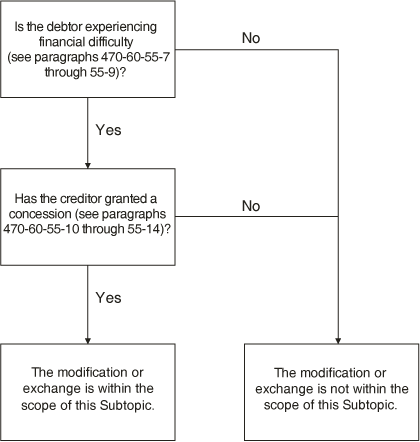
470-60-55-5
The following model should be applied by a debtor when determining whether a modification or an exchange of debt instruments is within the scope of this Subtopic.
470-60-55-6
The following factors have no relevance in the determination of whether a modification or an exchange is within the scope of this Subtopic:
  1. a
    The amount invested in the old debt by the current creditors
  2. b
    The fair value of the old debt immediately before the modification or exchange compared to the fair value of the new debt at issuance
  3. c
    Transactions among debt holders.
In addition, the length of time the current creditors have held the investment in the old debt is not relevant in the determination of whether a modification or exchange is within the scope of this Subtopic unless all the current creditors recently acquired the debt from the previous debt holders to effect what is in substance a planned refinancing.
470-60-55-7
If the debtor's creditworthiness (for example, based on its credit rating or equivalent, the effects of the original collateral or credit enhancements in the debt, or its sector risk) has deteriorated since the debt was originally issued, the debtor should evaluate whether it is experiencing financial difficulties. Changes in an investment-grade credit rating are not considered a deterioration in the debtor's creditworthiness for purposes of this guidance. Conversely, a decline in credit rating from investment grade to noninvestment grade is considered a deterioration in the debtor's creditworthiness for purposes of this guidance.
470-60-55-8
All of the following factors are indicators that the debtor is experiencing financial difficulties:
  1. a
    The debtor is currently in default on any of its debt.
  2. b
    The debtor has declared or is in the process of declaring bankruptcy.
  3. c
    There is significant doubt as to whether the debtor will continue to be a going concern.
  4. d
    Currently, the debtor has securities that have been delisted, are in the process of being delisted, or are under threat of being delisted from an exchange.
  5. e
    Based on estimates and projections that only encompass the current business capabilities, the debtor forecasts that its entity-specific cash flows will be insufficient to service the debt (both interest and principal) in accordance with the contractual terms of the existing agreement through maturity.
  6. f
    Absent the current modification, the debtor cannot obtain funds from sources other than the existing creditors at an effective interest rate equal to the current market interest rate for similar debt for a nontroubled debtor.
470-60-55-9
Notwithstanding the above, the following factors, if both are present, provide determinative evidence that the debtor is not experiencing financial difficulties, and, thus, the modification or exchange is not within the scope of this Subtopic (the presence of either factor individually would be an indicator, but not determinative, that the debtor is not experiencing financial difficulty):
  1. a
    The debtor is currently servicing the old debt and can obtain funds to repay the old prepayable debt from sources other than the existing creditors (without regard to the current modification) at an effective interest rate equal to the current market interest rate for a nontroubled debtor.
  2. b
    The creditors agree to restructure the old debt solely to reflect a decrease in current market interest rates for the debtor or positive changes in the creditworthiness of the debtor since the debt was originally issued.
470-60-55-10
A creditor is deemed to have granted a concession if the debtor's effective borrowing rate on the restructured debt is less than the effective borrowing rate of the old debt immediately before the restructuring. The effective borrowing rate of the restructured debt (after giving effect to all the terms of the restructured debt including any new or revised options or warrants, any new or revised guarantees or letters of credit, and so forth) should be calculated by projecting all the cash flows under the new terms and solving for the discount rate that equates the present value of the cash flows under the new terms to the debtor's current carrying amountof the old debt.
470-60-55-11
The carrying amount for purposes of this test would not include any hedging effects (including basis adjustments to the old debt) but would include any unamortized premium, discount, issuance costs, accrued interest payable, and so forth.
470-60-55-12
When determining the effect of any new or revised sweeteners (options, warrants, guarantees, letters of credit, and so forth), the current fair value of the new sweetener or change in fair value of the revised sweetener would be included in day-one cash flows. If such sweeteners are not exercisable for a period of time, that delay is typically considered within the estimation of the initial fair value as of the debt's modification date.
470-60-55-13
Although considered rare, if there is persuasive evidence that the decrease in the effective borrowing rate is due solely to a factor that is not captured in the mathematical calculation (for example, additional collateral), the creditor may not have granted a concession and the modification or exchange should be evaluated based on the substance of the modification.
470-60-55-14
Notwithstanding the guidance in this Section, if an entity has recently restructured the debt and is currently restructuring that debt again, the effective borrowing rate of the restructured debt (after giving effect to all the terms of the restructured debt including any new or revised options or warrants, any new or revised guarantees or letters of credit, and so forth) should be calculated by projecting all the cash flows under the new terms and solving for the discount rate that equates the present value of the cash flows under the new terms to the debtor's previous carrying amount of the debt immediately preceding the earlier restructuring. In addition, the effective borrowing rate of the restructured debt should be compared with the effective borrowing rate of the debt immediately preceding the earlier restructuring for purposes of determining whether the creditor granted a concession (that is, whether the effective borrowing rate decreased).

Related subtopics