ASC

ASC 360-10

Overall

360 Property, Plant, and Equipment

Download JSONDownload Markdown170 paragraphs · 16 sectionsIncludes SEC contentJump to summary

Source downloaded: .Record version c33572ca646c. Effective date must be checked in the source.

ASC 360-10 governs the accounting for property, plant, and equipment and, in separate "Impairment or Disposal of Long-Lived Assets" Subsections, the impairment testing of long-lived assets held and used and the measurement, presentation, and disclosure of long-lived assets to be disposed of. Cost (including capitalized interest) is allocated to periods through systematic and rational depreciation (360-10-35-4). A held-and-used asset group is written down only if its carrying amount fails an undiscounted cash flow recoverability test, and then only down to fair value (360-10-35-17); held-for-sale assets are measured at the lower of carrying amount or fair value less cost to sell and are not depreciated (360-10-35-43).

Key points (7)
  • Depreciation is a systematic and rational allocation of cost less salvage over the asset's estimated useful life—a process of allocation, not valuation (360-10-35-3 through 35-4); annuity methods are unacceptable and tax ACRS lives may not be used unless within a reasonable range of useful life (360-10-35-9, 35-10).
  • A held-and-used long-lived asset (asset group) is tested for recoverability only when events or changes in circumstances indicate the carrying amount may not be recoverable (the six indicators in 360-10-35-21); the two-step test compares carrying amount to undiscounted expected future cash flows, and an impairment loss is measured as carrying amount less fair value (360-10-35-17).
  • Assets are grouped at the lowest level for which identifiable cash flows are largely independent of other assets and liabilities (360-10-35-23); the impairment loss reduces only long-lived assets, allocated pro rata on relative carrying amounts but not below an individually determinable fair value (360-10-35-28).
  • The adjusted carrying amount after impairment becomes the new cost basis, depreciated over the remaining useful life, and restoration of a previously recognized impairment loss is prohibited (360-10-35-20).
  • Cash flow estimates cover the remaining useful life of the primary asset of the group (which cannot be land or a nonamortized intangible), exclude interest charges, include expenditures maintaining existing service potential, and exclude capital expenditures that increase service potential (360-10-35-29, 35-31 through 35-34).
  • All six criteria in 360-10-45-9 (management commitment, available for immediate sale, active program to locate a buyer, sale probable within one year, active marketing at a reasonable price, unlikely plan changes) must be met for held-for-sale classification; such assets are measured at the lower of carrying amount or fair value less cost to sell, are not depreciated, and subsequent gains are limited to cumulative losses previously recognized (360-10-35-40, 35-43).
  • Assets to be disposed of other than by sale (abandonment, exchange at recorded amount, spinoff) remain classified as held and used until disposed of (360-10-45-15), and disclosures about impairments (360-10-50-2) and disposals, including individually significant components (360-10-50-3, 50-3A), are required.

For students. This is the workhorse impairment model for tangible long-lived assets and a classic exam trap: candidates often forget that step one uses UNDISCOUNTED cash flows (so no loss is recorded if they exceed carrying amount, even if fair value is far lower), that the loss is measured against fair value, and that impairments here can never be reversed—unlike the held-for-sale model, where subsequent recoveries can be recognized up to cumulative losses previously recognized.

Machine-generated study aid for ASC 360-10. Check the source paragraphs below.

360-10-00Status

Source downloaded: .Record version 765c7a714467. Effective date must be checked in the source.

Status

360-10-00-1
The following table identifies the changes made to this Subtopic.
ParagraphActionAccounting Standards UpdateDate
BusinessAmendedAccounting Standards Update No. 2017-0101/05/2017
BusinessAddedAccounting Standards Update No. 2014-0905/28/2014
CollectionsAddedAccounting Standards Update No. 2019-0303/21/2019
ContractAddedAccounting Standards Update No. 2014-0905/28/2014
CustomerAddedAccounting Standards Update No. 2014-0905/28/2014
Disposal GroupAmendedAccounting Standards Update No. 2014-0804/10/2014
LeaseAddedAccounting Standards Update No. 2016-0202/25/2016
Lease TermAddedAccounting Standards Update No. 2016-0202/25/2016
LesseeAddedAccounting Standards Update No. 2016-0202/25/2016
LessorAddedAccounting Standards Update No. 2016-0202/25/2016
Net Realizable ValueAddedAccounting Standards Update No. 2015-1107/22/2015
Nonprofit ActivityAddedAccounting Standards Update No. 2014-0905/28/2014
Not-for-Profit EntityAddedAccounting Standards Update No. 2014-0804/10/2014
Performance ObligationAddedAccounting Standards Update No. 2016-0202/25/2016
Public Business EntityAmendedMaintenance Update 2017-06 (PDF)04/07/2017
Public Business EntityAmendedMaintenance Update 2016-11 (PDF)06/27/2016
Public Business EntityAddedAccounting Standards Update No. 2014-0804/10/2014
RevenueAddedAccounting Standards Update No. 2016-0202/25/2016
Right-of-Use AssetAddedAccounting Standards Update No. 2016-0202/25/2016
Underlying AssetAddedAccounting Standards Update No. 2016-0202/25/2016
360-10-05-1AmendedAccounting Standards Update No. 2016-0202/25/2016
360-10-05-1AmendedAccounting Standards Update No. 2014-0905/28/2014
360-10-05-4AmendedAccounting Standards Update No. 2014-0804/10/2014
360-10-05-5AmendedAccounting Standards Update No. 2014-0804/10/2014
360-10-15-4AmendedAccounting Standards Update No. 2016-0202/25/2016
360-10-15-6AddedAccounting Standards Update No. 2019-0303/21/2019
360-10-30-8AmendedAccounting Standards Update No. 2016-0202/25/2016
360-10-35-7AmendedAccounting Standards Update No. 2014-0905/28/2014
360-10-35-39AmendedAccounting Standards Update No. 2012-0410/01/2012
360-10-35-41AmendedAccounting Standards Update No. 2022-0203/31/2022
360-10-40-1SupersededAccounting Standards Update No. 2014-0905/28/2014
360-10-40-2SupersededAccounting Standards Update No. 2025-1212/17/2025
360-10-40-2AmendedAccounting Standards Update No. 2017-0502/22/2017
360-10-40-2AmendedAccounting Standards Update No. 2016-0202/25/2016
360-10-40-2AmendedAccounting Standards Update No. 2014-0905/28/2014
360-10-40-3SupersededAccounting Standards Update No. 2014-0905/28/2014
360-10-40-3AAmendedAccounting Standards Update No. 2017-0502/22/2017
360-10-40-3BAmendedAccounting Standards Update No. 2017-0502/22/2017
360-10-40-3A through 3CAddedAccounting Standards Update No. 2014-0905/28/2014
360-10-40-5AmendedAccounting Standards Update No. 2017-0502/22/2017
360-10-45-3AmendedAccounting Standards Update No. 2014-0804/10/2014
360-10-45-5AmendedAccounting Standards Update No. 2014-0905/28/2014
360-10-45-5AmendedAccounting Standards Update No. 2014-0804/10/2014
360-10-45-14AmendedAccounting Standards Update No. 2014-0804/10/2014
360-10-45-15AmendedAccounting Standards Update No. 2014-0804/10/2014
360-10-50-2AmendedAccounting Standards Update No. 2024-0311/04/2024
360-10-50-3AmendedAccounting Standards Update No. 2024-0311/04/2024
360-10-50-3AmendedAccounting Standards Update No. 2014-0804/10/2014
360-10-50-3AAmendedAccounting Standards Update No. 2025-1112/08/2025
360-10-50-3AAddedAccounting Standards Update No. 2014-0804/10/2014
360-10-50-4AddedAccounting Standards Update No. 2014-0401/17/2014
360-10-55-18AAddedAccounting Standards Update No. 2014-0804/10/2014
360-10-55-21AmendedAccounting Standards Update No. 2015-1107/22/2015
360-10-55-43AmendedAccounting Standards Update No. 2016-0202/25/2016
AddedAccounting Standards Update No. 2012-0410/01/2012
360-10-60-1AmendedAccounting Standards Update No. 2014-0905/28/2014

360-10-05Overview and Background

Source downloaded: .Record version fe07a29d9c15. Effective date must be checked in the source.

360-10-05-1
The Property, Plant, and Equipment Topic includes the following Subtopic:
  1. a
    Overall
  2. b
360-10-05-2
The guidance in the Overall Subtopic is presented in the following two Subsections:
  1. a
    The General Subsections address the accounting and reporting for property, plant, and equipment, including guidance for accumulated depreciation.
  2. b
    The Impairment or Disposal of Long-Lived Assets Subsections retain the pervasive guidance for recognizing and measuring the impairment of long-lived assets and for long-lived assets to be disposed of.
360-10-05-3
Property, plant, and equipment typically consist of long-lived tangible assets used to create and distribute an entity's products and services and include:
  1. a
    Land and land improvements
  2. b
    Buildings
  3. c
    Machinery and equipment
  4. d
    Furniture and fixtures.

Impairment or Disposal of Long-Lived Assets

360-10-05-4
The Impairment or Disposal of Long-Lived Assets Subsections provide guidance for:
  1. a
     Recognition and measurement of the impairment of long-lived assets to be held and used
  2. b
     Measurement of long-lived assets to be disposed of by sale
  3. c
    Disclosures about the impairment or disposal of long-lived assets and disposals of individually significant components of an entity.
360-10-05-5
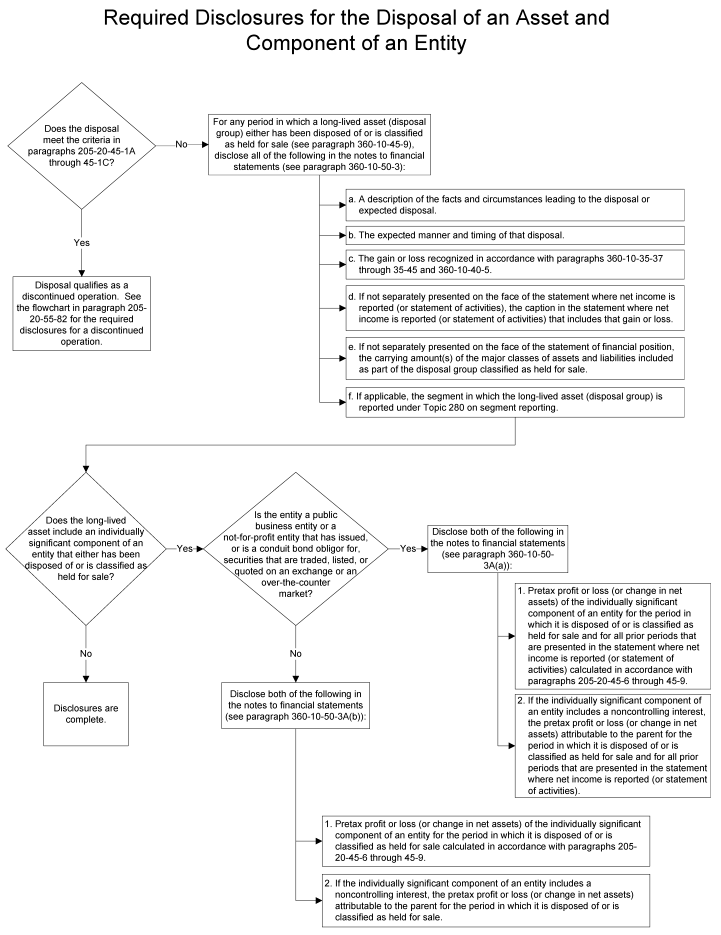
For long-lived assets disposed of or classified as held for sale, different presentation and disclosures are required depending on the nature of the disposal. If the long-lived assets are a significant component of an entity, more extensive disclosures are required. Additionally, if the component of an entity meets the definition of discontinued operation in paragraph 205-20-45-1B, an entity shall refer to Subtopic 205-20 for the presentation and disclosure requirements for discontinued operations (see the flowchart in paragraph 360-10-55-18A for an illustration).
360-10-05-6
This Subsection provides guidance that focuses on developing estimates of future cash flows used to test for recoverability, including the:
  1. a
    Cash flow estimation approach
  2. b
    Cash flow estimation period
  3. c
    Types of asset-related expenditures that should be considered in developing estimates of future cash flows.

360-10-15Scope and Scope Exceptions

Source downloaded: .Record version 9163de3d09d4. Effective date must be checked in the source.

Overall Guidance

360-10-15-1
The General Subsection of this Section establishes the pervasive scope for this Subtopic, with specific exceptions noted in the other Subsections of this Section.

Entities

360-10-15-2
The guidance in this Subtopic applies to all entities.

Impairment or Disposal of Long-Lived Assets

Overall Guidance

360-10-15-3
The Impairment or Disposal of Long-Lived Assets Subsections follow the same Scope and Scope Exceptions as outlined in the General Subsection of this Subtopic, see paragraph 360-10-15-1, with specific transaction exceptions noted below.

Transactions

360-10-15-4
The guidance in the Impairment or Disposal of Long-Lived Assets Subsections applies to the following transactions and activities:
  1. a
    Except as indicated in (b) and the following paragraph, all of the transactions and activities related to recognized long-lived assets of an entity to be held and used or to be disposed of, including:
    1. 1
    2. 2
      Long-lived assets of lessors subject to operating leases
    3. 3
      Proved oil and gas properties that are being accounted for using the successful-efforts method of accounting
    4. 4
      Long-term prepaid assets.
  2. b
    The following transactions and activities related to assets and liabilities that are considered part of an asset group or a disposal group:
    1. 1
      If a long-lived asset (or assets) is part of a group that includes other assets and liabilities not covered by the Impairment or Disposal of Long-Lived Assets Subsections, the guidance in the Impairment or Disposal of Long-Lived Assets Subsections applies to the group. In those situations, the unit of accounting for the long-lived asset is its group. For a long-lived asset or assets to be held and used, that group is referred to as an asset group. For a long-lived asset or assets to be disposed of by sale or otherwise, that group is referred to as a disposal group. Examples of liabilities included in a disposal group are legal obligations that transfer with a long-lived asset, such as certain environmental obligations, and obligations that, for business reasons, a potential buyer would prefer to settle when assumed as part of a group, such as warranty obligations that relate to an acquired customer base.
    2. 2
      The guidance in the Impairment or Disposal of Long-Lived Assets Subsections does not change generally accepted accounting principles (GAAP) applicable to those other individual assets (such as accounts receivable and inventory) and liabilities (such as accounts payable, long-term debt, and asset retirement obligations) not covered by the Impairment or Disposal of Long-Lived Assets Subsections that are included in such groups.
360-10-15-5
The guidance in the Impairment or Disposal of Long-Lived Assets Subsections does not apply to the following transactions and activities:
  1. a
    Goodwill
  2. b
    Intangible assets not being amortized that are to be held and used
  3. c
    Servicing assets
  4. d
    Financial instruments, including investments in equity securities accounted for under the cost or equity method
  5. e
    Deferred policy acquisition costs
  6. f
    Deferred tax assets
  7. g
    Unproved oil and gas properties that are being accounted for using the successful-efforts method of accounting
  8. h
    Oil and gas properties that are accounted for using the full-cost method of accounting as prescribed by the Securities and Exchange Commission (SEC) (see Regulation S-X, Rule 4-10, Financial Accounting and Reporting for Oil and Gas Producing Activities Pursuant to the Federal Securities Laws and the Energy Policy and Conservation Act of 1975)
  9. i
    Certain other long-lived assets for which the accounting is prescribed elsewhere in the standards:
    1. 1
      For guidance on financial reporting in the record and music industry, see Topic 928.
    2. 2
      For guidance on financial reporting in the broadcasting industry, see Topic 920.
    3. 3
      For guidance on accounting for the costs of computer software to be sold, leased, or otherwise marketed, see Subtopic 985-20.
    4. 4
      For guidance on accounting for abandonments and disallowances of plant costs for regulated entities, see Subtopic 980-360.

Entities Holding Collection Items

360-10-15-6
Entities that hold collections shall follow the accounting and disclosure requirements in Subtopic 958-360 on not-for-profit entities—property, plant, and equipment.

360-10-25Recognition

Source downloaded: .Record version 57e8334d0722. Effective date must be checked in the source.

360-10-25-1
See the Impairment or Disposal of Long-Lived Assets Subsection of Section 360-10-45 for a discussion of held-for-use and held-for-sale classifications of assets and asset groups.

Acquisition of the Residual Value in Leased Assets by a Third Party

360-10-25-2
This Section provides guidance on how a third-party entity shall account for the following:
  1. a
    The acquisition from a lessor of the unconditional right to own and possess, at the end of the lease term, an asset subject to a lease
  2. b
    The acquisition of the right to receive all, or a portion, of the proceeds from the sale of a leased asset at the end of the lease term.
360-10-25-3
At the date the rights in the preceding paragraph are acquired, both transactions involve a right to receive, at the end of the lease term, all, or a portion, of any future benefit to be derived from the leased asset and shall be accounted for as the acquisition of an asset. Both transactions are referred to as the acquisition of an interest in the residual value of a leased asset.
360-10-25-4
An interest in the residual value of a leased asset shall be recorded as an asset at the date the right is acquired.

Planned Major Maintenance Activities

360-10-25-5
The use of the accrue-in-advance (accrual) method of accounting for planned major maintenance activities is prohibited in annual and interim financial reporting periods.

Business Combinations

360-10-25-6
See Section 805-20-25 for general guidance related to the recognition of the acquisition of property, plant, and equipment in a business combination.

360-10-30Initial Measurement

Source downloaded: .Record version 247b48a24667. Effective date must be checked in the source.

Historical Cost Including Interest

360-10-30-1
Paragraph 835-20-05-1 states that the historical cost of acquiring an asset includes the costs necessarily incurred to bring it to the condition and location necessary for its intended use. As indicated in that paragraph, if an asset requires a period of time in which to carry out the activities necessary to bring it to that condition and location, the interest cost incurred during that period as a result of expenditures for the asset is a part of the historical cost of acquiring the asset.
360-10-30-2
See the glossary for a definition of activities necessary to bring an asset to the condition and location necessary for its intended use.

Acquisition of the Residual Value in Leased Assets

360-10-30-3
An interest in the residual value of a leased asset recognized under paragraph 360-10-25-4 shall be measured initially at the amount of cash disbursed, the fair value of other consideration given, and the present value of liabilities assumed.
360-10-30-4
The fair value of the interest in the residual value of the leased asset at the date of the agreement shall be used to measure its cost if that fair value is more clearly evident than the fair value of assets surrendered, services rendered, or liabilities assumed.

Other Asset Acquisition Concepts

360-10-30-5
The following paragraphs contain links to other Subtopics that contain guidance on acquiring property, plant, and equipment under other concepts. The following may not represent a complete list of other locations containing property, plant, and equipment acquisition guidance.
360-10-30-6
See Section 805-20-25 for general guidance related to assets acquired in a business combination.
360-10-30-7
See paragraphs for guidance related to assets acquired in a nonmonetary exchange.
360-10-30-8
See Subtopic 842-20 for guidance related to assets acquired under a lease.

360-10-35Subsequent Measurement

Source downloaded: .Record version eccf96225850. Effective date must be checked in the source.

360-10-35-1
This Subsection addresses depreciation of property, plant, and equipment and the post acquisition accounting for an interest in the residual value of a leased asset.

Depreciation

360-10-35-2
This guidance addresses the concept of depreciation accounting and the various factors to consider in selecting the related periods and methods to be used in such accounting.
360-10-35-3
Depreciation expense in financial statements for an asset shall be determined based on the asset's useful life.
360-10-35-4
The cost of a productive facility is one of the costs of the services it renders during its useful economic life. Generally accepted accounting principles (GAAP) require that this cost be spread over the expected useful life of the facility in such a way as to allocate it as equitably as possible to the periods during which services are obtained from the use of the facility. This procedure is known as depreciation accounting, a system of accounting which aims to distribute the cost or other basic value of tangible capital assets, less salvage (if any), over the estimated useful life of the unit (which may be a group of assets) in a systematic and rational manner. It is a process of allocation, not of valuation.
360-10-35-5
See paragraph 360-10-35-20 for a discussion of depreciation of a new cost basis after recognition of an impairment loss.
360-10-35-6
See paragraph 360-10-35-43 for a discussion of cessation of depreciation on long-lived assets classified as held for sale.
360-10-35-7
The declining-balance method is an example of one of the methods that meet the requirements of being systematic and rational. If the expected productivity of the asset or ability of the asset to generate revenue is relatively greater during the earlier years of its life, or maintenance charges tend to increase during later years, the declining-balance method may provide the most satisfactory allocation of cost. That conclusion also applies to other methods, including the sum-of-the-years'-digits method, that produce substantially similar results.
360-10-35-8
In practice, experience regarding loss or damage to depreciable assets is in some cases one of the factors considered in estimating the depreciable lives of a group of depreciable assets, along with such other factors as wear and tear, obsolescence, and maintenance and replacement policies.
360-10-35-9
If the number of years specified by the Accelerated Cost Recovery System of the Internal Revenue Service (IRS) for recovery deductions for an asset does not fall within a reasonable range of the asset's useful life, the recovery deductions shall not be used as depreciation expense for financial reporting.
360-10-35-10
Annuity methods of depreciation are not acceptable for entities in general.
360-10-35-11
See paragraphs for guidance on the accounting and presentation of changes in methods of depreciation.

Adjusting the Residual Value in Leased Assets by a Third Party

360-10-35-13
The following paragraph provides guidance on how an entity acquiring an interest in the residual value of a leased asset shall account for that asset during the lease term.
360-10-35-14
An entity acquiring an interest in the residual value of any leased asset, irrespective of the classification of the related lease by the lessor, shall not recognize increases to the asset's estimated value over the remaining term of the related lease, and the asset shall be reported at no more than its acquisition cost until sale or disposition. If it is subsequently determined that the fair value of the residual value of a leased asset has declined below the carrying amount of the acquired interest and that decline is other than temporary, the asset shall be written down to fair value, and the amount of the write-down shall be recognized as a loss. That fair value becomes the asset's new carrying amount, and the asset shall not be increased for any subsequent increase in its fair value before its sale or disposition.

Impairment or Disposal of Long-Lived Assets

360-10-35-15
There are unique requirements of accounting for the impairment or disposal of long-lived assets to be held and used or to be disposed of. Although this guidance deals with matters which may lead to the ultimate disposition of assets, it is included in this Subsection because it describes the measurement and classification of assets to be held and used and assets held for disposal before actual disposition and derecognition. See the Impairment or Disposal of Long-Lived Assets Subsection of Section 360-10-40 for a discussion of assets or asset groups for which disposition has taken place in an exchange or distribution to owners.

Long-Lived Assets Classified as Held and Used

360-10-35-16
This guidance addresses how long-lived assets or asset groups that are intended to be held and used in an entity's business shall be reviewed for impairment.
360-10-35-17
An impairment loss shall be recognized only if the carrying amount of a long-lived asset (asset group) is not recoverable and exceeds its fair value. The carrying amount of a long-lived asset (asset group) is not recoverable if it exceeds the sum of the undiscounted cash flows expected to result from the use and eventual disposition of the asset (asset group). That assessment shall be based on the carrying amount of the asset (asset group) at the date it is tested for recoverability, whether in use (see paragraph 360-10-35-33) or under development (see paragraph 360-10-35-34). An impairment loss shall be measured as the amount by which the carrying amount of a long-lived asset (asset group) exceeds its fair value.
360-10-35-18
In applying the provisions of this Subtopic, the carrying amount of the asset being tested for impairment shall include amounts of capitalized asset retirement costs. Estimated future cash flows related to the liability for an asset retirement obligation that has been recognized in the financial statements shall be excluded from both of the following:
  1. a
     The undiscounted cash flows used to test the asset for recoverability
  2. b
    The discounted cash flows used to measure the asset's fair value.
360-10-35-19
If the fair value of the asset is based on a quoted market price and that price considers the costs that will be incurred in retiring that asset, the quoted market price shall be increased by the fair value of the asset retirement obligation for purposes of measuring impairment.
360-10-35-20
If an impairment loss is recognized, the adjusted carrying amount of a long-lived asset shall be its new cost basis. For a depreciable long-lived asset, the new cost basis shall be depreciated (amortized) over the remaining useful life of that asset. Restoration of a previously recognized impairment loss is prohibited.
360-10-35-21
A long-lived asset (asset group) shall be tested for recoverability whenever events or changes in circumstances indicate that its carrying amount may not be recoverable. The following are examples of such events or changes in circumstances:
  1. a
    A significant decrease in the market price of a long-lived asset (asset group)
  2. b
    A significant adverse change in the extent or manner in which a long-lived asset (asset group) is being used or in its physical condition
  3. c
    A significant adverse change in legal factors or in the business climate that could affect the value of a long-lived asset (asset group), including an adverse action or assessment by a regulator
  4. d
    An accumulation of costs significantly in excess of the amount originally expected for the acquisition or construction of a long-lived asset (asset group)
  5. e
    A current-period operating or cash flow loss combined with a history of operating or cash flow losses or a projection or forecast that demonstrates continuing losses associated with the use of a long-lived asset (asset group)
  6. f
    A current expectation that, more likely than not, a long-lived asset (asset group) will be sold or otherwise disposed of significantly before the end of its previously estimated useful life. The term more likely than not refers to a level of likelihood that is more than 50 percent.
360-10-35-22
When a long-lived asset (asset group) is tested for recoverability, it also may be necessary to review depreciation estimates and method as required by Topic 250 or the amortization period as required by Topic 350. Paragraphs and 250-10-50-4 address the accounting for changes in estimates, including changes in the method of depreciation, amortization, and depletion. Paragraphs address the determination of the useful life of an intangible asset. Any revision to the remaining useful life of a long-lived asset resulting from that review also shall be considered in developing estimates of future cash flows used to test the asset (asset group) for recoverability (see paragraphs ). However, any change in the accounting method for the asset resulting from that review shall be made only after applying this Subtopic.
360-10-35-23
For purposes of recognition and measurement of an impairment loss, a long-lived asset or assets shall be grouped with other assets and liabilities at the lowest level for which identifiable cash flows are largely independent of the cash flows of other assets and liabilities. However, an impairment loss, if any, that results from applying this Subtopic shall reduce only the carrying amount of a long-lived asset or assets of the group in accordance with paragraph 360-10-35-28.
360-10-35-24
In limited circumstances, a long-lived asset (for example, a corporate headquarters facility) may not have identifiable cash flows that are largely independent of the cash flows of other assets and liabilities and of other asset groups. In those circumstances, the asset group for that long-lived asset shall include all assets and liabilities of the entity.
360-10-35-25
In limited circumstances, an asset group will include all assets and liabilities of the entity. For example, the cost of operating assets such as corporate headquarters or centralized research facilities may be funded by revenue-producing activities at lower levels of the entity. Accordingly, in limited circumstances, the lowest level of identifiable cash flows that are largely independent of other asset groups may be the entity level. See Example 4 (paragraph 360-10-55-35).
360-10-35-26
Goodwill shall be included in an asset group to be tested for impairment under this Subtopic only if the asset group is or includes a reporting unit. Goodwill shall not be included in a lower-level asset group that includes only part of a reporting unit. Estimates of future cash flows used to test that lower-level asset group for recoverability shall not be adjusted for the effect of excluding goodwill from the group. The term reporting unit is defined in Topic 350 as the same level as or one level below an operating segment. That Topic requires that goodwill be tested for impairment at the reporting unit level.
360-10-35-27
Other than goodwill, the carrying amounts of any assets (such as accounts receivable and inventory) and liabilities (such as accounts payable, long-term debt, and asset retirement obligations) not covered by this Subtopic that are included in an asset group shall be adjusted in accordance with other applicable generally accepted accounting principles (GAAP) before testing the asset group for recoverability. Paragraph 350-20-35-31 requires that goodwill be tested for impairment only after the carrying amounts of the other assets of the reporting unit, including the long-lived assets covered by this Subtopic, have been tested for impairment under other applicable accounting guidance.
360-10-35-28
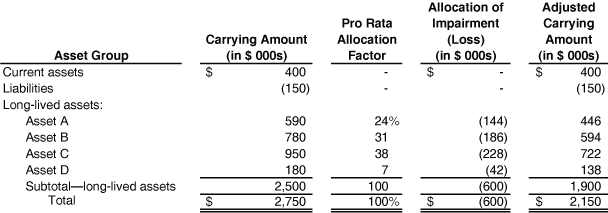
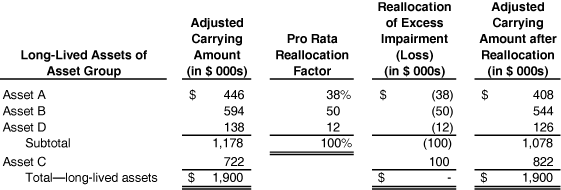
An impairment loss for an asset group shall reduce only the carrying amounts of a long-lived asset or assets of the group. The loss shall be allocated to the long-lived assets of the group on a pro rata basis using the relative carrying amounts of those assets, except that the loss allocated to an individual long-lived asset of the group shall not reduce the carrying amount of that asset below its fair value whenever that fair value is determinable without undue cost and effort. See Example 1 (paragraph 360-10-55-20) for an illustration of this guidance.
360-10-35-29
Estimates of future cash flows used to test the recoverability of a long-lived asset (asset group) shall include only the future cash flows (cash inflows less associated cash outflows) that are directly associated with and that are expected to arise as a direct result of the use and eventual disposition of the asset (asset group). Those estimates shall exclude interest charges that will be recognized as an expense when incurred.
360-10-35-30
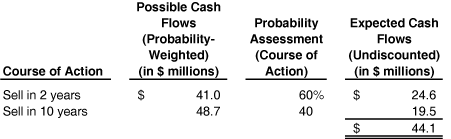
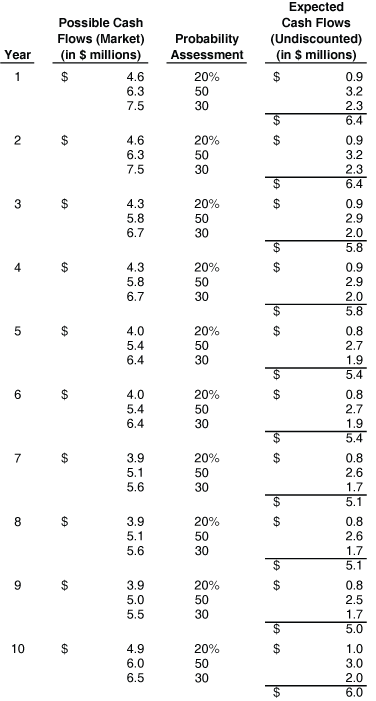
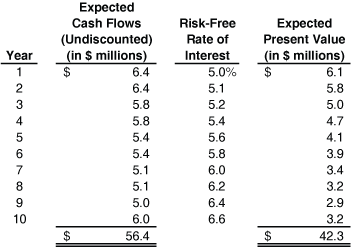
Estimates of future cash flows used to test the recoverability of a long-lived asset (asset group) shall incorporate the entity's own assumptions about its use of the asset (asset group) and shall consider all available evidence. The assumptions used in developing those estimates shall be reasonable in relation to the assumptions used in developing other information used by the entity for comparable periods, such as internal budgets and projections, accruals related to incentive compensation plans, or information communicated to others. However, if alternative courses of action to recover the carrying amount of a long-lived asset (asset group) are under consideration or if a range is estimated for the amount of possible future cash flows associated with the likely course of action, the likelihood of those possible outcomes shall be considered. A probability-weighted approach may be useful in considering the likelihood of those possible outcomes. See Example 2 (paragraph 360-10-55-23) for an illustration of this guidance.
360-10-35-31
Estimates of future cash flows used to test the recoverability of a long-lived asset (asset group) shall be made for the remaining useful life of the asset (asset group) to the entity. The remaining useful life of an asset group shall be based on the remaining useful life of the primary asset of the group. For purposes of this Subtopic, the primary asset is the principal long-lived tangible asset being depreciated or intangible asset being amortized that is the most significant component asset from which the asset group derives its cash-flow-generating capacity. The primary asset of an asset group therefore cannot be land or an intangible asset not being amortized.
360-10-35-32
Factors that an entity generally shall consider in determining whether a long-lived asset is the primary asset of an asset group include the following:
  1. a
    Whether other assets of the group would have been acquired by the entity without the asset
  2. b
    The level of investment that would be required to replace the asset
  3. c
    The remaining useful life of the asset relative to other assets of the group. If the primary asset is not the asset of the group with the longest remaining useful life, estimates of future cash flows for the group shall assume the sale of the group at the end of the remaining useful life of the primary asset.
360-10-35-33
Estimates of future cash flows used to test the recoverability of a long-lived asset (asset group) that is in use, including a long-lived asset (asset group) for which development is substantially complete, shall be based on the existing service potential of the asset (asset group) at the date it is tested. The service potential of a long-lived asset (asset group) encompasses its remaining useful life, cash-flow-generating capacity, and for tangible assets, physical output capacity. Those estimates shall include cash flows associated with future expenditures necessary to maintain the existing service potential of a long-lived asset (asset group), including those that replace the service potential of component parts of a long-lived asset (for example, the roof of a building) and component assets other than the primary asset of an asset group. Those estimates shall exclude cash flows associated with future capital expenditures that would increase the service potential of a long-lived asset (asset group).
360-10-35-34
Estimates of future cash flows used to test the recoverability of a long-lived asset (asset group) that is under development shall be based on the expected service potential of the asset (group) when development is substantially complete. Those estimates shall include cash flows associated with all future expenditures necessary to develop a long-lived asset (asset group), including interest payments that will be capitalized as part of the cost of the asset (asset group). Subtopic 835-20 requires the capitalization period to end when the asset is substantially complete and ready for its intended use.
360-10-35-35
If a long-lived asset that is under development is part of an asset group that is in use, estimates of future cash flows used to test the recoverability of that group shall include the cash flows associated with future expenditures necessary to maintain the existing service potential of the group (see paragraph 360-10-35-33) as well as the cash flows associated with all future expenditures necessary to substantially complete the asset that is under development (see the preceding paragraph). See Example 3 (paragraph 360-10-55-33). See also paragraphs for considerations of site restoration and environmental exit costs.
360-10-35-36
For long-lived assets (asset groups) that have uncertainties both in timing and amount, an expected present value technique will often be the appropriate technique with which to estimate fair value.

Long-Lived Assets Classified as Held for Sale

360-10-35-37
This guidance addresses the accounting for expected disposal losses for long-lived assets and asset groups that are classified as held for sale but have not yet been sold. See paragraphs for the initial criteria to be met for classification as held for sale.
360-10-35-38
Costs to sell are the incremental direct costs to transact a sale, that is, the costs that result directly from and are essential to a sale transaction and that would not have been incurred by the entity had the decision to sell not been made. Those costs include broker commissions, legal and title transfer fees, and closing costs that must be incurred before legal title can be transferred. Those costs exclude expected future losses associated with the operations of a long-lived asset (disposal group) while it is classified as held for sale. Expected future operating losses that marketplace participants would not similarly consider in their estimates of the fair value less cost to sell of a long-lived asset (disposal group) classified as held for sale shall not be indirectly recognized as part of an expected loss on the sale by reducing the carrying amount of the asset (disposal group) to an amount less than its current fair value less cost to sell. If the sale is expected to occur beyond one year as permitted in limited situations by paragraph 360-10-45-11, the cost to sell shall be discounted.
360-10-35-39
The carrying amounts of any assets that are not covered by this Subtopic, including goodwill, that are included in a disposal group classified as held for sale shall be adjusted in accordance with other applicable GAAP prior to measuring the fair value less cost to sell of the disposal group. Paragraphs provide guidance for allocating goodwill to a lower-level asset group to be disposed of that is part of a reporting unit and that constitutes a business. Goodwill is not included in a lower-level asset group to be disposed of that is part of a reporting unit if it does not constitute a business.
360-10-35-40
A loss shall be recognized for any initial or subsequent write-down to fair value less cost to sell. A gain shall be recognized for any subsequent increase in fair value less cost to sell, but not in excess of the cumulative loss previously recognized (for a write-down to fair value less cost to sell). The loss or gain shall adjust only the carrying amount of a long-lived asset, whether classified as held for sale individually or as part of a disposal group.
360-10-35-41
See paragraphs 310-20-35-12D and 310-20-40-12 for guidance related to determination of cost basis for foreclosed assets under Subtopic 310-20 and the measurement of cumulative losses previously recognized under paragraph 360-10-35-40.
360-10-35-42
See paragraphs for guidance regarding the application of Topic 830 to an investment being evaluated for impairment that will be disposed of.
360-10-35-43
A long-lived asset (disposal group) classified as held for sale shall be measured at the lower of its carrying amount or fair value less cost to sell. If the asset (disposal group) is newly acquired, the carrying amount of the asset (disposal group) shall be established based on its fair value less cost to sell at the acquisition date. A long-lived asset shall not be depreciated (amortized) while it is classified as held for sale. Interest and other expenses attributable to the liabilities of a disposal group classified as held for sale shall continue to be accrued.
360-10-35-44
If circumstances arise that previously were considered unlikely and, as a result, an entity decides not to sell a long-lived asset (disposal group) previously classified as held for sale, the asset (disposal group) shall be reclassified as held and used. A long-lived asset that is reclassified shall be measured individually at the lower of the following:
  1. a
    Its carrying amount before the asset (disposal group) was classified as held for sale, adjusted for any depreciation (amortization) expense that would have been recognized had the asset (disposal group) been continuously classified as held and used
  2. b
    Its fair value at the date of the subsequent decision not to sell.
360-10-35-45
If an entity removes an individual asset or liability from a disposal group previously classified as held for sale, the remaining assets and liabilities of the disposal group to be sold shall continue to be measured as a group only if the criteria in paragraph 360-10-45-9 are met. Otherwise, the remaining long-lived assets of the group shall be measured individually at the lower of their carrying amounts or fair values less cost to sell at that date.

Long-Lived Assets to Be Disposed of Other than by Sale

360-10-35-46
This guidance addresses the accounting for impairment of long-lived assets and asset groups that are intended to be disposed of by abandonment.
360-10-35-47
For purposes of this Subtopic, a long-lived asset to be abandoned is disposed of when it ceases to be used. If an entity commits to a plan to abandon a long-lived asset before the end of its previously estimated useful life, depreciation estimates shall be revised in accordance with paragraphs and 250-10-50-4 to reflect the use of the asset over its shortened useful life (see paragraph 360-10-35-22).
360-10-35-48
Because the continued use of a long-lived asset demonstrates the presence of service potential, only in unusual situations would the fair value of a long-lived asset to be abandoned be zero while it is being used. When a long-lived asset ceases to be used, the carrying amount of the asset should equal its salvage value, if any. The salvage value of the asset shall not be reduced to an amount less than zero.
360-10-35-49
A long-lived asset that has been temporarily idled shall not be accounted for as if abandoned.

360-10-40Derecognition

Source downloaded: .Record version 10371bc078a1. Effective date must be checked in the source.

Sale of Leased Property

360-10-40-2
Paragraph 840-20-40-5 states that if a sale to a third party of property subject to an operating lease (or of property that is leased by or intended to be leased by the third-party purchaser to another party) is not to be recorded as a sale because the entity has not transferred control over the promised asset to the third party in accordance with paragraph 606-10-25-30, the transaction shall be accounted for as a borrowing.
Transition date:(P) December 16, 2026; (N) December 16, 2026Transition guidance:
105-10-65-10
Editor's Note: Paragraph 360-10-40-2 will be superseded upon transition, together with its heading:
> Sale of Leased Property
Paragraph superseded by Accounting Standards Update No. 2025-12.

Transfer or Sale of Property, Plant, and Equipment

360-10-40-3A
An entity shall account for the derecognition of a nonfinancial asset, including an in substance nonfinancial asset and an asset subject to a lease , within the scope of this Topic in accordance with Subtopic 610-20 on gains and losses from the derecognition of nonfinancial assets, unless a scope exception from Subtopic 610-20 applies. For example, the derecognition of a nonfinancial asset in a contract with a customer shall be accounted for in accordance with Topic 606 on revenue from contracts with customers.
360-10-40-3B
An entity shall account for the derecognition of a subsidiary or group of assets that is either a business or nonprofit activity in accordance with the derecognition guidance in Subtopic 810-10.
360-10-40-3C
If an entity transfers a nonfinancial asset in accordance with paragraph 360-10-40-3A, and the contract does not meet all of the criteria in paragraph 606-10-25-1, the entity shall not derecognize the nonfinancial asset and shall follow the guidance in paragraphs to determine if and when the contract subsequently meets all the criteria in paragraph 606-10-25-1. Until all the criteria in paragraph 606-10-25-1 are met, the entity shall continue to do all of the following:
  1. a
    Report the nonfinancial asset in its financial statements
  2. b
    Recognize depreciation expense as a period cost unless the assets have been classified as held for sale in accordance with paragraphs
  3. c
    Apply the impairment guidance in Section 360-10-35.

Impairment or Disposal of Long-Lived Assets

Long-Lived Assets to Be Exchanged or to Be Distributed to Owners in a Spinoff

360-10-40-4
For purposes of this Subtopic, a long-lived asset to be disposed of in an exchange measured based on the recorded amount of the nonmonetary asset relinquished or to be distributed to owners in a spinoff is disposed of when it is exchanged or distributed. If the asset (asset group) is tested for recoverability while it is classified as held and used, the estimates of future cash flows used in that test shall be based on the use of the asset for its remaining useful life, assuming that the disposal transaction will not occur. In such a case, an undiscounted cash flows recoverability test shall apply prior to the disposal date. In addition to any impairment losses required to be recognized while the asset is classified as held and used, an impairment loss, if any, shall be recognized when the asset is disposed of if the carrying amount of the asset (disposal group) exceeds its fair value. The provisions of this Section apply to nonmonetary exchanges that are not recorded at fair value under the provisions of Topic 845.

Recognition of Gain or Loss from Sale

360-10-40-5
A gain or loss not previously recognized that results from the sale of a long-lived asset (disposal group) shall be recognized when the long-lived asset (disposal group) is derecognized in accordance with applicable Topics (for example, Topic 610 on other income, Topic 810 on consolidation, or Topic 860 on transfers and servicing).

Long-Lived Assets to Be Abandoned

360-10-40-6
See paragraphs for guidance related to the disposition of an asset upon its abandonment.

360-10-45Other Presentation Matters

Source downloaded: .Record version 3bfbe6dc0d2e. Effective date must be checked in the source.

Planned Major Maintenance Activities

360-10-45-1
An entity shall apply the same method of accounting for planned major maintenance activities in annual and interim financial reporting periods.

Impairment or Disposal of Long-Lived Assets

360-10-45-2
This Subsection presents guidance for the presentation of impairment or disposal of long-lived assets or asset groups that are classified as:
  1. a
    Held and used
  2. b
    Held for sale
  3. c
    To be disposed of other than by sale.
360-10-45-3
See paragraphs for guidance on the presentation of operations of a discontinued operation.

Long-Lived Assets Classified as Held and Used

360-10-45-4
An impairment loss recognized for a long-lived asset (asset group) to be held and used shall be included in income from continuing operations before income taxes in the income statement of a business entity. If a subtotal such as income from operations is presented, it shall include the amount of that loss.
360-10-45-5
A gain or loss recognized (see Subtopic 610-20 on the sale or transfer of a nonfinancial asset) on the sale of a long-lived asset (disposal group) that is not a discontinued operation shall be included in income from continuing operations before income taxes in the income statement of a business entity. If a subtotal such as income from operations is presented, it shall include the amounts of those gains or losses.
360-10-45-6
If circumstances arise that previously were considered unlikely and, as a result, an entity decides not to sell a long-lived asset (disposal group) previously classified as held for sale, the asset (disposal group) shall be reclassified as held and used.
360-10-45-7
Any required adjustment to the carrying amount of a long-lived asset that is reclassified as held and used shall be included in income from continuing operations in the period of the subsequent decision not to sell. That adjustment shall be reported in the same income statement caption used to report a loss, if any, recognized in accordance with paragraph 360-10-45-5. If a component of an entity is reclassified as held and used, the results of operations of the component previously reported in discontinued operations in accordance with paragraph 205-20-45-3 shall be reclassified and included in income from continuing operations for all periods presented.
360-10-45-8
Any long-lived assets that will not be sold shall be reclassified as held and used in accordance with paragraph 360-10-35-44.

Long-Lived Assets Classified as Held for Sale

360-10-45-9
A long-lived asset (disposal group) to be sold shall be classified as held for sale in the period in which all of the following criteria are met:
  1. a
    Management, having the authority to approve the action, commits to a plan to sell the asset (disposal group).
  2. b
    The asset (disposal group) is available for immediate sale in its present condition subject only to terms that are usual and customary for sales of such assets (disposal groups). (See Examples 5 through 7 [paragraphs ], which illustrate when that criterion would be met.)
  3. c
    An active program to locate a buyer and other actions required to complete the plan to sell the asset (disposal group) have been initiated.
  4. d
    The sale of the asset (disposal group) is probable, and transfer of the asset (disposal group) is expected to qualify for recognition as a completed sale, within one year, except as permitted by paragraph 360-10-45-11. (See Example 8 [paragraph 360-10-55-43], which illustrates when that criterion would be met.) The term probable refers to a future sale that is likely to occur.
  5. e
    The asset (disposal group) is being actively marketed for sale at a price that is reasonable in relation to its current fair value. The price at which a long-lived asset (disposal group) is being marketed is indicative of whether the entity currently has the intent and ability to sell the asset (disposal group). A market price that is reasonable in relation to fair value indicates that the asset (disposal group) is available for immediate sale, whereas a market price in excess of fair value indicates that the asset (disposal group) is not available for immediate sale.
  6. f
    Actions required to complete the plan indicate that it is unlikely that significant changes to the plan will be made or that the plan will be withdrawn.
360-10-45-10
If at any time the criteria in this Subsection are no longer met (except as permitted by the following paragraph), a long-lived asset (disposal group) classified as held for sale shall be reclassified as held and used in accordance with paragraph 360-10-35-44.
360-10-45-11
Events or circumstances beyond an entity's control may extend the period required to complete the sale of a long-lived asset (disposal group) beyond one year. An exception to the one-year requirement in paragraph 360-10-45-9(d) shall apply in the following situations in which such events or circumstances arise:
  1. a
    If at the date an entity commits to a plan to sell a long-lived asset (disposal group) the entity reasonably expects that others (not a buyer) will impose conditions on the transfer of the asset (group) that will extend the period required to complete the sale and both of the following conditions are met:
    1. 1
      Actions necessary to respond to those conditions cannot be initiated until after a firm purchase commitment is obtained.
    2. 2
      A firm purchase commitment is probable within one year. (See Example 9 [paragraph 360-10-55-44], which illustrates that situation.)
  2. b
    If an entity obtains a firm purchase commitment and, as a result, a buyer or others unexpectedly impose conditions on the transfer of a long-lived asset (disposal group) previously classified as held for sale that will extend the period required to complete the sale and both of the following conditions are met:
    1. 1
      Actions necessary to respond to the conditions have been or will be timely initiated.
    2. 2
      A favorable resolution of the delaying factors is expected. (See Example 10 [paragraph 360-10-55-46], which illustrates that situation.)
  3. c
    If during the initial one-year period, circumstances arise that previously were considered unlikely and, as a result, a long-lived asset (disposal group) previously classified as held for sale is not sold by the end of that period and all of the following conditions are met:
    1. 1
      During the initial one-year period the entity initiated actions necessary to respond to the change in circumstances.
    2. 2
      The asset (group) is being actively marketed at a price that is reasonable given the change in circumstances.
    3. 3
      The criteria in paragraph 360-10-45-9 are met. (See Example 11 [paragraph 360-10-55-48], which illustrates that situation.)
360-10-45-12
A long-lived asset (disposal group) that is newly acquired and that will be sold rather than held and used shall be classified as held for sale at the acquisition date only if the one-year requirement in paragraph 360-10-45-9(d) is met (except as permitted by the preceding paragraph) and any other criteria in paragraph 360-10-45-9 that are not met at that date are probable of being met within a short period following the acquisition (usually within three months).
360-10-45-13
If the criteria in paragraph 360-10-45-9 are met after the balance sheet date but before the financial statements are issued or are available to be issued (as discussed in Section 855-10-25), a long-lived asset shall continue to be classified as held and used in those financial statements when issued or when available to be issued. In addition, information required by paragraph 205-20-50-1(a) shall be disclosed in the notes to financial statements. If the asset (asset group) is tested for recoverability (on a held-and-used basis) as of the balance sheet date, the estimates of future cash flows used in that test shall consider the likelihood of possible outcomes that existed at the balance sheet date, including the assessment of the likelihood of the future sale of the asset. That assessment made as of the balance sheet date shall not be revised for a decision to sell the asset after the balance sheet date. Because it is difficult to separate the benefit of hindsight when assessing conditions that existed at a prior date, it is important that judgments about those conditions, the need to test an asset for recoverability, and the application of a recoverability test be made and documented together with supporting evidence on a timely basis. An impairment loss, if any, to be recognized shall be measured as the amount by which the carrying amount of the asset (asset group) exceeds its fair value at the balance sheet date.
360-10-45-14
A long-lived asset classified as held for sale (but not qualifying for presentation as a discontinued operation in the statement of financial position in accordance with paragraph 205-20-45-10) shall be presented separately in the statement of financial position of the current period. The assets and liabilities of a disposal group classified as held for sale shall be presented separately in the asset and liability sections, respectively, of the statement of financial position. Those assets and liabilities shall not be offset and presented as a single amount. The major classes of assets and liabilities classified as held for sale shall be separately presented on the face of the statement of financial position or disclosed in the notes to financial statements (see paragraph 360-10-50-3(e)).

Long-Lived Assets to Be Disposed of Other Than by Sale

360-10-45-15
A long-lived asset to be disposed of other than by sale (for example, by abandonment, in an exchange measured based on the recorded amount of the nonmonetary asset relinquished, or in a distribution to owners in a spinoff) shall continue to be classified as held and used until it is disposed of. The guidance on long-lived assets to be held and used in Sections 360-10-35, 360-10-45, and 360-10-50 shall apply while the asset is classified as held and used. If a long-lived asset is to be abandoned or distributed to owners in a spinoff together with other assets (and liabilities) as a group and that disposal group meets the conditions in paragraphs to be reported in discontinued operations, paragraphs shall apply to the disposal group at the date it is disposed of.

360-10-50Disclosure

Source downloaded: .Record version 055f24b66227. Effective date must be checked in the source.

360-10-50-1
Because of the significant effects on financial position and results of operations of the depreciation method or methods used, all of the following disclosures shall be made in the financial statements or in notes thereto:
  1. a
    Depreciation expense for the period
  2. b
    Balances of major classes of depreciable assets, by nature or function, at the balance sheet date
  3. c
    Accumulated depreciation, either by major classes of depreciable assets or in total, at the balance sheet date
  4. d
    A general description of the method or methods used in computing depreciation with respect to major classes of depreciable assets.

Impairment or Disposal of Long-Lived Assets

Impairment of Long-Lived Assets Classified as Held and Used

360-10-50-2
All of the following information shall be disclosed in the notes to financial statements that include the period in which an impairment loss is recognized:
  1. a
    A description of the impaired long-lived asset (asset group) and the facts and circumstances leading to the impairment
  2. b
    If not separately presented on the face of the statement, the amount of the impairment loss and the caption in the income statement or the statement of activities that includes that loss
  3. c
    The method or methods for determining fair value (whether based on a quoted market price, prices for similar assets, or another valuation technique)
  4. d
    If applicable, the segment in which the impaired long-lived asset (asset group) is reported under Topic 280.
Transition date:(P) December 16, 2026; (N) December 16, 2026Transition guidance:
220-40-65-1All of the following information shall be disclosed in the notes to financial statements that include the period in which an impairment loss is recognized:
  1. a
    A description of the impaired long-lived asset (asset group) and the facts and circumstances leading to the impairment
  2. b
    If not separately presented on the face of the statement, the amount of the impairment loss and the caption in the income statement or the statement of activities that includes that loss
  3. c
    The method or methods for determining fair value (whether based on a quoted market price, prices for similar assets, or another valuation technique)
  4. d
    If applicable, the segment in which the impaired long-lived asset (asset group) is reported under Topic 280.
See paragraphs for additional disclosure requirements.

Long-Lived Assets Classified as Held for Sale or Disposed Of

360-10-50-3
For any period in which a long-lived asset (disposal group) either has been disposed of or is classified as held for sale (see paragraph 360-10-45-9), an entity shall disclose all of the following in the notes to financial statements:
  1. a
    A description of the facts and circumstances leading to the disposal or the expected disposal.
  2. b
    The expected manner and timing of that disposal.
  3. c
    The gain or loss recognized in accordance with paragraphs and 360-10-40-5.
  4. d
    If not separately presented on the face of the statement where net income is reported (or in the statement of activities for a not-for-profit entity), the caption in the statement where net income is reported (or in the statement of activities for a not-for-profit entity) that includes that gain or loss.
  5. e
    If not separately presented on the face of the statement of financial position, the carrying amount(s) of the major classes of assets and liabilities included as part of a disposal group classified as held for sale. Any loss recognized on the disposal group classified as held for sale in accordance with paragraphs and 360-10-40-5 shall not be allocated to the major classes of assets and liabilities of the disposal group.
  6. f
    If applicable, the segment in which the long-lived asset (disposal group) is reported under Topic 280 on segment reporting.
Transition date:(P) December 16, 2026; (N) December 16, 2026Transition guidance:
220-40-65-1For any period in which a long-lived asset (disposal group) either has been disposed of or is classified as held for sale (see paragraph 360-10-45-9), an entity shall disclose all of the following in the notes to financial statements:
  1. a
    A description of the facts and circumstances leading to the disposal or the expected disposal.
  2. b
    The expected manner and timing of that disposal.
  3. c
    The gain or loss recognized in accordance with paragraphs and 360-10-40-5.
  4. d
    If not separately presented on the face of the statement where net income is reported (or in the statement of activities for a not-for-profit entity), the caption in the statement where net income is reported (or in the statement of activities for a not-for-profit entity) that includes that gain or loss.
  5. e
    If not separately presented on the face of the statement of financial position, the carrying amount(s) of the major classes of assets and liabilities included as part of a disposal group classified as held for sale. Any loss recognized on the disposal group classified as held for sale in accordance with paragraphs and 360-10-40-5 shall not be allocated to the major classes of assets and liabilities of the disposal group.
  6. f
    If applicable, the segment in which the long-lived asset (disposal group) is reported under Topic 280 on segment reporting.
See paragraphs for additional disclosure requirements.
360-10-50-3A
In addition to the disclosures in paragraph 360-10-50-3, if a long-lived asset (disposal group) includes an individually significant component of an entity that either has been disposed of or is classified as held for sale (see paragraph 360-10-45-9) and does not qualify for presentation and disclosure as a discontinued operation (see Subtopic 205-20 on discontinued operations), a public business entity and a not-for-profit entity that has issued, or is a conduit bond obligor for, securities that are traded, listed, or quoted on an exchange or an over-the-counter market shall disclose the information in (a). All other entities shall disclose the information in (b).
  1. a
    For a public business entity and a not-for-profit entity that has issued, or is a conduit bond obligor for, securities that are traded, listed, or quoted on an exchange or an over-the-counter market, both of the following:
    1. 1
      The pretax profit or loss (or change in net assets for a not-for-profit entity) of the individually significant component of an entity for the period in which it is disposed of or is classified as held for sale and for all prior periods that are presented in the statement where net income is reported (or statement of activities for a not-for-profit entity) calculated in accordance with paragraphs
    2. 2
      If the individually significant component of an entity includes a noncontrolling interest, the pretax profit or loss (or change in net assets for a not-for-profit entity) attributable to the parent for the period in which it is disposed of or is classified as held for sale and for all prior periods that are presented in the statement where net income is reported (or statement of activities for a not-for-profit entity).
  2. b
    For all other entities, both of the following:
    1. 1
      The pretax profit or loss (or change in net assets for a not-for-profit entity) of the individually significant component of an entity for the period in which it is disposed of or is classified as held for sale calculated in accordance with paragraphs
    2. 2
      If the individually significant component of an entity includes a noncontrolling interest, the pretax profit or loss (or change in net assets for a not-for-profit entity) attributable to the parent for the period in which it is disposed of or is classified as held for sale.
Transition date:(P) December 16, 2027; (N) December 16, 2028Transition guidance:
270-10-65-1In addition to the disclosures in paragraph 360-10-50-3, if a long-lived asset (disposal group) includes an individually significant component of an entity that either has been disposed of or is classified as held for sale (see paragraph 360-10-45-9) and does not qualify for presentation and disclosure as a discontinued operation (see Subtopic 205-20 on discontinued operations), a public business entity and a not-for-profit entity that has issued, or is a conduit bond obligor for, securities that are traded, listed, or quoted on an exchange or an over-the-counter market shall disclose the information in (a). All other entities shall disclose the information in (b). The following disclosures are required in interim and annual reporting periods:
  1. a
    For a public business entity and a not-for-profit entity that has issued, or is a conduit bond obligor for, securities that are traded, listed, or quoted on an exchange or an over-the-counter market, both of the following:
    1. 1
      The pretax profit or loss (or change in net assets for a not-for-profit entity) of the individually significant component of an entity for the period in which it is disposed of or is classified as held for sale and for all prior periods that are presented in the statement where net income is reported (or statement of activities for a not-for-profit entity) calculated in accordance with paragraphs
    2. 2
      If the individually significant component of an entity includes a noncontrolling interest, the pretax profit or loss (or change in net assets for a not-for-profit entity) attributable to the parent for the period in which it is disposed of or is classified as held for sale and for all prior periods that are presented in the statement where net income is reported (or statement of activities for a not-for-profit entity).
  2. b
    For all other entities, both of the following:
    1. 1
      The pretax profit or loss (or change in net assets for a not-for-profit entity) of the individually significant component of an entity for the period in which it is disposed of or is classified as held for sale calculated in accordance with paragraphs
    2. 2
      If the individually significant component of an entity includes a noncontrolling interest, the pretax profit or loss (or change in net assets for a not-for-profit entity) attributable to the parent for the period in which it is disposed of or is classified as held for sale.

Foreclosed Properties Held for Sale

360-10-50-4
See paragraph 310-10-50-11 for guidance related to foreclosed and repossessed assets.

360-10-55Implementation Guidance and Illustrations

Source downloaded: .Record version f6d8ba7344b2. Effective date must be checked in the source.

Impairment or Disposal of Long-Lived Assets

Implementation Guidance

360-10-55-1
The following guidance demonstrates the consideration of restoration and environmental exit costs when testing a long-lived asset for impairment. Paragraphs also provide guidance for such testing for assets subject to asset retirement obligations.
360-10-55-2
For certain assets covered by this Subtopic, costs for future site restoration or closure (environmental exit costs) may be incurred if the asset is sold, is abandoned, or ceases operations. Environmental exit costs within the scope of this Subsection include:
  1. a
    Asset retirement costs recognized pursuant to Subtopic 410-20
  2. b
    Asset retirement costs that have not been recognized because the obligation has not been incurred
  3. c
    Certain environmental remediation costs that have not yet been recognized as a liability pursuant to Subtopic 410-30.
360-10-55-3
Pursuant to Subtopic 410-20, asset retirement costs may be incurred over more than one reporting period. For example, the liability for performing certain capping, closure, and postclosure activities in connection with operating a landfill is incurred as the landfill receives waste.
360-10-55-4
The related cash flows, if any, might not occur until the end of the asset's life if the asset ceases operations, or they might be deferred indefinitely as long as the asset is not sold or abandoned.
360-10-55-5
The issue is whether the cash flows associated with environmental exit costs that may be incurred if a long-lived asset is sold, is abandoned, or ceases operations should be included in the undiscounted expected future cash flows used to test a long-lived asset for recoverability under this Subtopic.
360-10-55-6
For environmental exit costs that have not been recognized as a liability for accounting purposes, whether those environmental exit costs shall be included in the undiscounted expected future cash flows used to test a long-lived asset for recoverability under this Subtopic depends on management's intent with respect to the asset. Pursuant to this Subtopic, if management's intent contemplates alternative courses of action to recover the carrying amount of the asset or if a range is estimated for the amount of possible future cash flows, the likelihood of those possible outcomes shall be considered. Examples of management's intent and the corresponding treatment of the environmental exit costs in this Subtopic's recoverability test are described below. (Environmental remediation costs discussed in certain of these cases refer to environmental remediation costs that have not yet been recognized as a liability pursuant to Subtopic 410-30.) This paragraph illustrates the guidance in paragraphs on estimating future cash flows used to test a long-lived asset for recoverability.
360-10-55-7
The following guidance demonstrates the consideration of restoration and environmental exit costs when testing a long-lived asset for impairment. In all of the following situations, environmental exit costs would be excluded from this Subtopic's recoverability test.
360-10-55-8
Management intends to operate the asset for at least the asset's remaining depreciable life, the sum of the undiscounted future cash flows expected from the asset's use during that period exceeds the asset's carrying amount including any associated goodwill, and management has no reason to believe that the asset's eventual disposition will result in a net cash outflow.
360-10-55-9
Management expects to operate the asset indefinitely and has the ability to do so, the asset is generating positive cash flows, management's best information indicates that the asset will continue to be profitable in the future, and there are no known constraints to the asset's economic life. This Subtopic's recoverability test shall include the future cash outflows for repairs, maintenance, and capital expenditures necessary to obtain the future cash inflows expected to be generated by the asset based on its existing service potential.
360-10-55-10
The asset has a finite economic life, but environmental remediation costs will only be incurred if the asset is sold or abandoned. At the end of the asset's life, management intends either to close the asset permanently because the costs of remediating the asset exceed the proceeds that likely would be received if the asset were sold or, alternatively, to idle the asset by reducing production to a minimal or nominal amount. (Although the environmental remediation costs are excluded from this Subtopic's recoverability test, the recoverability test shall incorporate the entity's own assumptions about its use of the asset. That is, the recoverability test shall consider the likelihood of the alternative courses of action [either closing or idling the asset] and the resulting cash flows associated with those alternative courses.)
360-10-55-11
Management expects to sell the asset in the future, and the asset's sale will not require the environmental remediation costs to be incurred. (Although the environmental remediation costs are excluded from this Subtopic's recoverability test, the fair value of the asset is likely to be affected by the existence of those costs. The diminished fair value shall be considered in estimating the cash flows expected to arise from the eventual sale of the asset.)
360-10-55-12
The following guidance demonstrates the consideration of restoration and environmental exit costs when testing a long-lived asset for impairment. In all of the following situations, environmental exit costs would be included in this Subtopic's recoverability test.
360-10-55-13
Management expects to take a future action related to the asset that may cause the environmental remediation costs to be incurred. However, uncertainties or inconsistencies exist in how the related laws or regulatory requirements are applied. Management estimates, based on the weight of the available evidence, a 60 percent chance that the remediation costs will not be incurred and a 40 percent chance that those costs will be incurred. Pursuant to this Subtopic, other situations may exist in which cash flows are estimated using a single set or best estimate of cash flows.
360-10-55-14
The useful life of the asset is limited as a result of any of the following:
  1. a
    Actual or expected technological advances
  2. b
    Contractual provisions
  3. c
    Regulatory restrictions.
Also, when the asset's service potential has ended, management will be required to dispose of the asset under paragraph 360-10-55-16 or 360-10-55-17.
360-10-55-15
The asset has a current period cash flow loss from operations combined with a projection or forecast that anticipates continuing losses. Management expects the asset to achieve profitability in the future but uncertainty exists about management's ability to fund the future cash outflows up to the time that net cash inflows are expected from the asset's use. In the event of a forced liquidation, management would likely dispose of the asset under the following paragraph or paragraph 360-10-55-17.
360-10-55-16
Management intends to abandon or close the asset in the future, and the event of abandonment or closure will cause the environmental remediation costs to be incurred.
360-10-55-17
Management intends to sell the asset in the future, and the applicable laws, regulations, or interpretations thereof require that appropriate environmental remediation (not within the scope of Subtopic 410-20) occur in connection with the sale.
360-10-55-18
Management expects to operate the asset for the remainder of its useful life. Related asset retirement costs are incurred over the life of the asset (for example, the operation of a landfill). Estimated cash flows associated with the asset retirement costs yet to be incurred and recognized shall be included in this Subtopic's recoverability test.
360-10-55-18A
The following flowchart provides an overview of the disclosures required for disposals of long-lived assets and individually significant components of an entity that do not qualify for presentation and disclosure as a discontinued operation (see Subtopic 205-20 on discontinued operations).
  • "Does the disposal meet the criteria in paragraphs 205-20-45-1A through 45-1C?" "For any period in which a long-lived asset (disposal group) either has been disposed of or is classified as held for sale (see paragraph 360-10-45-9), disclose all of the following in the notes to financial statements (see paragraph 360-10-50-3):" Disposal qualifies as a discontinued operation. See the flowchart in paragraph 205-20-55-82 for the required disclosures for a discontinued operation. Yes a. A description of the facts and circumstances leading to the disposal or expected disposal. b. The expected manner and timing of that disposal. "e. If not separately presented on the face of the statement of financial position, the carrying amount(s) of the major classes of assets and liabilities included as part of the disposal group classified as held for sale." c. The gain or loss recognized in accordance with paragraphs 360-10-35-37 through 35-45 and 360-10-40-5. "d. If not separately presented on the face of the statement where net income is reported (or statement of activities), the caption in the statement where net income is reported (or statement of activities) that includes that gain or loss." "f. If applicable, the segment in which the long-lived asset (disposal group) is reported under Topic 280 on segment reporting." "Does the long-lived asset include an individually significant component of an entity that either has been disposed of or is classified as held for sale?" Disclosures are complete. No Yes "Is the entity a public business entity or a not-for-profit entity that has issued, or is a conduit bond obligor for, securities that are traded, listed, or quoted on an exchange or an over-the-counter market?" "Disclose both of the following in the notes to financial statements (see paragraph 360-10-50-3A(a)):" Disclose both of the following in the notes to financial statements (see paragraph 360-10-50-3A(b)): 1. Pretax profit or loss (or change in net assets) of the individually significant component of an entity for the period in which it is disposed of or is classified as held for sale and for all prior periods that are presented in the statement where net income is reported (or statement of activities) calculated in accordance with paragraphs 205-20-45-6 through 45-9. "2. If the individually significant component of an entity includes a noncontrolling interest, the pretax profit or loss (or change in net assets) attributable to the parent for the period in which it is disposed of or is classified as held for sale and for all prior periods that are presented in the statement where net income is reported (or statement of activities)." 1. Pretax profit or loss (or change in net assets) of the individually significant component of an entity for the period in which it is disposed of or is classified as held for sale calculated in accordance with paragraphs 205-20-45-6 through 45-9. "2. If the individually significant component of an entity includes a noncontrolling interest, the pretax profit or loss (or change in net assets) attributable to the parent for the period in which it is disposed of or is classified as held for sale." No No Yes Required Disclosures for the Disposal of an Asset and Component of an Entity

Illustrations

360-10-55-19
The following Examples illustrate application of some of the provisions of this Subtopic. The Examples do not address all possible situations or applications of this Subtopic.
360-10-55-20
This Example illustrates the allocation of an impairment loss to the long-lived assets of an asset group (see paragraph 360-10-35-28).
360-10-55-21
An entity owns a manufacturing facility that together with other assets is tested for recoverability as a group. In addition to long-lived assets (Assets A-D), the asset group includes inventory measured using first-in, first-out (FIFO), which is reported at the lower of cost and net realizable value in accordance with Topic 330, and other current assets and liabilities that are not covered by this Subtopic. The $2.75 million aggregate carrying amount of the asset group is not recoverable and exceeds its fair value by $600,000. In accordance with paragraph 360-10-35-28, the impairment loss of $600,000 would be allocated as shown below to the long-lived assets of the group.
  • Asset Group Carrying Amount (in $ 000s) Pro Rata Allocation Factor Allocation of Impairment (Loss) (in $ 000s) Adjusted Carrying Amount (in $ 000s) Current assets $400 - $- $400 Liabilities (150) - - (150) Long-lived assets: Asset A 590 24% (144) 446 Asset B 780 31 (186) 594 Asset C 950 38 (228) 722 Asset D 180 7 (42) 138 Subtotal—long-lived assets " 2,500 " 100 (600) " 1,900 " Total " $2,750 " 100% $(600) " $2,150 "
360-10-55-22
If the fair value of an individual long-lived asset of an asset group is determinable without undue cost and effort and exceeds the adjusted carrying amount of that asset after an impairment loss is allocated initially, the excess impairment loss initially allocated to that asset would be reallocated to the other long-lived assets of the group. For example, if the fair value of Asset C is $822,000, the excess impairment loss of $100,000 initially allocated to that asset (based on its adjusted carrying amount of $722,000) would be reallocated as shown below to the other long-lived assets of the group on a pro rata basis using the relative adjusted carrying amounts of those assets.
  • Long-Lived Assets of Asset Group Adjusted Carrying Amount (in $ 000s) Pro Rata Reallocation Factor Reallocation of Excess Impairment (Loss) (in $ 000s) Adjusted Carrying Amount after Reallocation (in $ 000s) Asset A $446 38% $(38) $408 Asset B 594 50 (50) 544 Asset D 138 12 (12) 126 Subtotal " 1,178 " 100% (100) " 1,078 " Asset C 722 100 822 Total—long-lived assets " $1,900 " $- " $1,900 "
360-10-55-23
This Example illustrates the use of a probability-weighted approach for developing estimates of future cash flows used to test a long-lived asset for recoverability when alternative courses of action are under consideration (see paragraph 360-10-35-30). This Example has the following Cases:
  1. a
    Probability-weighted cash flows (Case A)
  2. b
    Expected cash flows technique (Case B).
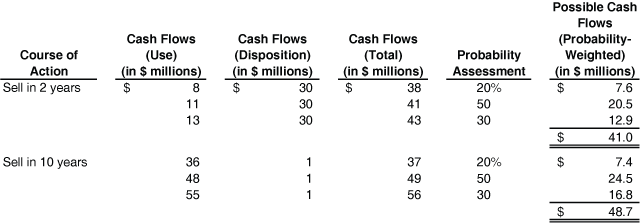
360-10-55-24
Cases A and B share all of the following assumptions.
360-10-55-25
As of December 31, 20X2, a manufacturing facility with a carrying amount of $48 million is tested for recoverability. At that date, 2 courses of action to recover the carrying amount of the facility are under consideration—sell in 2 years or sell in 10 years (at the end of its remaining useful life).
360-10-55-26
The possible cash flows associated with each of those courses of action are $41 million and $48.7 million, respectively. They are developed based on entity-specific assumptions about future sales (volume and price) and costs in varying scenarios that consider the likelihood that existing customer relationships will continue, changes in economic (market) conditions, and other relevant factors.
360-10-55-27
The following table shows the possible cash flows associated with each of the courses of action—sell in 2 years or sell in 10 years.
  • Course of Action Cash Flows (Use) (in $ millions) Cash Flows (Disposition) (in $ millions) "Cash Flows (Total) (in $ millions)" Probability Assessment Possible Cash Flows (Probability-Weighted) (in $ millions) Sell in 2 years $8 $30 $38 20% $7.6 11 30 41 50 20.5 13 30 43 30 12.9 $41.0 Sell in 10 years 36 1 37 20% $7.4 48 1 49 50 24.5 55 1 56 30 16.8 $48.7
360-10-55-28
As further indicated in the following table, there is a 60 percent probability that the facility will be sold in 2 years and a 40 percent probability that the facility will be sold in 10 years.
360-10-55-29
The alternatives of whether to sell or use an asset are not necessarily independent of each other. In many situations, after estimating the possible future cash flows relating to those potential courses of action, an entity might select the course of action that results in a significantly higher estimate of possible future cash flows. In that situation, the entity generally would use the estimates of possible future cash flows relating only to that course of action in computing future cash flows. As shown, the expected cash flows are $44.1 million (undiscounted). Therefore, the carrying amount of the facility of $48 million would not be recoverable.
  • Course of Action Possible Cash Flows (Probability-Weighted) (in $ millions) Probability Assessment (Course of Action) Expected Cash Flows (Undiscounted) (in $ millions) Sell in 2 years $41.0 60% $24.6 Sell in 10 years 48.7 40 19.5 $44.1
360-10-55-30
This Case illustrates the application of an expected present value technique to estimate the fair value of a long-lived asset in an impairment situation.
360-10-55-31
The following table shows by year the computation of the expected cash flows used in the measurement. They reflect the possible cash flows (probability-weighted) used to test the manufacturing facility for recoverability in Case A, adjusted for relevant marketplace assumptions, which increases the possible cash flows in total by approximately 15 percent.
  • Year Possible Cash Flows (Market) (in $ millions) Probability Assessment Expected Cash Flows (Undiscounted) (in $ millions) 1 $4.6 20% $0.9 6.3 50 3.2 7.5 30 2.3 $6.4 2 $4.6 20% $0.9 6.3 50 3.2 7.5 30 2.3 $6.4 3 $4.3 20% $0.9 5.8 50 2.9 6.7 30 2.0 $5.8 4 $4.3 20% $0.9 5.8 50 2.9 6.7 30 2.0 $5.8 5 $4.0 20% $0.8 5.4 50 2.7 6.4 30 1.9 $5.4 6 $4.0 20% $0.8 5.4 50 2.7 6.4 30 1.9 $5.4 7 $3.9 20% $0.8 5.1 50 2.6 5.6 30 1.7 $5.1 8 $3.9 20% $0.8 5.1 50 2.6 5.6 30 1.7 $5.1 9 $3.9 20% $0.8 5.0 50 2.5 5.5 30 1.7 $5.0 10 $4.9 20% $1.0 6.0 50 3.0 6.5 30 2.0 $6.0
360-10-55-32
The following table shows the computation of the expected present value; that is, the sum of the present values of the expected cash flows by year, each discounted at a risk-free interest rate determined from the yield curve for U.S. Treasury instruments. In this Case, a market risk premium is included in the expected cash flows; that is, the cash flows are certainty equivalent cash flows. As shown, the expected present value is $42.3 million, which is less than the carrying amount of $48 million. In accordance with paragraph 360-10-35-17 the entity would recognize an impairment loss of $5.7 million.
  • Year Expected Cash Flows (Undiscounted) (in $ millions) Risk-Free Rate of Interest Expected Present Value (in $ millions) 1 $6.4 5.0% $6.1 2 6.4 5.1 5.8 3 5.8 5.2 5.0 4 5.8 5.4 4.7 5 5.4 5.6 4.1 6 5.4 5.8 3.9 7 5.1 6.0 3.4 8 5.1 6.2 3.2 9 5.0 6.4 2.9 10 6.0 6.6 3.2 $56.4 $42.3
360-10-55-33
A long-lived asset that is under development may be part of an asset group that is in use. In that situation, estimates of future cash flows used to test the recoverability of that group shall include the cash flows associated with future expenditures necessary to maintain the existing service potential of the group as well as the cash flows associated with future expenditures necessary to substantially complete the asset that is under development (see paragraph 360-10-35-35).
360-10-55-34
An entity engaged in mining and selling phosphate estimates future cash flows from its commercially minable phosphate deposits in order to test the recoverability of the asset group that includes the mine and related long-lived assets (plant and equipment). Deposits from the mined rock must be processed in order to extract the phosphate. As the active mining area expands along the geological structure of the mine, a new processing plant is constructed near the production area. Depending on the size of the mine, extracting the minable deposits may require building numerous processing plants over the life of the mine. In testing the recoverability of the mine and related long-lived assets, the estimates of future cash flows from its commercially minable phosphate deposits would include cash flows associated with future expenditures necessary to build all of the required processing plants.
360-10-55-35
Varying facts and circumstances will inevitably justify different groupings of assets for impairment review. While grouping at the lowest level for which there are identifiable cash flows for recognition and measurement of an impairment loss is understood, determining that lowest level requires considerable judgment.
360-10-55-36
This Example illustrates the need for judgment in grouping assets for impairment, as discussed in paragraphs . In this Example, an entity operates a bus entity that provides service under contract with a municipality that requires minimum service on each of five separate routes. Assets devoted to serving each route and the cash flows from each route are discrete. One of the routes operates at a significant deficit that results in the inability to recover the carrying amounts of the dedicated assets. The five bus routes would be an appropriate level at which to group assets to test for and measure impairment because the entity does not have the option to curtail any one bus route.
360-10-55-37
This Example illustrates the classification as held for sale of a long-lived asset (disposal group) in accordance with paragraph 360-10-45-9(b).
360-10-55-38
An entity commits to a plan to sell its headquarters building and has initiated actions to locate a buyer. The following illustrate situations in which the criterion in paragraph 360-10-45-9(b) would or would not be met:
  1. a
    The entity intends to transfer the building to a buyer after it vacates the building. The time necessary to vacate the building is usual and customary for sales of such assets. The criterion in paragraph 360-10-45-9(b) would be met at the plan commitment date.
  2. b
    The entity will continue to use the building until construction of a new headquarters building is completed. The entity does not intend to transfer the existing building to a buyer until after construction of the new building is completed (and it vacates the existing building). The delay in the timing of the transfer of the existing building imposed by the entity (seller) demonstrates that the building is not available for immediate sale. The criterion in paragraph 360-10-45-9(b) would not be met until construction of the new building is completed, even if a firm purchase commitment for the future transfer of the existing building is obtained earlier.
360-10-55-39
This Example illustrates the classification as held for sale of a long-lived asset (disposal group) in accordance with paragraph 360-10-45-9(b).
360-10-55-40
An entity commits to a plan to sell a manufacturing facility and has initiated actions to locate a buyer. At the plan commitment date, there is a backlog of uncompleted customer orders. The following illustrate situations in which the criterion in paragraph 360-10-45-9(b) would or would not be met:
  1. a
    The entity intends to sell the manufacturing facility with its operations. Any uncompleted customer orders at the sale date would transfer to the buyer. The transfer of uncompleted customer orders at the sale date will not affect the timing of the transfer of the facility. The criterion in paragraph 360-10-45-9(b) would be met at the plan commitment date.
  2. b
    The entity intends to sell the manufacturing facility, but without its operations. The entity does not intend to transfer the facility to a buyer until after it ceases all operations of the facility and eliminates the backlog of uncompleted customer orders. The delay in the timing of the transfer of the facility imposed by the entity (seller) demonstrates that the facility is not available for immediate sale. The criterion in paragraph 360-10-45-9(b) would not be met until the operations of the facility cease, even if a firm purchase commitment for the future transfer of the facility is obtained earlier.
360-10-55-41
This Example illustrates the classification as held for sale of a long-lived asset (disposal group) in accordance with paragraph 360-10-45-9(b).
360-10-55-42
An entity acquires through foreclosure a real estate property that it intends to sell. The following illustrate situations in which the criterion in paragraph 360-10-45-9(b) would not be met:
  1. a
    The entity does not intend to transfer the property to a buyer until after it completes renovations to increase its sales value. The delay in the timing of the transfer of the property imposed by the entity (seller) demonstrates that the property is not available for immediate sale. The criterion in paragraph 360-10-45-9(b) would not be met until the renovations are completed.
  2. b
    After the renovations are completed and the property is classified as held for sale but before a firm purchase commitment is obtained, the entity becomes aware of environmental damage requiring remediation. The entity still intends to sell the property. However, the entity does not have the ability to transfer the property to a buyer until after the remediation is completed. The delay in the timing of the transfer of the property imposed by others before a firm purchase commitment is obtained demonstrates that the property is not available for immediate sale. The criterion in paragraph 360-10-45-9(b) would not continue to be met. The property would be reclassified as held and used in accordance with paragraph 360-10-45-7.
360-10-55-43
This Example illustrates the classification as held for sale of a long-lived asset (disposal group) in accordance with the criterion in paragraph 360-10-45-9(d). The following illustrates situations in which that criterion would not be met:
  1. a
    An entity that is a commercial leasing and finance company is holding for sale or lease equipment that has recently come off lease and the ultimate form of a future transaction (sale or lease) has not yet been determined.
  2. b
    An entity commits to a plan to sell an asset that is in use and lease back that asset; however, the transfer of the asset will not be accounted for as a sale and leaseback transaction because the buyer-lessor does not obtain control of the asset based on the guidance in paragraphs . The asset would continue to be classified as held and used following the appropriate guidance in Sections 360-10-35, 360-10-45, and 360-10-50.
360-10-55-44
This Example illustrates an exception to the one-year requirement in paragraph 360-10-45-9(d) to complete the sale of a long-lived asset (disposal group) (see paragraph 360-10-45-11). The following illustrates situations in which the conditions for an exception to the criterion in paragraph 360-10-45-9(d) would be met.
360-10-55-45
An entity in the utility industry commits to a plan to sell a disposal group that represents a significant portion of its regulated operations. The sale will require regulatory approval, which could extend the period required to complete the sale beyond one year. Actions necessary to obtain that approval cannot be initiated until after a buyer is known and a firm purchase commitment is obtained. However, a firm purchase commitment is probable within one year. In that situation, the conditions in paragraph 360-10-45-11(a) for an exception to the one-year requirement in paragraph 360-10-45-9(d) would be met.
360-10-55-46
This Example illustrates an exception to the one-year requirement in paragraph 360-10-45-9(d) to complete the sale of a long-lived asset (disposal group) (see paragraph 360-10-45-11). The following illustrates a situation in which the conditions for an exception to the criterion in paragraph 360-10-45-9(d) would be met.
360-10-55-47
An entity commits to a plan to sell a manufacturing facility in its present condition and classifies the facility as held for sale at that date. After a firm purchase commitment is obtained, the buyer's inspection of the property identifies environmental damage not previously known to exist. The entity is required by the buyer to remediate the damage, which will extend the period required to complete the sale beyond one year. However, the entity has initiated actions to remediate the damage, and satisfactory remediation of the damage is probable. In that situation, the conditions in paragraph 360-10-45-11(b) for an exception to the one-year requirement in paragraph 360-10-45-9(d) would be met.
360-10-55-48
This Example illustrates an exception to the one-year requirement in paragraph 360-10-45-9(d) to complete the sale of a long-lived asset (disposal group) (see paragraph 360-10-45-11).
360-10-55-49
An entity commits to a plan to sell a long-lived asset and classifies the asset as held for sale at that date. The following illustrates situations in which the conditions for an exception to the criterion in paragraph 360-10-45-9(d) would or would not be met:
  1. a
    During the initial one-year period, the market conditions that existed at the date the asset was classified initially as held for sale deteriorate and, as a result, the asset is not sold by the end of that period. During that period, the entity actively solicited but did not receive any reasonable offers to purchase the asset and, in response, reduced the price. The asset continues to be actively marketed at a price that is reasonable given the change in market conditions, and the criteria in paragraph 360-10-45-9 are met. In that situation, the conditions in paragraph 360-10-45-11(c) for an exception to the one-year requirement in paragraph 360-10-45-9(d) would be met. At the end of the initial one-year period, the asset would continue to be classified as held for sale.
  2. b
    During the following one-year period, market conditions deteriorate further, and the asset is not sold by the end of that period. The entity believes that the market conditions will improve and has not further reduced the price of the asset. The asset continues to be held for sale, but at a price in excess of its current fair value. In that situation, the absence of a price reduction demonstrates that the asset is not available for immediate sale as required by the criterion in paragraph 360-10-45-9(b). In addition, the criterion in paragraph 360-10-45-9(e) requires that an asset be marketed at a price that is reasonable in relation to its current fair value. Therefore, the conditions in paragraph 360-10-45-11(c) for an exception to the one-year requirement in paragraph 360-10-45-9(d) would not be met. The asset would be reclassified as held and used in accordance with paragraph 360-10-35-44.
360-10-55-50
Offshore Industries is a manufacturer of offshore drilling rigs and platforms. The entity's manufacturing process requires significant specialized equipment, which it currently owns. As a result of a decline in the price of oil, the demand for its products and services has fallen dramatically in the past two years, resulting in a significant underutilization of its manufacturing capacity.
360-10-55-51
The entity depreciates its investments in specialized equipment based on its original estimate of the remaining useful lives of the equipment using the units-of-production method, since it believes that the exhaustion of usefulness of these specialized assets relates more to their use than to the passage of time. The entity reevaluates these estimates in light of current conditions in accordance with generally accepted accounting principles (GAAP). The entity also monitors the policies of its major competitors and is aware that several have reported large write-downs of similar assets. Nevertheless, while the entity believes that it is at least reasonably possible that its estimate that it will recover the carrying amount of those assets from future operations will change during the next year, it believes it is more likely that conditions in the industry will improve and that no write-down for impairment will be necessary.
360-10-55-52
The entity would make the following disclosure:
  • Offshore's policy is to depreciate specialized manufacturing equipment (with a net book value of $25 million at December 31, 19X7) over its remaining useful life using the units-of-production method and to evaluate the remaining life and recoverability of such equipment in light of current conditions. [Given the excess capacity in the industry,] it is reasonably possible that the entity's estimate that it will recover the carrying amount of this equipment from future operations will change in the near term.
360-10-55-53
Regarding the preceding illustrative disclosure, if the information in the first sentence is already disclosed elsewhere in the notes, it need not be repeated. Also, the bracketed material in the second sentence represents an example of voluntary disclosure that is encouraged by paragraph 275-10-50-9.
360-10-55-54
In this Example, the entity acknowledges that the carrying amount of the specialized assets is subject to significant uncertainty based on current conditions. The uncertainty relates to the measurement of the specialized assets at the date of the financial statements, and the entity's disclosure makes clear that it is at least reasonably possible that the carrying amount will change in the near term.

360-10-60Relationships

Source downloaded: .Record version a5272a2d4581. Effective date must be checked in the source.

Real Estate—Real Estate Investment Trusts

360-10-60-1
For a discussion of the appropriate accounting affecting property, plant, and equipment by a real estate investment trust for operating support from its adviser, see paragraph 974-720-25-2.

360-10-S00StatusSEC

Source downloaded: .Record version 3306b87cb7c5. Effective date must be checked in the source.

360-10-S00-1
The following table identifies the changes made to this Subtopic.
ParagraphActionAccounting Standards UpdateDate
360-10-S99-2AmendedAccounting Standards Update No. 2012-0308/27/2012

360-10-S45Other Presentation MattersSEC

Source downloaded: .Record version 20ac9825f605. Effective date must be checked in the source.

Presentation of Disposal Gains or Losses in Continuing Operations

360-10-S45-1
See paragraph 360-10-S99-1, SAB Topic 5.B, for SEC Staff views on the presentation of gains or losses from the disposition of equipment.

Presentation of Accumulated Depreciation

360-10-S45-2
See paragraph 210-10-S99-1, Regulation S-X Rule 5-02.14, for the presentation requirements of accumulated depreciation within the balance sheet or notes thereto.

Impairment or Disposal of Long-lived Assets

Presentation of Disposal Gains or Losses

360-10-S45-3
See paragraph 360-10-S99-1, SAB Topic 5.B, for SEC Staff views on the presentation of gains or losses from the disposal of equipment.

360-10-S50DisclosureSEC

Source downloaded: .Record version e830cd8183de. Effective date must be checked in the source.

Required Disclosure Regarding Basis for Determining Amounts of Property, Plant, and Equipment

360-10-S50-1
See paragraph 210-10-S99-1, Regulation S-X Rule 5-02.13(a), for required disclosure regarding the basis for determining amounts of property, plant, and equipment.

360-10-S55Implementation Guidance and IllustrationsSEC

Source downloaded: .Record version b4b6a0e21721. Effective date must be checked in the source.

Impairment or Disposal of Long-lived Assets

Long-Lived Assets to Be Abandoned

360-10-S55-1
See paragraph 360-10-S99-2, SAB Topic 5.CC, for SEC Staff views on the accounting for long-lived assets that are to be abandoned in the near future.

Estimates of Future Cash Flows Used to Test a Long-Lived Asset for Recoverability

360-10-S55-2
See paragraph 360-10-S99-2, SAB Topic 5.CC, for SEC Staff views on estimating future cash flows for the purposes of performing an impairment test.

360-10-S99SEC MaterialsSEC

Source downloaded: .Record version 59329e2bab1c. Effective date must be checked in the source.

Impairment or Disposal of Long-lived Assets

SEC Staff Guidance

360-10-S99-1
The following is the text of SAB Topic 5.B, Gain or Loss from Disposition of Equipment.
  • Facts: Company A has adopted the policy of treating gains and losses from disposition of revenue producing equipment as adjustments to the current year's provision for depreciation. Company B reflects such gains and losses as a separate item in the statement of income.
  • Question: Does the staff have any views as to which method is preferable?
  • Interpretive Response: Gains and losses resulting from the disposition of revenue producing equipment should not be treated as adjustments to the provision for depreciation in the year of disposition, but should be shown as a separate item in the statement of income.
  • If such equipment is depreciated on the basis of group of composite accounts for fleets of like vehicles, gains (or losses) may be charged (or credited) to accumulated depreciation with the result that depreciation is adjusted over a period of years on an average basis. It should be noted that the latter treatment would not be appropriate for (1) an enterprise (such as an airline) which replaces its fleet on an episodic rather than a continuing basis or (2) an enterprise (such as a car leasing company) where equipment is sold after limited use so that the equipment on hand is both fairly new and carried at amounts closely related to current acquisition cost.
360-10-S99-2
The following is the text of SAB Topic 5.CC, Impairments.
  • Standards for recognizing and measuring impairment of the carrying amount of long-lived assets including certain identifiable intangibles to be held and used in operations are found in FASB ASC Topic 360, Property, Plant, and Equipment. Standards for recognizing and measuring impairment of the carrying amount of goodwill and identifiable intangible assets that are not currently being amortized are found in FASB ASC Topic 350, Intangibles—Goodwill and Other.
  • Facts: Company X has mainframe computers that are to be abandoned in six to nine months as replacement computers are put in place. The mainframe computers were placed in service in January 20X0 and were being depreciated on a straight-line basis over seven years. No salvage value had been projected at the end of seven years and the original cost of the computers was $8,400. The board of directors, with the appropriate authority, approved the abandonment of the computers in March 20X3 when the computers had a remaining carrying value of $4,600. No proceeds are expected upon abandonment. Abandonment cannot occur prior to the receipt and installation of replacement computers, which is expected prior to the end of 20X3. Management had begun reevaluating its mainframe computer capabilities in January 20X2 and had included in its 20X3 capital expenditures budget an estimated amount for new mainframe computers. The 20X3 capital expenditures budget had been prepared by management in August 20X2, had been discussed with the company's board of directors in September 20X2 and was formally approved by the board of directors in March 20X3. Management had also begun soliciting bids for new mainframe computers beginning in the fall of 20X2. The mainframe computers, when grouped with assets at the lowest level of identifiable cash flows, were not impaired on a "held and used" basis throughout this time period. Management had not adjusted the original estimated useful life of the computers (seven years) since 20X0.
  • Question 1: Company X proposes to recognize an impairment charge under FASB ASC Topic 360 for the carrying value of the mainframe computers of $4,600 in March 20X3. Does Company X meet the requirements in FASB ASC Topic 360 to classify the mainframe computer assets as "to be abandoned?"
  • Interpretive Response: No. FASB ASC paragraph 360-10-35-47 provides that "a long-lived asset to be abandoned is disposed of when it ceases to be used. If an entity commits to a plan to abandon a long-lived asset before the end of its previously estimated useful life, depreciation estimates shall be revised in accordance with FASB ASC Topic 250, Accounting Changes and Error Corrections, to reflect the use of the asset over its shortened useful life."
  • Question 2: Would the staff accept an adjustment to write down the carrying value of the computers to reflect a "normalized depreciation" rate for the period from March 20X3 through actual abandonment (e. g., December 20X3)? Normalized depreciation would represent the amount of depreciation otherwise expected to be recognized during that period without adjustment of the asset's useful life, or $1,000 ($100/month for ten months) in the example fact pattern.
  • Interpretive Response: No. The mainframe computers would be viewed as "held and used" at March 20X3 under the fact pattern described. There is no basis under FASB ASC Topic 360 to write down an asset to an amount that would subsequently result in a "normalized depreciation" charge through the disposal date, whether disposal is to be by sale, abandonment, or other means. FASB ASC paragraph 360-10-35-43 requires the asset to be valued at the lower of carrying amount or fair value less cost to sell in order to be classified as "held for sale." For assets that are classified as "held and used" under FASB ASC Topic 360, an assessment must first be made as to whether the asset (asset group) is impaired. FASB ASC paragraph 360-10-35-17 indicates that an impairment loss shall be recognized only if the carrying amount of a long-lived asset (asset group) is not recoverable and exceeds its fair value. The carrying amount of a long-lived asset (asset group) is not recoverable if it exceeds the sum of the undiscounted cash flows expected to result from the use and eventual disposition of the asset (asset group). The staff would object to a write down of long-lived assets to a "normalized depreciation" value as representing an acceptable alternative to the approaches required in FASB ASC Topic 360.
  • The staff also believes that registrants must continually evaluate the appropriateness of useful lives assigned to long-lived assets, including identifiable intangible assets and goodwill. In the above fact pattern, management had contemplated removal of the mainframe computers beginning in January 20X2 and, more formally, in August 20X2 as part of compiling the 20X3 capital expenditures budget. At those times, at a minimum, management should have reevaluated the original useful life assigned to the computers to determine whether a seven year amortization period remained appropriate given the company's current facts and circumstances, including ongoing technological changes in the market place. This reevaluation process should have continued at the time of the September 20X2 board of directors' meeting to discuss capital expenditure plans and, further, as the company pursued mainframe computer bids. Given the contemporaneous evidence that management's best estimate during much of 20X2 was that the current mainframe computers would be removed from service in 20X3, the depreciable life of the computers should have been adjusted prior to 20X3 to reflect this new estimate. The staff does not view the recognition of an impairment charge to be an acceptable substitute for choosing the appropriate initial amortization or depreciation period or subsequently adjusting this period as company or industry conditions change. The staff's view applies also to selection of, and changes to, estimated residual values. Consequently, the staff may challenge impairment charges for which the timely evaluation of useful life and residual value cannot be demonstrated.
  • Question 3: Has the staff expressed any views with respect to company-determined estimates of cash flows used for assessing and measuring impairment of assets under FASB ASC Topic 360?
  • Interpretive Response: In providing guidance on the development of cash flows for purposes of applying the provisions of that Topic, FASB ASC paragraph 360-10-35-30 indicates that "estimates of future cash flows used to test the recoverability of a long-lived asset (asset group) shall incorporate the entity's own assumptions about its use of the asset (asset group) and shall consider all available evidence. The assumptions used in developing those estimates shall be reasonable in relation to the assumptions used in developing other information used by the entity for comparable periods, such as internal budgets and projections, accruals related to incentive compensation plans, or information communicated to others."
  • The staff recognizes that various factors, including management's judgments and assumptions about the business plans and strategies, affect the development of future cash flow projections for purposes of applying FASB ASC Topic 360. The staff, however, cautions registrants that the judgments and assumptions made for purposes of applying FASB ASC Topic 360 must be consistent with other financial statement calculations and disclosures and disclosures in MD&A. The staff also expects that forecasts made for purposes of applying FASB ASC Topic 360 be consistent with other forward-looking information prepared by the company, such as that used for internal budgets, incentive compensation plans, discussions with lenders or third parties, and/or reporting to management or the board of directors.
  • For example, the staff has reviewed a fact pattern where a registrant developed cash flow projections for purposes of applying the provisions of FASB ASC Topic 360 using one set of assumptions and utilized a second, more conservative set of assumptions for purposes of determining whether deferred tax valuation allowances were necessary when applying the provisions of FASB ASC Topic 740, Income Taxes. In this case, the staff objected to the use of inconsistent assumptions.
  • In addition to disclosure of key assumptions used in the development of cash flow projections, the staff also has required discussion in MD&A of the implications of assumptions. For example, do the projections indicate that a company is likely to violate debt covenants in the future? What are the ramifications to the cash flow projections used in the impairment analysis? If growth rates used in the impairment analysis are lower than those used by outside analysts, has the company had discussions with the analysts regarding their overly optimistic projections? Has the company appropriately informed the market and its shareholders of its reduced expectations for the future that are sufficient to cause an impairment charge? The staff believes that cash flow projections used in the impairment analysis must be both internally consistent with the company's other projections and externally consistent with financial statement and other public disclosures.

Related subtopics