ASC 350-30
General Intangibles Other Than Goodwill
350 Intangibles—Goodwill and Other
Source downloaded: .Record version b80305d80cf7. Effective date must be checked in the source.
ASC 350-30 governs the accounting for intangible assets other than goodwill — their recognition when acquired individually or in an asset group, the expensing of internally developed intangibles that are not specifically identifiable, and, for all intangibles (including those from a business combination), their subsequent measurement, impairment, presentation, and disclosure. The core rule is that accounting after acquisition turns on useful life: finite-lived intangibles are amortized over their useful life (residual value presumed zero) and tested for impairment under Subtopic 360-10, while indefinite-lived intangibles are not amortized and are tested for impairment at least annually by comparing fair value with carrying amount.
Key points (7)
- An intangible asset acquired individually or with a group of other assets shall be recognized, with the group's cost allocated to individual assets on relative fair values and no goodwill recognized (350-30-25-1; 350-30-25-2); such assets may be recognized even if they fail the contractual-legal and separability criteria (350-30-25-4).
- Costs of internally developing, maintaining, or restoring intangibles that are not specifically identifiable, have indeterminate lives, or are inherent in a continuing business and related to the entity as a whole are expensed as incurred (350-30-25-3).
- Useful life is the period over which the asset is expected to contribute directly or indirectly to the entity's future cash flows, estimated using the pertinent factors in 350-30-35-3 (expected use, related asset lives, legal/contractual limits, renewal experience, obsolescence and competition, maintenance level), with no factor presumptive.
- A finite-lived intangible is amortized in the pattern in which its economic benefits are consumed (straight-line if that pattern is not reliably determinable), over the amount assigned less residual value, which is presumed zero unless a condition in 350-30-35-8(a)-(b) is met (350-30-35-6; 350-30-35-8).
- Useful life is indefinite when no legal, regulatory, contractual, competitive, economic, or other factors limit it; such assets are not amortized (350-30-35-4; 350-30-35-15), but life must be reassessed each reporting period, with a change tested for impairment and applied prospectively as a change in estimate (350-30-35-9 through 35-13; 350-30-35-16 through 35-17; 350-30-45-3).
- Indefinite-lived intangibles are tested annually and more frequently upon triggering events, using an optional qualitative 'more likely than not' assessment that may be bypassed; the quantitative test compares fair value with carrying amount, and reversal of a recognized impairment loss is prohibited (350-30-35-18 through 35-20).
- Separately recorded indefinite-lived intangibles operated as a single asset and essentially inseparable are combined into one unit of accounting for impairment testing under the indicators in 350-30-35-23 and 35-24; that unit cannot include goodwill or finite-lived assets or constitute a business (350-30-35-21; 350-30-35-26).
For students. Exams love the finite/indefinite split: indefinite-lived intangibles get a one-step fair-value-versus-carrying-amount test (no recoverability step), while finite-lived ones go through the long-lived-asset test in 360-10. A common misunderstanding is that "indefinite" means "infinite" — it only means no foreseeable limit, and the classification must be revisited every period, with any change treated prospectively as a change in estimate, never as a change in accounting principle.
Machine-generated study aid for ASC 350-30. Check the source paragraphs below.
350-30-00Status
Source downloaded: .Record version 1c3c9ea37406. Effective date must be checked in the source.
350-30-05Overview and Background
Source downloaded: .Record version a07ef0cab841. Effective date must be checked in the source.
350-30-15Scope and Scope Exceptions
Source downloaded: .Record version d1194f11440d. Effective date must be checked in the source.
Overall Guidance
Transactions
- aIntangible assets acquired individually or with a group of other assets (but not the recognition and initial measurement of those acquired in a business combination, acquired in an acquisition by a not-for-profit entity, or recognized by a joint venture upon formation)
- bIntangible assets (other than goodwill) that an entity recognizes in accordance with Subtopic 805-20, 805-60, or 958-805 after they have been initially recognized and measured, except for those identified in paragraph 350-30-15-4
- c
- dCosts of internally developing identifiable intangible assets that an entity recognizes as assets.
- aIntangible assets acquired individually or with a group of other assets (but not the recognition and initial measurement of those acquired in a business combination, acquired in an acquisition by a not-for-profit entity, or recognized by a joint venture upon formation)
- bIntangible assets (other than goodwill) that an entity recognizes in accordance with Subtopic 805-20, 805-60, or 958-805 after they have been initially recognized and measured, except for those identified in paragraph 350-30-15-4
- c
- dCosts of internally developing identifiable intangible assets that an entity recognizes as assets.
- a
- b
- cExcept for certain disclosure requirements as noted in paragraph 350-30-15-3, capitalized software costs
- dExcept for disclosures required by paragraph 944-805-50-1 (however, an insurance entity need not duplicate disclosures that also are required by paragraphs ), intangible assets recognized for acquired insurance contracts under the requirements of Subtopic 944-805
- eCrypto assets accounted for in accordance with Subtopic 350-60, except for recognition and initial measurement of crypto assets.
- a
- b
- cExcept for certain disclosure requirements as noted in paragraph 350-30-15-3, capitalized software costs that an entity recognizes in accordance with Subtopic 985-20.
- dExcept for disclosures required by paragraph 944-805-50-1 (however, an insurance entity need not duplicate disclosures that also are required by paragraphs ), intangible assets recognized for acquired insurance contracts under the requirements of Subtopic 944-805.
- eCrypto assets accounted for in accordance with Subtopic 350-60, except for recognition and initial measurement of crypto assets.
- fCapitalized software costs that an entity recognizes in accordance with Subtopic 350-40 on internal-use software.
Other Considerations
350-30-25Recognition
Source downloaded: .Record version 66eae7fc6799. Effective date must be checked in the source.
Defensive Intangible Assets
350-30-30Initial Measurement
Source downloaded: .Record version 37712575b118. Effective date must be checked in the source.
350-30-35Subsequent Measurement
Source downloaded: .Record version 731a5dc9b93a. Effective date must be checked in the source.
Determining the Useful Life of an Intangible Asset
- aThe expected use of the asset by the entity.
- bThe expected useful life of another asset or a group of assets to which the useful life of the intangible asset may relate.
- cAny legal, regulatory, or contractual provisions that may limit the useful life. The cash flows and useful lives of intangible assets that are based on legal rights are constrained by the duration of those legal rights. Thus, the useful lives of such intangible assets cannot extend beyond the length of their legal rights and may be shorter.
- dThe entity's own historical experience in renewing or extending similar arrangements, consistent with the intended use of the asset by the entity, regardless of whether those arrangements have explicit renewal or extension provisions. In the absence of that experience, the entity shall consider the assumptions that market participants would use about renewal or extension consistent with the highest and best use of the asset by market participants, adjusted for entity-specific factors in this paragraph.
- eThe effects of obsolescence, demand, competition, and other economic factors (such as the stability of the industry, known technological advances, legislative action that results in an uncertain or changing regulatory environment, and expected changes in distribution channels)
- fThe level of maintenance expenditures required to obtain the expected future cash flows from the asset (for example, a material level of required maintenance in relation to the carrying amount of the asset may suggest a very limited useful life). As in determining the useful life of depreciable tangible assets, regular maintenance may be assumed but enhancements may not.
Intangible Assets Subject to Amortization
- aThe reporting entity has a commitment from a third party to purchase the asset at the end of its useful life.
- bThe residual value can be determined by reference to an exchange transaction in an existing market for that asset and that market is expected to exist at the end of the asset's useful life.
Recognition and Measurement of an Impairment Loss
- aCost factors such as increases in raw materials, labor, or other costs that have a negative effect on future expected earnings and cash flows that could affect significant inputs used to determine the fair value of the indefinite-lived intangible asset
- bFinancial performance such as negative or declining cash flows or a decline in actual or planned revenue or earnings compared with actual and projected results of relevant prior periods that could affect significant inputs used to determine the fair value of the indefinite-lived intangible asset
- cLegal, regulatory, contractual, political, business, or other factors, including asset-specific factors that could affect significant inputs used to determine the fair value of the indefinite-lived intangible asset
- dOther relevant entity-specific events such as changes in management, key personnel, strategy, or customers; contemplation of bankruptcy; or litigation that could affect significant inputs used to determine the fair value of the indefinite-lived intangible asset
- eIndustry and market considerations such as a deterioration in the environment in which an entity operates, an increased competitive environment, a decline in market-dependent multiples or metrics (in both absolute terms and relative to peers), or a change in the market for an entity's products or services due to the effects of obsolescence, demand, competition, or other economic factors (such as the stability of the industry, known technological advances, legislative action that results in an uncertain or changing business environment, and expected changes in distribution channels) that could affect significant inputs used to determine the fair value of the indefinite-lived intangible asset
- fMacroeconomic conditions such as deterioration in general economic conditions, limitations on accessing capital, fluctuations in foreign exchange rates, or other developments in equity and credit markets that could affect significant inputs used to determine the fair value of the indefinite-lived intangible asset.
- aPositive and mitigating events and circumstances that could affect the significant inputs used to determine the fair value of the indefinite-lived intangible asset
- bIf an entity has made a recent fair value calculation for an indefinite-lived intangible asset, the difference between that fair value and the then carrying amount
- cWhether there have been any changes to the carrying amount of the indefinite-lived intangible asset.
Unit of Accounting for Purposes of Testing for Impairment of Intangible Assets Not Subject to Amortization
- aThe intangible assets were purchased in order to construct or enhance a single asset (that is, they will be used together).
- bHad the intangible assets been acquired in the same acquisition they would have been recorded as one asset.
- cThe intangible assets as a group represent the highest and best use of the assets (for example, they yield the highest price if sold as a group). This may be indicated if it is unlikely that a substantial portion of the assets would be sold separately or the sale of a substantial portion of the intangible assets individually would result in a significant reduction in the fair value of the remaining assets as a group.
- dThe marketing or branding strategy provides evidence that the intangible assets are complementary, as that term is used in paragraph 805-20-55-18.
- aEach intangible asset generates cash flows independent of any other intangible asset (as would be the case for an intangible asset licensed to another entity for its exclusive use).
- bIf sold, each intangible asset would likely be sold separately. A past practice of selling similar assets separately is evidence indicating that combining assets as a single unit of accounting may not be appropriate.
- cThe entity has adopted or is considering a plan to dispose of one or more intangible assets separately.
- dThe intangible assets are used exclusively by different asset groups (see the Impairment or Disposal of Long-Lived Assets Subsections of Subtopic 360-10).
- eThe economic or other factors that might limit the useful economic life of one of the intangible assets would not similarly limit the useful economic lives of other intangible assets combined in the unit of accounting.
- aThe unit of accounting shall include only indefinite-lived intangible assets—those assets cannot be tested in combination with goodwill or with a finite-lived asset.
- bThe unit of accounting cannot represent a group of indefinite-lived intangible assets that collectively constitute a business or a nonprofit activity.
- cA unit of accounting may include indefinite-lived intangible assets recorded in the separate financial statements of consolidated subsidiaries. As a result, an impairment loss recognized in the consolidated financial statements may differ from the sum of the impairment losses (if any) recognized in the separate financial statements of those subsidiaries.
- d
350-30-45Other Presentation Matters
Source downloaded: .Record version dbe63ffc73fd. Effective date must be checked in the source.
350-30-50Disclosure
Source downloaded: .Record version 6559fb8497b7. Effective date must be checked in the source.
Disclosures in the Period of Acquisition
- aFor intangible assets subject to amortization, all of the following:
- 1The total amount assigned and the amount assigned to any major intangible asset class
- 2The amount of any significant residual value, in total and by major intangible asset class
- 3The weighted-average amortization period, in total and by major intangible asset class.
- 1
- bFor intangible assets not subject to amortization, the total amount assigned and the amount assigned to any major intangible asset class.
- cThe amount of research and development assets acquired in a transaction other than a business combination, an acquisition by a not-for-profit entity, or a joint venture formation and written off in the period and the line item in the income statement in which the amounts written off are aggregated.
- dFor intangible assets with renewal or extension terms, the weighted-average period before the next renewal or extension (both explicit and implicit), by major intangible asset class.
- aFor intangible assets subject to amortization, all of the following:
- 1The total amount assigned and the amount assigned to any major intangible asset class
- 2The amount of any significant residual value, in total and by major intangible asset class
- 3The weighted-average amortization period, in total and by major intangible asset class.
- 1
- bFor intangible assets not subject to amortization, the total amount assigned and the amount assigned to any major intangible asset class.
- cThe amount of research and development assets acquired in a transaction other than a business combination, an acquisition by a not-for-profit entity, or a joint venture formation and written off in the period and the line item in the income statement in which the amounts written off are aggregated. See paragraphs for additional disclosure requirements.
- dFor intangible assets with renewal or extension terms, the weighted-average period before the next renewal or extension (both explicit and implicit), by major intangible asset class.
Disclosures for Each Period for Which a Statement of Financial Position Is Presented
- aFor intangible assets subject to amortization, all of the following:
- 1The gross carrying amount and accumulated amortization, in total and by major intangible asset class
- 2The aggregate amortization expense for the period
- 3The estimated aggregate amortization expense for each of the five succeeding fiscal years.
- 1
- bFor intangible assets not subject to amortization, the total carrying amount and the carrying amount for each major intangible asset class
- cThe entity's accounting policy on the treatment of costs incurred to renew or extend the term of a recognized intangible asset
- dFor intangible assets that have been renewed or extended in the period for which a statement of financial position is presented, both of the following:
- 1For entities that capitalize renewal or extension costs, the total amount of costs incurred in the period to renew or extend the term of a recognized intangible asset, by major intangible asset class
- 2The weighted-average period before the next renewal or extension (both explicit and implicit), by major intangible asset class.
- 1
Disclosures Relating to Impairment Losses
- aA description of the impaired intangible asset and the facts and circumstances leading to the impairment
- bThe amount of the impairment loss and the method for determining fair value
- cThe caption in the income statement or the statement of activities in which the impairment loss is aggregated
- dIf applicable, the segment in which the impaired intangible asset is reported under Topic 280.
- aA description of the impaired intangible asset and the facts and circumstances leading to the impairment
- bThe amount of the impairment loss and the method for determining fair value
- cThe caption in the income statement or the statement of activities in which the impairment loss is aggregated
- dIf applicable, the segment in which the impaired intangible asset is reported under Topic 280.
Renewal or Extension of an Intangible Asset's Legal or Contractual Life
Certain Significant Estimates
350-30-55Implementation Guidance and Illustrations
Source downloaded: .Record version be4342e0d760. Effective date must be checked in the source.
Implementation Guidance
- aAn asset that the entity will never actively use
- bAn asset that will be used by the entity during a transition period when the intention of the entity is to discontinue the use of that asset.
Example 1: Acquired Customer List
Example 2: Acquired Patent
Example 3: Acquired Copyright
Example 4: Acquired Broadcast License Deemed to Have an Indefinite Life
Example 5: Acquired Broadcast License Deemed to Have a Finite Life
Example 6: Acquired Airline Route
Example 7: Acquired Trademark Deemed to Have an Indefinite Useful Life
Example 8: Acquired Trademark Determined to Have Reduced Cash Flows
Example 9: Acquired Trademark No Longer Deemed to Have an Indefinite Life
Example 9A: Acquired Technology License That Renews Annually
Example 9B: Acquired Customer Relationship
Example 9C: Trade Name
Example 9D: Internally Developed Software
Example 10: Easements
Example 11: Trade Name
Example 12: Brands
Example 13: Illustration of Disclosure Requirements
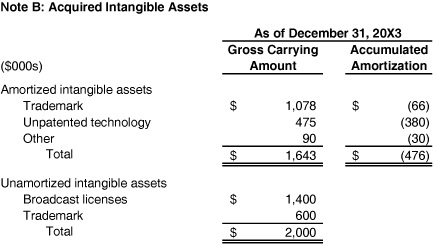 Note B: Acquired Intangible Assets "As of December 31, 20X3" ($000s) Gross Carrying Amount Accumulated Amortization Amortized intangible assets Trademark " $1,078 " $(66) Unpatented technology 475 (380) Other 90 (30) Total " $1,643 " $(476) Unamortized intangible assets Broadcast licenses " $1,400 " Trademark 600 Total " $2,000 "
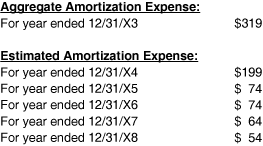 Aggregate Amortization Expense: For year ended 12/31/X3 $319 Estimated Amortization Expense: For year ended 12/31/X4 $199 For year ended 12/31/X5 $74 For year ended 12/31/X6 $74 For year ended 12/31/X7 $64 For year ended 12/31/X8 $54
350-30-65Transition and Open Effective Date Information
Source downloaded: .Record version d3842cd19ed1. Effective date must be checked in the source.
Related subtopics
- 350-10 OverallIntangibles—Goodwill and Other
- 350-20 GoodwillIntangibles—Goodwill and Other
- 805-20 Identifiable Assets and Liabilities, and Any Noncontrolling InterestBusiness Combinations
- 825-10 OverallFinancial Instruments
- 360-10 OverallProperty, Plant, and Equipment
- 410-20 Asset Retirement ObligationsAsset Retirement and Environmental Obligations