ASC 805-944
Financial Services—Insurance
805 Business Combinations
Source downloaded: .Record version c32c113315b4. Effective date must be checked in the source.
ASC 805-944 tells insurance entities how to account for insurance and reinsurance contracts acquired in a business combination and how to account for demutualizations (or formation of a mutual insurance holding entity). Acquired insurance/reinsurance contracts are treated as new contracts, recognized at fair value but split into (a) amounts measured under the acquirer's own insurance accounting policies and (b) an intangible asset (or liability) for the residual, while the acquiree's classification as insurance versus deposit contract is carried forward. A demutualization is not itself a change in ownership requiring a new accounting basis; instead the entity computes a one-time actuarial calculation of maximum future closed-block earnings and records a policyholder dividend obligation whenever cumulative actual closed-block earnings exceed cumulative expected earnings.
Key points (7)
- Insurance and reinsurance contracts acquired in a business combination are considered new contracts for measurement and accounting purposes, but the acquiree's classification as an insurance/reinsurance contract versus a deposit contract is carried forward based on terms at contract inception or last substantive modification (944-805-25-1 through 25-2).
- Fair value of the acquired contractual rights and obligations is recognized in two components: assets and liabilities measured under the acquirer's own insurance accounting policies (excluding the acquiree's deferred acquisition costs and unearned premiums), and an intangible asset or other liability for the difference (944-805-30-1); that intangible is subsequently measured on a basis consistent with the related insurance liability (944-805-35-1 through 35-3).
- A demutualization or formation of a mutual insurance holding entity does not, by itself, constitute a change in ownership requiring a change in historical accounting bases or carrying amounts, and closed block assets continue to be accounted for as before (944-805-25-6 through 25-7).
- Maximum future stockholder earnings from the closed block equal the excess of closed block liabilities over closed block assets, adjusted to remove unrealized amounts in accumulated other comprehensive income, measured at the demutualization date (944-805-25-8 through 25-9).
- A best-estimate actuarial calculation (no provision for adverse deviation) made at the actuarial calculation date is used in all later periods and shall not be revised (944-805-30-3 through 30-4); cumulative actual closed block earnings exceeding cumulative expected earnings are recorded as a policyholder dividend obligation, which may never be negative (944-805-35-5 through 35-12).
- Distributions by a mutual insurance holding entity to its members are accounted for by substance—as policyholder dividends under Subtopic 944-50 unless there are substantive independent third-party stockholders and the three conditions in 944-805-25-13 are met.
- In a distribution-form demutualization all retained earnings are reclassified to capital stock and additional paid-in capital (with cash or policy credits charged directly to those capital accounts), while a subscription-form demutualization causes no such reclassification; direct and incremental demutualization costs are shown as a single line item within income from continuing operations (944-805-45-3 through 45-4).
For students. This is niche insurance-industry guidance, but it illustrates two exam-worthy ideas: acquired insurance contracts are remeasured at fair value yet split into a policy-basis component plus a residual intangible, and a demutualization is a reorganization—not a purchase—so no new basis arises. The most common misunderstanding is thinking the closed block is a separate legal or reporting entity; it is displayed line-by-line with the insurer's other assets and liabilities, and its assets remain subject to the insurer's general creditors.
Machine-generated study aid for ASC 805-944. Check the source paragraphs below.
805-944-00Status
Source downloaded: .Record version 2f115e357422. Effective date must be checked in the source.
805-944-05Overview and Background
Source downloaded: .Record version 7ea40fd3740a. Effective date must be checked in the source.
- aGeneral
- bDemutualizations.
Demutualizations
- aThe demutualization process
- bFormation of a mutual insurance holding entity
- cClosed blocks for certain participating life insurance contracts
- dAlternative mechanisms to closed blocks.
The Demutualization Process
Formation of a Mutual Insurance Holding Entity
Closed Blocks for Certain Participating Life Insurance Contracts
Alternative Mechanisms to Closed Blocks
- aThe contracts covered by the limitation
- bThe profit limitation calculation
- cThe timing and manner (for example, as policy dividends, reduced premiums, or additional benefits) in which amounts that may not be distributed to stockholders are to be distributed to policyholders.
805-944-15Scope and Scope Exceptions
Source downloaded: .Record version 870b820fa7fc. Effective date must be checked in the source.
Overall Guidance
Demutualizations
Transactions
Other Considerations
805-944-25Recognition
Source downloaded: .Record version 9766fdde0032. Effective date must be checked in the source.
Insurance and Reinsurance Contracts Acquired
Demutualizations
Overall
Emergence of Earnings and Policyholder Dividend Obligation
Dividends Payable to Stockholders
Distributions to Members
- aThere is a mechanism to ensure that policyholder dividends are not a component of the mutual insurance holding entity distribution.
- bAll mutual insurance holding entity members are eligible to receive the mutual insurance holding entity distribution and the allocation of the mutual insurance holding entity distribution is consistent with the concept of mutual insurance holding entity membership. Depending on the jurisdiction, the distribution may be based on equity share or equally distributed to each mutual insurance holding entity member.
- cThe distribution is legally characterized as a membership distribution rather than a policyholder distribution.
805-944-30Initial Measurement
Source downloaded: .Record version e4192c61988a. Effective date must be checked in the source.
Insurance and Reinsurance Contracts Acquired
- aAssets and liabilities measured in accordance with the acquirer's accounting policies for insurance and reinsurance contracts that it issues or holds. For example, the contractual assets acquired could include a reinsurance recoverable and the liabilities assumed could include a liability to pay future contract claims and claims expenses on the unexpired portion of the acquired contracts and a liability to pay incurred contract claims and claims expenses. However, those assets acquired and liabilities assumed would not include the acquiree's deferred acquisition costs and unearned premiums that do not represent future cash flows.
- bAn intangible asset (or occasionally another liability), representing the difference between the following:
- 1The fair value of the contractual insurance and reinsurance assets acquired and liabilities assumed
- 2The amount described in (a).
- 1
Demutualizations
Emergence of Earnings and Policyholder Dividend Obligation
805-944-35Subsequent Measurement
Source downloaded: .Record version f2d1fd53795c. Effective date must be checked in the source.
Insurance and Reinsurance Contracts Acquired
Demutualizations
Policyholder Liabilities
Emergence of Earnings and Policyholder Dividend Obligation
Other Considerations
805-944-45Other Presentation Matters
Source downloaded: .Record version bd00de540ff3. Effective date must be checked in the source.
Demutualizations
Closed Block
Emergence of Earnings and Policyholder Dividend Obligation
Expenses of Demutualization or Holding Entity Formation
Date of Demutualization or Holding Entity Formation
805-944-50Disclosure
Source downloaded: .Record version ed5059e36feb. Effective date must be checked in the source.
Demutualizations
- aThe nature and terms of a demutualization or formation of a mutual insurance holding entity
- bThe basis of presentation and terms of operation of the closed block
- cA general description of all of the following:
- 1The method of emergence of earnings from the closed block
- 2Presentation of assets and liabilities of the closed block
- 3The policyholder dividend obligation.
- 1
- aA general description of the closed block, including all of the following:
- 1The purpose of the closed block
- 2The types of insurance policies included
- 3The nature of the cash flows that increase and decrease the amount of closed block assets and liabilities
- 4An indication of the continuing responsibility of the insurance entity to support the payment of contractual benefits, including the results of premium sufficiency or deficiency determined in accordance with paragraphs
- 5The nature of expenses charged to the closed block operations.
- 1
- bSummarized financial data of the closed block as of, or for periods ending on the date of, the financial statements presented, which shall include, at a minimum, all of the following:
- 1The carrying amounts for the major types of invested assets of the closed block
- 2Future policy benefits and policyholders' account balances
- 3Policyholder dividend obligation
- 4Premiums
- 5Net investment income
- 6Realized investment gains and losses
- 7Policyholder benefits
- 8Policyholder dividends
- 9The amount of maximum future earnings remaining to inure to the benefit of stockholders from the assets and liabilities of the closed block
- 10An analysis of the changes in the policyholder dividend obligation.
- 1
805-944-55Implementation Guidance and Illustrations
Source downloaded: .Record version c647d6b4f4c3. Effective date must be checked in the source.
Demutualizations
Implementation Guidance
Illustrations
- At the effective date (January XX, 20X1) of the Plan of Demutualization, eligible policyholders received, in the aggregate, approximately $XX million of cash, $XX million of policy credits, and XX million shares of common stock of ABC Holding Entity in exchange for their membership interests in ABC Life Insurance Entity. The demutualization was accounted for as a reorganization. Accordingly, ABC Life Insurance Entity's retained earnings at the Plan Effective Date (net of the aforementioned cash payments and policy credits, which were charged directly to retained earnings) were reclassified to common stock and capital in excess of par.
- As of January XX, 20X1, ABC Life Insurance Entity established a closed block for the benefit of certain classes of individual participating policies for which ABC Life Insurance Entity had a dividend scale payable in 20X0 and that were in force on January XX, 20X1. Assets were allocated to the closed block in an amount that, together with anticipated revenues from policies included in the closed block, was reasonably expected to be sufficient to support such business, including provision for payment of benefits, certain expenses, and taxes, and for continuation of dividend scales payable in 20X0, assuming experience underlying such scales continues. Assets allocated to the closed block inure solely to the benefit of the holders of the policies included in the closed block and will not revert to the benefit of stockholders of ABC Life Insurance Entity. No reallocation, transfer, borrowing, or lending of assets can be made between the closed block and other portions of ABC Life Insurance Entity's general account, any of its separate accounts, or any affiliate of ABC Life Insurance Entity without the approval of the Z State Insurance Department.
- If, over time, the aggregate performance of the closed block assets and policies is better than was assumed in funding the closed block, dividends to policyholders will be increased. If, over time, the aggregate performance of the closed block assets and policies is less favorable than was assumed in the funding, dividends to policyholders could be reduced.
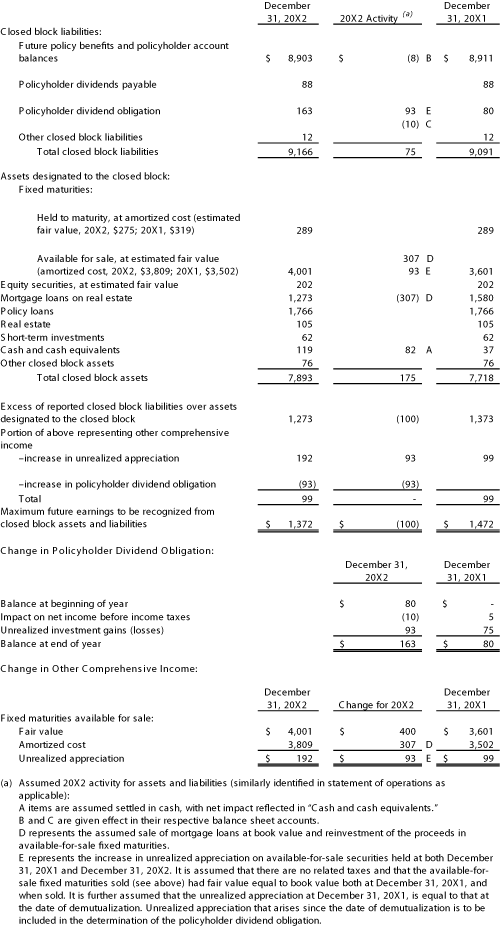
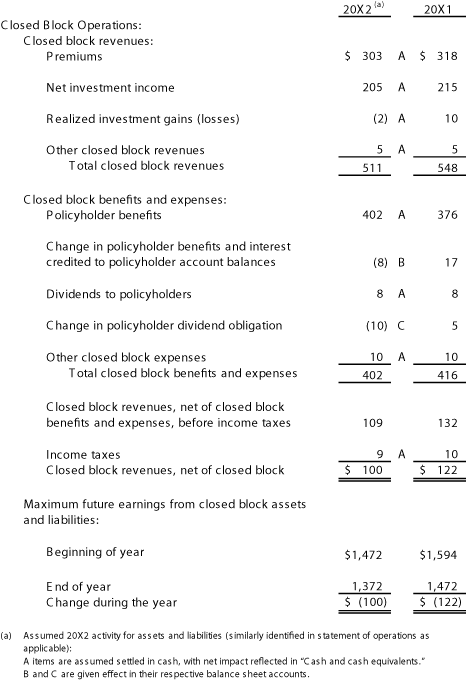
- The assets and liabilities allocated to the closed block are recognized in ABC Life Insurance Entity's financial statements on the same basis as other similar assets and liabilities. The carrying amount of closed block liabilities in excess of the carrying amount of closed block assets at the date of demutualization (adjusted to eliminate the effect of related amounts in accumulated other comprehensive income) represents the maximum future earnings from the assets and liabilities designated to the closed block that can be recognized in income over the period the policies in the closed block remain in force. ABC Life Insurance Entity has developed an actuarial calculation of the timing of such maximum future stockholder earnings, and this is the basis of the policyholder dividend obligation.
- If actual cumulative earnings are greater than expected cumulative earnings, only expected earnings will be recognized in income. Actual cumulative earnings in excess of expected cumulative earnings represents undistributed accumulated earnings attributable to policyholders, which are recognized as a policyholder dividend obligation because the excess will be paid to closed block policyholders as an additional policyholder dividend unless otherwise offset by future performance of the closed block that is less favorable than originally expected. If actual cumulative performance is less favorable than expected, only actual earnings will be recognized in income.
- The principal cash flow items that affect the amount of closed block assets and liabilities are premiums, net investment income, purchases and sales of investments, policyholders' benefits, policyholder dividends, premium taxes, and income taxes. The principal income and expense items excluded from the closed block are management and maintenance expenses, commissions and net investment income, and realized investment gains and losses of investment assets outside the closed block that support the closed block business. The amounts shown in the following tables for assets, liabilities, revenues, and expenses of the closed block are those that enter into the determination of amounts that are to be paid to policyholders.
 "December 31, 20X2" 20X2 Activity (a) "December 31, 20X1" Closed block liabilities: Future policy benefits and policyholder account balances " $8,903 " $(8) B " $8,911 " Policyholder dividends payable 88 88 Policyholder dividend obligation 163 93 E 80 (10) C Other closed block liabilities 12 12 Total closed block liabilities " 9,166 " 75 " 9,091 " Assets designated to the closed block: Fixed maturities: "Held to maturity, at amortized cost (estimated fair value, 20X2, $275; 20X1, $319)" 289 289 "Available for sale, at estimated fair value (amortized cost, 20X2, $3,809; 20X1, $3,502)" " 4,001 " " 307 93 " " D E " " 3,601 " "Equity securities, at estimated fair value" 202 202 Mortgage loans on real estate " 1,273 " (307) D " 1,580 " Policy loans " 1,766 " " 1,766 " Real estate 105 105 Short-term investments 62 62 Cash and cash equivalents 119 82 A 37 Other closed block assets 76 76 Total closed block assets " 7,893 " 175 " 7,718 " Excess of reported closed block liabilities over assets designated to the closed block " 1,273 " (100) " 1,373 " Portion of above representing other comprehensive income -increase in unrealized appreciation 192 93 99 -increase in policyholder dividend obligation (93) (93) Total 99 - 99 Maximum future earnings to be recognized from closed block assets and liabilities " $1,372 " $(100) " $1,472 " Change in Policyholder Dividend Obligation: "December 31, 20X2" "December 31, 20X1" Balance at beginning of year $80 $- Impact on net income before income taxes (10) 5 Unrealized investment gains (losses) 93 75 Balance at end of year $163 $80 Change in Other Comprehensive Income: "December 31, 20X2" Change for 20X2 "December 31, 20X1" Fixed maturities available for sale: Fair value " $4,001 " $400 " $3,601 " Amortized cost " 3,809 " 307 D " 3,502 " Unrealized appreciation $192 $93 E $99 (a) "Assumed 20X2 activity for assets and liabilities (similarly identified in statement of operations as applicable): A items are assumed settled in cash, with net impact reflected in "Cash and cash equivalents." B and C are given effect in their respective balance sheet accounts. D represents the assumed sale of mortgage loans at book value and reinvestment of the proceeds in available-for-sale fixed maturities. E represents the increase in unrealized appreciation on available-for-sale securities held at both December 31, 20X1 and December 31, 20X2. It is assumed that there are no related taxes and that the available-for-sale fixed maturities sold (see above) had fair value equal to book value both at December 31, 20X1, and when sold. It is further assumed that the unrealized appreciation at December 31, 20X1, is equal to that at the date of demutualization. Unrealized appreciation that arises since the date of demutualization is to be included in the determination of the policyholder dividend obligation."
 20X2(a) 20X1 Closed Block Operations: Closed block revenues: Premiums $303 A $318 Net investment income 205 A 215 Realized investment gains (losses) (2) A 10 Other closed block revenues 5 A 5 Total closed block revenues 511 548 Closed block benefits and expenses: Policyholder benefits 402 A 376 Change in policyholder benefits and interest credited to policyholder account balances (8) B 17 Dividends to policyholders 8 A 8 Change in policyholder dividend obligation (10) C 5 Other closed block expenses 10 A 10 Total closed block benefits and expenses 402 416 "Closed block revenues, net of closed block benefits and expenses, before income taxes" 109 132 Income taxes 9 A 10 "Closed block revenues, net of closed block benefits and expenses and income taxes" $100 $122 Maximum future earnings from closed block assets and liabilities: Beginning of year " $1,472 " " $1,594 " End of year " 1,372 " " 1,472 " Change during the year $(100) $(122) (a) "Assumed 20X2 activity for assets and liabilities (similarly identified in statement of operations as applicable): A items are assumed settled in cash, with net impact reflected in "Cash and cash equivalents." B and C are given effect in their respective balance sheet accounts."
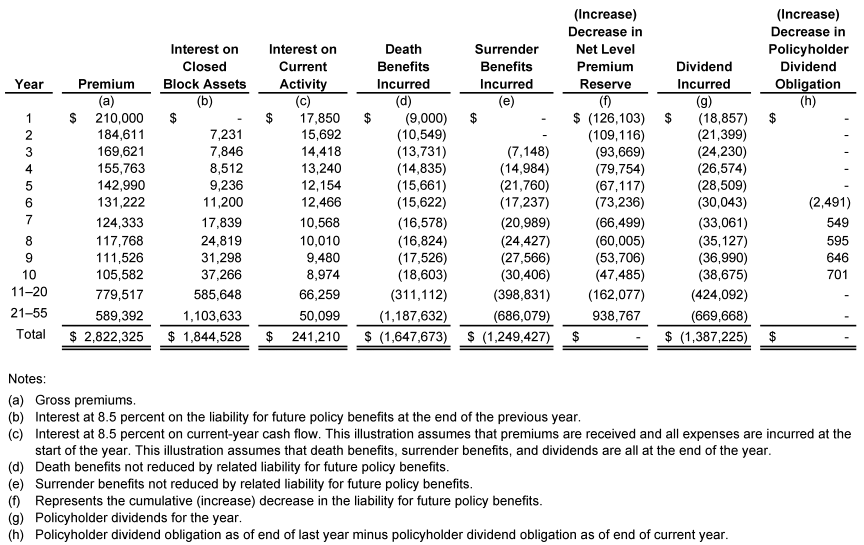
- aDetermining the amount of the policyholder dividend obligation
- b
- c
 Year Premium Interest on Closed Block Assets Interest on Current Activity Death Benefits Incurred Surrender Benefits Incurred (Increase) Decrease in Net Level Premium Reserve Dividend Incurred (Increase) Decrease in Policyholder Dividend Obligation (a) (b) (c) (d) (e) (f) (g) (h) 1 " $210,000 " $- " $17,850 " " $(9,000)" $- " $(126,103)" " $(18,857)" $- 2 " 184,611 " " 7,231 " " 15,692 " " (10,549)" - " (109,116)" " (21,399)" - 3 " 169,621 " " 7,846 " " 14,418 " " (13,731)" " (7,148)" " (93,669)" " (24,230)" - 4 " 155,763 " " 8,512 " " 13,240 " " (14,835)" " (14,984)" " (79,754)" " (26,574)" - 5 " 142,990 " " 9,236 " " 12,154 " " (15,661)" " (21,760)" " (67,117)" " (28,509)" - 6 " 131,222 " " 11,200 " " 12,466 " " (15,622)" " (17,237)" " (73,236)" " (30,043)" " (2,491)" 7 " 124,333 " " 17,839 " " 10,568 " " (16,578)" " (20,989)" " (66,499)" " (33,061)" 549 8 " 117,768 " " 24,819 " " 10,010 " " (16,824)" " (24,427)" " (60,005)" " (35,127)" 595 9 " 111,526 " " 31,298 " " 9,480 " " (17,526)" " (27,566)" " (53,706)" " (36,990)" 646 10 " 105,582 " " 37,266 " " 8,974 " " (18,603)" " (30,406)" " (47,485)" " (38,675)" 701 11-20 " 779,517 " " 585,648 " " 66,259 " " (311,112)" " (398,831)" " (162,077)" " (424,092)" - 21-55 " 589,392 " " 1,103,633 " " 50,099 " " (1,187,632)" " (686,079)" " 938,767 " " (669,668)" - Total " $2,822,325 " " $1,844,528 " " $241,210 " " $(1,647,673)" " $(1,249,427)" $- " $(1,387,225)" $- Notes: (a) Gross premiums. (b) Interest at 8.5 percent on the liability for future policy benefits at the end of the previous year. (c) "Interest at 8.5 percent on current-year cash flow. This illustration assumes that premiums are received and all expenses are incurred at the start of the year. This illustration assumes that death benefits, surrender benefits, and dividends are all at the end of the year." (d) Death benefits not reduced by related liability for future policy benefits. (e) Surrender benefits not reduced by related liability for future policy benefits. (f) Represents the cumulative (increase) decrease in the liability for future policy benefits. (g) Policyholder dividends for the year. (h) Policyholder dividend obligation as of end of last year minus policyholder dividend obligation as of end of current year.
 Actual as of Measurement Date " $18,750 " - Initial Actuarial Calculation " $16,259 " = Policyholder Dividend Obligation at Measurement Date " $2,491 "
805-944-S25RecognitionSEC
Source downloaded: .Record version c9dcd436c823. Effective date must be checked in the source.
Accounting by the Purchaser for a Seller's Guarantee of the Adequacy of Liabilities for Losses and Loss Adjustment Expenses Acquired in a Purchase Business Combination
805-944-S99SEC MaterialsSEC
Source downloaded: .Record version b287d2d12447. Effective date must be checked in the source.
SEC Staff Guidance
- The SEC staff believes it is preferable to present the effects of the loss guarantee on a gross rather than net basis. Any receivable from the seller should not be netted against the related liability in the balance sheet or in supporting information such as footnotes or SEC Industry Guide 6 disclosures. The SEC staff also expressed a preference that (1) any expense associated with increased reserves be reported as a component of other claim losses and loss adjustment expenses and (2) other claim losses and loss adjustment expenses not be reduced by the effect of the reserve guarantee.
- The SEC staff would not object to claim losses and loss adjustment expenses being reported net of the effect of the reserve guarantee in the income statement. A net presentation is appropriate only if the effects of the reserve guarantee are disclosed separately in the notes to the financial statements, in the SEC Industry Guide 6 disclosures including the reconciliation of claims reserves, and in the loss ratio information.
Related subtopics
- 605-944 Financial Services—InsuranceRevenue Recognition
- 944-80 Separate AccountsFinancial Services—Insurance
- 944-40 Claim Costs and Liabilities for Future Policy BenefitsFinancial Services—Insurance
- 325-30 Investments in Insurance ContractsInvestments—Other
- 405-30 Insurance-Related AssessmentsLiabilities
- 340-30 Insurance Contracts That Do Not Transfer Insurance RiskOther Assets and Deferred Costs